
Prof. Wallerstein Memorial Lecture Mahatma Gandhi
NS
Published · 17 slides · 0 views

1 / 1



Description
Prof. Wallerstein Memorial Lecture Mahatma Gandhi University, Kottayam, 09.12.2024 Challenges of Keralas Social Democratic-Oriented Development in Comparative Perspective. Olle Törnquist Professor emeritus of Politics and Development,
Related Topics
Share
Embed code
Download this presentation From Below
"Prof. Wallerstein Memorial Lecture Mahatma Gandhi" is the property of its rightful owner. Permission is granted to download and print the materials on this website for personal, non-commercial use only, and to display it on your personal computer provided you do not modify the materials and that you retain all copyright notices contained in the materials. By downloading content from our website, you accept the terms of this agreement.
Presentation Transcript
01
Prof. Wallerstein Memorial Lecture
Mahatma Gandhi University, Kottayam, 09.12.2024
Challenges of Kerala’s Social Democratic-Oriented Development in Comparative Perspective. Olle Törnquist
Professor emeritus of Politics and Development, University of Oslo
https://olle-tornquist.com 1<br>
Professor emeritus of Politics and Development, University of Oslo
https://olle-tornquist.com 1<br>
02
In honour of Prof. Wallerstein, let me begin (and later on also conclude) on the global level Exploitation, wars and climate change are certainly the major ‘world-system’ crises, But if modernity (in terms of development based on trustworthy knowledge), liberal rights and democracy are fundamental for change, conservative nationalism is the current main enemy.
This is not just about Putin et al. in my part of the world. It’s a global tendency, including in India. So Putin can not be fought only by resisting his invasion of Ukraine. He, and others of his kind, must be fought internationally, just as colonialism was.
In addition, conservative nationalism is not something that can be fought by defending the aging western liberal world order. Because it is to some extent part of what has caused the debacle. 2<br>
This is not just about Putin et al. in my part of the world. It’s a global tendency, including in India. So Putin can not be fought only by resisting his invasion of Ukraine. He, and others of his kind, must be fought internationally, just as colonialism was.
In addition, conservative nationalism is not something that can be fought by defending the aging western liberal world order. Because it is to some extent part of what has caused the debacle. 2<br>
03
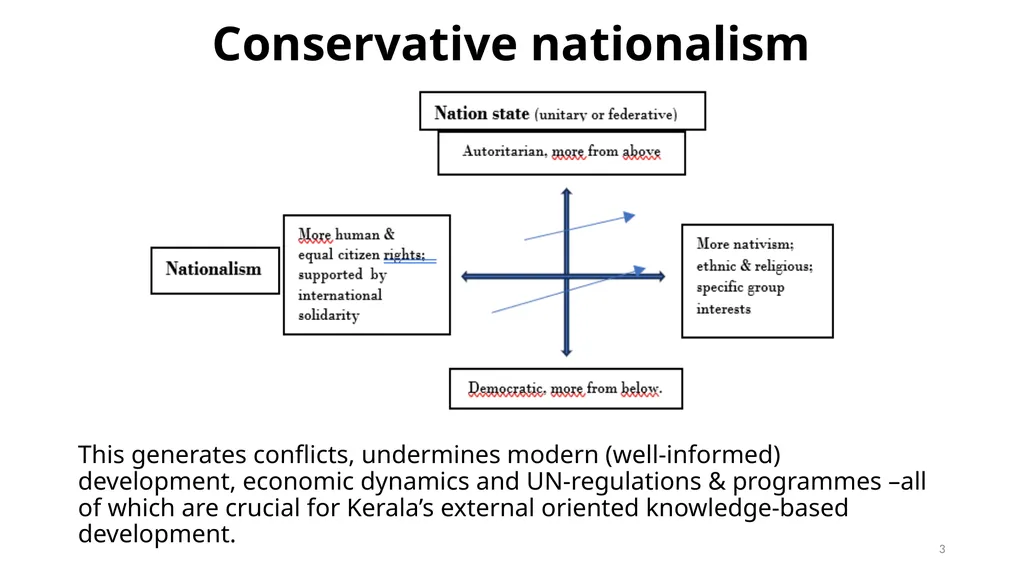
Conservative nationalism This generates conflicts, undermines modern (well-informed) development, economic dynamics and UN-regulations & programmes –all of which are crucial for Kerala’s external oriented knowledge-based development. 3<br>
04
Conservative nationalism gained ground in frustration over global neoliberalism, elite-democracy & undermined progressive alternatives. 4<br>
05
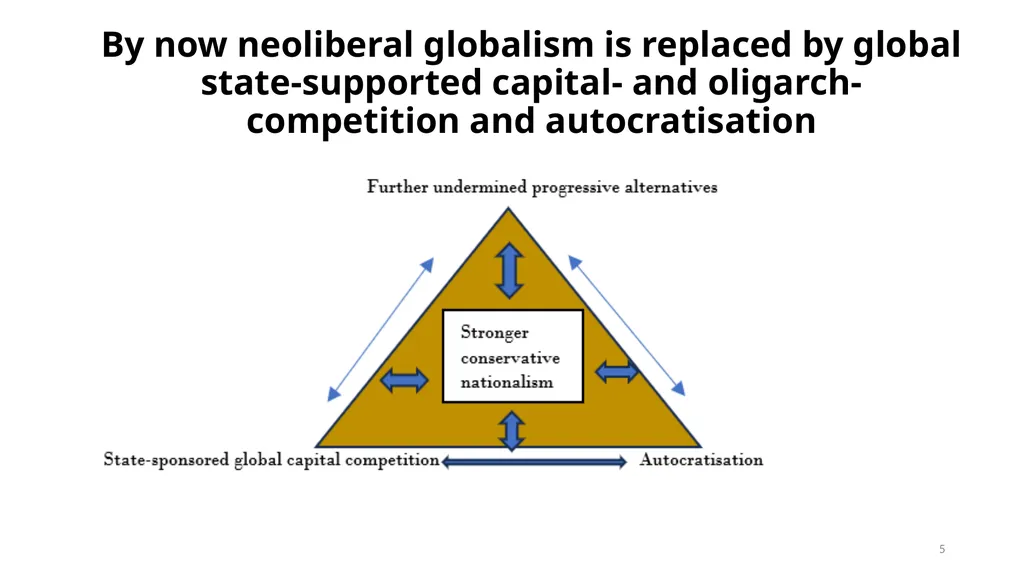
By now neoliberal globalism is replaced by global state-supported capital- and oligarch-competition and autocratisation 5<br>
06
As the western liberal world order is therefore part of the problem, a counter-movement presupposes reinvention of the undermined progressive alternatives. Especially the fundamentals of social-democratic politics
– broadly defined, beyond party labels, as –
gradual socio-economic development based on social justice with liberal democratic means. 6<br>
07
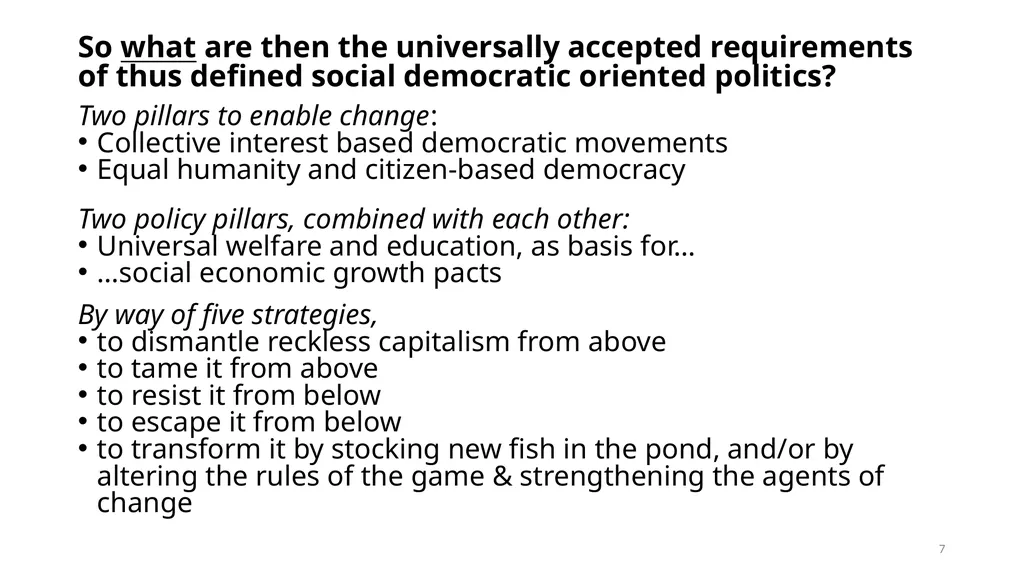
So what are then the universally accepted requirements of thus defined social democratic oriented politics?
Two pillars to enable change:
Collective interest based democratic movements
Equal humanity and citizen-based democracy
Two policy pillars, combined with each other:
Universal welfare and education, as basis for…
…social economic growth pacts
By way of five strategies,
to dismantle reckless capitalism from above
to tame it from above
to resist it from below
to escape it from below
to transform it by stocking new fish in the pond, and/or by altering the rules of the game & strengthening the agents of change 7<br>
Two pillars to enable change:
Collective interest based democratic movements
Equal humanity and citizen-based democracy
Two policy pillars, combined with each other:
Universal welfare and education, as basis for…
…social economic growth pacts
By way of five strategies,
to dismantle reckless capitalism from above
to tame it from above
to resist it from below
to escape it from below
to transform it by stocking new fish in the pond, and/or by altering the rules of the game & strengthening the agents of change 7<br>
08
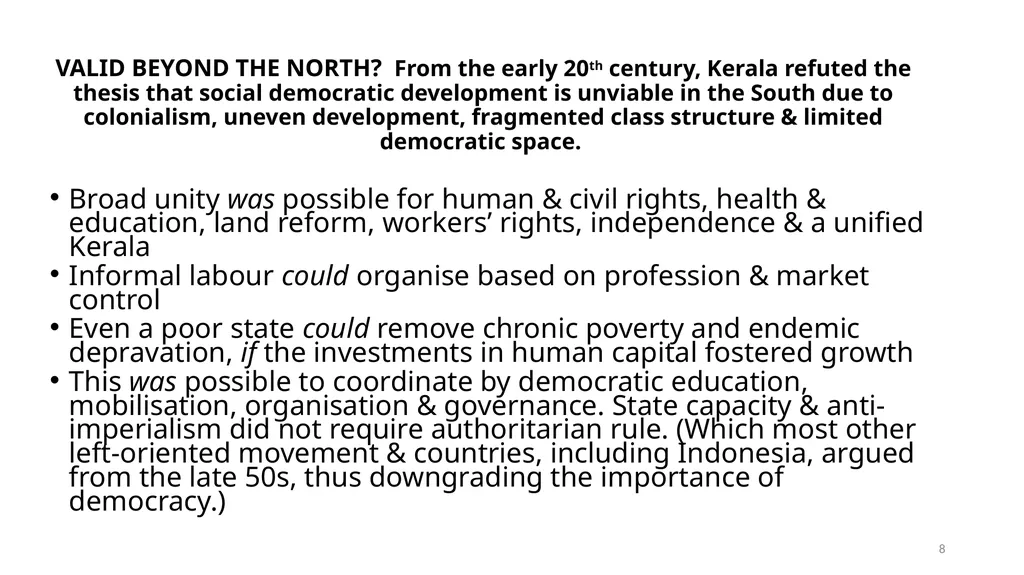
VALID BEYOND THE NORTH? From the early 20th century, Kerala refuted the thesis that social democratic development is unviable in the South due to colonialism, uneven development, fragmented class structure & limited democratic space. Broad unity was possible for human & civil rights, health & education, land reform, workers’ rights, independence & a unified Kerala
Informal labour could organise based on profession & market control
Even a poor state could remove chronic poverty and endemic depravation, if the investments in human capital fostered growth
This was possible to coordinate by democratic education, mobilisation, organisation & governance. State capacity & anti-imperialism did not require authoritarian rule. (Which most other left-oriented movement & countries, including Indonesia, argued from the late 50s, thus downgrading the importance of democracy.) 8<br>
Informal labour could organise based on profession & market control
Even a poor state could remove chronic poverty and endemic depravation, if the investments in human capital fostered growth
This was possible to coordinate by democratic education, mobilisation, organisation & governance. State capacity & anti-imperialism did not require authoritarian rule. (Which most other left-oriented movement & countries, including Indonesia, argued from the late 50s, thus downgrading the importance of democracy.) 8<br>
09
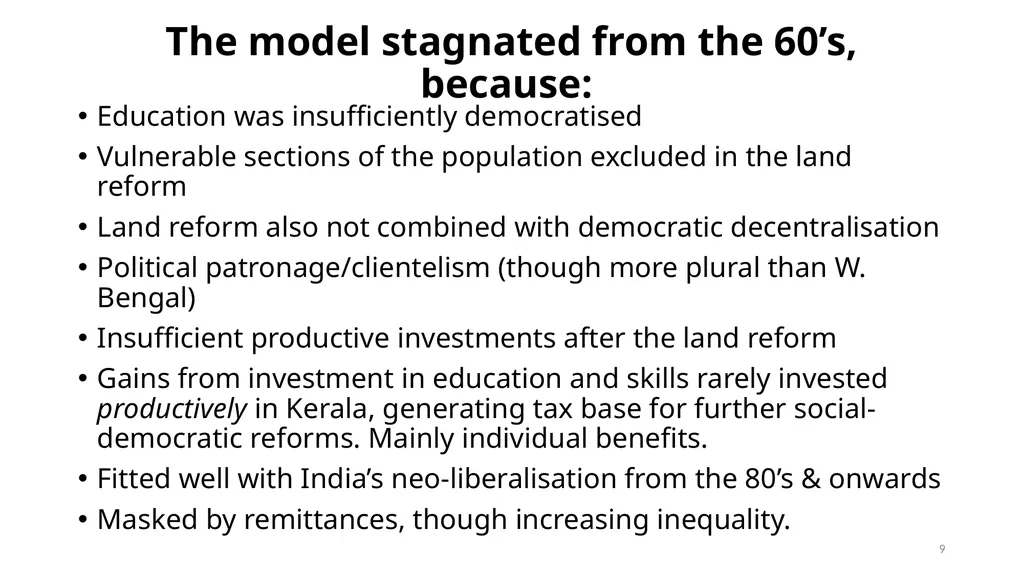
The model stagnated from the 60’s, because: Education was insufficiently democratised
Vulnerable sections of the population excluded in the land reform
Land reform also not combined with democratic decentralisation
Political patronage/clientelism (though more plural than W. Bengal)
Insufficient productive investments after the land reform
Gains from investment in education and skills rarely invested productively in Kerala, generating tax base for further social-democratic reforms. Mainly individual benefits.
Fitted well with India’s neo-liberalisation from the 80’s & onwards
Masked by remittances, though increasing inequality. 9<br>
Vulnerable sections of the population excluded in the land reform
Land reform also not combined with democratic decentralisation
Political patronage/clientelism (though more plural than W. Bengal)
Insufficient productive investments after the land reform
Gains from investment in education and skills rarely invested productively in Kerala, generating tax base for further social-democratic reforms. Mainly individual benefits.
Fitted well with India’s neo-liberalisation from the 80’s & onwards
Masked by remittances, though increasing inequality. 9<br>
10
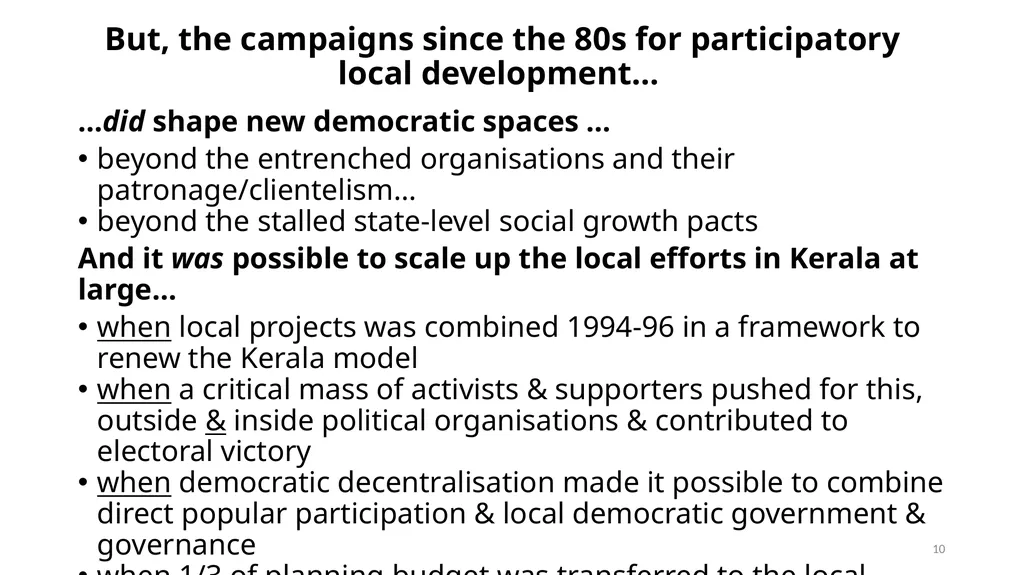
But, the campaigns since the 80s for participatory local development… …did shape new democratic spaces …
beyond the entrenched organisations and their patronage/clientelism…
beyond the stalled state-level social growth pacts
And it was possible to scale up the local efforts in Kerala at large…
when local projects was combined 1994-96 in a framework to renew the Kerala model
when a critical mass of activists & supporters pushed for this, outside & inside political organisations & contributed to electoral victory
when democratic decentralisation made it possible to combine direct popular participation & local democratic government & governance
when 1/3 of planning budget was transferred to the local institutions
when SPB could direct this in favour of participatory development 10<br>
beyond the entrenched organisations and their patronage/clientelism…
beyond the stalled state-level social growth pacts
And it was possible to scale up the local efforts in Kerala at large…
when local projects was combined 1994-96 in a framework to renew the Kerala model
when a critical mass of activists & supporters pushed for this, outside & inside political organisations & contributed to electoral victory
when democratic decentralisation made it possible to combine direct popular participation & local democratic government & governance
when 1/3 of planning budget was transferred to the local institutions
when SPB could direct this in favour of participatory development 10<br>
11
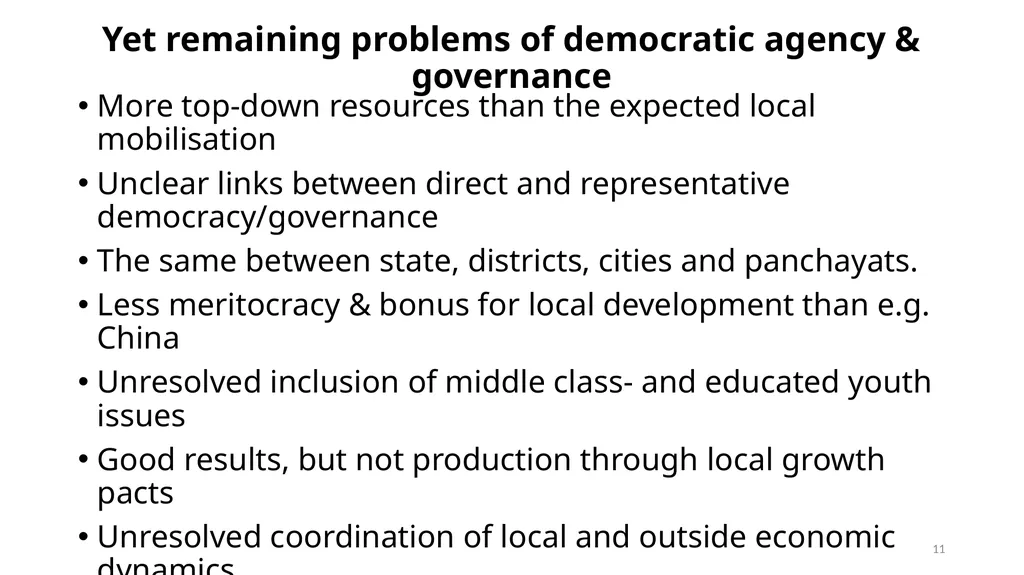
Yet remaining problems of democratic agency & governance More top-down resources than the expected local mobilisation
Unclear links between direct and representative democracy/governance
The same between state, districts, cities and panchayats.
Less meritocracy & bonus for local development than e.g. China
Unresolved inclusion of middle class- and educated youth issues
Good results, but not production through local growth pacts
Unresolved coordination of local and outside economic dynamics
Unresolved inclusion of “old” interest- and political organisations. In the end, political-party-hijacking in face of 2000/01 election. 11<br>
Unclear links between direct and representative democracy/governance
The same between state, districts, cities and panchayats.
Less meritocracy & bonus for local development than e.g. China
Unresolved inclusion of middle class- and educated youth issues
Good results, but not production through local growth pacts
Unresolved coordination of local and outside economic dynamics
Unresolved inclusion of “old” interest- and political organisations. In the end, political-party-hijacking in face of 2000/01 election. 11<br>
12
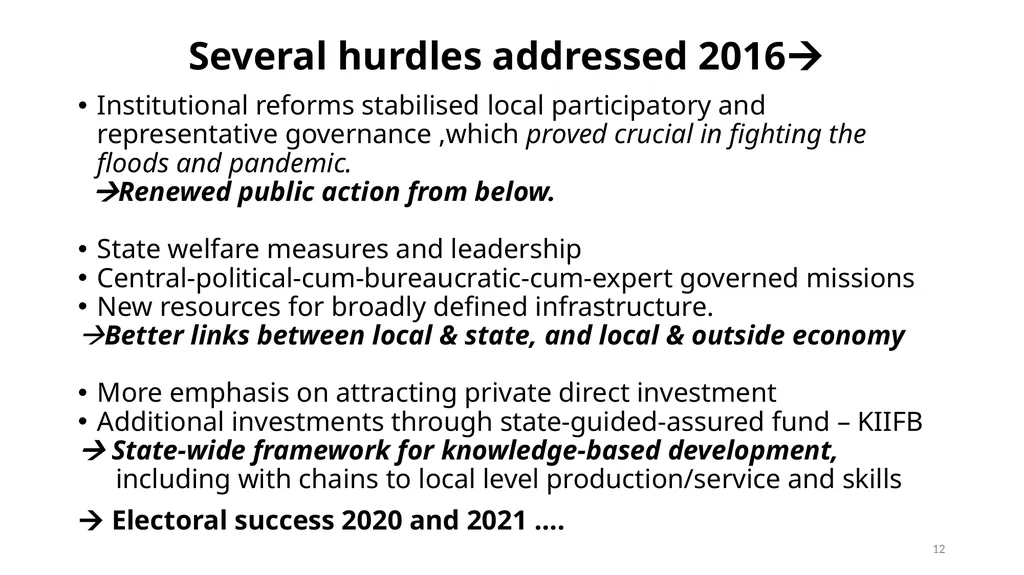
Several hurdles addressed 2016 Institutional reforms stabilised local participatory and representative governance ,which proved crucial in fighting the floods and pandemic.
Renewed public action from below.
State welfare measures and leadership
Central-political-cum-bureaucratic-cum-expert governed missions
New resources for broadly defined infrastructure.
Better links between local & state, and local & outside economy
More emphasis on attracting private direct investment
Additional investments through state-guided-assured fund – KIIFB
State-wide framework for knowledge-based development, including with chains to local level production/service and skills
Electoral success 2020 and 2021 …. 12<br>
Renewed public action from below.
State welfare measures and leadership
Central-political-cum-bureaucratic-cum-expert governed missions
New resources for broadly defined infrastructure.
Better links between local & state, and local & outside economy
More emphasis on attracting private direct investment
Additional investments through state-guided-assured fund – KIIFB
State-wide framework for knowledge-based development, including with chains to local level production/service and skills
Electoral success 2020 and 2021 …. 12<br>
13
..BUT, the new public action was not sustained & sufficiently connected with the efforts at knowledge-based development, which lost steam too. So, the dynamics from 1994-2000 was not reinvented Can there be a new critical mass for programmes?
Can direct & representative democracy & governance, be better combined in linkages between
(a) state & local, and
(b) public & private investments?
Are there alternative ways of overcoming the fiscal crunch? 13<br>
Can direct & representative democracy & governance, be better combined in linkages between
(a) state & local, and
(b) public & private investments?
Are there alternative ways of overcoming the fiscal crunch? 13<br>
14
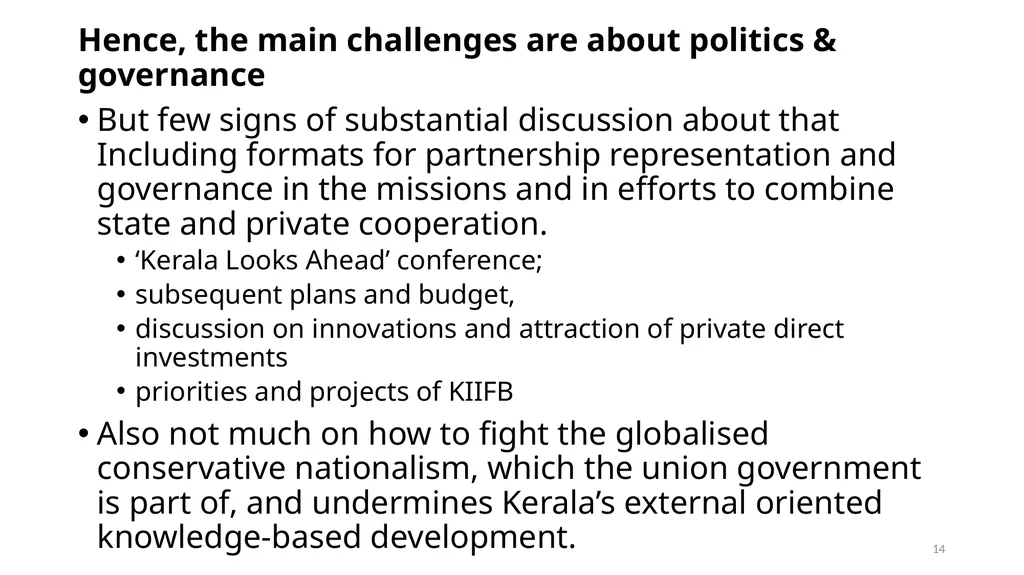
Hence, the main challenges are about politics & governance
But few signs of substantial discussion about that Including formats for partnership representation and governance in the missions and in efforts to combine state and private cooperation.
‘Kerala Looks Ahead’ conference;
subsequent plans and budget,
discussion on innovations and attraction of private direct investments
priorities and projects of KIIFB
Also not much on how to fight the globalised conservative nationalism, which the union government is part of, and undermines Kerala’s external oriented knowledge-based development. 14<br>
But few signs of substantial discussion about that Including formats for partnership representation and governance in the missions and in efforts to combine state and private cooperation.
‘Kerala Looks Ahead’ conference;
subsequent plans and budget,
discussion on innovations and attraction of private direct investments
priorities and projects of KIIFB
Also not much on how to fight the globalised conservative nationalism, which the union government is part of, and undermines Kerala’s external oriented knowledge-based development. 14<br>
15
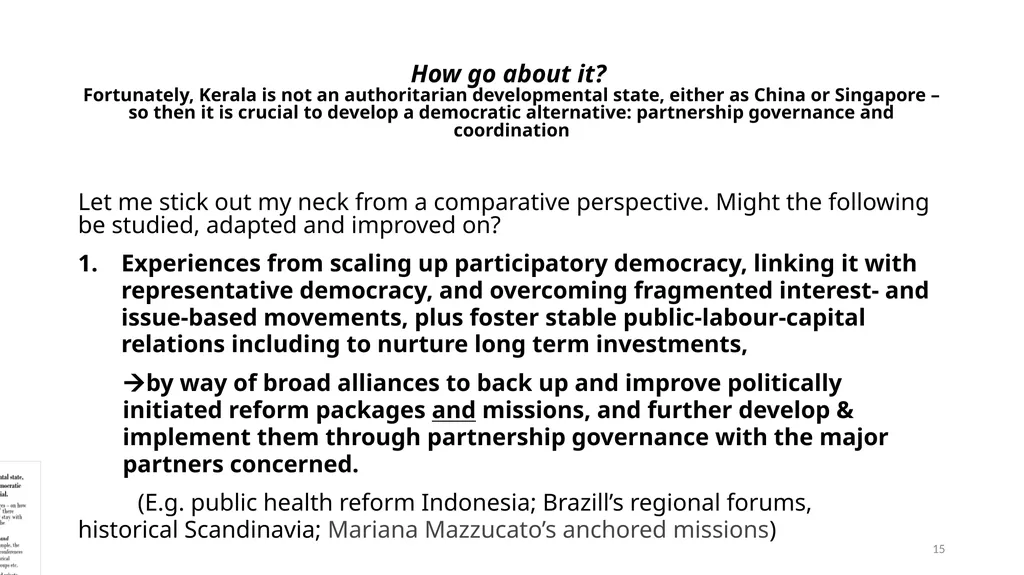
How go about it?
Fortunately, Kerala is not an authoritarian developmental state, either as China or Singapore – so then it is crucial to develop a democratic alternative: partnership governance and coordination Let me stick out my neck from a comparative perspective. Might the following be studied, adapted and improved on?
Experiences from scaling up participatory democracy, linking it with representative democracy, and overcoming fragmented interest- and issue-based movements, plus foster stable public-labour-capital relations including to nurture long term investments,
by way of broad alliances to back up and improve politically initiated reform packages and missions, and further develop & implement them through partnership governance with the major partners concerned.
(E.g. public health reform Indonesia; Brazill’s regional forums, historical Scandinavia; Mariana Mazzucato’s anchored missions) 15<br>
Experiences from scaling up participatory democracy, linking it with representative democracy, and overcoming fragmented interest- and issue-based movements, plus foster stable public-labour-capital relations including to nurture long term investments,
by way of broad alliances to back up and improve politically initiated reform packages and missions, and further develop & implement them through partnership governance with the major partners concerned.
(E.g. public health reform Indonesia; Brazill’s regional forums, historical Scandinavia; Mariana Mazzucato’s anchored missions) 15<br>
16
2. Experiences from facilitation of employee-owned & managed firms (& reinvented co-operatives) in strategic sectors for sustainable growth?
Staff with human capital hire capital, instead of capital hiring employees. With the firms and forthcoming returns as collateral for loans & investments. Thus possible to lend capital without constitutional hindrances, stimulate investment, democratise the economy, and increase labour’s share of “profits”.
3. Experiences from compensating for the shrinking tax base by obliging the facilitated firms to contribute to funds for common & societal purposes – (with broader stakeholder representation) 16<br>
Staff with human capital hire capital, instead of capital hiring employees. With the firms and forthcoming returns as collateral for loans & investments. Thus possible to lend capital without constitutional hindrances, stimulate investment, democratise the economy, and increase labour’s share of “profits”.
3. Experiences from compensating for the shrinking tax base by obliging the facilitated firms to contribute to funds for common & societal purposes – (with broader stakeholder representation) 16<br>
17
4. Share insights about these possibilities by international Kerala workshops toward policy package proposals for public discourse & and possible engagement by a ”critical mass”.
5. Foster international cooperation on social rights- and democracy-based investments in mission driven strategic sectors (including green technology) – as an economic and visionary alternative to the current state-supported global capital- and oligarch-competition, along with autocratisation, that make conservative nationalism even stronger.
Perhaps within the framework of new non-alignment- internationalism and the UN, suggested by Lula’s Brazil, Latin American partners et al. – in the spirit of Prof. Wallerstein.
Thanks for your attention! 17<br>