Professional Ethics Chapter 4 Learning Objective 1
Description: Professional Ethics Chapter 4 Learning Objective 1 Distinguish ethical from unethical behavior in personal and professional contexts. What are Ethics? Ethics can be defined broadly as a set of moral principles or values. Each of us has such
Related Topics
Download Presentation
"Professional Ethics Chapter 4 Learning Objective 1" is the property of its rightful owner. Permission is granted to download and print the materials on this website for personal, non-commercial use only, and to display it on your personal computer provided you do not modify the materials and that you retain all copyright notices contained in the materials. By downloading content from our website, you accept the terms of this agreement.
Presentation Transcript
slide1. Professional Ethics Chapter 4<br>
slide2. Learning Objective 1 Distinguish ethical from
unethical behavior
in personal and
professional contexts.<br>
slide3. What are Ethics? Ethics can be defined broadly as
a set of moral principles or values. Each of us has such a set of values. We may or may not have
considered them explicitly.<br>
slide4. Need for Ethics Ethical behavior is necessary for a society
to function in an orderly manner. The need for ethics in society is sufficiently
important that many commonly held ethical
values are incorporated into laws.<br>
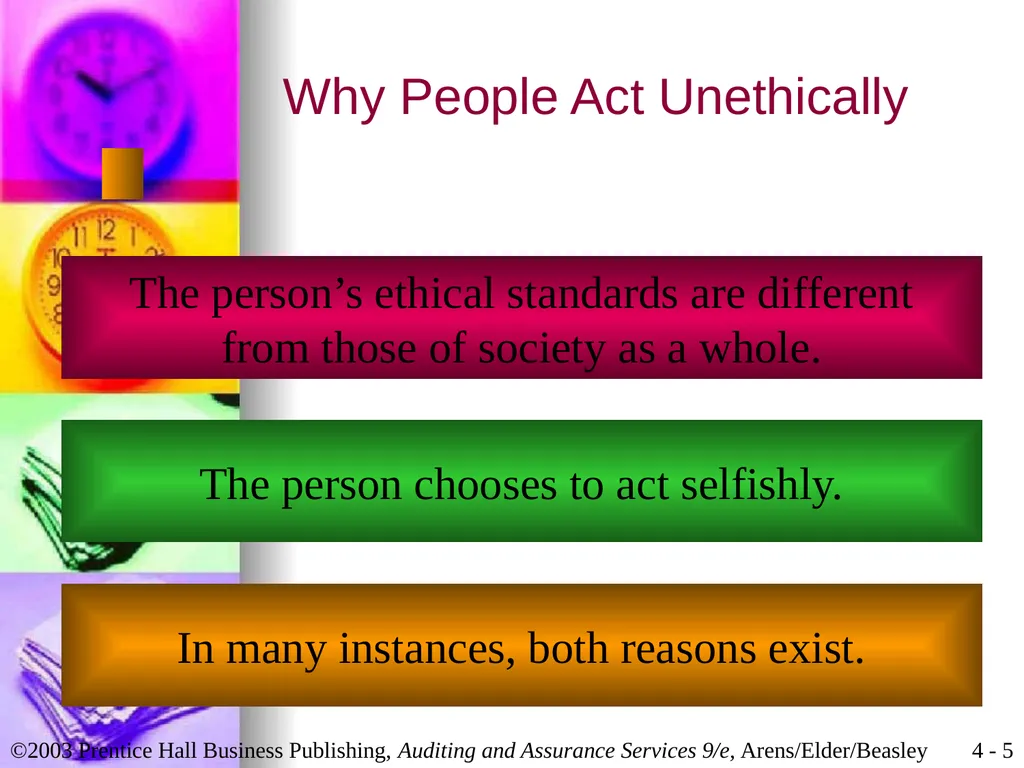
slide5. Why People Act Unethically The person’s ethical standards are different
from those of society as a whole. The person chooses to act selfishly. In many instances, both reasons exist.<br>
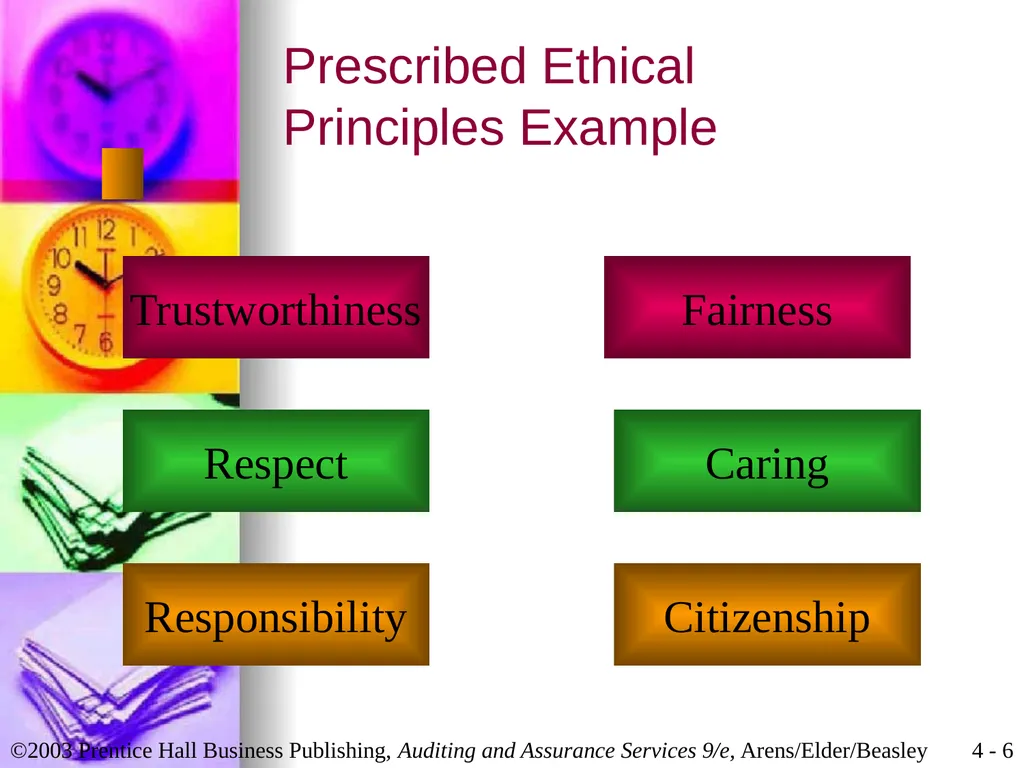
slide6. Prescribed EthicalPrinciples Example Trustworthiness Respect Fairness Responsibility Caring Citizenship<br>
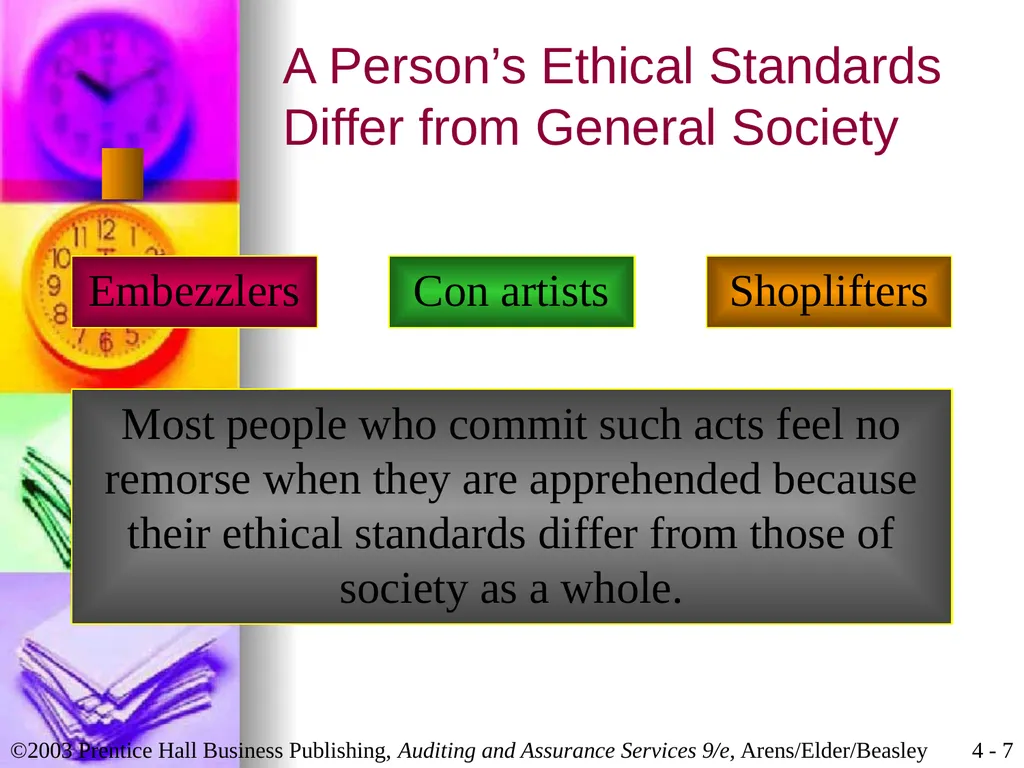
slide7. A Person’s Ethical StandardsDiffer from General Society Embezzlers Con artists Shoplifters Most people who commit such acts feel no
remorse when they are apprehended because
their ethical standards differ from those of
society as a whole.<br>
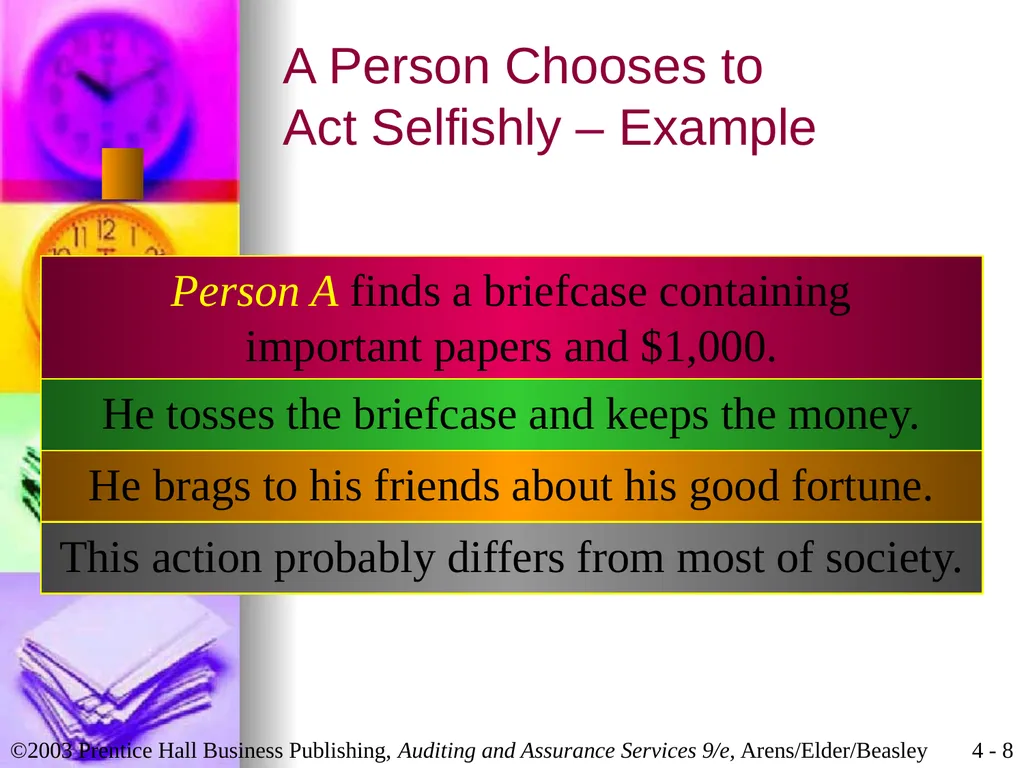
slide8. A Person Chooses toAct Selfishly – Example Person A finds a briefcase containing
important papers and $1,000. He tosses the briefcase and keeps the money. He brags to his friends about his good fortune. This action probably differs from most of society.<br>
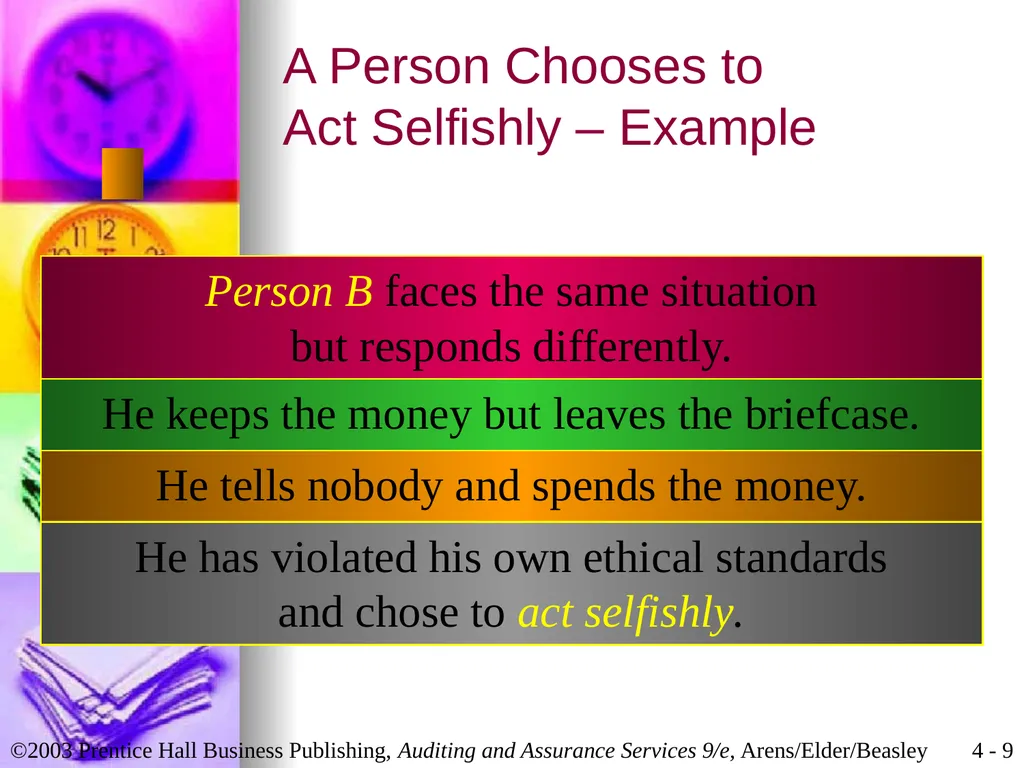
slide9. A Person Chooses toAct Selfishly – Example Person B faces the same situation
but responds differently. He keeps the money but leaves the briefcase. He tells nobody and spends the money. He has violated his own ethical standards
and chose to act selfishly.<br>
slide10. Learning Objective 2 Resolve ethical dilemmas
using an ethical
framework.<br>
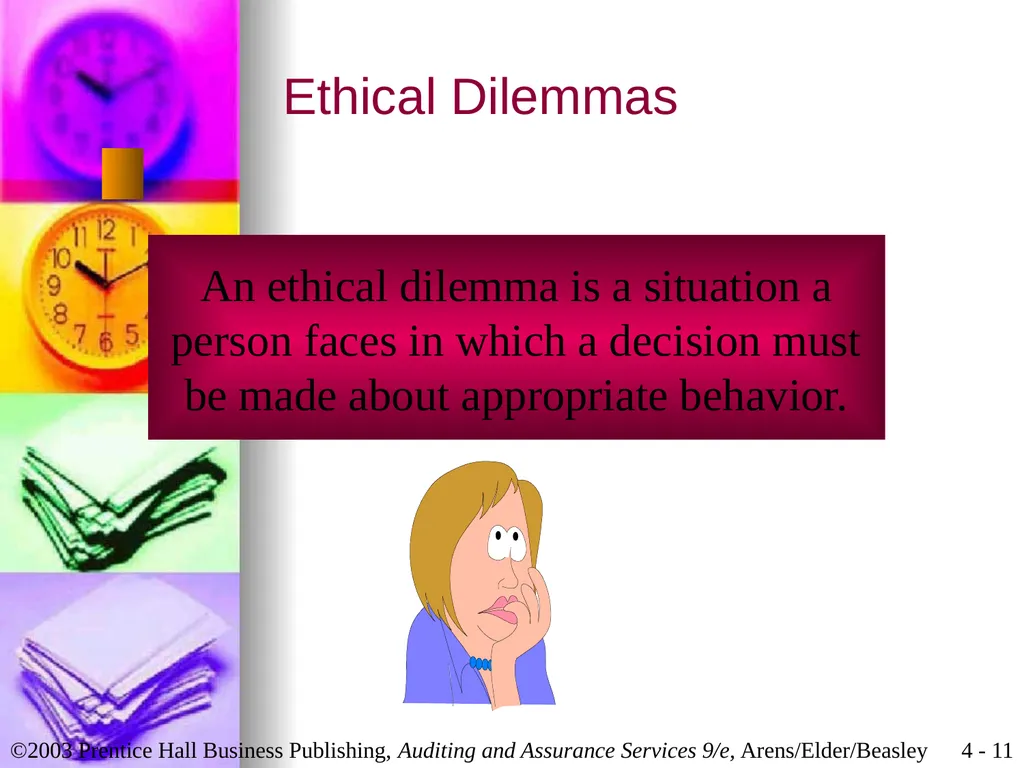
slide11. Ethical Dilemmas An ethical dilemma is a situation a
person faces in which a decision must
be made about appropriate behavior.<br>
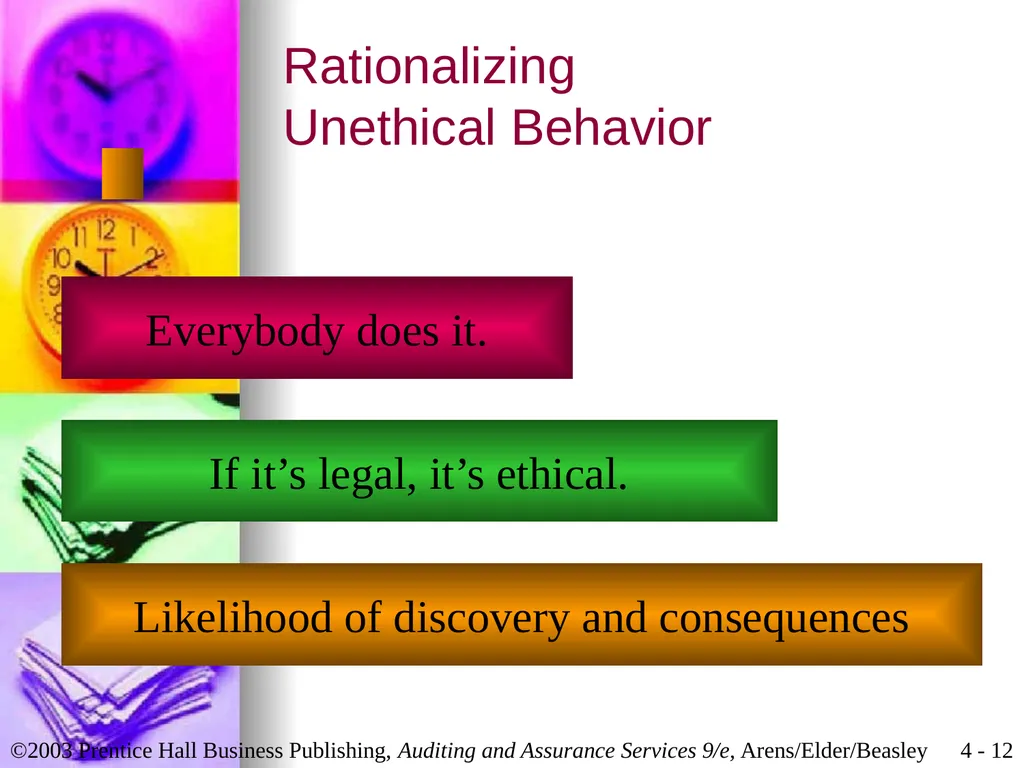
slide12. RationalizingUnethical Behavior Everybody does it. If it’s legal, it’s ethical. Likelihood of discovery and consequences<br>
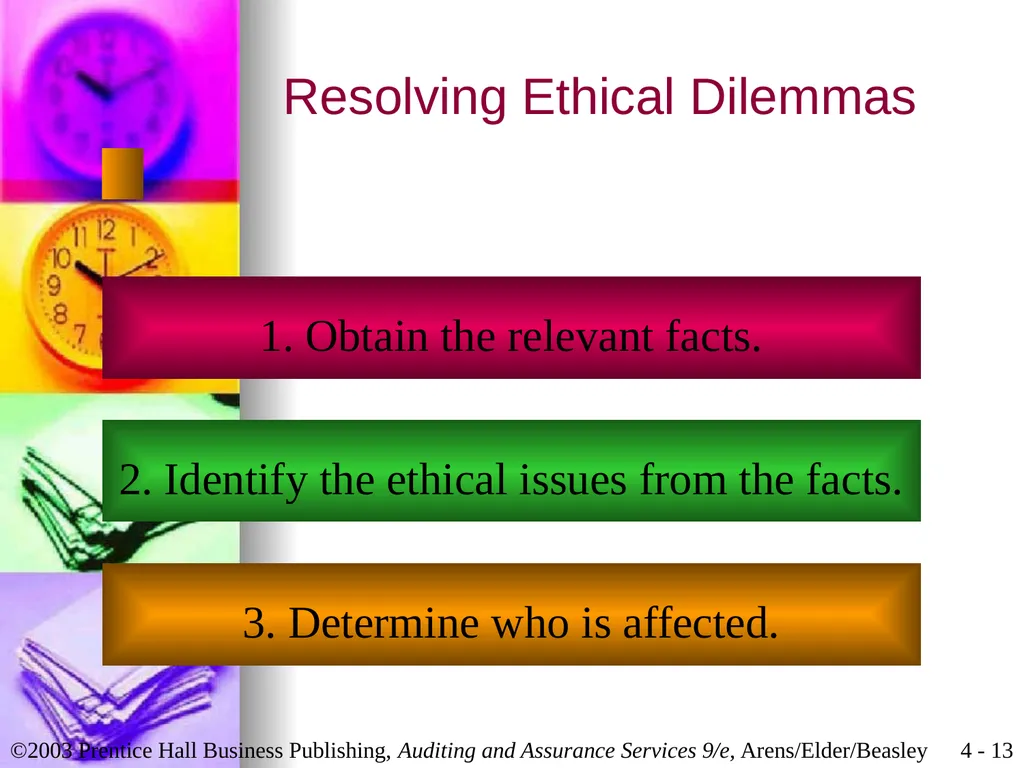
slide13. Resolving Ethical Dilemmas 1. Obtain the relevant facts. 2. Identify the ethical issues from the facts. 3. Determine who is affected.<br>
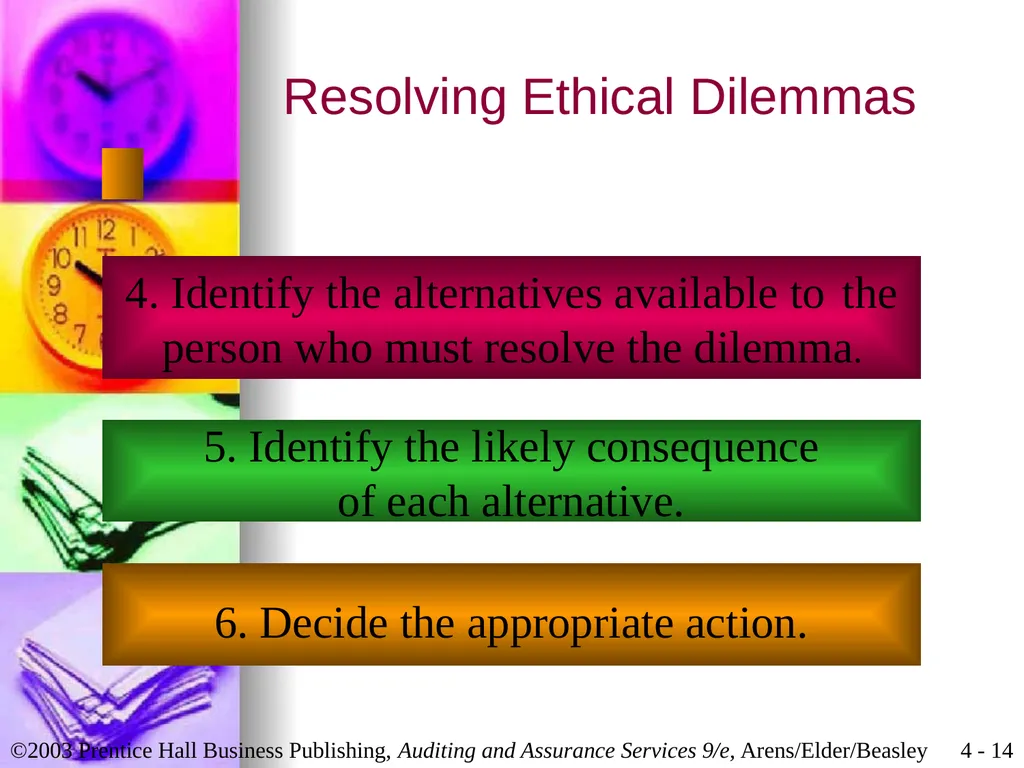
slide14. Resolving Ethical Dilemmas 4. Identify the alternatives available to the
person who must resolve the dilemma. 5. Identify the likely consequence
of each alternative. 6. Decide the appropriate action.<br>
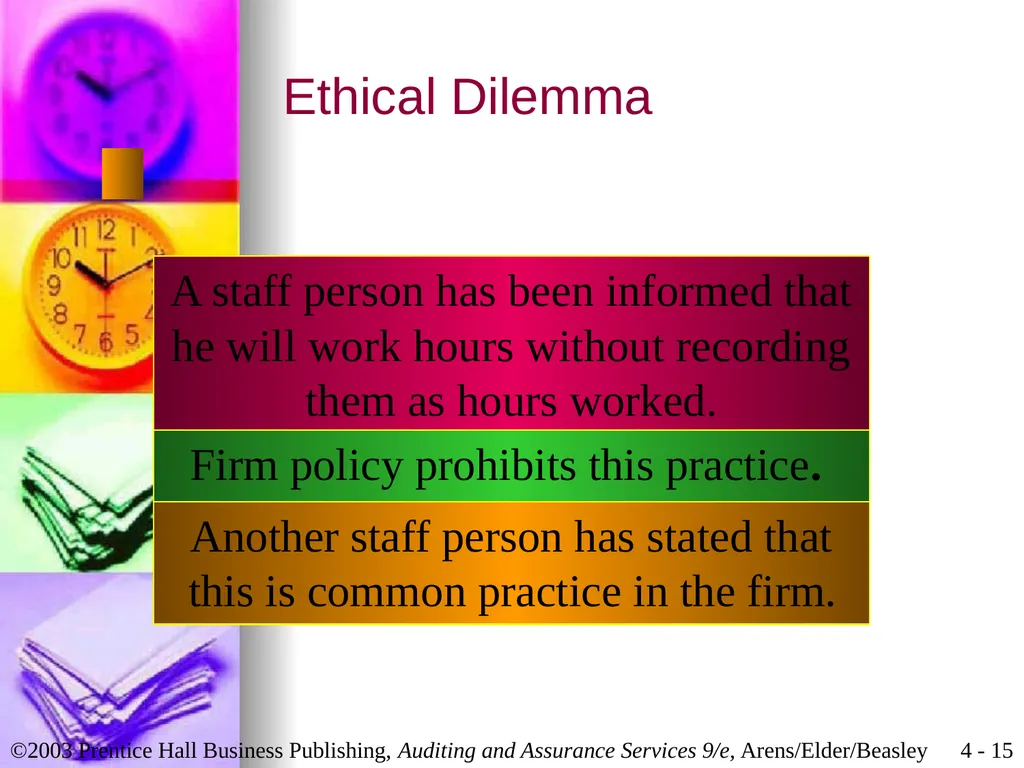
slide15. Ethical Dilemma A staff person has been informed that
he will work hours without recording
them as hours worked. Firm policy prohibits this practice. Another staff person has stated that
this is common practice in the firm.<br>
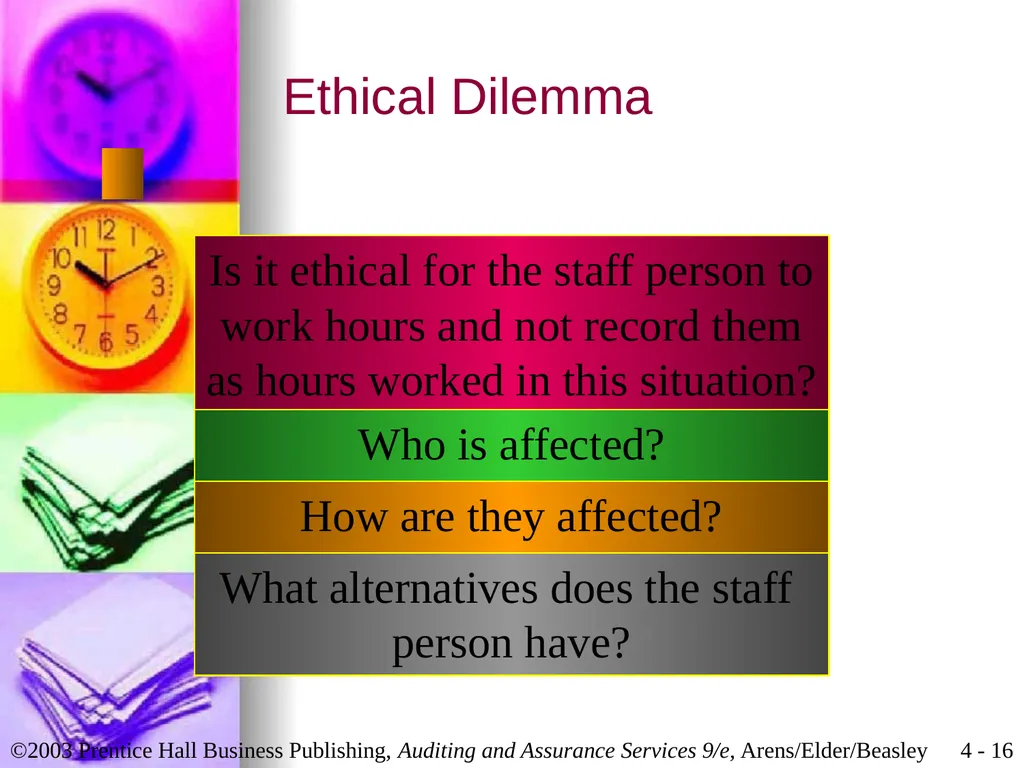
slide16. Ethical Dilemma Is it ethical for the staff person to
work hours and not record them
as hours worked in this situation? Who is affected? How are they affected? What alternatives does the staff
person have?<br>
slide17. Learning Objective 3 Explain the importance of
ethical conduct for the
accounting profession.<br>
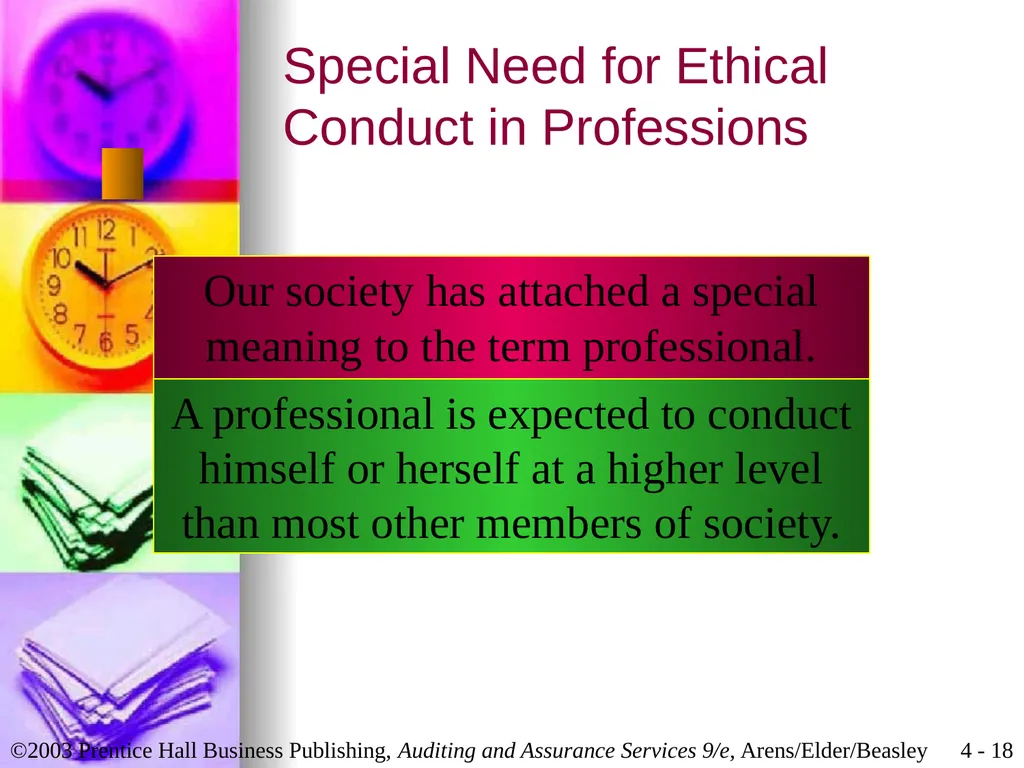
slide18. Special Need for Ethical Conduct in Professions Our society has attached a special
meaning to the term professional. A professional is expected to conduct
himself or herself at a higher level
than most other members of society.<br>
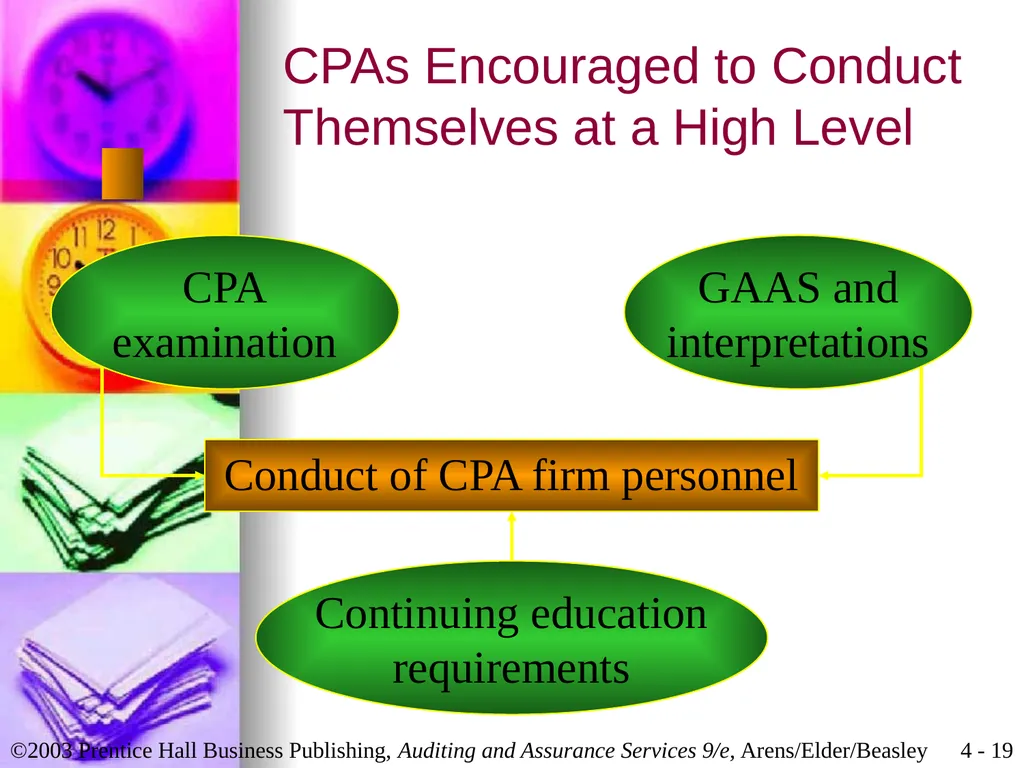
slide19. CPAs Encouraged to ConductThemselves at a High Level Conduct of CPA firm personnel CPA
examination GAAS and
interpretations Continuing education
requirements<br>
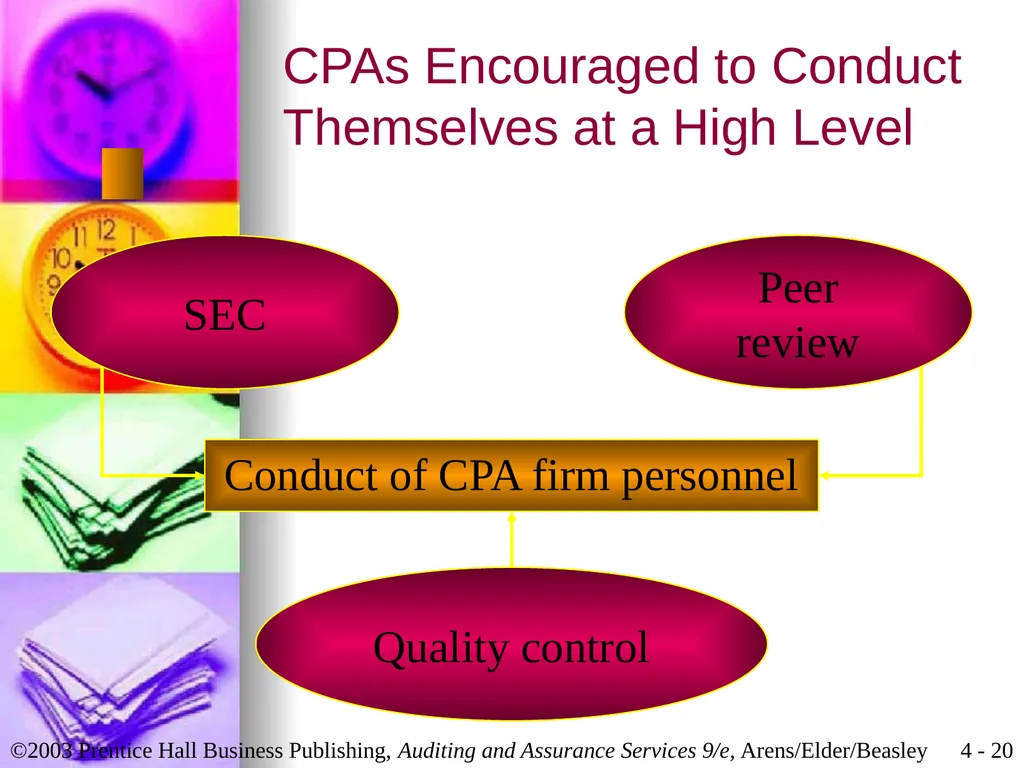
slide20. CPAs Encouraged to ConductThemselves at a High Level Conduct of CPA firm personnel SEC Peer
review Quality control<br>
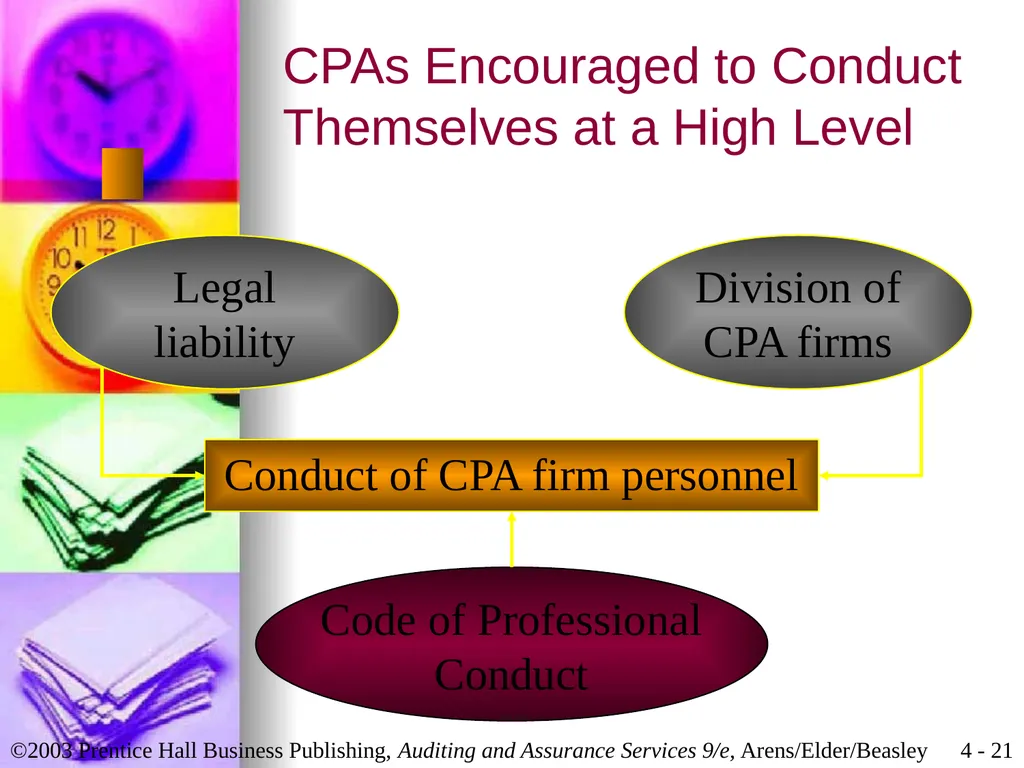
slide21. CPAs Encouraged to ConductThemselves at a High Level Conduct of CPA firm personnel Legal
liability Division of
CPA firms Code of Professional
Conduct<br>
slide22. Learning Objective 4 Describe the purpose and
content of the AICPA Code
of Professional Conduct.<br>
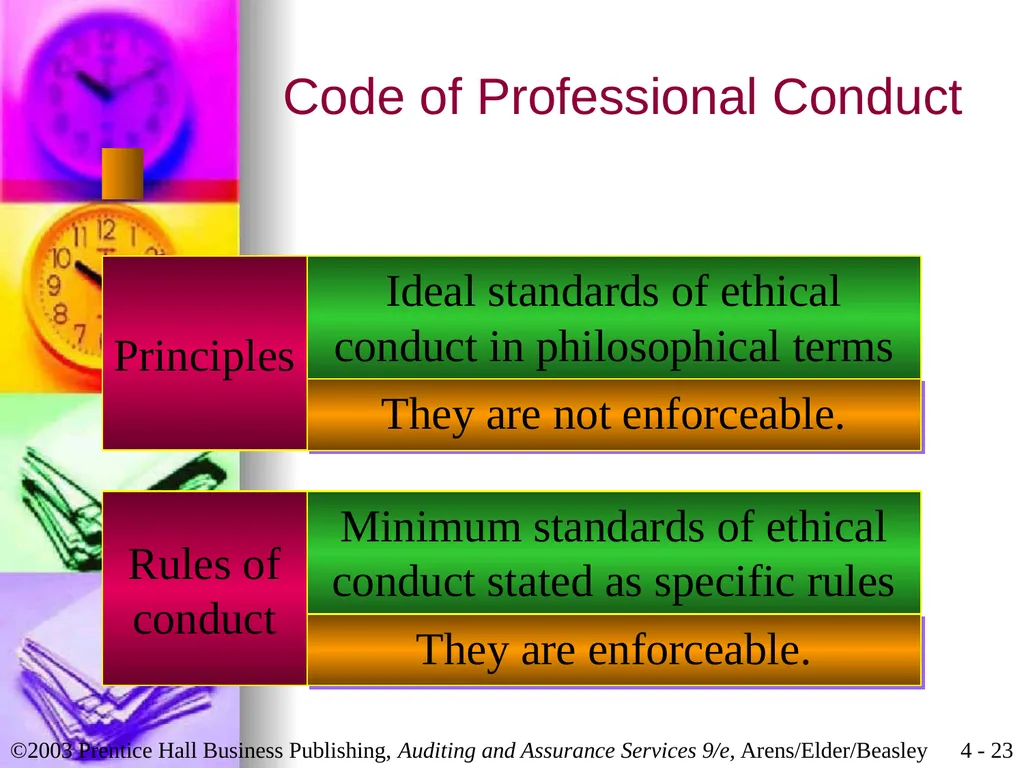
slide23. Code of Professional Conduct Principles Ideal standards of ethical
conduct in philosophical terms They are not enforceable. Rules of
conduct Minimum standards of ethical
conduct stated as specific rules They are enforceable.<br>
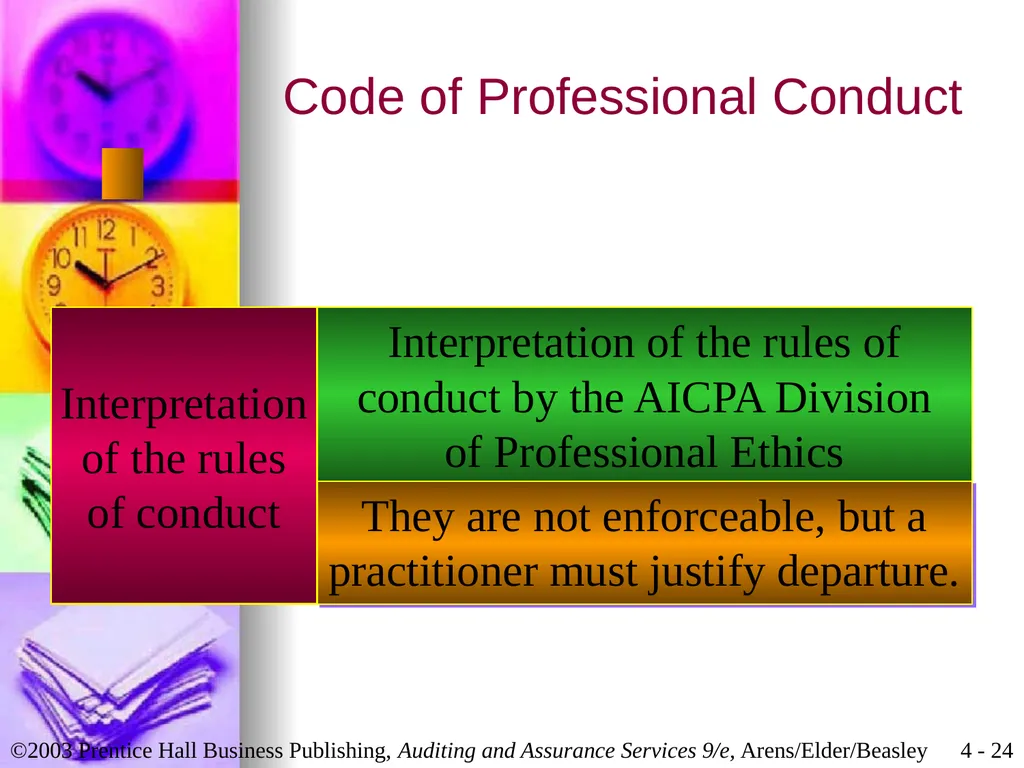
slide24. Code of Professional Conduct Interpretation
of the rules
of conduct Interpretation of the rules of
conduct by the AICPA Division
of Professional Ethics They are not enforceable, but a
practitioner must justify departure.<br>
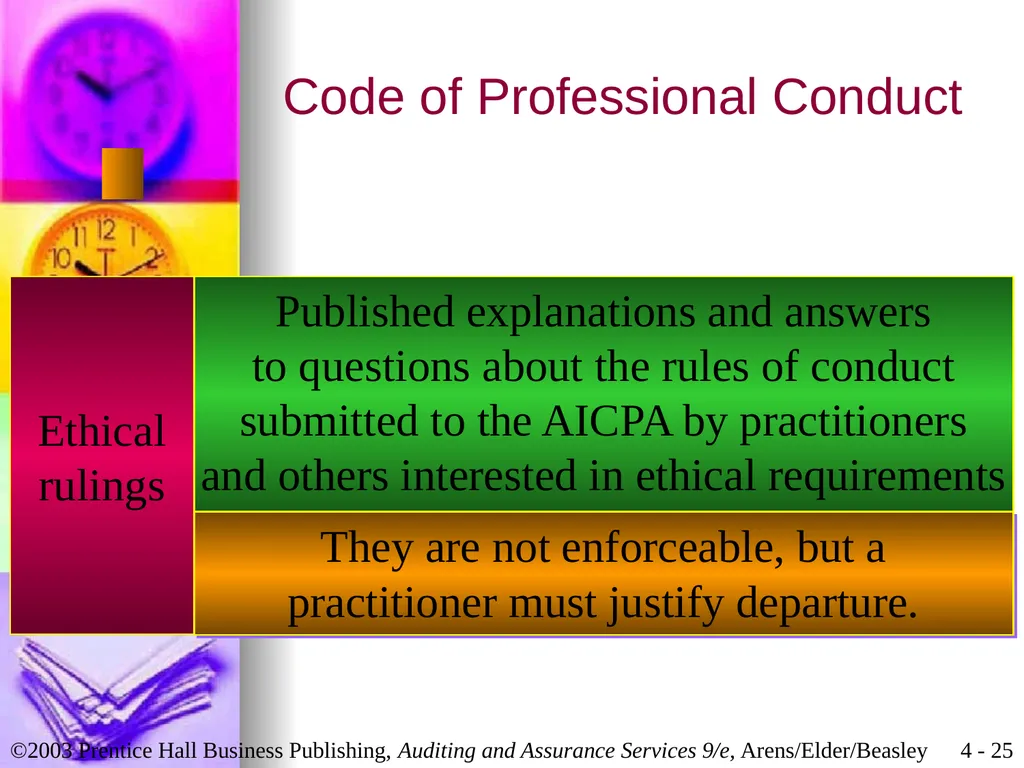
slide25. Code of Professional Conduct Ethical
rulings Published explanations and answers
to questions about the rules of conduct
submitted to the AICPA by practitioners
and others interested in ethical requirements They are not enforceable, but a
practitioner must justify departure.<br>
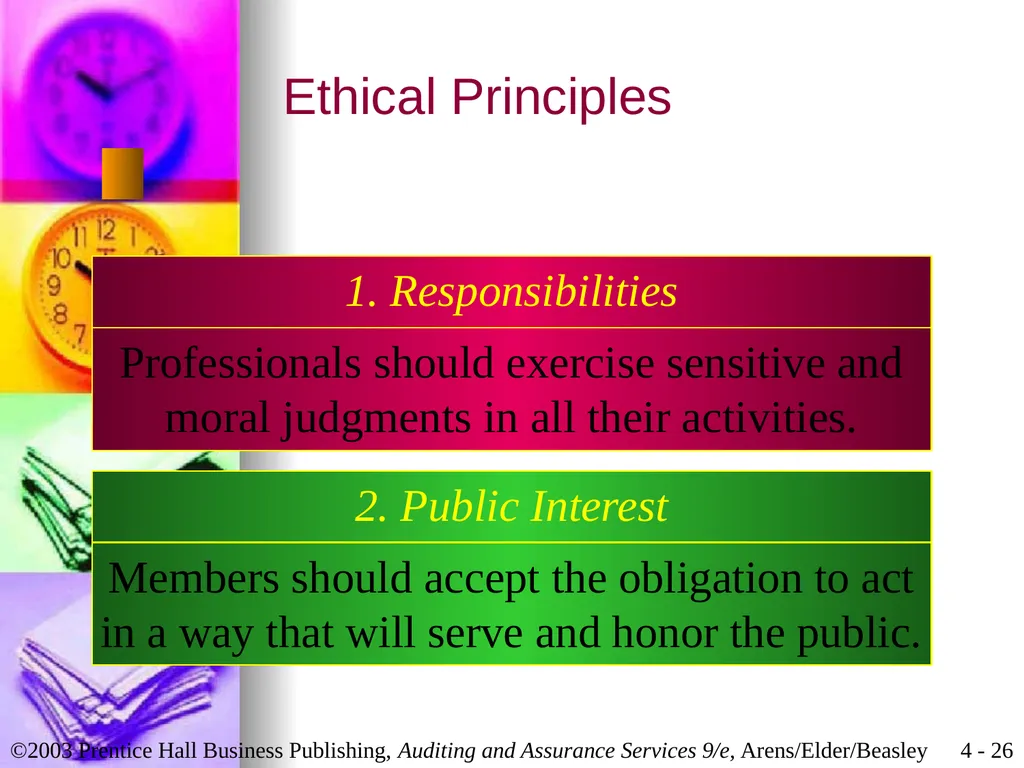
slide26. Ethical Principles 1. Responsibilities Professionals should exercise sensitive and
moral judgments in all their activities. Members should accept the obligation to act
in a way that will serve and honor the public. 2. Public Interest<br>
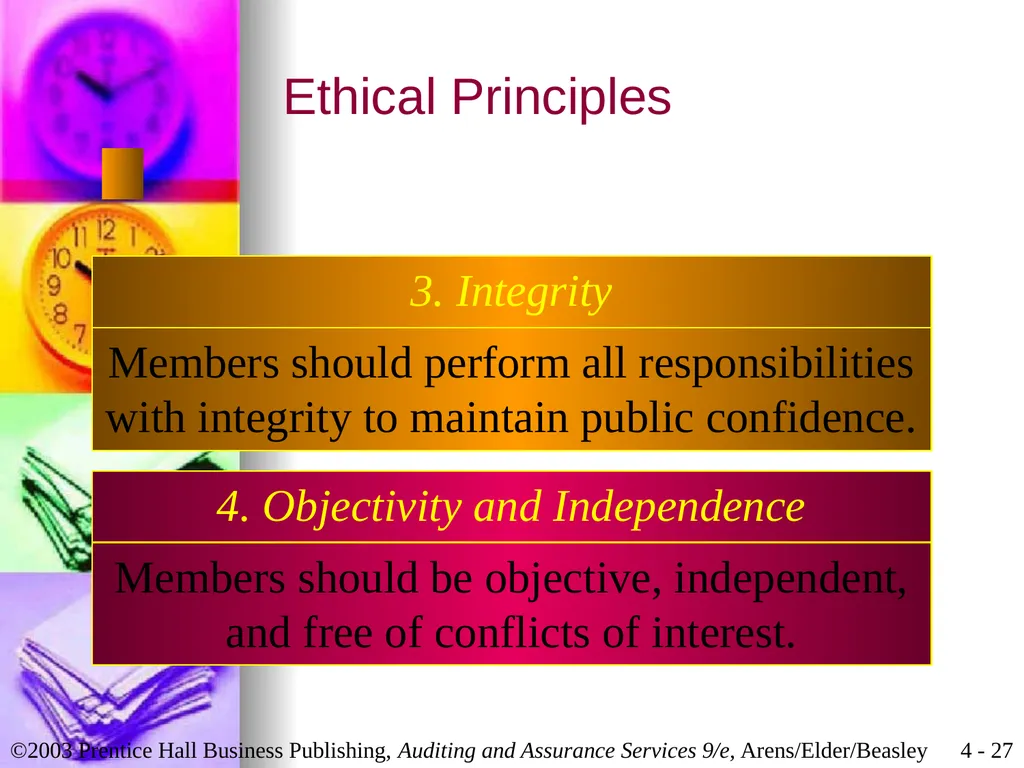
slide27. Ethical Principles 3. Integrity Members should perform all responsibilities
with integrity to maintain public confidence. Members should be objective, independent,
and free of conflicts of interest. 4. Objectivity and Independence<br>
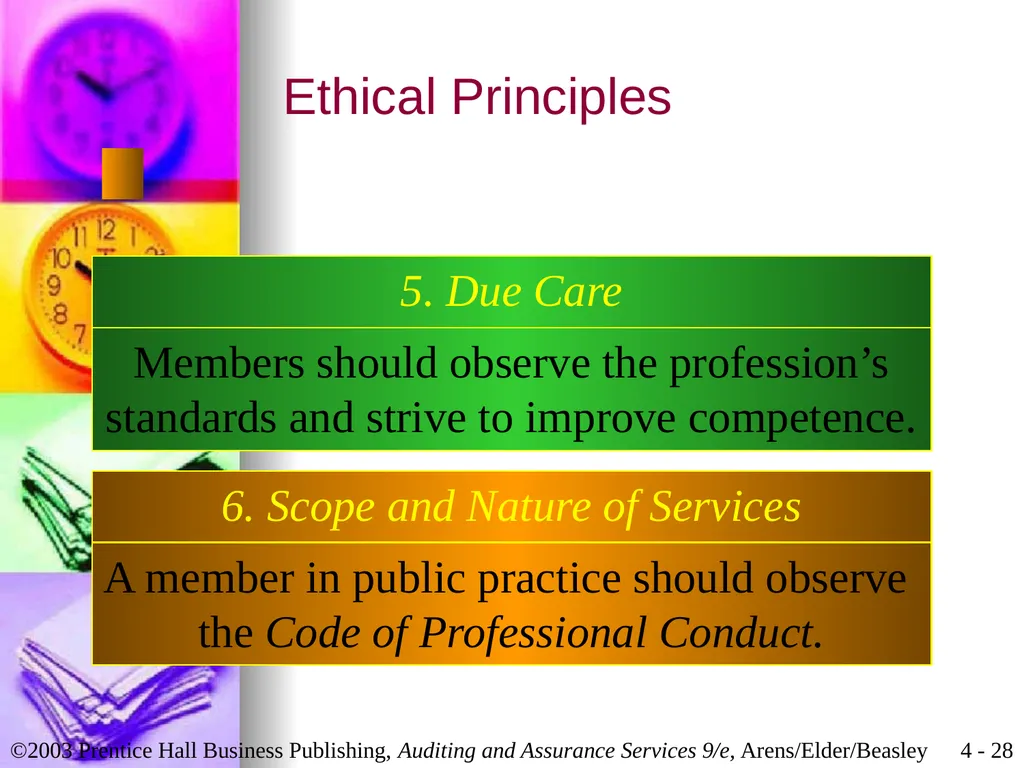
slide28. Ethical Principles 5. Due Care Members should observe the profession’s
standards and strive to improve competence. A member in public practice should observe
the Code of Professional Conduct. 6. Scope and Nature of Services<br>
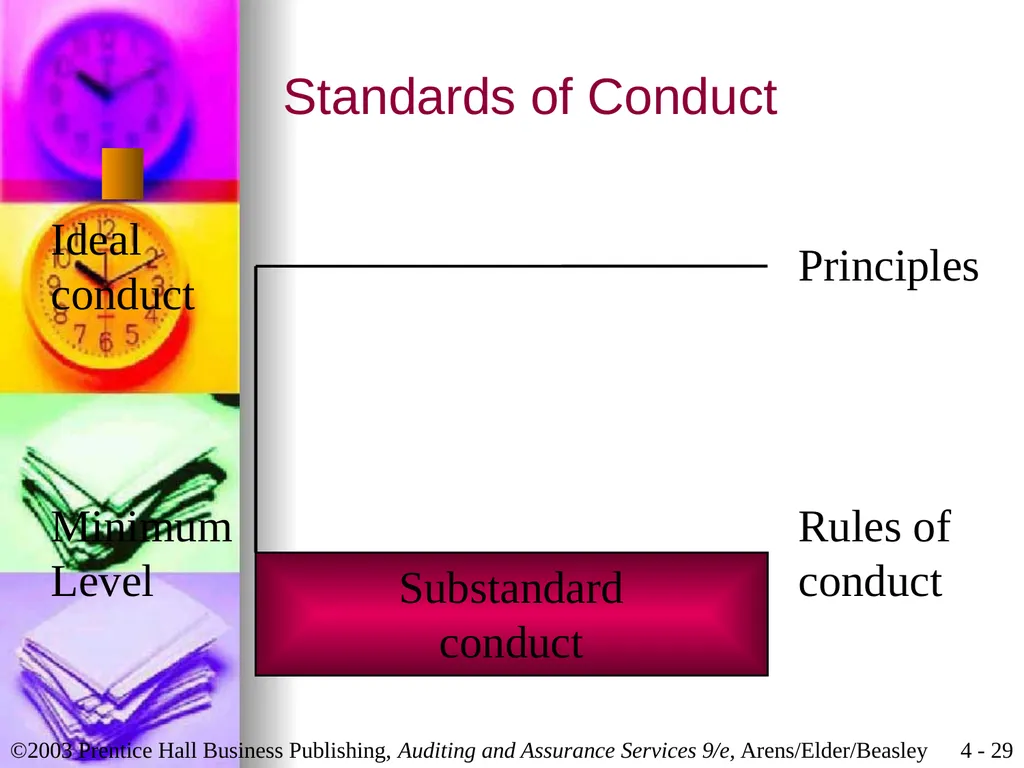
slide29. Standards of Conduct Principles Rules of
conduct Substandard
conduct Ideal
conduct Minimum
Level<br>
slide30. Learning Objective 5 Describe factors that influence
auditor independence.<br>
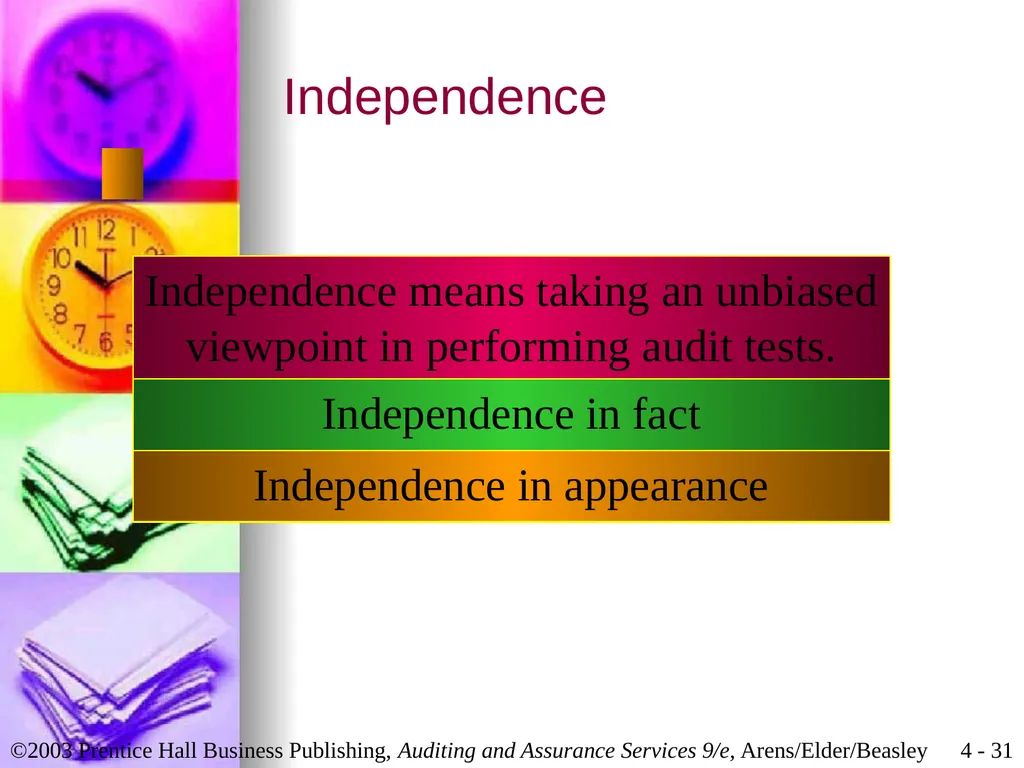
slide31. Independence Independence means taking an unbiased
viewpoint in performing audit tests. Independence in fact Independence in appearance<br>
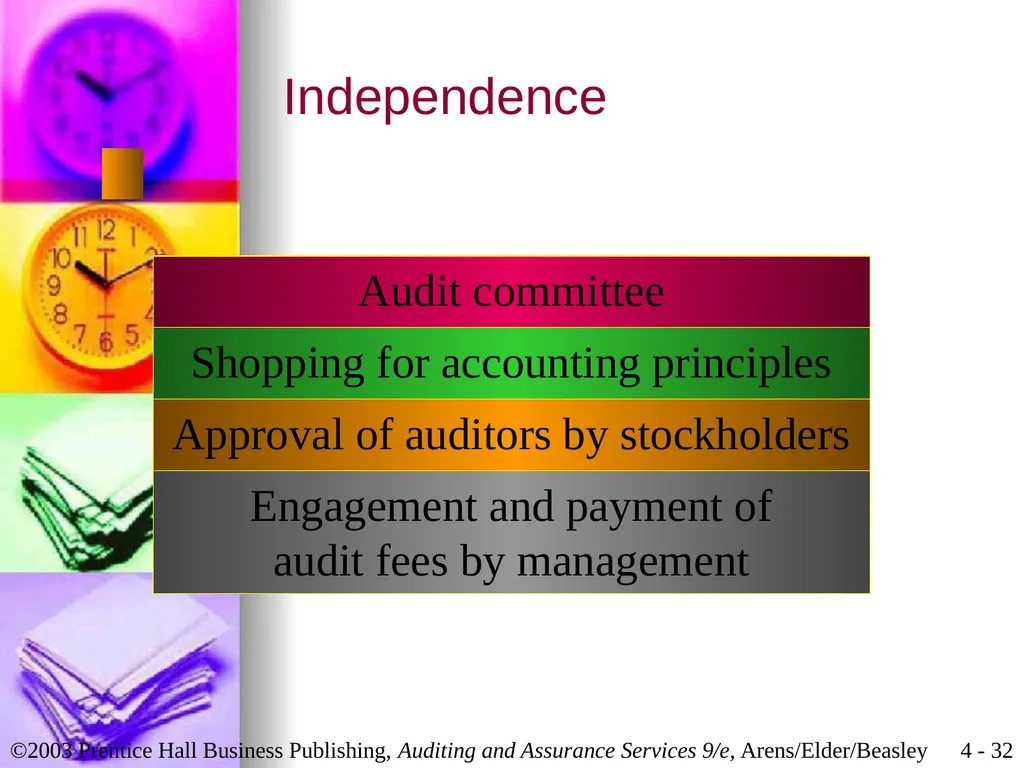
slide32. Independence Audit committee Shopping for accounting principles Approval of auditors by stockholders Engagement and payment of
audit fees by management<br>
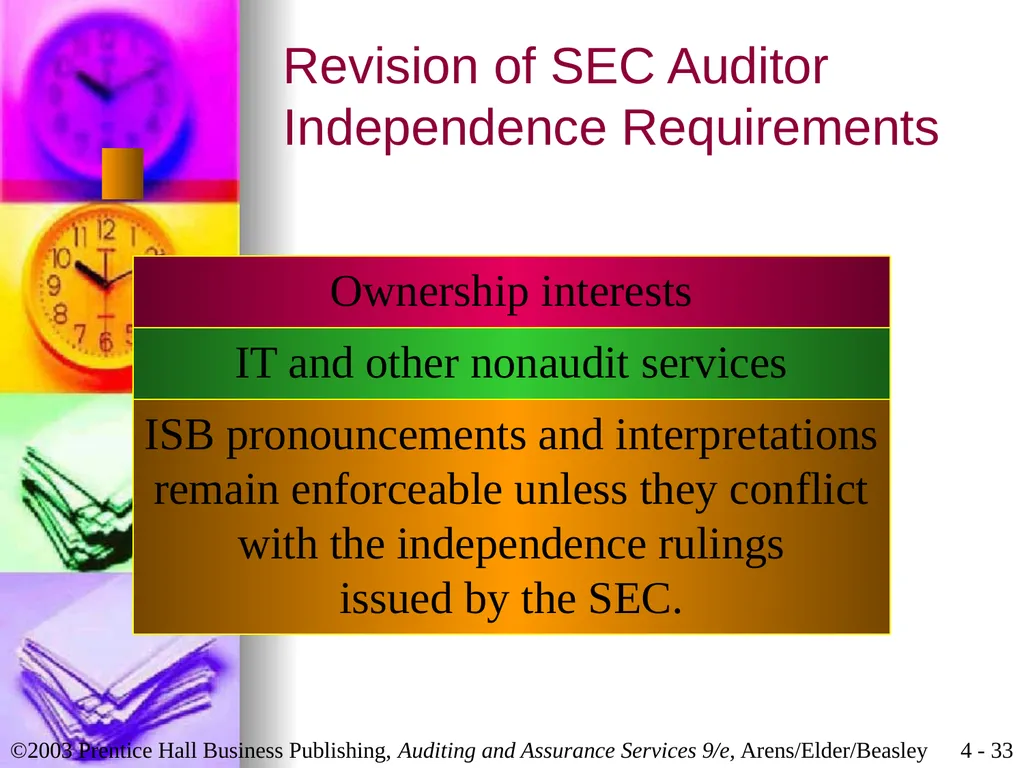
slide33. Revision of SEC Auditor Independence Requirements Ownership interests IT and other nonaudit services ISB pronouncements and interpretations
remain enforceable unless they conflict
with the independence rulings
issued by the SEC.<br>
slide34. Learning Objective 6 Apply the AICPA Code rules and
interpretations on independence
and explain their importance.<br>
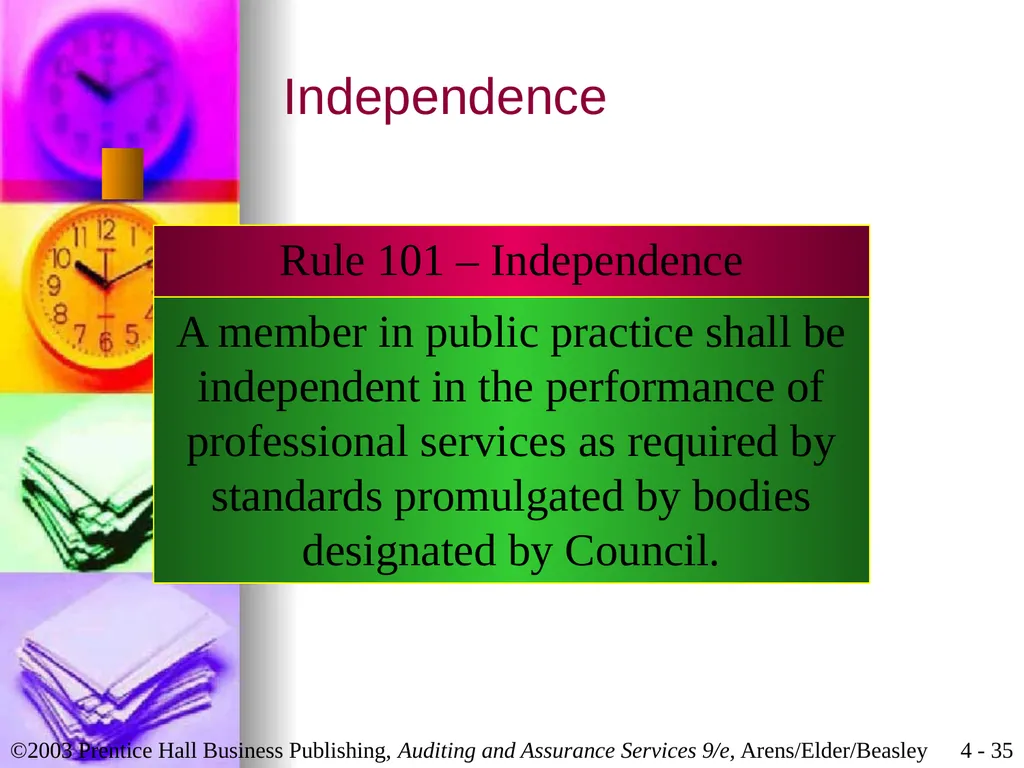
slide35. Independence Rule 101 – Independence A member in public practice shall be
independent in the performance of
professional services as required by
standards promulgated by bodies
designated by Council.<br>
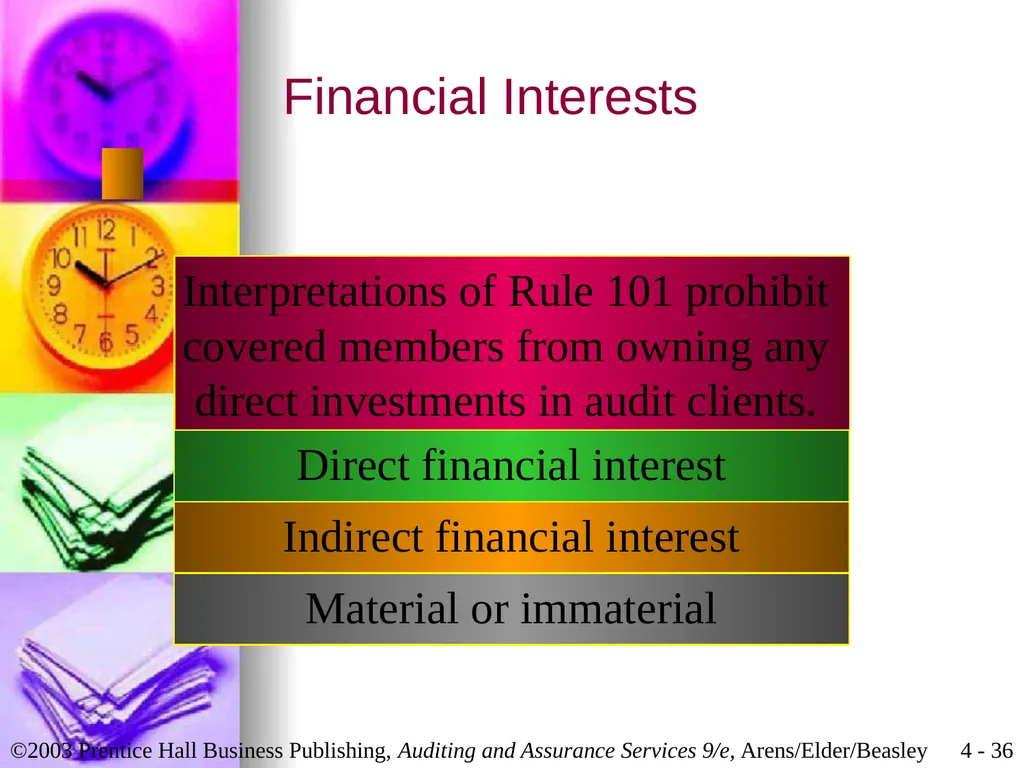
slide36. Financial Interests Interpretations of Rule 101 prohibit
covered members from owning any
direct investments in audit clients. Direct financial interest Indirect financial interest Material or immaterial<br>
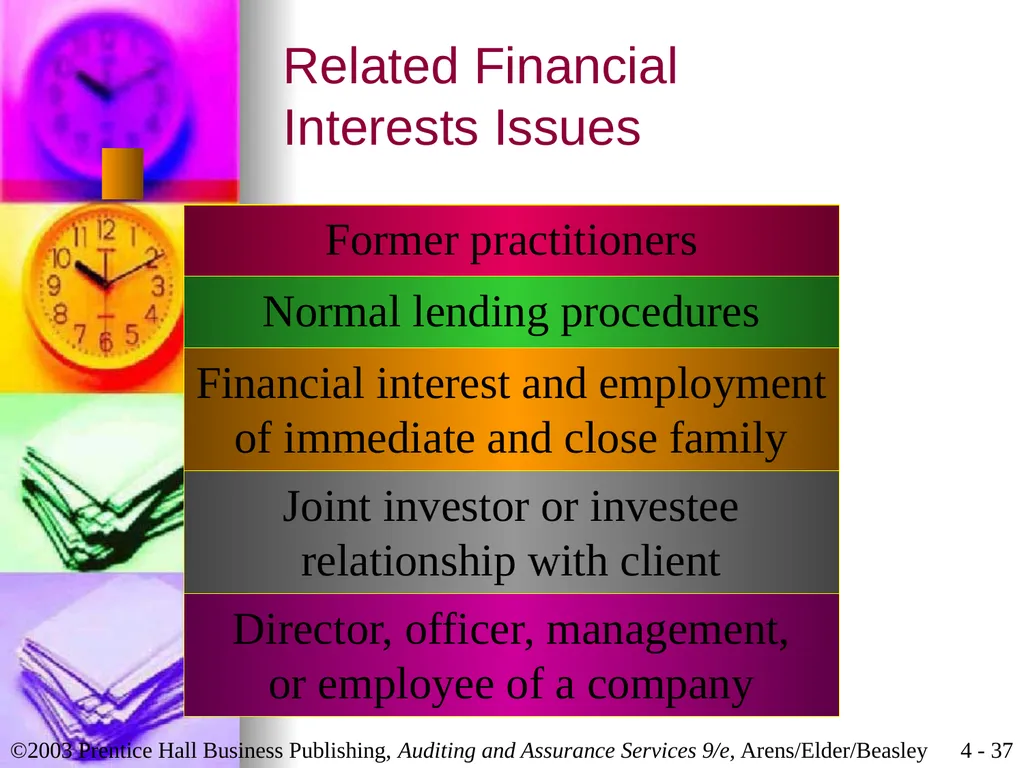
slide37. Related FinancialInterests Issues Former practitioners Normal lending procedures Financial interest and employment
of immediate and close family Joint investor or investee
relationship with client Director, officer, management,
or employee of a company<br>
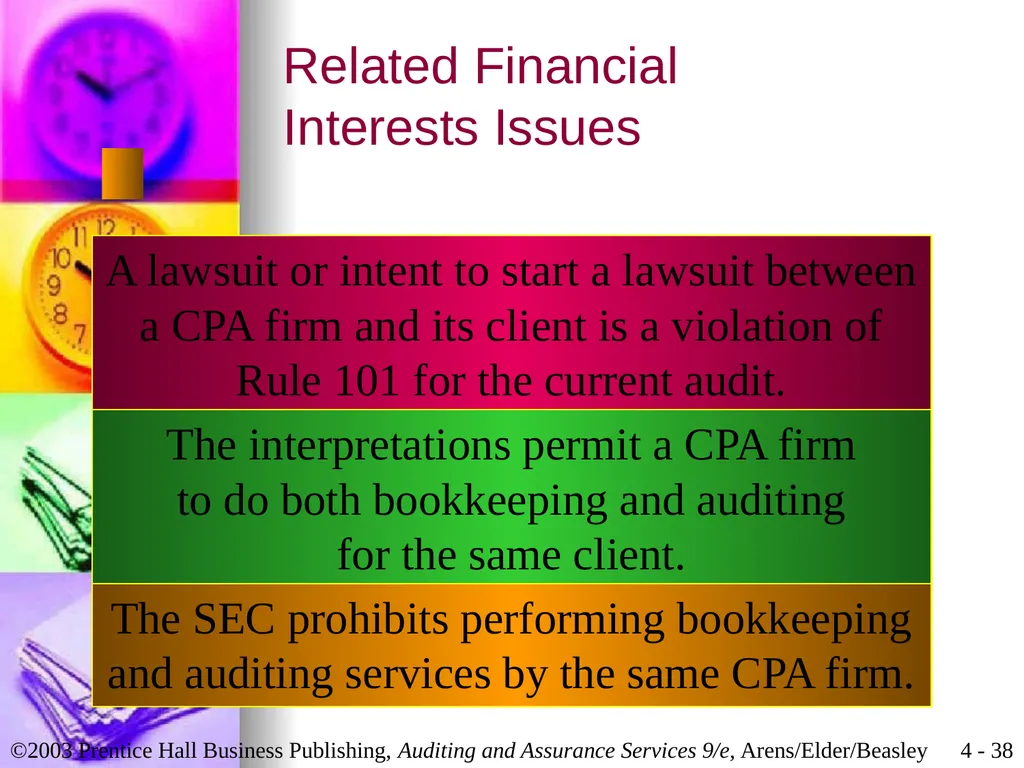
slide38. Related FinancialInterests Issues A lawsuit or intent to start a lawsuit between
a CPA firm and its client is a violation of
Rule 101 for the current audit. The interpretations permit a CPA firm
to do both bookkeeping and auditing
for the same client. The SEC prohibits performing bookkeeping
and auditing services by the same CPA firm.<br>
slide39. Related FinancialInterests Issues Internal auditing
and extended
audit services Unpaid fees<br>
slide40. Learning Objective 7 Understand the requirements
of other rules under the
AICPA Code.<br>
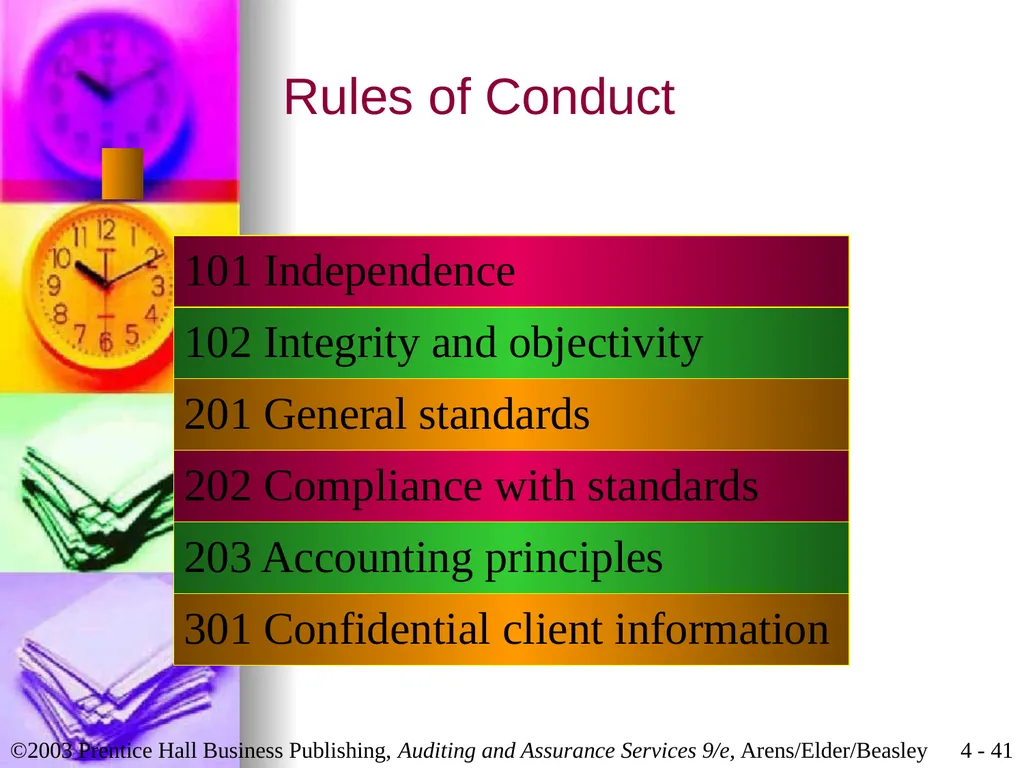
slide41. Rules of Conduct 101 Independence 102 Integrity and objectivity 201 General standards 202 Compliance with standards 203 Accounting principles 301 Confidential client information<br>
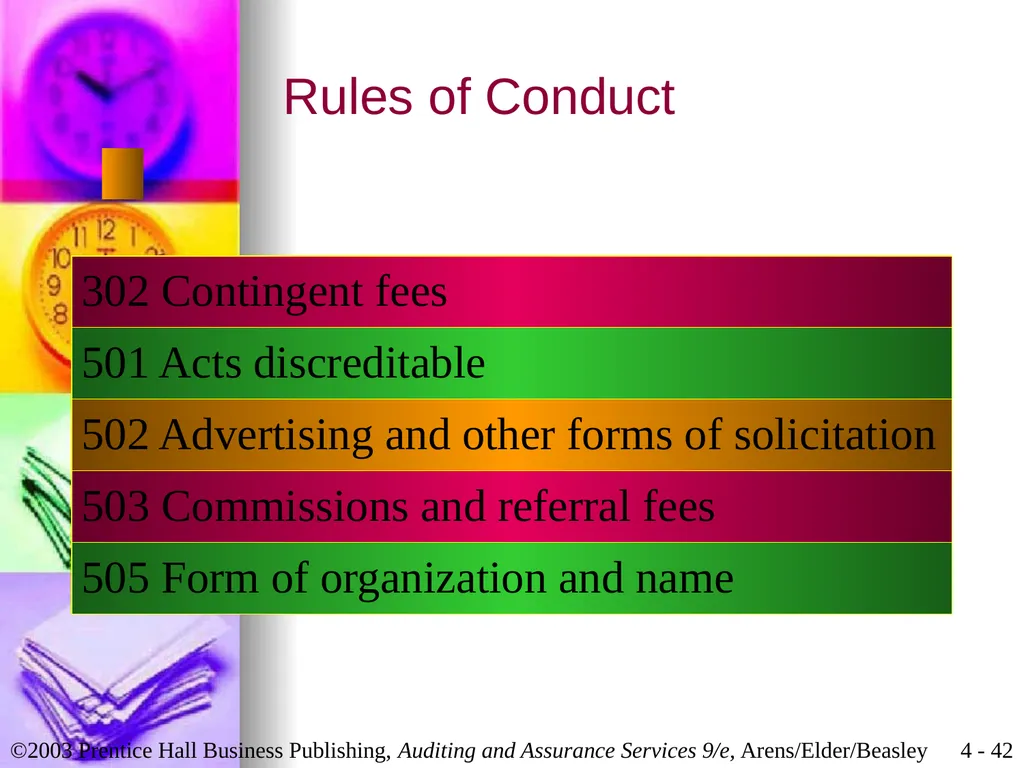
slide42. Rules of Conduct 302 Contingent fees 501 Acts discreditable 502 Advertising and other forms of solicitation 503 Commissions and referral fees 505 Form of organization and name<br>
slide43. Learning Objective 8 Describe the enforcement
mechanisms for the
rules of conduct.<br>
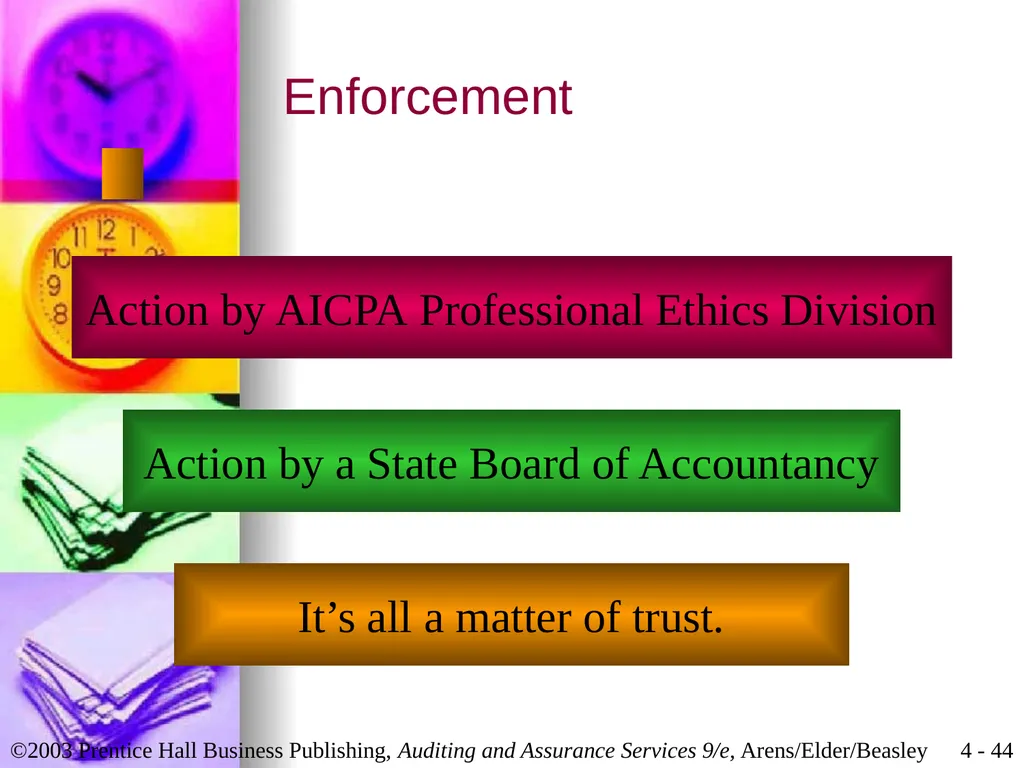
slide44. Enforcement Action by AICPA Professional Ethics Division Action by a State Board of Accountancy It’s all a matter of trust.<br>

slide45. End of Chapter 4<br>
slide2. Learning Objective 1 Distinguish ethical from
unethical behavior
in personal and
professional contexts.<br>
slide3. What are Ethics? Ethics can be defined broadly as
a set of moral principles or values. Each of us has such a set of values. We may or may not have
considered them explicitly.<br>
slide4. Need for Ethics Ethical behavior is necessary for a society
to function in an orderly manner. The need for ethics in society is sufficiently
important that many commonly held ethical
values are incorporated into laws.<br>
slide5. Why People Act Unethically The person’s ethical standards are different
from those of society as a whole. The person chooses to act selfishly. In many instances, both reasons exist.<br>
slide6. Prescribed EthicalPrinciples Example Trustworthiness Respect Fairness Responsibility Caring Citizenship<br>
slide7. A Person’s Ethical StandardsDiffer from General Society Embezzlers Con artists Shoplifters Most people who commit such acts feel no
remorse when they are apprehended because
their ethical standards differ from those of
society as a whole.<br>
slide8. A Person Chooses toAct Selfishly – Example Person A finds a briefcase containing
important papers and $1,000. He tosses the briefcase and keeps the money. He brags to his friends about his good fortune. This action probably differs from most of society.<br>
slide9. A Person Chooses toAct Selfishly – Example Person B faces the same situation
but responds differently. He keeps the money but leaves the briefcase. He tells nobody and spends the money. He has violated his own ethical standards
and chose to act selfishly.<br>
slide10. Learning Objective 2 Resolve ethical dilemmas
using an ethical
framework.<br>
slide11. Ethical Dilemmas An ethical dilemma is a situation a
person faces in which a decision must
be made about appropriate behavior.<br>
slide12. RationalizingUnethical Behavior Everybody does it. If it’s legal, it’s ethical. Likelihood of discovery and consequences<br>
slide13. Resolving Ethical Dilemmas 1. Obtain the relevant facts. 2. Identify the ethical issues from the facts. 3. Determine who is affected.<br>
slide14. Resolving Ethical Dilemmas 4. Identify the alternatives available to the
person who must resolve the dilemma. 5. Identify the likely consequence
of each alternative. 6. Decide the appropriate action.<br>
slide15. Ethical Dilemma A staff person has been informed that
he will work hours without recording
them as hours worked. Firm policy prohibits this practice. Another staff person has stated that
this is common practice in the firm.<br>
slide16. Ethical Dilemma Is it ethical for the staff person to
work hours and not record them
as hours worked in this situation? Who is affected? How are they affected? What alternatives does the staff
person have?<br>
slide17. Learning Objective 3 Explain the importance of
ethical conduct for the
accounting profession.<br>
slide18. Special Need for Ethical Conduct in Professions Our society has attached a special
meaning to the term professional. A professional is expected to conduct
himself or herself at a higher level
than most other members of society.<br>
slide19. CPAs Encouraged to ConductThemselves at a High Level Conduct of CPA firm personnel CPA
examination GAAS and
interpretations Continuing education
requirements<br>
slide20. CPAs Encouraged to ConductThemselves at a High Level Conduct of CPA firm personnel SEC Peer
review Quality control<br>
slide21. CPAs Encouraged to ConductThemselves at a High Level Conduct of CPA firm personnel Legal
liability Division of
CPA firms Code of Professional
Conduct<br>
slide22. Learning Objective 4 Describe the purpose and
content of the AICPA Code
of Professional Conduct.<br>
slide23. Code of Professional Conduct Principles Ideal standards of ethical
conduct in philosophical terms They are not enforceable. Rules of
conduct Minimum standards of ethical
conduct stated as specific rules They are enforceable.<br>
slide24. Code of Professional Conduct Interpretation
of the rules
of conduct Interpretation of the rules of
conduct by the AICPA Division
of Professional Ethics They are not enforceable, but a
practitioner must justify departure.<br>
slide25. Code of Professional Conduct Ethical
rulings Published explanations and answers
to questions about the rules of conduct
submitted to the AICPA by practitioners
and others interested in ethical requirements They are not enforceable, but a
practitioner must justify departure.<br>
slide26. Ethical Principles 1. Responsibilities Professionals should exercise sensitive and
moral judgments in all their activities. Members should accept the obligation to act
in a way that will serve and honor the public. 2. Public Interest<br>
slide27. Ethical Principles 3. Integrity Members should perform all responsibilities
with integrity to maintain public confidence. Members should be objective, independent,
and free of conflicts of interest. 4. Objectivity and Independence<br>
slide28. Ethical Principles 5. Due Care Members should observe the profession’s
standards and strive to improve competence. A member in public practice should observe
the Code of Professional Conduct. 6. Scope and Nature of Services<br>
slide29. Standards of Conduct Principles Rules of
conduct Substandard
conduct Ideal
conduct Minimum
Level<br>
slide30. Learning Objective 5 Describe factors that influence
auditor independence.<br>
slide31. Independence Independence means taking an unbiased
viewpoint in performing audit tests. Independence in fact Independence in appearance<br>
slide32. Independence Audit committee Shopping for accounting principles Approval of auditors by stockholders Engagement and payment of
audit fees by management<br>
slide33. Revision of SEC Auditor Independence Requirements Ownership interests IT and other nonaudit services ISB pronouncements and interpretations
remain enforceable unless they conflict
with the independence rulings
issued by the SEC.<br>
slide34. Learning Objective 6 Apply the AICPA Code rules and
interpretations on independence
and explain their importance.<br>
slide35. Independence Rule 101 – Independence A member in public practice shall be
independent in the performance of
professional services as required by
standards promulgated by bodies
designated by Council.<br>
slide36. Financial Interests Interpretations of Rule 101 prohibit
covered members from owning any
direct investments in audit clients. Direct financial interest Indirect financial interest Material or immaterial<br>
slide37. Related FinancialInterests Issues Former practitioners Normal lending procedures Financial interest and employment
of immediate and close family Joint investor or investee
relationship with client Director, officer, management,
or employee of a company<br>
slide38. Related FinancialInterests Issues A lawsuit or intent to start a lawsuit between
a CPA firm and its client is a violation of
Rule 101 for the current audit. The interpretations permit a CPA firm
to do both bookkeeping and auditing
for the same client. The SEC prohibits performing bookkeeping
and auditing services by the same CPA firm.<br>
slide39. Related FinancialInterests Issues Internal auditing
and extended
audit services Unpaid fees<br>
slide40. Learning Objective 7 Understand the requirements
of other rules under the
AICPA Code.<br>
slide41. Rules of Conduct 101 Independence 102 Integrity and objectivity 201 General standards 202 Compliance with standards 203 Accounting principles 301 Confidential client information<br>
slide42. Rules of Conduct 302 Contingent fees 501 Acts discreditable 502 Advertising and other forms of solicitation 503 Commissions and referral fees 505 Form of organization and name<br>
slide43. Learning Objective 8 Describe the enforcement
mechanisms for the
rules of conduct.<br>
slide44. Enforcement Action by AICPA Professional Ethics Division Action by a State Board of Accountancy It’s all a matter of trust.<br>
slide45. End of Chapter 4<br>