
Professional Licensure Disclosure 2025 Alabama
AM
Published · 25 slides · 0 views

1 / 1

Description
Professional Licensure Disclosure 2025 Alabama SARA Workshop November 7, 2025 Introduction AGENDA Key Terms and Concepts Provide definitions of professional licensure and certification at both the federal level and within the state of
Related Topics
Share
Embed code
Download this presentation From Below
"Professional Licensure Disclosure 2025 Alabama" is the property of its rightful owner. Permission is granted to download and print the materials on this website for personal, non-commercial use only, and to display it on your personal computer provided you do not modify the materials and that you retain all copyright notices contained in the materials. By downloading content from our website, you accept the terms of this agreement.
Presentation Transcript
01
Professional Licensure Disclosure 2025 Alabama SARA Workshop
November 7, 2025<br>
November 7, 2025<br>
02
Introduction<br>
03
AGENDA Key Terms and Concepts
Provide definitions of professional licensure and certification at both the federal level and within the state of Alabama.
Regulatory Overview
Review of federal and state regulations including Title IV and SARA policies governing educational programs.
Resources
Provide resources for professional licensure compliance support.
Examples of Disclosures
Institutional examples of general and direct disclosure requirements.<br>
Provide definitions of professional licensure and certification at both the federal level and within the state of Alabama.
Regulatory Overview
Review of federal and state regulations including Title IV and SARA policies governing educational programs.
Resources
Provide resources for professional licensure compliance support.
Examples of Disclosures
Institutional examples of general and direct disclosure requirements.<br>
04
KEY TERMS and Regulations<br>
05
LICENSURE VS Certification Professional Licensure
The term “licensure” generally refers to an official process, administered by a state-level authority, that is required by law in order for an individual to practice a regulated profession.
Certification
The term “certification” generally refers to a function administered by a nongovernmental organization, which is intended to further recognize professional competence based on having met the quality standards of the organization. The prevalence and relevance of certification varies by profession.
Source: Professional Licensure | U.S. Department of Education<br>
The term “licensure” generally refers to an official process, administered by a state-level authority, that is required by law in order for an individual to practice a regulated profession.
Certification
The term “certification” generally refers to a function administered by a nongovernmental organization, which is intended to further recognize professional competence based on having met the quality standards of the organization. The prevalence and relevance of certification varies by profession.
Source: Professional Licensure | U.S. Department of Education<br>
06
ACHE Operating definitions ACHE Operating Definitions
(86) Professional Licensure Program: As defined in federal regulations, an instructional program that is designed to meet educational requirements for a specific professional license or certification that is required for employment in an occupation or is advertised as meeting such requirements.
(90) Program that Leads to Professional Educator Certification: A type of professional licensure program at the baccalaureate, master’s, or education specialist level that receives authorization from the Alabama State Board of Education to lead to professional educator certification and is considered an “approved program,” as defined under Alabama Administrative Code §290-3-3-.01.
Source: Alabama Legislative Services Agency Administrative Code 300-2-1-.01<br>
(86) Professional Licensure Program: As defined in federal regulations, an instructional program that is designed to meet educational requirements for a specific professional license or certification that is required for employment in an occupation or is advertised as meeting such requirements.
(90) Program that Leads to Professional Educator Certification: A type of professional licensure program at the baccalaureate, master’s, or education specialist level that receives authorization from the Alabama State Board of Education to lead to professional educator certification and is considered an “approved program,” as defined under Alabama Administrative Code §290-3-3-.01.
Source: Alabama Legislative Services Agency Administrative Code 300-2-1-.01<br>
07
Key Regulatory Frameworks Federal Regulation Requirements
Federal regulations mandate disclosures for programs leading to professional licensure, ensuring transparency and compliance.
Program Participation Agreement
Certification procedures under 34 CFR 668.14(b)(32) guide institutions in maintaining eligibility for federal programs.
State-Level Education Regulations
State rules, like Alabama's nursing education standards, set specific requirements for distance education programs.
Interstate Distance Education Framework
SARA facilitates interstate distance education but does not substitute state professional licensure mandates.<br>
Federal regulations mandate disclosures for programs leading to professional licensure, ensuring transparency and compliance.
Program Participation Agreement
Certification procedures under 34 CFR 668.14(b)(32) guide institutions in maintaining eligibility for federal programs.
State-Level Education Regulations
State rules, like Alabama's nursing education standards, set specific requirements for distance education programs.
Interstate Distance Education Framework
SARA facilitates interstate distance education but does not substitute state professional licensure mandates.<br>
08
Federal Regulations 668.43(a)(5)(v) and 668.43(c) (Effective July 1, 2020) For consumer protection, 34 CFR 668.43 as amended requires Title IV institutions to identify which of their academic programs (whether online, hybrid, or face-to-face) are designed to fulfill the educational requirements for a professional license or certification that is a gateway for entry into a specific occupational field. For each academic program that falls within this category, institutions must develop two kinds of disclosures related to professional licensure or certification:
General Disclosure (34 CFR 668.43 (a)(5)(v)
Direct Disclosure (34 CFR 668.43 (c)(1) et seq.<br>
General Disclosure (34 CFR 668.43 (a)(5)(v)
Direct Disclosure (34 CFR 668.43 (c)(1) et seq.<br>
09
Federal Regulations 668.43(a)(5)(v) and 668.43(c) (Effective July 1, 2020) General Disclosures
General disclosures entail posting information in a public place, such as on your website or in your catalog, and must include state-by-state determinations of whether the program fulfills educational requirements for licensure or certification in that state. ACHE has developed a template that institutions may adopt to comply with this federal requirement: public disclosure template<br>
General disclosures entail posting information in a public place, such as on your website or in your catalog, and must include state-by-state determinations of whether the program fulfills educational requirements for licensure or certification in that state. ACHE has developed a template that institutions may adopt to comply with this federal requirement: public disclosure template<br>
10
Federal Regulations 668.43(a)(5)(v) and 668.43(c) (Effective July 1, 2020) Direct Disclosures:
Direct disclosures are targeted communications to individual students who are enrolled in or who are considering enrolling in a program that is designed to lead to licensure. These disclosures must indicate whether the student’s chosen program fulfills the education requirements for licensure or certification within that student’s state of residence.<br>
Direct disclosures are targeted communications to individual students who are enrolled in or who are considering enrolling in a program that is designed to lead to licensure. These disclosures must indicate whether the student’s chosen program fulfills the education requirements for licensure or certification within that student’s state of residence.<br>
11
Federal Regulations 668.43(a)(5)(v) and 668.43(c) (Effective July 1, 2020) Direct Disclosures:
Prospective Students – if curriculum does not meet state requirements or no determination made where student is located prior to enrollment in the program (prior to a financial commitment is official guidance from the Department of Education) provide a disclosure to that effect.
Enrolled students - if the institution makes a determination that the curriculum does not meet state educational requirements where the student is located - 14 calendar days of that determination to notify the students where they are located provide the disclosure to that effect.
Disclosures of this section must be made directly to the student in writing, which may include through email or other electronic communication.
Source: Professional Licensure<br>
Prospective Students – if curriculum does not meet state requirements or no determination made where student is located prior to enrollment in the program (prior to a financial commitment is official guidance from the Department of Education) provide a disclosure to that effect.
Enrolled students - if the institution makes a determination that the curriculum does not meet state educational requirements where the student is located - 14 calendar days of that determination to notify the students where they are located provide the disclosure to that effect.
Disclosures of this section must be made directly to the student in writing, which may include through email or other electronic communication.
Source: Professional Licensure<br>
12
Federal Regulations: Certification Procedures (Title IV) – 34 CFR 668.14(b)(32) (Effective July 1, 2024) General Disclosures
As part of the Program Participation Agreement (PPA), the institution must certify that it satisfies applicable state educational requirements:
Where the institution is located.
Where the student enrolled in distance education is located at the initial time of enrollment or where the student attests they intend to seek employment.
Source: Programs Leading to a License or Certification | State Authorization Network<br>
As part of the Program Participation Agreement (PPA), the institution must certify that it satisfies applicable state educational requirements:
Where the institution is located.
Where the student enrolled in distance education is located at the initial time of enrollment or where the student attests they intend to seek employment.
Source: Programs Leading to a License or Certification | State Authorization Network<br>
13
Program Participation Agreement (PPA) The Program Participation Agreement (PPA) is the agreement between the institution and the Department that specifies the conditions of the institution’s participation upon compliance with the provisions of the agreement. Consequences for failure to comply could include an impact on future participation in Title IV programs, fines, and repayment of misspent funds.
New regulation addressing programs leading to a license or certification is among the new provisions of the PPA (July 1, 2024).
Source: eCFR :: 34 CFR 668.14 -- Program participation agreement.<br>
New regulation addressing programs leading to a license or certification is among the new provisions of the PPA (July 1, 2024).
Source: eCFR :: 34 CFR 668.14 -- Program participation agreement.<br>
14
SARA Policy 5.2 Programs leading to professional licensure Effective beginning July 1, 2025:
SARA has no effect on state professional licensing requirements. Any institution approved to participate in SARA that offers courses or programs designed to lead to professional licensure or certification or advertised as leading to licensure must satisfy all federal requirements for disclosures regarding such professional licensure programs. For SARA purposes, these requirements will also apply to non-Title IV institutions and programs.<br>
SARA has no effect on state professional licensing requirements. Any institution approved to participate in SARA that offers courses or programs designed to lead to professional licensure or certification or advertised as leading to licensure must satisfy all federal requirements for disclosures regarding such professional licensure programs. For SARA purposes, these requirements will also apply to non-Title IV institutions and programs.<br>
15
Resources<br>
16
Support Tools and Guides Official Guidance and Licensing Boards
The U.S. Department of Education provides official guidance and maintains lists of state licensing boards for regulatory compliance.
Interstate Authorization Tools
NC-SARA offers tools to help institutions understand and comply with interstate authorization requirements effectively.
Compliance Articles and Webinars
WCET and SAN publish articles and webinars addressing emerging compliance challenges in higher education.
Best Practices for Licensure Disclosures
The NASASPS Best Practices Guide provides effective strategies for transparent licensure disclosures.<br>
The U.S. Department of Education provides official guidance and maintains lists of state licensing boards for regulatory compliance.
Interstate Authorization Tools
NC-SARA offers tools to help institutions understand and comply with interstate authorization requirements effectively.
Compliance Articles and Webinars
WCET and SAN publish articles and webinars addressing emerging compliance challenges in higher education.
Best Practices for Licensure Disclosures
The NASASPS Best Practices Guide provides effective strategies for transparent licensure disclosures.<br>
17
SARA Professional licensure directory NC-SARA maintains the Professional Licensure Directory, which provides contact information for five programs that lead to a professional license. These programs have the most enrollments per the data provided by SARA participating institutions.
Counseling
Nursing
Psychology
Social work
Teacher Education
This resource does not house regulations or requirements; it is exclusively general contact information. Students may find this contact information helpful in their research on state licensure requirements in their locations. NC-SARA updates the contact information twice annually.<br>
Counseling
Nursing
Psychology
Social work
Teacher Education
This resource does not house regulations or requirements; it is exclusively general contact information. Students may find this contact information helpful in their research on state licensure requirements in their locations. NC-SARA updates the contact information twice annually.<br>
18
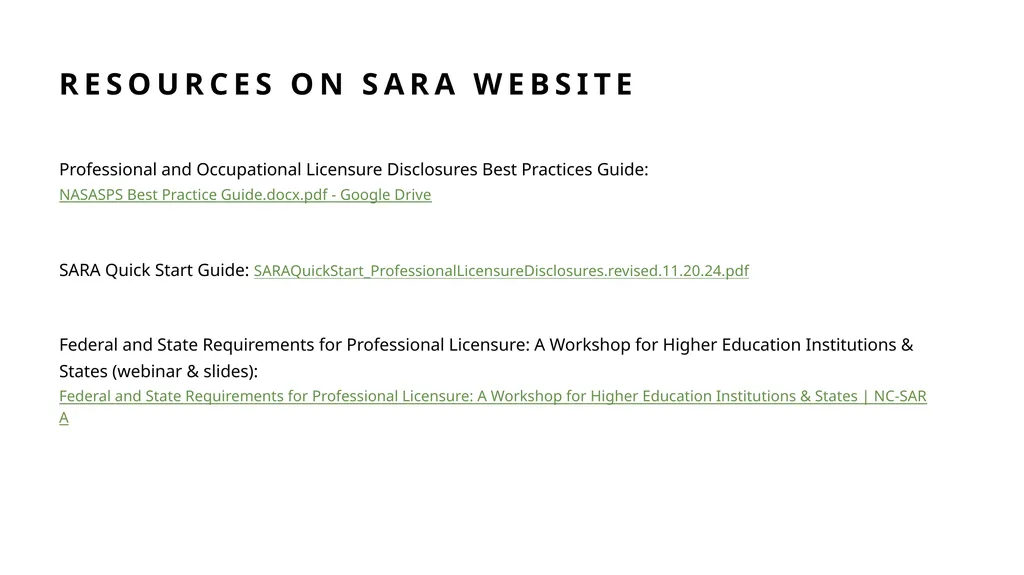
Resources on sara website Professional and Occupational Licensure Disclosures Best Practices Guide: NASASPS Best Practice Guide.docx.pdf - Google Drive
SARA Quick Start Guide: SARAQuickStart_ProfessionalLicensureDisclosures.revised.11.20.24.pdf
Federal and State Requirements for Professional Licensure: A Workshop for Higher Education Institutions & States (webinar & slides):Federal and State Requirements for Professional Licensure: A Workshop for Higher Education Institutions & States | NC-SARA<br>
SARA Quick Start Guide: SARAQuickStart_ProfessionalLicensureDisclosures.revised.11.20.24.pdf
Federal and State Requirements for Professional Licensure: A Workshop for Higher Education Institutions & States (webinar & slides):Federal and State Requirements for Professional Licensure: A Workshop for Higher Education Institutions & States | NC-SARA<br>
19
US Department of Education
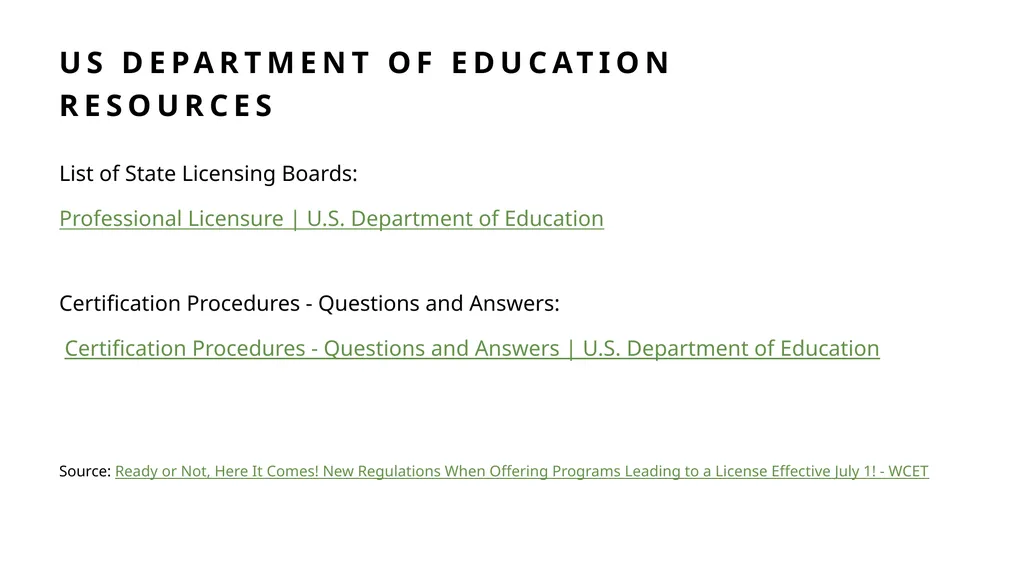
Resources List of State Licensing Boards:
Professional Licensure | U.S. Department of Education
Certification Procedures - Questions and Answers:
Certification Procedures - Questions and Answers | U.S. Department of Education
Source: Ready or Not, Here It Comes! New Regulations When Offering Programs Leading to a License Effective July 1! - WCET<br>
Professional Licensure | U.S. Department of Education
Certification Procedures - Questions and Answers:
Certification Procedures - Questions and Answers | U.S. Department of Education
Source: Ready or Not, Here It Comes! New Regulations When Offering Programs Leading to a License Effective July 1! - WCET<br>
20
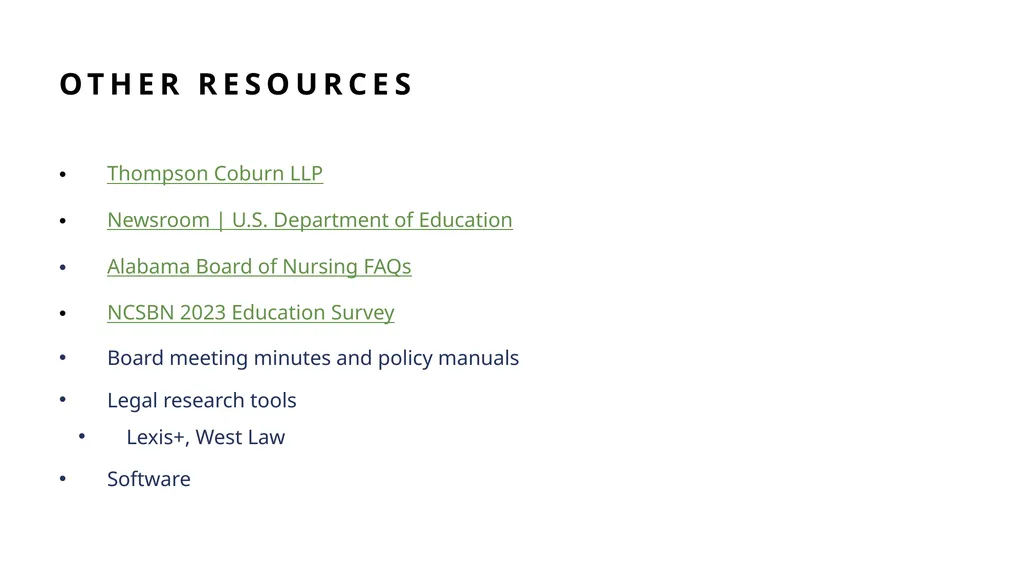
Other resources Thompson Coburn LLP
Newsroom | U.S. Department of Education
Alabama Board of Nursing FAQs
NCSBN 2023 Education Survey
Board meeting minutes and policy manuals
Legal research tools
Lexis+, West Law
Software<br>
Newsroom | U.S. Department of Education
Alabama Board of Nursing FAQs
NCSBN 2023 Education Survey
Board meeting minutes and policy manuals
Legal research tools
Lexis+, West Law
Software<br>
21
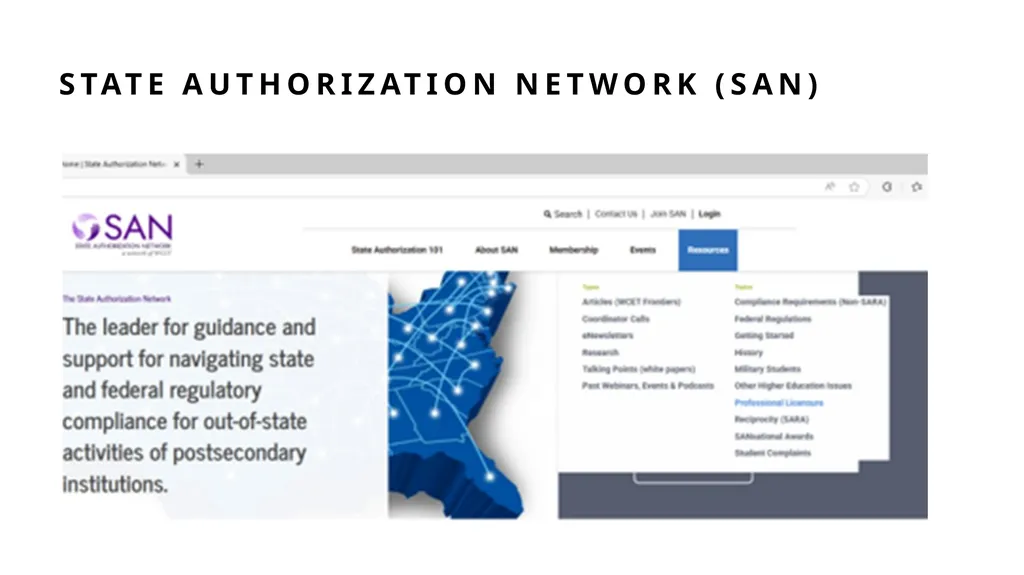
State authorization network (SAN)<br>
22
Institutional Support Primary Compliance Contact
Coordination and Liaison
Accountability<br>
Coordination and Liaison
Accountability<br>
23
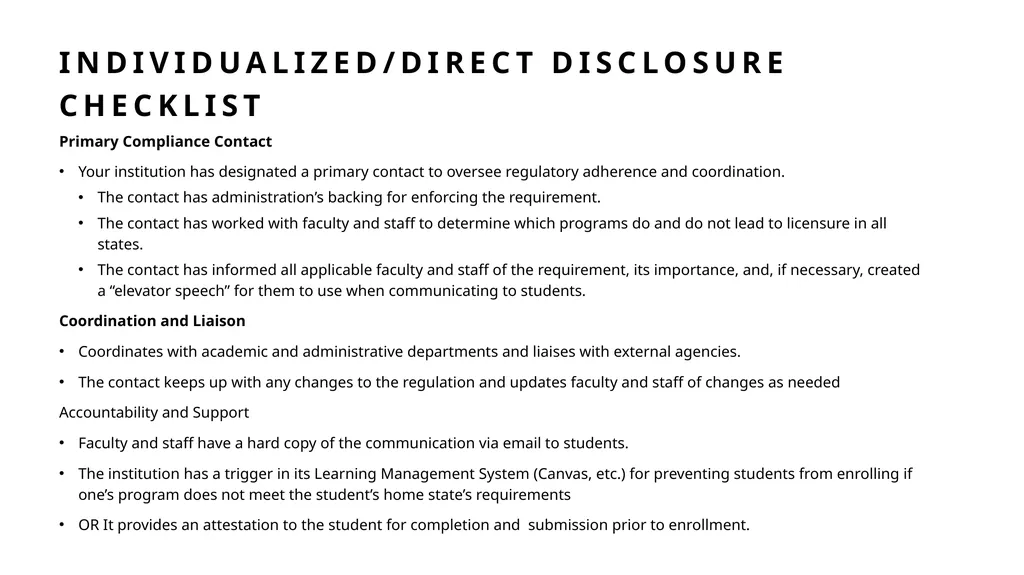
Individualized/Direct Disclosure Checklist Primary Compliance Contact
Your institution has designated a primary contact to oversee regulatory adherence and coordination.
The contact has administration’s backing for enforcing the requirement.
The contact has worked with faculty and staff to determine which programs do and do not lead to licensure in all states.
The contact has informed all applicable faculty and staff of the requirement, its importance, and, if necessary, created a “elevator speech” for them to use when communicating to students.
Coordination and Liaison
Coordinates with academic and administrative departments and liaises with external agencies.
The contact keeps up with any changes to the regulation and updates faculty and staff of changes as needed
Accountability and Support
Faculty and staff have a hard copy of the communication via email to students.
The institution has a trigger in its Learning Management System (Canvas, etc.) for preventing students from enrolling if one’s program does not meet the student’s home state’s requirements
OR It provides an attestation to the student for completion and submission prior to enrollment.<br>
Your institution has designated a primary contact to oversee regulatory adherence and coordination.
The contact has administration’s backing for enforcing the requirement.
The contact has worked with faculty and staff to determine which programs do and do not lead to licensure in all states.
The contact has informed all applicable faculty and staff of the requirement, its importance, and, if necessary, created a “elevator speech” for them to use when communicating to students.
Coordination and Liaison
Coordinates with academic and administrative departments and liaises with external agencies.
The contact keeps up with any changes to the regulation and updates faculty and staff of changes as needed
Accountability and Support
Faculty and staff have a hard copy of the communication via email to students.
The institution has a trigger in its Learning Management System (Canvas, etc.) for preventing students from enrolling if one’s program does not meet the student’s home state’s requirements
OR It provides an attestation to the student for completion and submission prior to enrollment.<br>
24
EXAMPLES of Disclosures<br>
25
Takeaways Determine who is responsible for compliance
Involve faculty; they have the expertise
Determine which programs do and do not lead to licensure in all states.
Review program and course descriptions
Have a single landing page for all disclosures
Those communicating with prospective and enrolled students should have an “elevator speech” to use.
Staff need to be trained on what not to say<br>
Involve faculty; they have the expertise
Determine which programs do and do not lead to licensure in all states.
Review program and course descriptions
Have a single landing page for all disclosures
Those communicating with prospective and enrolled students should have an “elevator speech” to use.
Staff need to be trained on what not to say<br>