Professor Karen Broadhurst OBE Centre for Child and Family Justice Research Lancaster University A New-born Baby Protocol for England Wales A Research Perspective Coram Chambers 20th May 2026 Professor Karen Broadhurst, OBE. Centre for
"Professor Karen Broadhurst OBE Centre for Child" is the property of its rightful owner. Permission is granted to
download and print the materials on this website for personal, non-commercial use only, and to display it
on your personal computer provided you do not modify the materials and that you retain all copyright
notices contained in the materials. By downloading content from our website, you accept the terms of this
agreement.
Presentation Transcript
01
Professor Karen Broadhurst OBE
Centre for Child and Family Justice Research Lancaster University<br>
02
A New-born Baby Protocol for England & Wales A Research Perspective Coram Chambers 20th May 2026
Professor Karen Broadhurst, OBE.
Centre for Child and Family Justice Research, Lancaster University.<br>
03
A welcome development Successive studies in the Born into Care series evidence:
Wide variation in the timing of pre-birth intervention & fragmented services
Practice which is not consistently inclusive or proportionate at birth
Checks and balances too frequently compromised
Major questions regarding full parental participation<br>
04
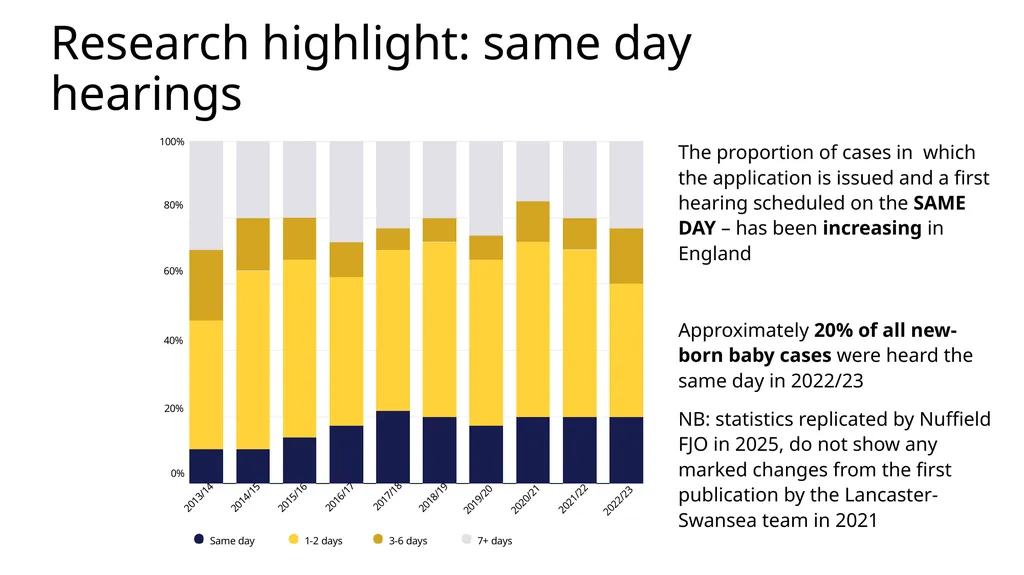
The proportion of cases in which the application is issued and a first hearing scheduled on the SAME DAY – has been increasing in England
Approximately 20% of all new-born baby cases were heard the same day in 2022/23
NB: statistics replicated by Nuffield FJO in 2025, do not show any marked changes from the first publication by the Lancaster-Swansea team in 2021 Research highlight: same day hearings Same day 1-2 days 3-6 days 7+ days<br>
05
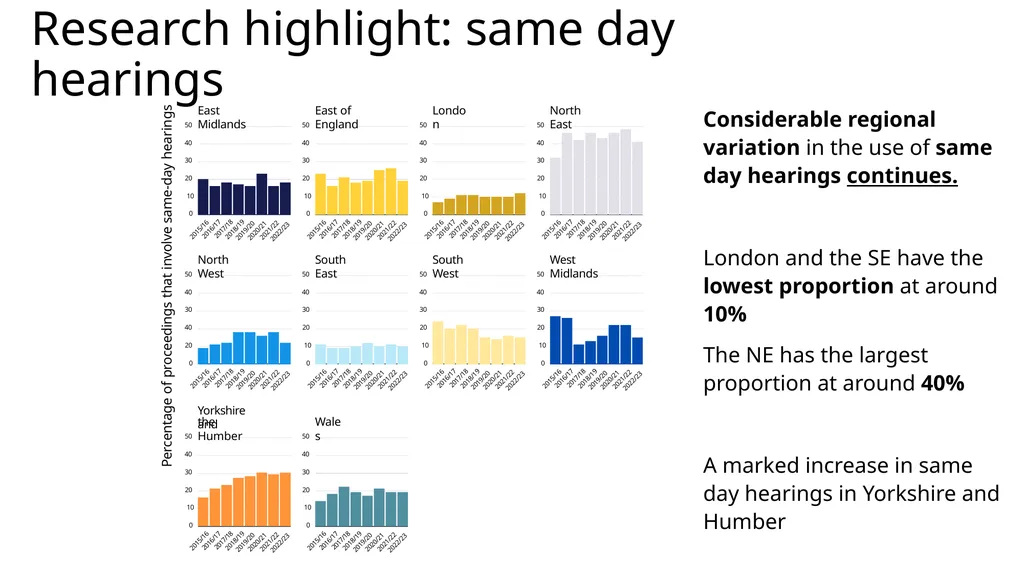
Research highlight: same day hearings Considerable regional variation in the use of same day hearings continues.
London and the SE have the lowest proportion at around 10%
The NE has the largest proportion at around 40%
A marked increase in same day hearings in Yorkshire and Humber 2015/16 2016/17 2017/18 2018/19 2019/20 2020/21 2021/22 2022/23 0 10 20 30 40 50 North East 2015/16 2016/17 2017/18 2018/19 2019/20 2020/21 2021/22 2022/23 0 10 20 30 40 50 London 2015/16 2016/17 2017/18 2018/19 2019/20 2020/21 2021/22 2022/23 0 10 20 30 40 50 East of England 2015/16 2016/17 2017/18 2018/19 2019/20 2020/21 2021/22 2022/23 0 10 20 30 40 50 East Midlands 2015/16 2016/17 2017/18 2018/19 2019/20 2020/21 2021/22 2022/23 0 10 20 30 40 50 West Midlands 2015/16 2016/17 2017/18 2018/19 2019/20 2020/21 2021/22 2022/23 0 10 20 30 40 50 South East 2015/16 2016/17 2017/18 2018/19 2019/20 2020/21 2021/22 2022/23 0 10 20 30 40 50 South West 2015/16 2016/17 2017/18 2018/19 2019/20 2020/21 2021/22 2022/23 0 20 40 30 40 50 North West 2015/16 2016/17 2017/18 2018/19 2019/20 2020/21 2021/22 2022/23 0 10 20 30 40 50 Yorkshire and the Humber 2015/16 2016/17 2017/18 2018/19 2019/20 2020/21 2021/22 2022/23 0 10 20 30 40 50 Wales Percentage of proceedings that involve same-day hearings<br>
06
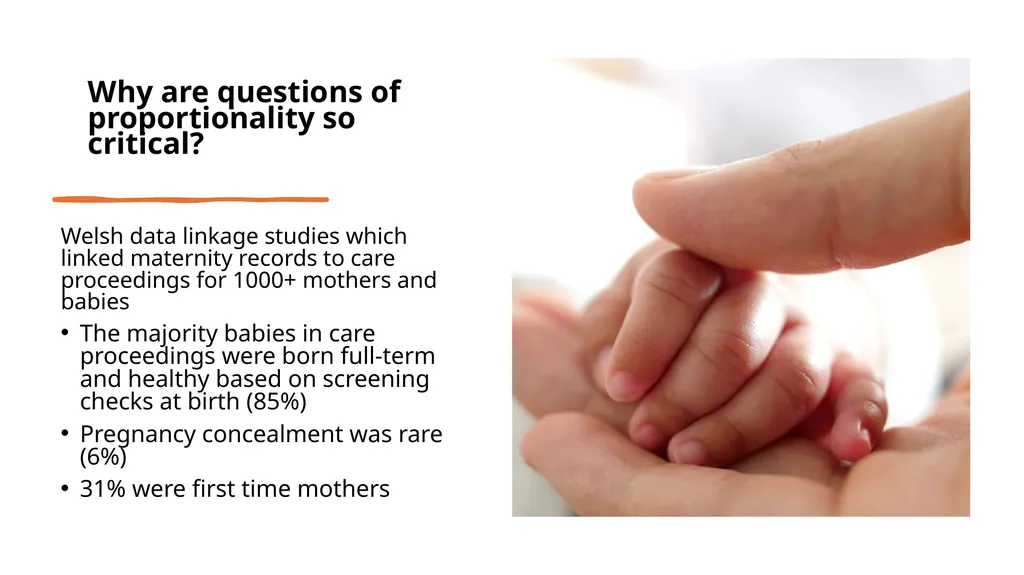
Why are questions of proportionality so critical? Welsh data linkage studies which linked maternity records to care proceedings for 1000+ mothers and babies
The majority babies in care proceedings were born full-term and healthy based on screening checks at birth (85%)
Pregnancy concealment was rare (6%)
31% were first time mothers<br>
07
Why are questions of proportionality so critical? In a proportion of new-born baby care cases – it is very clear that immediate removal at birth is the RIGHT decision
However – there is an equal if not greater proportion of cases – where it is far less clear:
A. How the parents will respond to the birth of the baby
B. Whether parents can/cannot respond to help and make the changes required (truncated assessment window and anticipatory harm)
C. Assessment is not complete<br>
08
Consistent Professional Concerns<br>
09
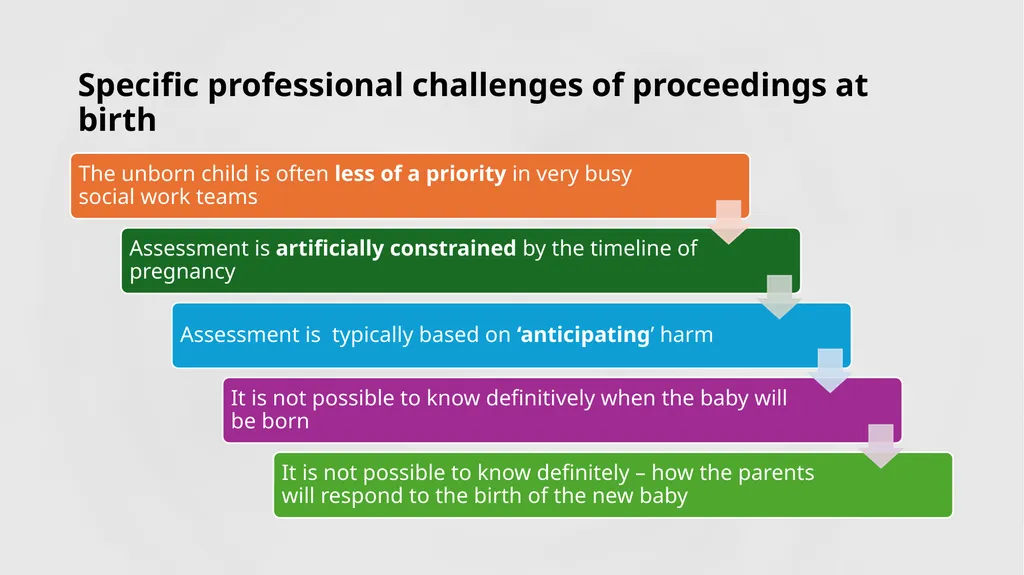
Specific professional challenges of proceedings at birth<br>
10
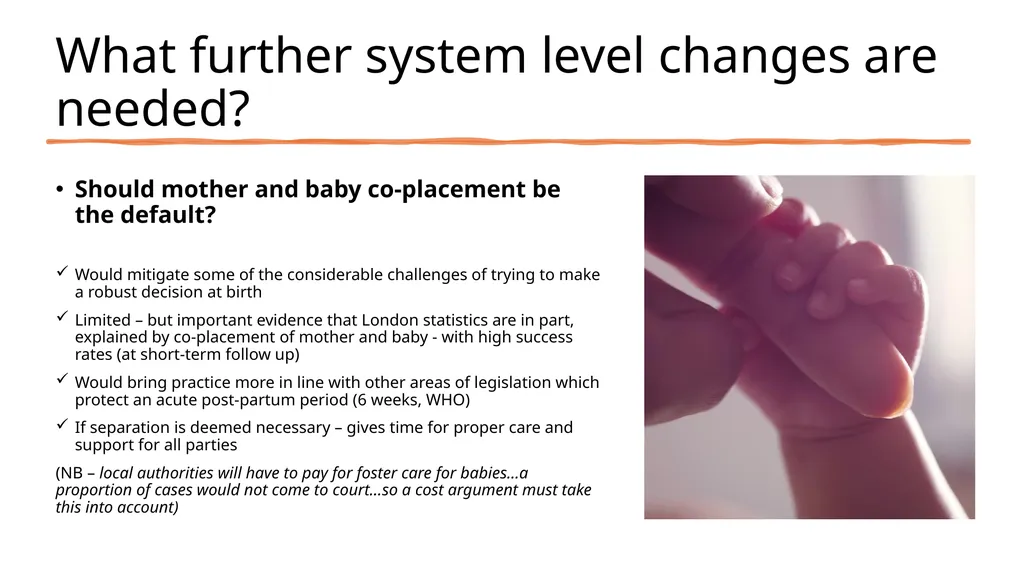
What further system level changes are needed? Should mother and baby co-placement be the default?
Would mitigate some of the considerable challenges of trying to make a robust decision at birth
Limited – but important evidence that London statistics are in part, explained by co-placement of mother and baby - with high success rates (at short-term follow up)
Would bring practice more in line with other areas of legislation which protect an acute post-partum period (6 weeks, WHO)
If separation is deemed necessary – gives time for proper care and support for all parties
(NB – local authorities will have to pay for foster care for babies…a proportion of cases would not come to court…so a cost argument must take this into account)<br>
11
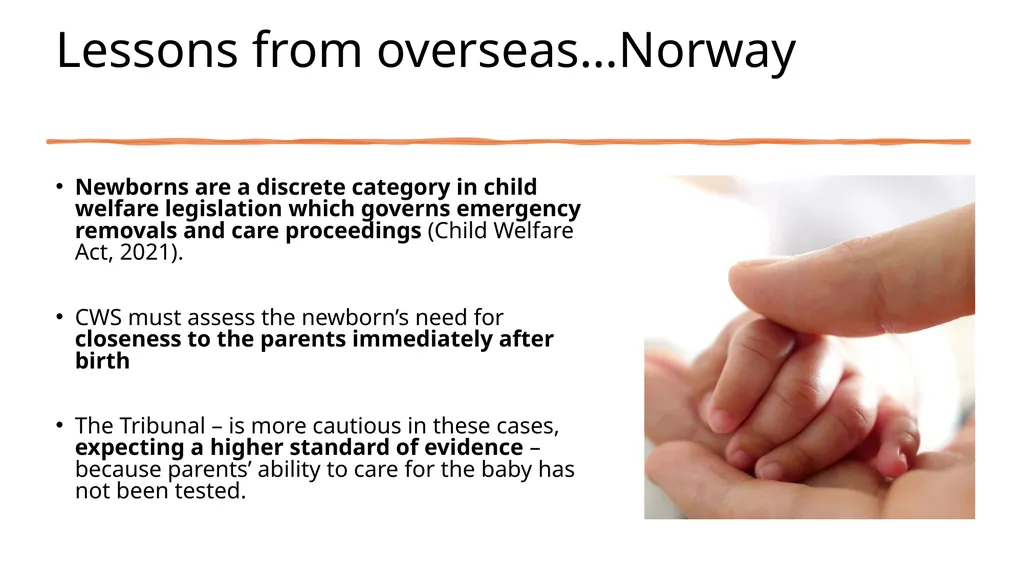
Lessons from overseas…Norway Newborns are a discrete category in child welfare legislation which governs emergency removals and care proceedings (Child Welfare Act, 2021).
CWS must assess the newborn’s need for closeness to the parents immediately after birth
The Tribunal – is more cautious in these cases, expecting a higher standard of evidence – because parents’ ability to care for the baby has not been tested.<br>
12
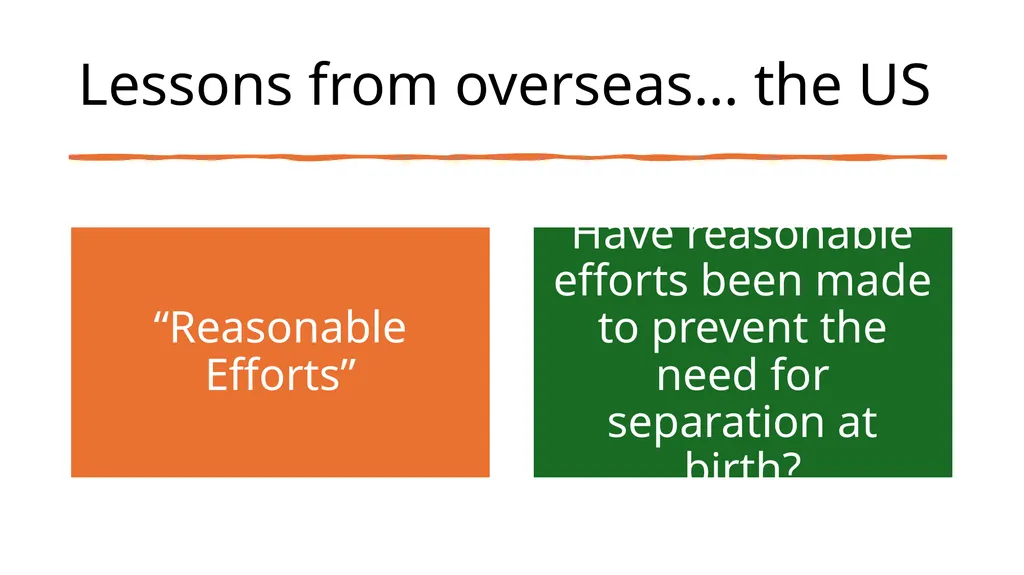
Lessons from overseas… the US<br>
13
Lessons from overseas New Zealand Indigenous family-led design and delivery – strong emphasis on peer/community advocacy and support for kinship placements
Changes to policy and practice centrally(govt) mandated
Major drop in new-born removals from indigenous communities<br>
14
Book Launch: Online, 10th of June 5pm – 6.30pm Publication date 26th of May (open access e-book)
Buy the book at 50% discount if you attend the launch!
Register here:
https://www.lancaster.ac.uk/centre-for-child-and-family-justice-research/events/centre-for-child-and-family-justice-research-book-launch-international-perspectives-on-the-removal-of-babies-at-birth/
Any problems with registering – contact myself or Jodi Lo - w.l.lo@Lancaster.ac.uk<br>
15
References (free open access) Karen Broadhurst, Claire Mason, Harriet Ward (2022), Urgent Care Proceedings for New-born Babies in England and Wales – Time for a Fundamental Review, International Journal of Law, Policy and the Family, Volume 36, Issue 1, ebac008, https://doi.org/10.1093/lawfam/ebac008
Pattinson, R. et al. (2021) Newborn babies in urgent care proceedings at birth. London: Nuffield Family Justice Observatory. https://www.nuffieldfjo.org.uk/resource/newborn-babies-urgent-care-proceedings<br>