Programming Tools Most of the programming assignments will require using the C language. We will use a current version of the GCC C compiler. Whats GCC? - the Gnu Compiler Collection (see gcc.gnu.org) - a collection of freeware software
"Programming Tools Most of the programming" is the property of its rightful owner. Permission is granted to
download and print the materials on this website for personal, non-commercial use only, and to display it
on your personal computer provided you do not modify the materials and that you retain all copyright
notices contained in the materials. By downloading content from our website, you accept the terms of this
agreement.
Presentation Transcript
01
Programming Tools Most of the programming assignments will require using the C language.
We will use a current version of the GCC C compiler.
What’s GCC?
- the Gnu Compiler Collection (see gcc.gnu.org)
- a collection of freeware software development tools, including support for C, C++, Objective-C, Fortran, Java, and Ada
- available as part of all Linux and most UNIX-derived operating systems
How do you get it?
- run Linux
- use a remote Linux environment (rlogin cluster)
You will have to use the CS Department’s rlogin cluster for some assignments in any case.<br>
02
Linux Read Chapter 1 of the Sobell book for a history of Linux… really…
There are many Linux distributions (distros)… superiority is a matter of religion.
- the CS Department’s rlogin cluster and other servers (more later) are running CentOS
- I use CentOS
- CentOS will be the official platform for testing your assignments
- If you run another distro, any difficulties that arise will be your problem
Linux distributions come in 32-bit and 64-bit versions; I recommend running 64-bit, but that will entail your installing some additional packages.
In any case, we require you to run CentOS on your own computer.
If you do not do so, expect to have problems.<br>
03
Running Linux on a Windows Host Here’s my advice:
- Install VirtualBox (virtualbox.org).
- I'm using version 4.3.28, but earlier versions should be fine.
- Follow the installation instructions carefully.
- Download a CD/DVD image for installing your chosen distro.
- I used CentOS-7-x86_64-DVD-1503-01.iso.
- Follow the instructions in the VirtualBox manual:
- for installing a guest OS on Windows
- for installing the VirtualBox Guest Additions (these are essential)
Once you’re done, you can boot and run Linux within a virtual machine.
This minimizes your chances of disrupting your existing system setup.
This works best if your computer has at least 2GB of RAM.<br>
04
Running Linux on an OS X Host Essentially, follow the instructions for a Windows Host, but install the version of VirtualBox for OS X.
Note:
- OS X is not Linux (or UNIX), and that prior students have experienced issues when trying to use the OS X native version of the GCC C compiler in this course.
- Those problems will go away if you run Linux.
- If you decline to do that, you may have to use the rlogin cluster (more later) for all of the UNIX-related and C programming assignments.<br>
05
Dual-booting Linux with Windows You may also install Linux so that you can choose between Linux and Windows when you boot your computer.
The website for your chosen Linux distro will include installation instructions for dual-booting.
This generally works as advertised as long as:
- Your computer does not have any unusual issues, especially with respect to the partitioning of the hard disk.
- You follow the instructions carefully.
That said…
- YMMV.
- I have had dual-boot installations go sour and trash my system.
- Using VirtualBox (or some other virtualization software) allows you to switch seamlessly between your native host OS and Linux.<br>
06
Safer Dual-booting Linux You may also install Linux so that you can boot it from a CD or a flash drive.
The website for your favorite distro will have instructions for creating a bootable CD installation (often called a Live CD).
This doesn’t usually give you the ability to update or save changes.
See pendrivelinux.com for instructions on creating a bootable Linux flash drive.
This generally works as advertised as long as you follow the instructions carefully.
This should pose no risk to your existing machine setup.
That said…
- YMMV.
- With some distros it is allegedly possible to perform updates and save changes. YMMV with this as well.<br>
07
SLO Accounts The CS Department uses a single-logon system (SLO) for many of its resources.
If you are a CS major and have previously taken a CS course at VT, you should already have an account.
If not, or if you’ve forgotten your SLO password, go to the following link and rectify the problem:
https://admin.cs.vt.edu/
Note that you will need this to access some of the resources necessary for this course.<br>
08
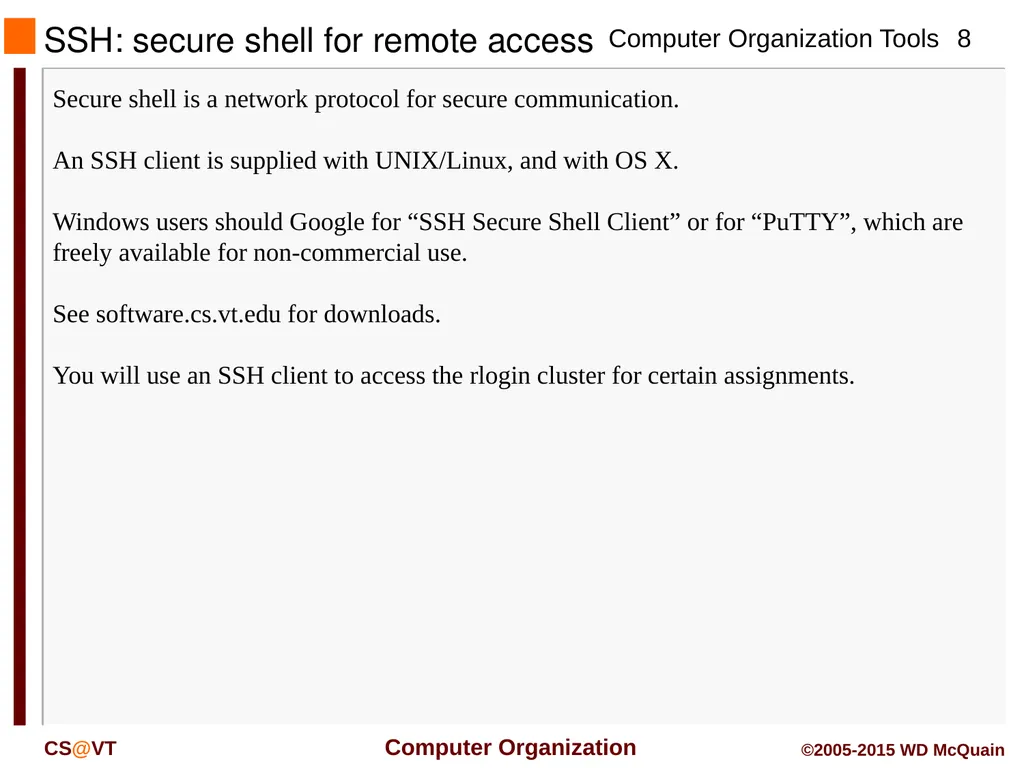
SSH: secure shell for remote access Secure shell is a network protocol for secure communication.
An SSH client is supplied with UNIX/Linux, and with OS X.
Windows users should Google for “SSH Secure Shell Client” or for “PuTTY”, which are freely available for non-commercial use.
See software.cs.vt.edu for downloads.
You will use an SSH client to access the rlogin cluster for certain assignments.<br>
09
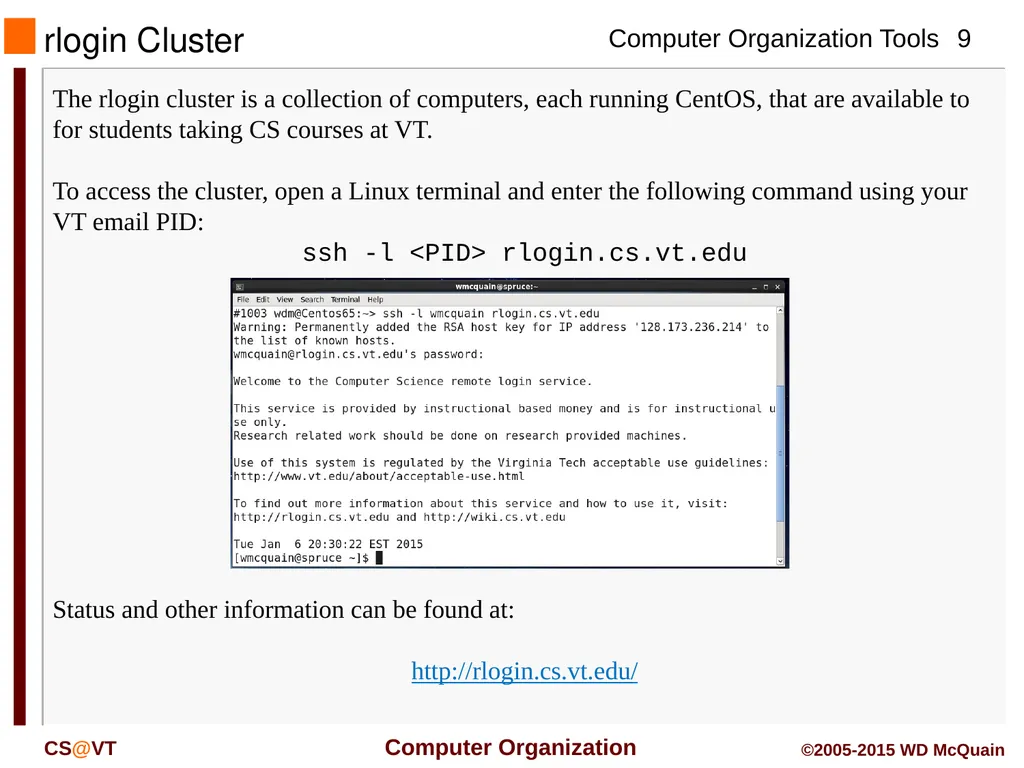
rlogin Cluster The rlogin cluster is a collection of computers, each running CentOS, that are available to for students taking CS courses at VT.
To access the cluster, open a Linux terminal and enter the following command using your VT email PID:
ssh -l <PID> rlogin.cs.vt.edu Status and other information can be found at:
http://rlogin.cs.vt.edu/<br>
10
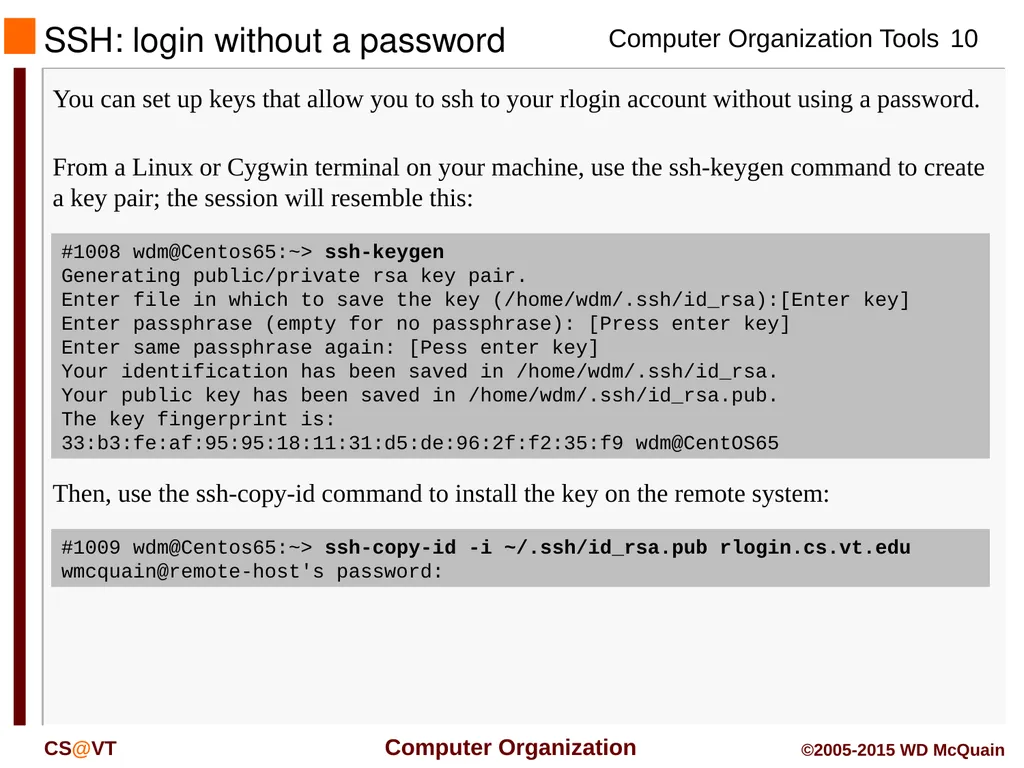
SSH: login without a password You can set up keys that allow you to ssh to your rlogin account without using a password. From a Linux or Cygwin terminal on your machine, use the ssh-keygen command to create a key pair; the session will resemble this: #1008 wdm@Centos65:~> ssh-keygen
Generating public/private rsa key pair.
Enter file in which to save the key (/home/wdm/.ssh/id_rsa):[Enter key]
Enter passphrase (empty for no passphrase): [Press enter key]
Enter same passphrase again: [Pess enter key]
Your identification has been saved in /home/wdm/.ssh/id_rsa.
Your public key has been saved in /home/wdm/.ssh/id_rsa.pub.
The key fingerprint is:
33:b3:fe:af:95:95:18:11:31:d5:de:96:2f:f2:35:f9 wdm@CentOS65 Then, use the ssh-copy-id command to install the key on the remote system: #1009 wdm@Centos65:~> ssh-copy-id -i ~/.ssh/id_rsa.pub rlogin.cs.vt.edu
wmcquain@remote-host's password:<br>
11
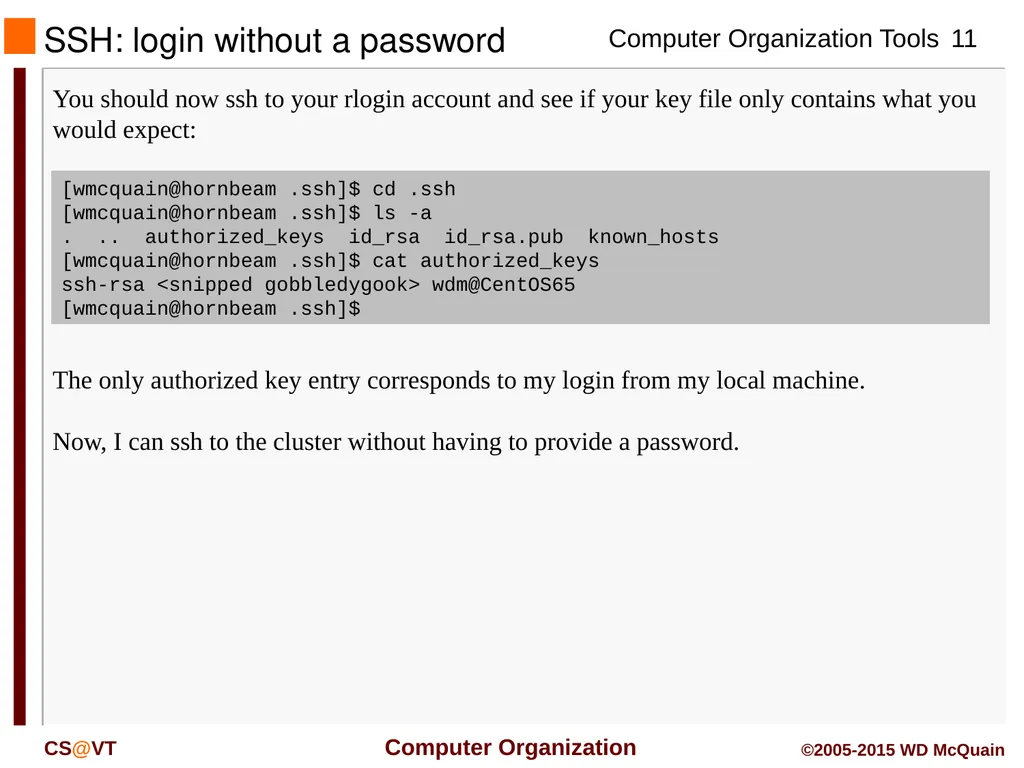
SSH: login without a password You should now ssh to your rlogin account and see if your key file only contains what you would expect: [wmcquain@hornbeam .ssh]$ cd .ssh
[wmcquain@hornbeam .ssh]$ ls -a
. .. authorized_keys id_rsa id_rsa.pub known_hosts
[wmcquain@hornbeam .ssh]$ cat authorized_keys
ssh-rsa <snipped gobbledygook> wdm@CentOS65
[wmcquain@hornbeam .ssh]$ The only authorized key entry corresponds to my login from my local machine.
Now, I can ssh to the cluster without having to provide a password.<br>
12
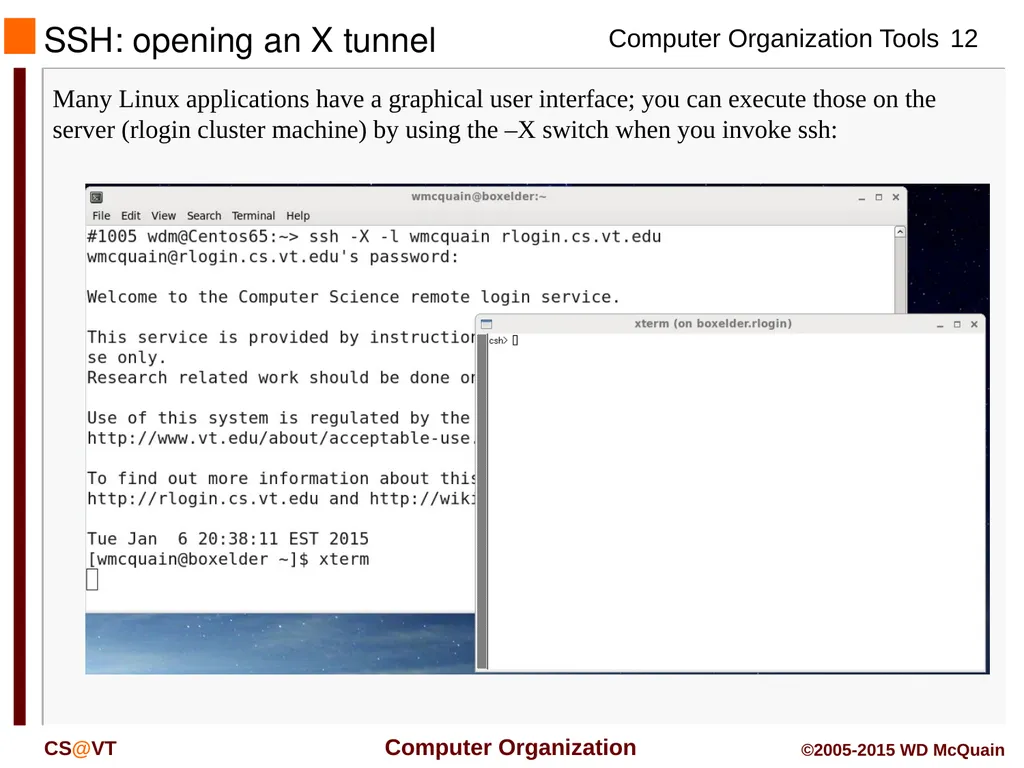
SSH: opening an X tunnel Many Linux applications have a graphical user interface; you can execute those on the server (rlogin cluster machine) by using the –X switch when you invoke ssh:<br>
13
So… Get to work!
Create an installation of Linux on your laptop/tablet.
- Use VirtualBox or not, your choice.
- Use CentOS 7
Get an SLO account (if you don't already have one) and make sure you know your password.
If you like, set up password-free login (via ssh) to your rlogin.cs.vt.edu account.<br>