
Project Development under Public Private

Description: Project Development under Public Private Partnership (PPP) Outline Understanding PPPs- what they are; key structures; perspectives Forms of partnerships: the PPP spectrum How to decide the options? International Experience Key Challenges
Related Topics
Download Presentation
"Project Development under Public Private" is the property of its rightful owner. Permission is granted to download and print the materials on this website for personal, non-commercial use only, and to display it on your personal computer provided you do not modify the materials and that you retain all copyright notices contained in the materials. By downloading content from our website, you accept the terms of this agreement.
Presentation Transcript
slide1. Project Development under Public Private Partnership
(PPP)<br>
slide2. Outline Understanding PPPs- what they are; key structures; perspectives
Forms of partnerships: the PPP spectrum
How to decide the options?
International Experience
Key Challenges<br>
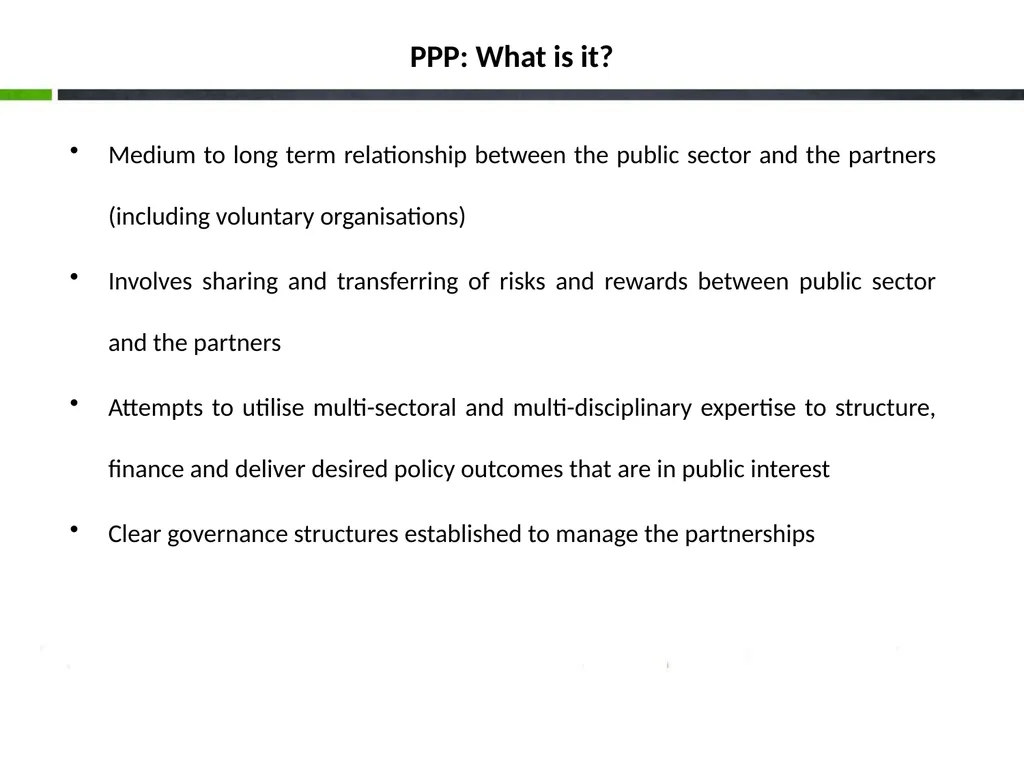
slide3. PPP: What is it? Medium to long term relationship between the public sector and the partners (including voluntary organisations)
Involves sharing and transferring of risks and rewards between public sector and the partners
Attempts to utilise multi-sectoral and multi-disciplinary expertise to structure, finance and deliver desired policy outcomes that are in public interest
Clear governance structures established to manage the partnerships<br>
slide4. PPP: What is it? It is about creating, nurturing and sustaining an effective relationship between the Government and the private sector
Achieving improved value for money by utilising the innovative capabilities and skills to deliver performance improvements and efficiency savings.
It aims to leverage private sector expertise and capital to obtain efficiency gains in service delivery and asset creation
The key contrast between PPPs and traditional procurement is that with PPPs the private sector returns are linked to service outcomes and performance of the asset over the contract life.<br>
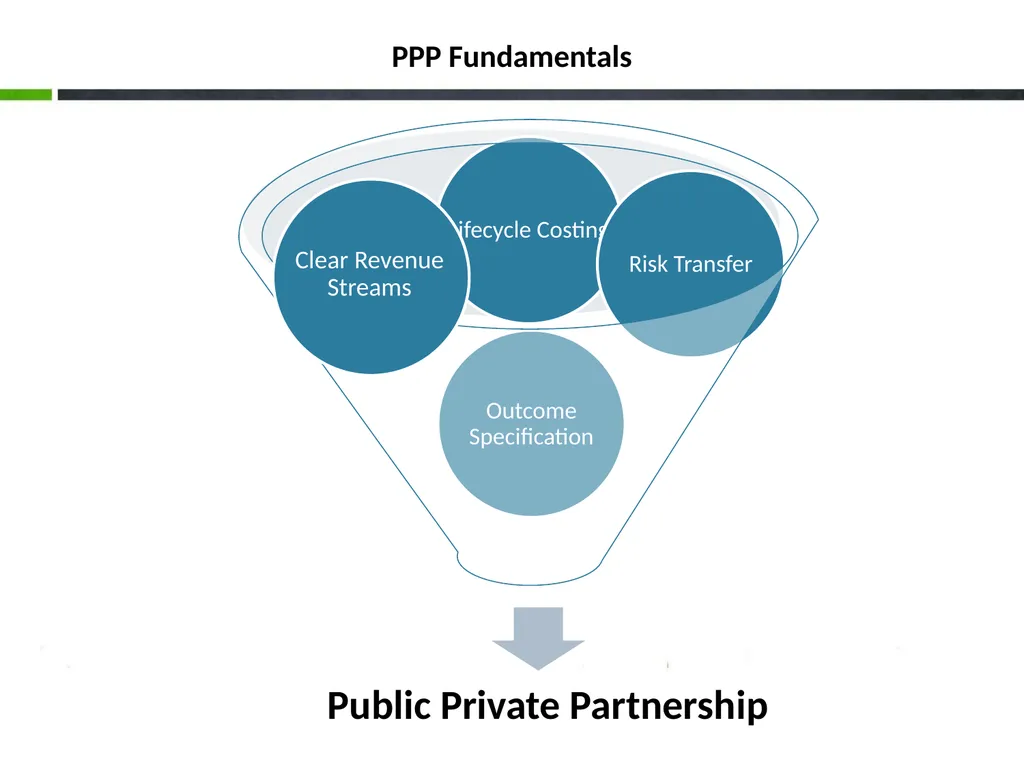
slide5. PPP Fundamentals<br>
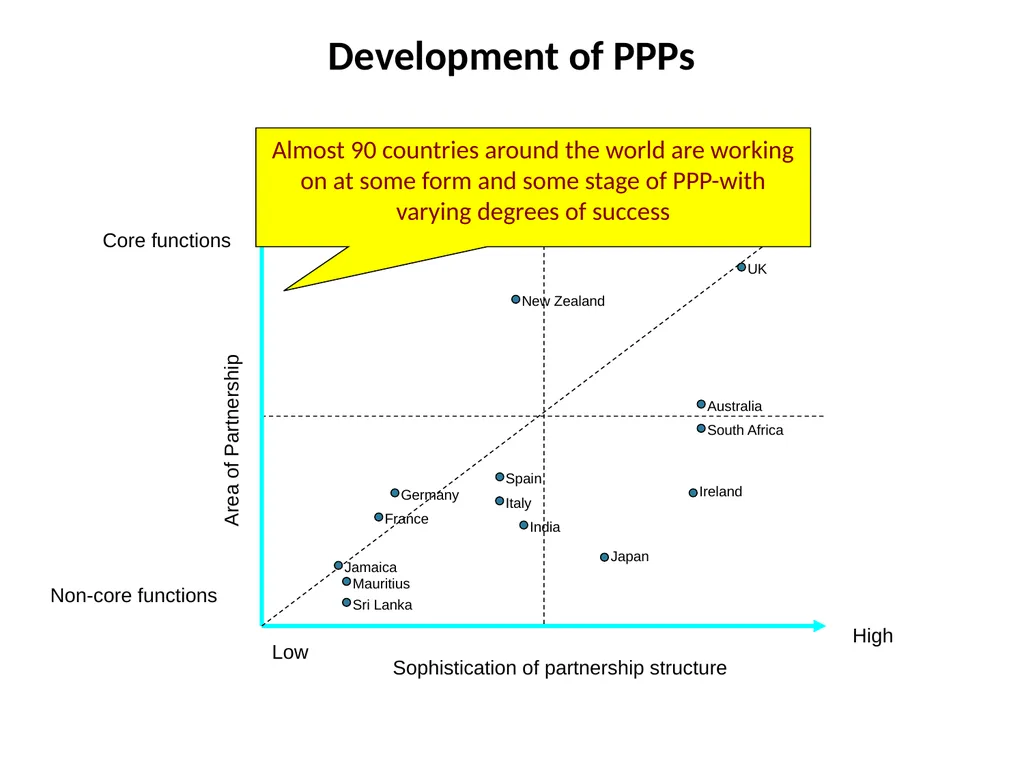
slide6. Development of PPPs Sophistication of partnership structure Low High Area of Partnership Non-core functions Core functions France Germany Italy Spain Japan Ireland South Africa Australia New Zealand UK Almost 90 countries around the world are working on at some form and some stage of PPP-with varying degrees of success India Mauritius Jamaica Sri Lanka<br>
slide7. Key structures Designed to maximize the use of Private Sector Skills
Risk placed where it can be managed best
Activities performed by those most capable
Public and Private Sector each retain their own identity
They collaborate on the basis of a clear division of tasks and risks
PPP offers to the Public Sector greater Value for Money:
PPP transaction facilitates technology transfer
Private Sector shares its experience with Public Sector
PPP delivers high quality infrastructure in the shortest possible time<br>
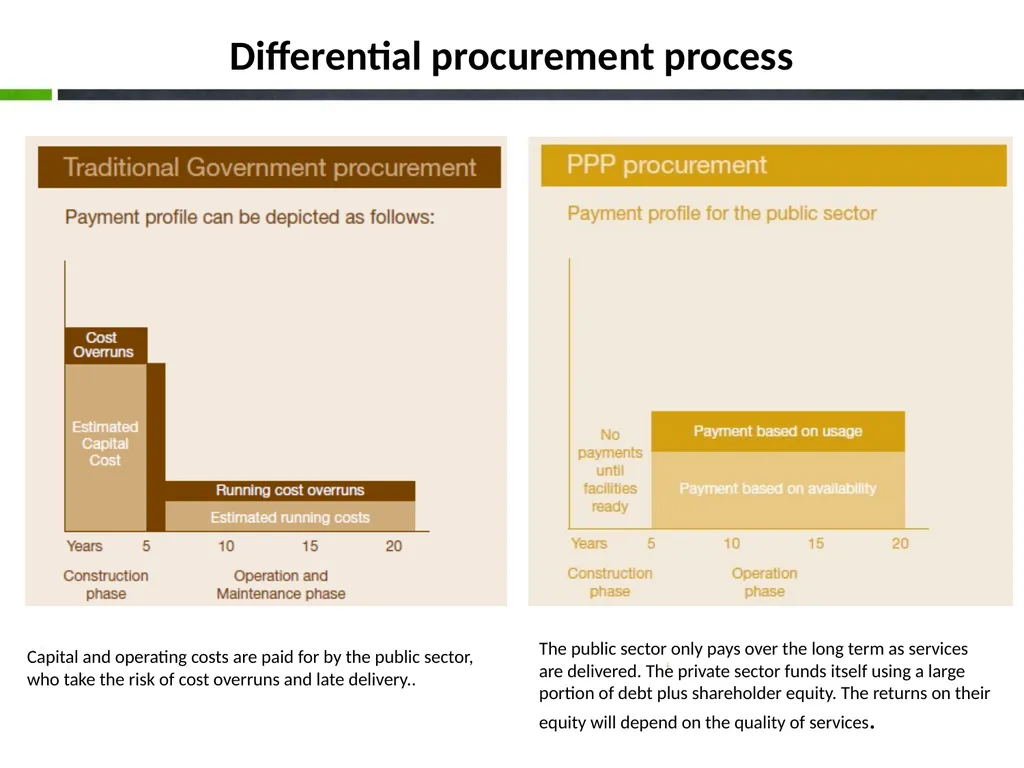
slide8. Differential procurement process Capital and operating costs are paid for by the public sector, who take the risk of cost overruns and late delivery.. The public sector only pays over the long term as services are delivered. The private sector funds itself using a large portion of debt plus shareholder equity. The returns on their equity will depend on the quality of services.<br>
slide9. Perspectives PPPs cannot be a solution for every challenge that public sector faces with regard to service delivery & infrastructure development
Countries have kept some sectors out; while others have put a floor price
PPPs play a small but important role in the overall objective of delivering modernised public services, and asset creation
Even in a mature market for PPP like UK, it represents 10-15% of total investment in public services<br>
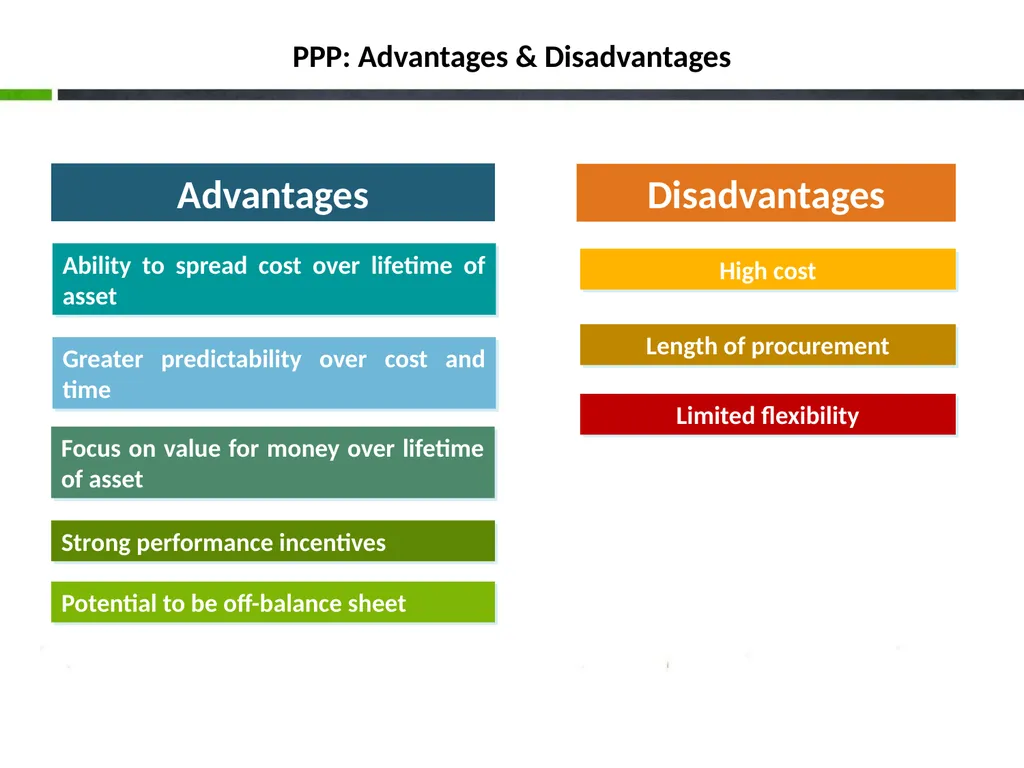
slide10. PPP: Advantages & Disadvantages Advantages Disadvantages Ability to spread cost over lifetime of asset Greater predictability over cost and time Focus on value for money over lifetime of asset Strong performance incentives Potential to be off-balance sheet High cost Limited flexibility Length of procurement<br>
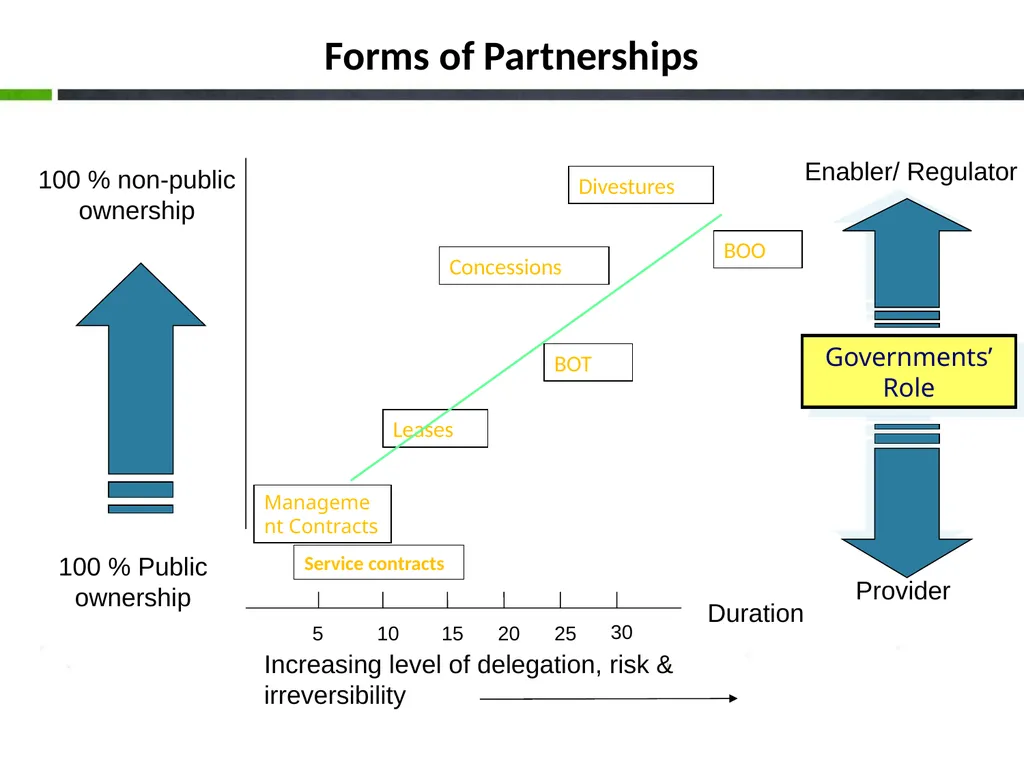
slide11. Forms of Partnerships Duration Increasing level of delegation, risk & irreversibility Service contracts Management Contracts Leases Concessions Divestures 100 % non-public ownership 100 % Public ownership 5 10 15 20 25 30 BOT BOO Governments’ Role Provider Enabler/ Regulator<br>
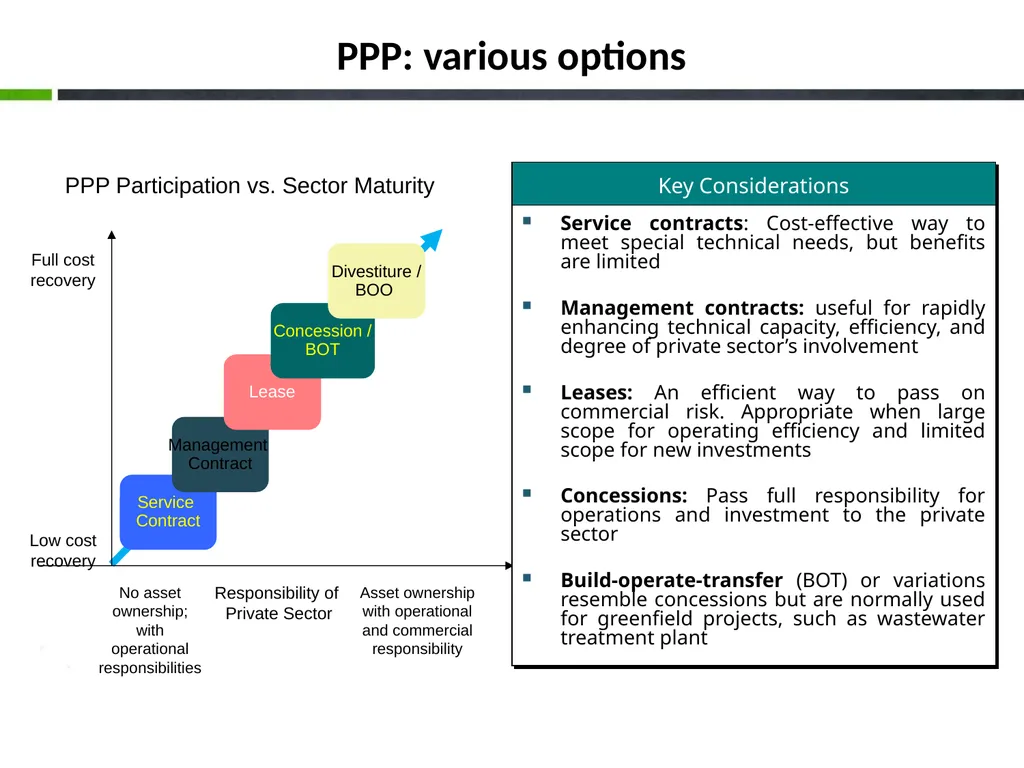
slide12. PPP: various options PPP Participation vs. Sector Maturity Responsibility of Private Sector Asset ownership with operational and commercial responsibility No asset ownership; with operational responsibilities Low cost recovery Full cost recovery Service
Contract Management
Contract Lease Concession /
BOT Divestiture /
BOO Key Considerations Service contracts: Cost-effective way to meet special technical needs, but benefits are limited
Management contracts: useful for rapidly enhancing technical capacity, efficiency, and degree of private sector’s involvement
Leases: An efficient way to pass on commercial risk. Appropriate when large scope for operating efficiency and limited scope for new investments
Concessions: Pass full responsibility for operations and investment to the private sector
Build-operate-transfer (BOT) or variations resemble concessions but are normally used for greenfield projects, such as wastewater treatment plant<br>
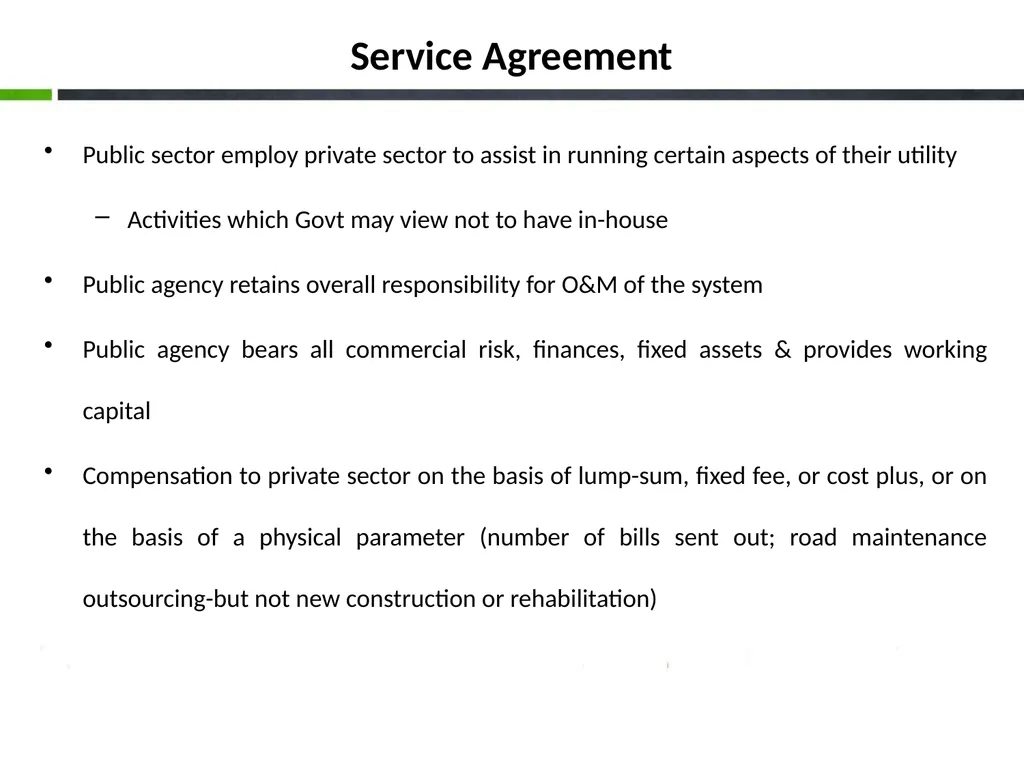
slide13. Service Agreement Public sector employ private sector to assist in running certain aspects of their utility
Activities which Govt may view not to have in-house
Public agency retains overall responsibility for O&M of the system
Public agency bears all commercial risk, finances, fixed assets & provides working capital
Compensation to private sector on the basis of lump-sum, fixed fee, or cost plus, or on the basis of a physical parameter (number of bills sent out; road maintenance outsourcing-but not new construction or rehabilitation)<br>
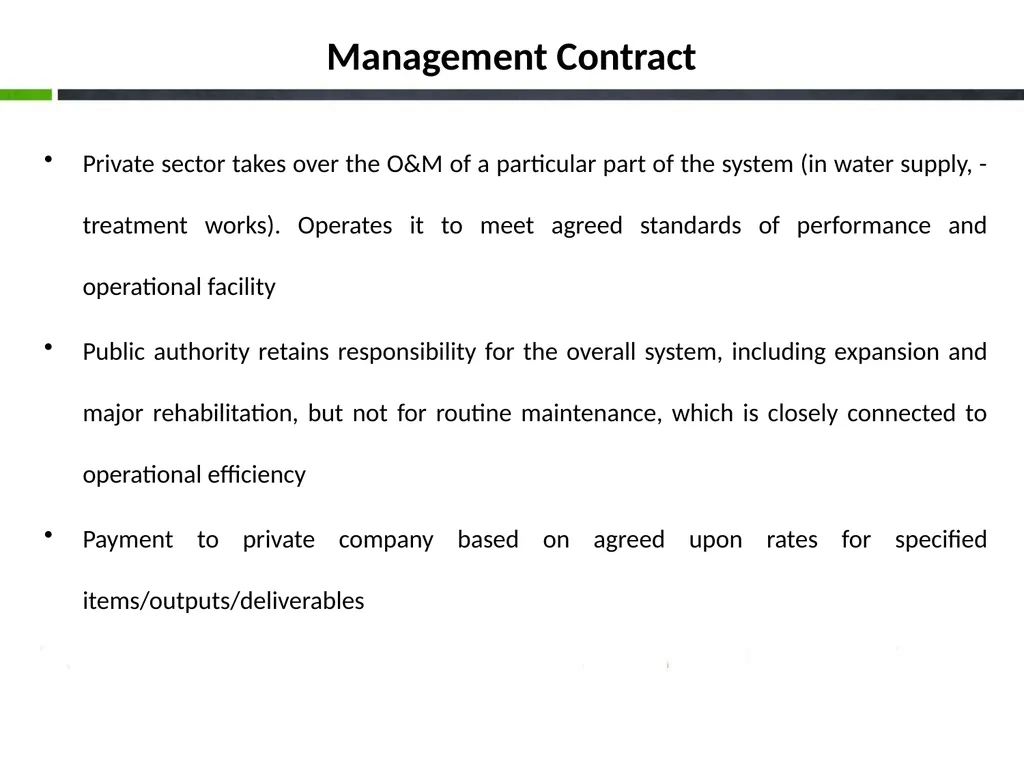
slide14. Management Contract Private sector takes over the O&M of a particular part of the system (in water supply, -treatment works). Operates it to meet agreed standards of performance and operational facility
Public authority retains responsibility for the overall system, including expansion and major rehabilitation, but not for routine maintenance, which is closely connected to operational efficiency
Payment to private company based on agreed upon rates for specified items/outputs/deliverables<br>
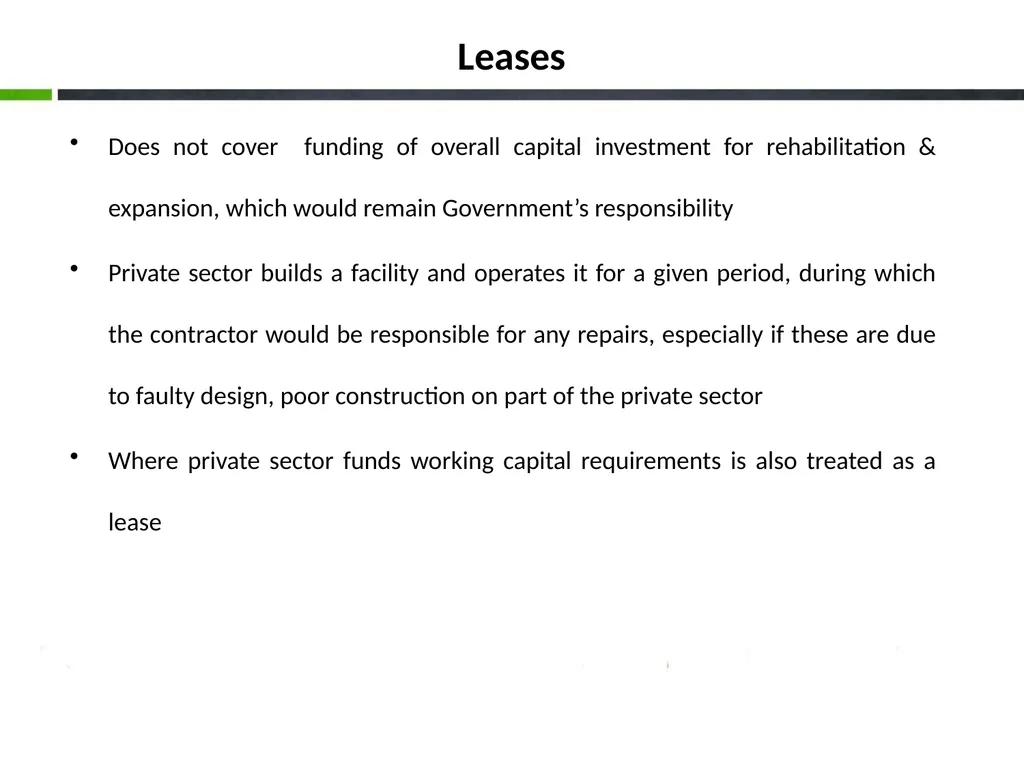
slide15. Leases Does not cover funding of overall capital investment for rehabilitation & expansion, which would remain Government’s responsibility
Private sector builds a facility and operates it for a given period, during which the contractor would be responsible for any repairs, especially if these are due to faulty design, poor construction on part of the private sector
Where private sector funds working capital requirements is also treated as a lease<br>
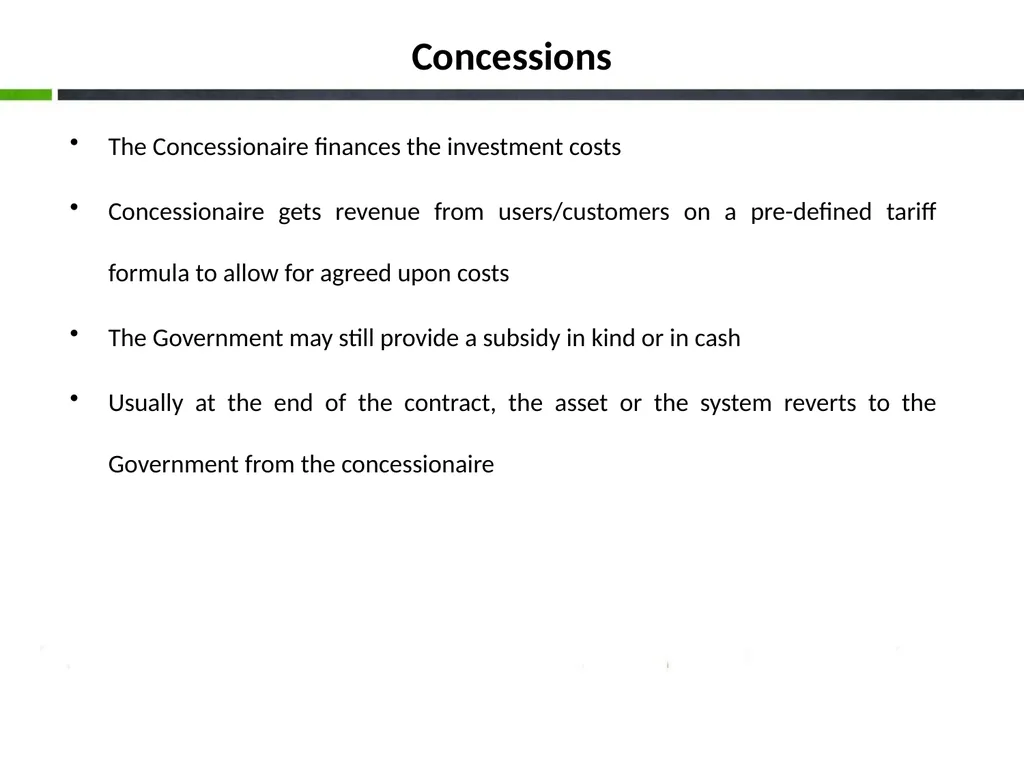
slide16. Concessions The Concessionaire finances the investment costs
Concessionaire gets revenue from users/customers on a pre-defined tariff formula to allow for agreed upon costs
The Government may still provide a subsidy in kind or in cash
Usually at the end of the contract, the asset or the system reverts to the Government from the concessionaire<br>
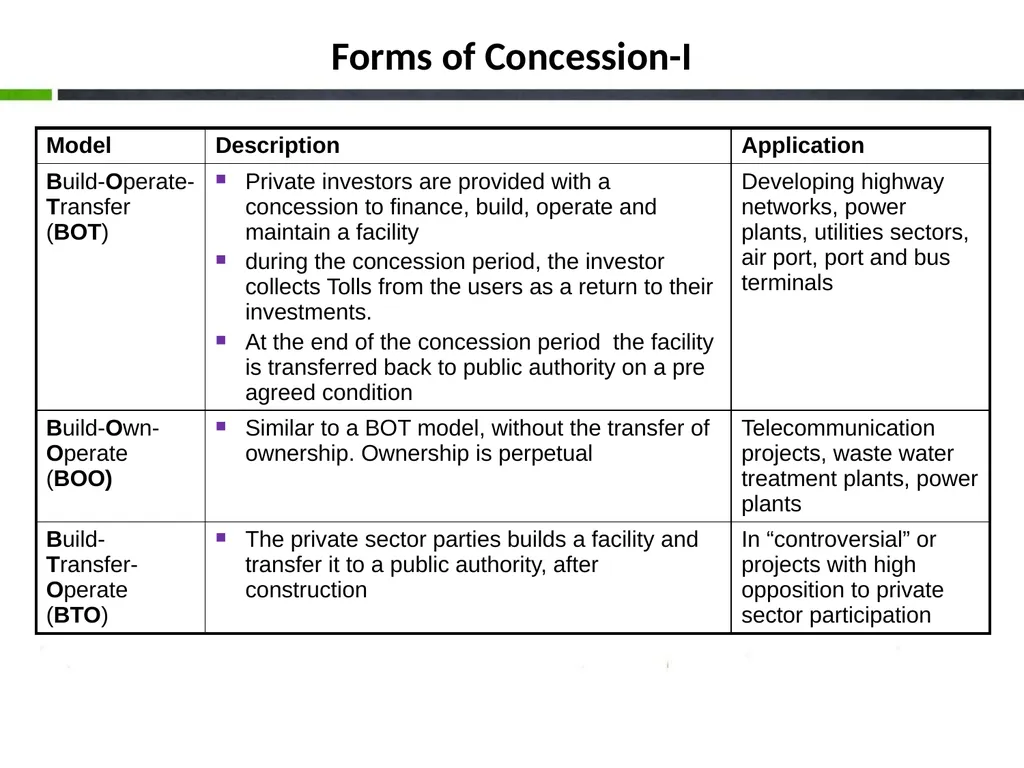
slide17. Forms of Concession-I<br>
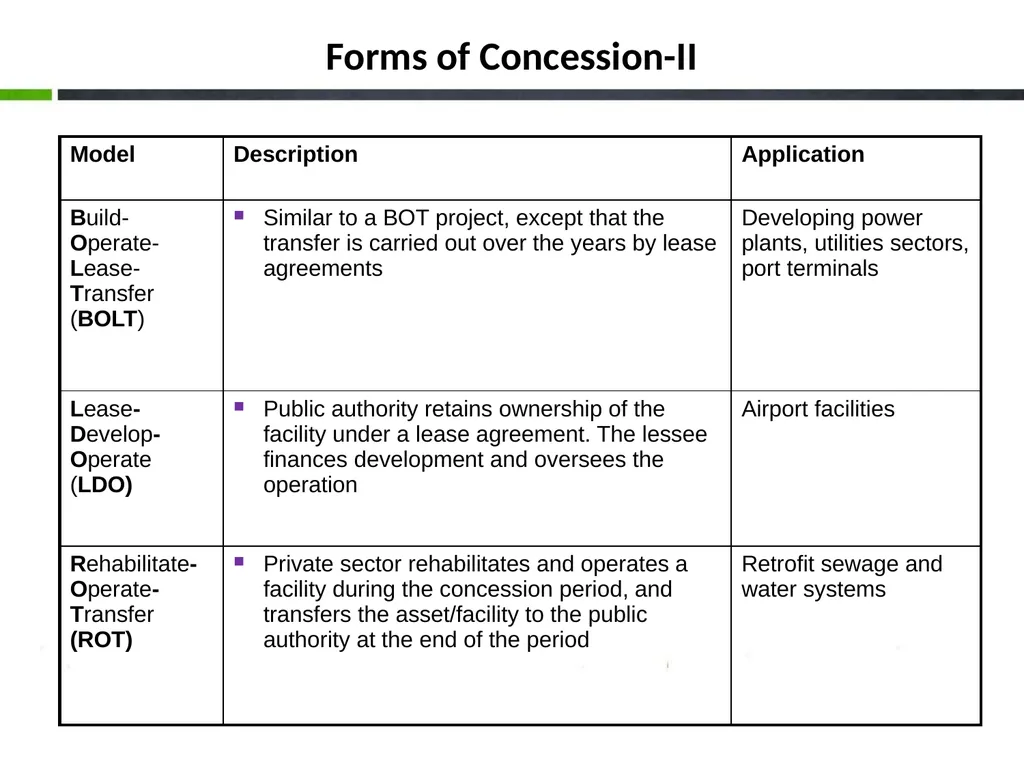
slide18. Forms of Concession-II<br>
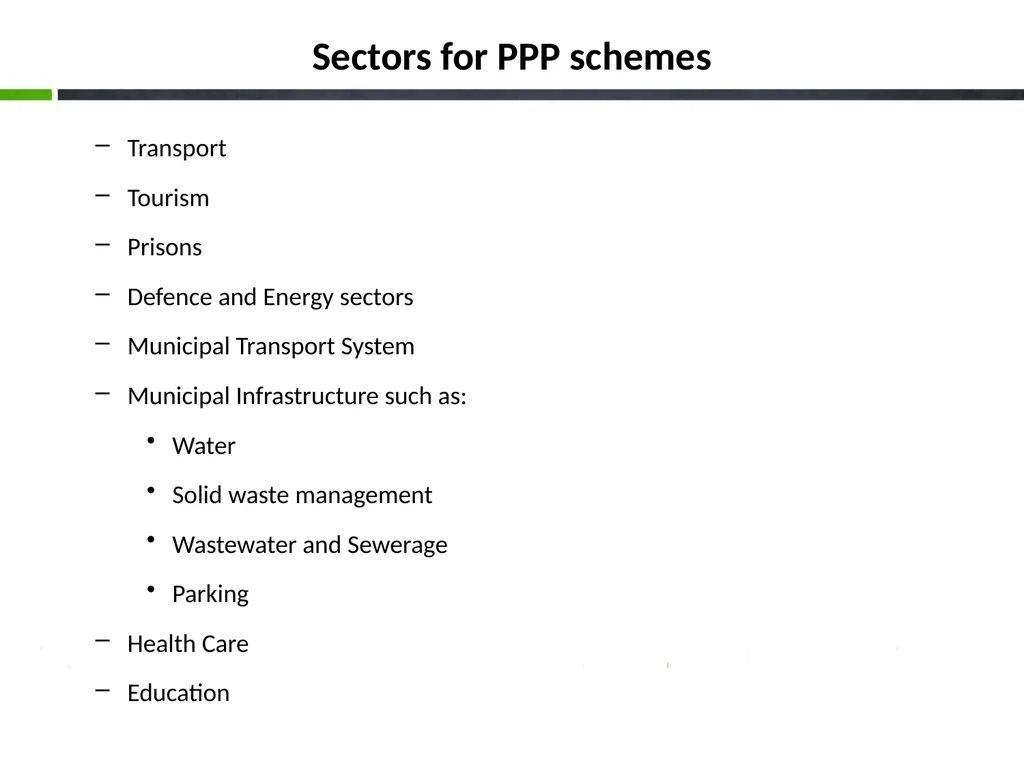
slide19. Sectors for PPP schemes Transport
Tourism
Prisons
Defence and Energy sectors
Municipal Transport System
Municipal Infrastructure such as:
Water
Solid waste management
Wastewater and Sewerage
Parking
Health Care
Education<br>
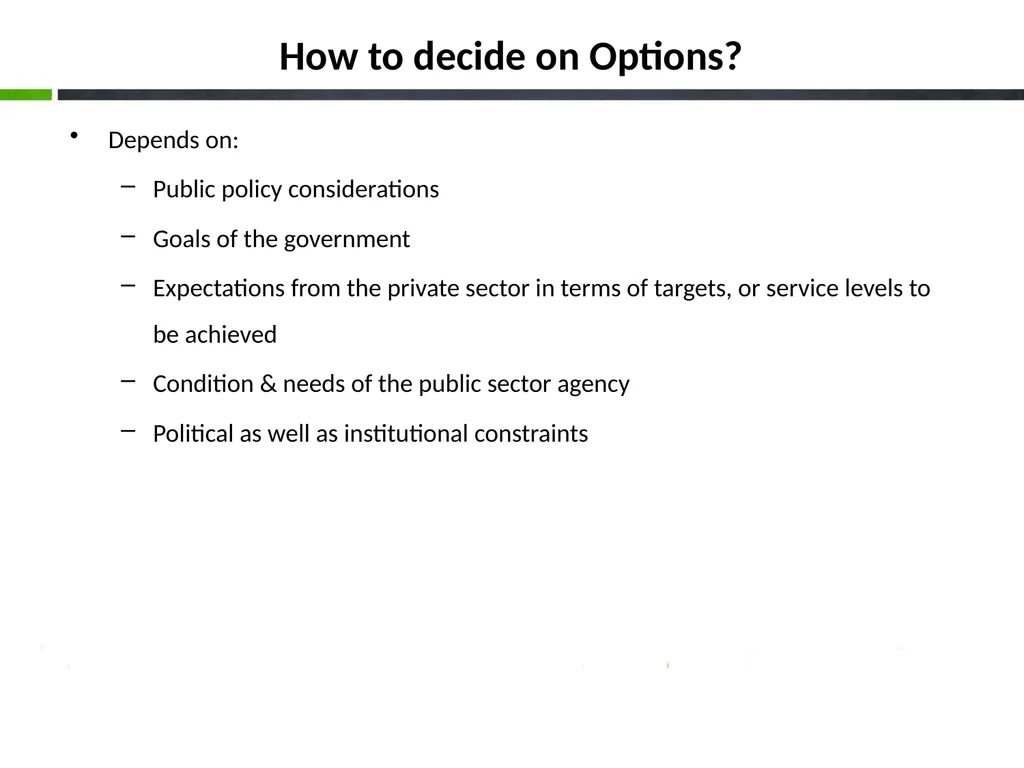
slide20. How to decide on Options? Depends on:
Public policy considerations
Goals of the government
Expectations from the private sector in terms of targets, or service levels to be achieved
Condition & needs of the public sector agency
Political as well as institutional constraints<br>
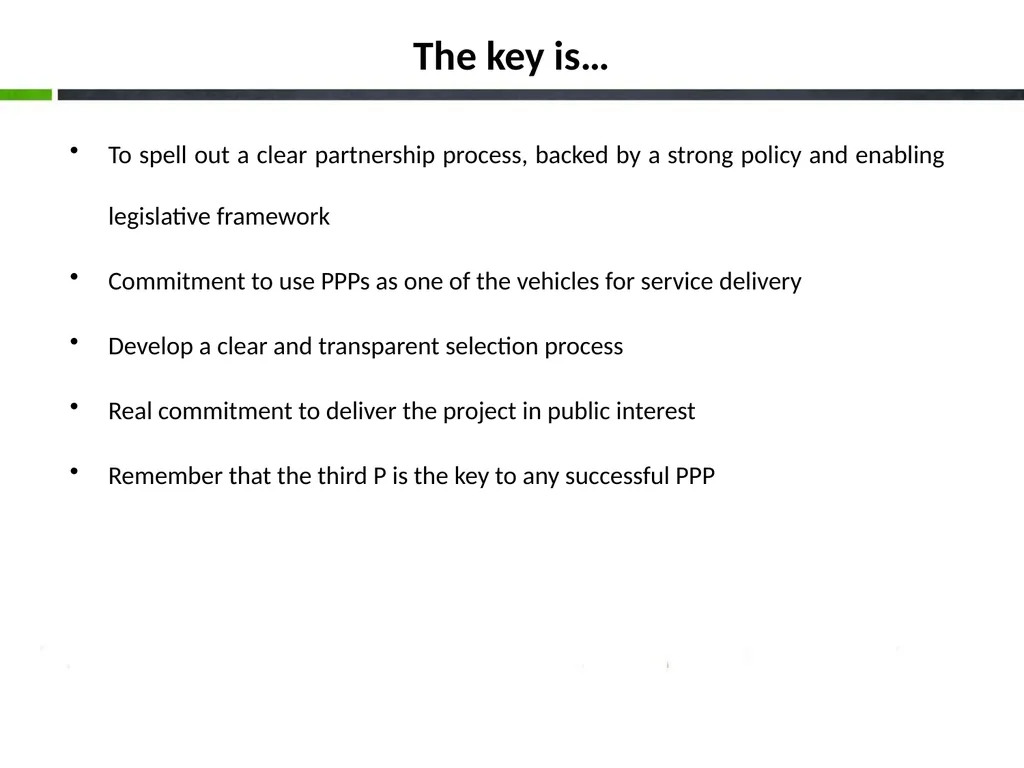
slide21. The key is… To spell out a clear partnership process, backed by a strong policy and enabling legislative framework
Commitment to use PPPs as one of the vehicles for service delivery
Develop a clear and transparent selection process
Real commitment to deliver the project in public interest
Remember that the third P is the key to any successful PPP<br>
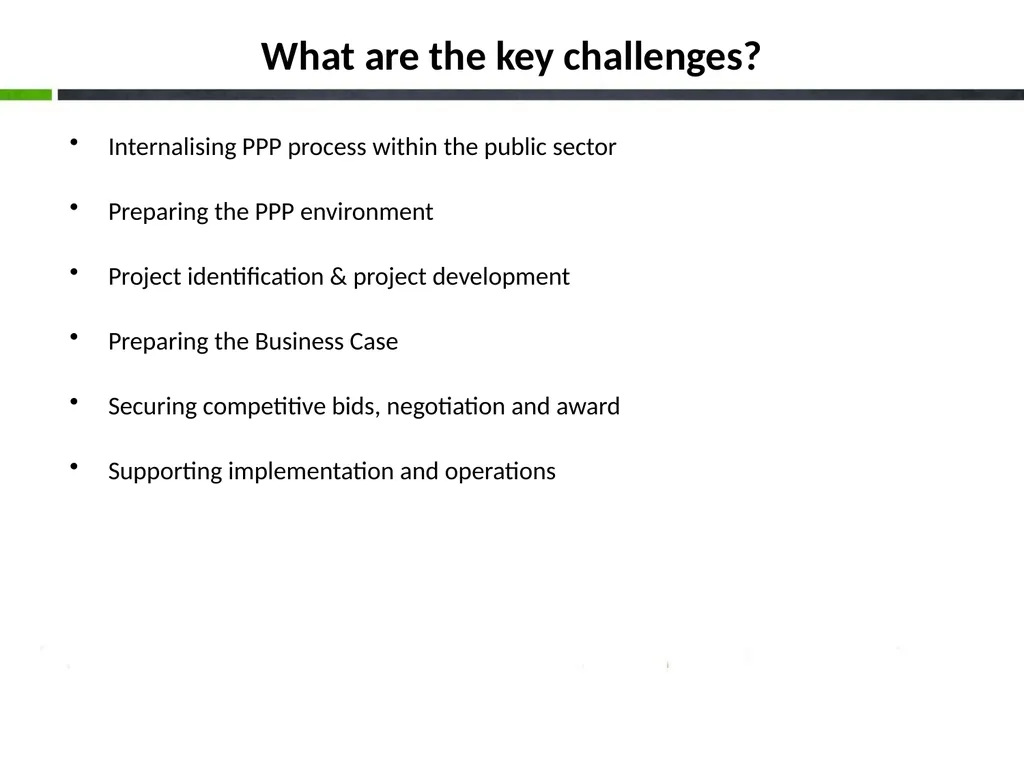
slide22. What are the key challenges? Internalising PPP process within the public sector
Preparing the PPP environment
Project identification & project development
Preparing the Business Case
Securing competitive bids, negotiation and award
Supporting implementation and operations<br>
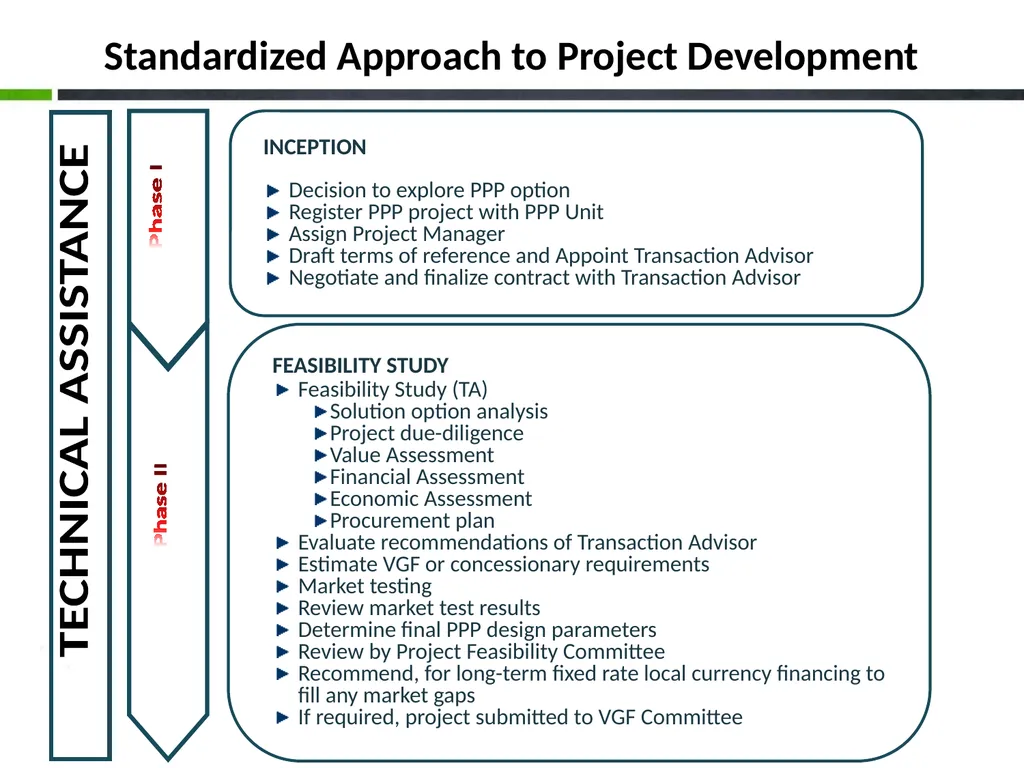
slide23. Standardized Approach to Project Development TECHNICAL ASSISTANCE Phase II Phase I<br>
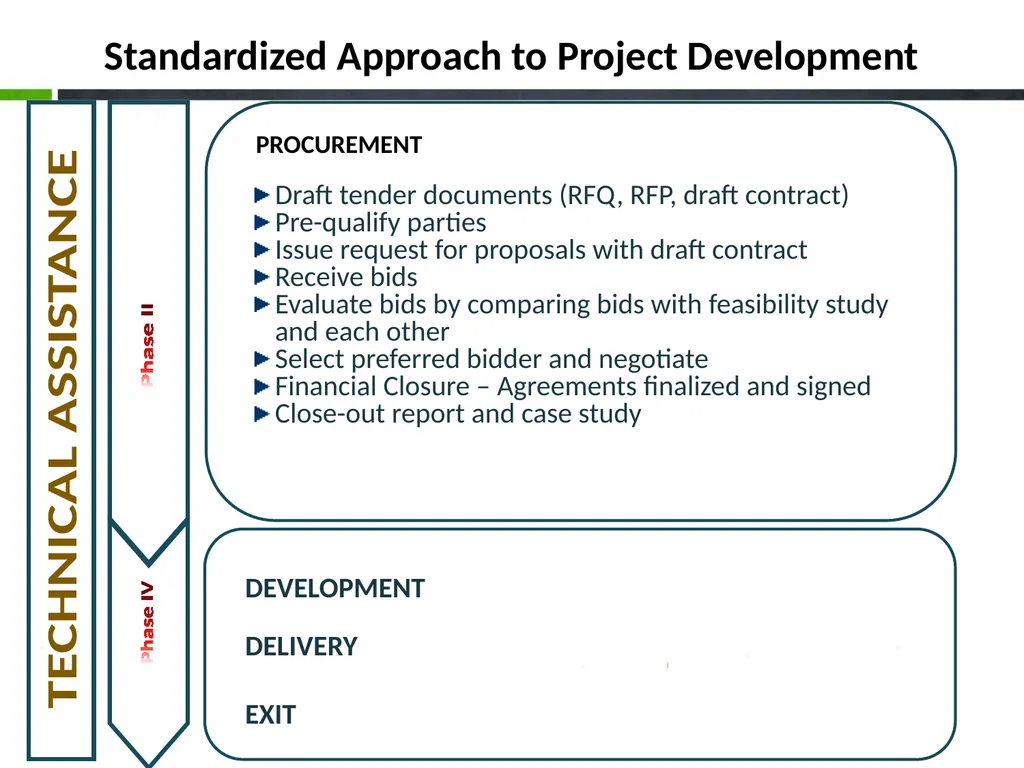
slide24. Standardized Approach to Project Development DEVELOPMENT
DELIVERY
EXIT PROCUREMENT
Draft tender documents (RFQ, RFP, draft contract)
Pre-qualify parties
Issue request for proposals with draft contract
Receive bids
Evaluate bids by comparing bids with feasibility study and each other
Select preferred bidder and negotiate
Financial Closure – Agreements finalized and signed
Close-out report and case study TECHNICAL ASSISTANCE Phase II Phase IV<br>
slide25. Thanks & Questions<br>
(PPP)<br>
slide2. Outline Understanding PPPs- what they are; key structures; perspectives
Forms of partnerships: the PPP spectrum
How to decide the options?
International Experience
Key Challenges<br>
slide3. PPP: What is it? Medium to long term relationship between the public sector and the partners (including voluntary organisations)
Involves sharing and transferring of risks and rewards between public sector and the partners
Attempts to utilise multi-sectoral and multi-disciplinary expertise to structure, finance and deliver desired policy outcomes that are in public interest
Clear governance structures established to manage the partnerships<br>
slide4. PPP: What is it? It is about creating, nurturing and sustaining an effective relationship between the Government and the private sector
Achieving improved value for money by utilising the innovative capabilities and skills to deliver performance improvements and efficiency savings.
It aims to leverage private sector expertise and capital to obtain efficiency gains in service delivery and asset creation
The key contrast between PPPs and traditional procurement is that with PPPs the private sector returns are linked to service outcomes and performance of the asset over the contract life.<br>
slide5. PPP Fundamentals<br>
slide6. Development of PPPs Sophistication of partnership structure Low High Area of Partnership Non-core functions Core functions France Germany Italy Spain Japan Ireland South Africa Australia New Zealand UK Almost 90 countries around the world are working on at some form and some stage of PPP-with varying degrees of success India Mauritius Jamaica Sri Lanka<br>
slide7. Key structures Designed to maximize the use of Private Sector Skills
Risk placed where it can be managed best
Activities performed by those most capable
Public and Private Sector each retain their own identity
They collaborate on the basis of a clear division of tasks and risks
PPP offers to the Public Sector greater Value for Money:
PPP transaction facilitates technology transfer
Private Sector shares its experience with Public Sector
PPP delivers high quality infrastructure in the shortest possible time<br>
slide8. Differential procurement process Capital and operating costs are paid for by the public sector, who take the risk of cost overruns and late delivery.. The public sector only pays over the long term as services are delivered. The private sector funds itself using a large portion of debt plus shareholder equity. The returns on their equity will depend on the quality of services.<br>
slide9. Perspectives PPPs cannot be a solution for every challenge that public sector faces with regard to service delivery & infrastructure development
Countries have kept some sectors out; while others have put a floor price
PPPs play a small but important role in the overall objective of delivering modernised public services, and asset creation
Even in a mature market for PPP like UK, it represents 10-15% of total investment in public services<br>
slide10. PPP: Advantages & Disadvantages Advantages Disadvantages Ability to spread cost over lifetime of asset Greater predictability over cost and time Focus on value for money over lifetime of asset Strong performance incentives Potential to be off-balance sheet High cost Limited flexibility Length of procurement<br>
slide11. Forms of Partnerships Duration Increasing level of delegation, risk & irreversibility Service contracts Management Contracts Leases Concessions Divestures 100 % non-public ownership 100 % Public ownership 5 10 15 20 25 30 BOT BOO Governments’ Role Provider Enabler/ Regulator<br>
slide12. PPP: various options PPP Participation vs. Sector Maturity Responsibility of Private Sector Asset ownership with operational and commercial responsibility No asset ownership; with operational responsibilities Low cost recovery Full cost recovery Service
Contract Management
Contract Lease Concession /
BOT Divestiture /
BOO Key Considerations Service contracts: Cost-effective way to meet special technical needs, but benefits are limited
Management contracts: useful for rapidly enhancing technical capacity, efficiency, and degree of private sector’s involvement
Leases: An efficient way to pass on commercial risk. Appropriate when large scope for operating efficiency and limited scope for new investments
Concessions: Pass full responsibility for operations and investment to the private sector
Build-operate-transfer (BOT) or variations resemble concessions but are normally used for greenfield projects, such as wastewater treatment plant<br>
slide13. Service Agreement Public sector employ private sector to assist in running certain aspects of their utility
Activities which Govt may view not to have in-house
Public agency retains overall responsibility for O&M of the system
Public agency bears all commercial risk, finances, fixed assets & provides working capital
Compensation to private sector on the basis of lump-sum, fixed fee, or cost plus, or on the basis of a physical parameter (number of bills sent out; road maintenance outsourcing-but not new construction or rehabilitation)<br>
slide14. Management Contract Private sector takes over the O&M of a particular part of the system (in water supply, -treatment works). Operates it to meet agreed standards of performance and operational facility
Public authority retains responsibility for the overall system, including expansion and major rehabilitation, but not for routine maintenance, which is closely connected to operational efficiency
Payment to private company based on agreed upon rates for specified items/outputs/deliverables<br>
slide15. Leases Does not cover funding of overall capital investment for rehabilitation & expansion, which would remain Government’s responsibility
Private sector builds a facility and operates it for a given period, during which the contractor would be responsible for any repairs, especially if these are due to faulty design, poor construction on part of the private sector
Where private sector funds working capital requirements is also treated as a lease<br>
slide16. Concessions The Concessionaire finances the investment costs
Concessionaire gets revenue from users/customers on a pre-defined tariff formula to allow for agreed upon costs
The Government may still provide a subsidy in kind or in cash
Usually at the end of the contract, the asset or the system reverts to the Government from the concessionaire<br>
slide17. Forms of Concession-I<br>
slide18. Forms of Concession-II<br>
slide19. Sectors for PPP schemes Transport
Tourism
Prisons
Defence and Energy sectors
Municipal Transport System
Municipal Infrastructure such as:
Water
Solid waste management
Wastewater and Sewerage
Parking
Health Care
Education<br>
slide20. How to decide on Options? Depends on:
Public policy considerations
Goals of the government
Expectations from the private sector in terms of targets, or service levels to be achieved
Condition & needs of the public sector agency
Political as well as institutional constraints<br>
slide21. The key is… To spell out a clear partnership process, backed by a strong policy and enabling legislative framework
Commitment to use PPPs as one of the vehicles for service delivery
Develop a clear and transparent selection process
Real commitment to deliver the project in public interest
Remember that the third P is the key to any successful PPP<br>
slide22. What are the key challenges? Internalising PPP process within the public sector
Preparing the PPP environment
Project identification & project development
Preparing the Business Case
Securing competitive bids, negotiation and award
Supporting implementation and operations<br>
slide23. Standardized Approach to Project Development TECHNICAL ASSISTANCE Phase II Phase I<br>
slide24. Standardized Approach to Project Development DEVELOPMENT
DELIVERY
EXIT PROCUREMENT
Draft tender documents (RFQ, RFP, draft contract)
Pre-qualify parties
Issue request for proposals with draft contract
Receive bids
Evaluate bids by comparing bids with feasibility study and each other
Select preferred bidder and negotiate
Financial Closure – Agreements finalized and signed
Close-out report and case study TECHNICAL ASSISTANCE Phase II Phase IV<br>
slide25. Thanks & Questions<br>