
Project Management What is Project Management Ian
CB
Published · 38 slides · 0 views
1 / 1
Description
Project Management What is Project Management Ian Bond Introduction to Project Management Session 1 Project Management Session 1: What is Project Management? (IB) Session 2: Project Planning (MR) Session 3: Project Delivery (NR) Session
Related Topics
Share
Embed code
Download this presentation From Below
"Project Management What is Project Management Ian" is the property of its rightful owner. Permission is granted to download and print the materials on this website for personal, non-commercial use only, and to display it on your personal computer provided you do not modify the materials and that you retain all copyright notices contained in the materials. By downloading content from our website, you accept the terms of this agreement.
Presentation Transcript
01
Project Management<br>
02
What is Project Management Ian Bond – Introduction to Project Management Session 1<br>
03
Project Management Session 1: What is Project Management? (IB)
Session 2: Project Planning (MR)
Session 3: Project Delivery (NR)
Session 4: Recap and Assessment (IB)<br>
Session 2: Project Planning (MR)
Session 3: Project Delivery (NR)
Session 4: Recap and Assessment (IB)<br>
04
Welcome to Project Management Find a partner
Tell your partner what your previous experience of projects has been (good, bad and ugly)
When we come back together, you can share your experiences<br>
Tell your partner what your previous experience of projects has been (good, bad and ugly)
When we come back together, you can share your experiences<br>
05
What is a Project? What makes a project?
How is this different from Business as Usual (BAU)?<br>
How is this different from Business as Usual (BAU)?<br>
06
What is a Project? A temporary thing with a defined start and end date
It has a dedicated set of resources
It has a life-cycle (more on this later)
It delivers a unique product with a defined purpose
BAU is:
Standard day to day business that ensures continuity within the organisation.
Monthly reporting, IT helpdesk, support for service users<br>
It has a dedicated set of resources
It has a life-cycle (more on this later)
It delivers a unique product with a defined purpose
BAU is:
Standard day to day business that ensures continuity within the organisation.
Monthly reporting, IT helpdesk, support for service users<br>
07
What is a Project? Project Sponsor
Project Manager
Service Continuity Manager
Project Delivery Team
Stakeholders
End Users/Beneficiaries<br>
Project Manager
Service Continuity Manager
Project Delivery Team
Stakeholders
End Users/Beneficiaries<br>
08
Different Project Management Tools and Approaches Many different types of Project Management approaches
There is no 'right' approach. Need to fit the approach to the project
Complex and sophisticated Project Management – Can you name an example of an approach for these types of project?
Efficiency projects focused on eliminating waste and maximising value – Can you name an example of an approach?
Smaller projects over a shorter time period – Can you name an example of an approach?<br>
There is no 'right' approach. Need to fit the approach to the project
Complex and sophisticated Project Management – Can you name an example of an approach for these types of project?
Efficiency projects focused on eliminating waste and maximising value – Can you name an example of an approach?
Smaller projects over a shorter time period – Can you name an example of an approach?<br>
09
Types of Organisations
And the role of the Project Manager Hierarchical/Functional
Project
Matrix
How would you describe your organisation?
What do you think may be the strengths and weaknesses of each approach?
How do you think the project manager operates in each type of organisation?<br>
Project
Matrix
How would you describe your organisation?
What do you think may be the strengths and weaknesses of each approach?
How do you think the project manager operates in each type of organisation?<br>
10
Strengths and Weaknesses Hierarchical/Functional: Strengths = People with technical skills in the department/functional area deliver the project that requires those skills. Weakness = Silo working
Matrix: Strengths = Project is visible across the org + the management of resources is more efficient. Weakness = Dual reporting lines can cause confusion
Project: Strength = clear focus on the project that's what the organisation is for. Weakness = When the project is completed there's no need to keep the team together and the organisational learning can be lost.<br>
Matrix: Strengths = Project is visible across the org + the management of resources is more efficient. Weakness = Dual reporting lines can cause confusion
Project: Strength = clear focus on the project that's what the organisation is for. Weakness = When the project is completed there's no need to keep the team together and the organisational learning can be lost.<br>
11
Why is it Better to have a Systematic Approach? Projects have a relevant Business Case
Projects follow a recognised project life cycle
Projects have a structured methodology for the delivery of projects ensuring consistency of practice
Clearly defined processes and documentation
More effective decision making at key stages
Reporting and escalation routes
Effective quality management<br>
Projects follow a recognised project life cycle
Projects have a structured methodology for the delivery of projects ensuring consistency of practice
Clearly defined processes and documentation
More effective decision making at key stages
Reporting and escalation routes
Effective quality management<br>
12
Business Case Business Case and Strategy
Who is involved in developing and producing the business case?
Other business case contributors
Typical business case content: background/situation; benefits; budget; risks; options appraisal; Additional Content<br>
Who is involved in developing and producing the business case?
Other business case contributors
Typical business case content: background/situation; benefits; budget; risks; options appraisal; Additional Content<br>
13
Importance of a Business Case throughout the Project Lifecycle Concept
Definition
Deployment
Transition<br>
Definition
Deployment
Transition<br>
14
Project Life Cycles Benefits of the Project Life Cycle:
Improved planning of work
Clearer identification of priorities
More effective risk management
Greater estimating accuracy
More representative performance management
Greater adoption of continual improvement
Improved control
More effective stakeholder communication<br>
Improved planning of work
Clearer identification of priorities
More effective risk management
Greater estimating accuracy
More representative performance management
Greater adoption of continual improvement
Improved control
More effective stakeholder communication<br>
15
Benefits of Conducting Reviews Throughout the Life Cycle Deliverables
The business case
Management processes
Decision Gates
Benefits Reviews
Audit
Other Reviews
Stage Reviews
Post-Project Reviews<br>
The business case
Management processes
Decision Gates
Benefits Reviews
Audit
Other Reviews
Stage Reviews
Post-Project Reviews<br>
16
Learning Summary Why are projects structured as phases in a linear life cycle?
Explain the benefits of conducting reviews throughout the project life cycle (including decision gates, benefits reviews and audits)<br>
Explain the benefits of conducting reviews throughout the project life cycle (including decision gates, benefits reviews and audits)<br>
17
Stakeholder Engagement Understand the role of various stakeholders
Identifying the real nature of each stakeholder group's business and their consequent interest in the project
Understanding their behaviour and motivation towards the project
Assessing how they may react to various approaches and communication
Identifying the characteristics of the stakeholders' environment and development appropriate responses to facilitate a good relationship<br>
Identifying the real nature of each stakeholder group's business and their consequent interest in the project
Understanding their behaviour and motivation towards the project
Assessing how they may react to various approaches and communication
Identifying the characteristics of the stakeholders' environment and development appropriate responses to facilitate a good relationship<br>
18
Stakeholder Engagement (contd.) Responding to the stakeholder's motivation in relation to the project
Determining the key areas that will have the most impact on the successful reception of the project<br>
Determining the key areas that will have the most impact on the successful reception of the project<br>
19
Importance of Managing Stakeholders Expectations to the Success of the Project Enabling more effective risk assessment
Improved communications planning
Ensuring a productive team is formed
Enabling effective engagement actions to be initiated
Increased likelihood of project being accepted<br>
Improved communications planning
Ensuring a productive team is formed
Enabling effective engagement actions to be initiated
Increased likelihood of project being accepted<br>
20
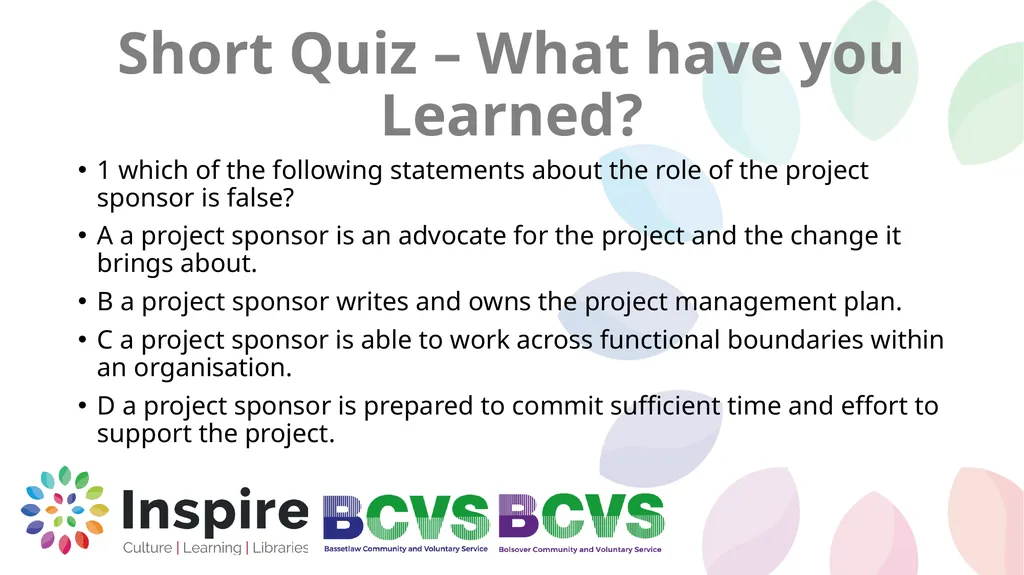
Short Quiz – What have you Learned? 1 which of the following statements about the role of the project sponsor is false?
A a project sponsor is an advocate for the project and the change it brings about.
B a project sponsor writes and owns the project management plan.
C a project sponsor is able to work across functional boundaries within an organisation.
D a project sponsor is prepared to commit sufficient time and effort to support the project.<br>
A a project sponsor is an advocate for the project and the change it brings about.
B a project sponsor writes and owns the project management plan.
C a project sponsor is able to work across functional boundaries within an organisation.
D a project sponsor is prepared to commit sufficient time and effort to support the project.<br>
21
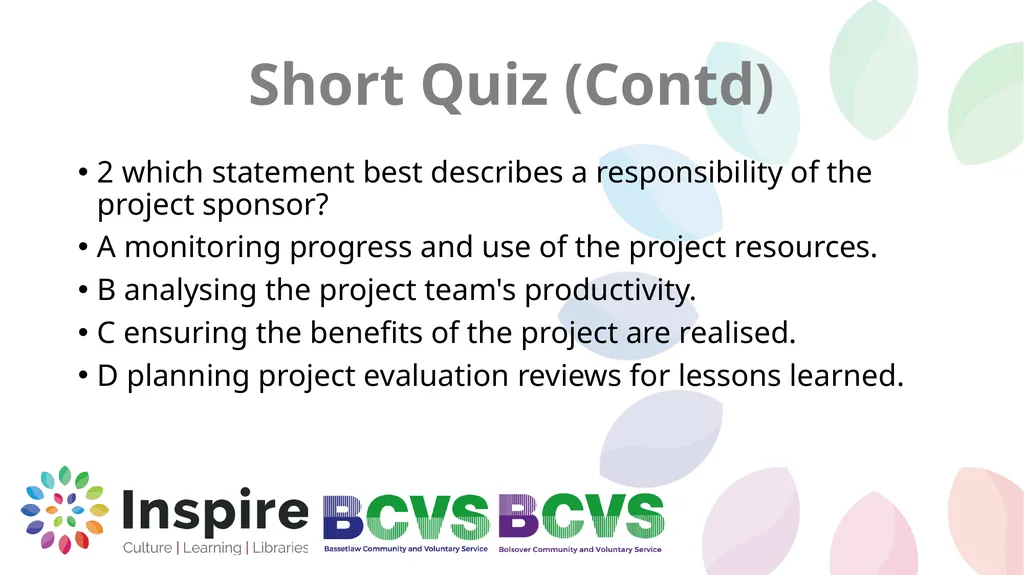
Short Quiz (Contd) 2 which statement best describes a responsibility of the project sponsor?
A monitoring progress and use of the project resources.
B analysing the project team's productivity.
C ensuring the benefits of the project are realised.
D planning project evaluation reviews for lessons learned.<br>
A monitoring progress and use of the project resources.
B analysing the project team's productivity.
C ensuring the benefits of the project are realised.
D planning project evaluation reviews for lessons learned.<br>
22
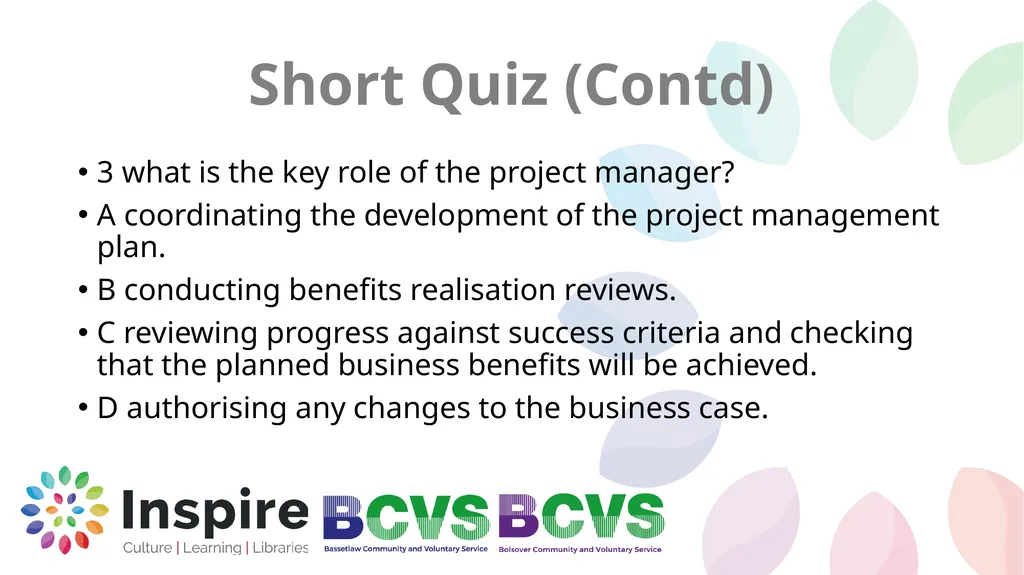
Short Quiz (Contd) 3 what is the key role of the project manager?
A coordinating the development of the project management plan.
B conducting benefits realisation reviews.
C reviewing progress against success criteria and checking that the planned business benefits will be achieved.
D authorising any changes to the business case.<br>
A coordinating the development of the project management plan.
B conducting benefits realisation reviews.
C reviewing progress against success criteria and checking that the planned business benefits will be achieved.
D authorising any changes to the business case.<br>
23
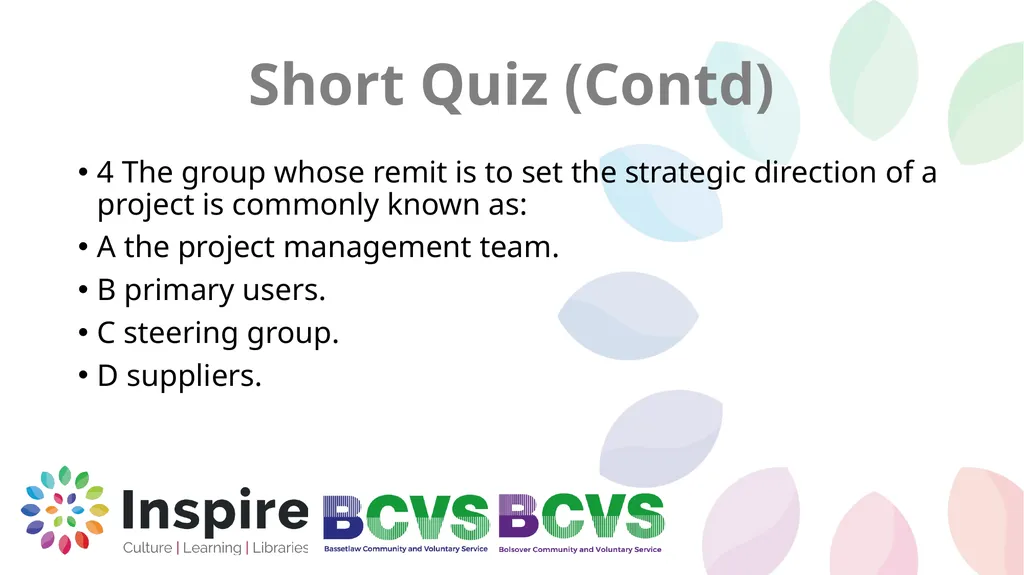
Short Quiz (Contd) 4 The group whose remit is to set the strategic direction of a project is commonly known as:
A the project management team.
B primary users.
C steering group.
D suppliers.<br>
A the project management team.
B primary users.
C steering group.
D suppliers.<br>
24
Short Quiz (Contd) 5 which stakeholders are likely to form the main part of a project steering group/board?
A project sponsor, project manager and quality manager.
B corporate management, project sponsor, quality manager, project office.
C sponsor, supplier representative, user representative.
D sponsor, project manager and senior project team members<br>
A project sponsor, project manager and quality manager.
B corporate management, project sponsor, quality manager, project office.
C sponsor, supplier representative, user representative.
D sponsor, project manager and senior project team members<br>
25
Short Quiz (Contd) 6 who in the project is responsible for benefits realisation?
A the senior management of the organisation.
B the project manager.
C the sponsor.
D the end users.<br>
A the senior management of the organisation.
B the project manager.
C the sponsor.
D the end users.<br>
26
Short Quiz (Contd) 7 which of the following roles is primarily responsible for defining goals and creating vision for the operability of the project's outputs?
A project sponsor.
B product owner.
C user.
D business case owner.<br>
A project sponsor.
B product owner.
C user.
D business case owner.<br>
27
Short Quiz (Contd) 8 when the majority of PMO functions are delivered under the control of the project/programme/portfolio manager, this could be described as a:
A central PMO.
B embedded PMO.
C hub and spoke PMO.
D matrix PMO.<br>
A central PMO.
B embedded PMO.
C hub and spoke PMO.
D matrix PMO.<br>
28
Short Quiz (Contd) 9 when effectively implemented, what is one of the key roles of governance?
A provide confidence that the business case is the best option for the current circumstances and that there will be no changes as the project is being delivered.
B provide confidence that the plans that have been developed will guarantee that the project will be delivered on time and to budget.
C provide confidence to all stakeholders that projects are being well managed and the most appropriate financial and technical controls are being exerted.
D provide confidence to all project team members that their jobs are secure at least from the period of the project start to the handover.<br>
A provide confidence that the business case is the best option for the current circumstances and that there will be no changes as the project is being delivered.
B provide confidence that the plans that have been developed will guarantee that the project will be delivered on time and to budget.
C provide confidence to all stakeholders that projects are being well managed and the most appropriate financial and technical controls are being exerted.
D provide confidence to all project team members that their jobs are secure at least from the period of the project start to the handover.<br>
29
Short Quiz (Contd) 10 governance cold best be described as:
A the framework of authority and accountability that defines and controls the outputs, outcomes and benefits from projects, programmes and portfolios.
B the framework that structures a review of the project and aids a decision to be made whether to continue with the next phase or stage of the project.
C the framework that is used for selection, prioritisation and control of an organisation's projects and programmes in line with its strategic objectives and capacity to deliver.
D the framework used by the organisation and approved by the project board at project initiation that allows the definition of the terms of reference for the project.<br>
A the framework of authority and accountability that defines and controls the outputs, outcomes and benefits from projects, programmes and portfolios.
B the framework that structures a review of the project and aids a decision to be made whether to continue with the next phase or stage of the project.
C the framework that is used for selection, prioritisation and control of an organisation's projects and programmes in line with its strategic objectives and capacity to deliver.
D the framework used by the organisation and approved by the project board at project initiation that allows the definition of the terms of reference for the project.<br>
30
Conclusion Project Vs BAU
Different Project Management Approaches (e.g. Prince 2/Agile/Sprint etc.)
Project Roles (Project Sponsor/Project Manager/Business as Usual)
Different types of organisation (Functional/Hierarchical/Matrix/Project)
Why be systematic when managing projects?
Business Case
Project Life Cycle / Reviews
Stakeholder Engagement
Stakeholder Management
Quiz
Next steps: Project Planning next week with Michael – Thank You!!!<br>
Different Project Management Approaches (e.g. Prince 2/Agile/Sprint etc.)
Project Roles (Project Sponsor/Project Manager/Business as Usual)
Different types of organisation (Functional/Hierarchical/Matrix/Project)
Why be systematic when managing projects?
Business Case
Project Life Cycle / Reviews
Stakeholder Engagement
Stakeholder Management
Quiz
Next steps: Project Planning next week with Michael – Thank You!!!<br>
31
Project Planning Michael Reid Session 2<br>
32
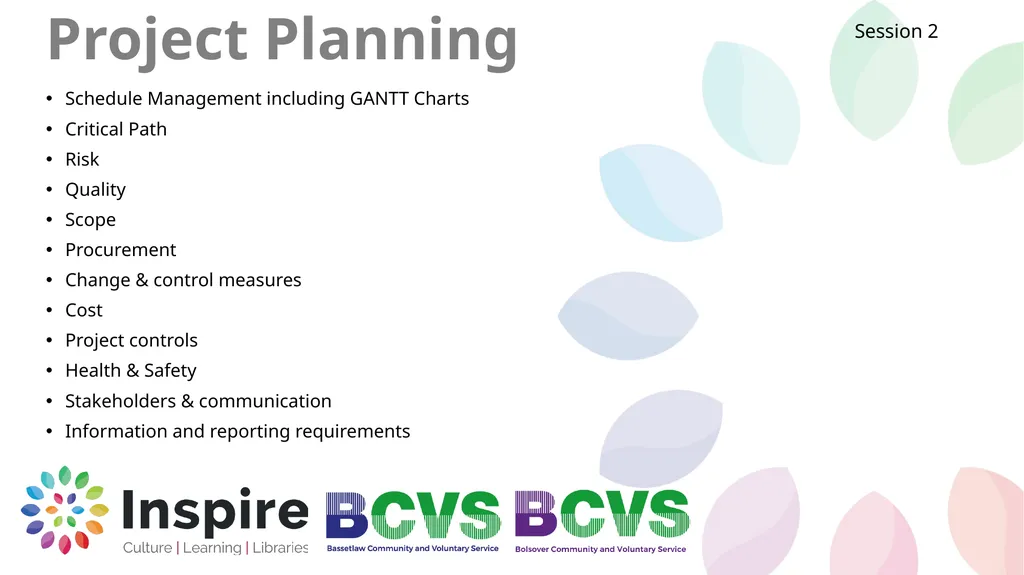
Project Planning Schedule Management including GANTT Charts
Critical Path
Risk
Quality
Scope
Procurement
Change & control measures
Cost
Project controls
Health & Safety
Stakeholders & communication
Information and reporting requirements Session 2<br>
Critical Path
Risk
Quality
Scope
Procurement
Change & control measures
Cost
Project controls
Health & Safety
Stakeholders & communication
Information and reporting requirements Session 2<br>
33
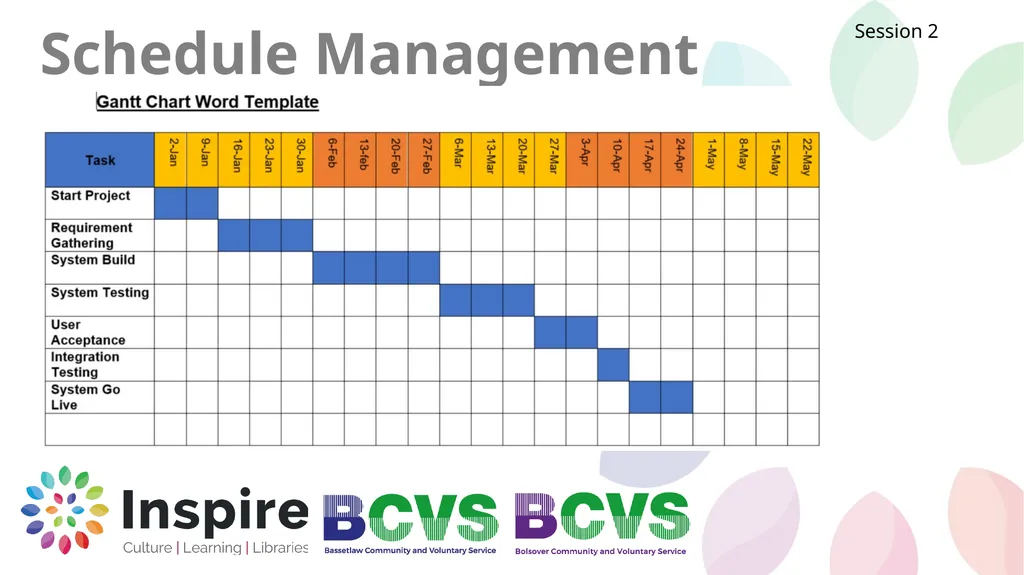
Schedule Management Session 2<br>
34
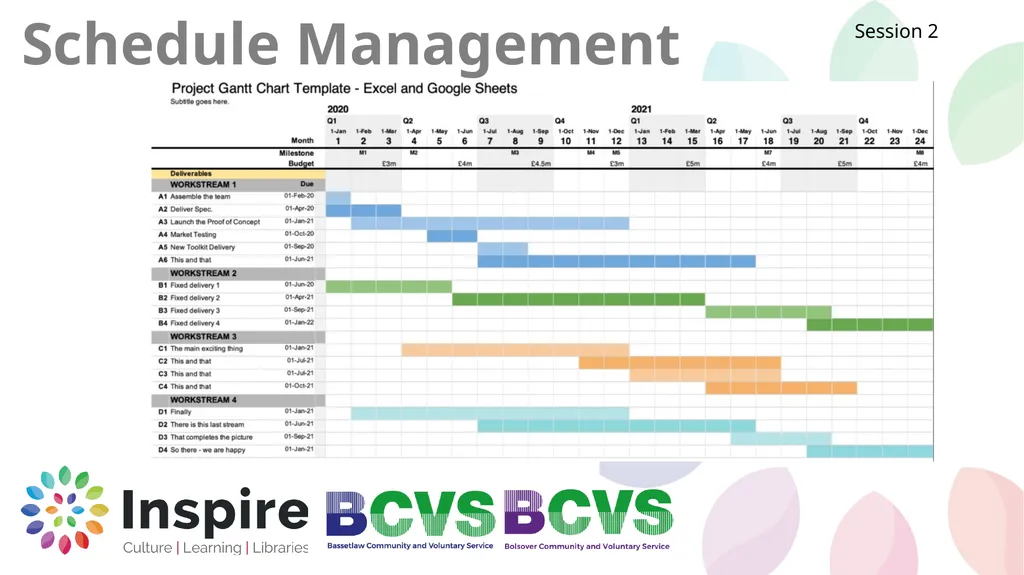
Schedule Management Session 2<br>
35
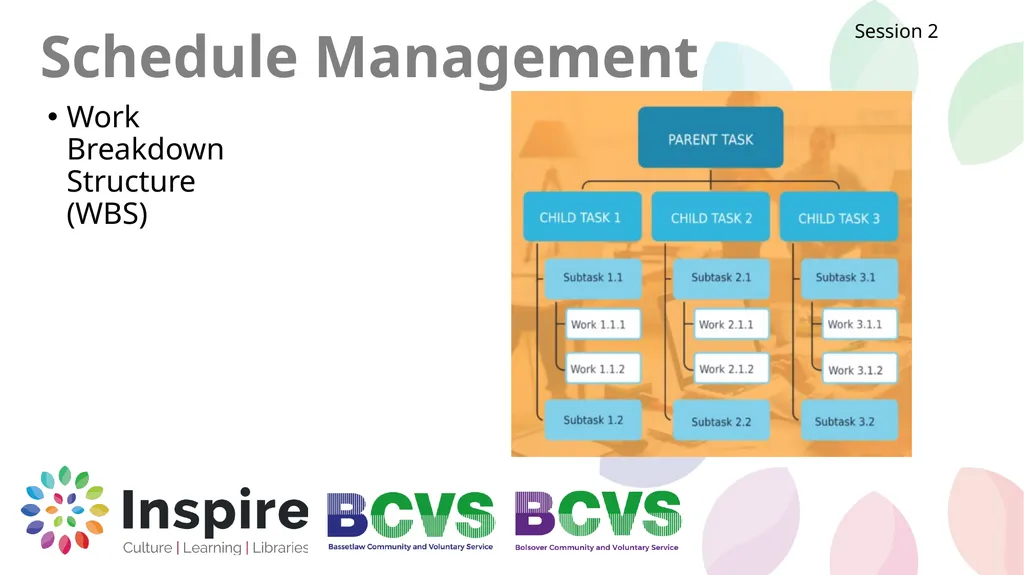
Schedule Management Work Breakdown Structure
(WBS) Session 2<br>
36
Schedule Management A completed work breakdown structure will help to develop the Gantt chart
Have a go at completing a basic WBS for the design and delivery of a new course
What is the Parent Task? What are the child tasks? Session 2<br>
Have a go at completing a basic WBS for the design and delivery of a new course
What is the Parent Task? What are the child tasks? Session 2<br>
37
Project Delivery Nicky Reed Session 3<br>
38
Recap and Assessment Ian Bond Session 4<br>