Projected changes in costs and volumes and overheating risks Latvian construction industry 2022-2026. 2022 RESEARCH RESULTS Purpose of the research To forecast changes in labour and building materials costs and possible overheating risks
"Projected changes in costs and volumes and" is the property of its rightful owner. Permission is granted to
download and print the materials on this website for personal, non-commercial use only, and to display it
on your personal computer provided you do not modify the materials and that you retain all copyright
notices contained in the materials. By downloading content from our website, you accept the terms of this
agreement.
Presentation Transcript
01
Projected changes in costs and volumes and overheating risks Latvian construction industry 2022-2026. 2022 | RESEARCH RESULTS<br>
02
Purpose of the
research
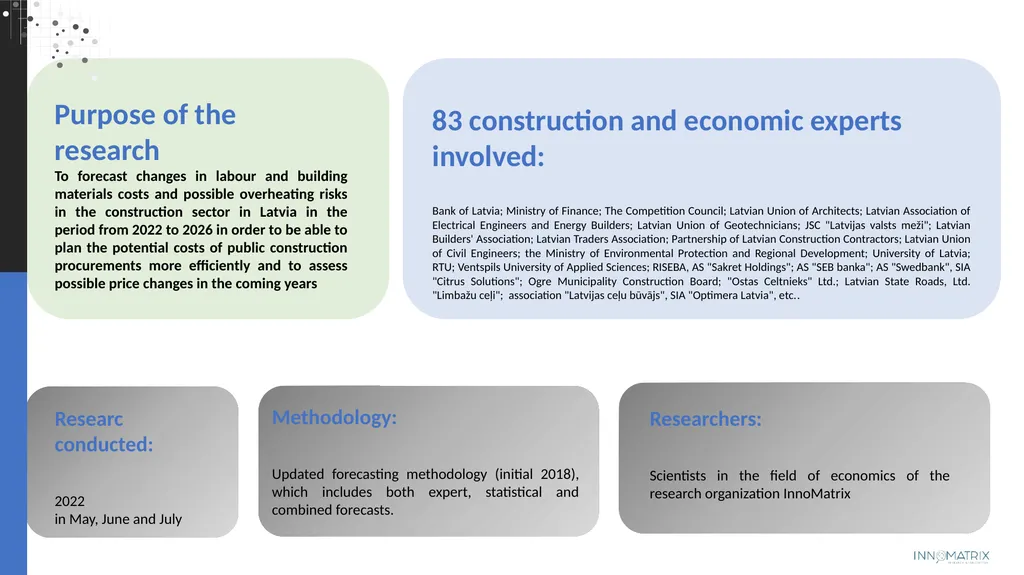
To forecast changes in labour and building materials costs and possible overheating risks in the construction sector in Latvia in the period from 2022 to 2026 in order to be able to plan the potential costs of public construction procurements more efficiently and to assess possible price changes in the coming years 83 construction and economic experts involved:
Bank of Latvia; Ministry of Finance; The Competition Council; Latvian Union of Architects; Latvian Association of Electrical Engineers and Energy Builders; Latvian Union of Geotechnicians; JSC "Latvijas valsts meži"; Latvian Builders' Association; Latvian Traders Association; Partnership of Latvian Construction Contractors; Latvian Union of Civil Engineers; the Ministry of Environmental Protection and Regional Development; University of Latvia; RTU; Ventspils University of Applied Sciences; RISEBA, AS "Sakret Holdings"; AS "SEB banka"; AS "Swedbank", SIA "Citrus Solutions"; Ogre Municipality Construction Board; "Ostas Celtnieks" Ltd.; Latvian State Roads, Ltd. "Limbažu ceļi"; association "Latvijas ceļu būvājs", SIA "Optimera Latvia", etc.. Researc conducted:
2022
in May, June and July Methodology:
Updated forecasting methodology (initial 2018), which includes both expert, statistical and combined forecasts. Researchers:
Scientists in the field of economics of the research organization InnoMatrix<br>
03
Content Cost and volume forecasts
Factors affecting costs
Assessment of the risks of overheating<br>
04
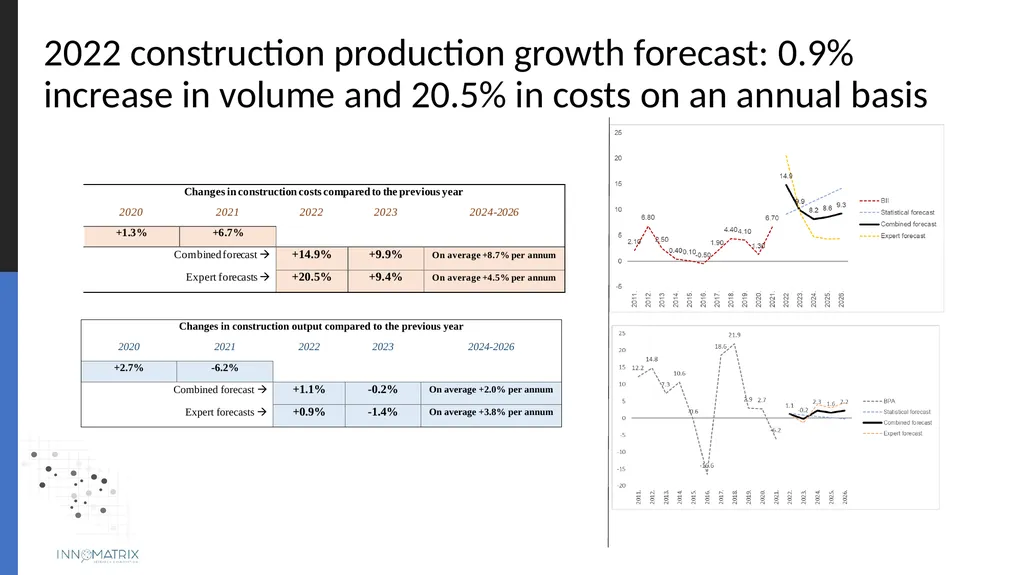
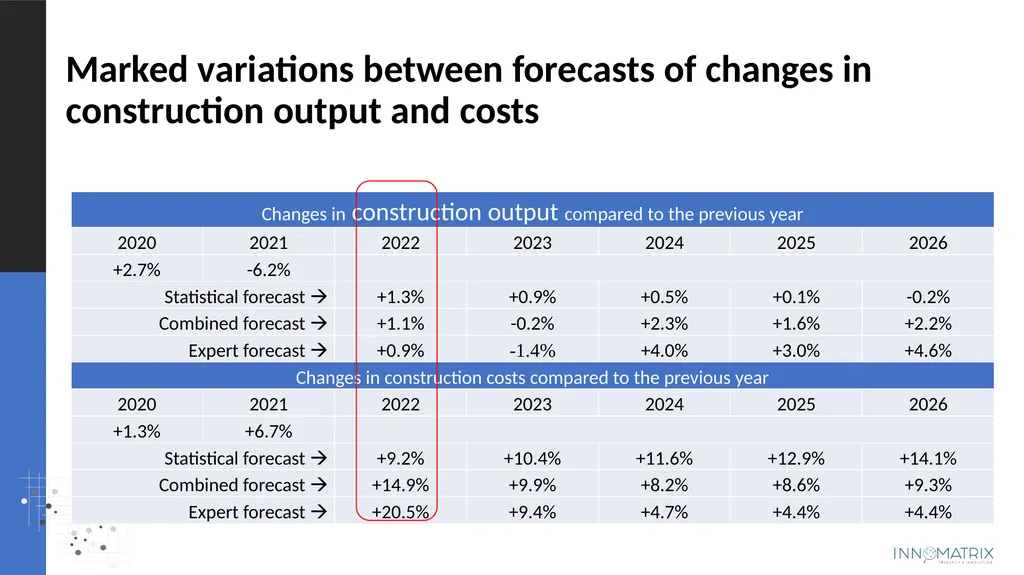
2022 construction production growth forecast: 0.9% increase in volume and 20.5% in costs on an annual basis<br>
05
Marked variations between forecasts of changes in construction output and costs<br>
06
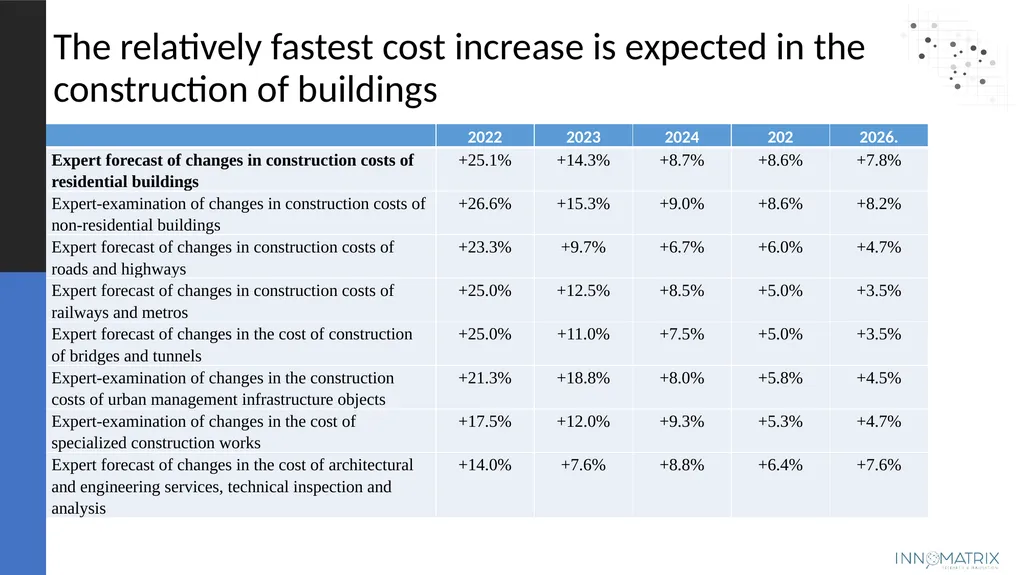
The relatively fastest cost increase is expected in the construction of buildings<br>
07
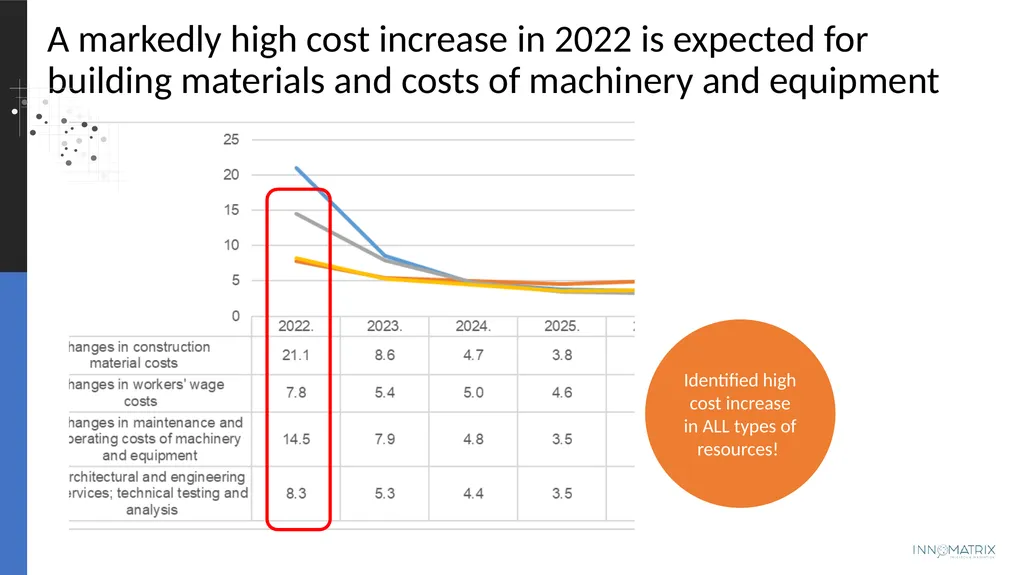
A markedly high cost increase in 2022 is expected for building materials and costs of machinery and equipment Identified high cost increase in ALL types of resources!<br>
08
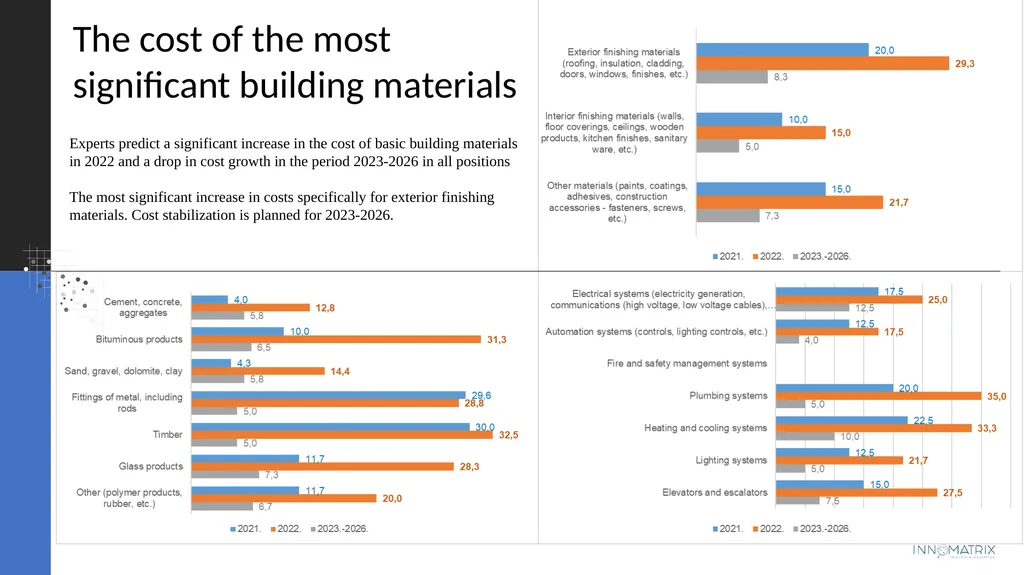
Experts predict a significant increase in the cost of basic building materials in 2022 and a drop in cost growth in the period 2023-2026 in all positions
The most significant increase in costs specifically for exterior finishing materials. Cost stabilization is planned for 2023-2026. The cost of the most significant building materials<br>
09
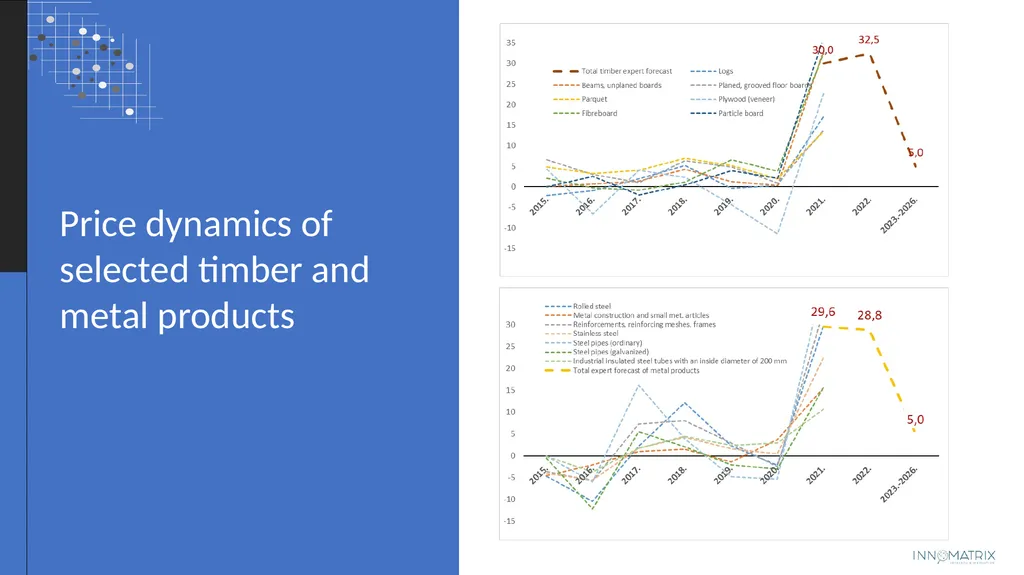
1/3 in the sale of building materials is formed by the costs of timber and metal products<br>
10
Price dynamics of selected timber and metal products<br>
11
Factors affecting costs 2022<br>
12
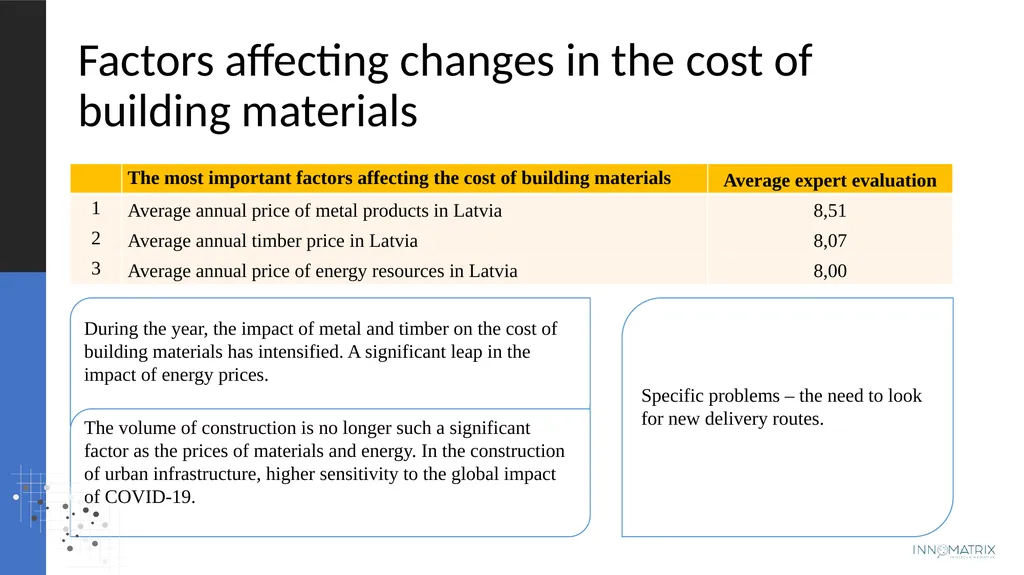
Factors affecting changes in the cost of building materials During the year, the impact of metal and timber on the cost of building materials has intensified. A significant leap in the impact of energy prices. The volume of construction is no longer such a significant factor as the prices of materials and energy. In the construction of urban infrastructure, higher sensitivity to the global impact of COVID-19. Specific problems – the need to look for new delivery routes.<br>
13
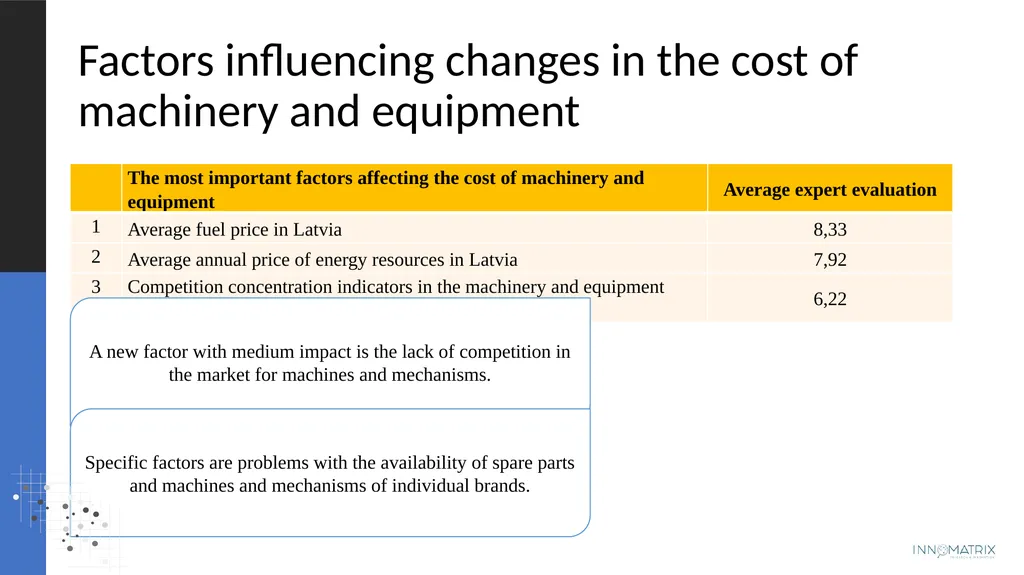
Factors influencing changes in the cost of machinery and equipment A new factor with medium impact is the lack of competition in the market for machines and mechanisms. Specific factors are problems with the availability of spare parts and machines and mechanisms of individual brands.<br>
14
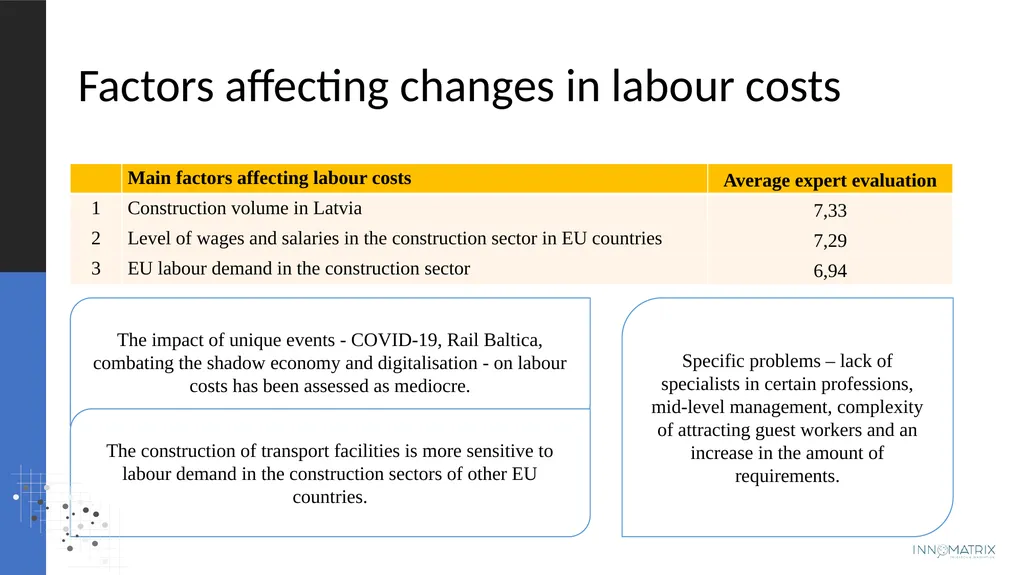
Factors affecting changes in labour costs The impact of unique events - COVID-19, Rail Baltica, combating the shadow economy and digitalisation - on labour costs has been assessed as mediocre. The construction of transport facilities is more sensitive to labour demand in the construction sectors of other EU countries. Specific problems – lack of specialists in certain professions, mid-level management, complexity of attracting guest workers and an increase in the amount of requirements.<br>
15
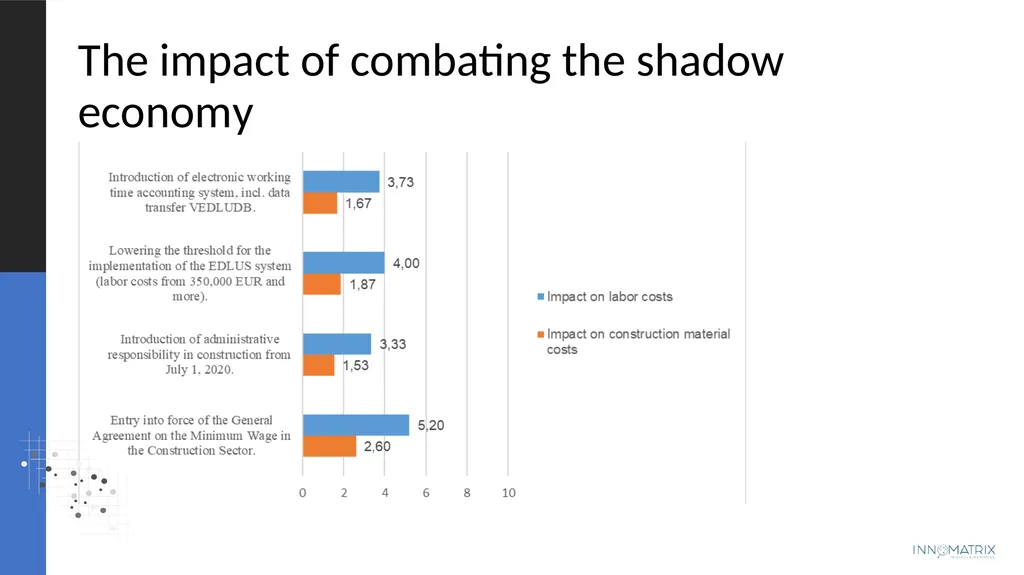
The impact of combating the shadow economy<br>
16
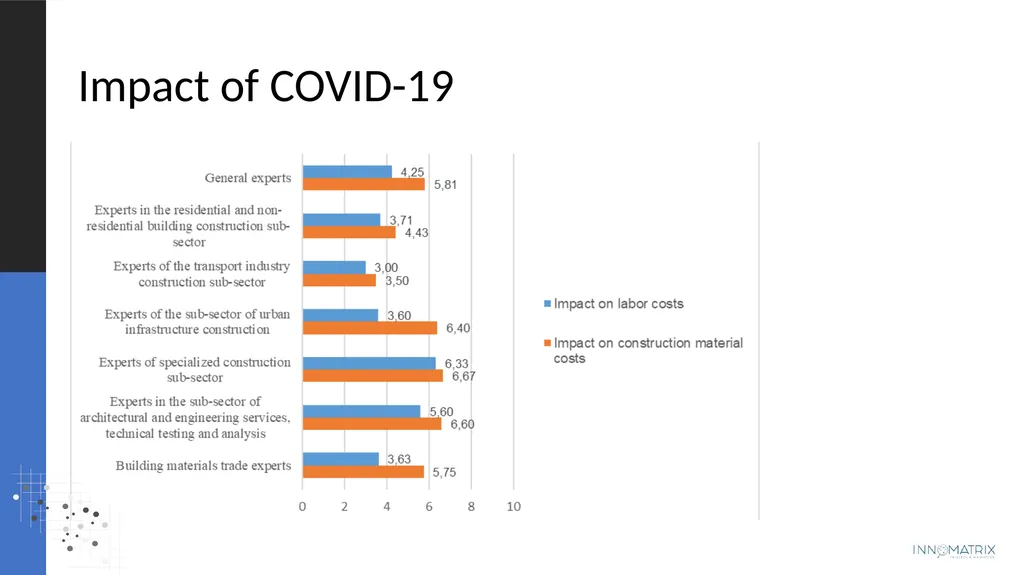
Impact of COVID-19<br>
17
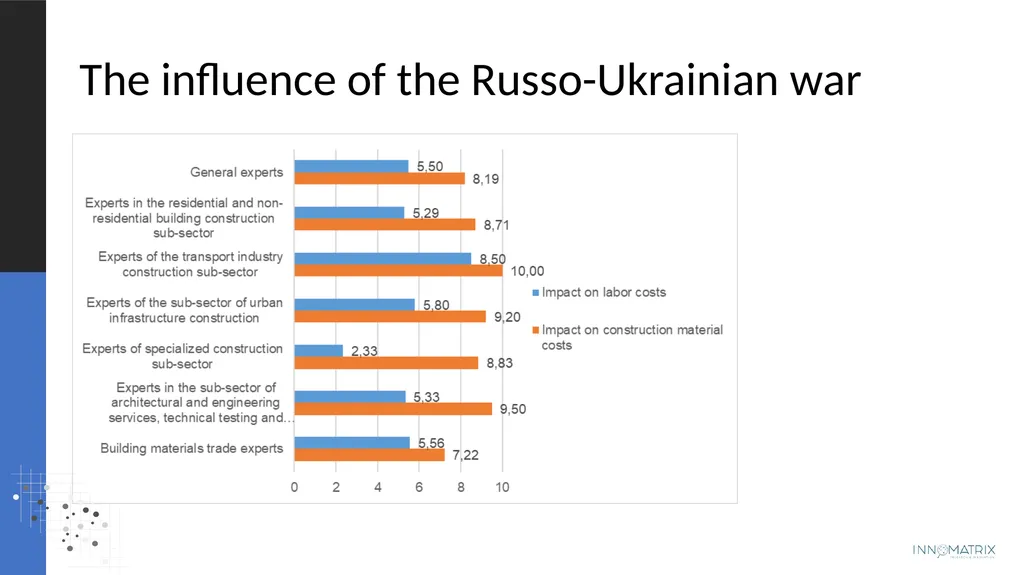
The influence of the Russo-Ukrainian war<br>
18
Assessment of potential overheating of Latvian construction in 2022<br>
19
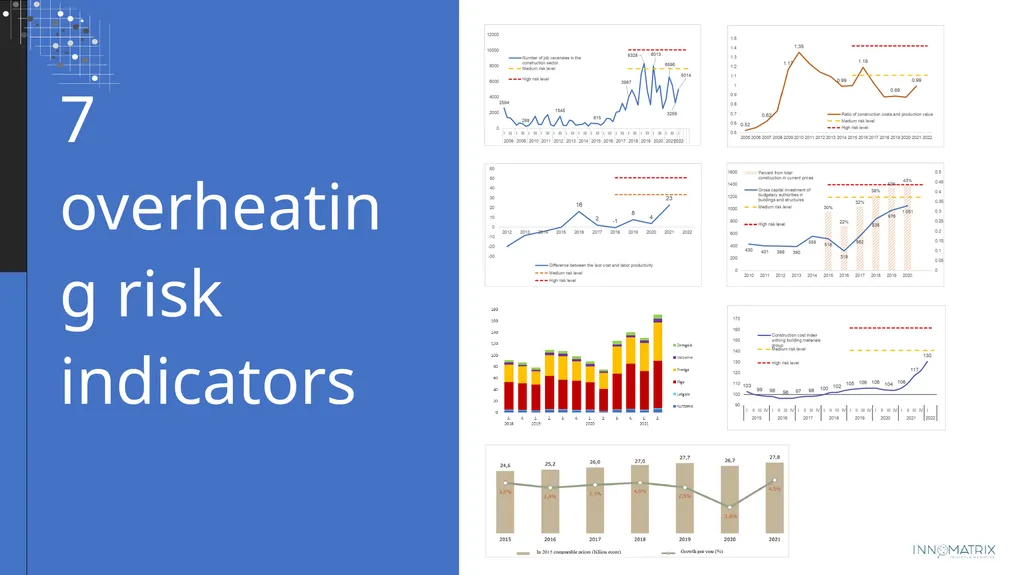
7 overheating risk indicators<br>
20
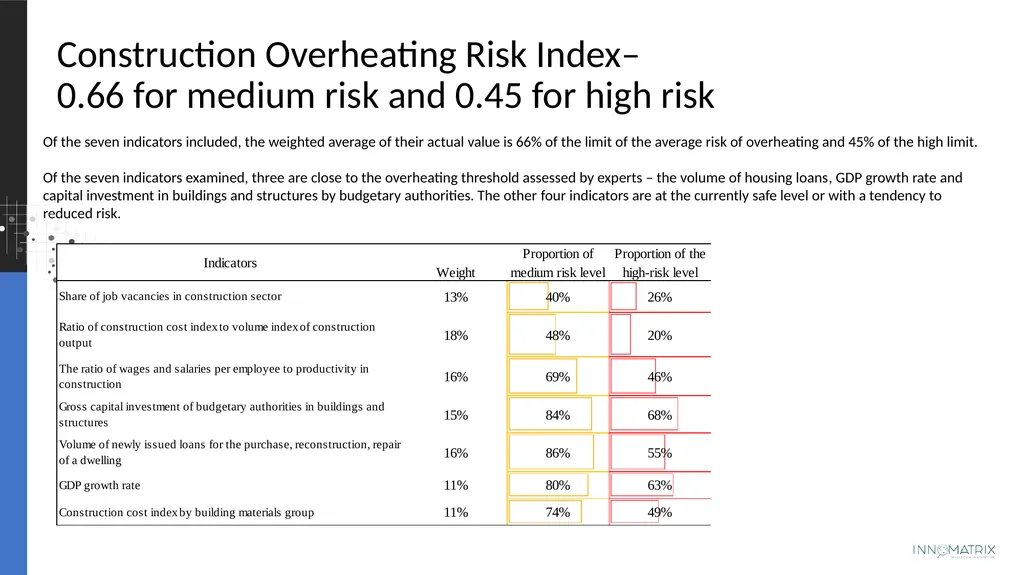
Of the seven indicators included, the weighted average of their actual value is 66% of the limit of the average risk of overheating and 45% of the high limit.
Of the seven indicators examined, three are close to the overheating threshold assessed by experts – the volume of housing loans, GDP growth rate and capital investment in buildings and structures by budgetary authorities. The other four indicators are at the currently safe level or with a tendency to reduced risk. Construction Overheating Risk Index–
0.66 for medium risk and 0.45 for high risk<br>
21
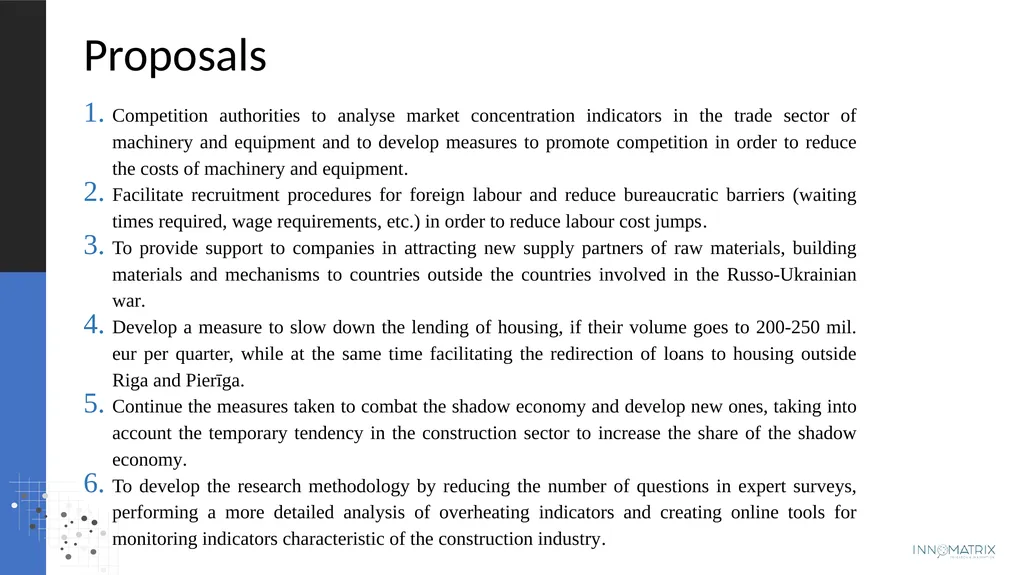
Proposals Competition authorities to analyse market concentration indicators in the trade sector of machinery and equipment and to develop measures to promote competition in order to reduce the costs of machinery and equipment.
Facilitate recruitment procedures for foreign labour and reduce bureaucratic barriers (waiting times required, wage requirements, etc.) in order to reduce labour cost jumps.
To provide support to companies in attracting new supply partners of raw materials, building materials and mechanisms to countries outside the countries involved in the Russo-Ukrainian war.
Develop a measure to slow down the lending of housing, if their volume goes to 200-250 mil. eur per quarter, while at the same time facilitating the redirection of loans to housing outside Riga and Pierīga.
Continue the measures taken to combat the shadow economy and develop new ones, taking into account the temporary tendency in the construction sector to increase the share of the shadow economy.
To develop the research methodology by reducing the number of questions in expert surveys, performing a more detailed analysis of overheating indicators and creating online tools for monitoring indicators characteristic of the construction industry.<br>
22
2022 | Thank you! Projected changes in labour and building materials costs and assessment of overheating risks in the construction sector in Latvia in 2022-2026.<br>