
Proofs (Chapter 4, 5 and 6) Proofs A proof of
MS
Published · 101 slides · 0 views

1 / 1




Description
Proofs (Chapter 4, 5 and 6) Proofs A proof of a mathematical statement is logical argument which establishes the truth of a statement. We will cover a variety of methods of proofs. There are terms which we should know while proving things.
Related Topics
Share
Embed code
Download this presentation From Below
"Proofs (Chapter 4, 5 and 6) Proofs A proof of" is the property of its rightful owner. Permission is granted to download and print the materials on this website for personal, non-commercial use only, and to display it on your personal computer provided you do not modify the materials and that you retain all copyright notices contained in the materials. By downloading content from our website, you accept the terms of this agreement.
Presentation Transcript
01
Proofs (Chapter 4, 5 and 6)<br>
02
Proofs A proof of a mathematical statement is logical argument which establishes the truth of a statement.
We will cover a variety of methods of proofs.
There are terms which we should know while proving things.<br>
We will cover a variety of methods of proofs.
There are terms which we should know while proving things.<br>
03
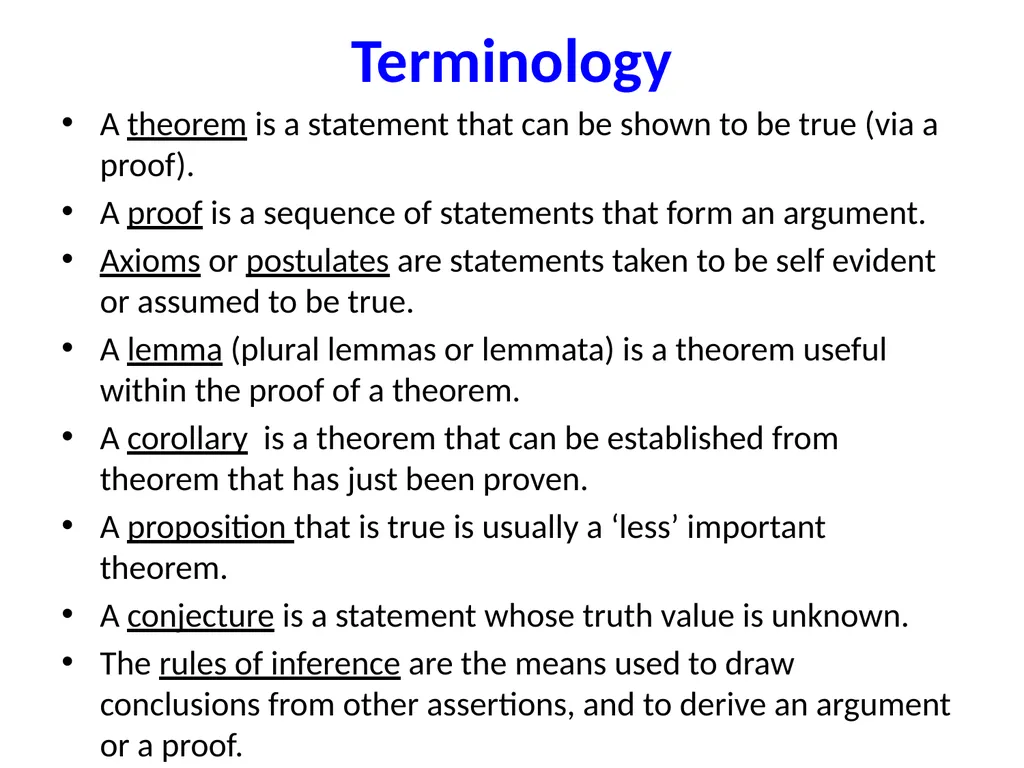
Terminology A theorem is a statement that can be shown to be true (via a proof).
A proof is a sequence of statements that form an argument.
Axioms or postulates are statements taken to be self evident or assumed to be true.
A lemma (plural lemmas or lemmata) is a theorem useful within the proof of a theorem.
A corollary is a theorem that can be established from theorem that has just been proven.
A proposition that is true is usually a ‘less’ important theorem.
A conjecture is a statement whose truth value is unknown.
The rules of inference are the means used to draw conclusions from other assertions, and to derive an argument or a proof.<br>
A proof is a sequence of statements that form an argument.
Axioms or postulates are statements taken to be self evident or assumed to be true.
A lemma (plural lemmas or lemmata) is a theorem useful within the proof of a theorem.
A corollary is a theorem that can be established from theorem that has just been proven.
A proposition that is true is usually a ‘less’ important theorem.
A conjecture is a statement whose truth value is unknown.
The rules of inference are the means used to draw conclusions from other assertions, and to derive an argument or a proof.<br>
04
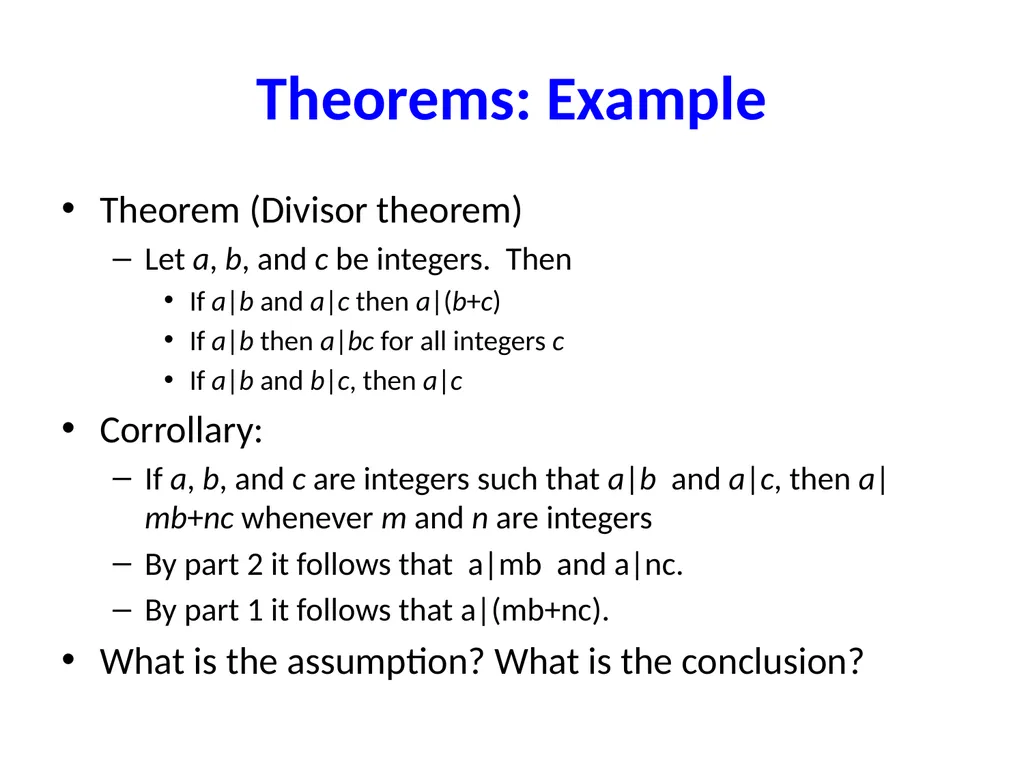
Theorems: Example Theorem (Divisor theorem)
Let a, b, and c be integers. Then
If a|b and a|c then a|(b+c)
If a|b then a|bc for all integers c
If a|b and b|c, then a|c
Corrollary:
If a, b, and c are integers such that a|b and a|c, then a|mb+nc whenever m and n are integers
By part 2 it follows that a|mb and a|nc.
By part 1 it follows that a|(mb+nc).
What is the assumption? What is the conclusion?<br>
Let a, b, and c be integers. Then
If a|b and a|c then a|(b+c)
If a|b then a|bc for all integers c
If a|b and b|c, then a|c
Corrollary:
If a, b, and c are integers such that a|b and a|c, then a|mb+nc whenever m and n are integers
By part 2 it follows that a|mb and a|nc.
By part 1 it follows that a|(mb+nc).
What is the assumption? What is the conclusion?<br>
05
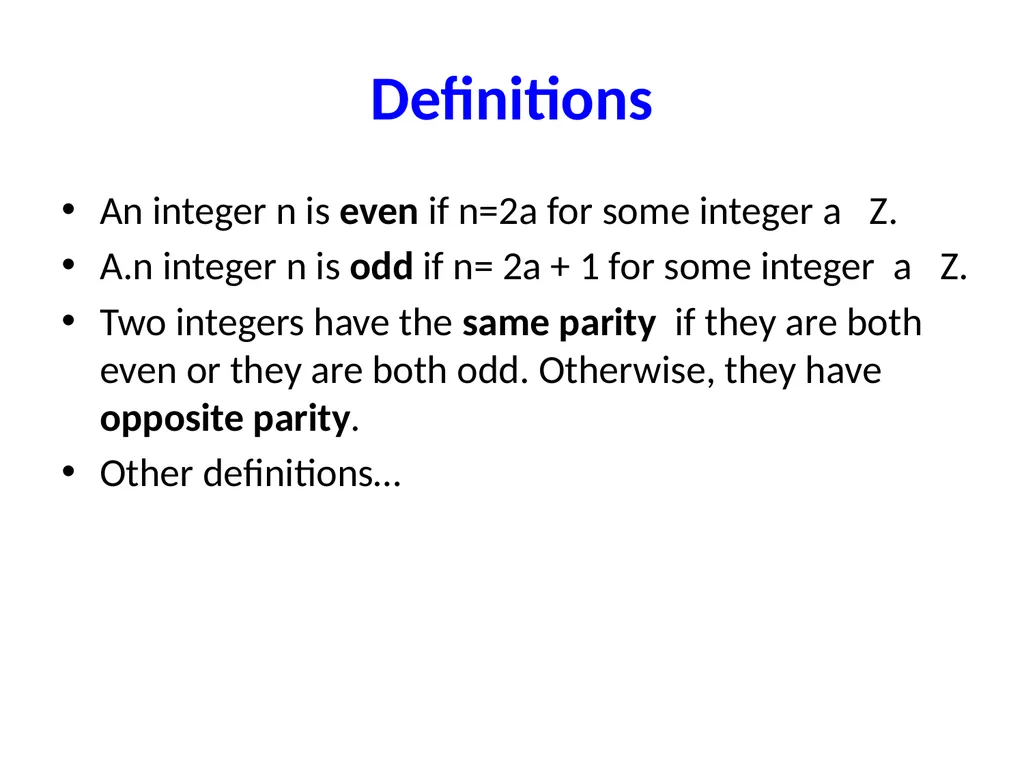
Definitions An integer n is even if n=2a for some integer a Z.
A.n integer n is odd if n= 2a + 1 for some integer a Z.
Two integers have the same parity if they are both even or they are both odd. Otherwise, they have opposite parity.
Other definitions…<br>
A.n integer n is odd if n= 2a + 1 for some integer a Z.
Two integers have the same parity if they are both even or they are both odd. Otherwise, they have opposite parity.
Other definitions…<br>
06
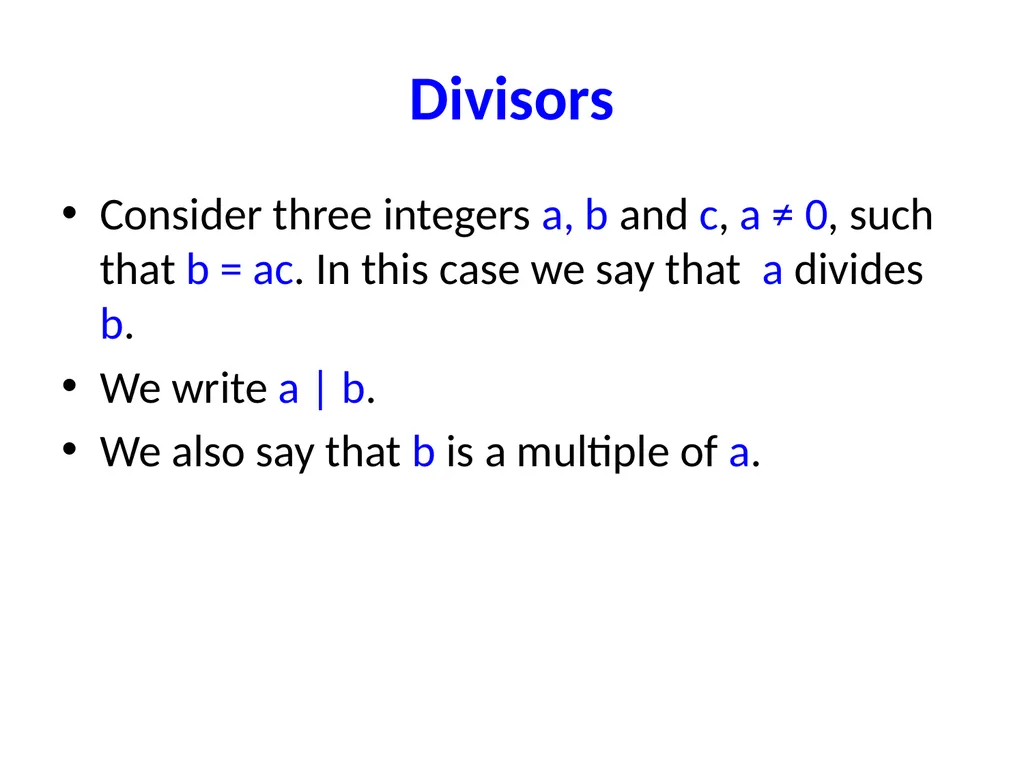
Divisors Consider three integers a, b and c, a ≠ 0, such that b = ac. In this case we say that a divides b.
We write a | b.
We also say that b is a multiple of a.<br>
We write a | b.
We also say that b is a multiple of a.<br>
07
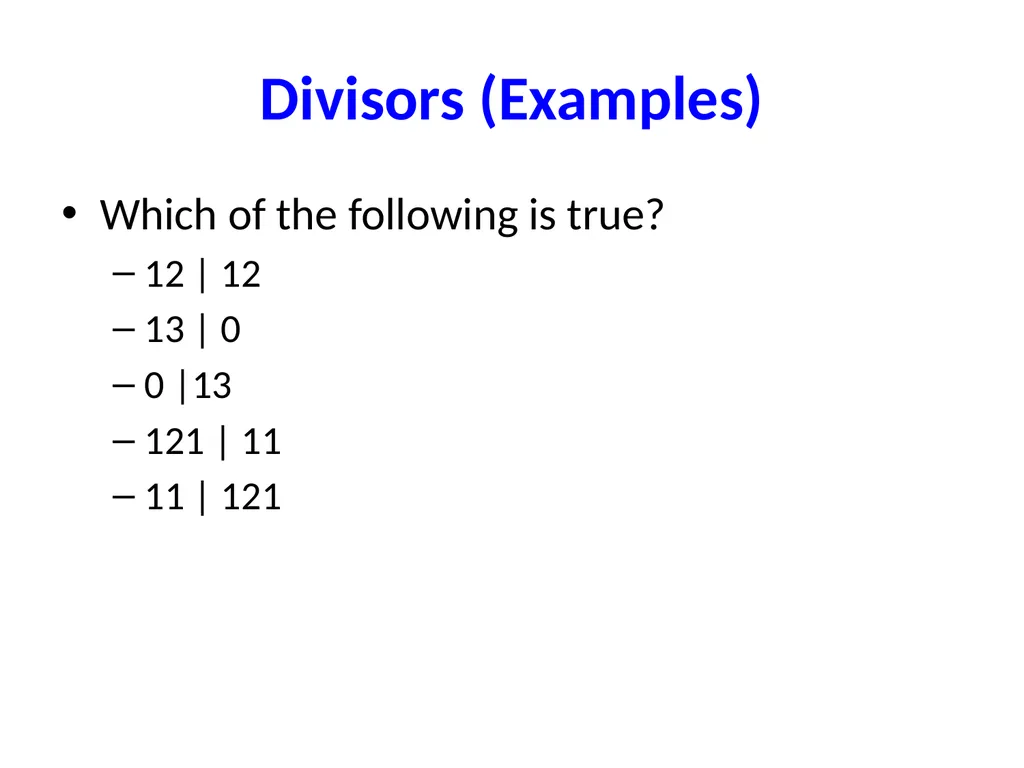
Divisors (Examples) Which of the following is true?
12 | 12
13 | 0
0 |13
121 | 11
11 | 121<br>
12 | 12
13 | 0
0 |13
121 | 11
11 | 121<br>
08
Accepted facts we will use as obvious (axioms):
In algebra, a + b = b + a
Laws of algebra
Laws of set theory
Laws of inference<br>
In algebra, a + b = b + a
Laws of algebra
Laws of set theory
Laws of inference<br>
09
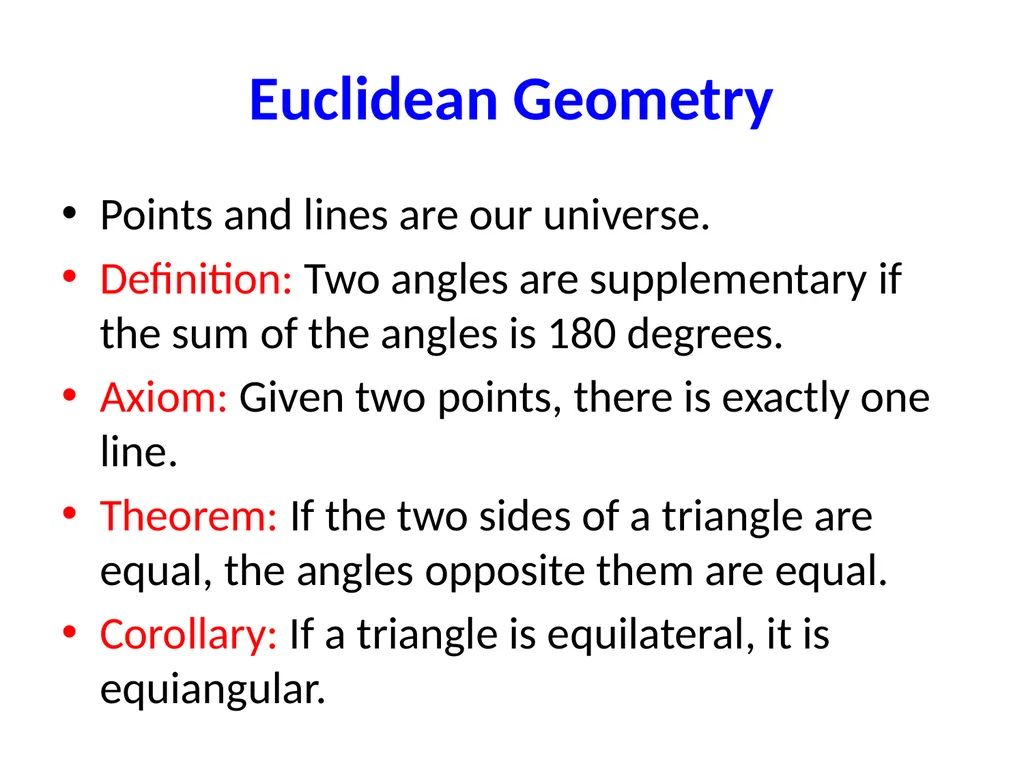
Euclidean Geometry Points and lines are our universe.
Definition: Two angles are supplementary if the sum of the angles is 180 degrees.
Axiom: Given two points, there is exactly one line.
Theorem: If the two sides of a triangle are equal, the angles opposite them are equal.
Corollary: If a triangle is equilateral, it is equiangular.<br>
Definition: Two angles are supplementary if the sum of the angles is 180 degrees.
Axiom: Given two points, there is exactly one line.
Theorem: If the two sides of a triangle are equal, the angles opposite them are equal.
Corollary: If a triangle is equilateral, it is equiangular.<br>
10
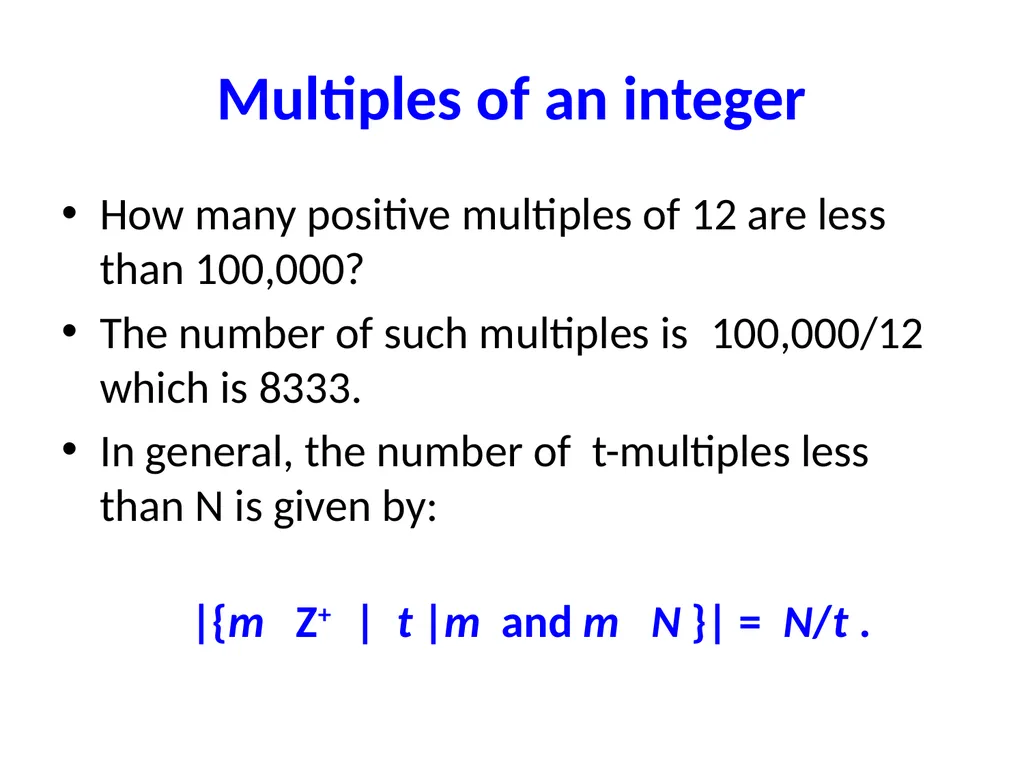
Multiples of an integer How many positive multiples of 12 are less than 100,000?
The number of such multiples is 100,000/12 which is 8333.
In general, the number of t-multiples less than N is given by:
|{m Z+ | t |m and m N }| = N/t.<br>
The number of such multiples is 100,000/12 which is 8333.
In general, the number of t-multiples less than N is given by:
|{m Z+ | t |m and m N }| = N/t.<br>
11
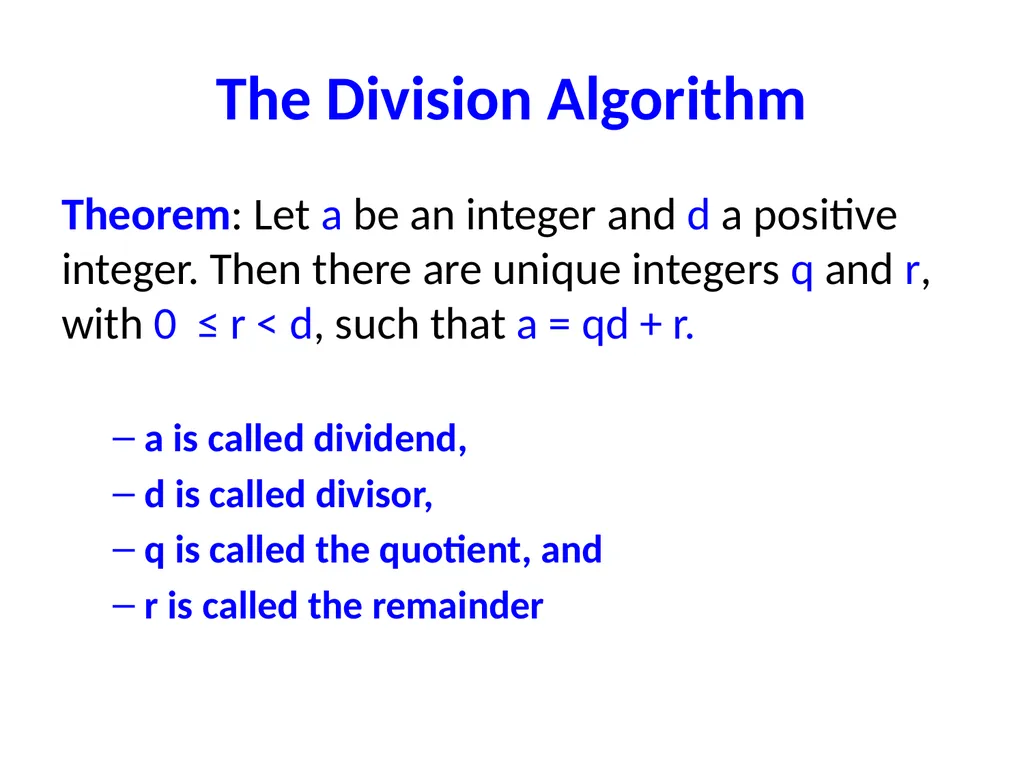
The Division Algorithm Theorem: Let a be an integer and d a positive integer. Then there are unique integers q and r, with 0 ≤ r < d, such that a = qd + r.
a is called dividend,
d is called divisor,
q is called the quotient, and
r is called the remainder<br>
a is called dividend,
d is called divisor,
q is called the quotient, and
r is called the remainder<br>
12
Prime numbers Definition:
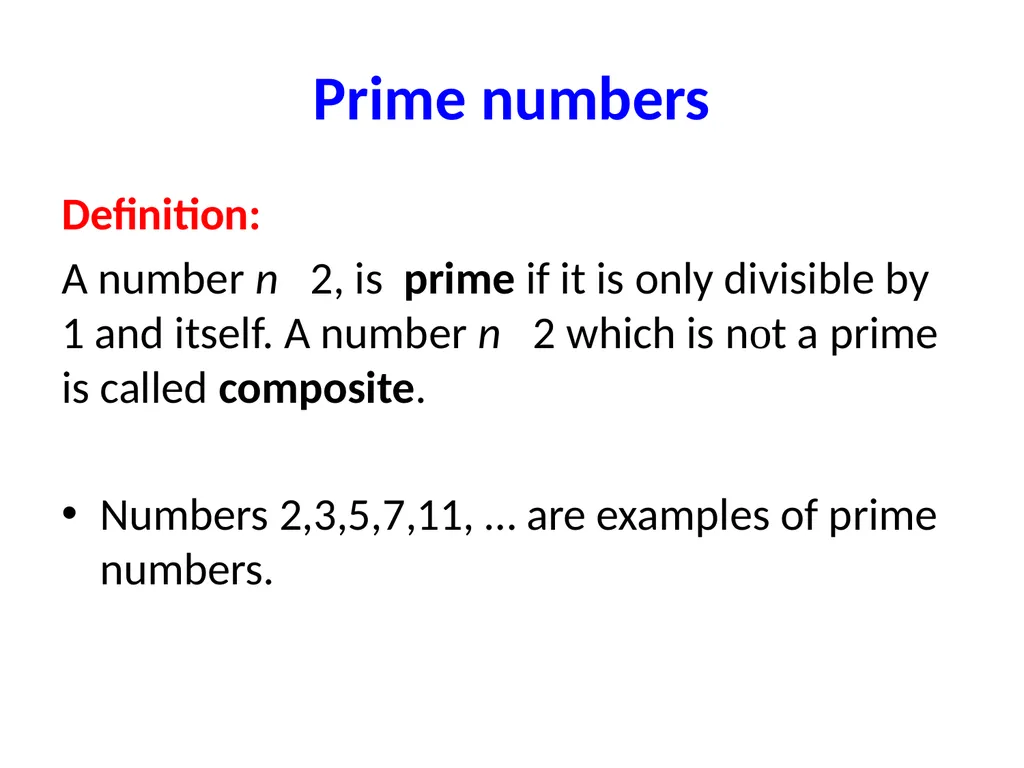
A number n 2, is prime if it is only divisible by 1 and itself. A number n 2 which is not a prime is called composite.
Numbers 2,3,5,7,11, … are examples of prime numbers.<br>
A number n 2, is prime if it is only divisible by 1 and itself. A number n 2 which is not a prime is called composite.
Numbers 2,3,5,7,11, … are examples of prime numbers.<br>
13
Greatest Common Divisor (gcd) Definition:
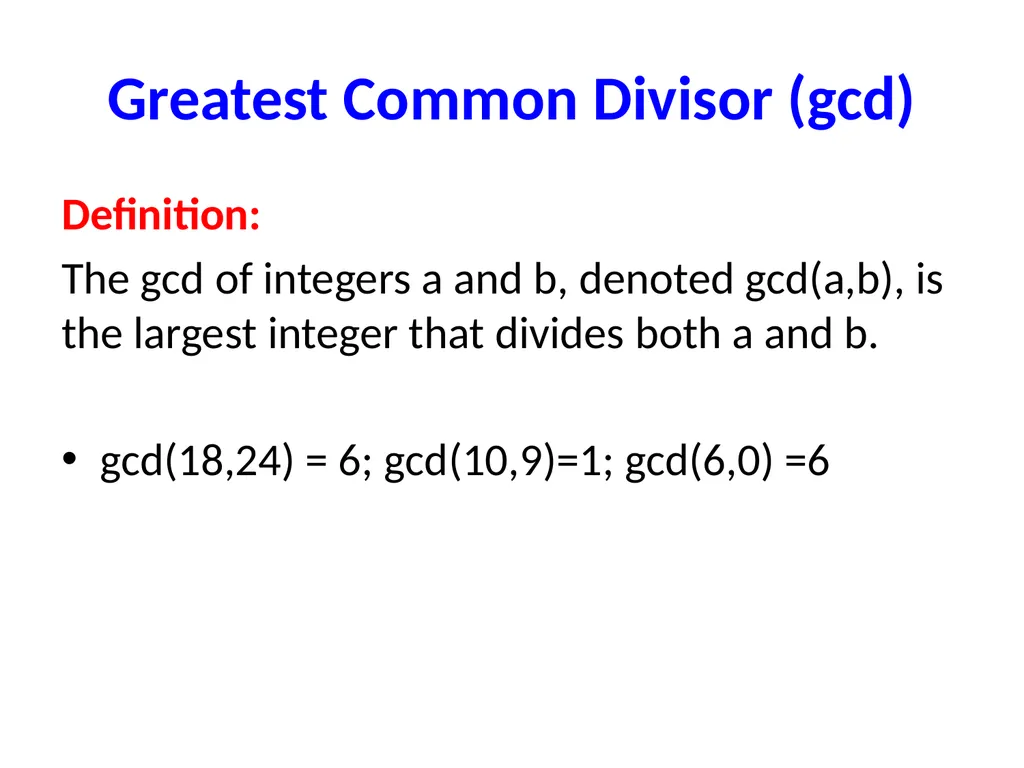
The gcd of integers a and b, denoted gcd(a,b), is the largest integer that divides both a and b.
gcd(18,24) = 6; gcd(10,9)=1; gcd(6,0) =6<br>
The gcd of integers a and b, denoted gcd(a,b), is the largest integer that divides both a and b.
gcd(18,24) = 6; gcd(10,9)=1; gcd(6,0) =6<br>
14
Least Common Multiple (lcm) Definition:
The lcm of non-zero integers a and b, denoted lcm(a,b), is the smallest positive integer that is multiple of both a and b.
lcm(4,6) = 12; lcm(7,7)=7.<br>
The lcm of non-zero integers a and b, denoted lcm(a,b), is the smallest positive integer that is multiple of both a and b.
lcm(4,6) = 12; lcm(7,7)=7.<br>
15
Comments Not all terms can be defined.
We accept some ideas as being so intuitively clear that they require no definitions or verifications.
We accept natural ordering of the elements of N, Z, Q and R. We also accept that for integers a and b,
a + b Z
a – b Z
ab Z.<br>
We accept some ideas as being so intuitively clear that they require no definitions or verifications.
We accept natural ordering of the elements of N, Z, Q and R. We also accept that for integers a and b,
a + b Z
a – b Z
ab Z.<br>
16
Direct Proofs We are interested in proving an implication:
P Q, i.e. if P, then Q.<br>
P Q, i.e. if P, then Q.<br>
17
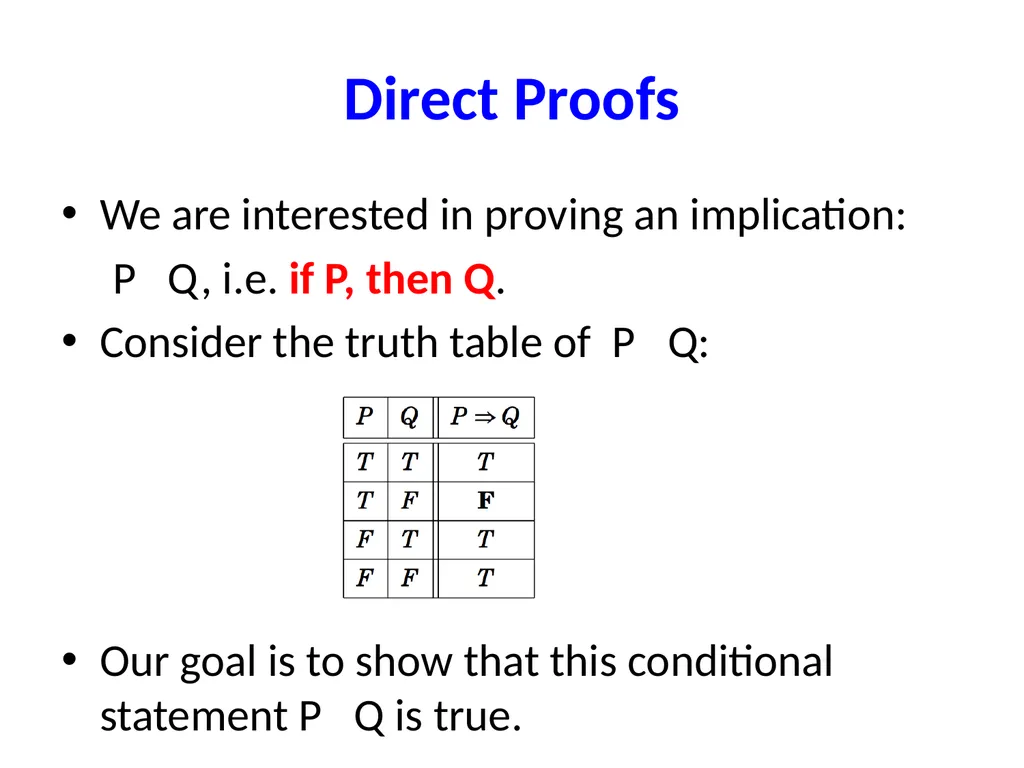
Direct Proofs We are interested in proving an implication:
P Q, i.e. if P, then Q.
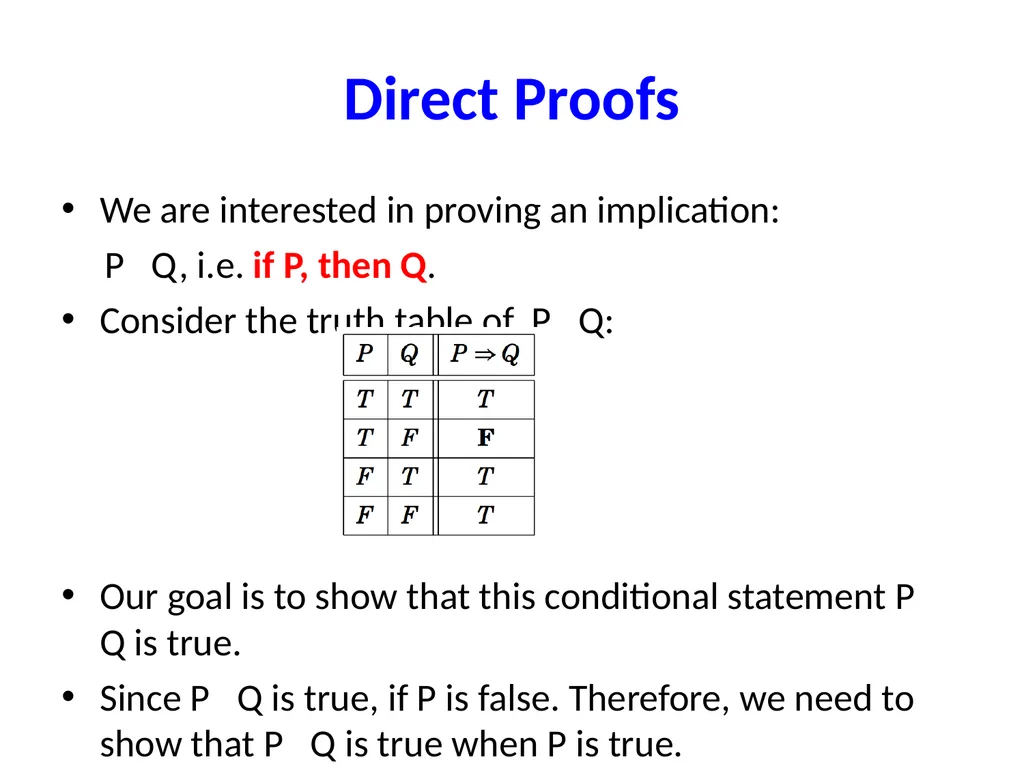
Consider the truth table of P Q:
Our goal is to show that this conditional statement P Q is true.<br>
P Q, i.e. if P, then Q.
Consider the truth table of P Q:
Our goal is to show that this conditional statement P Q is true.<br>
18
Direct Proofs We are interested in proving an implication:
P Q, i.e. if P, then Q.
Consider the truth table of P Q:
Our goal is to show that this conditional statement P Q is true.
Since P Q is true, if P is false. Therefore, we need to show that P Q is true when P is true.<br>
P Q, i.e. if P, then Q.
Consider the truth table of P Q:
Our goal is to show that this conditional statement P Q is true.
Since P Q is true, if P is false. Therefore, we need to show that P Q is true when P is true.<br>
19
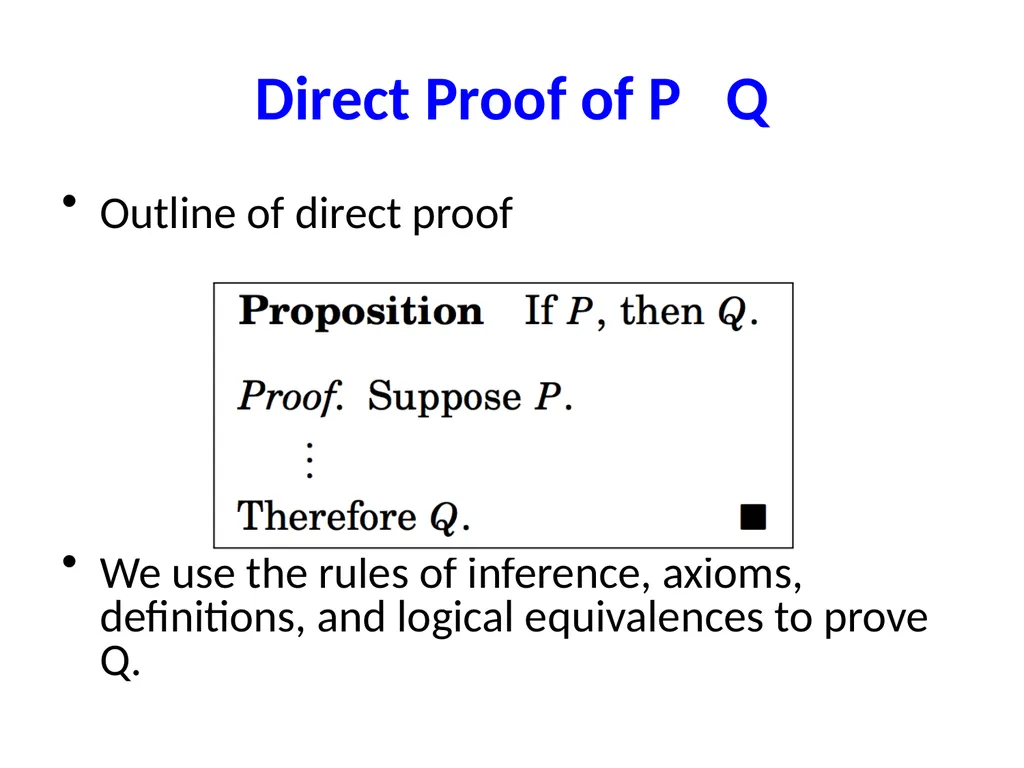
Direct Proof of P Q Outline of direct proof
We use the rules of inference, axioms, definitions, and logical equivalences to prove Q.<br>
We use the rules of inference, axioms, definitions, and logical equivalences to prove Q.<br>
20
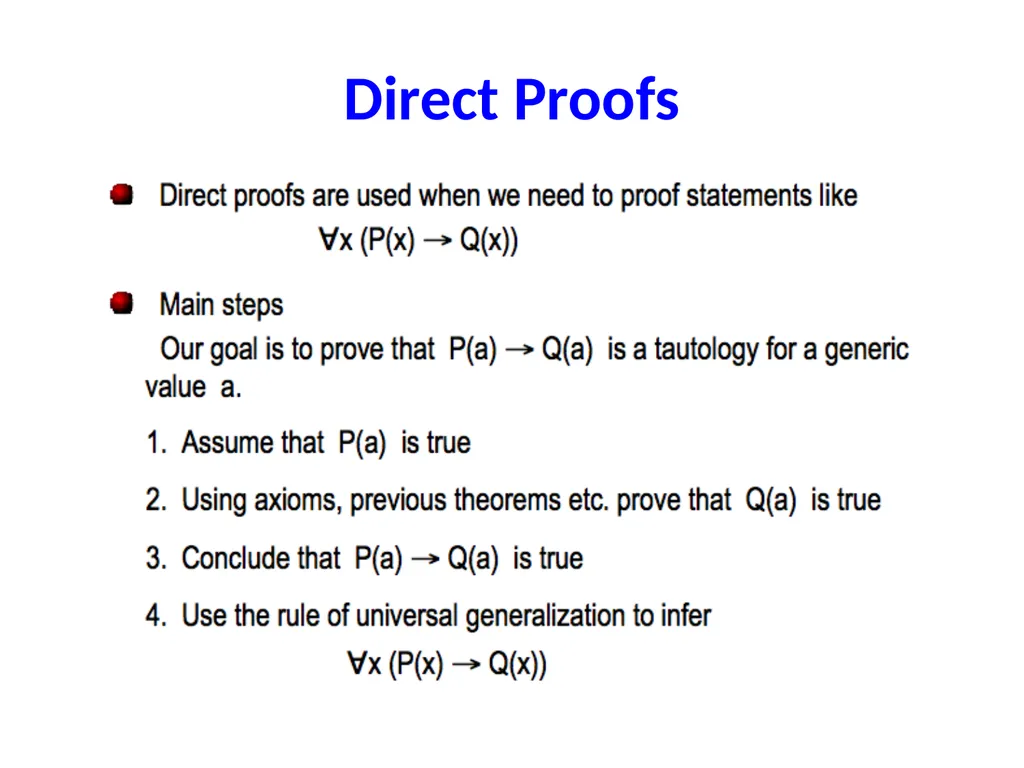
Direct Proofs<br>
21
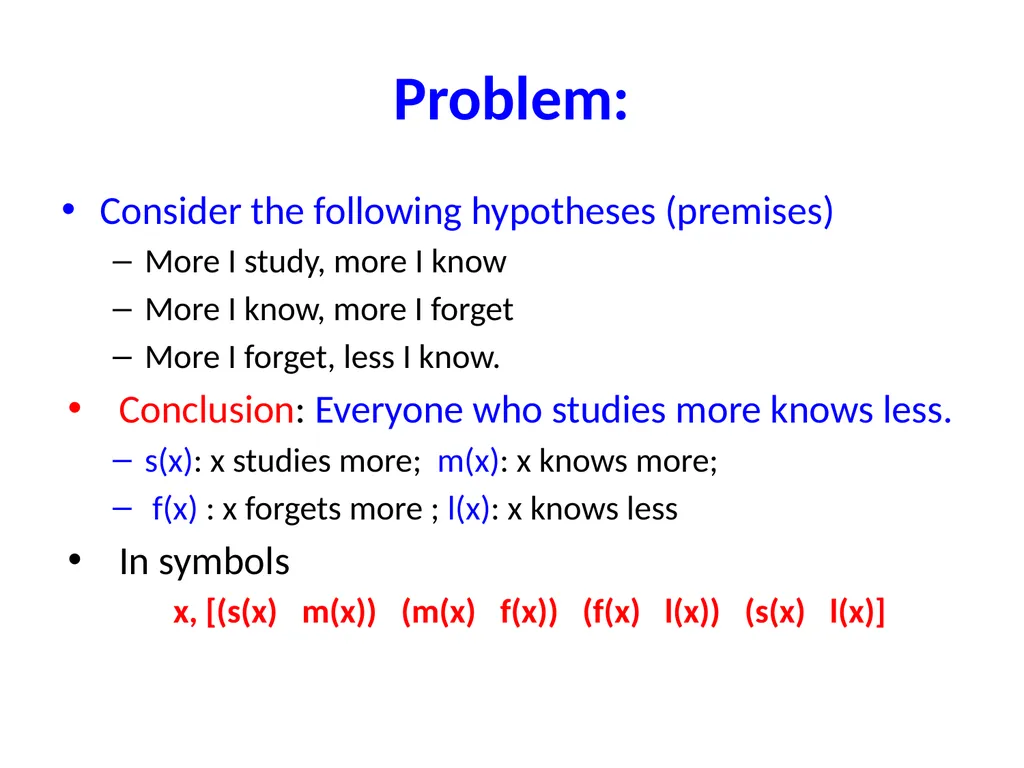
Problem: Consider the following hypotheses (premises)
More I study, more I know
More I know, more I forget
More I forget, less I know.
Conclusion: Everyone who studies more knows less.
s(x): x studies more; m(x): x knows more;
f(x) : x forgets more ; l(x): x knows less
In symbols
x, [(s(x) m(x)) (m(x) f(x)) (f(x) l(x)) (s(x) l(x)]<br>
More I study, more I know
More I know, more I forget
More I forget, less I know.
Conclusion: Everyone who studies more knows less.
s(x): x studies more; m(x): x knows more;
f(x) : x forgets more ; l(x): x knows less
In symbols
x, [(s(x) m(x)) (m(x) f(x)) (f(x) l(x)) (s(x) l(x)]<br>
22
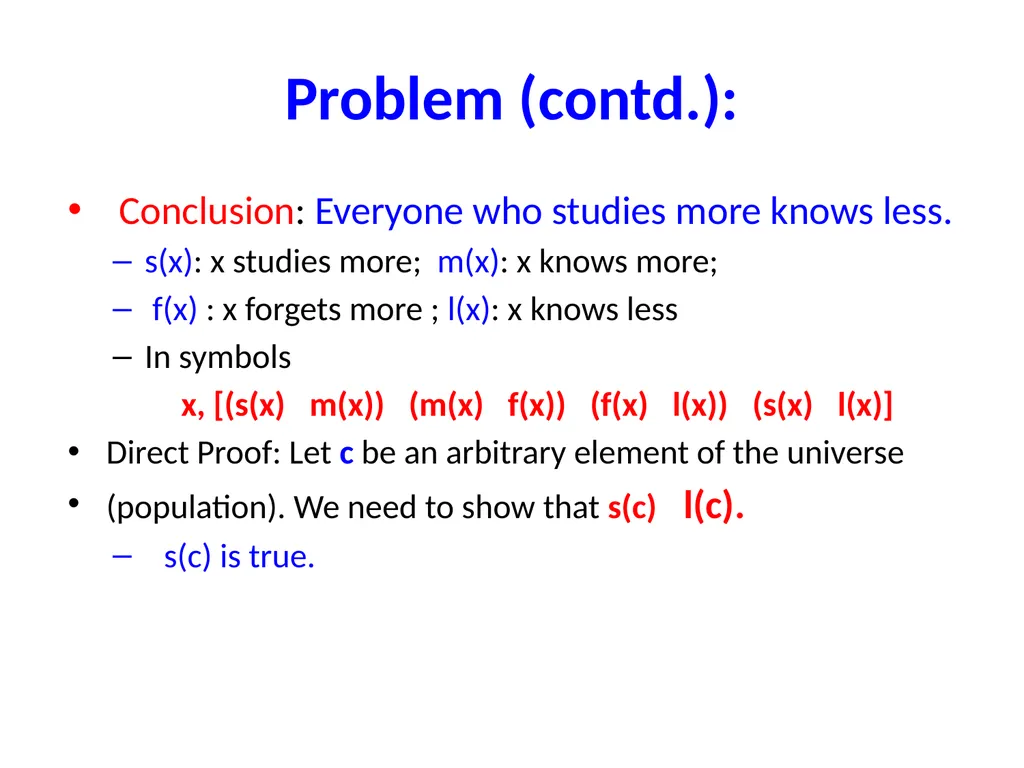
Problem (contd.): Conclusion: Everyone who studies more knows less.
s(x): x studies more; m(x): x knows more;
f(x) : x forgets more ; l(x): x knows less
In symbols
x, [(s(x) m(x)) (m(x) f(x)) (f(x) l(x)) (s(x) l(x)]
Direct Proof: Let c be an arbitrary element of the universe
(population). We need to show that s(c) l(c).
s(c) is true.<br>
s(x): x studies more; m(x): x knows more;
f(x) : x forgets more ; l(x): x knows less
In symbols
x, [(s(x) m(x)) (m(x) f(x)) (f(x) l(x)) (s(x) l(x)]
Direct Proof: Let c be an arbitrary element of the universe
(population). We need to show that s(c) l(c).
s(c) is true.<br>
23
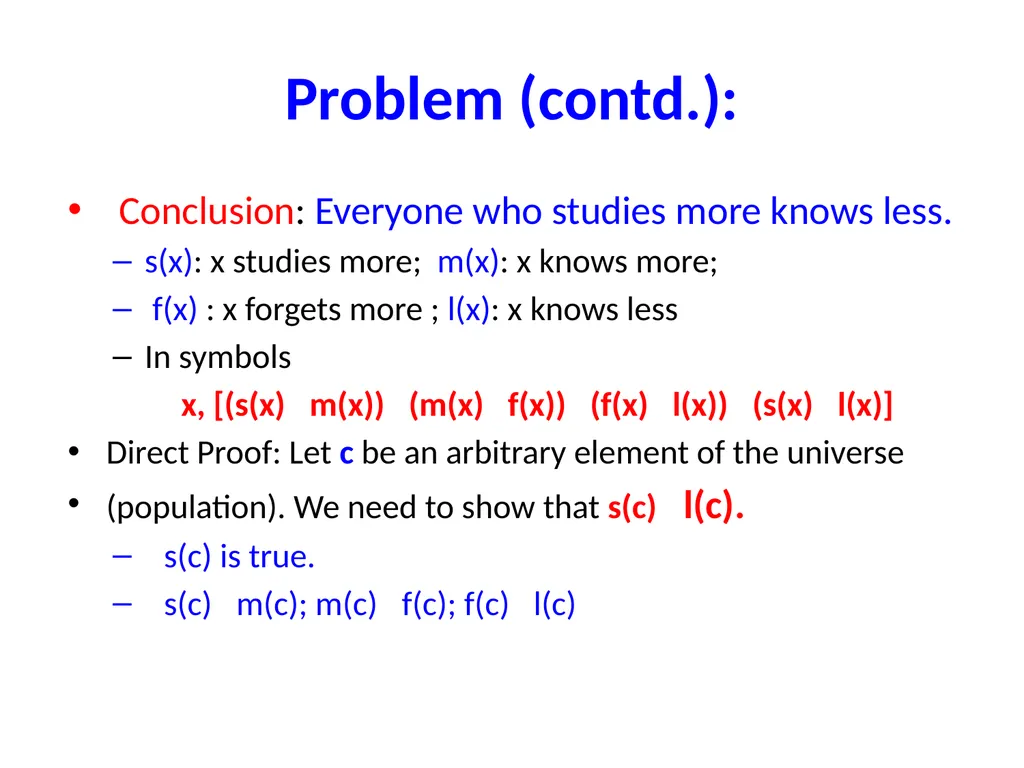
Problem (contd.): Conclusion: Everyone who studies more knows less.
s(x): x studies more; m(x): x knows more;
f(x) : x forgets more ; l(x): x knows less
In symbols
x, [(s(x) m(x)) (m(x) f(x)) (f(x) l(x)) (s(x) l(x)]
Direct Proof: Let c be an arbitrary element of the universe
(population). We need to show that s(c) l(c).
s(c) is true.
s(c) m(c); m(c) f(c); f(c) l(c)<br>
s(x): x studies more; m(x): x knows more;
f(x) : x forgets more ; l(x): x knows less
In symbols
x, [(s(x) m(x)) (m(x) f(x)) (f(x) l(x)) (s(x) l(x)]
Direct Proof: Let c be an arbitrary element of the universe
(population). We need to show that s(c) l(c).
s(c) is true.
s(c) m(c); m(c) f(c); f(c) l(c)<br>
24
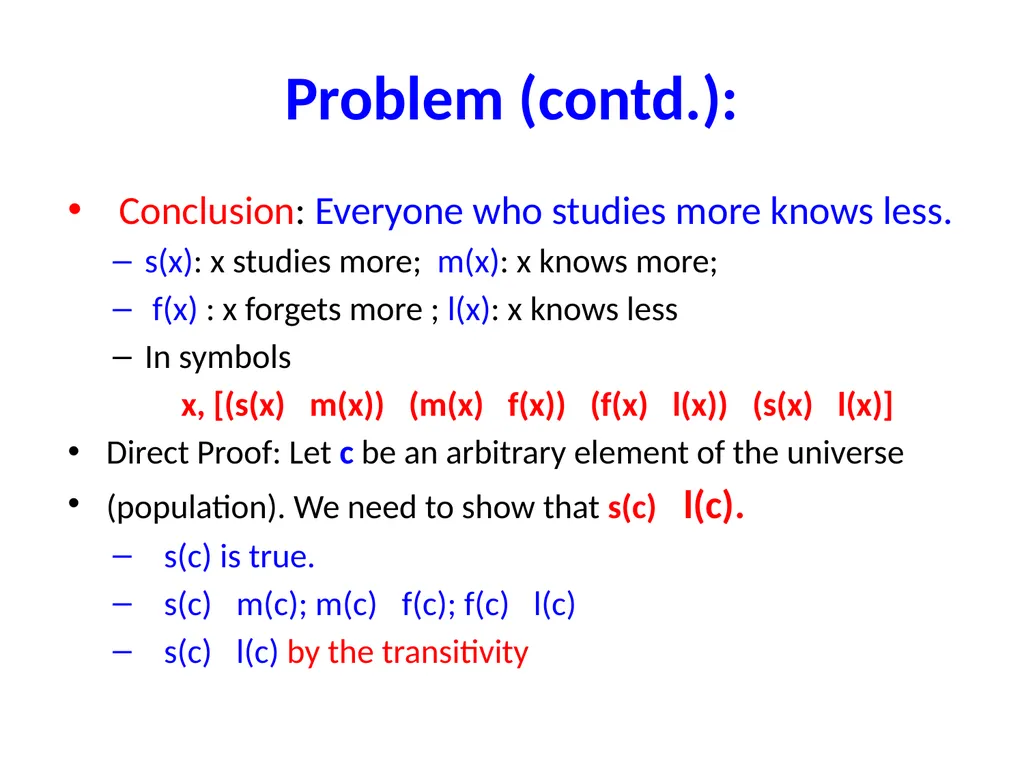
Problem (contd.): Conclusion: Everyone who studies more knows less.
s(x): x studies more; m(x): x knows more;
f(x) : x forgets more ; l(x): x knows less
In symbols
x, [(s(x) m(x)) (m(x) f(x)) (f(x) l(x)) (s(x) l(x)]
Direct Proof: Let c be an arbitrary element of the universe
(population). We need to show that s(c) l(c).
s(c) is true.
s(c) m(c); m(c) f(c); f(c) l(c)
s(c) l(c) by the transitivity<br>
s(x): x studies more; m(x): x knows more;
f(x) : x forgets more ; l(x): x knows less
In symbols
x, [(s(x) m(x)) (m(x) f(x)) (f(x) l(x)) (s(x) l(x)]
Direct Proof: Let c be an arbitrary element of the universe
(population). We need to show that s(c) l(c).
s(c) is true.
s(c) m(c); m(c) f(c); f(c) l(c)
s(c) l(c) by the transitivity<br>
25
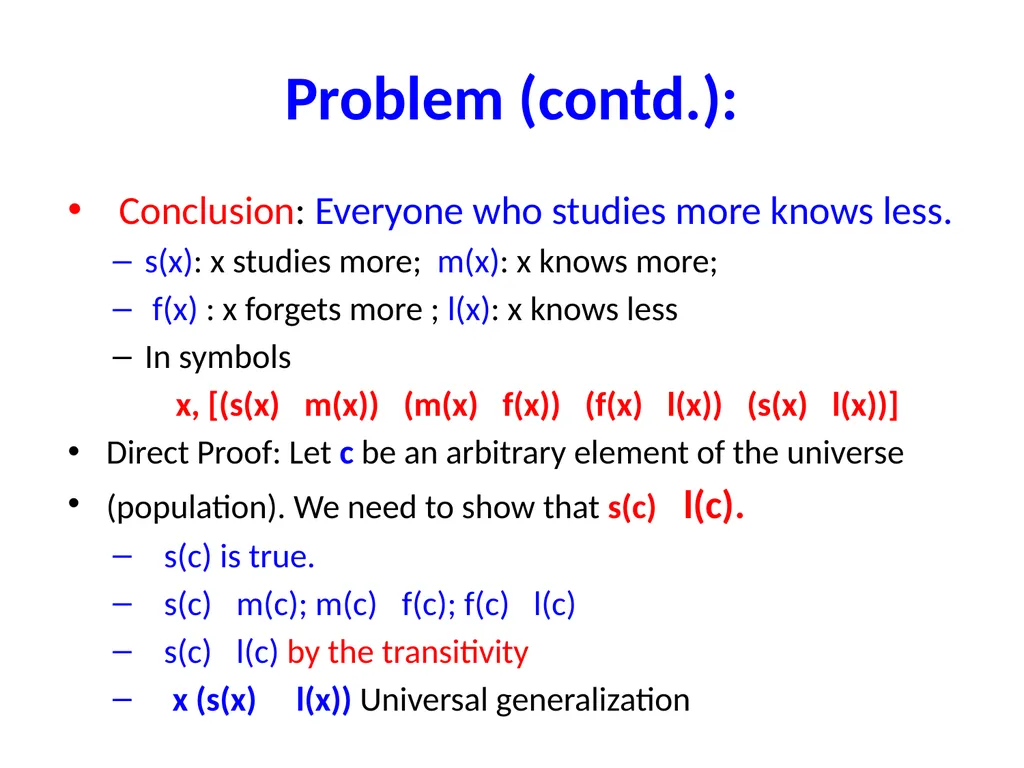
Problem (contd.): Conclusion: Everyone who studies more knows less.
s(x): x studies more; m(x): x knows more;
f(x) : x forgets more ; l(x): x knows less
In symbols
x, [(s(x) m(x)) (m(x) f(x)) (f(x) l(x)) (s(x) l(x))]
Direct Proof: Let c be an arbitrary element of the universe
(population). We need to show that s(c) l(c).
s(c) is true.
s(c) m(c); m(c) f(c); f(c) l(c)
s(c) l(c) by the transitivity
x (s(x) l(x)) Universal generalization<br>
s(x): x studies more; m(x): x knows more;
f(x) : x forgets more ; l(x): x knows less
In symbols
x, [(s(x) m(x)) (m(x) f(x)) (f(x) l(x)) (s(x) l(x))]
Direct Proof: Let c be an arbitrary element of the universe
(population). We need to show that s(c) l(c).
s(c) is true.
s(c) m(c); m(c) f(c); f(c) l(c)
s(c) l(c) by the transitivity
x (s(x) l(x)) Universal generalization<br>
26
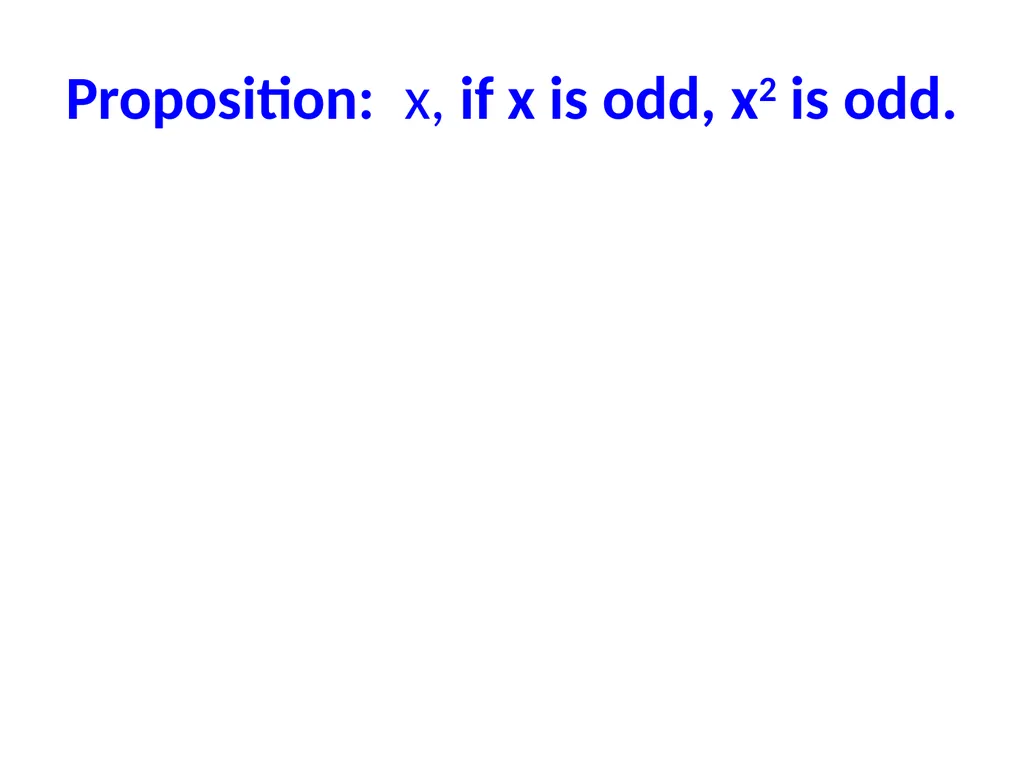
Proposition: x, if x is odd, x2 is odd.<br>
27
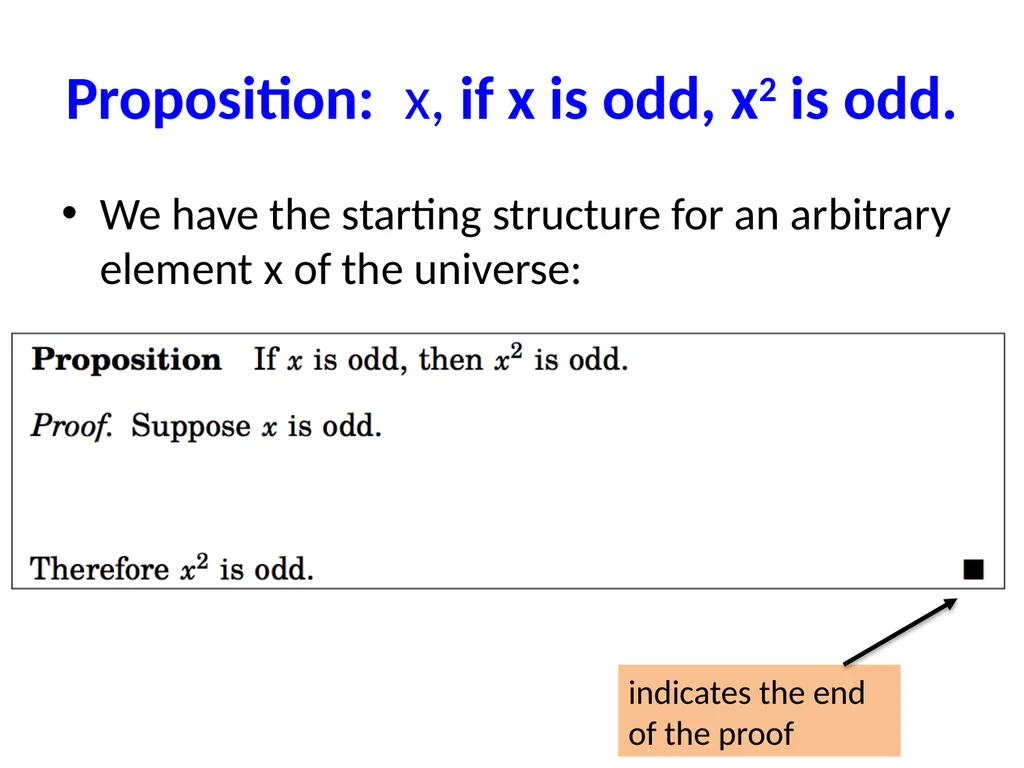
Proposition: x, if x is odd, x2 is odd. We have the starting structure for an arbitrary element x of the universe: indicates the end of the proof<br>
28
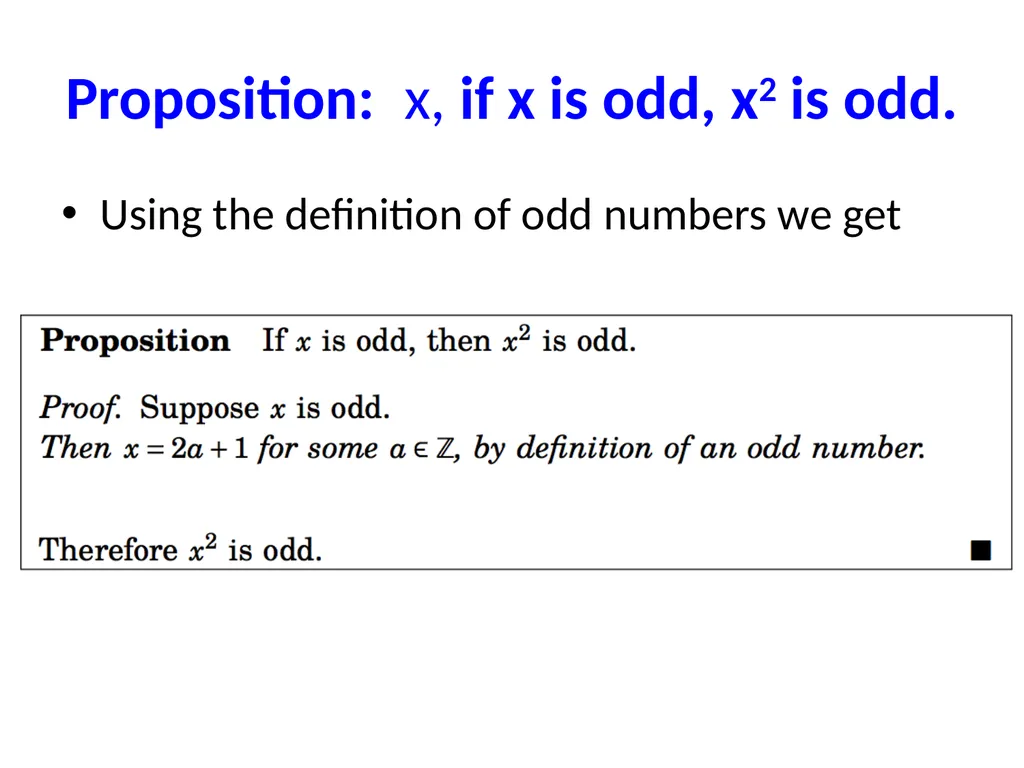
Proposition: x, if x is odd, x2 is odd. Using the definition of odd numbers we get<br>
29
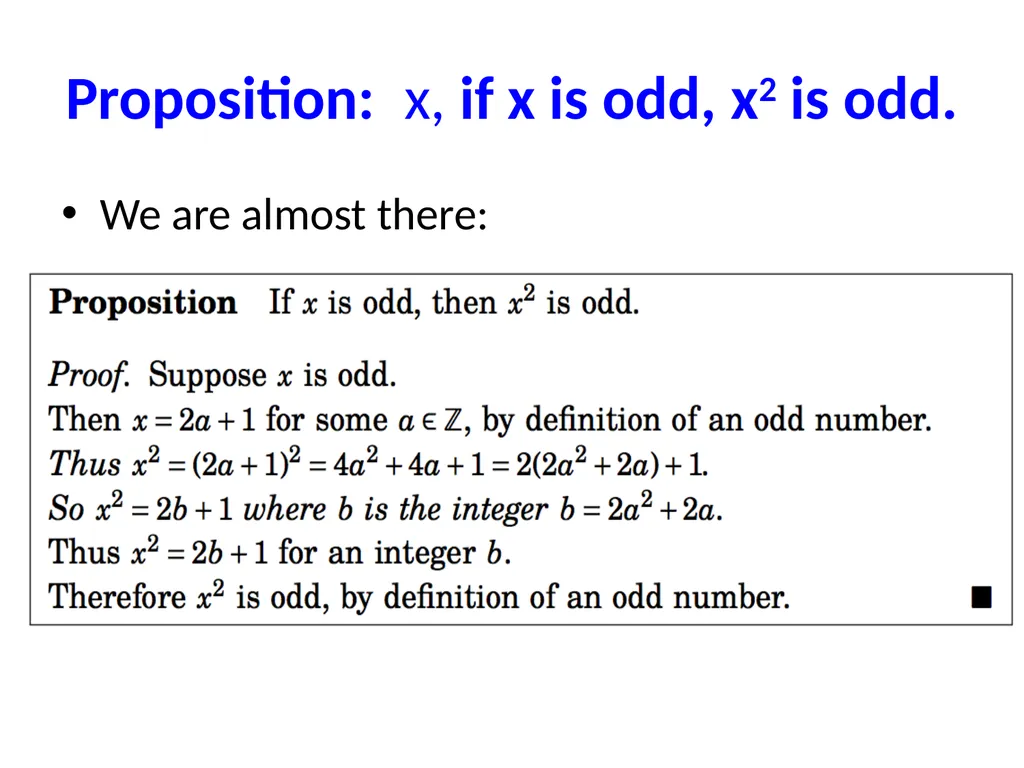
Proposition: x, if x is odd, x2 is odd. We are almost there:<br>
30
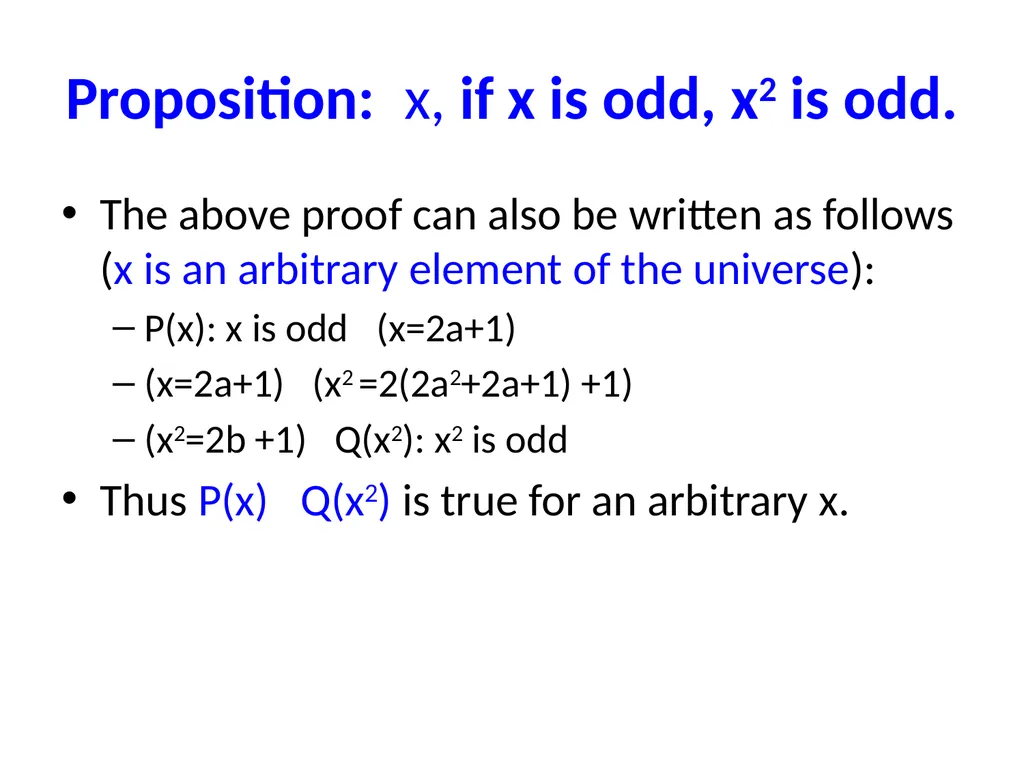
Proposition: x, if x is odd, x2 is odd. The above proof can also be written as follows (x is an arbitrary element of the universe):
P(x): x is odd (x=2a+1)
(x=2a+1) (x2 =2(2a2+2a+1) +1)
(x2=2b +1) Q(x2): x2 is odd
Thus P(x) Q(x2) is true for an arbitrary x.<br>
P(x): x is odd (x=2a+1)
(x=2a+1) (x2 =2(2a2+2a+1) +1)
(x2=2b +1) Q(x2): x2 is odd
Thus P(x) Q(x2) is true for an arbitrary x.<br>
31
Show that 1+2+3+ …+ n =n(n+1)/2 We assume that n N.
We write
x = 1 + 2 + … + n.<br>
We write
x = 1 + 2 + … + n.<br>
32
Show that 1+2+3+ …+ n =n(n+1)/2 We assume that n N.
We write
x = 1 + 2 + … + n.
x = n + (n-1) + … + 1. (Commutative property)<br>
We write
x = 1 + 2 + … + n.
x = n + (n-1) + … + 1. (Commutative property)<br>
33
Show that 1+2+3+ …+ n =n(n+1)/2 We assume that n N.
We write
x = 1 + 2 + … + n.
x = n + (n-1) + … + 1. (Commutative property)
2x = n(n+1) (adding both the rows)
x = n(n+1)/2<br>
We write
x = 1 + 2 + … + n.
x = n + (n-1) + … + 1. (Commutative property)
2x = n(n+1) (adding both the rows)
x = n(n+1)/2<br>
34
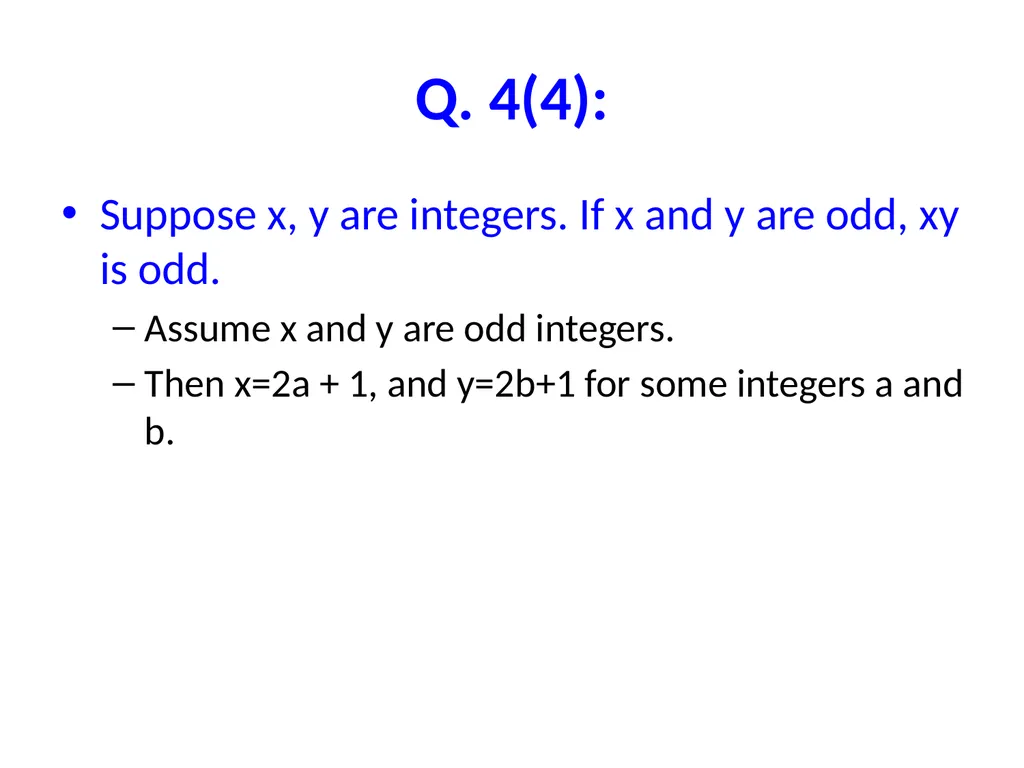
Q. 4(4): Suppose x, y are integers. If x and y are odd, xy is odd.
Assume x and y are odd integers.
Then x=2a + 1, and y=2b+1 for some integers a and b.<br>
Assume x and y are odd integers.
Then x=2a + 1, and y=2b+1 for some integers a and b.<br>
35
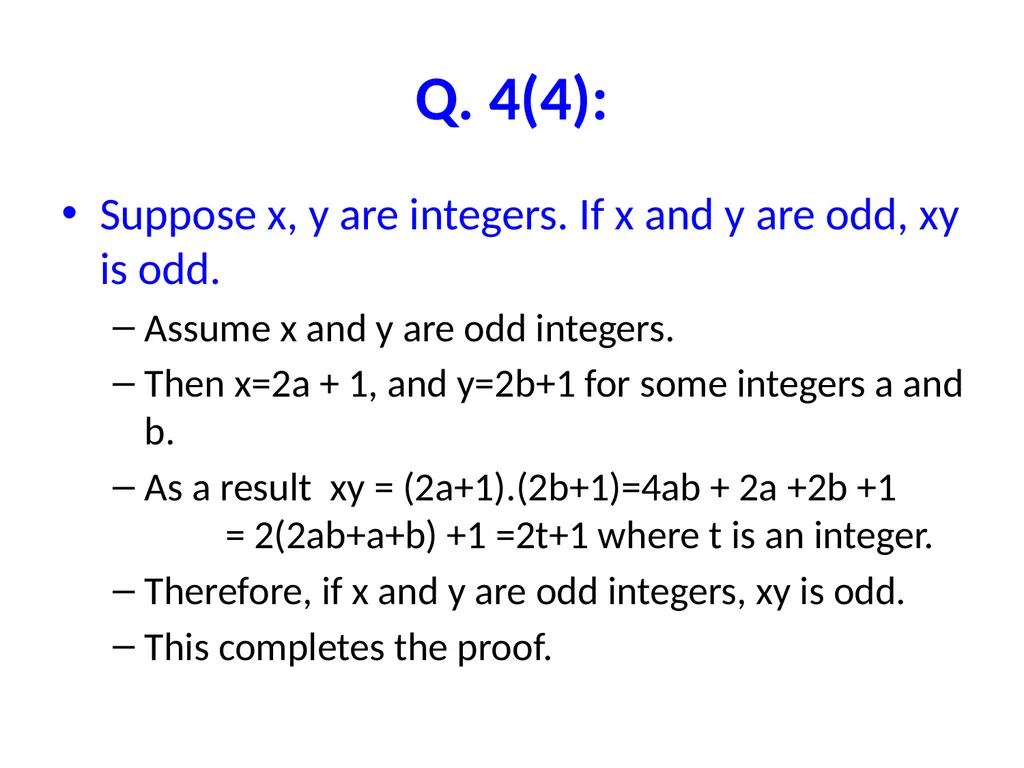
Q. 4(4): Suppose x, y are integers. If x and y are odd, xy is odd.
Assume x and y are odd integers.
Then x=2a + 1, and y=2b+1 for some integers a and b.
As a result xy = (2a+1).(2b+1)=4ab + 2a +2b +1 = 2(2ab+a+b) +1 =2t+1 where t is an integer.
Therefore, if x and y are odd integers, xy is odd.
This completes the proof.<br>
Assume x and y are odd integers.
Then x=2a + 1, and y=2b+1 for some integers a and b.
As a result xy = (2a+1).(2b+1)=4ab + 2a +2b +1 = 2(2ab+a+b) +1 =2t+1 where t is an integer.
Therefore, if x and y are odd integers, xy is odd.
This completes the proof.<br>
36
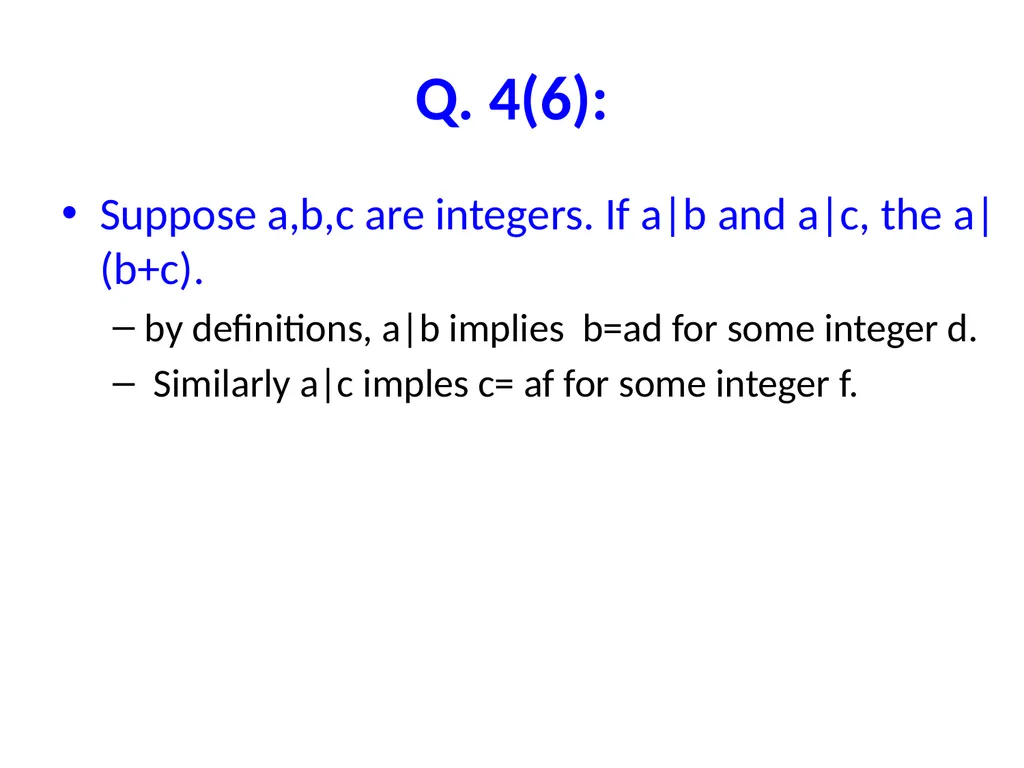
Q. 4(6): Suppose a,b,c are integers. If a|b and a|c, the a|(b+c).
by definitions, a|b implies b=ad for some integer d.
Similarly a|c imples c= af for some integer f.<br>
by definitions, a|b implies b=ad for some integer d.
Similarly a|c imples c= af for some integer f.<br>
37
Q. 4(6): Suppose a,b,c are integers. If a|b and a|c, the a|(b+c).
by definitions, a|b implies b=ad for some integer d.
Similarly a|c imples c= af for some integer f.
We can now write b + c =a(f+d) = a.t, for some integer t. Therefore, by definition, a | (b+c).<br>
by definitions, a|b implies b=ad for some integer d.
Similarly a|c imples c= af for some integer f.
We can now write b + c =a(f+d) = a.t, for some integer t. Therefore, by definition, a | (b+c).<br>
38
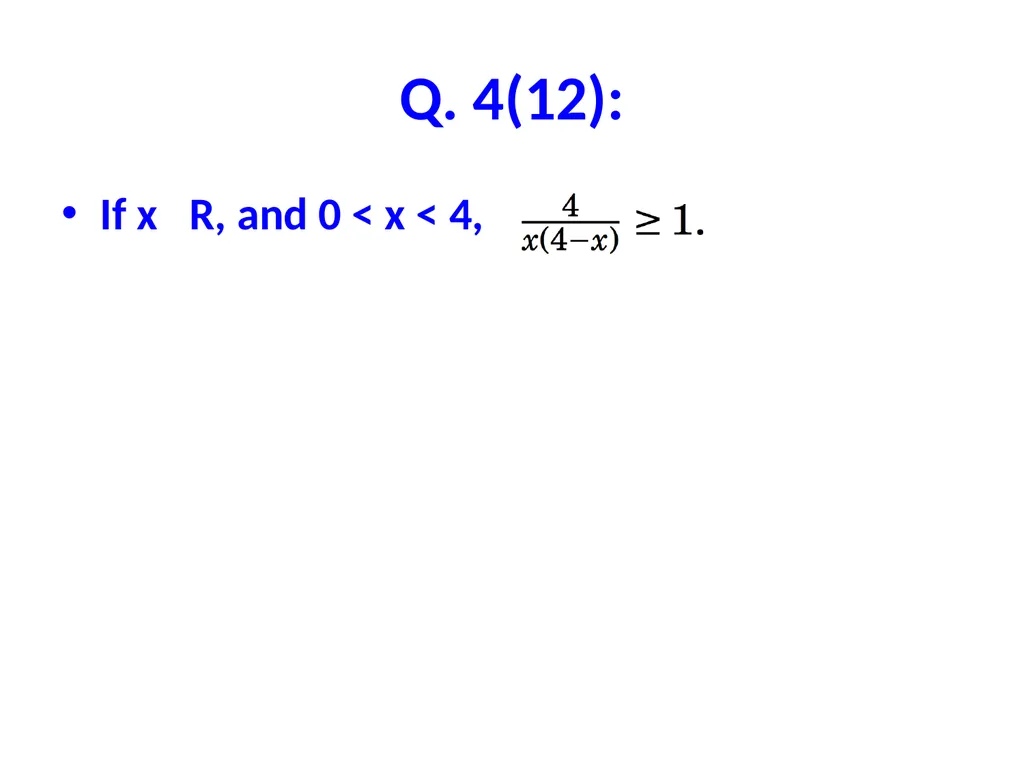
Q. 4(12): If x R, and 0 < x < 4,<br>
39
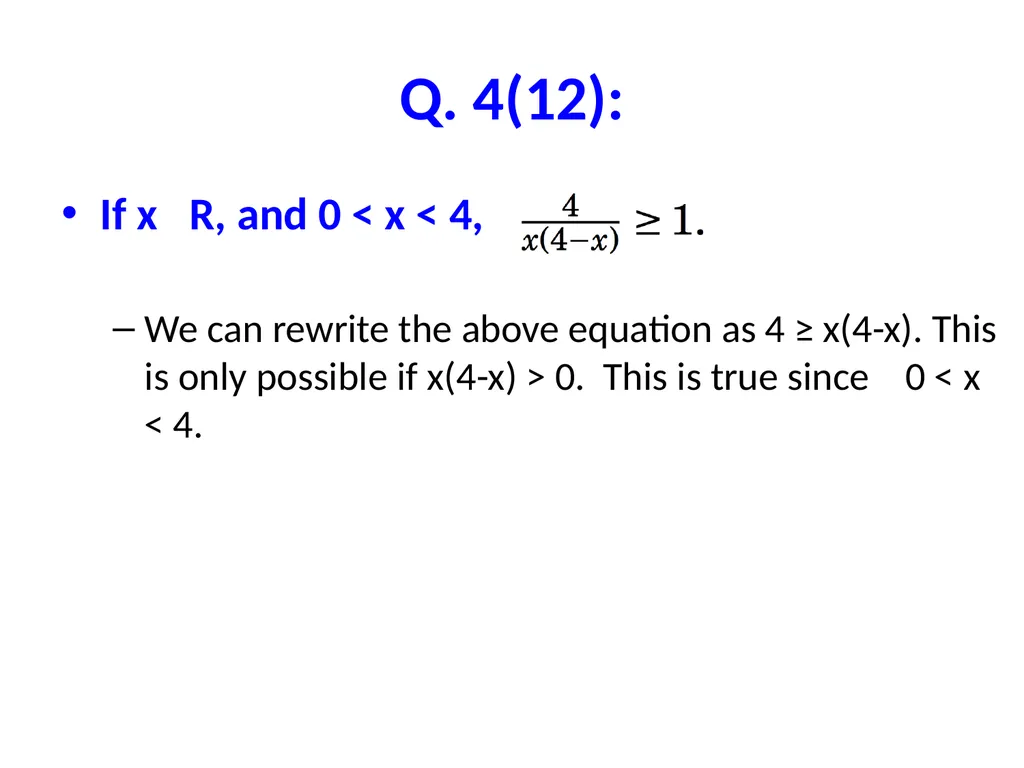
Q. 4(12): If x R, and 0 < x < 4,
We can rewrite the above equation as 4 ≥ x(4-x). This is only possible if x(4-x) > 0. This is true since 0 < x < 4.<br>
We can rewrite the above equation as 4 ≥ x(4-x). This is only possible if x(4-x) > 0. This is true since 0 < x < 4.<br>
40
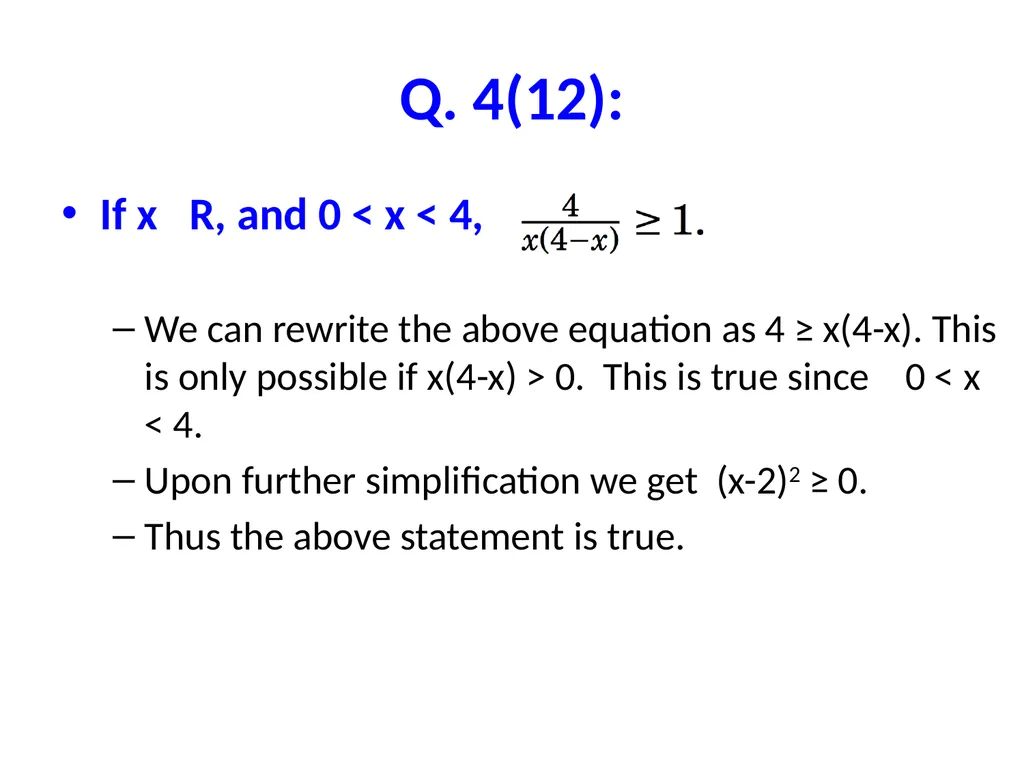
Q. 4(12): If x R, and 0 < x < 4,
We can rewrite the above equation as 4 ≥ x(4-x). This is only possible if x(4-x) > 0. This is true since 0 < x < 4.
Upon further simplification we get (x-2)2 ≥ 0.
Thus the above statement is true.<br>
We can rewrite the above equation as 4 ≥ x(4-x). This is only possible if x(4-x) > 0. This is true since 0 < x < 4.
Upon further simplification we get (x-2)2 ≥ 0.
Thus the above statement is true.<br>
41
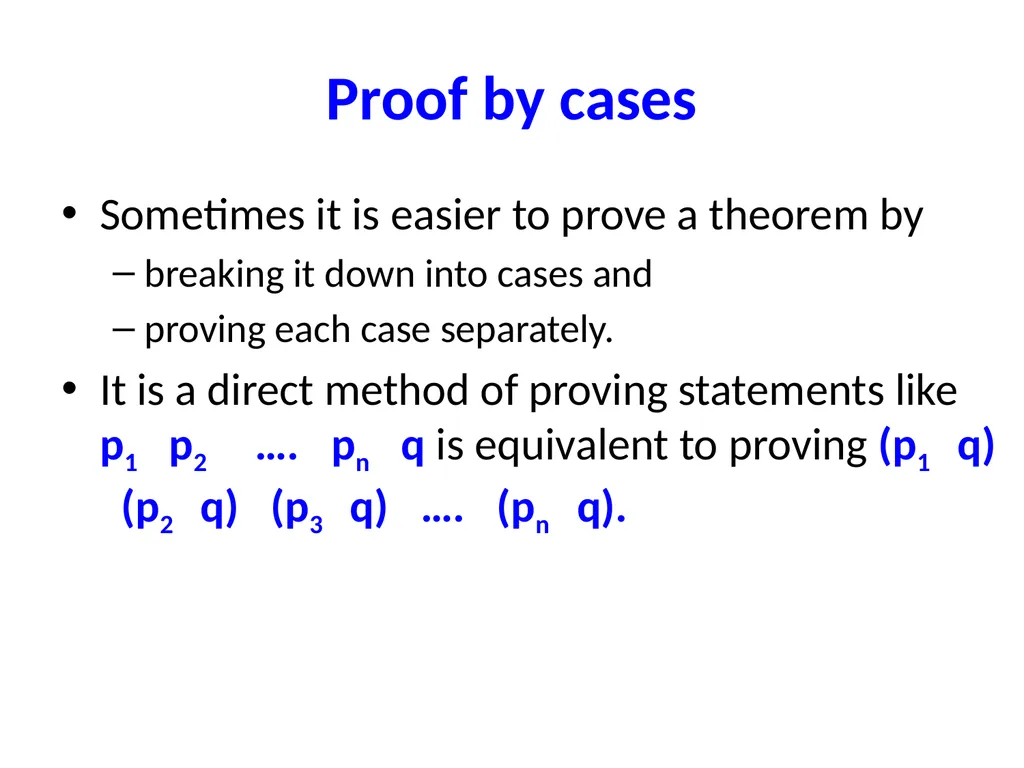
Proof by cases Sometimes it is easier to prove a theorem by
breaking it down into cases and
proving each case separately.
It is a direct method of proving statements like p1 p2 …. pn q is equivalent to proving (p1 q) (p2 q) (p3 q) …. (pn q).<br>
breaking it down into cases and
proving each case separately.
It is a direct method of proving statements like p1 p2 …. pn q is equivalent to proving (p1 q) (p2 q) (p3 q) …. (pn q).<br>
42
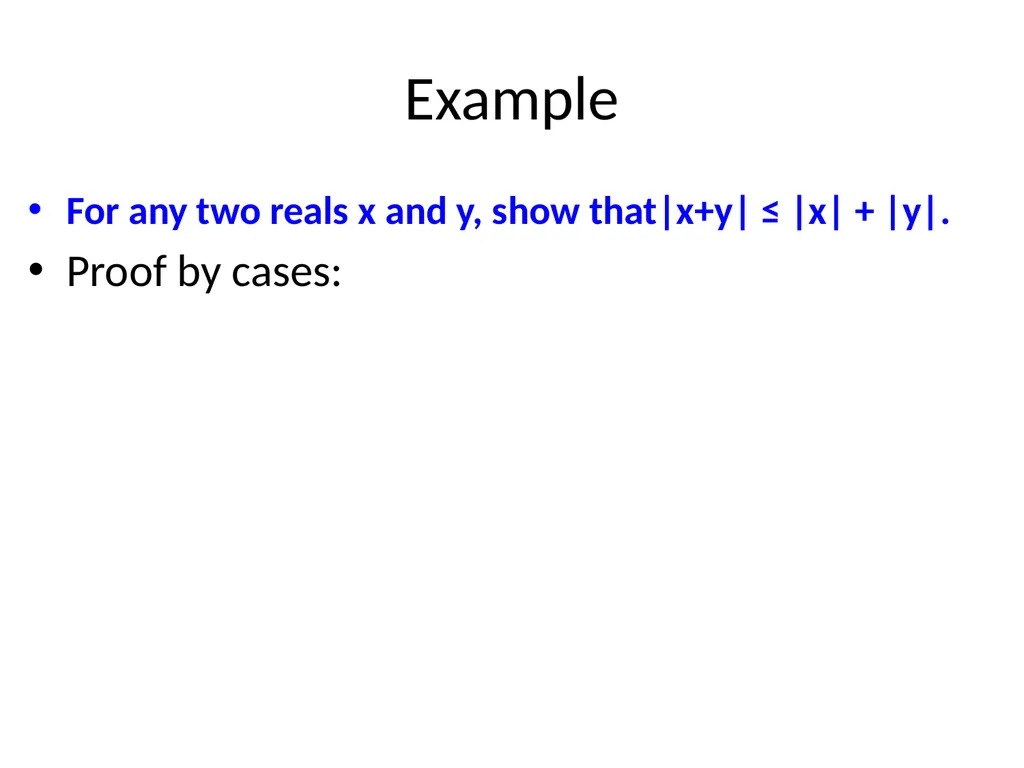
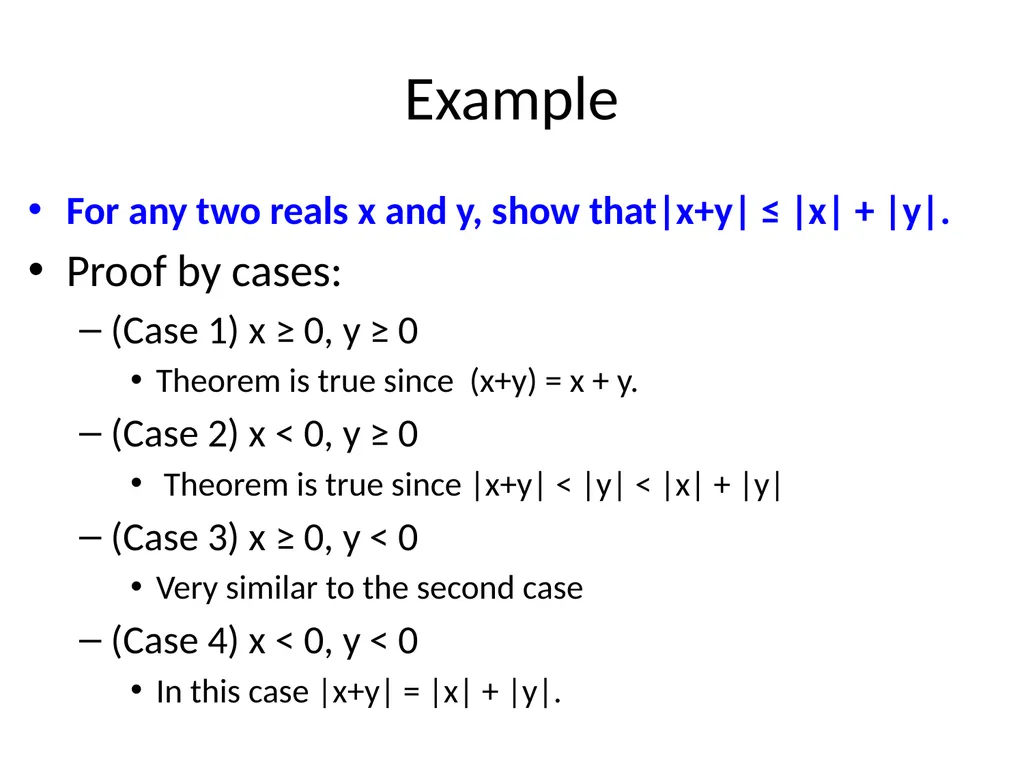
Example For any two reals x and y, show that|x+y| ≤ |x| + |y|.
Proof by cases:<br>
Proof by cases:<br>
43
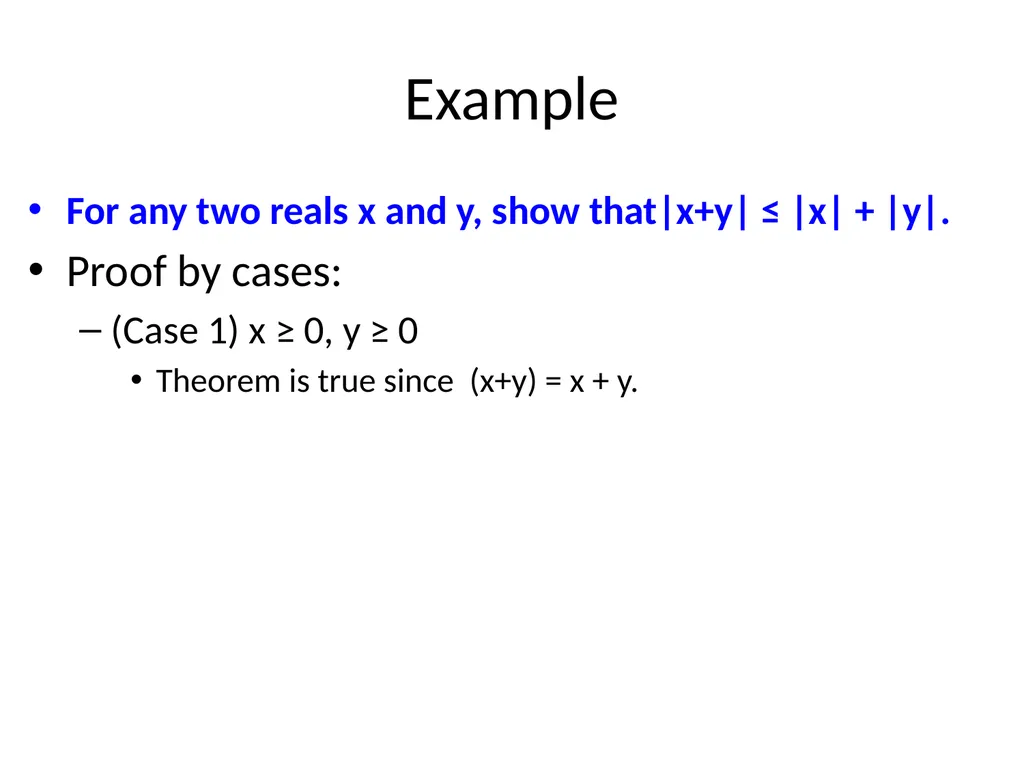
Example For any two reals x and y, show that|x+y| ≤ |x| + |y|.
Proof by cases:
(Case 1) x ≥ 0, y ≥ 0
Theorem is true since (x+y) = x + y.<br>
Proof by cases:
(Case 1) x ≥ 0, y ≥ 0
Theorem is true since (x+y) = x + y.<br>
44
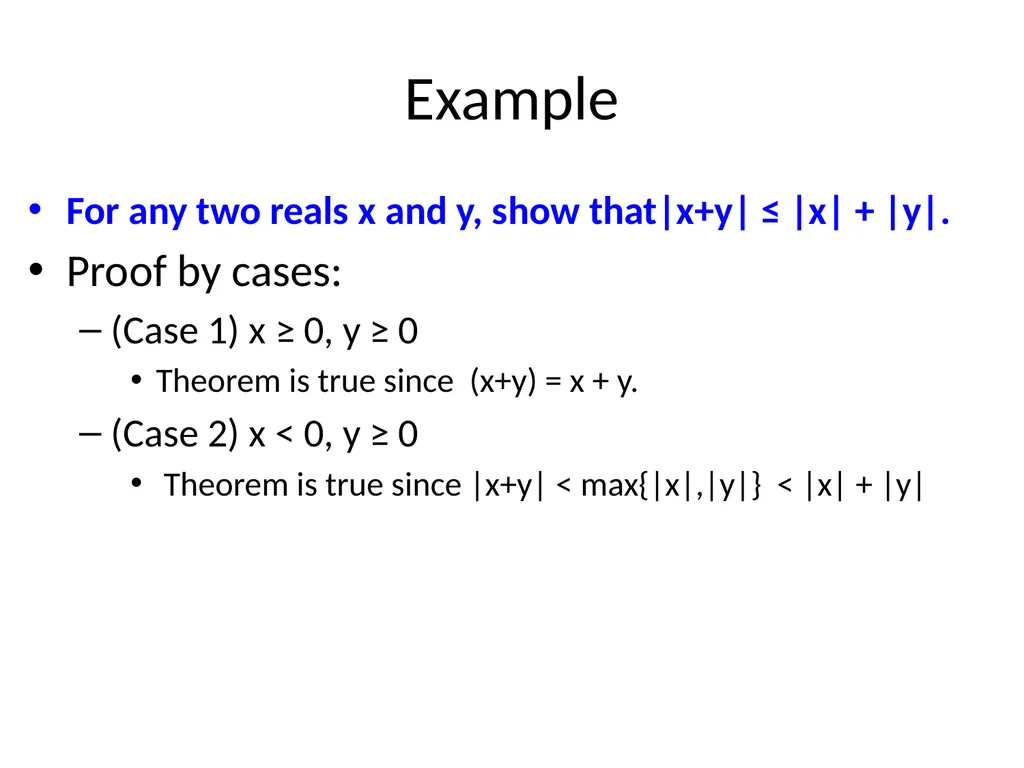
Example For any two reals x and y, show that|x+y| ≤ |x| + |y|.
Proof by cases:
(Case 1) x ≥ 0, y ≥ 0
Theorem is true since (x+y) = x + y.
(Case 2) x < 0, y ≥ 0
Theorem is true since |x+y| < max{|x|,|y|} < |x| + |y|<br>
Proof by cases:
(Case 1) x ≥ 0, y ≥ 0
Theorem is true since (x+y) = x + y.
(Case 2) x < 0, y ≥ 0
Theorem is true since |x+y| < max{|x|,|y|} < |x| + |y|<br>
45
Example For any two reals x and y, show that|x+y| ≤ |x| + |y|.
Proof by cases:
(Case 1) x ≥ 0, y ≥ 0
Theorem is true since (x+y) = x + y.
(Case 2) x < 0, y ≥ 0
Theorem is true since |x+y| < |y| < |x| + |y|
(Case 3) x ≥ 0, y < 0
Very similar to the second case
(Case 4) x < 0, y < 0
In this case |x+y| = |x| + |y|.<br>
Proof by cases:
(Case 1) x ≥ 0, y ≥ 0
Theorem is true since (x+y) = x + y.
(Case 2) x < 0, y ≥ 0
Theorem is true since |x+y| < |y| < |x| + |y|
(Case 3) x ≥ 0, y < 0
Very similar to the second case
(Case 4) x < 0, y < 0
In this case |x+y| = |x| + |y|.<br>
46
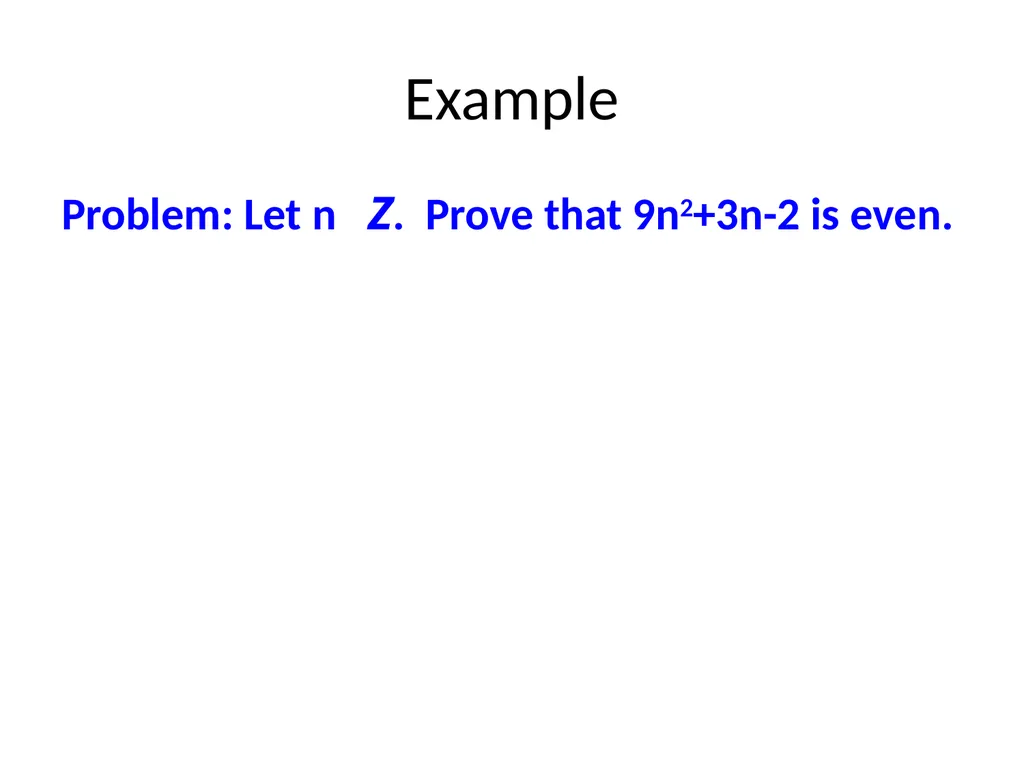
Example Problem: Let n Z. Prove that 9n2+3n-2 is even.<br>
47
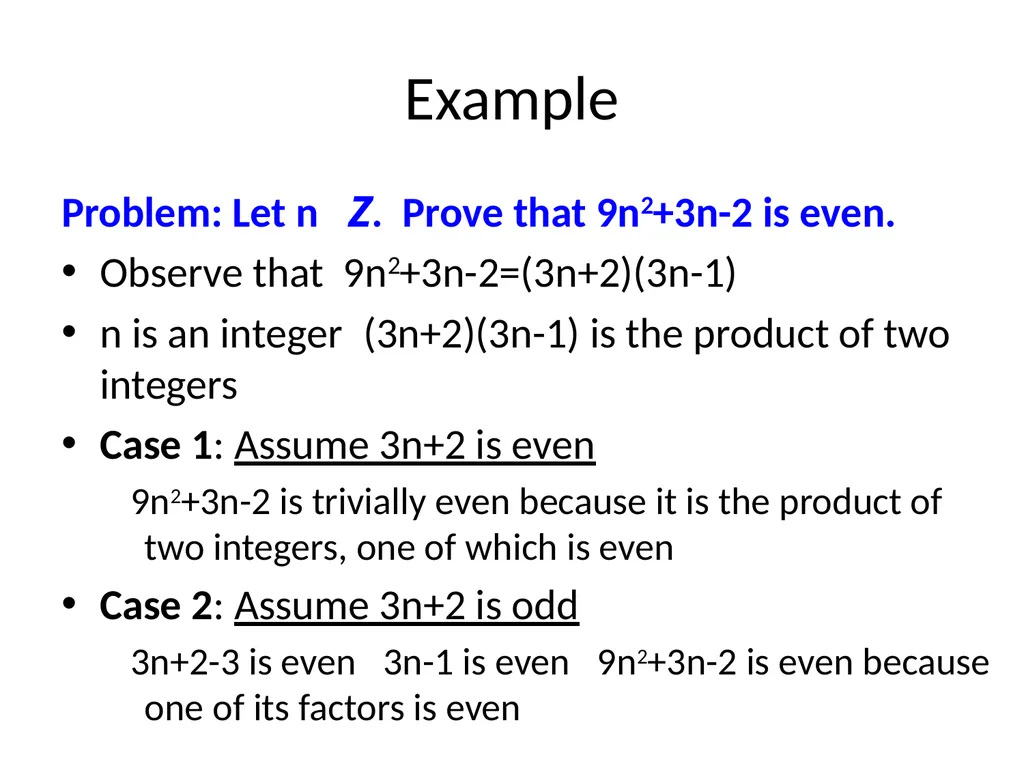
Example Problem: Let n Z. Prove that 9n2+3n-2 is even.
Observe that 9n2+3n-2=(3n+2)(3n-1)
n is an integer (3n+2)(3n-1) is the product of two integers
Case 1: Assume 3n+2 is even
9n2+3n-2 is trivially even because it is the product of two integers, one of which is even
Case 2: Assume 3n+2 is odd
3n+2-3 is even 3n-1 is even 9n2+3n-2 is even because one of its factors is even<br>
Observe that 9n2+3n-2=(3n+2)(3n-1)
n is an integer (3n+2)(3n-1) is the product of two integers
Case 1: Assume 3n+2 is even
9n2+3n-2 is trivially even because it is the product of two integers, one of which is even
Case 2: Assume 3n+2 is odd
3n+2-3 is even 3n-1 is even 9n2+3n-2 is even because one of its factors is even<br>
48
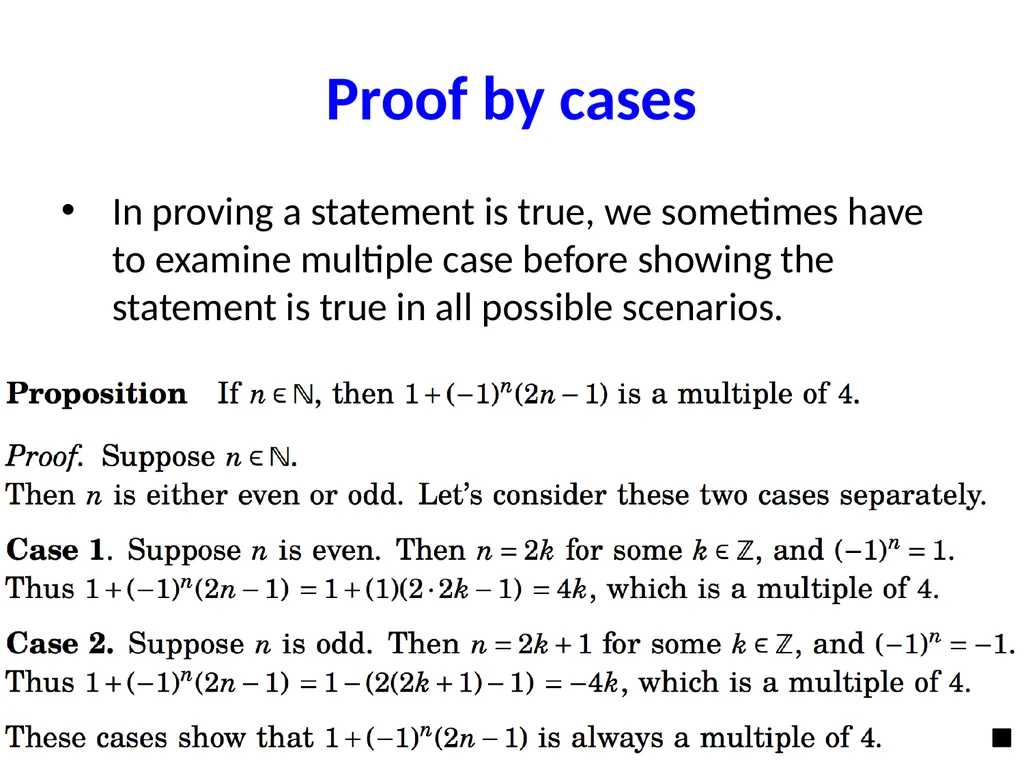
Proof by cases In proving a statement is true, we sometimes have to examine multiple case before showing the statement is true in all possible scenarios.<br>
49
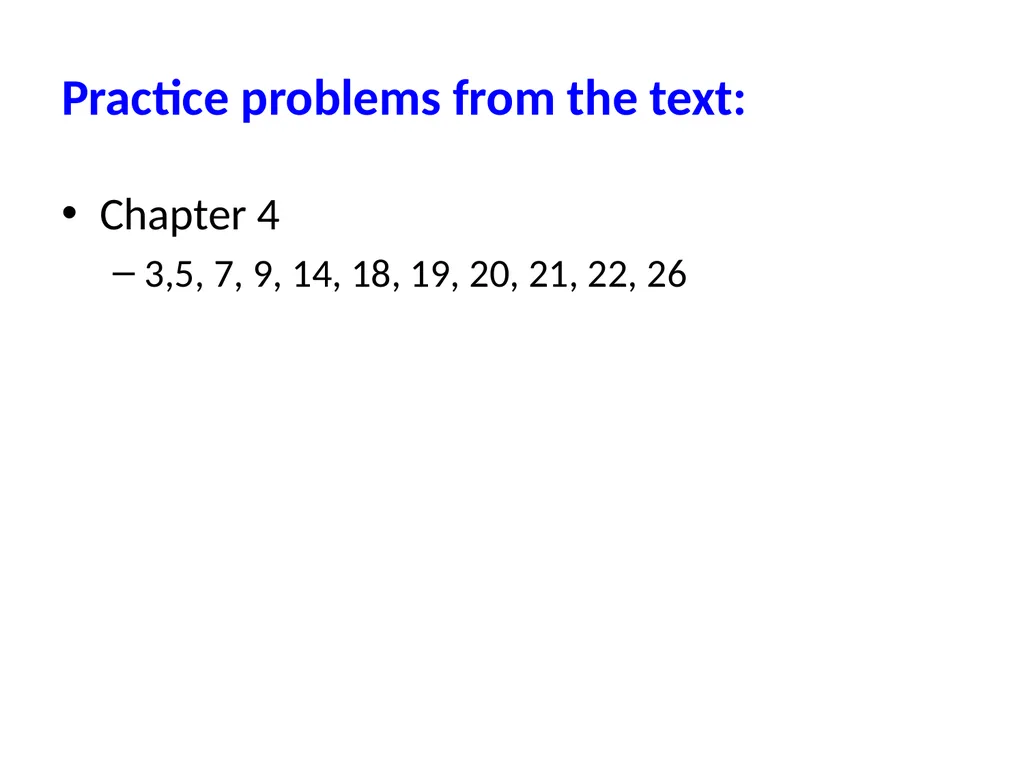
Practice problems from the text: Chapter 4
3,5, 7, 9, 14, 18, 19, 20, 21, 22, 26<br>
3,5, 7, 9, 14, 18, 19, 20, 21, 22, 26<br>
50
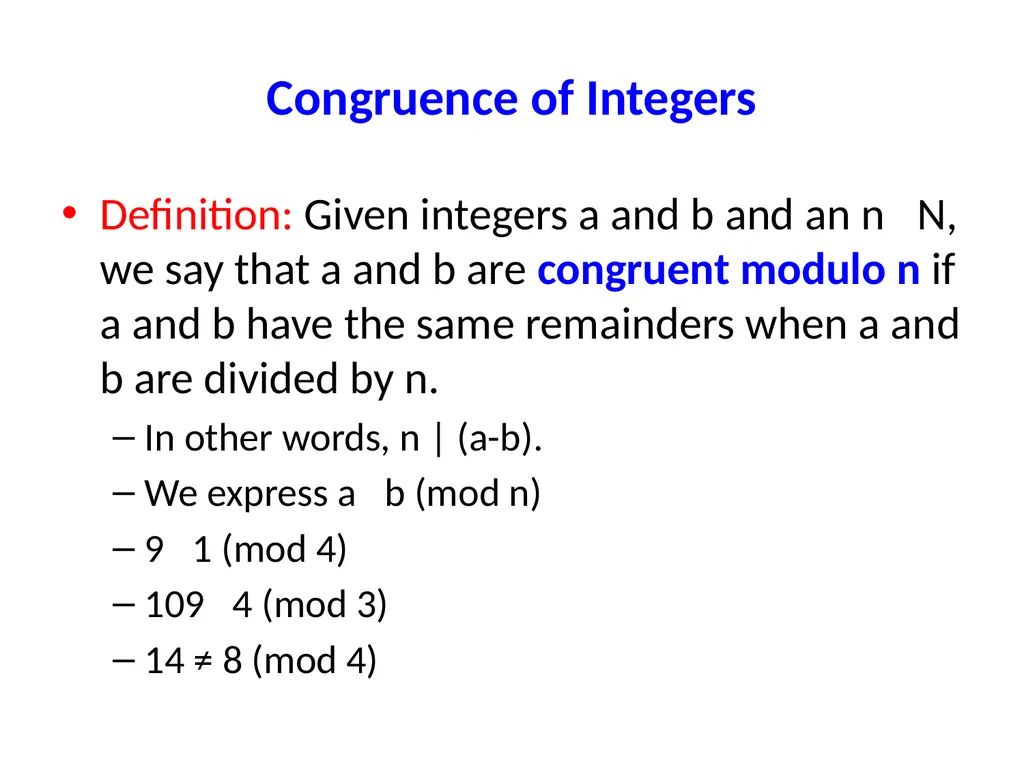
Congruence of Integers Definition: Given integers a and b and an n N, we say that a and b are congruent modulo n if a and b have the same remainders when a and b are divided by n.
In other words, n | (a-b).
We express a b (mod n)
9 1 (mod 4)
109 4 (mod 3)
14 ≠ 8 (mod 4)<br>
In other words, n | (a-b).
We express a b (mod n)
9 1 (mod 4)
109 4 (mod 3)
14 ≠ 8 (mod 4)<br>
51
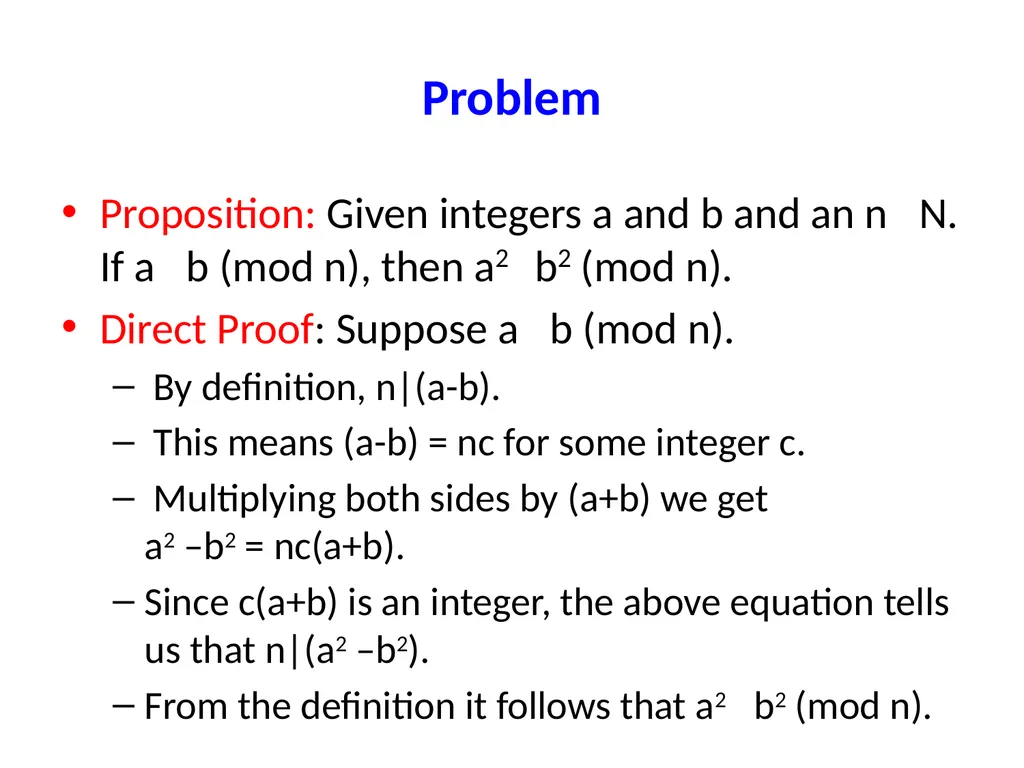
Problem Proposition: Given integers a and b and an n N. If a b (mod n), then a2 b2 (mod n).
Direct Proof: Suppose a b (mod n).
By definition, n|(a-b).
This means (a-b) = nc for some integer c.
Multiplying both sides by (a+b) we get a2 –b2 = nc(a+b).
Since c(a+b) is an integer, the above equation tells us that n|(a2 –b2).
From the definition it follows that a2 b2 (mod n).<br>
Direct Proof: Suppose a b (mod n).
By definition, n|(a-b).
This means (a-b) = nc for some integer c.
Multiplying both sides by (a+b) we get a2 –b2 = nc(a+b).
Since c(a+b) is an integer, the above equation tells us that n|(a2 –b2).
From the definition it follows that a2 b2 (mod n).<br>
52
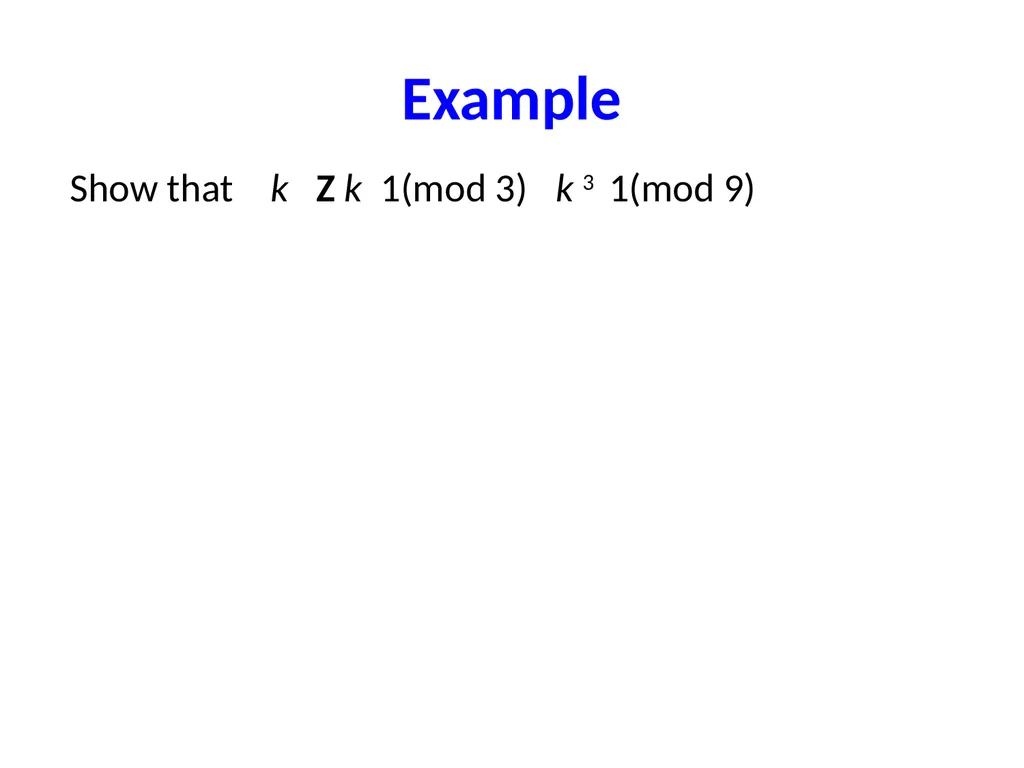
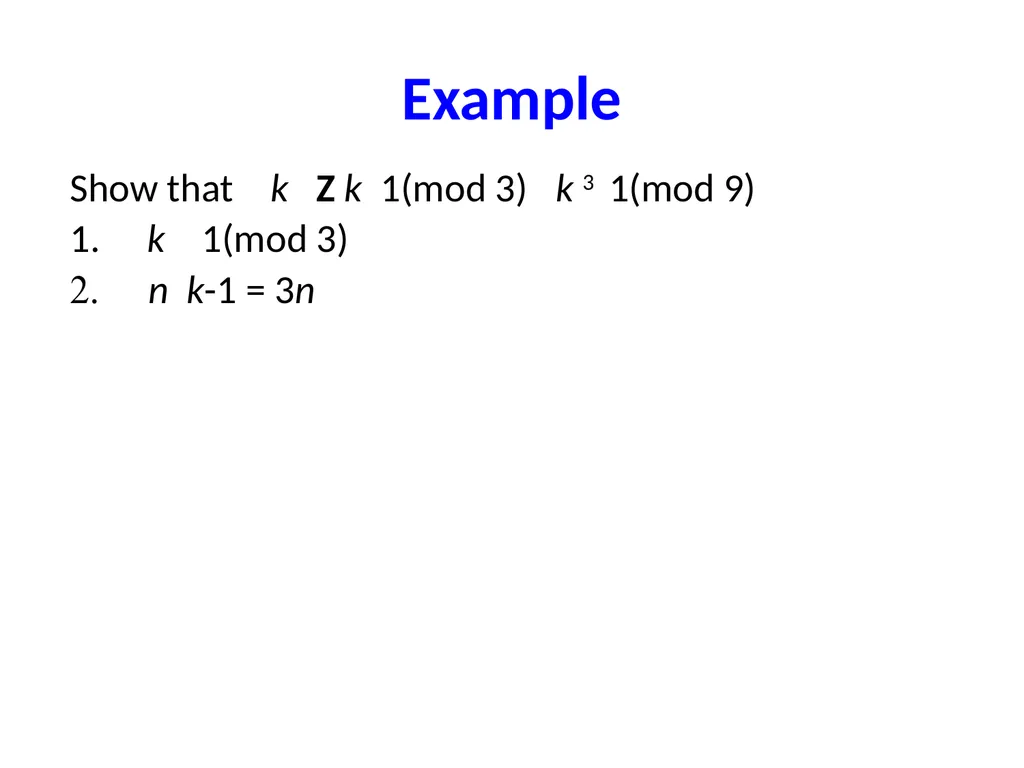
Example Show that k Z k 1(mod 3) k 3 1(mod 9)<br>
53
Example Show that k Z k 1(mod 3) k 3 1(mod 9)
k 1(mod 3)
n k-1 = 3n<br>
k 1(mod 3)
n k-1 = 3n<br>
54
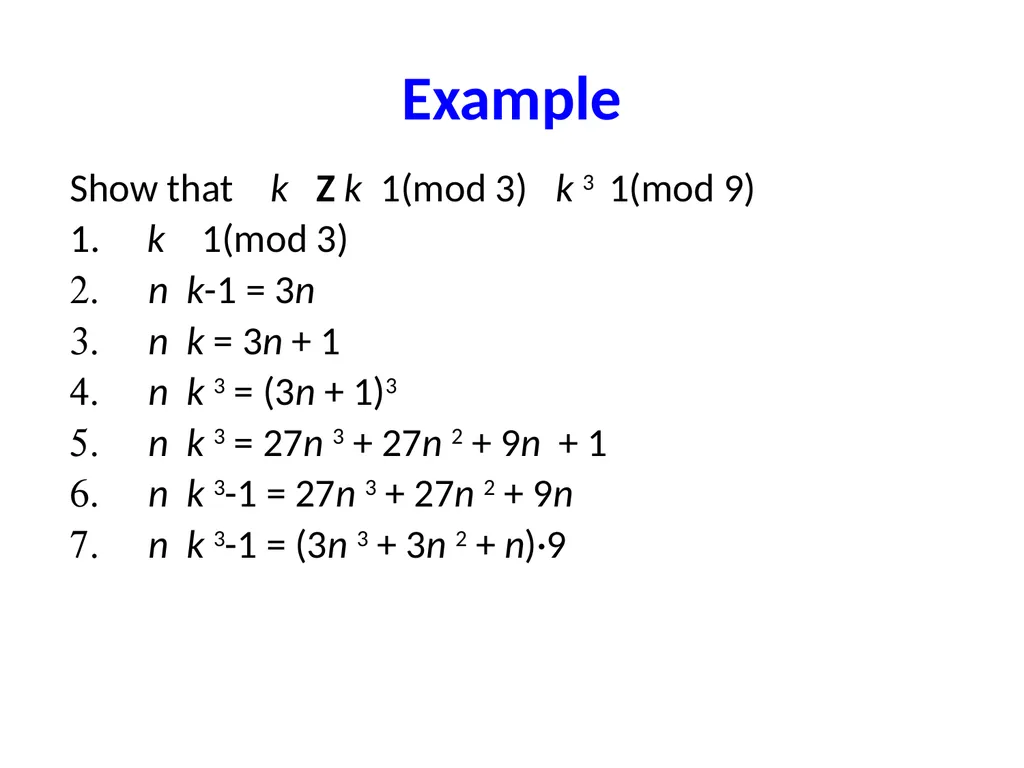
Example Show that k Z k 1(mod 3) k 3 1(mod 9)
k 1(mod 3)
n k-1 = 3n
n k = 3n + 1
n k 3 = (3n + 1)3
n k 3 = 27n 3 + 27n 2 + 9n + 1
n k 3-1 = 27n 3 + 27n 2 + 9n
n k 3-1 = (3n 3 + 3n 2 + n)·9<br>
k 1(mod 3)
n k-1 = 3n
n k = 3n + 1
n k 3 = (3n + 1)3
n k 3 = 27n 3 + 27n 2 + 9n + 1
n k 3-1 = 27n 3 + 27n 2 + 9n
n k 3-1 = (3n 3 + 3n 2 + n)·9<br>
55
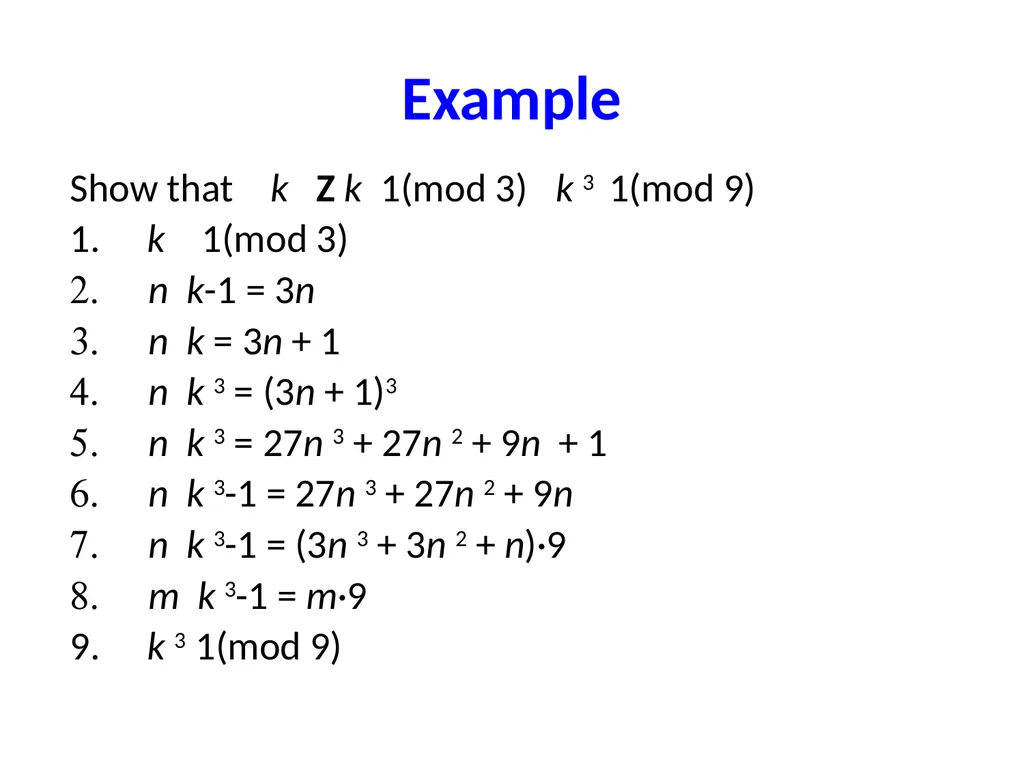
Example Show that k Z k 1(mod 3) k 3 1(mod 9)
k 1(mod 3)
n k-1 = 3n
n k = 3n + 1
n k 3 = (3n + 1)3
n k 3 = 27n 3 + 27n 2 + 9n + 1
n k 3-1 = 27n 3 + 27n 2 + 9n
n k 3-1 = (3n 3 + 3n 2 + n)·9
m k 3-1 = m·9
k 31(mod 9)<br>
k 1(mod 3)
n k-1 = 3n
n k = 3n + 1
n k 3 = (3n + 1)3
n k 3 = 27n 3 + 27n 2 + 9n + 1
n k 3-1 = 27n 3 + 27n 2 + 9n
n k 3-1 = (3n 3 + 3n 2 + n)·9
m k 3-1 = m·9
k 31(mod 9)<br>
56
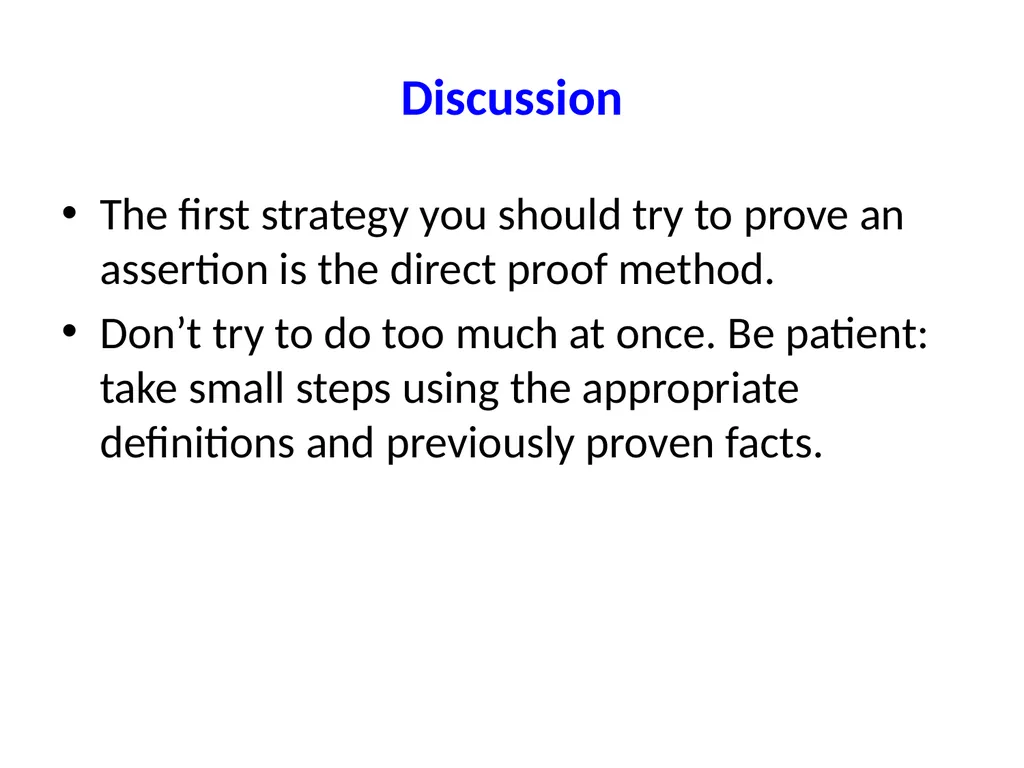
Discussion The first strategy you should try to prove an assertion is the direct proof method.
Don’t try to do too much at once. Be patient: take small steps using the appropriate definitions and previously proven facts.<br>
Don’t try to do too much at once. Be patient: take small steps using the appropriate definitions and previously proven facts.<br>
57
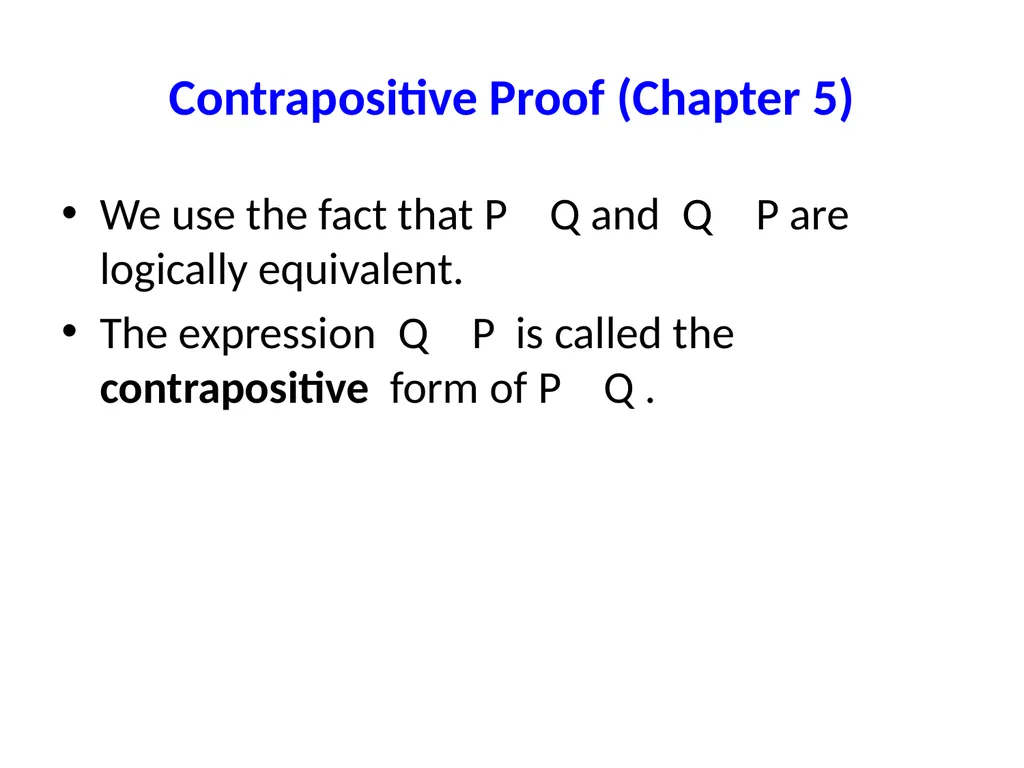
Contrapositive Proof (Chapter 5) We use the fact that P Q and Q P are logically equivalent.
The expression Q P is called the contrapositive form of P Q .<br>
The expression Q P is called the contrapositive form of P Q .<br>
58
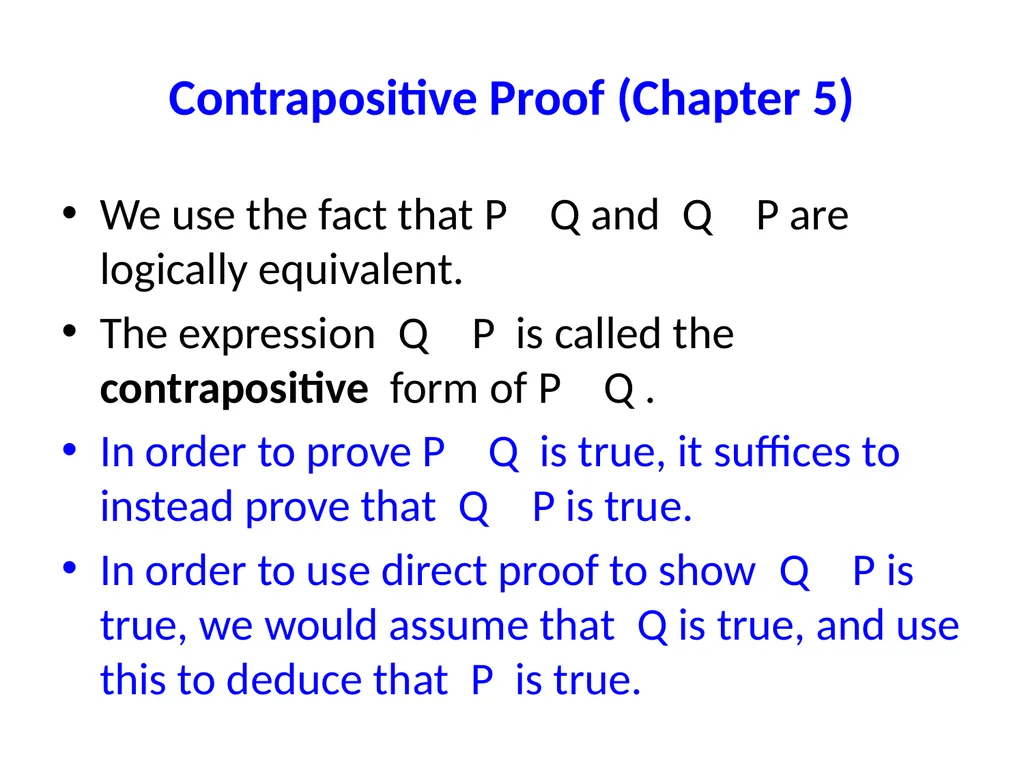
Contrapositive Proof (Chapter 5) We use the fact that P Q and Q P are logically equivalent.
The expression Q P is called the contrapositive form of P Q .
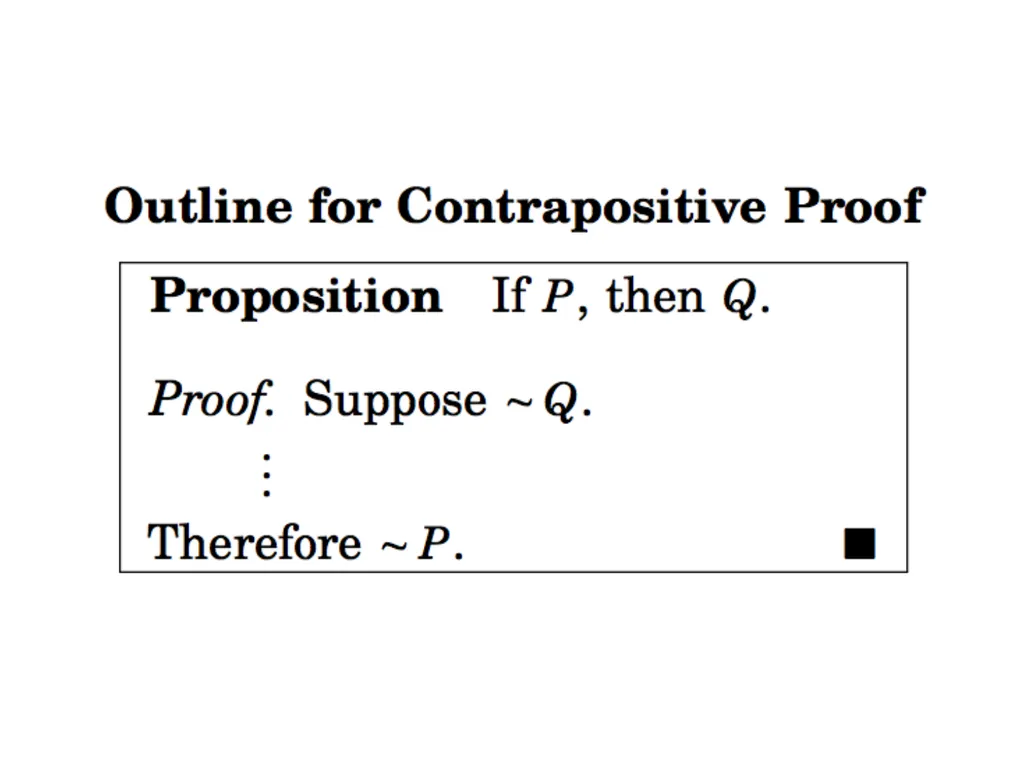
In order to prove P Q is true, it suffices to instead prove that Q P is true.
In order to use direct proof to show Q P is true, we would assume that Q is true, and use this to deduce that P is true.<br>
The expression Q P is called the contrapositive form of P Q .
In order to prove P Q is true, it suffices to instead prove that Q P is true.
In order to use direct proof to show Q P is true, we would assume that Q is true, and use this to deduce that P is true.<br>
59
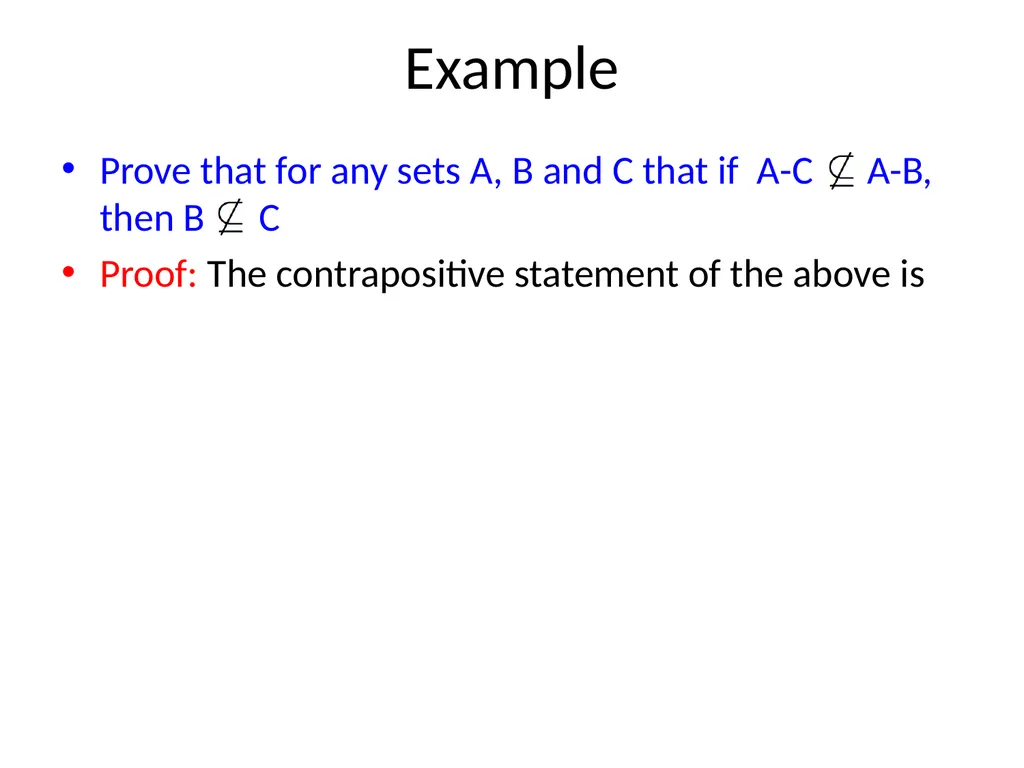
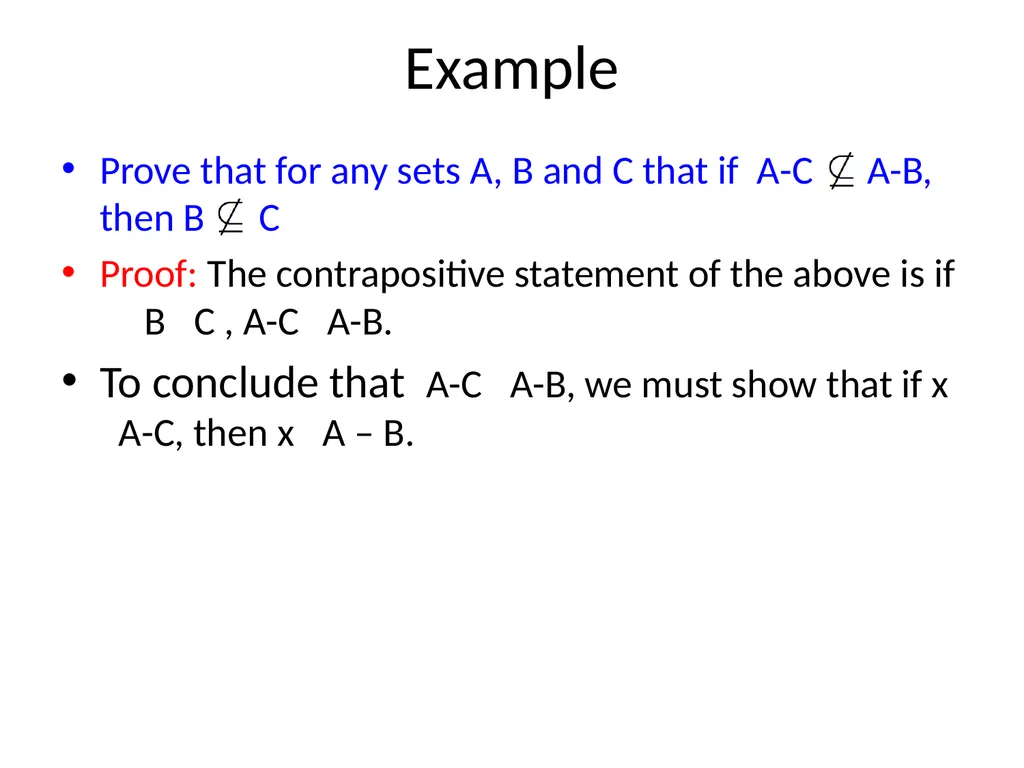
Example Prove that for any sets A, B and C that if A-C A-B, then B C
Proof: The contrapositive statement of the above is<br>
Proof: The contrapositive statement of the above is<br>
60
Example Prove that for any sets A, B and C that if A-C A-B, then B C
Proof: The contrapositive statement of the above is if B C , A-C A-B.
To conclude that A-C A-B, we must show that if x A-C, then x A – B.<br>
Proof: The contrapositive statement of the above is if B C , A-C A-B.
To conclude that A-C A-B, we must show that if x A-C, then x A – B.<br>
61
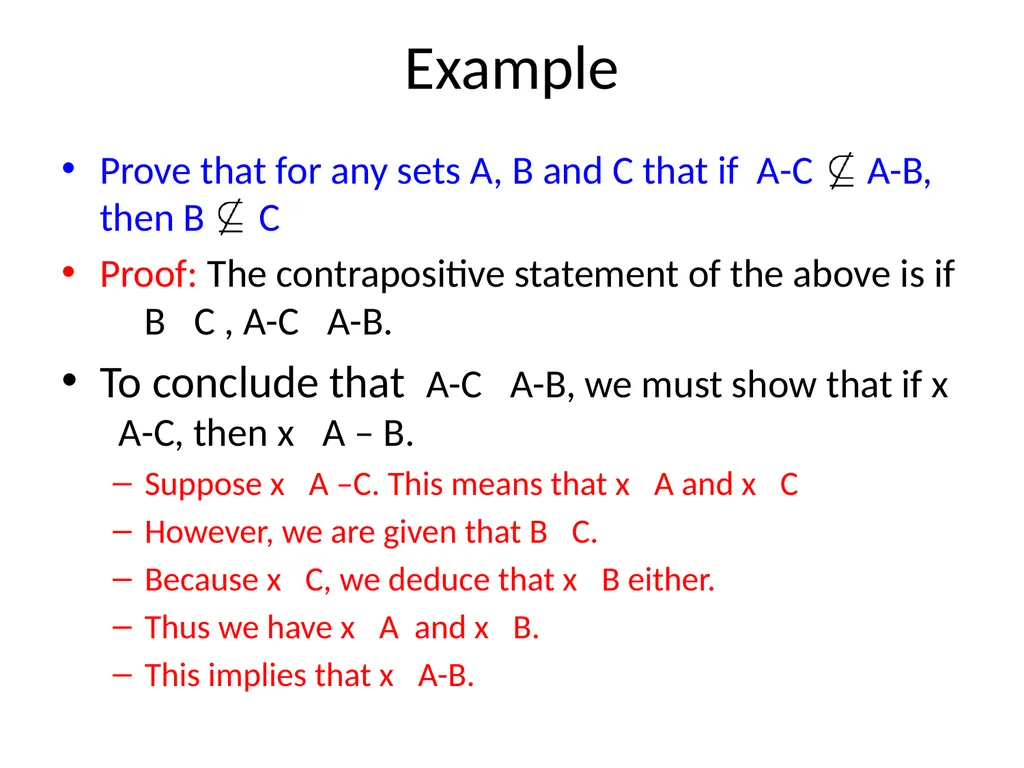
Example Prove that for any sets A, B and C that if A-C A-B, then B C
Proof: The contrapositive statement of the above is if B C , A-C A-B.
To conclude that A-C A-B, we must show that if x A-C, then x A – B.
Suppose x A –C. This means that x A and x C
However, we are given that B C.
Because x C, we deduce that x B either.
Thus we have x A and x B.
This implies that x A-B.<br>
Proof: The contrapositive statement of the above is if B C , A-C A-B.
To conclude that A-C A-B, we must show that if x A-C, then x A – B.
Suppose x A –C. This means that x A and x C
However, we are given that B C.
Because x C, we deduce that x B either.
Thus we have x A and x B.
This implies that x A-B.<br>
62
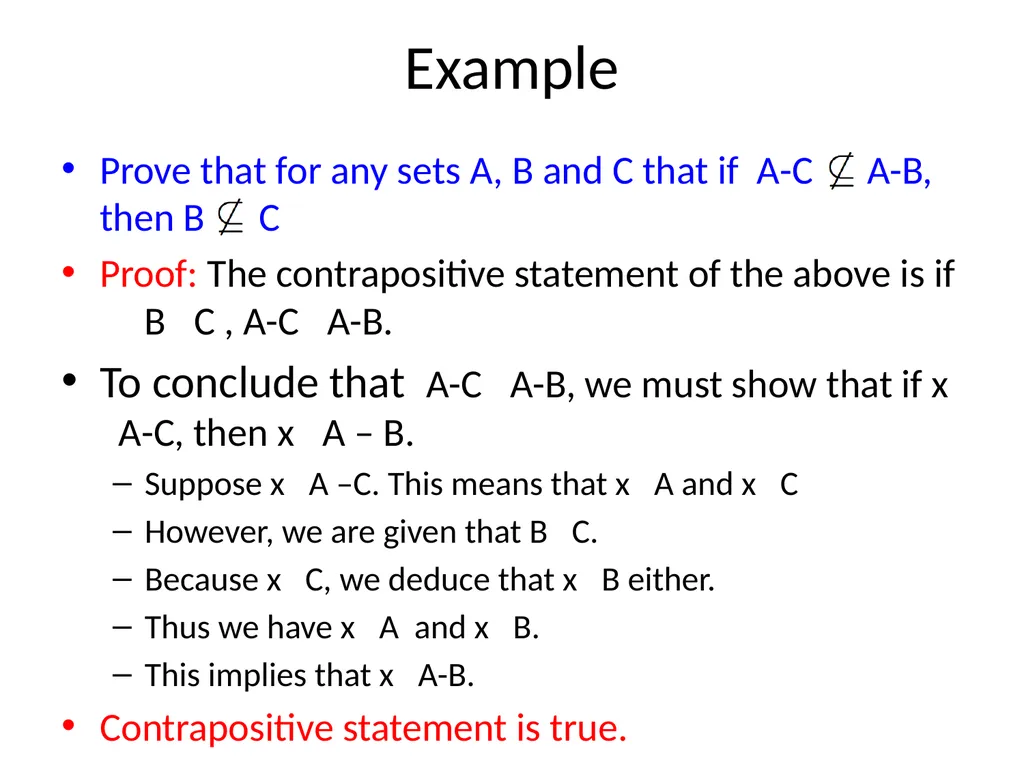
Example Prove that for any sets A, B and C that if A-C A-B, then B C
Proof: The contrapositive statement of the above is if B C , A-C A-B.
To conclude that A-C A-B, we must show that if x A-C, then x A – B.
Suppose x A –C. This means that x A and x C
However, we are given that B C.
Because x C, we deduce that x B either.
Thus we have x A and x B.
This implies that x A-B.
Contrapositive statement is true.
Original statement is also true<br>
Proof: The contrapositive statement of the above is if B C , A-C A-B.
To conclude that A-C A-B, we must show that if x A-C, then x A – B.
Suppose x A –C. This means that x A and x C
However, we are given that B C.
Because x C, we deduce that x B either.
Thus we have x A and x B.
This implies that x A-B.
Contrapositive statement is true.
Original statement is also true<br>
63
Example<br>
64
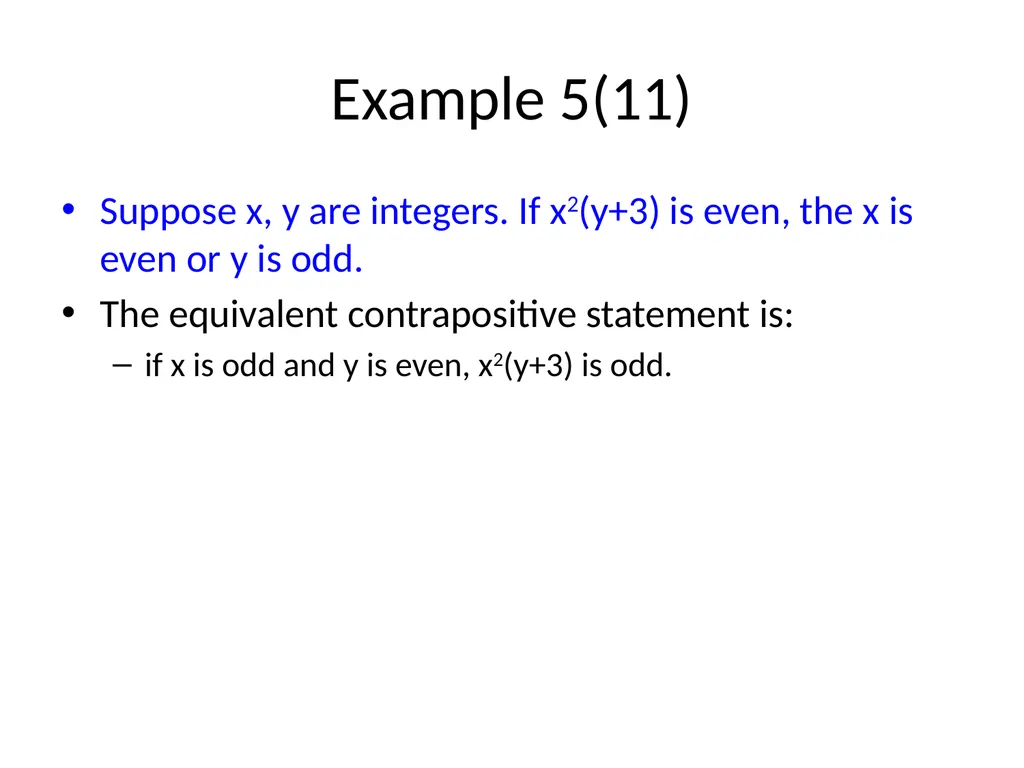
Example 5(11) Suppose x, y are integers. If x2(y+3) is even, the x is even or y is odd.
The equivalent contrapositive statement is:
if x is odd and y is even, x2(y+3) is odd.<br>
The equivalent contrapositive statement is:
if x is odd and y is even, x2(y+3) is odd.<br>
65
Practice Problems of Chapter 5 4, 5, 12, 13, 17, 24, 25, 27, 28<br>
66
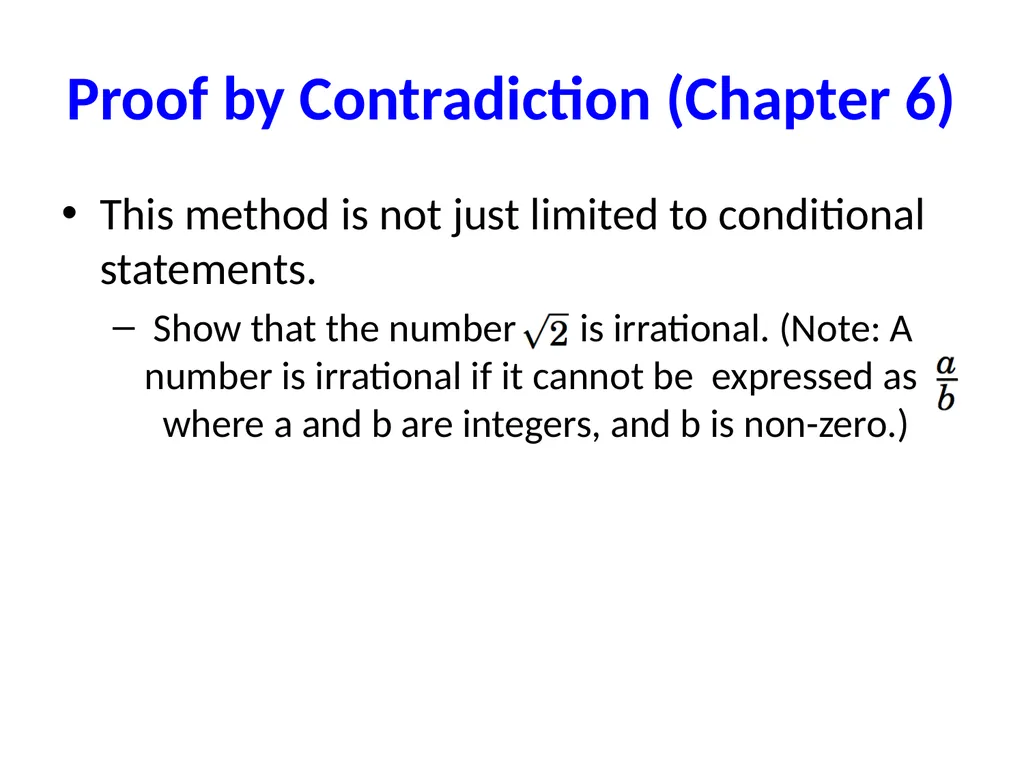
Proof by Contradiction (Chapter 6) This method is not just limited to conditional statements.
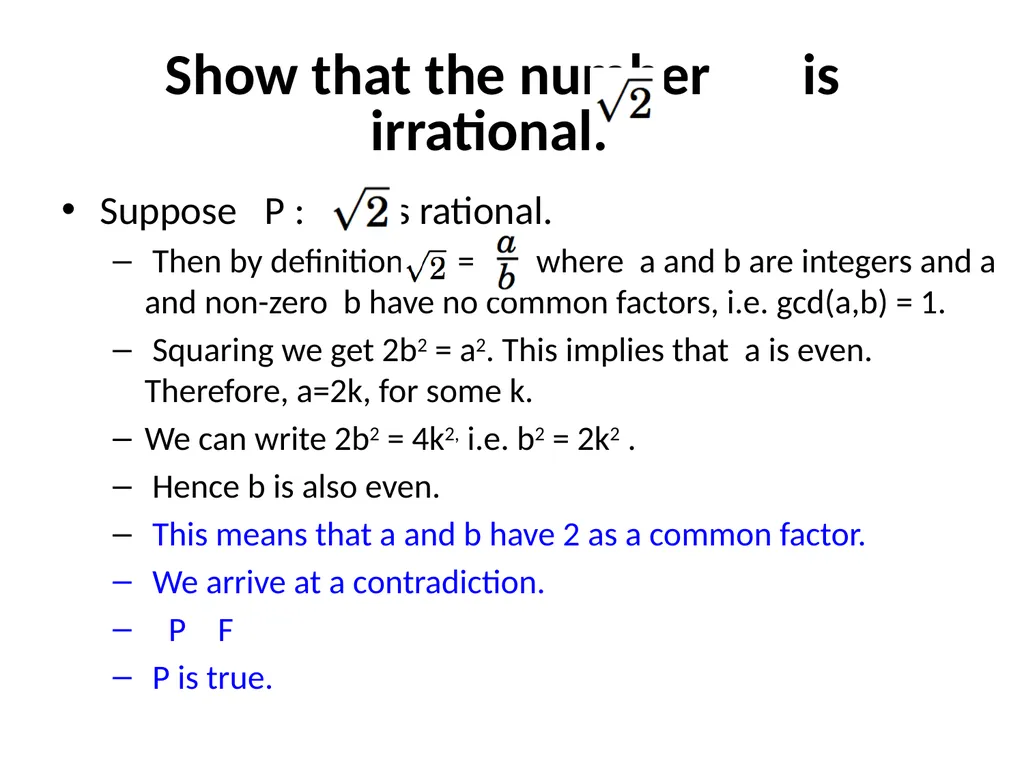
Show that the number is irrational. (Note: A number is irrational if it cannot be expressed as where a and b are integers, and b is non-zero.)<br>
Show that the number is irrational. (Note: A number is irrational if it cannot be expressed as where a and b are integers, and b is non-zero.)<br>
67
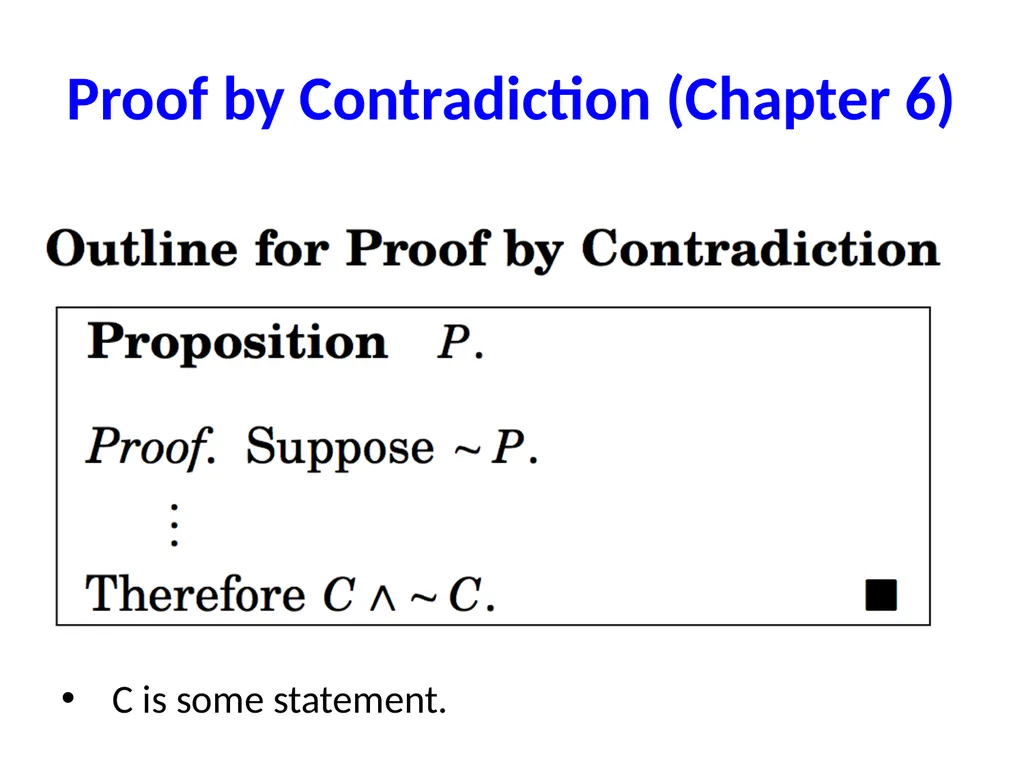
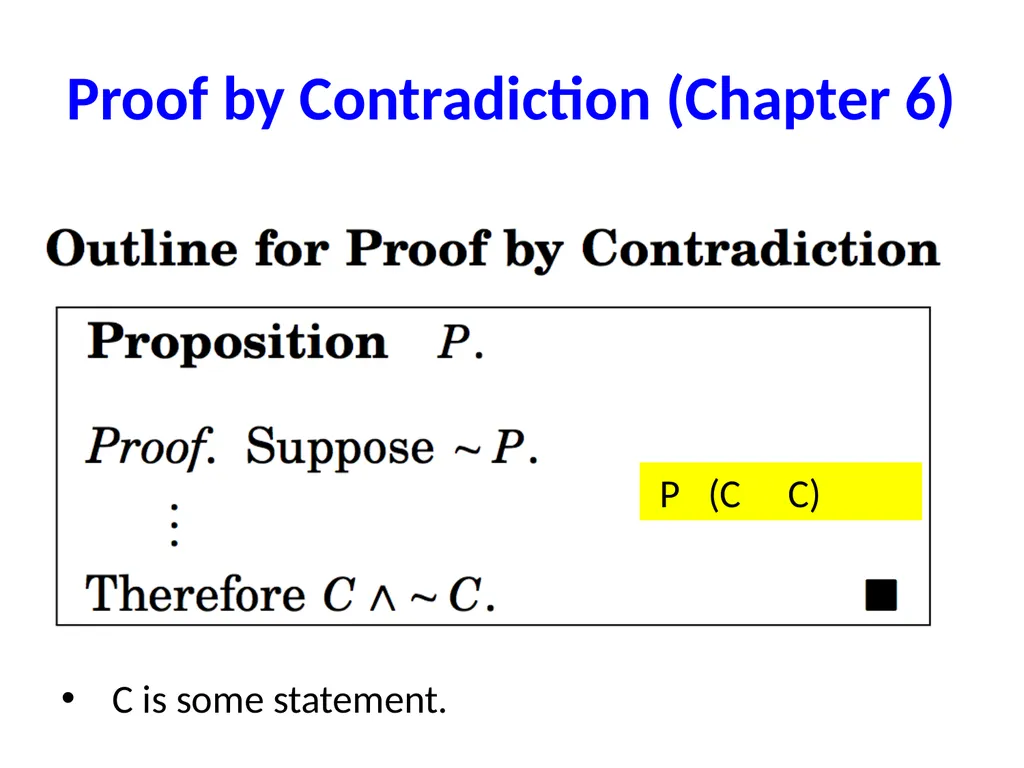
Proof by Contradiction (Chapter 6) C is some statement.<br>
68
Proof by Contradiction (Chapter 6) C is some statement. P (C C)<br>
69
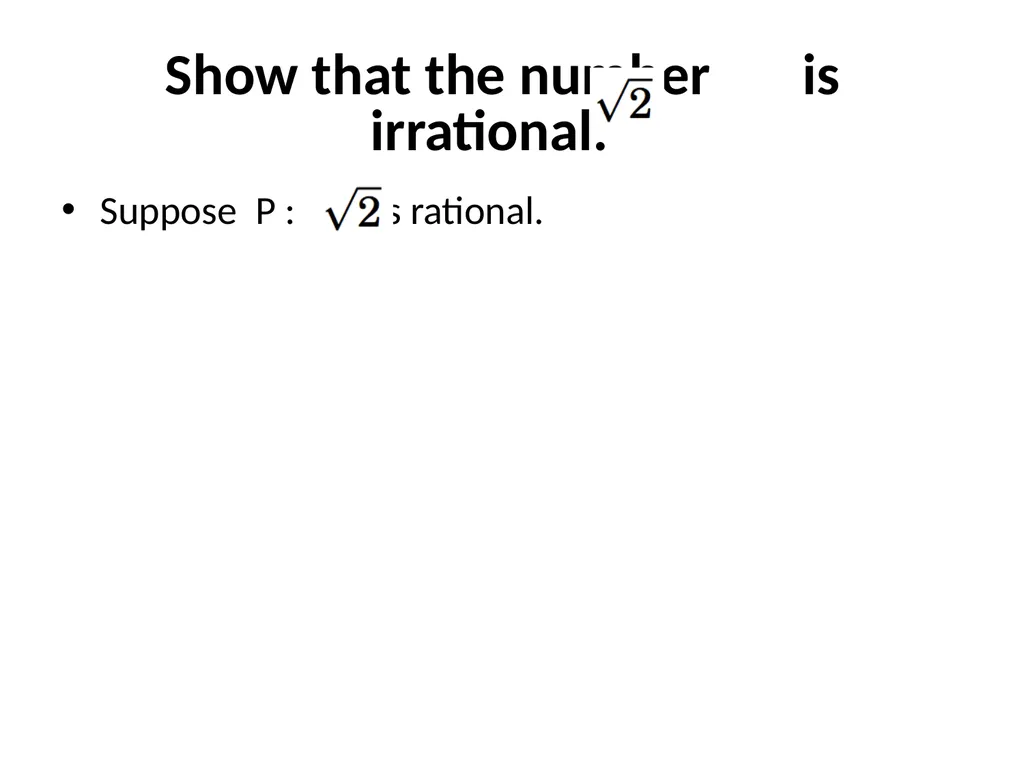
Show that the number is irrational. Suppose P : is rational.<br>
70
Show that the number is irrational. Suppose P : is rational.
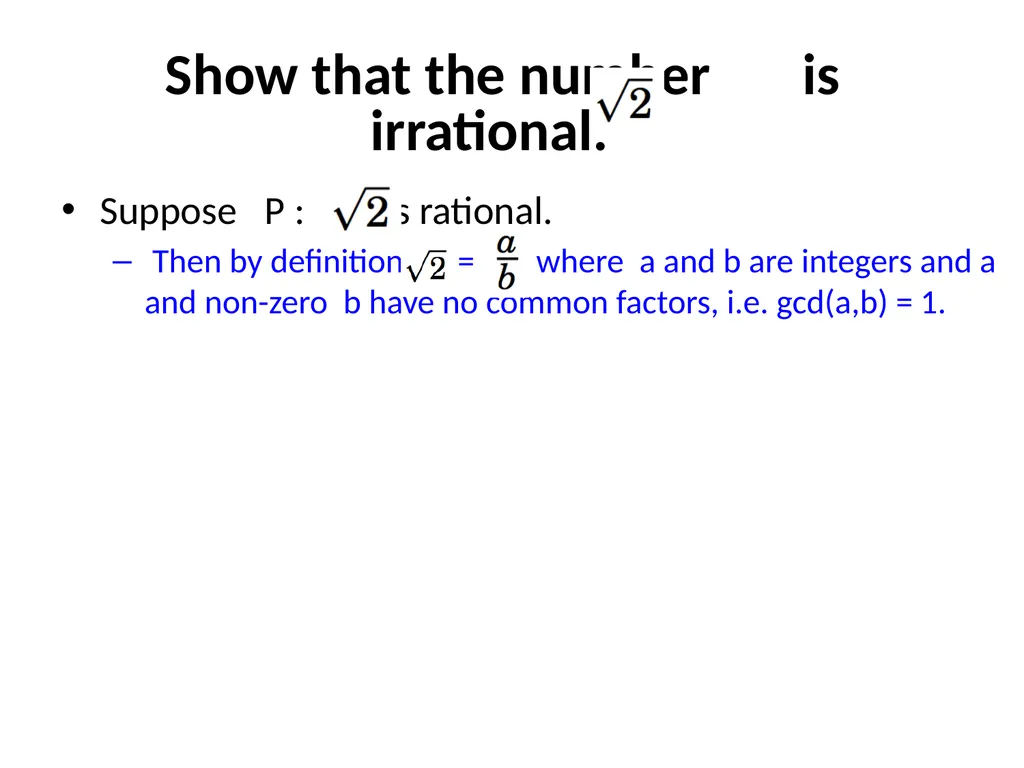
Then by definition = where a and b are integers and a and non-zero b have no common factors, i.e. gcd(a,b) = 1.<br>
Then by definition = where a and b are integers and a and non-zero b have no common factors, i.e. gcd(a,b) = 1.<br>
71
Show that the number is irrational. Suppose P : is rational.
Then by definition = where a and b are integers and a and non-zero b have no common factors, i.e. gcd(a,b) = 1.
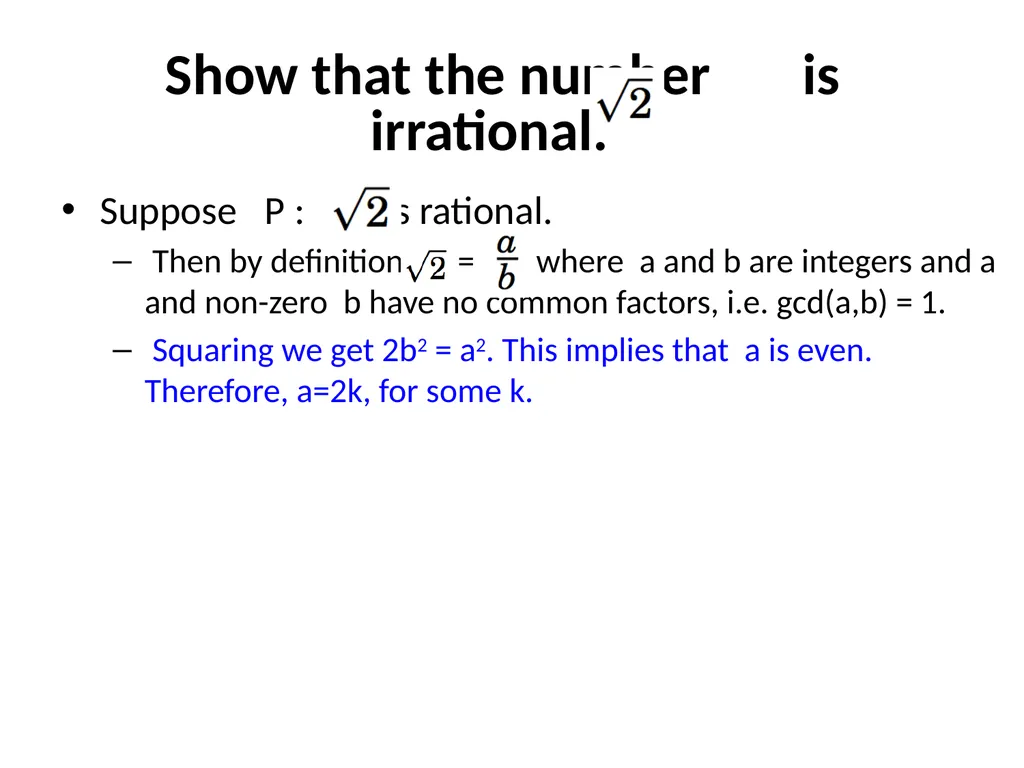
Squaring we get 2b2 = a2. This implies that a is even. Therefore, a=2k, for some k.<br>
Then by definition = where a and b are integers and a and non-zero b have no common factors, i.e. gcd(a,b) = 1.
Squaring we get 2b2 = a2. This implies that a is even. Therefore, a=2k, for some k.<br>
72
Show that the number is irrational. Suppose P : is rational.
Then by definition = where a and b are integers and a and non-zero b have no common factors, i.e. gcd(a,b) = 1.
Squaring we get 2b2 = a2. This implies that a is even. Therefore, a=2k, for some k.
We can write 2b2 = 4k2, i.e. b2 = 2k2 .
Hence b is also even.<br>
Then by definition = where a and b are integers and a and non-zero b have no common factors, i.e. gcd(a,b) = 1.
Squaring we get 2b2 = a2. This implies that a is even. Therefore, a=2k, for some k.
We can write 2b2 = 4k2, i.e. b2 = 2k2 .
Hence b is also even.<br>
73
Show that the number is irrational. Suppose P : is rational.
Then by definition = where a and b are integers and a and non-zero b have no common factors, i.e. gcd(a,b) = 1.
Squaring we get 2b2 = a2. This implies that a is even. Therefore, a=2k, for some k.
We can write 2b2 = 4k2, i.e. b2 = 2k2 .
Hence b is also even.
This means that a and b have 2 as a common factor.
We arrive at a contradiction.
P F
P is true.<br>
Then by definition = where a and b are integers and a and non-zero b have no common factors, i.e. gcd(a,b) = 1.
Squaring we get 2b2 = a2. This implies that a is even. Therefore, a=2k, for some k.
We can write 2b2 = 4k2, i.e. b2 = 2k2 .
Hence b is also even.
This means that a and b have 2 as a common factor.
We arrive at a contradiction.
P F
P is true.<br>
74
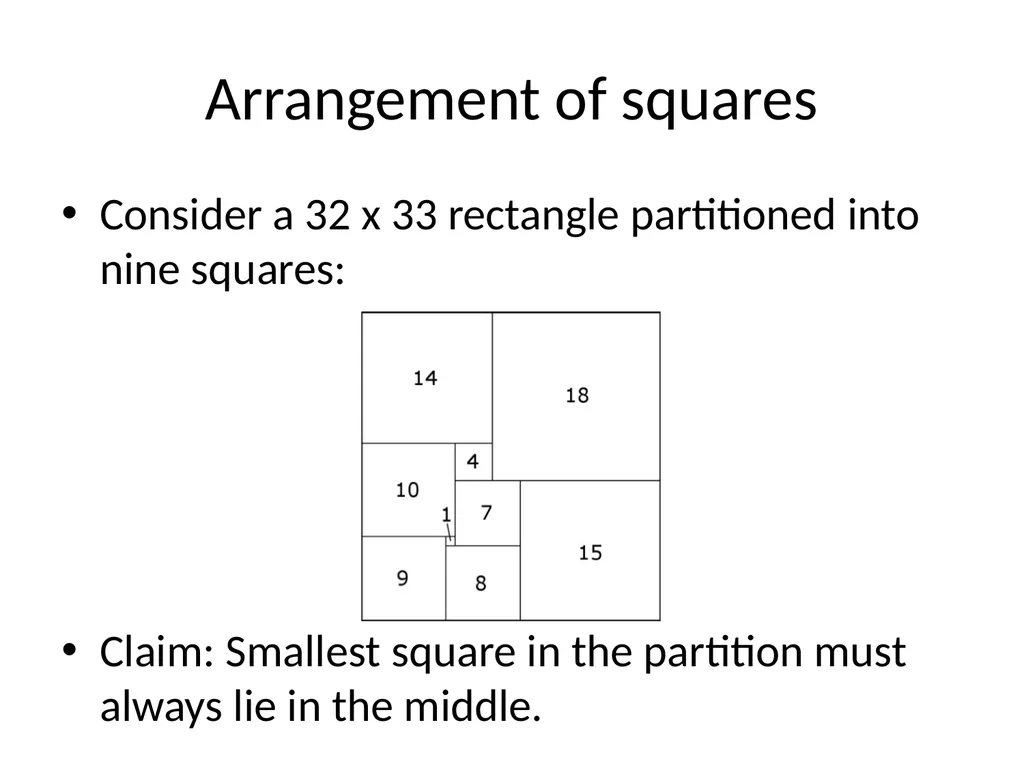
Arrangement of squares Consider a 32 x 33 rectangle partitioned into nine squares:
Claim: Smallest square in the partition must always lie in the middle.<br>
Claim: Smallest square in the partition must always lie in the middle.<br>
75
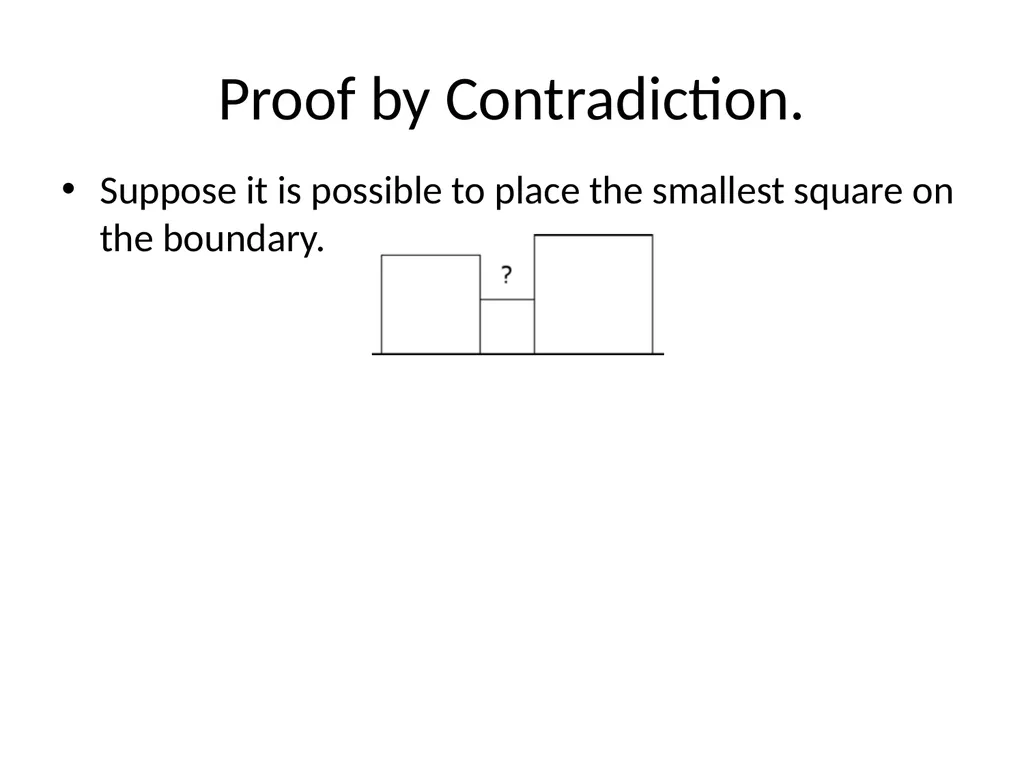
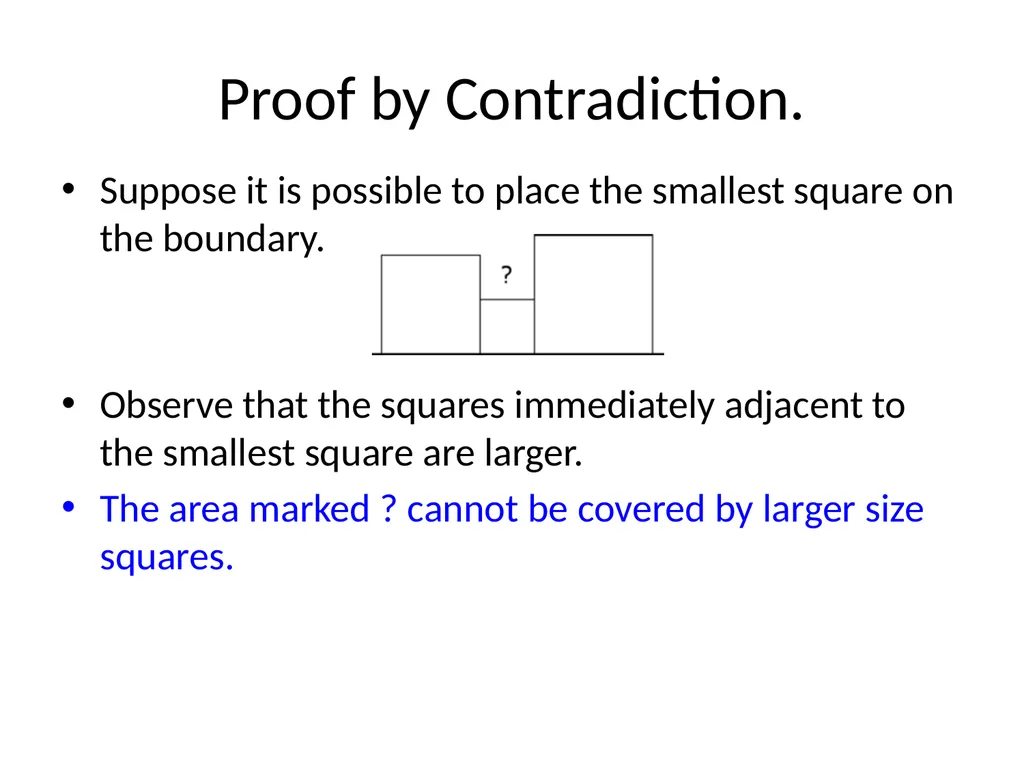
Proof by Contradiction. Suppose it is possible to place the smallest square on the boundary.<br>
76
Proof by Contradiction. Suppose it is possible to place the smallest square on the boundary.
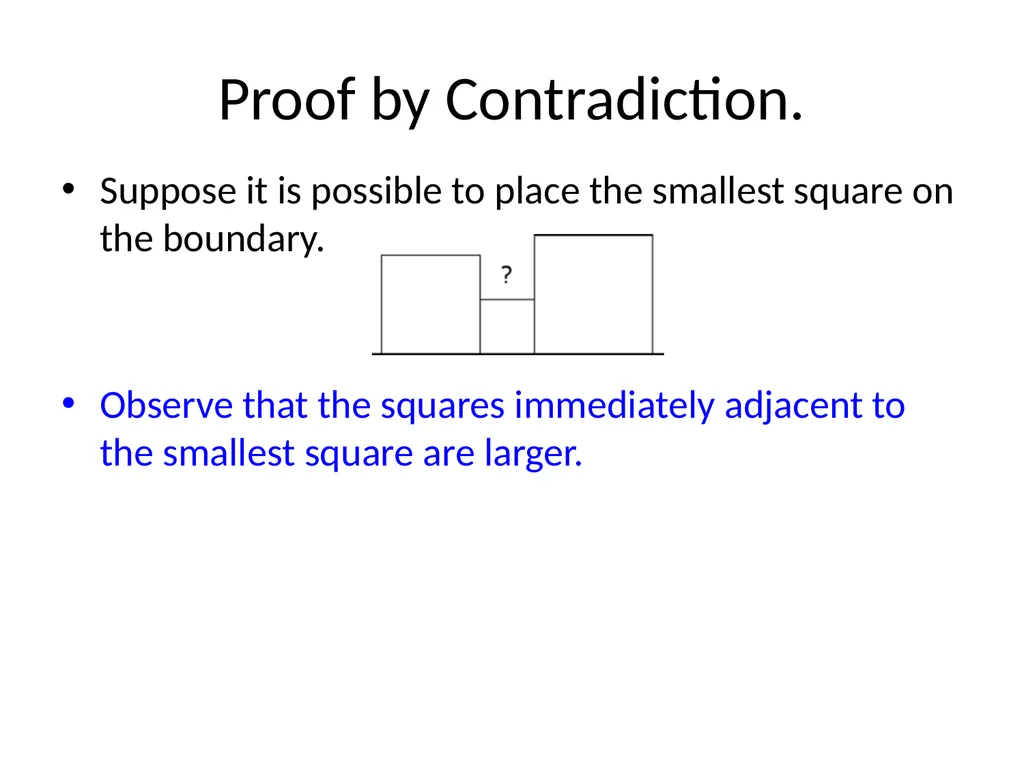
Observe that the squares immediately adjacent to the smallest square are larger.<br>
Observe that the squares immediately adjacent to the smallest square are larger.<br>
77
Proof by Contradiction. Suppose it is possible to place the smallest square on the boundary.
Observe that the squares immediately adjacent to the smallest square are larger.
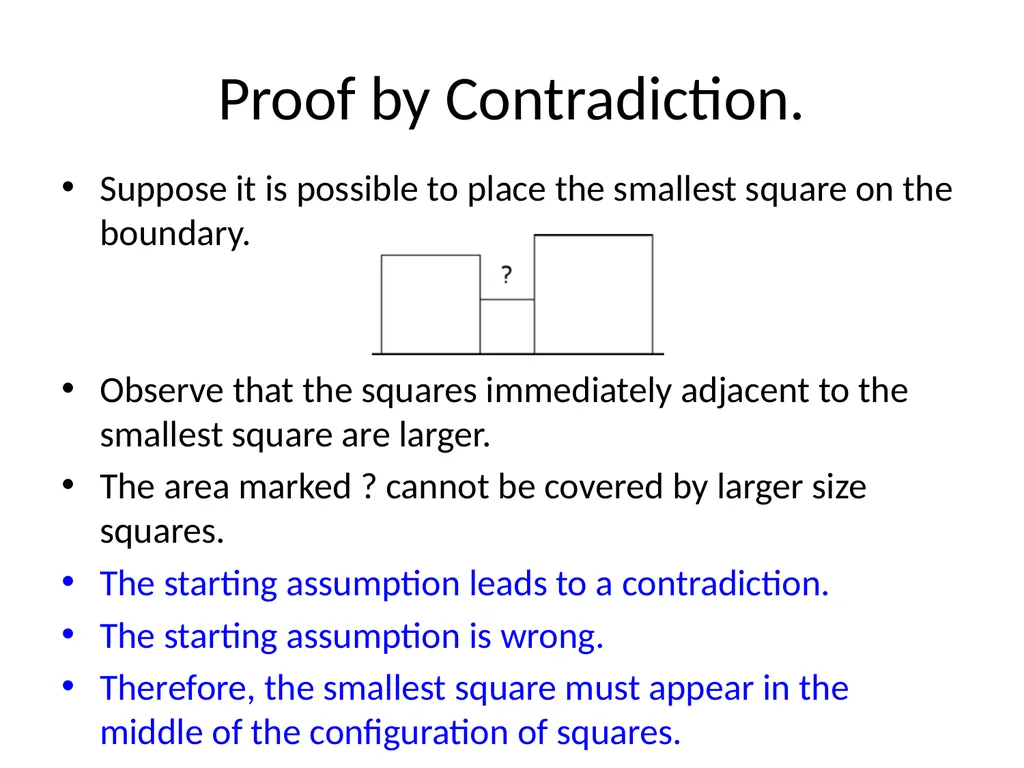
The area marked ? cannot be covered by larger size squares.<br>
Observe that the squares immediately adjacent to the smallest square are larger.
The area marked ? cannot be covered by larger size squares.<br>
78
Proof by Contradiction. Suppose it is possible to place the smallest square on the boundary.
Observe that the squares immediately adjacent to the smallest square are larger.
The area marked ? cannot be covered by larger size squares.
The starting assumption leads to a contradiction.
The starting assumption is wrong.
Therefore, the smallest square must appear in the middle of the configuration of squares.<br>
Observe that the squares immediately adjacent to the smallest square are larger.
The area marked ? cannot be covered by larger size squares.
The starting assumption leads to a contradiction.
The starting assumption is wrong.
Therefore, the smallest square must appear in the middle of the configuration of squares.<br>
79
There are infinitely many primes.<br>
80
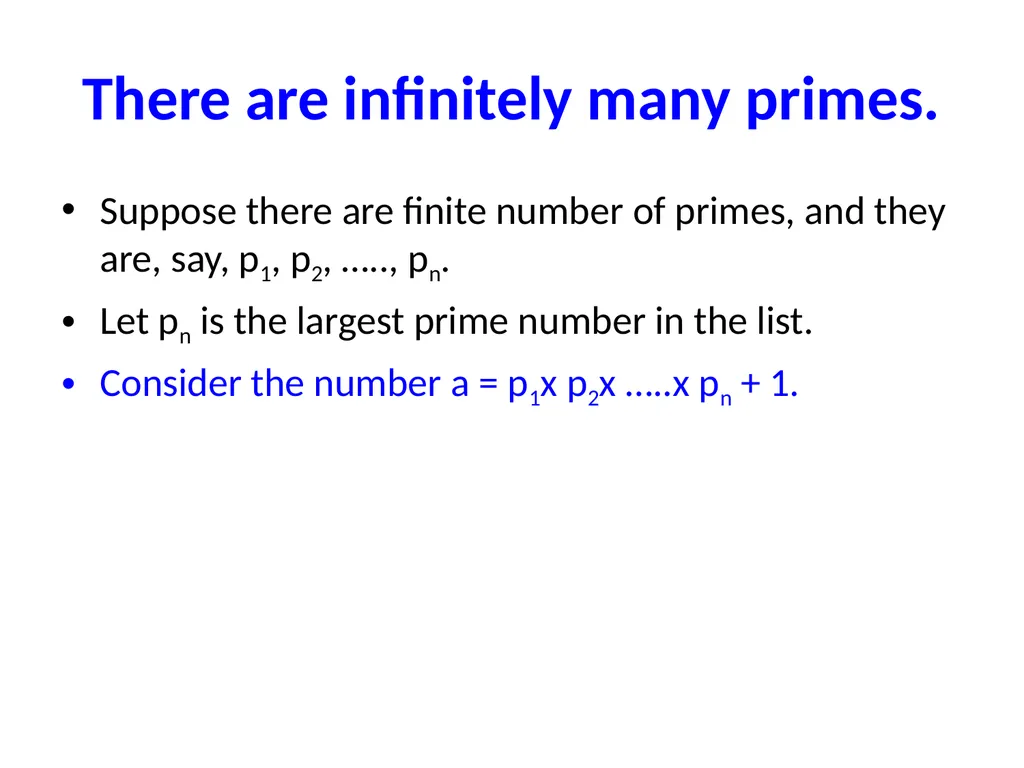
There are infinitely many primes. Suppose there are finite number of primes, and they are, say, p1, p2, ….., pn.
Let pn is the largest prime number in the list.<br>
Let pn is the largest prime number in the list.<br>
81
There are infinitely many primes. Suppose there are finite number of primes, and they are, say, p1, p2, ….., pn.
Let pn is the largest prime number in the list.
Consider the number a = p1x p2x …..x pn + 1.<br>
Let pn is the largest prime number in the list.
Consider the number a = p1x p2x …..x pn + 1.<br>
82
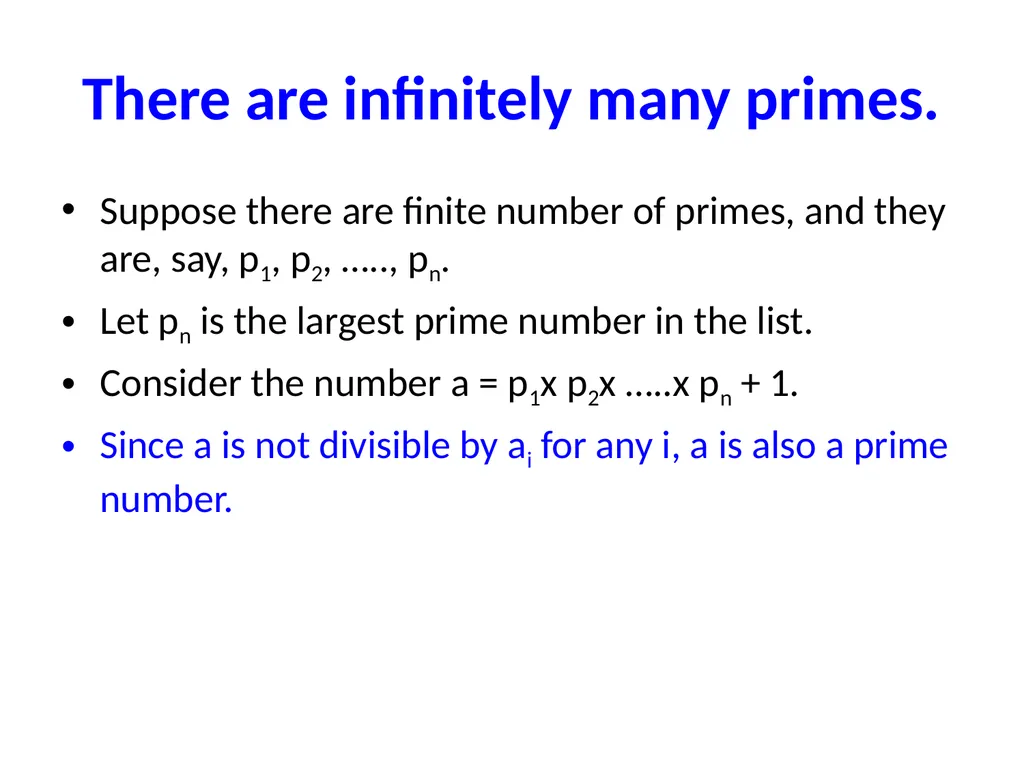
There are infinitely many primes. Suppose there are finite number of primes, and they are, say, p1, p2, ….., pn.
Let pn is the largest prime number in the list.
Consider the number a = p1x p2x …..x pn + 1.
Since a is not divisible by ai for any i, a is also a prime number.<br>
Let pn is the largest prime number in the list.
Consider the number a = p1x p2x …..x pn + 1.
Since a is not divisible by ai for any i, a is also a prime number.<br>
83
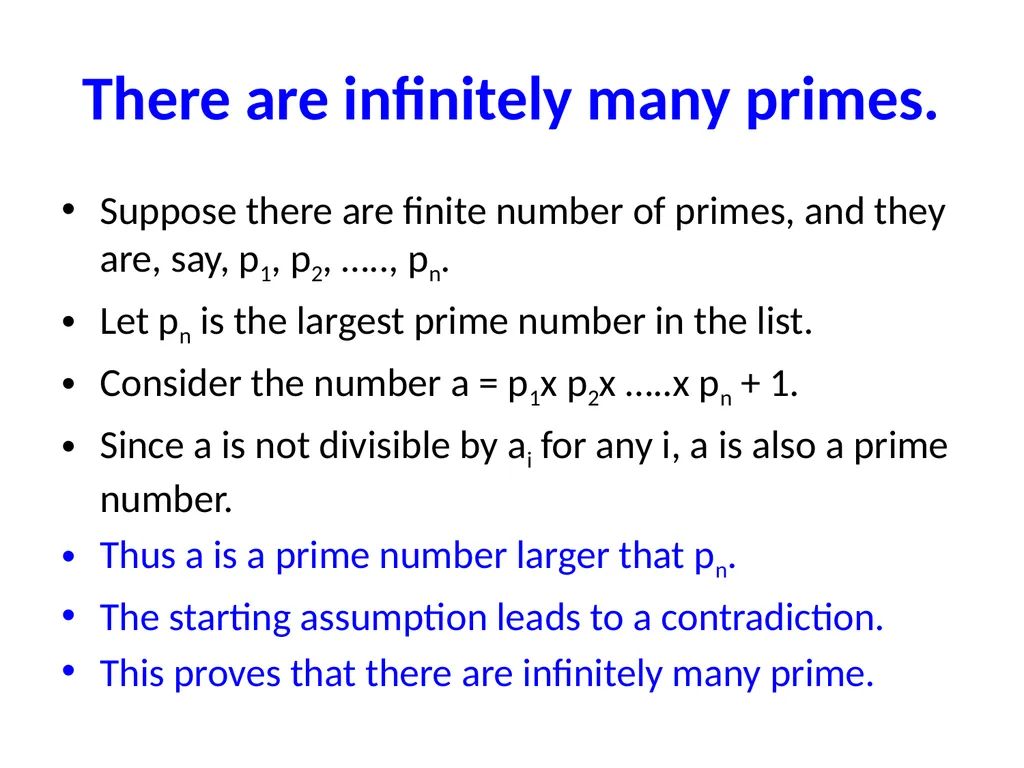
There are infinitely many primes. Suppose there are finite number of primes, and they are, say, p1, p2, ….., pn.
Let pn is the largest prime number in the list.
Consider the number a = p1x p2x …..x pn + 1.
Since a is not divisible by ai for any i, a is also a prime number.
Thus a is a prime number larger that pn.
The starting assumption leads to a contradiction.
This proves that there are infinitely many prime.<br>
Let pn is the largest prime number in the list.
Consider the number a = p1x p2x …..x pn + 1.
Since a is not divisible by ai for any i, a is also a prime number.
Thus a is a prime number larger that pn.
The starting assumption leads to a contradiction.
This proves that there are infinitely many prime.<br>
84
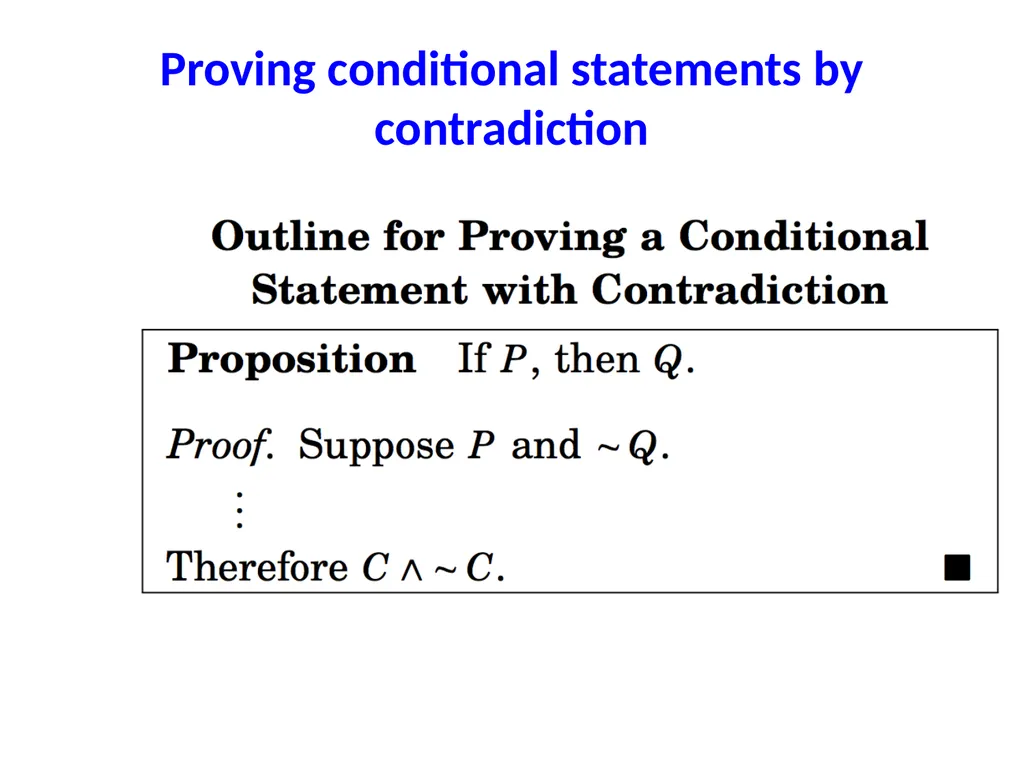
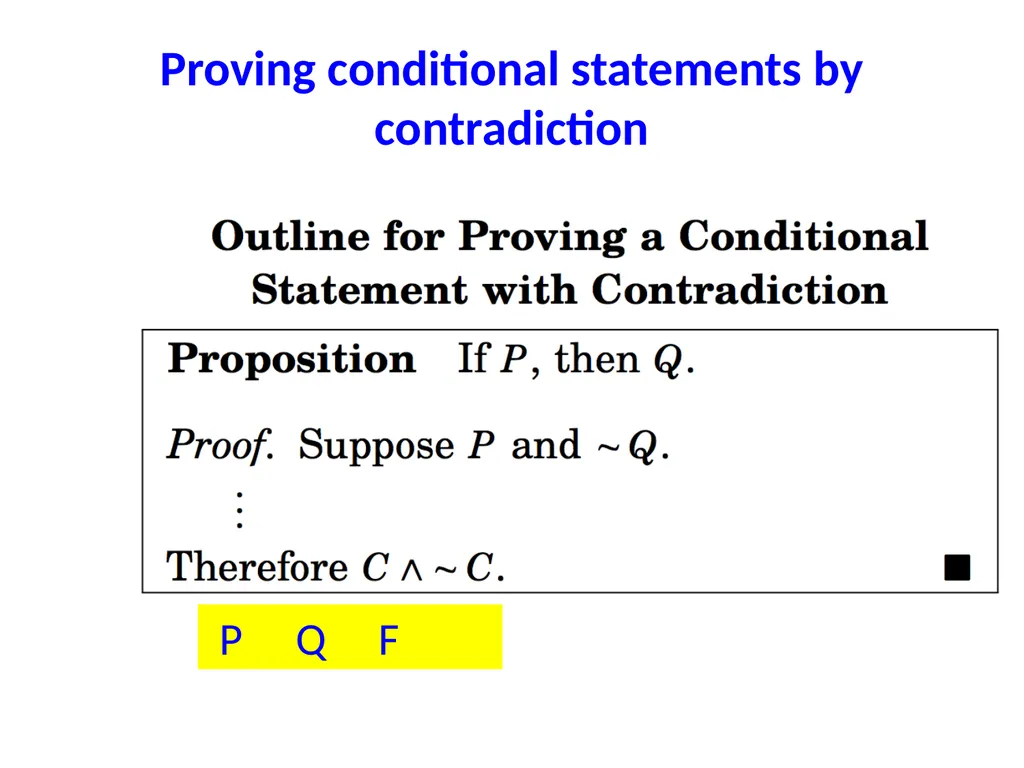
Proving conditional statements by contradiction<br>
85
Proving conditional statements by contradiction P Q F<br>
86
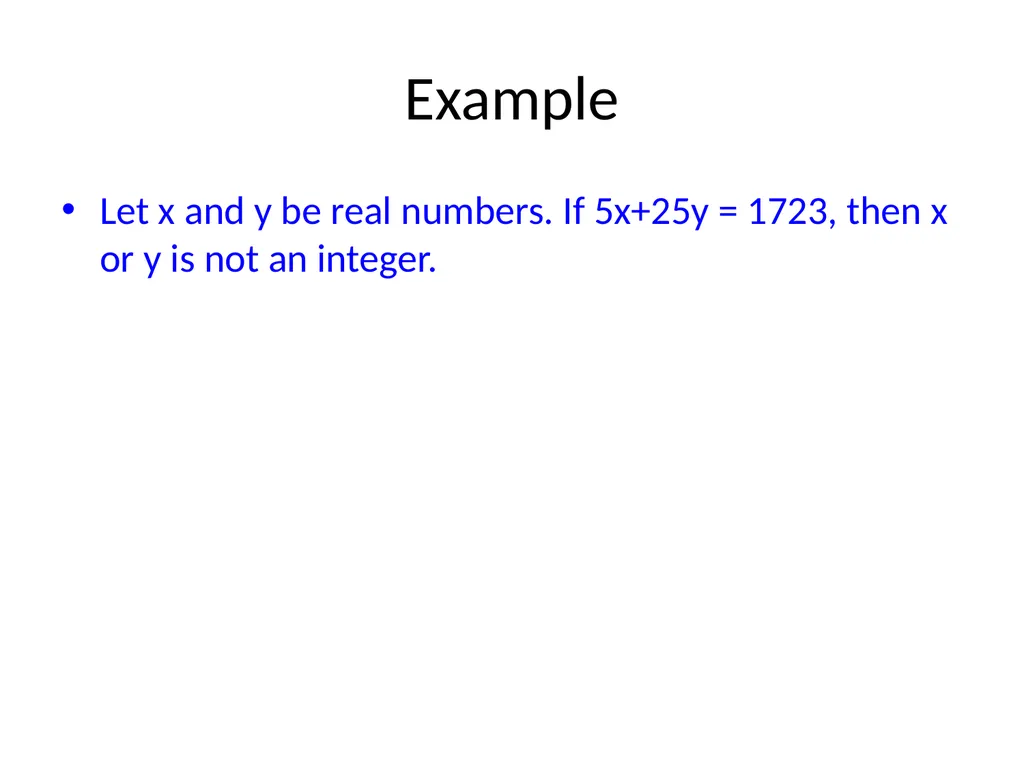
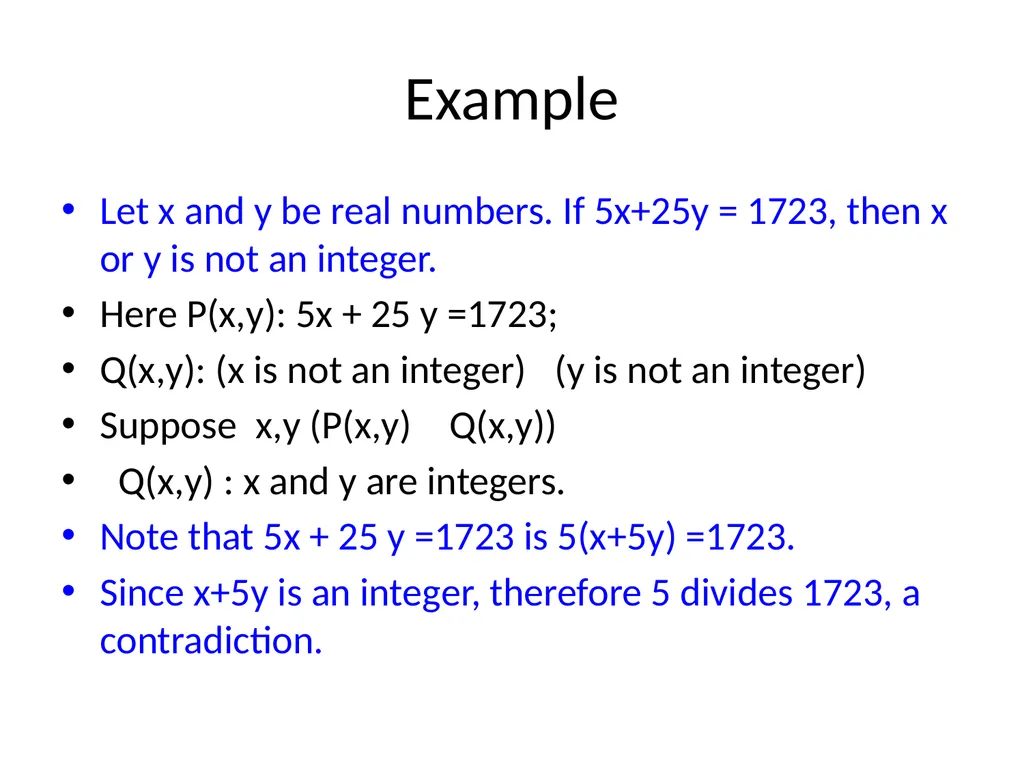
Example Let x and y be real numbers. If 5x+25y = 1723, then x or y is not an integer.<br>
87
Example Let x and y be real numbers. If 5x+25y = 1723, then x or y is not an integer.
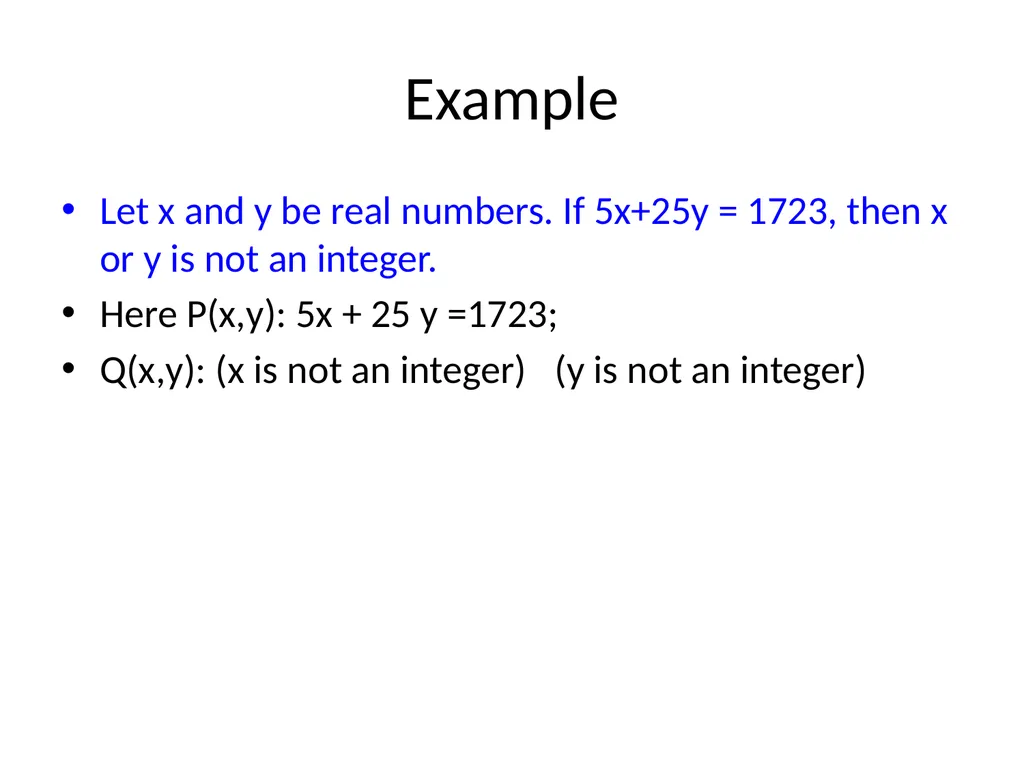
Here P(x,y): 5x + 25 y =1723;
Q(x,y): (x is not an integer) (y is not an integer)<br>
Here P(x,y): 5x + 25 y =1723;
Q(x,y): (x is not an integer) (y is not an integer)<br>
88
Example Let x and y be real numbers. If 5x+25y = 1723, then x or y is not an integer.
Here P(x,y): 5x + 25 y =1723;
Q(x,y): (x is not an integer) (y is not an integer)
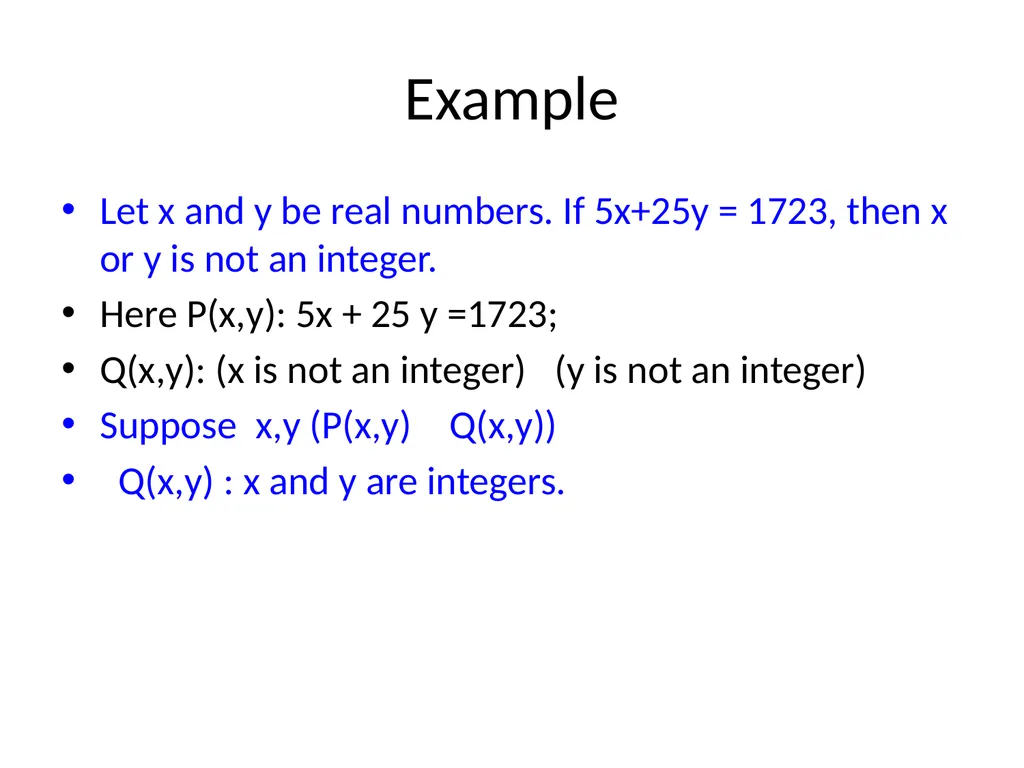
Suppose x,y (P(x,y) Q(x,y))
Q(x,y) : x and y are integers.<br>
Here P(x,y): 5x + 25 y =1723;
Q(x,y): (x is not an integer) (y is not an integer)
Suppose x,y (P(x,y) Q(x,y))
Q(x,y) : x and y are integers.<br>
89
Example Let x and y be real numbers. If 5x+25y = 1723, then x or y is not an integer.
Here P(x,y): 5x + 25 y =1723;
Q(x,y): (x is not an integer) (y is not an integer)
Suppose x,y (P(x,y) Q(x,y))
Q(x,y) : x and y are integers.
Note that 5x + 25 y =1723 is 5(x+5y) =1723.
Since x+5y is an integer, therefore 5 divides 1723, a contradiction.<br>
Here P(x,y): 5x + 25 y =1723;
Q(x,y): (x is not an integer) (y is not an integer)
Suppose x,y (P(x,y) Q(x,y))
Q(x,y) : x and y are integers.
Note that 5x + 25 y =1723 is 5(x+5y) =1723.
Since x+5y is an integer, therefore 5 divides 1723, a contradiction.<br>
90
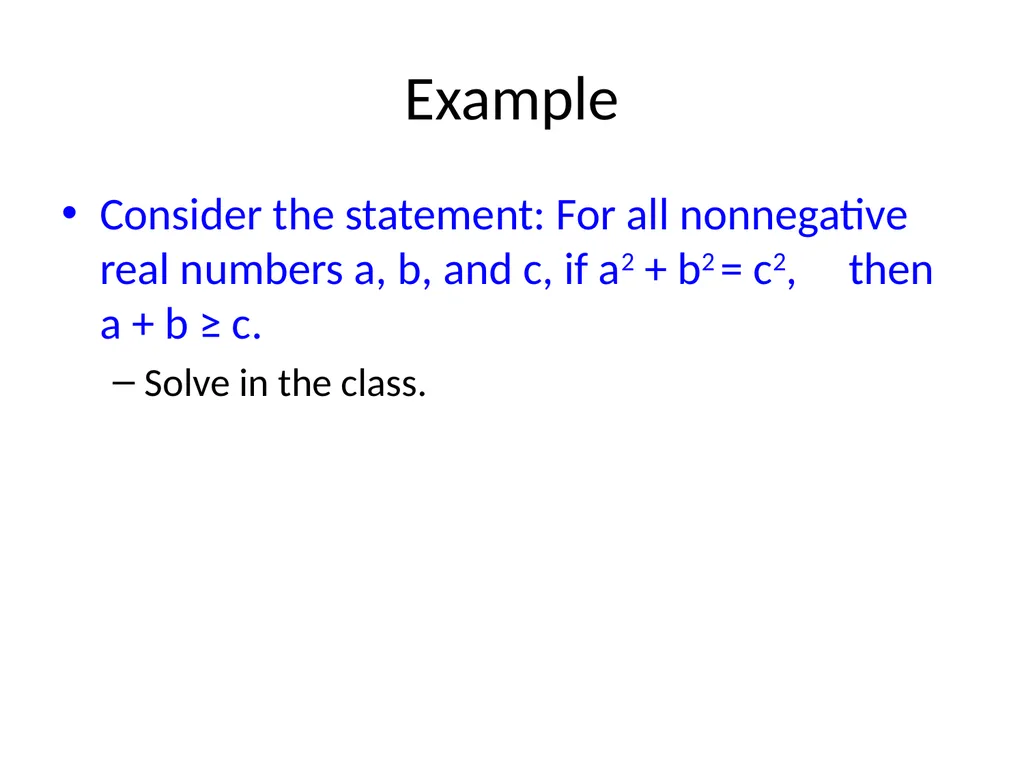
Example Consider the statement: For all nonnegative real numbers a, b, and c, if a2 + b2 = c2, then a + b ≥ c.
Solve in the class.<br>
Solve in the class.<br>
91
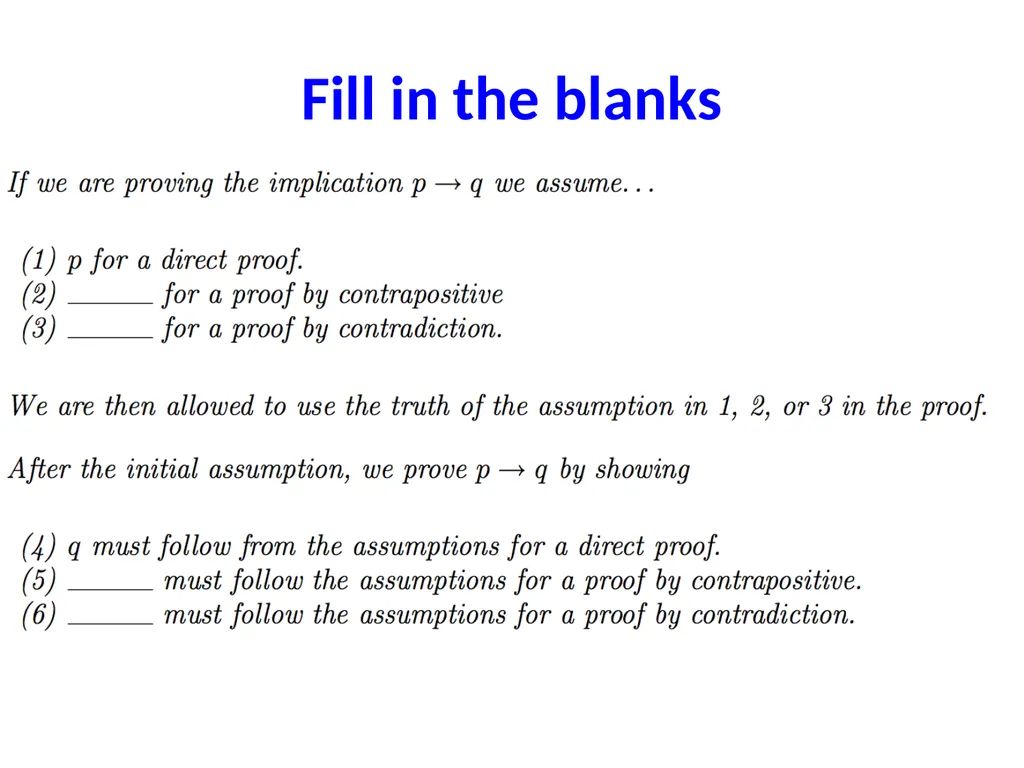
Fill in the blanks<br>
92
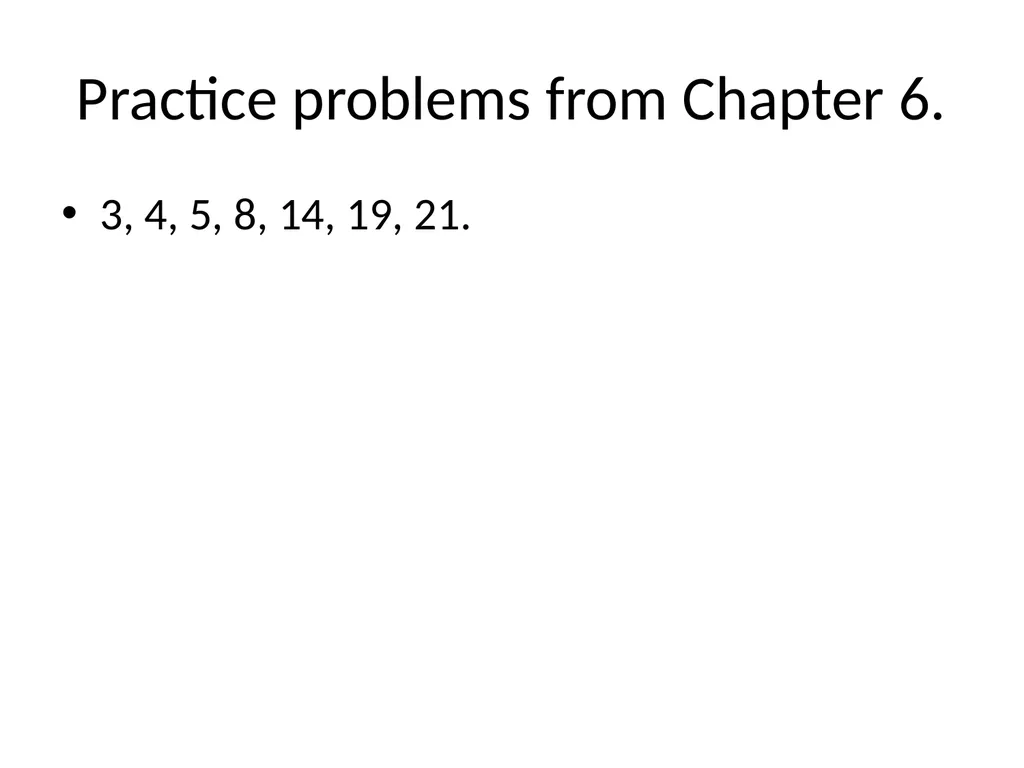
Practice problems from Chapter 6. 3, 4, 5, 8, 14, 19, 21.<br>
93
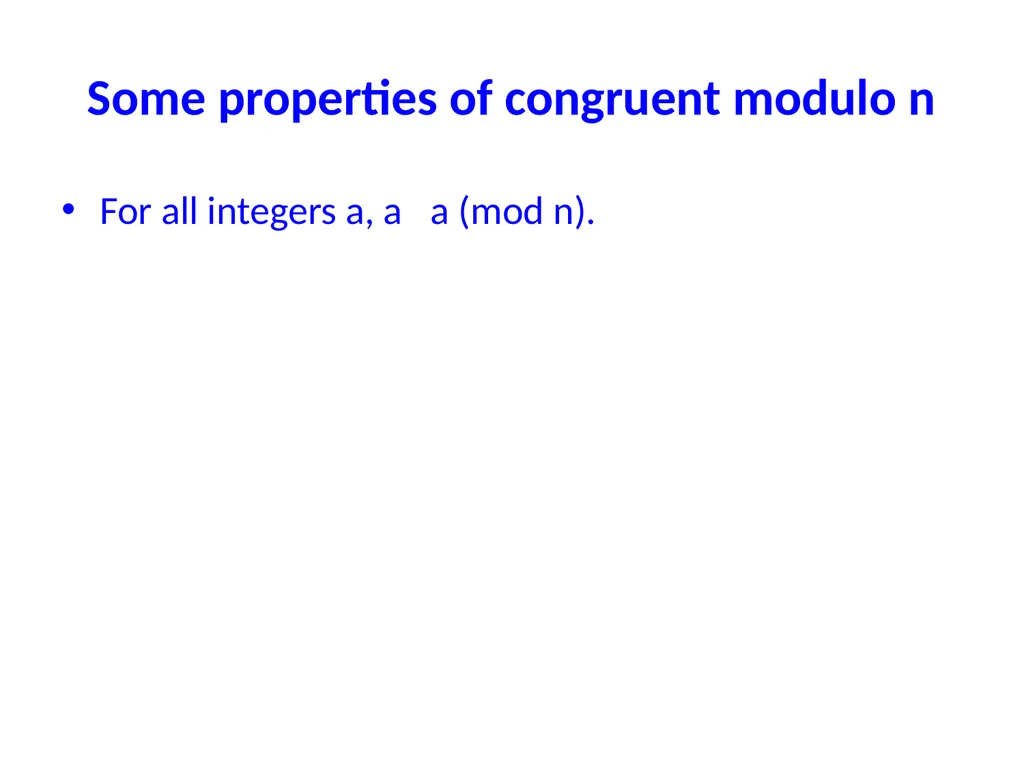
Some properties of congruent modulo n For all integers a, a a (mod n).<br>
94
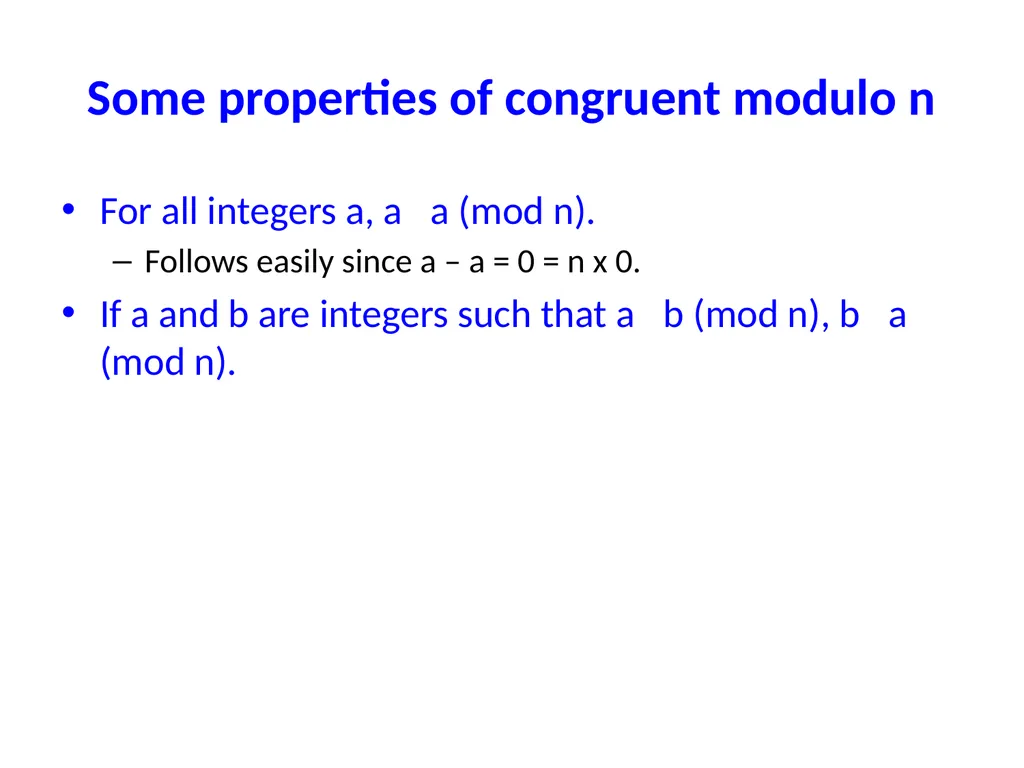
Some properties of congruent modulo n For all integers a, a a (mod n).
Follows easily since a – a = 0 = n x 0.
If a and b are integers such that a b (mod n), b a (mod n).<br>
Follows easily since a – a = 0 = n x 0.
If a and b are integers such that a b (mod n), b a (mod n).<br>
95
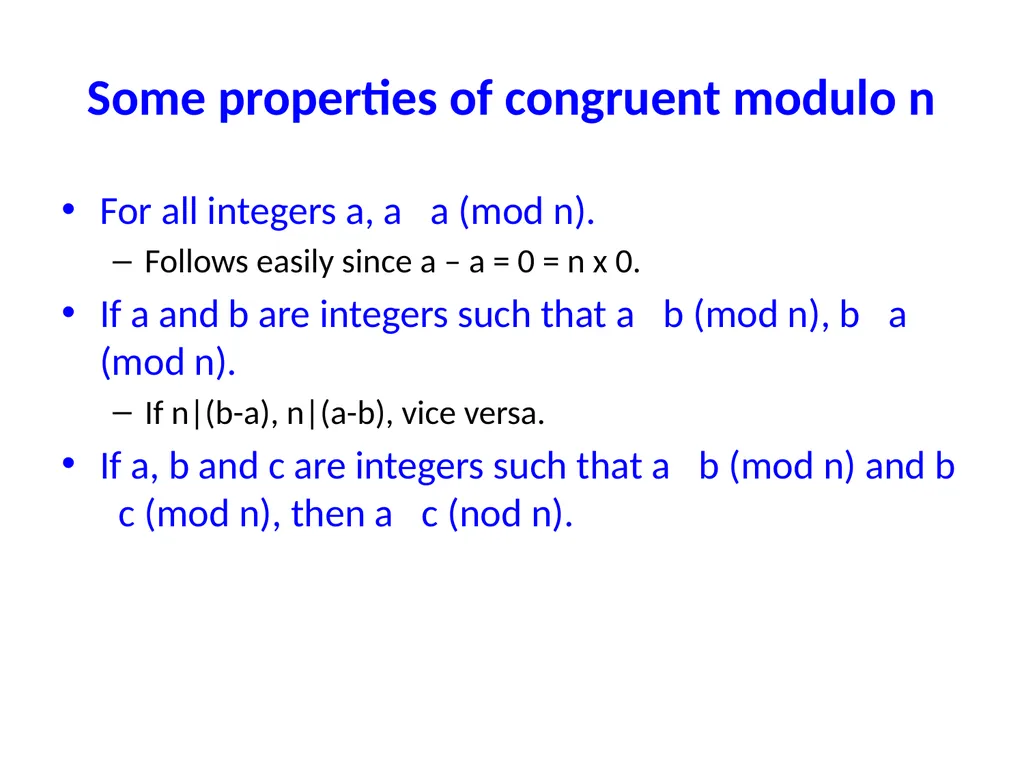
Some properties of congruent modulo n For all integers a, a a (mod n).
Follows easily since a – a = 0 = n x 0.
If a and b are integers such that a b (mod n), b a (mod n).
If n|(b-a), n|(a-b), vice versa.
If a, b and c are integers such that a b (mod n) and b c (mod n), then a c (nod n).<br>
Follows easily since a – a = 0 = n x 0.
If a and b are integers such that a b (mod n), b a (mod n).
If n|(b-a), n|(a-b), vice versa.
If a, b and c are integers such that a b (mod n) and b c (mod n), then a c (nod n).<br>
96
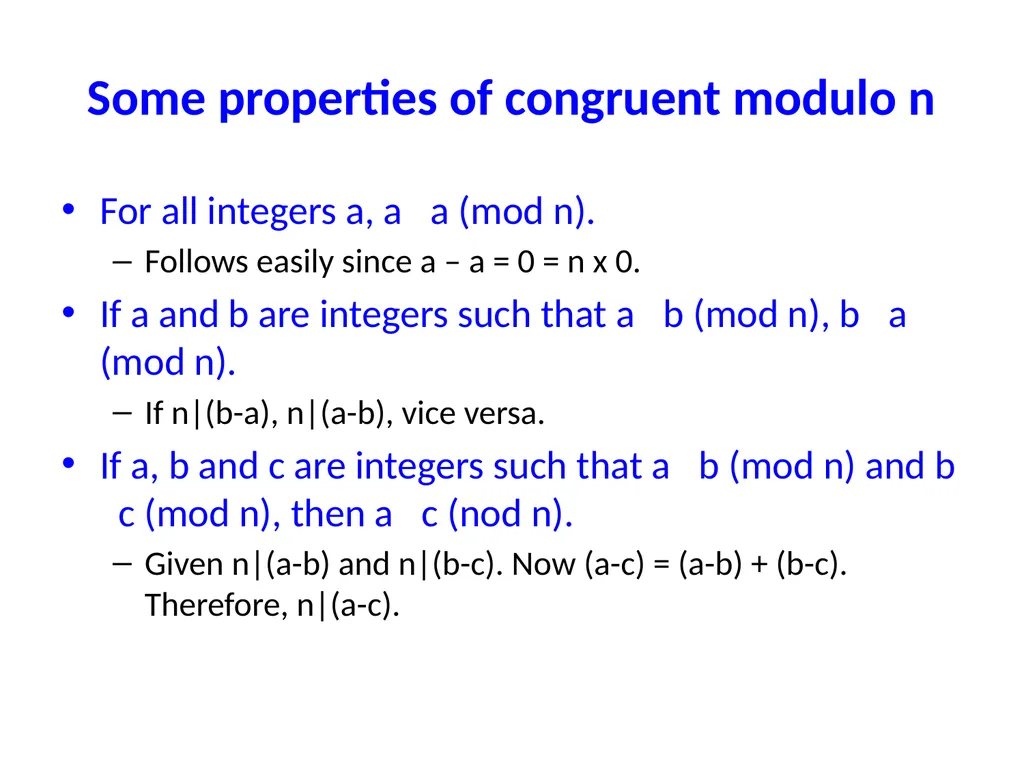
Some properties of congruent modulo n For all integers a, a a (mod n).
Follows easily since a – a = 0 = n x 0.
If a and b are integers such that a b (mod n), b a (mod n).
If n|(b-a), n|(a-b), vice versa.
If a, b and c are integers such that a b (mod n) and b c (mod n), then a c (nod n).
Given n|(a-b) and n|(b-c). Now (a-c) = (a-b) + (b-c). Therefore, n|(a-c).<br>
Follows easily since a – a = 0 = n x 0.
If a and b are integers such that a b (mod n), b a (mod n).
If n|(b-a), n|(a-b), vice versa.
If a, b and c are integers such that a b (mod n) and b c (mod n), then a c (nod n).
Given n|(a-b) and n|(b-c). Now (a-c) = (a-b) + (b-c). Therefore, n|(a-c).<br>
97
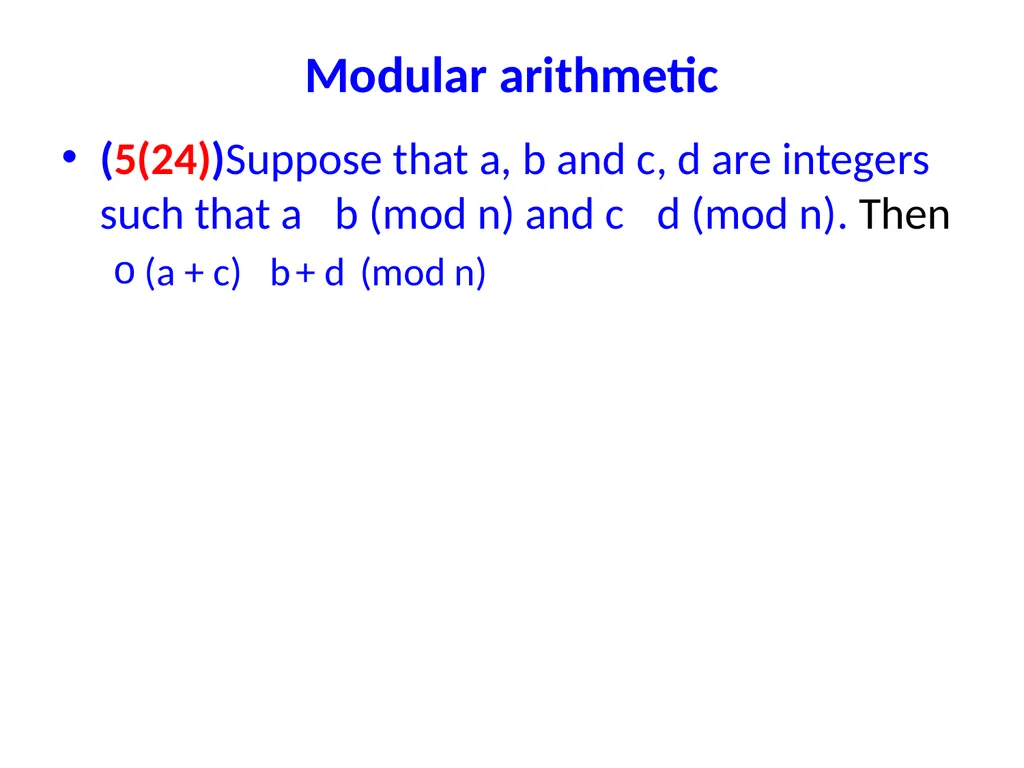
Modular arithmetic (5(24))Suppose that a, b and c, d are integers such that a b (mod n) and c d (mod n). Then
(a + c) b + d (mod n)<br>
(a + c) b + d (mod n)<br>
98
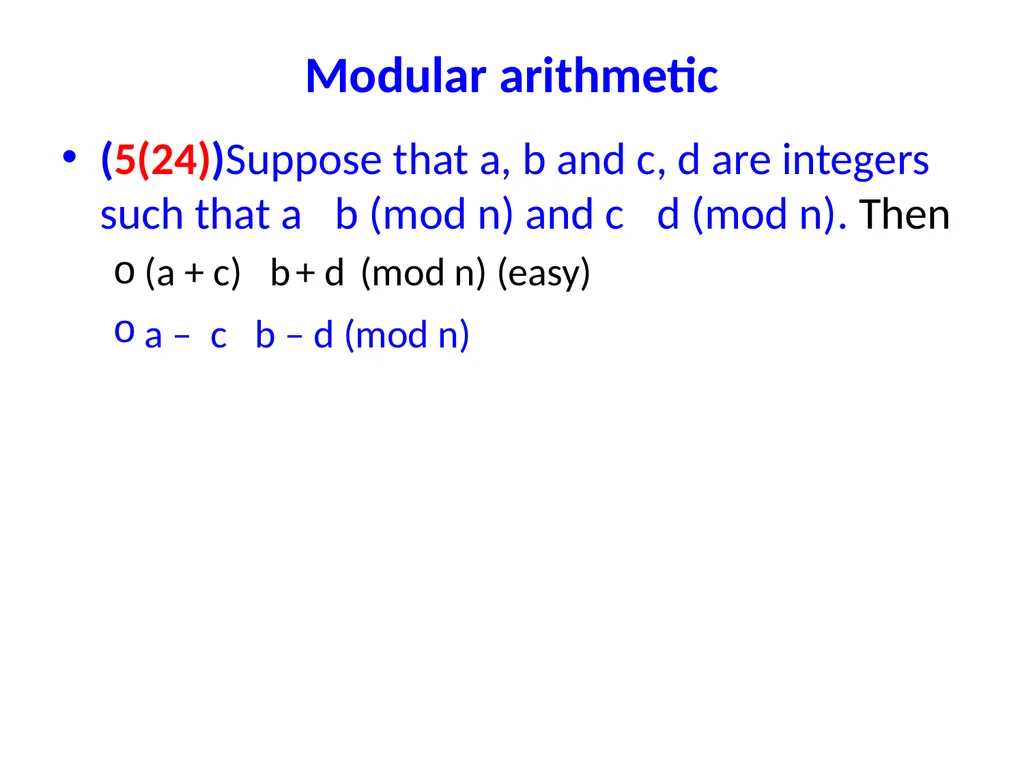
Modular arithmetic (5(24))Suppose that a, b and c, d are integers such that a b (mod n) and c d (mod n). Then
(a + c) b + d (mod n) (easy)
a – c b – d (mod n)<br>
(a + c) b + d (mod n) (easy)
a – c b – d (mod n)<br>
99
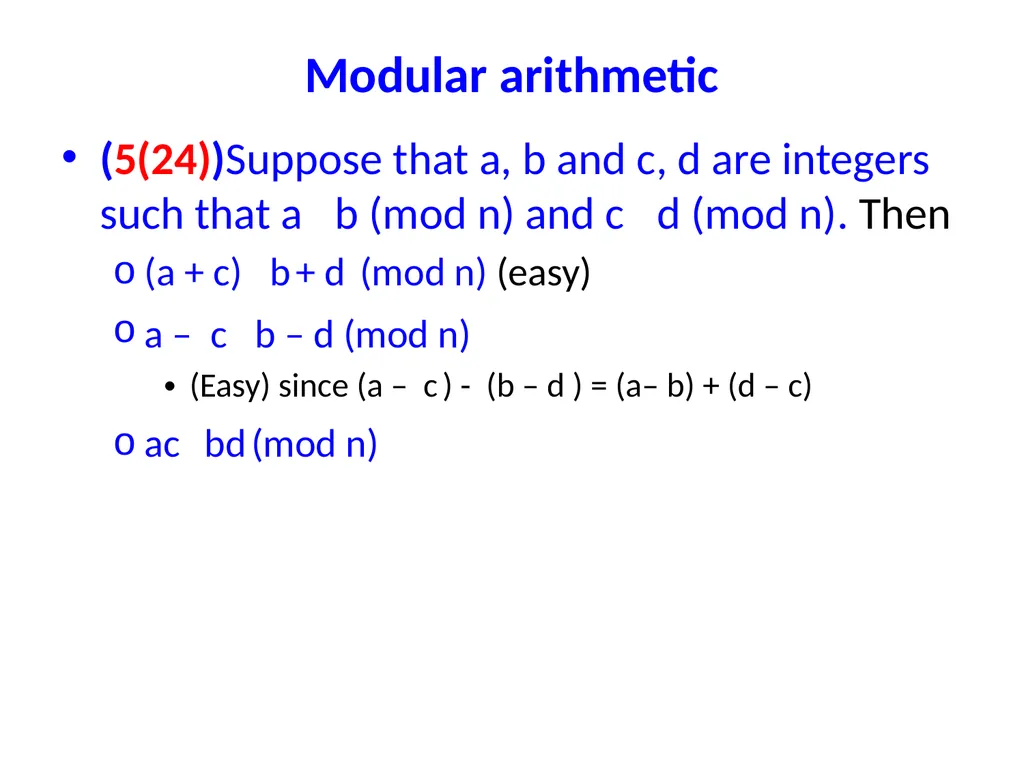
Modular arithmetic (5(24))Suppose that a, b and c, d are integers such that a b (mod n) and c d (mod n). Then
(a + c) b + d (mod n) (easy)
a – c b – d (mod n)
(Easy) since (a – c ) - (b – d ) = (a– b) + (d – c)
ac bd (mod n)<br>
(a + c) b + d (mod n) (easy)
a – c b – d (mod n)
(Easy) since (a – c ) - (b – d ) = (a– b) + (d – c)
ac bd (mod n)<br>
100
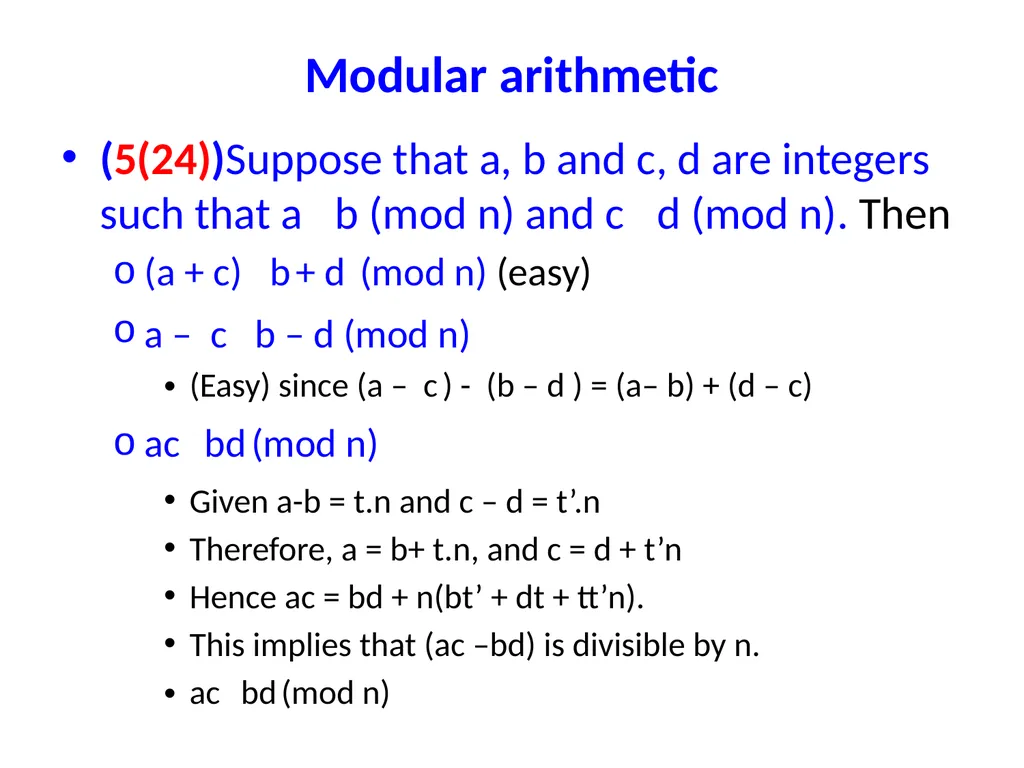
Modular arithmetic (5(24))Suppose that a, b and c, d are integers such that a b (mod n) and c d (mod n). Then
(a + c) b + d (mod n) (easy)
a – c b – d (mod n)
(Easy) since (a – c ) - (b – d ) = (a– b) + (d – c)
ac bd (mod n)
Given a-b = t.n and c – d = t’.n
Therefore, a = b+ t.n, and c = d + t’n
Hence ac = bd + n(bt’ + dt + tt’n).
This implies that (ac –bd) is divisible by n.
ac bd (mod n)<br>
(a + c) b + d (mod n) (easy)
a – c b – d (mod n)
(Easy) since (a – c ) - (b – d ) = (a– b) + (d – c)
ac bd (mod n)
Given a-b = t.n and c – d = t’.n
Therefore, a = b+ t.n, and c = d + t’n
Hence ac = bd + n(bt’ + dt + tt’n).
This implies that (ac –bd) is divisible by n.
ac bd (mod n)<br>