Proposition Logic BY Dr. ISMAEL ABDUL SATTAR A proposition is a declarative sentence (that is, a sentence that declares a fact) that is either true or false, but not both. EXAMPLE 1: All the following declarative sentences are propositions.
"Proposition Logic BY Dr. ISMAEL ABDUL SATTAR A" is the property of its rightful owner. Permission is granted to
download and print the materials on this website for personal, non-commercial use only, and to display it
on your personal computer provided you do not modify the materials and that you retain all copyright
notices contained in the materials. By downloading content from our website, you accept the terms of this
agreement.
Presentation Transcript
01
Proposition Logic BY
Dr. ISMAEL ABDUL SATTAR<br>
02
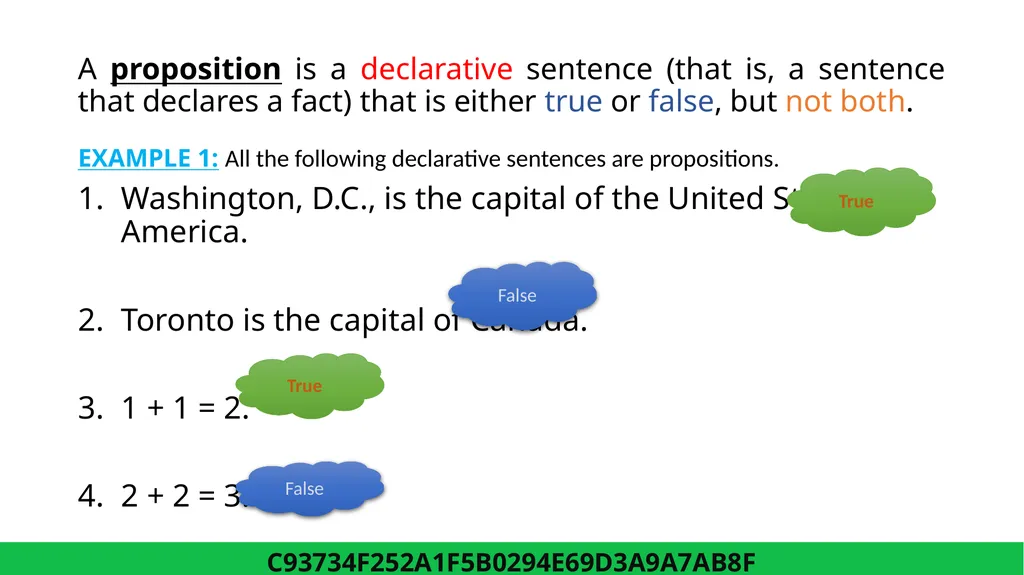
A proposition is a declarative sentence (that is, a sentence that declares a fact) that is either true or false, but not both. EXAMPLE 1: All the following declarative sentences are propositions.
Washington, D.C., is the capital of the United States of America.
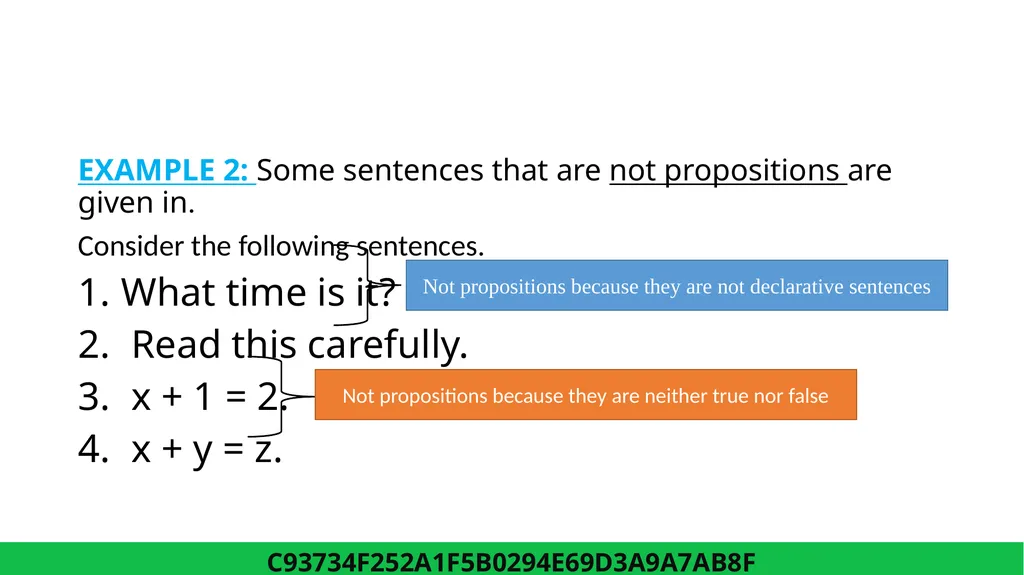
EXAMPLE 2: Some sentences that are not propositions are given in.
Consider the following sentences.
What time is it?
Read this carefully.
x + 1 = 2.
x + y = z. Not propositions because they are not declarative sentences Not propositions because they are neither true nor false C93734F252A1F5B0294E69D3A9A7AB8F<br>
04
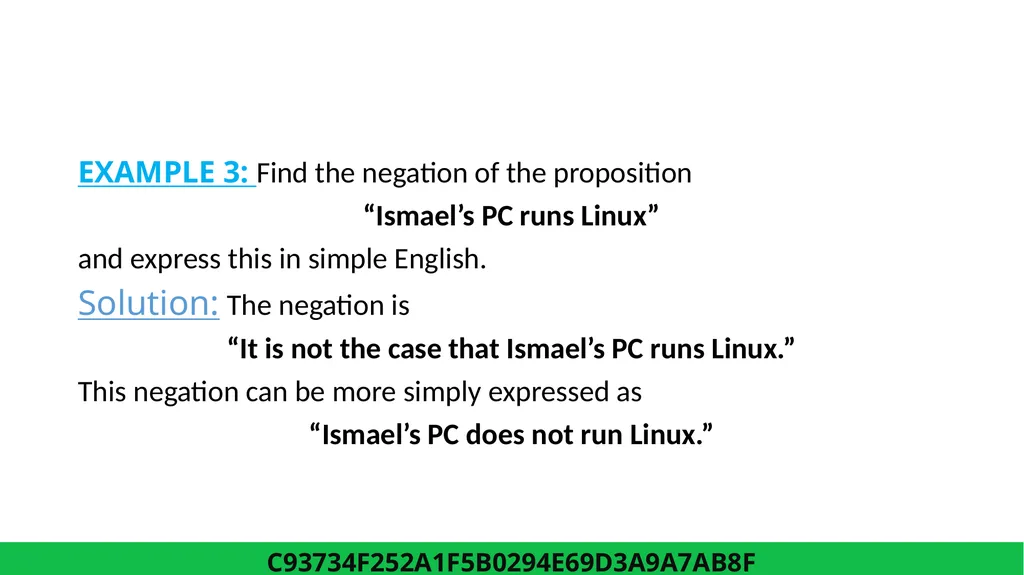
EXAMPLE 3: Find the negation of the proposition
“Ismael’s PC runs Linux”
and express this in simple English.
Solution: The negation is
“It is not the case that Ismael’s PC runs Linux.”
This negation can be more simply expressed as
“Ismael’s PC does not run Linux.” C93734F252A1F5B0294E69D3A9A7AB8F<br>
05
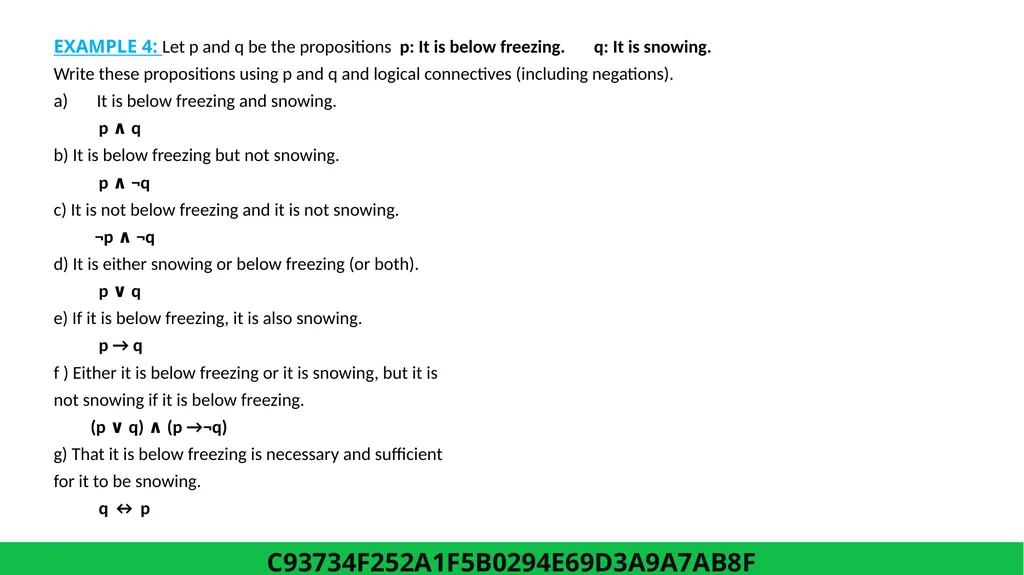
EXAMPLE 4: Let p and q be the propositions p: It is below freezing. q: It is snowing.
Write these propositions using p and q and logical connectives (including negations).
It is below freezing and snowing.
p ∧ q
b) It is below freezing but not snowing.
p ∧ ¬q
c) It is not below freezing and it is not snowing.
¬p ∧ ¬q
d) It is either snowing or below freezing (or both).
p ∨ q
e) If it is below freezing, it is also snowing.
p → q
f ) Either it is below freezing or it is snowing, but it is
not snowing if it is below freezing.
(p ∨ q) ∧ (p →¬q)
g) That it is below freezing is necessary and sufficient
for it to be snowing.
q ↔ p C93734F252A1F5B0294E69D3A9A7AB8F<br>
06
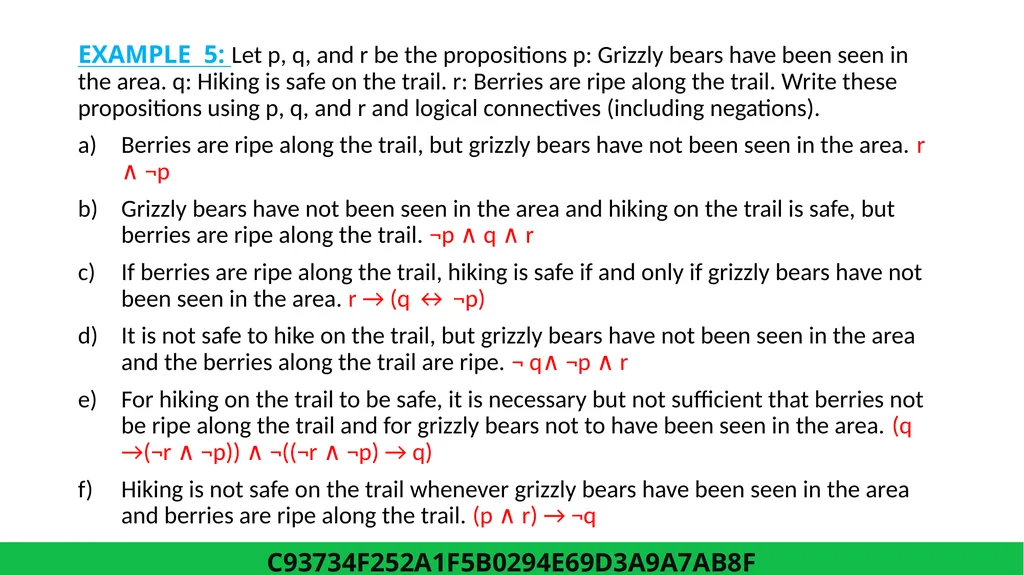
EXAMPLE 5: Let p, q, and r be the propositions p: Grizzly bears have been seen in the area. q: Hiking is safe on the trail. r: Berries are ripe along the trail. Write these propositions using p, q, and r and logical connectives (including negations).
Berries are ripe along the trail, but grizzly bears have not been seen in the area. r ∧ ¬p
Grizzly bears have not been seen in the area and hiking on the trail is safe, but berries are ripe along the trail. ¬p ∧ q ∧ r
If berries are ripe along the trail, hiking is safe if and only if grizzly bears have not been seen in the area. r → (q ↔ ¬p)
It is not safe to hike on the trail, but grizzly bears have not been seen in the area and the berries along the trail are ripe. ¬ q∧ ¬p ∧ r
For hiking on the trail to be safe, it is necessary but not sufficient that berries not be ripe along the trail and for grizzly bears not to have been seen in the area. (q →(¬r ∧ ¬p)) ∧ ¬((¬r ∧ ¬p) → q)
Hiking is not safe on the trail whenever grizzly bears have been seen in the area and berries are ripe along the trail. (p ∧ r) → ¬q C93734F252A1F5B0294E69D3A9A7AB8F<br>
07
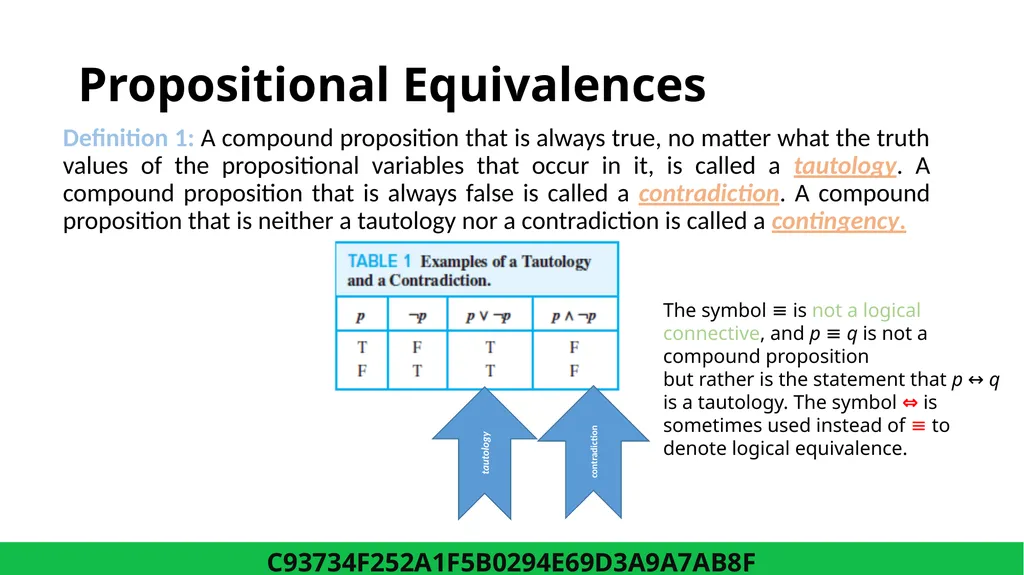
Propositional Equivalences Definition 1: A compound proposition that is always true, no matter what the truth values of the propositional variables that occur in it, is called a tautology. A compound proposition that is always false is called a contradiction. A compound proposition that is neither a tautology nor a contradiction is called a contingency. tautology contradiction The symbol ≡ is not a logical connective, and p ≡ q is not a compound proposition
but rather is the statement that p ↔ q is a tautology. The symbol ⇔ is sometimes used instead of ≡ to denote logical equivalence. C93734F252A1F5B0294E69D3A9A7AB8F<br>
08
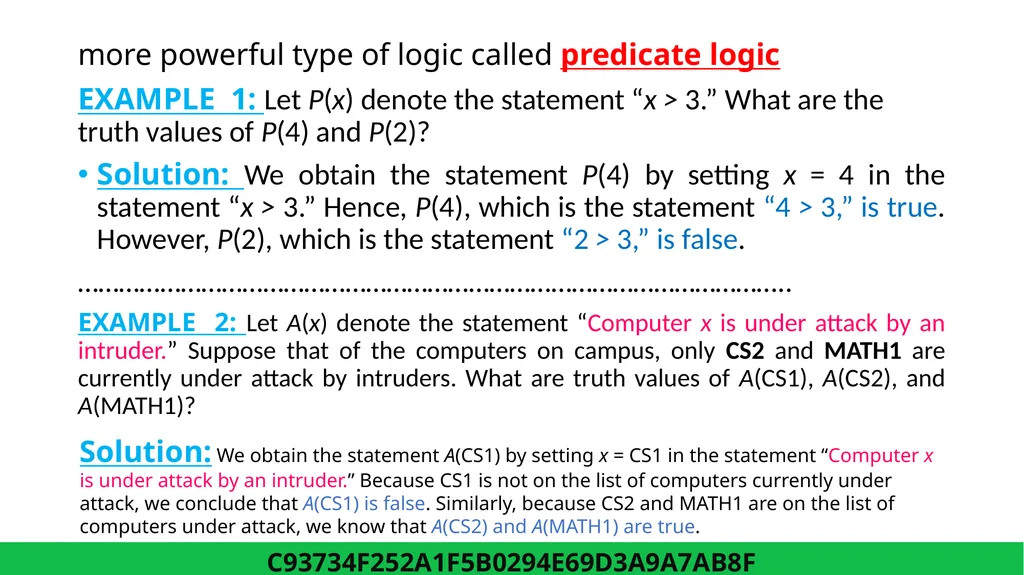
more powerful type of logic called predicate logic EXAMPLE 1: Let P(x) denote the statement “x > 3.” What are the truth values of P(4) and P(2)?
Solution: We obtain the statement P(4) by setting x = 4 in the statement “x > 3.” Hence, P(4), which is the statement “4 > 3,” is true. However, P(2), which is the statement “2 > 3,” is false.
…………………………………………………………………………………………..
EXAMPLE 2: Let A(x) denote the statement “Computer x is under attack by an intruder.” Suppose that of the computers on campus, only CS2 and MATH1 are currently under attack by intruders. What are truth values of A(CS1), A(CS2), and A(MATH1)? Solution: We obtain the statement A(CS1) by setting x = CS1 in the statement “Computer x
is under attack by an intruder.” Because CS1 is not on the list of computers currently under
attack, we conclude that A(CS1) is false. Similarly, because CS2 and MATH1 are on the list of
computers under attack, we know that A(CS2) and A(MATH1) are true. C93734F252A1F5B0294E69D3A9A7AB8F<br>
09
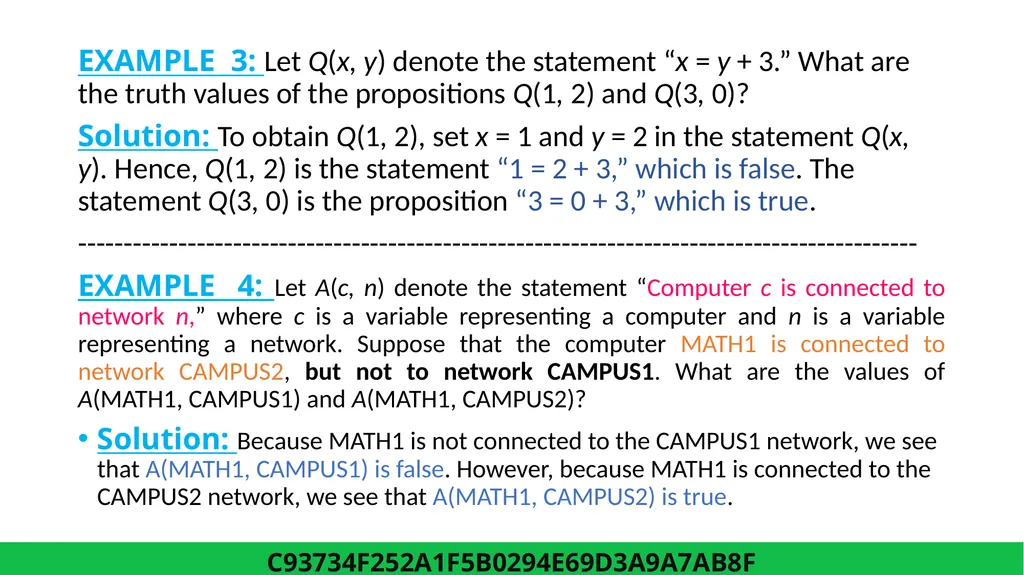
EXAMPLE 3: Let Q(x, y) denote the statement “x = y + 3.” What are the truth values of the propositions Q(1, 2) and Q(3, 0)?
Solution: To obtain Q(1, 2), set x = 1 and y = 2 in the statement Q(x, y). Hence, Q(1, 2) is the statement “1 = 2 + 3,” which is false. The statement Q(3, 0) is the proposition “3 = 0 + 3,” which is true.
--------------------------------------------------------------------------------------------
EXAMPLE 4: Let A(c, n) denote the statement “Computer c is connected to network n,” where c is a variable representing a computer and n is a variable representing a network. Suppose that the computer MATH1 is connected to network CAMPUS2, but not to network CAMPUS1. What are the values of A(MATH1, CAMPUS1) and A(MATH1, CAMPUS2)?
Solution: Because MATH1 is not connected to the CAMPUS1 network, we see that A(MATH1, CAMPUS1) is false. However, because MATH1 is connected to the CAMPUS2 network, we see that A(MATH1, CAMPUS2) is true. C93734F252A1F5B0294E69D3A9A7AB8F<br>