Prosodic foot: what is it and how is it relevant
Description: Prosodic foot: what is it and how is it relevant for tonal systems? Valentin Vydrin What is the foot in linguistics? In the Metric Theory, the prosodic foot is closely associated with stress (or prominence). The foot is the basic unit of
Related Topics
Download Presentation
"Prosodic foot: what is it and how is it relevant" is the property of its rightful owner. Permission is granted to download and print the materials on this website for personal, non-commercial use only, and to display it on your personal computer provided you do not modify the materials and that you retain all copyright notices contained in the materials. By downloading content from our website, you accept the terms of this agreement.
Presentation Transcript
slide1. Prosodic foot: what is it and how is it relevant for tonal systems? Valentin Vydrin<br>
slide2. What is the foot in linguistics? In the Metric Theory, the prosodic foot is closely associated with stress (or prominence).
“The foot is the basic unit of word stress assignment in many contemporary linguistic theories” (Alber, 2006, in Encyclopedia of Elsevier).
The term was introduced by Selkirk in 1980 (borrowed from poetic metric).
A prosodic unit (phonological domain) intermediary between syllable and word.<br>
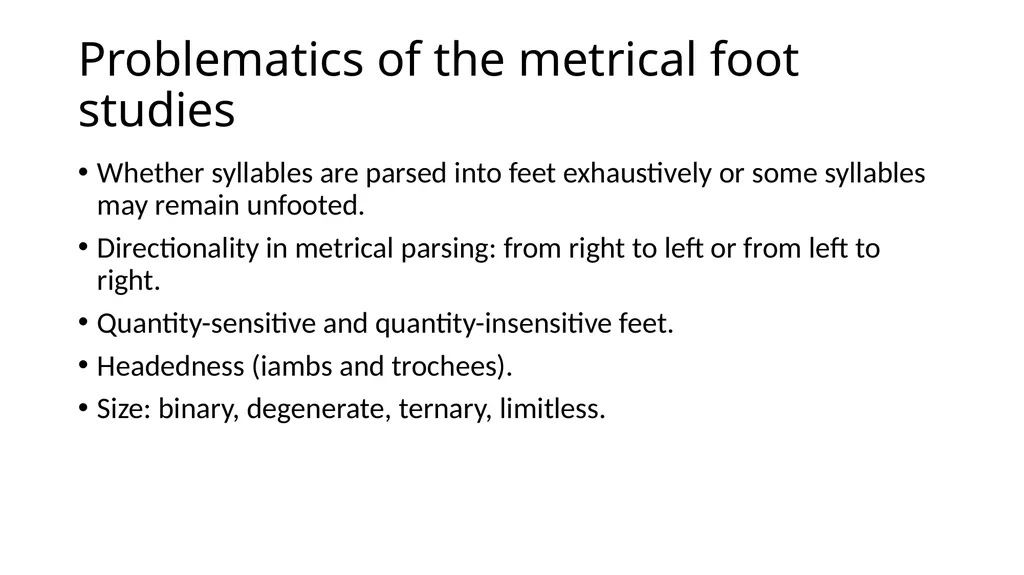
slide3. Prosodic hierarchy (a scheme borrowed from Green 2015)<br>
slide4. Problematics of the metrical foot studies Whether syllables are parsed into feet exhaustively or some syllables may remain unfooted.
Directionality in metrical parsing: from right to left or from left to right.
Quantity-sensitive and quantity-insensitive feet.
Headedness (iambs and trochees).
Size: binary, degenerate, ternary, limitless.<br>
slide5. Foot as a metrical constituent It manifests itself (language-specifically):
in reduplication;
in minimal length of a word;
various phonological processes, e.g., distribution of consonants (in English, aspirated consonants can be foot-initial, but not foot-internal; etc.).<br>
slide6. Foot in stressless languages There can be various phenomena conditioned by foot structure unrelated to stress.
Foot may have no head, i.e., it is not necessarily iambic or trochaic (contrary to Hayes 1980).
Foot and stress often correlate, however, this correlation is not obligatory: foot can exist without stress.<br>
slide7. Phenomena dependent on the foot structure (Culhane 2023)
Vocalic processes
Consonantal processes
Deletion, coalescence, truncation processes
Tonal processes
Phonotactics
Affixation
Reduplication<br>
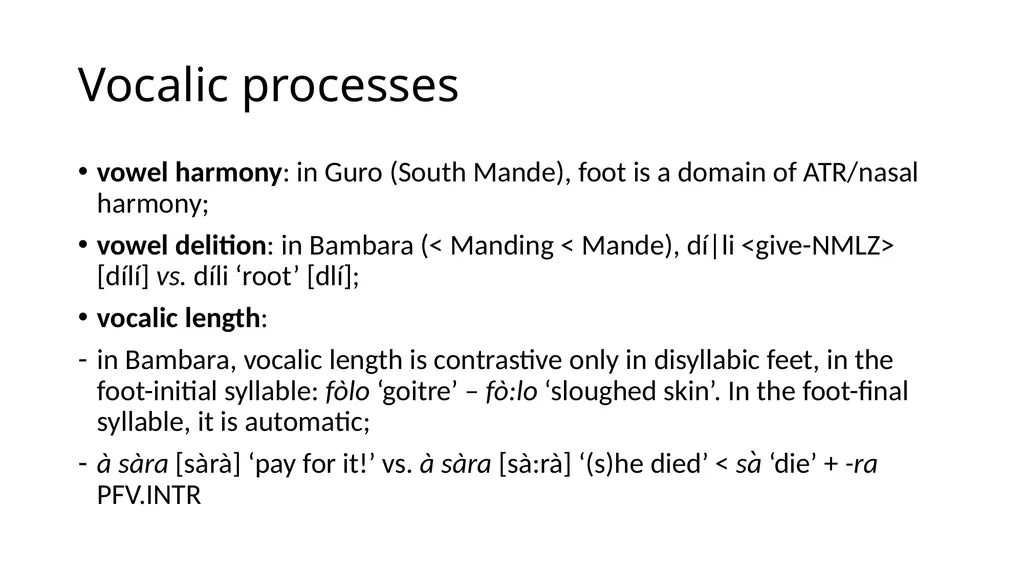
slide8. Vocalic processes vowel harmony: in Guro (South Mande), foot is a domain of ATR/nasal harmony;
vowel delition: in Bambara (< Manding < Mande), dí|li <give-NMLZ> [dílí] vs. díli ‘root’ [dlí];
vocalic length:
in Bambara, vocalic length is contrastive only in disyllabic feet, in the foot-initial syllable: fòlo ‘goitre’ – fò:lo ‘sloughed skin’. In the foot-final syllable, it is automatic;
à sàra [sàrà] ‘pay for it!’ vs. à sàra [sà:rà] ‘(s)he died’ < sà ‘die’ + -ra PFV.INTR<br>
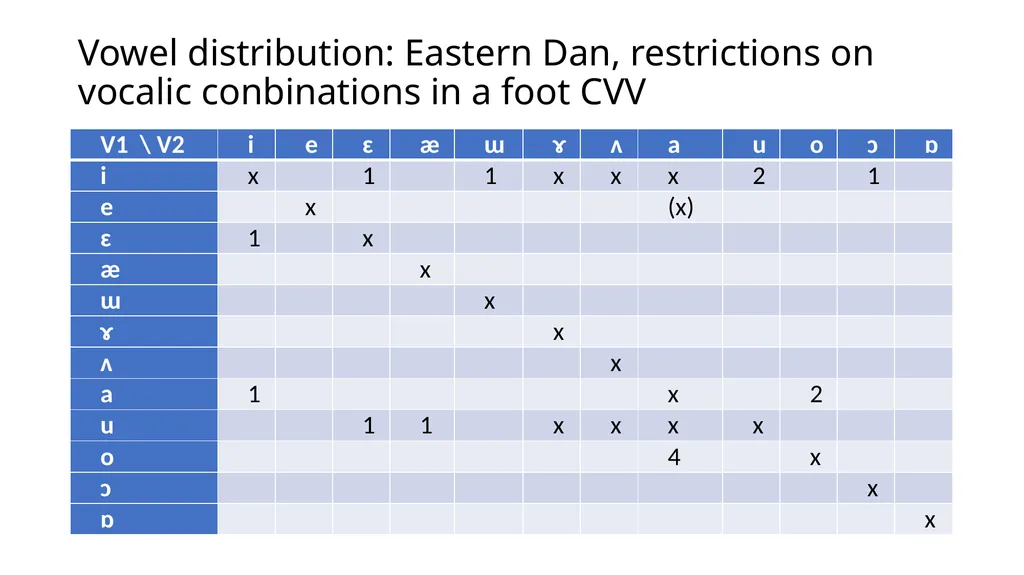
slide9. Vowel distribution: Eastern Dan, restrictions on vocalic conbinations in a foot CVV<br>
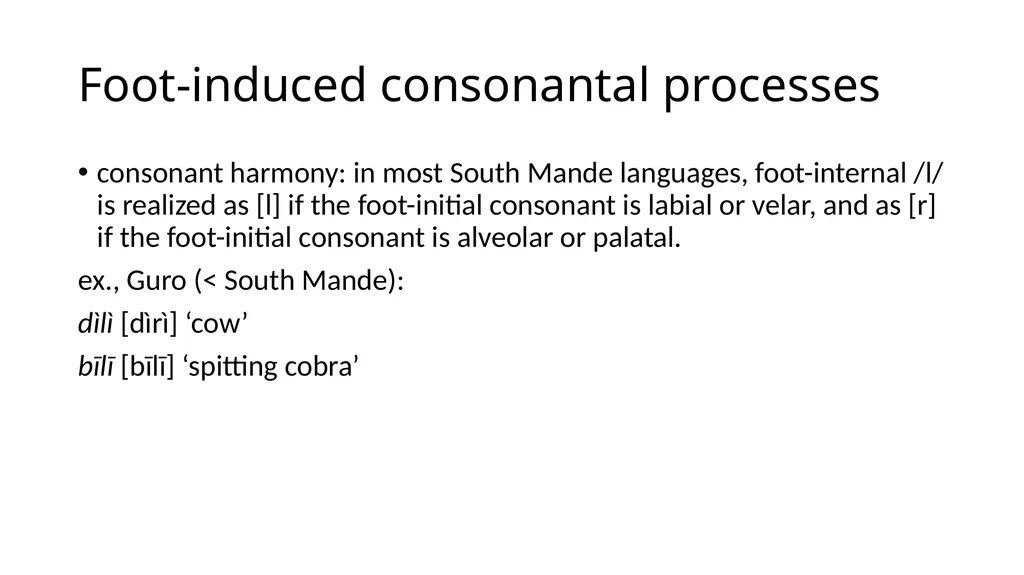
slide10. Foot-induced consonantal processes consonant harmony: in most South Mande languages, foot-internal /l/ is realized as [l] if the foot-initial consonant is labial or velar, and as [r] if the foot-initial consonant is alveolar or palatal.
ex., Guro (< South Mande):
dìlì [dìrì] ‘cow’
bīlī [bīlī] ‘spitting cobra’<br>
slide11. Consonant fortition and lenition Bambara
Do not appear in the foot-internal position: voiceless stops p, t, č; voiced stops ǰ, gw.
Does not appear in the foot-initial position: r.
In the foot-internal position, the contrast between /k/ and /g/ is neutralized: mɔ̀Gɔ [mɔ̀gɔ ~ mɔ̀ɣɔ ~ mɔ̀kɔ] ‘human being’.<br>
slide12. Other foot-related processes consonant epenthesis;
consonant delition;
reduplication.<br>
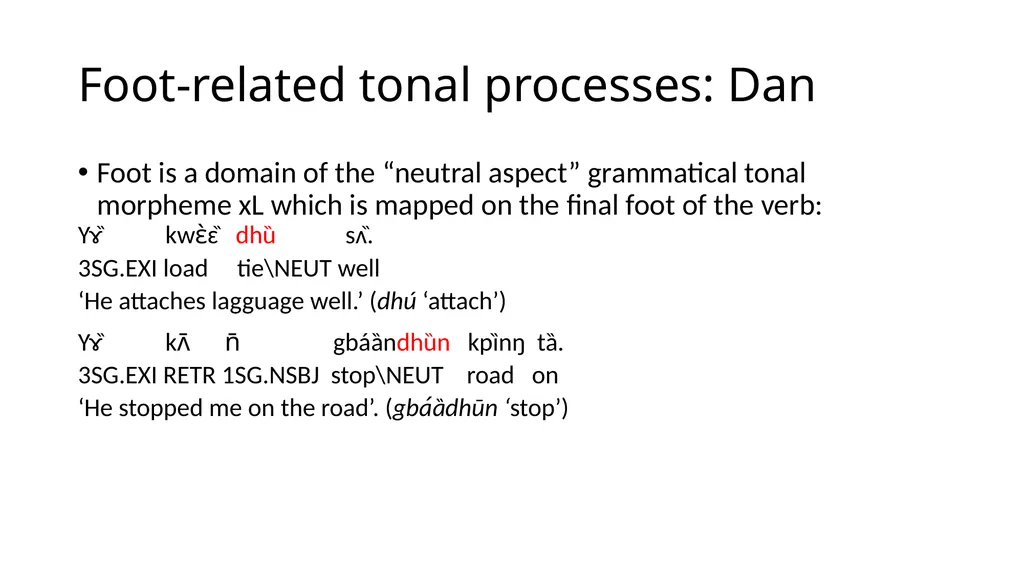
slide13. Foot-related tonal processes: Dan Foot is a domain of the “neutral aspect” grammatical tonal morpheme xL which is mapped on the final foot of the verb:
Yɤ̏ kwɛ̀ɛ̏ dhȕ sʌ̏.
3SG.EXI load tie\NEUT well
‘He attaches lagguage well.’ (dhú ‘attach’)
Yɤ̏ kʌ̄ n̄ gbáȁndhȕn kpȉnŋ tȁ.
3SG.EXI RETR 1SG.NSBJ stop\NEUT road on
‘He stopped me on the road’. (gbáȁdhūn ‘stop’)<br>
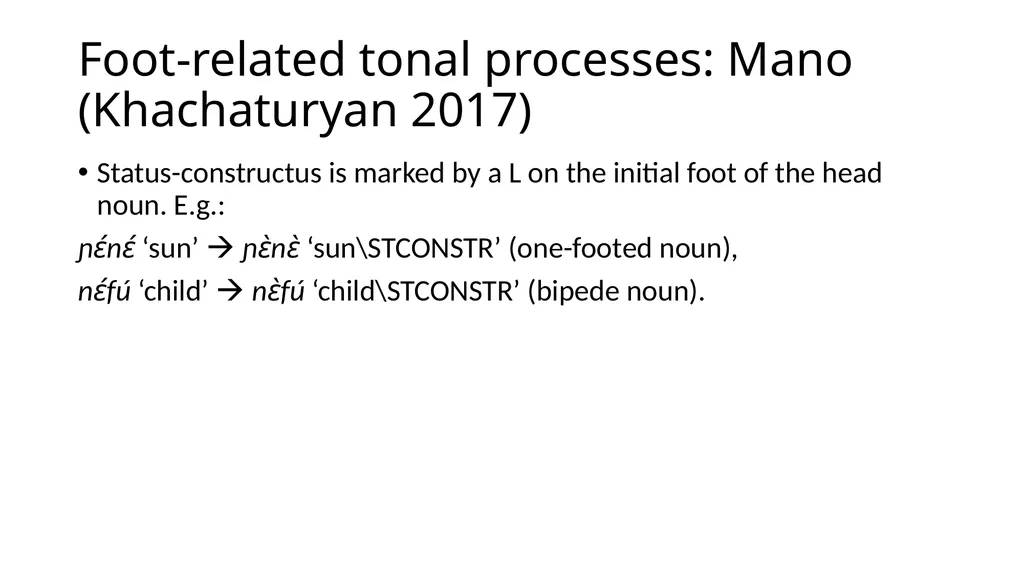
slide14. Foot-related tonal processes: Mano (Khachaturyan 2017) Status-constructus is marked by a L on the initial foot of the head noun. E.g.:
ɲɛ́nɛ́ ‘sun’ ɲɛ̀nɛ̀ ‘sun\STCONSTR’ (one-footed noun),
nɛ́fú ‘child’ nɛ̀fú ‘child\STCONSTR’ (bipede noun).<br>
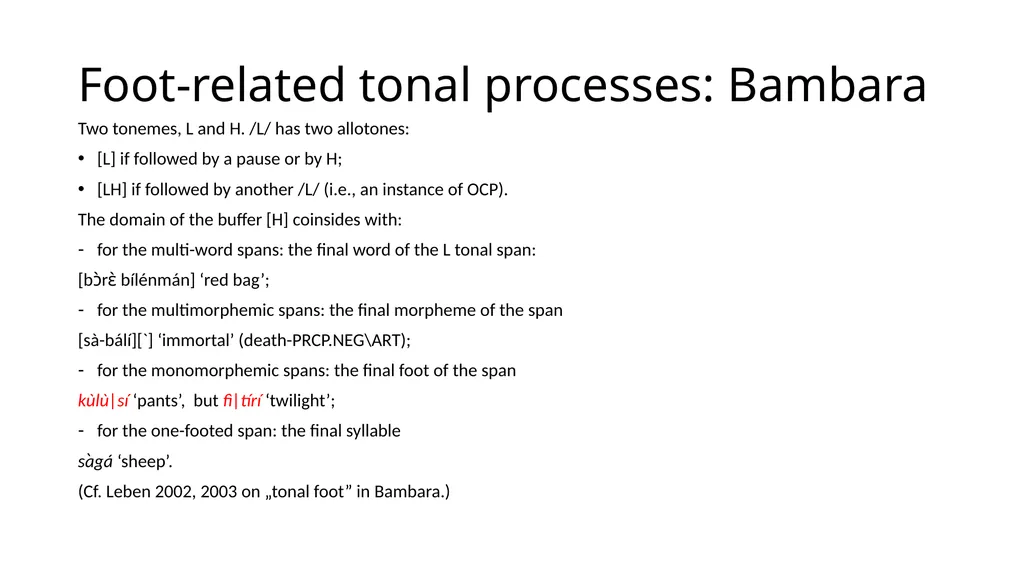
slide15. Foot-related tonal processes: Bambara Two tonemes, L and H. /L/ has two allotones:
[L] if followed by a pause or by H;
[LH] if followed by another /L/ (i.e., an instance of OCP).
The domain of the buffer [H] coinsides with:
for the multi-word spans: the final word of the L tonal span:
[bɔ̀rɛ̀ bílénmán] ‘red bag’;
for the multimorphemic spans: the final morpheme of the span
[sà-bálí][`] ‘immortal’ (death-PRCP.NEG\ART);
for the monomorphemic spans: the final foot of the span
kùlù|sí ‘pants’, but fì|tírí ‘twilight’;
for the one-footed span: the final syllable
sàgá ‘sheep’.
(Cf. Leben 2002, 2003 on „tonal foot” in Bambara.)<br>
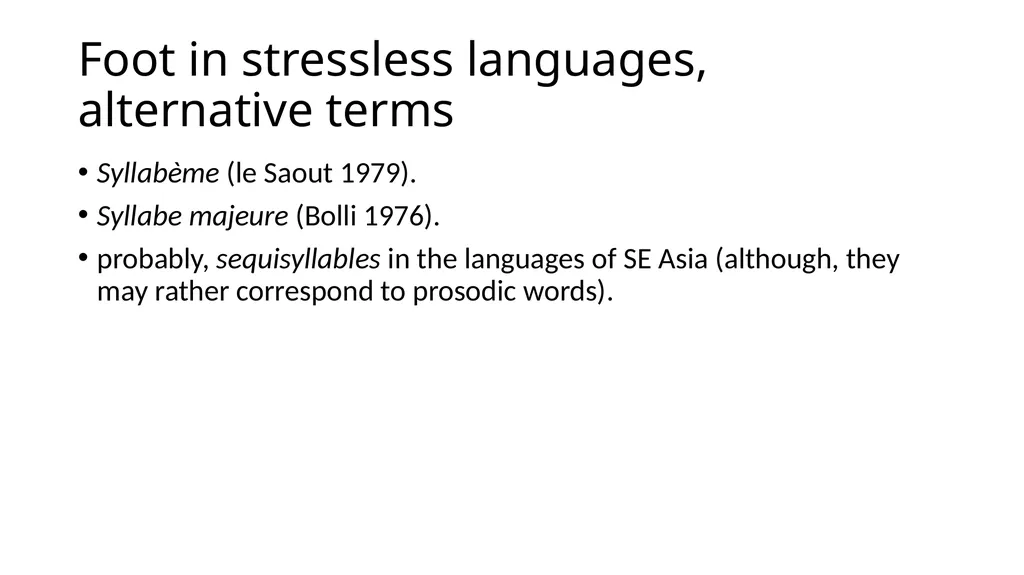
slide16. Foot in stressless languages, alternative terms Syllabème (le Saout 1979).
Syllabe majeure (Bolli 1976).
probably, sequisyllables in the languages of SE Asia (although, they may rather correspond to prosodic words).<br>
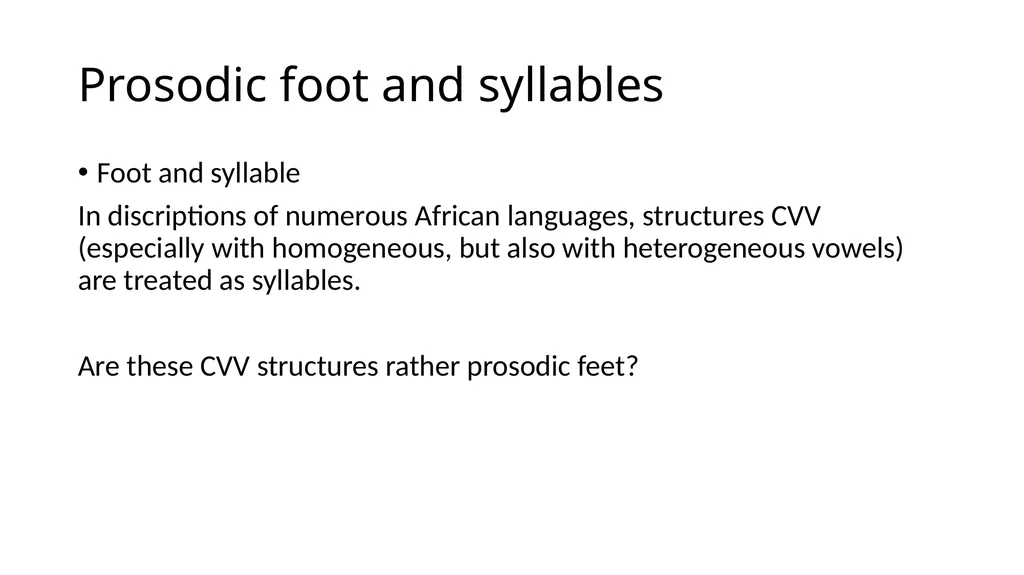
slide17. Prosodic foot and syllables Foot and syllable
In discriptions of numerous African languages, structures CVV (especially with homogeneous, but also with heterogeneous vowels) are treated as syllables.
Are these CVV structures rather prosodic feet?<br>
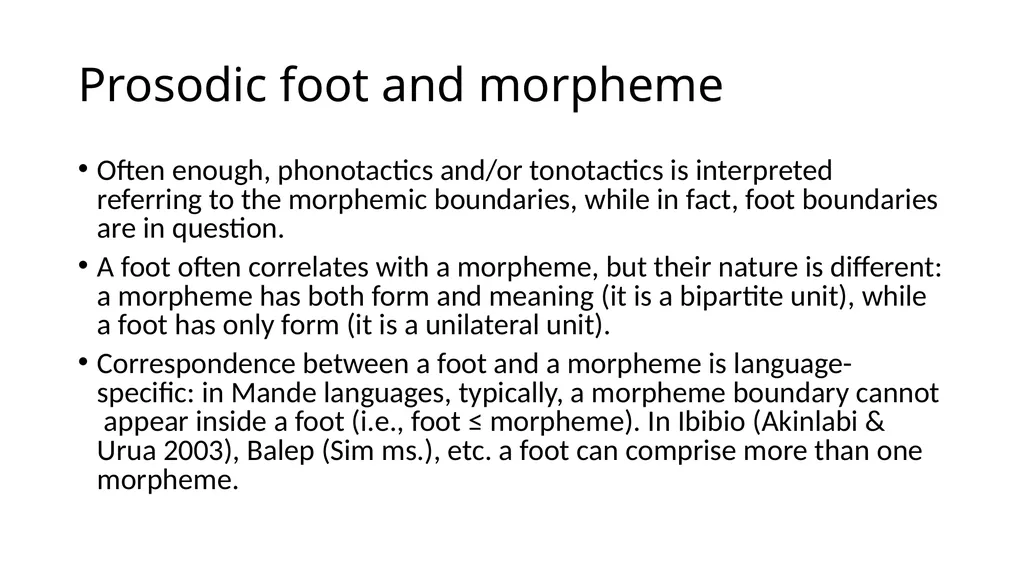
slide18. Prosodic foot and morpheme Often enough, phonotactics and/or tonotactics is interpreted referring to the morphemic boundaries, while in fact, foot boundaries are in question.
A foot often correlates with a morpheme, but their nature is different: a morpheme has both form and meaning (it is a bipartite unit), while a foot has only form (it is a unilateral unit).
Correspondence between a foot and a morpheme is language-specific: in Mande languages, typically, a morpheme boundary cannot appear inside a foot (i.e., foot ≤ morpheme). In Ibibio (Akinlabi & Urua 2003), Balep (Sim ms.), etc. a foot can comprise more than one morpheme.<br>
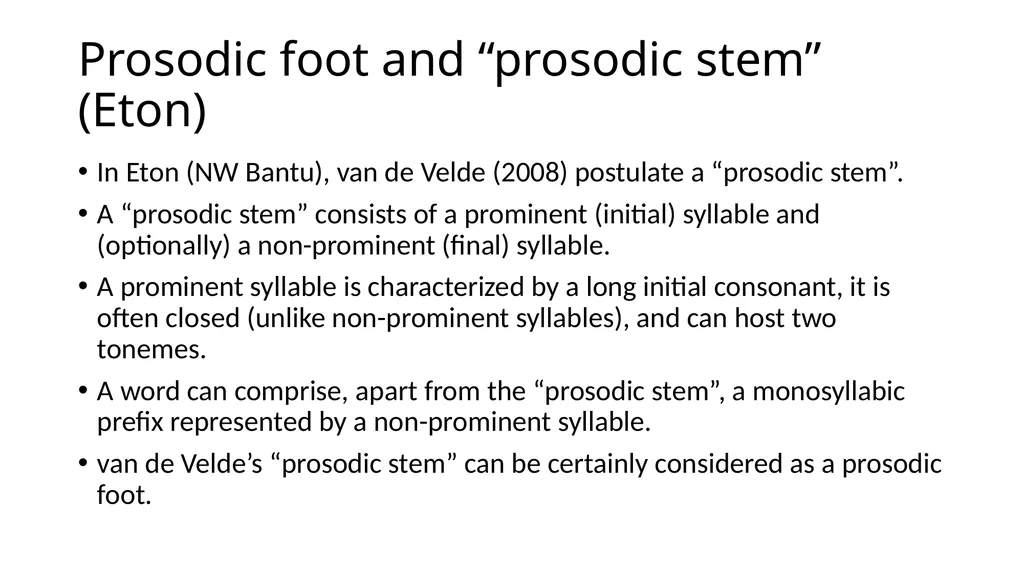
slide19. Prosodic foot and “prosodic stem” (Eton) In Eton (NW Bantu), van de Velde (2008) postulate a “prosodic stem”.
A “prosodic stem” consists of a prominent (initial) syllable and (optionally) a non-prominent (final) syllable.
A prominent syllable is characterized by a long initial consonant, it is often closed (unlike non-prominent syllables), and can host two tonemes.
A word can comprise, apart from the “prosodic stem”, a monosyllabic prefix represented by a non-prominent syllable.
van de Velde’s “prosodic stem” can be certainly considered as a prosodic foot.<br>
slide20. Exhaustive and non-exhaustive feet parsing A segmental chain is not necessarily parsed in feet exhaustively; the exhaustive/non-exhaustive feet parsing is language-specific.
The syllables which remain outside full-fledged feet are degenerative feet or unfooted syllables.
Bambara: some monosyllabic suffixes are degenerative feet, e.g. imperfective intransitive suffix –ra.
Eton: the monosyllabic non-prominent syllables of prefixes are unfooted syllables.<br>

slide2. What is the foot in linguistics? In the Metric Theory, the prosodic foot is closely associated with stress (or prominence).
“The foot is the basic unit of word stress assignment in many contemporary linguistic theories” (Alber, 2006, in Encyclopedia of Elsevier).
The term was introduced by Selkirk in 1980 (borrowed from poetic metric).
A prosodic unit (phonological domain) intermediary between syllable and word.<br>
slide3. Prosodic hierarchy (a scheme borrowed from Green 2015)<br>
slide4. Problematics of the metrical foot studies Whether syllables are parsed into feet exhaustively or some syllables may remain unfooted.
Directionality in metrical parsing: from right to left or from left to right.
Quantity-sensitive and quantity-insensitive feet.
Headedness (iambs and trochees).
Size: binary, degenerate, ternary, limitless.<br>
slide5. Foot as a metrical constituent It manifests itself (language-specifically):
in reduplication;
in minimal length of a word;
various phonological processes, e.g., distribution of consonants (in English, aspirated consonants can be foot-initial, but not foot-internal; etc.).<br>
slide6. Foot in stressless languages There can be various phenomena conditioned by foot structure unrelated to stress.
Foot may have no head, i.e., it is not necessarily iambic or trochaic (contrary to Hayes 1980).
Foot and stress often correlate, however, this correlation is not obligatory: foot can exist without stress.<br>
slide7. Phenomena dependent on the foot structure (Culhane 2023)
Vocalic processes
Consonantal processes
Deletion, coalescence, truncation processes
Tonal processes
Phonotactics
Affixation
Reduplication<br>
slide8. Vocalic processes vowel harmony: in Guro (South Mande), foot is a domain of ATR/nasal harmony;
vowel delition: in Bambara (< Manding < Mande), dí|li <give-NMLZ> [dílí] vs. díli ‘root’ [dlí];
vocalic length:
in Bambara, vocalic length is contrastive only in disyllabic feet, in the foot-initial syllable: fòlo ‘goitre’ – fò:lo ‘sloughed skin’. In the foot-final syllable, it is automatic;
à sàra [sàrà] ‘pay for it!’ vs. à sàra [sà:rà] ‘(s)he died’ < sà ‘die’ + -ra PFV.INTR<br>
slide9. Vowel distribution: Eastern Dan, restrictions on vocalic conbinations in a foot CVV<br>
slide10. Foot-induced consonantal processes consonant harmony: in most South Mande languages, foot-internal /l/ is realized as [l] if the foot-initial consonant is labial or velar, and as [r] if the foot-initial consonant is alveolar or palatal.
ex., Guro (< South Mande):
dìlì [dìrì] ‘cow’
bīlī [bīlī] ‘spitting cobra’<br>
slide11. Consonant fortition and lenition Bambara
Do not appear in the foot-internal position: voiceless stops p, t, č; voiced stops ǰ, gw.
Does not appear in the foot-initial position: r.
In the foot-internal position, the contrast between /k/ and /g/ is neutralized: mɔ̀Gɔ [mɔ̀gɔ ~ mɔ̀ɣɔ ~ mɔ̀kɔ] ‘human being’.<br>
slide12. Other foot-related processes consonant epenthesis;
consonant delition;
reduplication.<br>
slide13. Foot-related tonal processes: Dan Foot is a domain of the “neutral aspect” grammatical tonal morpheme xL which is mapped on the final foot of the verb:
Yɤ̏ kwɛ̀ɛ̏ dhȕ sʌ̏.
3SG.EXI load tie\NEUT well
‘He attaches lagguage well.’ (dhú ‘attach’)
Yɤ̏ kʌ̄ n̄ gbáȁndhȕn kpȉnŋ tȁ.
3SG.EXI RETR 1SG.NSBJ stop\NEUT road on
‘He stopped me on the road’. (gbáȁdhūn ‘stop’)<br>
slide14. Foot-related tonal processes: Mano (Khachaturyan 2017) Status-constructus is marked by a L on the initial foot of the head noun. E.g.:
ɲɛ́nɛ́ ‘sun’ ɲɛ̀nɛ̀ ‘sun\STCONSTR’ (one-footed noun),
nɛ́fú ‘child’ nɛ̀fú ‘child\STCONSTR’ (bipede noun).<br>
slide15. Foot-related tonal processes: Bambara Two tonemes, L and H. /L/ has two allotones:
[L] if followed by a pause or by H;
[LH] if followed by another /L/ (i.e., an instance of OCP).
The domain of the buffer [H] coinsides with:
for the multi-word spans: the final word of the L tonal span:
[bɔ̀rɛ̀ bílénmán] ‘red bag’;
for the multimorphemic spans: the final morpheme of the span
[sà-bálí][`] ‘immortal’ (death-PRCP.NEG\ART);
for the monomorphemic spans: the final foot of the span
kùlù|sí ‘pants’, but fì|tírí ‘twilight’;
for the one-footed span: the final syllable
sàgá ‘sheep’.
(Cf. Leben 2002, 2003 on „tonal foot” in Bambara.)<br>
slide16. Foot in stressless languages, alternative terms Syllabème (le Saout 1979).
Syllabe majeure (Bolli 1976).
probably, sequisyllables in the languages of SE Asia (although, they may rather correspond to prosodic words).<br>
slide17. Prosodic foot and syllables Foot and syllable
In discriptions of numerous African languages, structures CVV (especially with homogeneous, but also with heterogeneous vowels) are treated as syllables.
Are these CVV structures rather prosodic feet?<br>
slide18. Prosodic foot and morpheme Often enough, phonotactics and/or tonotactics is interpreted referring to the morphemic boundaries, while in fact, foot boundaries are in question.
A foot often correlates with a morpheme, but their nature is different: a morpheme has both form and meaning (it is a bipartite unit), while a foot has only form (it is a unilateral unit).
Correspondence between a foot and a morpheme is language-specific: in Mande languages, typically, a morpheme boundary cannot appear inside a foot (i.e., foot ≤ morpheme). In Ibibio (Akinlabi & Urua 2003), Balep (Sim ms.), etc. a foot can comprise more than one morpheme.<br>
slide19. Prosodic foot and “prosodic stem” (Eton) In Eton (NW Bantu), van de Velde (2008) postulate a “prosodic stem”.
A “prosodic stem” consists of a prominent (initial) syllable and (optionally) a non-prominent (final) syllable.
A prominent syllable is characterized by a long initial consonant, it is often closed (unlike non-prominent syllables), and can host two tonemes.
A word can comprise, apart from the “prosodic stem”, a monosyllabic prefix represented by a non-prominent syllable.
van de Velde’s “prosodic stem” can be certainly considered as a prosodic foot.<br>
slide20. Exhaustive and non-exhaustive feet parsing A segmental chain is not necessarily parsed in feet exhaustively; the exhaustive/non-exhaustive feet parsing is language-specific.
The syllables which remain outside full-fledged feet are degenerative feet or unfooted syllables.
Bambara: some monosyllabic suffixes are degenerative feet, e.g. imperfective intransitive suffix –ra.
Eton: the monosyllabic non-prominent syllables of prefixes are unfooted syllables.<br>