Prospects for Full Employment Presented at the UNOG-WAAS conference on Opportunities Challenges of the 21st Century June 3, 2013 Garry Jacobs Chairman of the Board of Trustees, World Academy of Art Science Vice President, The Mothers
"Prospects for Full Employment Presented at the" is the property of its rightful owner. Permission is granted to
download and print the materials on this website for personal, non-commercial use only, and to display it
on your personal computer provided you do not modify the materials and that you retain all copyright
notices contained in the materials. By downloading content from our website, you accept the terms of this
agreement.
Presentation Transcript
01
Prospects for Full Employment Presented at the UNOG-WAAS conference on Opportunities & Challenges of the 21st Century
June 3, 2013 Garry Jacobs
Chairman of the Board of Trustees, World Academy of Art & Science
Vice President, The Mother’s Service Society, Pondicherry 1<br>
02
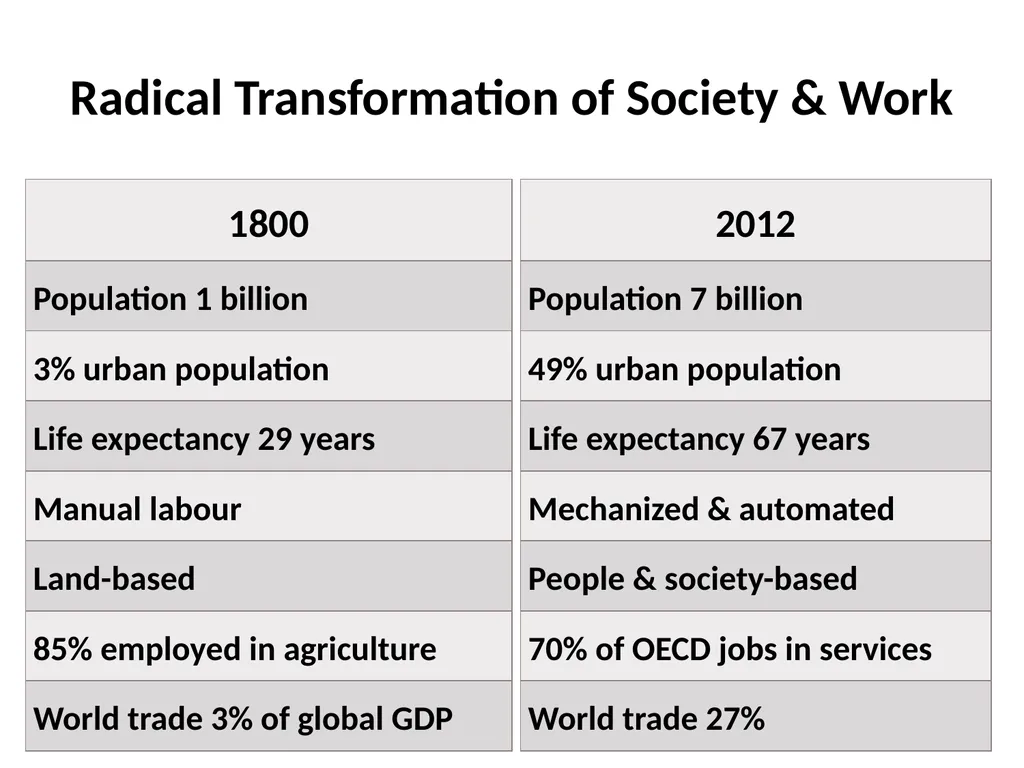
Radical Transformation of Society & Work 2<br>
03
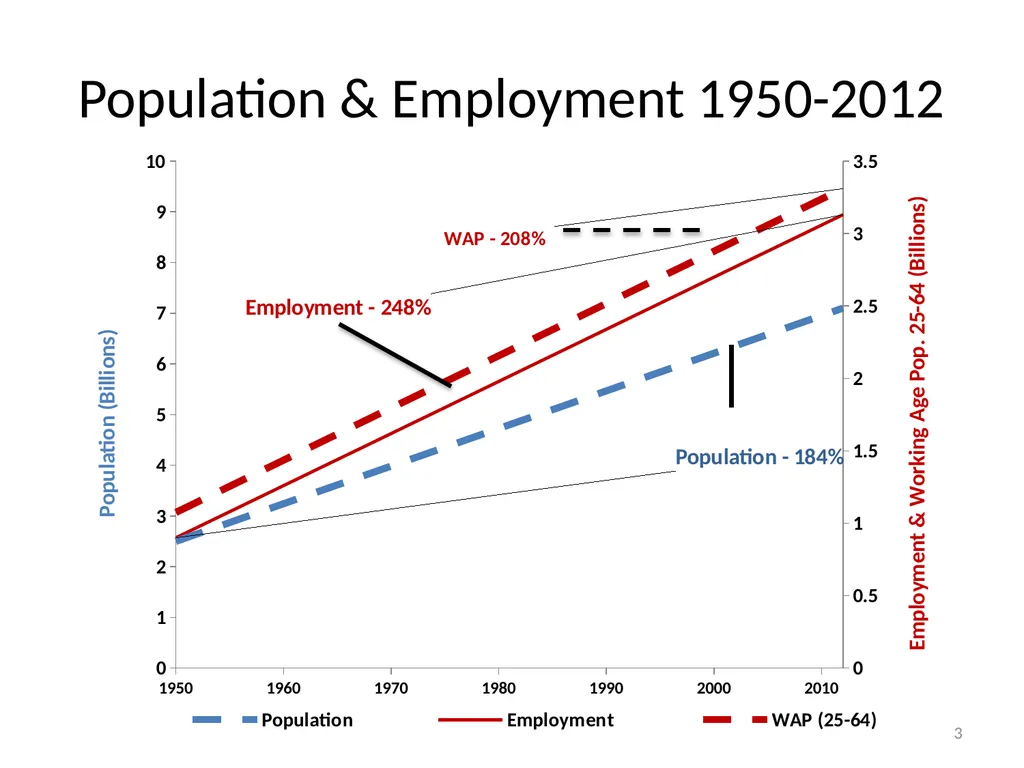
Population & Employment 1950-2012 3<br>
04
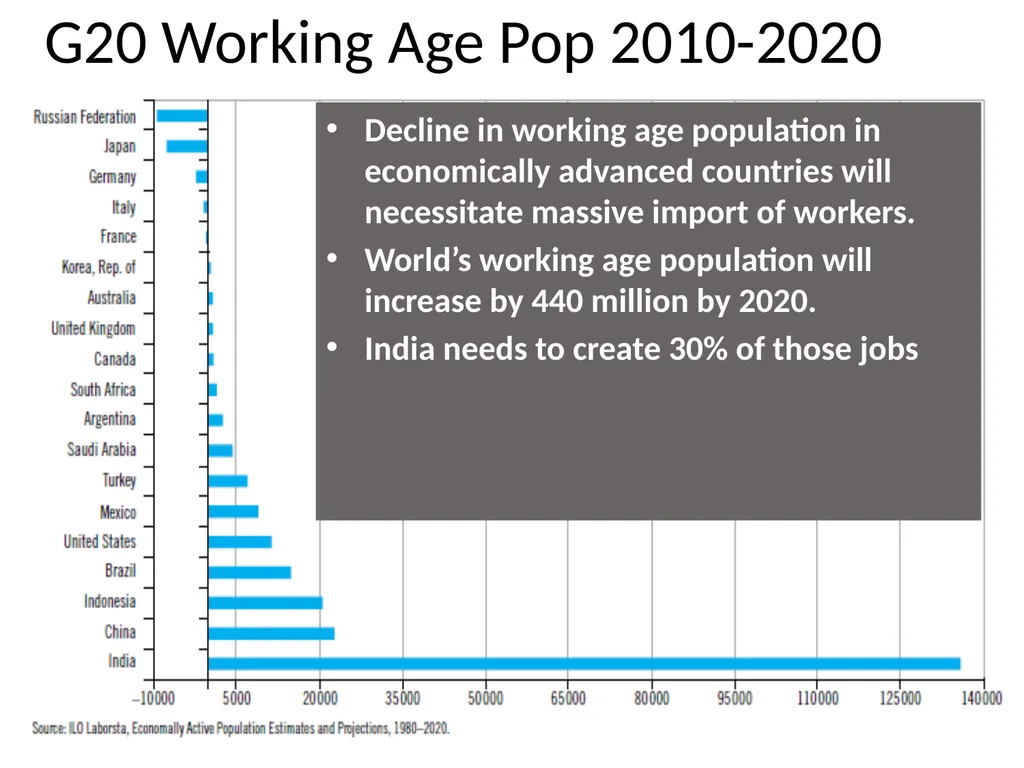
G20 Working Age Pop 2010-2020 Decline in working age population in economically advanced countries will necessitate massive import of workers.
World’s working age population will increase by 440 million by 2020.
India needs to create 30% of those jobs 4<br>
05
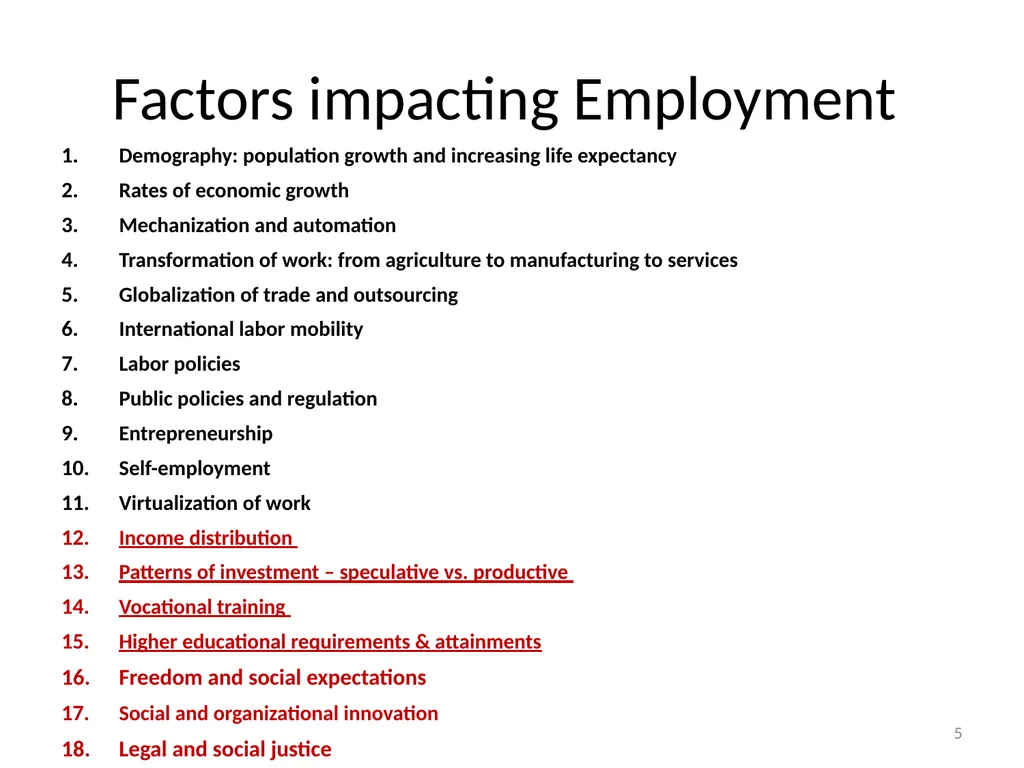
Factors impacting Employment Demography: population growth and increasing life expectancy
Rates of economic growth
Mechanization and automation
Transformation of work: from agriculture to manufacturing to services
Globalization of trade and outsourcing
International labor mobility
Labor policies
Public policies and regulation
Entrepreneurship
Self-employment
Virtualization of work
Income distribution
Patterns of investment – speculative vs. productive
Vocational training
Higher educational requirements & attainments
Freedom and social expectations
Social and organizational innovation
Legal and social justice 5<br>
06
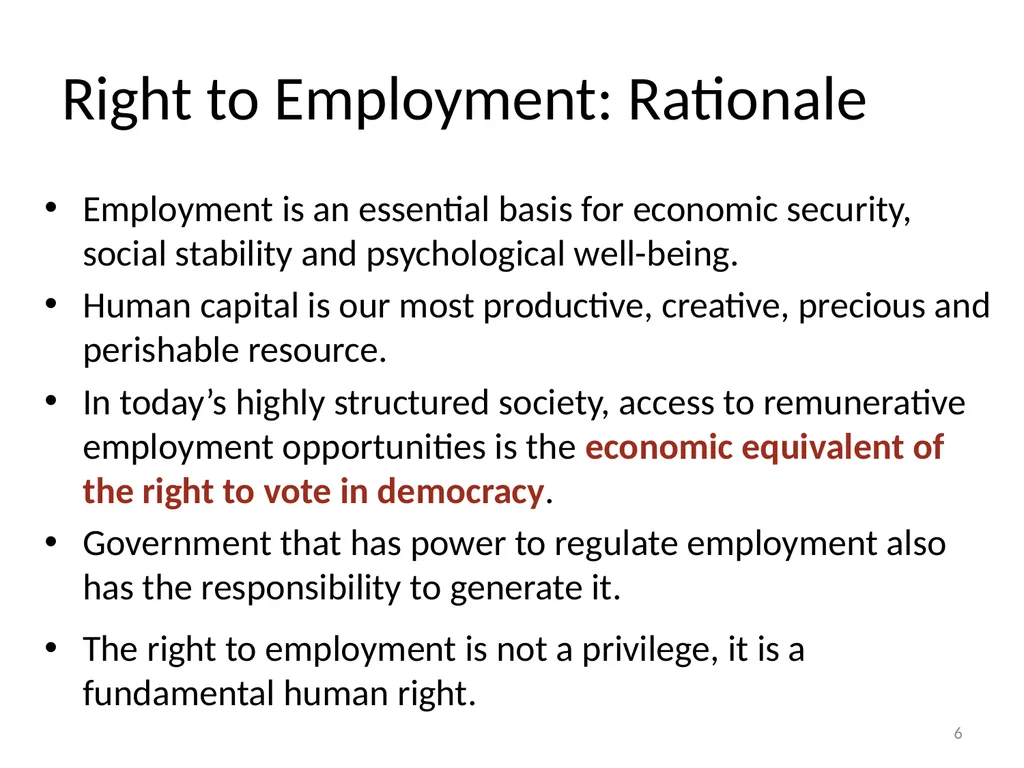
Right to Employment: Rationale Employment is an essential basis for economic security, social stability and psychological well-being.
Human capital is our most productive, creative, precious and perishable resource.
In today’s highly structured society, access to remunerative employment opportunities is the economic equivalent of the right to vote in democracy.
Government that has power to regulate employment also has the responsibility to generate it.
The right to employment is not a privilege, it is a fundamental human right. 6<br>
07
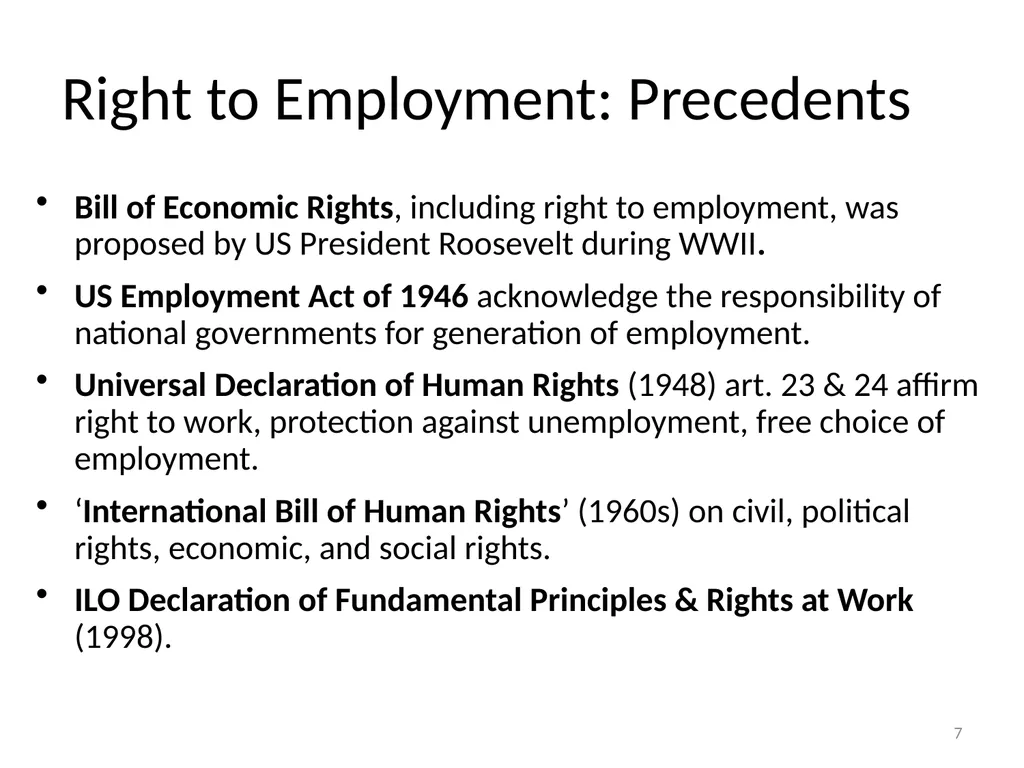
Right to Employment: Precedents Bill of Economic Rights, including right to employment, was proposed by US President Roosevelt during WWII.
US Employment Act of 1946 acknowledge the responsibility of national governments for generation of employment.
Universal Declaration of Human Rights (1948) art. 23 & 24 affirm right to work, protection against unemployment, free choice of employment.
‘International Bill of Human Rights’ (1960s) on civil, political rights, economic, and social rights.
ILO Declaration of Fundamental Principles & Rights at Work (1998). 7<br>
08
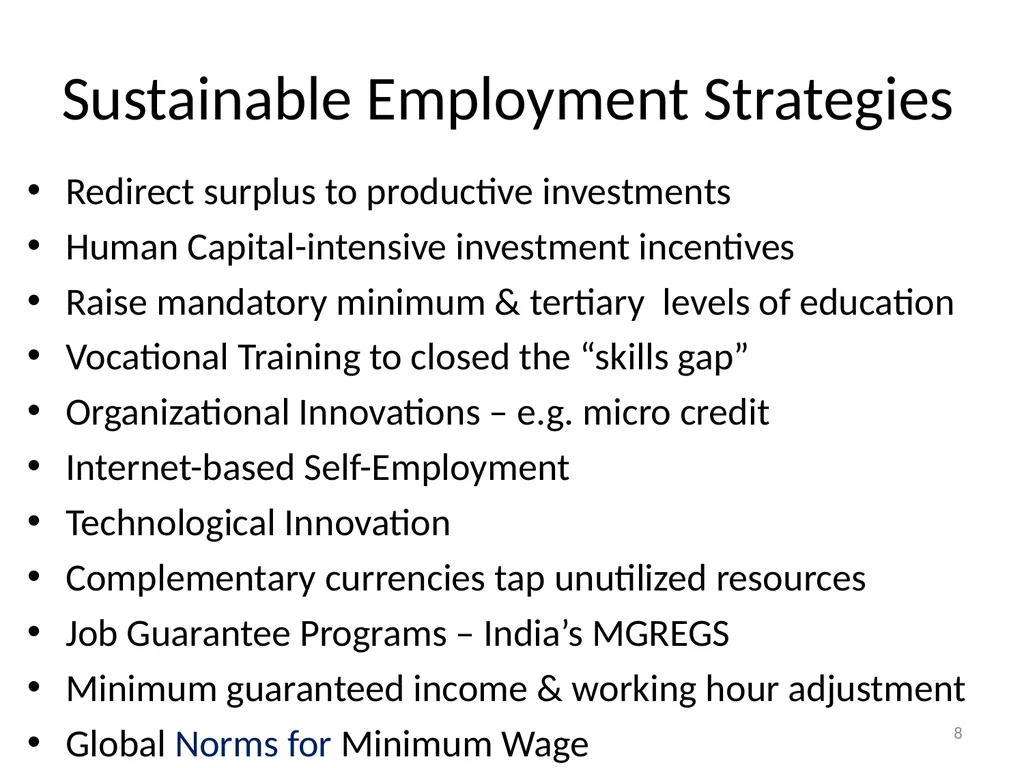
Sustainable Employment Strategies Redirect surplus to productive investments
Human Capital-intensive investment incentives
Raise mandatory minimum & tertiary levels of education
Vocational Training to closed the “skills gap”
Organizational Innovations – e.g. micro credit
Internet-based Self-Employment
Technological Innovation
Complementary currencies tap unutilized resources
Job Guarantee Programs – India’s MGREGS
Minimum guaranteed income & working hour adjustment
Global Norms for Minimum Wage 8<br>
09
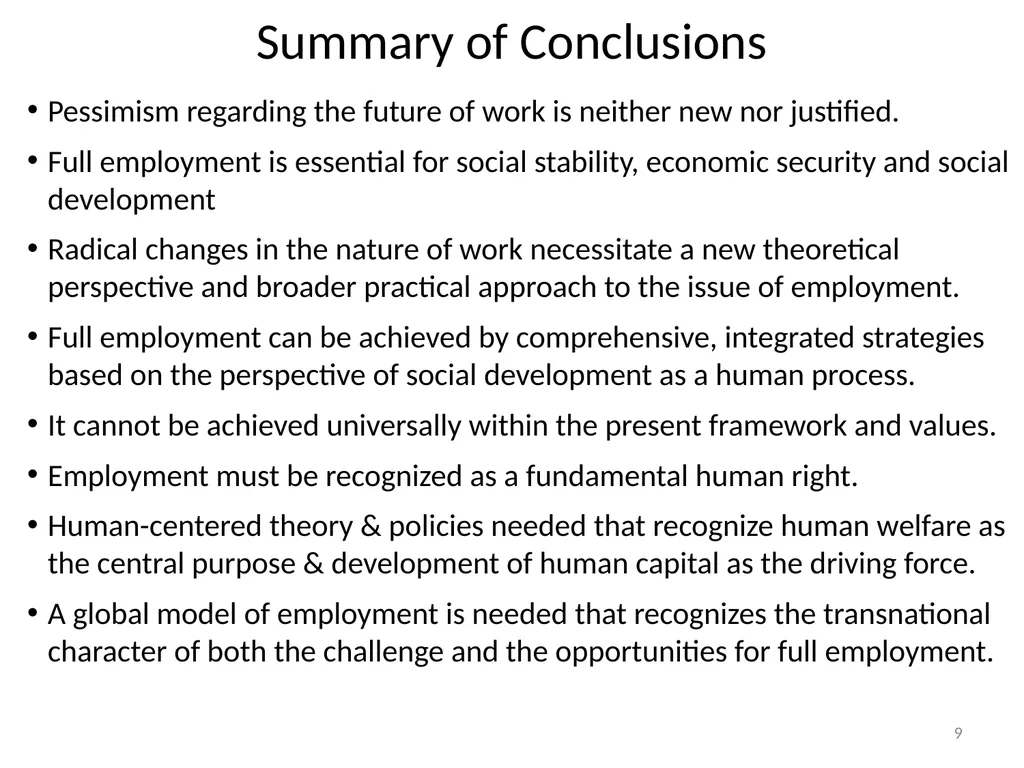
Summary of Conclusions Pessimism regarding the future of work is neither new nor justified.
Full employment is essential for social stability, economic security and social development
Radical changes in the nature of work necessitate a new theoretical perspective and broader practical approach to the issue of employment.
Full employment can be achieved by comprehensive, integrated strategies based on the perspective of social development as a human process.
It cannot be achieved universally within the present framework and values.
Employment must be recognized as a fundamental human right.
Human-centered theory & policies needed that recognize human welfare as the central purpose & development of human capital as the driving force.
A global model of employment is needed that recognizes the transnational character of both the challenge and the opportunities for full employment. 9<br>
10
10<br>
11
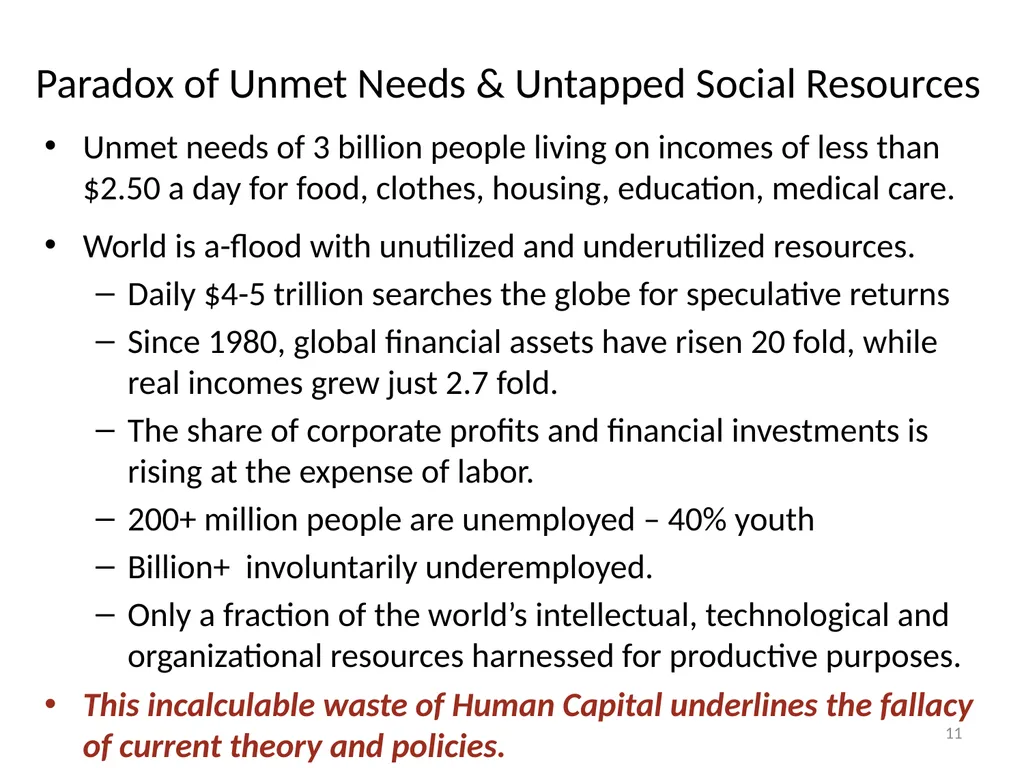
Paradox of Unmet Needs & Untapped Social Resources Unmet needs of 3 billion people living on incomes of less than $2.50 a day for food, clothes, housing, education, medical care.
World is a-flood with unutilized and underutilized resources.
Daily $4-5 trillion searches the globe for speculative returns
Since 1980, global financial assets have risen 20 fold, while real incomes grew just 2.7 fold.
The share of corporate profits and financial investments is rising at the expense of labor.
200+ million people are unemployed – 40% youth
Billion+ involuntarily underemployed.
Only a fraction of the world’s intellectual, technological and organizational resources harnessed for productive purposes.
This incalculable waste of Human Capital underlines the fallacy of current theory and policies. 11<br>