
Prosthetic Options in Implant Dentistry Guided By
MT
Published · 53 slides · 0 views

1 / 1


Description
Prosthetic Options in Implant Dentistry Guided By - Dr. Vivek Thombre Sir Associate Professor Dept. of Periodontology GDCH ,Nagpur Presented By - Dr. Falguni Roy Fellow Oral Implantology GDCH , Nagpur Contents Introduction Prosthetic
Related Topics
Share
Embed code
Download this presentation From Below
"Prosthetic Options in Implant Dentistry Guided By" is the property of its rightful owner. Permission is granted to download and print the materials on this website for personal, non-commercial use only, and to display it on your personal computer provided you do not modify the materials and that you retain all copyright notices contained in the materials. By downloading content from our website, you accept the terms of this agreement.
Presentation Transcript
01
Prosthetic Options in Implant Dentistry Guided By - Dr. Vivek Thombre Sir
Associate Professor
Dept. of Periodontology GDCH ,Nagpur
Presented By - Dr. Falguni Roy
Fellow Oral Implantology GDCH , Nagpur<br>
Associate Professor
Dept. of Periodontology GDCH ,Nagpur
Presented By - Dr. Falguni Roy
Fellow Oral Implantology GDCH , Nagpur<br>
02
Contents Introduction
Prosthetic Options
Fixed prosthesis -Fp 1, Fp 2, Fp 3
Removable Prosthesis- - Rp 4 , Rp 5
Mandibular Overdenture TReatement options- OD 1, OD 2, OD 3, OD 4
Implant treatement options for fixed restorations
Maxillary Overdenture options
Fixed maxillaryTreatement Plans
conclusion
references<br>
Prosthetic Options
Fixed prosthesis -Fp 1, Fp 2, Fp 3
Removable Prosthesis- - Rp 4 , Rp 5
Mandibular Overdenture TReatement options- OD 1, OD 2, OD 3, OD 4
Implant treatement options for fixed restorations
Maxillary Overdenture options
Fixed maxillaryTreatement Plans
conclusion
references<br>
03
Introduction Most treatment options are derived from the obtained diagnostic information.
Traditional dentistry provides limited treatment options for the edentulous patient.
In contrast, implant dentistry can provide a range of additional abutment locations, thus allowing for a wide spectrum of treatment options.
Bone augmentation may further modify the existing edentulous condition in both the partial and total edentulous arch, and therefore also affects the final prosthetic design.
As a result, a number of treatment options are available to most partially and completely edentulous patients.
Therefore once the diagnosis is complete, the implant treatment plan of choice at a particular moment is patient and problem based.
Not all patients should be treated with the same restoration type or design even when their oral conditions are similar.<br>
Traditional dentistry provides limited treatment options for the edentulous patient.
In contrast, implant dentistry can provide a range of additional abutment locations, thus allowing for a wide spectrum of treatment options.
Bone augmentation may further modify the existing edentulous condition in both the partial and total edentulous arch, and therefore also affects the final prosthetic design.
As a result, a number of treatment options are available to most partially and completely edentulous patients.
Therefore once the diagnosis is complete, the implant treatment plan of choice at a particular moment is patient and problem based.
Not all patients should be treated with the same restoration type or design even when their oral conditions are similar.<br>
04
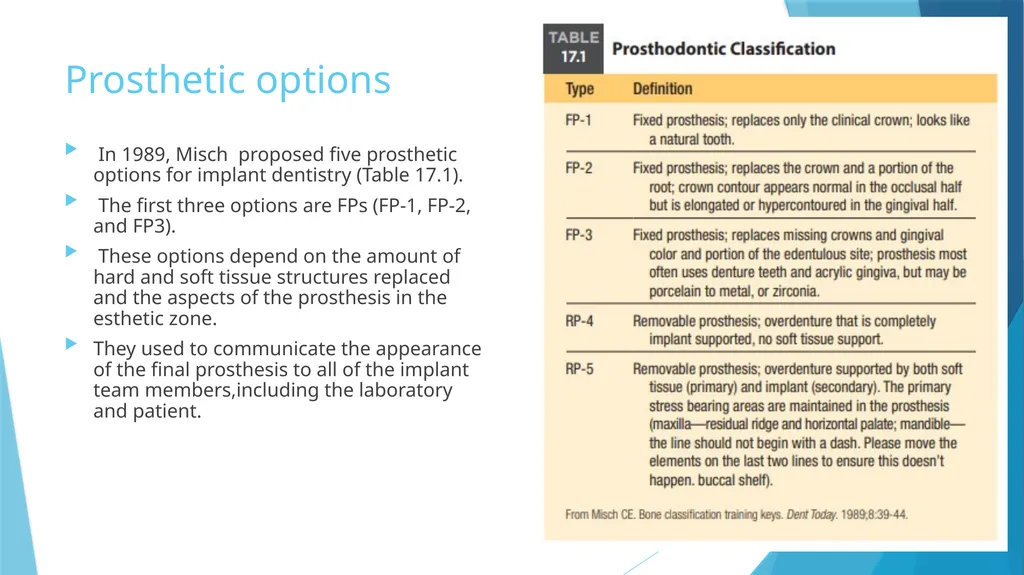
Prosthetic options In 1989, Misch proposed five prosthetic options for implant dentistry (Table 17.1).
The first three options are FPs (FP-1, FP-2, and FP3).
These options depend on the amount of hard and soft tissue structures replaced and the aspects of the prosthesis in the esthetic zone.
They used to communicate the appearance of the final prosthesis to all of the implant team members,including the laboratory and patient.<br>
The first three options are FPs (FP-1, FP-2, and FP3).
These options depend on the amount of hard and soft tissue structures replaced and the aspects of the prosthesis in the esthetic zone.
They used to communicate the appearance of the final prosthesis to all of the implant team members,including the laboratory and patient.<br>
05
Fixed Prosthesis FP-1
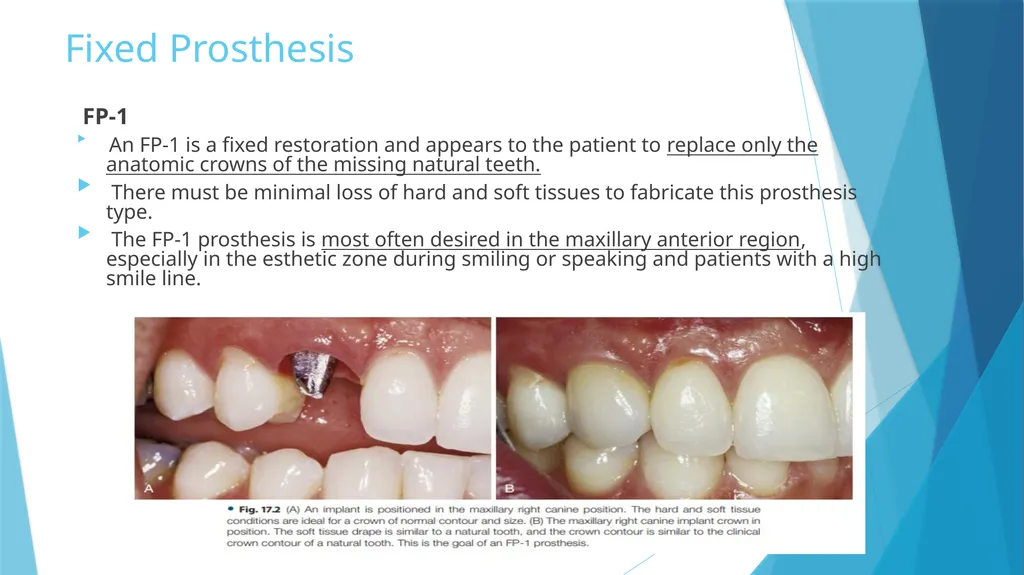
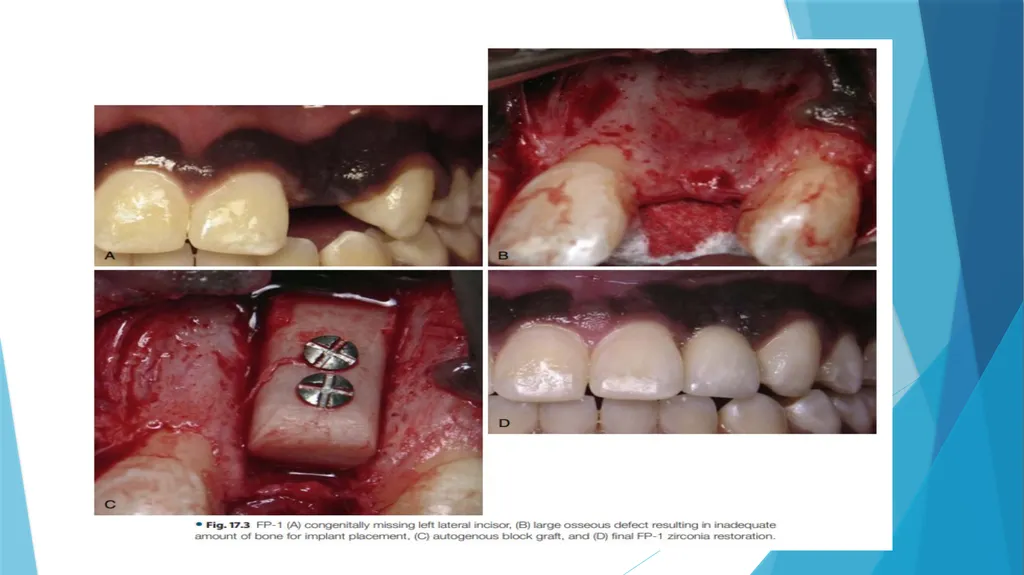
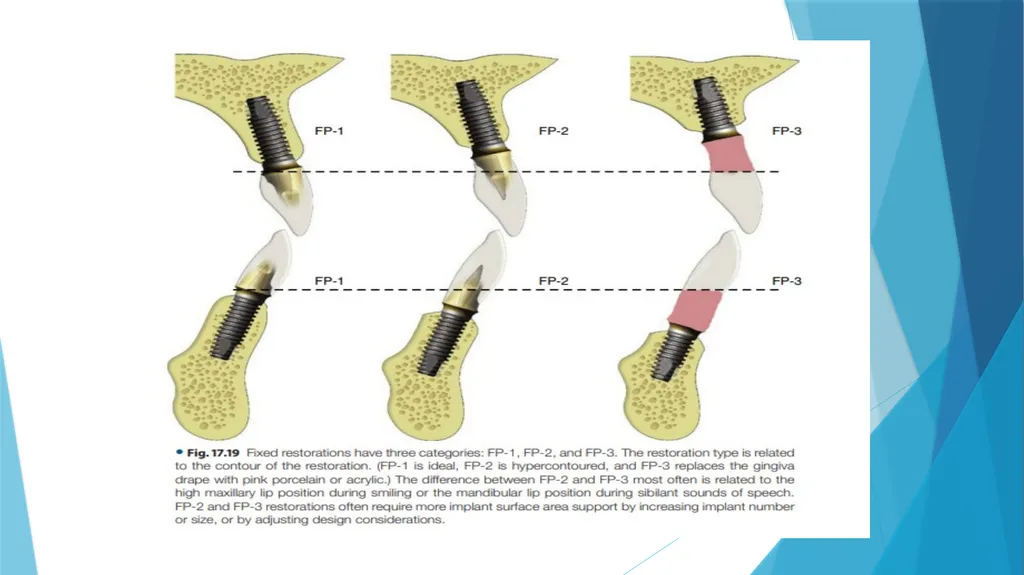
An FP-1 is a fixed restoration and appears to the patient to replace only the anatomic crowns of the missing natural teeth.
There must be minimal loss of hard and soft tissues to fabricate this prosthesis type.
The FP-1 prosthesis is most often desired in the maxillary anterior region, especially in the esthetic zone during smiling or speaking and patients with a high smile line.<br>
An FP-1 is a fixed restoration and appears to the patient to replace only the anatomic crowns of the missing natural teeth.
There must be minimal loss of hard and soft tissues to fabricate this prosthesis type.
The FP-1 prosthesis is most often desired in the maxillary anterior region, especially in the esthetic zone during smiling or speaking and patients with a high smile line.<br>
06
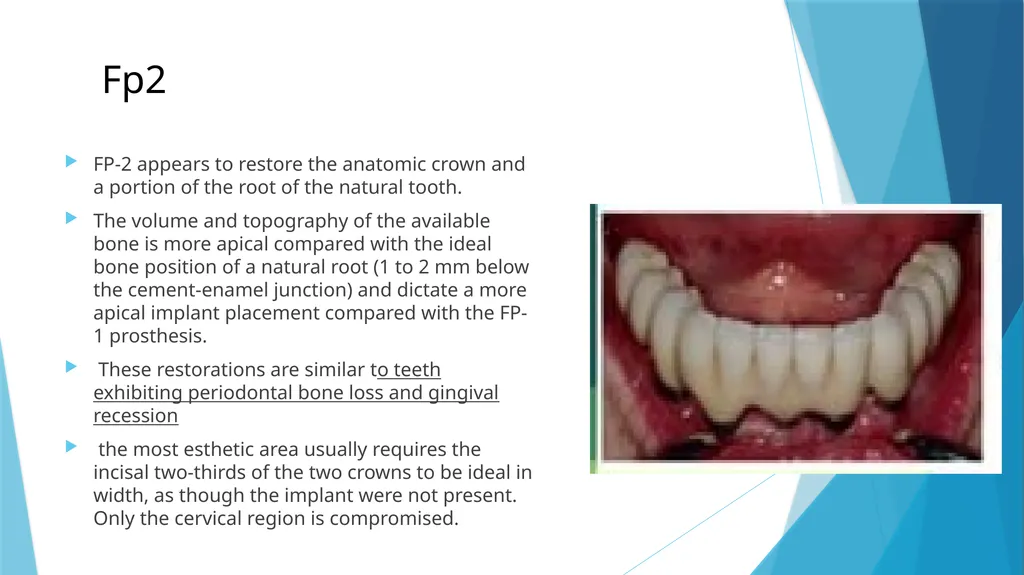
Fp2 FP-2 appears to restore the anatomic crown and a portion of the root of the natural tooth.
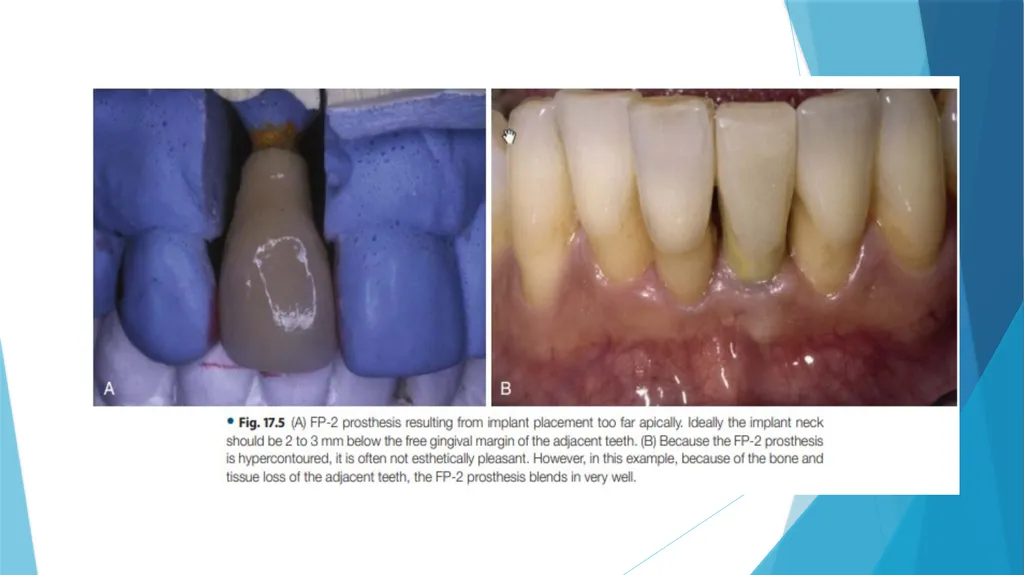
The volume and topography of the available bone is more apical compared with the ideal bone position of a natural root (1 to 2 mm below the cement-enamel junction) and dictate a more apical implant placement compared with the FP-1 prosthesis.
These restorations are similar to teeth exhibiting periodontal bone loss and gingival recession
the most esthetic area usually requires the incisal two-thirds of the two crowns to be ideal in width, as though the implant were not present. Only the cervical region is compromised.<br>
The volume and topography of the available bone is more apical compared with the ideal bone position of a natural root (1 to 2 mm below the cement-enamel junction) and dictate a more apical implant placement compared with the FP-1 prosthesis.
These restorations are similar to teeth exhibiting periodontal bone loss and gingival recession
the most esthetic area usually requires the incisal two-thirds of the two crowns to be ideal in width, as though the implant were not present. Only the cervical region is compromised.<br>
07
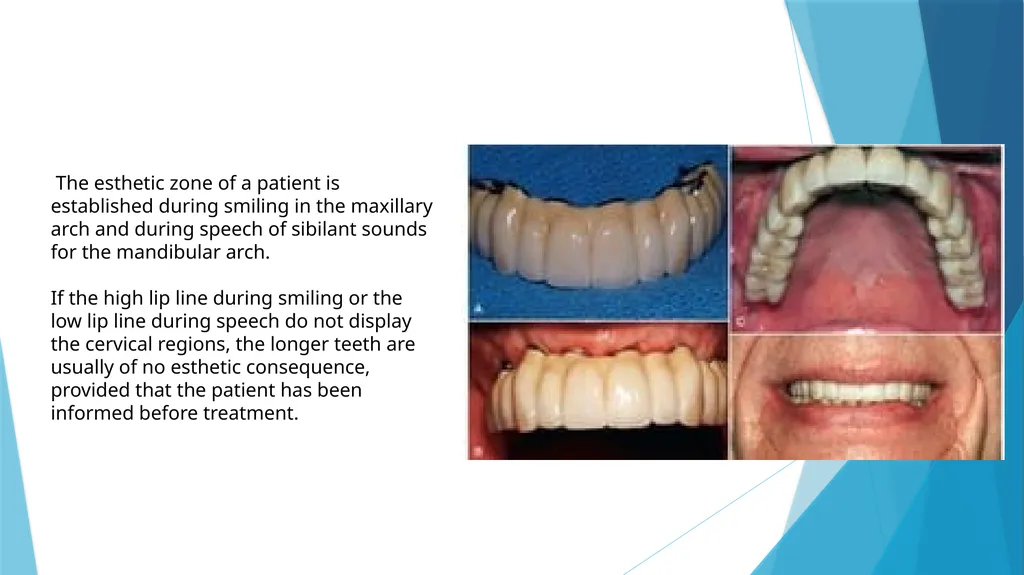
The esthetic zone of a patient is established during smiling in the maxillary arch and during speech of sibilant sounds for the mandibular arch.
If the high lip line during smiling or the low lip line during speech do not display
the cervical regions, the longer teeth are usually of no esthetic consequence, provided that the patient has been informed before treatment.<br>
If the high lip line during smiling or the low lip line during speech do not display
the cervical regions, the longer teeth are usually of no esthetic consequence, provided that the patient has been informed before treatment.<br>
08
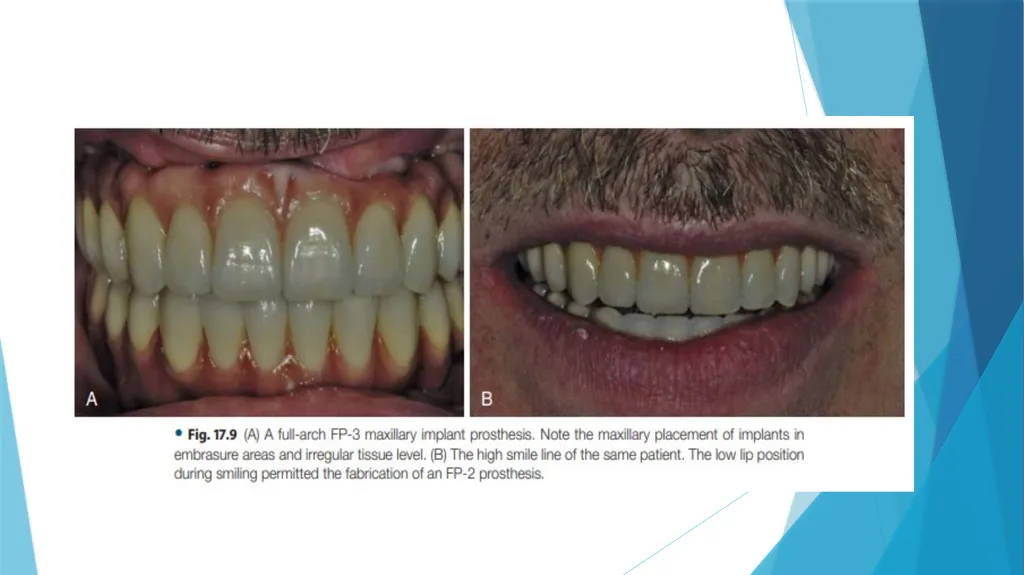
Fp3 The FP-3 fixed restoration appears to replace the natural teeth crowns and has pink-colored restorative materials to replace a portion of the soft tissue.
As with the FP-2 prosthesis, the original available bone height has decreased by natural resorption or osteoplasty at the time of implant placement.
To place the incisal edge of the teeth in proper position for esthetics, function, lip support, and speech, the excessive vertical dimension to be restored requires teeth that are unnatural in length.<br>
As with the FP-2 prosthesis, the original available bone height has decreased by natural resorption or osteoplasty at the time of implant placement.
To place the incisal edge of the teeth in proper position for esthetics, function, lip support, and speech, the excessive vertical dimension to be restored requires teeth that are unnatural in length.<br>
09
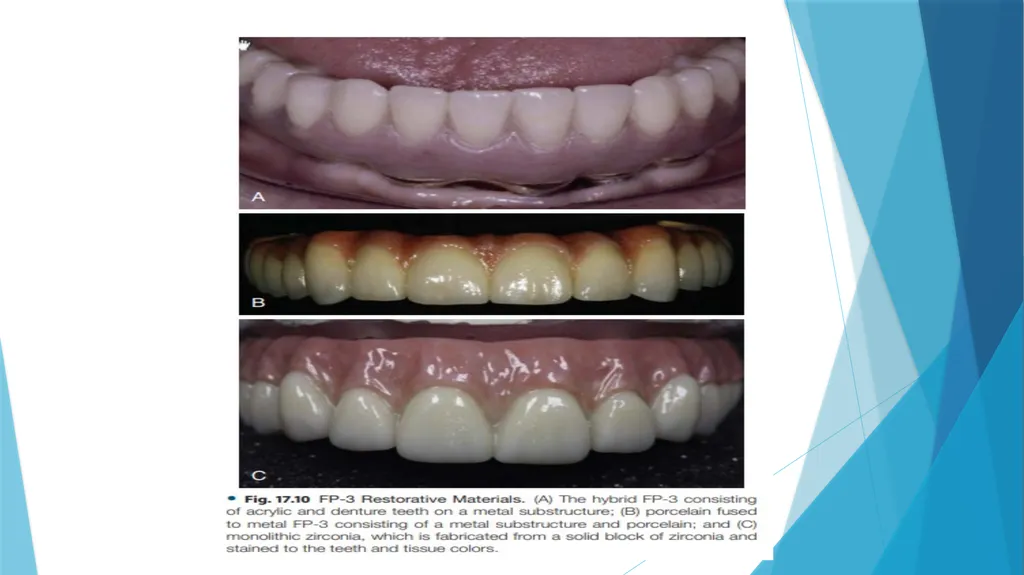
There are basically three approaches for an FP-3 prosthesis:
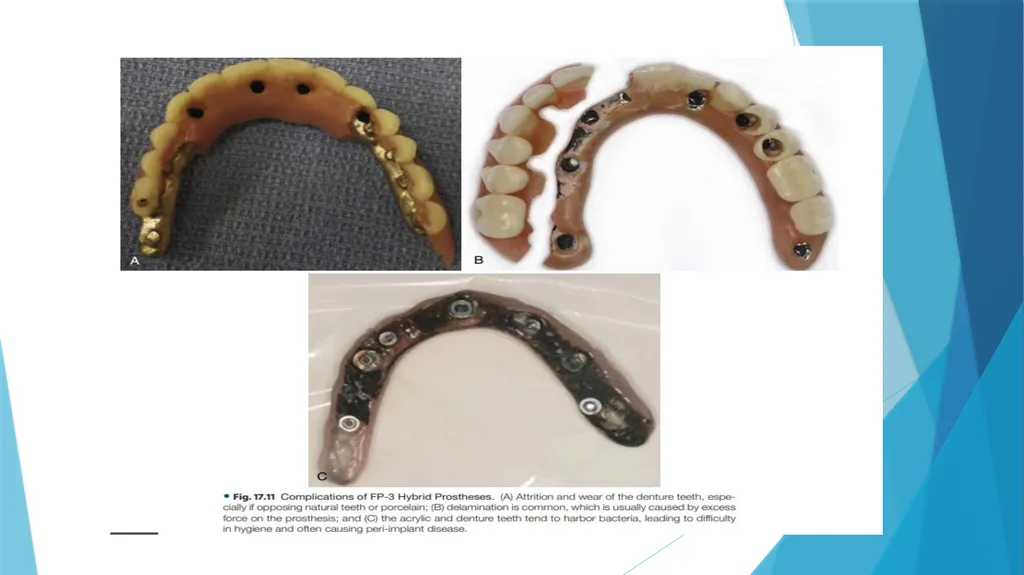
(1) a hybrid restoration of denture teeth and acrylic and metal substructure
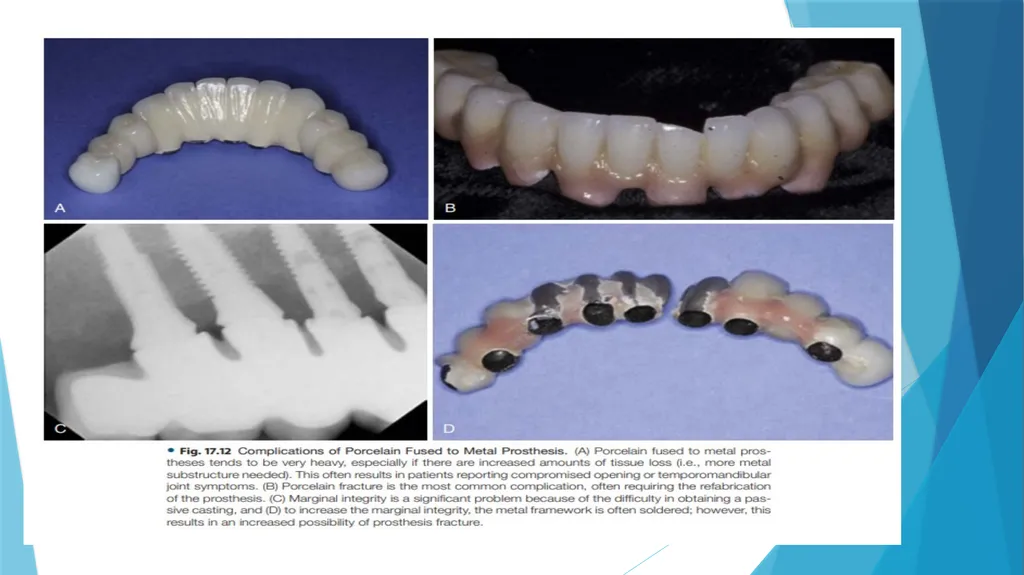
(2) a porcelain-metal restoration, or
(3) a monolithic zirconia prosthesis.
The most important factor involved in selecting the prosthetic material is esthetics, longevity, and durability.
Today the material that is advantageous and fulfills these requirements is monolithic zirconia .<br>
(1) a hybrid restoration of denture teeth and acrylic and metal substructure
(2) a porcelain-metal restoration, or
(3) a monolithic zirconia prosthesis.
The most important factor involved in selecting the prosthetic material is esthetics, longevity, and durability.
Today the material that is advantageous and fulfills these requirements is monolithic zirconia .<br>
10
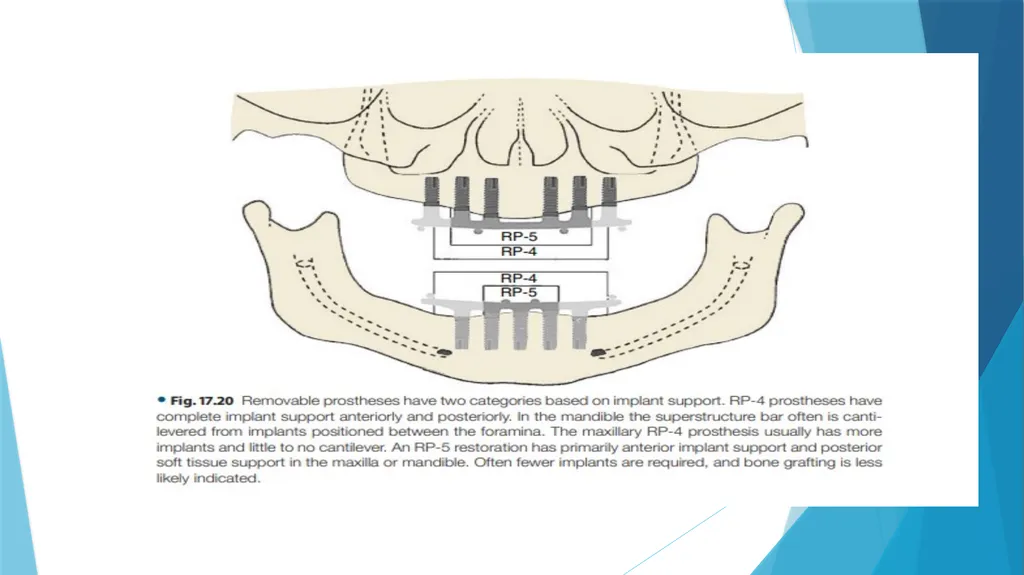
Removable Prosthesis There are two types of removable prostheses RPs (RP-4 and RP-5), based on support of the restoration .
Patients are able to remove the prosthesis but not the implant-supported superstructure attached to the abutments.
The difference in the two categories of removable restorations is not in appearance.<br>
Patients are able to remove the prosthesis but not the implant-supported superstructure attached to the abutments.
The difference in the two categories of removable restorations is not in appearance.<br>
11
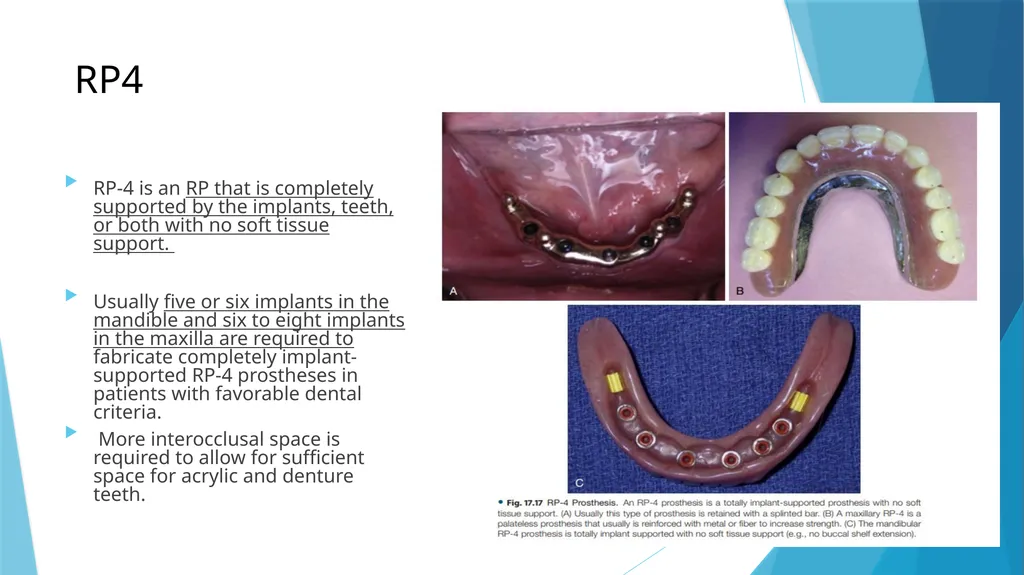
RP4 RP-4 is an RP that is completely supported by the implants, teeth, or both with no soft tissue support.
Usually five or six implants in the mandible and six to eight implants in the maxilla are required to fabricate completely implant-supported RP-4 prostheses in patients with favorable dental criteria.
More interocclusal space is required to allow for sufficient space for acrylic and denture teeth.<br>
Usually five or six implants in the mandible and six to eight implants in the maxilla are required to fabricate completely implant-supported RP-4 prostheses in patients with favorable dental criteria.
More interocclusal space is required to allow for sufficient space for acrylic and denture teeth.<br>
12
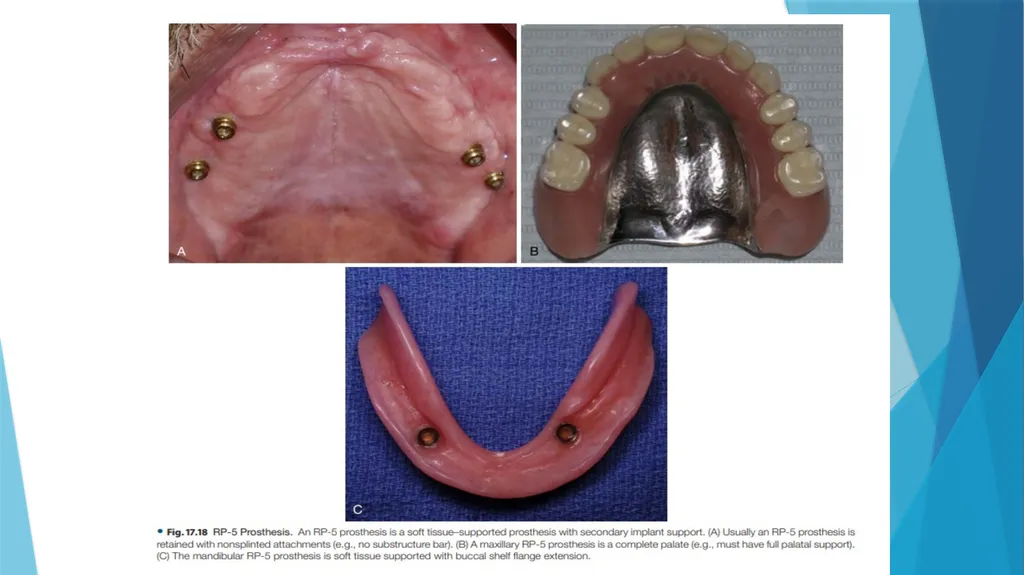
RP-5 RP-5 is an RP with soft tissue (primary) and implant (secondary) support.
There exist many options with an RP-5 prosthesis. For example, the completely edentulous mandibular overdenture may have: (1) two anterior implants independent of each other, (2) splinted implants in the canine region to enhance retention, (3) three splinted implants in the premolar and central incisor areas to provide lateral stability, or (4) implants splinted with a cantilevered bar to reduce soft tissue abrasions and to limit the amount of soft tissue coverage needed for prosthesis support.
The primary advantage of an RP-5 restoration is the reduced cost.
The prosthesis is similar to traditional overdentures supported by natural teeth .
The final prosthesis is a full-arch conventional denture that receives the primary support from the soft tissue and secondarily from the implants.<br>
There exist many options with an RP-5 prosthesis. For example, the completely edentulous mandibular overdenture may have: (1) two anterior implants independent of each other, (2) splinted implants in the canine region to enhance retention, (3) three splinted implants in the premolar and central incisor areas to provide lateral stability, or (4) implants splinted with a cantilevered bar to reduce soft tissue abrasions and to limit the amount of soft tissue coverage needed for prosthesis support.
The primary advantage of an RP-5 restoration is the reduced cost.
The prosthesis is similar to traditional overdentures supported by natural teeth .
The final prosthesis is a full-arch conventional denture that receives the primary support from the soft tissue and secondarily from the implants.<br>
13
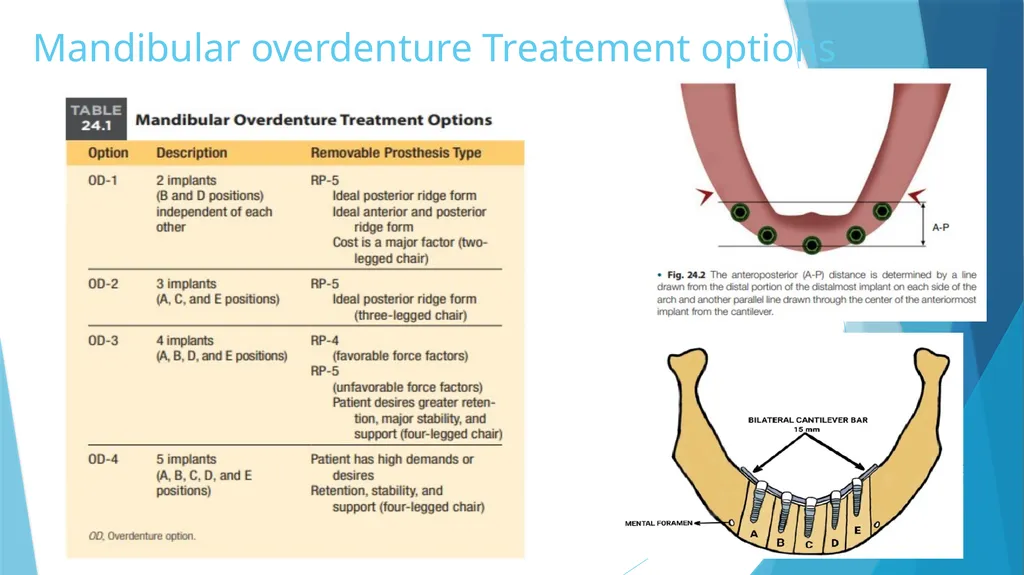
Mandibular overdenture Treatement options<br>
14
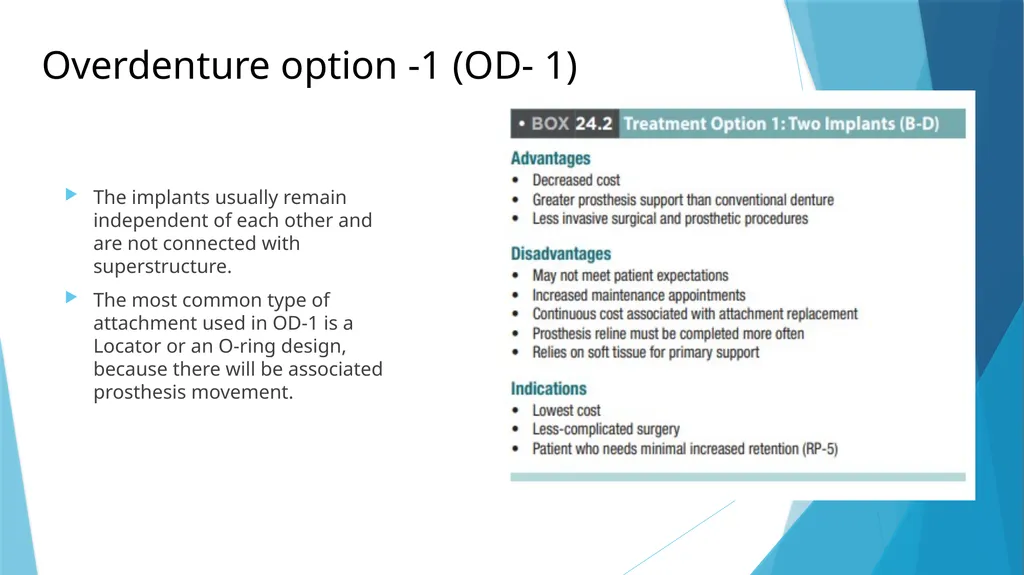
Overdenture option -1 (OD- 1) The implants usually remain independent of each other and are not connected with superstructure.
The most common type of attachment used in OD-1 is a Locator or an O-ring design, because there will be associated prosthesis movement.<br>
The most common type of attachment used in OD-1 is a Locator or an O-ring design, because there will be associated prosthesis movement.<br>
15
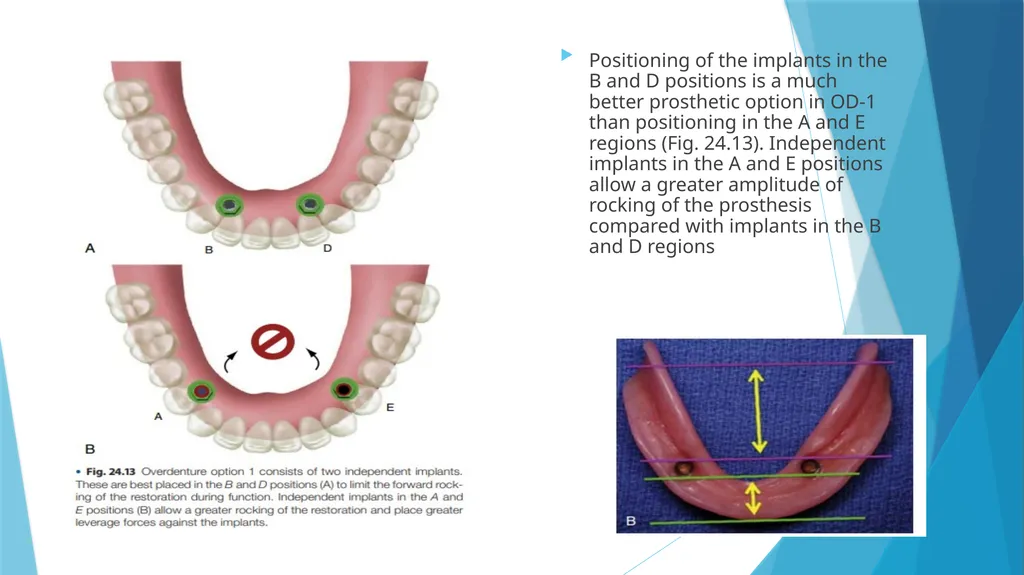
Positioning of the implants in the B and D positions is a much better prosthetic option in OD-1 than positioning in the A and E regions (Fig. 24.13). Independent implants in the A and E positions allow a greater amplitude of rocking of the prosthesis compared with implants in the B and D regions<br>
16
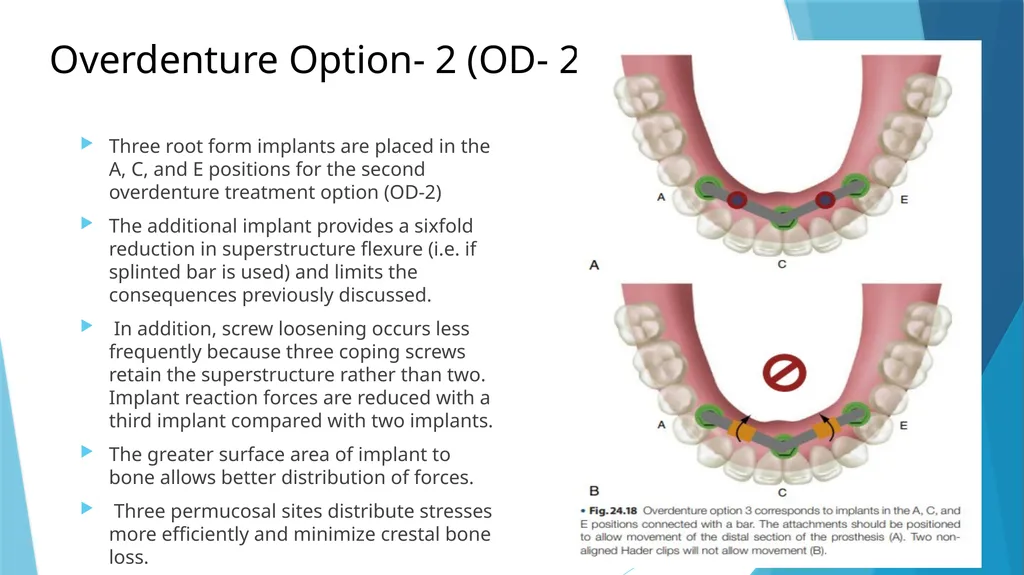
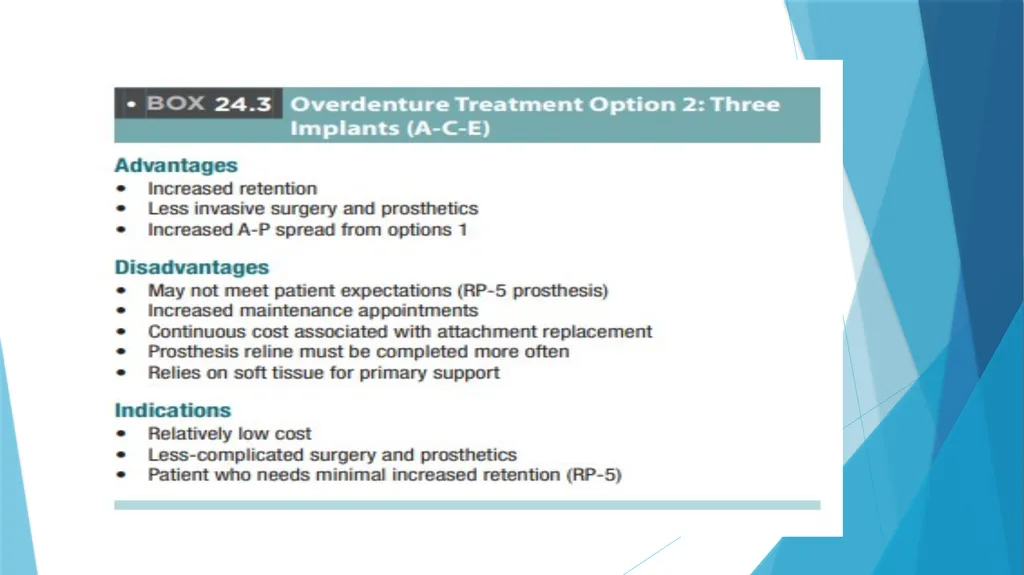
Overdenture Option- 2 (OD- 2) Three root form implants are placed in the A, C, and E positions for the second overdenture treatment option (OD-2)
The additional implant provides a sixfold reduction in superstructure flexure (i.e. if splinted bar is used) and limits the consequences previously discussed.
In addition, screw loosening occurs less frequently because three coping screws retain the superstructure rather than two. Implant reaction forces are reduced with a third implant compared with two implants.
The greater surface area of implant to bone allows better distribution of forces.
Three permucosal sites distribute stresses more efficiently and minimize crestal bone loss.<br>
The additional implant provides a sixfold reduction in superstructure flexure (i.e. if splinted bar is used) and limits the consequences previously discussed.
In addition, screw loosening occurs less frequently because three coping screws retain the superstructure rather than two. Implant reaction forces are reduced with a third implant compared with two implants.
The greater surface area of implant to bone allows better distribution of forces.
Three permucosal sites distribute stresses more efficiently and minimize crestal bone loss.<br>
17
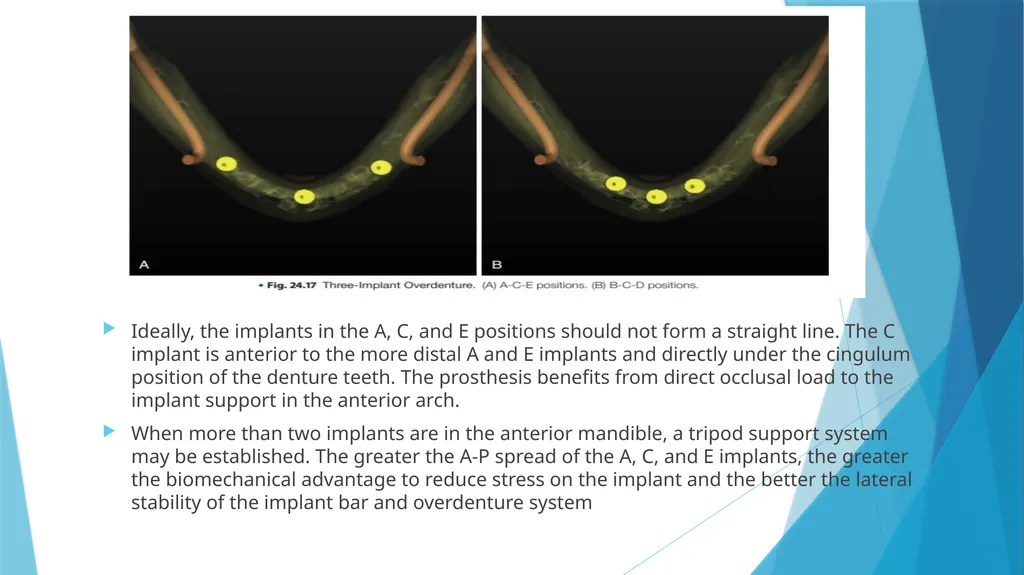
Ideally, the implants in the A, C, and E positions should not form a straight line. The C implant is anterior to the more distal A and E implants and directly under the cingulum position of the denture teeth. The prosthesis benefits from direct occlusal load to the implant support in the anterior arch.
When more than two implants are in the anterior mandible, a tripod support system may be established. The greater the A-P spread of the A, C, and E implants, the greater the biomechanical advantage to reduce stress on the implant and the better the lateral stability of the implant bar and overdenture system<br>
When more than two implants are in the anterior mandible, a tripod support system may be established. The greater the A-P spread of the A, C, and E implants, the greater the biomechanical advantage to reduce stress on the implant and the better the lateral stability of the implant bar and overdenture system<br>
18
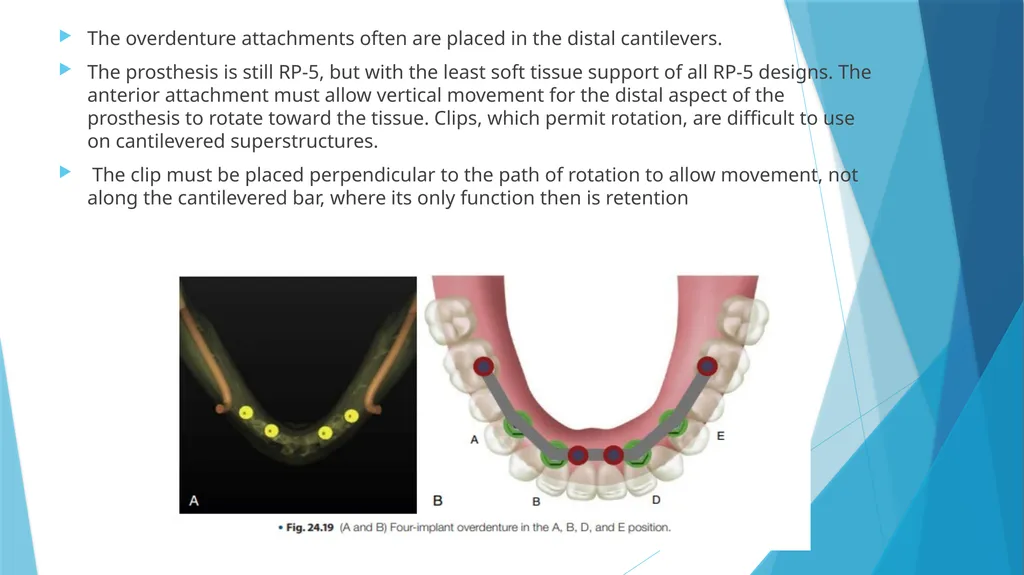
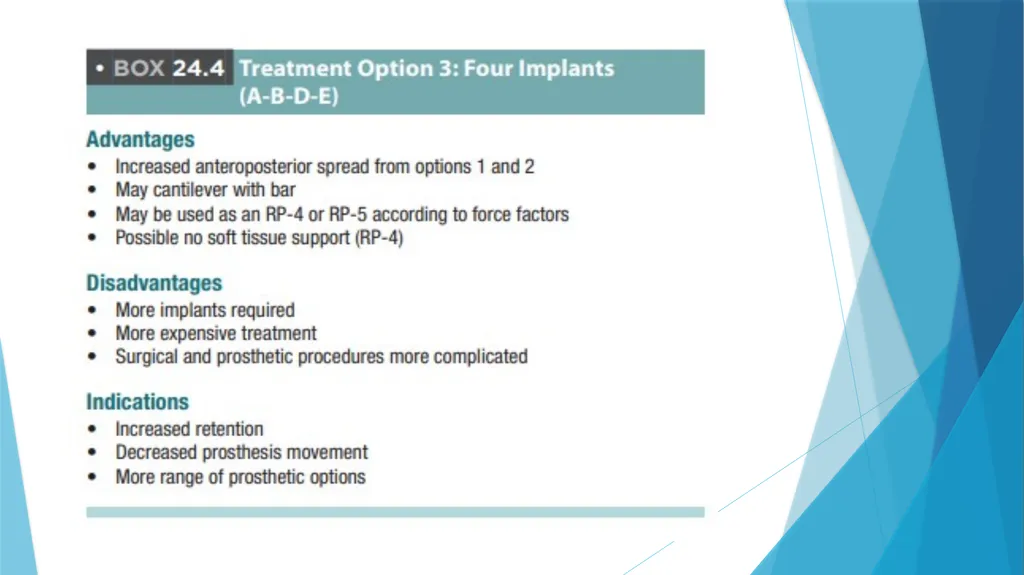
Overdenture Option -3 (OD -3) In the third mandibular overdenture option (OD-3), four implants are placed in the A, B, D, and E positions.
These implants usually provide sufficient support to include a distal cantilever up to 10 mm on each side if the stress factors are low.
The cantilevered superstructure is a feature of the four or more implant treatment option .<br>
These implants usually provide sufficient support to include a distal cantilever up to 10 mm on each side if the stress factors are low.
The cantilevered superstructure is a feature of the four or more implant treatment option .<br>
19
The overdenture attachments often are placed in the distal cantilevers.
The prosthesis is still RP-5, but with the least soft tissue support of all RP-5 designs. The anterior attachment must allow vertical movement for the distal aspect of the prosthesis to rotate toward the tissue. Clips, which permit rotation, are difficult to use on cantilevered superstructures.
The clip must be placed perpendicular to the path of rotation to allow movement, not along the cantilevered bar, where its only function then is retention<br>
The prosthesis is still RP-5, but with the least soft tissue support of all RP-5 designs. The anterior attachment must allow vertical movement for the distal aspect of the prosthesis to rotate toward the tissue. Clips, which permit rotation, are difficult to use on cantilevered superstructures.
The clip must be placed perpendicular to the path of rotation to allow movement, not along the cantilevered bar, where its only function then is retention<br>
20
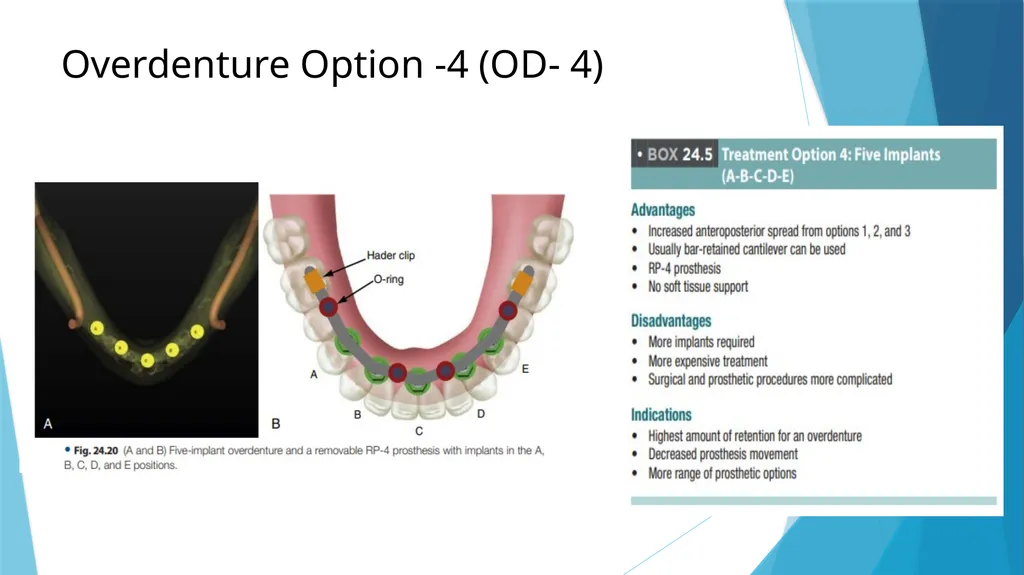
Overdenture Option -4 (OD- 4)<br>
21
The mandibular arch form may be square, tapering, or ovoid.
Square arch forms limit the A-P spread between implants and may not be able to counter the effect of a distal cantilever.
Therefore rarely are distal cantilevers designed for square arch forms. In a tapering arch form the A-P spread between implants in the A-E and B-D positions is greater and therefore permits a longer distal cantilever.
This A-P spread is often at least 10 mm, and therefore often permits a cantilever up to 10 mm from the A and E positions.
In an ovoid arch, which is most common, the A-P spread between AE and BD is usually 8 mm.
Therefore the cantilever may be up to 8 mm long distally from the A and E implants.<br>
Square arch forms limit the A-P spread between implants and may not be able to counter the effect of a distal cantilever.
Therefore rarely are distal cantilevers designed for square arch forms. In a tapering arch form the A-P spread between implants in the A-E and B-D positions is greater and therefore permits a longer distal cantilever.
This A-P spread is often at least 10 mm, and therefore often permits a cantilever up to 10 mm from the A and E positions.
In an ovoid arch, which is most common, the A-P spread between AE and BD is usually 8 mm.
Therefore the cantilever may be up to 8 mm long distally from the A and E implants.<br>
22
Implant Treatment Options for Fixed
Restorations Treatment Option 1: The Brånemark Approach
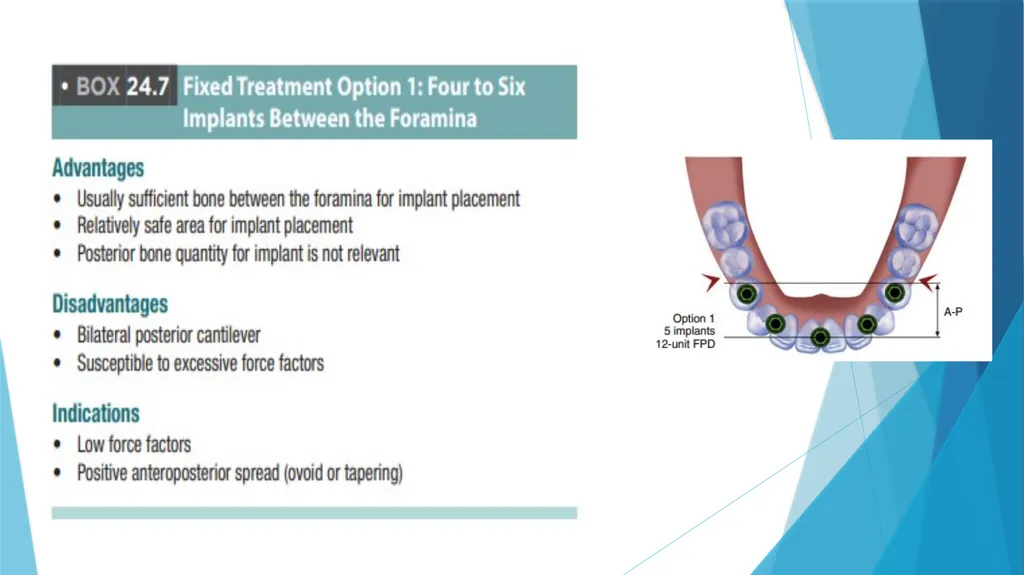
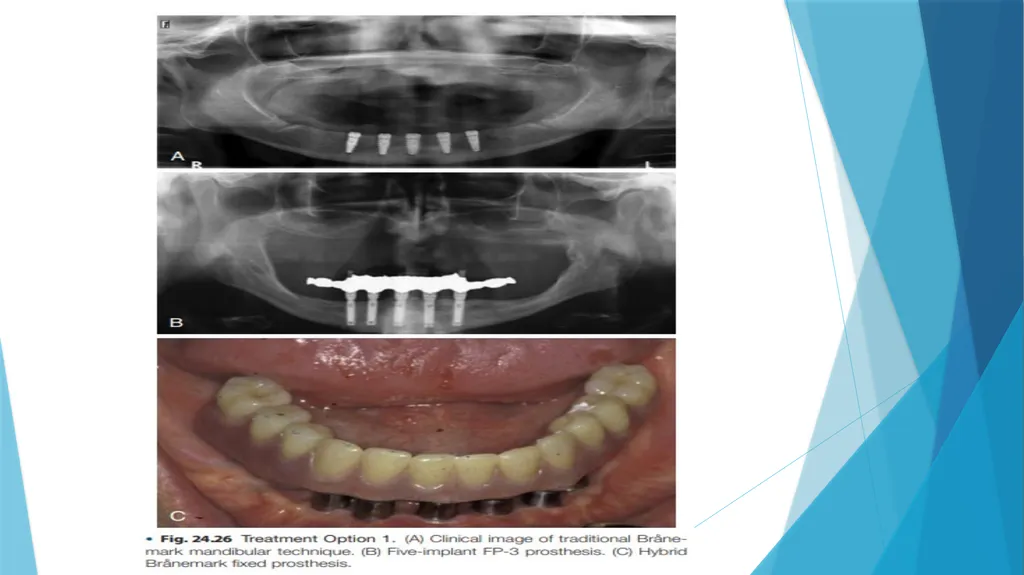
Among the fixed implant–supported options, the prosthesis following the Brånemark protocol has been shown to have excellent longevity and clinical efficacy.
This classical treatment plan involves four to six implants between the mental foramina, and bilateral distal cantilevers replace the mandibular posterior teeth, usually to the first molar region.
The mandible does not flex or exhibit significant torsion between the mental foramina.
Therefore anterior implants may be splinted together without risk or compromise.<br>
Among the fixed implant–supported options, the prosthesis following the Brånemark protocol has been shown to have excellent longevity and clinical efficacy.
This classical treatment plan involves four to six implants between the mental foramina, and bilateral distal cantilevers replace the mandibular posterior teeth, usually to the first molar region.
The mandible does not flex or exhibit significant torsion between the mental foramina.
Therefore anterior implants may be splinted together without risk or compromise.<br>
23
Treatment Option 2: Modified Brånemark Technique
A second mandibular fixed treatment plan involves a modified Brånemark technique.
Bidez and Misch19 have evaluated dentate and edentulous mandibles, and developed a three-dimensional bone-strain model of flexure and torsion.
Studies were performed to evaluate different splinted implant options that would not compromise the prosthetic foundation. As a consequence a number of implant site options have become available.
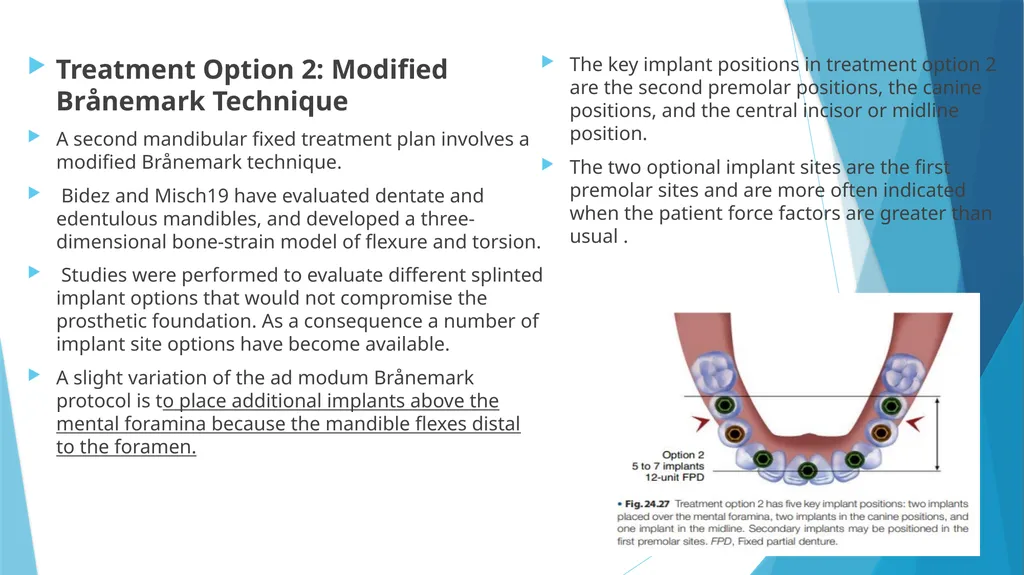
A slight variation of the ad modum Brånemark protocol is to place additional implants above the mental foramina because the mandible flexes distal to the foramen. The key implant positions in treatment option 2 are the second premolar positions, the canine positions, and the central incisor or midline position.
The two optional implant sites are the first premolar sites and are more often indicated when the patient force factors are greater than usual .<br>
A second mandibular fixed treatment plan involves a modified Brånemark technique.
Bidez and Misch19 have evaluated dentate and edentulous mandibles, and developed a three-dimensional bone-strain model of flexure and torsion.
Studies were performed to evaluate different splinted implant options that would not compromise the prosthetic foundation. As a consequence a number of implant site options have become available.
A slight variation of the ad modum Brånemark protocol is to place additional implants above the mental foramina because the mandible flexes distal to the foramen. The key implant positions in treatment option 2 are the second premolar positions, the canine positions, and the central incisor or midline position.
The two optional implant sites are the first premolar sites and are more often indicated when the patient force factors are greater than usual .<br>
24
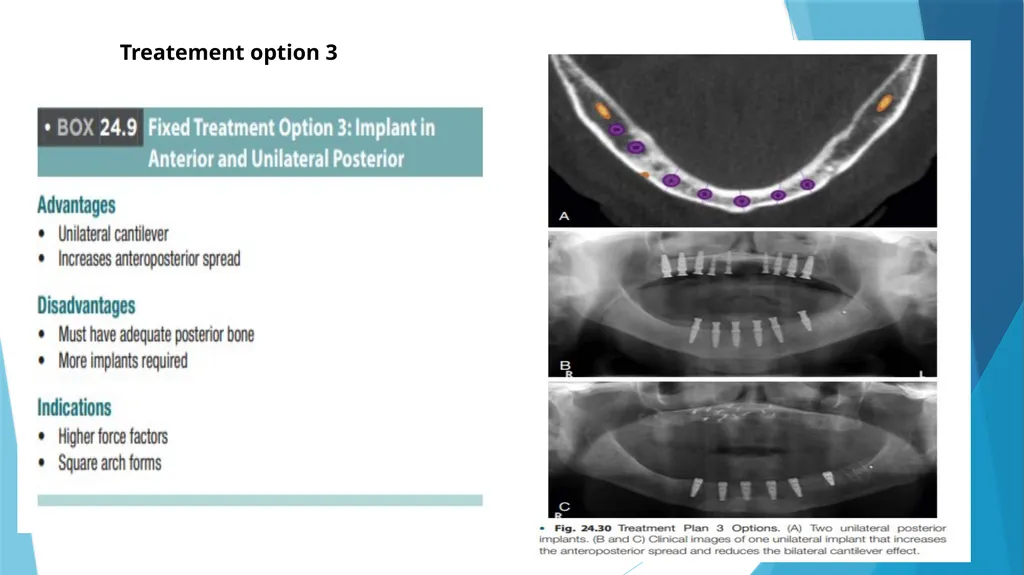
Treatement option 3<br>
25
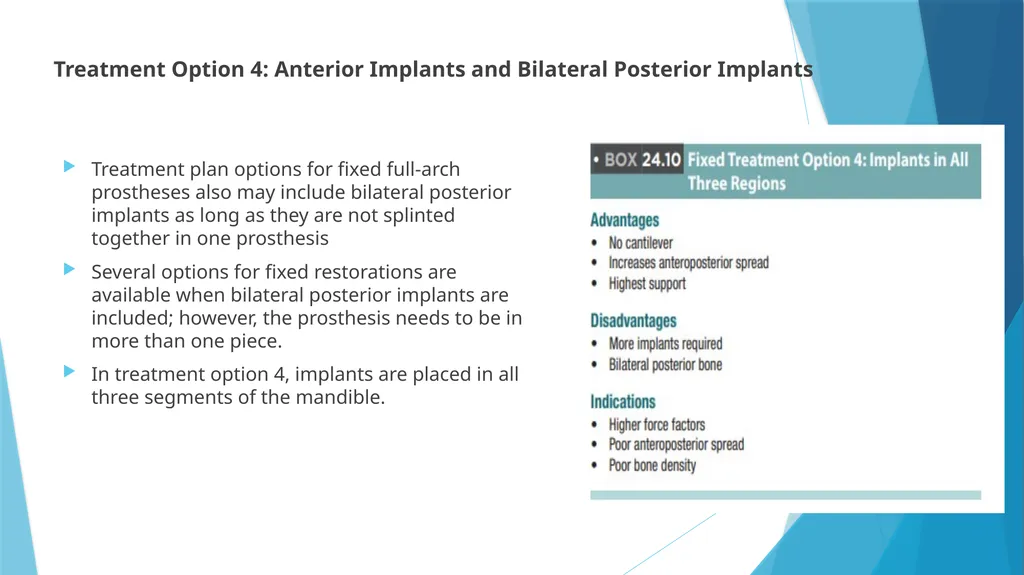
Treatment Option 4: Anterior Implants and Bilateral Posterior Implants Treatment plan options for fixed full-arch prostheses also may include bilateral posterior implants as long as they are not splinted together in one prosthesis
Several options for fixed restorations are available when bilateral posterior implants are included; however, the prosthesis needs to be in more than one piece.
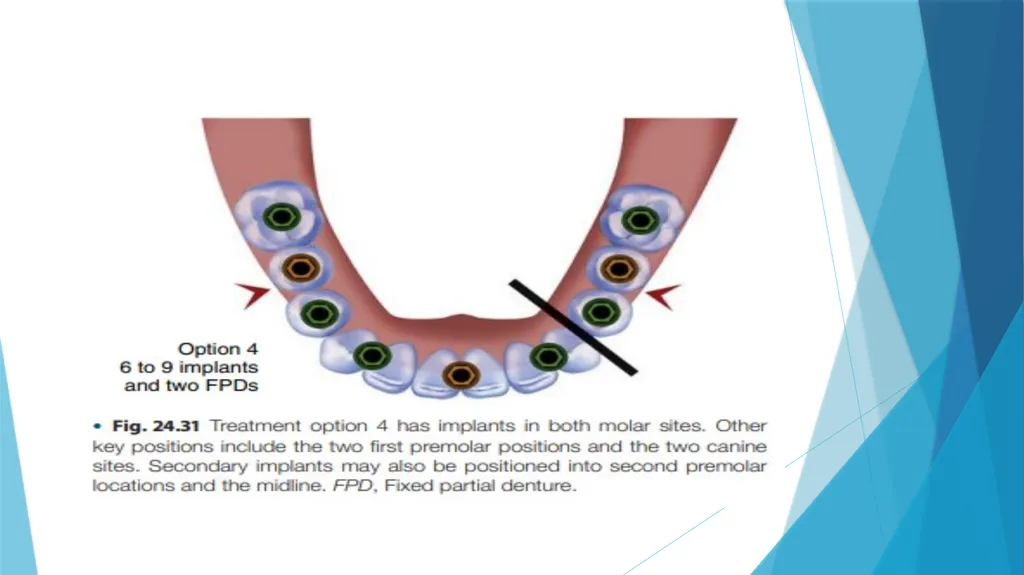
In treatment option 4, implants are placed in all three segments of the mandible.<br>
Several options for fixed restorations are available when bilateral posterior implants are included; however, the prosthesis needs to be in more than one piece.
In treatment option 4, implants are placed in all three segments of the mandible.<br>
26
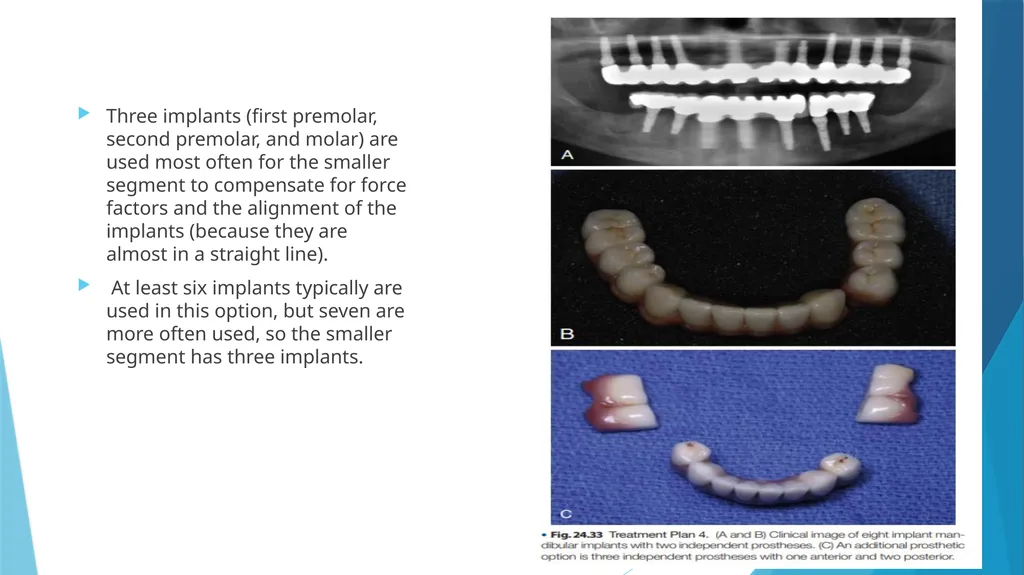
Three implants (first premolar, second premolar, and molar) are used most often for the smaller segment to compensate for force factors and the alignment of the implants (because they are almost in a straight line).
At least six implants typically are used in this option, but seven are more often used, so the smaller segment has three implants.<br>
At least six implants typically are used in this option, but seven are more often used, so the smaller segment has three implants.<br>
27
Treatment Option 5: All-on-Four Protocol
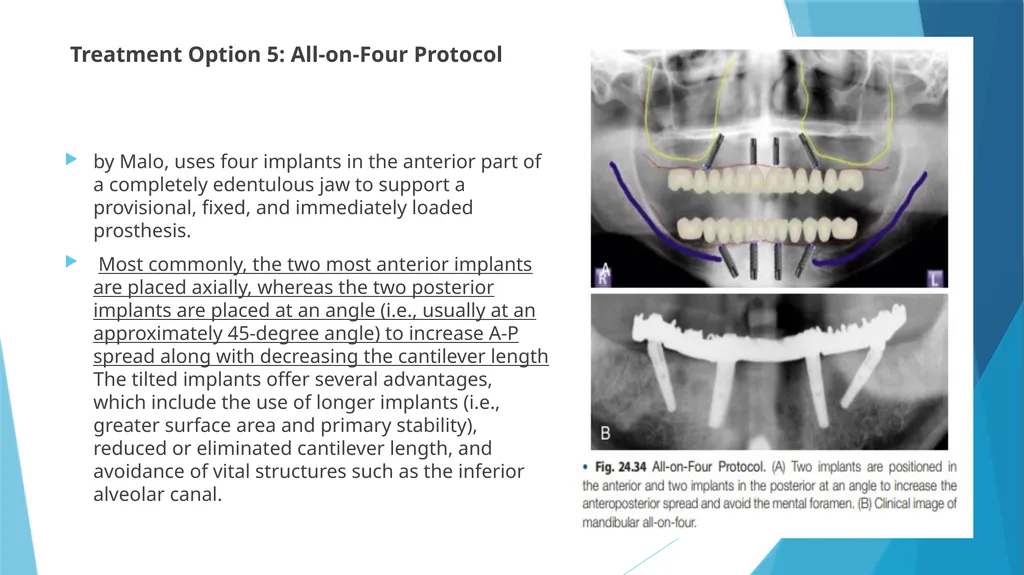
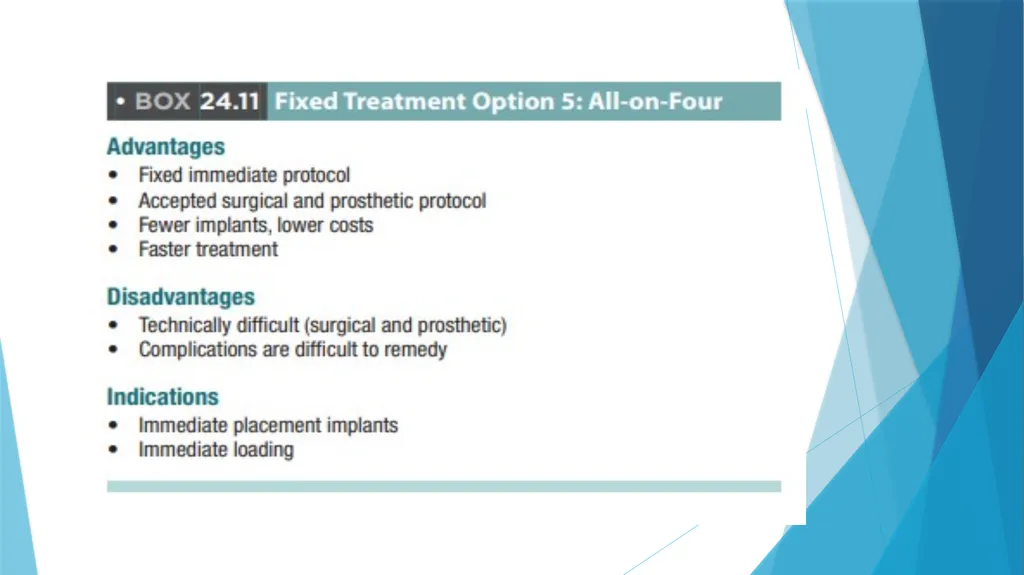
by Malo, uses four implants in the anterior part of a completely edentulous jaw to support a provisional, fixed, and immediately loaded prosthesis.
Most commonly, the two most anterior implants are placed axially, whereas the two posterior implants are placed at an angle (i.e., usually at an approximately 45-degree angle) to increase A-P spread along with decreasing the cantilever length The tilted implants offer several advantages, which include the use of longer implants (i.e., greater surface area and primary stability), reduced or eliminated cantilever length, and avoidance of vital structures such as the inferior alveolar canal.<br>
by Malo, uses four implants in the anterior part of a completely edentulous jaw to support a provisional, fixed, and immediately loaded prosthesis.
Most commonly, the two most anterior implants are placed axially, whereas the two posterior implants are placed at an angle (i.e., usually at an approximately 45-degree angle) to increase A-P spread along with decreasing the cantilever length The tilted implants offer several advantages, which include the use of longer implants (i.e., greater surface area and primary stability), reduced or eliminated cantilever length, and avoidance of vital structures such as the inferior alveolar canal.<br>
28
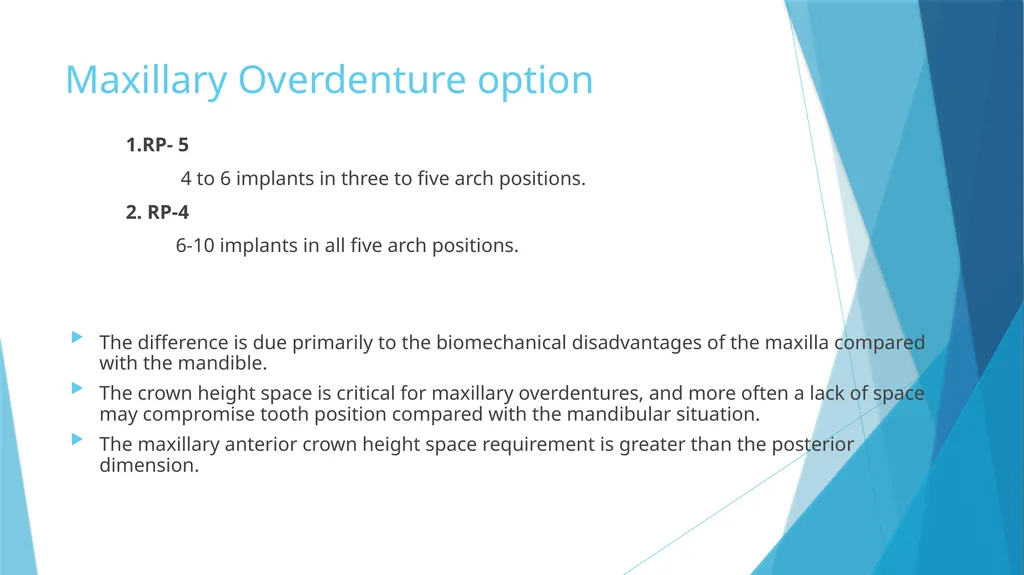
Maxillary Overdenture option The difference is due primarily to the biomechanical disadvantages of the maxilla compared with the mandible.
The crown height space is critical for maxillary overdentures, and more often a lack of space may compromise tooth position compared with the mandibular situation.
The maxillary anterior crown height space requirement is greater than the posterior dimension. 1.RP- 5
4 to 6 implants in three to five arch positions.
2. RP-4
6-10 implants in all five arch positions.<br>
The crown height space is critical for maxillary overdentures, and more often a lack of space may compromise tooth position compared with the mandibular situation.
The maxillary anterior crown height space requirement is greater than the posterior dimension. 1.RP- 5
4 to 6 implants in three to five arch positions.
2. RP-4
6-10 implants in all five arch positions.<br>
29
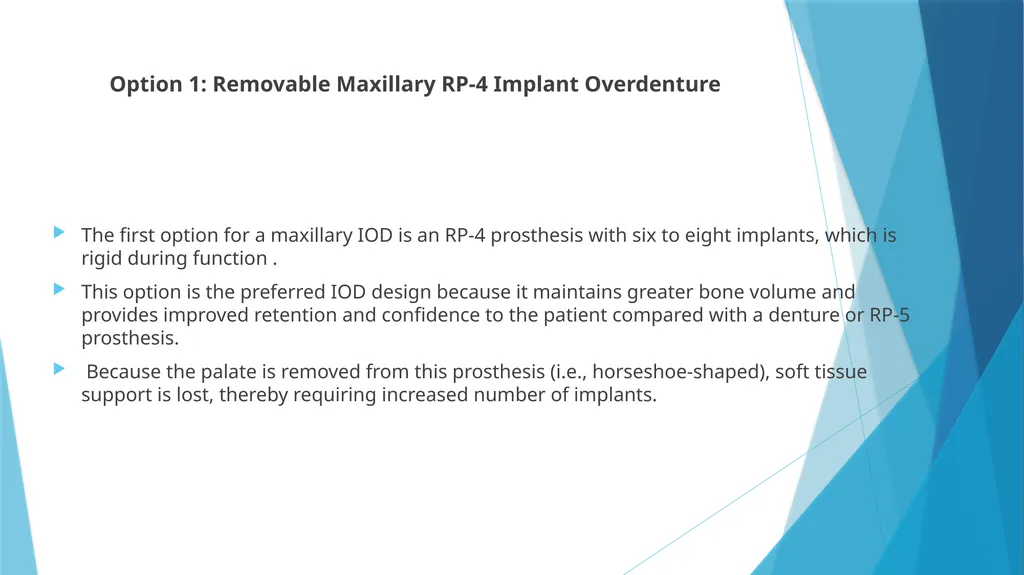
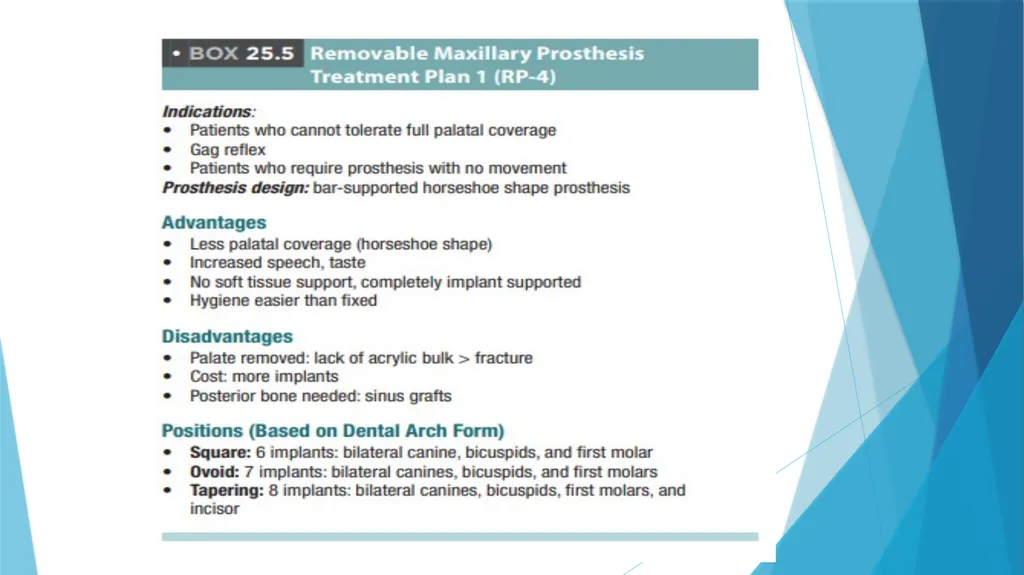
Option 1: Removable Maxillary RP-4 Implant Overdenture The first option for a maxillary IOD is an RP-4 prosthesis with six to eight implants, which is rigid during function .
This option is the preferred IOD design because it maintains greater bone volume and provides improved retention and confidence to the patient compared with a denture or RP-5 prosthesis.
Because the palate is removed from this prosthesis (i.e., horseshoe-shaped), soft tissue support is lost, thereby requiring increased number of implants.<br>
This option is the preferred IOD design because it maintains greater bone volume and provides improved retention and confidence to the patient compared with a denture or RP-5 prosthesis.
Because the palate is removed from this prosthesis (i.e., horseshoe-shaped), soft tissue support is lost, thereby requiring increased number of implants.<br>
30
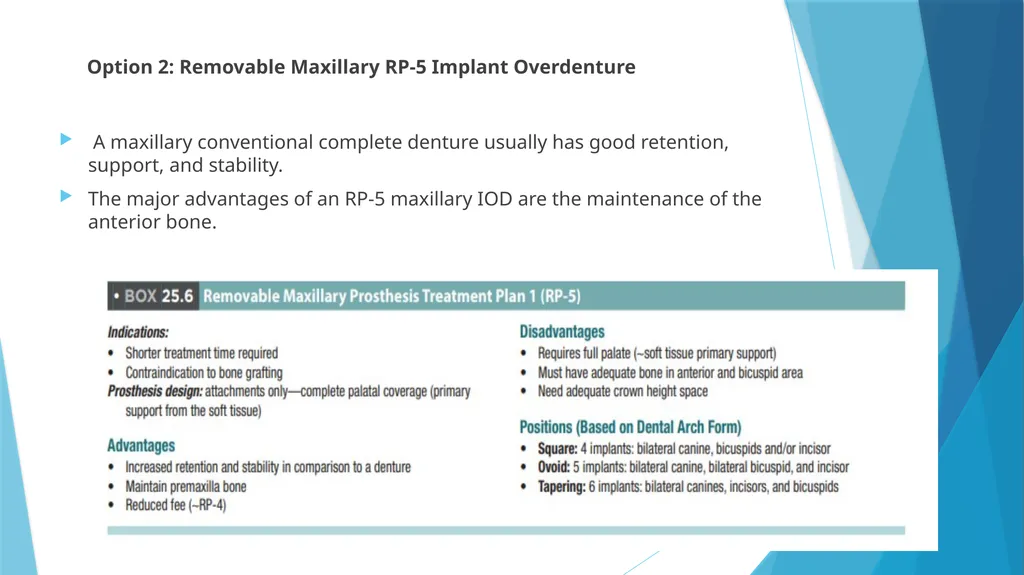
Option 2: Removable Maxillary RP-5 Implant Overdenture A maxillary conventional complete denture usually has good retention, support, and stability.
The major advantages of an RP-5 maxillary IOD are the maintenance of the anterior bone.<br>
The major advantages of an RP-5 maxillary IOD are the maintenance of the anterior bone.<br>
31
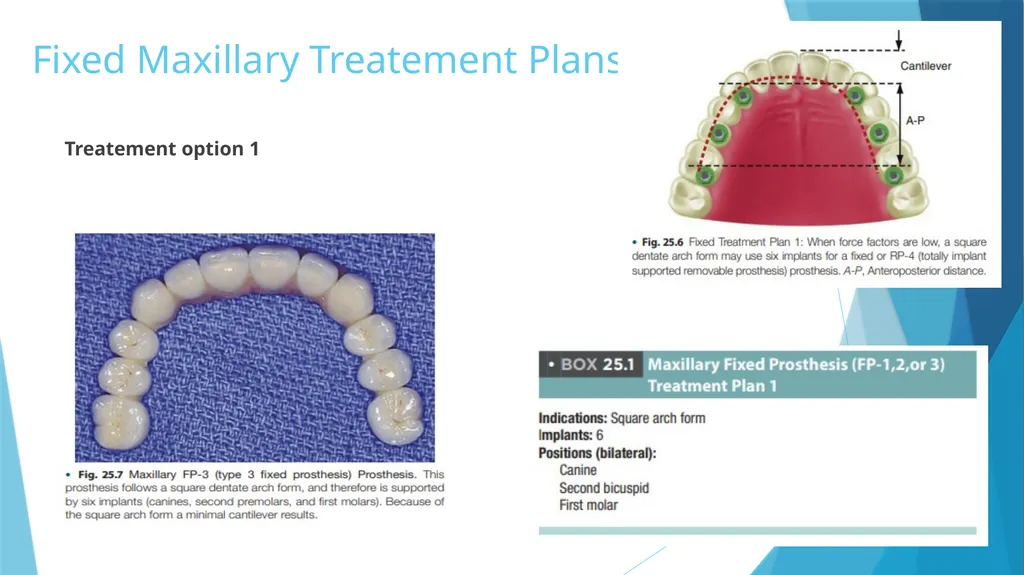
Fixed Maxillary Treatement Plans Treatement option 1<br>
32
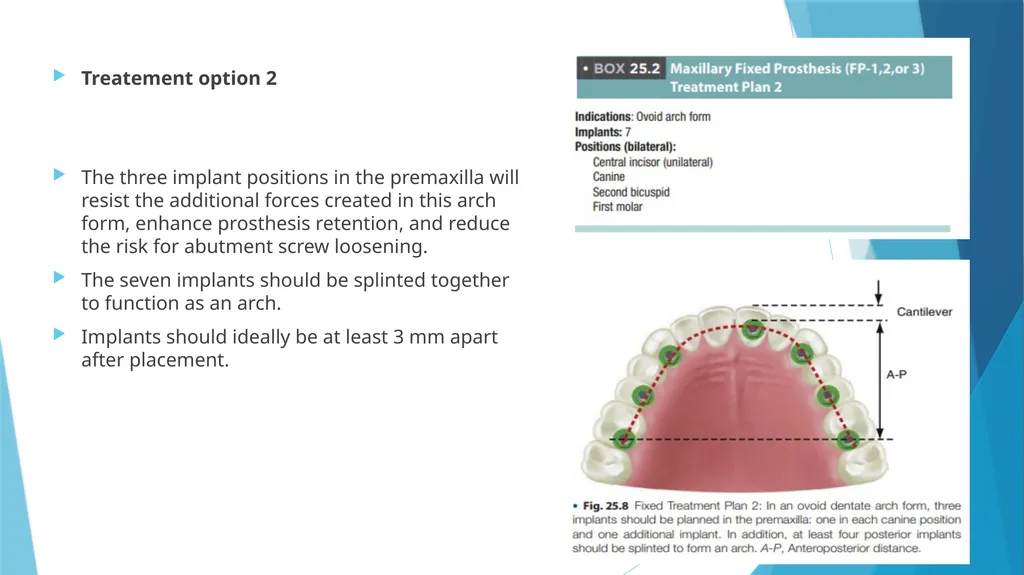
Treatement option 2 The three implant positions in the premaxilla will resist the additional forces created in this arch form, enhance prosthesis retention, and reduce the risk for abutment screw loosening.
The seven implants should be splinted together to function as an arch.
Implants should ideally be at least 3 mm apart after placement.<br>
The seven implants should be splinted together to function as an arch.
Implants should ideally be at least 3 mm apart after placement.<br>
33
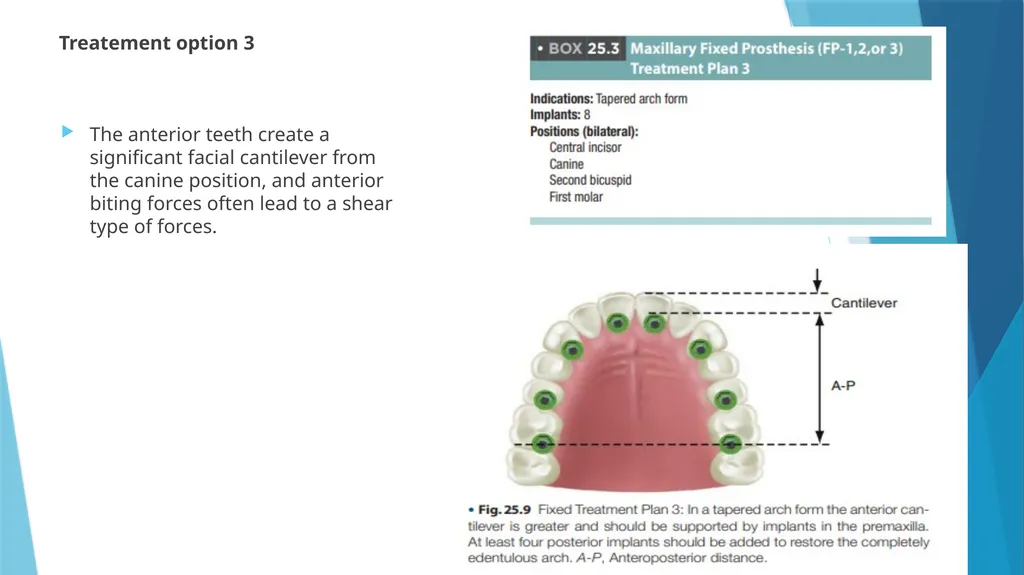
Treatement option 3 The anterior teeth create a significant facial cantilever from the canine position, and anterior biting forces often lead to a shear type of forces.<br>
34
Treatement option 4- All on four In general the all-onfour technique includes placing four implants in the maxillary arch, with two axially placed implants in the anterior and two posterior implants positioned angulated at 30 to 45 degrees<br>
35
Conclusion Implant dentistry is unique because an additional foundation base may be created for a desired prosthodontic result. Therefore both the psychological and anatomic needs and desires of the patient should be evaluated and determined. The prosthesis that satisfies these goals and eliminates the existing problems may then be designed. The prosthesis may be fixed or removable for the completely edentulous patient, whereas fixed restorations are planned for most partially edentulous patients.
Therefore patients need to be educated on the advantages and disadvantages of the various types of prostheses.<br>
Therefore patients need to be educated on the advantages and disadvantages of the various types of prostheses.<br>
36
References 1. Misch CE. Consideration of biomechanical stress in treatment with dental implants. Dent Today. 2006;25(80). 82,84,85; quiz 85.
2. Misch CE, Goodacre CJ, Finley M, et al. Consensus conference panel reports: crown-height space guidelines for implant dentistry— part 1. Implant Dent. 2005;14:312–318.
3. Jacobs R, van Steenberghe D, Nys M, et al. Maxillary bone resorption in patients with mandibular implant-supported overdentures: a survey. Int J Prosthodont. 1996;9:58–64.
4. Barber HD, Scott RF, Maxon BB, et al. Evaluation of anterior maxillary alveolar ridge resorption when opposed by the transmandibular implant. J Oral Maxillofac Surg. 1990;48:1283–1287.
5. Jacobs R, Schotte A, van Steenberghe D, et al. Posterior jaw bone resorption in osseointegrated implant overdentures. Clin Oral Implants Res. 1992;2:63–70<br>
2. Misch CE, Goodacre CJ, Finley M, et al. Consensus conference panel reports: crown-height space guidelines for implant dentistry— part 1. Implant Dent. 2005;14:312–318.
3. Jacobs R, van Steenberghe D, Nys M, et al. Maxillary bone resorption in patients with mandibular implant-supported overdentures: a survey. Int J Prosthodont. 1996;9:58–64.
4. Barber HD, Scott RF, Maxon BB, et al. Evaluation of anterior maxillary alveolar ridge resorption when opposed by the transmandibular implant. J Oral Maxillofac Surg. 1990;48:1283–1287.
5. Jacobs R, Schotte A, van Steenberghe D, et al. Posterior jaw bone resorption in osseointegrated implant overdentures. Clin Oral Implants Res. 1992;2:63–70<br>
37
Thank
You<br>