
PROVISION OF THE TRANSFER PRICING BENCHMARKING
CS
Published · 41 slides · 0 views

1 / 1

Description
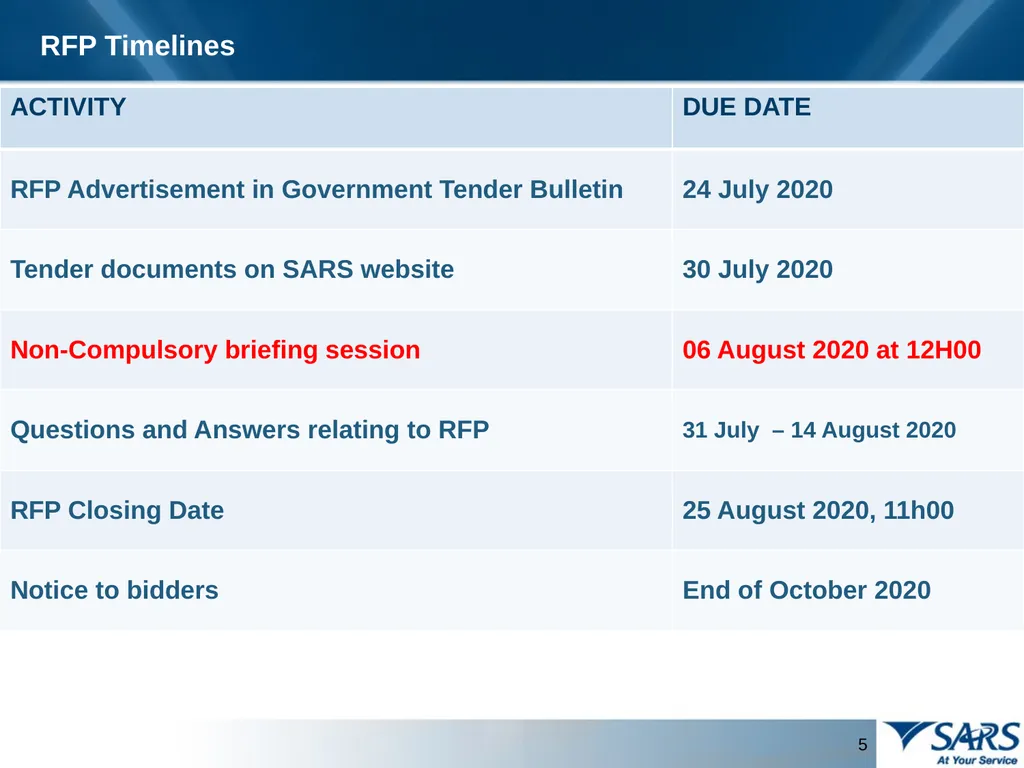
PROVISION OF THE TRANSFER PRICING BENCHMARKING TOOL Briefing Session 06 August 2020 at 12H00 RFP No RFP 00312019 Closing Date 25 August 2020, 11h00 Welcome and Introduction RFP Timelines Background and Scope of Work Bid Evaluation Process
Related Topics
Share
Embed code
Download this presentation From Below
"PROVISION OF THE TRANSFER PRICING BENCHMARKING" is the property of its rightful owner. Permission is granted to download and print the materials on this website for personal, non-commercial use only, and to display it on your personal computer provided you do not modify the materials and that you retain all copyright notices contained in the materials. By downloading content from our website, you accept the terms of this agreement.
Presentation Transcript
01
PROVISION OF THE TRANSFER PRICING BENCHMARKING TOOL Briefing Session 06 August 2020 at 12H00
RFP No RFP 0031/2019
Closing Date 25 August 2020, 11h00<br>
RFP No RFP 0031/2019
Closing Date 25 August 2020, 11h00<br>
02
Welcome and Introduction
RFP Timelines
Background and Scope of Work
Bid Evaluation Process
Price & BBBEE
Draft SLA
RFP submission and contact details
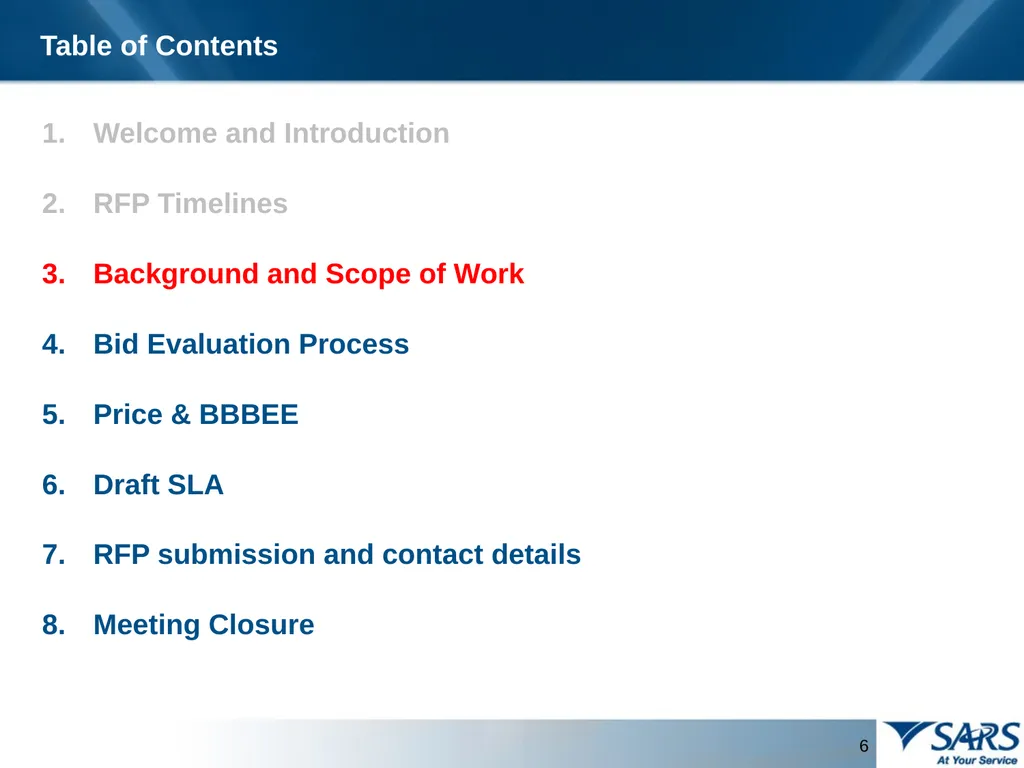
Meeting Closure Table of Contents 2<br>
RFP Timelines
Background and Scope of Work
Bid Evaluation Process
Price & BBBEE
Draft SLA
RFP submission and contact details
Meeting Closure Table of Contents 2<br>
03
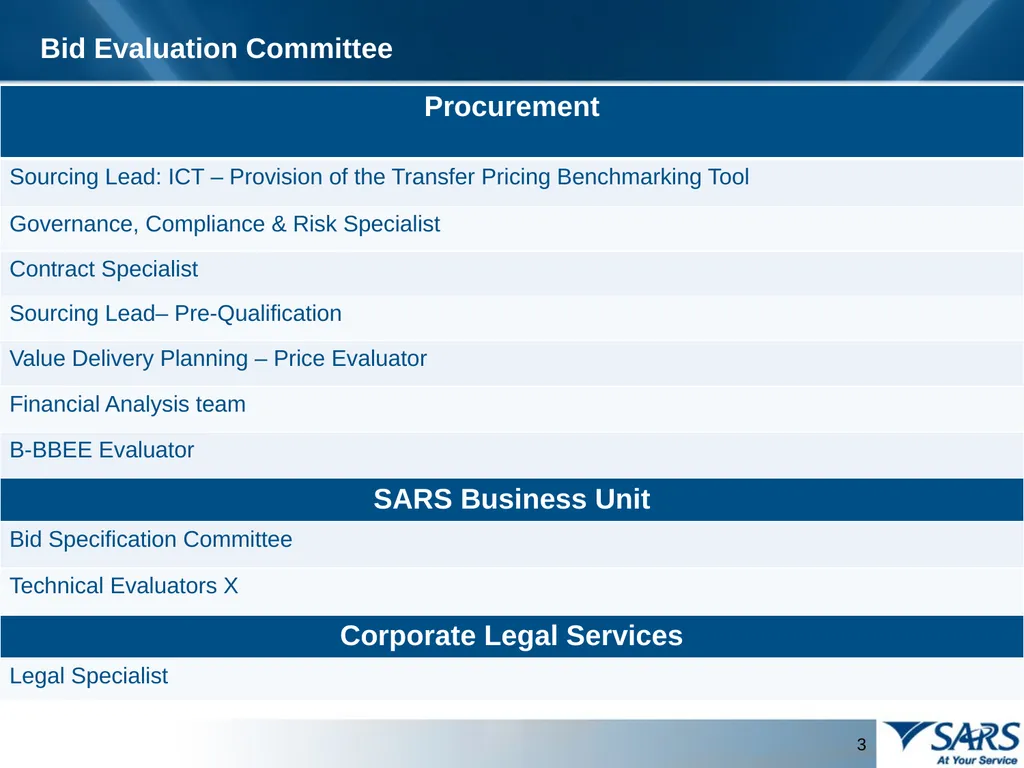
Bid Evaluation Committee 3<br>
04
4 Welcome and Introduction
RFP Timelines
Background and Scope of Work
Bid Evaluation Process
Price & BBBEE
Draft SLA
RFP submission and contact details
Meeting Closure Table of Contents<br>
RFP Timelines
Background and Scope of Work
Bid Evaluation Process
Price & BBBEE
Draft SLA
RFP submission and contact details
Meeting Closure Table of Contents<br>
05
RFP Timelines 5<br>
06
6 Welcome and Introduction
RFP Timelines
Background and Scope of Work
Bid Evaluation Process
Price & BBBEE
Draft SLA
RFP submission and contact details
Meeting Closure Table of Contents<br>
RFP Timelines
Background and Scope of Work
Bid Evaluation Process
Price & BBBEE
Draft SLA
RFP submission and contact details
Meeting Closure Table of Contents<br>
07
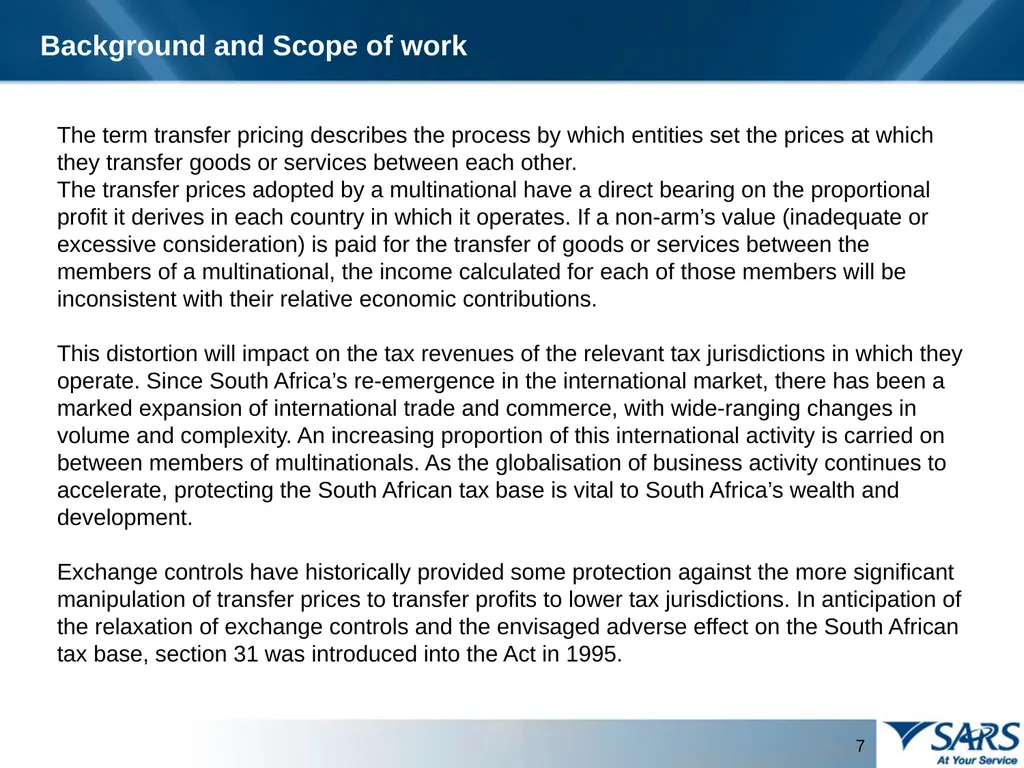
7 Background and Scope of work The term transfer pricing describes the process by which entities set the prices at which they transfer goods or services between each other.
The transfer prices adopted by a multinational have a direct bearing on the proportional profit it derives in each country in which it operates. If a non-arm’s value (inadequate or excessive consideration) is paid for the transfer of goods or services between the members of a multinational, the income calculated for each of those members will be inconsistent with their relative economic contributions.
This distortion will impact on the tax revenues of the relevant tax jurisdictions in which they operate. Since South Africa’s re-emergence in the international market, there has been a marked expansion of international trade and commerce, with wide-ranging changes in volume and complexity. An increasing proportion of this international activity is carried on between members of multinationals. As the globalisation of business activity continues to accelerate, protecting the South African tax base is vital to South Africa’s wealth and development.
Exchange controls have historically provided some protection against the more significant manipulation of transfer prices to transfer profits to lower tax jurisdictions. In anticipation of the relaxation of exchange controls and the envisaged adverse effect on the South African tax base, section 31 was introduced into the Act in 1995.<br>
The transfer prices adopted by a multinational have a direct bearing on the proportional profit it derives in each country in which it operates. If a non-arm’s value (inadequate or excessive consideration) is paid for the transfer of goods or services between the members of a multinational, the income calculated for each of those members will be inconsistent with their relative economic contributions.
This distortion will impact on the tax revenues of the relevant tax jurisdictions in which they operate. Since South Africa’s re-emergence in the international market, there has been a marked expansion of international trade and commerce, with wide-ranging changes in volume and complexity. An increasing proportion of this international activity is carried on between members of multinationals. As the globalisation of business activity continues to accelerate, protecting the South African tax base is vital to South Africa’s wealth and development.
Exchange controls have historically provided some protection against the more significant manipulation of transfer prices to transfer profits to lower tax jurisdictions. In anticipation of the relaxation of exchange controls and the envisaged adverse effect on the South African tax base, section 31 was introduced into the Act in 1995.<br>
08
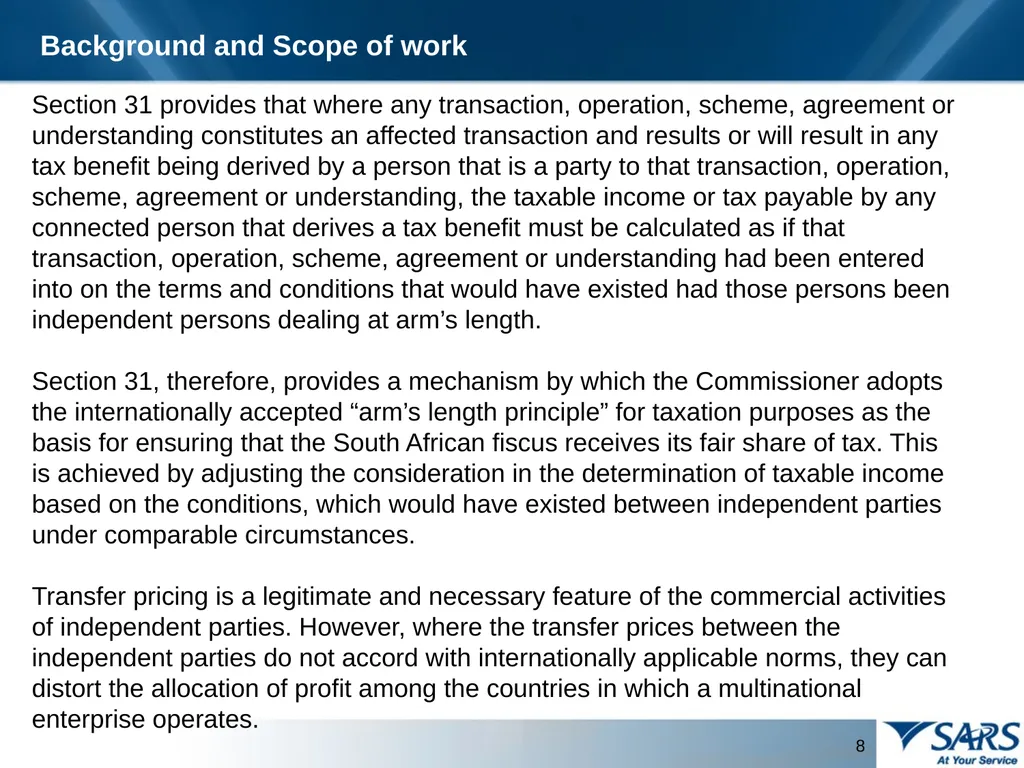
8 Background and Scope of work Section 31 provides that where any transaction, operation, scheme, agreement or understanding constitutes an affected transaction and results or will result in any tax benefit being derived by a person that is a party to that transaction, operation, scheme, agreement or understanding, the taxable income or tax payable by any connected person that derives a tax benefit must be calculated as if that transaction, operation, scheme, agreement or understanding had been entered into on the terms and conditions that would have existed had those persons been independent persons dealing at arm’s length.
Section 31, therefore, provides a mechanism by which the Commissioner adopts the internationally accepted “arm’s length principle” for taxation purposes as the basis for ensuring that the South African fiscus receives its fair share of tax. This is achieved by adjusting the consideration in the determination of taxable income based on the conditions, which would have existed between independent parties under comparable circumstances.
Transfer pricing is a legitimate and necessary feature of the commercial activities of independent parties. However, where the transfer prices between the independent parties do not accord with internationally applicable norms, they can distort the allocation of profit among the countries in which a multinational enterprise operates.<br>
Section 31, therefore, provides a mechanism by which the Commissioner adopts the internationally accepted “arm’s length principle” for taxation purposes as the basis for ensuring that the South African fiscus receives its fair share of tax. This is achieved by adjusting the consideration in the determination of taxable income based on the conditions, which would have existed between independent parties under comparable circumstances.
Transfer pricing is a legitimate and necessary feature of the commercial activities of independent parties. However, where the transfer prices between the independent parties do not accord with internationally applicable norms, they can distort the allocation of profit among the countries in which a multinational enterprise operates.<br>
09
9 Background and Scope of work When transfer pricing artificially shifts profits out of a country it, primarily, denies the country essential tax revenue. Such profit shifting can also have much wider implications: tax avoidance by high-profile corporate taxpayers will be perceived as “unfair” by citizens and may undermine the legitimacy and credibility of the wider tax system, thus discouraging compliance by all taxpayers. These are issues faced by developing and developed countries alike.
Most double tax treaties also incorporate the arm's length principle as the basis for allocating profits (and thus taxes) between independent parties. The arm’s length principle provides broad parity of tax treatment for transactions between associated enterprises and those between independent parties. Implementation of the principle is intended to create equality of treatment between members of a group of companies (which may gain tax advantages through non-arm’s length transfer pricing) and independent parties.
It also provides an objective standard that attempts to replicate market results. By helping to level the playing field, and by virtue of the fact that it represents an international standard, the arm’s length principle helps reduce distortions to international trade and investment.<br>
Most double tax treaties also incorporate the arm's length principle as the basis for allocating profits (and thus taxes) between independent parties. The arm’s length principle provides broad parity of tax treatment for transactions between associated enterprises and those between independent parties. Implementation of the principle is intended to create equality of treatment between members of a group of companies (which may gain tax advantages through non-arm’s length transfer pricing) and independent parties.
It also provides an objective standard that attempts to replicate market results. By helping to level the playing field, and by virtue of the fact that it represents an international standard, the arm’s length principle helps reduce distortions to international trade and investment.<br>
10
10 Background and Scope of work In enforcing the arm’s length principle, many Tax Administrations report uncertainties and difficulties in conducting comparability analyses. A key issue raised by developing countries, in particular, is the scarcity in some parts of the world of the financial data necessary to carry out a comparability analysis (i.e. benchmarking study). Such issues can affect taxpayers and tax administrations alike. Tax Administrations may face difficulties in implementing their rules, which, in turn, will affect their tax revenues.
In many developing countries, challenges to obtaining information are not limited to specific, highly complex transactions: they may exist in all industries. For many resource-rich developing countries, a lack of data on the pricing of certain commodities is of particular concern.
In order to determine if a transaction between associated entities is at arm’s length, a benchmark study would need to be conducted using a reliable comparable database. A common concern of developing economies in the implementation of transfer pricing regimes relates to difficulties in accessing information on “comparables”: data on transactions between independent parties used in the application of the arm’s length principle.<br>
In many developing countries, challenges to obtaining information are not limited to specific, highly complex transactions: they may exist in all industries. For many resource-rich developing countries, a lack of data on the pricing of certain commodities is of particular concern.
In order to determine if a transaction between associated entities is at arm’s length, a benchmark study would need to be conducted using a reliable comparable database. A common concern of developing economies in the implementation of transfer pricing regimes relates to difficulties in accessing information on “comparables”: data on transactions between independent parties used in the application of the arm’s length principle.<br>
11
11 Background and Scope of work Benchmarking studies are the critical part of any transfer pricing analysis contained in a compliance or policy document and are mainly used to test the arm's length nature of the connected party transactions.
The purpose of benchmarking studies is to determine the general conditions surrounding the transactions conducted by third parties on a given market. Such studies help elicit a range of values, i.e. the so-called arm's length range. Statistically, the arm's length range is typically defined within the boundaries of a lower quartile and upper quartile and is the range of values of price or profit attached to the comparable transactions between comparable unrelated parties.
When a transfer price determined by a taxpayer for a transaction under review (or the profitability derived by taxpayer from such transaction) is not found in the applicable arm's length range, SARS will determine the arm's length price or margin with reference to such an arm’s length range, derived through conducting a benchmarking study on a database containing relevant and reliable independent comparable data.<br>
The purpose of benchmarking studies is to determine the general conditions surrounding the transactions conducted by third parties on a given market. Such studies help elicit a range of values, i.e. the so-called arm's length range. Statistically, the arm's length range is typically defined within the boundaries of a lower quartile and upper quartile and is the range of values of price or profit attached to the comparable transactions between comparable unrelated parties.
When a transfer price determined by a taxpayer for a transaction under review (or the profitability derived by taxpayer from such transaction) is not found in the applicable arm's length range, SARS will determine the arm's length price or margin with reference to such an arm’s length range, derived through conducting a benchmarking study on a database containing relevant and reliable independent comparable data.<br>
12
12 Background and Scope of work Managing transfer pricing risk remains critical in an increasingly aggressive environment. SARS has continued to focus on transfer pricing and is currently involved in several major audits that could lead to substantial adjustments. The tool is at the centre of auditing and raising transfer pricing tax assessment. Put simply, a comprehensive Transfer Pricing tax audit is not possible without a benchmarking study or tool.
An effectively resourced Transfer Pricing Unit is thus integral in order to ensure a successful and sustained tax compliance focus. Transfer pricing is one of the key areas of focus, particularly after the BEPS Action plan and the impact that BEPS has on developing countries. BEPS is a major significance for developing countries due to the heavy reliance on corporate income tax, particularly from multinational entities. In order to ensure that SARS issues accurate and defendable Transfer Pricing assessments, it is critical that these assessments are based on external comparables that are derived from a well-established, comprehensive and reputable database, that can be supported in a Court of Law.<br>
An effectively resourced Transfer Pricing Unit is thus integral in order to ensure a successful and sustained tax compliance focus. Transfer pricing is one of the key areas of focus, particularly after the BEPS Action plan and the impact that BEPS has on developing countries. BEPS is a major significance for developing countries due to the heavy reliance on corporate income tax, particularly from multinational entities. In order to ensure that SARS issues accurate and defendable Transfer Pricing assessments, it is critical that these assessments are based on external comparables that are derived from a well-established, comprehensive and reputable database, that can be supported in a Court of Law.<br>
13
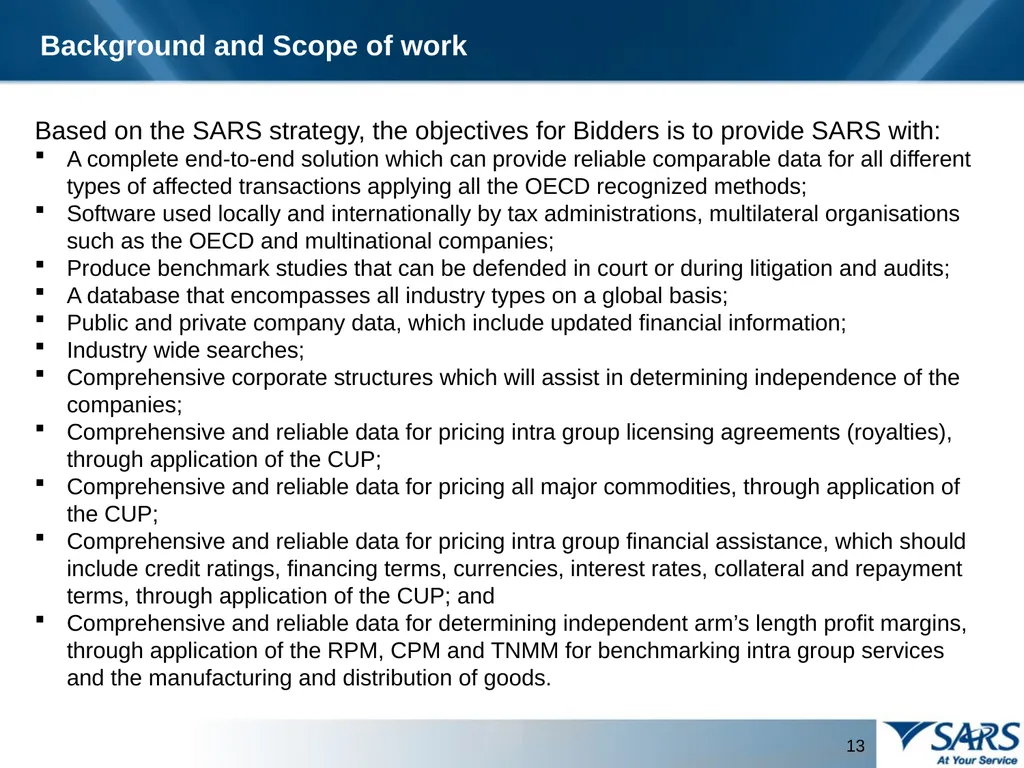
13 Background and Scope of work Based on the SARS strategy, the objectives for Bidders is to provide SARS with:
A complete end-to-end solution which can provide reliable comparable data for all different types of affected transactions applying all the OECD recognized methods;
Software used locally and internationally by tax administrations, multilateral organisations such as the OECD and multinational companies;
Produce benchmark studies that can be defended in court or during litigation and audits;
A database that encompasses all industry types on a global basis;
Public and private company data, which include updated financial information;
Industry wide searches;
Comprehensive corporate structures which will assist in determining independence of the companies;
Comprehensive and reliable data for pricing intra group licensing agreements (royalties), through application of the CUP;
Comprehensive and reliable data for pricing all major commodities, through application of the CUP;
Comprehensive and reliable data for pricing intra group financial assistance, which should include credit ratings, financing terms, currencies, interest rates, collateral and repayment terms, through application of the CUP; and
Comprehensive and reliable data for determining independent arm’s length profit margins, through application of the RPM, CPM and TNMM for benchmarking intra group services and the manufacturing and distribution of goods.<br>
A complete end-to-end solution which can provide reliable comparable data for all different types of affected transactions applying all the OECD recognized methods;
Software used locally and internationally by tax administrations, multilateral organisations such as the OECD and multinational companies;
Produce benchmark studies that can be defended in court or during litigation and audits;
A database that encompasses all industry types on a global basis;
Public and private company data, which include updated financial information;
Industry wide searches;
Comprehensive corporate structures which will assist in determining independence of the companies;
Comprehensive and reliable data for pricing intra group licensing agreements (royalties), through application of the CUP;
Comprehensive and reliable data for pricing all major commodities, through application of the CUP;
Comprehensive and reliable data for pricing intra group financial assistance, which should include credit ratings, financing terms, currencies, interest rates, collateral and repayment terms, through application of the CUP; and
Comprehensive and reliable data for determining independent arm’s length profit margins, through application of the RPM, CPM and TNMM for benchmarking intra group services and the manufacturing and distribution of goods.<br>
14
14 Background and Scope of work See attached Business Requirements Specification document.<br>
15
15 Background and Scope of work See attached Main RFP Document<br>
16
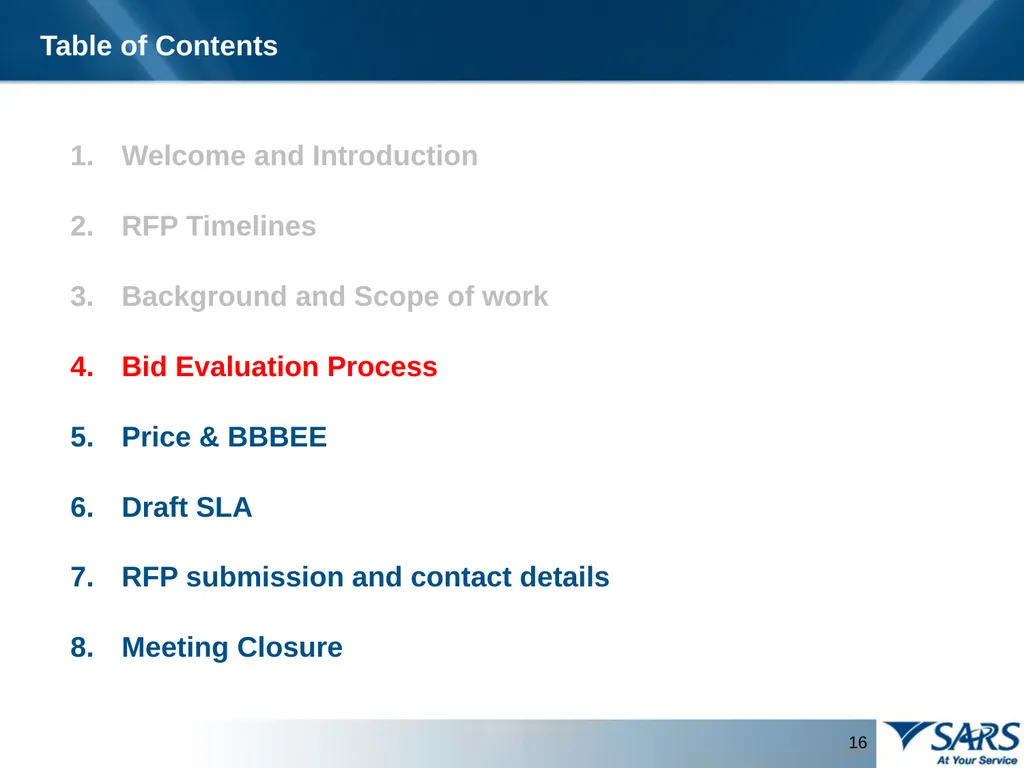
Welcome and Introduction
RFP Timelines
Background and Scope of work
Bid Evaluation Process
Price & BBBEE
Draft SLA
RFP submission and contact details
Meeting Closure 16 Table of Contents<br>
RFP Timelines
Background and Scope of work
Bid Evaluation Process
Price & BBBEE
Draft SLA
RFP submission and contact details
Meeting Closure 16 Table of Contents<br>
17
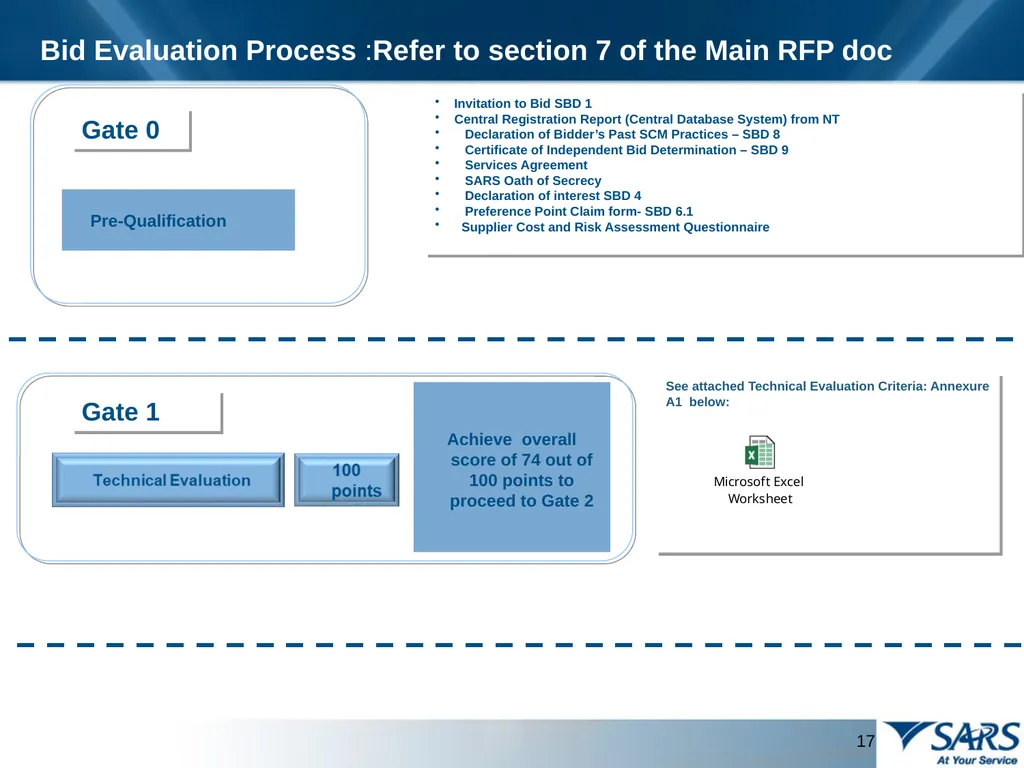
17 Pre-Qualification Gate 0 Invitation to Bid SBD 1
Central Registration Report (Central Database System) from NT
Declaration of Bidder’s Past SCM Practices – SBD 8
Certificate of Independent Bid Determination – SBD 9
Services Agreement
SARS Oath of Secrecy
Declaration of interest SBD 4
Preference Point Claim form- SBD 6.1
Supplier Cost and Risk Assessment Questionnaire See attached Technical Evaluation Criteria: Annexure A1 below: Gate 1 Bid Evaluation Process :Refer to section 7 of the Main RFP doc Achieve overall score of 74 out of 100 points to proceed to Gate 2<br>
Central Registration Report (Central Database System) from NT
Declaration of Bidder’s Past SCM Practices – SBD 8
Certificate of Independent Bid Determination – SBD 9
Services Agreement
SARS Oath of Secrecy
Declaration of interest SBD 4
Preference Point Claim form- SBD 6.1
Supplier Cost and Risk Assessment Questionnaire See attached Technical Evaluation Criteria: Annexure A1 below: Gate 1 Bid Evaluation Process :Refer to section 7 of the Main RFP doc Achieve overall score of 74 out of 100 points to proceed to Gate 2<br>
18
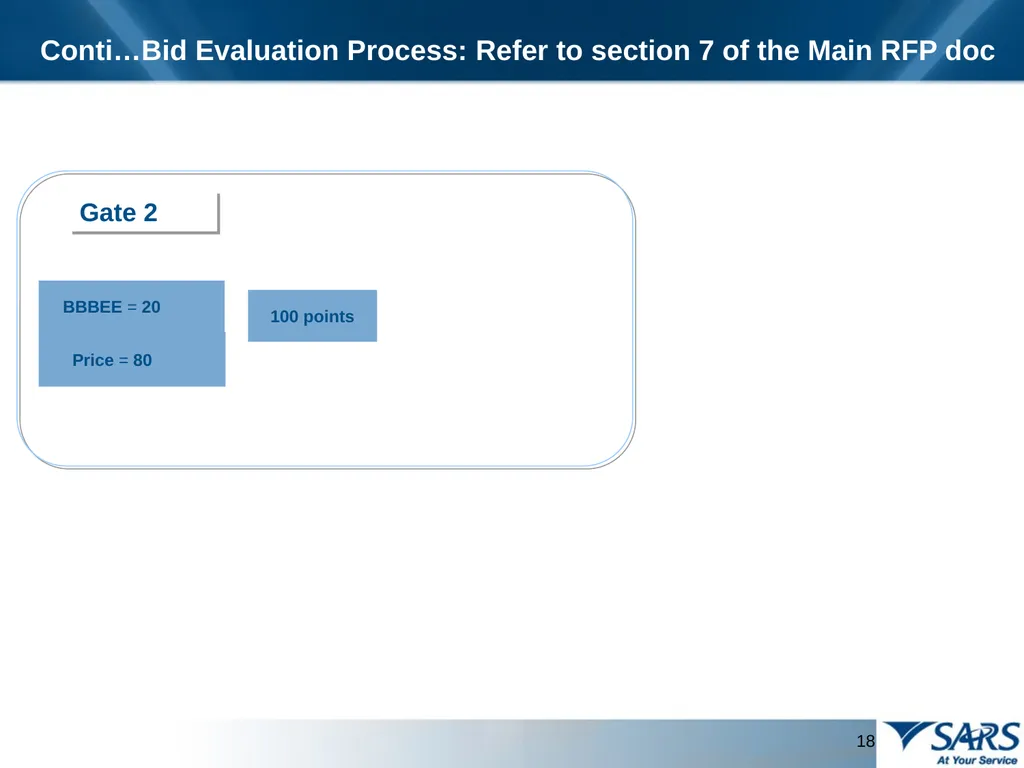
18 100 points Gate 2 Conti…Bid Evaluation Process: Refer to section 7 of the Main RFP doc Price = 80 BBBEE = 20<br>
19
19 Welcome and Introduction
RFP Timelines
Background & Scope of work
Bid Evaluation Process
Price & BBBEE
Draft SLA
RFP submission and contact details
Meeting Closure Table of Contents<br>
RFP Timelines
Background & Scope of work
Bid Evaluation Process
Price & BBBEE
Draft SLA
RFP submission and contact details
Meeting Closure Table of Contents<br>
20
Bid Evaluation Process Gate 2 (Price & BBBEE)
PRICING<br>
PRICING<br>
21
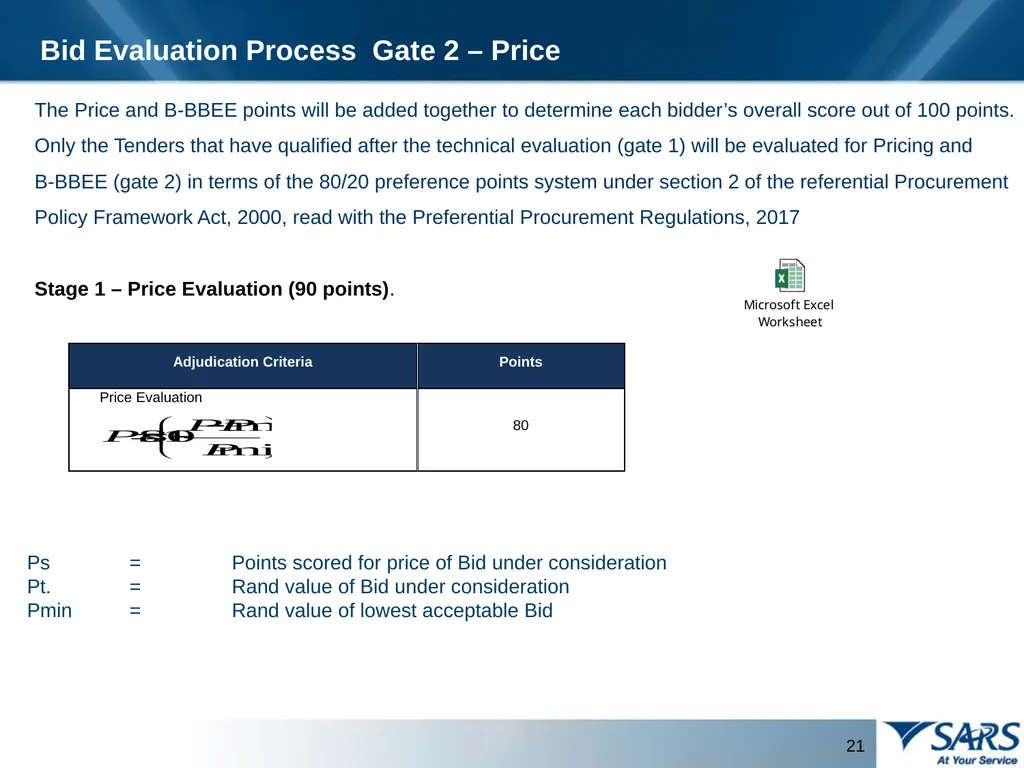
21 Bid Evaluation Process Gate 2 – Price Ps = Points scored for price of Bid under consideration
Pt. = Rand value of Bid under consideration
Pmin = Rand value of lowest acceptable Bid The Price and B-BBEE points will be added together to determine each bidder’s overall score out of 100 points.
Only the Tenders that have qualified after the technical evaluation (gate 1) will be evaluated for Pricing and
B-BBEE (gate 2) in terms of the 80/20 preference points system under section 2 of the referential Procurement Policy Framework Act, 2000, read with the Preferential Procurement Regulations, 2017
Stage 1 – Price Evaluation (90 points).<br>
Pt. = Rand value of Bid under consideration
Pmin = Rand value of lowest acceptable Bid The Price and B-BBEE points will be added together to determine each bidder’s overall score out of 100 points.
Only the Tenders that have qualified after the technical evaluation (gate 1) will be evaluated for Pricing and
B-BBEE (gate 2) in terms of the 80/20 preference points system under section 2 of the referential Procurement Policy Framework Act, 2000, read with the Preferential Procurement Regulations, 2017
Stage 1 – Price Evaluation (90 points).<br>
22
Bid Evaluation Process Gate 3 (Price & BBBEE)
B-BBEE<br>
B-BBEE<br>
23
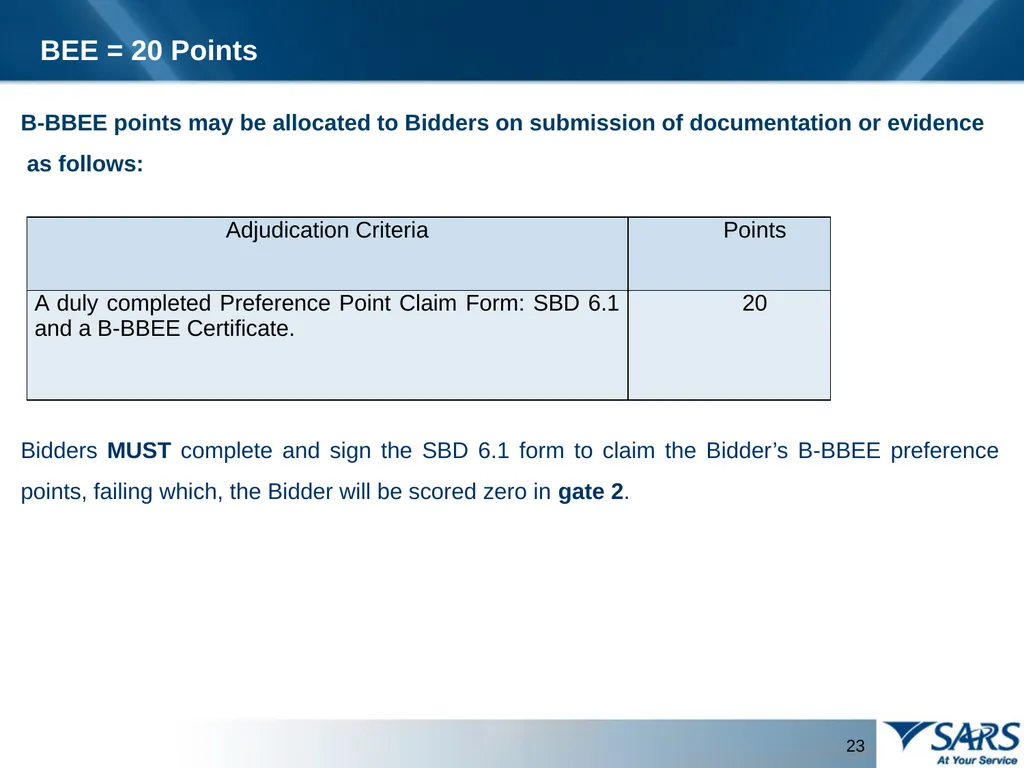
23 BEE = 20 Points B-BBEE points may be allocated to Bidders on submission of documentation or evidence
as follows:
Bidders MUST complete and sign the SBD 6.1 form to claim the Bidder’s B-BBEE preference points, failing which, the Bidder will be scored zero in gate 2.<br>
as follows:
Bidders MUST complete and sign the SBD 6.1 form to claim the Bidder’s B-BBEE preference points, failing which, the Bidder will be scored zero in gate 2.<br>
24
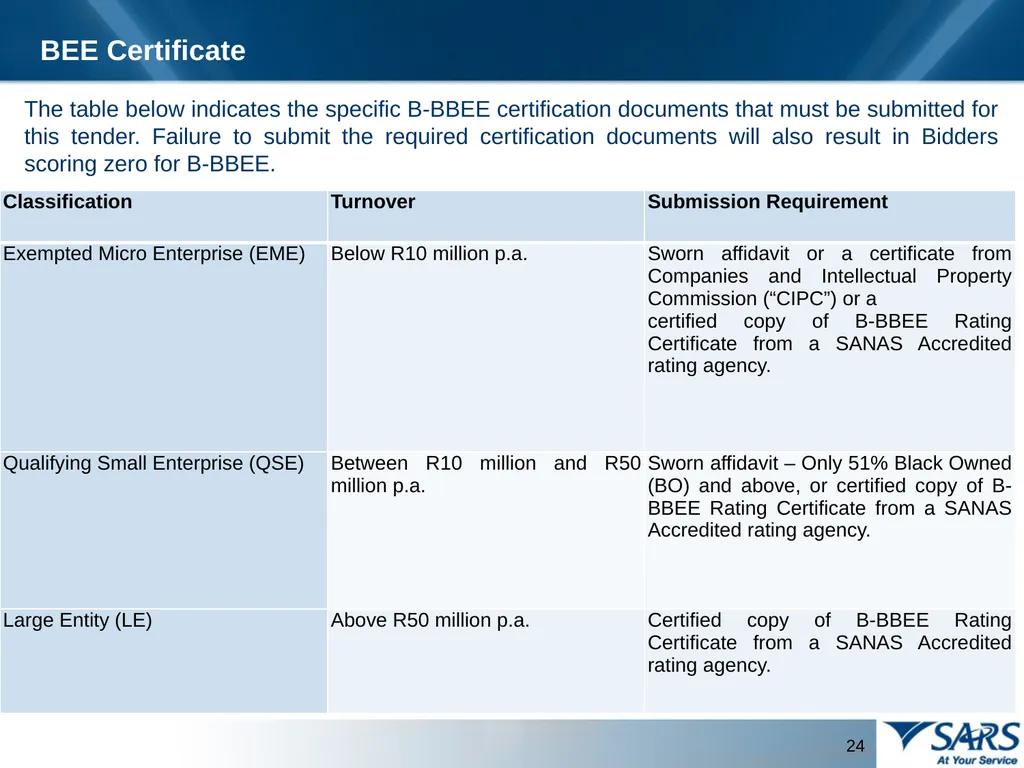
24 BEE Certificate The table below indicates the specific B-BBEE certification documents that must be submitted for this tender. Failure to submit the required certification documents will also result in Bidders scoring zero for B-BBEE.<br>
25
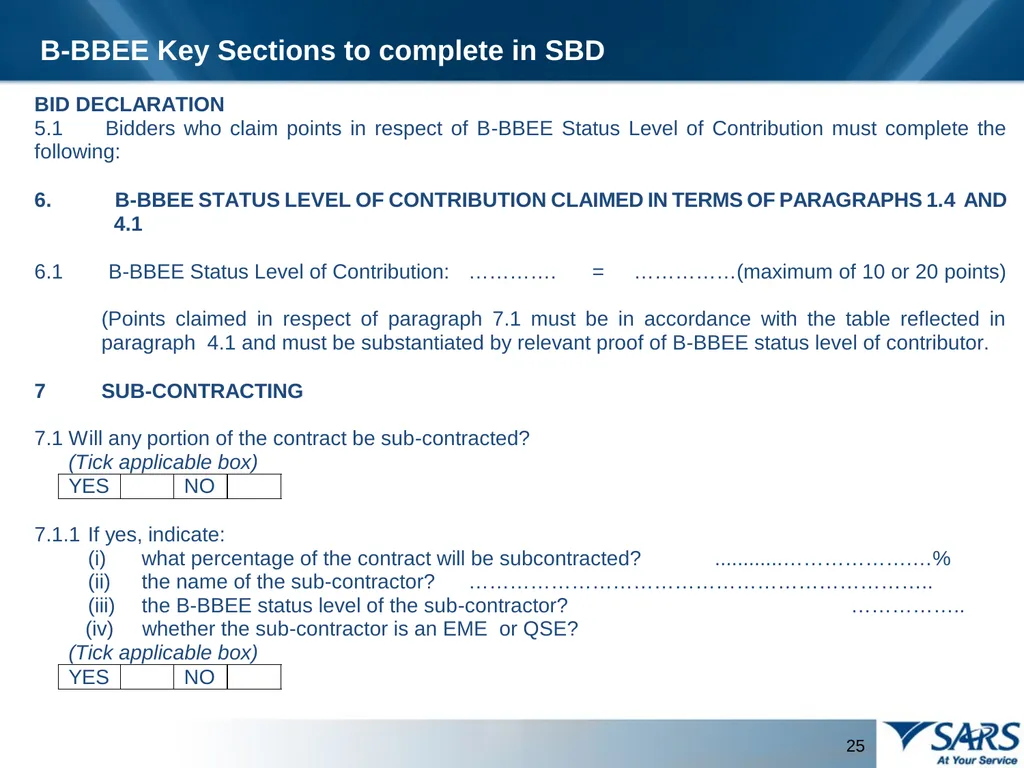
25 B-BBEE Key Sections to complete in SBD<br>
26
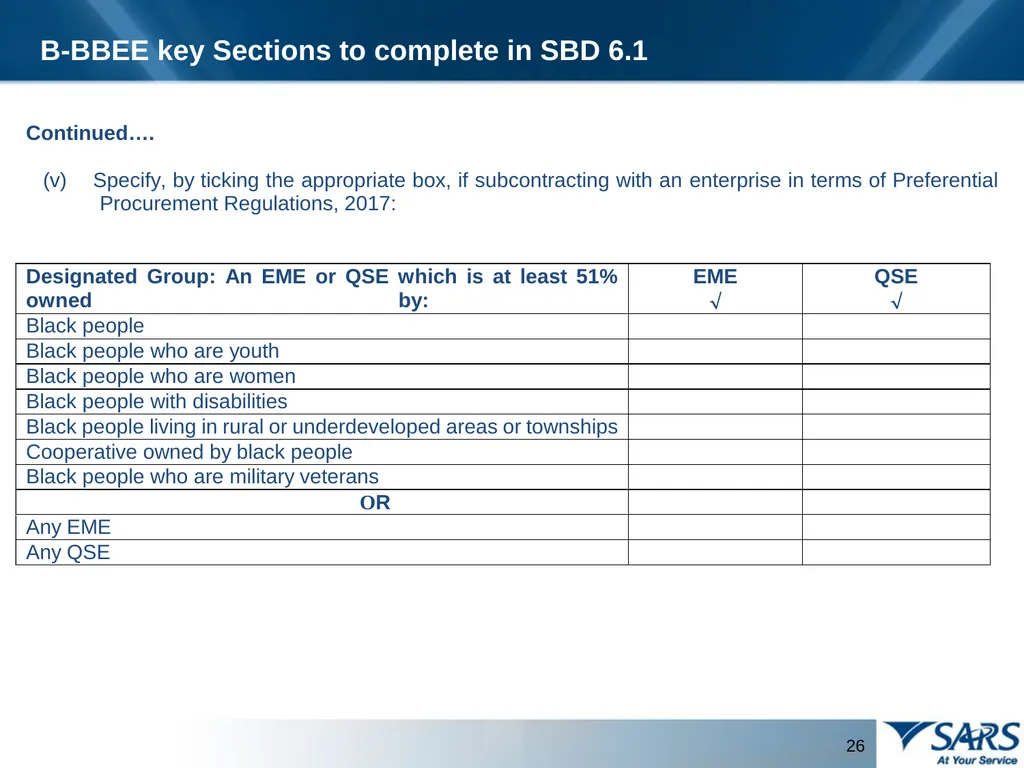
26 B-BBEE key Sections to complete in SBD 6.1<br>
27
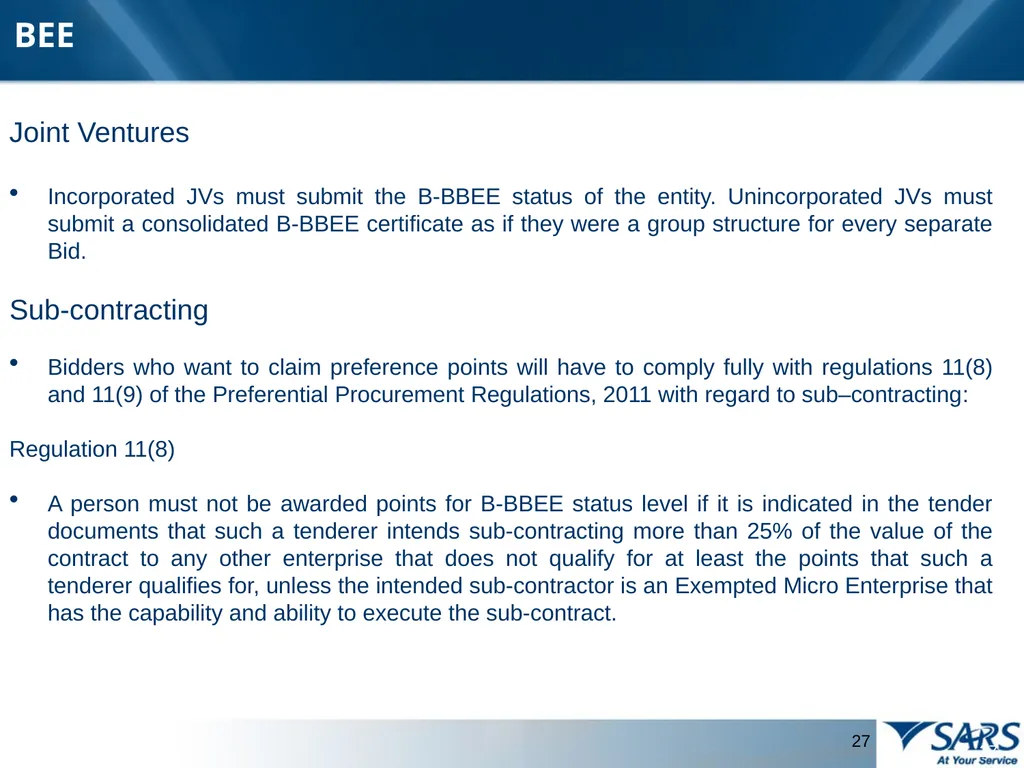
BEE Joint Ventures
Incorporated JVs must submit the B-BBEE status of the entity. Unincorporated JVs must submit a consolidated B-BBEE certificate as if they were a group structure for every separate Bid.
Sub-contracting
Bidders who want to claim preference points will have to comply fully with regulations 11(8) and 11(9) of the Preferential Procurement Regulations, 2011 with regard to sub–contracting:
Regulation 11(8)
A person must not be awarded points for B-BBEE status level if it is indicated in the tender documents that such a tenderer intends sub-contracting more than 25% of the value of the contract to any other enterprise that does not qualify for at least the points that such a tenderer qualifies for, unless the intended sub-contractor is an Exempted Micro Enterprise that has the capability and ability to execute the sub-contract. 27 27<br>
Incorporated JVs must submit the B-BBEE status of the entity. Unincorporated JVs must submit a consolidated B-BBEE certificate as if they were a group structure for every separate Bid.
Sub-contracting
Bidders who want to claim preference points will have to comply fully with regulations 11(8) and 11(9) of the Preferential Procurement Regulations, 2011 with regard to sub–contracting:
Regulation 11(8)
A person must not be awarded points for B-BBEE status level if it is indicated in the tender documents that such a tenderer intends sub-contracting more than 25% of the value of the contract to any other enterprise that does not qualify for at least the points that such a tenderer qualifies for, unless the intended sub-contractor is an Exempted Micro Enterprise that has the capability and ability to execute the sub-contract. 27 27<br>
28
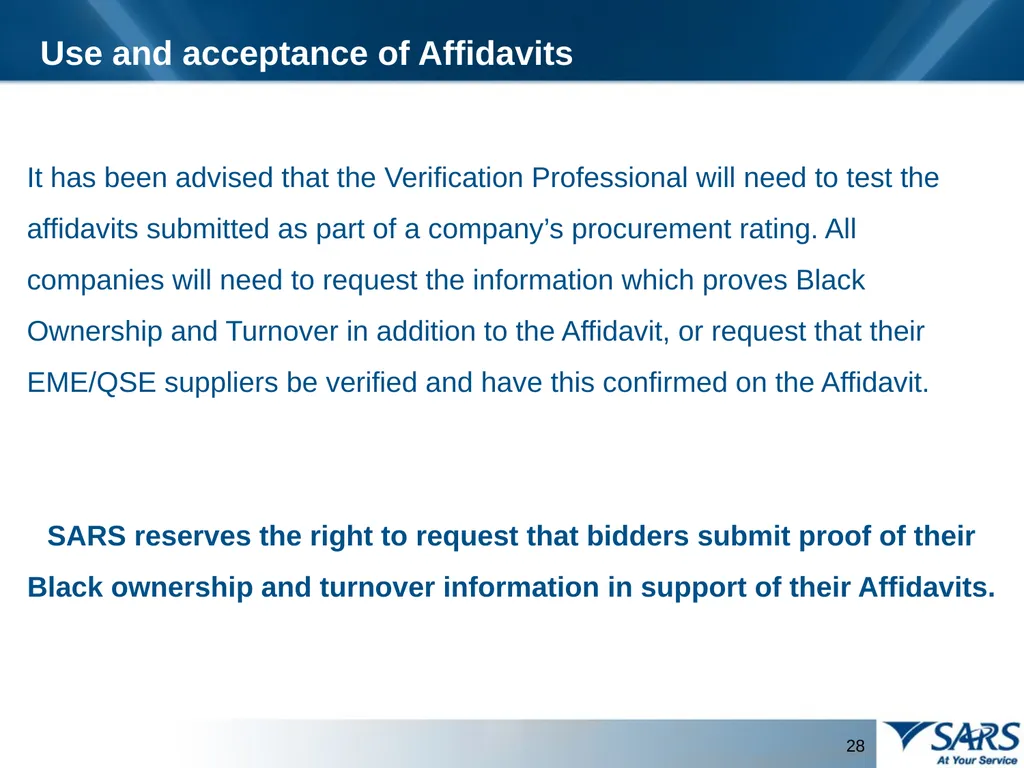
28 Use and acceptance of Affidavits It has been advised that the Verification Professional will need to test the affidavits submitted as part of a company’s procurement rating. All companies will need to request the information which proves Black Ownership and Turnover in addition to the Affidavit, or request that their EME/QSE suppliers be verified and have this confirmed on the Affidavit.
SARS reserves the right to request that bidders submit proof of their Black ownership and turnover information in support of their Affidavits.<br>
SARS reserves the right to request that bidders submit proof of their Black ownership and turnover information in support of their Affidavits.<br>
29
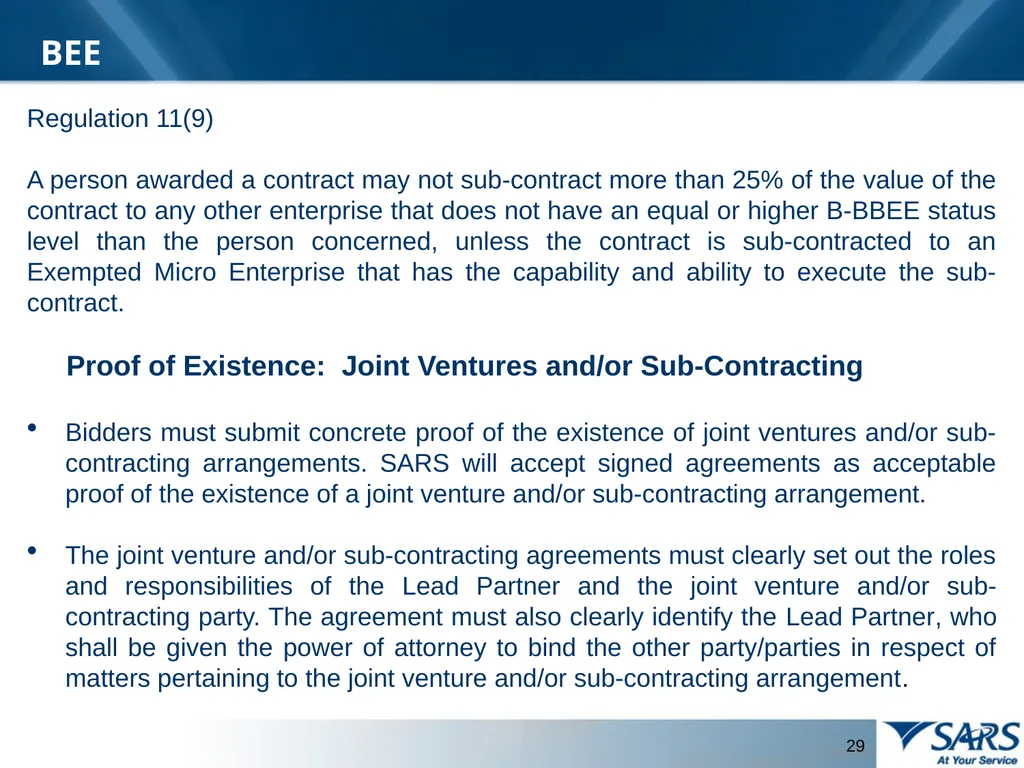
29 BEE Regulation 11(9)
A person awarded a contract may not sub-contract more than 25% of the value of the contract to any other enterprise that does not have an equal or higher B-BBEE status level than the person concerned, unless the contract is sub-contracted to an Exempted Micro Enterprise that has the capability and ability to execute the sub-contract.
Proof of Existence: Joint Ventures and/or Sub-Contracting
Bidders must submit concrete proof of the existence of joint ventures and/or sub-contracting arrangements. SARS will accept signed agreements as acceptable proof of the existence of a joint venture and/or sub-contracting arrangement.
The joint venture and/or sub-contracting agreements must clearly set out the roles and responsibilities of the Lead Partner and the joint venture and/or sub-contracting party. The agreement must also clearly identify the Lead Partner, who shall be given the power of attorney to bind the other party/parties in respect of matters pertaining to the joint venture and/or sub-contracting arrangement.<br>
A person awarded a contract may not sub-contract more than 25% of the value of the contract to any other enterprise that does not have an equal or higher B-BBEE status level than the person concerned, unless the contract is sub-contracted to an Exempted Micro Enterprise that has the capability and ability to execute the sub-contract.
Proof of Existence: Joint Ventures and/or Sub-Contracting
Bidders must submit concrete proof of the existence of joint ventures and/or sub-contracting arrangements. SARS will accept signed agreements as acceptable proof of the existence of a joint venture and/or sub-contracting arrangement.
The joint venture and/or sub-contracting agreements must clearly set out the roles and responsibilities of the Lead Partner and the joint venture and/or sub-contracting party. The agreement must also clearly identify the Lead Partner, who shall be given the power of attorney to bind the other party/parties in respect of matters pertaining to the joint venture and/or sub-contracting arrangement.<br>
30
Bid Evaluation Process Gate 2 (Price & BBBEE)
FINANCIALS<br>
FINANCIALS<br>
31
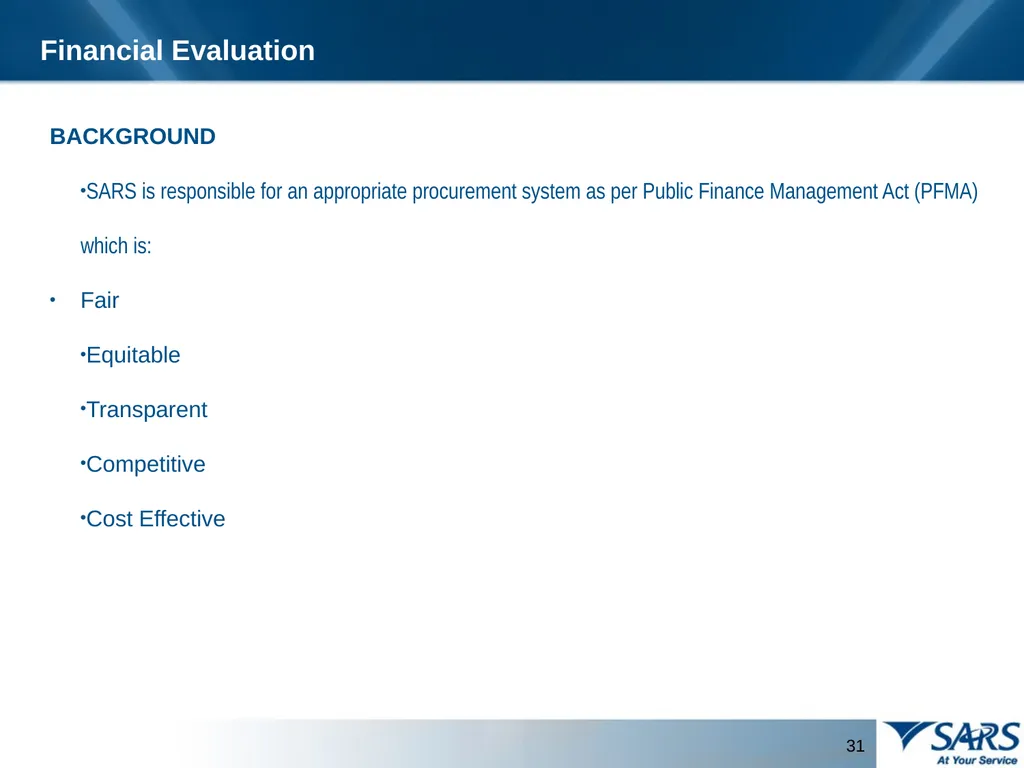
31 BACKGROUND
SARS is responsible for an appropriate procurement system as per Public Finance Management Act (PFMA)
which is:
Fair
Equitable
Transparent
Competitive
Cost Effective Financial Evaluation<br>
SARS is responsible for an appropriate procurement system as per Public Finance Management Act (PFMA)
which is:
Fair
Equitable
Transparent
Competitive
Cost Effective Financial Evaluation<br>
32
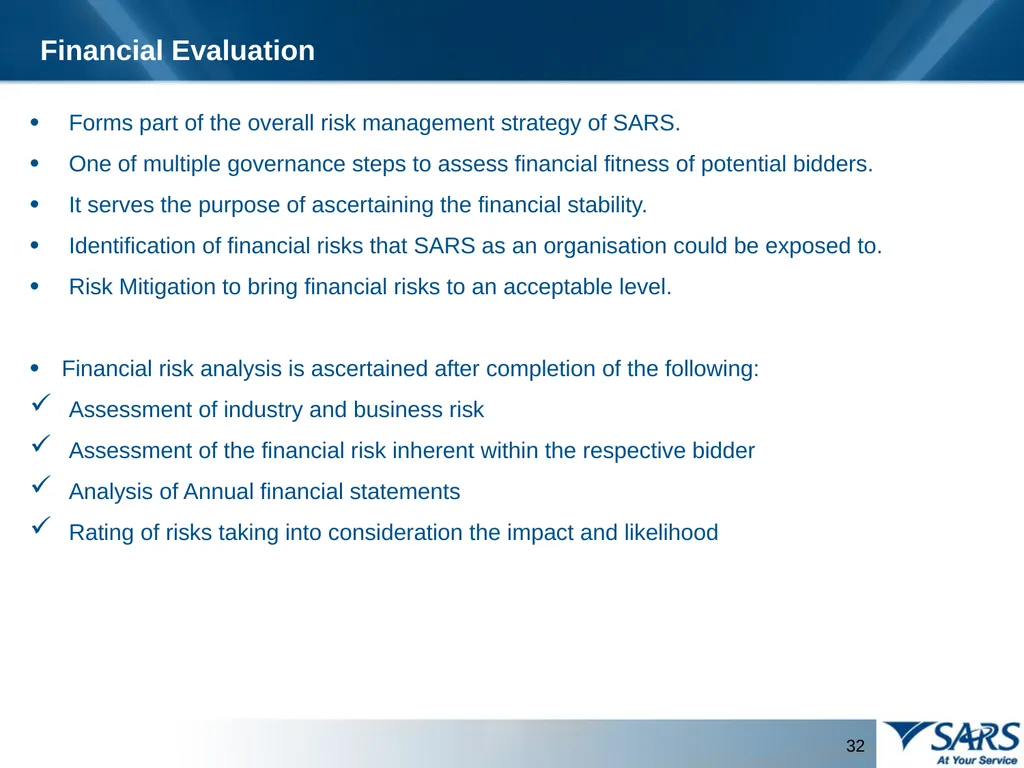
32 Forms part of the overall risk management strategy of SARS.
One of multiple governance steps to assess financial fitness of potential bidders.
It serves the purpose of ascertaining the financial stability.
Identification of financial risks that SARS as an organisation could be exposed to.
Risk Mitigation to bring financial risks to an acceptable level.
Financial risk analysis is ascertained after completion of the following:
Assessment of industry and business risk
Assessment of the financial risk inherent within the respective bidder
Analysis of Annual financial statements
Rating of risks taking into consideration the impact and likelihood Financial Evaluation<br>
One of multiple governance steps to assess financial fitness of potential bidders.
It serves the purpose of ascertaining the financial stability.
Identification of financial risks that SARS as an organisation could be exposed to.
Risk Mitigation to bring financial risks to an acceptable level.
Financial risk analysis is ascertained after completion of the following:
Assessment of industry and business risk
Assessment of the financial risk inherent within the respective bidder
Analysis of Annual financial statements
Rating of risks taking into consideration the impact and likelihood Financial Evaluation<br>
33
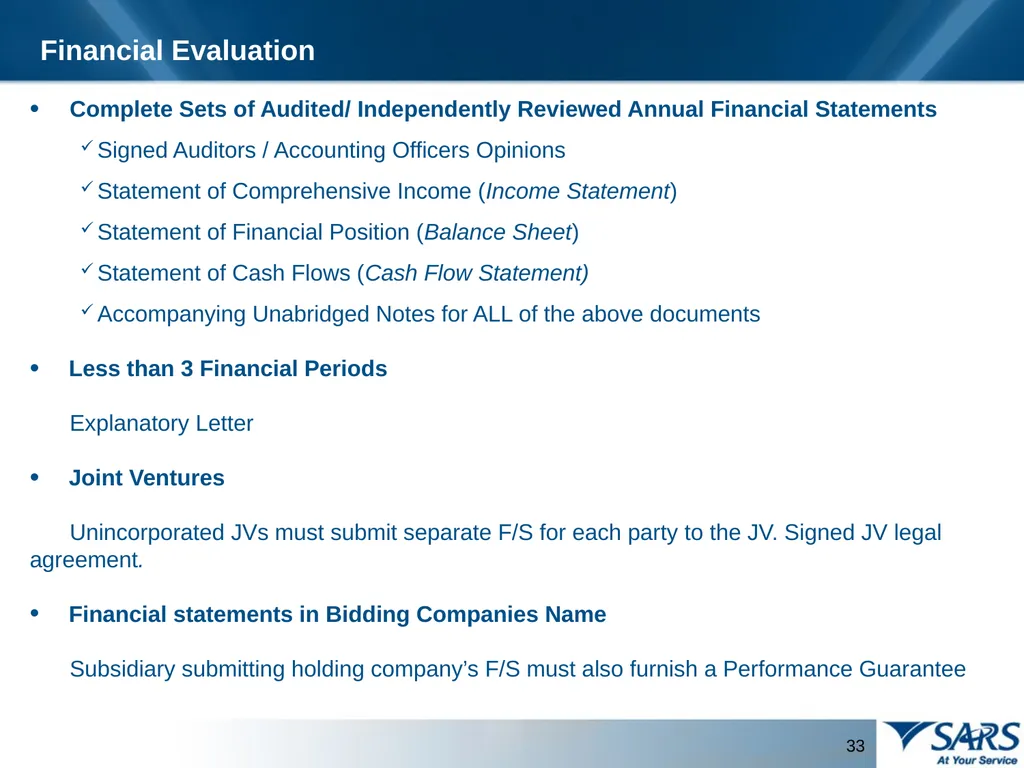
33 Complete Sets of Audited/ Independently Reviewed Annual Financial Statements
Signed Auditors / Accounting Officers Opinions
Statement of Comprehensive Income (Income Statement)
Statement of Financial Position (Balance Sheet)
Statement of Cash Flows (Cash Flow Statement)
Accompanying Unabridged Notes for ALL of the above documents
Less than 3 Financial Periods
Explanatory Letter
Joint Ventures
Unincorporated JVs must submit separate F/S for each party to the JV. Signed JV legal agreement.
Financial statements in Bidding Companies Name
Subsidiary submitting holding company’s F/S must also furnish a Performance Guarantee Financial Evaluation<br>
Signed Auditors / Accounting Officers Opinions
Statement of Comprehensive Income (Income Statement)
Statement of Financial Position (Balance Sheet)
Statement of Cash Flows (Cash Flow Statement)
Accompanying Unabridged Notes for ALL of the above documents
Less than 3 Financial Periods
Explanatory Letter
Joint Ventures
Unincorporated JVs must submit separate F/S for each party to the JV. Signed JV legal agreement.
Financial statements in Bidding Companies Name
Subsidiary submitting holding company’s F/S must also furnish a Performance Guarantee Financial Evaluation<br>
34
34 Welcome and Introduction
RFP Timelines
Background & Scope of work
Bid Evaluation Process
Price and BBBEE
Draft SLA
RFP submission and contact details
Meeting Closure Table of Contents<br>
RFP Timelines
Background & Scope of work
Bid Evaluation Process
Price and BBBEE
Draft SLA
RFP submission and contact details
Meeting Closure Table of Contents<br>
35
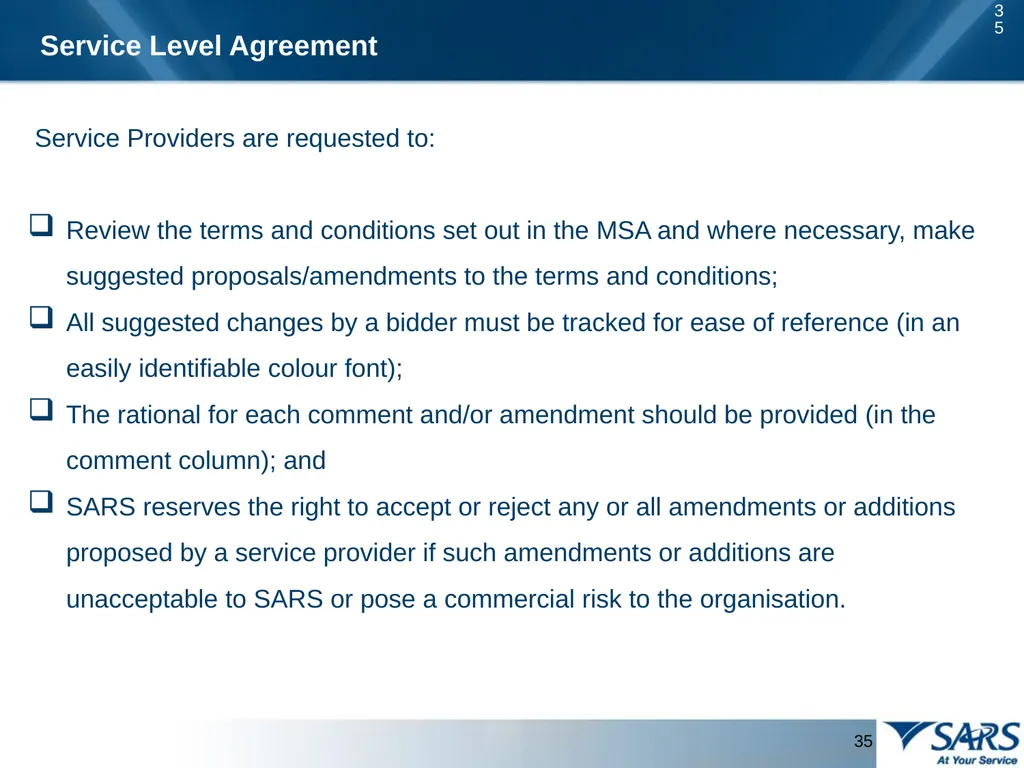
35 Service Level Agreement Service Providers are requested to:
Review the terms and conditions set out in the MSA and where necessary, make suggested proposals/amendments to the terms and conditions;
All suggested changes by a bidder must be tracked for ease of reference (in an easily identifiable colour font);
The rational for each comment and/or amendment should be provided (in the comment column); and
SARS reserves the right to accept or reject any or all amendments or additions proposed by a service provider if such amendments or additions are unacceptable to SARS or pose a commercial risk to the organisation. 35<br>
Review the terms and conditions set out in the MSA and where necessary, make suggested proposals/amendments to the terms and conditions;
All suggested changes by a bidder must be tracked for ease of reference (in an easily identifiable colour font);
The rational for each comment and/or amendment should be provided (in the comment column); and
SARS reserves the right to accept or reject any or all amendments or additions proposed by a service provider if such amendments or additions are unacceptable to SARS or pose a commercial risk to the organisation. 35<br>
36
36 Welcome and Introduction
RFP Timelines
Background & Scope of Work
Bid Evaluation Process
Price & BBBEE
Draft SLA
RFP submission and contact details
Meeting Closure Table of Contents<br>
RFP Timelines
Background & Scope of Work
Bid Evaluation Process
Price & BBBEE
Draft SLA
RFP submission and contact details
Meeting Closure Table of Contents<br>
37
37 + TENDER BOX SARS Brooklyn Bridge,570 Fehrsen Street, Linton House, Brooklyn Any enquiries must be referred, in writing via email: to
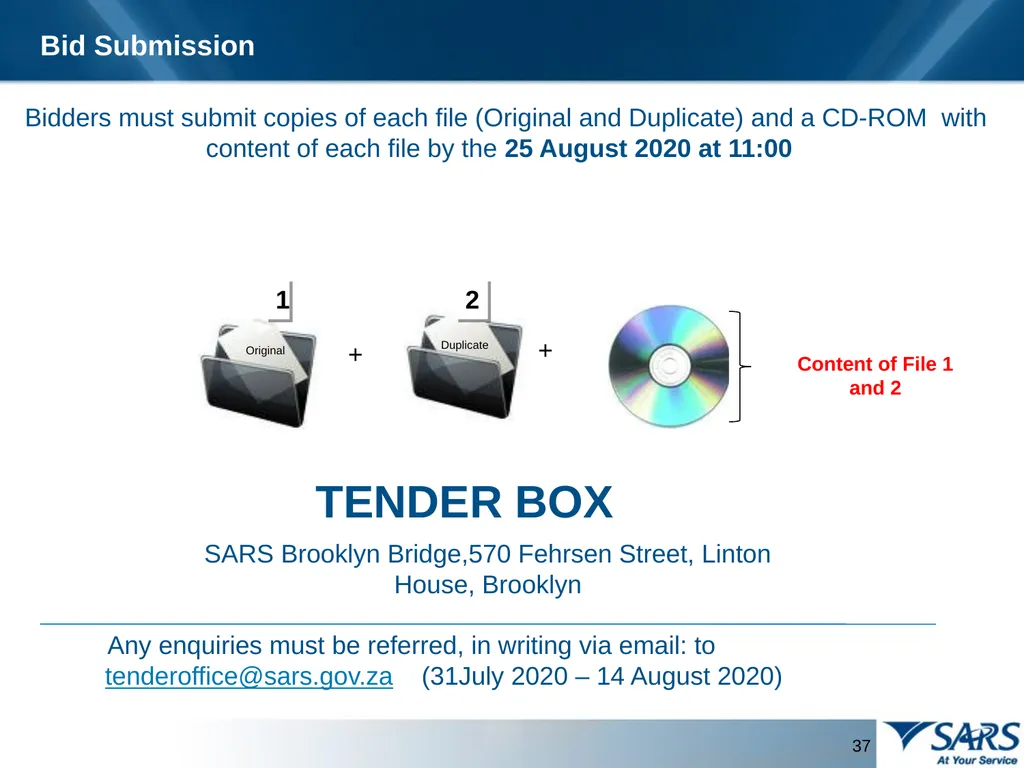
tenderoffice@sars.gov.za (31July 2020 – 14 August 2020) 1 2 Bidders must submit copies of each file (Original and Duplicate) and a CD-ROM with content of each file by the 25 August 2020 at 11:00 Original Duplicate Bid Submission + Content of File 1 and 2<br>
tenderoffice@sars.gov.za (31July 2020 – 14 August 2020) 1 2 Bidders must submit copies of each file (Original and Duplicate) and a CD-ROM with content of each file by the 25 August 2020 at 11:00 Original Duplicate Bid Submission + Content of File 1 and 2<br>
38
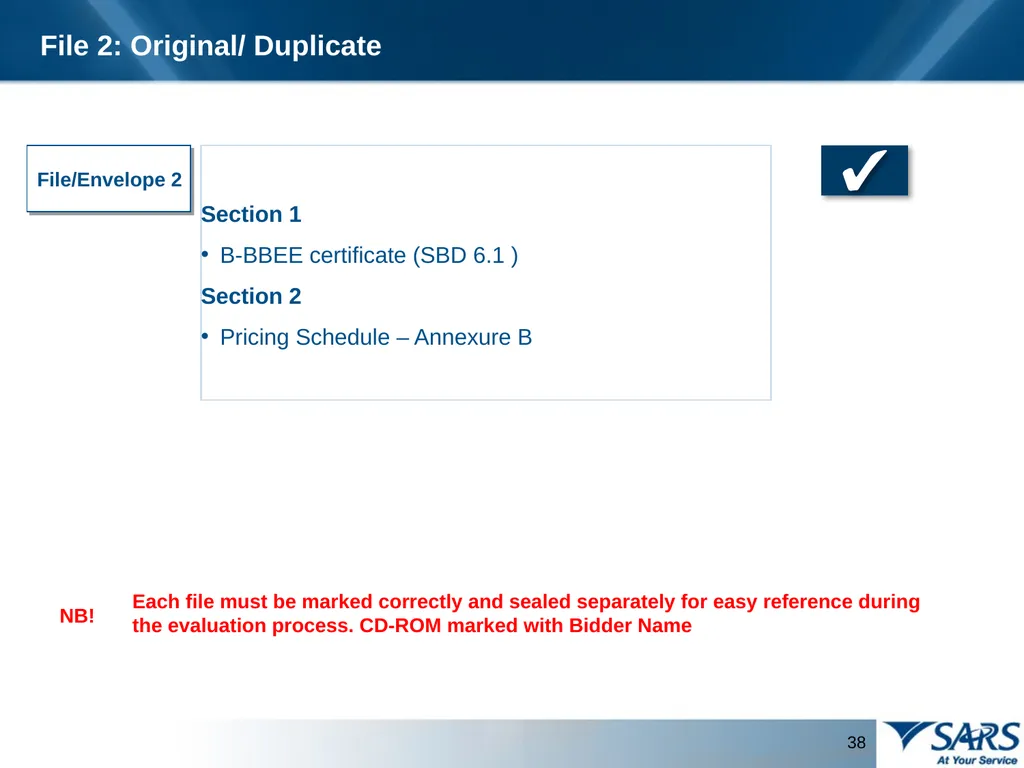
38 File/Envelope 2 Section 1
B-BBEE certificate (SBD 6.1 )
Section 2
Pricing Schedule – Annexure B File 2: Original/ Duplicate Each file must be marked correctly and sealed separately for easy reference during the evaluation process. CD-ROM marked with Bidder Name NB!<br>
B-BBEE certificate (SBD 6.1 )
Section 2
Pricing Schedule – Annexure B File 2: Original/ Duplicate Each file must be marked correctly and sealed separately for easy reference during the evaluation process. CD-ROM marked with Bidder Name NB!<br>
39
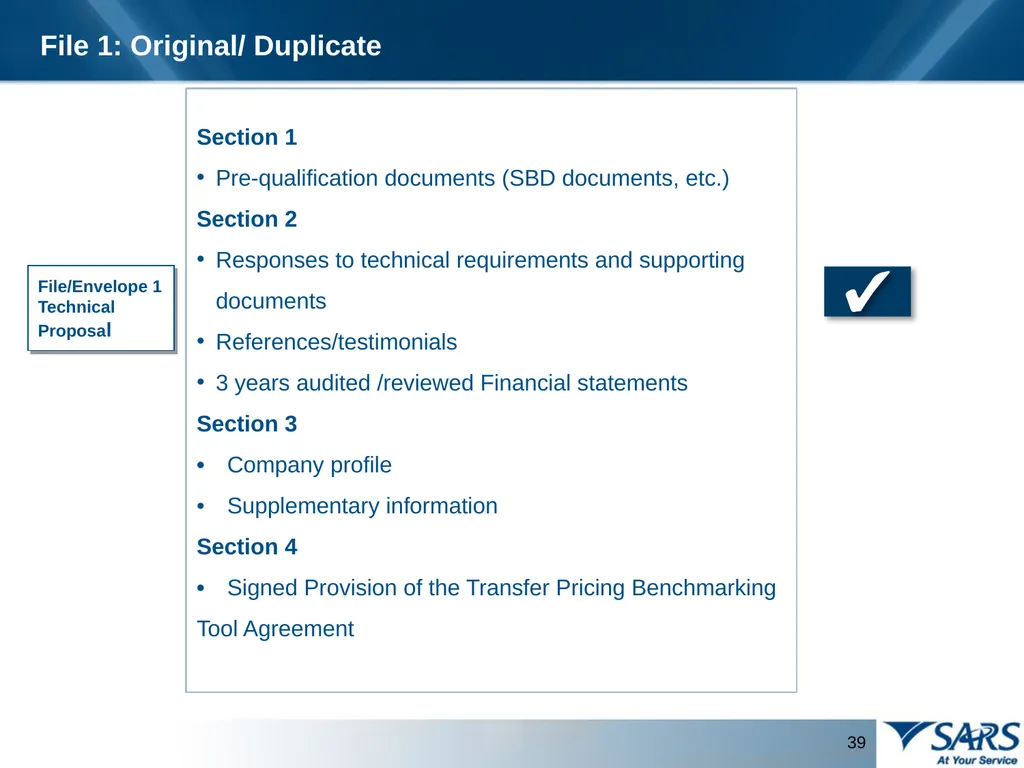
39 File/Envelope 1
Technical
Proposal Section 1
Pre-qualification documents (SBD documents, etc.)
Section 2
Responses to technical requirements and supporting documents
References/testimonials
3 years audited /reviewed Financial statements
Section 3
• Company profile
• Supplementary information
Section 4
• Signed Provision of the Transfer Pricing Benchmarking Tool Agreement File 1: Original/ Duplicate<br>
Technical
Proposal Section 1
Pre-qualification documents (SBD documents, etc.)
Section 2
Responses to technical requirements and supporting documents
References/testimonials
3 years audited /reviewed Financial statements
Section 3
• Company profile
• Supplementary information
Section 4
• Signed Provision of the Transfer Pricing Benchmarking Tool Agreement File 1: Original/ Duplicate<br>
40
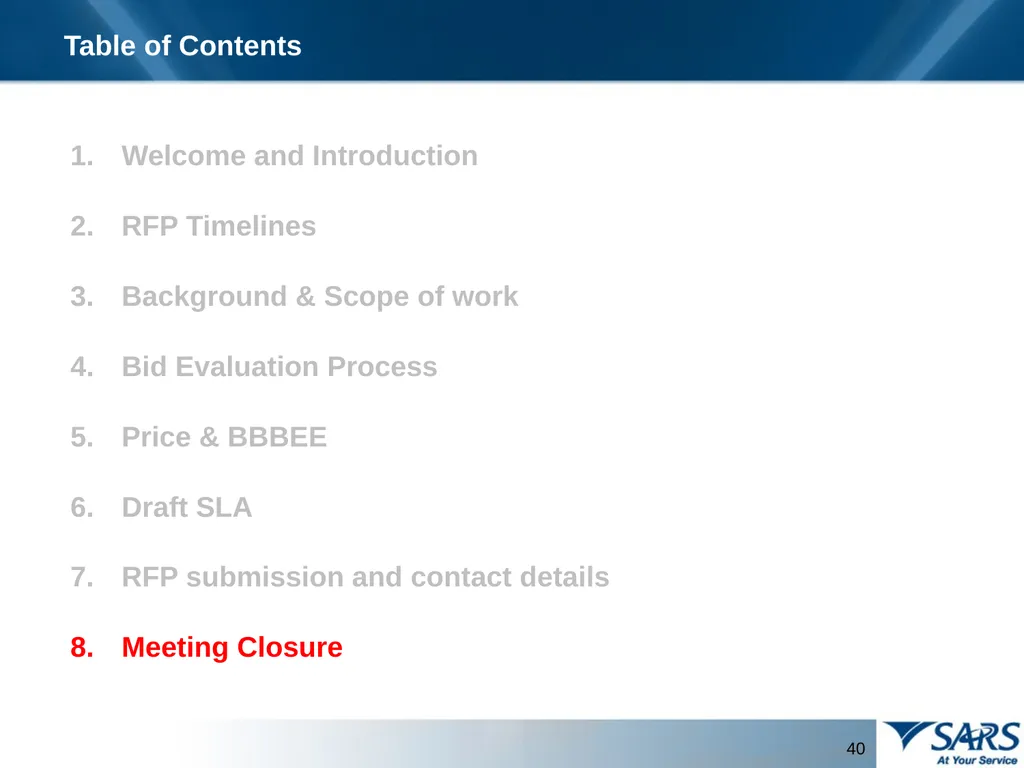
40 Welcome and Introduction
RFP Timelines
Background & Scope of work
Bid Evaluation Process
Price & BBBEE
Draft SLA
RFP submission and contact details
Meeting Closure Table of Contents<br>
RFP Timelines
Background & Scope of work
Bid Evaluation Process
Price & BBBEE
Draft SLA
RFP submission and contact details
Meeting Closure Table of Contents<br>
41
41<br>