
PSYCHOLOGICAL FIRST AID Getting through trauma



Description: PSYCHOLOGICAL FIRST AID Getting through trauma together. OBJECTIVES Understand the psychological impact of disasters and recognize the common reactions in self and others. Define the goal and core actions of Psychological First Aid (PFA).
Related Topics
Download Presentation
"PSYCHOLOGICAL FIRST AID Getting through trauma" is the property of its rightful owner. Permission is granted to download and print the materials on this website for personal, non-commercial use only, and to display it on your personal computer provided you do not modify the materials and that you retain all copyright notices contained in the materials. By downloading content from our website, you accept the terms of this agreement.
Presentation Transcript
slide1. PSYCHOLOGICAL FIRST AID Getting through trauma together….<br>
slide2. OBJECTIVES Understand the psychological impact of disasters and recognize the common reactions in self and others.
Define the goal and core actions of Psychological First Aid (PFA).
Prepare to provide immediate support to residents and co-workers experiencing disaster-related stress.<br>
slide3. STRESS AND DISASTERS MODULE I<br>
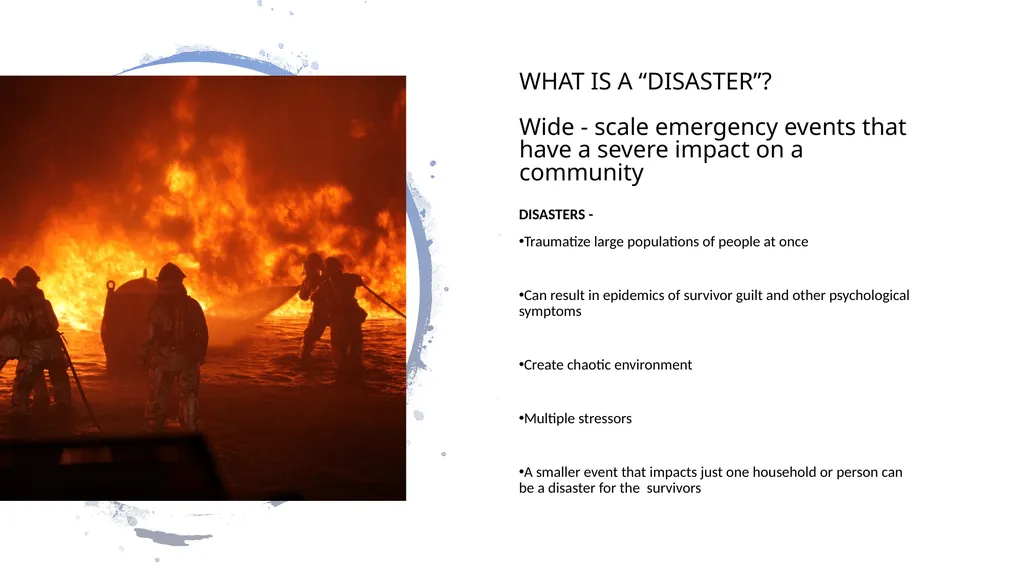
slide4. WHAT IS A “DISASTER”? Wide - scale emergency events that have a severe impact on a community DISASTERS -
Traumatize large populations of people at once
Can result in epidemics of survivor guilt and other psychological symptoms
Create chaotic environment
Multiple stressors
A smaller event that impacts just one household or person can be a disaster for the survivors<br>
slide5. IMPACT OF DISASTERS For a community – depletion of resources and slow recovery
For people –
Everyone who experiences a disaster is affected in some way – Even the helpers!
People pull together
Stress and grief are common reactions to uncommon situations<br>
slide6. REACTIONS Some people will have severe reactions following a disaster event
Most people recover without professional treatment
Survivors often to do not seek or accept help, especially from helpers from outside the community<br>
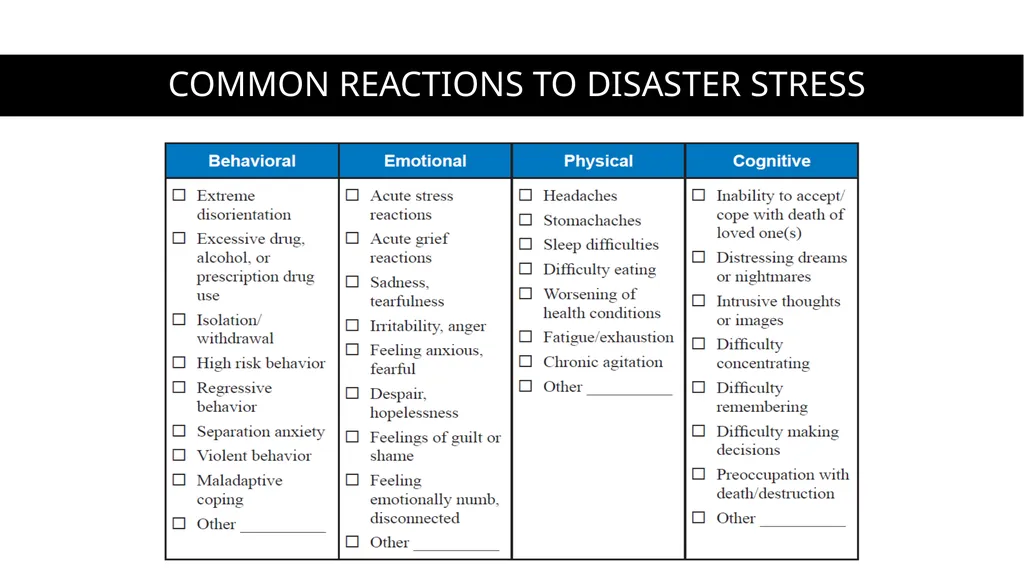
slide7. COMMON REACTIONS TO DISASTER STRESS<br>
slide8. HOW LONG DO THESE THOUGHTS AND FEELINGS LAST? Most people exposed to disasters recover fully from the psychological affects within one year
The most intense reactions will lessen over the first few weeks
If they persist over 4-6 weeks or are so bad they impair functioning then professional help is needed.<br>
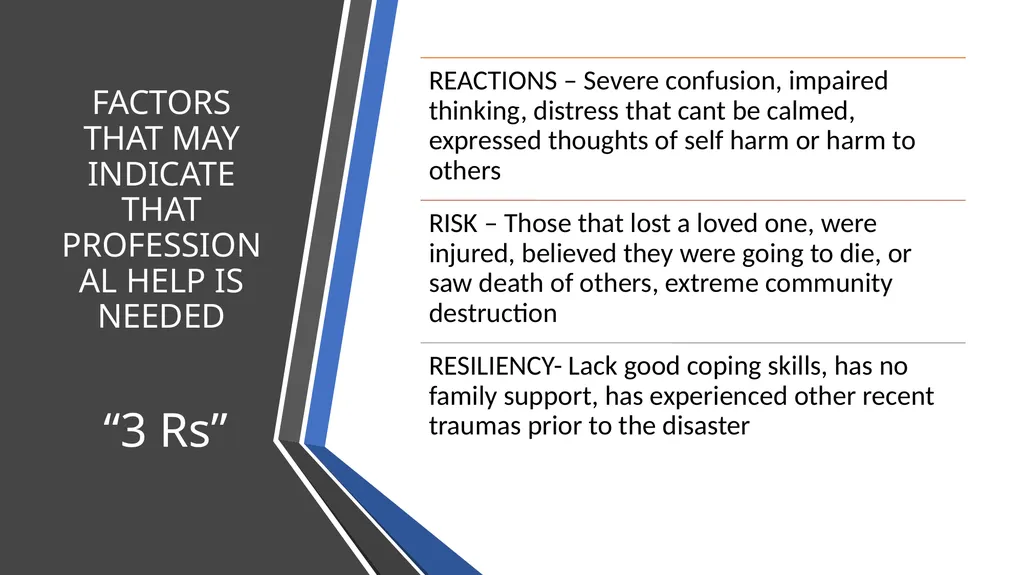
slide9. FACTORS THAT MAY INDICATE THAT PROFESSIONAL HELP IS NEEDED “3 Rs”<br>
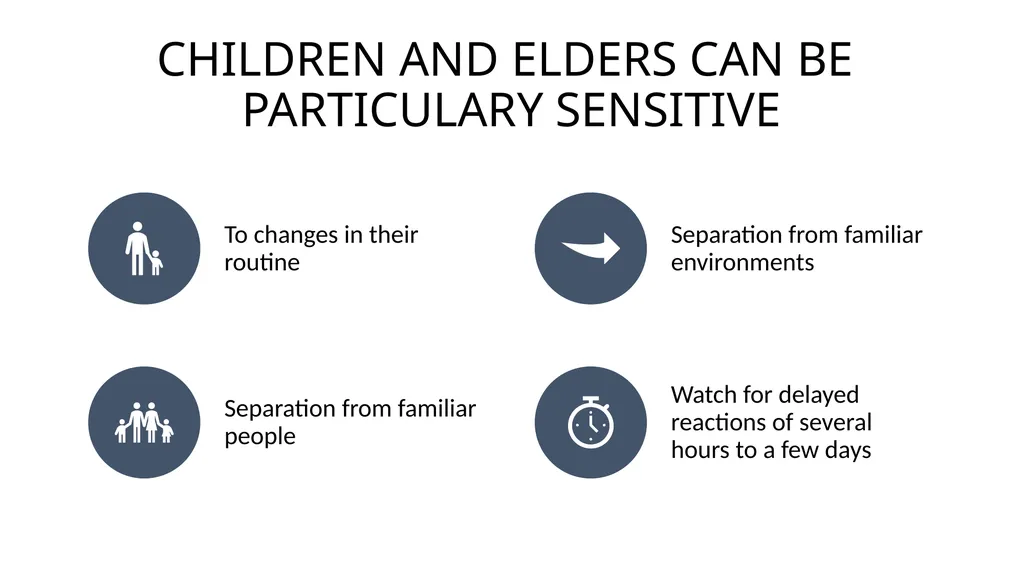
slide10. CHILDREN AND ELDERS CAN BE PARTICULARY SENSITIVE<br>
slide11. MODULE 1 QUIZ 1. All people are impacted by a disaster, even those that come to the area help others.
True/False
2. All people need professional mental health services after a disaster experience
True/False<br>
slide12. MODULE 1 QUIZ (cont.) 3. Common reactions after a disaster include:
a. Feelings of guilt, anger, hopelessness or a loss of control.
b. Difficulty sleeping, remembering, or paying attention
c. Headaches, digestive problems, dizziness, tightness in chest
d. All of the above
4. What does the “3 Rs” stand for?
a. Reactions, Risk factors, Resilience factors
b. Respect, Reassurance, Regular factors
c. Routine, Respect, Rest factors
d. None of the above<br>
slide13. PSYCHOLOGICAL FIRST AID MODULE 2<br>
slide14. PSYCHOLOGICAL FIRST AID (PFA) Is an approach that:
Eases suffering of disaster survivors: both physical and emotional
Improves survivors short term functioning
Promotes emotional recovery after a disaster event<br>
slide15. THE GOAL OF PFA Is to promote an environment of:
Safety
Calm
Connectiveness
Self-reliance
Hope<br>
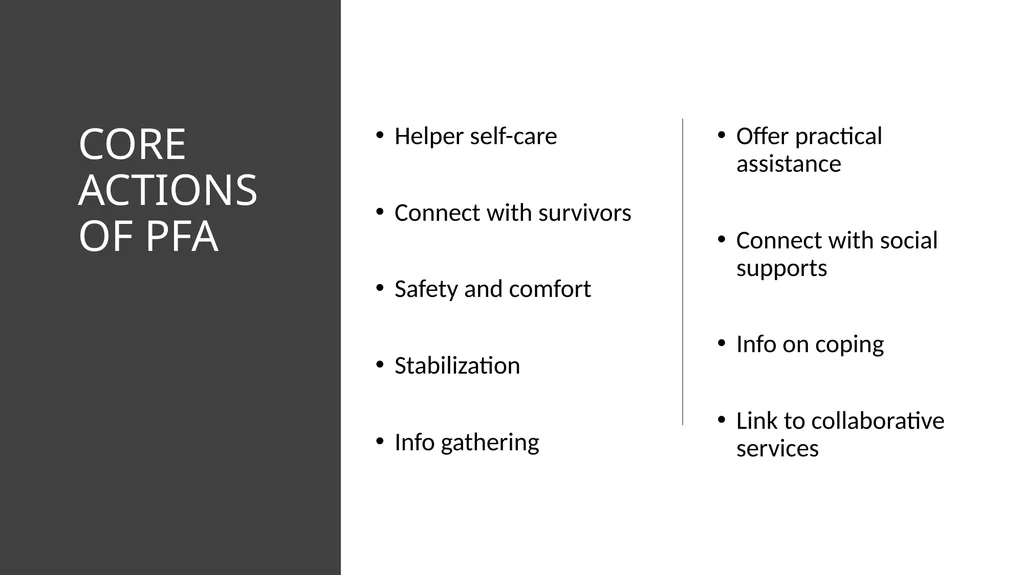
slide16. CORE ACTIONS OF PFA Helper self-care
Connect with survivors
Safety and comfort
Stabilization
Info gathering Offer practical assistance
Connect with social supports
Info on coping
Link to collaborative services<br>
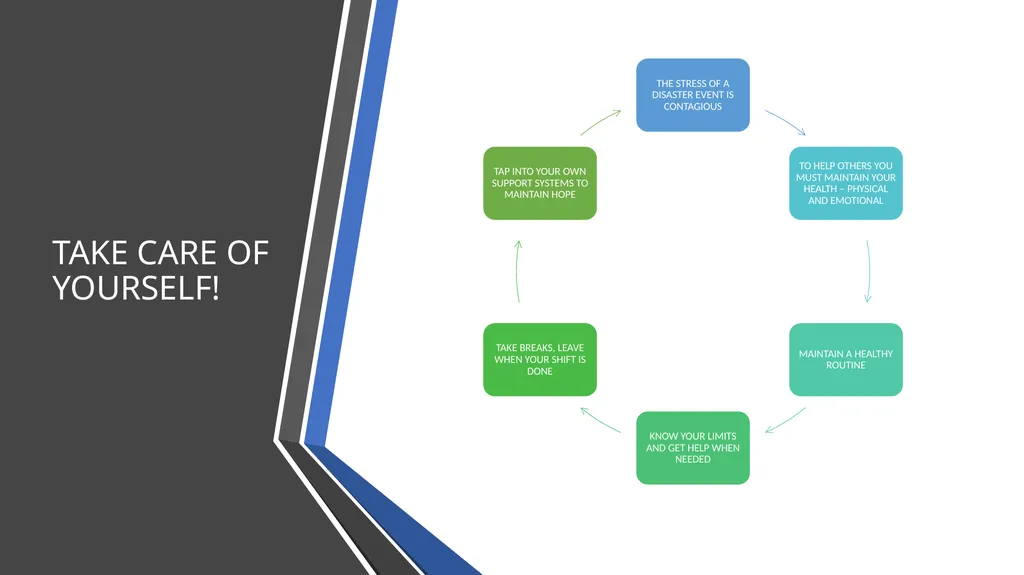
slide17. TAKE CARE OF YOURSELF!<br>
slide18. MAKE A CONNECTION WITH SURVIVORS Make the first move
Intro self and ask permission to talk
Ask about their immediate needs
Present with an air of patience, compassion, and calm
Respect their privacy by finding a quiet place to talk
Don’t approach too closely or touch them if you are not familiar with their cultural background or personal preferences
Protect their confidentiality by sharing their info appropriately<br>
slide19. OFFER SAFETY AND COMFORT Make sure the environment is safe
Help survivors meet their basic immediate needs
Offer physical comforts (food, water, blanket, bathroom)
Ask about their needs for eye glasses, medications, hearing aids
Protect them from additional trauma and trauma reminders (sights and sounds of danger, destruction or suffering)<br>
slide20. SEEK IMMEDIATE PROFESSIONAL HELP IF: The person states a desire to harm themselves or others
The person shows signs of shock:
Clammy ashen skin
Rapid breathing and pulse
Nausea /vomiting
Faintness, dizziness
Extreme agitation<br>
slide21. STABILIZATION Calm and Orient Survivors Use a calm and soothing voice
Give realistic reassurance
What you are feeling is understandable
We are here to help
Calming techniques include:
Cool washcloth to forehead
Stretching, head roll
Clench and release fists
Focus on slow deep breaths
Provide repeated, simple and accurate information
Rumors and the unknown increase stress<br>
slide22. INFORMATION GATHERING Gather information for identification of their needs
Find out the nature and severity of the disaster
Those that have been injured or witnessed injury or death are at greater risk for a severe and prolonged distress reaction
Ask “What are your immediate concerns?
Listen carefully to identify their physical, medical, emotional needs<br>
slide23. INFO GATHERING (Cont.) Don’t give simple reassurances like “Everything will be ok”
Listen in a patient and caring way
Don’t pry or force people to share their stories
Some people want to talk and some don’t
Be patient, and come back a little later if the survivor is not ready to talk<br>
slide24. OFFER PRACTICAL ASSISTANCE Meet immediate physical needs if possible
Clarify what they have told you about their needs and concerns
“So I heard you say that you are most worried about….”
Help them problem solve and develop an action plan for next steps
Assist them in accomplishing those steps by:
Connecting them with internal or external resources
Communicating their needs to appropriate members of your team or community<br>
slide25. CONNECTION WITH SOCIAL SUPPORTS Very important to recovery
Help survivors contact their family, friends, clergy
Sometimes they are reluctant to reach out to loved ones
Don’t want to be a burden
Embarrassed or feel guilty about needing help
Help them to work through these concerns
Assist them to contact a support person they trust when they are ready<br>
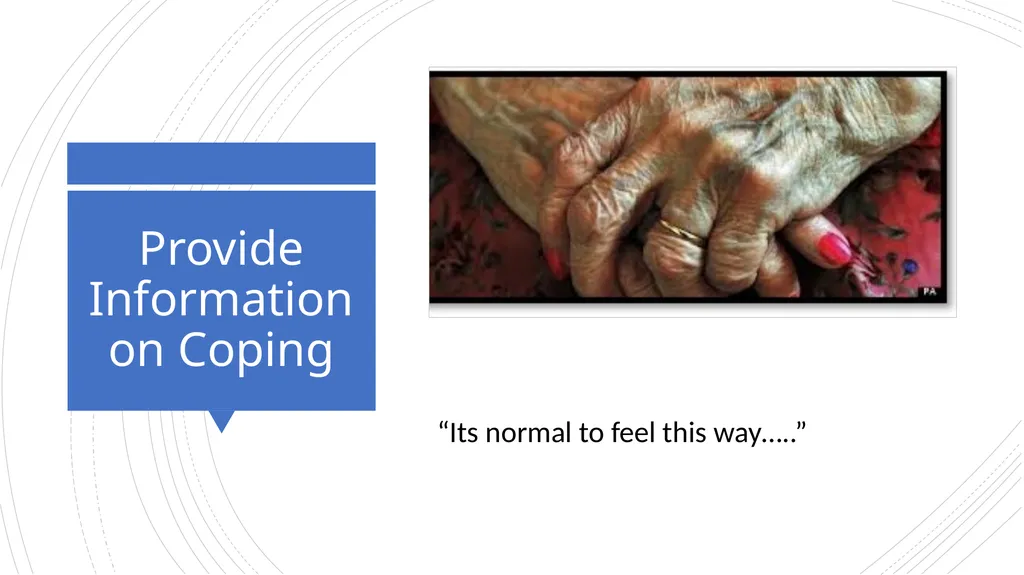
slide26. Provide Information on Coping “Its normal to feel this way…..”<br>
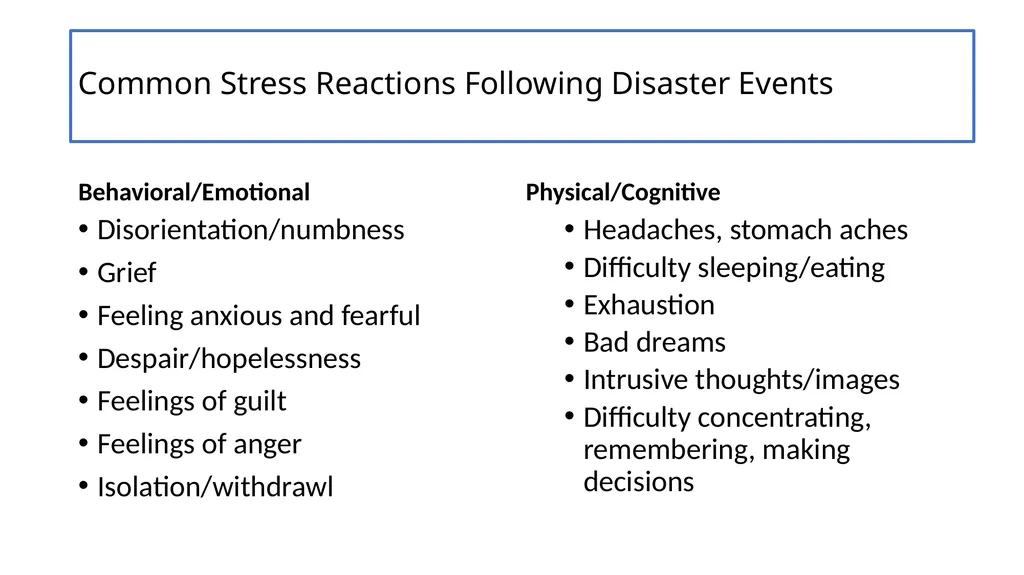
slide27. Common Stress Reactions Following Disaster Events Behavioral/Emotional Disorientation/numbness
Grief
Feeling anxious and fearful
Despair/hopelessness
Feelings of guilt
Feelings of anger
Isolation/withdrawl Physical/Cognitive Headaches, stomach aches
Difficulty sleeping/eating
Exhaustion
Bad dreams
Intrusive thoughts/images
Difficulty concentrating, remembering, making decisions<br>
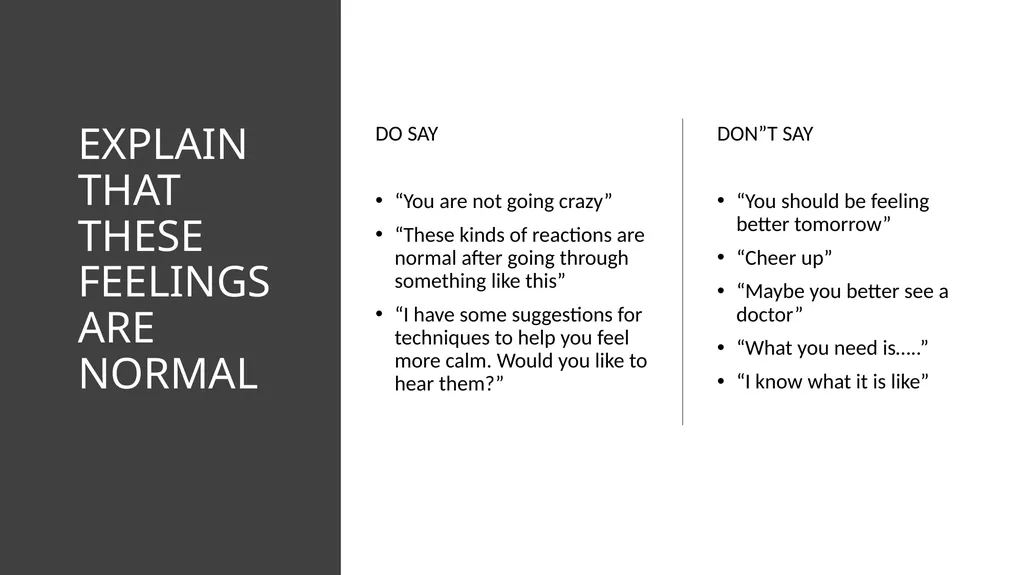
slide28. EXPLAIN THAT THESE FEELINGS ARE NORMAL DO SAY
“You are not going crazy”
“These kinds of reactions are normal after going through something like this”
“I have some suggestions for techniques to help you feel more calm. Would you like to hear them?” DON”T SAY
“You should be feeling better tomorrow”
“Cheer up”
“Maybe you better see a doctor”
“What you need is…..”
“I know what it is like”<br>
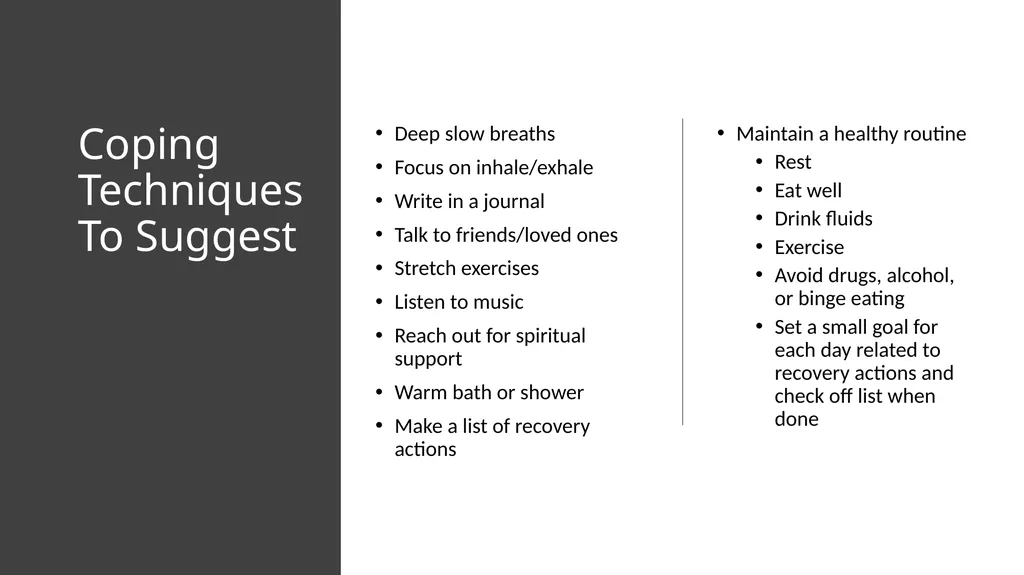
slide29. Coping Techniques To Suggest Deep slow breaths
Focus on inhale/exhale
Write in a journal
Talk to friends/loved ones
Stretch exercises
Listen to music
Reach out for spiritual support
Warm bath or shower
Make a list of recovery actions Maintain a healthy routine
Rest
Eat well
Drink fluids
Exercise
Avoid drugs, alcohol, or binge eating
Set a small goal for each day related to recovery actions and check off list when done<br>
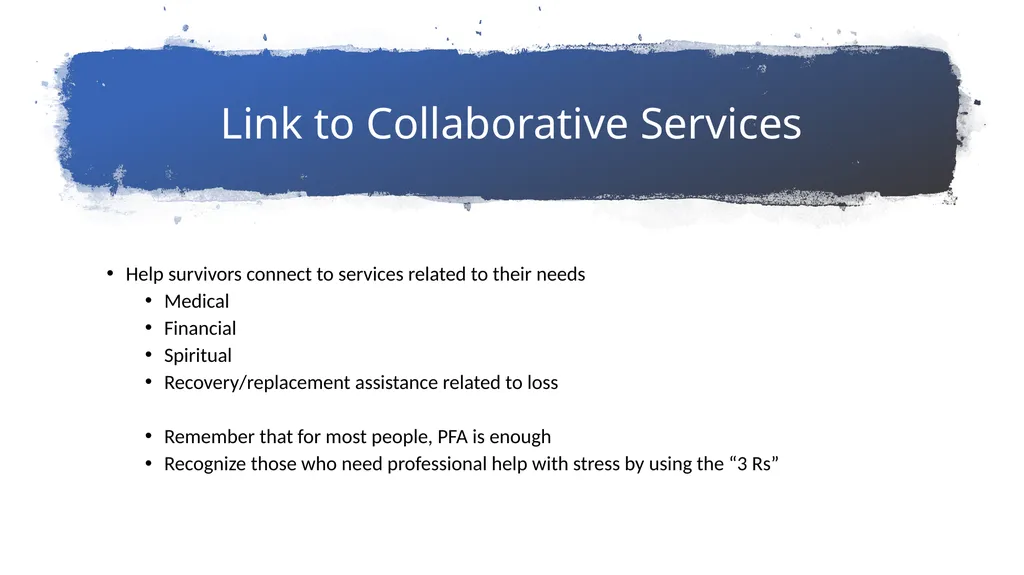
slide30. Link to Collaborative Services Help survivors connect to services related to their needs
Medical
Financial
Spiritual
Recovery/replacement assistance related to loss
Remember that for most people, PFA is enough
Recognize those who need professional help with stress by using the “3 Rs”<br>
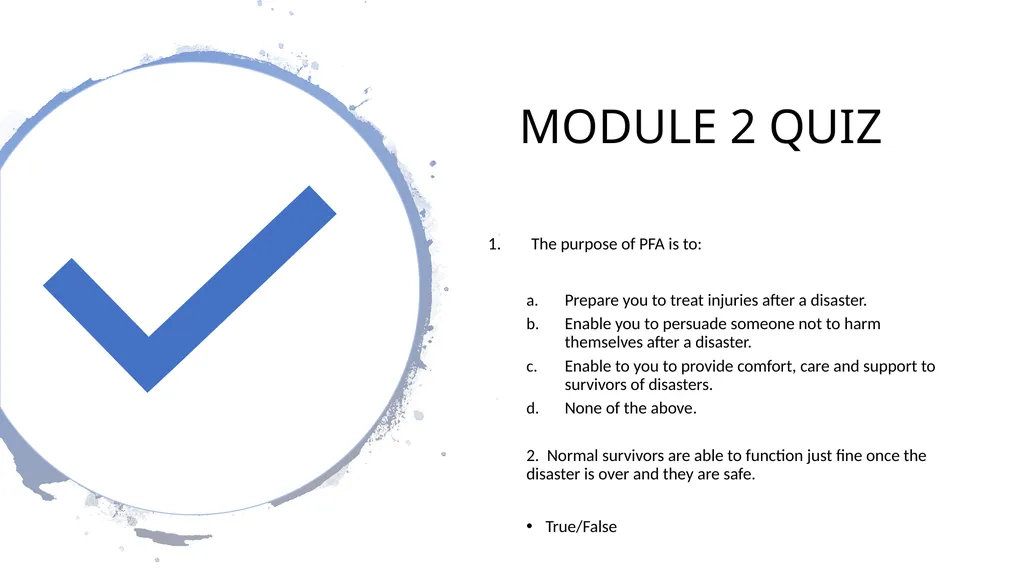
slide31. MODULE 2 QUIZ The purpose of PFA is to:
Prepare you to treat injuries after a disaster.
Enable you to persuade someone not to harm themselves after a disaster.
Enable to you to provide comfort, care and support to survivors of disasters.
None of the above.
2. Normal survivors are able to function just fine once the disaster is over and they are safe.
True/False<br>
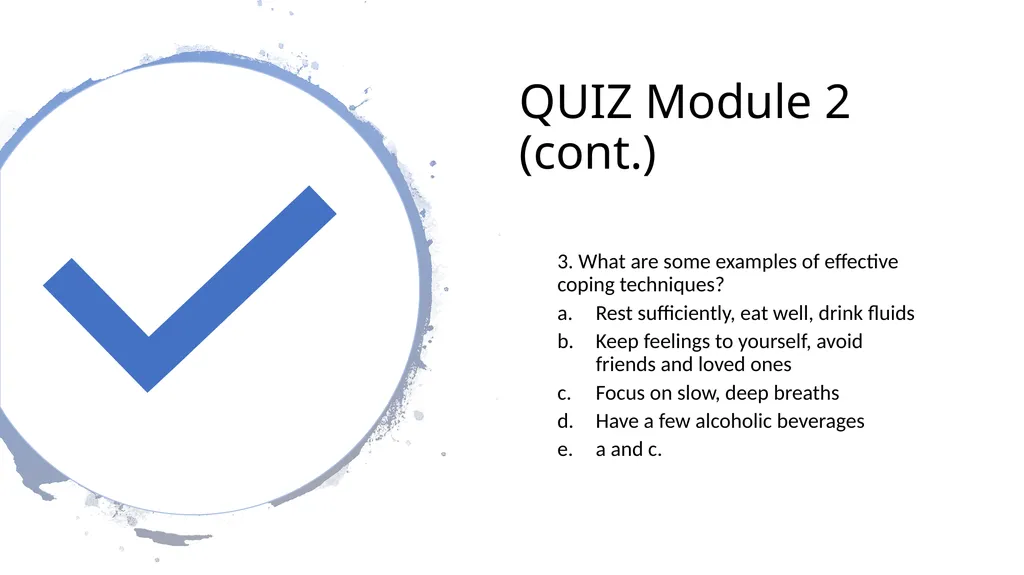
slide32. QUIZ Module 2 (cont.) 3. What are some examples of effective coping techniques?
Rest sufficiently, eat well, drink fluids
Keep feelings to yourself, avoid friends and loved ones
Focus on slow, deep breaths
Have a few alcoholic beverages
a and c.<br>
slide33. PRACTICING PSYCHOLOGICAL FIRST AID MODULE 3<br>
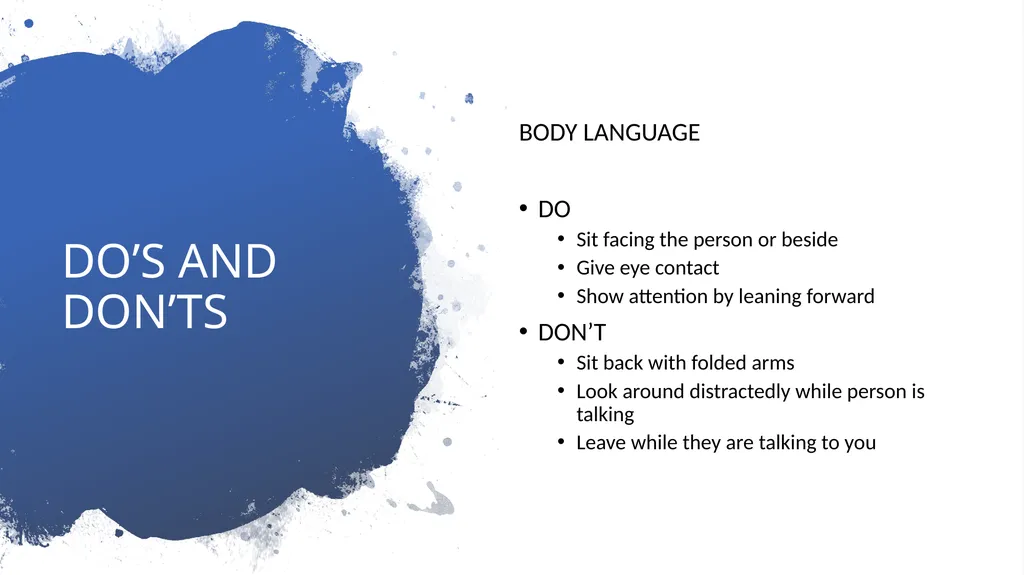
slide34. DO’S AND DON’TS BODY LANGUAGE
DO
Sit facing the person or beside
Give eye contact
Show attention by leaning forward
DON’T
Sit back with folded arms
Look around distractedly while person is talking
Leave while they are talking to you<br>
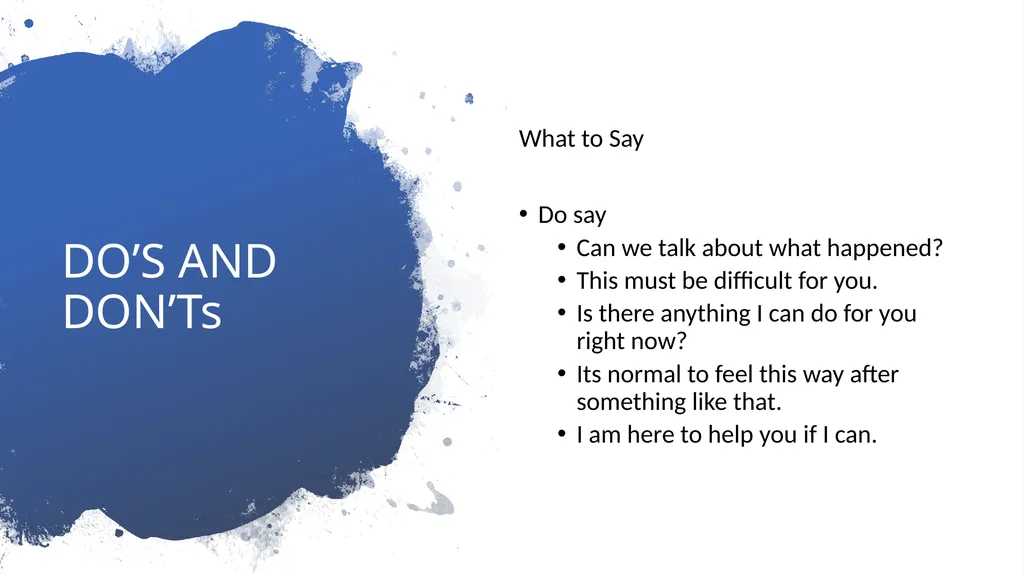
slide35. DO’S AND DON’Ts What to Say
Do say
Can we talk about what happened?
This must be difficult for you.
Is there anything I can do for you right now?
Its normal to feel this way after something like that.
I am here to help you if I can.<br>
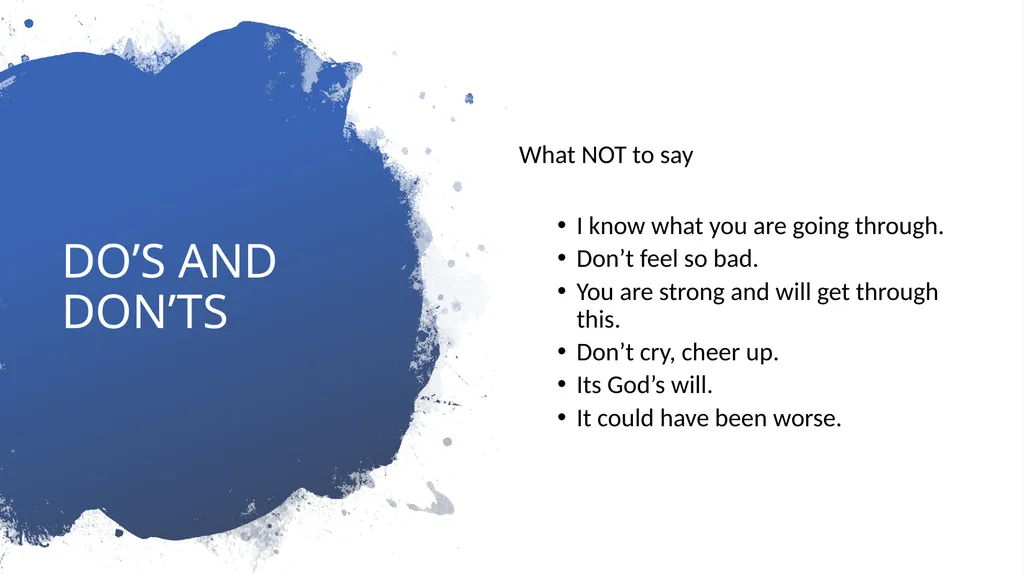
slide36. DO’S AND DON’TS What NOT to say
I know what you are going through.
Don’t feel so bad.
You are strong and will get through this.
Don’t cry, cheer up.
Its God’s will.
It could have been worse.<br>
slide37. LEARNING ACTIVITY – ROLE PLAY PICK A PARTNER
ONE IS SURVIVOR AND ONE IS HELPER
SWITCH ROLES FOR ROLE PLAY #2
PRACTICE THE TECHNIQUES YOU HAVE LEARNED<br>
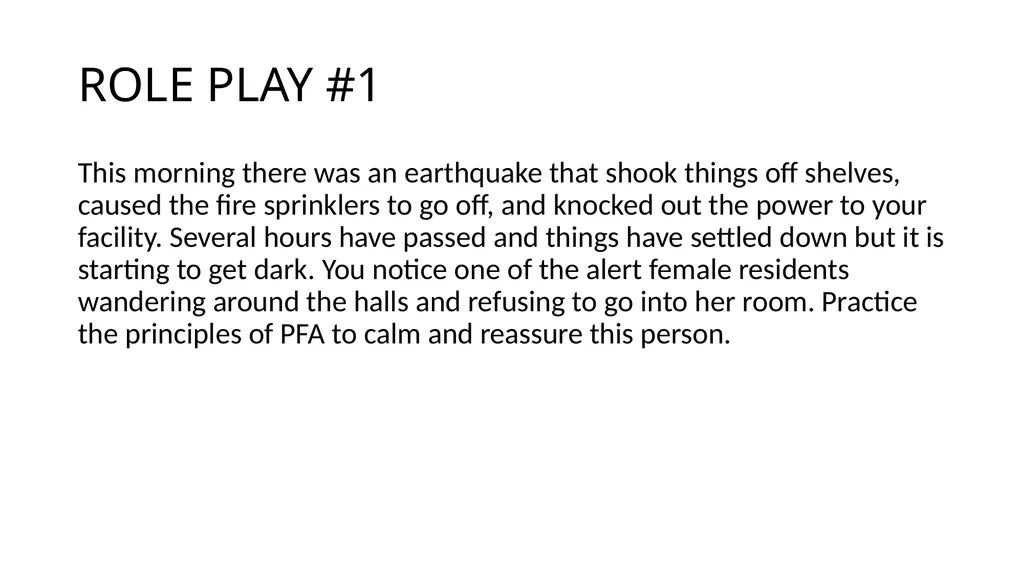
slide38. ROLE PLAY #1 This morning there was an earthquake that shook things off shelves, caused the fire sprinklers to go off, and knocked out the power to your facility. Several hours have passed and things have settled down but it is starting to get dark. You notice one of the alert female residents wandering around the halls and refusing to go into her room. Practice the principles of PFA to calm and reassure this person.<br>
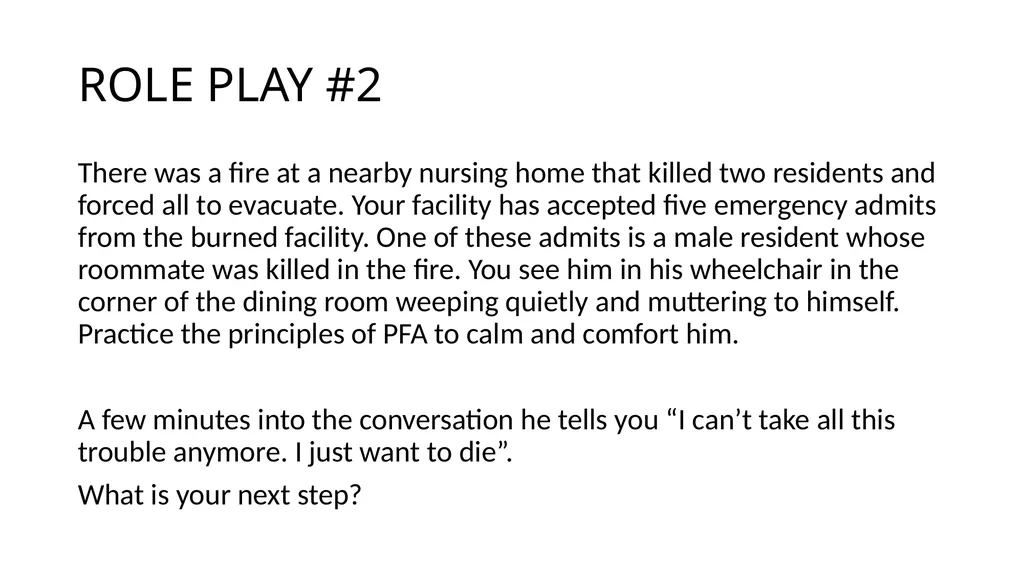
slide39. ROLE PLAY #2 There was a fire at a nearby nursing home that killed two residents and forced all to evacuate. Your facility has accepted five emergency admits from the burned facility. One of these admits is a male resident whose roommate was killed in the fire. You see him in his wheelchair in the corner of the dining room weeping quietly and muttering to himself. Practice the principles of PFA to calm and comfort him.
A few minutes into the conversation he tells you “I can’t take all this trouble anymore. I just want to die”.
What is your next step?<br>
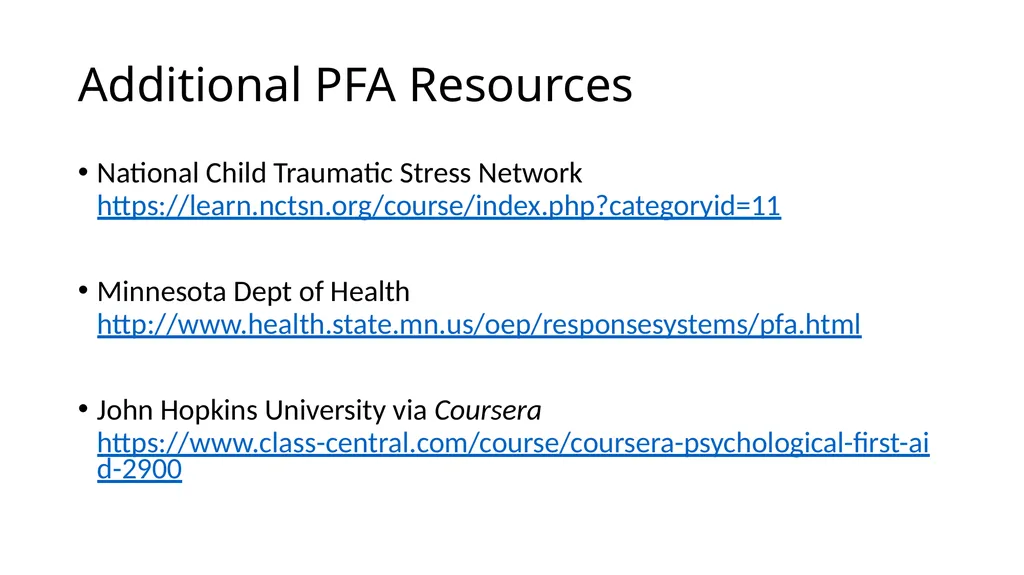
slide40. Additional PFA Resources National Child Traumatic Stress Network https://learn.nctsn.org/course/index.php?categoryid=11
Minnesota Dept of Health http://www.health.state.mn.us/oep/responsesystems/pfa.html
John Hopkins University via Coursera https://www.class-central.com/course/coursera-psychological-first-aid-2900<br>
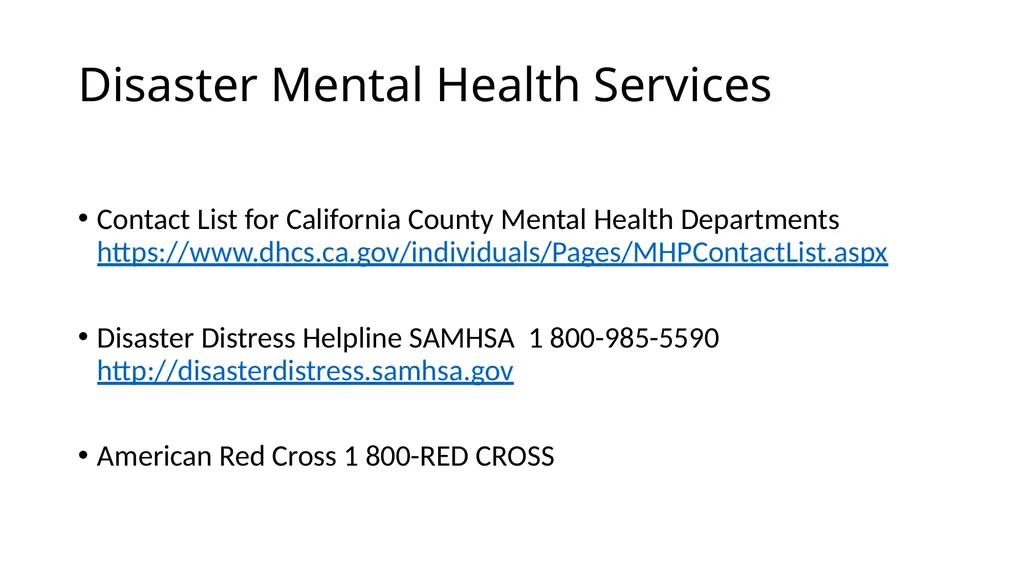
slide41. Disaster Mental Health Services Contact List for California County Mental Health Departments https://www.dhcs.ca.gov/individuals/Pages/MHPContactList.aspx
Disaster Distress Helpline SAMHSA 1 800-985-5590 http://disasterdistress.samhsa.gov
American Red Cross 1 800-RED CROSS<br>
slide42. Questions? Regarding this presentation:
Jocelyn Montgomery, PHN
jocelynmontgomery@gmail.com
Regarding Continuing Education:
Cortney Kesterson, CAHF-DPP Coordinator
ckesterson@cahf.org<br>
slide2. OBJECTIVES Understand the psychological impact of disasters and recognize the common reactions in self and others.
Define the goal and core actions of Psychological First Aid (PFA).
Prepare to provide immediate support to residents and co-workers experiencing disaster-related stress.<br>
slide3. STRESS AND DISASTERS MODULE I<br>
slide4. WHAT IS A “DISASTER”? Wide - scale emergency events that have a severe impact on a community DISASTERS -
Traumatize large populations of people at once
Can result in epidemics of survivor guilt and other psychological symptoms
Create chaotic environment
Multiple stressors
A smaller event that impacts just one household or person can be a disaster for the survivors<br>
slide5. IMPACT OF DISASTERS For a community – depletion of resources and slow recovery
For people –
Everyone who experiences a disaster is affected in some way – Even the helpers!
People pull together
Stress and grief are common reactions to uncommon situations<br>
slide6. REACTIONS Some people will have severe reactions following a disaster event
Most people recover without professional treatment
Survivors often to do not seek or accept help, especially from helpers from outside the community<br>
slide7. COMMON REACTIONS TO DISASTER STRESS<br>
slide8. HOW LONG DO THESE THOUGHTS AND FEELINGS LAST? Most people exposed to disasters recover fully from the psychological affects within one year
The most intense reactions will lessen over the first few weeks
If they persist over 4-6 weeks or are so bad they impair functioning then professional help is needed.<br>
slide9. FACTORS THAT MAY INDICATE THAT PROFESSIONAL HELP IS NEEDED “3 Rs”<br>
slide10. CHILDREN AND ELDERS CAN BE PARTICULARY SENSITIVE<br>
slide11. MODULE 1 QUIZ 1. All people are impacted by a disaster, even those that come to the area help others.
True/False
2. All people need professional mental health services after a disaster experience
True/False<br>
slide12. MODULE 1 QUIZ (cont.) 3. Common reactions after a disaster include:
a. Feelings of guilt, anger, hopelessness or a loss of control.
b. Difficulty sleeping, remembering, or paying attention
c. Headaches, digestive problems, dizziness, tightness in chest
d. All of the above
4. What does the “3 Rs” stand for?
a. Reactions, Risk factors, Resilience factors
b. Respect, Reassurance, Regular factors
c. Routine, Respect, Rest factors
d. None of the above<br>
slide13. PSYCHOLOGICAL FIRST AID MODULE 2<br>
slide14. PSYCHOLOGICAL FIRST AID (PFA) Is an approach that:
Eases suffering of disaster survivors: both physical and emotional
Improves survivors short term functioning
Promotes emotional recovery after a disaster event<br>
slide15. THE GOAL OF PFA Is to promote an environment of:
Safety
Calm
Connectiveness
Self-reliance
Hope<br>
slide16. CORE ACTIONS OF PFA Helper self-care
Connect with survivors
Safety and comfort
Stabilization
Info gathering Offer practical assistance
Connect with social supports
Info on coping
Link to collaborative services<br>
slide17. TAKE CARE OF YOURSELF!<br>
slide18. MAKE A CONNECTION WITH SURVIVORS Make the first move
Intro self and ask permission to talk
Ask about their immediate needs
Present with an air of patience, compassion, and calm
Respect their privacy by finding a quiet place to talk
Don’t approach too closely or touch them if you are not familiar with their cultural background or personal preferences
Protect their confidentiality by sharing their info appropriately<br>
slide19. OFFER SAFETY AND COMFORT Make sure the environment is safe
Help survivors meet their basic immediate needs
Offer physical comforts (food, water, blanket, bathroom)
Ask about their needs for eye glasses, medications, hearing aids
Protect them from additional trauma and trauma reminders (sights and sounds of danger, destruction or suffering)<br>
slide20. SEEK IMMEDIATE PROFESSIONAL HELP IF: The person states a desire to harm themselves or others
The person shows signs of shock:
Clammy ashen skin
Rapid breathing and pulse
Nausea /vomiting
Faintness, dizziness
Extreme agitation<br>
slide21. STABILIZATION Calm and Orient Survivors Use a calm and soothing voice
Give realistic reassurance
What you are feeling is understandable
We are here to help
Calming techniques include:
Cool washcloth to forehead
Stretching, head roll
Clench and release fists
Focus on slow deep breaths
Provide repeated, simple and accurate information
Rumors and the unknown increase stress<br>
slide22. INFORMATION GATHERING Gather information for identification of their needs
Find out the nature and severity of the disaster
Those that have been injured or witnessed injury or death are at greater risk for a severe and prolonged distress reaction
Ask “What are your immediate concerns?
Listen carefully to identify their physical, medical, emotional needs<br>
slide23. INFO GATHERING (Cont.) Don’t give simple reassurances like “Everything will be ok”
Listen in a patient and caring way
Don’t pry or force people to share their stories
Some people want to talk and some don’t
Be patient, and come back a little later if the survivor is not ready to talk<br>
slide24. OFFER PRACTICAL ASSISTANCE Meet immediate physical needs if possible
Clarify what they have told you about their needs and concerns
“So I heard you say that you are most worried about….”
Help them problem solve and develop an action plan for next steps
Assist them in accomplishing those steps by:
Connecting them with internal or external resources
Communicating their needs to appropriate members of your team or community<br>
slide25. CONNECTION WITH SOCIAL SUPPORTS Very important to recovery
Help survivors contact their family, friends, clergy
Sometimes they are reluctant to reach out to loved ones
Don’t want to be a burden
Embarrassed or feel guilty about needing help
Help them to work through these concerns
Assist them to contact a support person they trust when they are ready<br>
slide26. Provide Information on Coping “Its normal to feel this way…..”<br>
slide27. Common Stress Reactions Following Disaster Events Behavioral/Emotional Disorientation/numbness
Grief
Feeling anxious and fearful
Despair/hopelessness
Feelings of guilt
Feelings of anger
Isolation/withdrawl Physical/Cognitive Headaches, stomach aches
Difficulty sleeping/eating
Exhaustion
Bad dreams
Intrusive thoughts/images
Difficulty concentrating, remembering, making decisions<br>
slide28. EXPLAIN THAT THESE FEELINGS ARE NORMAL DO SAY
“You are not going crazy”
“These kinds of reactions are normal after going through something like this”
“I have some suggestions for techniques to help you feel more calm. Would you like to hear them?” DON”T SAY
“You should be feeling better tomorrow”
“Cheer up”
“Maybe you better see a doctor”
“What you need is…..”
“I know what it is like”<br>
slide29. Coping Techniques To Suggest Deep slow breaths
Focus on inhale/exhale
Write in a journal
Talk to friends/loved ones
Stretch exercises
Listen to music
Reach out for spiritual support
Warm bath or shower
Make a list of recovery actions Maintain a healthy routine
Rest
Eat well
Drink fluids
Exercise
Avoid drugs, alcohol, or binge eating
Set a small goal for each day related to recovery actions and check off list when done<br>
slide30. Link to Collaborative Services Help survivors connect to services related to their needs
Medical
Financial
Spiritual
Recovery/replacement assistance related to loss
Remember that for most people, PFA is enough
Recognize those who need professional help with stress by using the “3 Rs”<br>
slide31. MODULE 2 QUIZ The purpose of PFA is to:
Prepare you to treat injuries after a disaster.
Enable you to persuade someone not to harm themselves after a disaster.
Enable to you to provide comfort, care and support to survivors of disasters.
None of the above.
2. Normal survivors are able to function just fine once the disaster is over and they are safe.
True/False<br>
slide32. QUIZ Module 2 (cont.) 3. What are some examples of effective coping techniques?
Rest sufficiently, eat well, drink fluids
Keep feelings to yourself, avoid friends and loved ones
Focus on slow, deep breaths
Have a few alcoholic beverages
a and c.<br>
slide33. PRACTICING PSYCHOLOGICAL FIRST AID MODULE 3<br>
slide34. DO’S AND DON’TS BODY LANGUAGE
DO
Sit facing the person or beside
Give eye contact
Show attention by leaning forward
DON’T
Sit back with folded arms
Look around distractedly while person is talking
Leave while they are talking to you<br>
slide35. DO’S AND DON’Ts What to Say
Do say
Can we talk about what happened?
This must be difficult for you.
Is there anything I can do for you right now?
Its normal to feel this way after something like that.
I am here to help you if I can.<br>
slide36. DO’S AND DON’TS What NOT to say
I know what you are going through.
Don’t feel so bad.
You are strong and will get through this.
Don’t cry, cheer up.
Its God’s will.
It could have been worse.<br>
slide37. LEARNING ACTIVITY – ROLE PLAY PICK A PARTNER
ONE IS SURVIVOR AND ONE IS HELPER
SWITCH ROLES FOR ROLE PLAY #2
PRACTICE THE TECHNIQUES YOU HAVE LEARNED<br>
slide38. ROLE PLAY #1 This morning there was an earthquake that shook things off shelves, caused the fire sprinklers to go off, and knocked out the power to your facility. Several hours have passed and things have settled down but it is starting to get dark. You notice one of the alert female residents wandering around the halls and refusing to go into her room. Practice the principles of PFA to calm and reassure this person.<br>
slide39. ROLE PLAY #2 There was a fire at a nearby nursing home that killed two residents and forced all to evacuate. Your facility has accepted five emergency admits from the burned facility. One of these admits is a male resident whose roommate was killed in the fire. You see him in his wheelchair in the corner of the dining room weeping quietly and muttering to himself. Practice the principles of PFA to calm and comfort him.
A few minutes into the conversation he tells you “I can’t take all this trouble anymore. I just want to die”.
What is your next step?<br>
slide40. Additional PFA Resources National Child Traumatic Stress Network https://learn.nctsn.org/course/index.php?categoryid=11
Minnesota Dept of Health http://www.health.state.mn.us/oep/responsesystems/pfa.html
John Hopkins University via Coursera https://www.class-central.com/course/coursera-psychological-first-aid-2900<br>
slide41. Disaster Mental Health Services Contact List for California County Mental Health Departments https://www.dhcs.ca.gov/individuals/Pages/MHPContactList.aspx
Disaster Distress Helpline SAMHSA 1 800-985-5590 http://disasterdistress.samhsa.gov
American Red Cross 1 800-RED CROSS<br>
slide42. Questions? Regarding this presentation:
Jocelyn Montgomery, PHN
jocelynmontgomery@gmail.com
Regarding Continuing Education:
Cortney Kesterson, CAHF-DPP Coordinator
ckesterson@cahf.org<br>