Psychological Safety for Improvement: - Enabling Team Voices A practical guide to help teams and leaders Rachel Trask interim Assistant Director ABCi - ABUHB BHNOG Conference 27th April 2022 Background Psychological safety is not a new
"Psychological Safety for Improvement: - Enabling" is the property of its rightful owner. Permission is granted to
download and print the materials on this website for personal, non-commercial use only, and to display it
on your personal computer provided you do not modify the materials and that you retain all copyright
notices contained in the materials. By downloading content from our website, you accept the terms of this
agreement.
Presentation Transcript
01
Psychological Safety for Improvement: - Enabling Team Voices A practical guide to help teams and leaders Rachel Trask – interim Assistant Director ABCi - ABUHB
BHNOG Conference 27th April 2022<br>
02
Background Psychological safety is not a new construct.
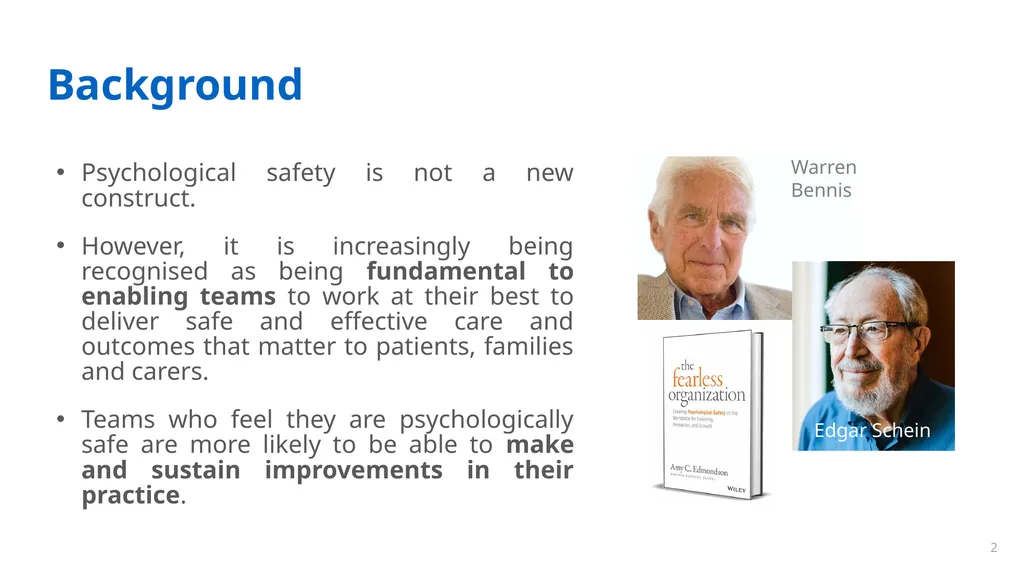
However, it is increasingly being recognised as being fundamental to enabling teams to work at their best to deliver safe and effective care and outcomes that matter to patients, families and carers.
Teams who feel they are psychologically safe are more likely to be able to make and sustain improvements in their practice. 2<br>
03
Why is Psychological Safety important? Psychological safety minimises fear and enables people to be and work at their best in their teams to deliver safe and effective care.
Because …
… ‘the problems fear creates result in bad data, ineffective decision making and the destruction of joy in work.’ (Deming Institute) 3<br>
04
4 Neither psychological safety is a ‘nice to have’ nor something ‘soft and fluffy’.
It requires inclusive leadership to create an environment in which teams can flourish to deliver safe and effective patient care.
That is, leadership that draws on the qualities of kindness and humility and the core skills of listening and asking open questions.
‘How very little can be done under the spirit of fear.’ (Florence Nightingale)<br>
05
The effect of Psychological Safety Research tells us that when psychological safety is high,
nurses speak about errors more often.
people are more committed to the organisation and to patient safety.
there is a reduction in work-arounds.
team-based learning in QI is more likely to happen.
engagement and performance is more likely to be high.
organisations are more able to learn from failure. 5<br>
06
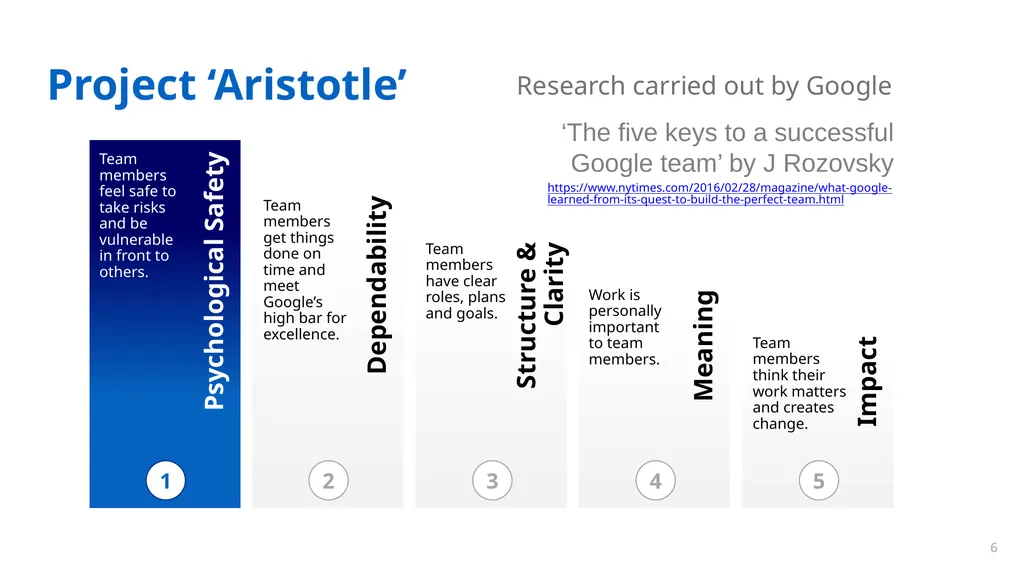
Project ‘Aristotle’ 6 Research carried out by Google ‘The five keys to a successful Google team’ by J Rozovsky https://www.nytimes.com/2016/02/28/magazine/what-google-learned-from-its-quest-to-build-the-perfect-team.html 1 2 3 4 5<br>
07
How to pin down Psychological Safety Definition
“The belief that the work environment is safe for interpersonal risk taking and that people feel able to speak up with relevant ideas, questions, concerns or mistakes without fear of being punished or humiliated.”
(Edmondson 2018)
TED Talk: Amy Edmondson on Psychological Safety
https://www.youtube.com/watch?v=LhoLuui9gX8<br>
08
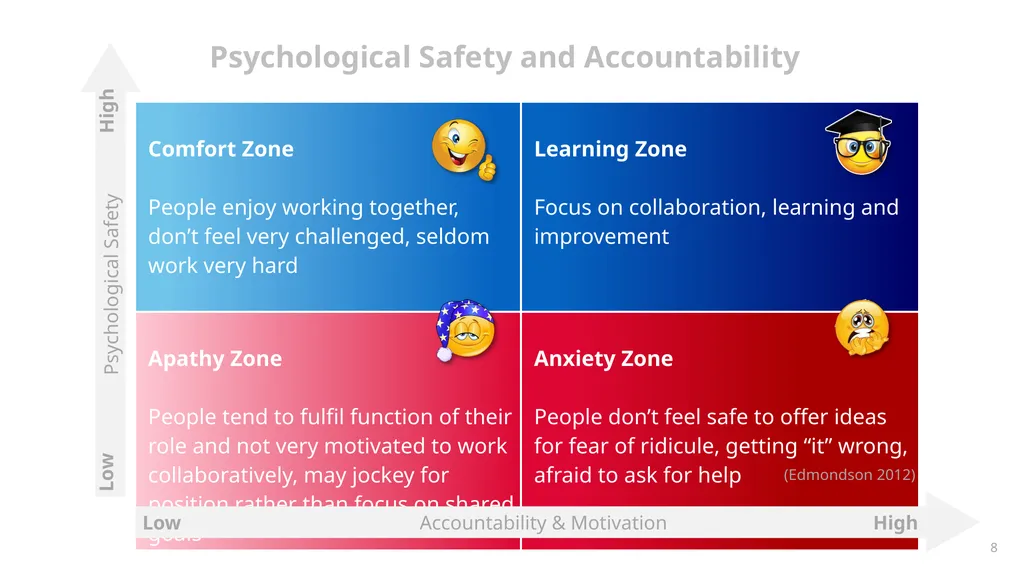
(Edmondson 2012) Psychological Safety and Accountability 8<br>
09
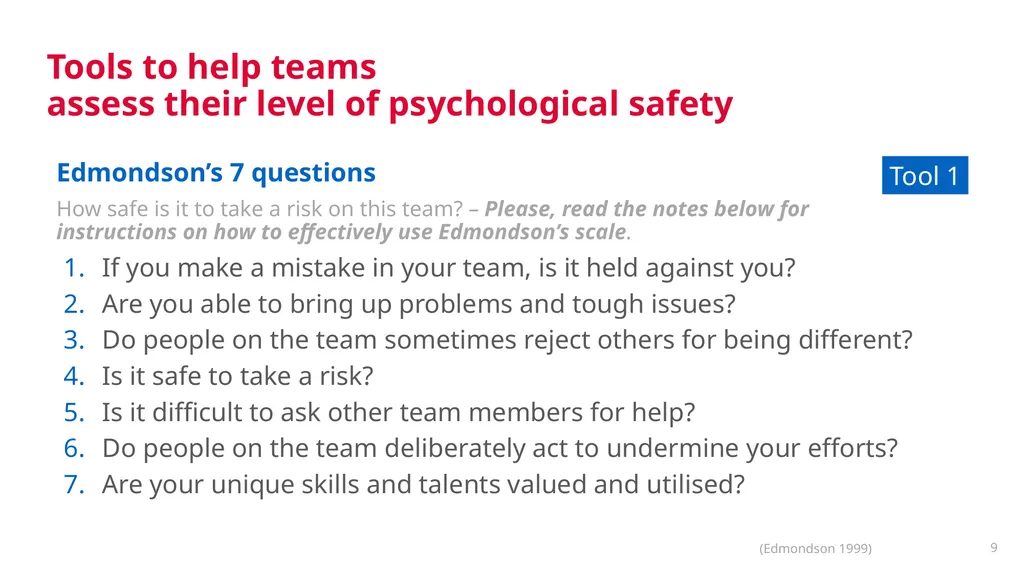
Tools to help teams assess their level of psychological safety Edmondson’s 7 questions
How safe is it to take a risk on this team? – Please, read the notes below for instructions on how to effectively use Edmondson’s scale.
If you make a mistake in your team, is it held against you?
Are you able to bring up problems and tough issues?
Do people on the team sometimes reject others for being different?
Is it safe to take a risk?
Is it difficult to ask other team members for help?
Do people on the team deliberately act to undermine your efforts?
Are your unique skills and talents valued and utilised? 9 Tool 1 (Edmondson 1999)<br>
10
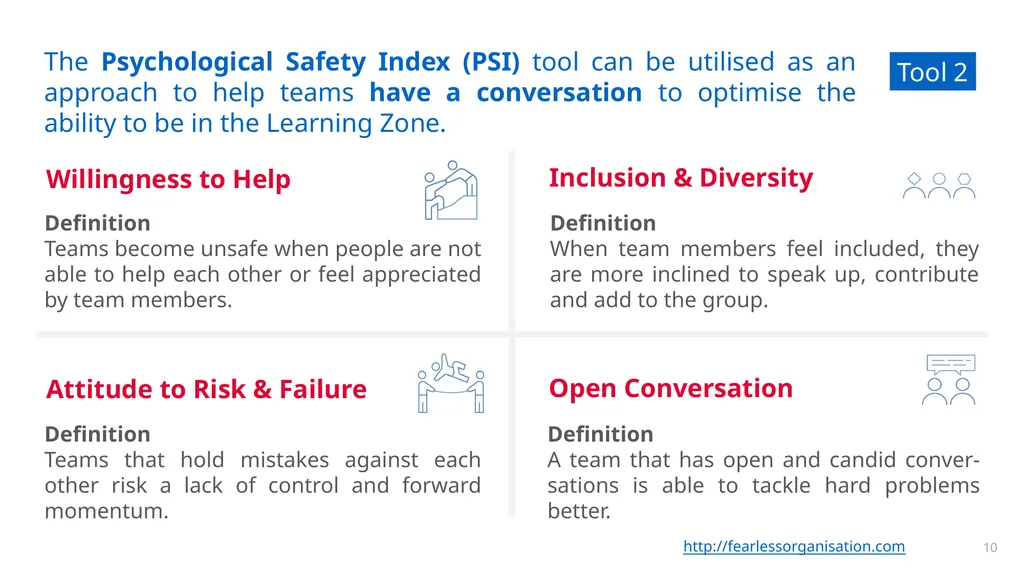
Open Conversation Willingness to Help Inclusion & Diversity Attitude to Risk & Failure Definition
Teams that hold mistakes against each other risk a lack of control and forward momentum. Definition
Teams become unsafe when people are not able to help each other or feel appreciated by team members. Definition
When team members feel included, they are more inclined to speak up, contribute and add to the group. Definition
A team that has open and candid conver-sations is able to tackle hard problems better. Tool 2 The Psychological Safety Index (PSI) tool can be utilised as an approach to help teams have a conversation to optimise the ability to be in the Learning Zone. 10 http://fearlessorganisation.com<br>
11
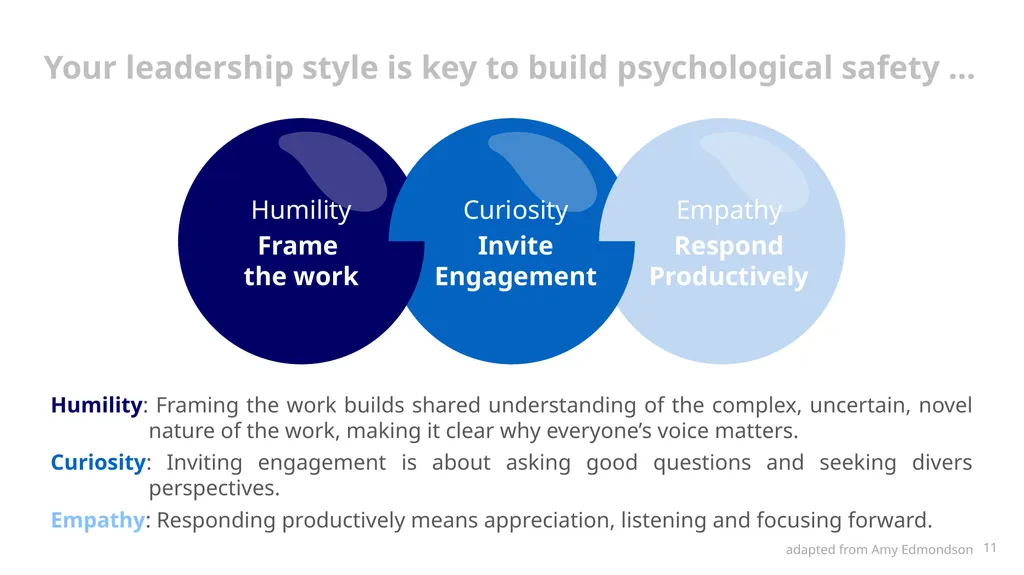
11 Your leadership style is key to build psychological safety … Humility: Framing the work builds shared understanding of the complex, uncertain, novel nature of the work, making it clear why everyone’s voice matters.
Curiosity: Inviting engagement is about asking good questions and seeking divers perspectives.
Empathy: Responding productively means appreciation, listening and focusing forward. Humility
Frame the work Empathy
Respond Productively Curiosity
Invite Engagement adapted from Amy Edmondson<br>
12
What leaders can do to create a psychologically safe environment in which individuals and teams can flourish Be visible, curious and approachable – it encourages productive conversations.
Demonstrate humility by admitting lacking of knowledge and asking open questions.
Be open and willing to display fallibility & acknowledge failures – it will help others speak up.
Value active participation from staff, service users & carers – it facilitates engagement.
Use straightforward language – it encourages clarity and enables learning.
Set boundaries, be clear about what is acceptable & what not – it helps people to feel safe.
Hold people accountable – this facilitates follow through.
Frame work as learning problems, as opposed to execution problems – it reduces fear and deepens the learning. 12 (Schein 1999, Edmondson 2018)<br>
13
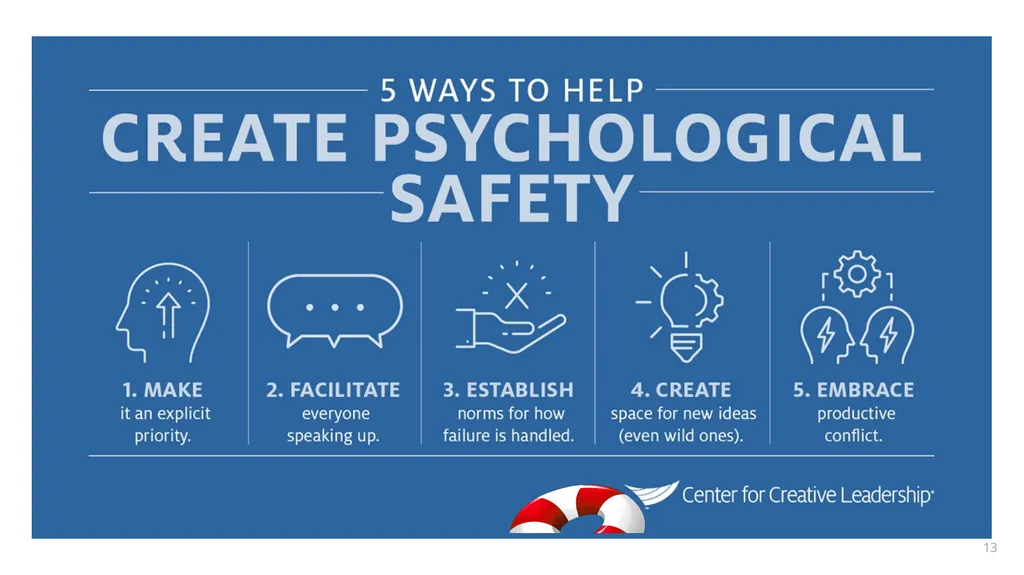
13<br>
14
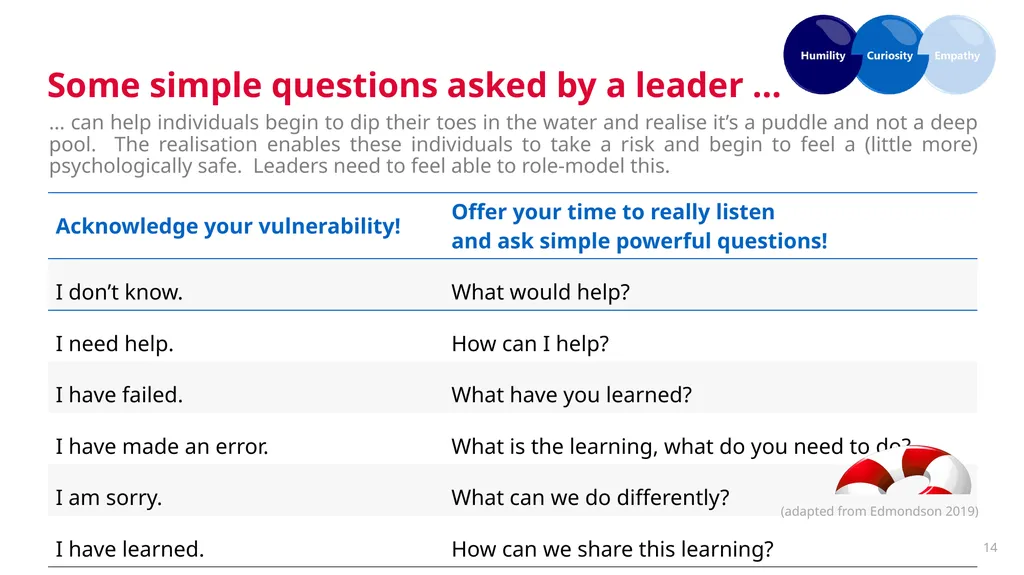
14 Some simple questions asked by a leader … … can help individuals begin to dip their toes in the water and realise it’s a puddle and not a deep pool. The realisation enables these individuals to take a risk and begin to feel a (little more) psychologically safe. Leaders need to feel able to role-model this. (adapted from Edmondson 2019)<br>
15
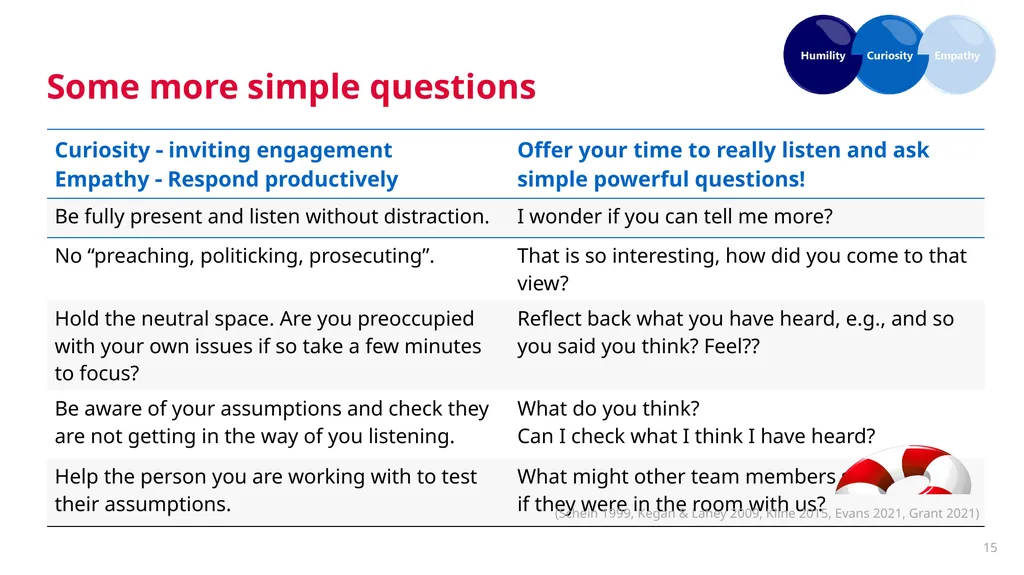
Some more simple questions 15 (Schein 1999, Kegan & Lahey 2009, Kline 2015, Evans 2021, Grant 2021)<br>
16
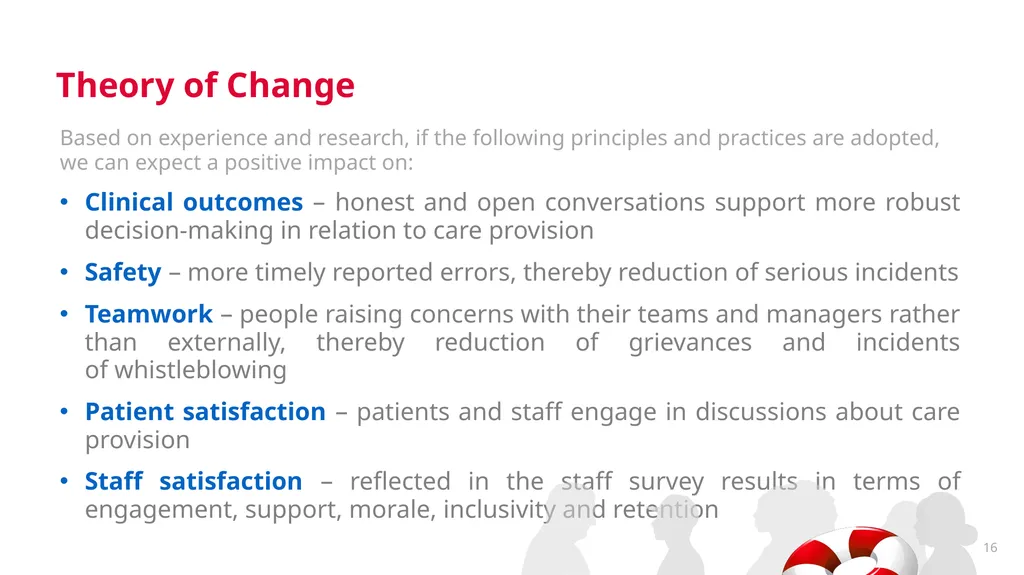
16 Theory of Change Based on experience and research, if the following principles and practices are adopted, we can expect a positive impact on:
Clinical outcomes – honest and open conversations support more robust decision-making in relation to care provision
Safety – more timely reported errors, thereby reduction of serious incidents
Teamwork – people raising concerns with their teams and managers rather than externally, thereby reduction of grievances and incidents of whistleblowing
Patient satisfaction – patients and staff engage in discussions about care provision
Staff satisfaction – reflected in the staff survey results in terms of engagement, support, morale, inclusivity and retention<br>
17
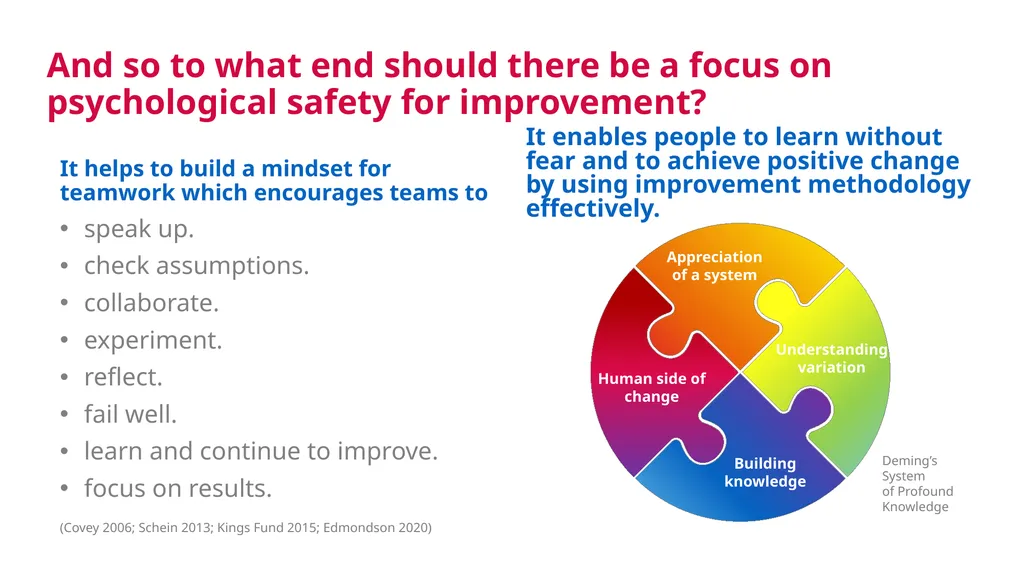
And so to what end should there be a focus on psychological safety for improvement? It enables people to learn without fear and to achieve positive change by using improvement methodology effectively. Appreciation of a system Building knowledge Understanding variation Human side of change It helps to build a mindset for teamwork which encourages teams to
speak up.
check assumptions.
collaborate.
experiment.
reflect.
fail well.
learn and continue to improve.
focus on results.
(Covey 2006; Schein 2013; Kings Fund 2015; Edmondson 2020) Deming’s System of Profound Knowledge<br>
18
Lets explore Psychological Safety In groups on your tables:
Reflect on what you have heard about psychological safety, at an individual, team or system level
What would a system look like, that would enable people to report when things have gone wrong?
Back to the room – Debrief – overall thoughts, reflections, ideas? 18<br>