
Psychotherapy BORDERLINE PERSONALITY DISORDER: A
PT
Published · 66 slides · 0 views
1 / 1


















Description
Psychotherapy BORDERLINE PERSONALITY DISORDER: A PSYCHOLOGICAL PERSPECTIVE Borderline Personality Disorder: A Psychological Perspective Aims and Objectives (from handbook) Understand emotionally unstable personality disorder from a
Related Topics
Share
Embed code
Download this presentation From Below
"Psychotherapy BORDERLINE PERSONALITY DISORDER: A" is the property of its rightful owner. Permission is granted to download and print the materials on this website for personal, non-commercial use only, and to display it on your personal computer provided you do not modify the materials and that you retain all copyright notices contained in the materials. By downloading content from our website, you accept the terms of this agreement.
Presentation Transcript
01
Psychotherapy BORDERLINE PERSONALITY DISORDER:
A PSYCHOLOGICAL PERSPECTIVE<br>
02
Borderline Personality Disorder: A Psychological Perspective Aims and Objectives (from handbook) Understand emotionally unstable personality disorder from a psychological /psychotherapy perspective.
To gain a more detailed understanding of at least one of the newer therapy approaches to EUPD.<br>
To gain a more detailed understanding of at least one of the newer therapy approaches to EUPD.<br>
03
BPD: A Psychological Perspective To achieve this Case Presentation
Journal Club
555 Presentation
Expert-Led Session
MCQs
Please sign the register and complete the feedback<br>
Journal Club
555 Presentation
Expert-Led Session
MCQs
Please sign the register and complete the feedback<br>
04
BPD: A Psychological Perspective Expert Led Session Borderline Personality Disorder: A Psychological Perspective
Author: Dr. Adam Dierckx
Consultant Medical Psychotherapist<br>
Author: Dr. Adam Dierckx
Consultant Medical Psychotherapist<br>
05
OVERVIEW Personality and PD
BPD – background
Aetiology
NICE Guidance
Treatment approaches
Clinical traps and tips<br>
BPD – background
Aetiology
NICE Guidance
Treatment approaches
Clinical traps and tips<br>
06
PERSONALITY Self
vs
Personality
Self as organizing principle for personality traits
or
Self = subjective (how we see ourselves)
Personality = objective (how others see us)
Traits / Dimensions cf. Categories<br>
vs
Personality
Self as organizing principle for personality traits
or
Self = subjective (how we see ourselves)
Personality = objective (how others see us)
Traits / Dimensions cf. Categories<br>
07
PERSONALITY DISORDER Intrapersonal
What goes on inside – e.g. affect regulation
Interpersonal
Between people – e.g. conflict, dependence
Social
Within society – i.e how you fit in and adapt
You can’t have PD on a desert island!<br>
What goes on inside – e.g. affect regulation
Interpersonal
Between people – e.g. conflict, dependence
Social
Within society – i.e how you fit in and adapt
You can’t have PD on a desert island!<br>
08
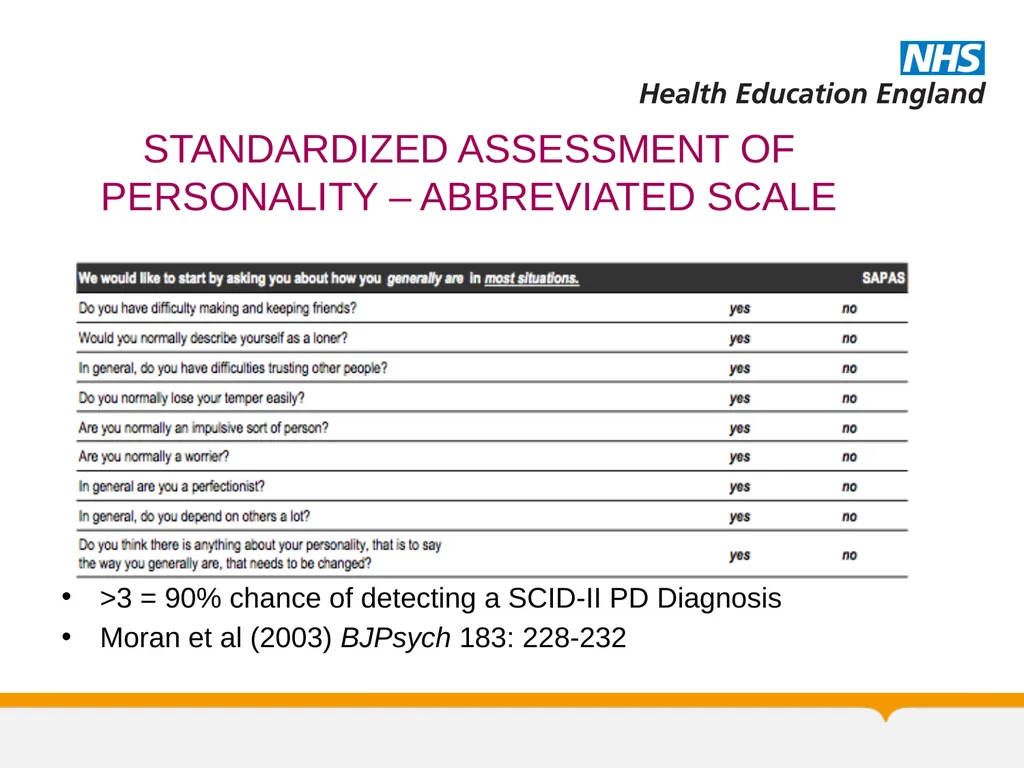
STANDARDIZED ASSESSMENT OF PERSONALITY – ABBREVIATED SCALE >3 = 90% chance of detecting a SCID-II PD Diagnosis
Moran et al (2003) BJPsych 183: 228-232<br>
Moran et al (2003) BJPsych 183: 228-232<br>
09
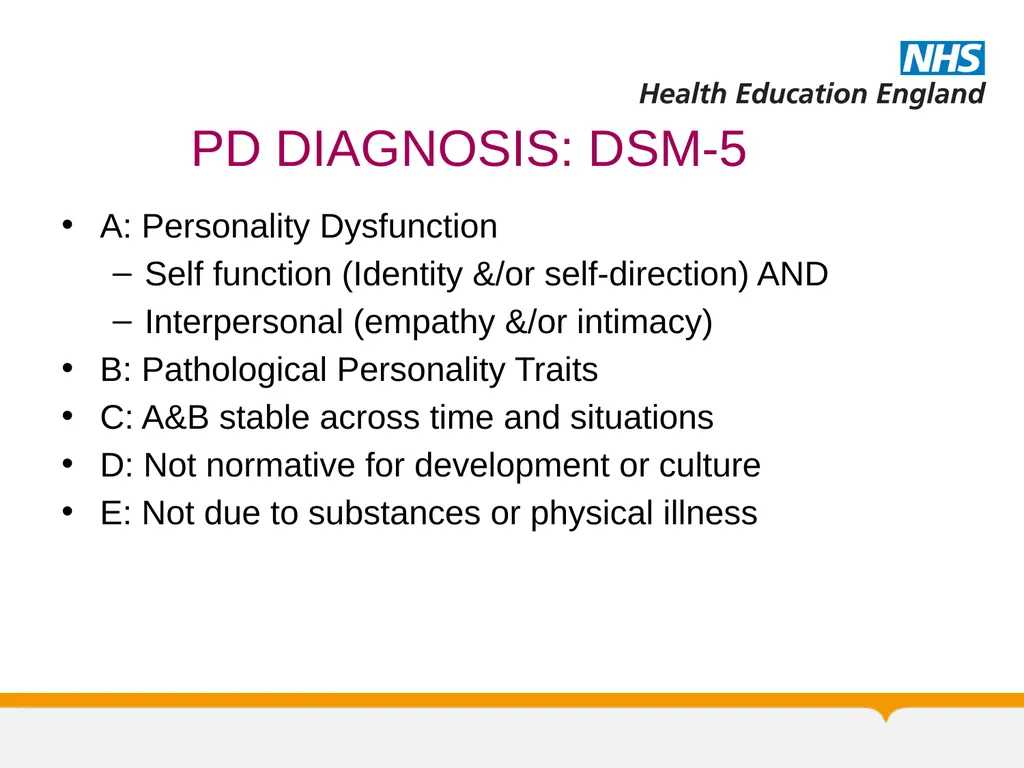
PD DIAGNOSIS: DSM-5 A: Personality Dysfunction
Self function (Identity &/or self-direction) AND
Interpersonal (empathy &/or intimacy)
B: Pathological Personality Traits
C: A&B stable across time and situations
D: Not normative for development or culture
E: Not due to substances or physical illness<br>
Self function (Identity &/or self-direction) AND
Interpersonal (empathy &/or intimacy)
B: Pathological Personality Traits
C: A&B stable across time and situations
D: Not normative for development or culture
E: Not due to substances or physical illness<br>
10
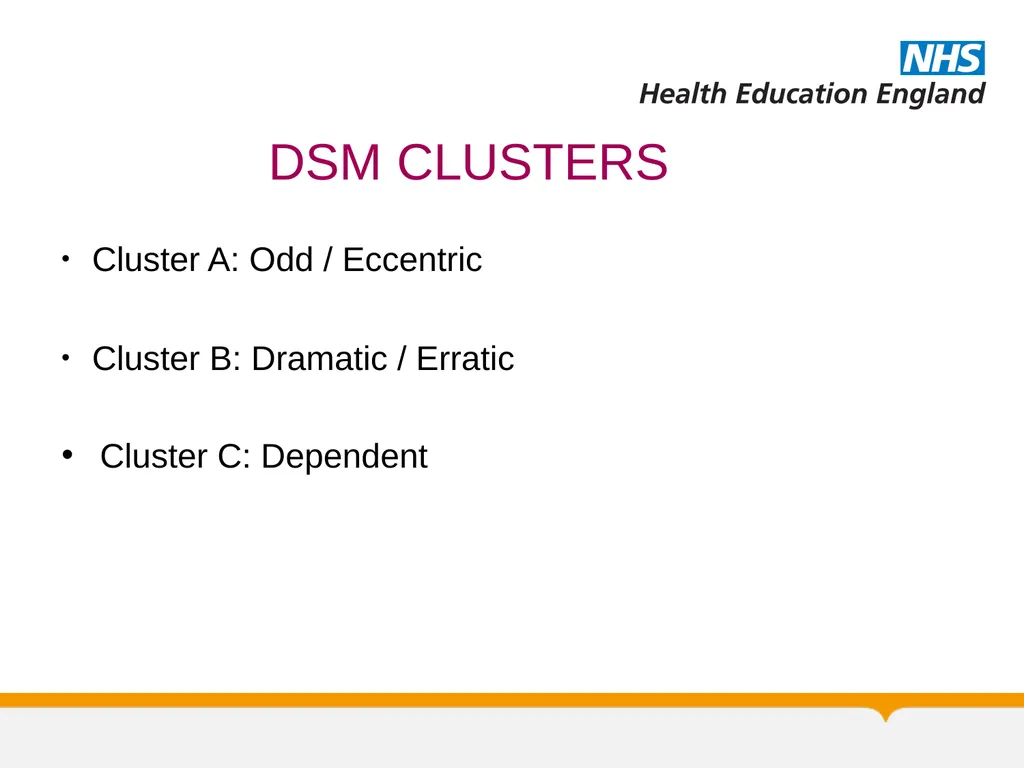
DSM CLUSTERS Cluster A: Odd / Eccentric
Cluster B: Dramatic / Erratic
Cluster C: Dependent<br>
Cluster B: Dramatic / Erratic
Cluster C: Dependent<br>
11
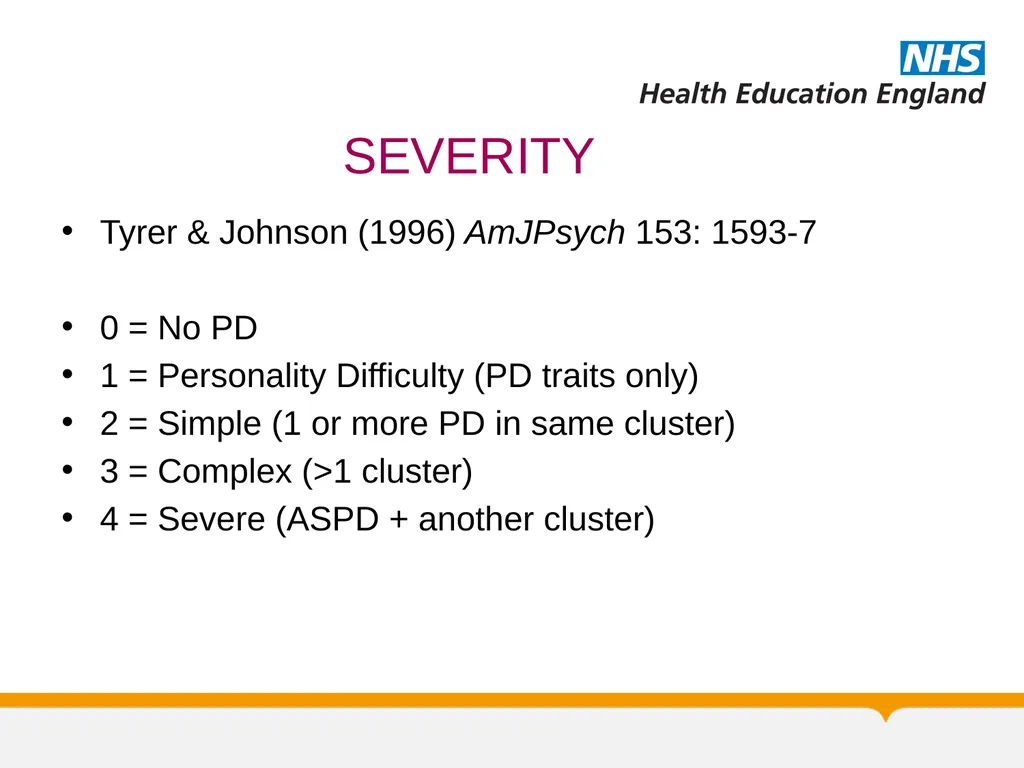
SEVERITY Tyrer & Johnson (1996) AmJPsych 153: 1593-7
0 = No PD
1 = Personality Difficulty (PD traits only)
2 = Simple (1 or more PD in same cluster)
3 = Complex (>1 cluster)
4 = Severe (ASPD + another cluster)<br>
0 = No PD
1 = Personality Difficulty (PD traits only)
2 = Simple (1 or more PD in same cluster)
3 = Complex (>1 cluster)
4 = Severe (ASPD + another cluster)<br>
12
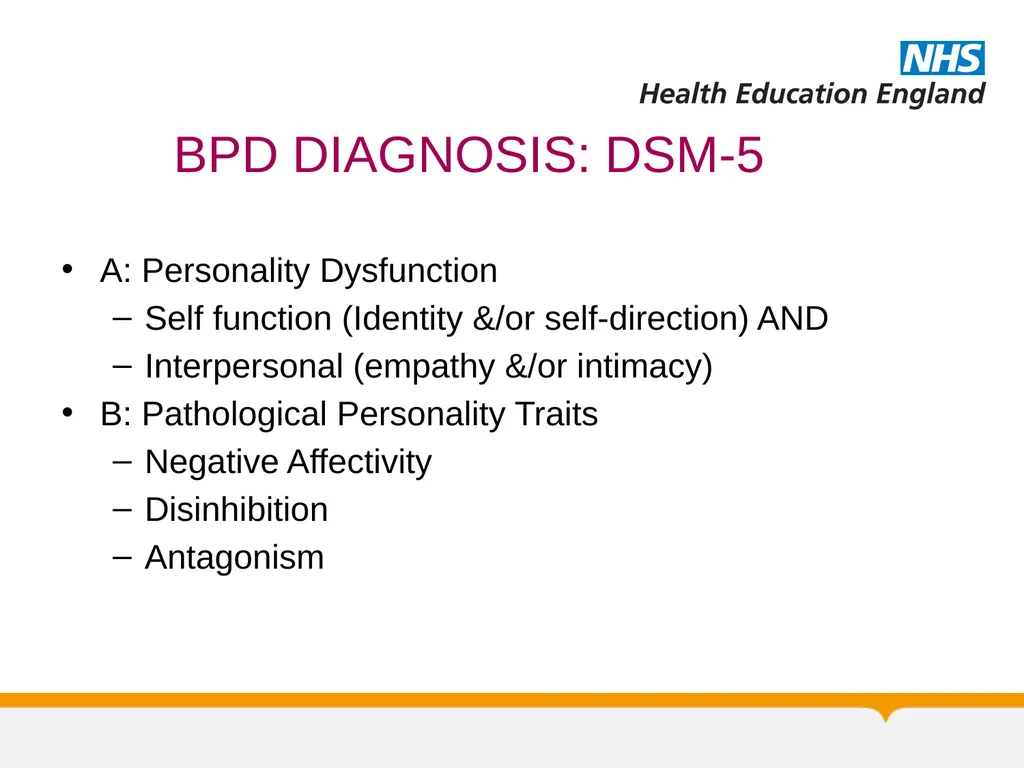
BPD DIAGNOSIS: DSM-5 A: Personality Dysfunction
Self function (Identity &/or self-direction) AND
Interpersonal (empathy &/or intimacy)
B: Pathological Personality Traits
Negative Affectivity
Disinhibition
Antagonism<br>
Self function (Identity &/or self-direction) AND
Interpersonal (empathy &/or intimacy)
B: Pathological Personality Traits
Negative Affectivity
Disinhibition
Antagonism<br>
13
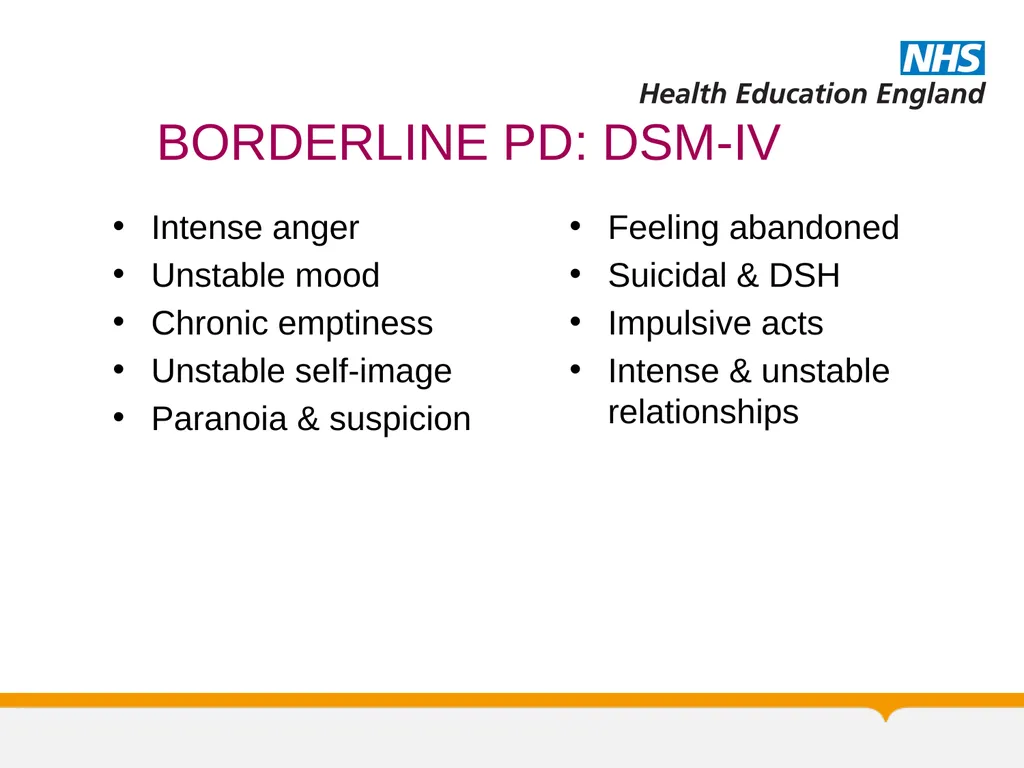
BORDERLINE PD: DSM-IV Intense anger
Unstable mood
Chronic emptiness
Unstable self-image
Paranoia & suspicion Feeling abandoned
Suicidal & DSH
Impulsive acts
Intense & unstable relationships<br>
Unstable mood
Chronic emptiness
Unstable self-image
Paranoia & suspicion Feeling abandoned
Suicidal & DSH
Impulsive acts
Intense & unstable relationships<br>
14
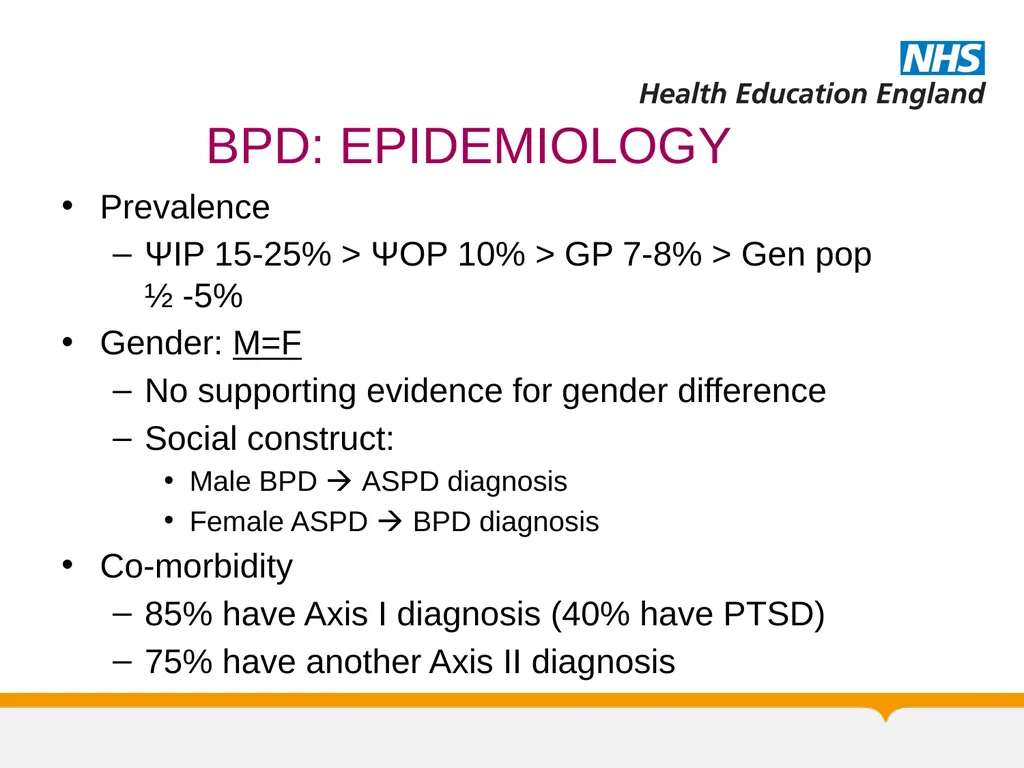
BPD: EPIDEMIOLOGY Prevalence
ΨIP 15-25% > ΨOP 10% > GP 7-8% > Gen pop ½ -5%
Gender: M=F
No supporting evidence for gender difference
Social construct:
Male BPD ASPD diagnosis
Female ASPD BPD diagnosis
Co-morbidity
85% have Axis I diagnosis (40% have PTSD)
75% have another Axis II diagnosis<br>
ΨIP 15-25% > ΨOP 10% > GP 7-8% > Gen pop ½ -5%
Gender: M=F
No supporting evidence for gender difference
Social construct:
Male BPD ASPD diagnosis
Female ASPD BPD diagnosis
Co-morbidity
85% have Axis I diagnosis (40% have PTSD)
75% have another Axis II diagnosis<br>
15
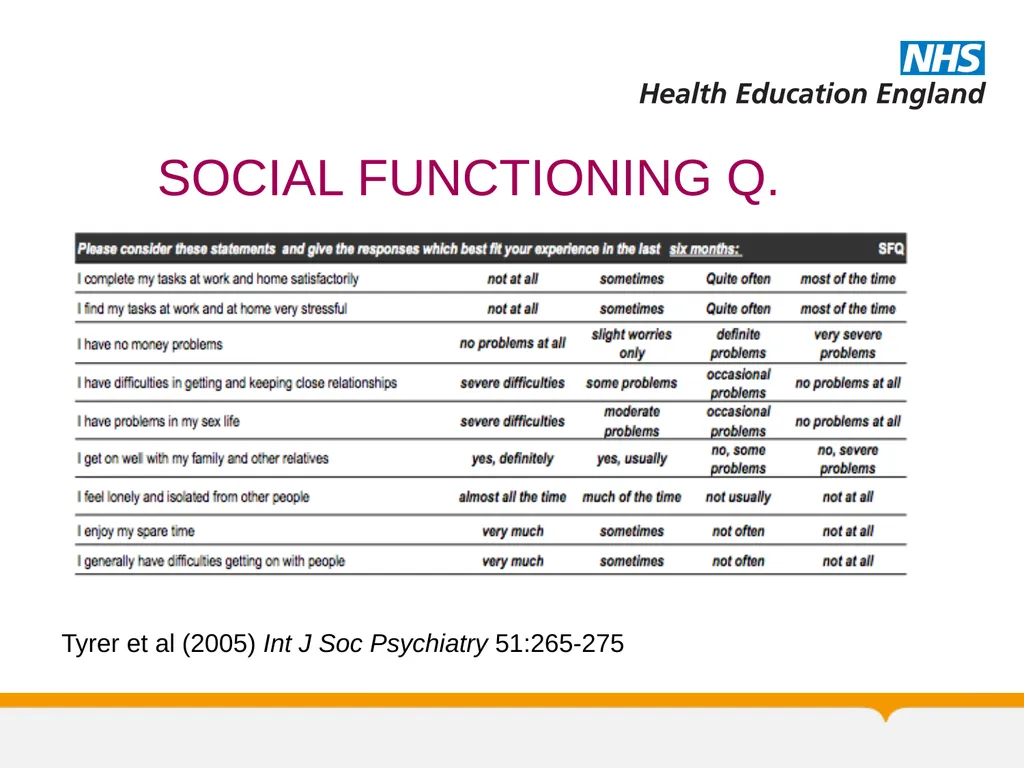
SOCIAL FUNCTIONING Q. Tyrer et al (2005) Int J Soc Psychiatry 51:265-275<br>
16
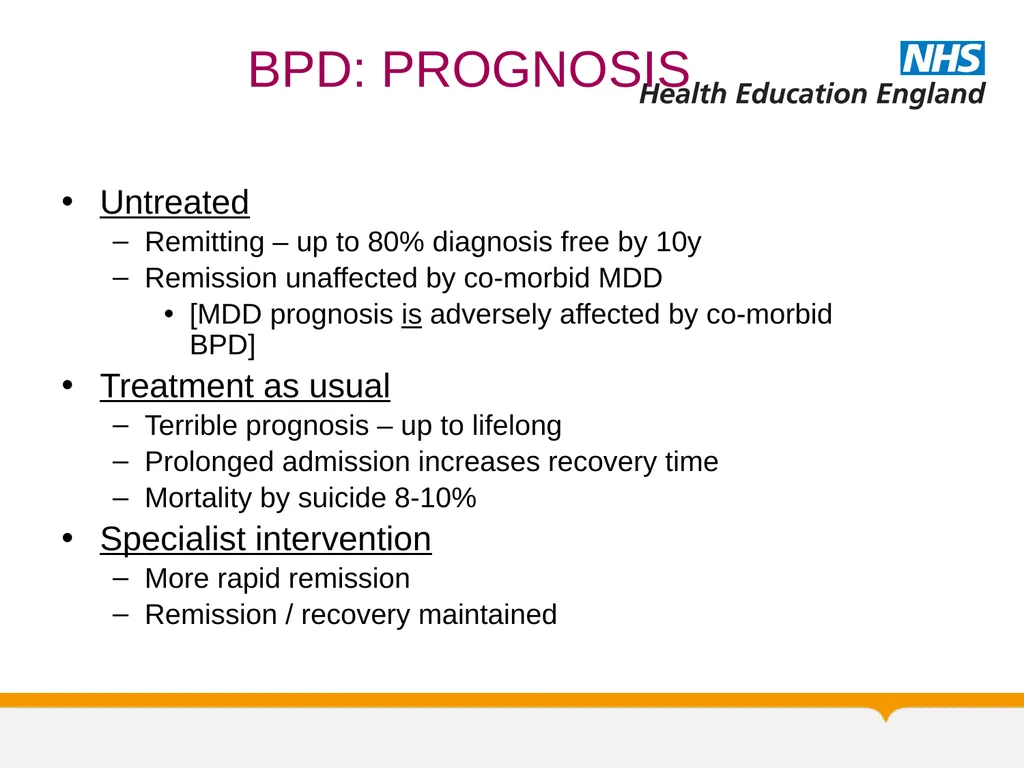
BPD: PROGNOSIS Untreated
Remitting – up to 80% diagnosis free by 10y
Remission unaffected by co-morbid MDD
[MDD prognosis is adversely affected by co-morbid BPD]
Treatment as usual
Terrible prognosis – up to lifelong
Prolonged admission increases recovery time
Mortality by suicide 8-10%
Specialist intervention
More rapid remission
Remission / recovery maintained<br>
Remitting – up to 80% diagnosis free by 10y
Remission unaffected by co-morbid MDD
[MDD prognosis is adversely affected by co-morbid BPD]
Treatment as usual
Terrible prognosis – up to lifelong
Prolonged admission increases recovery time
Mortality by suicide 8-10%
Specialist intervention
More rapid remission
Remission / recovery maintained<br>
17
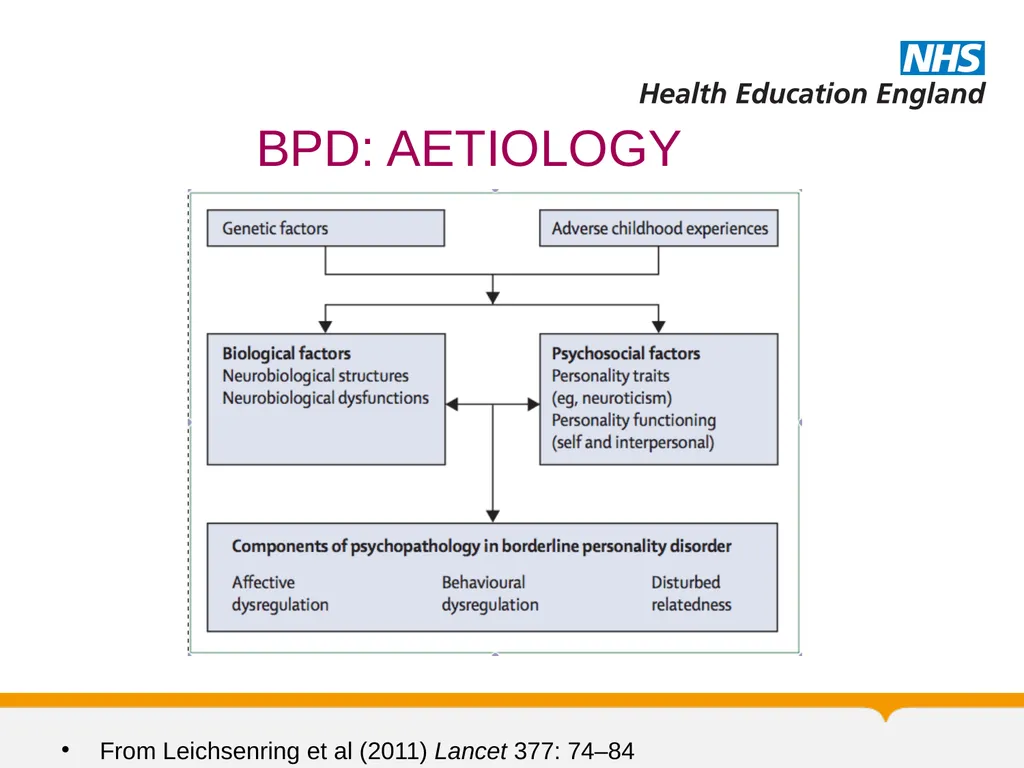
BPD: AETIOLOGY From Leichsenring et al (2011) Lancet 377: 74–84<br>
18
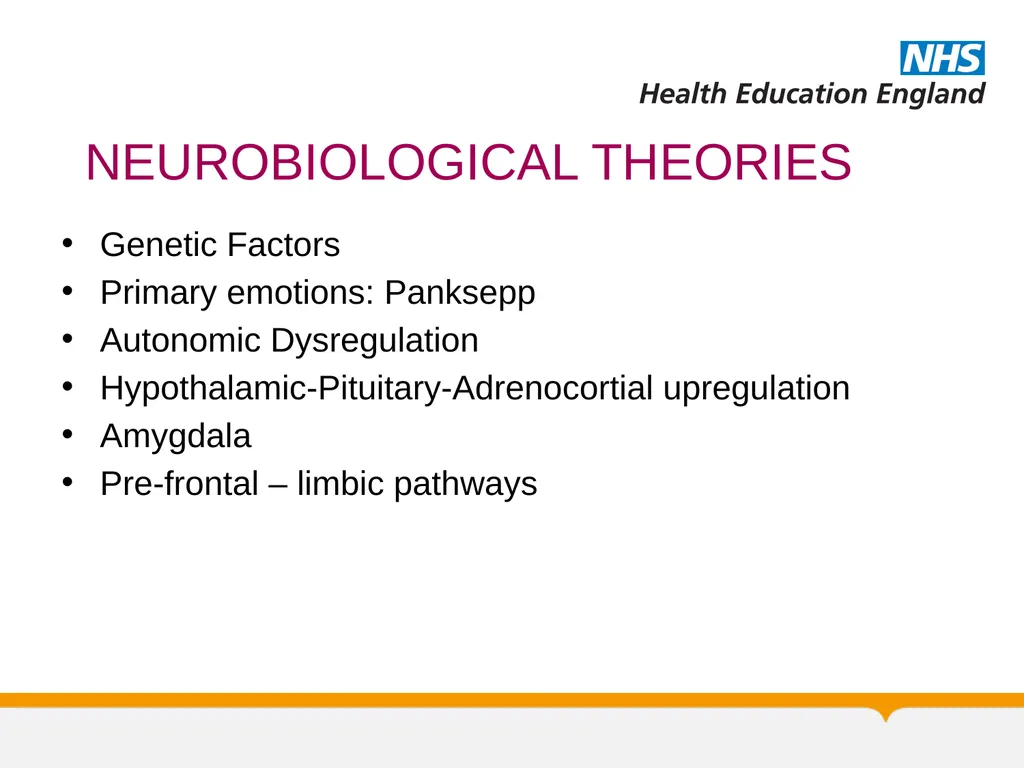
NEUROBIOLOGICAL THEORIES Genetic Factors
Primary emotions: Panksepp
Autonomic Dysregulation
Hypothalamic-Pituitary-Adrenocortial upregulation
Amygdala
Pre-frontal – limbic pathways<br>
Primary emotions: Panksepp
Autonomic Dysregulation
Hypothalamic-Pituitary-Adrenocortial upregulation
Amygdala
Pre-frontal – limbic pathways<br>
19
PSYCHOLOGICAL THEORIES Cognitive
Psychodynamic
Attachment
Mentalizing<br>
Psychodynamic
Attachment
Mentalizing<br>
20
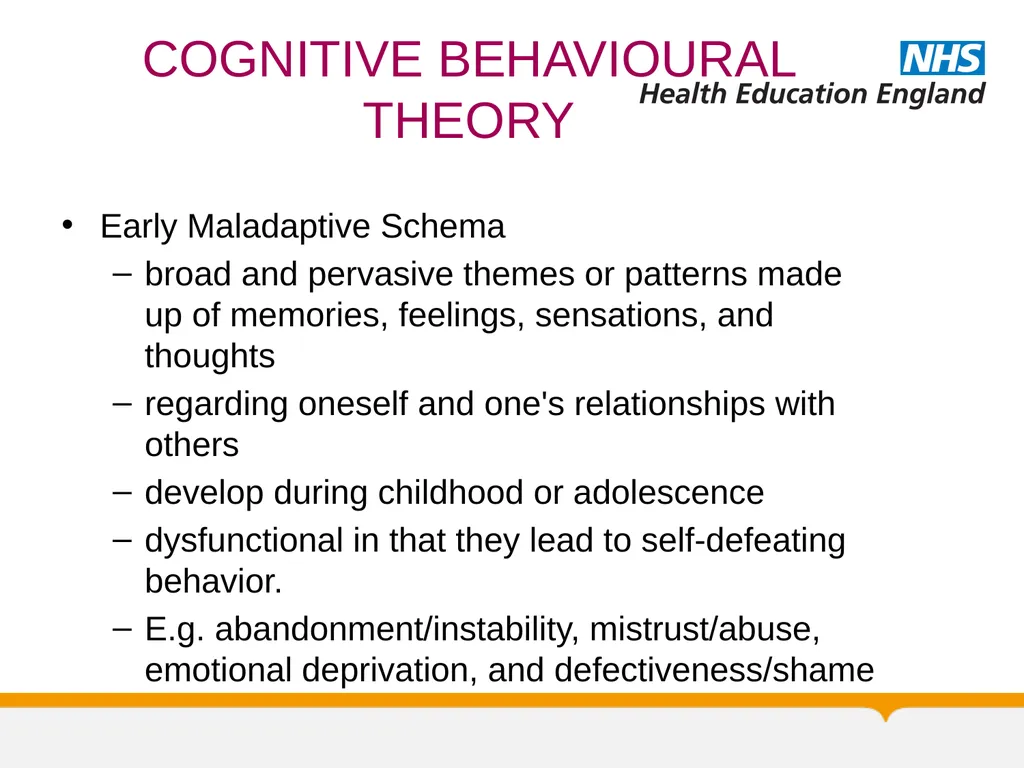
COGNITIVE BEHAVIOURAL THEORY Early Maladaptive Schema
broad and pervasive themes or patterns made up of memories, feelings, sensations, and thoughts
regarding oneself and one's relationships with others
develop during childhood or adolescence
dysfunctional in that they lead to self-defeating behavior.
E.g. abandonment/instability, mistrust/abuse, emotional deprivation, and defectiveness/shame<br>
broad and pervasive themes or patterns made up of memories, feelings, sensations, and thoughts
regarding oneself and one's relationships with others
develop during childhood or adolescence
dysfunctional in that they lead to self-defeating behavior.
E.g. abandonment/instability, mistrust/abuse, emotional deprivation, and defectiveness/shame<br>
21
PSYCHODYNAMIC CONCEPTS Projection
Idealization / Denigration
Splitting
Projective identification
Envy
Acting Out<br>
Idealization / Denigration
Splitting
Projective identification
Envy
Acting Out<br>
22
PSYCHODYNAMIC ‘SCHOOLS OF THOUGHT’ Object Relations Theory
Kernberg: ‘Borderline Personality Organization’
Kohut: Self Psychology
Group Dynamic theory
Foulkes
Nitsun’s ‘Anti-group’<br>
Kernberg: ‘Borderline Personality Organization’
Kohut: Self Psychology
Group Dynamic theory
Foulkes
Nitsun’s ‘Anti-group’<br>
23
ATTACHMENT THEORY<br>
24
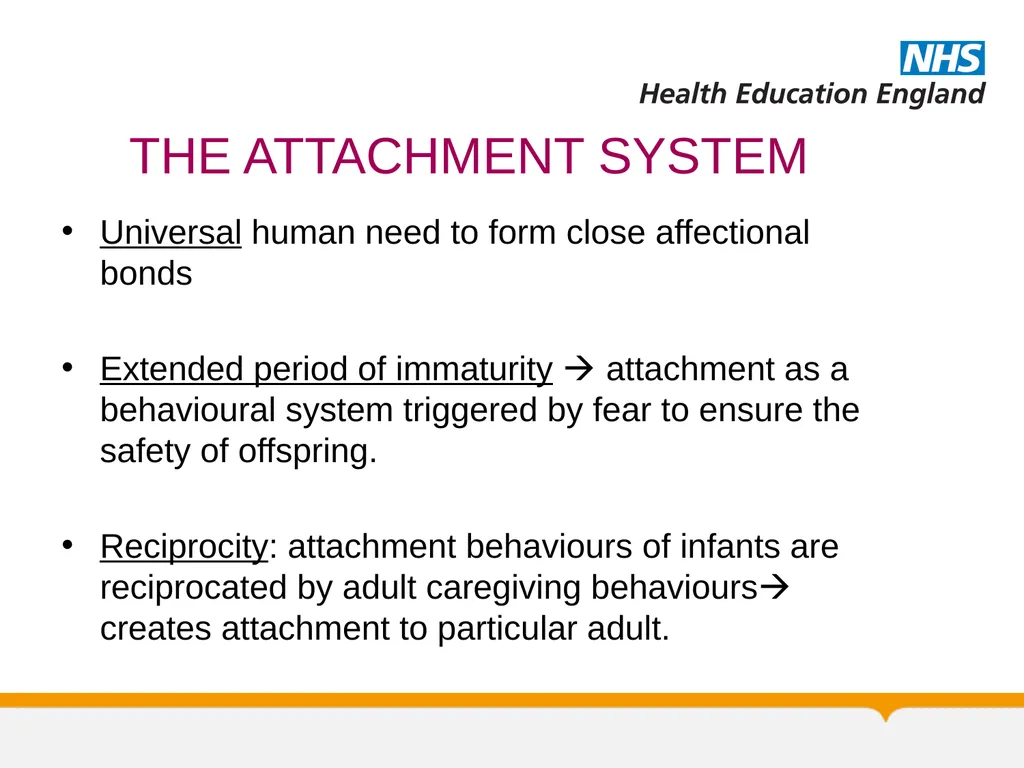
THE ATTACHMENT SYSTEM Universal human need to form close affectional bonds
Extended period of immaturity attachment as a behavioural system triggered by fear to ensure the safety of offspring.
Reciprocity: attachment behaviours of infants are reciprocated by adult caregiving behaviours creates attachment to particular adult.<br>
Extended period of immaturity attachment as a behavioural system triggered by fear to ensure the safety of offspring.
Reciprocity: attachment behaviours of infants are reciprocated by adult caregiving behaviours creates attachment to particular adult.<br>
25
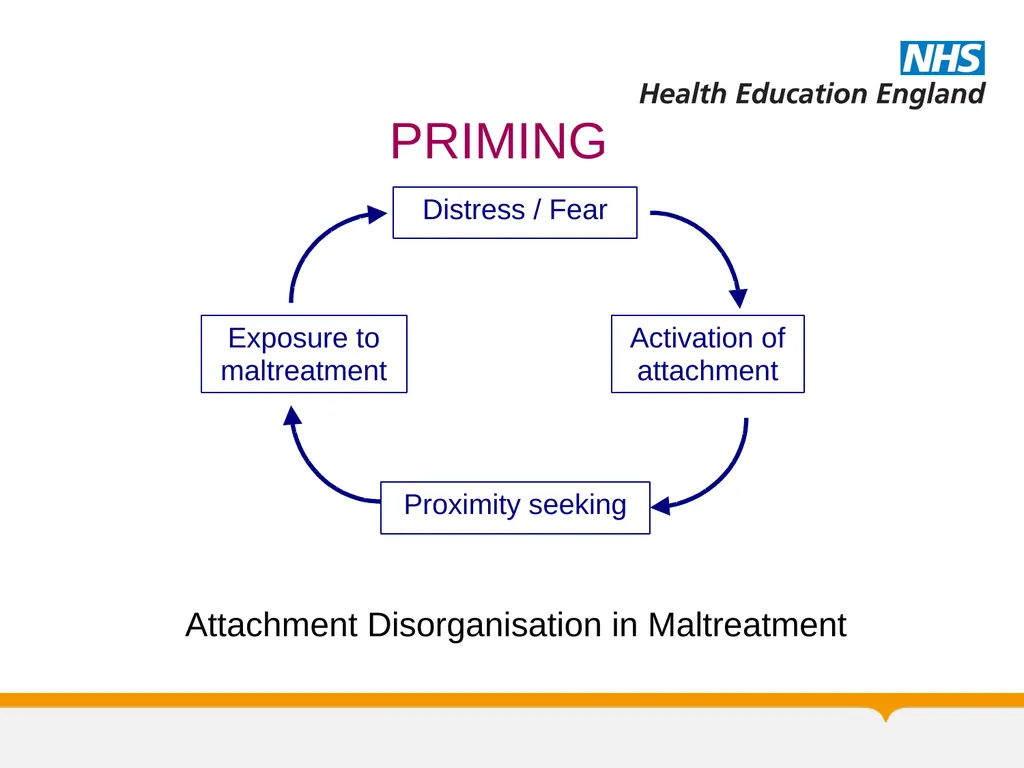
PRIMING Attachment Disorganisation in Maltreatment<br>
26
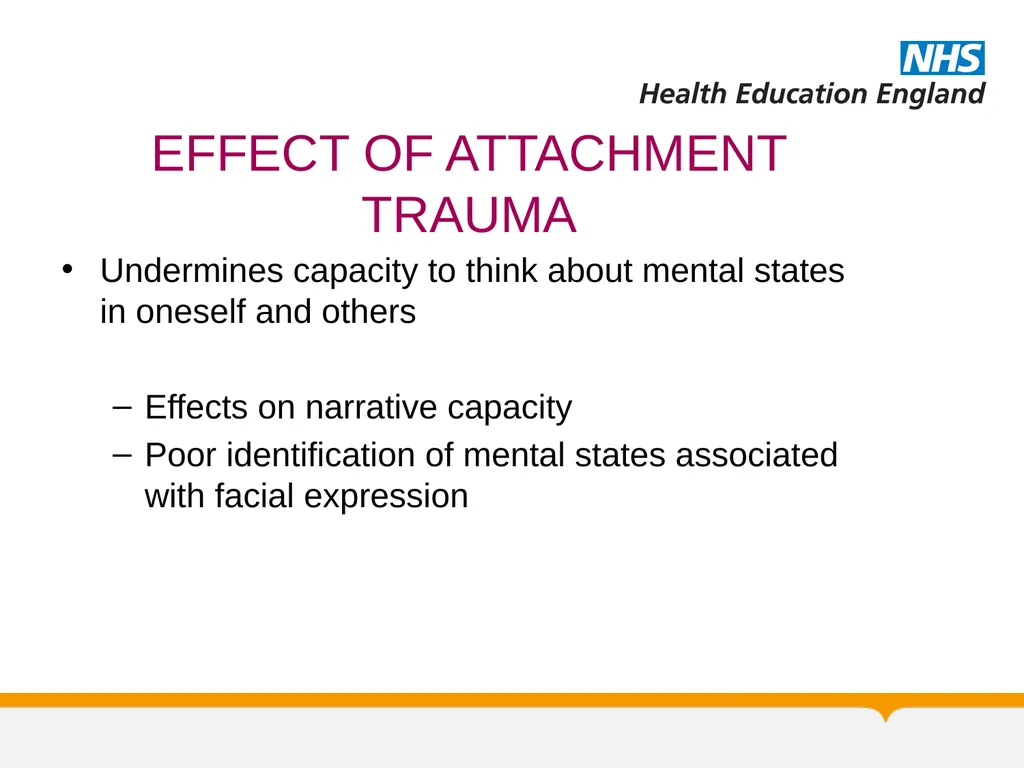
EFFECT OF ATTACHMENT TRAUMA Undermines capacity to think about mental states in oneself and others
Effects on narrative capacity
Poor identification of mental states associated with facial expression<br>
Effects on narrative capacity
Poor identification of mental states associated with facial expression<br>
27
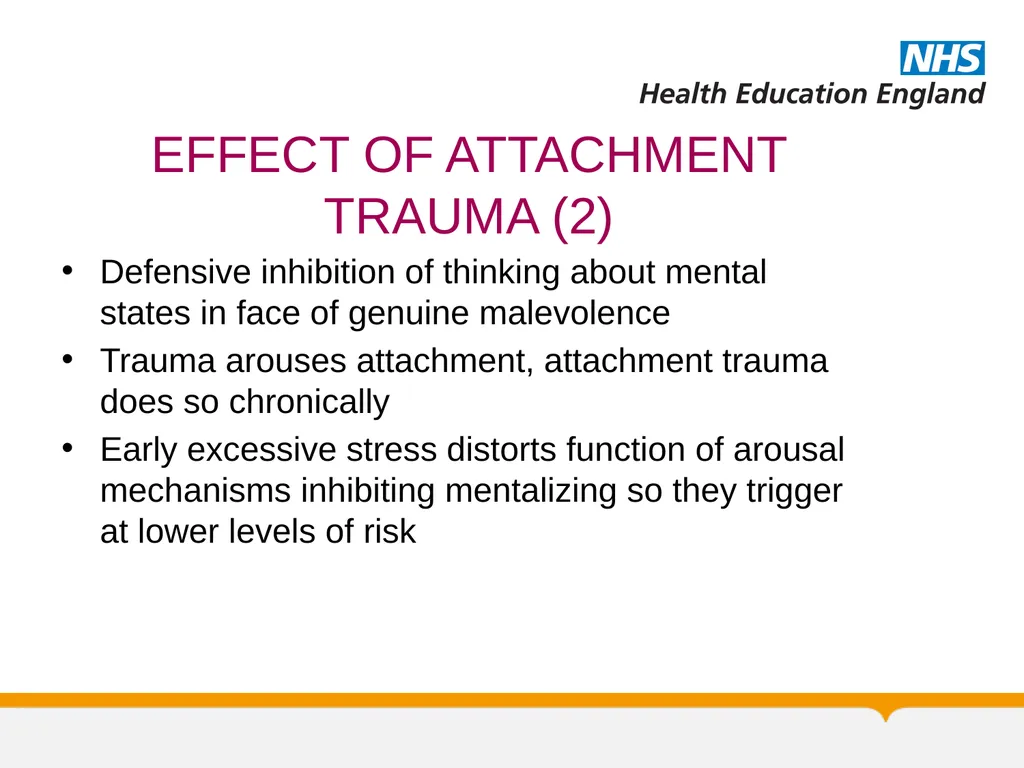
EFFECT OF ATTACHMENT TRAUMA (2) Defensive inhibition of thinking about mental states in face of genuine malevolence
Trauma arouses attachment, attachment trauma does so chronically
Early excessive stress distorts function of arousal mechanisms inhibiting mentalizing so they trigger at lower levels of risk<br>
Trauma arouses attachment, attachment trauma does so chronically
Early excessive stress distorts function of arousal mechanisms inhibiting mentalizing so they trigger at lower levels of risk<br>
28
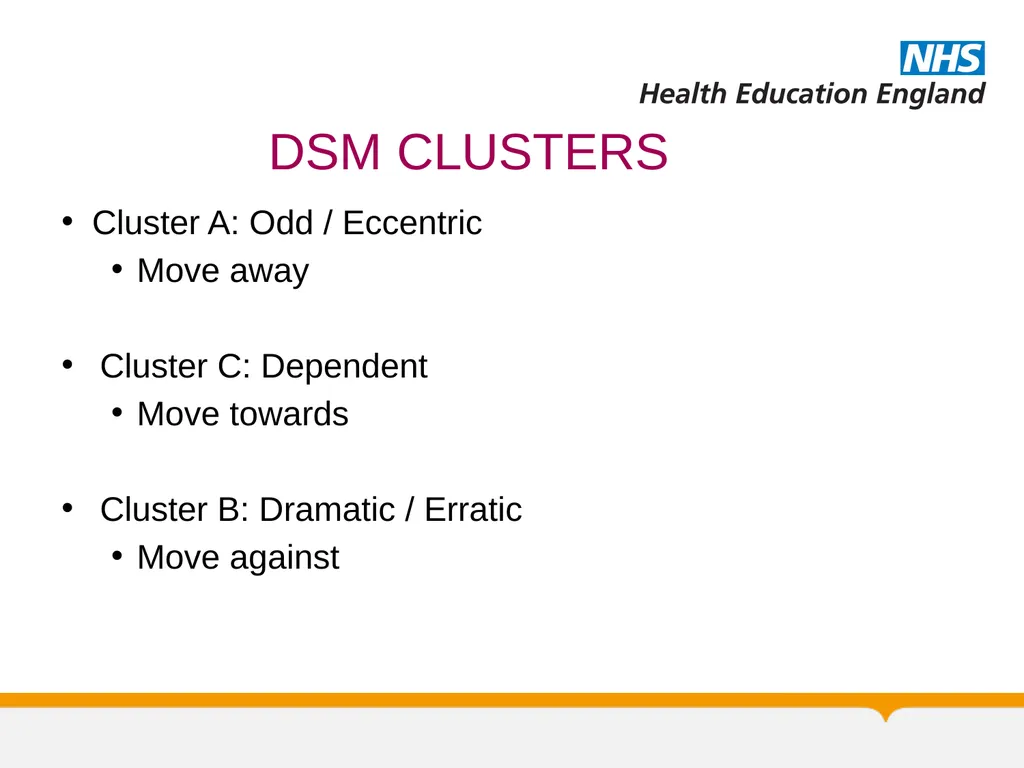
DSM CLUSTERS Cluster A: Odd / Eccentric
Move away
Cluster C: Dependent
Move towards
Cluster B: Dramatic / Erratic
Move against<br>
Move away
Cluster C: Dependent
Move towards
Cluster B: Dramatic / Erratic
Move against<br>
29
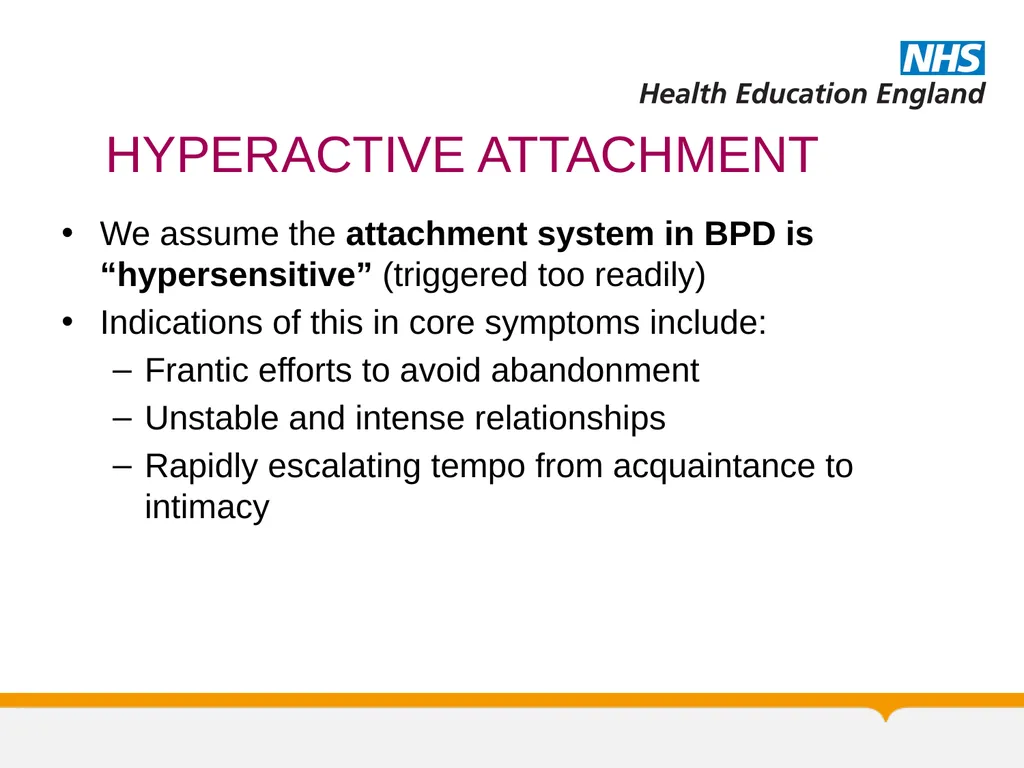
HYPERACTIVE ATTACHMENT We assume the attachment system in BPD is “hypersensitive” (triggered too readily)
Indications of this in core symptoms include:
Frantic efforts to avoid abandonment
Unstable and intense relationships
Rapidly escalating tempo from acquaintance to intimacy<br>
Indications of this in core symptoms include:
Frantic efforts to avoid abandonment
Unstable and intense relationships
Rapidly escalating tempo from acquaintance to intimacy<br>
30
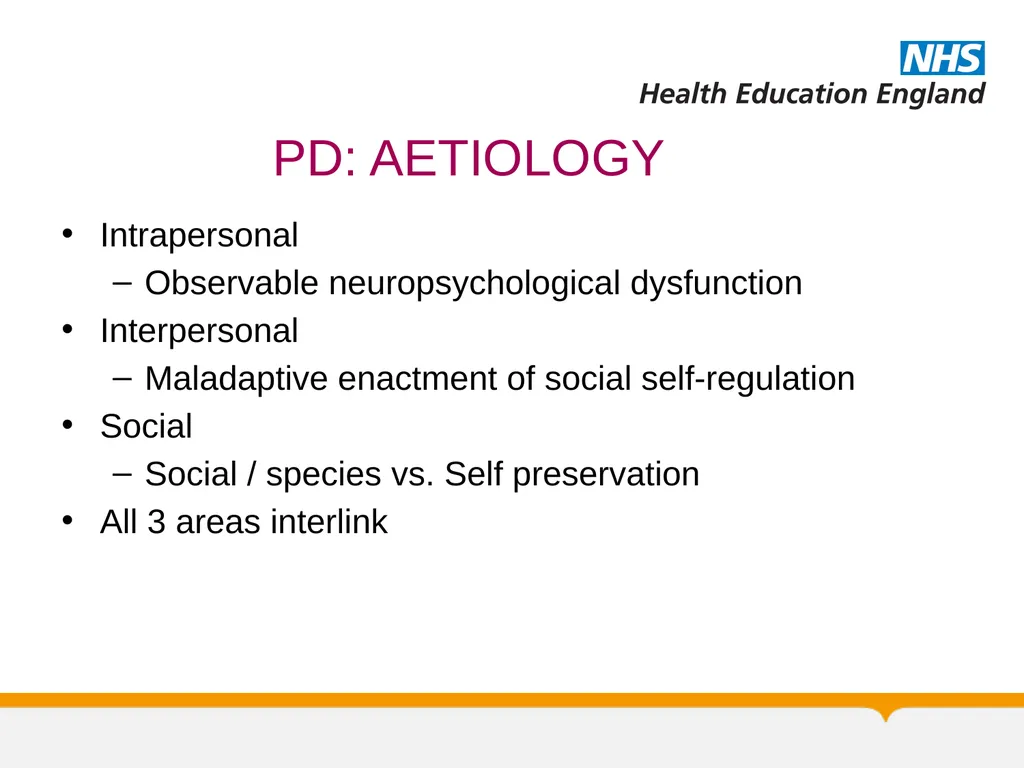
PD: AETIOLOGY Intrapersonal
Observable neuropsychological dysfunction
Interpersonal
Maladaptive enactment of social self-regulation
Social
Social / species vs. Self preservation
All 3 areas interlink<br>
Observable neuropsychological dysfunction
Interpersonal
Maladaptive enactment of social self-regulation
Social
Social / species vs. Self preservation
All 3 areas interlink<br>
31
NICE GUIDANCE: CG78 Mostly concern good quality relationships
Equality of access to services
Optimistic, trusting relationships
Autonomy & choice
Managing endings and transitions
Comments on good quality care
Theoretically coherent and shared framework
Training and support for staff; service planning
CPA, other NICE CG (e.g. Self harm)
Don’t use medication for BPD
Some therapies work, most need more research<br>
Equality of access to services
Optimistic, trusting relationships
Autonomy & choice
Managing endings and transitions
Comments on good quality care
Theoretically coherent and shared framework
Training and support for staff; service planning
CPA, other NICE CG (e.g. Self harm)
Don’t use medication for BPD
Some therapies work, most need more research<br>
32
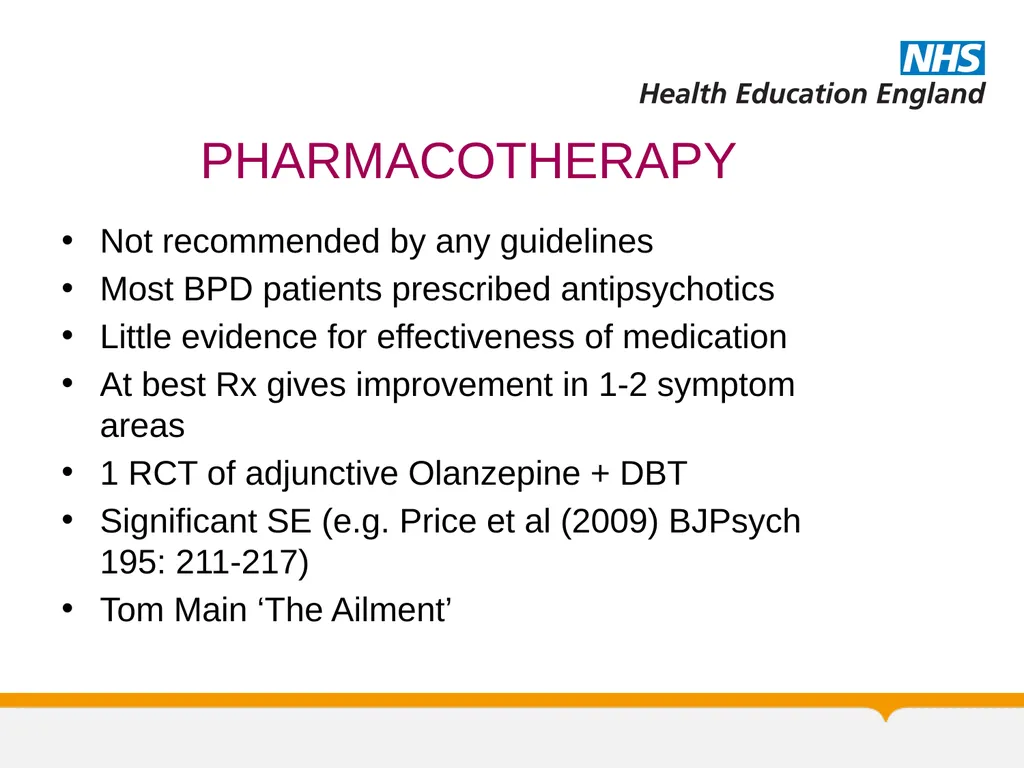
PHARMACOTHERAPY Not recommended by any guidelines
Most BPD patients prescribed antipsychotics
Little evidence for effectiveness of medication
At best Rx gives improvement in 1-2 symptom areas
1 RCT of adjunctive Olanzepine + DBT
Significant SE (e.g. Price et al (2009) BJPsych 195: 211-217)
Tom Main ‘The Ailment’<br>
Most BPD patients prescribed antipsychotics
Little evidence for effectiveness of medication
At best Rx gives improvement in 1-2 symptom areas
1 RCT of adjunctive Olanzepine + DBT
Significant SE (e.g. Price et al (2009) BJPsych 195: 211-217)
Tom Main ‘The Ailment’<br>
33
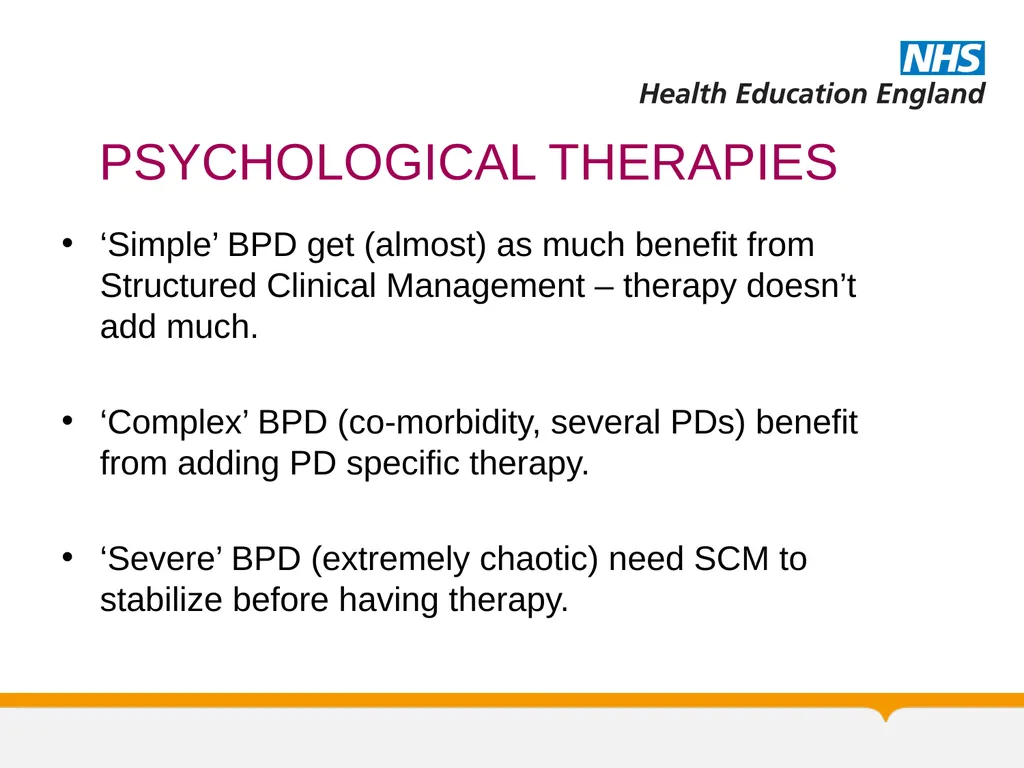
PSYCHOLOGICAL THERAPIES ‘Simple’ BPD get (almost) as much benefit from Structured Clinical Management – therapy doesn’t add much.
‘Complex’ BPD (co-morbidity, several PDs) benefit from adding PD specific therapy.
‘Severe’ BPD (extremely chaotic) need SCM to stabilize before having therapy.<br>
‘Complex’ BPD (co-morbidity, several PDs) benefit from adding PD specific therapy.
‘Severe’ BPD (extremely chaotic) need SCM to stabilize before having therapy.<br>
34
PSYCHOLOGICAL THERAPIES Traditional therapies
Psychodynamic
Cognitive – Behavioural
Milieu / Systemic<br>
Psychodynamic
Cognitive – Behavioural
Milieu / Systemic<br>
35
PSYCHOLOGICAL THERAPIES Adapted therapies
Mentalization Based Treatment
Transference Focused Psychotherapy
Cognitive Analytic Therapy
Schema Focused Therapy
Dialectical Behaviour Therapy
Therapeutic Communities
Structured Clinical Management *<br>
Mentalization Based Treatment
Transference Focused Psychotherapy
Cognitive Analytic Therapy
Schema Focused Therapy
Dialectical Behaviour Therapy
Therapeutic Communities
Structured Clinical Management *<br>
36
MENTALIZATION BASED TREATMENT<br>
37
WHAT IS MENTALIZING? New word for an ancient concept
Implicitly and explicitly interpreting the actions of oneself and others as meaningful on the basis of intentional mental states
(e.g. desires, needs, feelings, beliefs, & reasons)<br>
Implicitly and explicitly interpreting the actions of oneself and others as meaningful on the basis of intentional mental states
(e.g. desires, needs, feelings, beliefs, & reasons)<br>
38
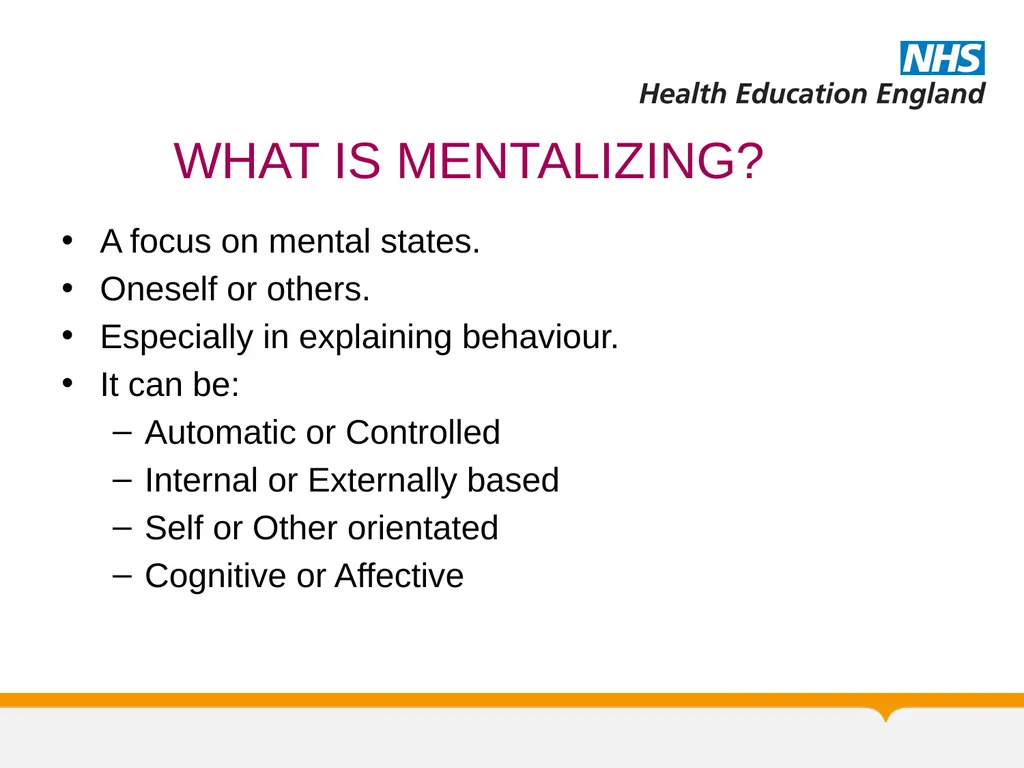
WHAT IS MENTALIZING? A focus on mental states.
Oneself or others.
Especially in explaining behaviour.
It can be:
Automatic or Controlled
Internal or Externally based
Self or Other orientated
Cognitive or Affective<br>
Oneself or others.
Especially in explaining behaviour.
It can be:
Automatic or Controlled
Internal or Externally based
Self or Other orientated
Cognitive or Affective<br>
39
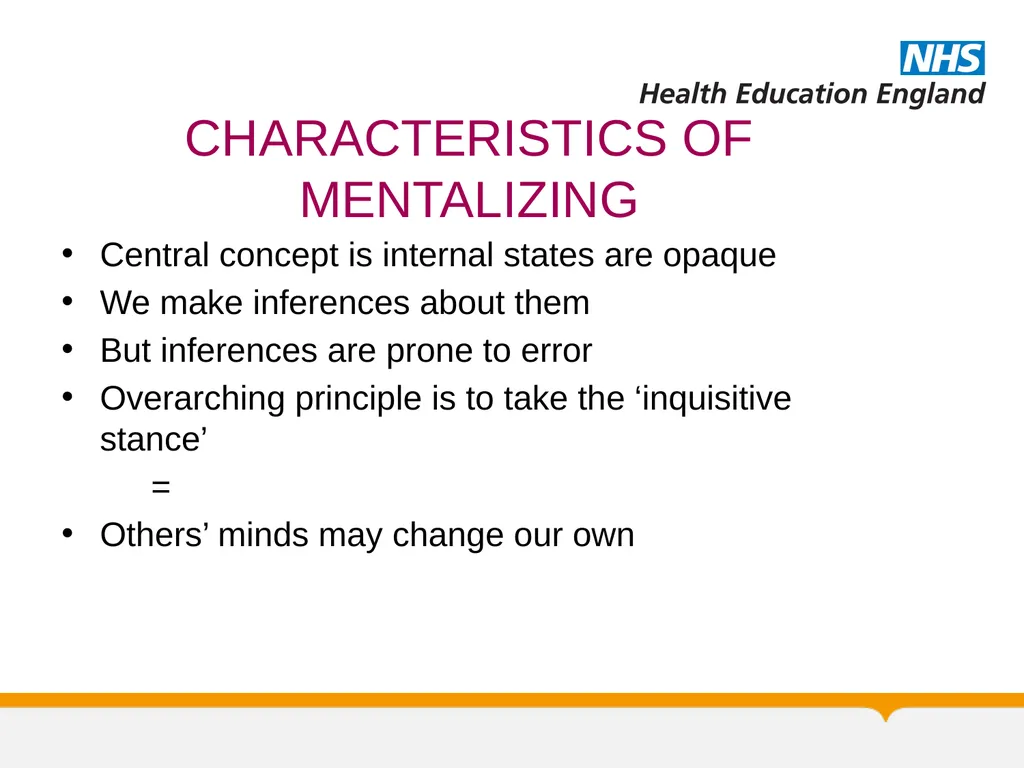
CHARACTERISTICS OF MENTALIZING Central concept is internal states are opaque
We make inferences about them
But inferences are prone to error
Overarching principle is to take the ‘inquisitive stance’
=
Others’ minds may change our own<br>
We make inferences about them
But inferences are prone to error
Overarching principle is to take the ‘inquisitive stance’
=
Others’ minds may change our own<br>
40
WHAT IS MENTALIZING? To see ourselves from the outside and others from the inside
Understanding misunderstanding
Having mind in mind
Past present and future<br>
Understanding misunderstanding
Having mind in mind
Past present and future<br>
41
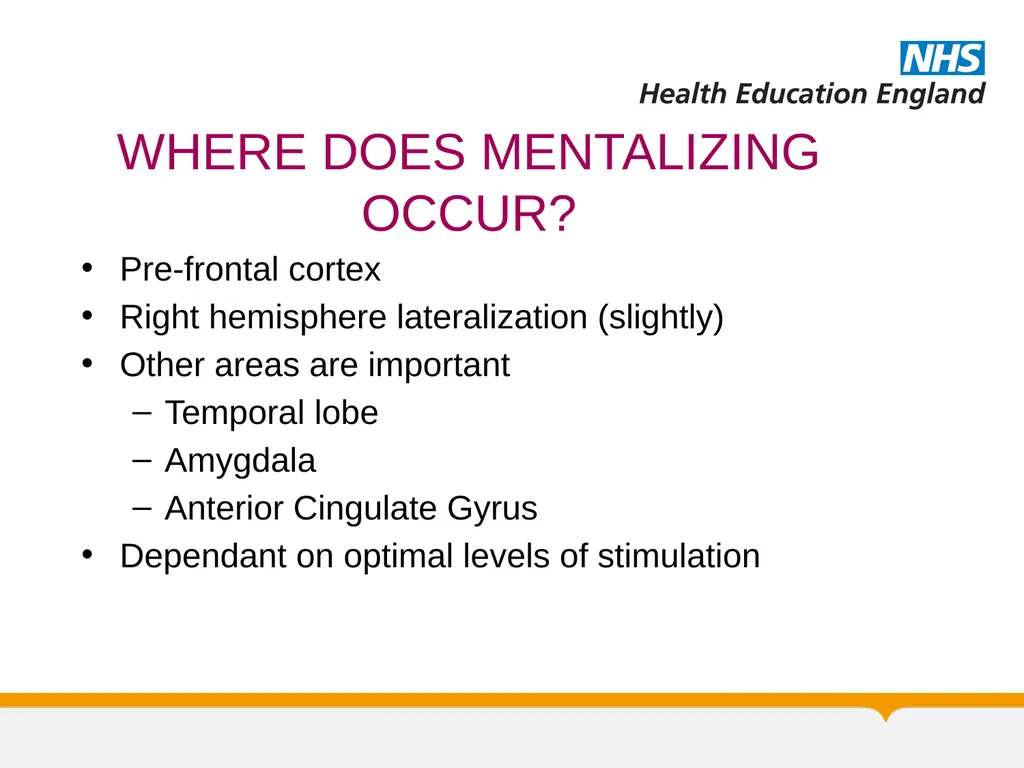
WHERE DOES MENTALIZING OCCUR? Pre-frontal cortex
Right hemisphere lateralization (slightly)
Other areas are important
Temporal lobe
Amygdala
Anterior Cingulate Gyrus
Dependant on optimal levels of stimulation<br>
Right hemisphere lateralization (slightly)
Other areas are important
Temporal lobe
Amygdala
Anterior Cingulate Gyrus
Dependant on optimal levels of stimulation<br>
42
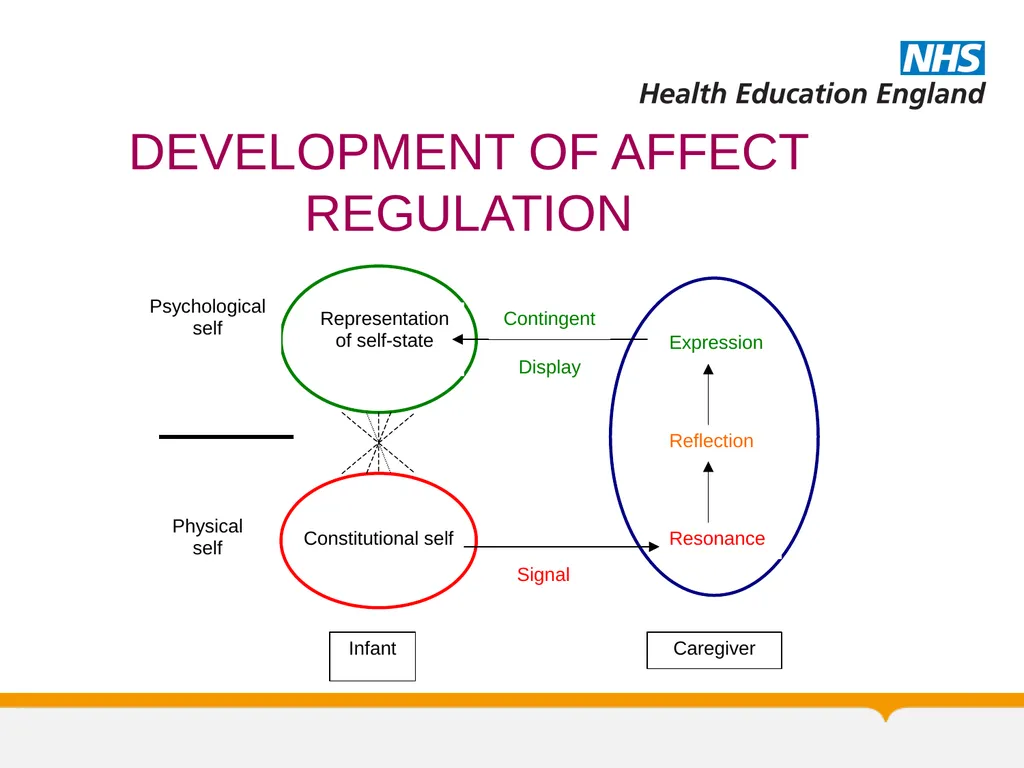
HOW DOES IT DEVELOP? Maternal attunement
‘Discovering’ the infant’s mind
Marked mirroring
Internalisation
Play & Safety
=
ATTACHMENT<br>
‘Discovering’ the infant’s mind
Marked mirroring
Internalisation
Play & Safety
=
ATTACHMENT<br>
43
DEVELOPMENT OF AFFECT REGULATION<br>
44
WHAT STOPS PEOPLE MENTALIZING? Over-arousal
Past attachment trauma<br>
Past attachment trauma<br>
45
AROUSAL Mentalizing systems require optimal levels of arousal.
Too little arousal leads to under-activation of the system and failure to start mentalizing
Excessive arousal leads to over-activation of the system and inhibition of mentalizing<br>
Too little arousal leads to under-activation of the system and failure to start mentalizing
Excessive arousal leads to over-activation of the system and inhibition of mentalizing<br>
46
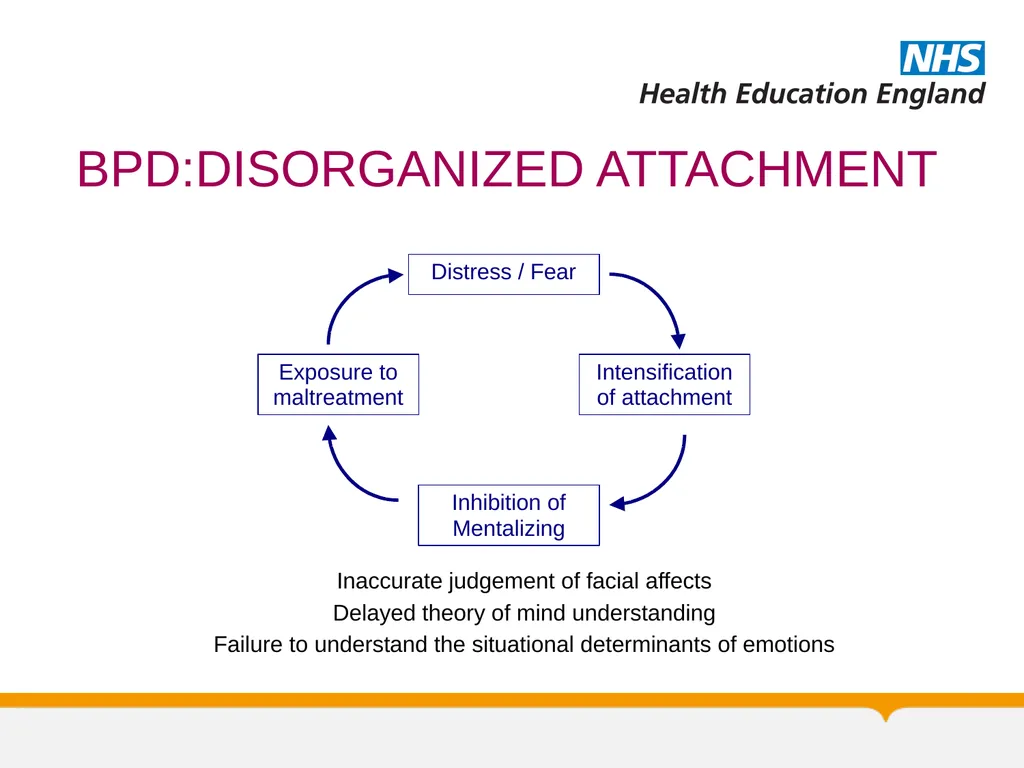
BPD:DISORGANIZED ATTACHMENT Inaccurate judgement of facial affects
Delayed theory of mind understanding
Failure to understand the situational determinants of emotions<br>
Delayed theory of mind understanding
Failure to understand the situational determinants of emotions<br>
47
NON-MENTALIZING IN BPD States of mind that pre-date mentalizing
Psychic Equivalence
Pretend Mode
Teleological Mode<br>
Psychic Equivalence
Pretend Mode
Teleological Mode<br>
48
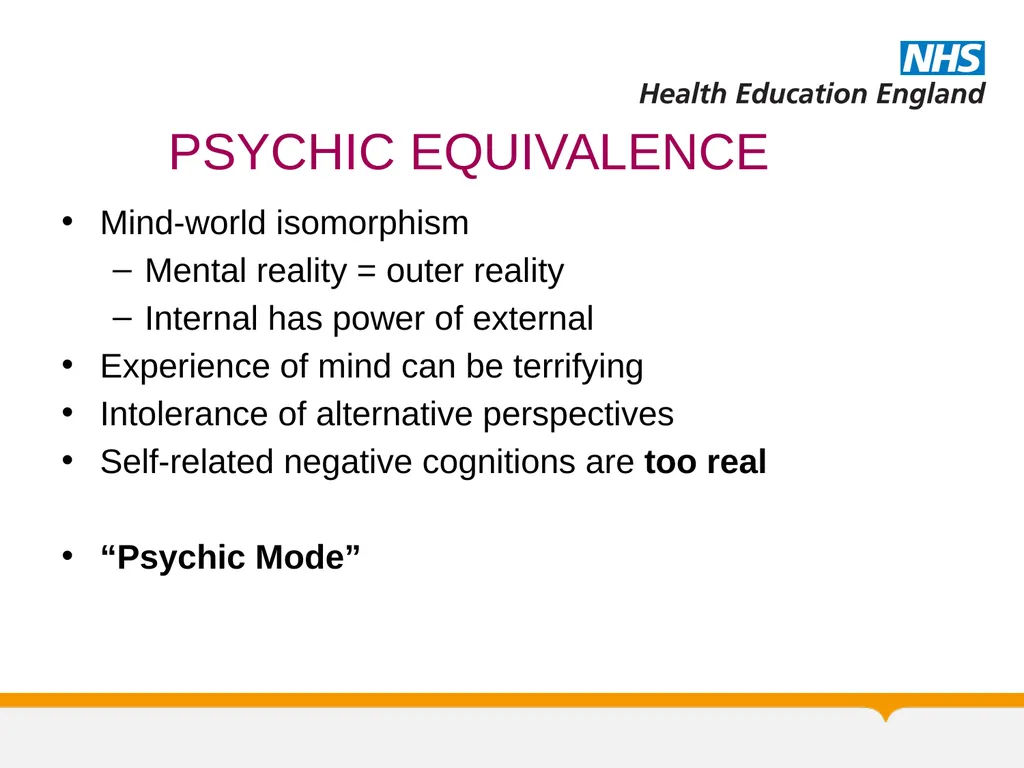
PSYCHIC EQUIVALENCE Mind-world isomorphism
Mental reality = outer reality
Internal has power of external
Experience of mind can be terrifying
Intolerance of alternative perspectives
Self-related negative cognitions are too real
“Psychic Mode”<br>
Mental reality = outer reality
Internal has power of external
Experience of mind can be terrifying
Intolerance of alternative perspectives
Self-related negative cognitions are too real
“Psychic Mode”<br>
49
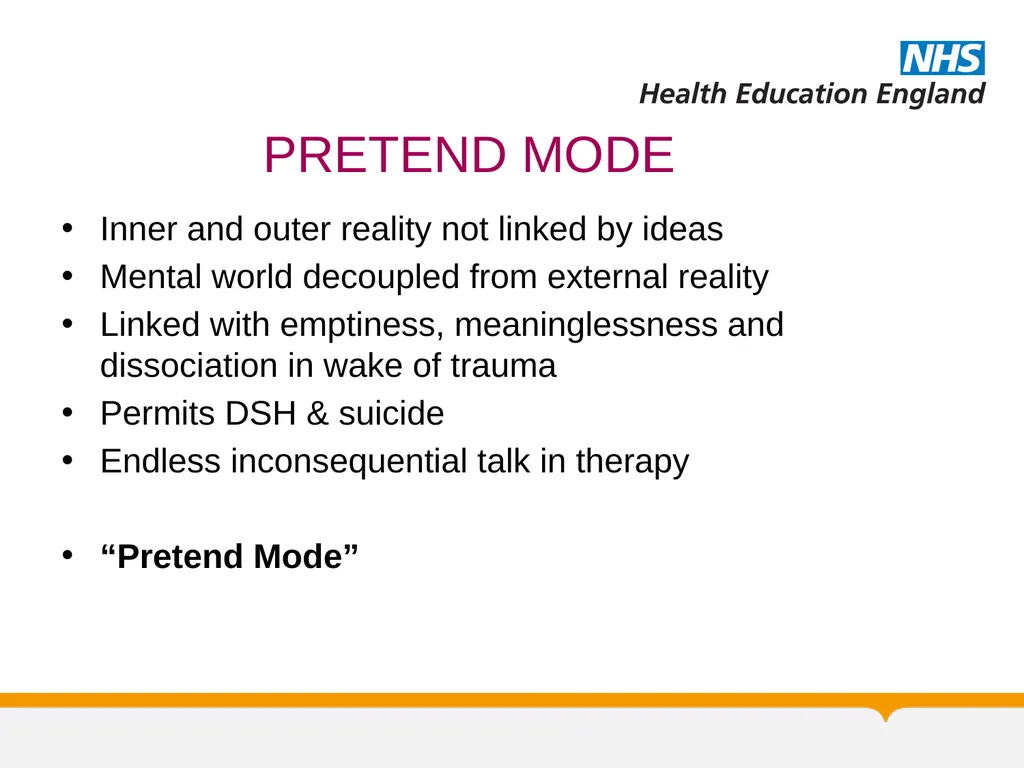
PRETEND MODE Inner and outer reality not linked by ideas
Mental world decoupled from external reality
Linked with emptiness, meaninglessness and dissociation in wake of trauma
Permits DSH & suicide
Endless inconsequential talk in therapy
“Pretend Mode”<br>
Mental world decoupled from external reality
Linked with emptiness, meaninglessness and dissociation in wake of trauma
Permits DSH & suicide
Endless inconsequential talk in therapy
“Pretend Mode”<br>
50
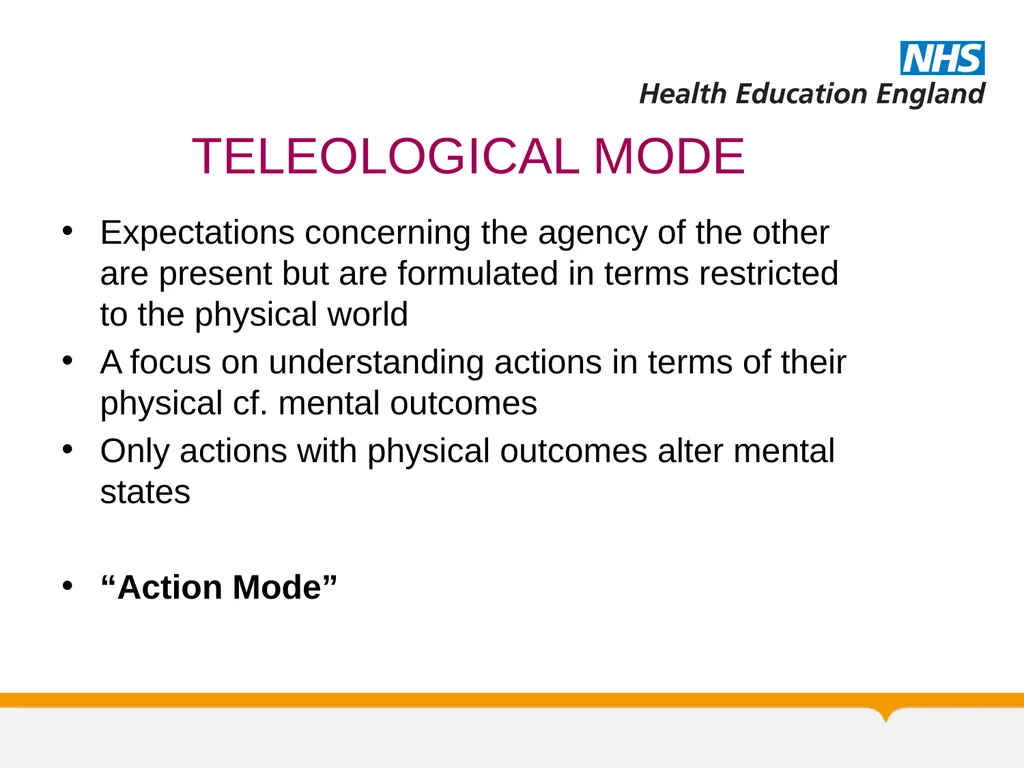
TELEOLOGICAL MODE Expectations concerning the agency of the other are present but are formulated in terms restricted to the physical world
A focus on understanding actions in terms of their physical cf. mental outcomes
Only actions with physical outcomes alter mental states
“Action Mode”<br>
A focus on understanding actions in terms of their physical cf. mental outcomes
Only actions with physical outcomes alter mental states
“Action Mode”<br>
51
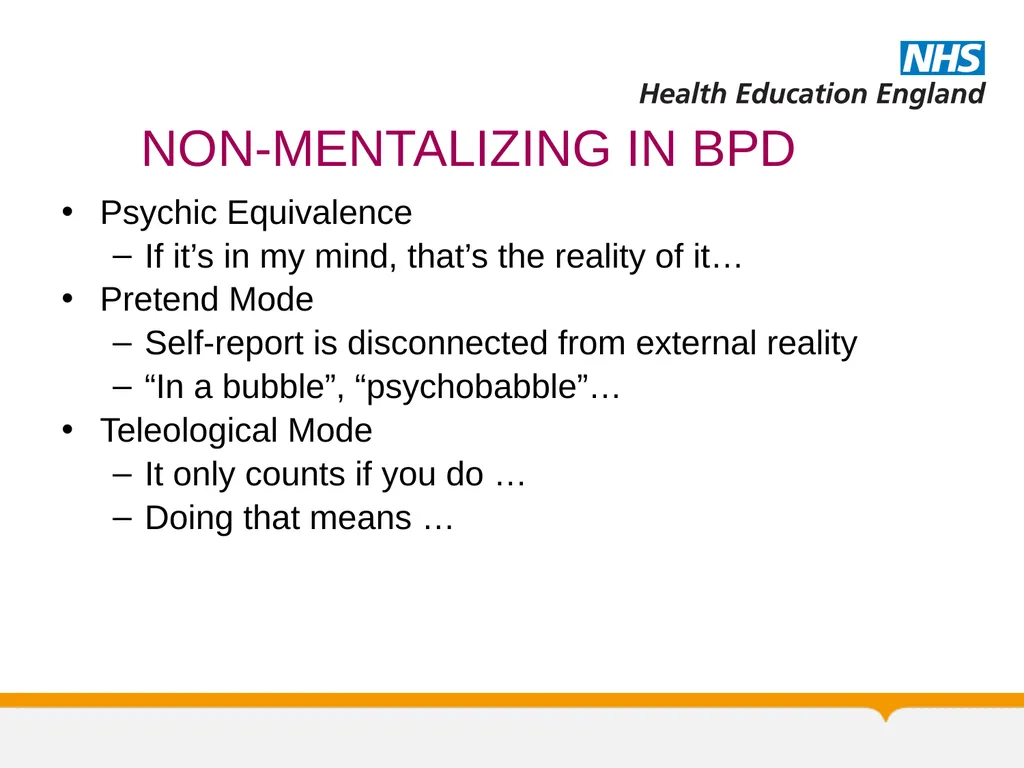
NON-MENTALIZING IN BPD Psychic Equivalence
If it’s in my mind, that’s the reality of it…
Pretend Mode
Self-report is disconnected from external reality
“In a bubble”, “psychobabble”…
Teleological Mode
It only counts if you do …
Doing that means …<br>
If it’s in my mind, that’s the reality of it…
Pretend Mode
Self-report is disconnected from external reality
“In a bubble”, “psychobabble”…
Teleological Mode
It only counts if you do …
Doing that means …<br>
52
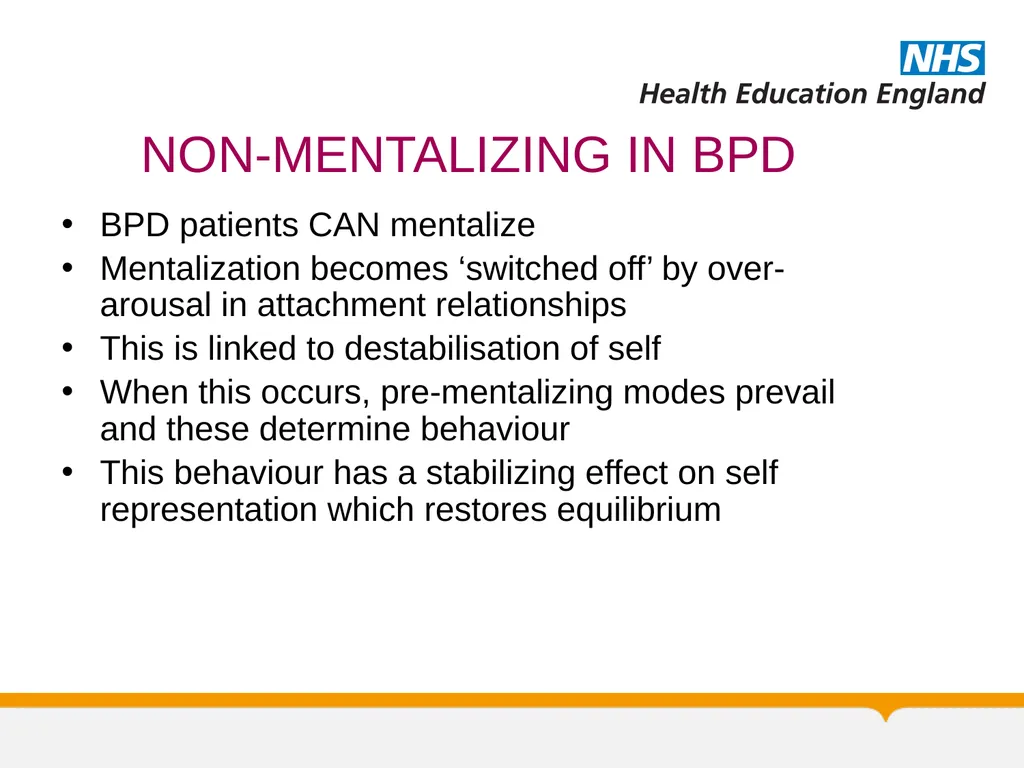
NON-MENTALIZING IN BPD BPD patients CAN mentalize
Mentalization becomes ‘switched off’ by over-arousal in attachment relationships
This is linked to destabilisation of self
When this occurs, pre-mentalizing modes prevail and these determine behaviour
This behaviour has a stabilizing effect on self representation which restores equilibrium<br>
Mentalization becomes ‘switched off’ by over-arousal in attachment relationships
This is linked to destabilisation of self
When this occurs, pre-mentalizing modes prevail and these determine behaviour
This behaviour has a stabilizing effect on self representation which restores equilibrium<br>
53
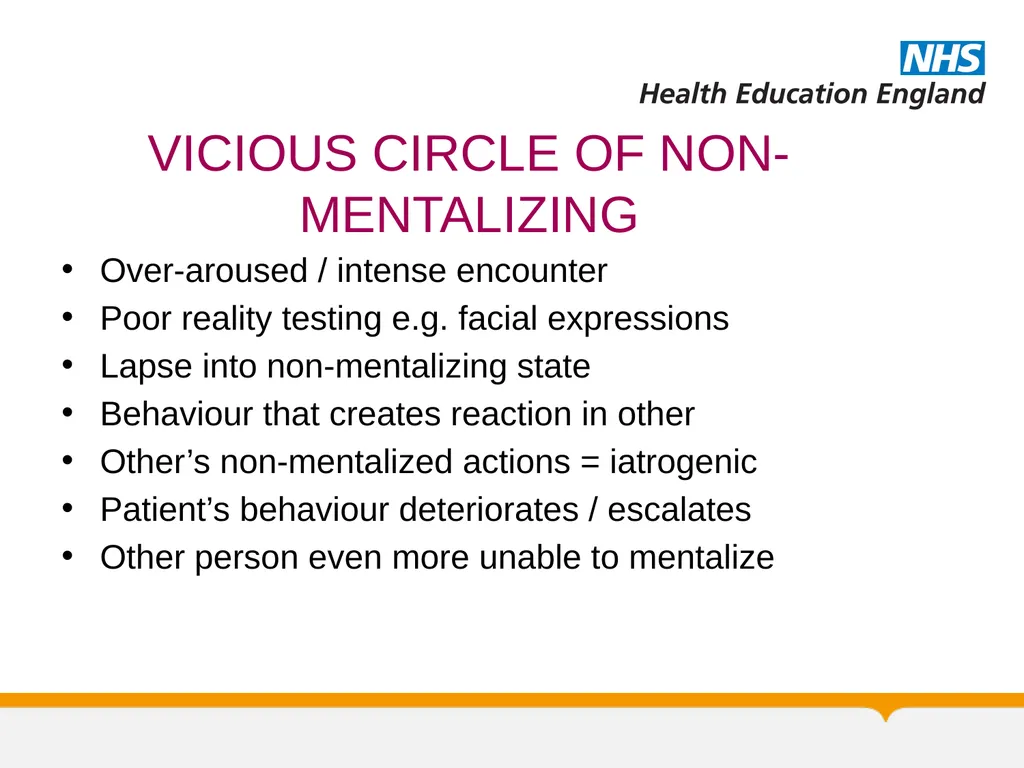
VICIOUS CIRCLE OF NON-MENTALIZING Over-aroused / intense encounter
Poor reality testing e.g. facial expressions
Lapse into non-mentalizing state
Behaviour that creates reaction in other
Other’s non-mentalized actions = iatrogenic
Patient’s behaviour deteriorates / escalates
Other person even more unable to mentalize<br>
Poor reality testing e.g. facial expressions
Lapse into non-mentalizing state
Behaviour that creates reaction in other
Other’s non-mentalized actions = iatrogenic
Patient’s behaviour deteriorates / escalates
Other person even more unable to mentalize<br>
54
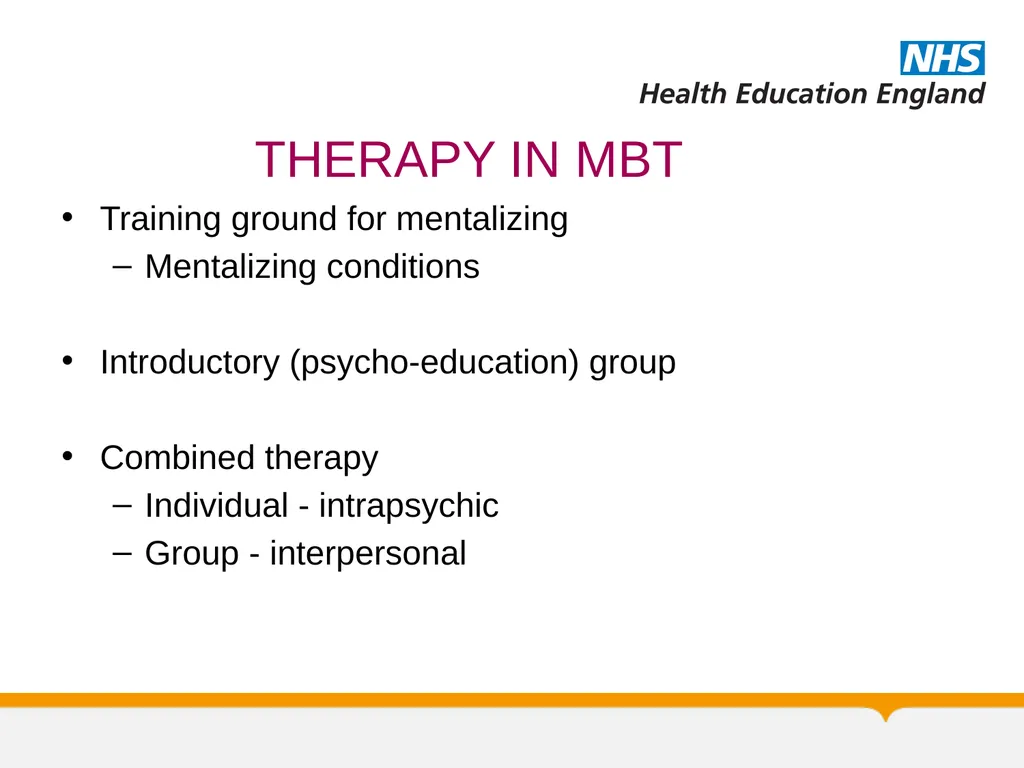
THERAPY IN MBT Training ground for mentalizing
Mentalizing conditions
Introductory (psycho-education) group
Combined therapy
Individual - intrapsychic
Group - interpersonal<br>
Mentalizing conditions
Introductory (psycho-education) group
Combined therapy
Individual - intrapsychic
Group - interpersonal<br>
55
IATROGENIC HARM Iatrogenic – adj. caused by doctors
Doctors are human too
Acting in a non-mentalizing way
Preventing the patient from mentalizing
Reinforcing non-mentalizing states<br>
Doctors are human too
Acting in a non-mentalizing way
Preventing the patient from mentalizing
Reinforcing non-mentalizing states<br>
56
TAU Treatment as ‘usual’
The ‘Good Enough’ doctor
Framework for mentalizing
NICE Guidance
Structured Clinical Management
Clinical Skills
Mentalizing
Alert to traps …<br>
The ‘Good Enough’ doctor
Framework for mentalizing
NICE Guidance
Structured Clinical Management
Clinical Skills
Mentalizing
Alert to traps …<br>
57
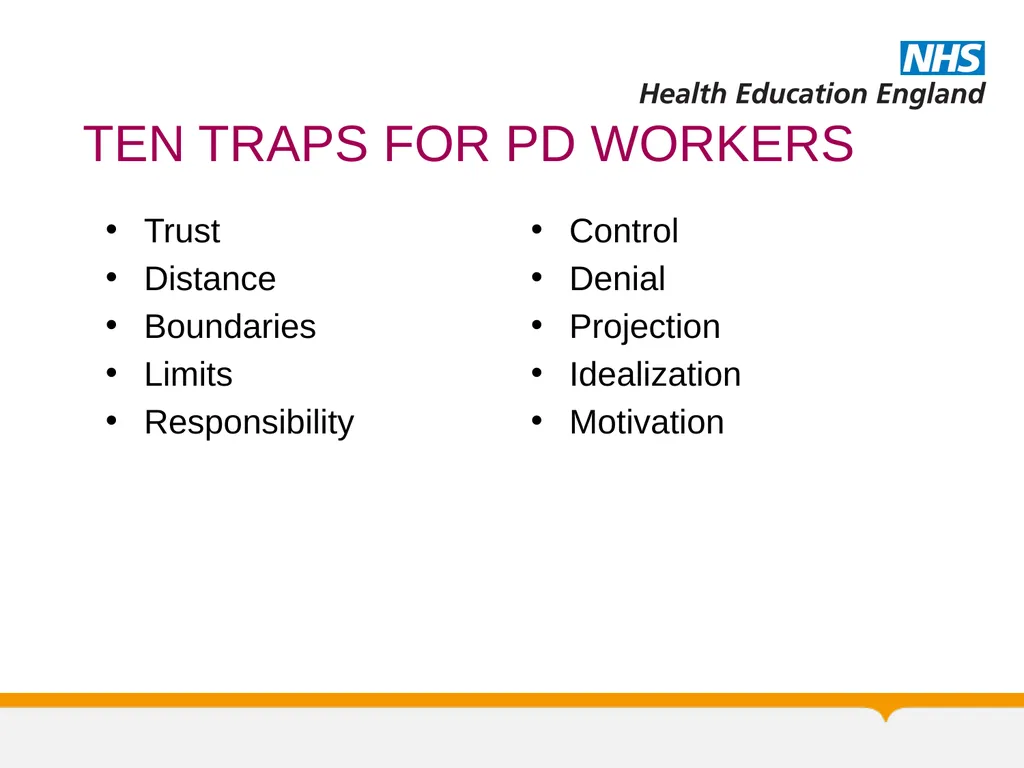
TEN TRAPS FOR PD WORKERS Trust
Distance
Boundaries
Limits
Responsibility Control
Denial
Projection
Idealization
Motivation<br>
Distance
Boundaries
Limits
Responsibility Control
Denial
Projection
Idealization
Motivation<br>
58
ANY QUESTIONS?<br>
59
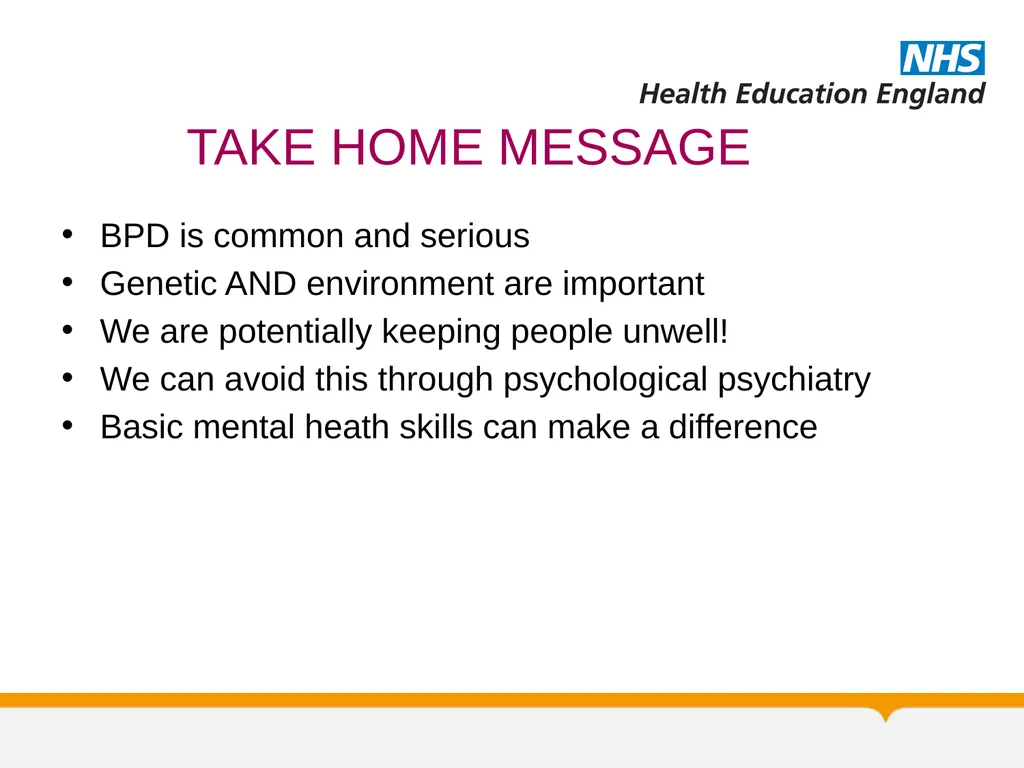
TAKE HOME MESSAGE BPD is common and serious
Genetic AND environment are important
We are potentially keeping people unwell!
We can avoid this through psychological psychiatry
Basic mental heath skills can make a difference<br>
Genetic AND environment are important
We are potentially keeping people unwell!
We can avoid this through psychological psychiatry
Basic mental heath skills can make a difference<br>
60
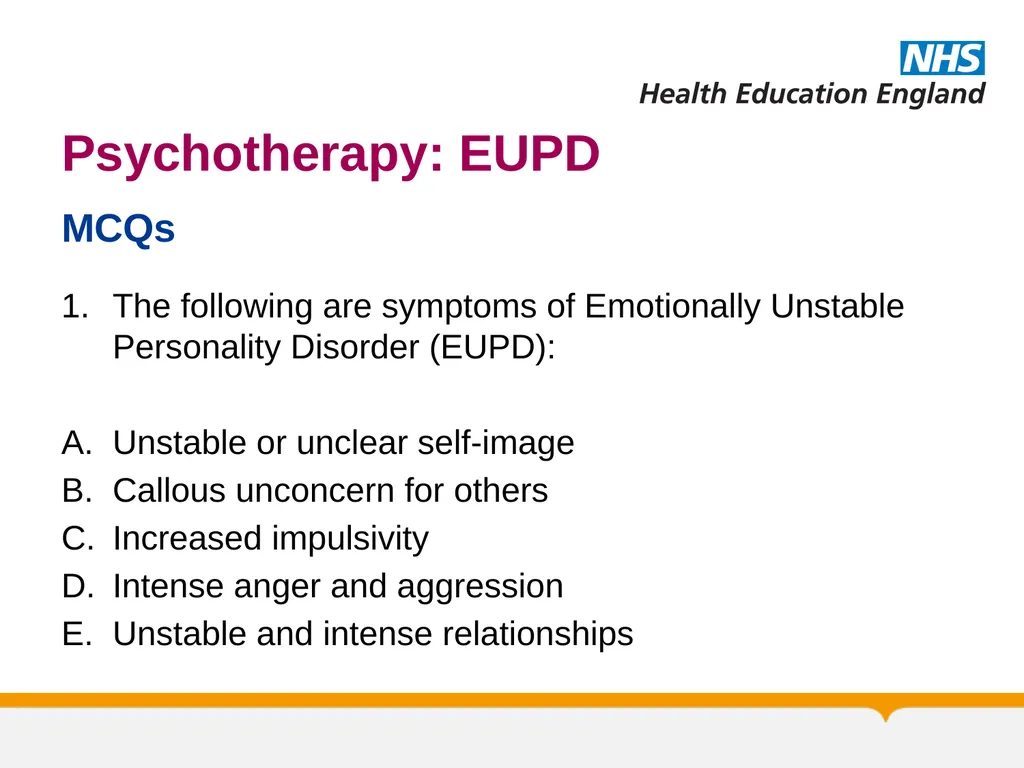
Psychotherapy: EUPD MCQs The following are symptoms of Emotionally Unstable Personality Disorder (EUPD):
Unstable or unclear self-image
Callous unconcern for others
Increased impulsivity
Intense anger and aggression
Unstable and intense relationships<br>
Unstable or unclear self-image
Callous unconcern for others
Increased impulsivity
Intense anger and aggression
Unstable and intense relationships<br>
61
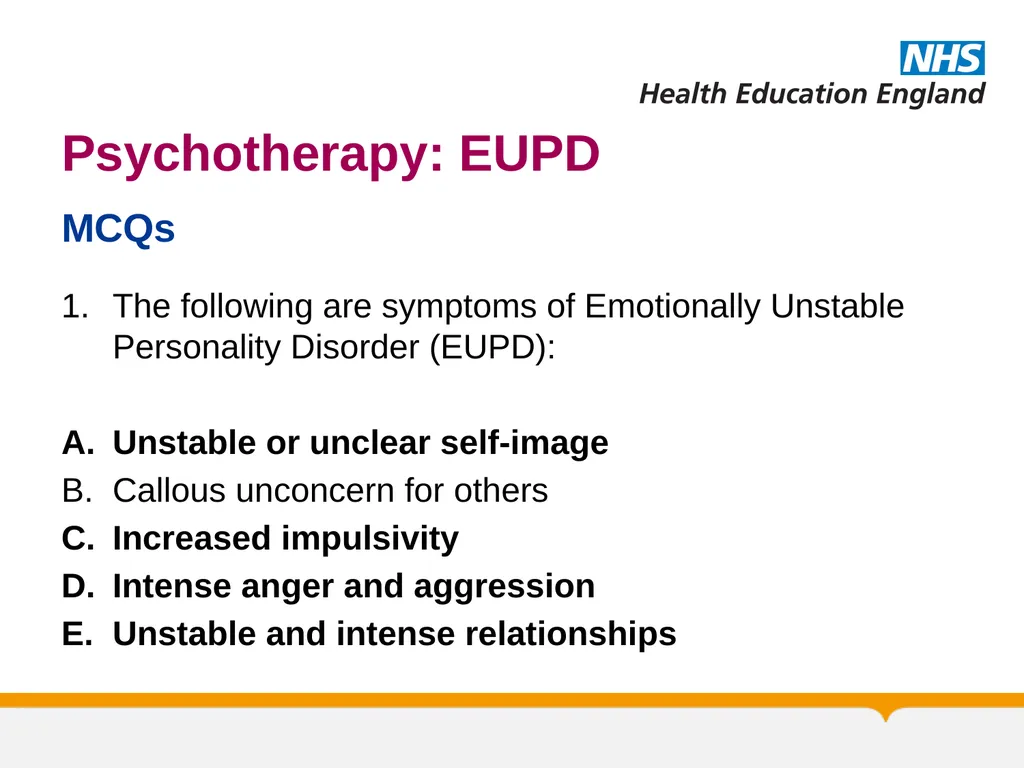
Psychotherapy: EUPD MCQs The following are symptoms of Emotionally Unstable Personality Disorder (EUPD):
Unstable or unclear self-image
Callous unconcern for others
Increased impulsivity
Intense anger and aggression
Unstable and intense relationships<br>
Unstable or unclear self-image
Callous unconcern for others
Increased impulsivity
Intense anger and aggression
Unstable and intense relationships<br>
62
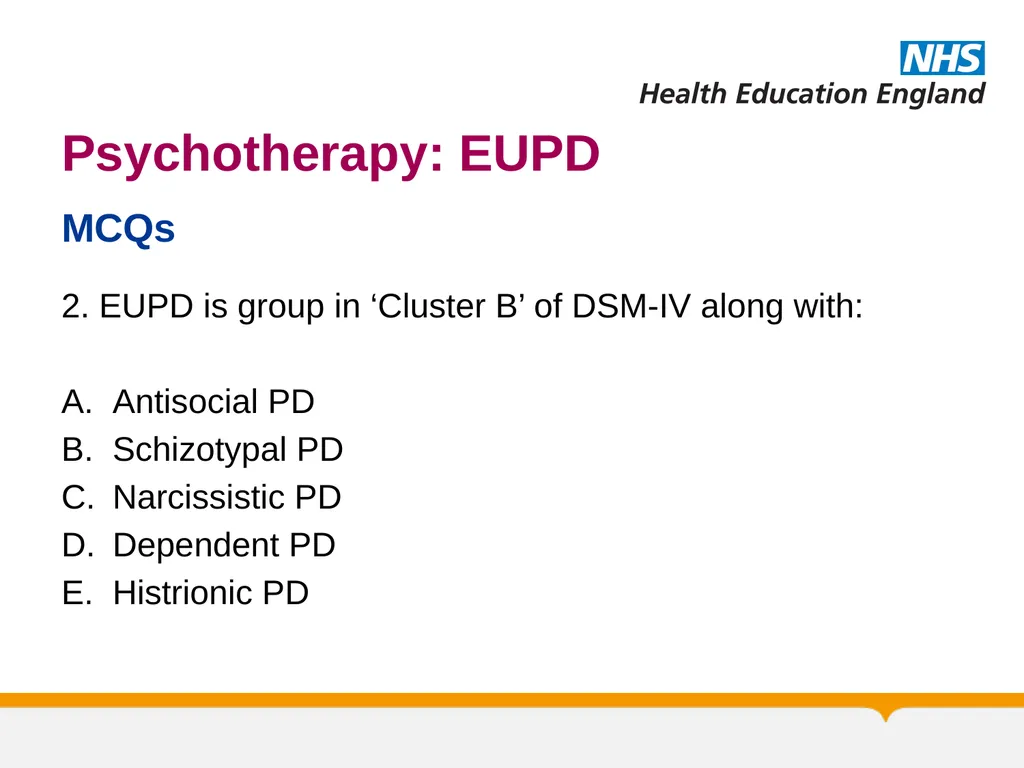
Psychotherapy: EUPD MCQs 2. EUPD is group in ‘Cluster B’ of DSM-IV along with:
Antisocial PD
Schizotypal PD
Narcissistic PD
Dependent PD
Histrionic PD<br>
Antisocial PD
Schizotypal PD
Narcissistic PD
Dependent PD
Histrionic PD<br>
63
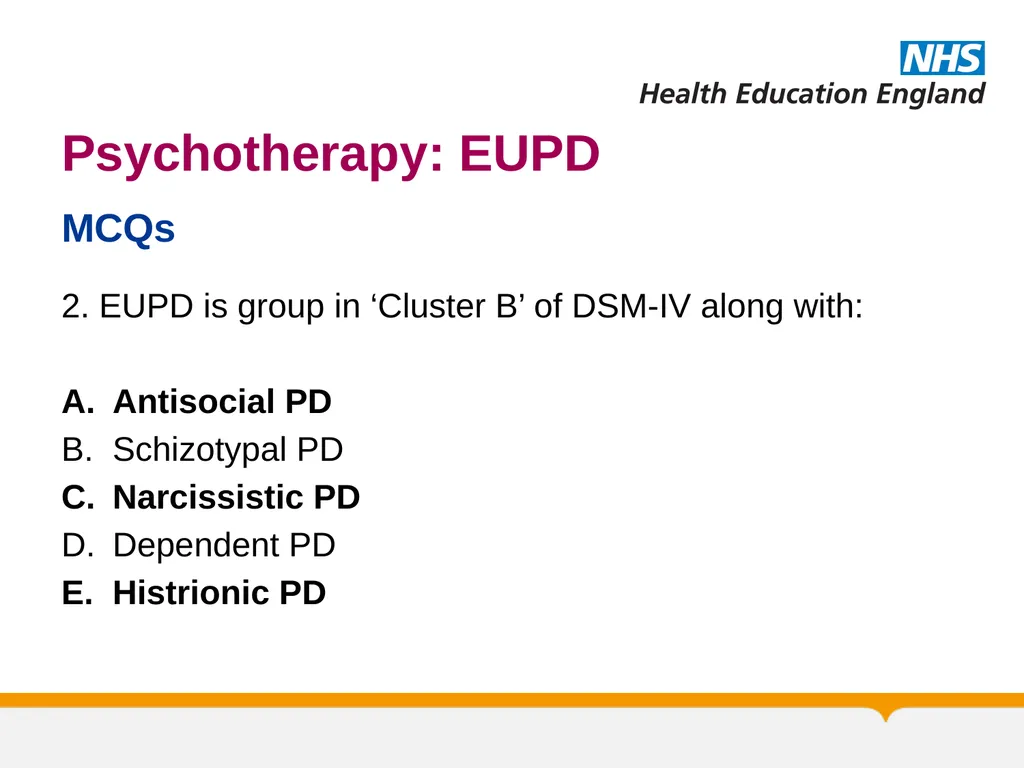
Psychotherapy: EUPD MCQs 2. EUPD is group in ‘Cluster B’ of DSM-IV along with:
Antisocial PD
Schizotypal PD
Narcissistic PD
Dependent PD
Histrionic PD<br>
Antisocial PD
Schizotypal PD
Narcissistic PD
Dependent PD
Histrionic PD<br>
64
Psychotherapy: EUPD MCQs 3. The following have been recommended by NICE in the treatment of EUPD:
Brief Dynamic Psychotherapy
Mentalization Based Treatment
Mindfulness Based Therapy
Olanzepine
Dialectical Behaviour Therapy<br>
Brief Dynamic Psychotherapy
Mentalization Based Treatment
Mindfulness Based Therapy
Olanzepine
Dialectical Behaviour Therapy<br>
65
Psychotherapy: EUPD MCQs 3. The following have been recommended by NICE in the treatment of EUPD:
Brief Dynamic Psychotherapy
Mentalization Based Treatment
Mindfulness Based Therapy
Olanzepine
Dialectical Behaviour Therapy<br>
Brief Dynamic Psychotherapy
Mentalization Based Treatment
Mindfulness Based Therapy
Olanzepine
Dialectical Behaviour Therapy<br>
66
Psychotherapy: EUPD Any Questions?
Thank you.<br>
Thank you.<br>