
PSYCHOTIC DISORDERS Jessica Nelson, M.D. Assistant
CM
Published · 107 slides · 0 views

1 / 1










Description
PSYCHOTIC DISORDERS Jessica Nelson, M.D. Assistant Professor of Psychiatry Objectives 1. Know and understand the diagnostic criteria for schizophrenia, the major psychotic disorder 2. Know the neurotransmitters suspected in the
Related Topics
Share
Embed code
Download this presentation From Below
"PSYCHOTIC DISORDERS Jessica Nelson, M.D. Assistant" is the property of its rightful owner. Permission is granted to download and print the materials on this website for personal, non-commercial use only, and to display it on your personal computer provided you do not modify the materials and that you retain all copyright notices contained in the materials. By downloading content from our website, you accept the terms of this agreement.
Presentation Transcript
01
PSYCHOTIC DISORDERS Jessica Nelson, M.D.
Assistant Professor of Psychiatry<br>
Assistant Professor of Psychiatry<br>
02
Objectives 1. Know and understand the diagnostic criteria for schizophrenia, the major psychotic disorder
2. Know the neurotransmitters suspected in the pathophysiology of schizophrenia
3. Understand the good and poor prognostic factors in psychotic disorders 2<br>
2. Know the neurotransmitters suspected in the pathophysiology of schizophrenia
3. Understand the good and poor prognostic factors in psychotic disorders 2<br>
03
Objectives 4. Understand that psychotic symptoms can be due to disorders other than schizophrenia
5. Be able to make a reasonable differential diagnosis of a patient with psychotic symptoms 3<br>
5. Be able to make a reasonable differential diagnosis of a patient with psychotic symptoms 3<br>
04
Types of Psychotic Disorders Schizophrenia (DSM IV-TR, V)
Schizophreniform Disorder (DSM IV-TR, V)
Schizoaffective Disorder (DSM IV-TR, V)
Delusional Disorder (DSM IV-TR, V)
Brief Psychotic Disorder (DSM IV-TR, V)
Other Psychotic Disorder (DSM V)
Secondary Psychotic Disorders (DSM IV-TR, V)
Catatonia (DSM V) 4<br>
Schizophreniform Disorder (DSM IV-TR, V)
Schizoaffective Disorder (DSM IV-TR, V)
Delusional Disorder (DSM IV-TR, V)
Brief Psychotic Disorder (DSM IV-TR, V)
Other Psychotic Disorder (DSM V)
Secondary Psychotic Disorders (DSM IV-TR, V)
Catatonia (DSM V) 4<br>
05
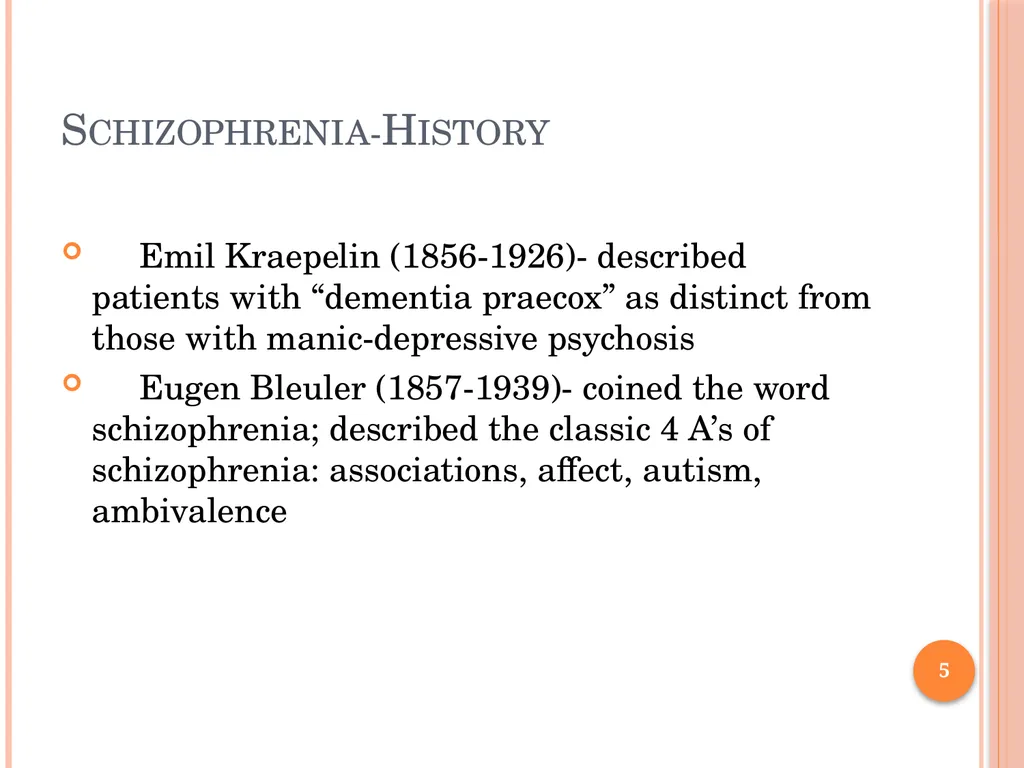
Schizophrenia-History Emil Kraepelin (1856-1926)- described patients with “dementia praecox” as distinct from those with manic-depressive psychosis
Eugen Bleuler (1857-1939)- coined the word schizophrenia; described the classic 4 A’s of schizophrenia: associations, affect, autism, ambivalence 5<br>
Eugen Bleuler (1857-1939)- coined the word schizophrenia; described the classic 4 A’s of schizophrenia: associations, affect, autism, ambivalence 5<br>
06
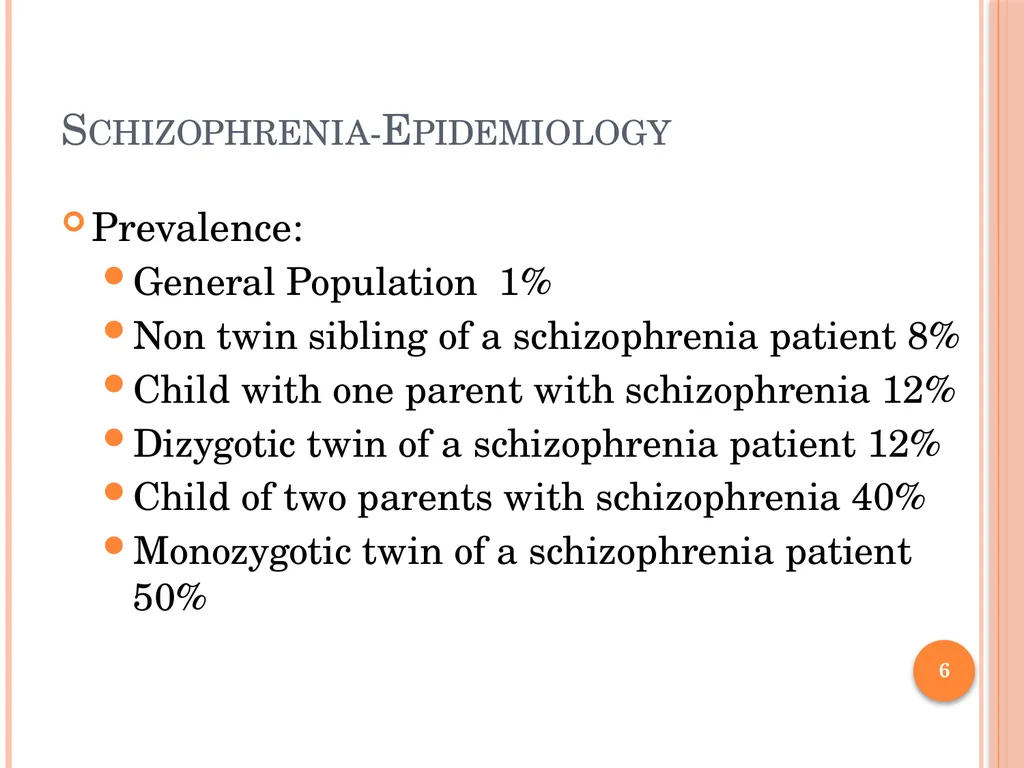
Schizophrenia-Epidemiology Prevalence:
General Population 1%
Non twin sibling of a schizophrenia patient 8%
Child with one parent with schizophrenia 12%
Dizygotic twin of a schizophrenia patient 12%
Child of two parents with schizophrenia 40%
Monozygotic twin of a schizophrenia patient 50% 6<br>
General Population 1%
Non twin sibling of a schizophrenia patient 8%
Child with one parent with schizophrenia 12%
Dizygotic twin of a schizophrenia patient 12%
Child of two parents with schizophrenia 40%
Monozygotic twin of a schizophrenia patient 50% 6<br>
07
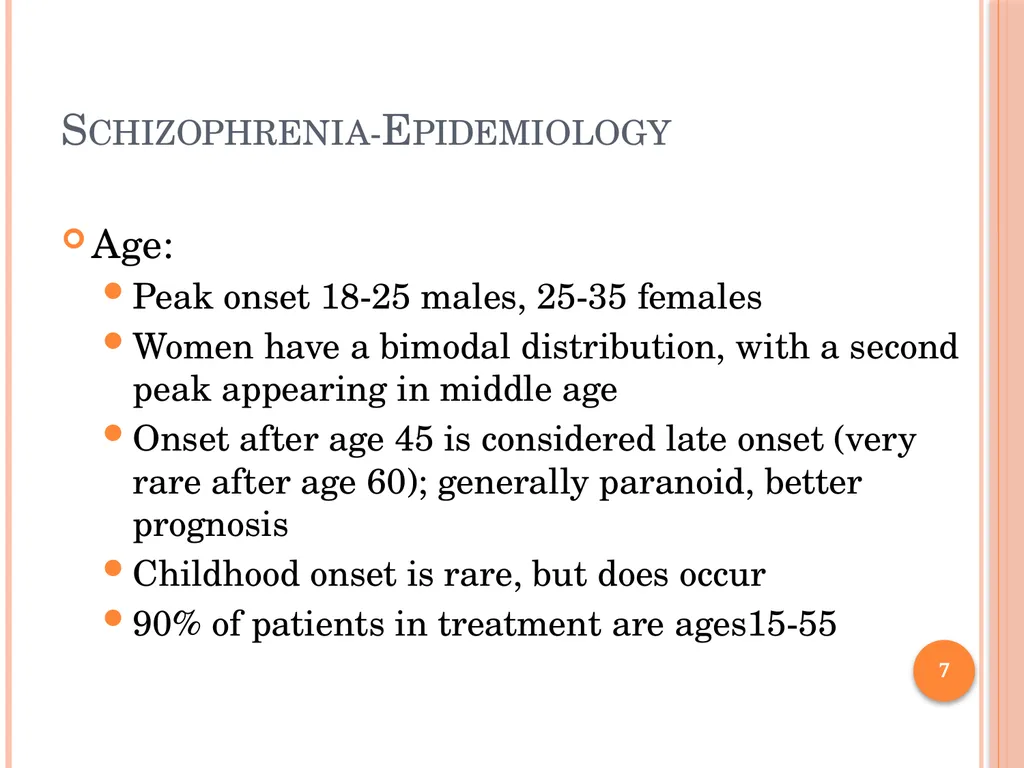
Schizophrenia-Epidemiology Age:
Peak onset 18-25 males, 25-35 females
Women have a bimodal distribution, with a second peak appearing in middle age
Onset after age 45 is considered late onset (very rare after age 60); generally paranoid, better prognosis
Childhood onset is rare, but does occur
90% of patients in treatment are ages15-55 7<br>
08
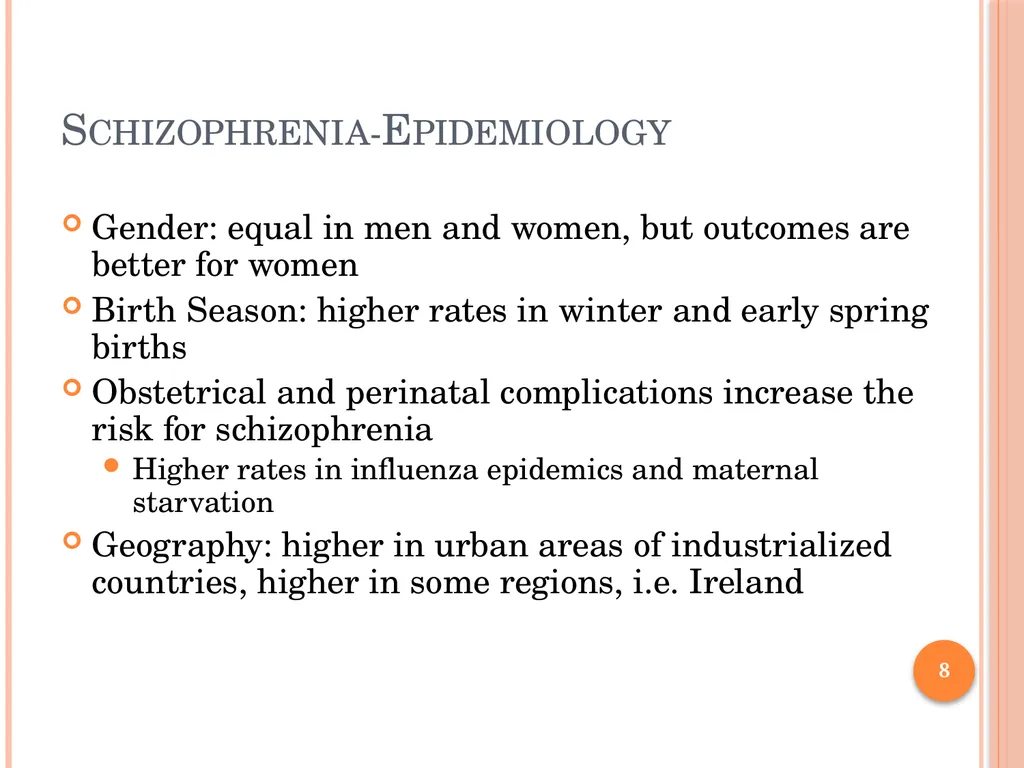
Schizophrenia-Epidemiology Gender: equal in men and women, but outcomes are better for women
Birth Season: higher rates in winter and early spring births
Obstetrical and perinatal complications increase the risk for schizophrenia
Higher rates in influenza epidemics and maternal starvation
Geography: higher in urban areas of industrialized countries, higher in some regions, i.e. Ireland 8<br>
09
Schizophrenia-Epidemiology Non-psychiatric morbidity and mortality:
Higher death rate from accidents
Higher rates of sudden death
Higher rates of metabolic syndrome: insulin resistance, hypertension, dyslipidemia, increased waist circumference
Up to 80% of patients with schizophrenia have concurrent medical illnesses, half of which are undiagnosed 9<br>
Higher death rate from accidents
Higher rates of sudden death
Higher rates of metabolic syndrome: insulin resistance, hypertension, dyslipidemia, increased waist circumference
Up to 80% of patients with schizophrenia have concurrent medical illnesses, half of which are undiagnosed 9<br>
10
Schizophrenia-Epidemiology Suicide:
10-15% of patients with schizophrenia commit suicide
50% attempt suicide
Risk factors: male, young, post-psychotic depression, realistic assessment of deterioration due to illness 10<br>
10-15% of patients with schizophrenia commit suicide
50% attempt suicide
Risk factors: male, young, post-psychotic depression, realistic assessment of deterioration due to illness 10<br>
11
Schizophrenia-Epidemiology Substance Use:
Cigarette Smoking
75-90% of patients smoke (there may be brain abnormalities in nicotinic receptors in schizophrenia)
Increases the metabolism of some antipsychotics
Nicotine appears to improve some cognitive impairments (may decrease positive symptoms) 11<br>
Cigarette Smoking
75-90% of patients smoke (there may be brain abnormalities in nicotinic receptors in schizophrenia)
Increases the metabolism of some antipsychotics
Nicotine appears to improve some cognitive impairments (may decrease positive symptoms) 11<br>
12
Schizophrenia-Epidemiology Substance Use:
Alcohol
30-50% meet criteria for abuse or dependence
Cannabis and cocaine are the two other commonly used drugs. High cannabis use increases risk of developing schizophrenia by 6x
Alcohol and drug use are associated with a poor prognosis 12<br>
Alcohol
30-50% meet criteria for abuse or dependence
Cannabis and cocaine are the two other commonly used drugs. High cannabis use increases risk of developing schizophrenia by 6x
Alcohol and drug use are associated with a poor prognosis 12<br>
13
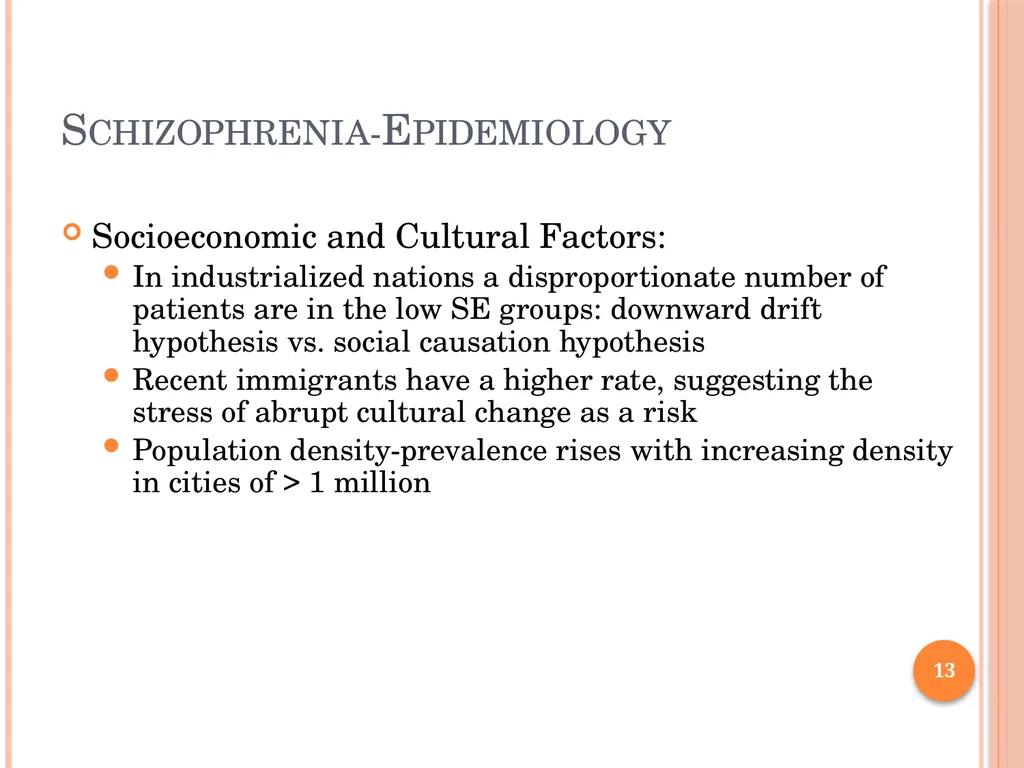
Schizophrenia-Epidemiology Socioeconomic and Cultural Factors:
In industrialized nations a disproportionate number of patients are in the low SE groups: downward drift hypothesis vs. social causation hypothesis
Recent immigrants have a higher rate, suggesting the stress of abrupt cultural change as a risk
Population density-prevalence rises with increasing density in cities of > 1 million 13<br>
14
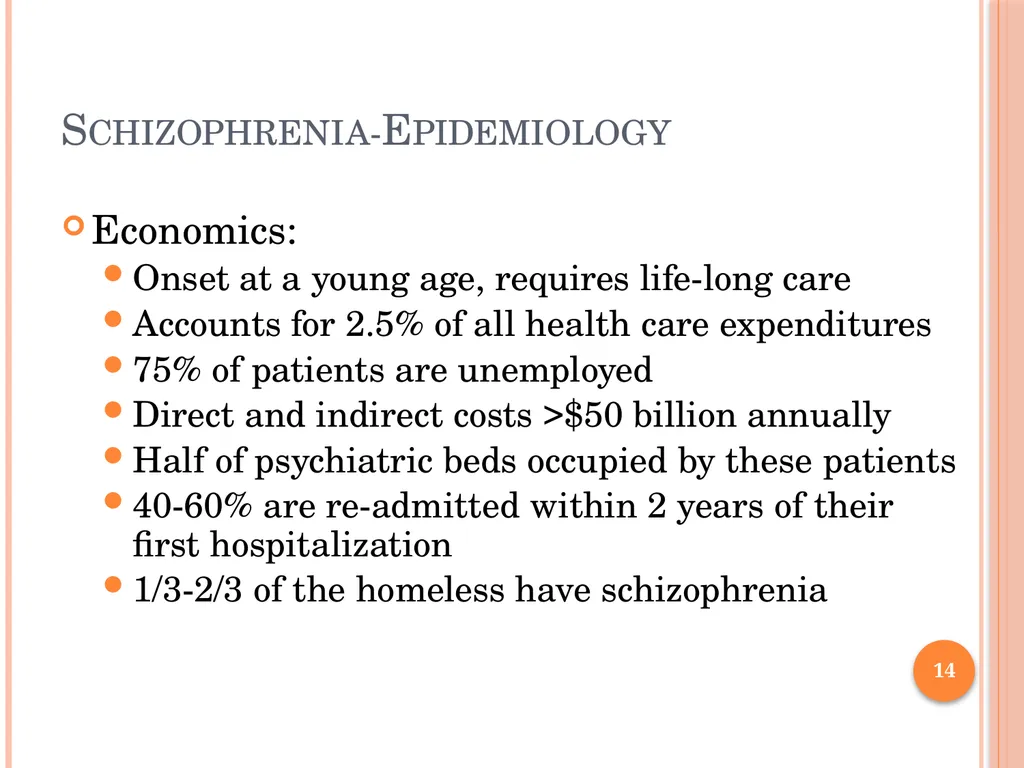
Schizophrenia-Epidemiology Economics:
Onset at a young age, requires life-long care
Accounts for 2.5% of all health care expenditures
75% of patients are unemployed
Direct and indirect costs >$50 billion annually
Half of psychiatric beds occupied by these patients
40-60% are re-admitted within 2 years of their first hospitalization
1/3-2/3 of the homeless have schizophrenia 14<br>
15
Schizophrenia-Etiology Schizophrenia is not a single disease, but a group of disorders with heterogeneous causes
Stress-Diathesis Model: The person has a specific vulnerability (diathesis) that when acted on by a stress leads to the development of schizophrenia. The stress can be environmental or biological or both. 15<br>
Stress-Diathesis Model: The person has a specific vulnerability (diathesis) that when acted on by a stress leads to the development of schizophrenia. The stress can be environmental or biological or both. 15<br>
16
Schizophrenia-Etiology Genetic Factors:
Significant genetic contribution to some, perhaps all, forms of schizophrenia, involving multiple genes
Paternal age: direct correlation of increased risk with advancing paternal age (perhaps spermatogenesis in older men is subject to greater epigenetic damage) 16<br>
Significant genetic contribution to some, perhaps all, forms of schizophrenia, involving multiple genes
Paternal age: direct correlation of increased risk with advancing paternal age (perhaps spermatogenesis in older men is subject to greater epigenetic damage) 16<br>
17
Schizophrenia-Etiology-Neurobiology Schizophrenia is a complex neurodevelopmental disorder without one cause, defect or manifestation. Research implicates dysfunction in certain areas of the brain, primarily in the limbic system and basal ganglia, including the cerebral cortex, thalamus and brainstem. Some patients have loss of brain volume believed to be due to reduced density of axons, dendrites, and synapses. 17<br>
18
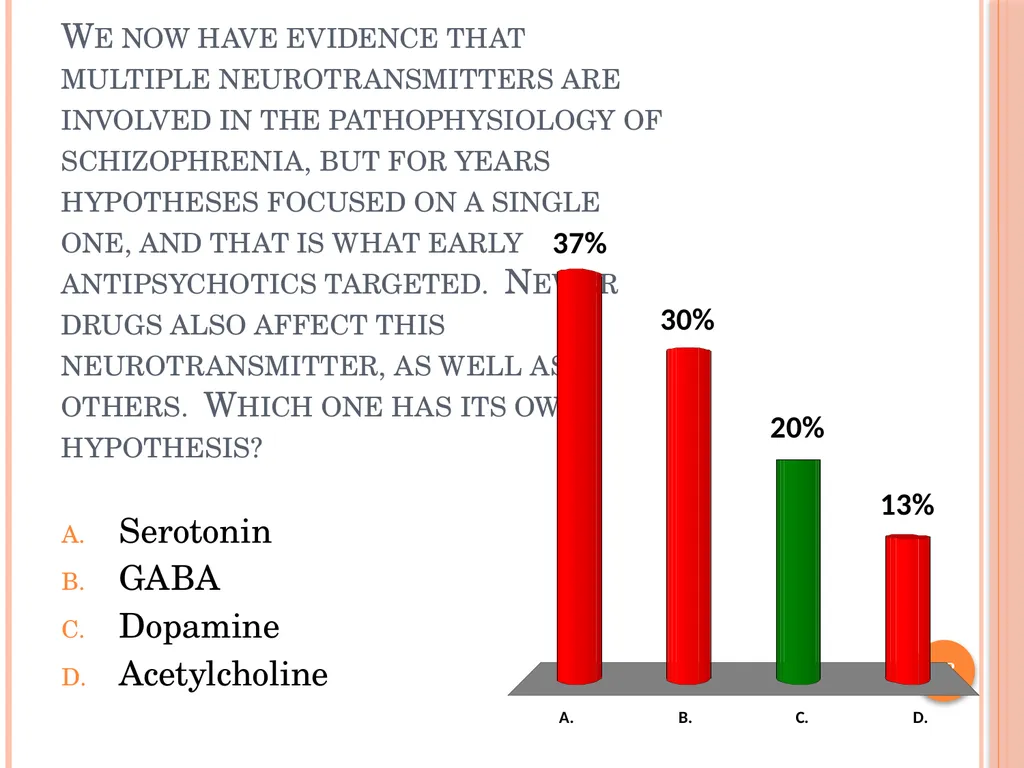
We now have evidence that multiple neurotransmitters are involved in the pathophysiology of schizophrenia, but for years hypotheses focused on a single one, and that is what early antipsychotics targeted. Newer drugs also affect this neurotransmitter, as well as others. Which one has its own hypothesis? Serotonin
GABA
Dopamine
Acetylcholine 18<br>
GABA
Dopamine
Acetylcholine 18<br>
19
Schizophrenia-Etiology-Neurotransmitters The Dopamine Hypothesis of Schizophrenia:
Disease results from too much dopaminergic activity as evidenced by:
Dopamine receptor antagonists are effective antipsychotics
Drugs that increase dopamine (amphetamines) are psychotomimetics
This basic theory doesn’t speculate on whether the dopaminergic hyperactivity is due to excessive release of dopamine, excessive number of dopamine receptors, hypersensitivity of receptors, or some combination. 19<br>
20
Schizophrenia-Etiology-Neurotransmitters It has become clear in recent years that the dopamine hypothesis is not sufficient:
Newer theories posit serotonin excess
The serotonin antagonist activity of clozapine and other atypical antipsychotics support this, as does the psychotomimetic effect of the serotonin agonist LSD
A single neuron can contain more than one neurotransmitter and can have receptors for 6 or more neurotransmitters 20<br>
21
Schizophrenia-Etiology-Neurotransmitters Norepinephrine likely modulates the dopaminergic system, and the prominent feature of anhedonia suggests dysfunction in the norepinephrine reward neural system
GABA has a regulatory effect on dopamine activity, and the loss of GABAergic neurons seen in the hippocampus of some patients could lead to hyperactivity of dopaminergic neurons 21<br>
GABA has a regulatory effect on dopamine activity, and the loss of GABAergic neurons seen in the hippocampus of some patients could lead to hyperactivity of dopaminergic neurons 21<br>
22
Schizophrenia-Etiology-Neurotransmitters Glutamate is implicated because phencyclidine (PCP), a glutamate antagonist, causes psychosis. New drugs are in development that influence glutamate
Acetylcholine and nicotine are suspected, as postmortem studies show decreased muscarinic and nicotinic receptors (important in cognition)
Substance P and neurotensin are two neuropeptides with altered concentrations in psychosis 22<br>
Acetylcholine and nicotine are suspected, as postmortem studies show decreased muscarinic and nicotinic receptors (important in cognition)
Substance P and neurotensin are two neuropeptides with altered concentrations in psychosis 22<br>
23
Schizophrenia-Etiology-Neuropathology Limbic system
Post-mortem studies show decreased size in this region, including the amygdala, hippocampus, and parahippocampal gyrus
Disorganization of neurons within the hippocampus has also been reported
The limbic system is important in controlling emotions 23<br>
Post-mortem studies show decreased size in this region, including the amygdala, hippocampus, and parahippocampal gyrus
Disorganization of neurons within the hippocampus has also been reported
The limbic system is important in controlling emotions 23<br>
24
Schizophrenia-Etiology-Neuropathology Basal Ganglia and Cerebellum are of theoretical interest for several reasons:
Many antipsychotic drug-naive schizophrenia patients show odd movements: awkward gait, facial grimacing, and stereotypies
Movement disorders involving the basal ganglia are more commonly associated with psychosis than are other neurological disorders 24<br>
Many antipsychotic drug-naive schizophrenia patients show odd movements: awkward gait, facial grimacing, and stereotypies
Movement disorders involving the basal ganglia are more commonly associated with psychosis than are other neurological disorders 24<br>
25
Schizophrenia-Etiology-Neuropathology Cerebral ventricles: lateral and third ventricle enlargement and some degree of reduction in cortical volume.
Reduced Symmetry: present in several brain areas, including temporal, frontal, and occipital lobes
Believed by some to originate during fetal life and to be indicative of a disruption in brain lateralization during neurodevelopment 25<br>
Reduced Symmetry: present in several brain areas, including temporal, frontal, and occipital lobes
Believed by some to originate during fetal life and to be indicative of a disruption in brain lateralization during neurodevelopment 25<br>
26
Schizophrenia-Etiology-Neuropathology Prefrontal Cortex: postmortem studies show anatomical abnormalities in this region, and imaging has shown functional deficits
Some symptoms of illness are shared with patients with frontal lobe syndromes and those who underwent prefrontal lobotomies years ago
Thalamus: some patients (including antipsychotic-naive) have shown volume shrinkage or neuronal loss in particular thalamic subnuclei 26<br>
Some symptoms of illness are shared with patients with frontal lobe syndromes and those who underwent prefrontal lobotomies years ago
Thalamus: some patients (including antipsychotic-naive) have shown volume shrinkage or neuronal loss in particular thalamic subnuclei 26<br>
27
Schizophrenia-Etiology-Neuropathology Electroencephalography (EEG): Many schizophrenic patients have abnormal EEG’s
They also have an inability to filter out irrelevant sounds and are extremely sensitive to background noise
Complex partial epilepsy: schizophrenia-like psychoses occur more commonly than expected, particularly with a left-sided seizure focus, medial temporal location of lesion, and early onset of seizures 27<br>
28
Schizophrenia-Etiology-Neuropathology Evoked Potentials: a number of abnormalities have been found, both positive and negative. Most studied is the P300; a large positive EP wave that occurs about 300msec after a sensory stimulus. The major source of the P300 may be in limbic system structures of the medial temporal lobes 28<br>
29
Schizophrenia-Etiology-Neuropathology Eye Movement Dysfunction: 50-85% of pts, 25% of other psych pts, and 10% of controls
Inability to accurately follow a moving visual target; independent of drug treatment and also found in first degree relatives of patients
Eye movement is partly controlled by centers in the frontal lobes; a disorder in eye movement is consistent with theories that implicate a frontal lobe pathological process in schizophrenia 29<br>
30
Schizophrenia-Etiology-Neuropathology Psychoneuroimmunology:
Decreased T cell interleukin-2 production
Reduced number and responsiveness of peripheral lymphocytes
Abnormal cellular and humoral reactivity to neurons
Presence of brain-directed antibodies
Relevance of these abnormalities is unclear 30<br>
Decreased T cell interleukin-2 production
Reduced number and responsiveness of peripheral lymphocytes
Abnormal cellular and humoral reactivity to neurons
Presence of brain-directed antibodies
Relevance of these abnormalities is unclear 30<br>
31
Schizophrenia-Etiology-Neuropathology Psychoneuroendocrinology:
Many studies have shown differences in hormone levels and responses to stimulation and suppression tests between groups of patients with schizophrenia and groups of control subjects 31<br>
Many studies have shown differences in hormone levels and responses to stimulation and suppression tests between groups of patients with schizophrenia and groups of control subjects 31<br>
32
Schizophrenia-Etiology-Social Psychosocial Factors:
Many theories over the years blamed the family, especially the mother, for the development of schizophrenia; these have been largely discredited.
It has been shown that patients living with parents or other caretakers with high levels of expressed emotion (criticism, hostility, over involvement) have high relapse rates 32<br>
33
Schizophrenia-Diagnosis DSM IV-TR and DSM V (Diagnostic and Statistical Manual of Mental Disorders) Diagnostic Criteria for Schizophrenia (criteria A-F must all be met): 33<br>
34
Schizophrenia Diagnosis A. Characteristic symptoms: Two (or more) of the following, each present for a significant portion of time during a 1 month period (or less if successfully treated):
1) Delusions
2) Hallucinations
3) Disorganized speech (i.e. frequent derailment or incoherence)
4) Grossly disorganized or catatonic behavior
5) Negative symptoms (i.e. affective flattening, alogia, or avolition) 34<br>
1) Delusions
2) Hallucinations
3) Disorganized speech (i.e. frequent derailment or incoherence)
4) Grossly disorganized or catatonic behavior
5) Negative symptoms (i.e. affective flattening, alogia, or avolition) 34<br>
35
Schizophrenia-Diagnosis Note: Only one Criterion A symptom is required if delusions are bizarre or hallucinations consist of a voice keeping up a running commentary on the person’s behavior or thoughts, or two or more voices conversing with each other. 35<br>
36
Schizophrenia-Diagnosis B. Social/occupational dysfunction: For a significant portion of the time since the onset of the disturbance, one or more major areas of functioning such as work, interpersonal relations, or self-care are markedly below the level achieved prior to the onset (or when the onset is in childhood or adolescence, failure to achieve expected level of interpersonal, academic, or occupational achievement) 36<br>
37
Schizophrenia-Diagnosis C. Duration: Continuous signs of the disturbance persist for at least 6 months. This 6 month period must include at least 1 month of symptoms (or less if successfully treated) that meet Criterion A (i.e. active phase symptoms) and may include periods of prodromal or residual symptoms. During these prodromal or residual periods, the signs of the disturbance may be manifested by only negative symptoms or two or more symptoms listed in Criterion A presented in an attenuated form (e.g. odd beliefs, unusual perceptual experiences). 37<br>
38
Schizophrenia-Diagnosis D. Schizoaffective and mood disorder exclusion: Schizoaffective disorder and mood disorder with psychotic features have been ruled out because either (1) no major depressive, manic or mixed episodes have occurred concurrently with the active-phase symptoms; or (2) if mood episodes have occurred during active-phase symptoms, their total duration has been brief relative to the duration of the active and residual periods. 38<br>
39
Schizophrenia-Diagnosis E. Substance/general medical condition exclusion: The disturbance is not due to the direct physiological effects of a substance (e.g. a drug of abuse, a medication) or a general medical condition 39<br>
40
Schizophrenia-Diagnosis F. Relationship to a pervasive developmental disorder: If there is a history of autistic disorder or another pervasive developmental disorder, the additional diagnosis of schizophrenia is made only if prominent delusions or hallucinations are also present for at least a month (or less if successfully treated). 40<br>
41
A 25-year-old married man who is employed at a hardware store develops psychotic symptoms during a two-week period after his father’s sudden death. He feels sadness and hears his father’s voice telling him to join him. He has no prior psychiatric history, but family history is notable for a brother with schizophrenia. Which of the following is the poorest prognostic sign for this patient? Depression
Family History
Marital Status
Acute Onset 41<br>
Family History
Marital Status
Acute Onset 41<br>
42
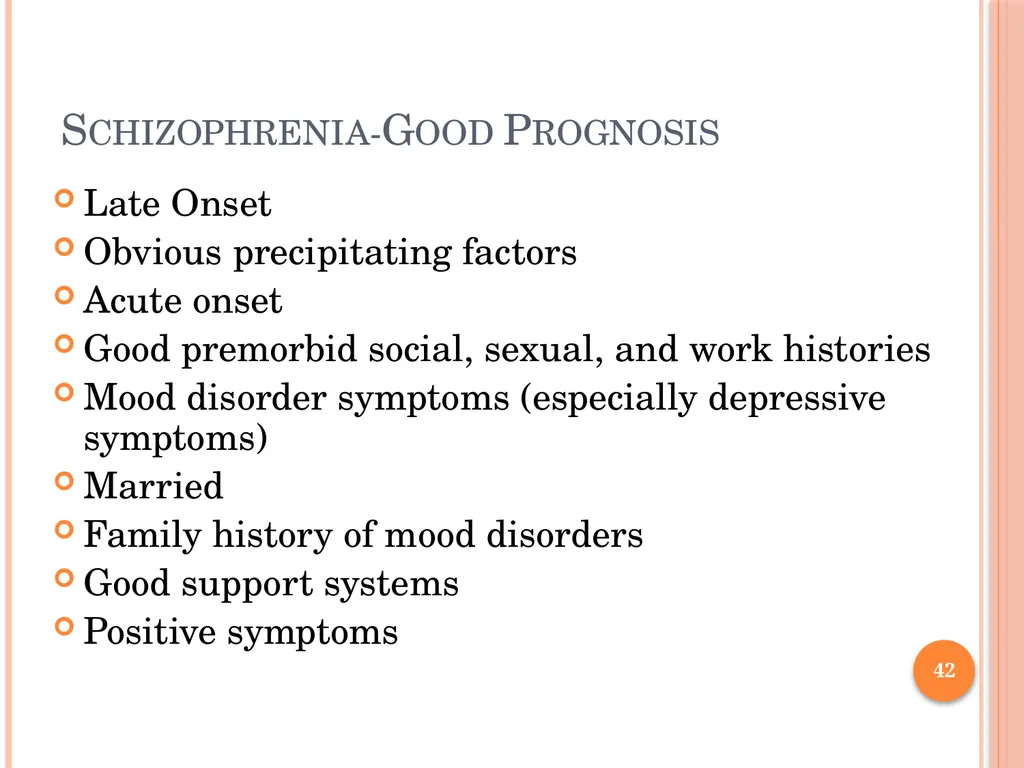
Schizophrenia-Good Prognosis Late Onset
Obvious precipitating factors
Acute onset
Good premorbid social, sexual, and work histories
Mood disorder symptoms (especially depressive symptoms)
Married
Family history of mood disorders
Good support systems
Positive symptoms 42<br>
Obvious precipitating factors
Acute onset
Good premorbid social, sexual, and work histories
Mood disorder symptoms (especially depressive symptoms)
Married
Family history of mood disorders
Good support systems
Positive symptoms 42<br>
43
Schizophrenia-Poor Prognosis Young onset
No precipitating factors
Insidious onset
Poor premorbid social, sexual, and work histories
Withdrawn, autistic behavior
Single, divorced, or widowed
Poor support systems 43<br>
No precipitating factors
Insidious onset
Poor premorbid social, sexual, and work histories
Withdrawn, autistic behavior
Single, divorced, or widowed
Poor support systems 43<br>
44
Schizophrenia-Poor Prognosis Negative Symptoms
Neurological signs and symptoms
History of perinatal trauma
No remission in 3 years
Many relapses
History of assaultiveness
Family history of schizophrenia 44<br>
Neurological signs and symptoms
History of perinatal trauma
No remission in 3 years
Many relapses
History of assaultiveness
Family history of schizophrenia 44<br>
45
Schizophrenia-Psychological Testing Schizophrenia is a brain disease that disrupts the normal functioning of many cognitive abilities
Vigilance, memory, and concept formation are most affected and consistent with frontotemporal cortical defects
Frequently there are impairments in attention, retention time, and problem solving ability
Motor ability is also impaired
IQ is lower at onset of illness and may deteriorate with progression of the disorder
Projective tests may indicate bizarre ideation 45<br>
46
Schizophrenia-Mental Status Exam Appearance:
Hygiene may be poor
Dress may be odd
Motor Behavior:
Eye contact may be poor, or patient may stare or look around the room if paranoid
Psychomotor agitation or retardation may be present
Evaluate for posturing, grimacing, echopraxia, echolalia
Look for medication side effects, EPS or TD 46<br>
Hygiene may be poor
Dress may be odd
Motor Behavior:
Eye contact may be poor, or patient may stare or look around the room if paranoid
Psychomotor agitation or retardation may be present
Evaluate for posturing, grimacing, echopraxia, echolalia
Look for medication side effects, EPS or TD 46<br>
47
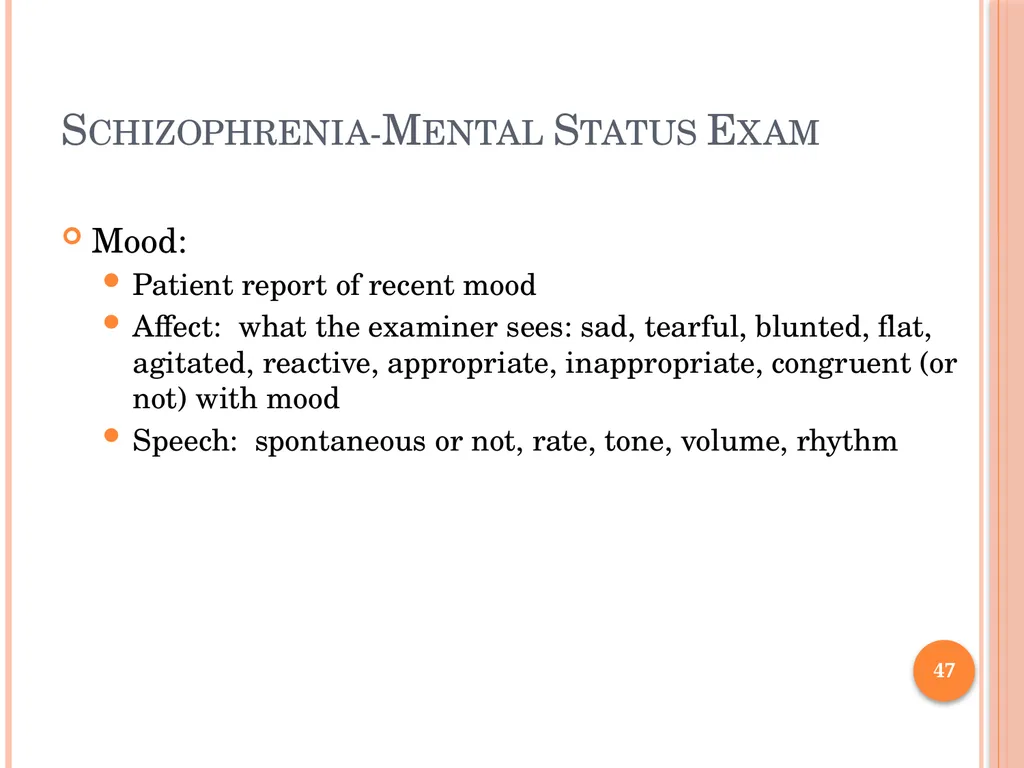
Schizophrenia-Mental Status Exam Mood:
Patient report of recent mood
Affect: what the examiner sees: sad, tearful, blunted, flat, agitated, reactive, appropriate, inappropriate, congruent (or not) with mood
Speech: spontaneous or not, rate, tone, volume, rhythm 47<br>
Patient report of recent mood
Affect: what the examiner sees: sad, tearful, blunted, flat, agitated, reactive, appropriate, inappropriate, congruent (or not) with mood
Speech: spontaneous or not, rate, tone, volume, rhythm 47<br>
48
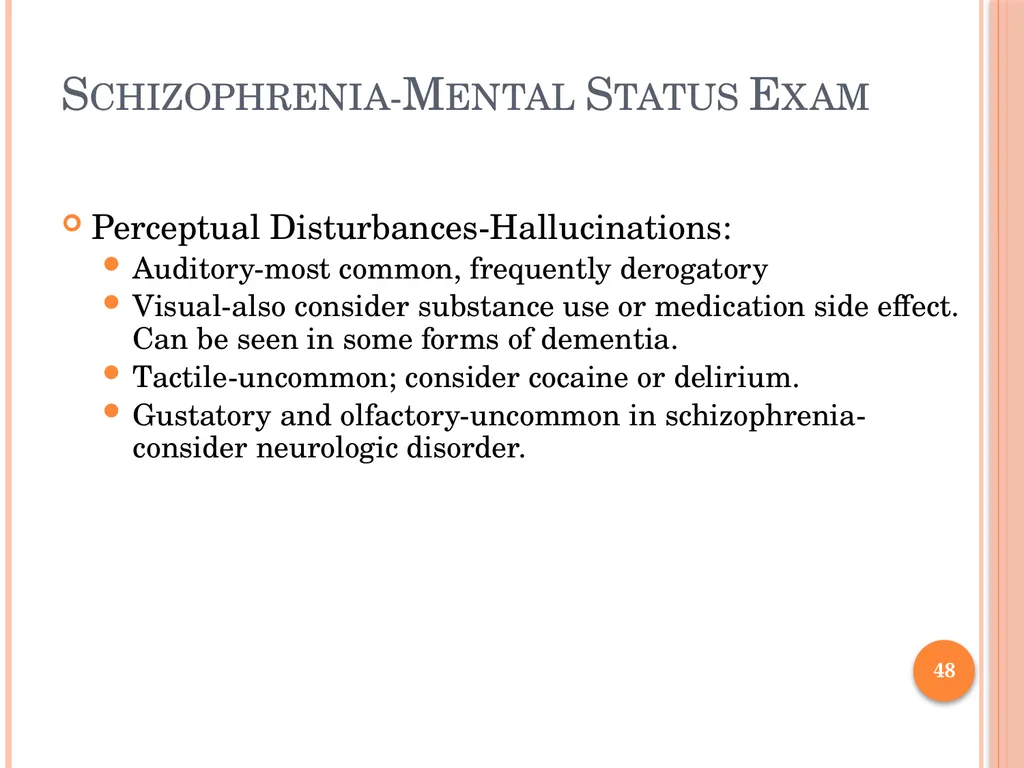
Schizophrenia-Mental Status Exam Perceptual Disturbances-Hallucinations:
Auditory-most common, frequently derogatory
Visual-also consider substance use or medication side effect. Can be seen in some forms of dementia.
Tactile-uncommon; consider cocaine or delirium.
Gustatory and olfactory-uncommon in schizophrenia-consider neurologic disorder. 48<br>
Auditory-most common, frequently derogatory
Visual-also consider substance use or medication side effect. Can be seen in some forms of dementia.
Tactile-uncommon; consider cocaine or delirium.
Gustatory and olfactory-uncommon in schizophrenia-consider neurologic disorder. 48<br>
49
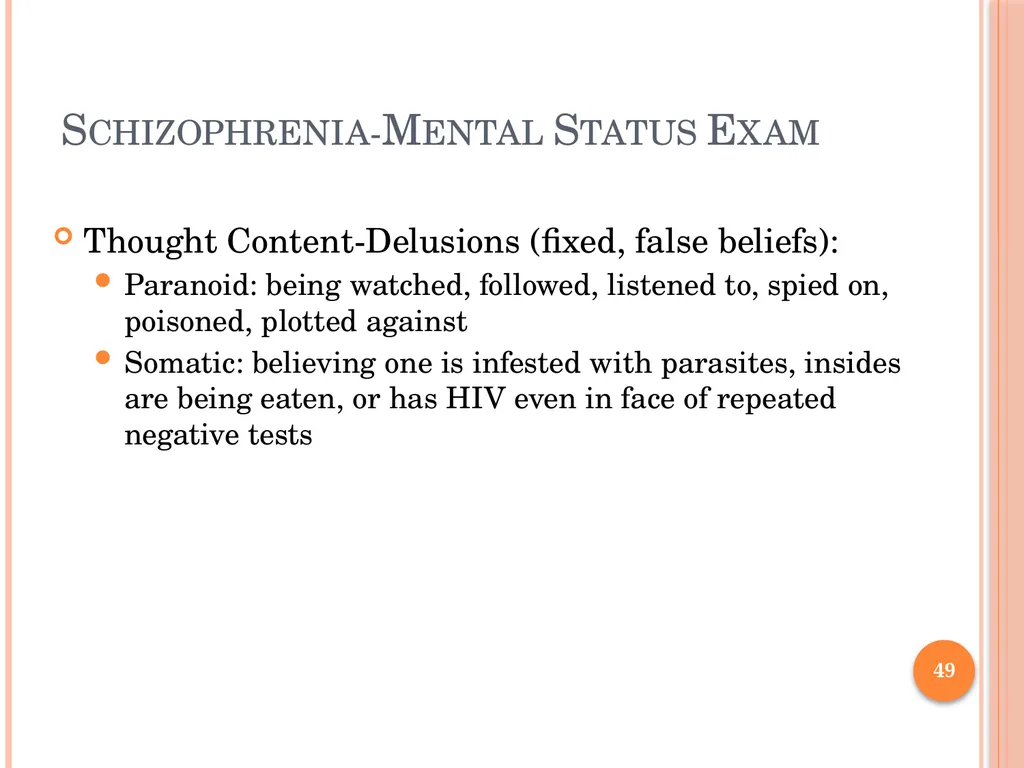
Schizophrenia-Mental Status Exam Thought Content-Delusions (fixed, false beliefs):
Paranoid: being watched, followed, listened to, spied on, poisoned, plotted against
Somatic: believing one is infested with parasites, insides are being eaten, or has HIV even in face of repeated negative tests 49<br>
Paranoid: being watched, followed, listened to, spied on, poisoned, plotted against
Somatic: believing one is infested with parasites, insides are being eaten, or has HIV even in face of repeated negative tests 49<br>
50
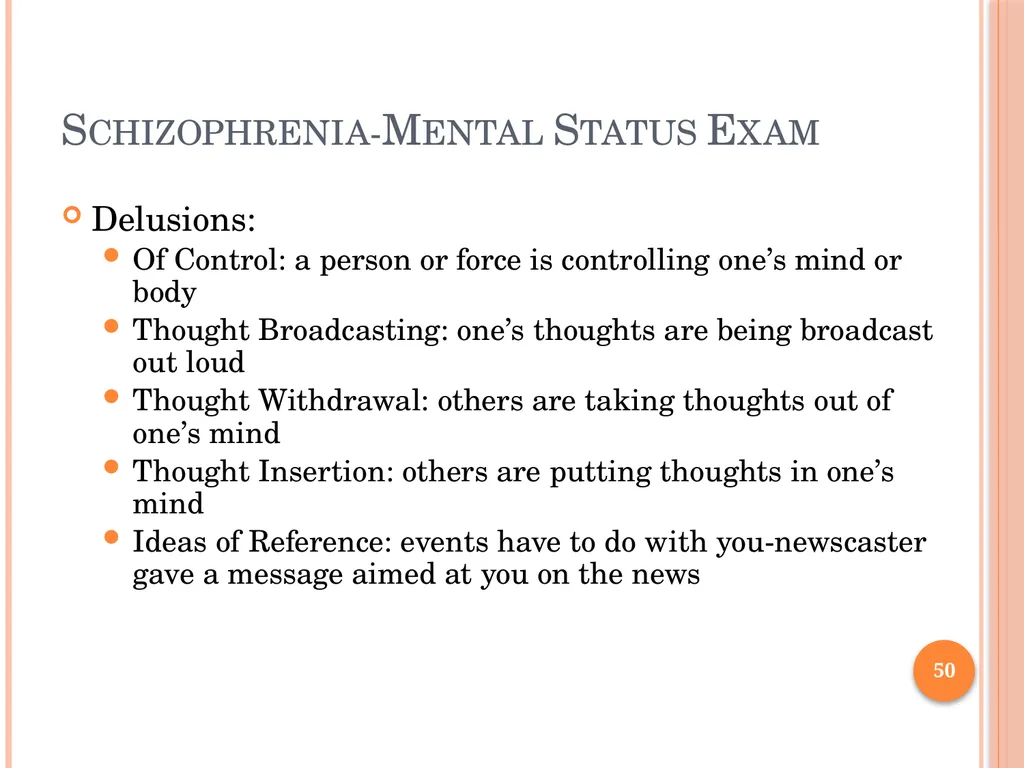
Schizophrenia-Mental Status Exam Delusions:
Of Control: a person or force is controlling one’s mind or body
Thought Broadcasting: one’s thoughts are being broadcast out loud
Thought Withdrawal: others are taking thoughts out of one’s mind
Thought Insertion: others are putting thoughts in one’s mind
Ideas of Reference: events have to do with you-newscaster gave a message aimed at you on the news 50<br>
51
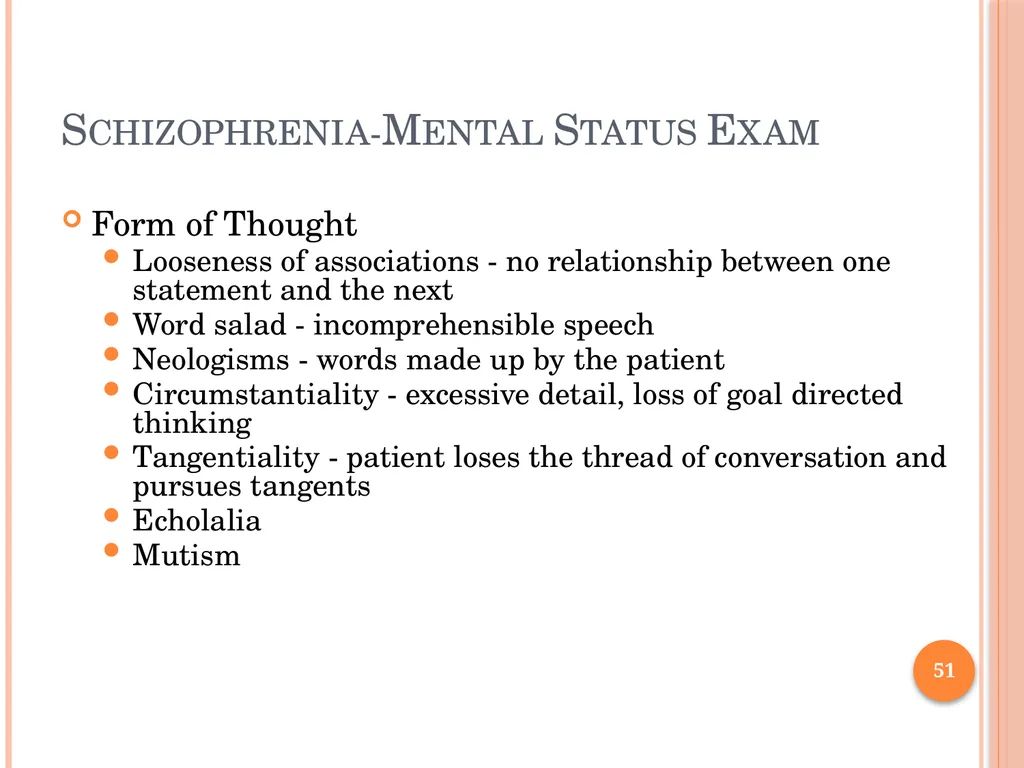
Schizophrenia-Mental Status Exam Form of Thought
Looseness of associations - no relationship between one statement and the next
Word salad - incomprehensible speech
Neologisms - words made up by the patient
Circumstantiality - excessive detail, loss of goal directed thinking
Tangentiality - patient loses the thread of conversation and pursues tangents
Echolalia
Mutism 51<br>
52
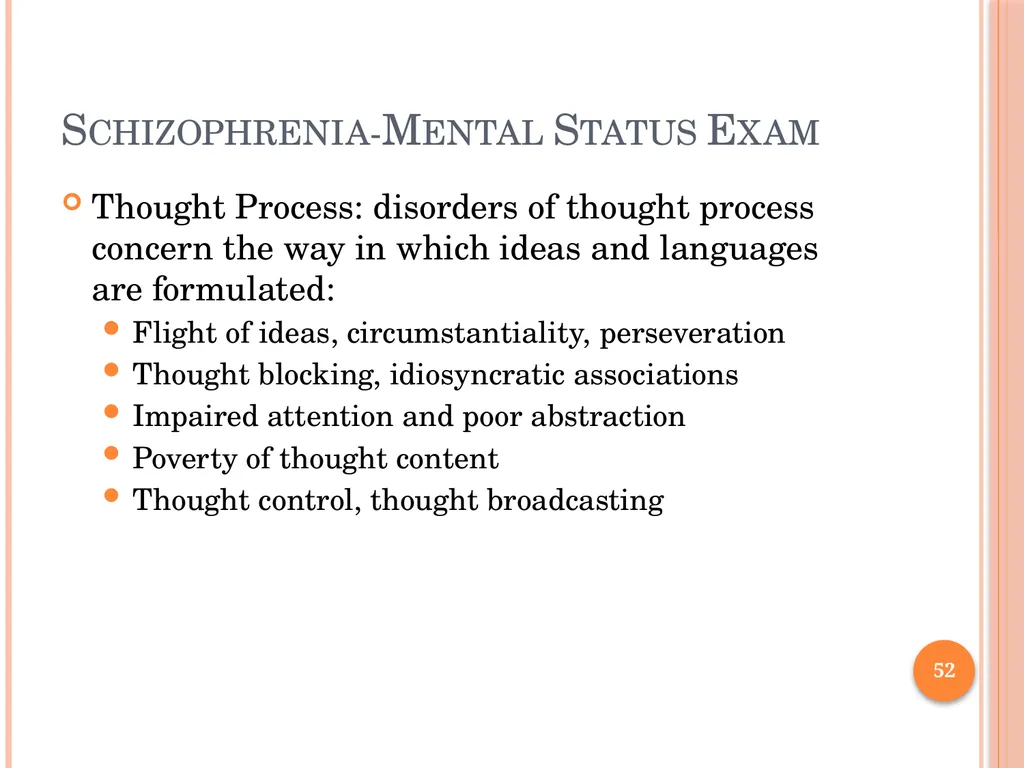
Schizophrenia-Mental Status Exam Thought Process: disorders of thought process concern the way in which ideas and languages are formulated:
Flight of ideas, circumstantiality, perseveration
Thought blocking, idiosyncratic associations
Impaired attention and poor abstraction
Poverty of thought content
Thought control, thought broadcasting 52<br>
Flight of ideas, circumstantiality, perseveration
Thought blocking, idiosyncratic associations
Impaired attention and poor abstraction
Poverty of thought content
Thought control, thought broadcasting 52<br>
53
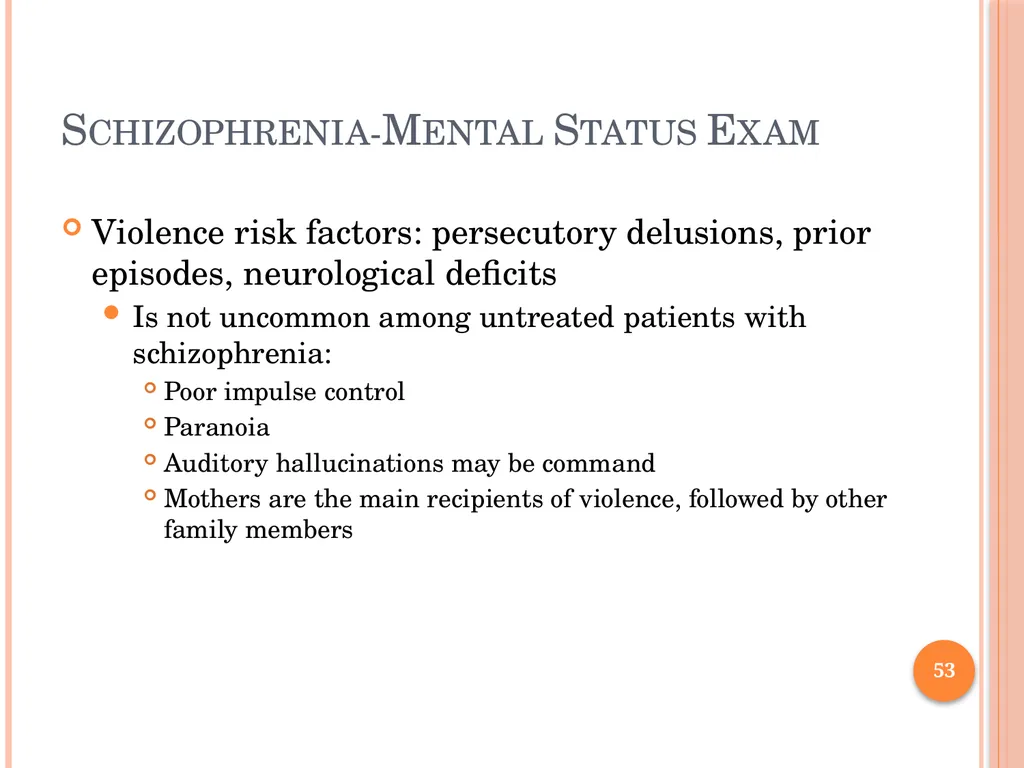
Schizophrenia-Mental Status Exam Violence risk factors: persecutory delusions, prior episodes, neurological deficits
Is not uncommon among untreated patients with schizophrenia:
Poor impulse control
Paranoia
Auditory hallucinations may be command
Mothers are the main recipients of violence, followed by other family members 53<br>
Is not uncommon among untreated patients with schizophrenia:
Poor impulse control
Paranoia
Auditory hallucinations may be command
Mothers are the main recipients of violence, followed by other family members 53<br>
54
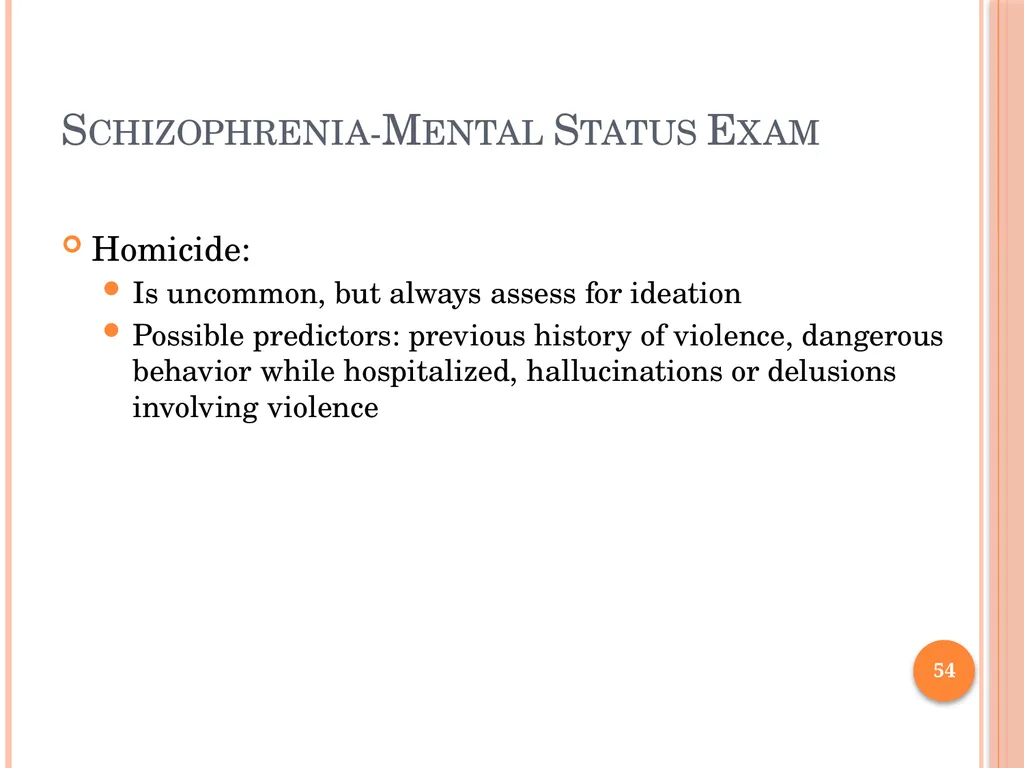
Schizophrenia-Mental Status Exam Homicide:
Is uncommon, but always assess for ideation
Possible predictors: previous history of violence, dangerous behavior while hospitalized, hallucinations or delusions involving violence 54<br>
Is uncommon, but always assess for ideation
Possible predictors: previous history of violence, dangerous behavior while hospitalized, hallucinations or delusions involving violence 54<br>
55
Schizophrenia-Mental Status Exam Suicide is always a risk-always assess. Look for depression that may be misdiagnosed as flat affect or medication side effect. Up to 80% of patients may have a major depressive episode at some time in their lives. Antidepressant medication can help depression in patients with schizophrenia.
20-50% of patients attempt suicide, 10-13% commit suicide 55<br>
20-50% of patients attempt suicide, 10-13% commit suicide 55<br>
56
Schizophrenia-Mental Status Exam Sensorium and Cognition:
Usually oriented
Memory as tested in formal MSE usually intact if patient can pay attention
There are subtle cognitive impairments in attention, executive function, working and episodic memory
Insight frequently impaired, which can lead to non-compliance
Judgment may be impaired in some spheres 56<br>
57
Schizophrenia-Other Findings Localizing and non-localizing neurological signs (also known as hard and soft signs) occur more frequently in people with schizophrenia than in other psychiatric patients. These signs are correlated with severity of illness, affective blunting, and poor prognosis.
Elevated eye blink rate, which is thought to reflect hyperdopaminergic activity
Minor physical anomalies
Compulsive water drinking (up to 10 L/d) 57<br>
Elevated eye blink rate, which is thought to reflect hyperdopaminergic activity
Minor physical anomalies
Compulsive water drinking (up to 10 L/d) 57<br>
58
Schizopohrenia-Differential Diagnosis Secondary Psychotic Disorders-due to a medical condition or substance
Other Psychotic Disorder-schizophreniform, brief psychotic, schizoaffective, delusional
Mood Disorders
Personality Disorders
Malingering (material goal) and Factitious Disorder (emotional goal) 58<br>
Other Psychotic Disorder-schizophreniform, brief psychotic, schizoaffective, delusional
Mood Disorders
Personality Disorders
Malingering (material goal) and Factitious Disorder (emotional goal) 58<br>
59
Schizophrenia-Course and Prognosis Prodromal syndrome may last a year or more before the onset of overt psychosis
Classic course one of exacerbations and remissions with progressive deterioration after each relapse
Positive symptoms tend to become less severe with time, but negative symptoms may worsen
In the 5-10 years after first hospitalization, 10-20% of patients have a good outcome, more than 50% have a poor outcome 59<br>
60
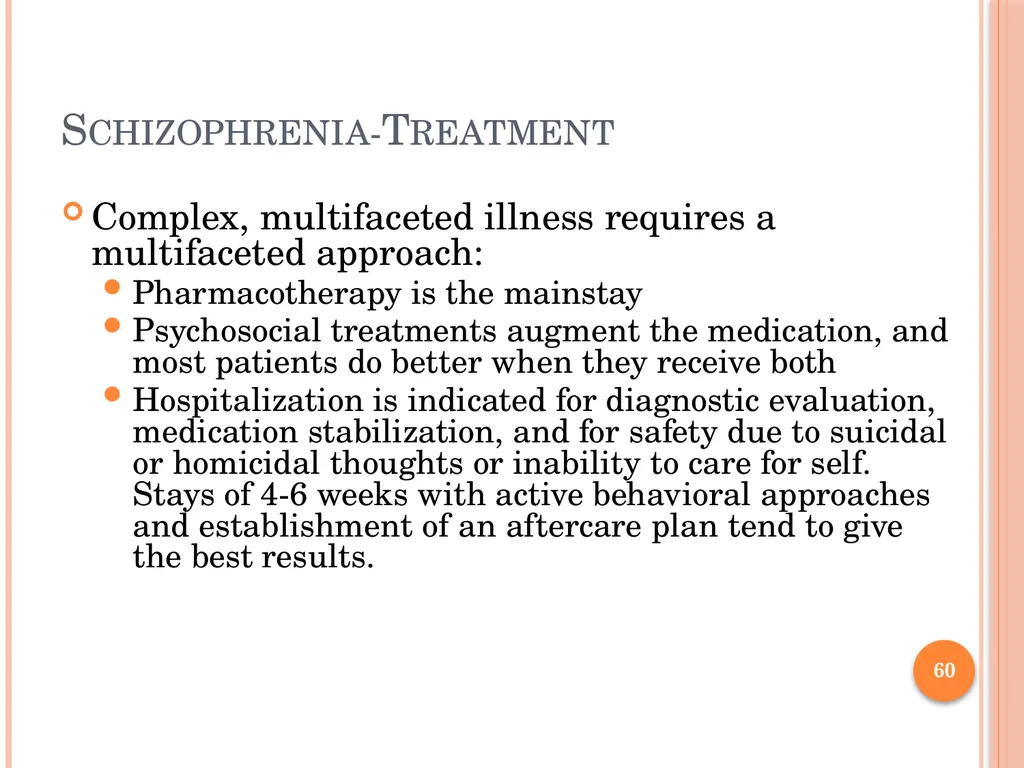
Schizophrenia-Treatment Complex, multifaceted illness requires a multifaceted approach:
Pharmacotherapy is the mainstay
Psychosocial treatments augment the medication, and most patients do better when they receive both
Hospitalization is indicated for diagnostic evaluation, medication stabilization, and for safety due to suicidal or homicidal thoughts or inability to care for self. Stays of 4-6 weeks with active behavioral approaches and establishment of an aftercare plan tend to give the best results. 60<br>
61
Schizophrenia-Pharmacotherapy Introduction of antipsychotic medication in the 1950s revolutionized the treatment of this disease. Patients are 2-4 times more likely to relapse when treated with placebo than with antipsychotics. 61<br>
62
Schizophrenia-Pharmacotherapy Two major classes:
Dopamine receptor antagonists (first generation antipsychotics, typical antipsychotics) (haloperidol, fluphenazine, thiothixene)
Serotonin-dopamine receptor antagonists (second generation antipsychotics, atypical antipsychotics) (clozapine, risperidone, paliperidone, asenapine, lurasidone, olanzapine, quetiapine, ziprasidone, aripiprazole)
These are considered first line agents by most psychiatrists (except clozapine which has significant side effects) because of the more benign side effect profile 62<br>
63
Schizophrenia-Pharmacotherapy Typical Antipsychotics Side Effects:
Extra Pyramidal Symptoms (EPS): parkinsonism (bradykinesia, tremor, rigidity)
Treatment is anticholinergic meds like benztropine, but they can cause dry mouth, constipation, blurred vision, memory loss
Akathisia: internal restlessness, inability to sit still, very distressing to patients
Treatment is beta-blockers like propranolol
Elevated Prolactin: sexual dysfunction, menstrual irregularities, galactorrhea, osteoporosis
Tardive Dyskinesia: permanent movement disorder 63<br>
64
Schizophrenia-Pharmacotherapy Tardive Dyskinesia (TD): a serious and likely permanent movement disorder related to therapy with dopamine blocking drugs
20-30% of long-term patients on typical antipsychotics exhibit symptoms
3-5% of young patients per year on typical antipsychotics develop TD
Higher incidence in females, older age, organic and affective mental illness 64<br>
20-30% of long-term patients on typical antipsychotics exhibit symptoms
3-5% of young patients per year on typical antipsychotics develop TD
Higher incidence in females, older age, organic and affective mental illness 64<br>
65
Schizophrenia-Pharmacotherapy Atypical Antipsychotics:
Decreased EPS and TD (primary benefit)
Do not cause elevated Prolactin (except risperidone and paliperidone))
Were thought to be more effective at treating negative symptoms than typical antipsychotics, although that now seems to not be the case
Some are associated with weight gain and metabolic abnormalities (monitoring is needed) 65<br>
66
Schizophrenia-Pharmacotherapy Clozapine
Most effective antipsychotic drug
0.3% risk of agranulocytosis in first year. Weekly WBC for first 6 mo, then biweekly for 6 mo, then q 4 weeks
Higher risk of seizures than other drugs, almost 5% at doses > 600mg (manage with AED’s)
Hypersalivation, sedation, postural hypotension, tachycardia, myocarditis, metabolic issues 66<br>
67
Schizophrenia-Pharmacotherapy Therapeutic principles for antipsychotic use:
1. Target the symptoms to be addressed
2. Use a drug that has worked in the past, if possible. Choose a drug based on the side effect profile
3. Minimum length of a medication trial is 6 weeks at a therapeutic dose
4. Rarely indicated to use more than one antipsychotic at a time
5. Maintain patient on lowest effective dose 67<br>
68
Schizophrenia-Pharmacotherapy Non-response:
Major cause is non-compliance; consider long-acting injectable medication
If patient is compliant, switch to another drug. After 2 failed drug trials, consider clozapine. It is the most effective drug, but requires weekly white blood cell counts due to a risk of agranulocytosis.
Sometimes augmenting an antipsychotic with a mood stabilizer such as lithium, valproate, or carbamazepine is helpful 68<br>
69
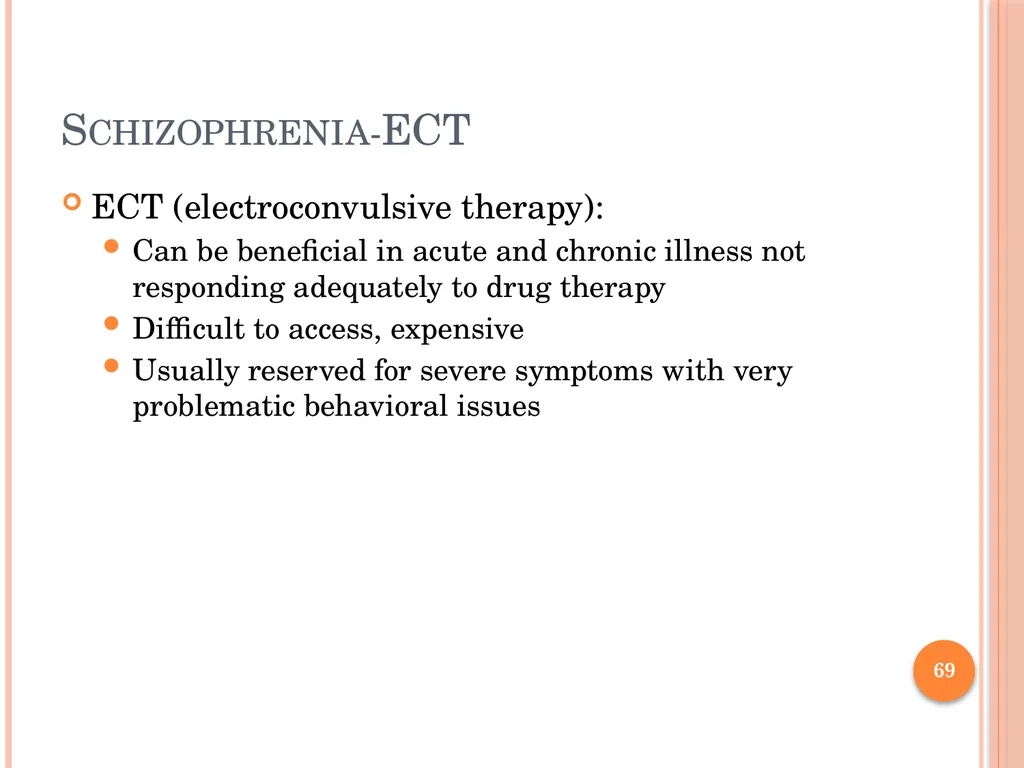
Schizophrenia-ECT ECT (electroconvulsive therapy):
Can be beneficial in acute and chronic illness not responding adequately to drug therapy
Difficult to access, expensive
Usually reserved for severe symptoms with very problematic behavioral issues 69<br>
Can be beneficial in acute and chronic illness not responding adequately to drug therapy
Difficult to access, expensive
Usually reserved for severe symptoms with very problematic behavioral issues 69<br>
70
Schizophrenia-Psychosocial Therapies Social Skills Training
Family Oriented Therapies
NAMI (National Alliance for the Mentally Ill)
Case Management
Assertive Community Treatment (ACT)
Group Therapy, Art Therapy
Cognitive Behavioral Therapy
Individual Psychotherapy, Personal Therapy
Vocational Therapy 70<br>
Family Oriented Therapies
NAMI (National Alliance for the Mentally Ill)
Case Management
Assertive Community Treatment (ACT)
Group Therapy, Art Therapy
Cognitive Behavioral Therapy
Individual Psychotherapy, Personal Therapy
Vocational Therapy 70<br>
71
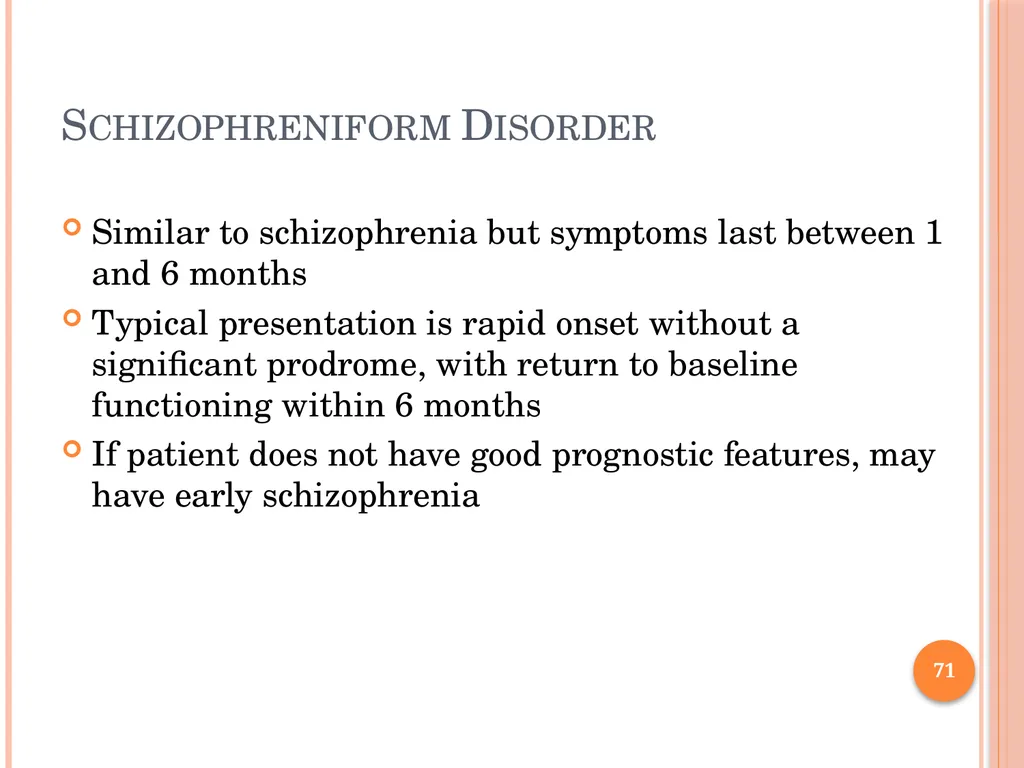
Schizophreniform Disorder Similar to schizophrenia but symptoms last between 1 and 6 months
Typical presentation is rapid onset without a significant prodrome, with return to baseline functioning within 6 months
If patient does not have good prognostic features, may have early schizophrenia 71<br>
Typical presentation is rapid onset without a significant prodrome, with return to baseline functioning within 6 months
If patient does not have good prognostic features, may have early schizophrenia 71<br>
72
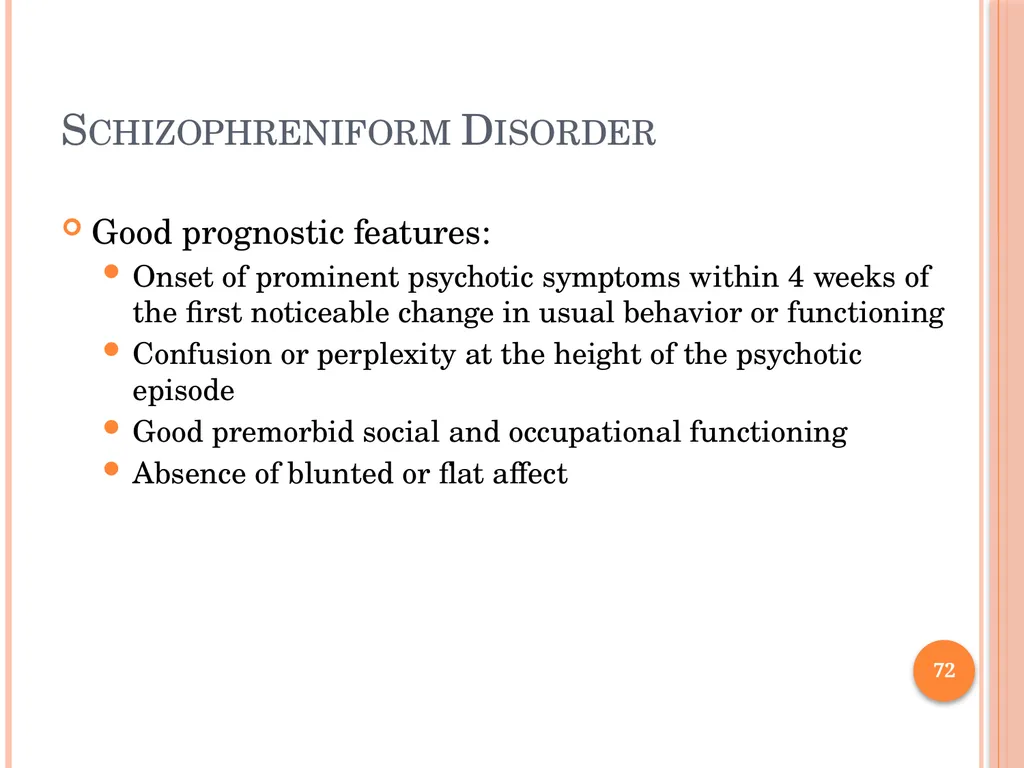
Schizophreniform Disorder Good prognostic features:
Onset of prominent psychotic symptoms within 4 weeks of the first noticeable change in usual behavior or functioning
Confusion or perplexity at the height of the psychotic episode
Good premorbid social and occupational functioning
Absence of blunted or flat affect 72<br>
Onset of prominent psychotic symptoms within 4 weeks of the first noticeable change in usual behavior or functioning
Confusion or perplexity at the height of the psychotic episode
Good premorbid social and occupational functioning
Absence of blunted or flat affect 72<br>
73
Schizophreniform Disorder Course: 60-80% progress to schizophrenia
Treatment: initial hospitalization for evaluation and stabilization followed by 3-6 month course of antipsychotic medication 73<br>
Treatment: initial hospitalization for evaluation and stabilization followed by 3-6 month course of antipsychotic medication 73<br>
74
Schizoaffective Disorder Has features of both schizophrenia and affective (mood) disorders
Epidemiology
Lifetime prevalence of 0.5-0.8%
Depressive type may be more common in older patients, bipolar in younger
Slightly higher rates in females than males, age of onset later in women
Men may exhibit antisocial behavior and flat or inappropriate affect 74<br>
Epidemiology
Lifetime prevalence of 0.5-0.8%
Depressive type may be more common in older patients, bipolar in younger
Slightly higher rates in females than males, age of onset later in women
Men may exhibit antisocial behavior and flat or inappropriate affect 74<br>
75
Schizoaffective Disorder Etiology-theories:
A type of schizophrenia or a type of mood disorder
Simultaneous expression of schizophrenia and mood disorder
A distinct third type of psychosis
A heterogeneous group of disorders encompassing all of the above (most likely) 75<br>
A type of schizophrenia or a type of mood disorder
Simultaneous expression of schizophrenia and mood disorder
A distinct third type of psychosis
A heterogeneous group of disorders encompassing all of the above (most likely) 75<br>
76
Schizoaffective Disorder-Diagnosis DSM IV-TR and DSM V Diagnostic Criteria:
A. An uninterrupted period of illness during which, at some time, there is either a major depressive episode, a manic episode, or a mixed episode, concurrent with symptoms that meet Criterion A for schizophrenia.
Note: The major depressive episode must include Criterion A1: depressed mood 76<br>
A. An uninterrupted period of illness during which, at some time, there is either a major depressive episode, a manic episode, or a mixed episode, concurrent with symptoms that meet Criterion A for schizophrenia.
Note: The major depressive episode must include Criterion A1: depressed mood 76<br>
77
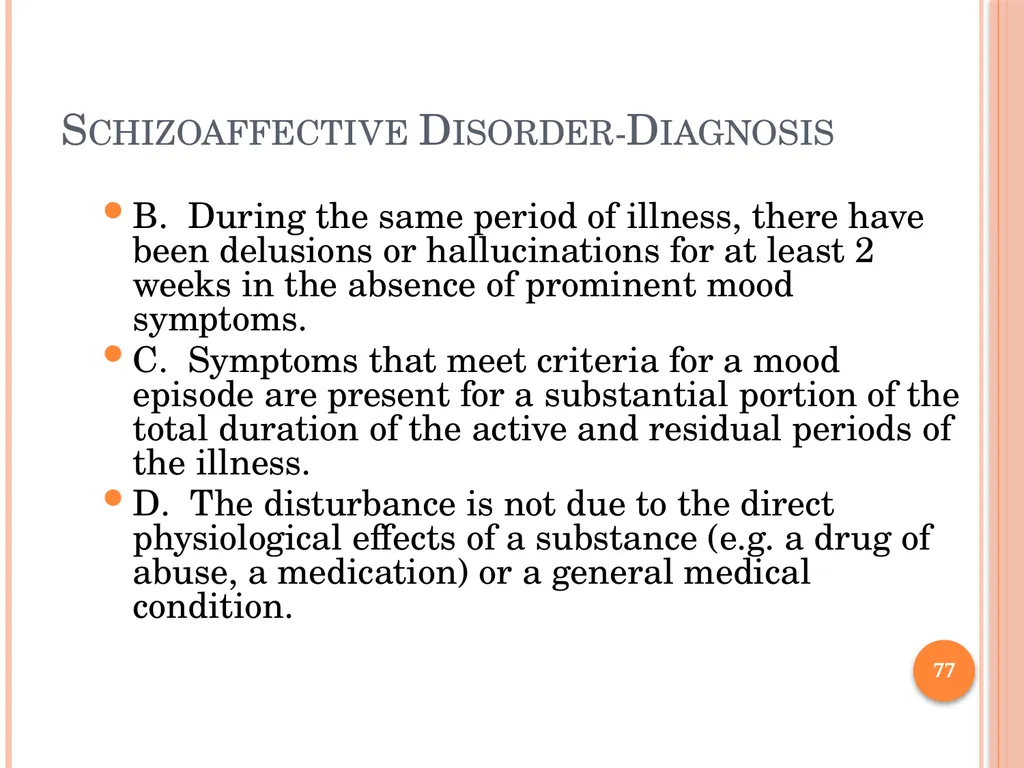
Schizoaffective Disorder-Diagnosis B. During the same period of illness, there have been delusions or hallucinations for at least 2 weeks in the absence of prominent mood symptoms.
C. Symptoms that meet criteria for a mood episode are present for a substantial portion of the total duration of the active and residual periods of the illness.
D. The disturbance is not due to the direct physiological effects of a substance (e.g. a drug of abuse, a medication) or a general medical condition. 77<br>
78
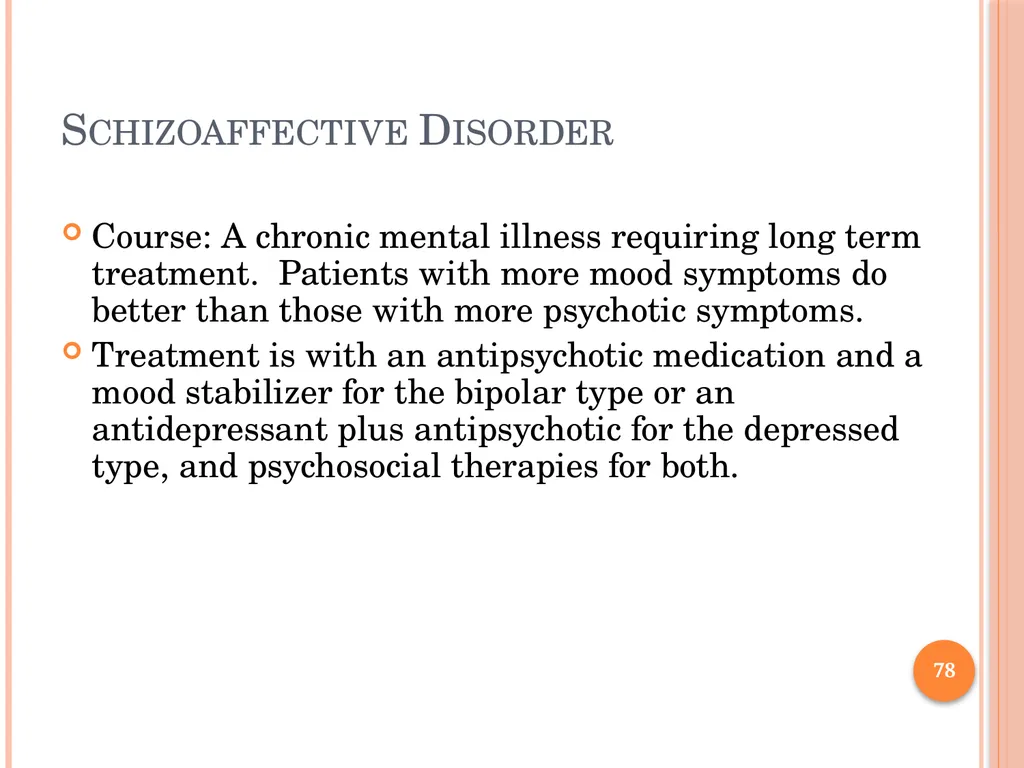
Schizoaffective Disorder Course: A chronic mental illness requiring long term treatment. Patients with more mood symptoms do better than those with more psychotic symptoms.
Treatment is with an antipsychotic medication and a mood stabilizer for the bipolar type or an antidepressant plus antipsychotic for the depressed type, and psychosocial therapies for both. 78<br>
Treatment is with an antipsychotic medication and a mood stabilizer for the bipolar type or an antidepressant plus antipsychotic for the depressed type, and psychosocial therapies for both. 78<br>
79
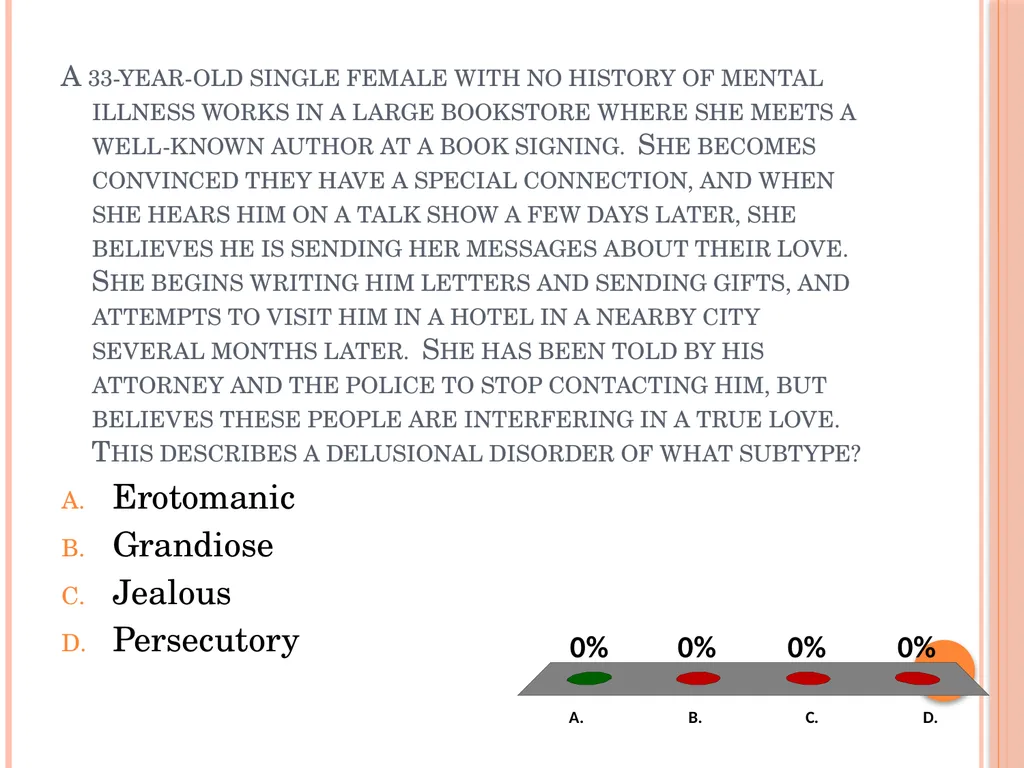
A 33-year-old single female with no history of mental illness works in a large bookstore where she meets a well-known author at a book signing. She becomes convinced they have a special connection, and when she hears him on a talk show a few days later, she believes he is sending her messages about their love. She begins writing him letters and sending gifts, and attempts to visit him in a hotel in a nearby city several months later. She has been told by his attorney and the police to stop contacting him, but believes these people are interfering in a true love. This describes a delusional disorder of what subtype? Erotomanic
Grandiose
Jealous
Persecutory 79<br>
Grandiose
Jealous
Persecutory 79<br>
80
Delusional Disorder Epidemiology
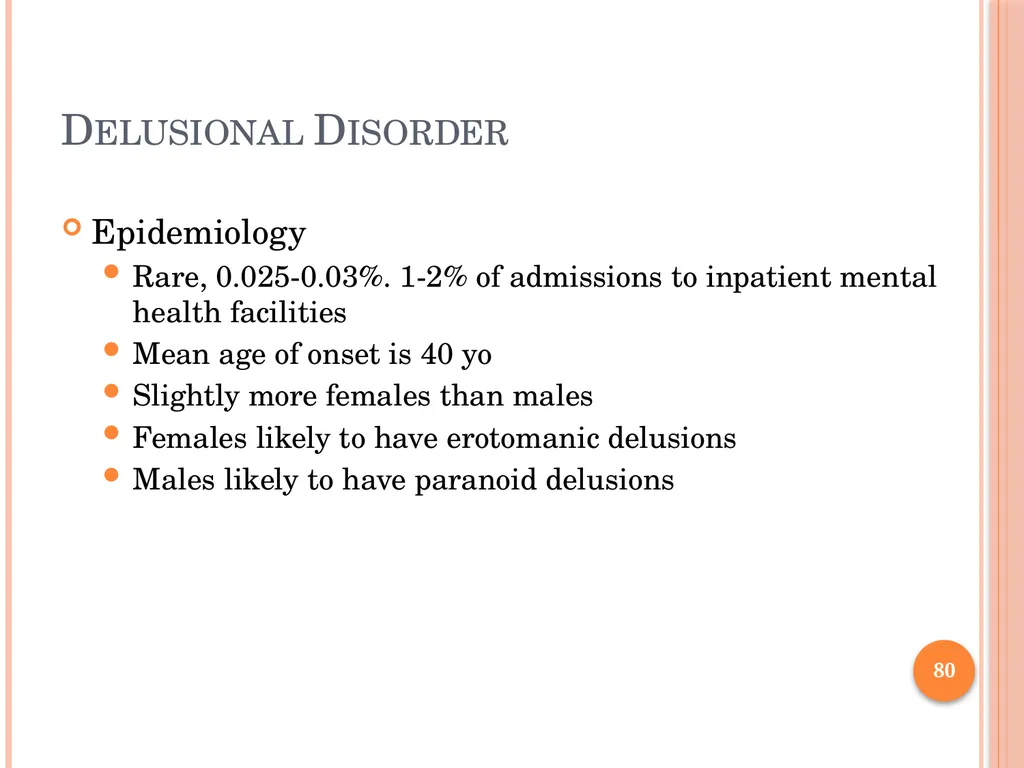
Rare, 0.025-0.03%. 1-2% of admissions to inpatient mental health facilities
Mean age of onset is 40 yo
Slightly more females than males
Females likely to have erotomanic delusions
Males likely to have paranoid delusions 80<br>
Rare, 0.025-0.03%. 1-2% of admissions to inpatient mental health facilities
Mean age of onset is 40 yo
Slightly more females than males
Females likely to have erotomanic delusions
Males likely to have paranoid delusions 80<br>
81
Delusional Disorder Etiology is unknown:
It is not related to schizophrenia or mood disorders. Studies do show an increased rate of delusional disorder, suspiciousness, jealousy and secretiveness in family members of delusional disorder patients.
Important to rule out medical conditions which can have associated delusions, i.e. toxic-metabolic disorders, and especially CNS disorders such as Huntington’s, CVA, dementia. 81<br>
82
Delusional Disorder Clinical Features:
Appearance unremarkable. May be eccentric, odd, suspicious or hostile, sometimes litigious. Mental status exam remarkably normal except for the delusional system. The delusions are non-bizarre and have been present at least a month.
Main defense mechanisms of reaction formation, denial, and projection
Multiple factors associated with formation of delusions 82<br>
83
Delusional Disorder-Subtypes Erotomanic type: delusions that another person, usually of higher status, is in love with the individual; more common in females, males may become aggressive
Grandiose type: delusions of inflated worth, power, knowledge, identity, or special relationship to a deity or famous person
Jealous type: delusions that the individual’s sexual partner is unfaithful; usually affects males 83<br>
Grandiose type: delusions of inflated worth, power, knowledge, identity, or special relationship to a deity or famous person
Jealous type: delusions that the individual’s sexual partner is unfaithful; usually affects males 83<br>
84
Delusional Disorder-Subtypes Persecutory type: delusions that the person (or someone to whom the person is close) is being malevolently treated in some way. Patient may be litigious or become aggressive.
Somatic type: delusions that the person has some physical defect or general medical condition
Mixed type: delusions characteristic of more than one of the above types but no one theme predominates
Unspecified type 84<br>
Somatic type: delusions that the person has some physical defect or general medical condition
Mixed type: delusions characteristic of more than one of the above types but no one theme predominates
Unspecified type 84<br>
85
Delusional Disorder - Course and Prognosis Psychosocial stress may precede the onset
IQ may be lower than average
Premorbid personality may be extroverted, dominant, hypersensitive
The initial concerns become more and more involved until delusional in quality
50% recover at long term follow up
20% have a decrease in symptoms
30% have no change
Good prognostic factors: high functioning, female, age
<30, sudden onset, short illness, precipitating factors 85<br>
86
Delusional Disorder-Treatment Difficult to treat
Try antipsychotic although patient may be resistant and it may not help
Psychotherapy-the essential element is to establish a trusting relationship. Patient may not give up delusions but therapy may improve functioning. 86<br>
Try antipsychotic although patient may be resistant and it may not help
Psychotherapy-the essential element is to establish a trusting relationship. Patient may not give up delusions but therapy may improve functioning. 86<br>
87
A 28-year-old female from Central America is brought to the ER after an accident in which she witnessed the death of her 9-year-old son. She is shouting, confused, fearful, and appears to be hearing voices. There are no apparent physical injuries except minor abrasions and bruises. The most likely diagnosis is: Schizophreniform D/O
Delusional D/O
Schizophrenia
Brief Psychotic D/O 87<br>
Delusional D/O
Schizophrenia
Brief Psychotic D/O 87<br>
88
Brief Psychotic Disorder An acute and transient psychotic disorder:
Uncommon, occurs more often among younger patients. Higher incidence in women and people in developing countries, particularly those who have experienced disasters or major cultural changes (immigrants).
Often seen with personality disorders. Psychodynamic formulations have emphasized the presence of inadequate coping mechanisms. 88<br>
89
Brief Psychotic Disorder - Diagnosis A. Presence of one (or more) of the following symptoms:
Delusions
Hallucinations
Disorganized speech (e.g. frequent derailment or incoherence)
Grossly disorganized or catatonic behavior
Note: do not include a symptom if it is a culturally sanctioned response pattern 89<br>
Delusions
Hallucinations
Disorganized speech (e.g. frequent derailment or incoherence)
Grossly disorganized or catatonic behavior
Note: do not include a symptom if it is a culturally sanctioned response pattern 89<br>
90
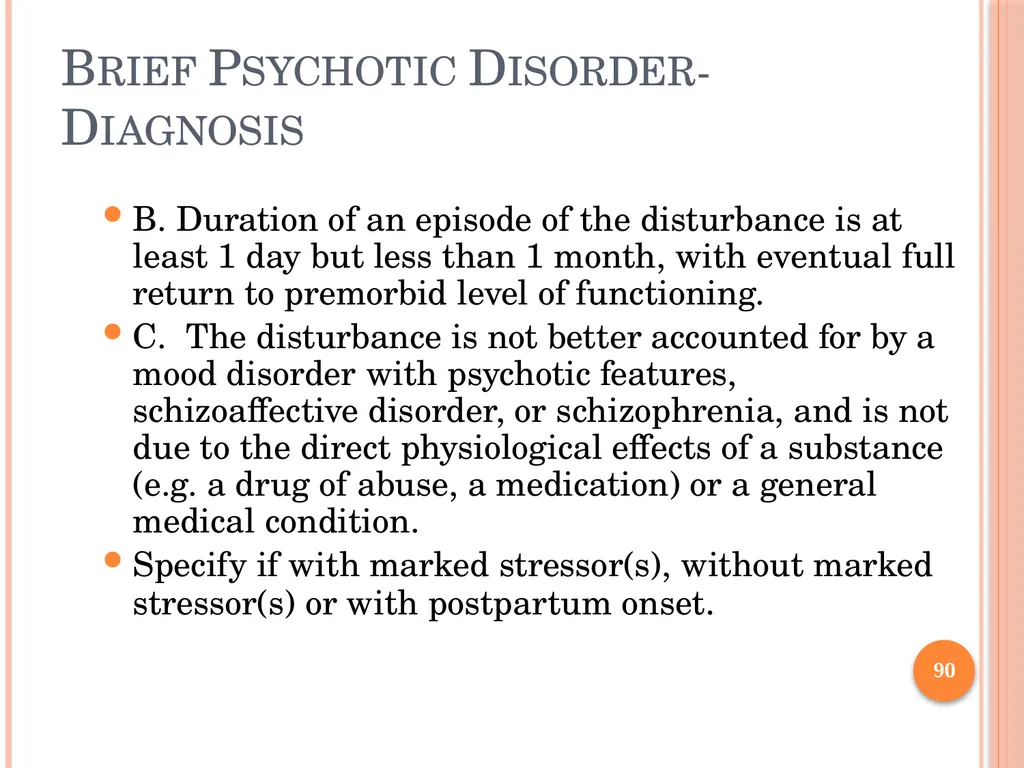
Brief Psychotic Disorder-Diagnosis B. Duration of an episode of the disturbance is at least 1 day but less than 1 month, with eventual full return to premorbid level of functioning.
C. The disturbance is not better accounted for by a mood disorder with psychotic features, schizoaffective disorder, or schizophrenia, and is not due to the direct physiological effects of a substance (e.g. a drug of abuse, a medication) or a general medical condition.
Specify if with marked stressor(s), without marked stressor(s) or with postpartum onset. 90<br>
91
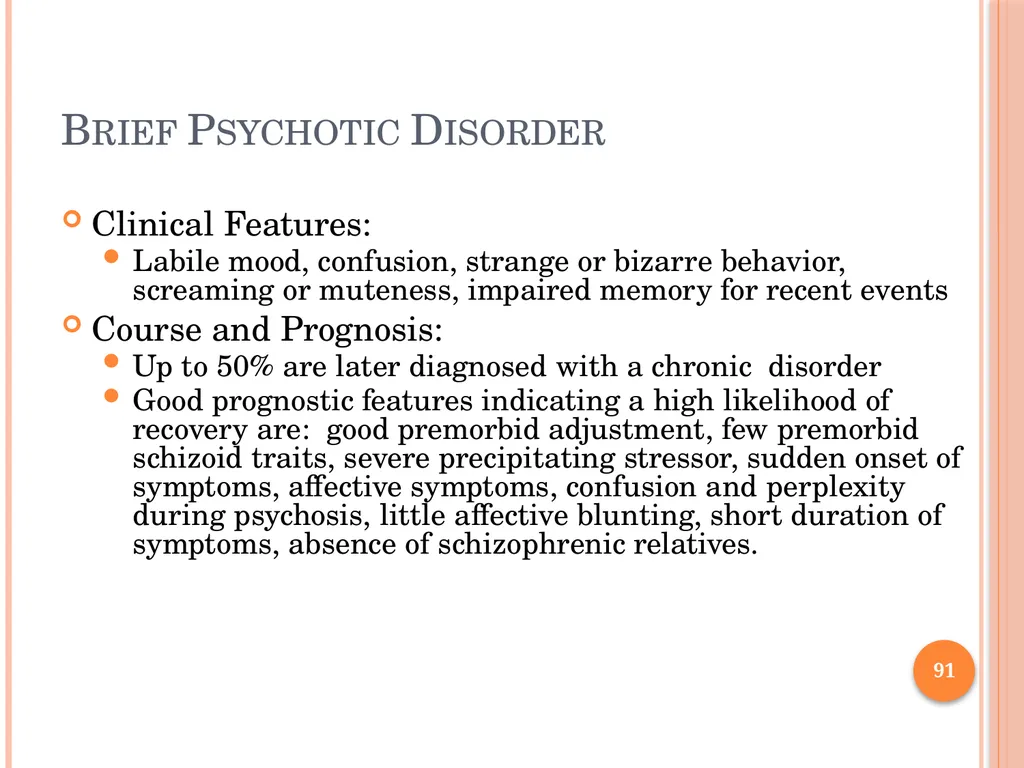
Brief Psychotic Disorder Clinical Features:
Labile mood, confusion, strange or bizarre behavior, screaming or muteness, impaired memory for recent events
Course and Prognosis:
Up to 50% are later diagnosed with a chronic disorder
Good prognostic features indicating a high likelihood of recovery are: good premorbid adjustment, few premorbid schizoid traits, severe precipitating stressor, sudden onset of symptoms, affective symptoms, confusion and perplexity during psychosis, little affective blunting, short duration of symptoms, absence of schizophrenic relatives. 91<br>
92
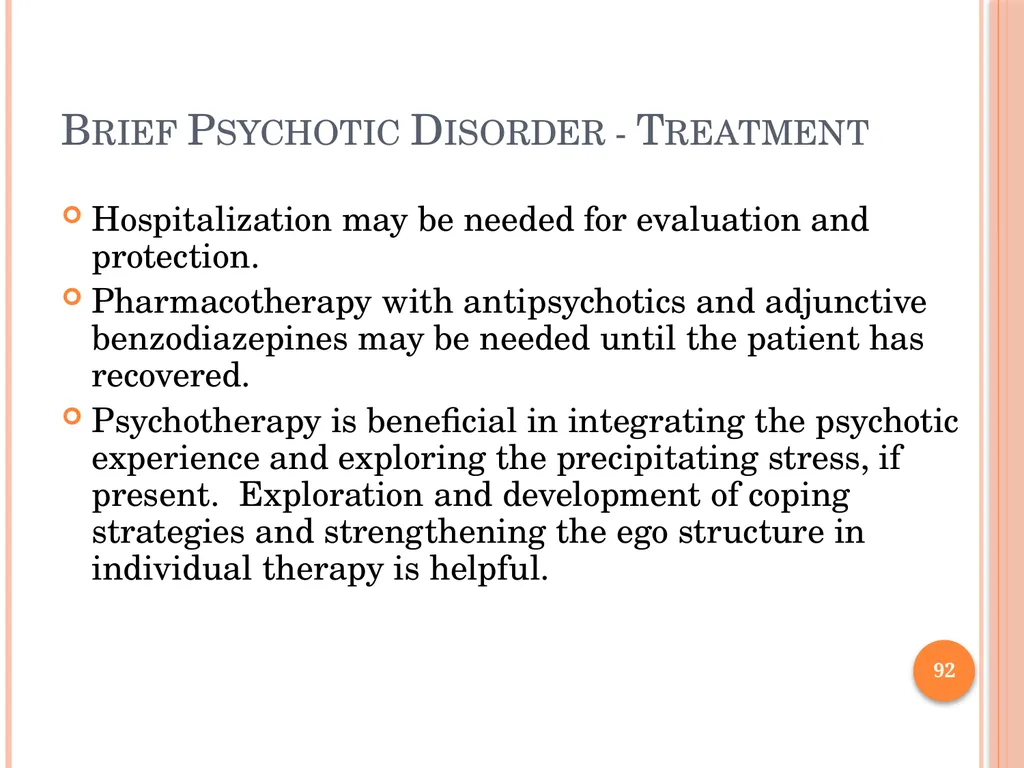
Brief Psychotic Disorder - Treatment Hospitalization may be needed for evaluation and protection.
Pharmacotherapy with antipsychotics and adjunctive benzodiazepines may be needed until the patient has recovered.
Psychotherapy is beneficial in integrating the psychotic experience and exploring the precipitating stress, if present. Exploration and development of coping strategies and strengthening the ego structure in individual therapy is helpful. 92<br>
93
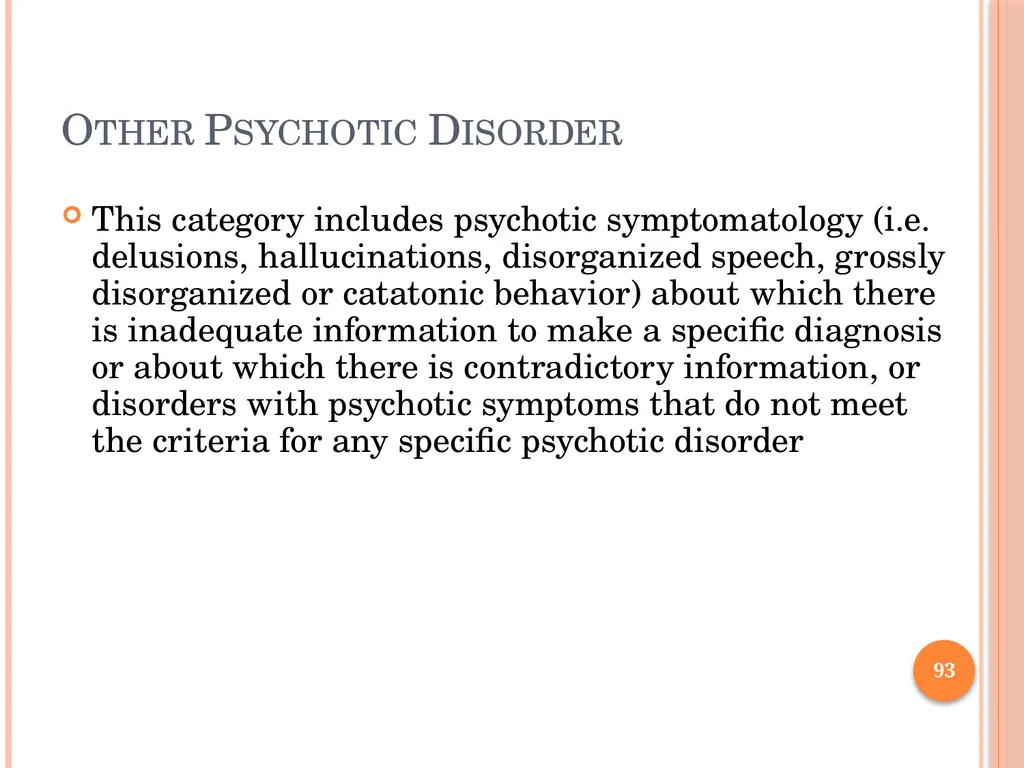
Other Psychotic Disorder This category includes psychotic symptomatology (i.e. delusions, hallucinations, disorganized speech, grossly disorganized or catatonic behavior) about which there is inadequate information to make a specific diagnosis or about which there is contradictory information, or disorders with psychotic symptoms that do not meet the criteria for any specific psychotic disorder 93<br>
94
Other Psychotic Disorder Examples include:
Postpartum psychosis that does not meet criteria for mood disorder with psychotic features, psychotic disorder due to a general medical condition, or substance-induced psychotic disorder
Psychotic symptoms that have lasted for less than 1 month but that have not yet remitted, so that the criteria for brief psychotic disorder are not met
Persistent auditory hallucinations in the absence of any other features
Shared Psychotic Disorder 94<br>
95
Other Psychotic Disorder Examples
Persistent non-bizarre delusions with periods of overlapping mood episodes that have been present for a substantial portion of the delusional disturbance
Situations in which the clinician has concluded that a psychotic disorder is present, but is unable to determine whether it is primary, due to a general medical condition, or substance induced 95<br>
96
Post Partum Psychosis Occurs in 0.1% of pregnancies
50-60% of patients have just had their first child
50% of children have experienced perinatal complications
Most cases represent an underlying mood disorder, usually bipolar disorder
2/3 go on to have a mood episode within a year
Post partum psychosis is a psychiatric emergency:
5% commit suicide
4% commit infanticide 96<br>
97
Post Partum Psychosis Clinical Features:
Mean time to onset 2-3 weeks after delivery
Symptoms: fatigue, insomnia, restlessness, emotional lability, progressing to suspiciousness, confusion, irrational statements, obsessive concern about the baby’s health, delusions and or hallucinations. The mother may have thoughts of not loving or wanting the baby, or thoughts of harming self or baby. 97<br>
98
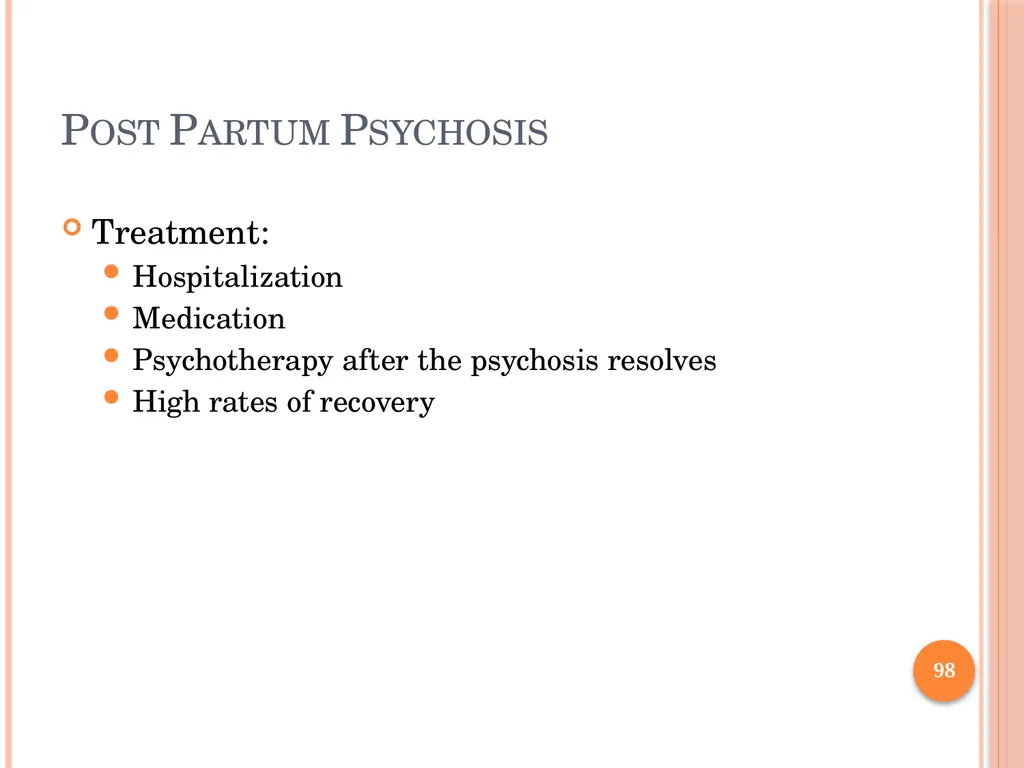
Post Partum Psychosis Treatment:
Hospitalization
Medication
Psychotherapy after the psychosis resolves
High rates of recovery 98<br>
Hospitalization
Medication
Psychotherapy after the psychosis resolves
High rates of recovery 98<br>
99
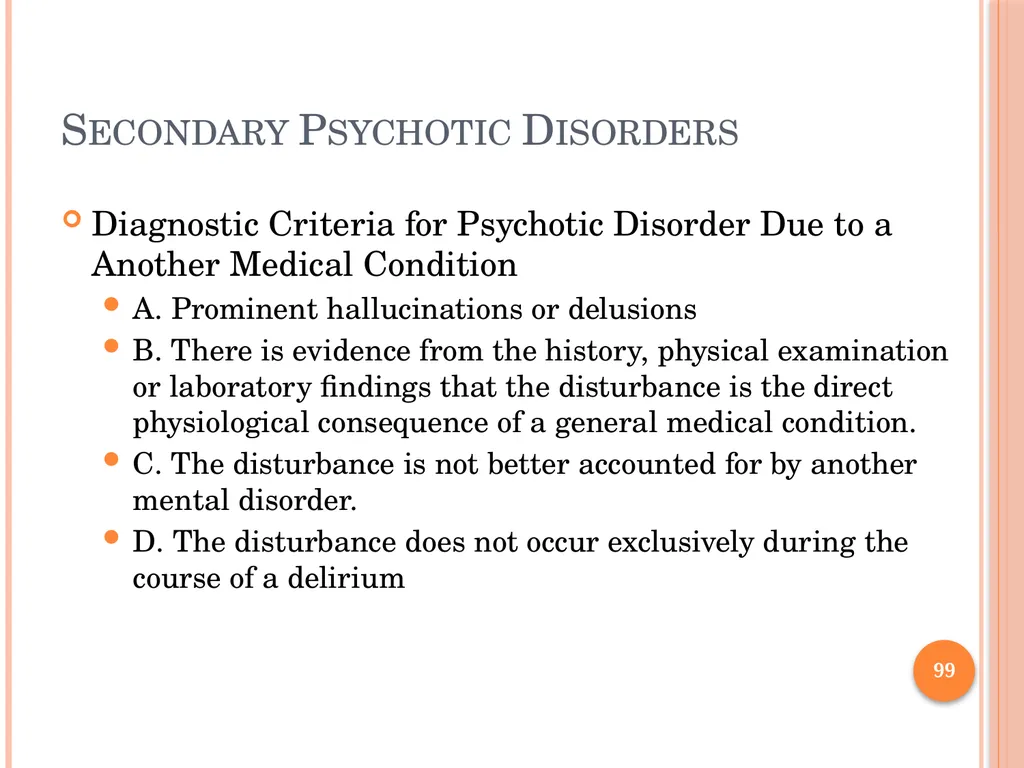
Secondary Psychotic Disorders Diagnostic Criteria for Psychotic Disorder Due to a Another Medical Condition
A. Prominent hallucinations or delusions
B. There is evidence from the history, physical examination or laboratory findings that the disturbance is the direct physiological consequence of a general medical condition.
C. The disturbance is not better accounted for by another mental disorder.
D. The disturbance does not occur exclusively during the course of a delirium 99<br>
100
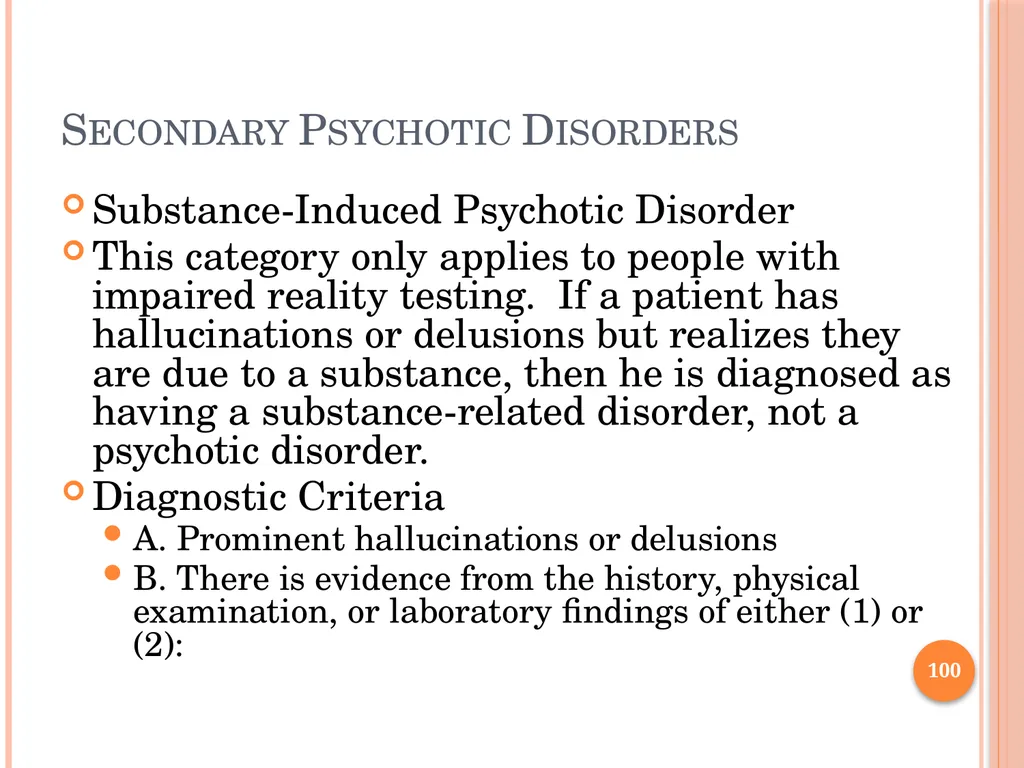
Secondary Psychotic Disorders Substance-Induced Psychotic Disorder
This category only applies to people with impaired reality testing. If a patient has hallucinations or delusions but realizes they are due to a substance, then he is diagnosed as having a substance-related disorder, not a psychotic disorder.
Diagnostic Criteria
A. Prominent hallucinations or delusions
B. There is evidence from the history, physical examination, or laboratory findings of either (1) or (2): 100<br>
101
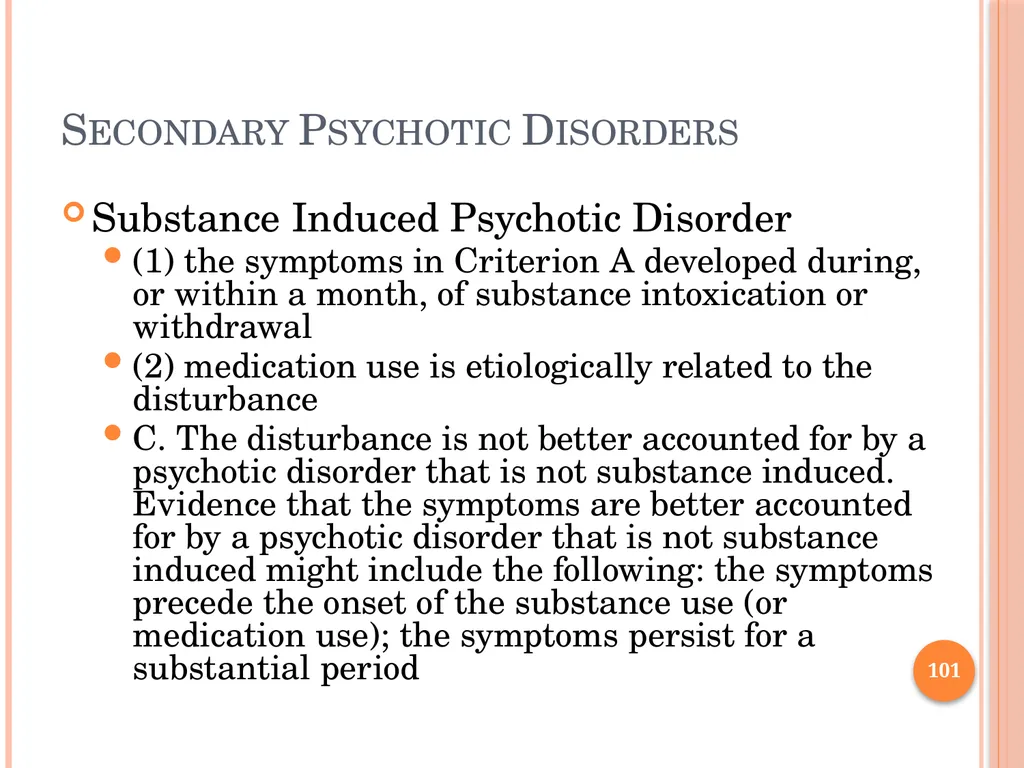
Secondary Psychotic Disorders Substance Induced Psychotic Disorder
(1) the symptoms in Criterion A developed during, or within a month, of substance intoxication or withdrawal
(2) medication use is etiologically related to the disturbance
C. The disturbance is not better accounted for by a psychotic disorder that is not substance induced. Evidence that the symptoms are better accounted for by a psychotic disorder that is not substance induced might include the following: the symptoms precede the onset of the substance use (or medication use); the symptoms persist for a substantial period 101<br>
102
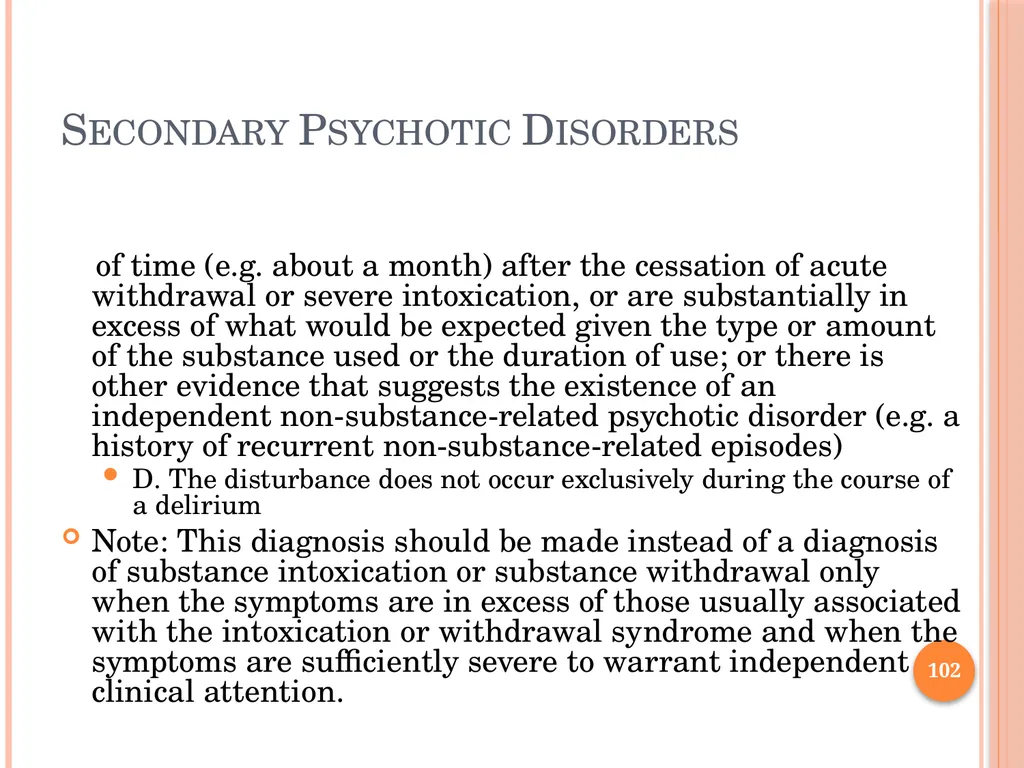
Secondary Psychotic Disorders of time (e.g. about a month) after the cessation of acute withdrawal or severe intoxication, or are substantially in excess of what would be expected given the type or amount of the substance used or the duration of use; or there is other evidence that suggests the existence of an independent non-substance-related psychotic disorder (e.g. a history of recurrent non-substance-related episodes)
D. The disturbance does not occur exclusively during the course of a delirium
Note: This diagnosis should be made instead of a diagnosis of substance intoxication or substance withdrawal only when the symptoms are in excess of those usually associated with the intoxication or withdrawal syndrome and when the symptoms are sufficiently severe to warrant independent clinical attention. 102<br>
103
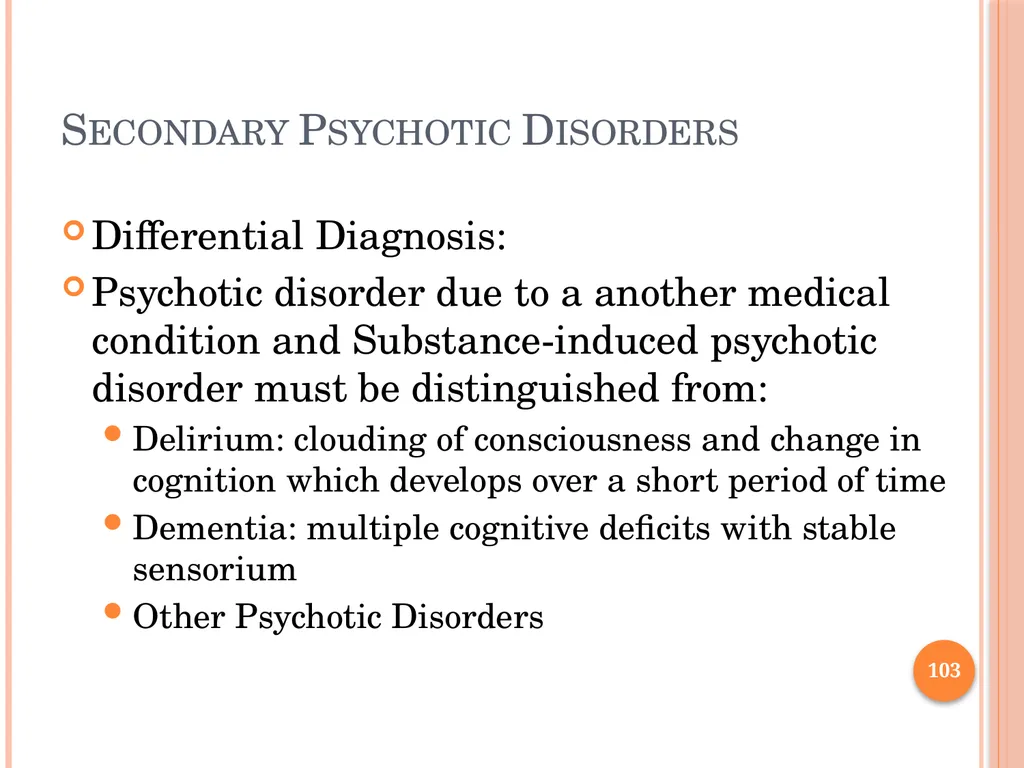
Secondary Psychotic Disorders Differential Diagnosis:
Psychotic disorder due to a another medical condition and Substance-induced psychotic disorder must be distinguished from:
Delirium: clouding of consciousness and change in cognition which develops over a short period of time
Dementia: multiple cognitive deficits with stable sensorium
Other Psychotic Disorders 103<br>
104
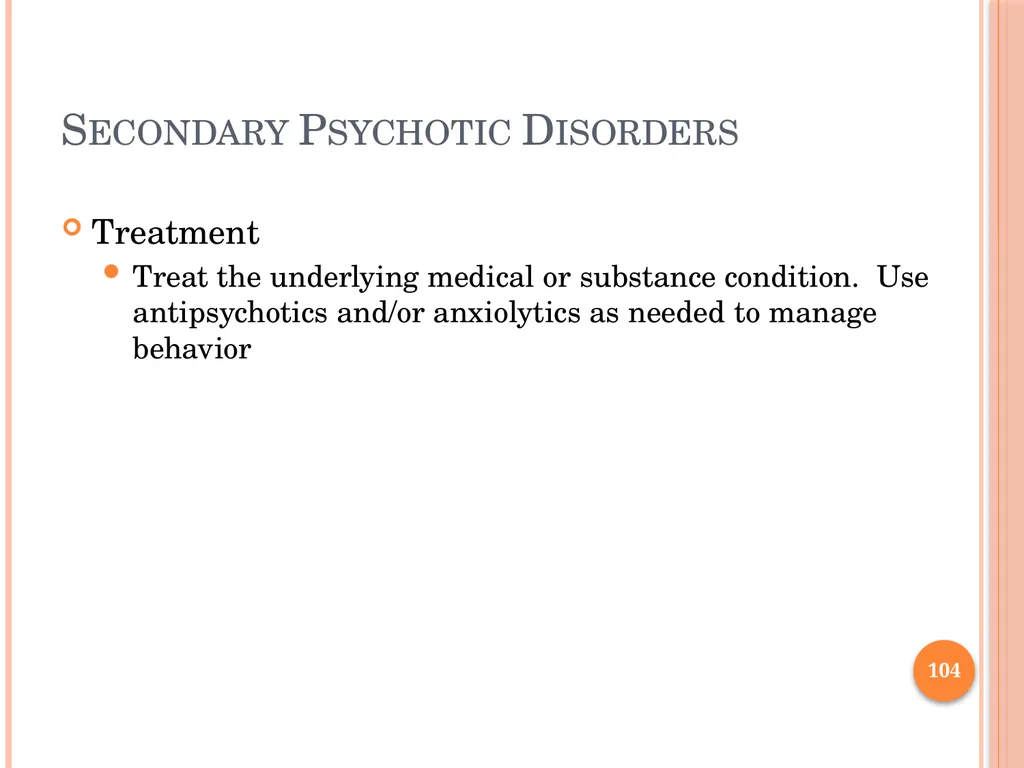
Secondary Psychotic Disorders Treatment
Treat the underlying medical or substance condition. Use antipsychotics and/or anxiolytics as needed to manage behavior 104<br>
Treat the underlying medical or substance condition. Use antipsychotics and/or anxiolytics as needed to manage behavior 104<br>
105
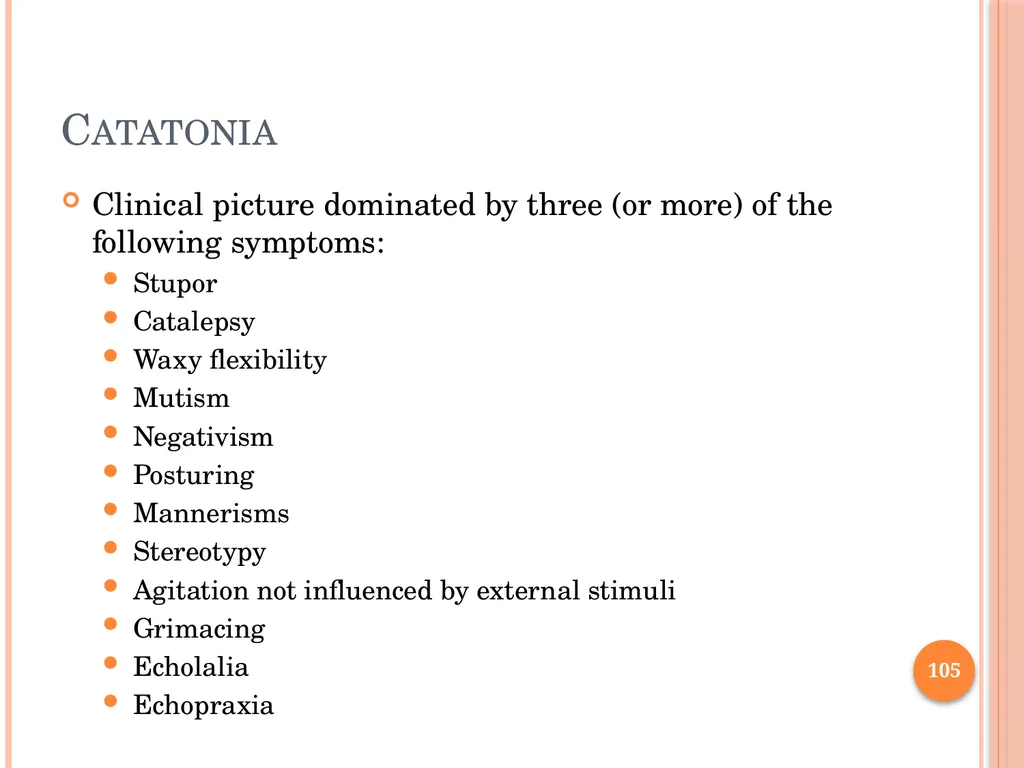
Catatonia Clinical picture dominated by three (or more) of the following symptoms:
Stupor
Catalepsy
Waxy flexibility
Mutism
Negativism
Posturing
Mannerisms
Stereotypy
Agitation not influenced by external stimuli
Grimacing
Echolalia
Echopraxia 105<br>
Stupor
Catalepsy
Waxy flexibility
Mutism
Negativism
Posturing
Mannerisms
Stereotypy
Agitation not influenced by external stimuli
Grimacing
Echolalia
Echopraxia 105<br>
106
Catatonia May occur in the context of a mental or medical disorder
May be a medical emergency secondary to dehydration, hyperpyrexia, exhaustion, and muscle breakdown
Aggressive hydration
Administer benzodiazepines
Treat underlying mental or medical conditions 106<br>
May be a medical emergency secondary to dehydration, hyperpyrexia, exhaustion, and muscle breakdown
Aggressive hydration
Administer benzodiazepines
Treat underlying mental or medical conditions 106<br>
107
Thank You! Questions?<br>