Public Key Cryptosystems: These public key cryptosystems have with two keys, one for encryption which is made public and the other for decryption which is kept secret. These systems are sometimes called asymmetric systems since the key used
"Public Key Cryptosystems: These public key" is the property of its rightful owner. Permission is granted to
download and print the materials on this website for personal, non-commercial use only, and to display it
on your personal computer provided you do not modify the materials and that you retain all copyright
notices contained in the materials. By downloading content from our website, you accept the terms of this
agreement.
Presentation Transcript
01
Public Key Cryptosystems: These public key cryptosystems have with two keys, one for encryption which is made public and the other for decryption which is kept secret. These systems are sometimes called asymmetric systems since the key used for encryption is different from the key used for decryption. Two very well known of such systems will be presented:<br>
02
A]-RSA public key system:
Each user places in a public file an encryption key E and keeps a secret key D. By knowing E, the 3rd party cannot deduce D so easy. The RSA was developed by Rivest, Shamer and Adelman.
Properties:
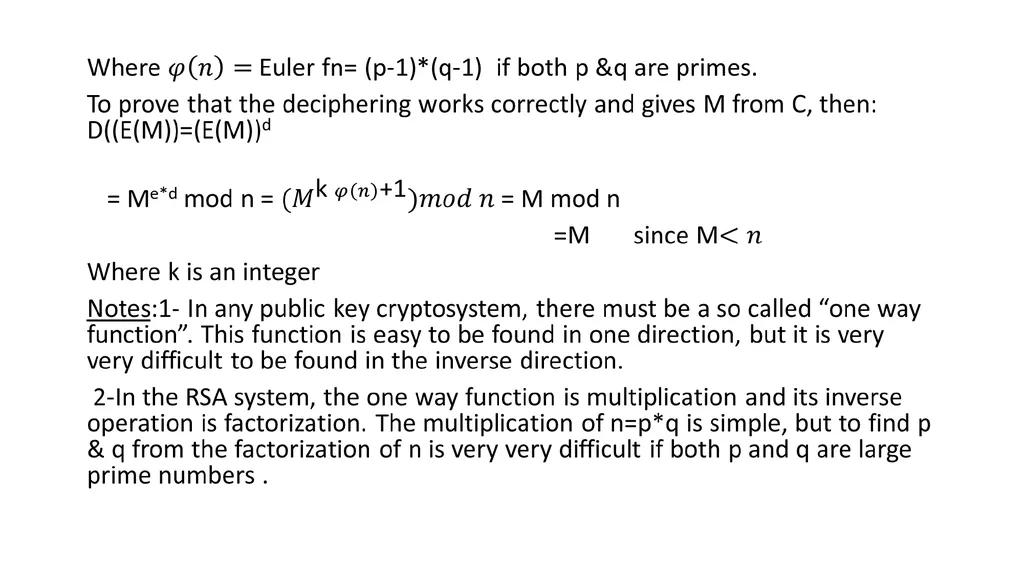
1- Deciphering the enciphered form of the message M will give again M, i.e,: D(E(M))=M. (Note also that E(D(M))=M)
2- The 3rd party cannot deduce D from E so easily.
3- Both D & E are easy to compute.
Encryption:
Block the message into a series of blocks.
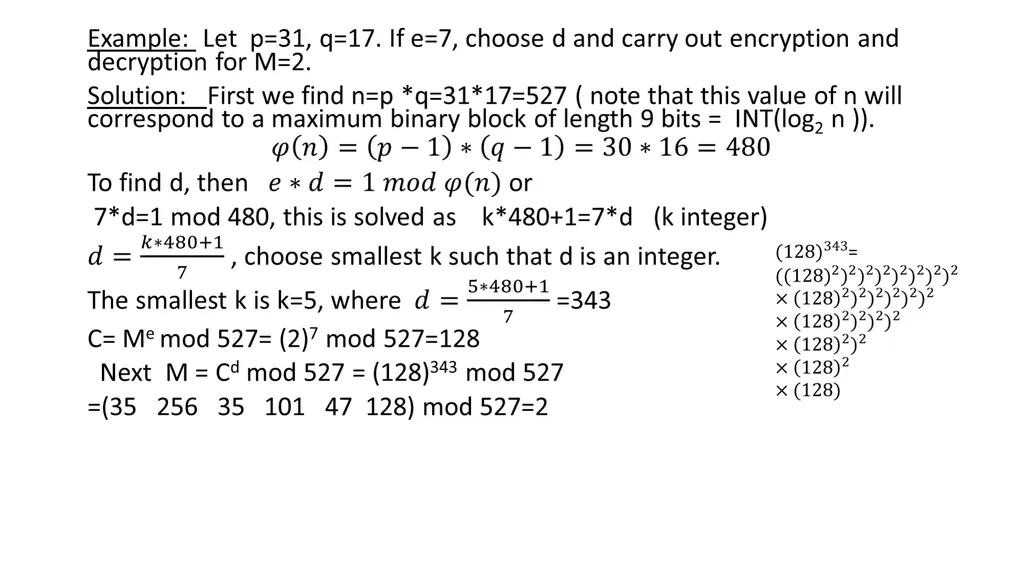
2- Represent blocks by integers between 0 & n-1, call it M.
3- The ciphertext is C= Me mod n<br>
03
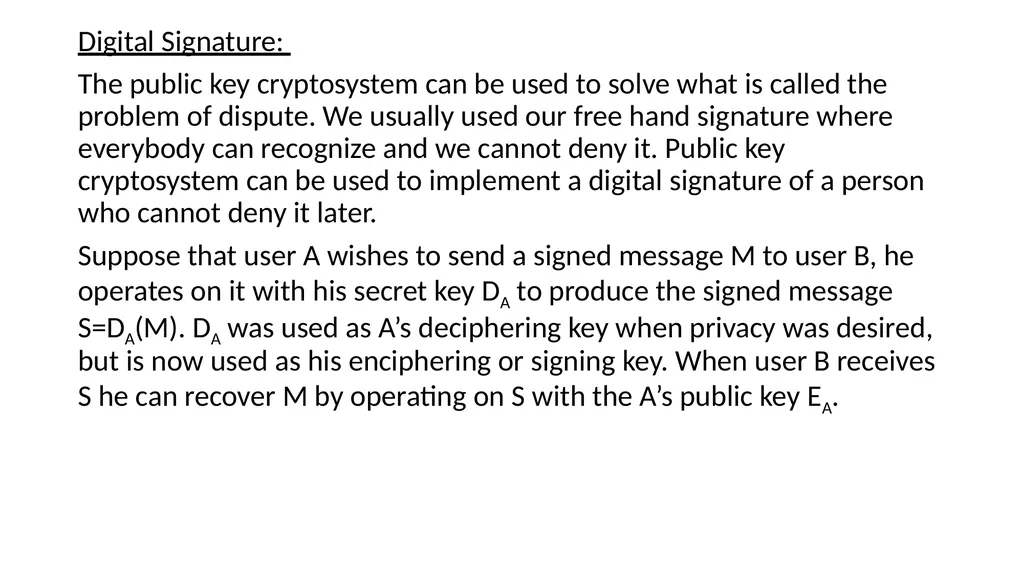
Digital Signature:
The public key cryptosystem can be used to solve what is called the problem of dispute. We usually used our free hand signature where everybody can recognize and we cannot deny it. Public key cryptosystem can be used to implement a digital signature of a person who cannot deny it later.
Suppose that user A wishes to send a signed message M to user B, he operates on it with his secret key DA to produce the signed message S=DA(M). DA was used as A’s deciphering key when privacy was desired, but is now used as his enciphering or signing key. When user B receives S he can recover M by operating on S with the A’s public key EA.<br>
04
The digital signature described above does not provide protection against eavesdroppers since S can be understood by anyone. To provide privacy, user A can operate EB on S and transmit EB(S) in stead of S as a ciphertext. Only B knows DB where B can recover S as: S=DB(EB(S)) and again B can still save S as a proof.
User B saves S as a proof that user A sent him the particular message M. If A later disclaims having sent this letter, user B can take this S to a judge who obtains EA from the public file and check that M=EA(S) is a meaningful message with the A’s name at the end. Only user A could have generated S because only he knows DA, so A will be held responsible for having sent M. (note: this scenario is so important in banking where any customer cannot deny sending say a letter of credit to transfer funds to others).<br>