Public policies for a productive and entrepreneurial economy- the role of VET Hanne Shapiro Danish Technological Institute VET Conference St. Sebastian, Basque Country Envisioning- Aligning Engaging Background- analysis SMEs in global
"Public policies for a productive and" is the property of its rightful owner. Permission is granted to
download and print the materials on this website for personal, non-commercial use only, and to display it
on your personal computer provided you do not modify the materials and that you retain all copyright
notices contained in the materials. By downloading content from our website, you accept the terms of this
agreement.
Presentation Transcript
01
Public policies for a productive and entrepreneurial economy- the role of VET Hanne Shapiro
Danish Technological Institute
VET Conference
St. Sebastian, Basque Country<br>
02
Envisioning-
Aligning
Engaging<br>
03
Background- analysis SME’s in global value chains- role of digital technologies
State of Affairs- Manufacturing industry EU- European Parliament
SME growth strategies- international best practice- design of Danish SME Growth Programme
PIAAC data- Adult Learning indicator- DG EAC
VET Excellence- VET and innovation- DG EAC
World Economic Forum- Work on Employment rich recovery- role of apprenticeship<br>
04
7 Emerging issues Biggest SME challenge in EU 28- lack of customer demand
Major changes in markets/ inclusive innovation as growth opportunity- OECD World Bank, World Economic Forum?
Limitations of skills supply policies –<br>
05
7 Major Isssue emerging Cont The role of VET in economic development and innovation?
Unrecognised role of the skilled worker in innovation in SMEs- DUI Innovation-
But not all SMEs are set to exploit that opportunity
VET excellence?<br>
06
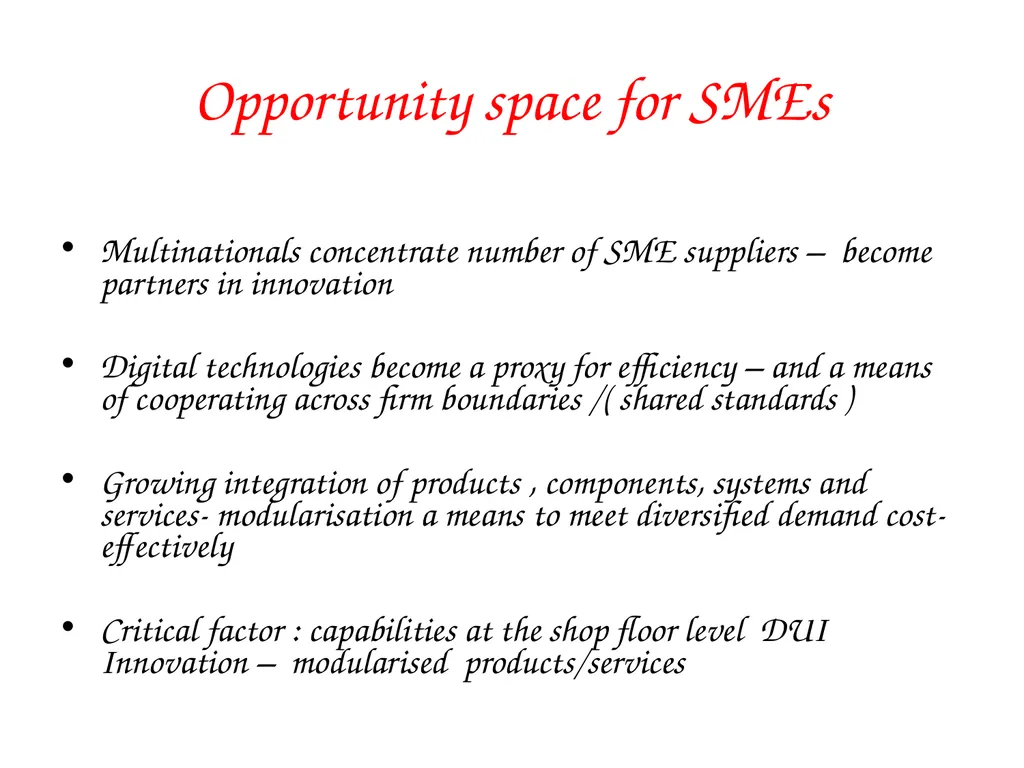
Opportunity space for SMEs Multinationals concentrate number of SME suppliers – become partners in innovation
Digital technologies become a proxy for efficiency – and a means of cooperating across firm boundaries /( shared standards )
Growing integration of products , components, systems and services- modularisation a means to meet diversified demand cost- effectively
Critical factor : capabilities at the shop floor level DUI Innovation – modularised products/services<br>
07
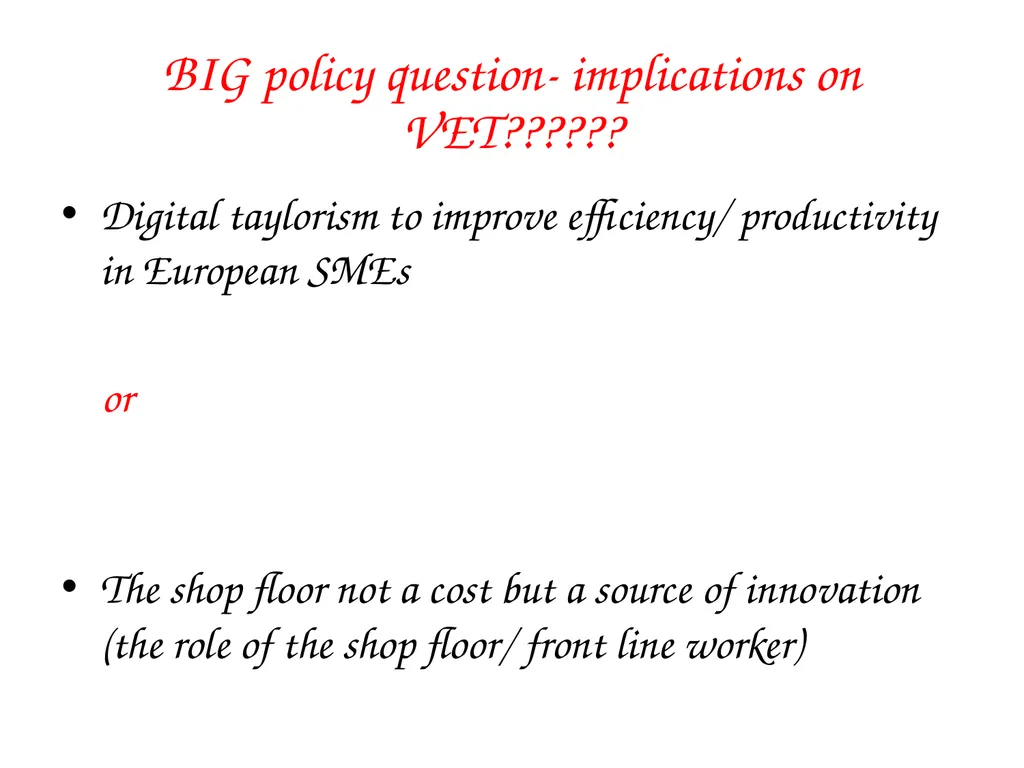
BIG policy question- implications on VET?????? Digital taylorism to improve efficiency/ productivity in European SMEs
or
The shop floor not a cost but a source of innovation (the role of the shop floor/ front line worker)<br>
08
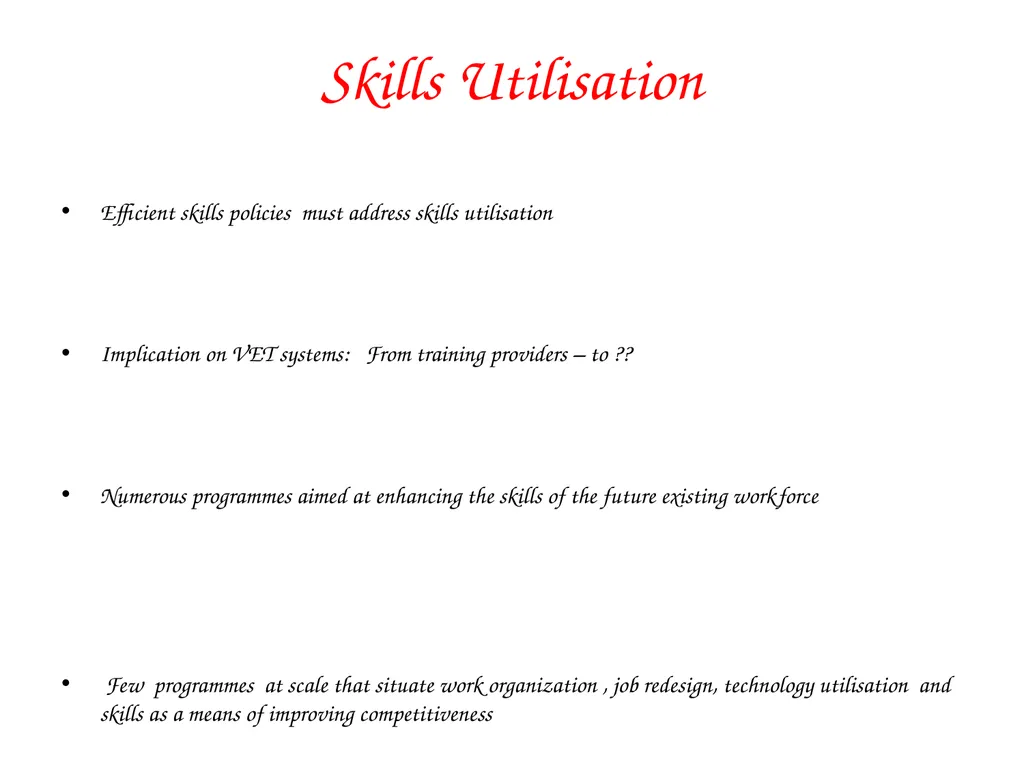
Skills Utilisation Efficient skills policies must address skills utilisation
Implication on VET systems: From training providers – to ??
Numerous programmes aimed at enhancing the skills of the future existing workforce
Few programmes at scale that situate work organization , job redesign, technology utilisation and skills as a means of improving competitiveness<br>
09
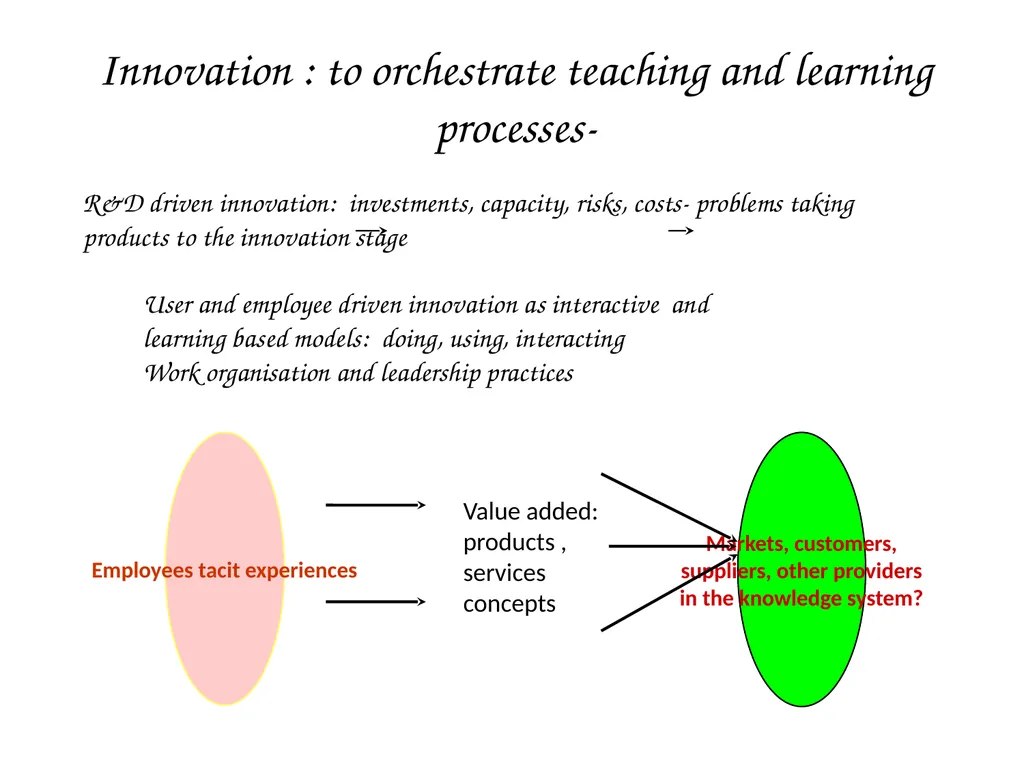
Employees tacit experiences Innovation : to orchestrate teaching and learning processes- R&D driven innovation: investments, capacity, risks, costs- problems taking products to the innovation stage User and employee driven innovation as interactive and learning based models: doing, using, interacting
Work organisation and leadership practices Markets, customers,
suppliers, other providers
in the knowledge system? Value added: products , services concepts<br>
10
The enabling role of ICT- BUT? In DK fx 1 mill Danes 16- 65 years who cannot solve basic problems in an ICT environment-
Higher order numeracy- literacy: analysis, synthesis, envisoning/ simulation , understanding complex data problem shooting, problem identification
Emulating work environment+<br>
11
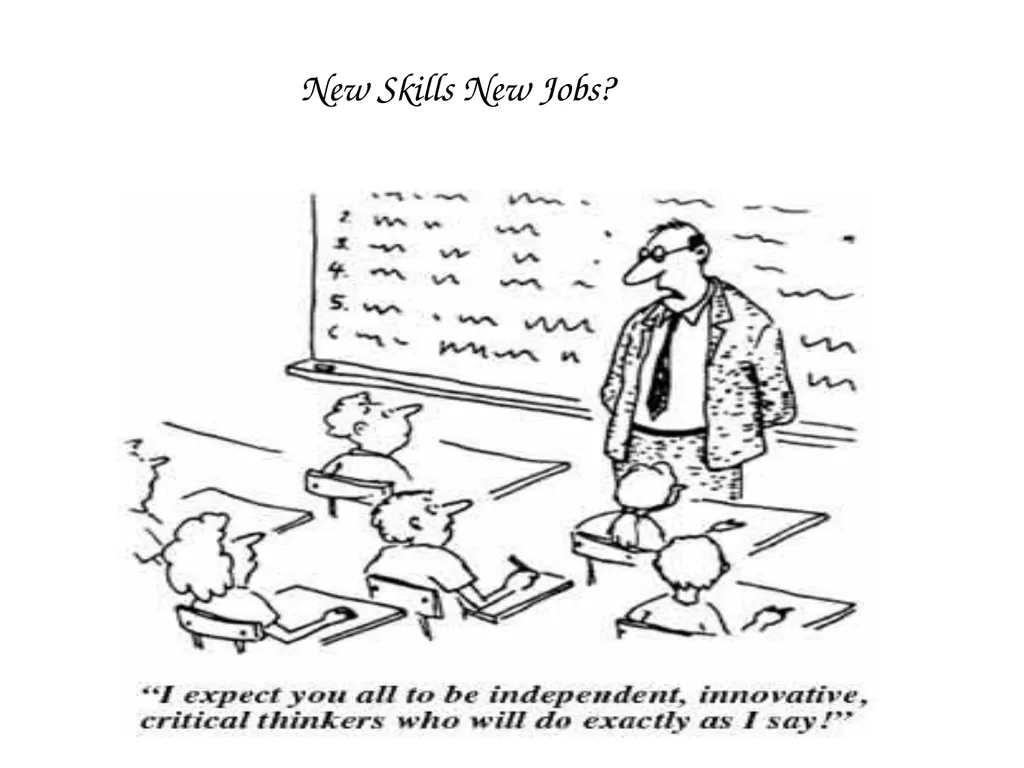
New Skills New Jobs?<br>
12
Role of VET institutions Skills utilisation could be part of the wider business support structure a VET institution offer
Horisontal and vertical cooperation within the innovation system- enabling policies?
Build capacity for better skills utilisation as part of a firm’s strategic planning (clusters, networks, value chain upgrading.)<br>
13
Work placed learning/ apprenticeships Competence/ Learning outcomes- learning at school – learning at work as an integrated setting; ( dedicated school staff)
Learning- (knowledge, skills, and competences) - routinisation/ progression in complexity-
“the company’s hidden repository”
A learning environment that offers opportunities to reflect on practice/transcend practice- different communities of practices
Status and an employee- but also as a learner
Measures focusing on building employers’ capacity to host learners/ measures to adapt to the needs of the company;
Process and tools to support - reflective practice<br>
14
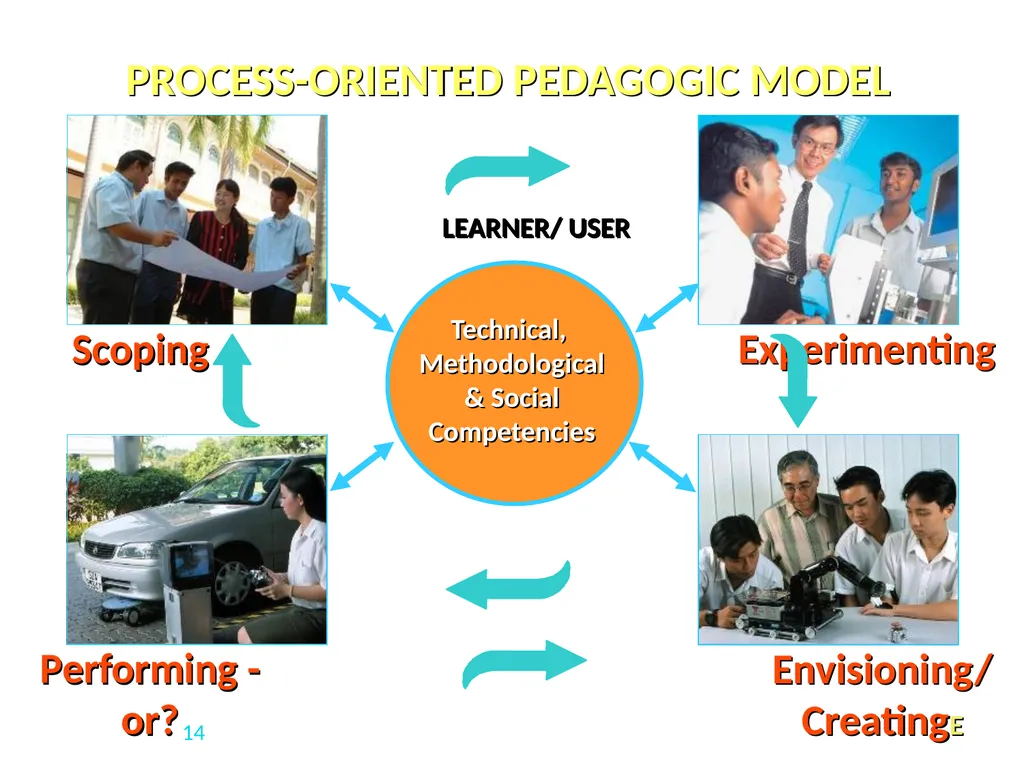
PROCESS-ORIENTED PEDAGOGIC MODEL Experimenting Envisioning/
CreatingE Performing - or? Scoping LEARNER/ USER Technical,
Methodological
& Social
Competencies 14<br>
15
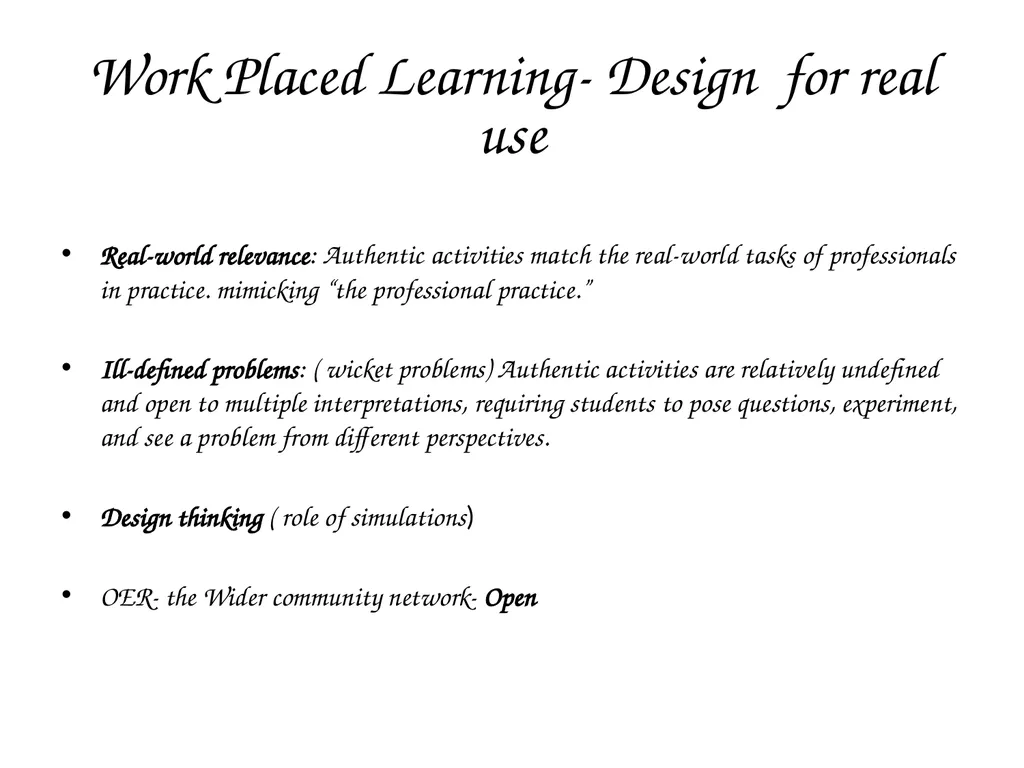
Work Placed Learning- Design for real use Real-world relevance: Authentic activities match the real-world tasks of professionals in practice. mimicking “the professional practice.”
Ill-defined problems: ( wicket problems) Authentic activities are relatively undefined and open to multiple interpretations, requiring students to pose questions, experiment, and see a problem from different perspectives.
Design thinking ( role of simulations)
OER- the Wider community network- Open<br>
16
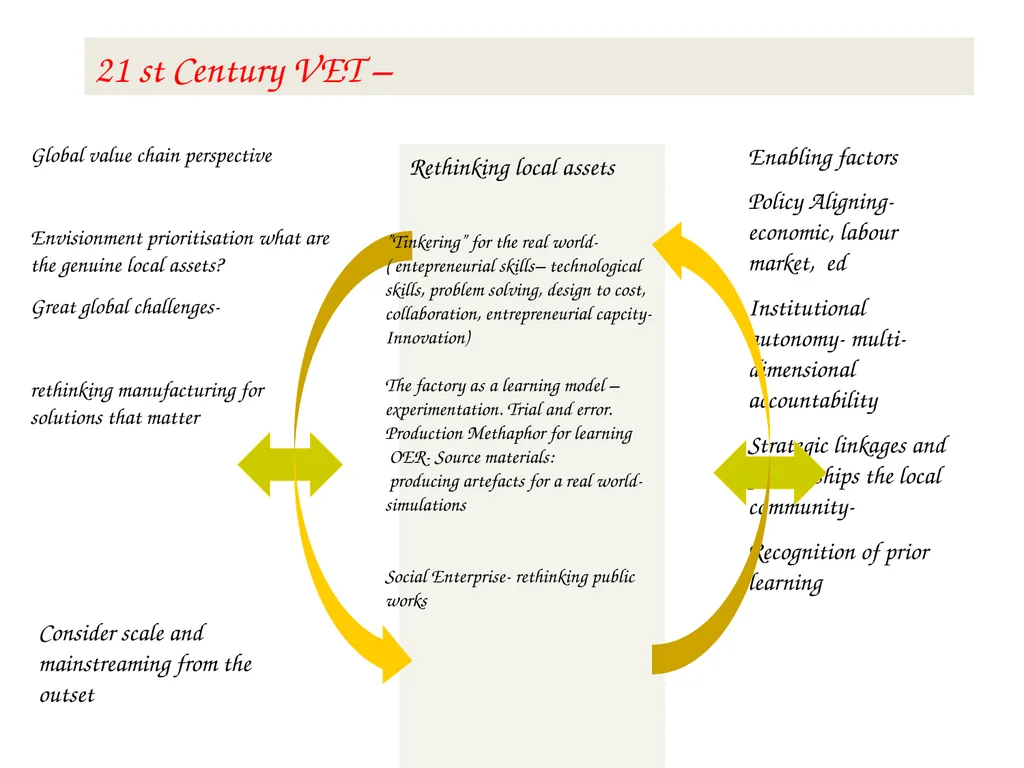
”Tinkering” for the real world- ( entepreneurial skills– technological skills, problem solving, design to cost, collaboration, entrepreneurial capcity- Innovation)
The factory as a learning model – experimentation. Trial and error. Production Methaphor for learning
OER- Source materials:
producing artefacts for a real world- simulations
Social Enterprise- rethinking public works<br>
17
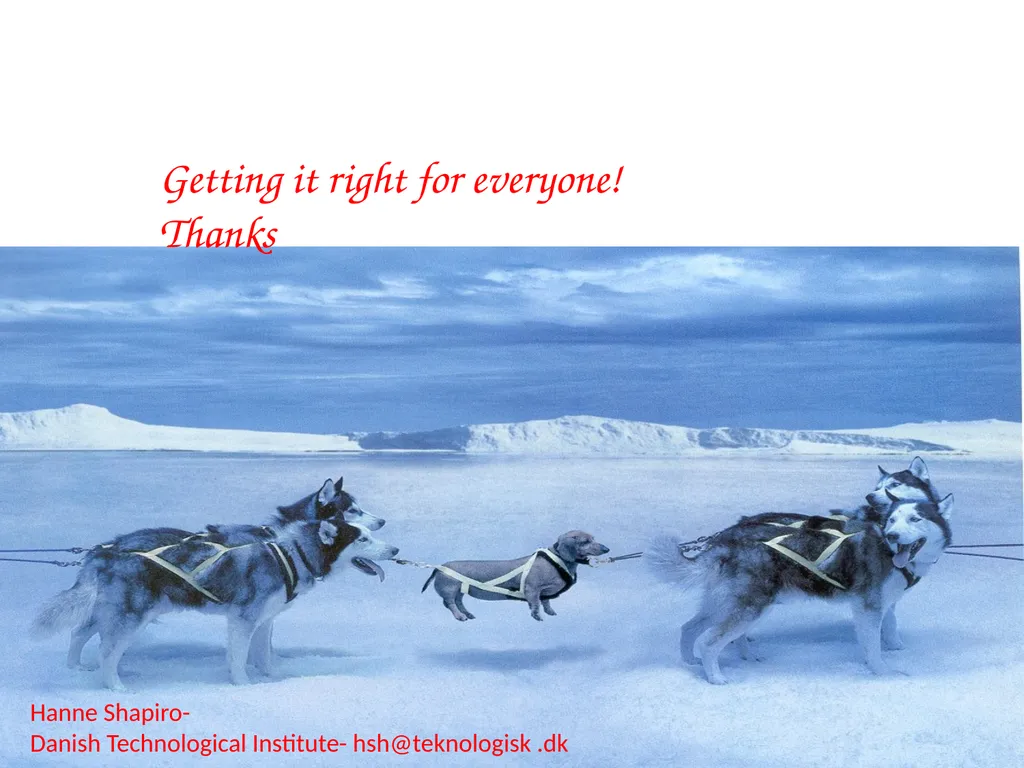
Getting it right for everyone!
Thanks Hanne Shapiro-
Danish Technological Institute- hsh@teknologisk .dk<br>