
Public Procurement & E-Procurement Legal System in
MY
Published · 35 slides · 0 views
1 / 1
Description
Public Procurement E-Procurement Legal System in KOREA Dae Sik, Kim Research Fellow Korea Institute of Procurement CONTENTS Public Procurement and Economic Development Short History of Economic Development in Korea E-Public
Related Topics
Share
Embed code
Download this presentation From Below
"Public Procurement & E-Procurement Legal System in" is the property of its rightful owner. Permission is granted to download and print the materials on this website for personal, non-commercial use only, and to display it on your personal computer provided you do not modify the materials and that you retain all copyright notices contained in the materials. By downloading content from our website, you accept the terms of this agreement.
Presentation Transcript
01
Public Procurement & E-Procurement Legal System in KOREA Dae Sik, Kim
Research Fellow
Korea Institute of Procurement<br>
Research Fellow
Korea Institute of Procurement<br>
02
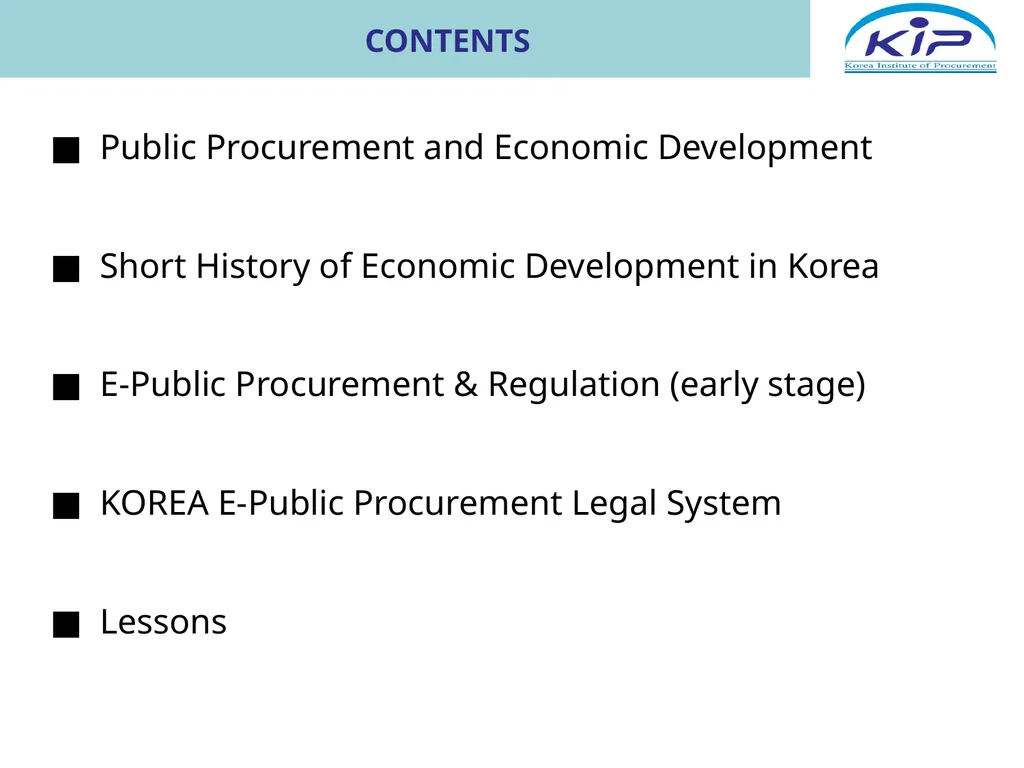
CONTENTS ■ Public Procurement and Economic Development
■ Short History of Economic Development in Korea
■ E-Public Procurement & Regulation (early stage)
■ KOREA E-Public Procurement Legal System
■ Lessons<br>
■ Short History of Economic Development in Korea
■ E-Public Procurement & Regulation (early stage)
■ KOREA E-Public Procurement Legal System
■ Lessons<br>
03
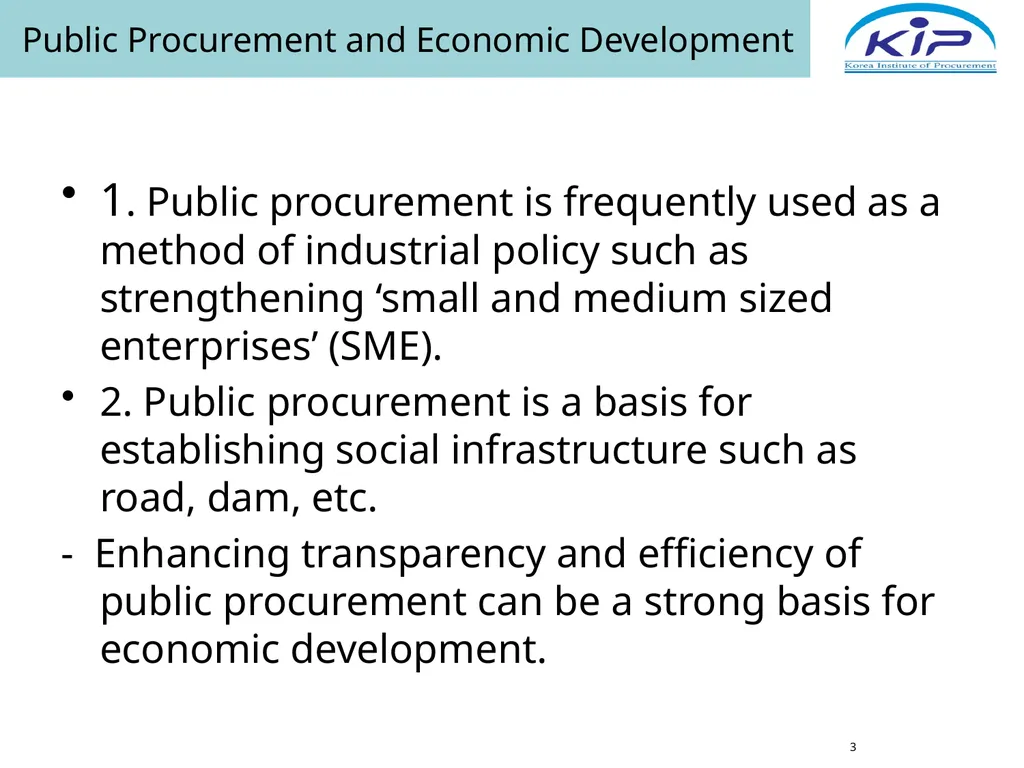
Public Procurement and Economic Development 1. Public procurement is frequently used as a method of industrial policy such as strengthening ‘small and medium sized enterprises’ (SME).
2. Public procurement is a basis for establishing social infrastructure such as road, dam, etc.
- Enhancing transparency and efficiency of public procurement can be a strong basis for economic development. 3<br>
2. Public procurement is a basis for establishing social infrastructure such as road, dam, etc.
- Enhancing transparency and efficiency of public procurement can be a strong basis for economic development. 3<br>
04
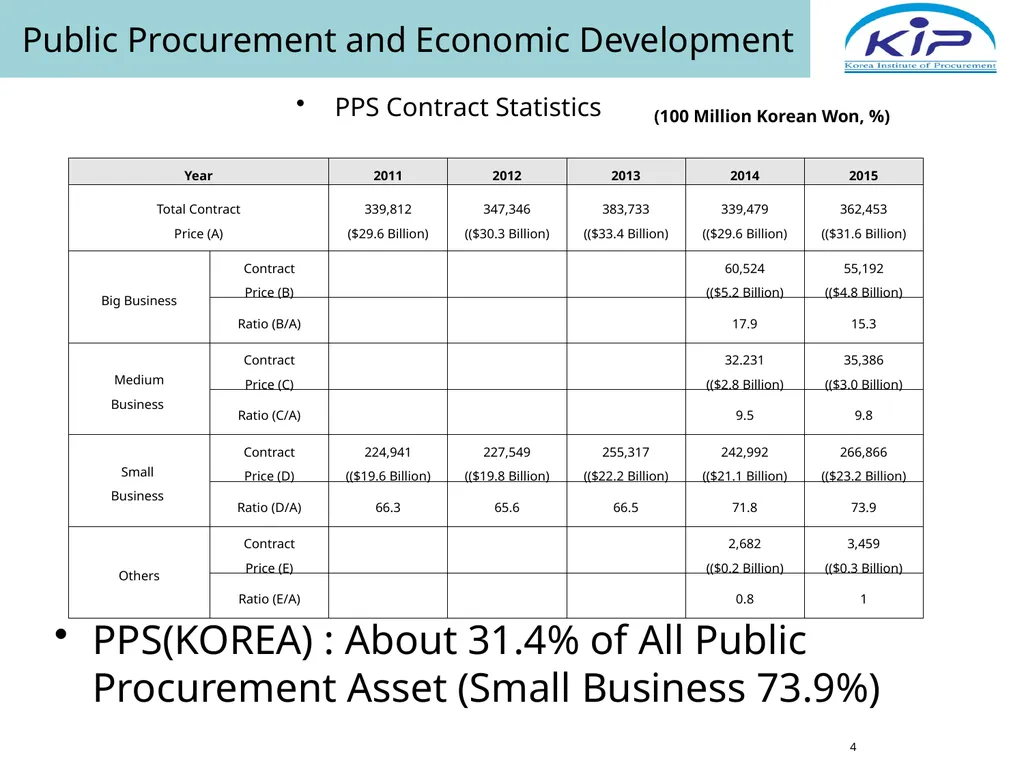
(100 Million Korean Won, %) PPS(KOREA) : About 31.4% of All Public Procurement Asset (Small Business 73.9%) PPS Contract Statistics Public Procurement and Economic Development 4<br>
05
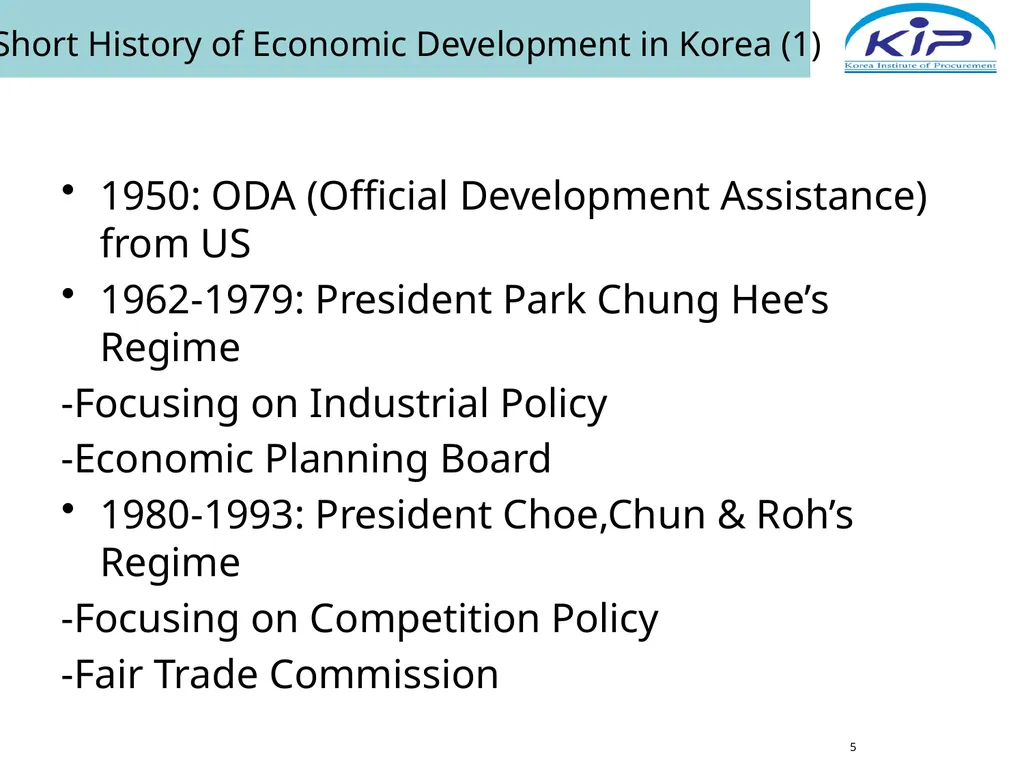
Short History of Economic Development in Korea (1) 1950: ODA (Official Development Assistance) from US
1962-1979: President Park Chung Hee’s Regime
-Focusing on Industrial Policy
-Economic Planning Board
1980-1993: President Choe,Chun & Roh’s Regime
-Focusing on Competition Policy
-Fair Trade Commission 5<br>
1962-1979: President Park Chung Hee’s Regime
-Focusing on Industrial Policy
-Economic Planning Board
1980-1993: President Choe,Chun & Roh’s Regime
-Focusing on Competition Policy
-Fair Trade Commission 5<br>
06
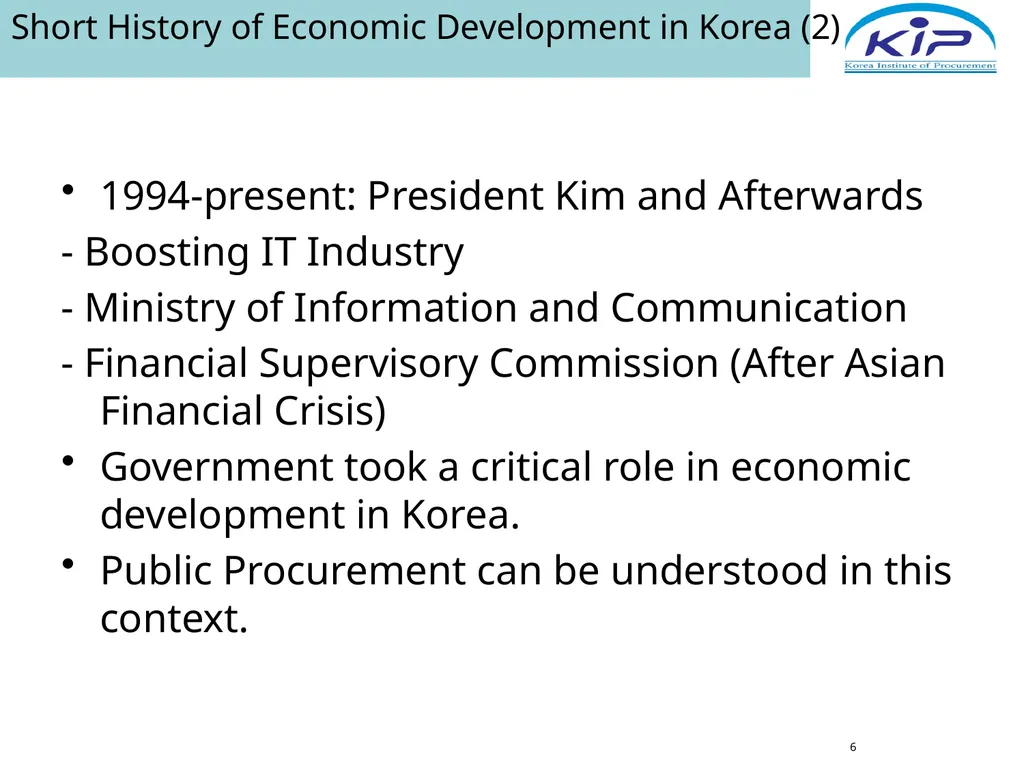
Short History of Economic Development in Korea (2) 1994-present: President Kim and Afterwards
- Boosting IT Industry
- Ministry of Information and Communication
- Financial Supervisory Commission (After Asian Financial Crisis)
Government took a critical role in economic development in Korea.
Public Procurement can be understood in this context. 6<br>
- Boosting IT Industry
- Ministry of Information and Communication
- Financial Supervisory Commission (After Asian Financial Crisis)
Government took a critical role in economic development in Korea.
Public Procurement can be understood in this context. 6<br>
07
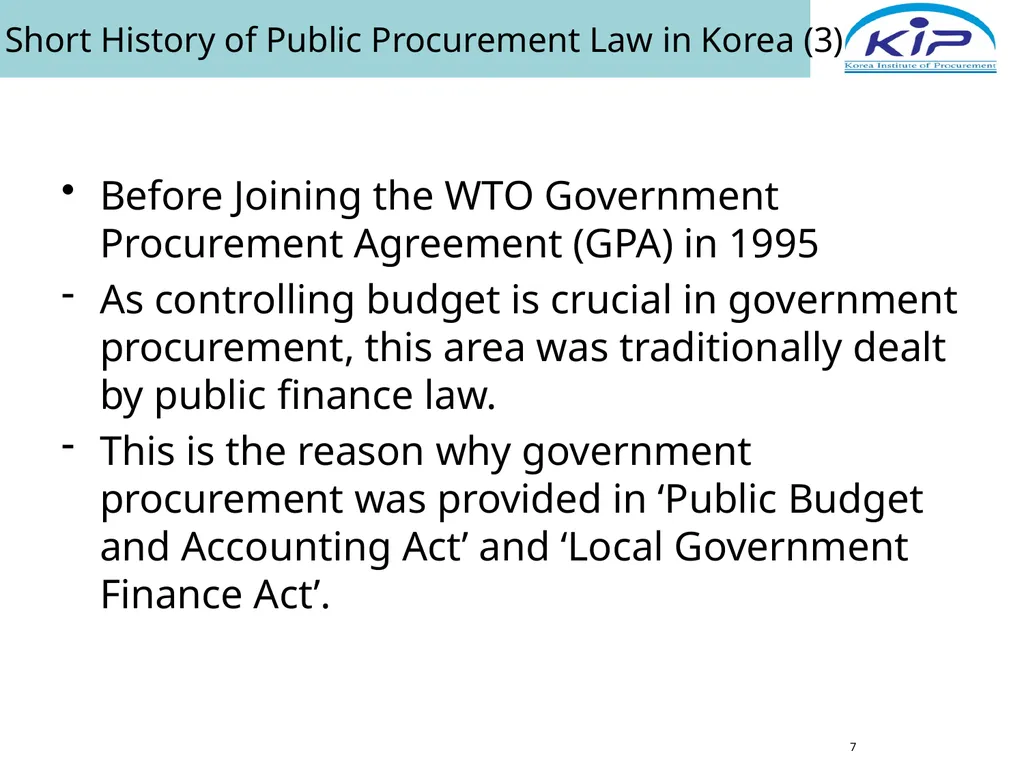
Short History of Public Procurement Law in Korea (3) Before Joining the WTO Government Procurement Agreement (GPA) in 1995
As controlling budget is crucial in government procurement, this area was traditionally dealt by public finance law.
This is the reason why government procurement was provided in ‘Public Budget and Accounting Act’ and ‘Local Government Finance Act’. 7<br>
As controlling budget is crucial in government procurement, this area was traditionally dealt by public finance law.
This is the reason why government procurement was provided in ‘Public Budget and Accounting Act’ and ‘Local Government Finance Act’. 7<br>
08
Short History of Public Procurement Law in Korea (4) After Joining the WTO Government Procurement Agreement (GPA) in 1995
Independent Statutes on public procurement were enacted.
‘Act on contracts in which the state is a party’ [hereinafter, Central Government Procurement Act (CGPA)] was enacted in 1995, and ‘Act on contracts in which the local government is a party’ [hereinafter, Local Government Procurement Act (LGPA)] was enacted in 2005. 8<br>
Independent Statutes on public procurement were enacted.
‘Act on contracts in which the state is a party’ [hereinafter, Central Government Procurement Act (CGPA)] was enacted in 1995, and ‘Act on contracts in which the local government is a party’ [hereinafter, Local Government Procurement Act (LGPA)] was enacted in 2005. 8<br>
09
Korea E-bidding System (GoBIMS) (2000) - Improvement of
Relevant Laws & Systems
Some systems needed to be newly created for the following two reasons.
The first was that there were no existing systems in place. Another was that there were needed some regulations for preventing bidding-related conflicts and ensuring legal stability.
The former includes regulating the confirmation and time of e-Document exchange and clarifying the validity and responsibility of e-Signature based on the Framework Act on Electronic Commerce and Digital Signature Act.
The latter includes regulations on system failure handling and successful bidder declaration. E-Public Procurement & Regulation (early stage) (1) 9<br>
Relevant Laws & Systems
Some systems needed to be newly created for the following two reasons.
The first was that there were no existing systems in place. Another was that there were needed some regulations for preventing bidding-related conflicts and ensuring legal stability.
The former includes regulating the confirmation and time of e-Document exchange and clarifying the validity and responsibility of e-Signature based on the Framework Act on Electronic Commerce and Digital Signature Act.
The latter includes regulations on system failure handling and successful bidder declaration. E-Public Procurement & Regulation (early stage) (1) 9<br>
10
Korea E-bidding System (GoBIMS) (2000) - Improvement of
Relevant Laws & Systems
- The new regulations adopted in the course of the e-Bidding system development include Stipulations for e-Bidders (Sep. 19. 2000), Stipulations for e-Bidding executives (Nov. 13. 2000), Special guidelines for facility construction e-Bidding (Sep. 28. 2000), Special guidelines for purchase e-Bidding (Oct. 10. 2000).
Stipulations for e-Bidders defines the rights and duties of PPS and bidder(suppliers) in relation to the participation in and use of e-Bidding prior to the commencement of registration on September 20, 2000.
For registration, users are required to undergo an agreement procedure. Stipulations for e-Bidding executives defines the rights and duties of the public institutions and PPS, the system operator, in relation to the co-use of the e-Bidding system. For registration as an e-Bidding executive, officials from public institutions are required to undergo an agreement procedure. E-Public Procurement & Regulation (early stage) (2) 10<br>
Relevant Laws & Systems
- The new regulations adopted in the course of the e-Bidding system development include Stipulations for e-Bidders (Sep. 19. 2000), Stipulations for e-Bidding executives (Nov. 13. 2000), Special guidelines for facility construction e-Bidding (Sep. 28. 2000), Special guidelines for purchase e-Bidding (Oct. 10. 2000).
Stipulations for e-Bidders defines the rights and duties of PPS and bidder(suppliers) in relation to the participation in and use of e-Bidding prior to the commencement of registration on September 20, 2000.
For registration, users are required to undergo an agreement procedure. Stipulations for e-Bidding executives defines the rights and duties of the public institutions and PPS, the system operator, in relation to the co-use of the e-Bidding system. For registration as an e-Bidding executive, officials from public institutions are required to undergo an agreement procedure. E-Public Procurement & Regulation (early stage) (2) 10<br>
11
Korea E-bidding System (GoBIMS) (2000) - Improvement of
Relevant Laws & Systems
- The registration of public institutions was commenced after the system was opened in November 2000. Special guidelines for facility and purchase e-Bidding was prepared prior to the formal mock bidding scheduled for the end of October and contains the contents unique to e-Bidding.
- All above regulations have a mutually complementary relationship in the system development. Problems arising from the regulation process are reflected in the system. The system development results are reflected in the regulations to complete the system. E-Public Procurement & Regulation (early stage) (3) 11<br>
Relevant Laws & Systems
- The registration of public institutions was commenced after the system was opened in November 2000. Special guidelines for facility and purchase e-Bidding was prepared prior to the formal mock bidding scheduled for the end of October and contains the contents unique to e-Bidding.
- All above regulations have a mutually complementary relationship in the system development. Problems arising from the regulation process are reflected in the system. The system development results are reflected in the regulations to complete the system. E-Public Procurement & Regulation (early stage) (3) 11<br>
12
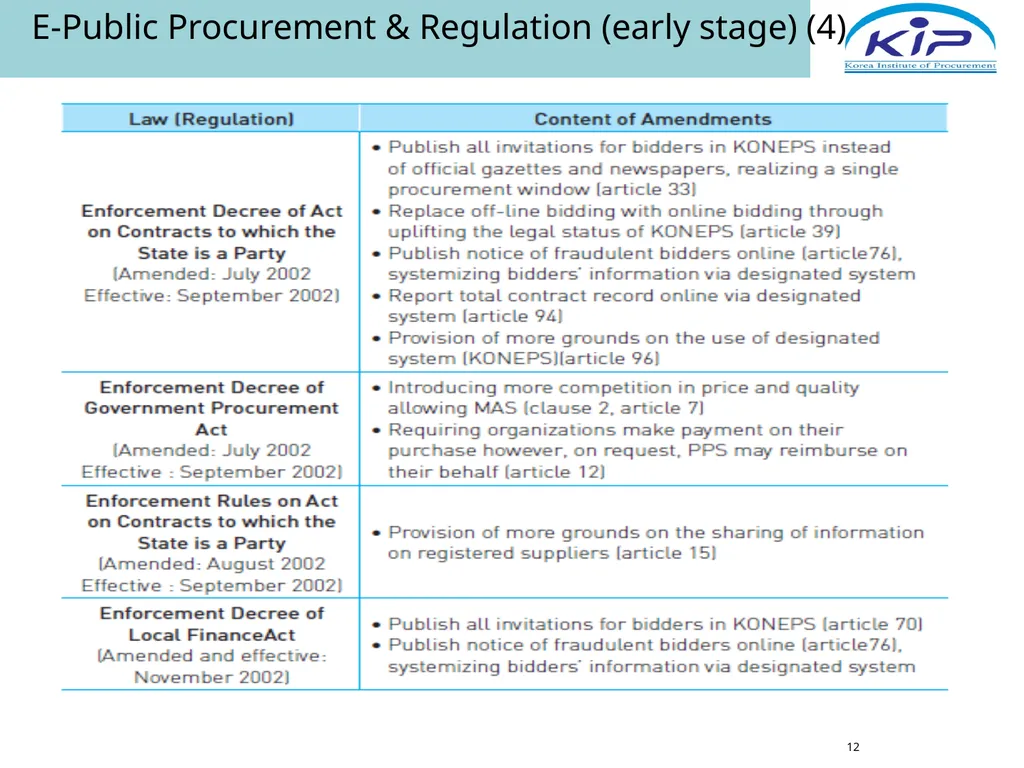
12 E-Public Procurement & Regulation (early stage) (4)<br>
13
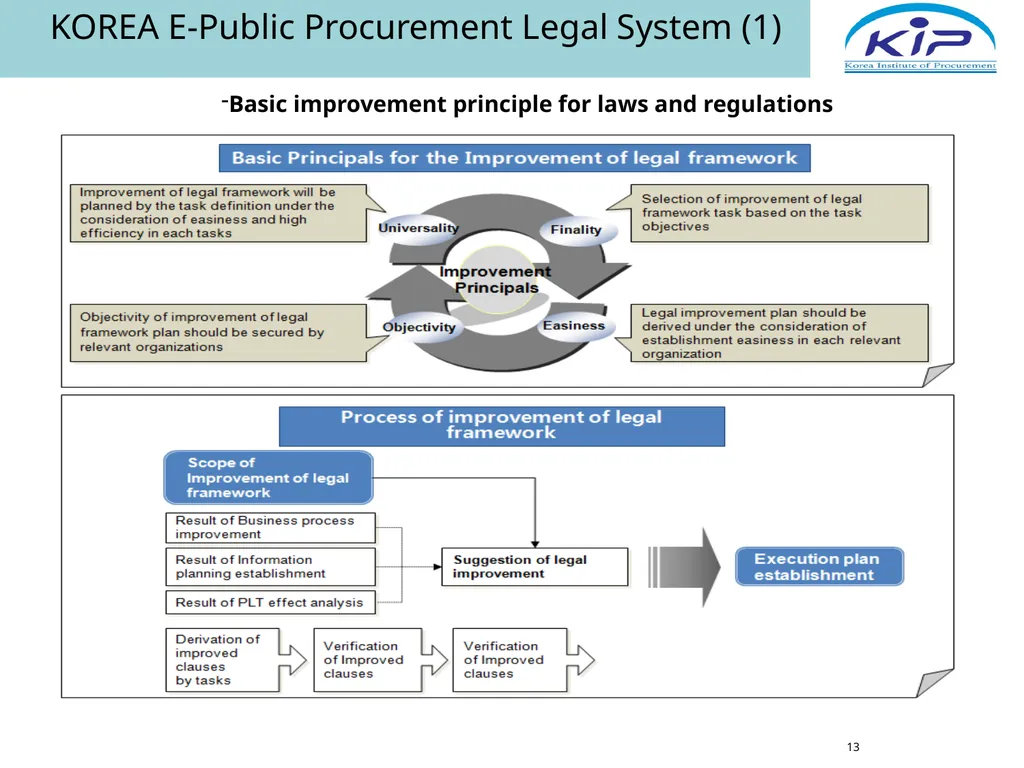
13 KOREA E-Public Procurement Legal System (1) Basic improvement principle for laws and regulations<br>
14
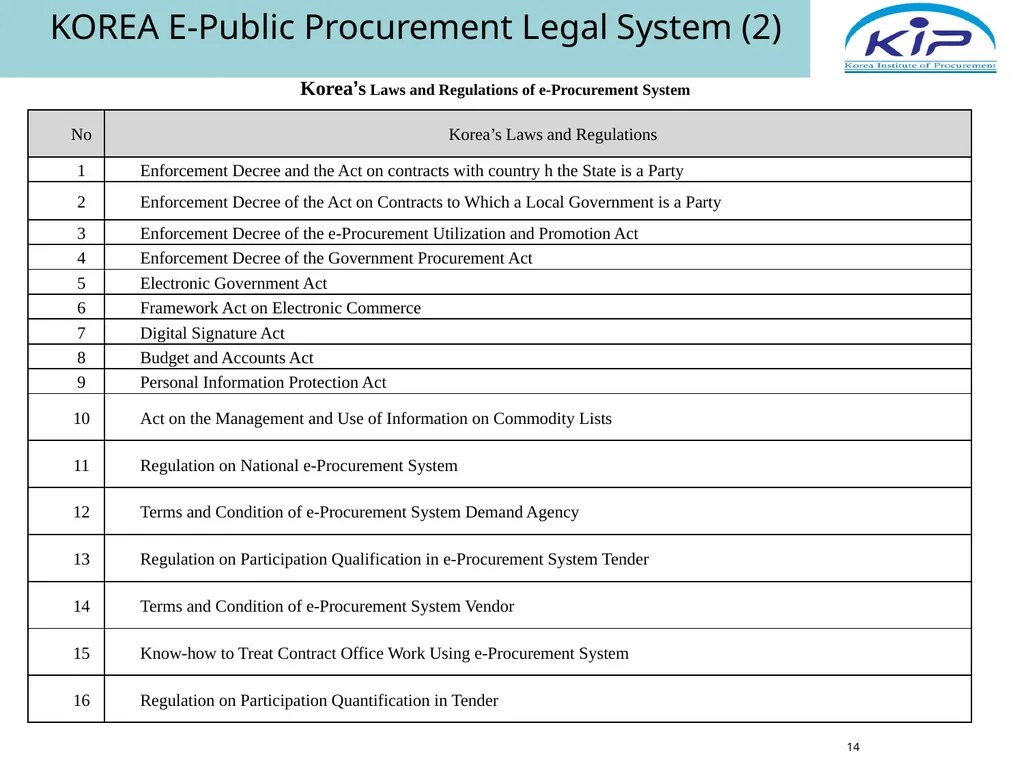
14 Korea’s Laws and Regulations of e-Procurement System KOREA E-Public Procurement Legal System (2)<br>
15
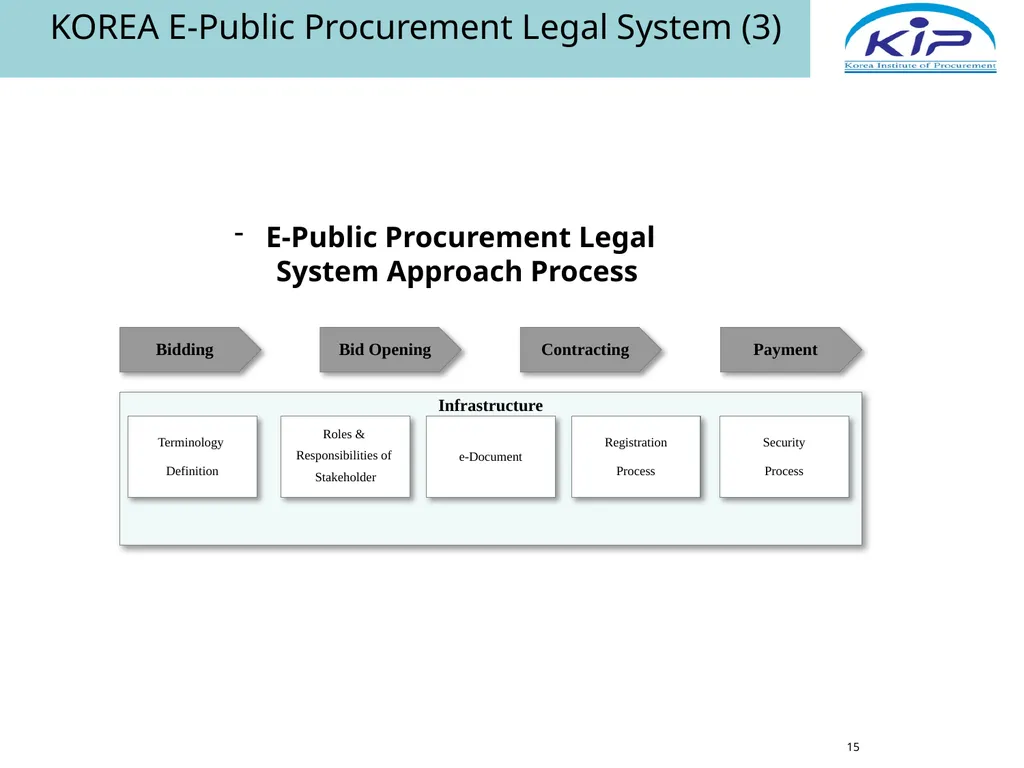
15 E-Public Procurement Legal System Approach Process Infrastructure Terminology
Definition Roles &
Responsibilities of
Stakeholder e-Document Registration
Process Security
Process Bidding Bid Opening Contracting Payment KOREA E-Public Procurement Legal System (3)<br>
Definition Roles &
Responsibilities of
Stakeholder e-Document Registration
Process Security
Process Bidding Bid Opening Contracting Payment KOREA E-Public Procurement Legal System (3)<br>
16
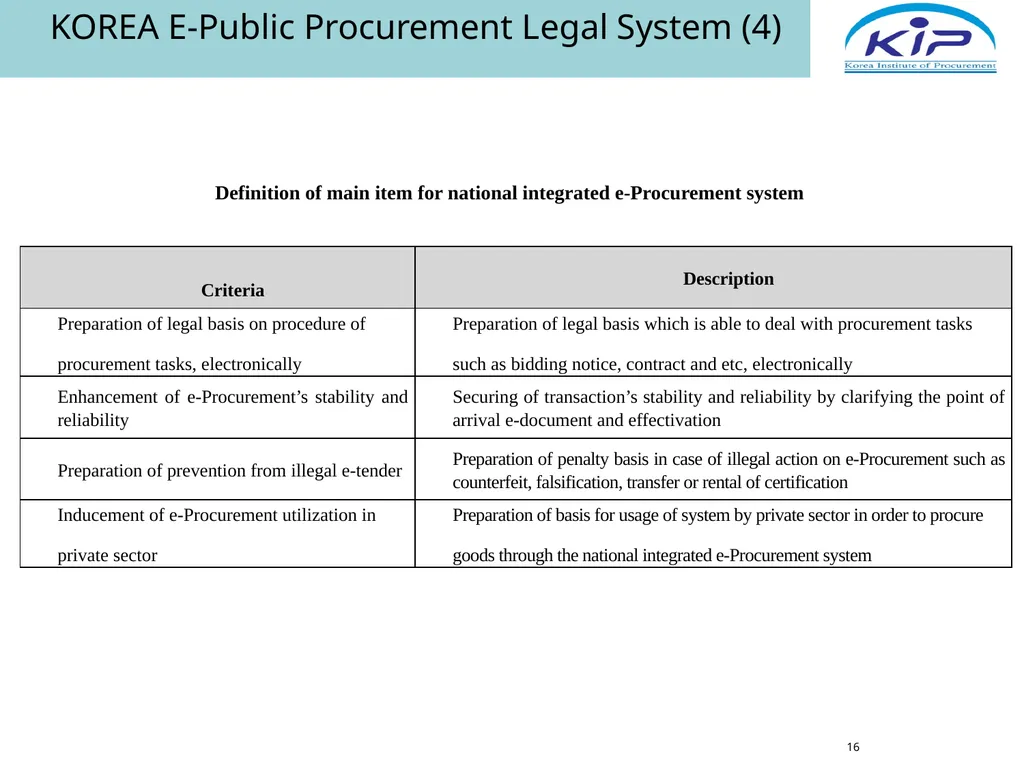
16 Definition of main item for national integrated e-Procurement system KOREA E-Public Procurement Legal System (4)<br>
17
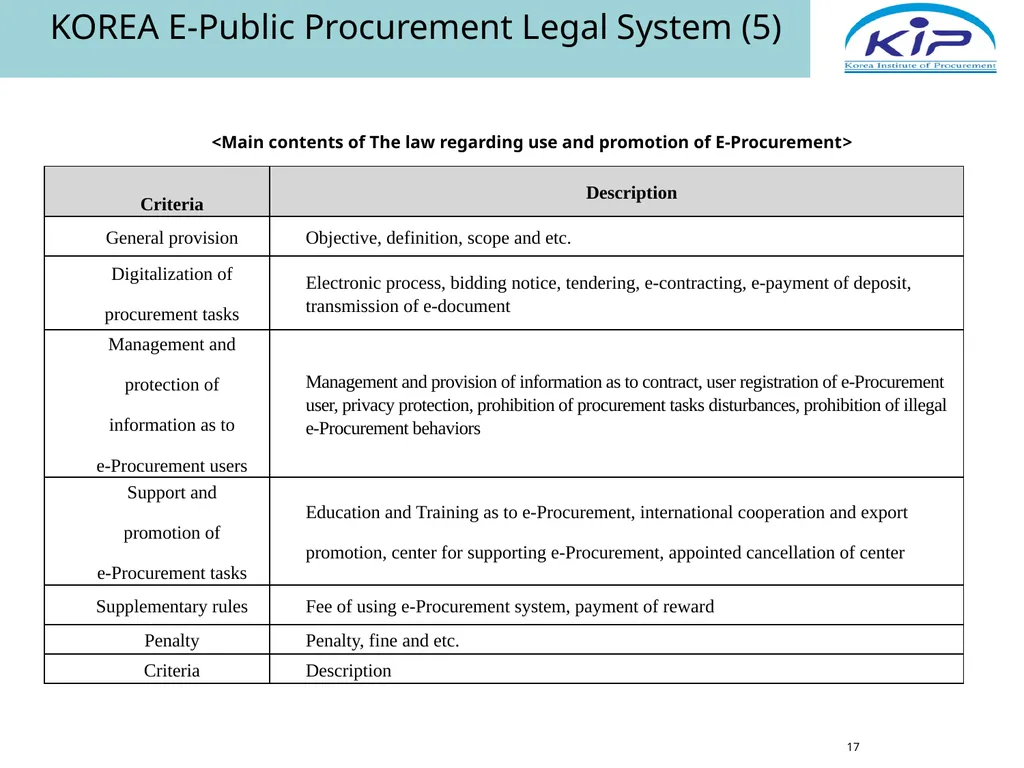
17 <Main contents of The law regarding use and promotion of E-Procurement> KOREA E-Public Procurement Legal System (5)<br>
18
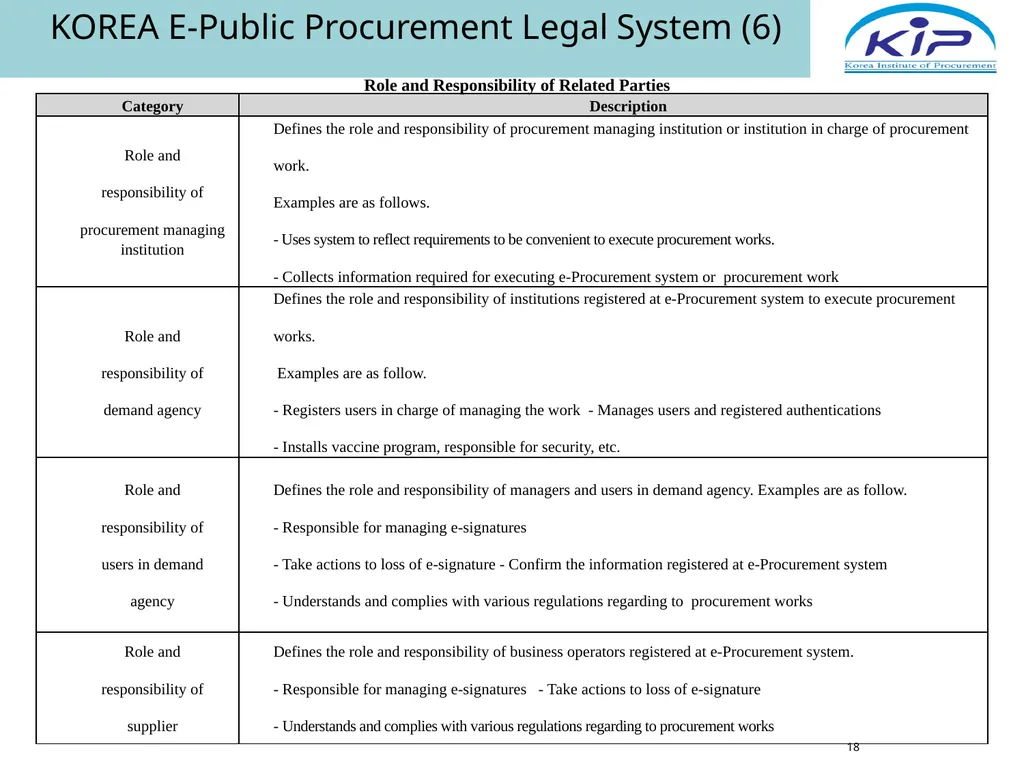
18 Role and Responsibility of Related Parties KOREA E-Public Procurement Legal System (6)<br>
19
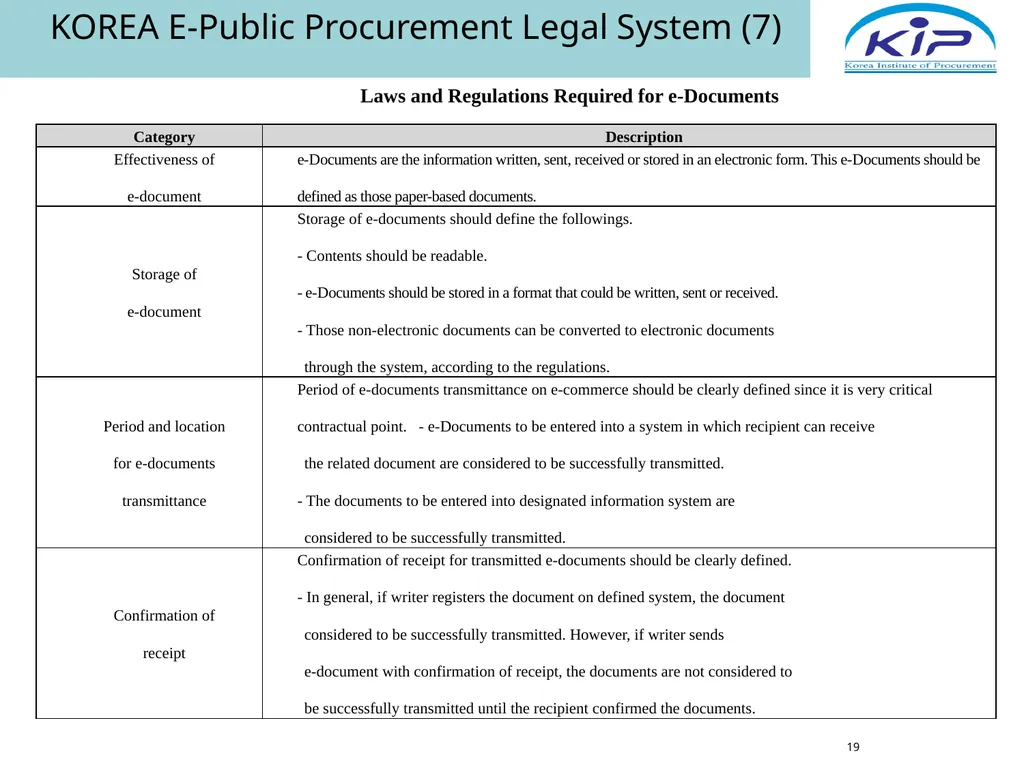
19 Laws and Regulations Required for e-Documents KOREA E-Public Procurement Legal System (7)<br>
20
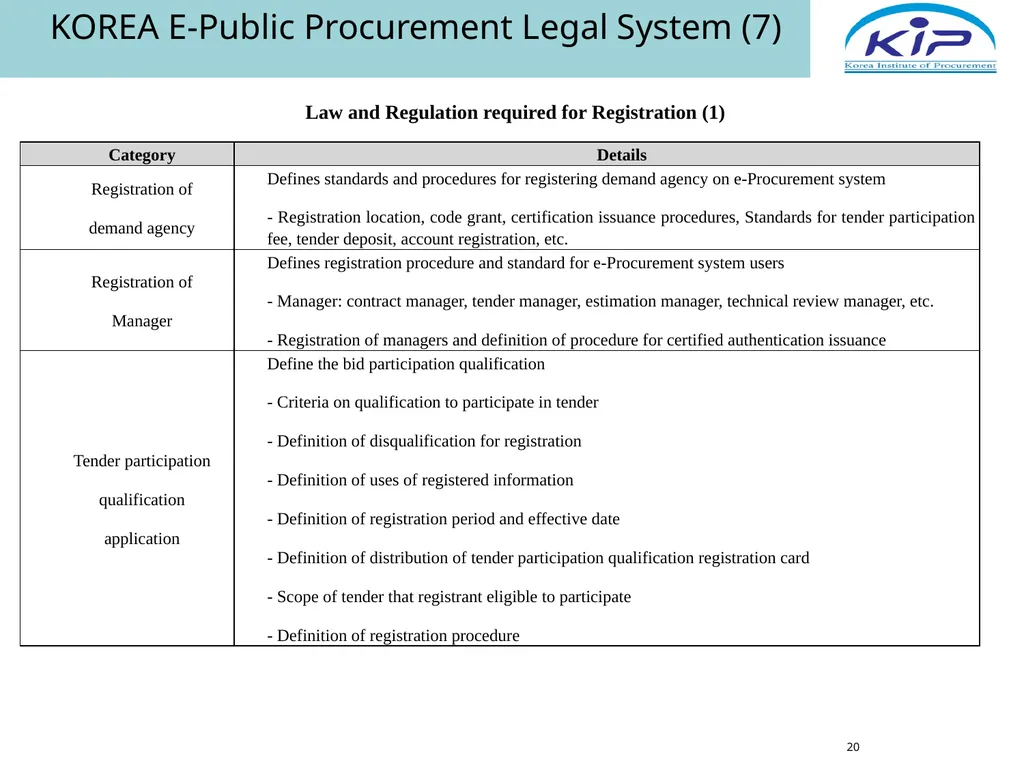
20 Law and Regulation required for Registration (1) KOREA E-Public Procurement Legal System (7)<br>
21
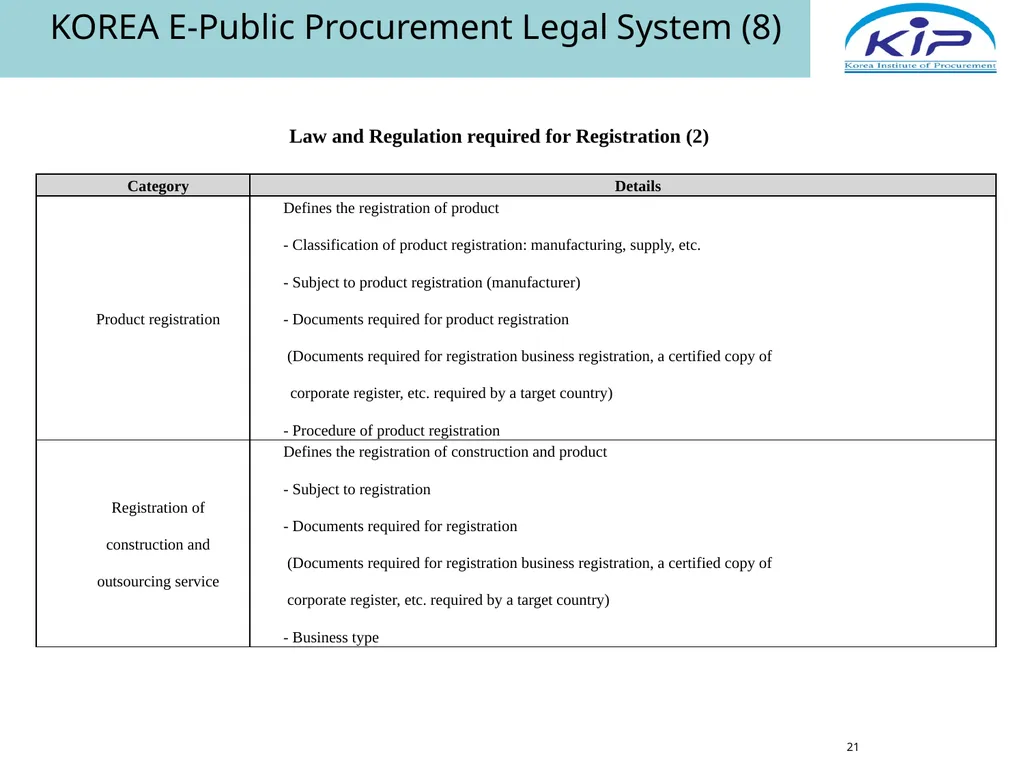
21 Law and Regulation required for Registration (2) KOREA E-Public Procurement Legal System (8)<br>
22
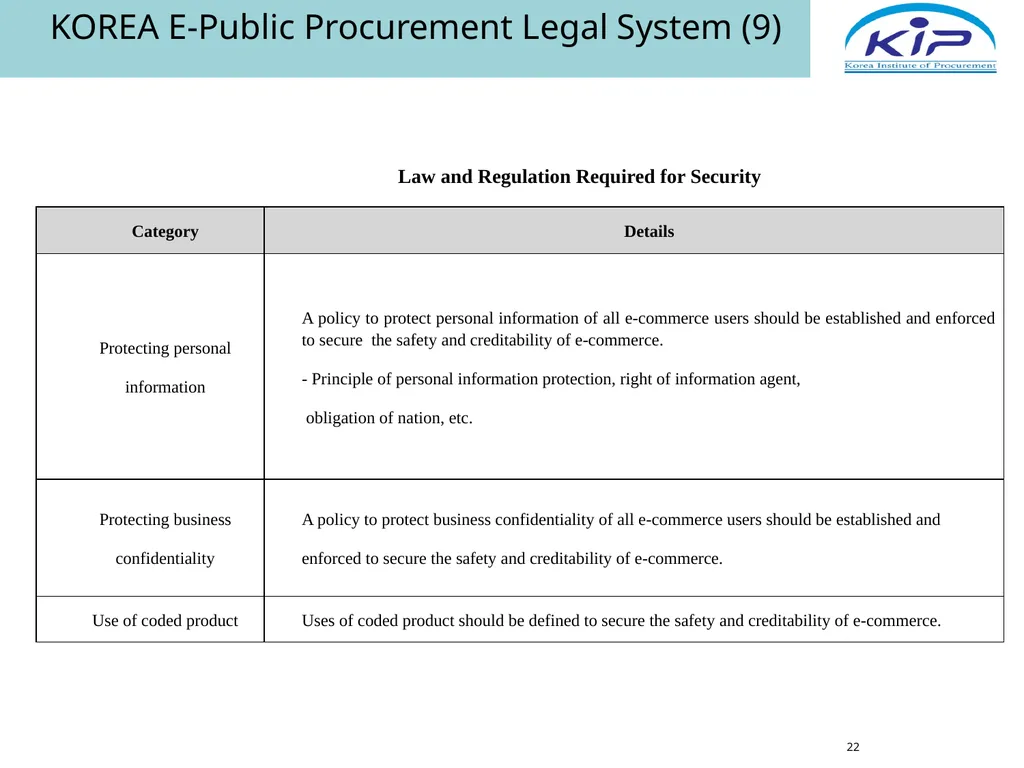
22 Law and Regulation Required for Security KOREA E-Public Procurement Legal System (9)<br>
23
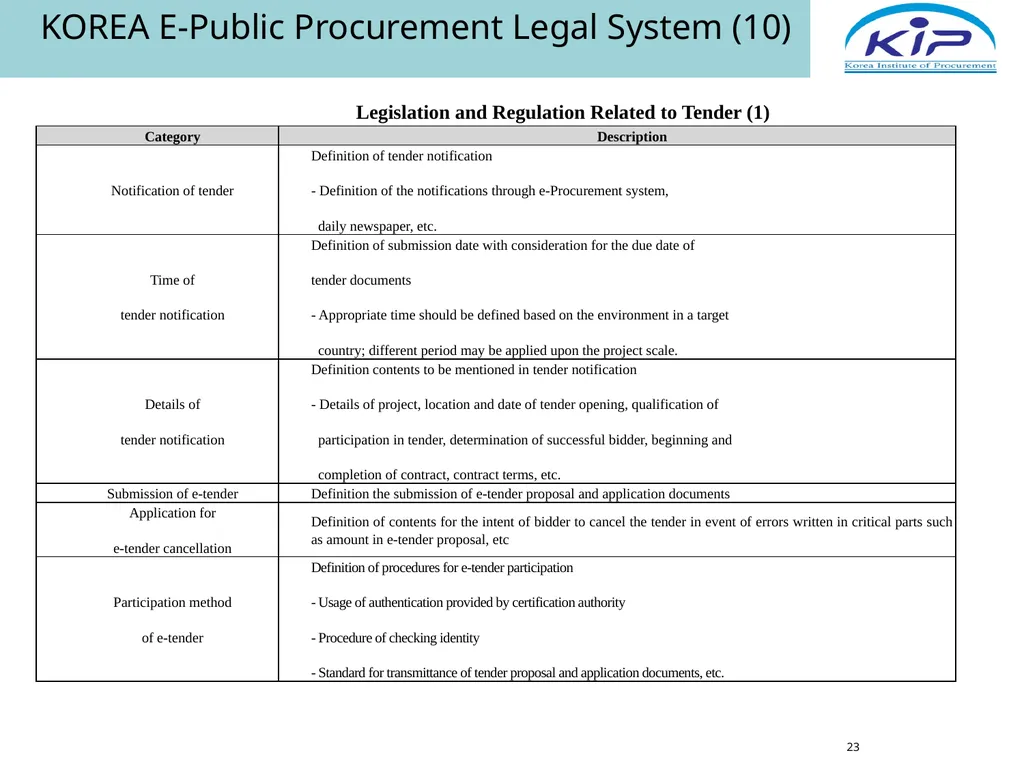
23 Legislation and Regulation Related to Tender (1) KOREA E-Public Procurement Legal System (10)<br>
24
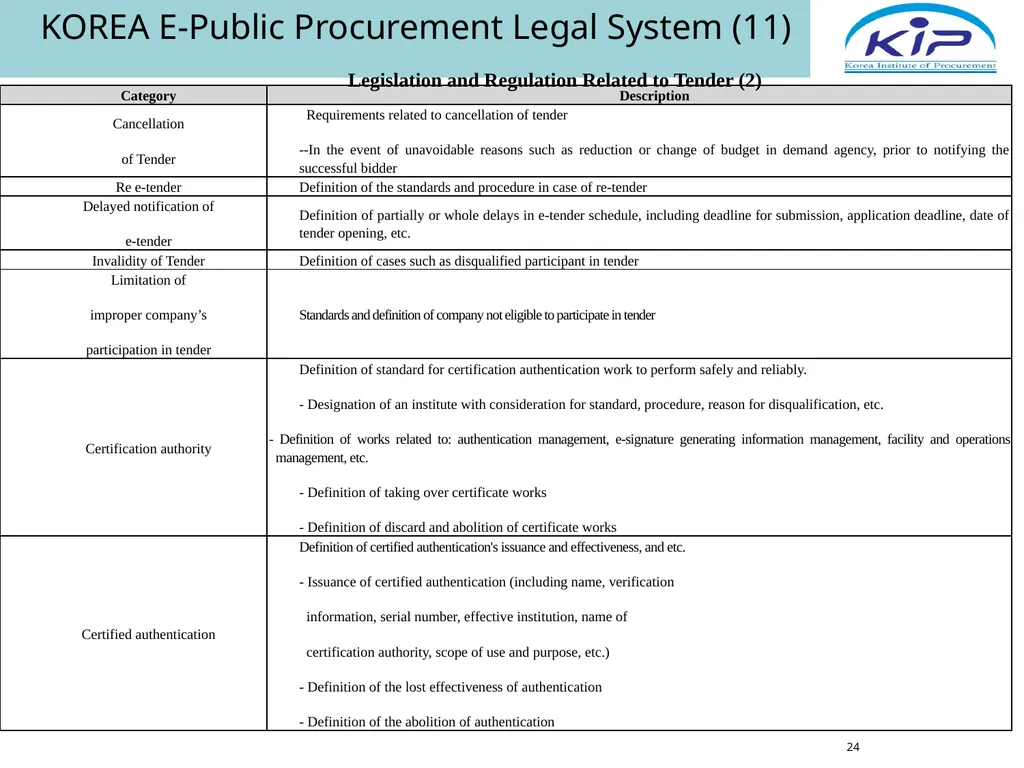
24 Legislation and Regulation Related to Tender (2) KOREA E-Public Procurement Legal System (11)<br>
25
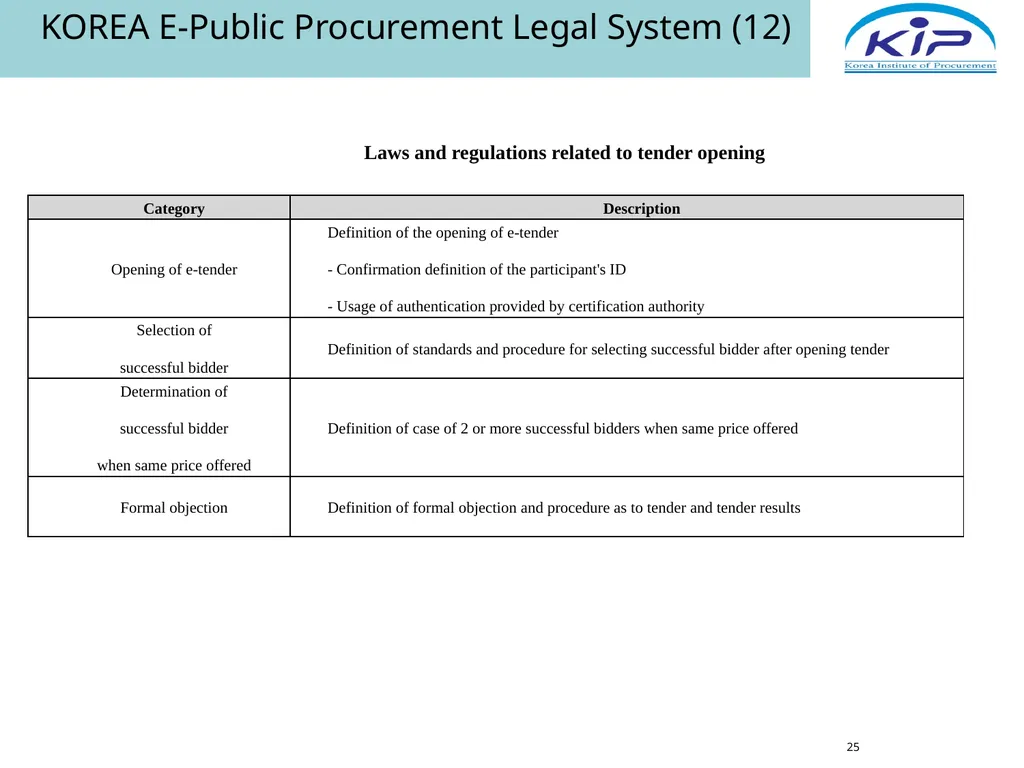
25 Laws and regulations related to tender opening KOREA E-Public Procurement Legal System (12)<br>
26
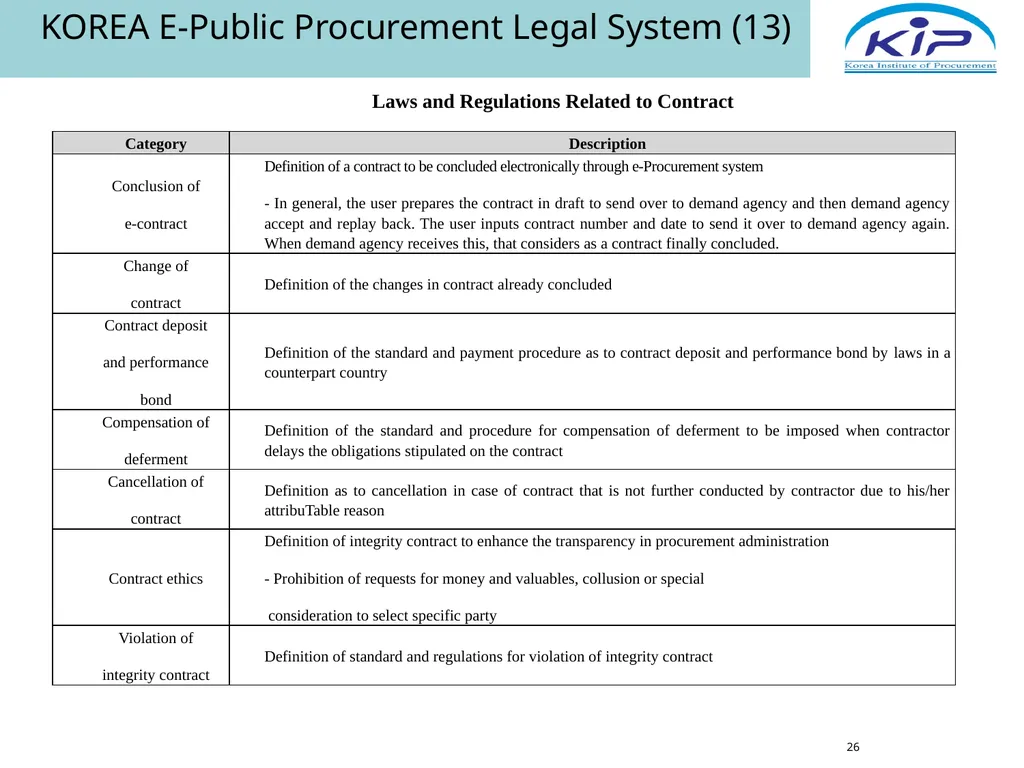
26 Laws and Regulations Related to Contract KOREA E-Public Procurement Legal System (13)<br>
27
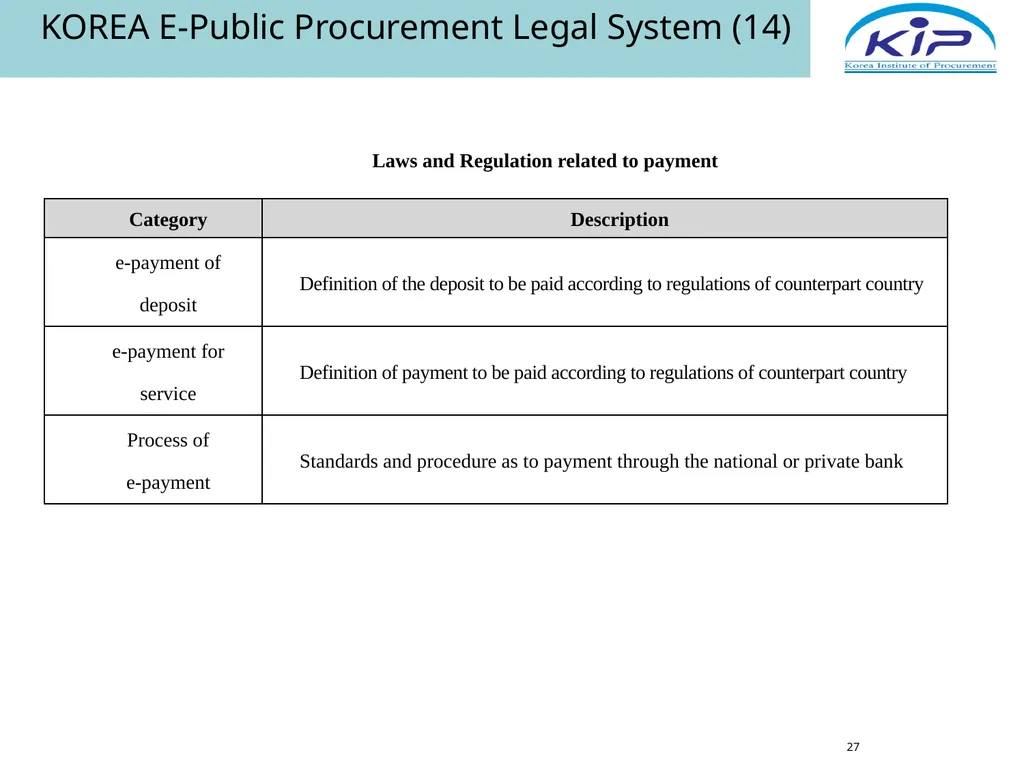
27 Laws and Regulation related to payment KOREA E-Public Procurement Legal System (14)<br>
28
Lessons(1) Centralized Procurement
Centralized Procurement through PPS enhanced innovation and expertise.
E-procurement is combined with efficient centralized procurement. Many central and local government agencies are using KONEPS which is established by PPS. 28<br>
Centralized Procurement through PPS enhanced innovation and expertise.
E-procurement is combined with efficient centralized procurement. Many central and local government agencies are using KONEPS which is established by PPS. 28<br>
29
Lessons(2) 29 E-procurement
Balancing between transparency and efficiency is crucial point in developing public procurement regime. E-procurement can be useful tool to achieve both objectives.
In Korea, in the first phase, E-procurement was emphasized as a tool for enhancing transparency (information disclosure), however in the second phase more emphasis was put upon efficiency (Multiple Award Schedule).<br>
Balancing between transparency and efficiency is crucial point in developing public procurement regime. E-procurement can be useful tool to achieve both objectives.
In Korea, in the first phase, E-procurement was emphasized as a tool for enhancing transparency (information disclosure), however in the second phase more emphasis was put upon efficiency (Multiple Award Schedule).<br>
30
Lessons(3) Government Role in Economic Development
In Korean economic development, the central role of government was crucial. Strengthening SME through public procurement is one example. (East-Asian Development Model)
Liberalization of government market should be harmonized with enhancing SME in each country. 30<br>
In Korean economic development, the central role of government was crucial. Strengthening SME through public procurement is one example. (East-Asian Development Model)
Liberalization of government market should be harmonized with enhancing SME in each country. 30<br>
31
Lessons(4) Motivation
Preference for new technology products in e-public procurement motivated the innovations in each enterprise. 31<br>
Preference for new technology products in e-public procurement motivated the innovations in each enterprise. 31<br>
32
Lessons(5) Sub-central government
The Relationship between central government procurement law and sub-central government law should be carefully designed.
There should be sound ground for different legislation of both system. 32<br>
The Relationship between central government procurement law and sub-central government law should be carefully designed.
There should be sound ground for different legislation of both system. 32<br>
33
Lessons(6) Transparency
In Korea, corruptions in public procurement is not totally eradicated yet.
However, enhanced transparency through e-procurement are diminishing the level of corruption incrementally.
Supreme court decision that public procurement contract as a private contract is criticized. 33<br>
In Korea, corruptions in public procurement is not totally eradicated yet.
However, enhanced transparency through e-procurement are diminishing the level of corruption incrementally.
Supreme court decision that public procurement contract as a private contract is criticized. 33<br>
34
Lessons(7) User-Friendly
Act on E-Government Provides that administrative information of government (court decisions, statutes, regulations etc) should be disclosed through internet (Art. 14).
It is emphasized that the information should be disclosed in a way that ordinary citizens can understand easily (user-friendly information disclosure, Art. 3). 34<br>
Act on E-Government Provides that administrative information of government (court decisions, statutes, regulations etc) should be disclosed through internet (Art. 14).
It is emphasized that the information should be disclosed in a way that ordinary citizens can understand easily (user-friendly information disclosure, Art. 3). 34<br>
35
Thank You!<br>