
PUBLIC PROCUREMENT PROCESSES by Rakesh Jain Deputy
DP
Published · 21 slides · 0 views

1 / 1


Description
PUBLIC PROCUREMENT PROCESSES by Rakesh Jain Deputy Comptroller Auditor General Outline of Presentation Procurement Existing Instructions Principles laid down by Supreme Court Weaknesses Way forward Salient features of Public Procurement
Related Topics
Share
Embed code
Download this presentation From Below
"PUBLIC PROCUREMENT PROCESSES by Rakesh Jain Deputy" is the property of its rightful owner. Permission is granted to download and print the materials on this website for personal, non-commercial use only, and to display it on your personal computer provided you do not modify the materials and that you retain all copyright notices contained in the materials. By downloading content from our website, you accept the terms of this agreement.
Presentation Transcript
01
PUBLIC PROCUREMENT PROCESSES
by
Rakesh Jain
Deputy Comptroller & Auditor General<br>
02
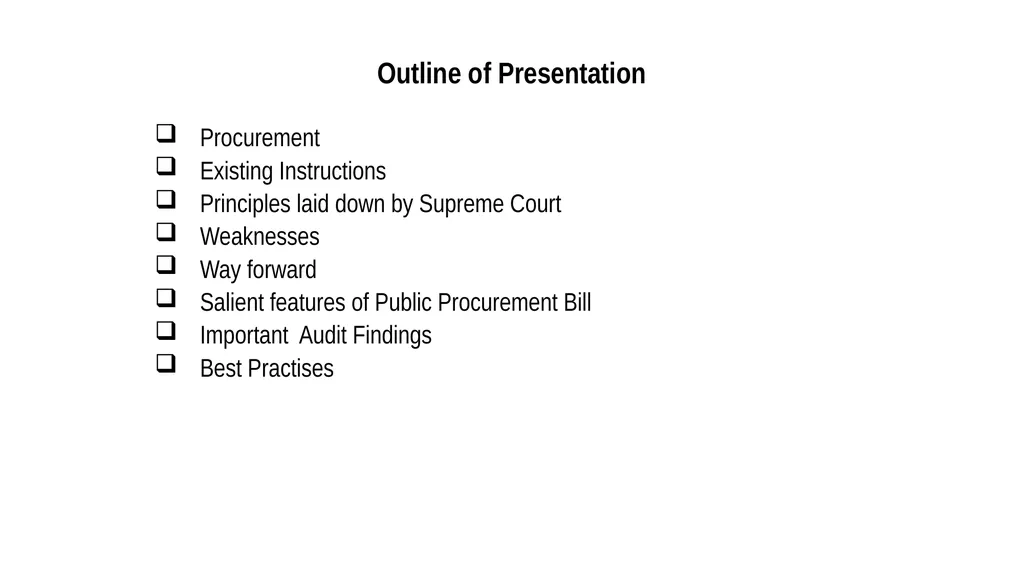
Outline of Presentation Procurement
Existing Instructions
Principles laid down by Supreme Court
Weaknesses
Way forward
Salient features of Public Procurement Bill
Important Audit Findings
Best Practises<br>
Existing Instructions
Principles laid down by Supreme Court
Weaknesses
Way forward
Salient features of Public Procurement Bill
Important Audit Findings
Best Practises<br>
03
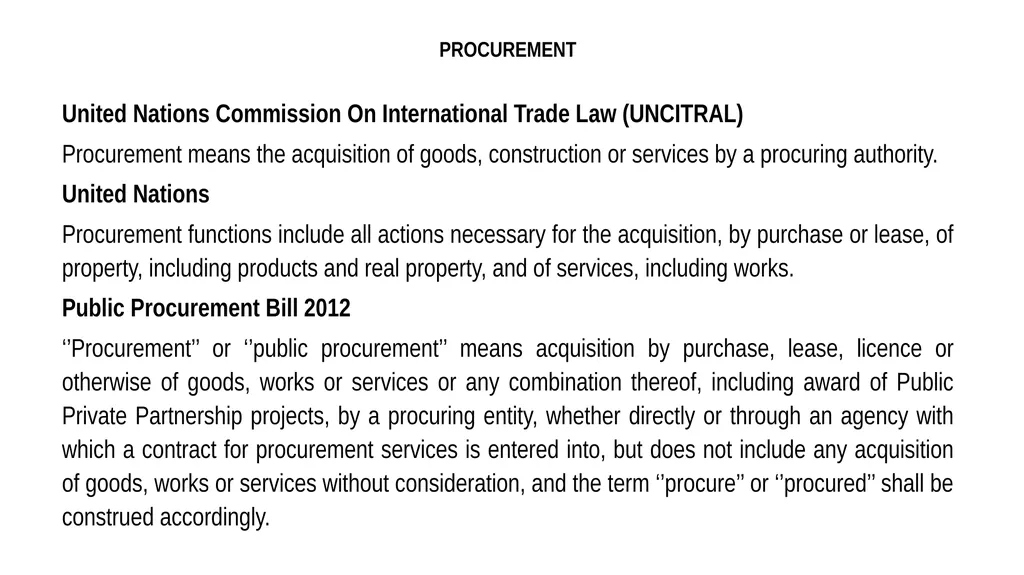
PROCUREMENT United Nations Commission On International Trade Law (UNCITRAL)
Procurement means the acquisition of goods, construction or services by a procuring authority.
United Nations
Procurement functions include all actions necessary for the acquisition, by purchase or lease, of property, including products and real property, and of services, including works.
Public Procurement Bill 2012
‘’Procurement’’ or ‘’public procurement’’ means acquisition by purchase, lease, licence or otherwise of goods, works or services or any combination thereof, including award of Public Private Partnership projects, by a procuring entity, whether directly or through an agency with which a contract for procurement services is entered into, but does not include any acquisition of goods, works or services without consideration, and the term ‘’procure’’ or ‘’procured’’ shall be construed accordingly.<br>
Procurement means the acquisition of goods, construction or services by a procuring authority.
United Nations
Procurement functions include all actions necessary for the acquisition, by purchase or lease, of property, including products and real property, and of services, including works.
Public Procurement Bill 2012
‘’Procurement’’ or ‘’public procurement’’ means acquisition by purchase, lease, licence or otherwise of goods, works or services or any combination thereof, including award of Public Private Partnership projects, by a procuring entity, whether directly or through an agency with which a contract for procurement services is entered into, but does not include any acquisition of goods, works or services without consideration, and the term ‘’procure’’ or ‘’procured’’ shall be construed accordingly.<br>
04
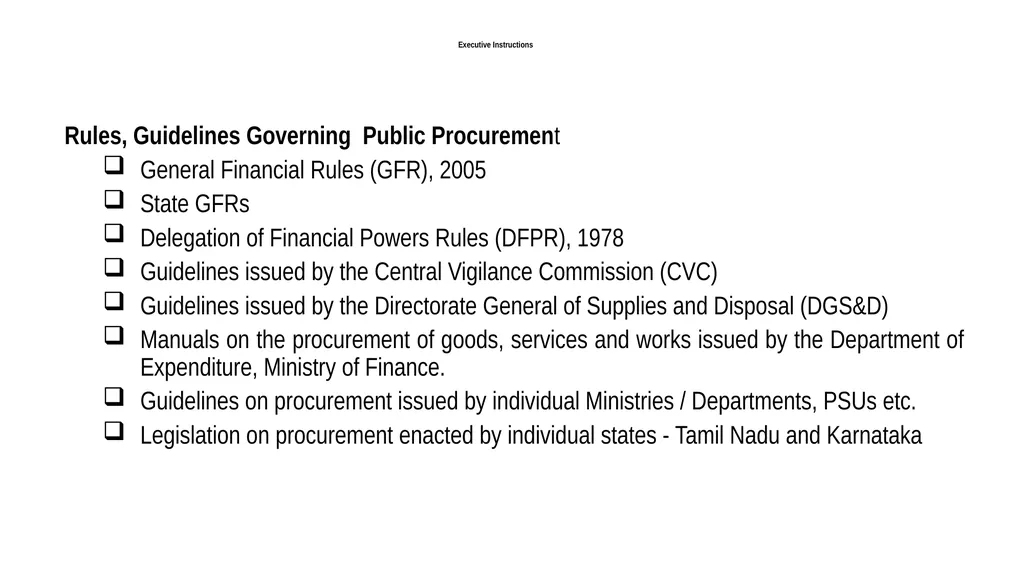
Executive Instructions Rules, Guidelines Governing Public Procurement
General Financial Rules (GFR), 2005
State GFRs
Delegation of Financial Powers Rules (DFPR), 1978
Guidelines issued by the Central Vigilance Commission (CVC)
Guidelines issued by the Directorate General of Supplies and Disposal (DGS&D)
Manuals on the procurement of goods, services and works issued by the Department of Expenditure, Ministry of Finance.
Guidelines on procurement issued by individual Ministries / Departments, PSUs etc.
Legislation on procurement enacted by individual states - Tamil Nadu and Karnataka<br>
General Financial Rules (GFR), 2005
State GFRs
Delegation of Financial Powers Rules (DFPR), 1978
Guidelines issued by the Central Vigilance Commission (CVC)
Guidelines issued by the Directorate General of Supplies and Disposal (DGS&D)
Manuals on the procurement of goods, services and works issued by the Department of Expenditure, Ministry of Finance.
Guidelines on procurement issued by individual Ministries / Departments, PSUs etc.
Legislation on procurement enacted by individual states - Tamil Nadu and Karnataka<br>
05
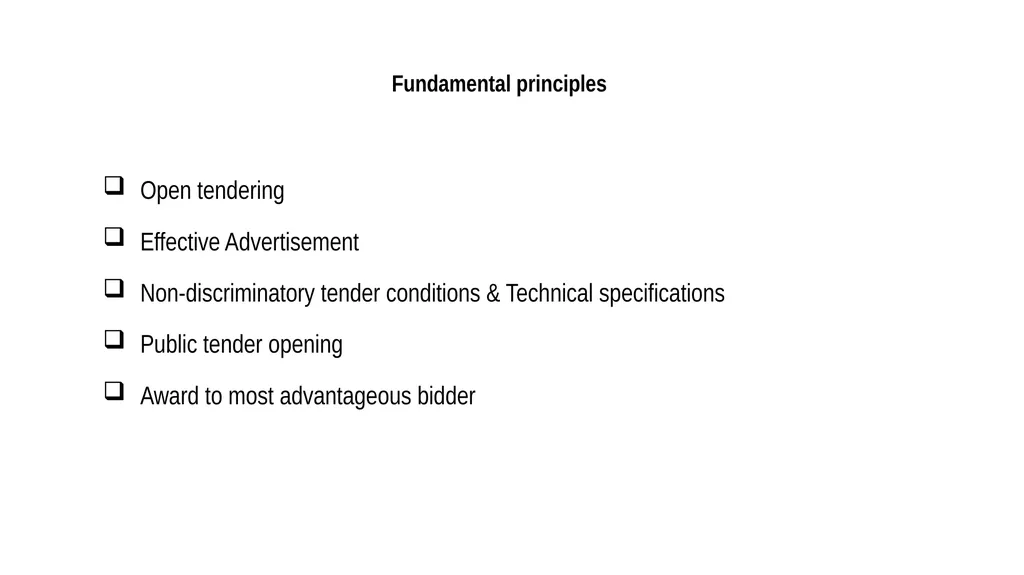
Fundamental principles Open tendering
Effective Advertisement
Non-discriminatory tender conditions & Technical specifications
Public tender opening
Award to most advantageous bidder<br>
Effective Advertisement
Non-discriminatory tender conditions & Technical specifications
Public tender opening
Award to most advantageous bidder<br>
06
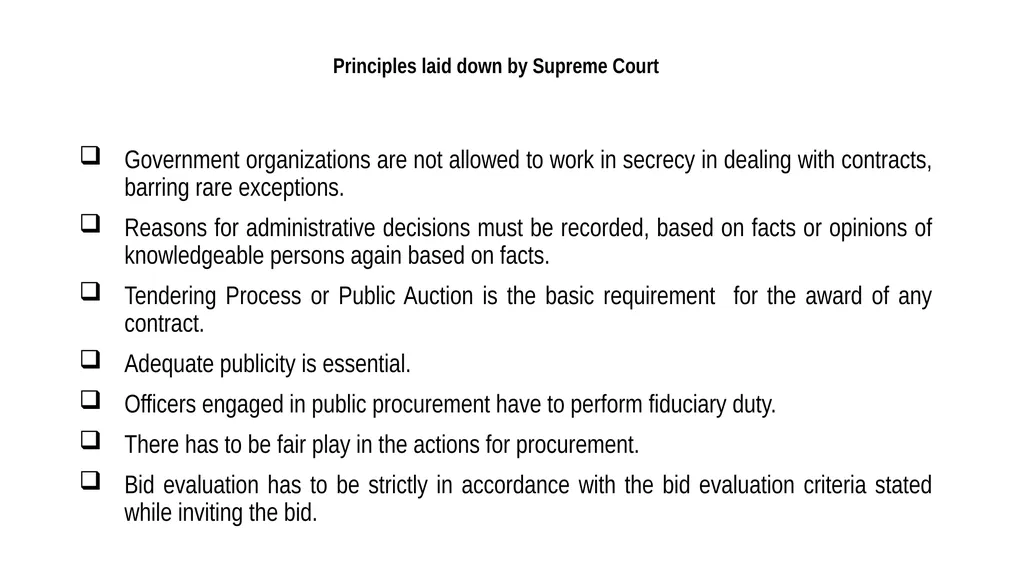
Principles laid down by Supreme Court Government organizations are not allowed to work in secrecy in dealing with contracts, barring rare exceptions.
Reasons for administrative decisions must be recorded, based on facts or opinions of knowledgeable persons again based on facts.
Tendering Process or Public Auction is the basic requirement for the award of any contract.
Adequate publicity is essential.
Officers engaged in public procurement have to perform fiduciary duty.
There has to be fair play in the actions for procurement.
Bid evaluation has to be strictly in accordance with the bid evaluation criteria stated while inviting the bid.<br>
Reasons for administrative decisions must be recorded, based on facts or opinions of knowledgeable persons again based on facts.
Tendering Process or Public Auction is the basic requirement for the award of any contract.
Adequate publicity is essential.
Officers engaged in public procurement have to perform fiduciary duty.
There has to be fair play in the actions for procurement.
Bid evaluation has to be strictly in accordance with the bid evaluation criteria stated while inviting the bid.<br>
07
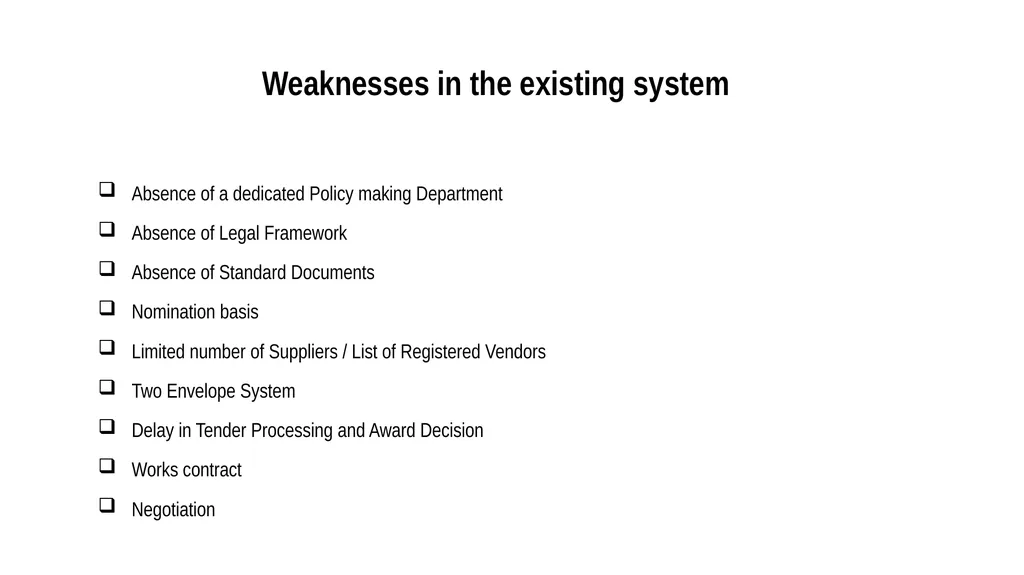
Weaknesses in the existing system Absence of a dedicated Policy making Department
Absence of Legal Framework
Absence of Standard Documents
Nomination basis
Limited number of Suppliers / List of Registered Vendors
Two Envelope System
Delay in Tender Processing and Award Decision
Works contract
Negotiation<br>
Absence of Legal Framework
Absence of Standard Documents
Nomination basis
Limited number of Suppliers / List of Registered Vendors
Two Envelope System
Delay in Tender Processing and Award Decision
Works contract
Negotiation<br>
08
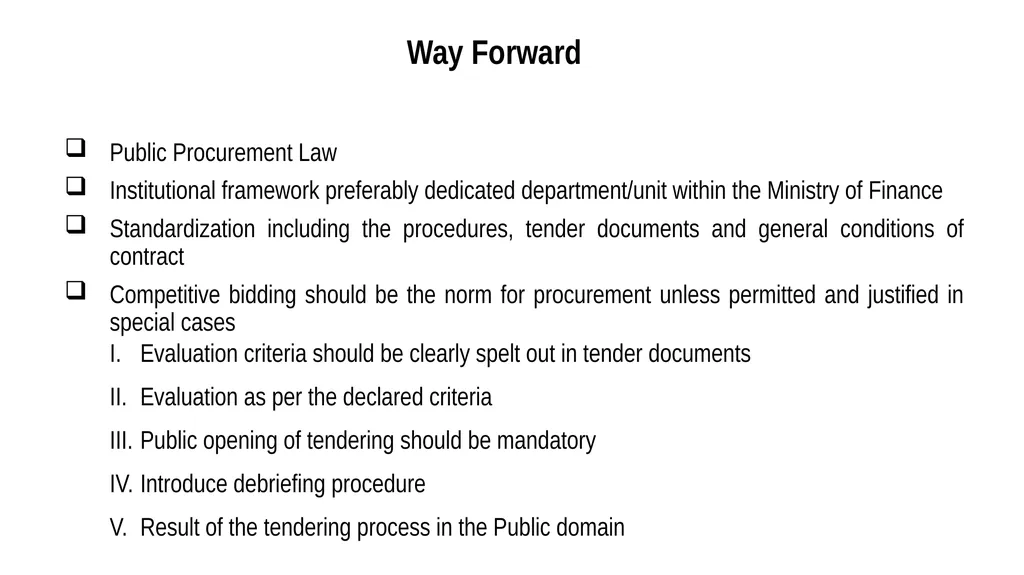
Way Forward Public Procurement Law
Institutional framework preferably dedicated department/unit within the Ministry of Finance
Standardization including the procedures, tender documents and general conditions of contract
Competitive bidding should be the norm for procurement unless permitted and justified in special cases
Evaluation criteria should be clearly spelt out in tender documents
Evaluation as per the declared criteria
Public opening of tendering should be mandatory
Introduce debriefing procedure
Result of the tendering process in the Public domain<br>
Institutional framework preferably dedicated department/unit within the Ministry of Finance
Standardization including the procedures, tender documents and general conditions of contract
Competitive bidding should be the norm for procurement unless permitted and justified in special cases
Evaluation criteria should be clearly spelt out in tender documents
Evaluation as per the declared criteria
Public opening of tendering should be mandatory
Introduce debriefing procedure
Result of the tendering process in the Public domain<br>
09
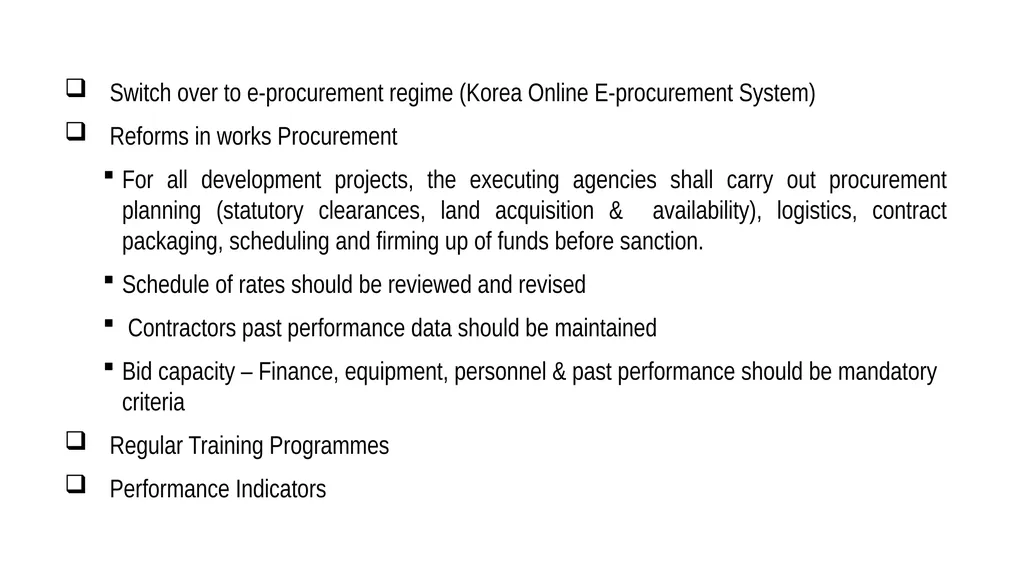
Switch over to e-procurement regime (Korea Online E-procurement System)
Reforms in works Procurement
For all development projects, the executing agencies shall carry out procurement planning (statutory clearances, land acquisition & availability), logistics, contract packaging, scheduling and firming up of funds before sanction.
Schedule of rates should be reviewed and revised
Contractors past performance data should be maintained
Bid capacity – Finance, equipment, personnel & past performance should be mandatory criteria
Regular Training Programmes
Performance Indicators<br>
Reforms in works Procurement
For all development projects, the executing agencies shall carry out procurement planning (statutory clearances, land acquisition & availability), logistics, contract packaging, scheduling and firming up of funds before sanction.
Schedule of rates should be reviewed and revised
Contractors past performance data should be maintained
Bid capacity – Finance, equipment, personnel & past performance should be mandatory criteria
Regular Training Programmes
Performance Indicators<br>
10
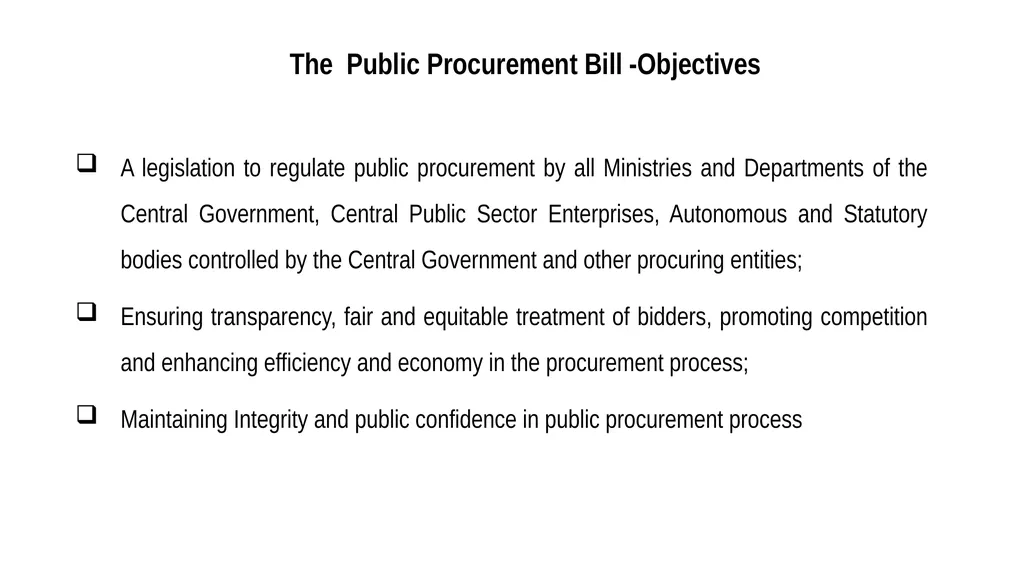
The Public Procurement Bill -Objectives A legislation to regulate public procurement by all Ministries and Departments of the Central Government, Central Public Sector Enterprises, Autonomous and Statutory bodies controlled by the Central Government and other procuring entities;
Ensuring transparency, fair and equitable treatment of bidders, promoting competition and enhancing efficiency and economy in the procurement process;
Maintaining Integrity and public confidence in public procurement process<br>
Ensuring transparency, fair and equitable treatment of bidders, promoting competition and enhancing efficiency and economy in the procurement process;
Maintaining Integrity and public confidence in public procurement process<br>
11
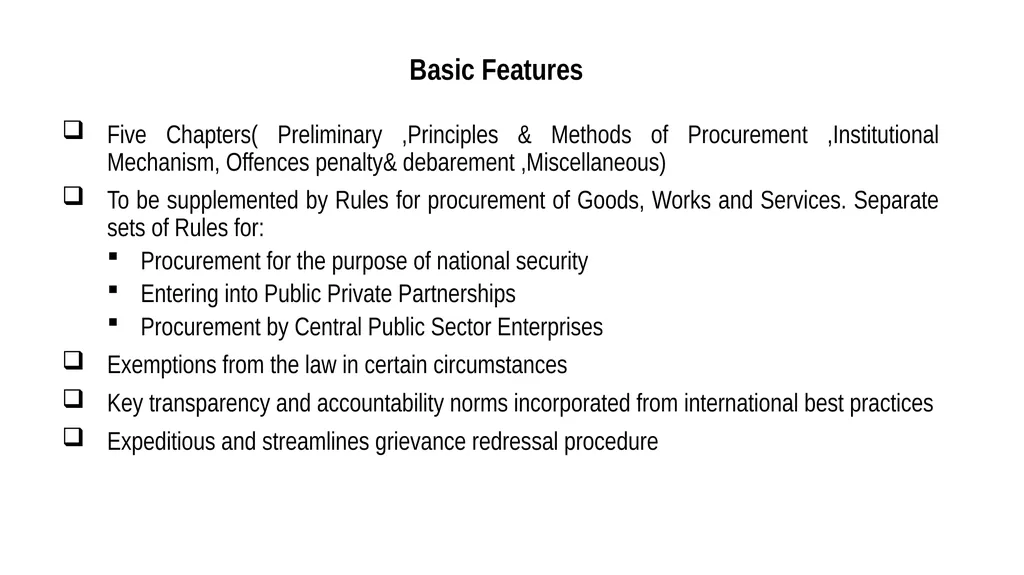
Basic Features Five Chapters( Preliminary ,Principles & Methods of Procurement ,Institutional Mechanism, Offences penalty& debarement ,Miscellaneous)
To be supplemented by Rules for procurement of Goods, Works and Services. Separate sets of Rules for:
Procurement for the purpose of national security
Entering into Public Private Partnerships
Procurement by Central Public Sector Enterprises
Exemptions from the law in certain circumstances
Key transparency and accountability norms incorporated from international best practices
Expeditious and streamlines grievance redressal procedure<br>
To be supplemented by Rules for procurement of Goods, Works and Services. Separate sets of Rules for:
Procurement for the purpose of national security
Entering into Public Private Partnerships
Procurement by Central Public Sector Enterprises
Exemptions from the law in certain circumstances
Key transparency and accountability norms incorporated from international best practices
Expeditious and streamlines grievance redressal procedure<br>
12
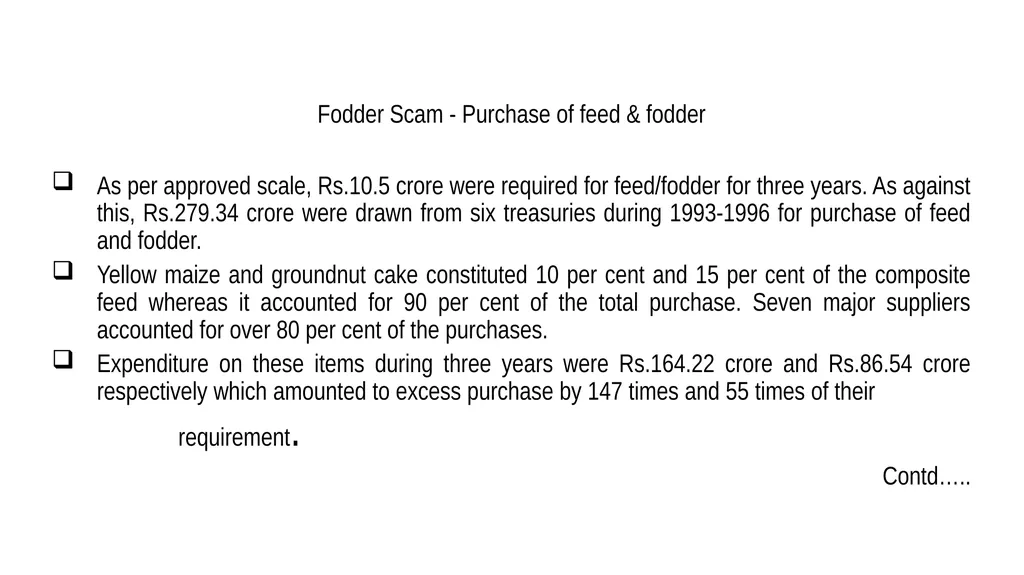
Fodder Scam - Purchase of feed & fodder As per approved scale, Rs.10.5 crore were required for feed/fodder for three years. As against this, Rs.279.34 crore were drawn from six treasuries during 1993-1996 for purchase of feed and fodder.
Yellow maize and groundnut cake constituted 10 per cent and 15 per cent of the composite feed whereas it accounted for 90 per cent of the total purchase. Seven major suppliers accounted for over 80 per cent of the purchases.
Expenditure on these items during three years were Rs.164.22 crore and Rs.86.54 crore respectively which amounted to excess purchase by 147 times and 55 times of their requirement.
Contd…..<br>
Yellow maize and groundnut cake constituted 10 per cent and 15 per cent of the composite feed whereas it accounted for 90 per cent of the total purchase. Seven major suppliers accounted for over 80 per cent of the purchases.
Expenditure on these items during three years were Rs.164.22 crore and Rs.86.54 crore respectively which amounted to excess purchase by 147 times and 55 times of their requirement.
Contd…..<br>
13
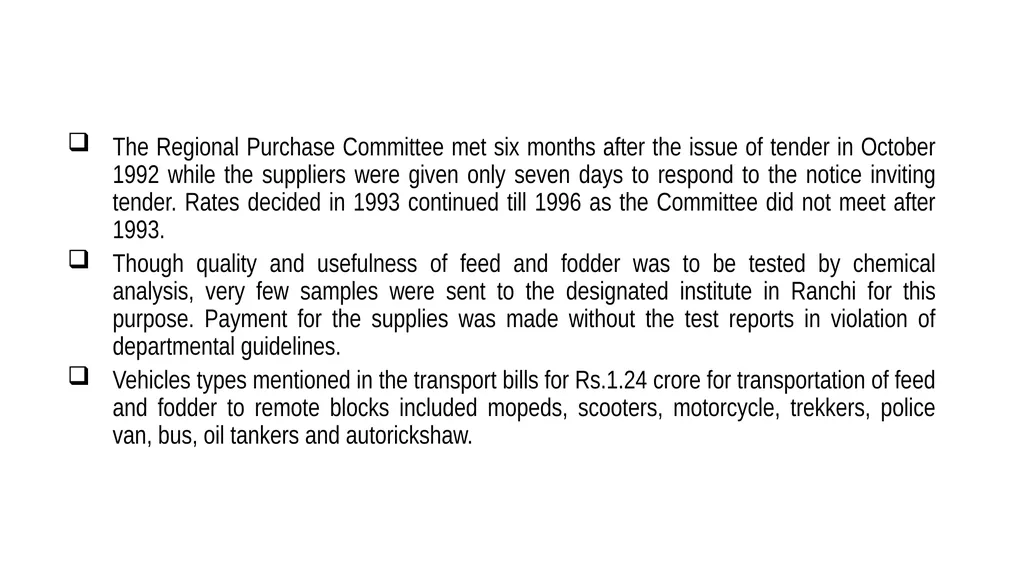
The Regional Purchase Committee met six months after the issue of tender in October 1992 while the suppliers were given only seven days to respond to the notice inviting tender. Rates decided in 1993 continued till 1996 as the Committee did not meet after 1993.
Though quality and usefulness of feed and fodder was to be tested by chemical analysis, very few samples were sent to the designated institute in Ranchi for this purpose. Payment for the supplies was made without the test reports in violation of departmental guidelines.
Vehicles types mentioned in the transport bills for Rs.1.24 crore for transportation of feed and fodder to remote blocks included mopeds, scooters, motorcycle, trekkers, police van, bus, oil tankers and autorickshaw.<br>
Though quality and usefulness of feed and fodder was to be tested by chemical analysis, very few samples were sent to the designated institute in Ranchi for this purpose. Payment for the supplies was made without the test reports in violation of departmental guidelines.
Vehicles types mentioned in the transport bills for Rs.1.24 crore for transportation of feed and fodder to remote blocks included mopeds, scooters, motorcycle, trekkers, police van, bus, oil tankers and autorickshaw.<br>
14
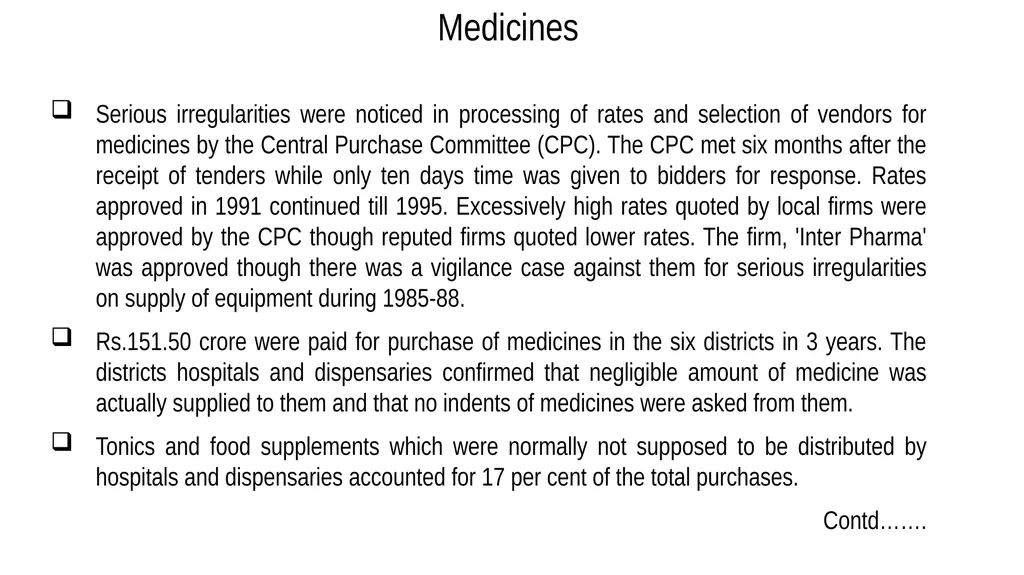
Medicines Serious irregularities were noticed in processing of rates and selection of vendors for medicines by the Central Purchase Committee (CPC). The CPC met six months after the receipt of tenders while only ten days time was given to bidders for response. Rates approved in 1991 continued till 1995. Excessively high rates quoted by local firms were approved by the CPC though reputed firms quoted lower rates. The firm, 'Inter Pharma' was approved though there was a vigilance case against them for serious irregularities on supply of equipment during 1985-88.
Rs.151.50 crore were paid for purchase of medicines in the six districts in 3 years. The districts hospitals and dispensaries confirmed that negligible amount of medicine was actually supplied to them and that no indents of medicines were asked from them.
Tonics and food supplements which were normally not supposed to be distributed by hospitals and dispensaries accounted for 17 per cent of the total purchases.
Contd…….<br>
Rs.151.50 crore were paid for purchase of medicines in the six districts in 3 years. The districts hospitals and dispensaries confirmed that negligible amount of medicine was actually supplied to them and that no indents of medicines were asked from them.
Tonics and food supplements which were normally not supposed to be distributed by hospitals and dispensaries accounted for 17 per cent of the total purchases.
Contd…….<br>
15
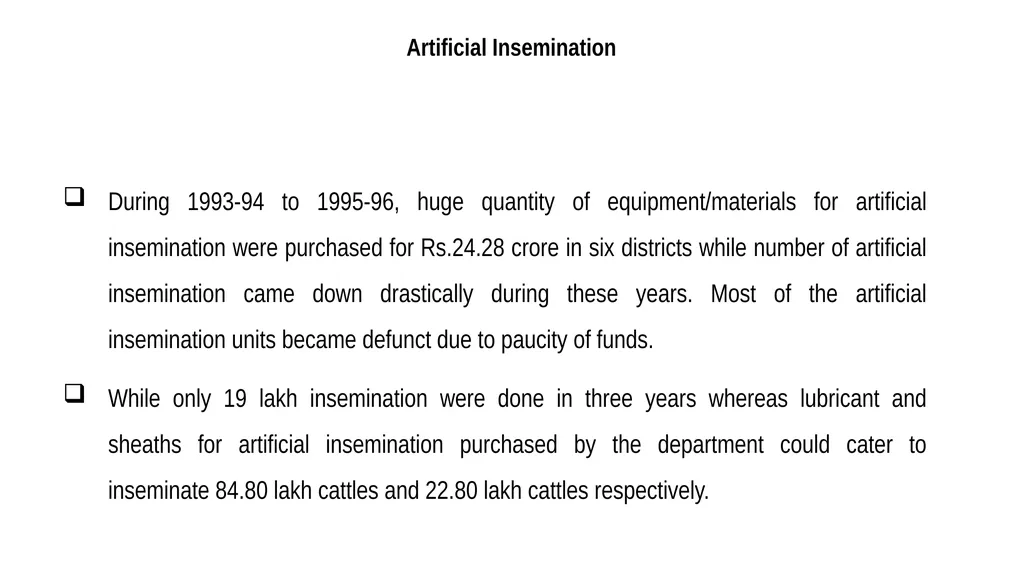
Artificial Insemination During 1993-94 to 1995-96, huge quantity of equipment/materials for artificial insemination were purchased for Rs.24.28 crore in six districts while number of artificial insemination came down drastically during these years. Most of the artificial insemination units became defunct due to paucity of funds.
While only 19 lakh insemination were done in three years whereas lubricant and sheaths for artificial insemination purchased by the department could cater to inseminate 84.80 lakh cattles and 22.80 lakh cattles respectively.<br>
While only 19 lakh insemination were done in three years whereas lubricant and sheaths for artificial insemination purchased by the department could cater to inseminate 84.80 lakh cattles and 22.80 lakh cattles respectively.<br>
16
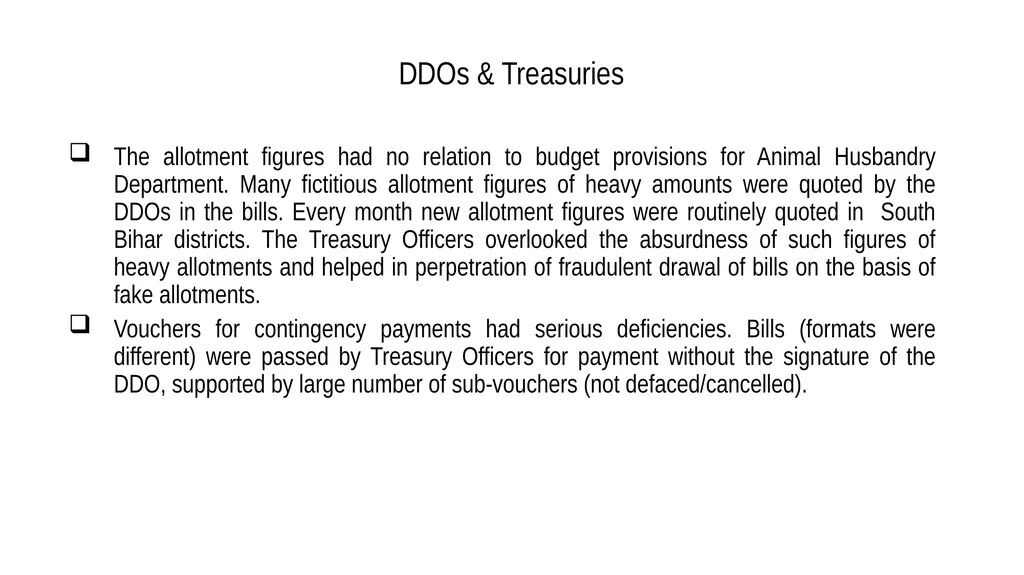
DDOs & Treasuries The allotment figures had no relation to budget provisions for Animal Husbandry Department. Many fictitious allotment figures of heavy amounts were quoted by the DDOs in the bills. Every month new allotment figures were routinely quoted in South Bihar districts. The Treasury Officers overlooked the absurdness of such figures of heavy allotments and helped in perpetration of fraudulent drawal of bills on the basis of fake allotments.
Vouchers for contingency payments had serious deficiencies. Bills (formats were different) were passed by Treasury Officers for payment without the signature of the DDO, supported by large number of sub-vouchers (not defaced/cancelled).<br>
Vouchers for contingency payments had serious deficiencies. Bills (formats were different) were passed by Treasury Officers for payment without the signature of the DDO, supported by large number of sub-vouchers (not defaced/cancelled).<br>
17
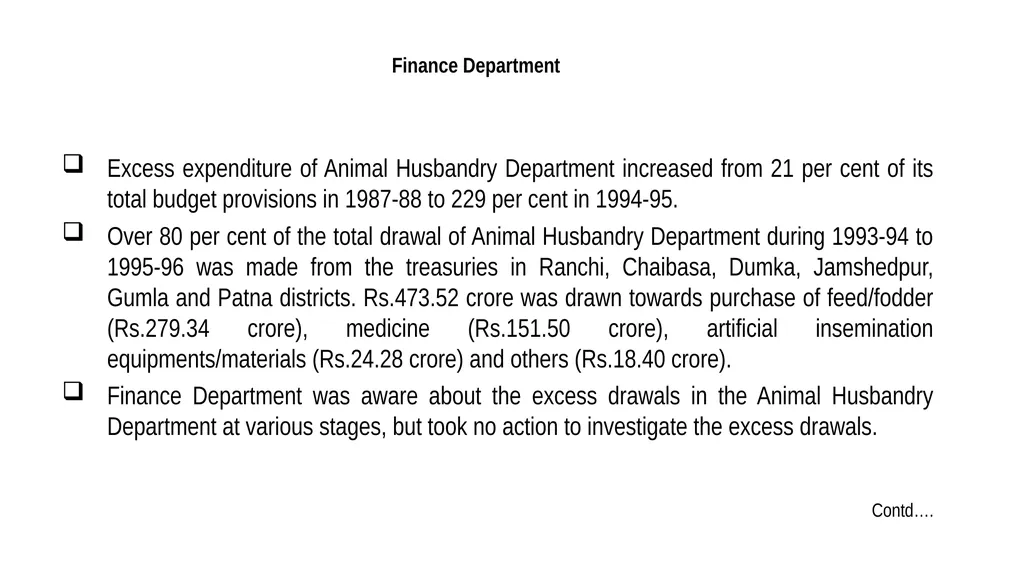
Finance Department Excess expenditure of Animal Husbandry Department increased from 21 per cent of its total budget provisions in 1987-88 to 229 per cent in 1994-95.
Over 80 per cent of the total drawal of Animal Husbandry Department during 1993-94 to 1995-96 was made from the treasuries in Ranchi, Chaibasa, Dumka, Jamshedpur, Gumla and Patna districts. Rs.473.52 crore was drawn towards purchase of feed/fodder (Rs.279.34 crore), medicine (Rs.151.50 crore), artificial insemination equipments/materials (Rs.24.28 crore) and others (Rs.18.40 crore).
Finance Department was aware about the excess drawals in the Animal Husbandry Department at various stages, but took no action to investigate the excess drawals.
Contd….<br>
Over 80 per cent of the total drawal of Animal Husbandry Department during 1993-94 to 1995-96 was made from the treasuries in Ranchi, Chaibasa, Dumka, Jamshedpur, Gumla and Patna districts. Rs.473.52 crore was drawn towards purchase of feed/fodder (Rs.279.34 crore), medicine (Rs.151.50 crore), artificial insemination equipments/materials (Rs.24.28 crore) and others (Rs.18.40 crore).
Finance Department was aware about the excess drawals in the Animal Husbandry Department at various stages, but took no action to investigate the excess drawals.
Contd….<br>
18
During 1993-94, the Finance Department banned payment for three schemes of Animal Husbandry Department. Finance Department issued clarifications to the Doranda and Ranchi Treasury Officers to make payment of bills of all items relating to the animals of Animal Husbandry Department up to 16 per cent of Annual Budget Provision even while the ban imposed by them continued.
On 18.2.94, the Chief Secretaries observed heavy drawals from the treasuries and instructed the Finance Commissioner to enquire on test basis within two days, two or three major Treasuries to ascertain the cause of heavy drawal. There was no evidence to show that such an inquiry of drawals from Treasuries was made.
Reserve Bank of India, Nagpur sends monthly statement to Finance Department showing the disbursements through each treasury which were not analysed in Finance Department to ascertain the reasons of heavy cash outgo from certain treasuries.<br>
On 18.2.94, the Chief Secretaries observed heavy drawals from the treasuries and instructed the Finance Commissioner to enquire on test basis within two days, two or three major Treasuries to ascertain the cause of heavy drawal. There was no evidence to show that such an inquiry of drawals from Treasuries was made.
Reserve Bank of India, Nagpur sends monthly statement to Finance Department showing the disbursements through each treasury which were not analysed in Finance Department to ascertain the reasons of heavy cash outgo from certain treasuries.<br>
19
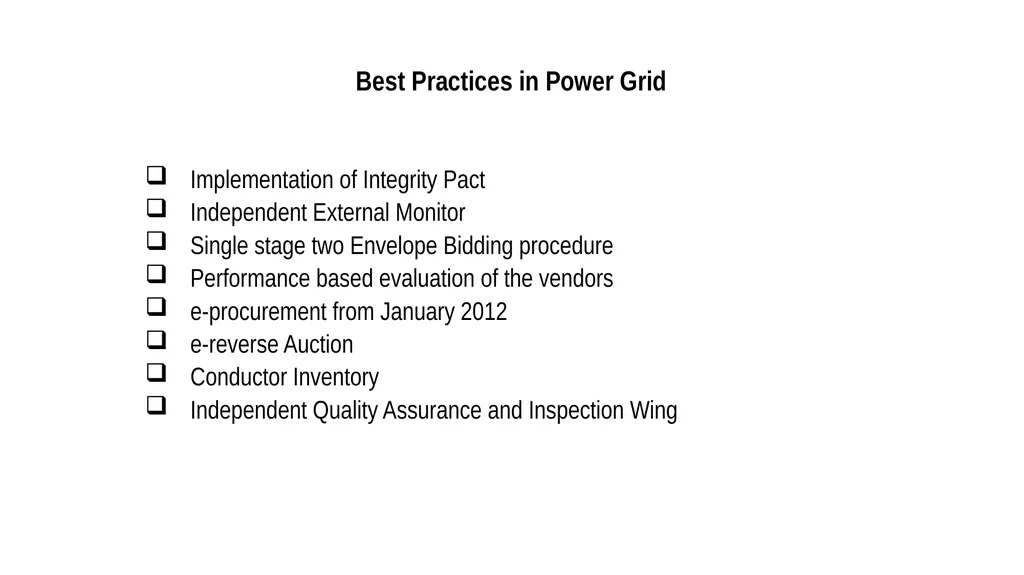
Best Practices in Power Grid Implementation of Integrity Pact
Independent External Monitor
Single stage two Envelope Bidding procedure
Performance based evaluation of the vendors
e-procurement from January 2012
e-reverse Auction
Conductor Inventory
Independent Quality Assurance and Inspection Wing<br>
Independent External Monitor
Single stage two Envelope Bidding procedure
Performance based evaluation of the vendors
e-procurement from January 2012
e-reverse Auction
Conductor Inventory
Independent Quality Assurance and Inspection Wing<br>
20
21<br>