
Public sector integrity framework A framework to

Description: Public sector integrity framework A framework to show how we can and why we should act with integrity in the Victorian public sector How we define integrity Integrity in the public sector is about doing the right thing. This means
Related Topics
Download Presentation
"Public sector integrity framework A framework to" is the property of its rightful owner. Permission is granted to download and print the materials on this website for personal, non-commercial use only, and to display it on your personal computer provided you do not modify the materials and that you retain all copyright notices contained in the materials. By downloading content from our website, you accept the terms of this agreement.
Presentation Transcript
slide1. Public sector integrity framework A framework to show how we can and why we should
act with integrity in the Victorian public sector<br>
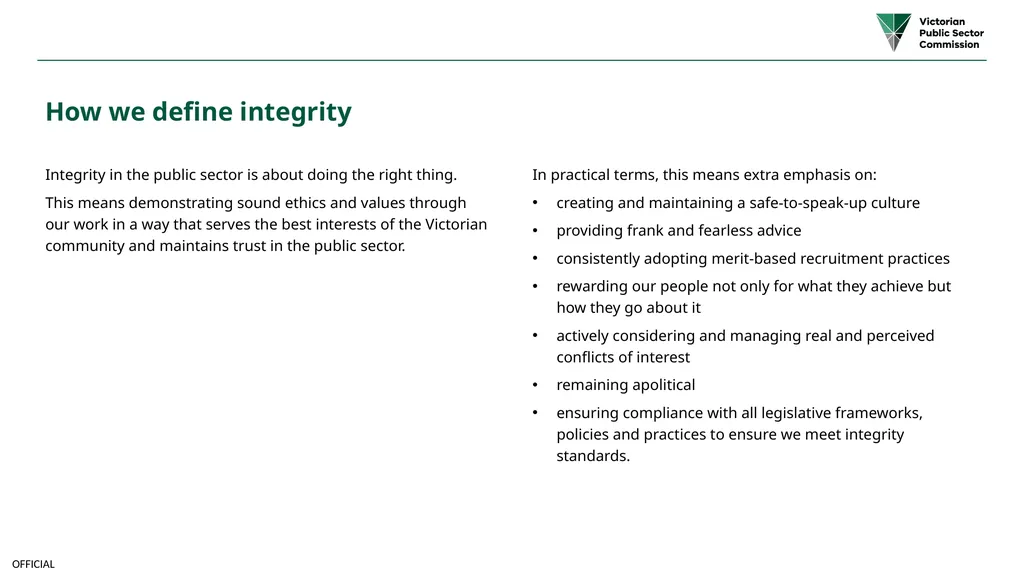
slide2. How we define integrity Integrity in the public sector is about doing the right thing.
This means demonstrating sound ethics and values through our work in a way that serves the best interests of the Victorian community and maintains trust in the public sector. In practical terms, this means extra emphasis on:
creating and maintaining a safe-to-speak-up culture
providing frank and fearless advice
consistently adopting merit-based recruitment practices
rewarding our people not only for what they achieve but how they go about it
actively considering and managing real and perceived conflicts of interest
remaining apolitical
ensuring compliance with all legislative frameworks, policies and practices to ensure we meet integrity standards.<br>
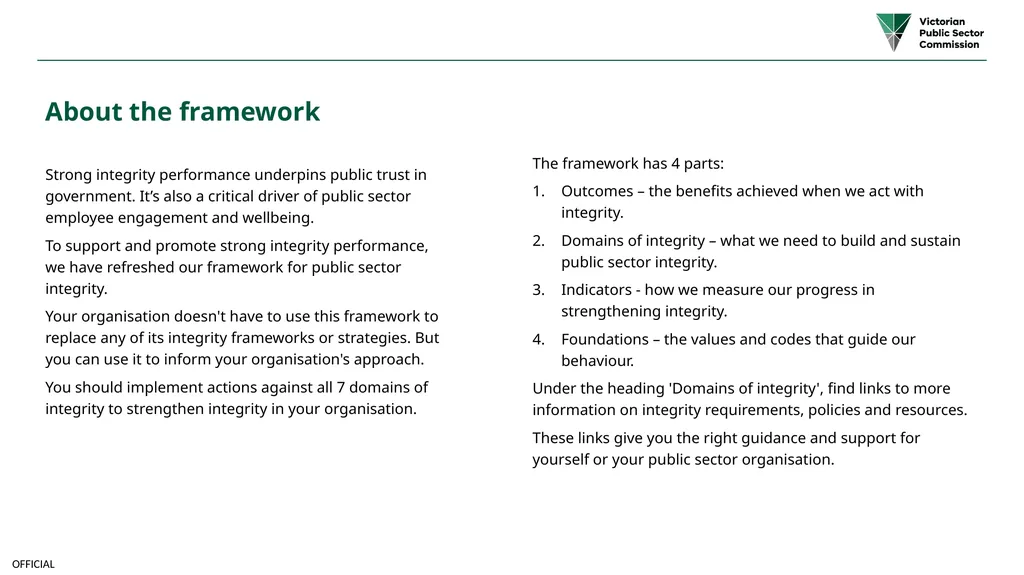
slide3. About the framework Strong integrity performance underpins public trust in government. It’s also a critical driver of public sector employee engagement and wellbeing.
To support and promote strong integrity performance, we have refreshed our framework for public sector integrity.
Your organisation doesn't have to use this framework to replace any of its integrity frameworks or strategies. But you can use it to inform your organisation's approach.
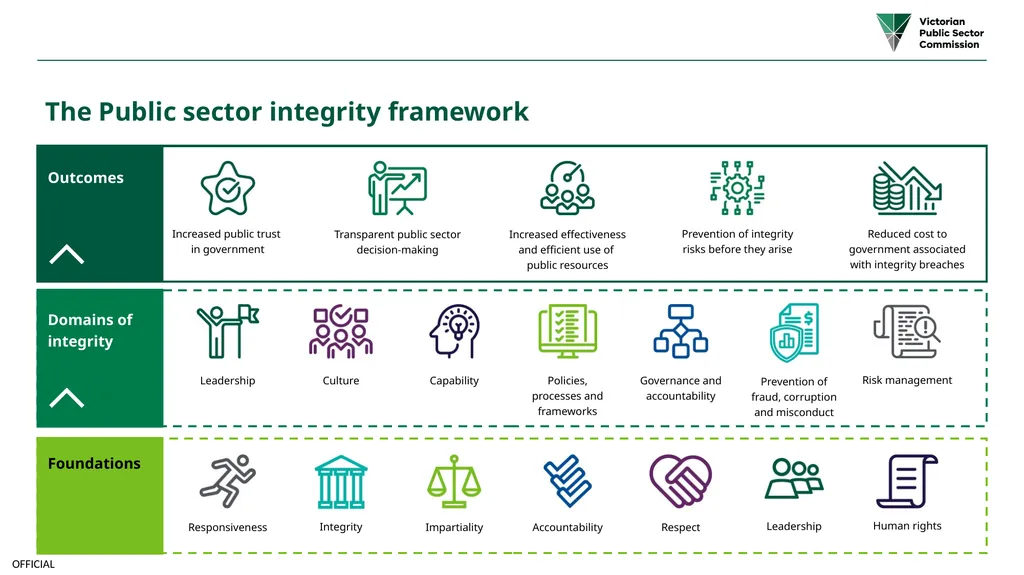
You should implement actions against all 7 domains of integrity to strengthen integrity in your organisation. The framework has 4 parts:
Outcomes – the benefits achieved when we act with integrity.
Domains of integrity – what we need to build and sustain public sector integrity.
Indicators - how we measure our progress in strengthening integrity.
Foundations – the values and codes that guide our behaviour.
Under the heading 'Domains of integrity', find links to more information on integrity requirements, policies and resources.
These links give you the right guidance and support for yourself or your public sector organisation.<br>
slide4. The Public sector integrity framework Outcomes Increased public trust in government Transparent public sector decision-making Increased effectiveness and efficient use of public resources Prevention of integrity risks before they arise Reduced cost to government associated with integrity breaches Domains of integrity Leadership Culture Capability Policies, processes and frameworks Governance and accountability Prevention of fraud, corruption and misconduct Risk management Foundations Responsiveness Integrity Impartiality Accountability Respect Leadership Human rights<br>
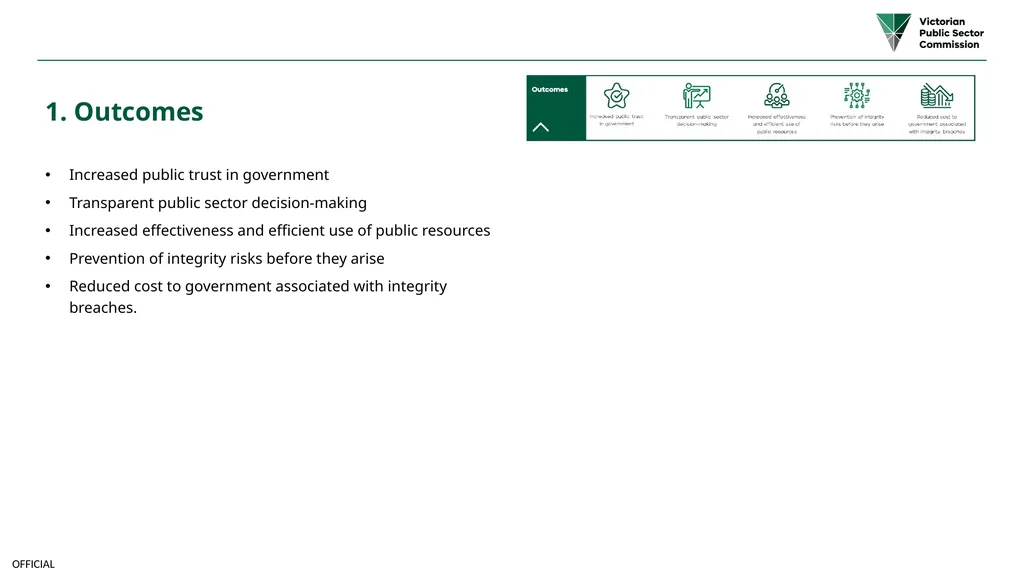
slide5. 1. Outcomes Increased public trust in government
Transparent public sector decision-making
Increased effectiveness and efficient use of public resources
Prevention of integrity risks before they arise
Reduced cost to government associated with integrity breaches.<br>
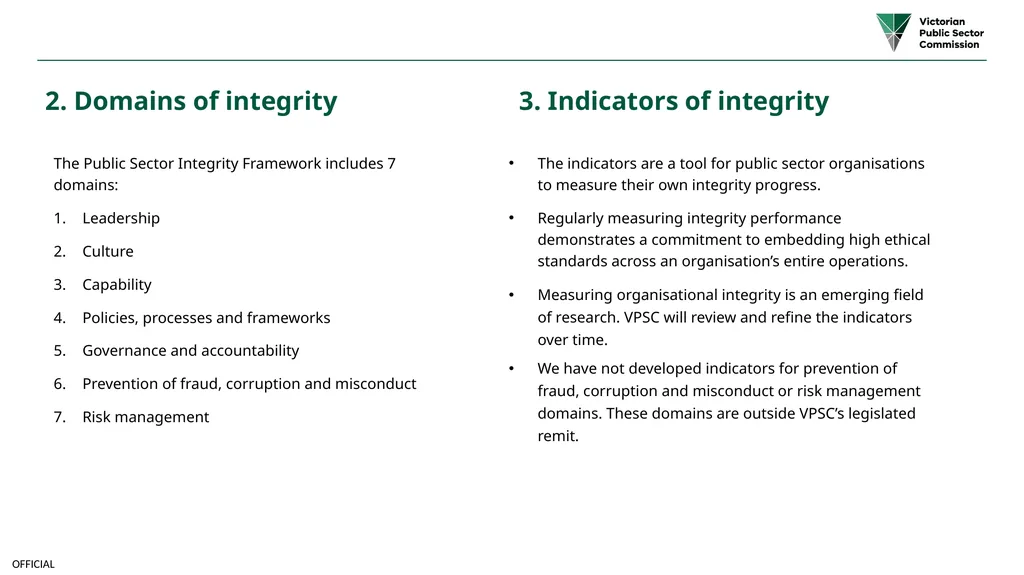
slide6. The Public Sector Integrity Framework includes 7 domains:
Leadership
Culture
Capability
Policies, processes and frameworks
Governance and accountability
Prevention of fraud, corruption and misconduct
Risk management 2. Domains of integrity – Leadership and Culture 3. Indicators of integrity – Leadership and Culture The indicators are a tool for public sector organisations to measure their own integrity progress.
Regularly measuring integrity performance demonstrates a commitment to embedding high ethical standards across an organisation’s entire operations.
Measuring organisational integrity is an emerging field of research. VPSC will review and refine the indicators over time.
We have not developed indicators for prevention of fraud, corruption and misconduct or risk management domains. These domains are outside VPSC’s legislated remit.<br>
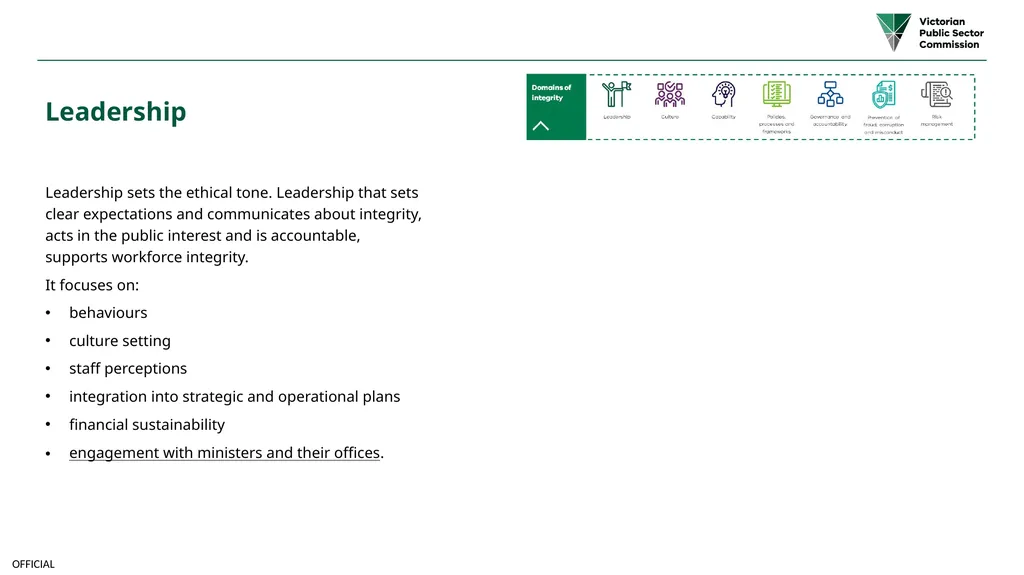
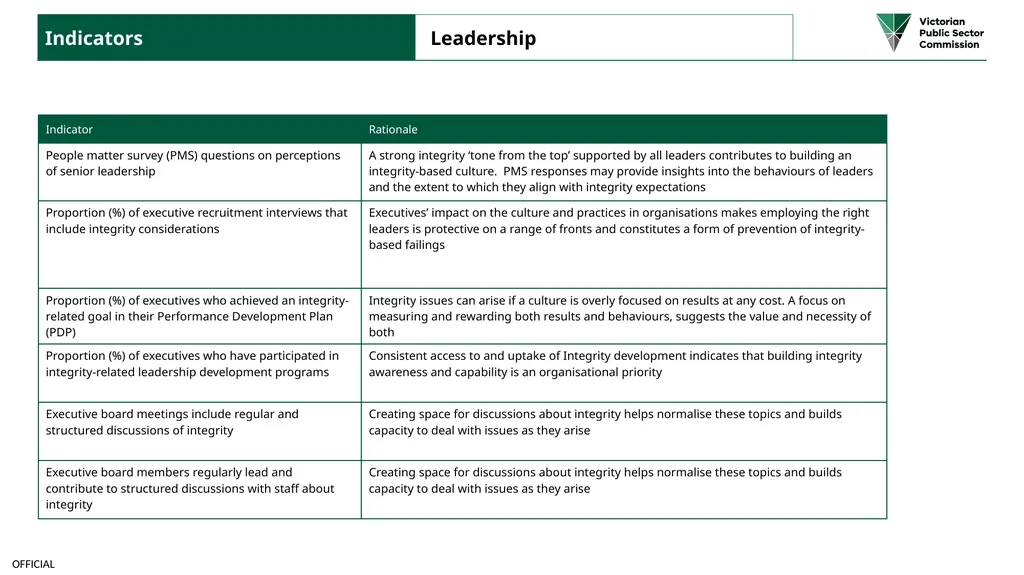
slide7. Leadership– Leadership and Culture Leadership sets the ethical tone. Leadership that sets clear expectations and communicates about integrity, acts in the public interest and is accountable, supports workforce integrity.
It focuses on:
behaviours
culture setting
staff perceptions
integration into strategic and operational plans
financial sustainability
engagement with ministers and their offices.<br>
slide8. Indicators Leadership<br>
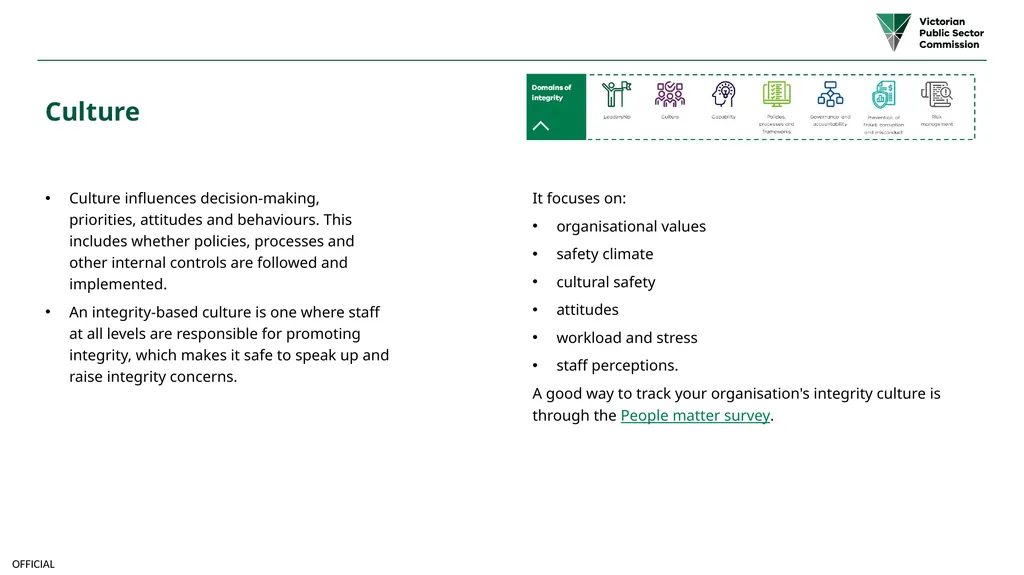
slide9. Culture– Leadership and Culture Culture influences decision-making, priorities, attitudes and behaviours. This includes whether policies, processes and other internal controls are followed and implemented.
An integrity-based culture is one where staff at all levels are responsible for promoting integrity, which makes it safe to speak up and raise integrity concerns. It focuses on:
organisational values
safety climate
cultural safety
attitudes
workload and stress
staff perceptions.
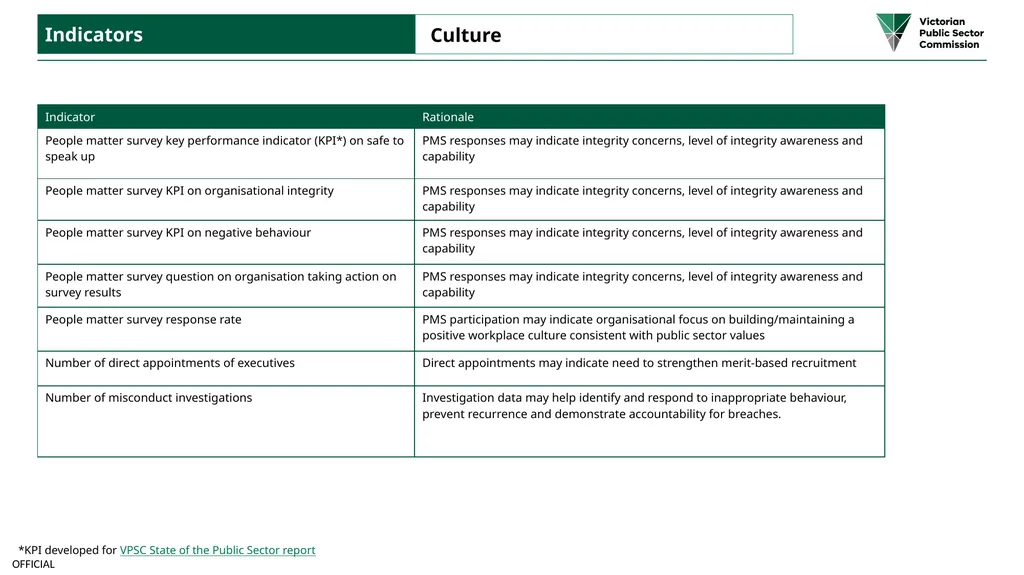
A good way to track your organisation's integrity culture is through the People matter survey.<br>
slide10. *KPI developed for VPSC State of the Public Sector report Indicators Culture<br>
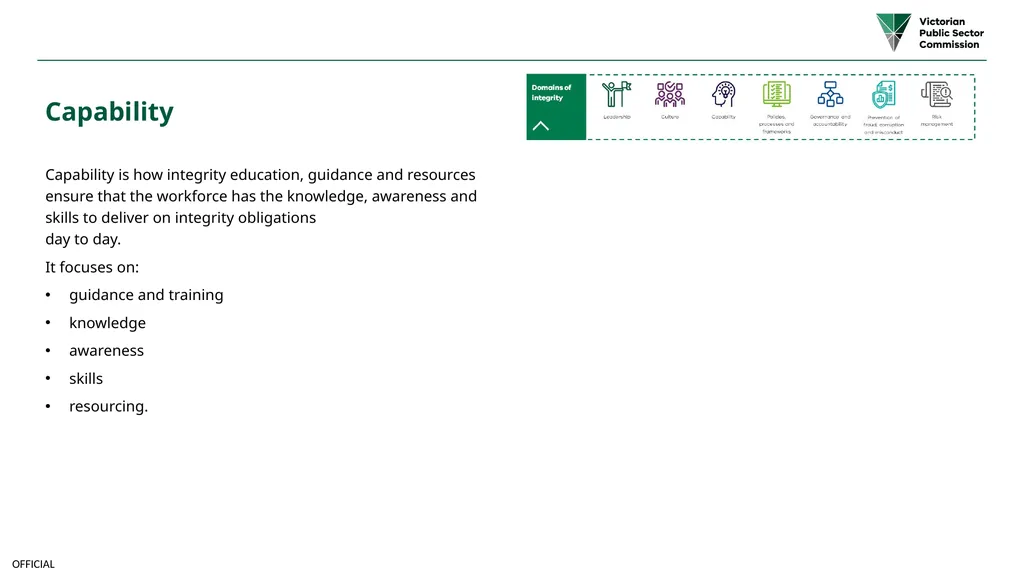
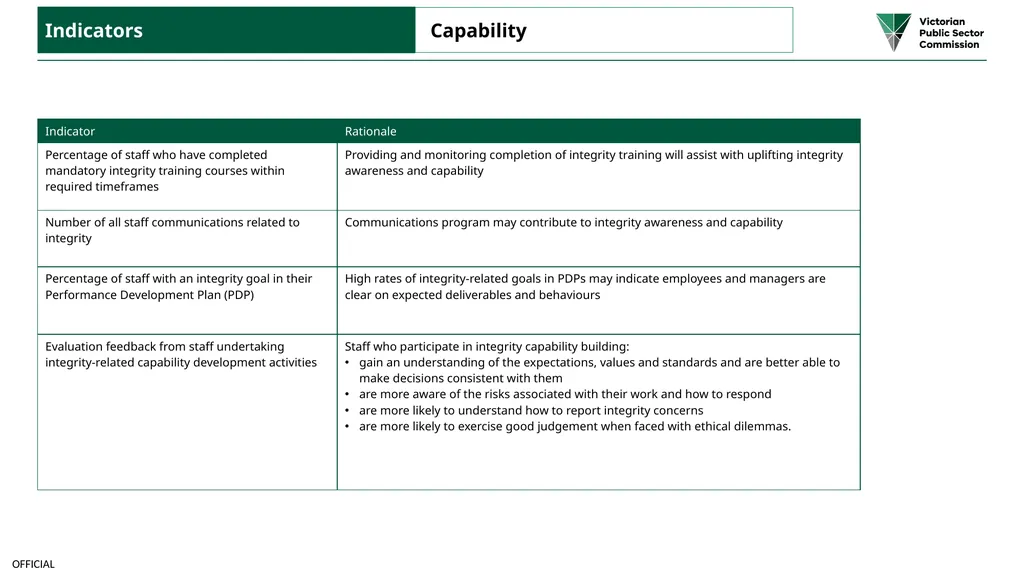
slide11. Capability Capability is how integrity education, guidance and resources ensure that the workforce has the knowledge, awareness and skills to deliver on integrity obligations day to day.
It focuses on:
guidance and training
knowledge
awareness
skills
resourcing.<br>
slide12. Indicators Capability<br>
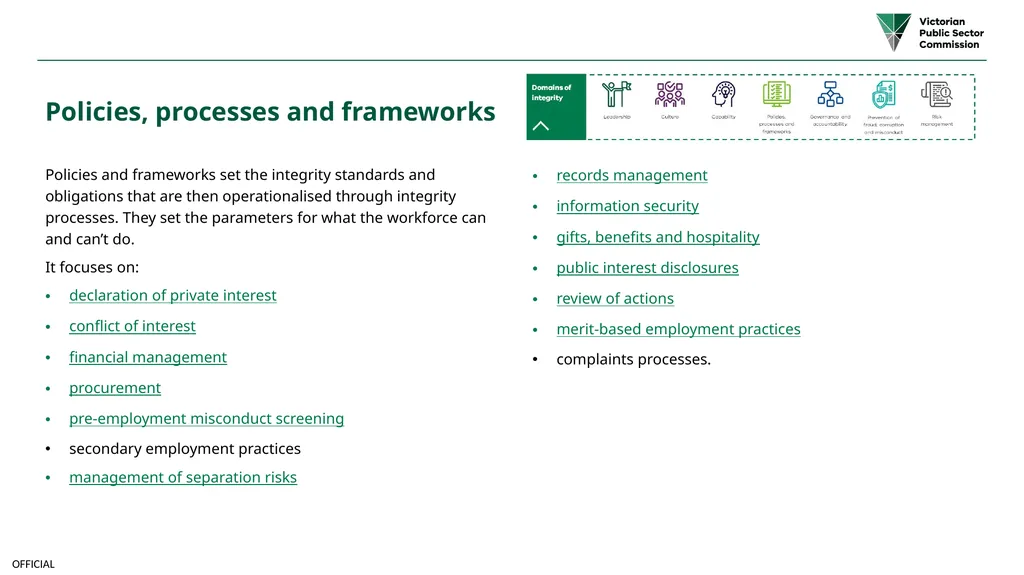
slide13. Policies, processes and frameworks- Policies, processes and frameworks Policies and frameworks set the integrity standards and obligations that are then operationalised through integrity processes. They set the parameters for what the workforce can and can’t do.
It focuses on:
declaration of private interest
conflict of interest
financial management
procurement
pre-employment misconduct screening
secondary employment practices
management of separation risks records management
information security
gifts, benefits and hospitality
public interest disclosures
review of actions
merit-based employment practices
complaints processes.<br>
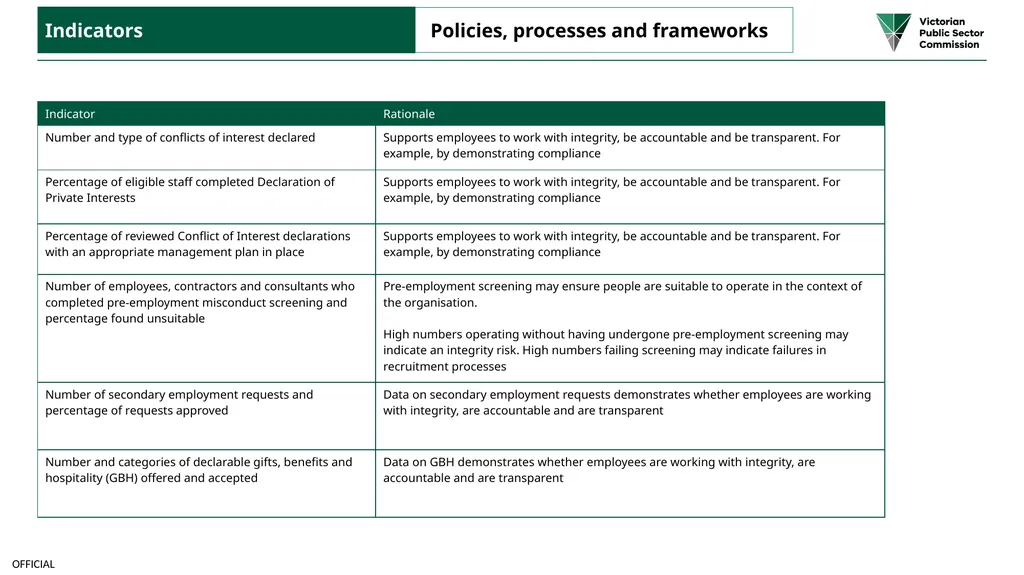
slide14. Indicators Policies, processes and frameworks<br>
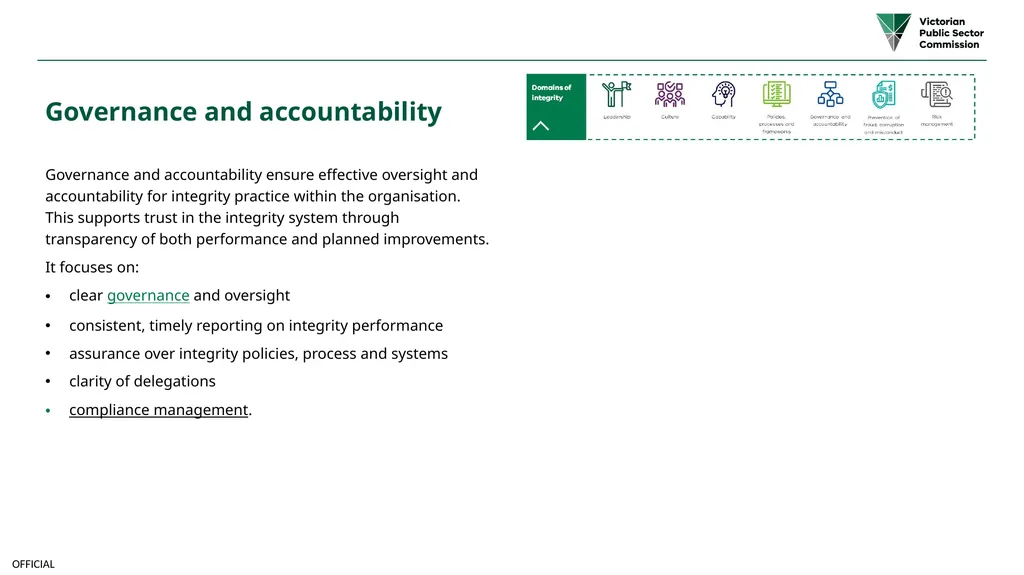
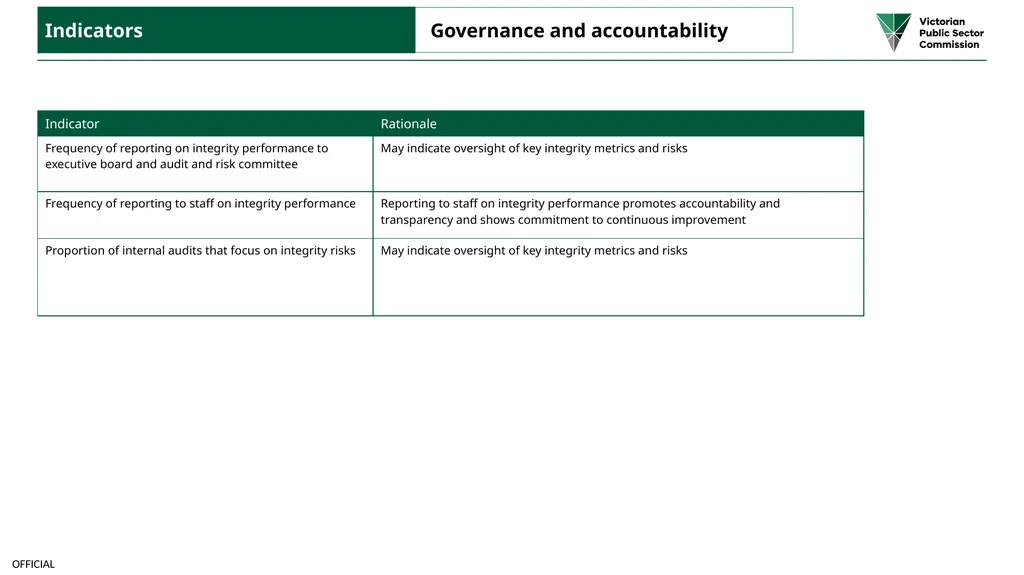
slide15. Governance and accountability accountability, Prevention of fraud Governance and accountability ensure effective oversight and accountability for integrity practice within the organisation. This supports trust in the integrity system through transparency of both performance and planned improvements.
It focuses on:
clear governance and oversight
consistent, timely reporting on integrity performance
assurance over integrity policies, process and systems
clarity of delegations
compliance management.<br>
slide16. Indicators Governance and accountability<br>
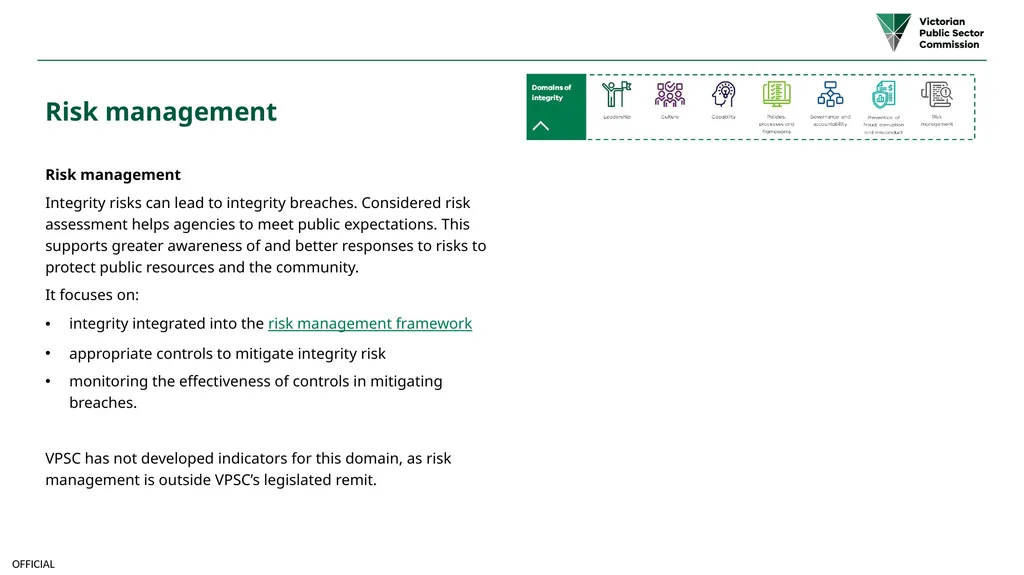
slide17. Risk management– Risk management Risk management
Integrity risks can lead to integrity breaches. Considered risk assessment helps agencies to meet public expectations. This supports greater awareness of and better responses to risks to protect public resources and the community.
It focuses on:
integrity integrated into the risk management framework
appropriate controls to mitigate integrity risk
monitoring the effectiveness of controls in mitigating breaches.
VPSC has not developed indicators for this domain, as risk management is outside VPSC’s legislated remit.<br>
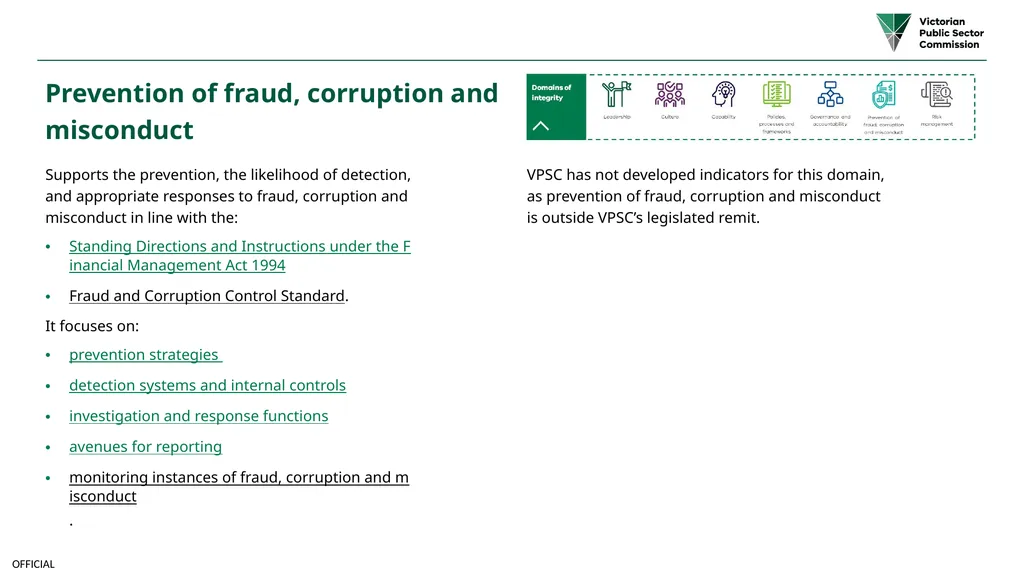
slide18. Prevention of fraud, corruption and misconduct, Prevention of fraud Supports the prevention, the likelihood of detection, and appropriate responses to fraud, corruption and misconduct in line with the:
Standing Directions and Instructions under the Financial Management Act 1994
Fraud and Corruption Control Standard.
It focuses on:
prevention strategies
detection systems and internal controls
investigation and response functions
avenues for reporting
monitoring instances of fraud, corruption and misconduct. VPSC has not developed indicators for this domain, as prevention of fraud, corruption and misconduct is outside VPSC’s legislated remit.<br>
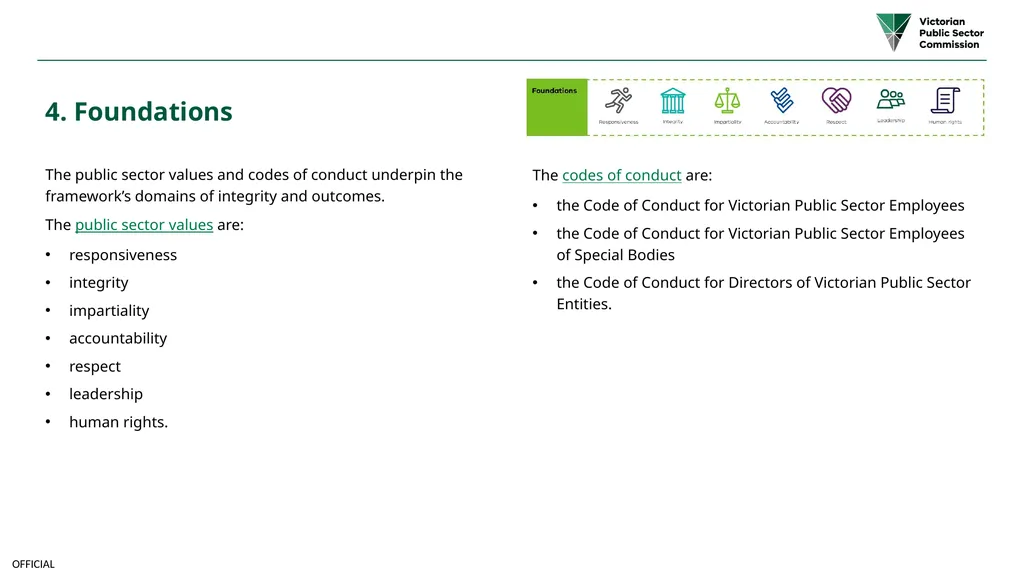
slide19. 4. Foundations The public sector values and codes of conduct underpin the framework’s domains of integrity and outcomes.
The public sector values are:
responsiveness
integrity
impartiality
accountability
respect
leadership
human rights. The codes of conduct are:
the Code of Conduct for Victorian Public Sector Employees
the Code of Conduct for Victorian Public Sector Employees of Special Bodies
the Code of Conduct for Directors of Victorian Public Sector Entities.<br>
slide20. End of presentation<br>
slide2. How we define integrity Integrity in the public sector is about doing the right thing.
This means demonstrating sound ethics and values through our work in a way that serves the best interests of the Victorian community and maintains trust in the public sector. In practical terms, this means extra emphasis on:
creating and maintaining a safe-to-speak-up culture
providing frank and fearless advice
consistently adopting merit-based recruitment practices
rewarding our people not only for what they achieve but how they go about it
actively considering and managing real and perceived conflicts of interest
remaining apolitical
ensuring compliance with all legislative frameworks, policies and practices to ensure we meet integrity standards.<br>
slide3. About the framework Strong integrity performance underpins public trust in government. It’s also a critical driver of public sector employee engagement and wellbeing.
To support and promote strong integrity performance, we have refreshed our framework for public sector integrity.
Your organisation doesn't have to use this framework to replace any of its integrity frameworks or strategies. But you can use it to inform your organisation's approach.
You should implement actions against all 7 domains of integrity to strengthen integrity in your organisation. The framework has 4 parts:
Outcomes – the benefits achieved when we act with integrity.
Domains of integrity – what we need to build and sustain public sector integrity.
Indicators - how we measure our progress in strengthening integrity.
Foundations – the values and codes that guide our behaviour.
Under the heading 'Domains of integrity', find links to more information on integrity requirements, policies and resources.
These links give you the right guidance and support for yourself or your public sector organisation.<br>
slide4. The Public sector integrity framework Outcomes Increased public trust in government Transparent public sector decision-making Increased effectiveness and efficient use of public resources Prevention of integrity risks before they arise Reduced cost to government associated with integrity breaches Domains of integrity Leadership Culture Capability Policies, processes and frameworks Governance and accountability Prevention of fraud, corruption and misconduct Risk management Foundations Responsiveness Integrity Impartiality Accountability Respect Leadership Human rights<br>
slide5. 1. Outcomes Increased public trust in government
Transparent public sector decision-making
Increased effectiveness and efficient use of public resources
Prevention of integrity risks before they arise
Reduced cost to government associated with integrity breaches.<br>
slide6. The Public Sector Integrity Framework includes 7 domains:
Leadership
Culture
Capability
Policies, processes and frameworks
Governance and accountability
Prevention of fraud, corruption and misconduct
Risk management 2. Domains of integrity – Leadership and Culture 3. Indicators of integrity – Leadership and Culture The indicators are a tool for public sector organisations to measure their own integrity progress.
Regularly measuring integrity performance demonstrates a commitment to embedding high ethical standards across an organisation’s entire operations.
Measuring organisational integrity is an emerging field of research. VPSC will review and refine the indicators over time.
We have not developed indicators for prevention of fraud, corruption and misconduct or risk management domains. These domains are outside VPSC’s legislated remit.<br>
slide7. Leadership– Leadership and Culture Leadership sets the ethical tone. Leadership that sets clear expectations and communicates about integrity, acts in the public interest and is accountable, supports workforce integrity.
It focuses on:
behaviours
culture setting
staff perceptions
integration into strategic and operational plans
financial sustainability
engagement with ministers and their offices.<br>
slide8. Indicators Leadership<br>
slide9. Culture– Leadership and Culture Culture influences decision-making, priorities, attitudes and behaviours. This includes whether policies, processes and other internal controls are followed and implemented.
An integrity-based culture is one where staff at all levels are responsible for promoting integrity, which makes it safe to speak up and raise integrity concerns. It focuses on:
organisational values
safety climate
cultural safety
attitudes
workload and stress
staff perceptions.
A good way to track your organisation's integrity culture is through the People matter survey.<br>
slide10. *KPI developed for VPSC State of the Public Sector report Indicators Culture<br>
slide11. Capability Capability is how integrity education, guidance and resources ensure that the workforce has the knowledge, awareness and skills to deliver on integrity obligations day to day.
It focuses on:
guidance and training
knowledge
awareness
skills
resourcing.<br>
slide12. Indicators Capability<br>
slide13. Policies, processes and frameworks- Policies, processes and frameworks Policies and frameworks set the integrity standards and obligations that are then operationalised through integrity processes. They set the parameters for what the workforce can and can’t do.
It focuses on:
declaration of private interest
conflict of interest
financial management
procurement
pre-employment misconduct screening
secondary employment practices
management of separation risks records management
information security
gifts, benefits and hospitality
public interest disclosures
review of actions
merit-based employment practices
complaints processes.<br>
slide14. Indicators Policies, processes and frameworks<br>
slide15. Governance and accountability accountability, Prevention of fraud Governance and accountability ensure effective oversight and accountability for integrity practice within the organisation. This supports trust in the integrity system through transparency of both performance and planned improvements.
It focuses on:
clear governance and oversight
consistent, timely reporting on integrity performance
assurance over integrity policies, process and systems
clarity of delegations
compliance management.<br>
slide16. Indicators Governance and accountability<br>
slide17. Risk management– Risk management Risk management
Integrity risks can lead to integrity breaches. Considered risk assessment helps agencies to meet public expectations. This supports greater awareness of and better responses to risks to protect public resources and the community.
It focuses on:
integrity integrated into the risk management framework
appropriate controls to mitigate integrity risk
monitoring the effectiveness of controls in mitigating breaches.
VPSC has not developed indicators for this domain, as risk management is outside VPSC’s legislated remit.<br>
slide18. Prevention of fraud, corruption and misconduct, Prevention of fraud Supports the prevention, the likelihood of detection, and appropriate responses to fraud, corruption and misconduct in line with the:
Standing Directions and Instructions under the Financial Management Act 1994
Fraud and Corruption Control Standard.
It focuses on:
prevention strategies
detection systems and internal controls
investigation and response functions
avenues for reporting
monitoring instances of fraud, corruption and misconduct. VPSC has not developed indicators for this domain, as prevention of fraud, corruption and misconduct is outside VPSC’s legislated remit.<br>
slide19. 4. Foundations The public sector values and codes of conduct underpin the framework’s domains of integrity and outcomes.
The public sector values are:
responsiveness
integrity
impartiality
accountability
respect
leadership
human rights. The codes of conduct are:
the Code of Conduct for Victorian Public Sector Employees
the Code of Conduct for Victorian Public Sector Employees of Special Bodies
the Code of Conduct for Directors of Victorian Public Sector Entities.<br>
slide20. End of presentation<br>