
Public sector reforms and employee relations: Is
DP
Published · 63 slides · 0 views

1 / 1





Description
Public sector reforms and employee relations: Is there a link to Malawis economic underperformance? Prof. Lewis B Dzimbiri Professor of Public Administration University of Malawi Chancellor College ZOMBA Broad presentation outline Aims and
Related Topics
Share
Embed code
Download this presentation From Below
"Public sector reforms and employee relations: Is" is the property of its rightful owner. Permission is granted to download and print the materials on this website for personal, non-commercial use only, and to display it on your personal computer provided you do not modify the materials and that you retain all copyright notices contained in the materials. By downloading content from our website, you accept the terms of this agreement.
Presentation Transcript
01
Public sector reforms and employee relations: Is there a link to Malawi's economic underperformance? Prof. Lewis B Dzimbiri
Professor of Public Administration
University of Malawi
Chancellor College
ZOMBA<br>
Professor of Public Administration
University of Malawi
Chancellor College
ZOMBA<br>
02
Broad presentation outline Aims and rationale of public sector reforms in Africa and Malawi
Window-shopping of reforms implemented in Malawi
Promise and Performance – critical reflection
Employee relations as another explanation
Employee relations in Malawi- past and present
Other approaches to improve performance<br>
Window-shopping of reforms implemented in Malawi
Promise and Performance – critical reflection
Employee relations as another explanation
Employee relations in Malawi- past and present
Other approaches to improve performance<br>
03
Public Sector Reforms in Africa At independence- challenges on economies-
Demand for socio socio-economic development - health, education, social infrastructure etc vs acute shortage of human, material and financial resources
extensive needs, low capacities, severe obstacles (Schaffer 1969).<br>
Demand for socio socio-economic development - health, education, social infrastructure etc vs acute shortage of human, material and financial resources
extensive needs, low capacities, severe obstacles (Schaffer 1969).<br>
04
Generations of reforms FIRST GENERATION- AFTER INDEPENDENCE
SECOND GENERATION- A DECADE OR SO LATER
THIRD GENERATION- 1990s AND BEYOND<br>
SECOND GENERATION- A DECADE OR SO LATER
THIRD GENERATION- 1990s AND BEYOND<br>
05
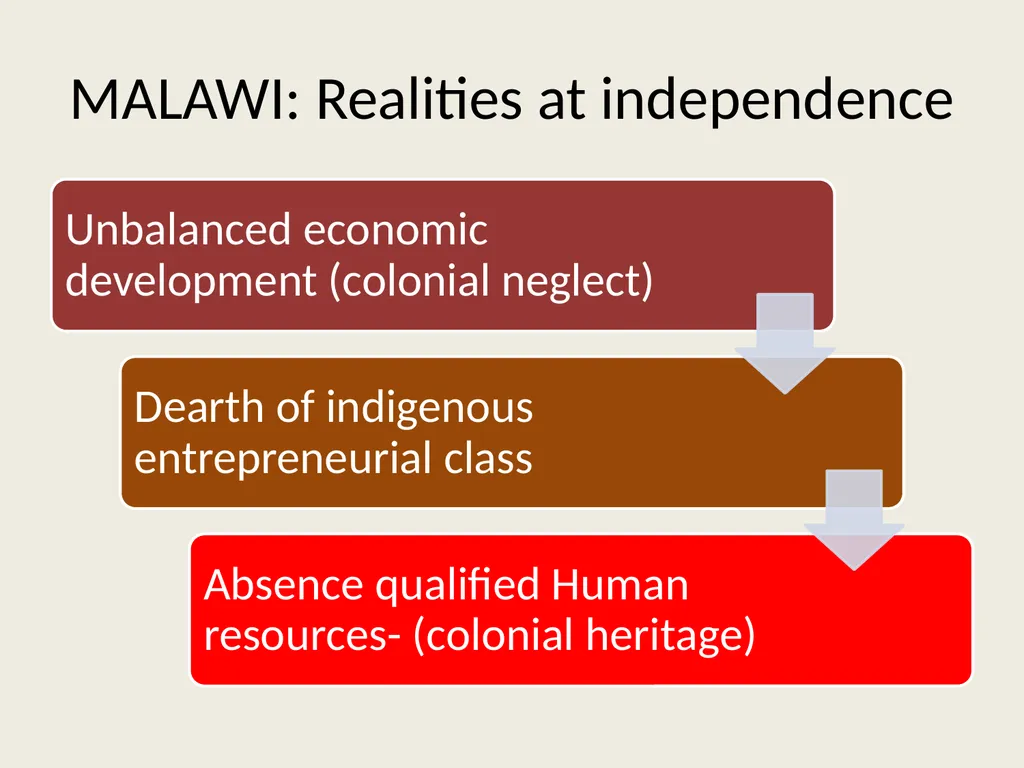
MALAWI: Realities at independence<br>
06
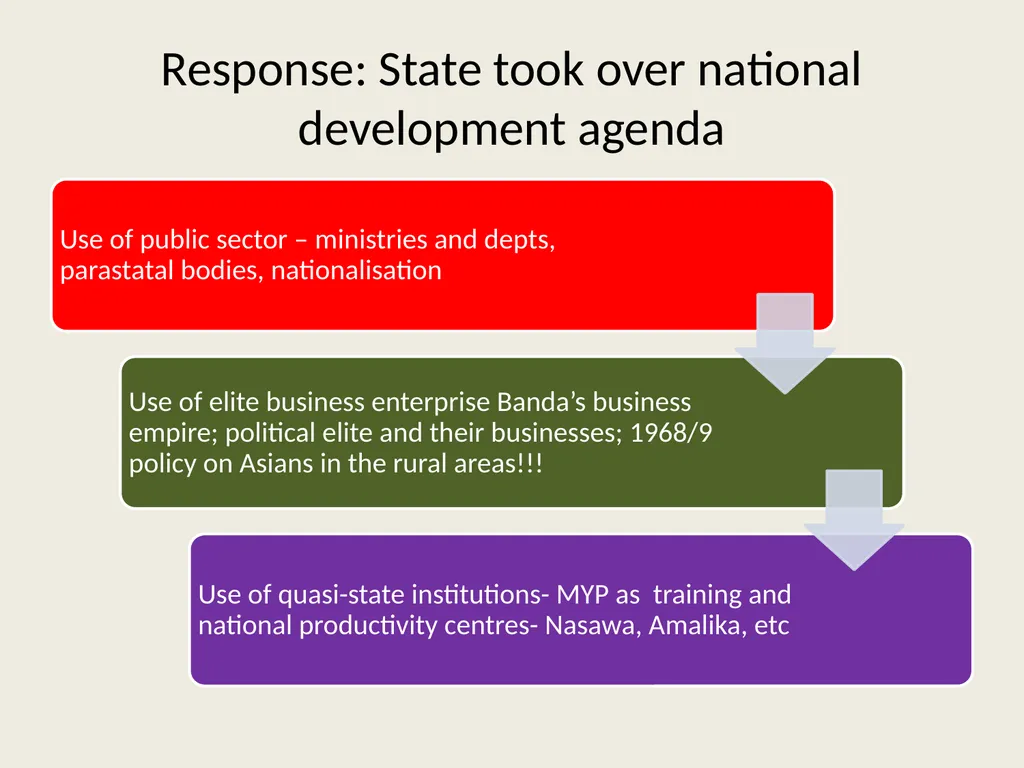
Response: State took over national development agenda<br>
07
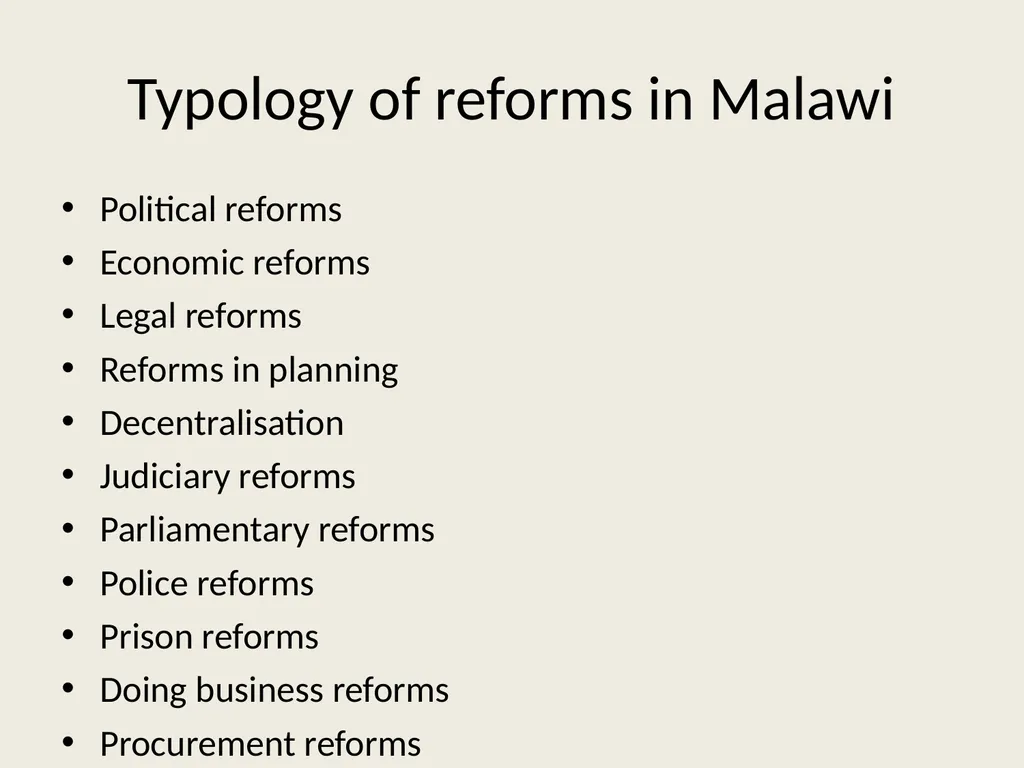
Typology of reforms in Malawi Political reforms
Economic reforms
Legal reforms
Reforms in planning
Decentralisation
Judiciary reforms
Parliamentary reforms
Police reforms
Prison reforms
Doing business reforms
Procurement reforms<br>
Economic reforms
Legal reforms
Reforms in planning
Decentralisation
Judiciary reforms
Parliamentary reforms
Police reforms
Prison reforms
Doing business reforms
Procurement reforms<br>
08
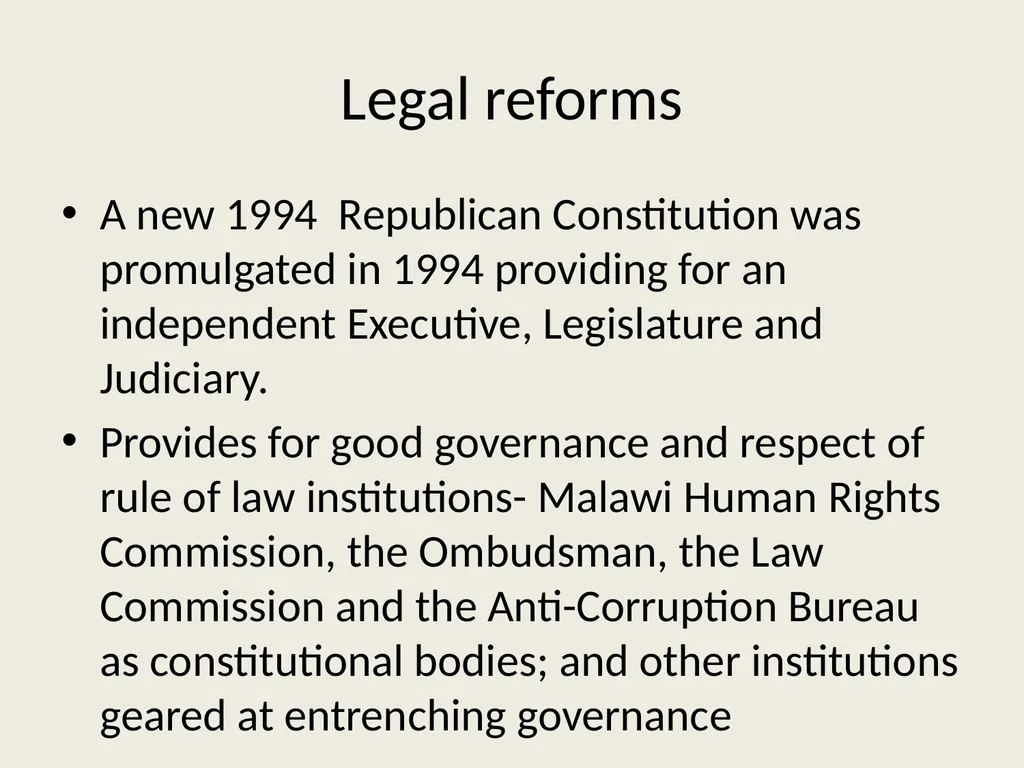
Legal reforms A new 1994 Republican Constitution was promulgated in 1994 providing for an independent Executive, Legislature and Judiciary.
Provides for good governance and respect of rule of law institutions- Malawi Human Rights Commission, the Ombudsman, the Law Commission and the Anti-Corruption Bureau as constitutional bodies; and other institutions geared at entrenching governance<br>
Provides for good governance and respect of rule of law institutions- Malawi Human Rights Commission, the Ombudsman, the Law Commission and the Anti-Corruption Bureau as constitutional bodies; and other institutions geared at entrenching governance<br>
09
LEGAL REFORMS RELATED TO PUBLIC SERVICE MANAGEMENT The Public Service Act was promulgated in 1994 which among other key issues provides for the core functions of the Public Service;
the responsibilities and duties of the offices of the Secretary to the President and Cabinet and the Secretary for Human Resource Management and Development ;<br>
the responsibilities and duties of the offices of the Secretary to the President and Cabinet and the Secretary for Human Resource Management and Development ;<br>
10
others The need for predictability, accountability and transparent of the operations of the public service.
Other legal reforms to enhance transparency and accountability in the Public Service -Public Finance Management Act (2003), the Public Procurement Act (2003) and the Public Audit Act (2003
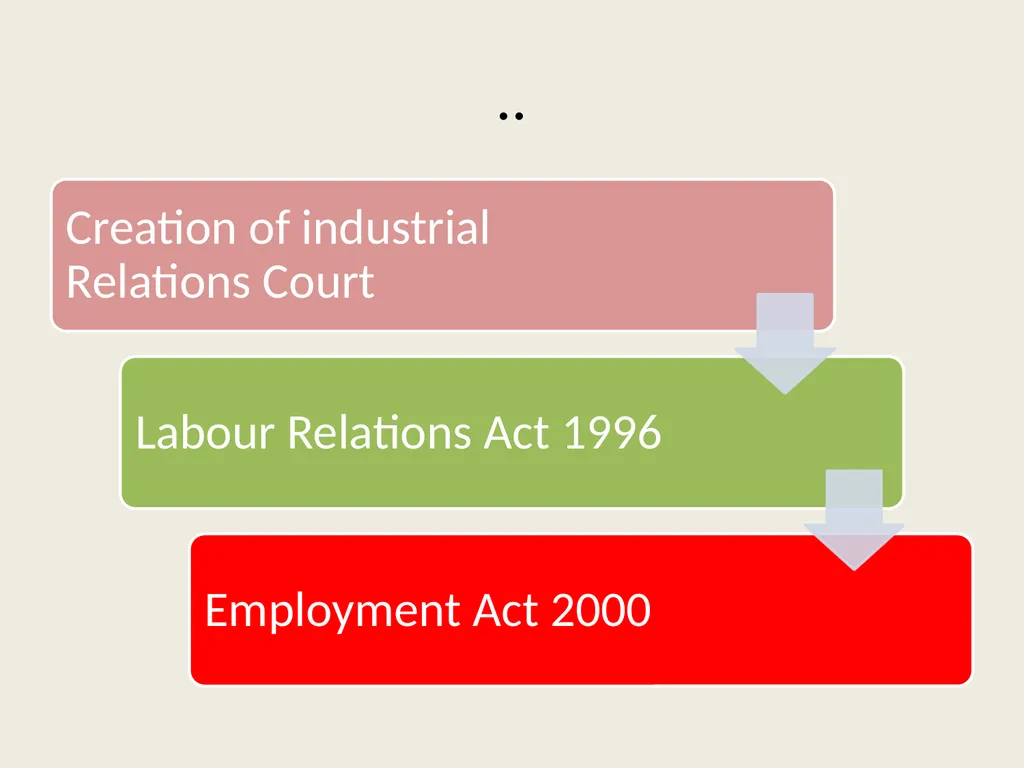
Labour relations Act
Employment Act.
New regulations and procedures on the management of the public service (MPSR)<br>
Other legal reforms to enhance transparency and accountability in the Public Service -Public Finance Management Act (2003), the Public Procurement Act (2003) and the Public Audit Act (2003
Labour relations Act
Employment Act.
New regulations and procedures on the management of the public service (MPSR)<br>
11
Reforms in planning The development and adoption of the Malawi Vision 2020 had ushered in the imperative to reform the Public Service
MPRS (1996-2004)
MGDS(2007-2011, 2011-2015).
ERP
Desire for an efficient, effective and transparent Public Service was seen as the key factor to the successful realization of democratic, highly developed, socially, economically and politically just Malawi.<br>
MPRS (1996-2004)
MGDS(2007-2011, 2011-2015).
ERP
Desire for an efficient, effective and transparent Public Service was seen as the key factor to the successful realization of democratic, highly developed, socially, economically and politically just Malawi.<br>
12
Democratic governance & rule of law Reforms in the sectors have focused on improving policy formulation, service delivery systems and technical capacities and human resource skills and competencies.
Health, education, water, roads and agricultures sector have implemented more robust reforms.<br>
Health, education, water, roads and agricultures sector have implemented more robust reforms.<br>
13
Parliamentary Reforms Parliamentary Reforms aimed at improving management of the National Assembly , management of the interface between the Legislature and the Executive, between the Legislature and the Judiciary, between the Legislature and the Civil Society; and enhancing the capacity of Parliamentary Committees and of Members of Parliament.<br>
14
Judicial reforms The objective of Judiciary reforms is to enhance access to justice delivery systems by most ordinary citizens, creating a framework for traditional justice systems, and introducing frameworks for engaging the none-state actors in alternative dispute resolution mechanism<br>
15
Police reforms A Police Reform Programme commenced in 1995 guided by a strategic plan to guide the reform process.
The strategic objective of the Reform Programme is to transform the Malawi Police from being a force to being a service in maintaining Law and Order in an independent and professional manner,
Characterized by compassion, sound judgment, respecting the sanctity of life and death, never accepting unlawful rewards and demonstrating willingness to change in the face of justified criticisms from the public<br>
The strategic objective of the Reform Programme is to transform the Malawi Police from being a force to being a service in maintaining Law and Order in an independent and professional manner,
Characterized by compassion, sound judgment, respecting the sanctity of life and death, never accepting unlawful rewards and demonstrating willingness to change in the face of justified criticisms from the public<br>
16
Prison reforms Functional review of the Prison Service, development of Strategic Plan and review of the Prison Act.<br>
17
Doing Business Reforms Government has embarked on improving the regulatory environment in which the private sector operates; and strengthening the institutions that protect private property rights, and allow speedy and low cost business setting up facilitation.<br>
18
.. It has also strengthened capacity of private sector development support institutions and services in order to improve the quality and volume of services delivered
Government has been enhancing Public Private Partnership (PPP) with focus on developing an enabling policy and legal framework to promote and regulate PPP<br>
Government has been enhancing Public Private Partnership (PPP) with focus on developing an enabling policy and legal framework to promote and regulate PPP<br>
19
Procurement Reforms Promulgation of the Public Procurement Act of 2003 and the establishment of the Directorate of Public Procurement
Procurement resulted in the liberalization of the public procurement functions and allowing the out sourcing of goods and services<br>
Procurement resulted in the liberalization of the public procurement functions and allowing the out sourcing of goods and services<br>
20
Parastatals Reforms The Parastatal Sector has been subjected to reforms from 1998 when government approved privatization of some parastatals providing of services and goods which the private sector had a comparative advantage.
The privatization of some parastatals was implemented within the context of reduced state role in the economy and allowing for liberalized market economy.<br>
The privatization of some parastatals was implemented within the context of reduced state role in the economy and allowing for liberalized market economy.<br>
21
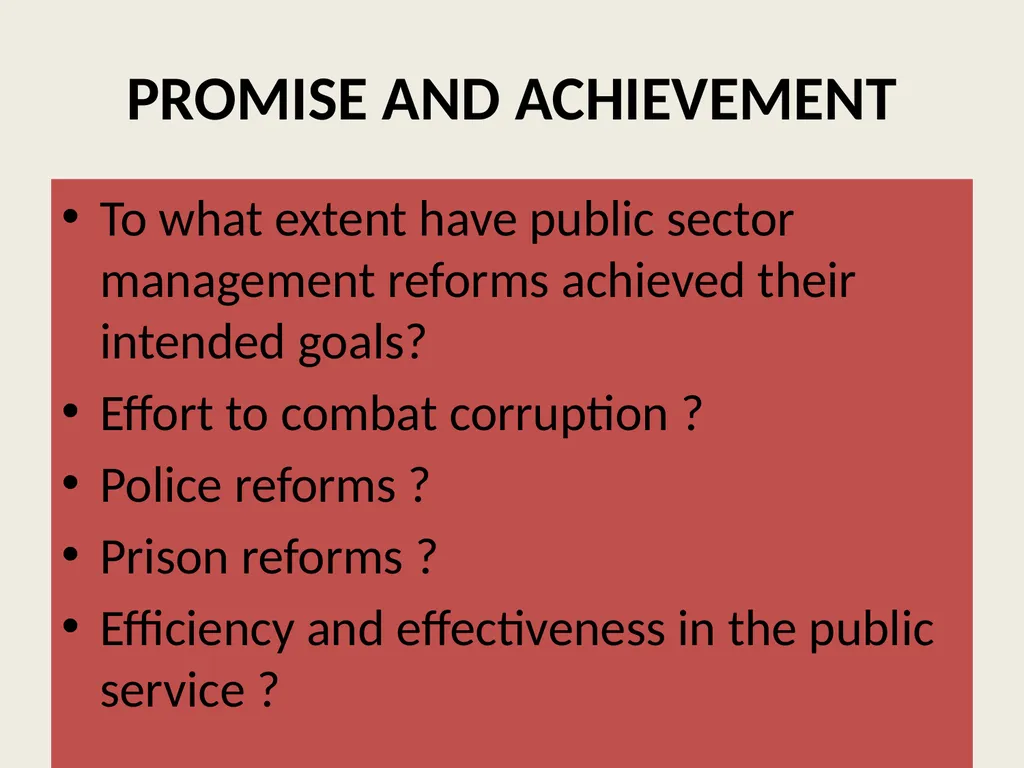
PROMISE AND ACHIEVEMENT To what extent have public sector management reforms achieved their intended goals?
Effort to combat corruption ?
Police reforms ?
Prison reforms ?
Efficiency and effectiveness in the public service ?<br>
Effort to combat corruption ?
Police reforms ?
Prison reforms ?
Efficiency and effectiveness in the public service ?<br>
22
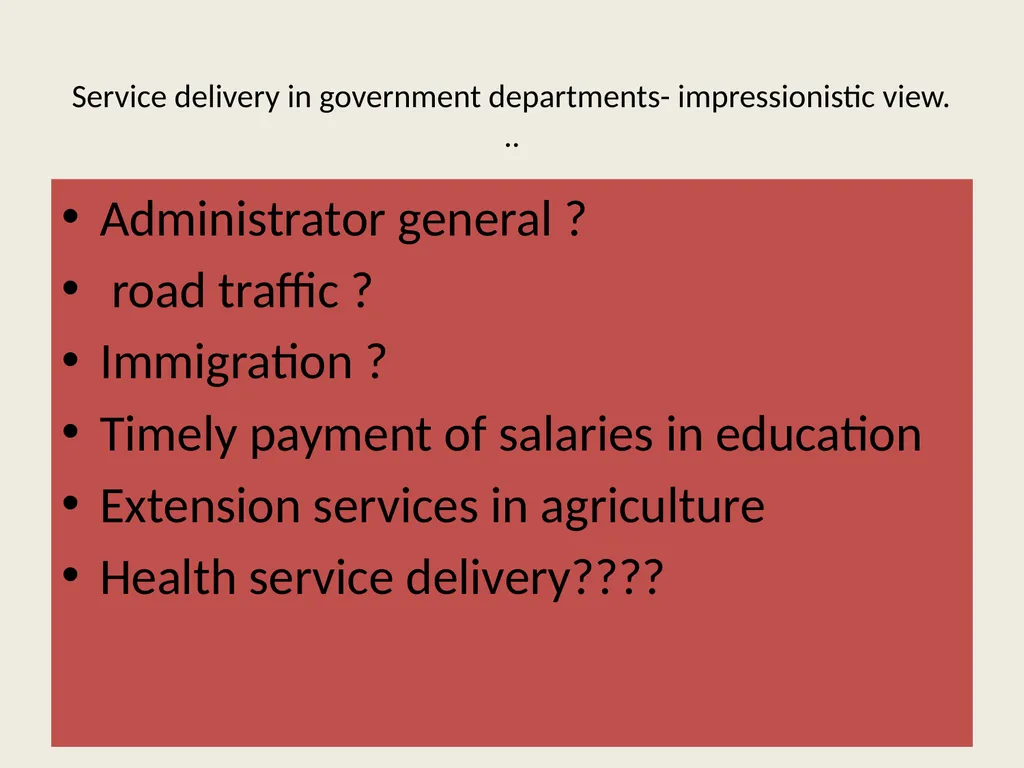
Service delivery in government departments- impressionistic view.
.. Administrator general ?
road traffic ?
Immigration ?
Timely payment of salaries in education
Extension services in agriculture
Health service delivery????<br>
road traffic ?
Immigration ?
Timely payment of salaries in education
Extension services in agriculture
Health service delivery????<br>
23
DISCUSSION QUESTION.. TO WHAT EXTENT CAN WE ATTRIBUTE MALAWI’S ECONOMIC UNDERPERFORMANCE TO FAILURE OF PUBLIC SECTOR REFORMS?<br>
24
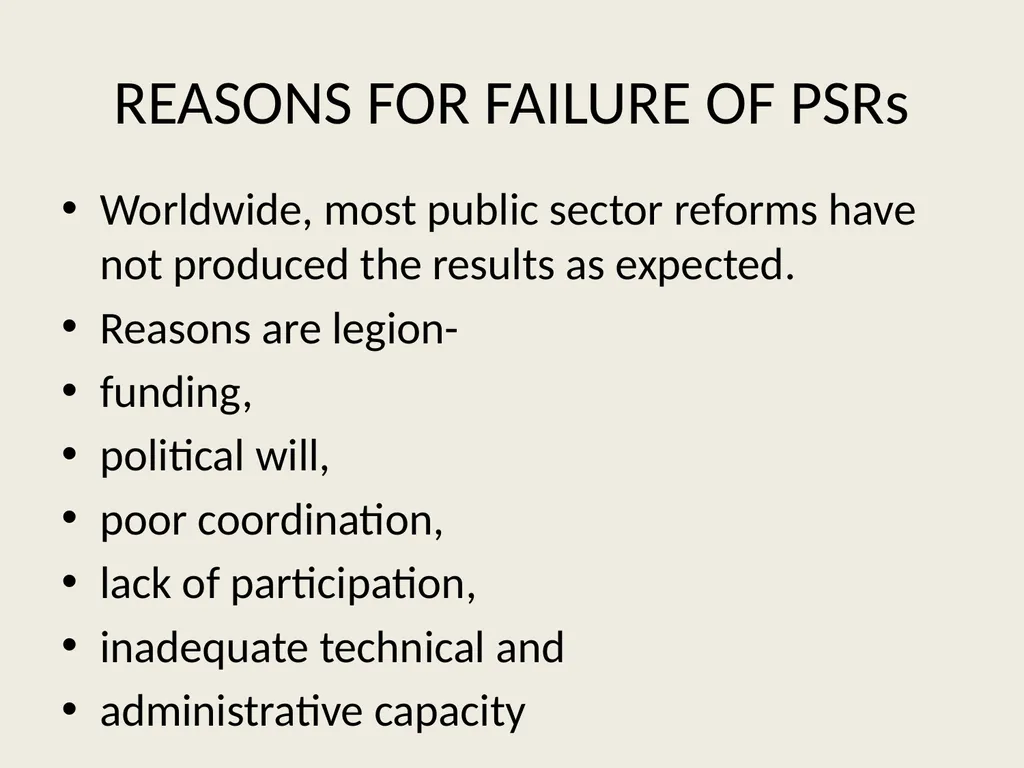
REASONS FOR FAILURE OF PSRs Worldwide, most public sector reforms have not produced the results as expected.
Reasons are legion-
funding,
political will,
poor coordination,
lack of participation,
inadequate technical and
administrative capacity<br>
Reasons are legion-
funding,
political will,
poor coordination,
lack of participation,
inadequate technical and
administrative capacity<br>
25
EMPLOYEE RELATIONS- ANOTHER EXPLANATION!! Do employers, government managers understand the role of the human factor in the implementation of reform programmes and projects?
Is it known that the human resource is both a subject of reform as well as an object of reform,
Both a facilitator as well as a victim of some reforms?
If poorly done turning human resources into victims, reforms can be counter-productive.....<br>
Is it known that the human resource is both a subject of reform as well as an object of reform,
Both a facilitator as well as a victim of some reforms?
If poorly done turning human resources into victims, reforms can be counter-productive.....<br>
26
.. If done with a human face in mind, they can enhance efficiency and effectiveness.
Issues of employer-employee relations and the climate created at the workplace is crucial in understanding success or failure of reforms
EMPLOYEE RELATIONS<br>
Issues of employer-employee relations and the climate created at the workplace is crucial in understanding success or failure of reforms
EMPLOYEE RELATIONS<br>
27
What is Employee relations? the relationship between employer and employees in paid employment:
the ways employees are recruited, selected, appointed, promoted, rewarded, motivated, trained and disciplined<br>
the ways employees are recruited, selected, appointed, promoted, rewarded, motivated, trained and disciplined<br>
28
Good employee relations lead to: Lower level of industrial grievances and disputes
Industrial peace
Higher worker productivity
Investor-friendly environment
High employment through more new investment
THE OPPOSITE IS ALSO TRUE<br>
Industrial peace
Higher worker productivity
Investor-friendly environment
High employment through more new investment
THE OPPOSITE IS ALSO TRUE<br>
29
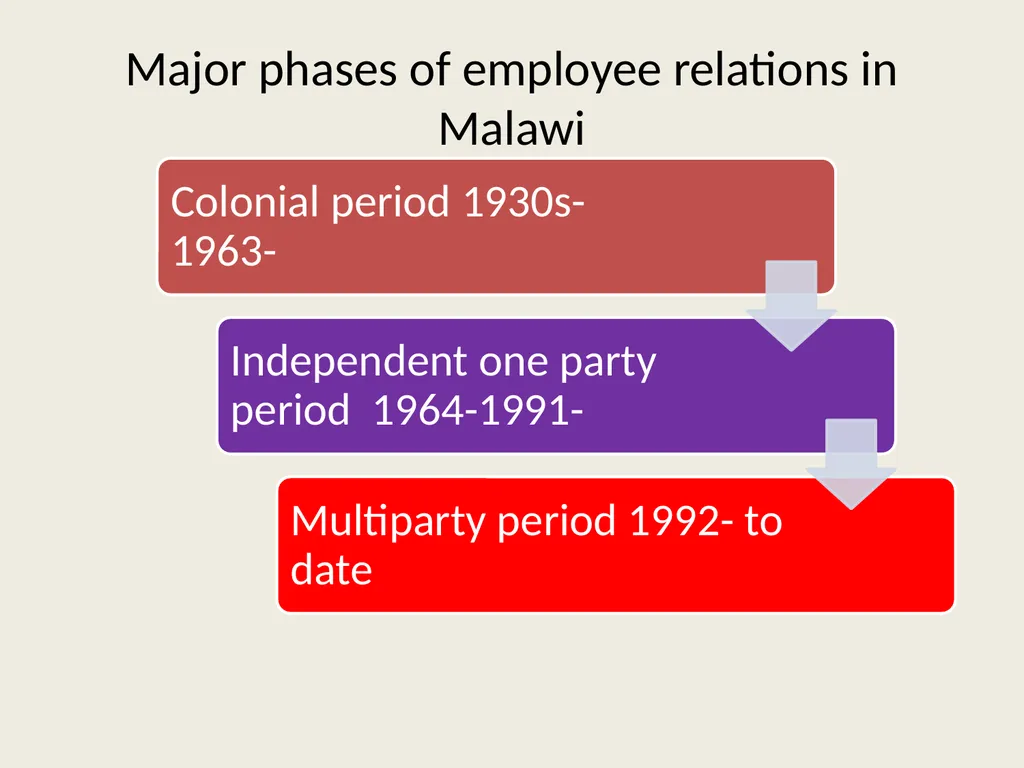
Major phases of employee relations in Malawi<br>
30
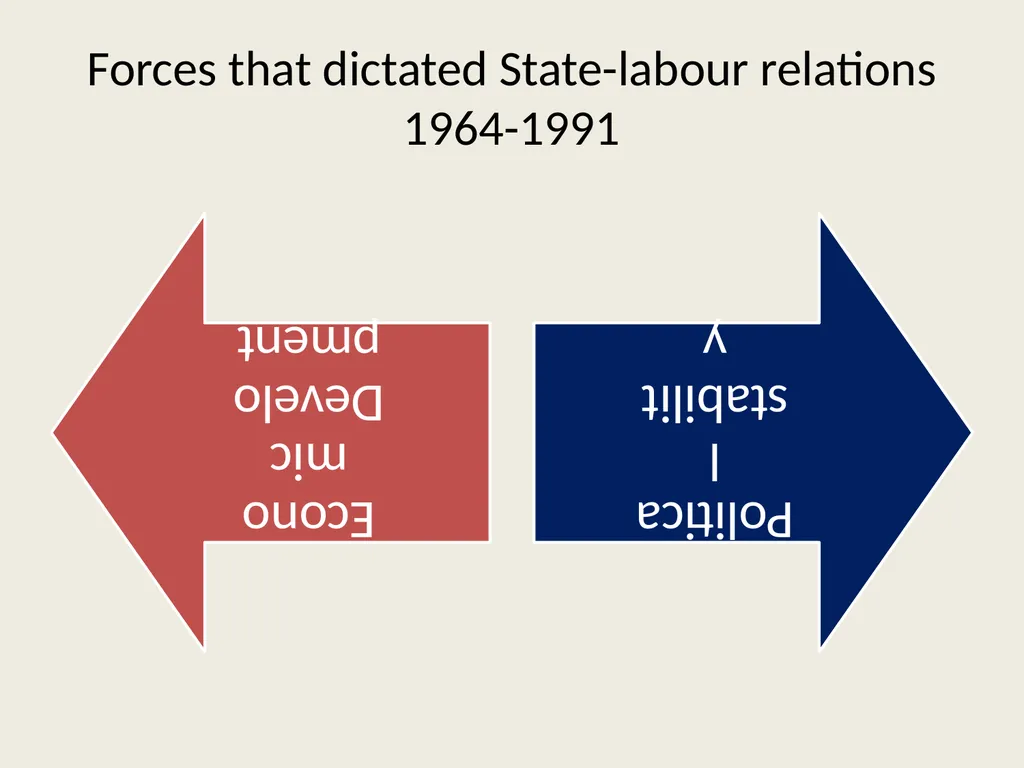
Forces that dictated State-labour relations 1964-1991<br>
31
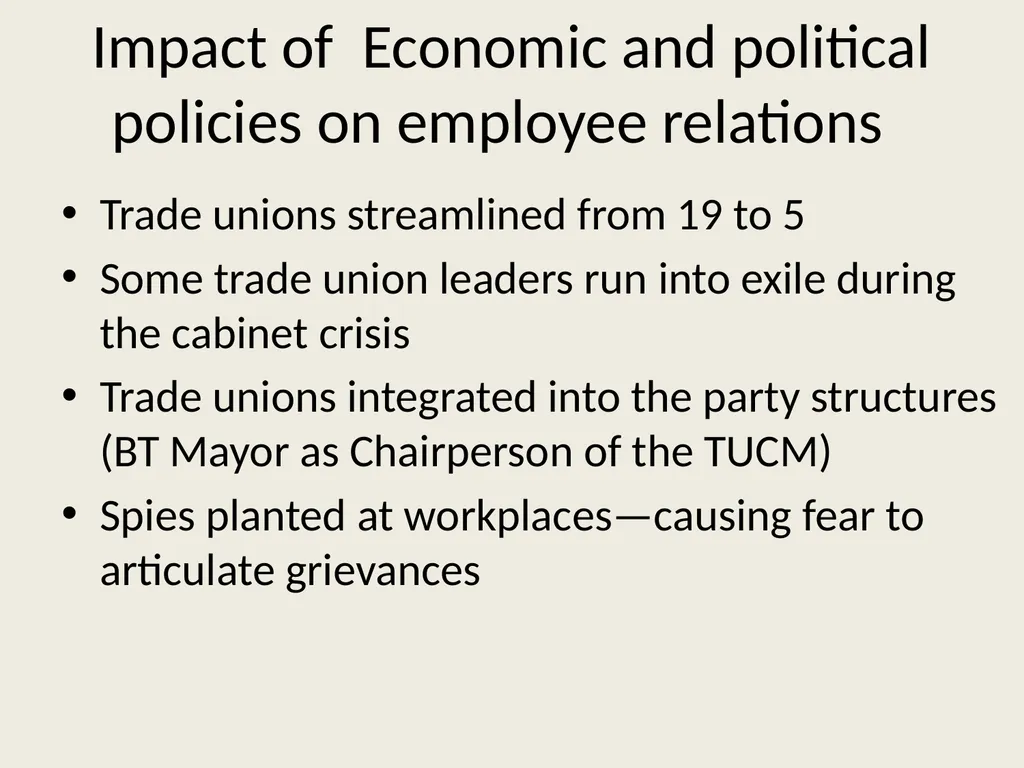
Impact of Economic and political policies on employee relations Trade unions streamlined from 19 to 5
Some trade union leaders run into exile during the cabinet crisis
Trade unions integrated into the party structures (BT Mayor as Chairperson of the TUCM)
Spies planted at workplaces—causing fear to articulate grievances<br>
Some trade union leaders run into exile during the cabinet crisis
Trade unions integrated into the party structures (BT Mayor as Chairperson of the TUCM)
Spies planted at workplaces—causing fear to articulate grievances<br>
32
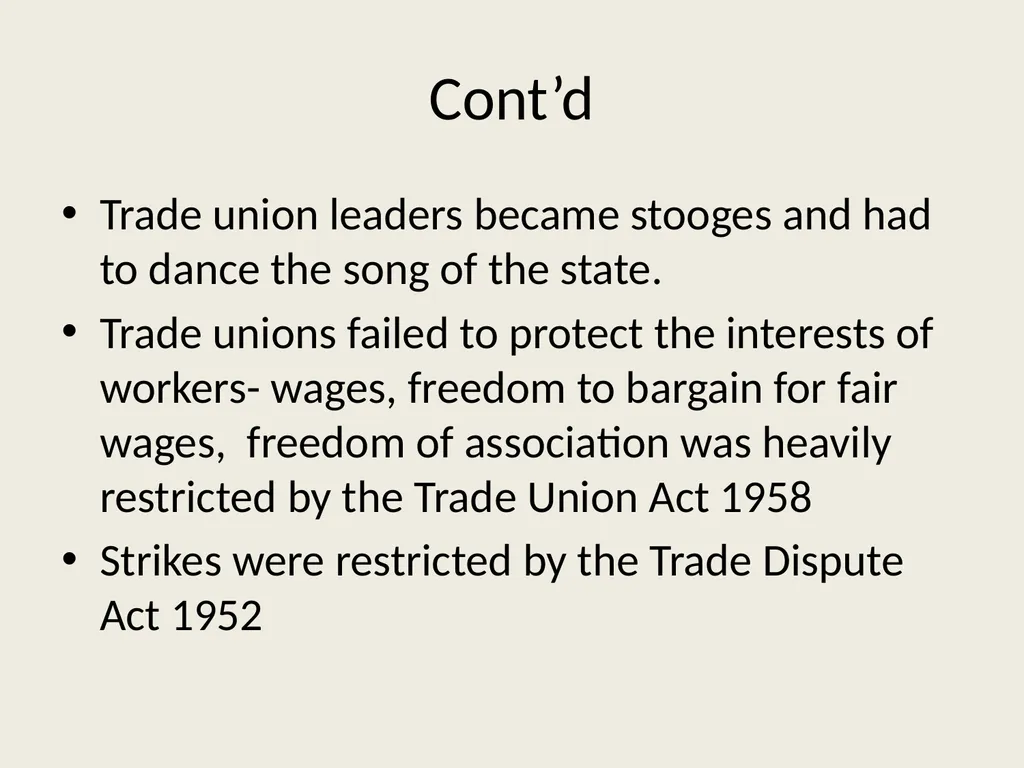
Cont’d Trade union leaders became stooges and had to dance the song of the state.
Trade unions failed to protect the interests of workers- wages, freedom to bargain for fair wages, freedom of association was heavily restricted by the Trade Union Act 1958
Strikes were restricted by the Trade Dispute Act 1952<br>
Trade unions failed to protect the interests of workers- wages, freedom to bargain for fair wages, freedom of association was heavily restricted by the Trade Union Act 1958
Strikes were restricted by the Trade Dispute Act 1952<br>
33
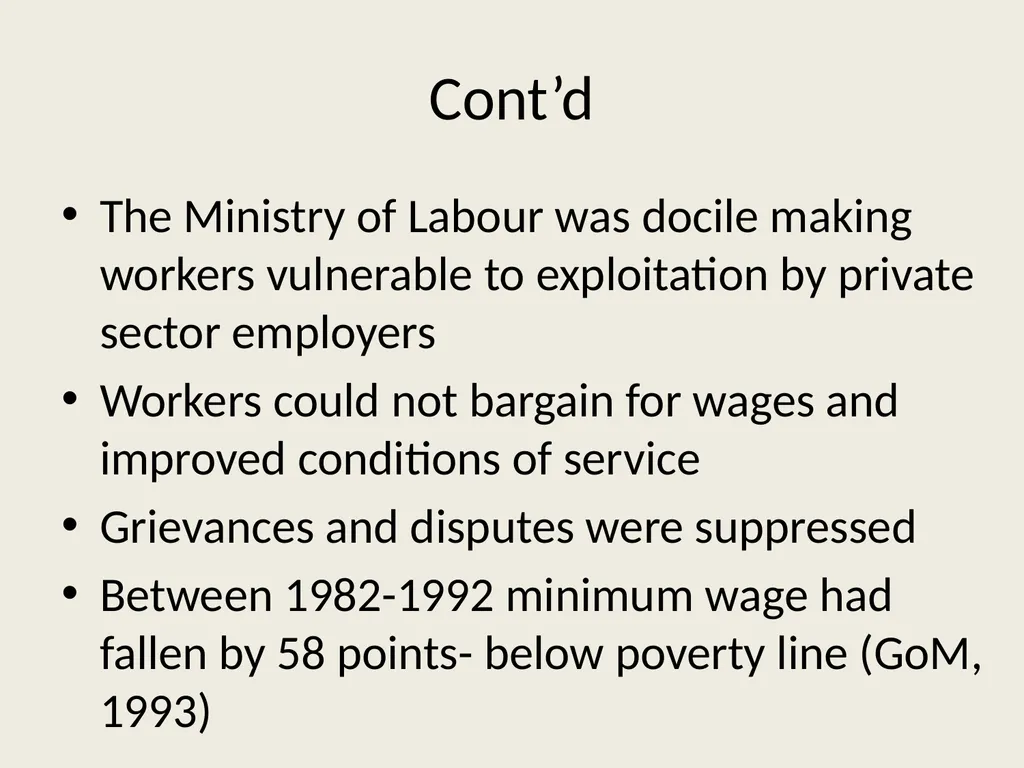
Cont’d The Ministry of Labour was docile making workers vulnerable to exploitation by private sector employers
Workers could not bargain for wages and improved conditions of service
Grievances and disputes were suppressed
Between 1982-1992 minimum wage had fallen by 58 points- below poverty line (GoM, 1993)<br>
Workers could not bargain for wages and improved conditions of service
Grievances and disputes were suppressed
Between 1982-1992 minimum wage had fallen by 58 points- below poverty line (GoM, 1993)<br>
34
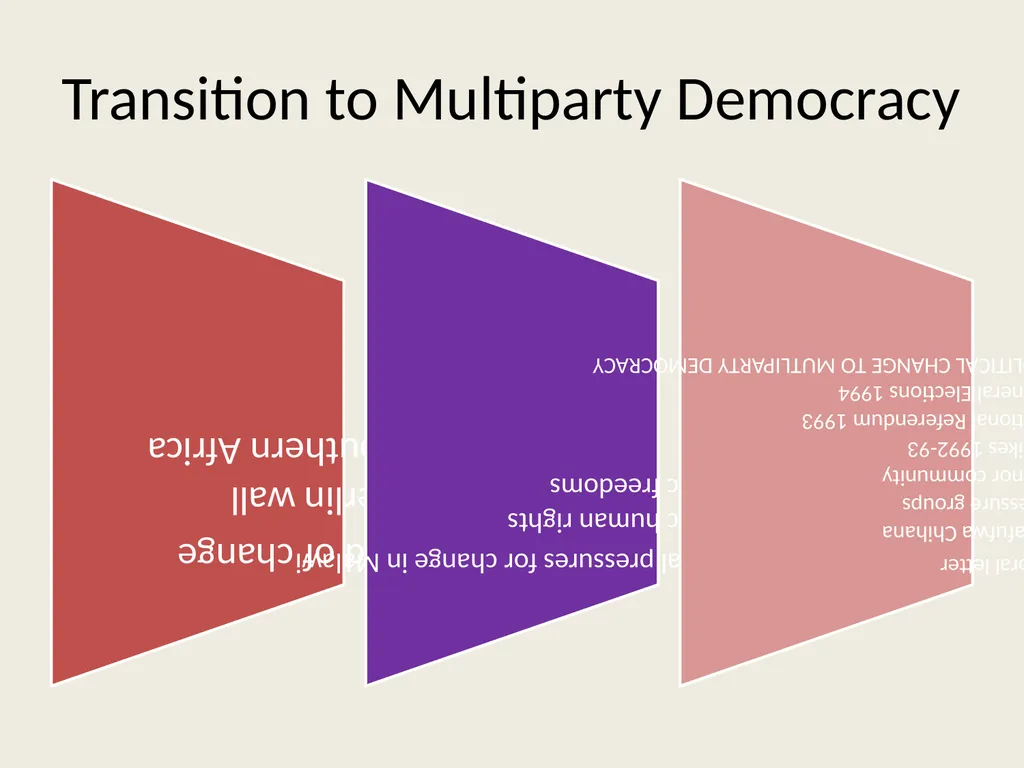
Transition to Multiparty Democracy<br>
35
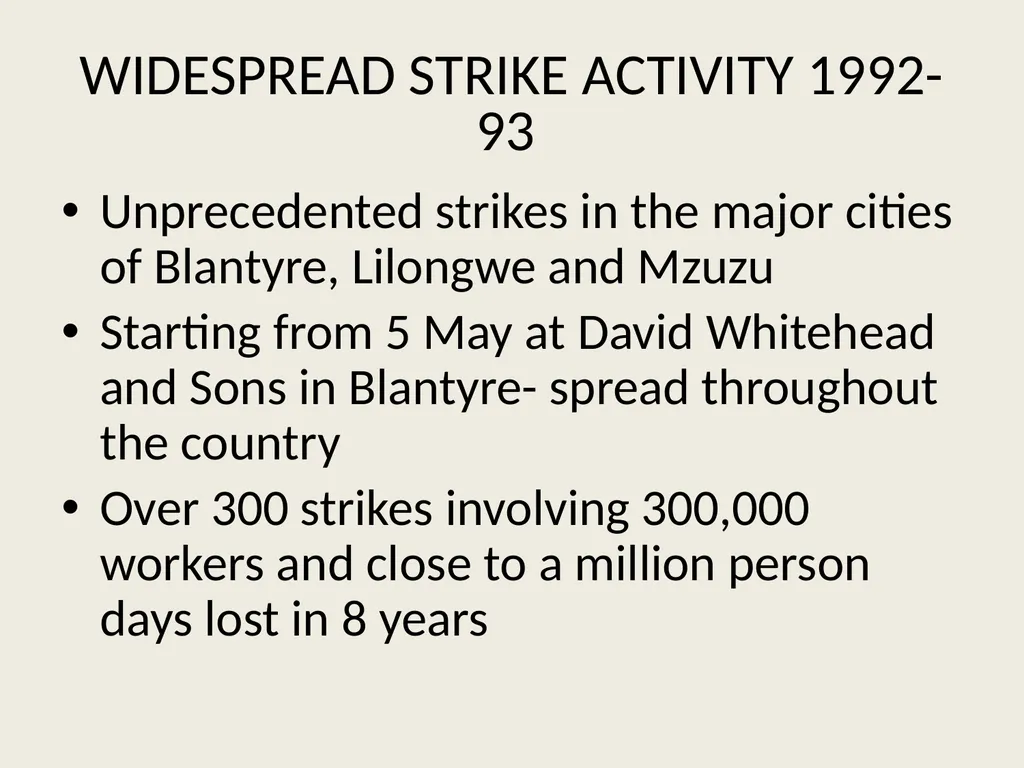
WIDESPREAD STRIKE ACTIVITY 1992-93 Unprecedented strikes in the major cities of Blantyre, Lilongwe and Mzuzu
Starting from 5 May at David Whitehead and Sons in Blantyre- spread throughout the country
Over 300 strikes involving 300,000 workers and close to a million person days lost in 8 years<br>
Starting from 5 May at David Whitehead and Sons in Blantyre- spread throughout the country
Over 300 strikes involving 300,000 workers and close to a million person days lost in 8 years<br>
36
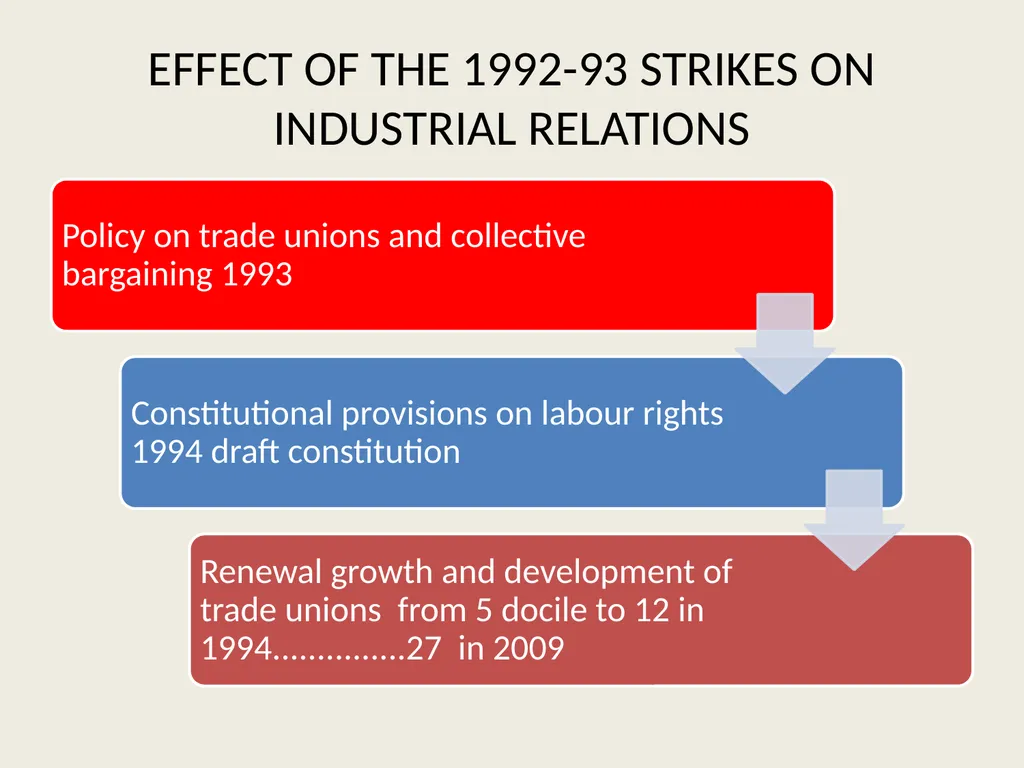
EFFECT OF THE 1992-93 STRIKES ON INDUSTRIAL RELATIONS<br>
37
..<br>
38
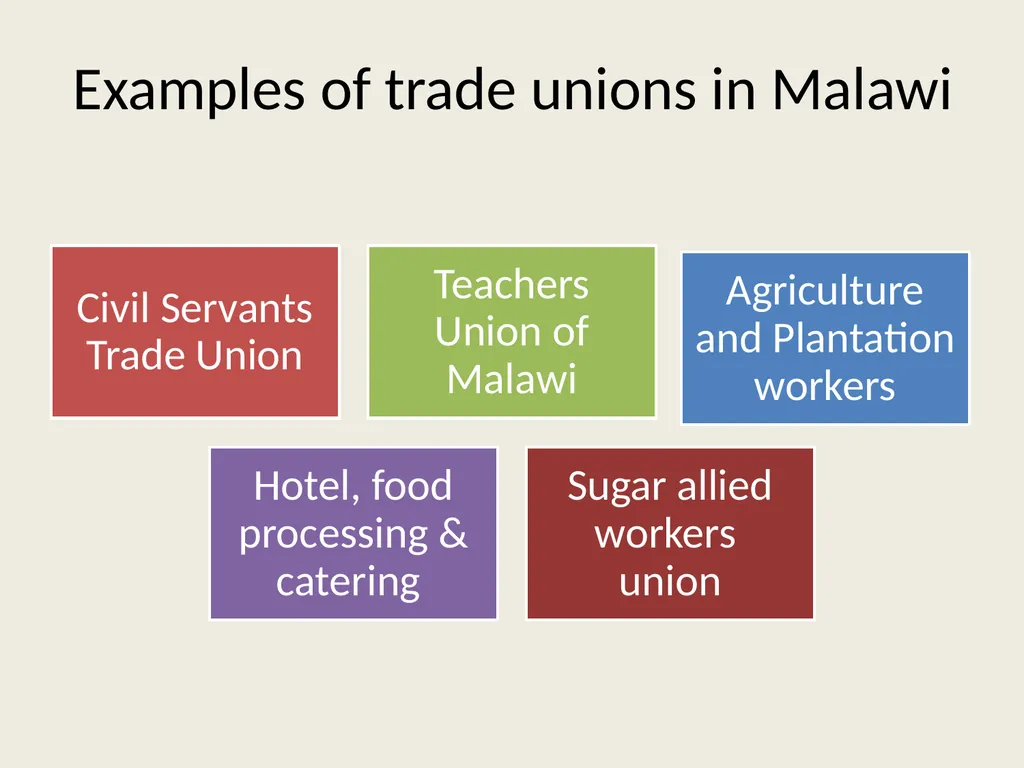
Examples of trade unions in Malawi<br>
39
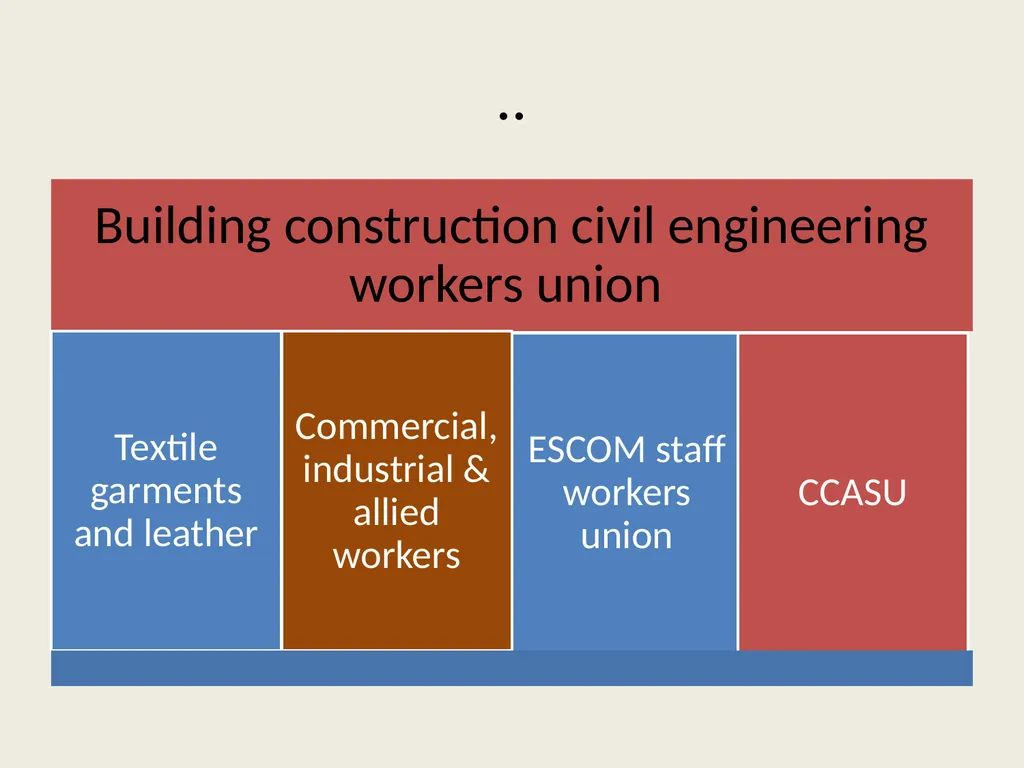
..<br>
40
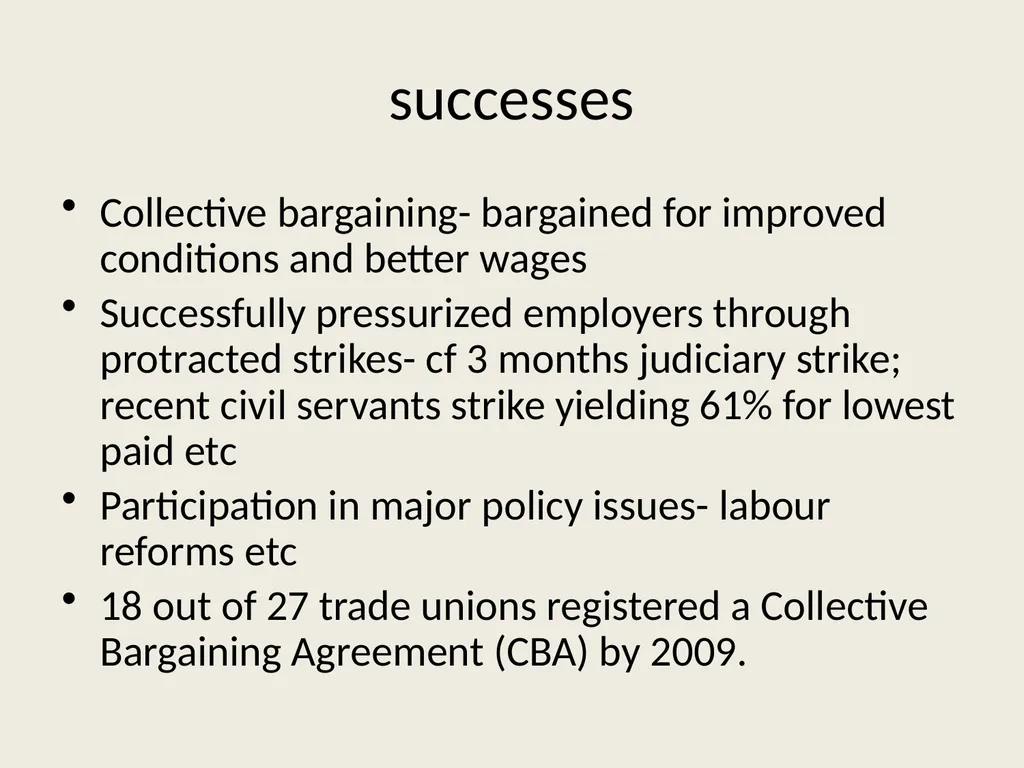
successes Collective bargaining- bargained for improved conditions and better wages
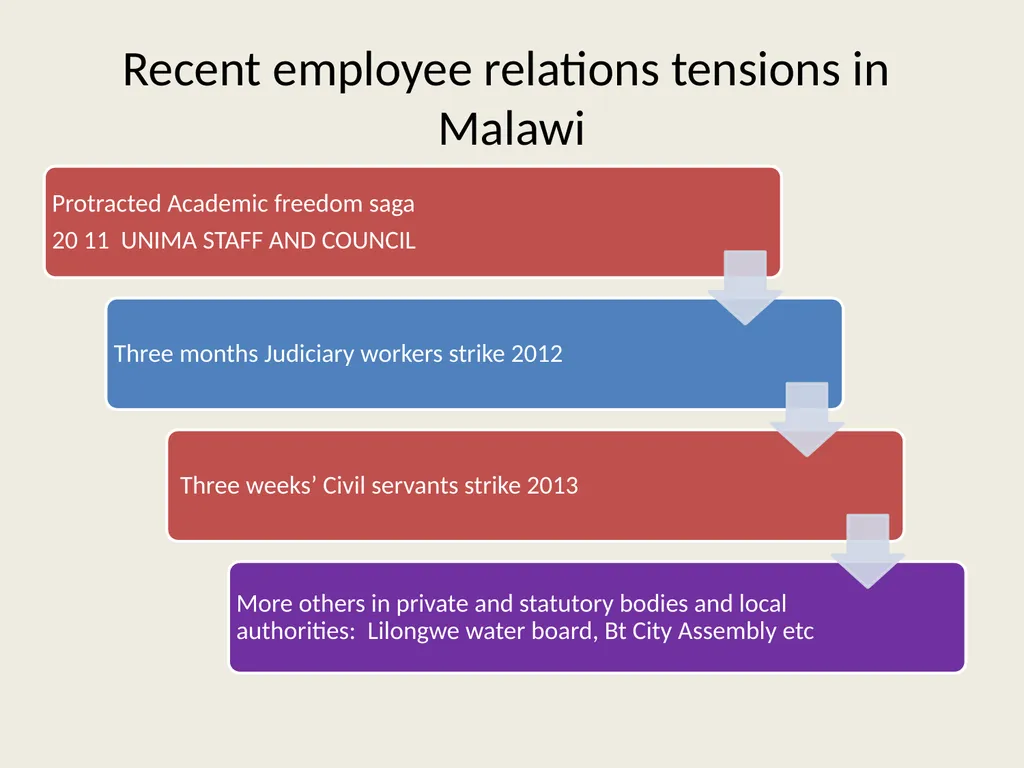
Successfully pressurized employers through protracted strikes- cf 3 months judiciary strike; recent civil servants strike yielding 61% for lowest paid etc
Participation in major policy issues- labour reforms etc
18 out of 27 trade unions registered a Collective Bargaining Agreement (CBA) by 2009.<br>
Successfully pressurized employers through protracted strikes- cf 3 months judiciary strike; recent civil servants strike yielding 61% for lowest paid etc
Participation in major policy issues- labour reforms etc
18 out of 27 trade unions registered a Collective Bargaining Agreement (CBA) by 2009.<br>
41
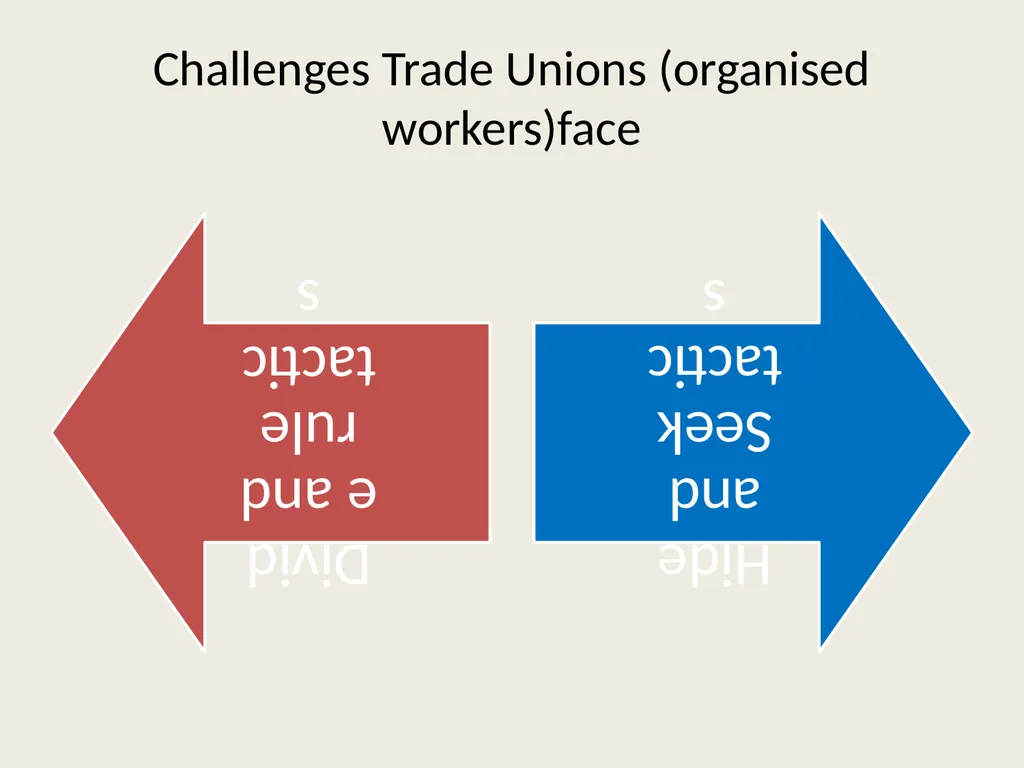
Challenges Trade Unions (organised workers)face<br>
42
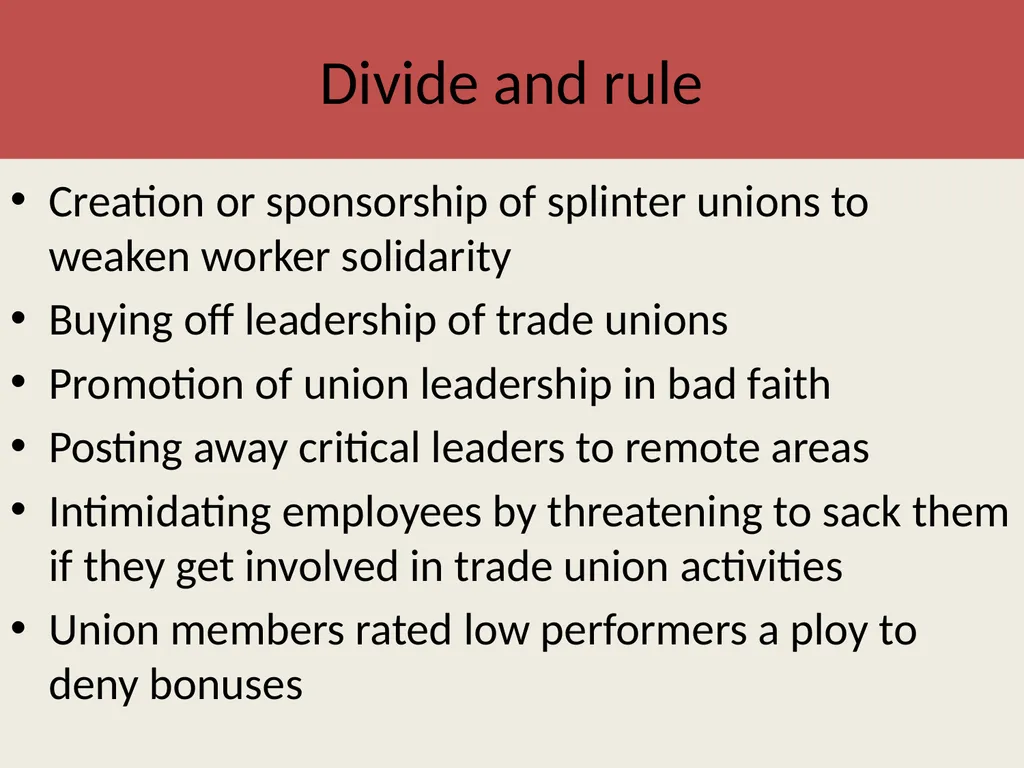
Divide and rule Creation or sponsorship of splinter unions to weaken worker solidarity
Buying off leadership of trade unions
Promotion of union leadership in bad faith
Posting away critical leaders to remote areas
Intimidating employees by threatening to sack them if they get involved in trade union activities
Union members rated low performers a ploy to deny bonuses<br>
Buying off leadership of trade unions
Promotion of union leadership in bad faith
Posting away critical leaders to remote areas
Intimidating employees by threatening to sack them if they get involved in trade union activities
Union members rated low performers a ploy to deny bonuses<br>
43
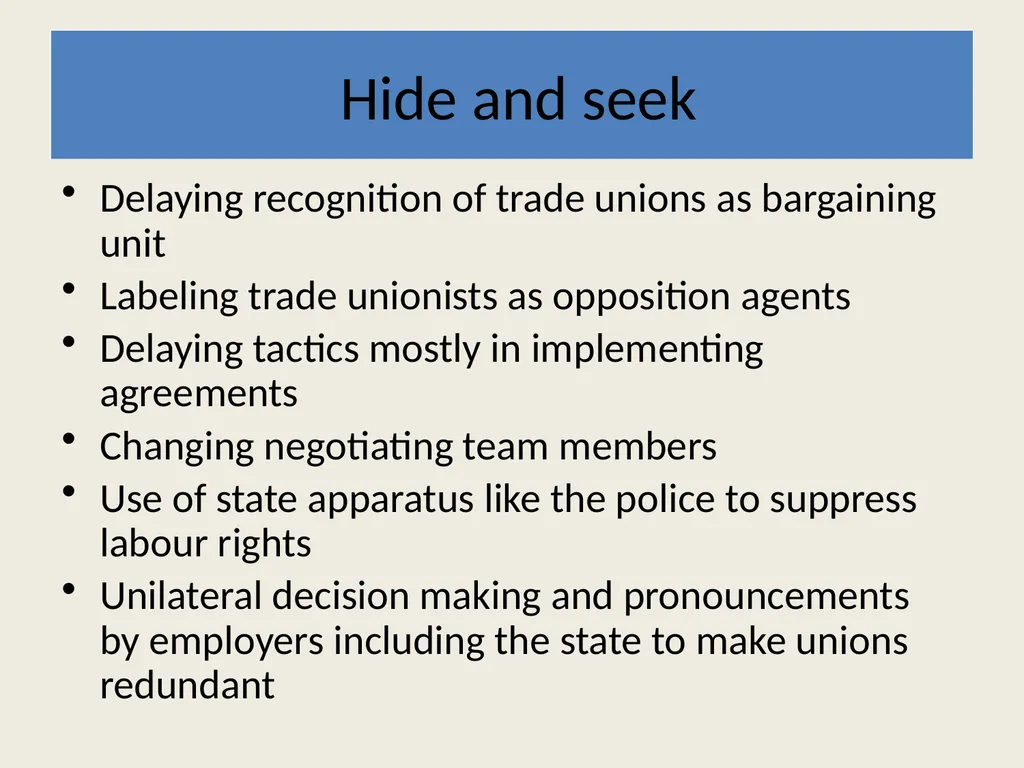
Hide and seek Delaying recognition of trade unions as bargaining unit
Labeling trade unionists as opposition agents
Delaying tactics mostly in implementing agreements
Changing negotiating team members
Use of state apparatus like the police to suppress labour rights
Unilateral decision making and pronouncements by employers including the state to make unions redundant<br>
Labeling trade unionists as opposition agents
Delaying tactics mostly in implementing agreements
Changing negotiating team members
Use of state apparatus like the police to suppress labour rights
Unilateral decision making and pronouncements by employers including the state to make unions redundant<br>
44
Malawi Vision 2020 “By 2020, Malawi as a God-fearing nation will be secure, democratically mature, environmentally sustainable, self-reliant with equal opportunities for and active participation by all, having social services, vibrant cultural and religious values and being a technologically driven middle-income economy.” Malawi Vision 2020<br>
45
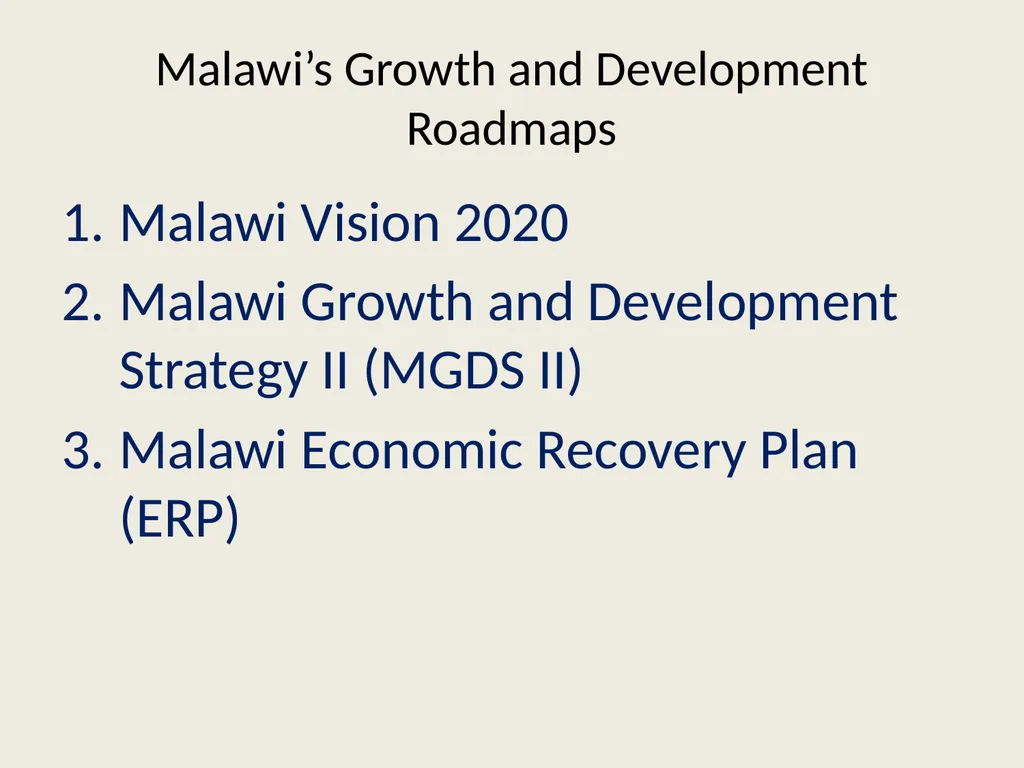
Malawi’s Growth and Development Roadmaps Malawi Vision 2020
Malawi Growth and Development Strategy II (MGDS II)
Malawi Economic Recovery Plan (ERP)<br>
Malawi Growth and Development Strategy II (MGDS II)
Malawi Economic Recovery Plan (ERP)<br>
46
Public sector reforms, employee relations and Economic development Economic growth Malawi has enjoyed since independence can be attributed to the role of workers in various capacities in the public and private sector.
the overall performance of a national economy is a product of individual organizations’ Performance put together.
The human resources of a nation- not its capital or raw materials determine the character and pace of its economic and social development<br>
the overall performance of a national economy is a product of individual organizations’ Performance put together.
The human resources of a nation- not its capital or raw materials determine the character and pace of its economic and social development<br>
47
.. Economic growth and development cannot be achieved without substantial investment in human capital in the form of skills development.
Skilled human resource is indispensable for any country aspiring to develop its economy and advance aspirations of its people.<br>
Skilled human resource is indispensable for any country aspiring to develop its economy and advance aspirations of its people.<br>
48
,, A country which has a pool of human resource in critical skill areas can produce economic miracles even if it is devastated or less endowed by natural resources..
The Asian Tigers which exploited their scientific, technological and innovation capacity to make socio-economic breakthroughs are cases in point.<br>
The Asian Tigers which exploited their scientific, technological and innovation capacity to make socio-economic breakthroughs are cases in point.<br>
49
Harnessing workers The need to harness a conducive environment for human resources of any nation through sound employee relations is the surest way of tapping the vast potential in the professional, technical and administrative/management staff that a nation has
The achievement of Vision 2020, MGDS 11 and the ERP will depend on the nature of relationship between employers and employees in the production of goods and services<br>
The achievement of Vision 2020, MGDS 11 and the ERP will depend on the nature of relationship between employers and employees in the production of goods and services<br>
50
Recent employee relations tensions in Malawi<br>
51
Other private sector disputes over<br>
52
QUESTION WORTH REFLECTING ON! WHAT IMPACT DOES THIS CLIMATE HAVE ON EFFICIENCY, EFFECTIVENESS AND PRODUCTIVITY OF PUBLIC AND PRIVATE SECTOR ORGANISATIONS?<br>
53
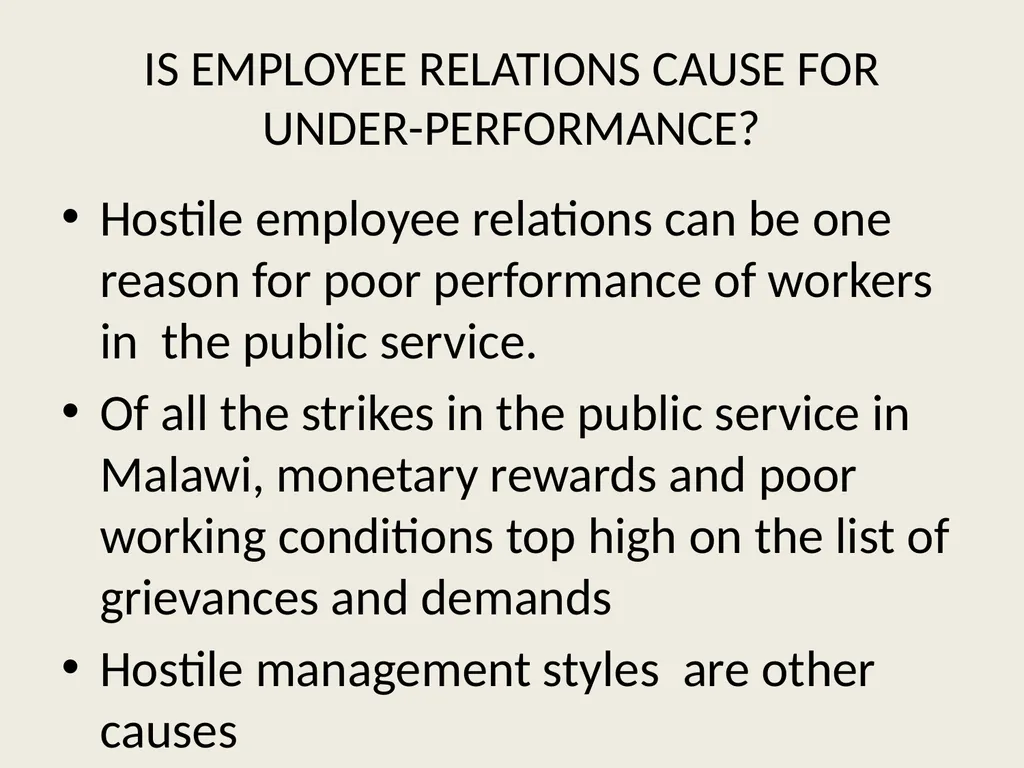
IS EMPLOYEE RELATIONS CAUSE FOR UNDER-PERFORMANCE? Hostile employee relations can be one reason for poor performance of workers in the public service.
Of all the strikes in the public service in Malawi, monetary rewards and poor working conditions top high on the list of grievances and demands
Hostile management styles are other causes<br>
Of all the strikes in the public service in Malawi, monetary rewards and poor working conditions top high on the list of grievances and demands
Hostile management styles are other causes<br>
54
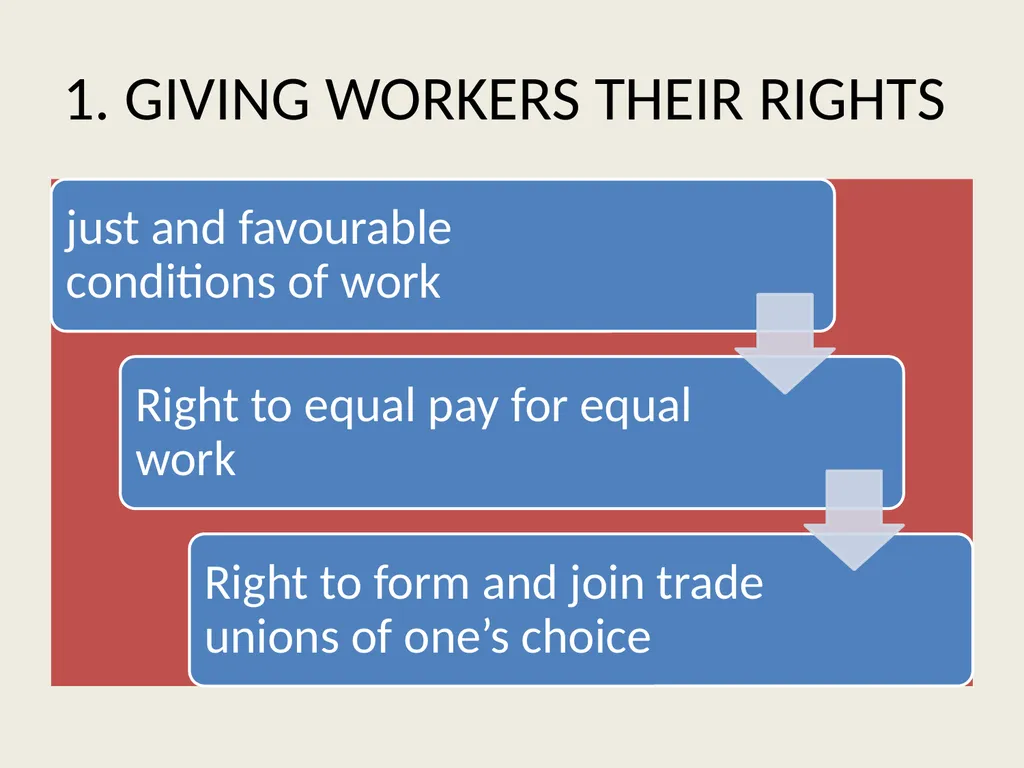
1. GIVING WORKERS THEIR RIGHTS<br>
55
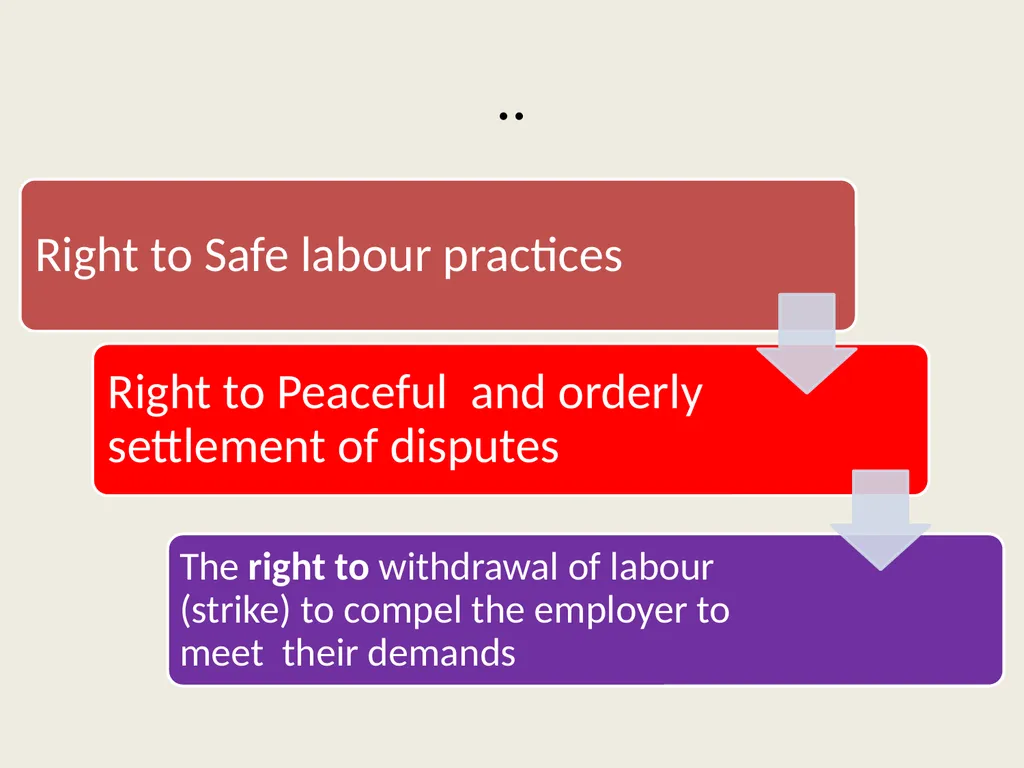
..<br>
56
2. Good reward systems help to attract and retain the high quality people the organization needs;
create total reward processes that recognize the importance of both financial and non-financial rewards;
develop a positive employment relationship and psychological contract;
align reward practices with both business goals and employee values<br>
create total reward processes that recognize the importance of both financial and non-financial rewards;
develop a positive employment relationship and psychological contract;
align reward practices with both business goals and employee values<br>
57
3. Managing performance effectively All employers want employees who perform their jobs well.
Effective performance management system (PMS) increases the likelihood that such performance will occur.
PMS links organizational vision, missions, values and strategic goals to divisional, departmental and individual goals, objectives and tasks/targets<br>
Effective performance management system (PMS) increases the likelihood that such performance will occur.
PMS links organizational vision, missions, values and strategic goals to divisional, departmental and individual goals, objectives and tasks/targets<br>
58
Performance measurement starts with strategic planning through implementation, monitoring then performance evaluation.
There is need to develop objectives, performance measures, indicators and proper reporting.<br>
There is need to develop objectives, performance measures, indicators and proper reporting.<br>
59
REFLECTIONS!!! Can national development be achieved without corresponding improvements in employee relations ?
Sound employee relations is a pre-requisite for industrial peace, employee engagement, commitment, and therefore higher productivity and national development.<br>
Sound employee relations is a pre-requisite for industrial peace, employee engagement, commitment, and therefore higher productivity and national development.<br>
60
OTHER STRATEGIES Participative management strategies and enhancing employee voice at work
Raising the strategic positioning of the human resource function in organisations<br>
Raising the strategic positioning of the human resource function in organisations<br>
61
ADAGE ........A man who carries a dead lizard at the back should not be surprised when flies are all over him.........<br>
62
SUMMARY The public sector is the major machinery for implementing government development agenda.
The need to reform public service employment relations to take into account the centrality of human resources in the implementation of public policies and programmes is more vital now than ever before.<br>
The need to reform public service employment relations to take into account the centrality of human resources in the implementation of public policies and programmes is more vital now than ever before.<br>
63
THE END THANKS FOR YOUR ATTENTION
dzimbiri2002@yahoo.co.uk<br>
dzimbiri2002@yahoo.co.uk<br>