
Pyogenic cocci: Genus Streptococcus Prof.Dr.Baydaa
KB
Published · 15 slides · 0 views
1 / 1




Description
Pyogenic cocci: Genus Streptococcus Prof.Dr.Baydaa Hameed Abdullah Streptococcus pyogenes Streptococcus are gram-positive spherical bacteria that characteristically form pairs or chains during growth. They are widely distributed in nature.
Related Topics
Share
Embed code
Download this presentation From Below
"Pyogenic cocci: Genus Streptococcus Prof.Dr.Baydaa" is the property of its rightful owner. Permission is granted to download and print the materials on this website for personal, non-commercial use only, and to display it on your personal computer provided you do not modify the materials and that you retain all copyright notices contained in the materials. By downloading content from our website, you accept the terms of this agreement.
Presentation Transcript
01
Pyogenic cocci:
Genus Streptococcus Prof.Dr.Baydaa Hameed Abdullah<br>
02
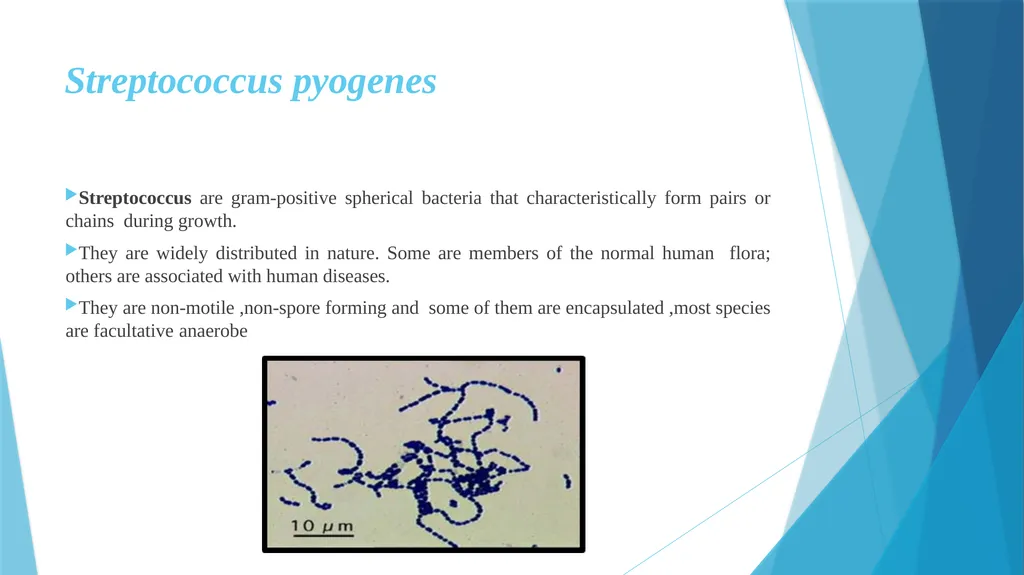
Streptococcus pyogenes Streptococcus are gram-positive spherical bacteria that characteristically form pairs or chains during growth.
They are widely distributed in nature. Some are members of the normal human flora; others are associated with human diseases.
They are non-motile ,non-spore forming and some of them are encapsulated ,most species are facultative anaerobe<br>
They are widely distributed in nature. Some are members of the normal human flora; others are associated with human diseases.
They are non-motile ,non-spore forming and some of them are encapsulated ,most species are facultative anaerobe<br>
03
Classification of streptococci of medical importance A. Hemolysis Many streptococci are able to hemolyze red blood cells in vitro in varying degrees.
Complete disruption of erythrocytes with clearing of the blood around the bacterial growth is called β-hemolysis.
Incomplete lysis of erythrocytes with reduction of hemoglobin and the formation of green pigment is called α-hemolysis.
Other streptococci are nonhemolytic (sometimes called γ- [gamma-] hemolysis).
Group-Specific Substance :Carbohydrate antigen ( C antigen): Its carbohydrate in nature and it’s located in the cell wall of many streptococci and form the basis of serologic grouping (Lancefield grouping). Lancefield groups A–H and K–U. The serologic specificity of the group specific carbohydrate is determined by an amino sugar.
Capsular Polysaccharides
Biochemical Reactions Biochemical tests include sugar fermentation reactions, tests for the presence of enzymes, and tests for susceptibility or resistance to certain chemical agents.<br>
Complete disruption of erythrocytes with clearing of the blood around the bacterial growth is called β-hemolysis.
Incomplete lysis of erythrocytes with reduction of hemoglobin and the formation of green pigment is called α-hemolysis.
Other streptococci are nonhemolytic (sometimes called γ- [gamma-] hemolysis).
Group-Specific Substance :Carbohydrate antigen ( C antigen): Its carbohydrate in nature and it’s located in the cell wall of many streptococci and form the basis of serologic grouping (Lancefield grouping). Lancefield groups A–H and K–U. The serologic specificity of the group specific carbohydrate is determined by an amino sugar.
Capsular Polysaccharides
Biochemical Reactions Biochemical tests include sugar fermentation reactions, tests for the presence of enzymes, and tests for susceptibility or resistance to certain chemical agents.<br>
04
The most important Streptococci associated with human diseases are : Group A Streptococci : Streptococcus pyogenes
Pneumococci: Streptococcus pneumoniae
Viridans Streptococci : S. mutans<br>
Pneumococci: Streptococcus pneumoniae
Viridans Streptococci : S. mutans<br>
05
Group A Streptococci : Streptococcus pyogenes Streptococcus pyogenes is the main human pathogen associated with local or systemic invasion and poststreptococcal immunologic disorders.
S pyogenes typically produces large zones of β-hemolysis around colonies.
Individual cocci are spherical or ovoid and are arranged in chains, produce capsules composed of hyaluronic acid.<br>
S pyogenes typically produces large zones of β-hemolysis around colonies.
Individual cocci are spherical or ovoid and are arranged in chains, produce capsules composed of hyaluronic acid.<br>
06
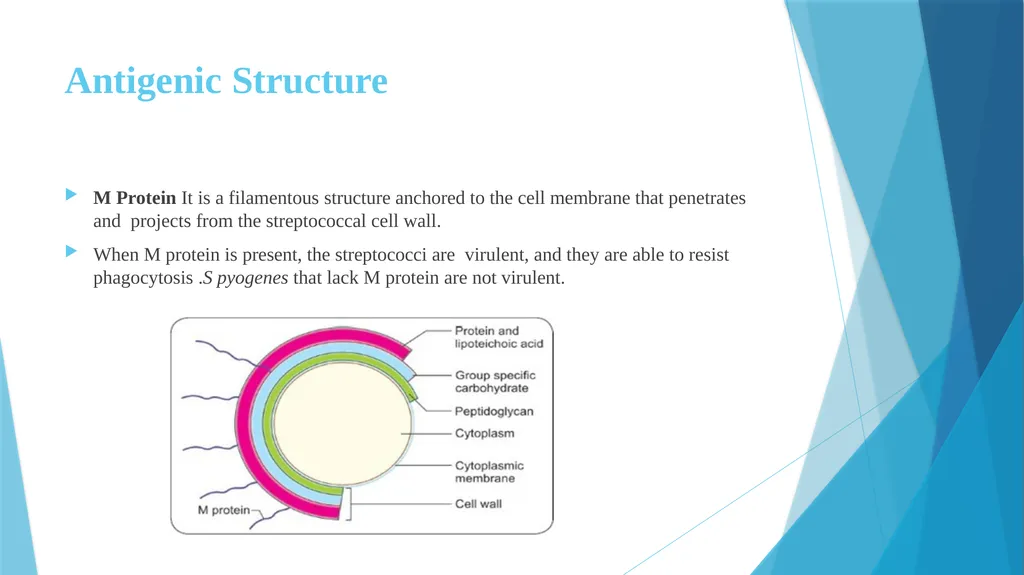
Antigenic Structure M Protein It is a filamentous structure anchored to the cell membrane that penetrates and projects from the streptococcal cell wall.
When M protein is present, the streptococci are virulent, and they are able to resist phagocytosis .S pyogenes that lack M protein are not virulent.<br>
When M protein is present, the streptococci are virulent, and they are able to resist phagocytosis .S pyogenes that lack M protein are not virulent.<br>
07
Toxins and Enzymes More than 20 extracellular products that are antigenic are elaborated by S pyogenes, including the following.
A. Streptokinase (Fibrinolysin) Streptokinase is produced by many strains of group A β-hemolytic streptococci. It transforms the plasminogen of human plasma into plasmin, an active proteolytic enzyme that digests fibrin and other proteins, allowing the bacteria to escape from blood clots.
Streptokinase has been given intravenously for treatment of pulmonary emboli, coronary artery, and venous thromboses.
Deoxyribonucleases Streptococcal deoxyribonucleases A, B, C, and D degrade DNA (DNases) and similar to streptokinase facilitate the spread of streptococci in tissue by liquefying pus.
Hyaluronidase Hyaluronidase splits hyaluronic acid, an important component of the ground substance of connective tissue. Thus, hyaluronidase aids in spreading infecting microorganisms (spreading factor).
Pyrogenic Exotoxins (Erythrogenic Toxin) Pyrogenic exotoxins are elaborated by S pyogenes and associated with streptococcal toxic shock syndrome and scarlet fever.
Hemolysins :The β-hemolytic group A S. pyogenes elaborates two hemolysins (streptolysins) that not only lyse the membranes of erythrocytes but also damage a variety of other cell types.
Streptolysin O is a protein rapidly inactivated in the presence of oxygen.
Streptolysin S is the agent responsible for the hemolytic zones around streptococcal colonies growing on the surface of blood agar plates.<br>
A. Streptokinase (Fibrinolysin) Streptokinase is produced by many strains of group A β-hemolytic streptococci. It transforms the plasminogen of human plasma into plasmin, an active proteolytic enzyme that digests fibrin and other proteins, allowing the bacteria to escape from blood clots.
Streptokinase has been given intravenously for treatment of pulmonary emboli, coronary artery, and venous thromboses.
Deoxyribonucleases Streptococcal deoxyribonucleases A, B, C, and D degrade DNA (DNases) and similar to streptokinase facilitate the spread of streptococci in tissue by liquefying pus.
Hyaluronidase Hyaluronidase splits hyaluronic acid, an important component of the ground substance of connective tissue. Thus, hyaluronidase aids in spreading infecting microorganisms (spreading factor).
Pyrogenic Exotoxins (Erythrogenic Toxin) Pyrogenic exotoxins are elaborated by S pyogenes and associated with streptococcal toxic shock syndrome and scarlet fever.
Hemolysins :The β-hemolytic group A S. pyogenes elaborates two hemolysins (streptolysins) that not only lyse the membranes of erythrocytes but also damage a variety of other cell types.
Streptolysin O is a protein rapidly inactivated in the presence of oxygen.
Streptolysin S is the agent responsible for the hemolytic zones around streptococcal colonies growing on the surface of blood agar plates.<br>
08
Diseases caused by S. pyogenes: Sore throat or pharyngitis
Streptococcal pyoderma—Local infection of superficial layers of skin, especially in children, is called impetigo.
Erysipelas
Cellulitis—Streptococcal cellulitis is an acute, rapidly spreading infection of the skin and subcutaneous tissues. It follows infection associated with mild trauma, burns, wounds, or surgical incisions.
Necrotizing fasciitis (streptococcal gangrene)— There is extensive and very rapidly spreading necrosis of the skin, tissues, and fascia also sometimes termed flesh-eating bacteria.
Puerperal fever—If the streptococci enter the uterus after delivery, puerperal fever develops, which is essentially a septicemia originating in the infected wound (endometritis).
Bacteremia or sepsis
.Streptococcal toxic shock syndrome are characterized by shock, bacteremia, respiratory failure, and multiorgan failure. The infections tend to occur after minor trauma.
scarlet fever in association with S. pyogenes pharyngitis or with skin or soft tissue infection. It is caused by Pyrogenic exotoxins.<br>
Streptococcal pyoderma—Local infection of superficial layers of skin, especially in children, is called impetigo.
Erysipelas
Cellulitis—Streptococcal cellulitis is an acute, rapidly spreading infection of the skin and subcutaneous tissues. It follows infection associated with mild trauma, burns, wounds, or surgical incisions.
Necrotizing fasciitis (streptococcal gangrene)— There is extensive and very rapidly spreading necrosis of the skin, tissues, and fascia also sometimes termed flesh-eating bacteria.
Puerperal fever—If the streptococci enter the uterus after delivery, puerperal fever develops, which is essentially a septicemia originating in the infected wound (endometritis).
Bacteremia or sepsis
.Streptococcal toxic shock syndrome are characterized by shock, bacteremia, respiratory failure, and multiorgan failure. The infections tend to occur after minor trauma.
scarlet fever in association with S. pyogenes pharyngitis or with skin or soft tissue infection. It is caused by Pyrogenic exotoxins.<br>
09
Pneumococci
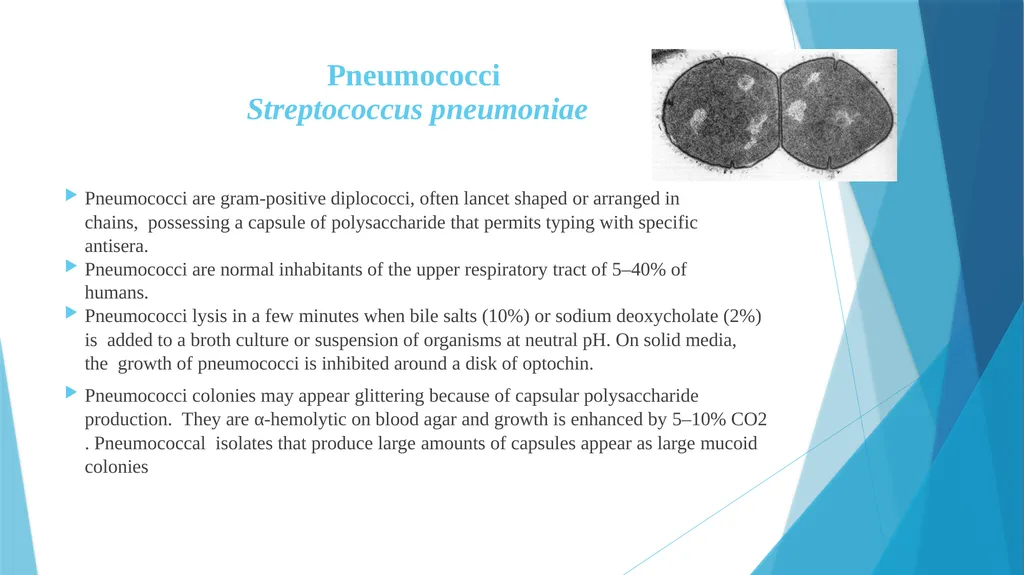
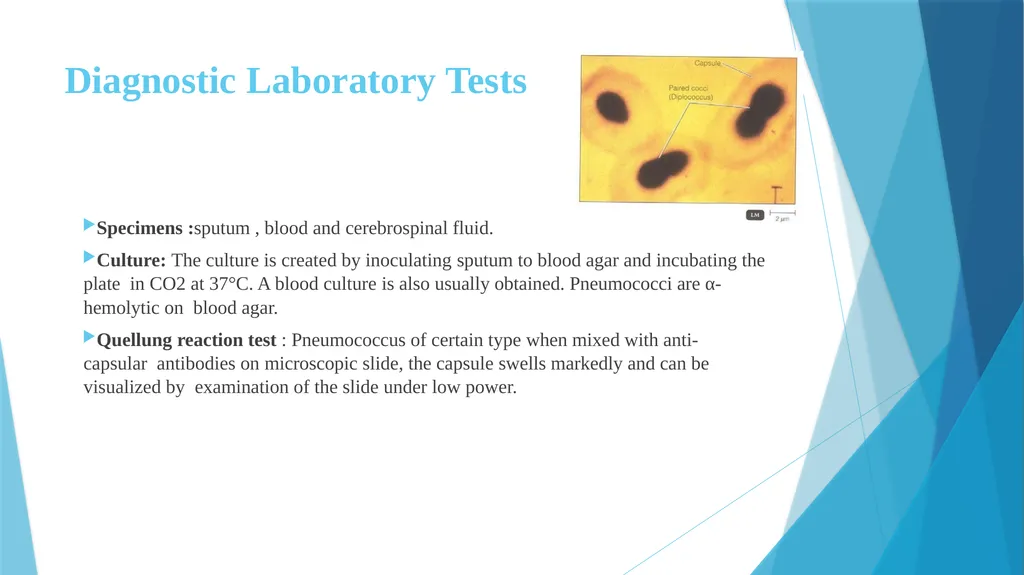
Streptococcus pneumoniae Pneumococci are gram-positive diplococci, often lancet shaped or arranged in chains, possessing a capsule of polysaccharide that permits typing with specific antisera.
Pneumococci are normal inhabitants of the upper respiratory tract of 5–40% of humans.
Pneumococci lysis in a few minutes when bile salts (10%) or sodium deoxycholate (2%) is added to a broth culture or suspension of organisms at neutral pH. On solid media, the growth of pneumococci is inhibited around a disk of optochin.
Pneumococci colonies may appear glittering because of capsular polysaccharide production. They are α-hemolytic on blood agar and growth is enhanced by 5–10% CO2 . Pneumococcal isolates that produce large amounts of capsules appear as large mucoid colonies<br>
Pneumococci are normal inhabitants of the upper respiratory tract of 5–40% of humans.
Pneumococci lysis in a few minutes when bile salts (10%) or sodium deoxycholate (2%) is added to a broth culture or suspension of organisms at neutral pH. On solid media, the growth of pneumococci is inhibited around a disk of optochin.
Pneumococci colonies may appear glittering because of capsular polysaccharide production. They are α-hemolytic on blood agar and growth is enhanced by 5–10% CO2 . Pneumococcal isolates that produce large amounts of capsules appear as large mucoid colonies<br>
10
Virulence Markers of Streptococcus pneumoniae associated with: -Polysaccharide capsule which may prevent or delay phagocytosis. Non capsulated pneumococci are avirulent (nonpathogenic).
- Production of IgA protease: this enzyme inactivate IgA which is the main secretary Ig in upper respiratory tract (URT). This enzyme aids the bacteria to colonize in the URT.<br>
- Production of IgA protease: this enzyme inactivate IgA which is the main secretary Ig in upper respiratory tract (URT). This enzyme aids the bacteria to colonize in the URT.<br>
11
Disease caused by Streptococcus pneumoniae This bacteria cause important human diseases such as pneumonia, bronchitis, sinusitis, otitis media.
The classic presentation of pneumococcal pneumonia is the sudden onset of fever, chills, pleuritic chest pain and cough associated with rusty colored sputum. The sputum is rusty colored.
Early in the disease, when the fever is high, bacteremia is present in 10–20% of cases.
With antimicrobial therapy, the illness is usually terminated promptly; if drugs are given early, the development of consolidation is interrupted. On chest x ray the infiltrate is usually lobar.
The cases that may be complicated by the development of meningitis, arthritis or endocarditis (i.e., the pneumococcus seeds another organ).<br>
The classic presentation of pneumococcal pneumonia is the sudden onset of fever, chills, pleuritic chest pain and cough associated with rusty colored sputum. The sputum is rusty colored.
Early in the disease, when the fever is high, bacteremia is present in 10–20% of cases.
With antimicrobial therapy, the illness is usually terminated promptly; if drugs are given early, the development of consolidation is interrupted. On chest x ray the infiltrate is usually lobar.
The cases that may be complicated by the development of meningitis, arthritis or endocarditis (i.e., the pneumococcus seeds another organ).<br>
12
Diagnostic Laboratory Tests Specimens :sputum , blood and cerebrospinal fluid.
Culture: The culture is created by inoculating sputum to blood agar and incubating the plate in CO2 at 37°C. A blood culture is also usually obtained. Pneumococci are α-hemolytic on blood agar.
Quellung reaction test : Pneumococcus of certain type when mixed with anti- capsular antibodies on microscopic slide, the capsule swells markedly and can be visualized by examination of the slide under low power.<br>
Culture: The culture is created by inoculating sputum to blood agar and incubating the plate in CO2 at 37°C. A blood culture is also usually obtained. Pneumococci are α-hemolytic on blood agar.
Quellung reaction test : Pneumococcus of certain type when mixed with anti- capsular antibodies on microscopic slide, the capsule swells markedly and can be visualized by examination of the slide under low power.<br>
13
Treatment
Penicillin ,erythromycin and vancomycin.
Prevention
It is possible to immunize individuals with type-specific polysaccharides. Such vaccines can probably provide 90% protection against pneumonia.<br>
Penicillin ,erythromycin and vancomycin.
Prevention
It is possible to immunize individuals with type-specific polysaccharides. Such vaccines can probably provide 90% protection against pneumonia.<br>
14
VIRIDANS STREPTOCOCCI They are α-Hemolytic streptococci , their growth is not inhibited by optochin, and colonies are not soluble in bile (deoxycholate) .
The viridans streptococci are the most prevalent members of the normal microbiota of the upper respiratory tract.
After dental extraction, at least 30% of patients have viridans streptococcal bacteremia. In the course of bacteremia, viridans streptococci may settle on normal or previously deformed heart valves, producing acute endocarditis. Rapid destruction of the valves frequently leads to fatal cardiac failure in days or weeks .
Some viridans streptococci ( S mutans) synthesize large polysaccharides such as dextrans or levans from sucrose and contribute importantly to the genesis of dental caries<br>
The viridans streptococci are the most prevalent members of the normal microbiota of the upper respiratory tract.
After dental extraction, at least 30% of patients have viridans streptococcal bacteremia. In the course of bacteremia, viridans streptococci may settle on normal or previously deformed heart valves, producing acute endocarditis. Rapid destruction of the valves frequently leads to fatal cardiac failure in days or weeks .
Some viridans streptococci ( S mutans) synthesize large polysaccharides such as dextrans or levans from sucrose and contribute importantly to the genesis of dental caries<br>
15
Thank you<br>