Qualitative Research Designs Grounded Theory: Strengths and challenges Strengths Fosters creativity-the researcher is not confined to testing preconceived hypothesis, but rather explores empirical data to identify associations Has a
"Qualitative Research Designs Grounded Theory:" is the property of its rightful owner. Permission is granted to
download and print the materials on this website for personal, non-commercial use only, and to display it
on your personal computer provided you do not modify the materials and that you retain all copyright
notices contained in the materials. By downloading content from our website, you accept the terms of this
agreement.
Presentation Transcript
01
Qualitative Research Designs<br>
02
Grounded Theory: Strengths and challenges Strengths
Fosters creativity-the researcher is not confined to testing preconceived hypothesis, but rather explores empirical data to identify associations
Has a systematic data analysis protocol
It is instinctive-this design allows intensive engagement with the data
Allows researchers to conceptualize-researcher can generate valid concepts from data (El Hussein et al. 2014)
Challenges
Time consuming-open data coding is laborious and exhaustive
Vulnerable to methodological errors-complexity of this approach exposes novice researchers to an array of technical errors (Pulla, 2016)
Has numerous approaches<br>
03
Case studies: Strengths and challenges Strengths
Accuracy in relating theory to practice-this approach allows researchers to evaluate associations between theory and practice
Efficient in hypothesis formulation- case studies lead to identification of unanticipated information
Discloses pertinent correlations- intensive analysis of a case allows the researcher to unearth crucial details
Challenges
Lack of rigor-reliability and internal validity are questionable (Lock and Seele, 2018)
Potential of collecting useless data-researcher may collect vast quantities of data of minimal scientific value (Crowe et al. 2011)
Conceptualizing an inappropriate case<br>
04
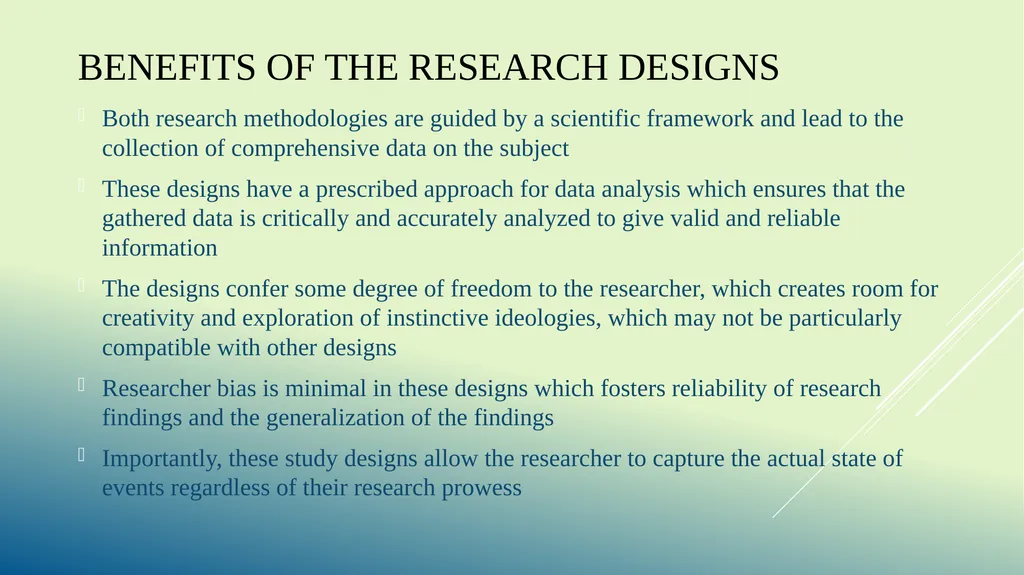
Benefits of the Research Designs Both research methodologies are guided by a scientific framework and lead to the collection of comprehensive data on the subject
These designs have a prescribed approach for data analysis which ensures that the gathered data is critically and accurately analyzed to give valid and reliable information
The designs confer some degree of freedom to the researcher, which creates room for creativity and exploration of instinctive ideologies, which may not be particularly compatible with other designs
Researcher bias is minimal in these designs which fosters reliability of research findings and the generalization of the findings
Importantly, these study designs allow the researcher to capture the actual state of events regardless of their research prowess<br>
05
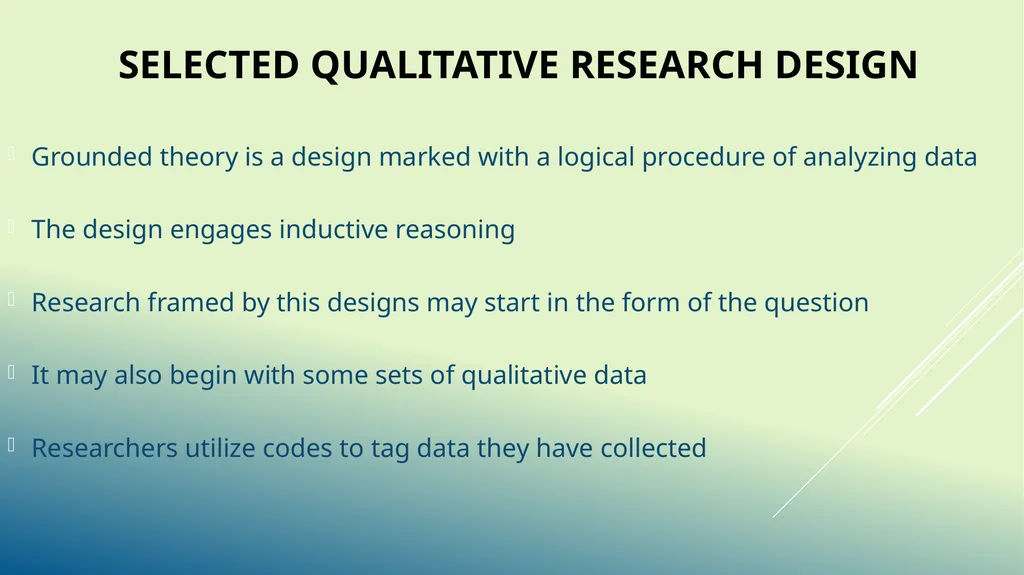
SELECTED QUALITATIVE RESEARCH DESIGN Grounded theory is a design marked with a logical procedure of analyzing data
The design engages inductive reasoning
Research framed by this designs may start in the form of the question
It may also begin with some sets of qualitative data
Researchers utilize codes to tag data they have collected<br>
06
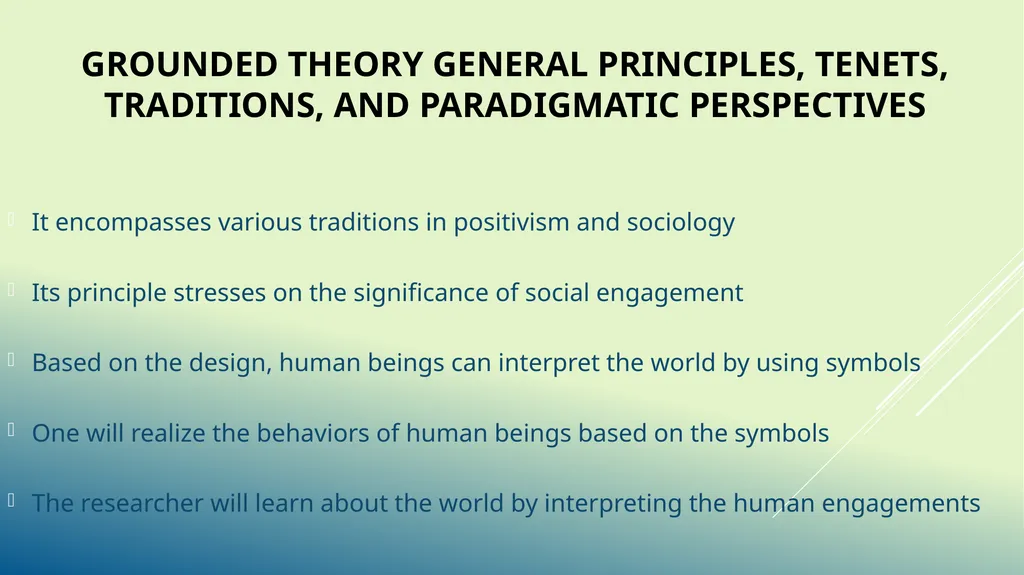
Grounded theory general principles, tenets, traditions, and paradigmatic perspectives It encompasses various traditions in positivism and sociology
Its principle stresses on the significance of social engagement
Based on the design, human beings can interpret the world by using symbols
One will realize the behaviors of human beings based on the symbols
The researcher will learn about the world by interpreting the human engagements<br>
07
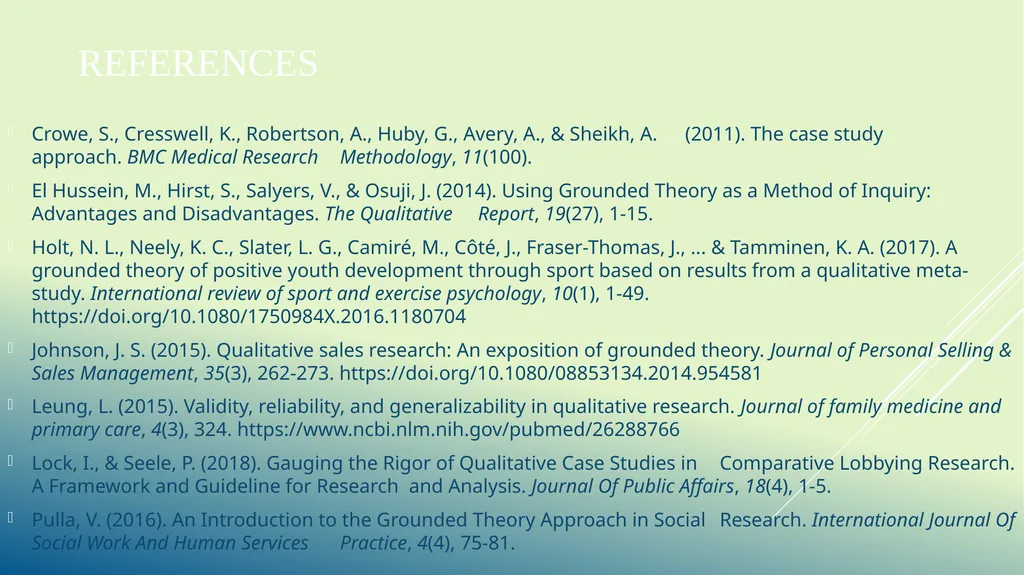
References Crowe, S., Cresswell, K., Robertson, A., Huby, G., Avery, A., & Sheikh, A. (2011). The case study approach. BMC Medical Research Methodology, 11(100).
El Hussein, M., Hirst, S., Salyers, V., & Osuji, J. (2014). Using Grounded Theory as a Method of Inquiry: Advantages and Disadvantages. The Qualitative Report, 19(27), 1-15.
Holt, N. L., Neely, K. C., Slater, L. G., Camiré, M., Côté, J., Fraser-Thomas, J., ... & Tamminen, K. A. (2017). A grounded theory of positive youth development through sport based on results from a qualitative meta-study. International review of sport and exercise psychology, 10(1), 1-49. https://doi.org/10.1080/1750984X.2016.1180704
Johnson, J. S. (2015). Qualitative sales research: An exposition of grounded theory. Journal of Personal Selling & Sales Management, 35(3), 262-273. https://doi.org/10.1080/08853134.2014.954581
Leung, L. (2015). Validity, reliability, and generalizability in qualitative research. Journal of family medicine and primary care, 4(3), 324. https://www.ncbi.nlm.nih.gov/pubmed/26288766
Lock, I., & Seele, P. (2018). Gauging the Rigor of Qualitative Case Studies in Comparative Lobbying Research. A Framework and Guideline for Research and Analysis. Journal Of Public Affairs, 18(4), 1-5.
Pulla, V. (2016). An Introduction to the Grounded Theory Approach in Social Research. International Journal Of Social Work And Human Services Practice, 4(4), 75-81.<br>