
Quality Arts Assessments: A Closer Look When done
T
Published · 23 slides · 0 views

1 / 1





Description
Quality Arts Assessments: A Closer Look When done purposefully, thoughtfully, and skillfully, assessment can and should: increase student interest and motivation to learn help students develop a growth mindset help both teachers and
Related Topics
Share
Embed code
Download this presentation From Below
"Quality Arts Assessments: A Closer Look When done" is the property of its rightful owner. Permission is granted to download and print the materials on this website for personal, non-commercial use only, and to display it on your personal computer provided you do not modify the materials and that you retain all copyright notices contained in the materials. By downloading content from our website, you accept the terms of this agreement.
Presentation Transcript
01
Quality Arts Assessments:
A Closer Look<br>
A Closer Look<br>
02
When done purposefully, thoughtfully, and skillfully, assessment can and should:
increase student interest and motivation to learn
help students develop a growth mindset
help both teachers and students understand students' learning styles and challenges
improve classroom instruction and student achievement Assessment: What’s the Point?<br>
increase student interest and motivation to learn
help students develop a growth mindset
help both teachers and students understand students' learning styles and challenges
improve classroom instruction and student achievement Assessment: What’s the Point?<br>
03
Achievement in the arts can be highly subjective, but there are many assessable aspects, including:
Content: Can students demonstrate knowledge of traditions, history, vocabulary, and other factual information?
Technique: Can students demonstrate specific measurable skills (e.g., playing correct notes in a piece of music; performing a plié in ballet)?
Thinking / social behaviors: Do students demonstrate skills like inquiry, organization, collaboration, innovation, persistence? Arts Assessment Misconception #1 ✘ Success in the arts is too subjective to evaluate.<br>
Content: Can students demonstrate knowledge of traditions, history, vocabulary, and other factual information?
Technique: Can students demonstrate specific measurable skills (e.g., playing correct notes in a piece of music; performing a plié in ballet)?
Thinking / social behaviors: Do students demonstrate skills like inquiry, organization, collaboration, innovation, persistence? Arts Assessment Misconception #1 ✘ Success in the arts is too subjective to evaluate.<br>
04
High-quality arts assessments:
Examine student knowledge of the topic or subject
The student’s artmaking process (how they create artwork)
The student’s final product (the artwork itself)
Process-related criteria are emphasized, including:
Effort and persistence through challenges
Problem-solving ability
Arts classroom behaviors (e.g., collaboration; peer critique) Arts Assessment Misconception #2 ✘ The end product is the most important thing to assess.<br>
Examine student knowledge of the topic or subject
The student’s artmaking process (how they create artwork)
The student’s final product (the artwork itself)
Process-related criteria are emphasized, including:
Effort and persistence through challenges
Problem-solving ability
Arts classroom behaviors (e.g., collaboration; peer critique) Arts Assessment Misconception #2 ✘ The end product is the most important thing to assess.<br>
05
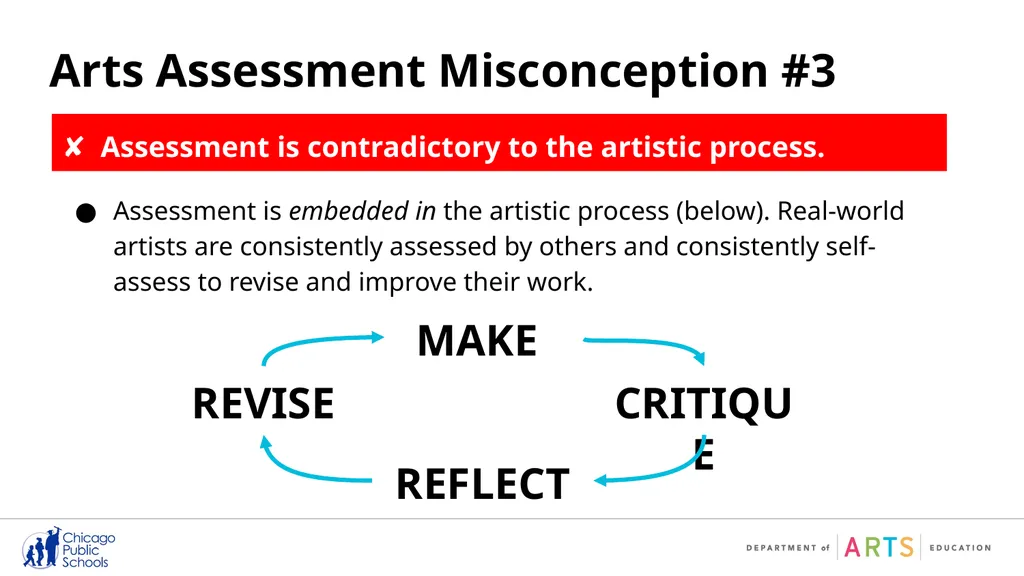
Assessment is embedded in the artistic process (below). Real-world artists are consistently assessed by others and consistently self-assess to revise and improve their work. Arts Assessment Misconception #3 ✘ Assessment is contradictory to the artistic process.<br>
06
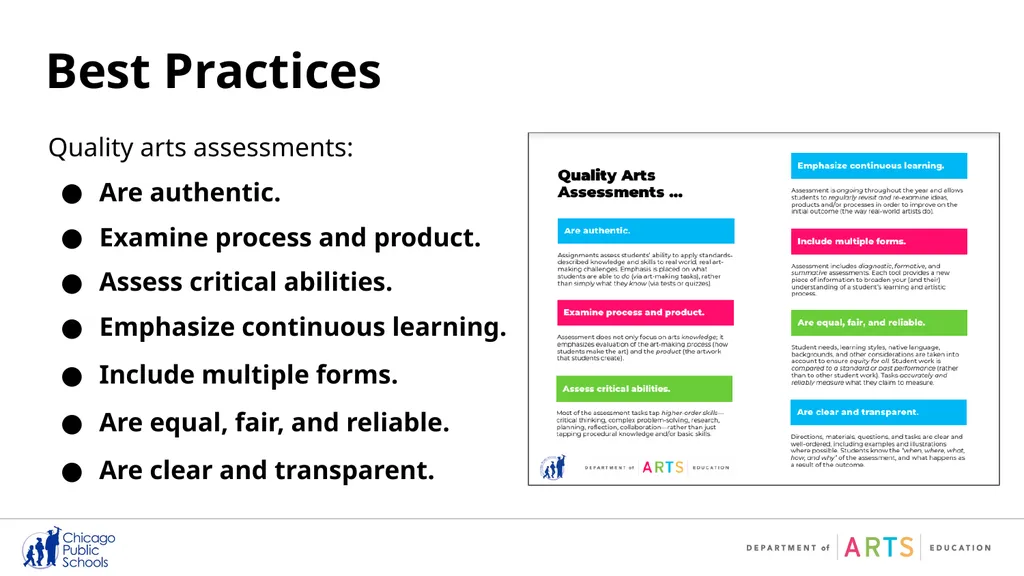
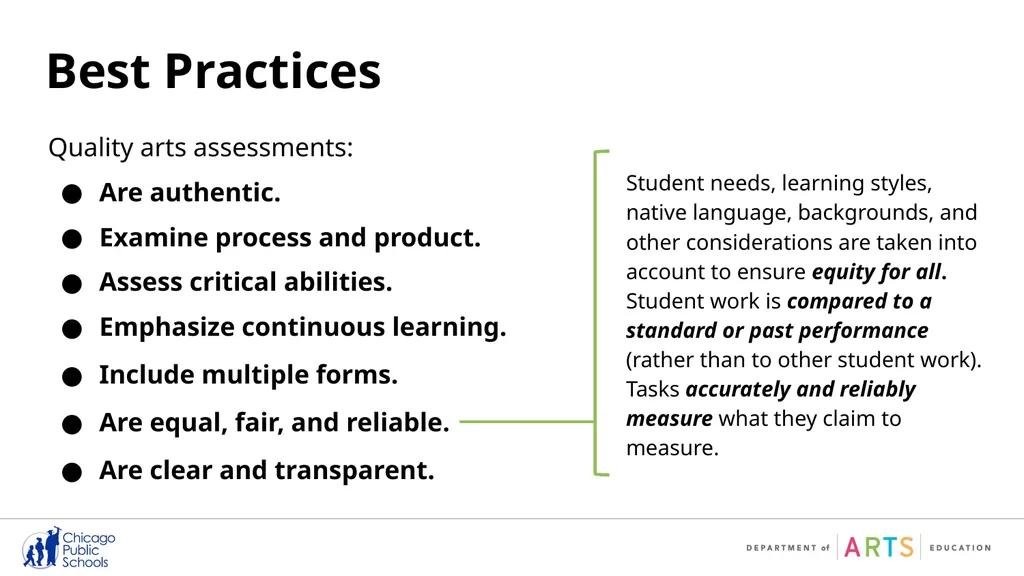
Quality arts assessments:
Are authentic.
Examine process and product.
Assess critical abilities.
Emphasize continuous learning.
Include multiple forms.
Are equal, fair, and reliable.
Are clear and transparent. Best Practices<br>
Are authentic.
Examine process and product.
Assess critical abilities.
Emphasize continuous learning.
Include multiple forms.
Are equal, fair, and reliable.
Are clear and transparent. Best Practices<br>
07
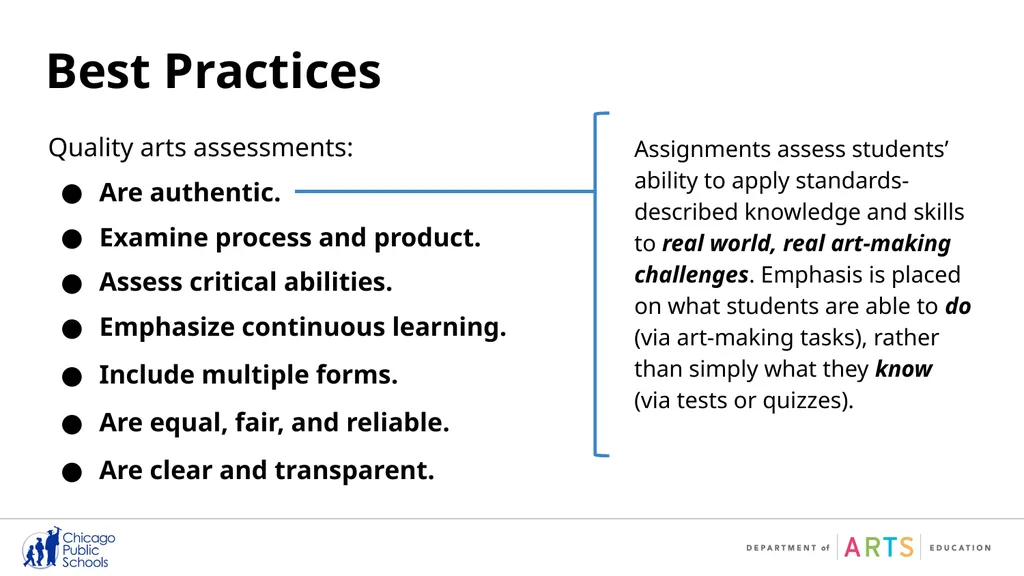
Quality arts assessments:
Are authentic.
Examine process and product.
Assess critical abilities.
Emphasize continuous learning.
Include multiple forms.
Are equal, fair, and reliable.
Are clear and transparent. Assignments assess students’ ability to apply standards- described knowledge and skills to real world, real art-making challenges. Emphasis is placed on what students are able to do (via art-making tasks), rather than simply what they know (via tests or quizzes). Best Practices<br>
Are authentic.
Examine process and product.
Assess critical abilities.
Emphasize continuous learning.
Include multiple forms.
Are equal, fair, and reliable.
Are clear and transparent. Assignments assess students’ ability to apply standards- described knowledge and skills to real world, real art-making challenges. Emphasis is placed on what students are able to do (via art-making tasks), rather than simply what they know (via tests or quizzes). Best Practices<br>
08
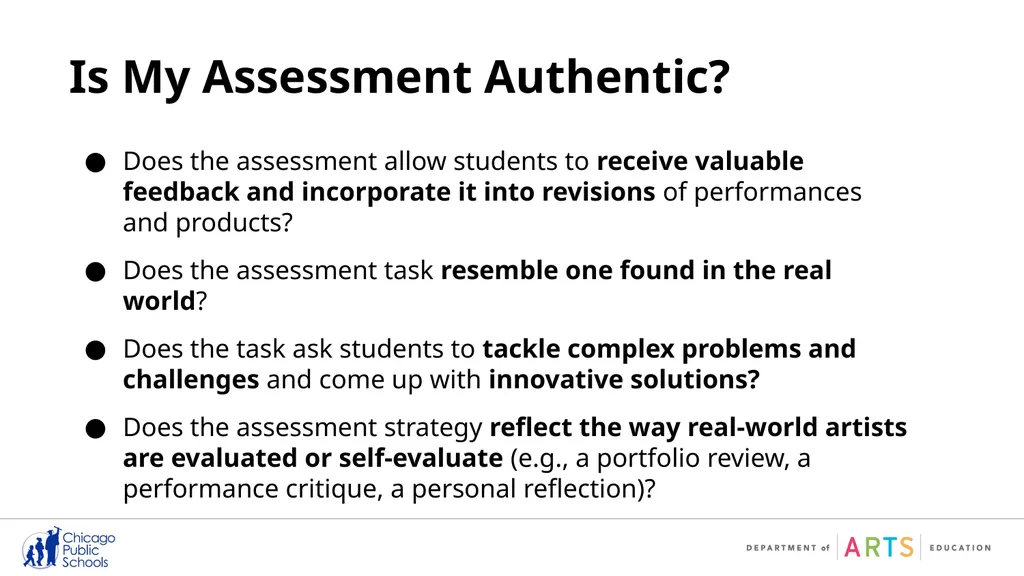
Is My Assessment Authentic? Does the assessment allow students to receive valuable feedback and incorporate it into revisions of performances and products?
Does the assessment task resemble one found in the real world?
Does the task ask students to tackle complex problems and challenges and come up with innovative solutions?
Does the assessment strategy reflect the way real-world artists are evaluated or self-evaluate (e.g., a portfolio review, a performance critique, a personal reflection)?<br>
Does the assessment task resemble one found in the real world?
Does the task ask students to tackle complex problems and challenges and come up with innovative solutions?
Does the assessment strategy reflect the way real-world artists are evaluated or self-evaluate (e.g., a portfolio review, a performance critique, a personal reflection)?<br>
09
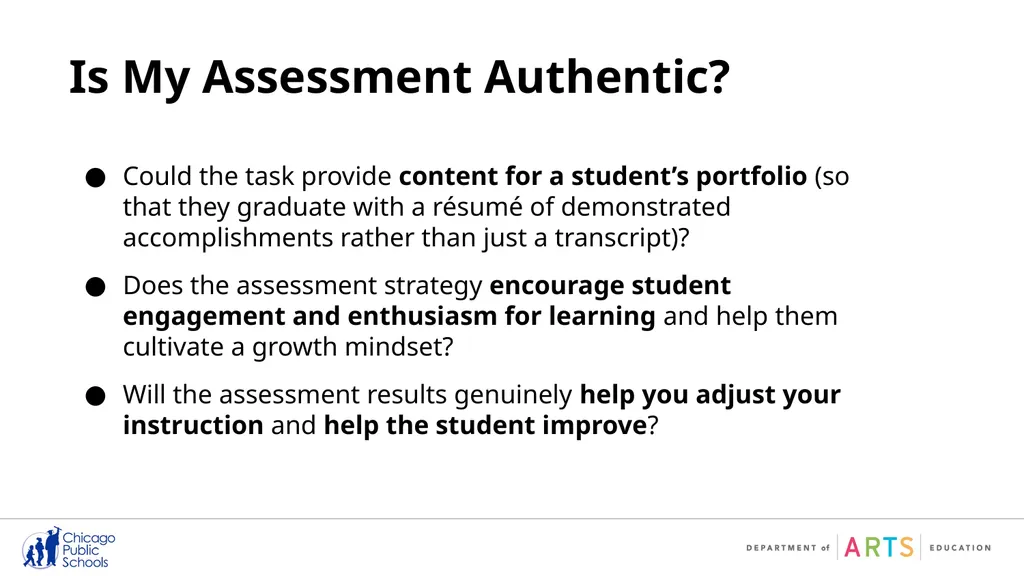
Could the task provide content for a student’s portfolio (so that they graduate with a résumé of demonstrated accomplishments rather than just a transcript)?
Does the assessment strategy encourage student engagement and enthusiasm for learning and help them cultivate a growth mindset?
Will the assessment results genuinely help you adjust your instruction and help the student improve? Is My Assessment Authentic?<br>
Does the assessment strategy encourage student engagement and enthusiasm for learning and help them cultivate a growth mindset?
Will the assessment results genuinely help you adjust your instruction and help the student improve? Is My Assessment Authentic?<br>
10
Quality arts assessments:
Are authentic.
Examine process and product.
Assess critical abilities.
Emphasize continuous learning.
Include multiple forms.
Are equal, fair, and reliable.
Are clear and transparent. Assessment does not only focus on students’ arts knowledge; it emphasizes evaluation of the art-making process (how students make the art) and the product (the artwork that students create). Best Practices<br>
Are authentic.
Examine process and product.
Assess critical abilities.
Emphasize continuous learning.
Include multiple forms.
Are equal, fair, and reliable.
Are clear and transparent. Assessment does not only focus on students’ arts knowledge; it emphasizes evaluation of the art-making process (how students make the art) and the product (the artwork that students create). Best Practices<br>
11
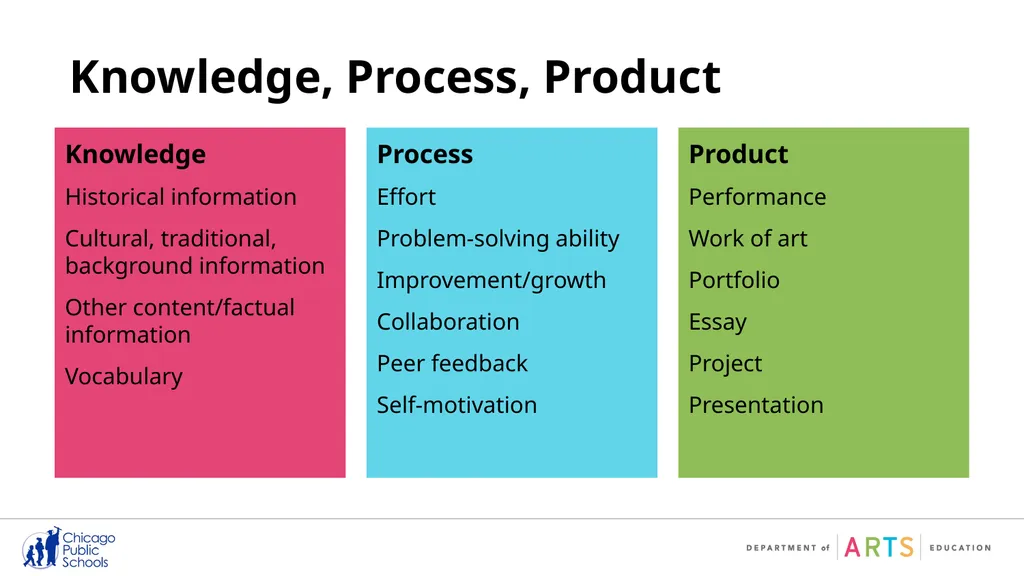
Knowledge, Process, Product Knowledge
Historical information
Cultural, traditional, background information
Other content/factual information
Vocabulary Process
Effort
Problem-solving ability
Improvement/growth
Collaboration
Peer feedback
Self-motivation Product
Performance
Work of art
Portfolio
Essay
Project
Presentation<br>
Historical information
Cultural, traditional, background information
Other content/factual information
Vocabulary Process
Effort
Problem-solving ability
Improvement/growth
Collaboration
Peer feedback
Self-motivation Product
Performance
Work of art
Portfolio
Essay
Project
Presentation<br>
12
Quality arts assessments:
Are authentic.
Examine process and product.
Assess critical abilities.
Emphasize continuous learning.
Include multiple forms.
Are equal, fair, and reliable.
Are clear and transparent. Most of the assessment tasks tap higher-order skills—critical thinking, complex problem-solving, research, planning, reflection, collaboration— rather than just tapping procedural knowledge and/or basic skills. Best Practices<br>
Are authentic.
Examine process and product.
Assess critical abilities.
Emphasize continuous learning.
Include multiple forms.
Are equal, fair, and reliable.
Are clear and transparent. Most of the assessment tasks tap higher-order skills—critical thinking, complex problem-solving, research, planning, reflection, collaboration— rather than just tapping procedural knowledge and/or basic skills. Best Practices<br>
13
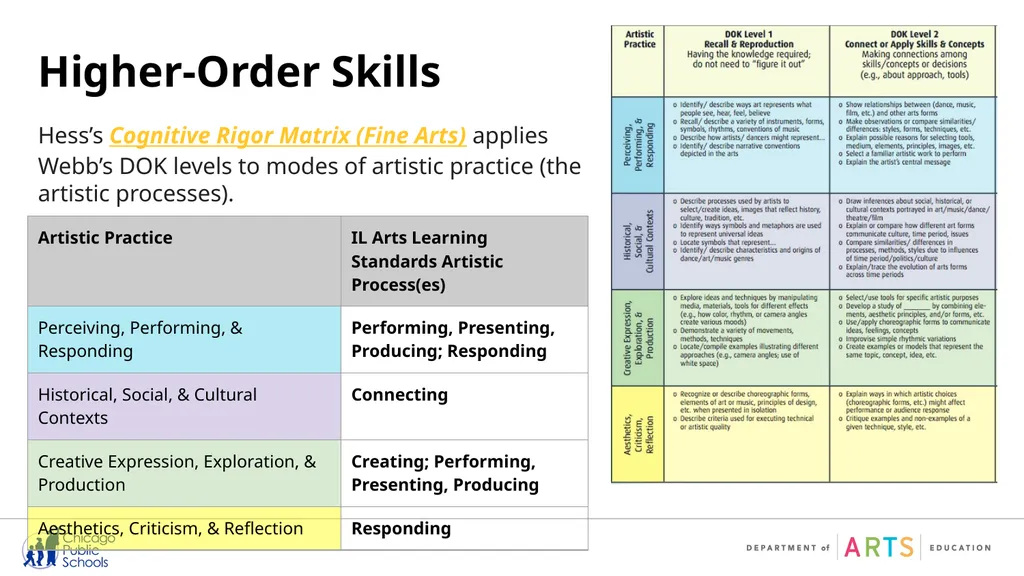
Higher-Order Skills Hess’s Cognitive Rigor Matrix (Fine Arts) applies Webb’s DOK levels to modes of artistic practice (the artistic processes).<br>
14
Quality arts assessments:
Are authentic.
Examine process and product.
Assess critical abilities.
Emphasize continuous learning.
Include multiple forms.
Are equal, fair, and reliable.
Are clear and transparent. Assessment is ongoing throughout the year and allows students to regularly revisit and re-examine ideas, products and/or processes to improve on the initial outcome (the way real-world artists do). Best Practices<br>
Are authentic.
Examine process and product.
Assess critical abilities.
Emphasize continuous learning.
Include multiple forms.
Are equal, fair, and reliable.
Are clear and transparent. Assessment is ongoing throughout the year and allows students to regularly revisit and re-examine ideas, products and/or processes to improve on the initial outcome (the way real-world artists do). Best Practices<br>
15
Quality arts assessments:
Are authentic.
Examine process and product.
Assess critical abilities.
Emphasize continuous learning.
Include multiple forms.
Are equal, fair, and reliable.
Are clear and transparent. The assessment system includes diagnostic, formative, and summative assessments. Each tool provides a new piece of information to broaden your (and their) understanding of a student’s learning and artistic process. Best Practices<br>
Are authentic.
Examine process and product.
Assess critical abilities.
Emphasize continuous learning.
Include multiple forms.
Are equal, fair, and reliable.
Are clear and transparent. The assessment system includes diagnostic, formative, and summative assessments. Each tool provides a new piece of information to broaden your (and their) understanding of a student’s learning and artistic process. Best Practices<br>
16
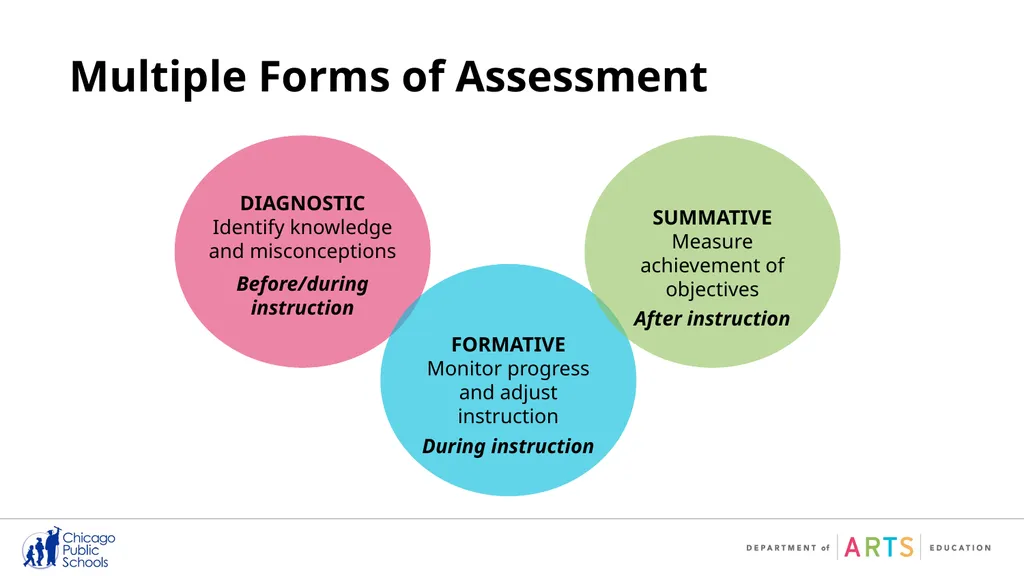
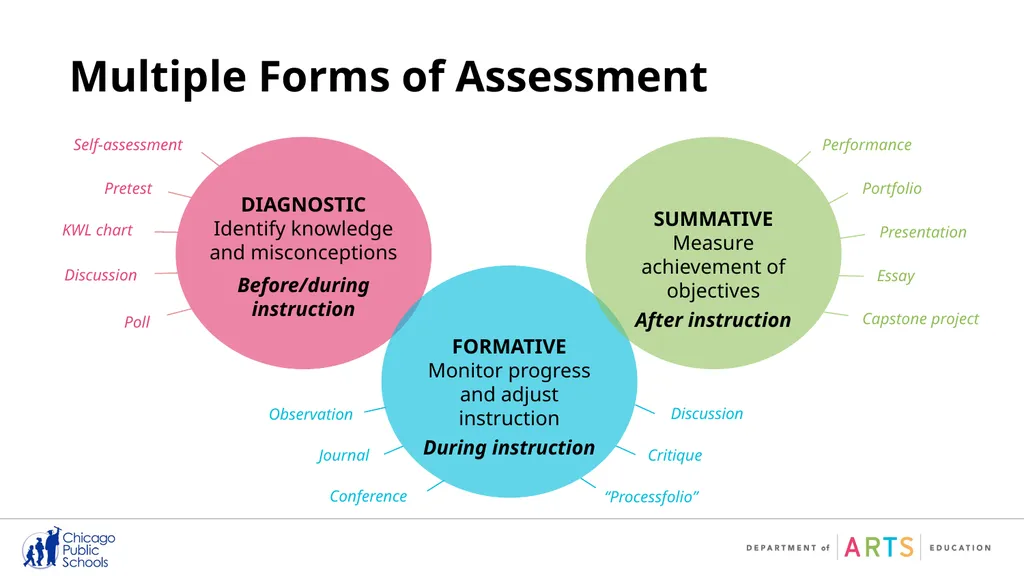
Multiple Forms of Assessment DIAGNOSTIC
Identify knowledge and misconceptions
Before/during instruction FORMATIVE Monitor progress and adjust instruction
During instruction SUMMATIVE Measure achievement of objectives
After instruction<br>
Before/during instruction FORMATIVE Monitor progress and adjust instruction
During instruction SUMMATIVE Measure achievement of objectives
After instruction<br>
17
Multiple Forms of Assessment<br>
18
Quality arts assessments:
Are authentic.
Examine process and product.
Assess critical abilities.
Emphasize continuous learning.
Include multiple forms.
Are equal, fair, and reliable.
Are clear and transparent. Student needs, learning styles, native language, backgrounds, and other considerations are taken into account to ensure equity for all. Student work is compared to a standard or past performance (rather than to other student work). Tasks accurately and reliably measure what they claim to measure. Best Practices<br>
Are authentic.
Examine process and product.
Assess critical abilities.
Emphasize continuous learning.
Include multiple forms.
Are equal, fair, and reliable.
Are clear and transparent. Student needs, learning styles, native language, backgrounds, and other considerations are taken into account to ensure equity for all. Student work is compared to a standard or past performance (rather than to other student work). Tasks accurately and reliably measure what they claim to measure. Best Practices<br>
19
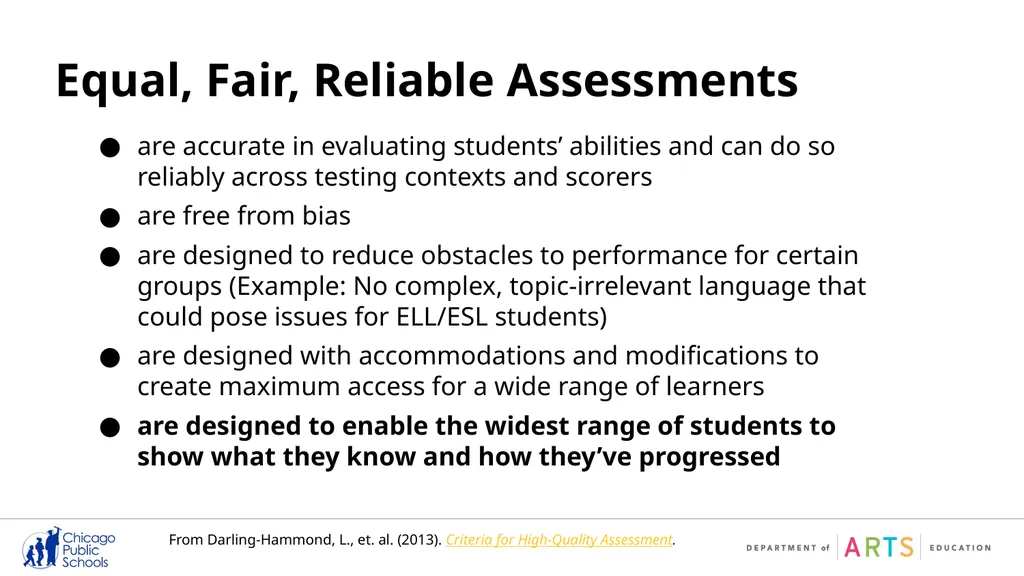
Equal, Fair, Reliable Assessments are accurate in evaluating students’ abilities and can do so reliably across testing contexts and scorers
are free from bias
are designed to reduce obstacles to performance for certain groups (Example: No complex, topic-irrelevant language that could pose issues for ELL/ESL students)
are designed with accommodations and modifications to create maximum access for a wide range of learners
are designed to enable the widest range of students to show what they know and how they’ve progressed From Darling-Hammond, L., et. al. (2013). Criteria for High-Quality Assessment.<br>
are free from bias
are designed to reduce obstacles to performance for certain groups (Example: No complex, topic-irrelevant language that could pose issues for ELL/ESL students)
are designed with accommodations and modifications to create maximum access for a wide range of learners
are designed to enable the widest range of students to show what they know and how they’ve progressed From Darling-Hammond, L., et. al. (2013). Criteria for High-Quality Assessment.<br>
20
Quality arts assessments:
Are authentic.
Examine process and product.
Assess critical abilities.
Emphasize continuous learning.
Include multiple forms.
Are equal, fair, and reliable.
Are clear and transparent. Directions, materials, questions, and tasks are clear and well-ordered, including examples and illustrations where possible. Students know the “when, where, what, how, and why” of the assessment, and what happens as a result of the outcome. Best Practices<br>
Are authentic.
Examine process and product.
Assess critical abilities.
Emphasize continuous learning.
Include multiple forms.
Are equal, fair, and reliable.
Are clear and transparent. Directions, materials, questions, and tasks are clear and well-ordered, including examples and illustrations where possible. Students know the “when, where, what, how, and why” of the assessment, and what happens as a result of the outcome. Best Practices<br>
21
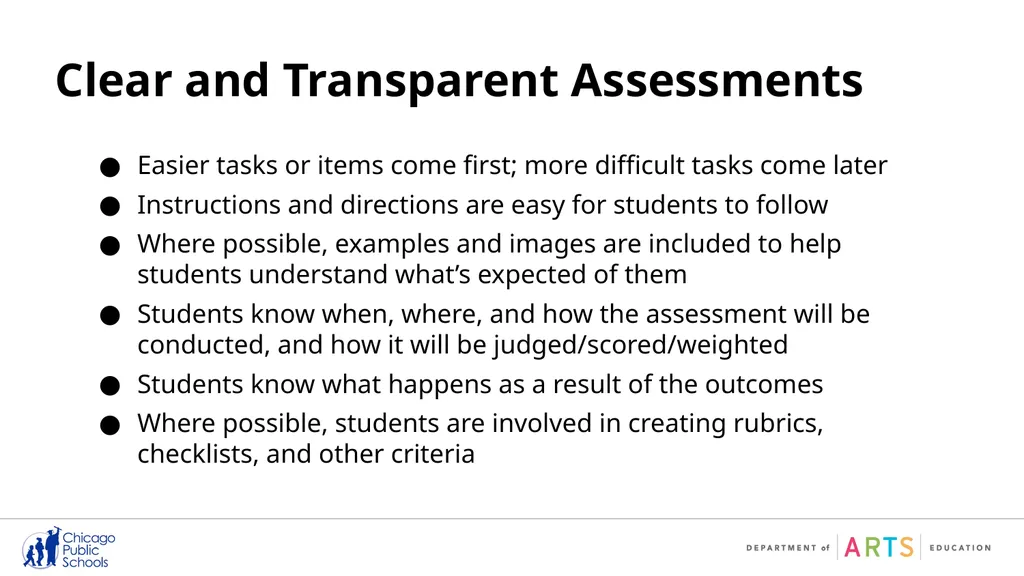
Clear and Transparent Assessments Easier tasks or items come first; more difficult tasks come later
Instructions and directions are easy for students to follow
Where possible, examples and images are included to help students understand what’s expected of them
Students know when, where, and how the assessment will be conducted, and how it will be judged/scored/weighted
Students know what happens as a result of the outcomes
Where possible, students are involved in creating rubrics, checklists, and other criteria<br>
Instructions and directions are easy for students to follow
Where possible, examples and images are included to help students understand what’s expected of them
Students know when, where, and how the assessment will be conducted, and how it will be judged/scored/weighted
Students know what happens as a result of the outcomes
Where possible, students are involved in creating rubrics, checklists, and other criteria<br>
22
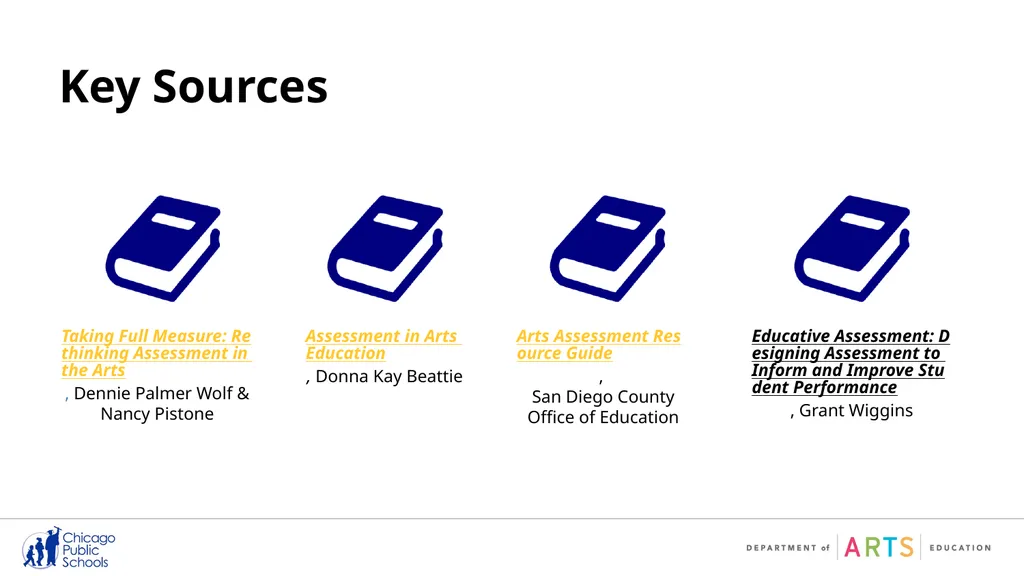
Taking Full Measure: Rethinking Assessment in the Arts, Dennie Palmer Wolf & Nancy Pistone Assessment in Arts Education, Donna Kay Beattie Arts Assessment Resource Guide,
San Diego County Office of Education Educative Assessment: Designing Assessment to Inform and Improve Student Performance, Grant Wiggins Key Sources<br>
23
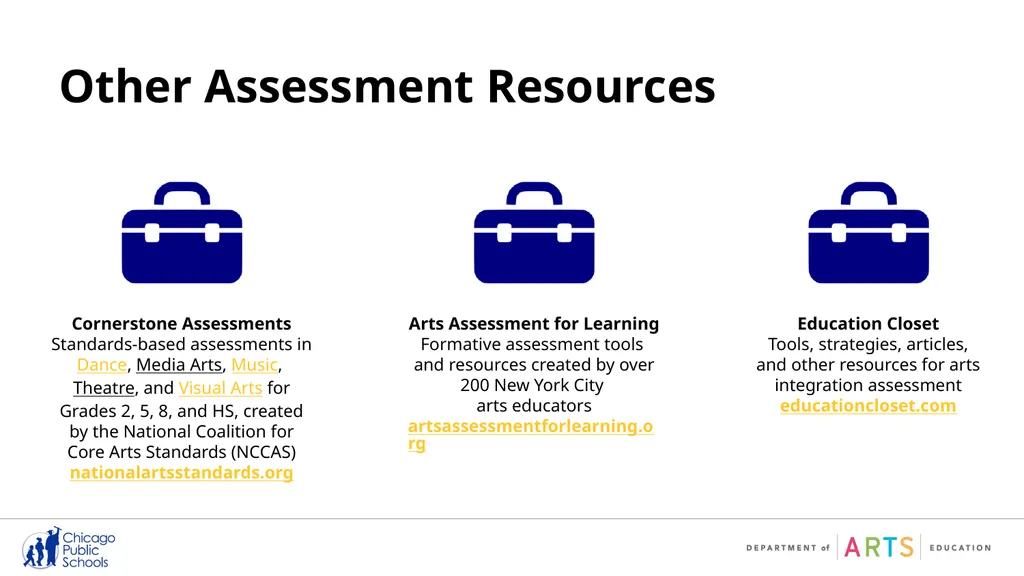
Cornerstone Assessments
Standards-based assessments in Dance, Media Arts, Music, Theatre, and Visual Arts for Grades 2, 5, 8, and HS, created by the National Coalition for Core Arts Standards (NCCAS)
nationalartsstandards.org Arts Assessment for Learning Formative assessment tools and resources created by over 200 New York City
arts educators
artsassessmentforlearning.org Education Closet
Tools, strategies, articles, and other resources for arts integration assessment educationcloset.com Other Assessment Resources<br>
Tools, strategies, articles, and other resources for arts integration assessment educationcloset.com Other Assessment Resources<br>