
Quality Day 2022 – Achieving with Pride! Using
MT
Published · 23 slides · 0 views
1 / 1

Description
Quality Day 2022 Achieving with Pride! Using Results for Improvement: Academic Programs and Support Units Agenda Reporting data Analyzing data Using results to develop an action plan The institution identifies expected outcomes, assesses
Related Topics
Share
Embed code
Download this presentation From Below
"Quality Day 2022 – Achieving with Pride! Using" is the property of its rightful owner. Permission is granted to download and print the materials on this website for personal, non-commercial use only, and to display it on your personal computer provided you do not modify the materials and that you retain all copyright notices contained in the materials. By downloading content from our website, you accept the terms of this agreement.
Presentation Transcript
01
Quality Day 2022 – Achieving with Pride! Using Results for Improvement: Academic Programs and Support Units<br>
02
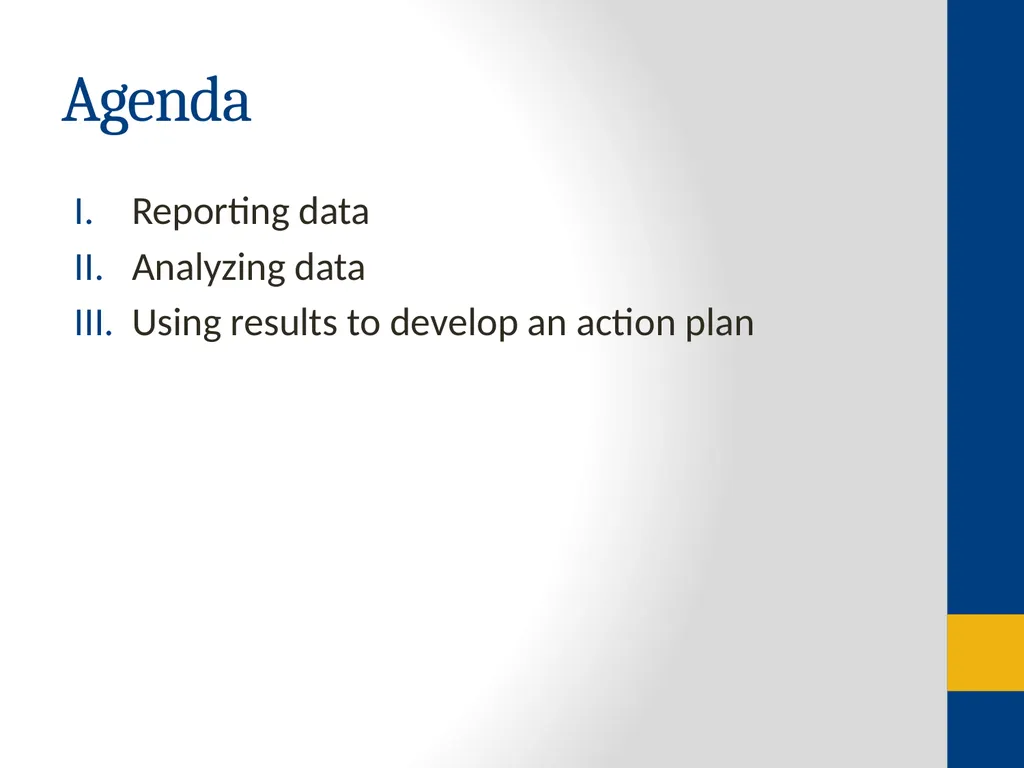
Agenda Reporting data
Analyzing data
Using results to develop an action plan<br>
Analyzing data
Using results to develop an action plan<br>
03
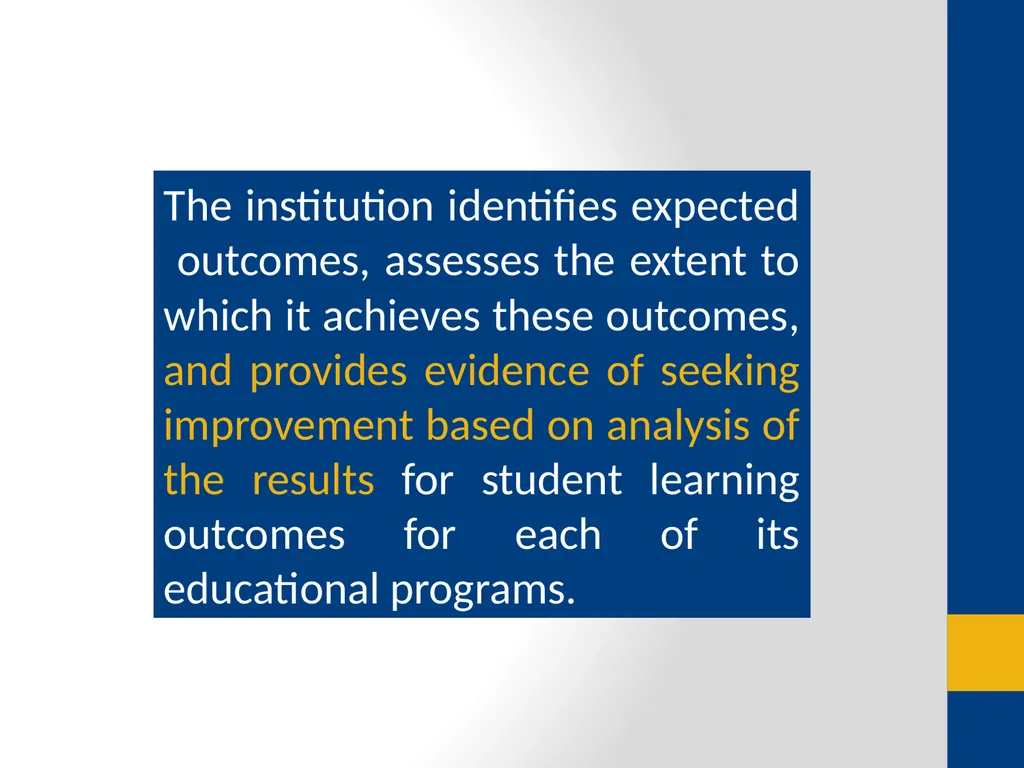
The institution identifies expected outcomes, assesses the extent to which it achieves these outcomes, and provides evidence of seeking improvement based on analysis of the results for student learning outcomes for each of its educational programs.<br>
04
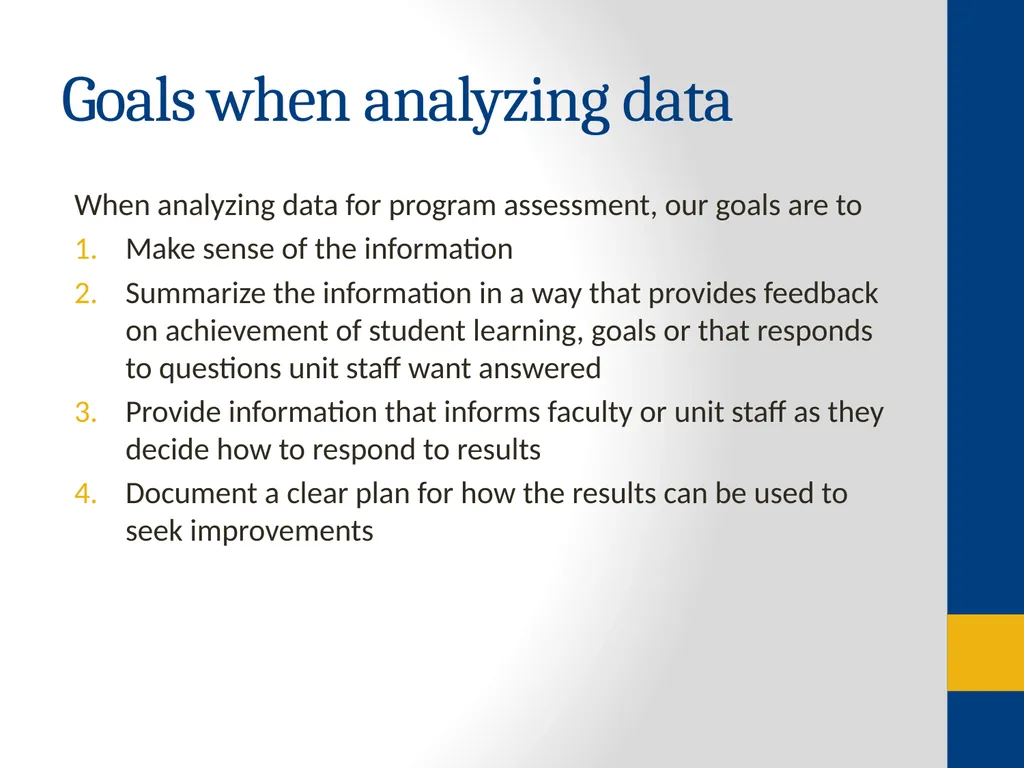
Goals when analyzing data When analyzing data for program assessment, our goals are to
Make sense of the information
Summarize the information in a way that provides feedback on achievement of student learning, goals or that responds to questions unit staff want answered
Provide information that informs faculty or unit staff as they decide how to respond to results
Document a clear plan for how the results can be used to seek improvements<br>
Make sense of the information
Summarize the information in a way that provides feedback on achievement of student learning, goals or that responds to questions unit staff want answered
Provide information that informs faculty or unit staff as they decide how to respond to results
Document a clear plan for how the results can be used to seek improvements<br>
05
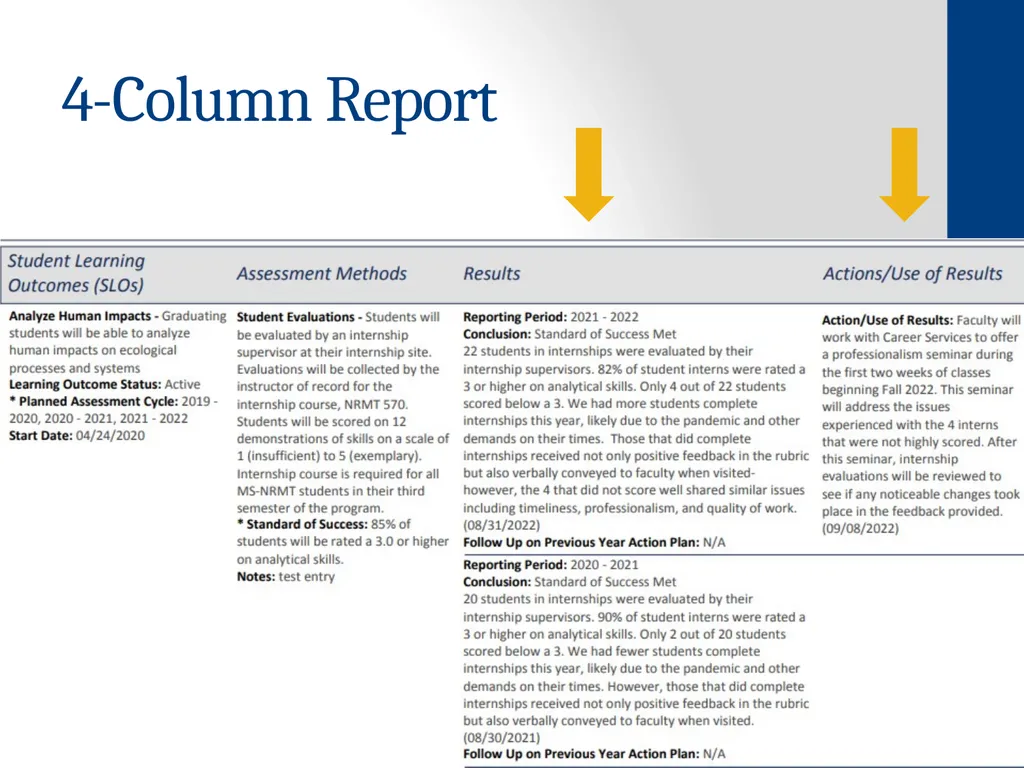
4-Column Report<br>
06
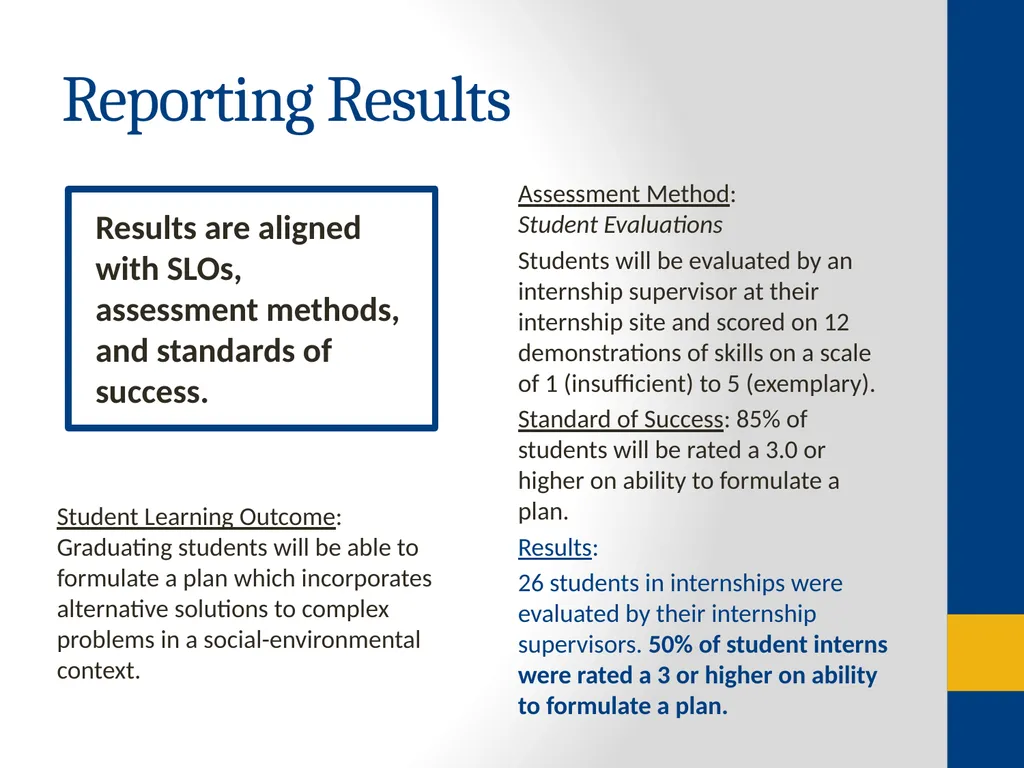
Reporting Results Assessment Method:
Student Evaluations
Students will be evaluated by an internship supervisor at their internship site and scored on 12 demonstrations of skills on a scale of 1 (insufficient) to 5 (exemplary).
Standard of Success: 85% of students will be rated a 3.0 or higher on ability to formulate a plan.
Results:
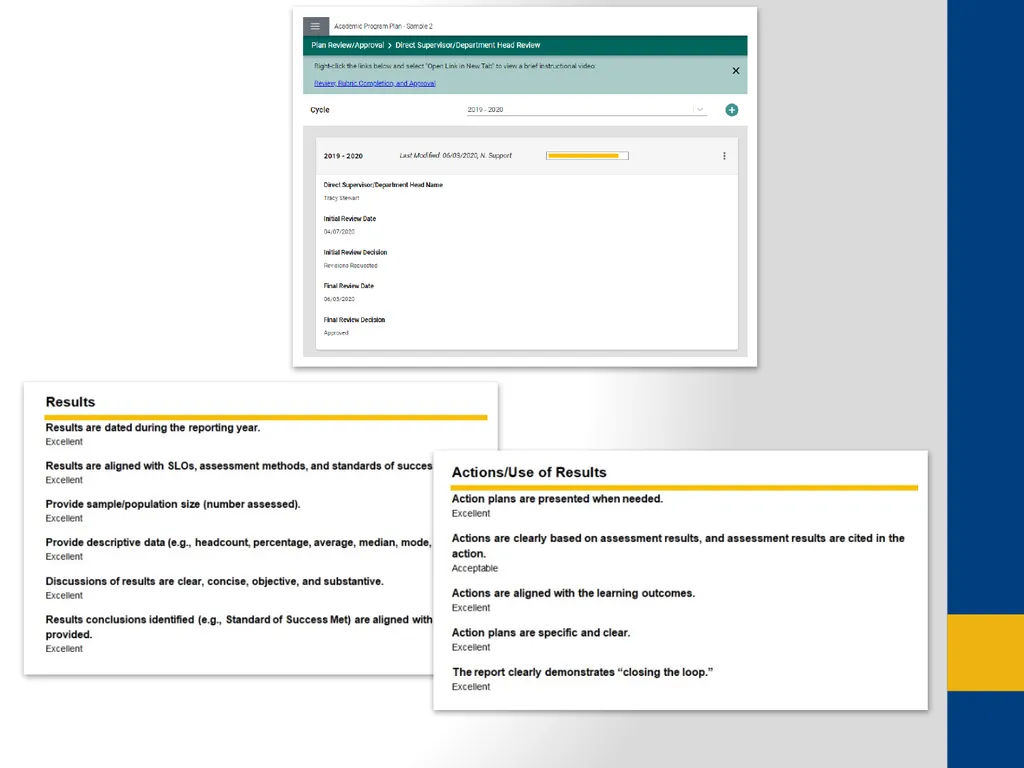
26 students in internships were evaluated by their internship supervisors. 50% of student interns were rated a 3 or higher on ability to formulate a plan. Results are aligned with SLOs, assessment methods, and standards of success. Student Learning Outcome:
Graduating students will be able to formulate a plan which incorporates alternative solutions to complex problems in a social-environmental context.<br>
Students will be evaluated by an internship supervisor at their internship site and scored on 12 demonstrations of skills on a scale of 1 (insufficient) to 5 (exemplary).
Standard of Success: 85% of students will be rated a 3.0 or higher on ability to formulate a plan.
Results:
26 students in internships were evaluated by their internship supervisors. 50% of student interns were rated a 3 or higher on ability to formulate a plan. Results are aligned with SLOs, assessment methods, and standards of success. Student Learning Outcome:
Graduating students will be able to formulate a plan which incorporates alternative solutions to complex problems in a social-environmental context.<br>
07
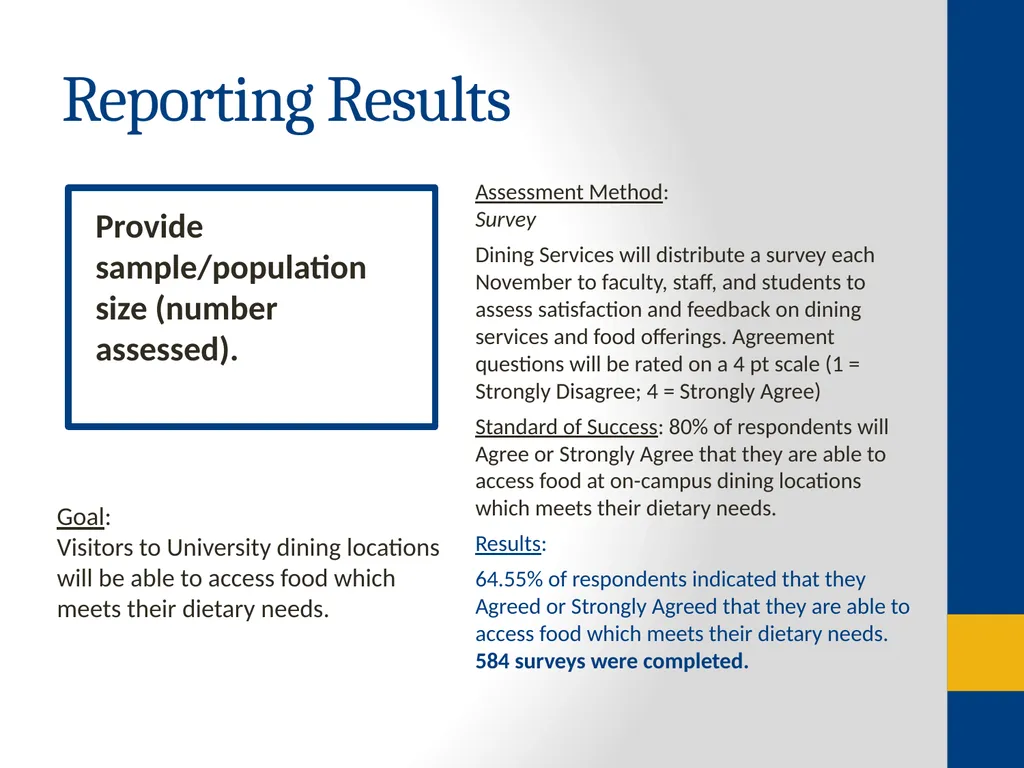
Reporting Results Assessment Method:
Survey
Dining Services will distribute a survey each November to faculty, staff, and students to assess satisfaction and feedback on dining services and food offerings. Agreement questions will be rated on a 4 pt scale (1 = Strongly Disagree; 4 = Strongly Agree)
Standard of Success: 80% of respondents will Agree or Strongly Agree that they are able to access food at on-campus dining locations which meets their dietary needs.
Results:
64.55% of respondents indicated that they Agreed or Strongly Agreed that they are able to access food which meets their dietary needs. 584 surveys were completed. Provide sample/population size (number assessed). Goal:
Visitors to University dining locations will be able to access food which meets their dietary needs.<br>
Dining Services will distribute a survey each November to faculty, staff, and students to assess satisfaction and feedback on dining services and food offerings. Agreement questions will be rated on a 4 pt scale (1 = Strongly Disagree; 4 = Strongly Agree)
Standard of Success: 80% of respondents will Agree or Strongly Agree that they are able to access food at on-campus dining locations which meets their dietary needs.
Results:
64.55% of respondents indicated that they Agreed or Strongly Agreed that they are able to access food which meets their dietary needs. 584 surveys were completed. Provide sample/population size (number assessed). Goal:
Visitors to University dining locations will be able to access food which meets their dietary needs.<br>
08
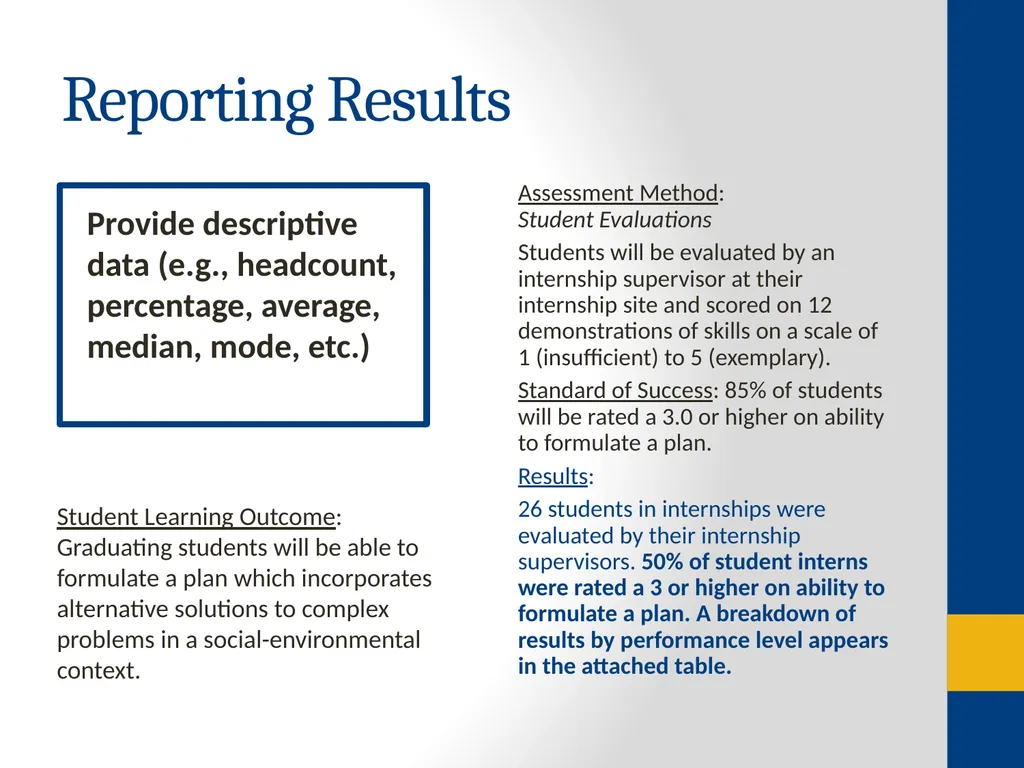
Reporting Results Assessment Method:
Student Evaluations
Students will be evaluated by an internship supervisor at their internship site and scored on 12 demonstrations of skills on a scale of 1 (insufficient) to 5 (exemplary).
Standard of Success: 85% of students will be rated a 3.0 or higher on ability to formulate a plan.
Results:
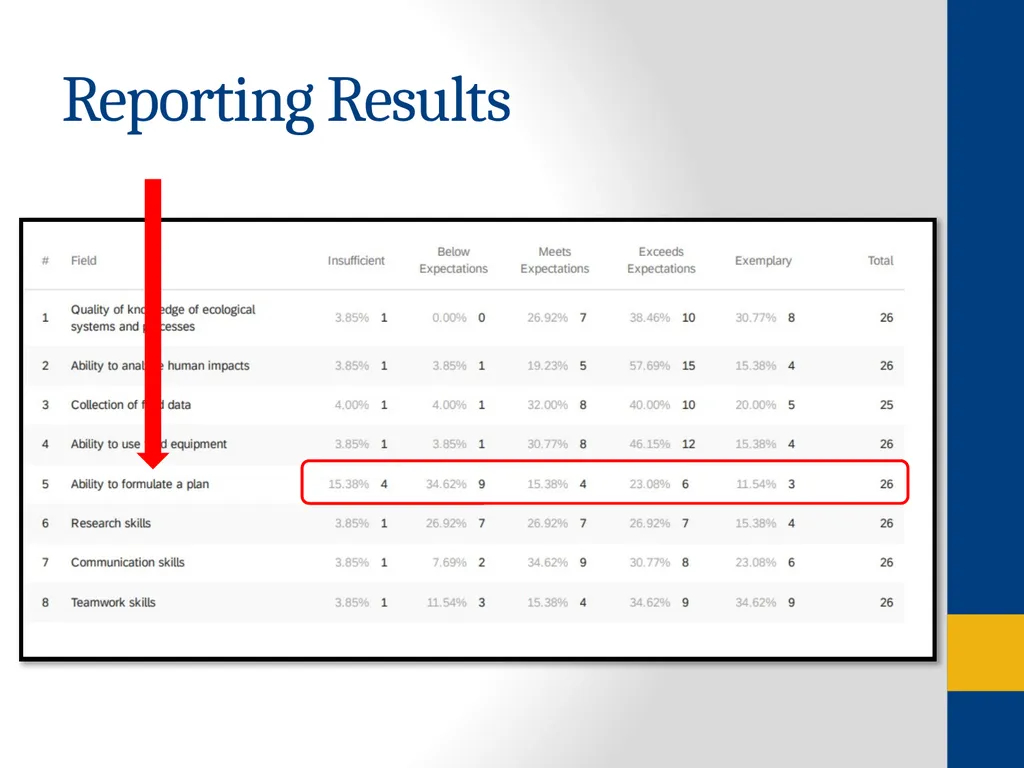
26 students in internships were evaluated by their internship supervisors. 50% of student interns were rated a 3 or higher on ability to formulate a plan. A breakdown of results by performance level appears in the attached table. Provide descriptive data (e.g., headcount, percentage, average, median, mode, etc.) Student Learning Outcome:
Graduating students will be able to formulate a plan which incorporates alternative solutions to complex problems in a social-environmental context.<br>
Students will be evaluated by an internship supervisor at their internship site and scored on 12 demonstrations of skills on a scale of 1 (insufficient) to 5 (exemplary).
Standard of Success: 85% of students will be rated a 3.0 or higher on ability to formulate a plan.
Results:
26 students in internships were evaluated by their internship supervisors. 50% of student interns were rated a 3 or higher on ability to formulate a plan. A breakdown of results by performance level appears in the attached table. Provide descriptive data (e.g., headcount, percentage, average, median, mode, etc.) Student Learning Outcome:
Graduating students will be able to formulate a plan which incorporates alternative solutions to complex problems in a social-environmental context.<br>
09
Reporting Results<br>
10
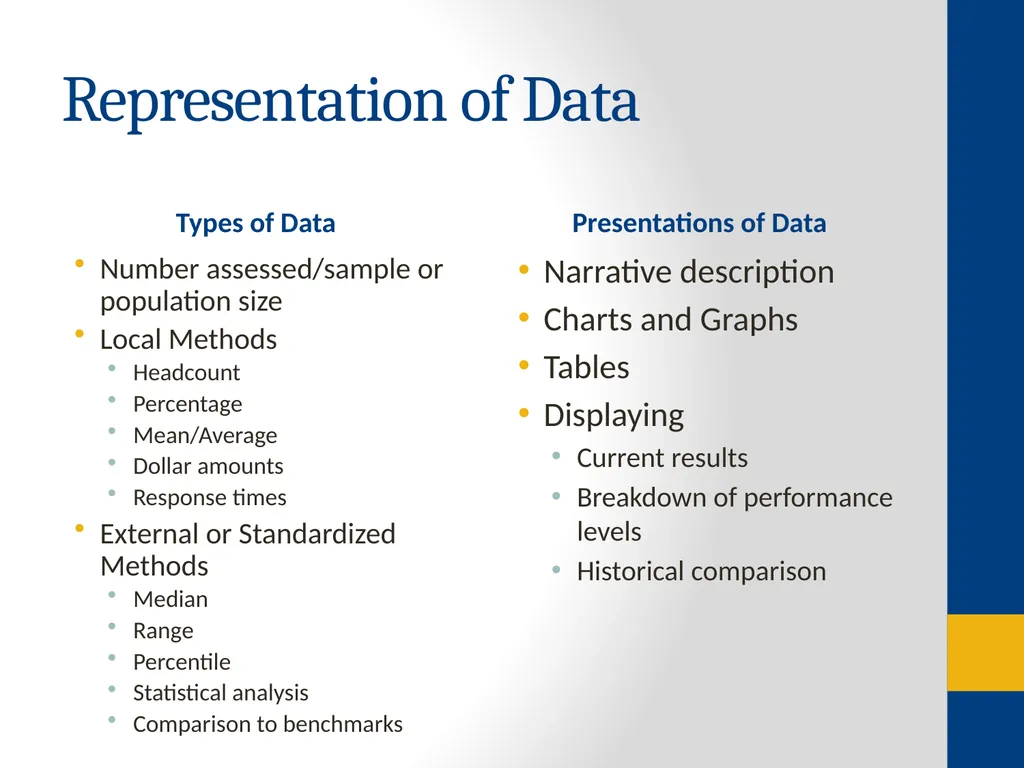
Representation of Data Types of Data Number assessed/sample or population size
Local Methods
Headcount
Percentage
Mean/Average
Dollar amounts
Response times
External or Standardized Methods
Median
Range
Percentile
Statistical analysis
Comparison to benchmarks Presentations of Data Narrative description
Charts and Graphs
Tables
Displaying
Current results
Breakdown of performance levels
Historical comparison<br>
Local Methods
Headcount
Percentage
Mean/Average
Dollar amounts
Response times
External or Standardized Methods
Median
Range
Percentile
Statistical analysis
Comparison to benchmarks Presentations of Data Narrative description
Charts and Graphs
Tables
Displaying
Current results
Breakdown of performance levels
Historical comparison<br>
11
Analyzing Results Results:
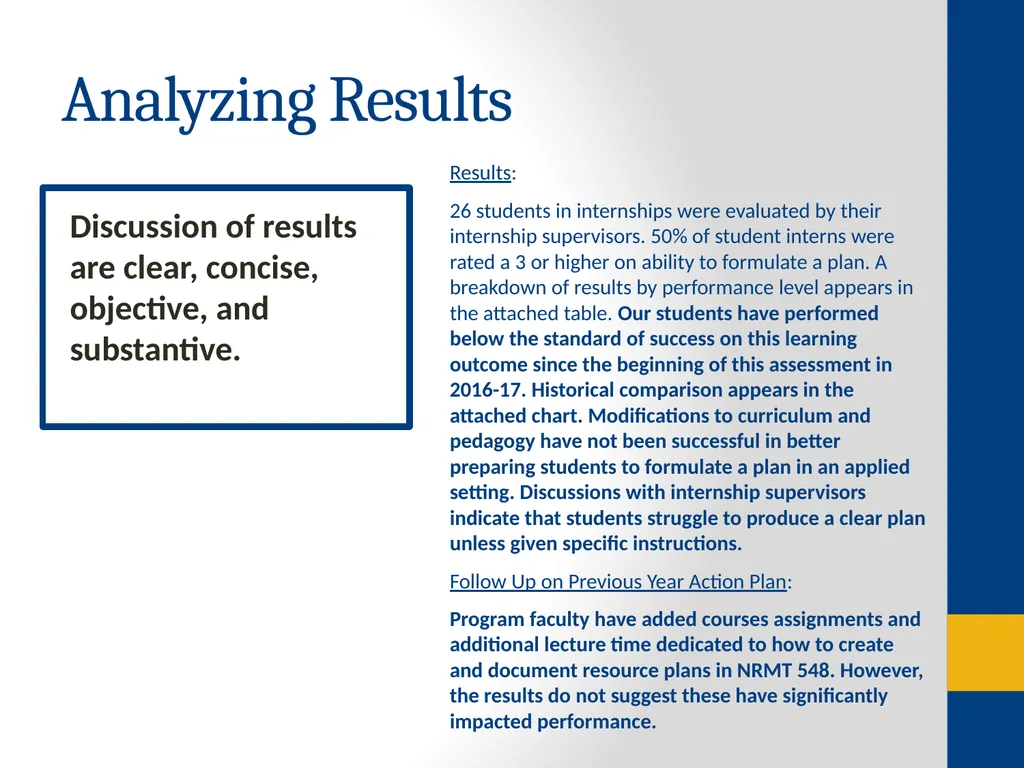
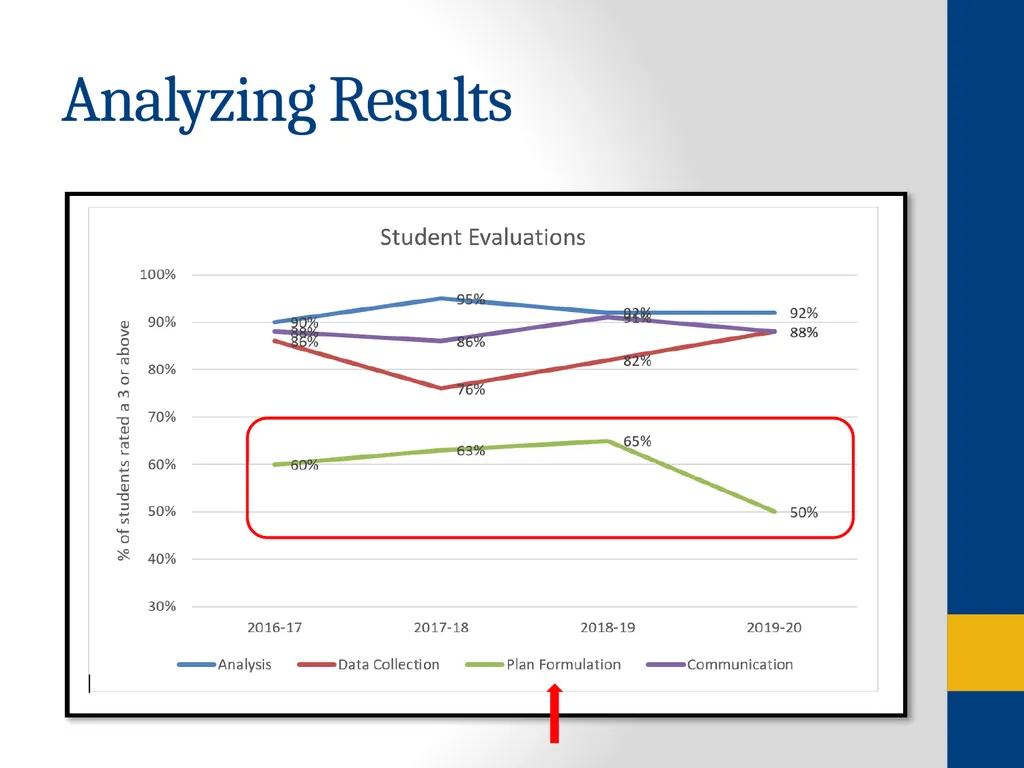
26 students in internships were evaluated by their internship supervisors. 50% of student interns were rated a 3 or higher on ability to formulate a plan. A breakdown of results by performance level appears in the attached table. Our students have performed below the standard of success on this learning outcome since the beginning of this assessment in 2016-17. Historical comparison appears in the attached chart. Modifications to curriculum and pedagogy have not been successful in better preparing students to formulate a plan in an applied setting. Discussions with internship supervisors indicate that students struggle to produce a clear plan unless given specific instructions.
Follow Up on Previous Year Action Plan:
Program faculty have added courses assignments and additional lecture time dedicated to how to create and document resource plans in NRMT 548. However, the results do not suggest these have significantly impacted performance. Discussion of results are clear, concise, objective, and substantive.<br>
26 students in internships were evaluated by their internship supervisors. 50% of student interns were rated a 3 or higher on ability to formulate a plan. A breakdown of results by performance level appears in the attached table. Our students have performed below the standard of success on this learning outcome since the beginning of this assessment in 2016-17. Historical comparison appears in the attached chart. Modifications to curriculum and pedagogy have not been successful in better preparing students to formulate a plan in an applied setting. Discussions with internship supervisors indicate that students struggle to produce a clear plan unless given specific instructions.
Follow Up on Previous Year Action Plan:
Program faculty have added courses assignments and additional lecture time dedicated to how to create and document resource plans in NRMT 548. However, the results do not suggest these have significantly impacted performance. Discussion of results are clear, concise, objective, and substantive.<br>
12
Analyzing Results<br>
13
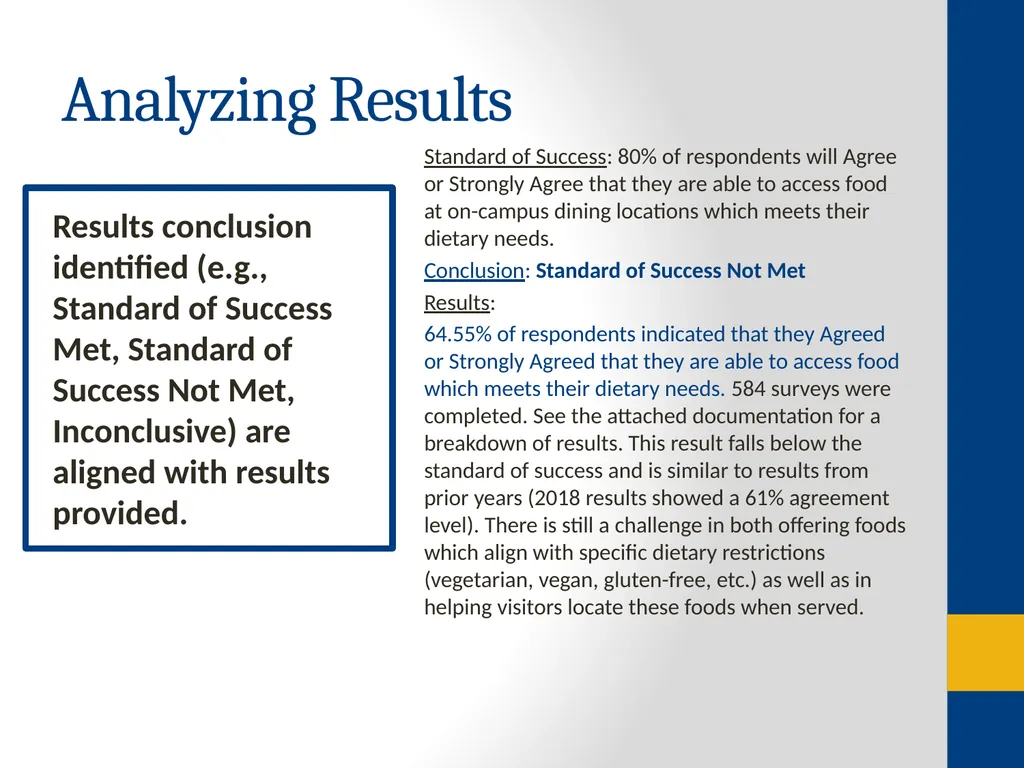
Analyzing Results Standard of Success: 80% of respondents will Agree or Strongly Agree that they are able to access food at on-campus dining locations which meets their dietary needs.
Conclusion: Standard of Success Not Met
Results:
64.55% of respondents indicated that they Agreed or Strongly Agreed that they are able to access food which meets their dietary needs. 584 surveys were completed. See the attached documentation for a breakdown of results. This result falls below the standard of success and is similar to results from prior years (2018 results showed a 61% agreement level). There is still a challenge in both offering foods which align with specific dietary restrictions (vegetarian, vegan, gluten-free, etc.) as well as in helping visitors locate these foods when served. Results conclusion identified (e.g., Standard of Success Met, Standard of Success Not Met, Inconclusive) are aligned with results provided.<br>
Conclusion: Standard of Success Not Met
Results:
64.55% of respondents indicated that they Agreed or Strongly Agreed that they are able to access food which meets their dietary needs. 584 surveys were completed. See the attached documentation for a breakdown of results. This result falls below the standard of success and is similar to results from prior years (2018 results showed a 61% agreement level). There is still a challenge in both offering foods which align with specific dietary restrictions (vegetarian, vegan, gluten-free, etc.) as well as in helping visitors locate these foods when served. Results conclusion identified (e.g., Standard of Success Met, Standard of Success Not Met, Inconclusive) are aligned with results provided.<br>
14
Activity #1 For each example provided, select the rubric rating which best applies - Revise/Acceptable/Excellent
[see Qualtrics QR Code]<br>
[see Qualtrics QR Code]<br>
15
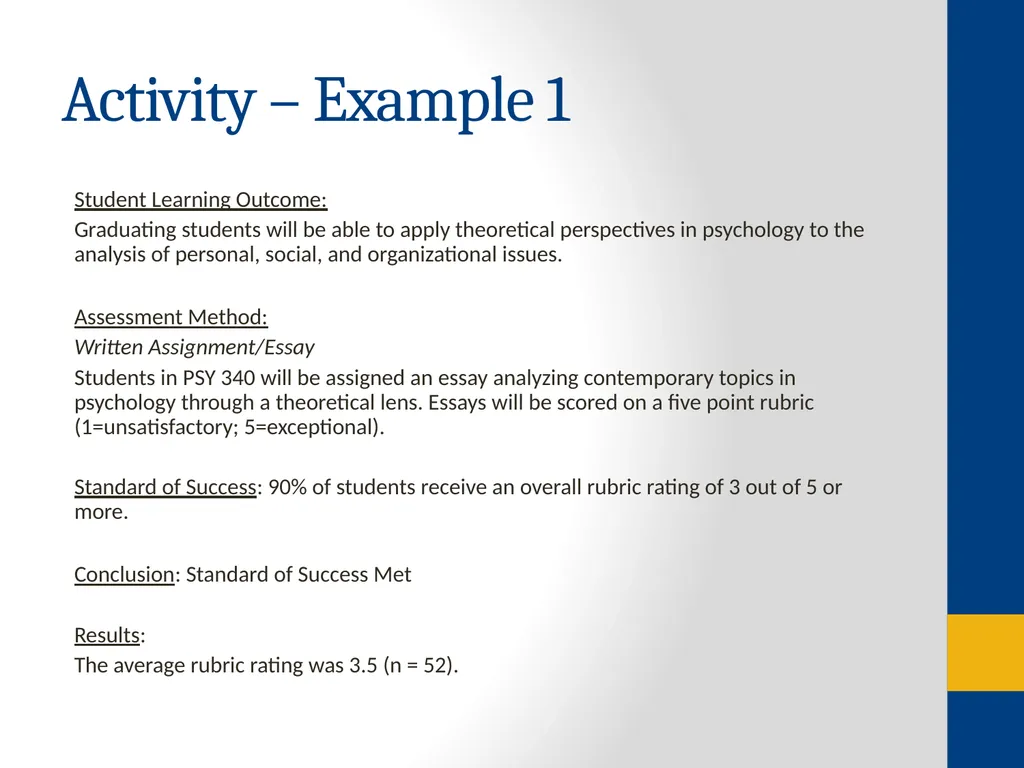
Activity – Example 1 Student Learning Outcome:
Graduating students will be able to apply theoretical perspectives in psychology to the analysis of personal, social, and organizational issues.
Assessment Method:
Written Assignment/Essay
Students in PSY 340 will be assigned an essay analyzing contemporary topics in psychology through a theoretical lens. Essays will be scored on a five point rubric (1=unsatisfactory; 5=exceptional).
Standard of Success: 90% of students receive an overall rubric rating of 3 out of 5 or more.
Conclusion: Standard of Success Met
Results:
The average rubric rating was 3.5 (n = 52).<br>
Graduating students will be able to apply theoretical perspectives in psychology to the analysis of personal, social, and organizational issues.
Assessment Method:
Written Assignment/Essay
Students in PSY 340 will be assigned an essay analyzing contemporary topics in psychology through a theoretical lens. Essays will be scored on a five point rubric (1=unsatisfactory; 5=exceptional).
Standard of Success: 90% of students receive an overall rubric rating of 3 out of 5 or more.
Conclusion: Standard of Success Met
Results:
The average rubric rating was 3.5 (n = 52).<br>
16
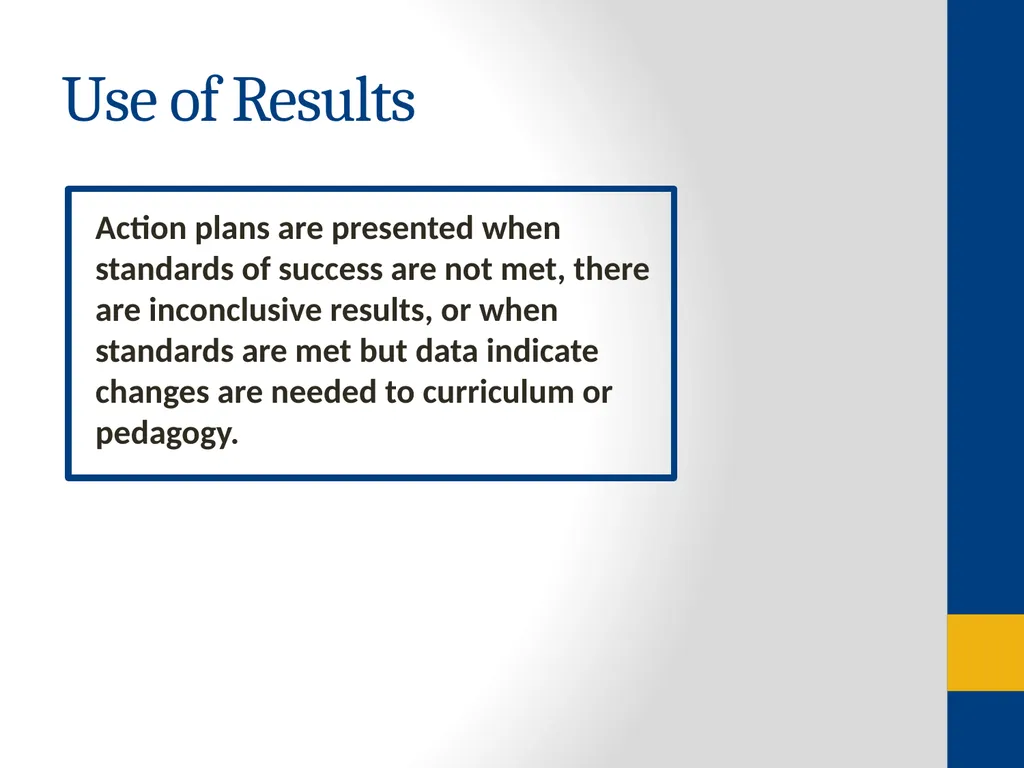
Use of Results Action plans are presented when standards of success are not met, there are inconclusive results, or when standards are met but data indicate changes are needed to curriculum or pedagogy.<br>
17
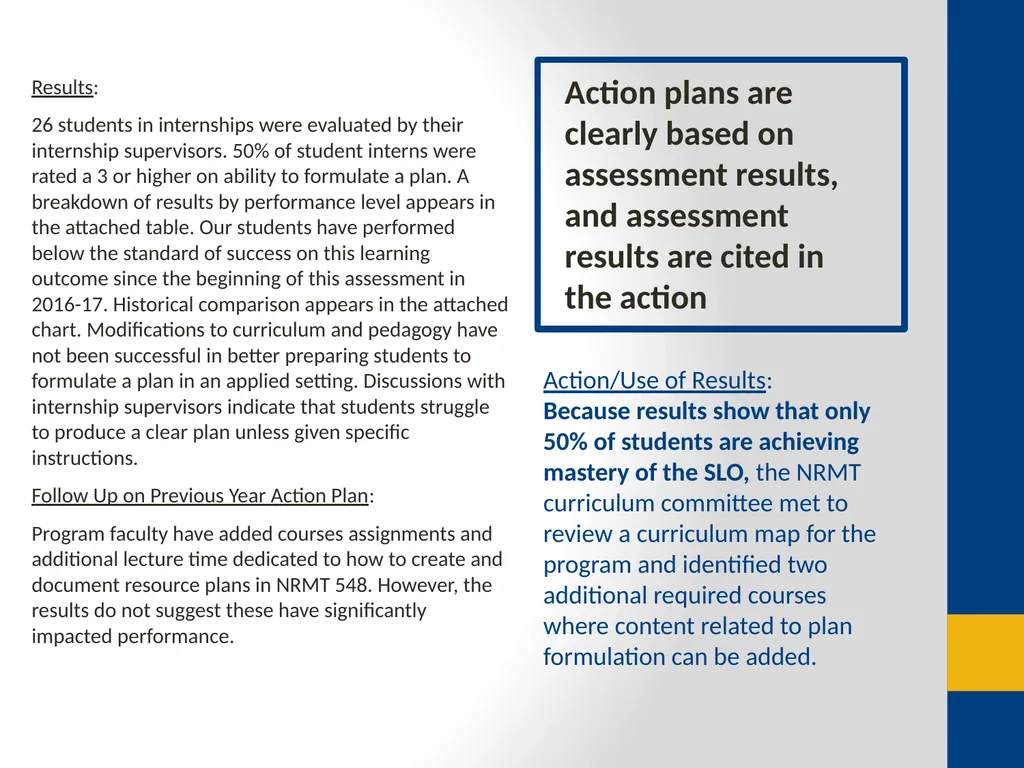
Action plans are clearly based on assessment results, and assessment results are cited in the action Action/Use of Results:
Because results show that only 50% of students are achieving mastery of the SLO, the NRMT curriculum committee met to review a curriculum map for the program and identified two additional required courses where content related to plan formulation can be added. Results:
26 students in internships were evaluated by their internship supervisors. 50% of student interns were rated a 3 or higher on ability to formulate a plan. A breakdown of results by performance level appears in the attached table. Our students have performed below the standard of success on this learning outcome since the beginning of this assessment in 2016-17. Historical comparison appears in the attached chart. Modifications to curriculum and pedagogy have not been successful in better preparing students to formulate a plan in an applied setting. Discussions with internship supervisors indicate that students struggle to produce a clear plan unless given specific instructions.
Follow Up on Previous Year Action Plan:
Program faculty have added courses assignments and additional lecture time dedicated to how to create and document resource plans in NRMT 548. However, the results do not suggest these have significantly impacted performance.<br>
Because results show that only 50% of students are achieving mastery of the SLO, the NRMT curriculum committee met to review a curriculum map for the program and identified two additional required courses where content related to plan formulation can be added. Results:
26 students in internships were evaluated by their internship supervisors. 50% of student interns were rated a 3 or higher on ability to formulate a plan. A breakdown of results by performance level appears in the attached table. Our students have performed below the standard of success on this learning outcome since the beginning of this assessment in 2016-17. Historical comparison appears in the attached chart. Modifications to curriculum and pedagogy have not been successful in better preparing students to formulate a plan in an applied setting. Discussions with internship supervisors indicate that students struggle to produce a clear plan unless given specific instructions.
Follow Up on Previous Year Action Plan:
Program faculty have added courses assignments and additional lecture time dedicated to how to create and document resource plans in NRMT 548. However, the results do not suggest these have significantly impacted performance.<br>
18
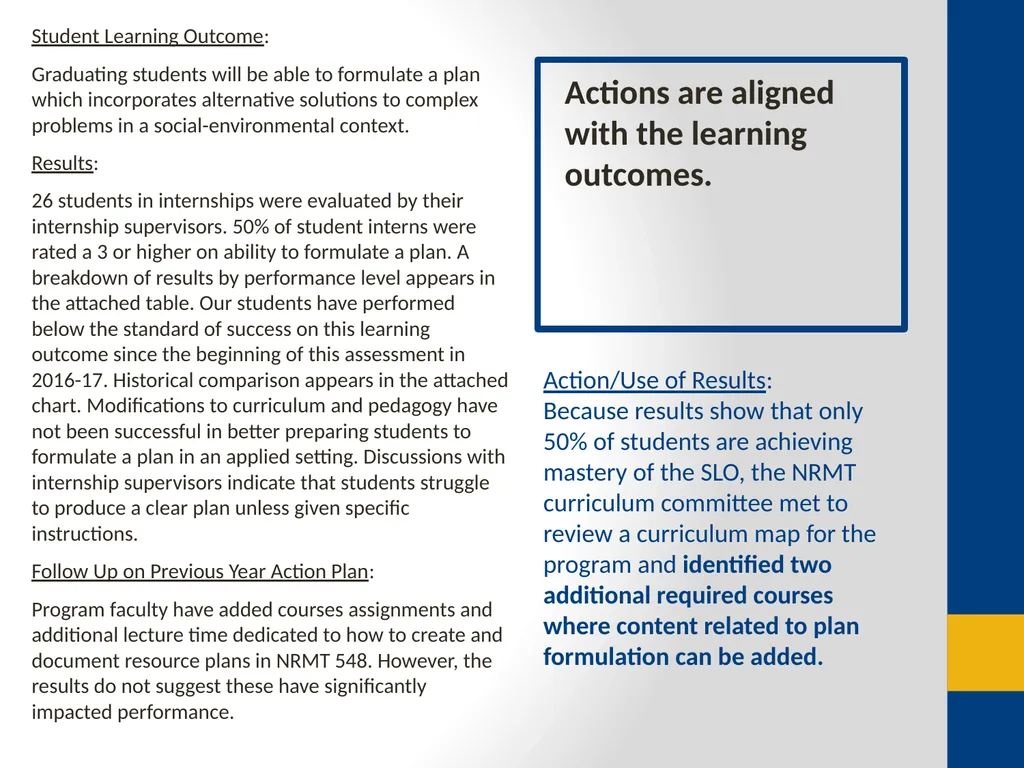
Actions are aligned with the learning outcomes. Action/Use of Results:
Because results show that only 50% of students are achieving mastery of the SLO, the NRMT curriculum committee met to review a curriculum map for the program and identified two additional required courses where content related to plan formulation can be added. Student Learning Outcome:
Graduating students will be able to formulate a plan which incorporates alternative solutions to complex problems in a social-environmental context.
Results:
26 students in internships were evaluated by their internship supervisors. 50% of student interns were rated a 3 or higher on ability to formulate a plan. A breakdown of results by performance level appears in the attached table. Our students have performed below the standard of success on this learning outcome since the beginning of this assessment in 2016-17. Historical comparison appears in the attached chart. Modifications to curriculum and pedagogy have not been successful in better preparing students to formulate a plan in an applied setting. Discussions with internship supervisors indicate that students struggle to produce a clear plan unless given specific instructions.
Follow Up on Previous Year Action Plan:
Program faculty have added courses assignments and additional lecture time dedicated to how to create and document resource plans in NRMT 548. However, the results do not suggest these have significantly impacted performance.<br>
Because results show that only 50% of students are achieving mastery of the SLO, the NRMT curriculum committee met to review a curriculum map for the program and identified two additional required courses where content related to plan formulation can be added. Student Learning Outcome:
Graduating students will be able to formulate a plan which incorporates alternative solutions to complex problems in a social-environmental context.
Results:
26 students in internships were evaluated by their internship supervisors. 50% of student interns were rated a 3 or higher on ability to formulate a plan. A breakdown of results by performance level appears in the attached table. Our students have performed below the standard of success on this learning outcome since the beginning of this assessment in 2016-17. Historical comparison appears in the attached chart. Modifications to curriculum and pedagogy have not been successful in better preparing students to formulate a plan in an applied setting. Discussions with internship supervisors indicate that students struggle to produce a clear plan unless given specific instructions.
Follow Up on Previous Year Action Plan:
Program faculty have added courses assignments and additional lecture time dedicated to how to create and document resource plans in NRMT 548. However, the results do not suggest these have significantly impacted performance.<br>
19
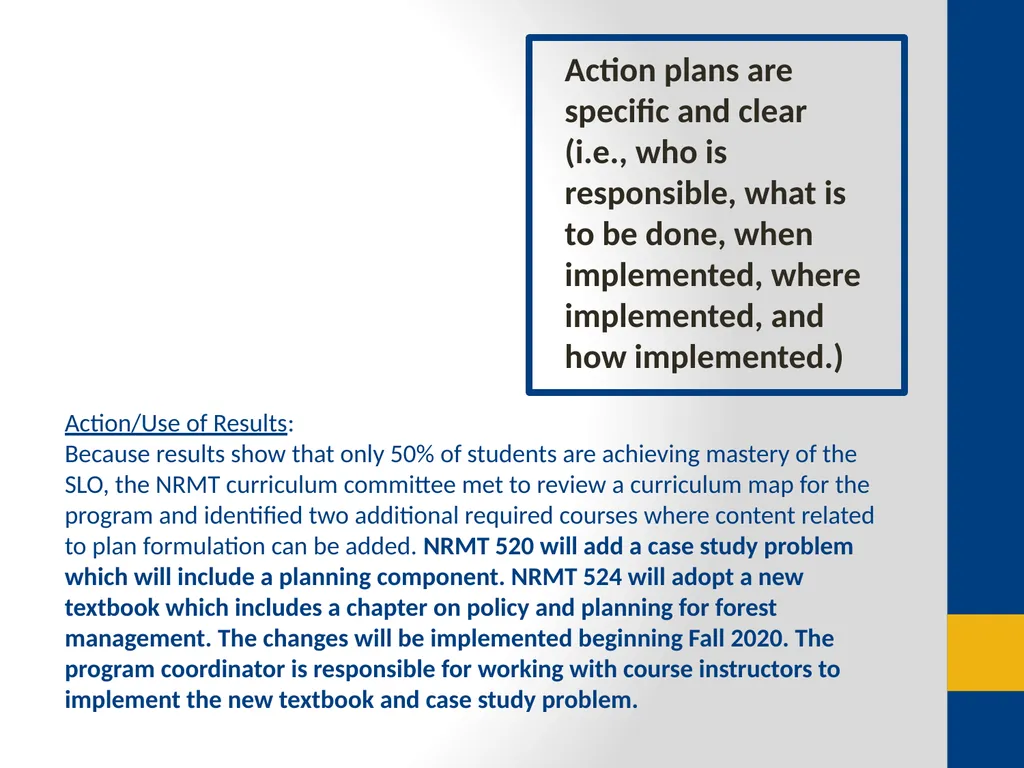
Action plans are specific and clear (i.e., who is responsible, what is to be done, when implemented, where implemented, and how implemented.) Action/Use of Results:
Because results show that only 50% of students are achieving mastery of the SLO, the NRMT curriculum committee met to review a curriculum map for the program and identified two additional required courses where content related to plan formulation can be added. NRMT 520 will add a case study problem which will include a planning component. NRMT 524 will adopt a new textbook which includes a chapter on policy and planning for forest management. The changes will be implemented beginning Fall 2020. The program coordinator is responsible for working with course instructors to implement the new textbook and case study problem.<br>
Because results show that only 50% of students are achieving mastery of the SLO, the NRMT curriculum committee met to review a curriculum map for the program and identified two additional required courses where content related to plan formulation can be added. NRMT 520 will add a case study problem which will include a planning component. NRMT 524 will adopt a new textbook which includes a chapter on policy and planning for forest management. The changes will be implemented beginning Fall 2020. The program coordinator is responsible for working with course instructors to implement the new textbook and case study problem.<br>
20
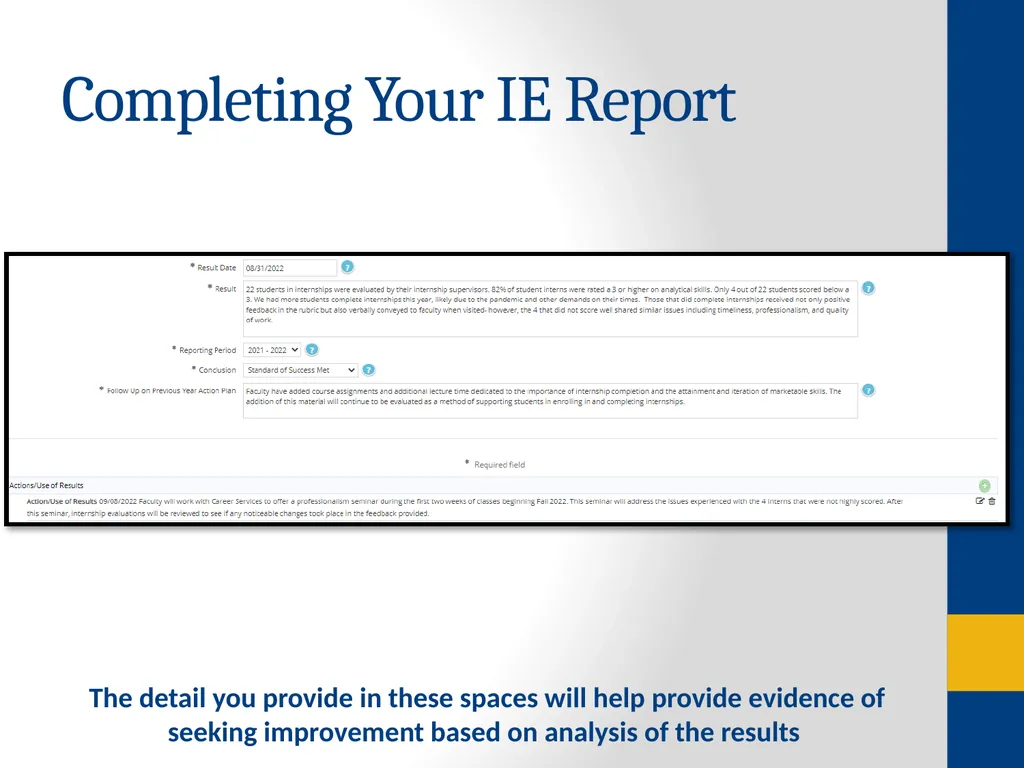
Completing Your IE Report The detail you provide in these spaces will help provide evidence of seeking improvement based on analysis of the results<br>
21
Workshop Evaluation<br>
22
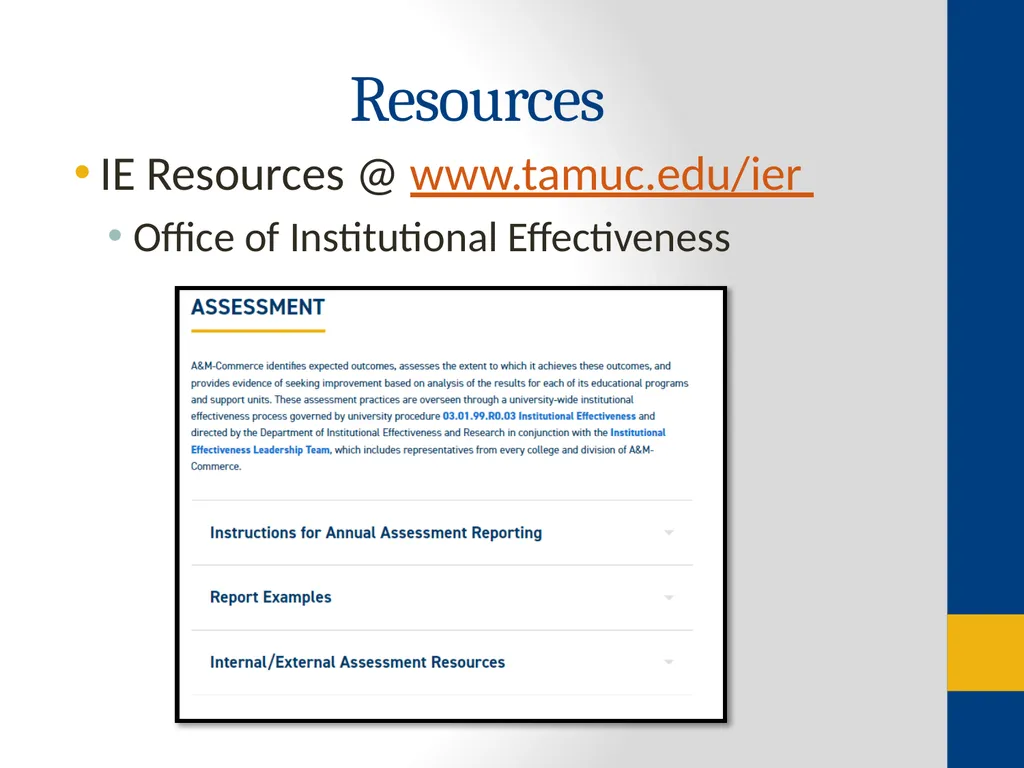
Resources IE Resources @ www.tamuc.edu/ier
Office of Institutional Effectiveness<br>
Office of Institutional Effectiveness<br>