
Quantum Computing MasterClass Giampiero Pepe
EM
Published · 12 slides · 0 views
1 / 1
Description
Quantum Computing MasterClass Giampiero Pepe University of Naples Federico II Paolo Massarotti University of Naples Federico II in collaboration with IBM Q-Experience Team, Italy There is a quantum computing race among some tech giants like
Related Topics
Share
Embed code
Download this presentation From Below
"Quantum Computing MasterClass Giampiero Pepe" is the property of its rightful owner. Permission is granted to download and print the materials on this website for personal, non-commercial use only, and to display it on your personal computer provided you do not modify the materials and that you retain all copyright notices contained in the materials. By downloading content from our website, you accept the terms of this agreement.
Presentation Transcript
01
Quantum Computing MasterClass Giampiero Pepe
University of Naples Federico II
Paolo Massarotti
University of Naples Federico II
in collaboration with
IBM Q-Experience Team, Italy<br>
University of Naples Federico II
Paolo Massarotti
University of Naples Federico II
in collaboration with
IBM Q-Experience Team, Italy<br>
02
There is a quantum computing race among some tech giants like Google, IBM, Rigetti and Microsoft, including to a lesser extent Amazon and China’s Alibaba. Governments are funding work in the area with the concern that quantum computers may soon crack current encryption methods, giving the country that gets there first a major advantage. Many universities worldwide have some activity in quantum computing, and considerable funding is also available worldwide. There is the need in introducing quantum computing and encouraging schools to join us in this revolutionary step forward for computing.
The Quantum Computing MasterClass is a graduate-level quantum computing introduction to elementary problems to be solved on IBM’s Q Experience quantum computing simulator.<br>
The Quantum Computing MasterClass is a graduate-level quantum computing introduction to elementary problems to be solved on IBM’s Q Experience quantum computing simulator.<br>
03
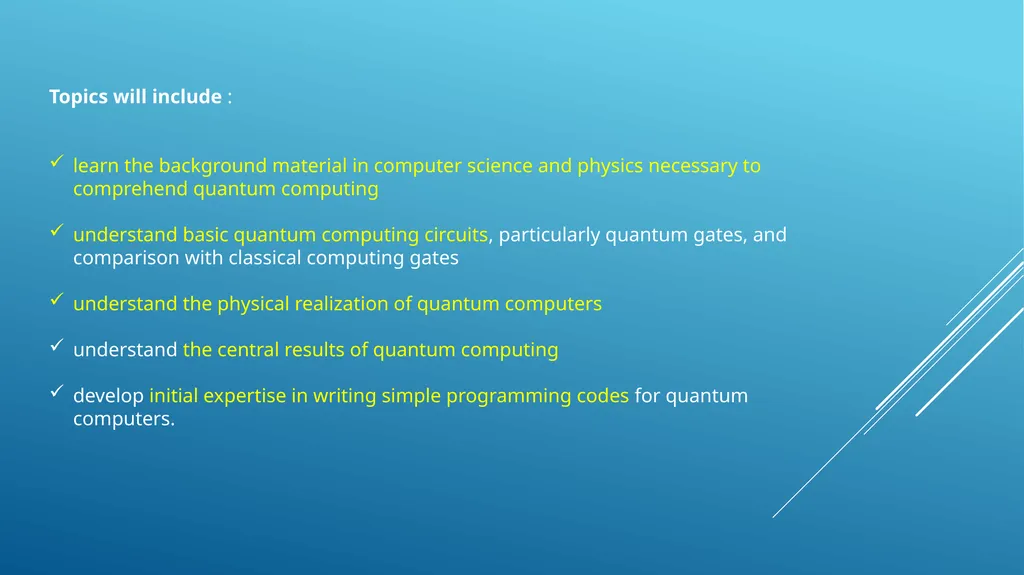
Topics will include :
learn the background material in computer science and physics necessary to comprehend quantum computing
understand basic quantum computing circuits, particularly quantum gates, and comparison with classical computing gates
understand the physical realization of quantum computers
understand the central results of quantum computing
develop initial expertise in writing simple programming codes for quantum computers.<br>
learn the background material in computer science and physics necessary to comprehend quantum computing
understand basic quantum computing circuits, particularly quantum gates, and comparison with classical computing gates
understand the physical realization of quantum computers
understand the central results of quantum computing
develop initial expertise in writing simple programming codes for quantum computers.<br>
04
The Quantum Computing MasterClass has student projects that utilize hands-on labs with simplified quantum program development, live code executions and student projects performed using IBM’s Quantum Experience Platform with access to real Quantum Computers.
The MC will use the free-access 5 Qubit computer within IBM Research Labs.
The projects will address three types of problems:
Computing an algebraic operation by using qubits in a “classical” mode
Implementing the use of quantum computer to evaluate a simple operation by using qubits
Placing qubits in super positions
Creating the superposition of quantum states to understand the basic idea of quantum mechanics
Implementing quantum entanglement
Implementing an algorithm which gives a direct evidence of the entanglement<br>
The MC will use the free-access 5 Qubit computer within IBM Research Labs.
The projects will address three types of problems:
Computing an algebraic operation by using qubits in a “classical” mode
Implementing the use of quantum computer to evaluate a simple operation by using qubits
Placing qubits in super positions
Creating the superposition of quantum states to understand the basic idea of quantum mechanics
Implementing quantum entanglement
Implementing an algorithm which gives a direct evidence of the entanglement<br>
05
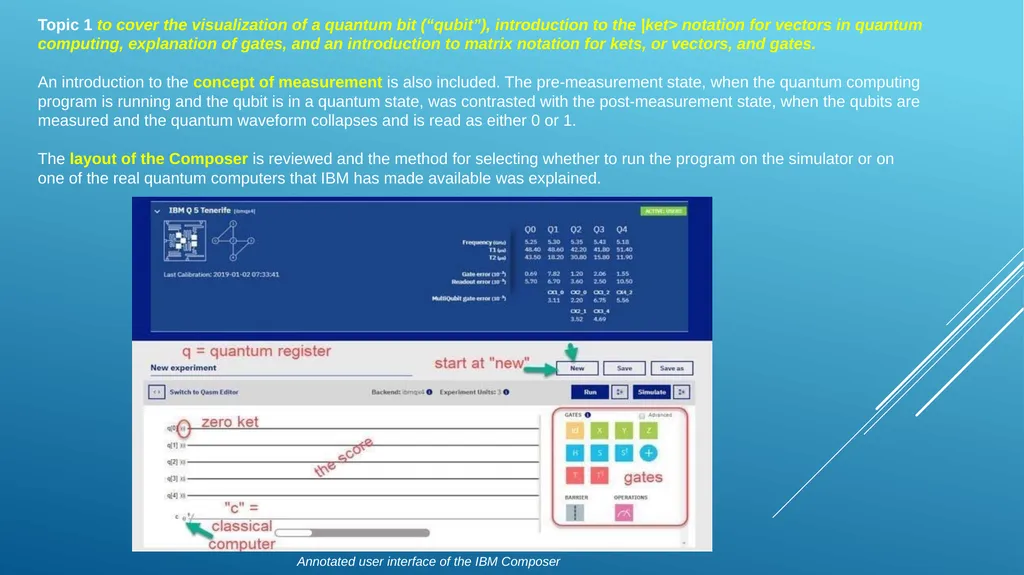
Topic 1 to cover the visualization of a quantum bit (“qubit”), introduction to the |ket> notation for vectors in quantum computing, explanation of gates, and an introduction to matrix notation for kets, or vectors, and gates.
An introduction to the concept of measurement is also included. The pre-measurement state, when the quantum computing program is running and the qubit is in a quantum state, was contrasted with the post-measurement state, when the qubits are measured and the quantum waveform collapses and is read as either 0 or 1.
The layout of the Composer is reviewed and the method for selecting whether to run the program on the simulator or on one of the real quantum computers that IBM has made available was explained. Annotated user interface of the IBM Composer<br>
An introduction to the concept of measurement is also included. The pre-measurement state, when the quantum computing program is running and the qubit is in a quantum state, was contrasted with the post-measurement state, when the qubits are measured and the quantum waveform collapses and is read as either 0 or 1.
The layout of the Composer is reviewed and the method for selecting whether to run the program on the simulator or on one of the real quantum computers that IBM has made available was explained. Annotated user interface of the IBM Composer<br>
06
Topic 2 to cover superposition.
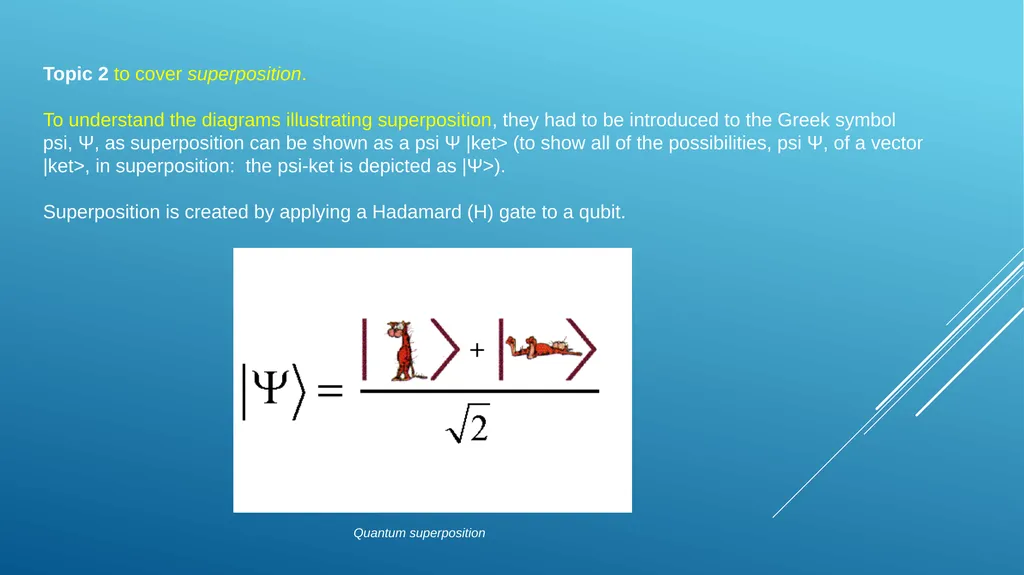
To understand the diagrams illustrating superposition, they had to be introduced to the Greek symbol psi, Ψ, as superposition can be shown as a psi Ψ |ket> (to show all of the possibilities, psi Ψ, of a vector |ket>, in superposition: the psi-ket is depicted as |Ψ>).
Superposition is created by applying a Hadamard (H) gate to a qubit. Quantum superposition<br>
To understand the diagrams illustrating superposition, they had to be introduced to the Greek symbol psi, Ψ, as superposition can be shown as a psi Ψ |ket> (to show all of the possibilities, psi Ψ, of a vector |ket>, in superposition: the psi-ket is depicted as |Ψ>).
Superposition is created by applying a Hadamard (H) gate to a qubit. Quantum superposition<br>
07
Topic 3 to cover entanglement.
Entanglement means that two or more qubits have formed a relationship. The entanglement is created by the program applying an H gate to the one qubit and then a Controlled-Not (CNOT) gate to two qubits, the control qubit and the target qubit. They can be separated by large distances, yet always remain entangled with one another – if one is changed by a new gate, the other changes instantly in the same way. It was explained that there is no violation because the message noting that the change occurred is still limited by c.
The hands-on portion of the class was to make CNOT connections in the IBM Composer, use X gates (X gates flip values from zero to one and one to zero), to predict their answers, and run the program. To do this, the students had to study the diagram that accompanies the programming interface of the Composer, to identify legitimate paths for entanglement of qubits.
Review of Superposition included the Bloch Sphere as an illustration of a qubit, and the |Ψ> vector within that sphere with its nearly infinite possibilities between zero and one, will be proposed.<br>
Entanglement means that two or more qubits have formed a relationship. The entanglement is created by the program applying an H gate to the one qubit and then a Controlled-Not (CNOT) gate to two qubits, the control qubit and the target qubit. They can be separated by large distances, yet always remain entangled with one another – if one is changed by a new gate, the other changes instantly in the same way. It was explained that there is no violation because the message noting that the change occurred is still limited by c.
The hands-on portion of the class was to make CNOT connections in the IBM Composer, use X gates (X gates flip values from zero to one and one to zero), to predict their answers, and run the program. To do this, the students had to study the diagram that accompanies the programming interface of the Composer, to identify legitimate paths for entanglement of qubits.
Review of Superposition included the Bloch Sphere as an illustration of a qubit, and the |Ψ> vector within that sphere with its nearly infinite possibilities between zero and one, will be proposed.<br>
08
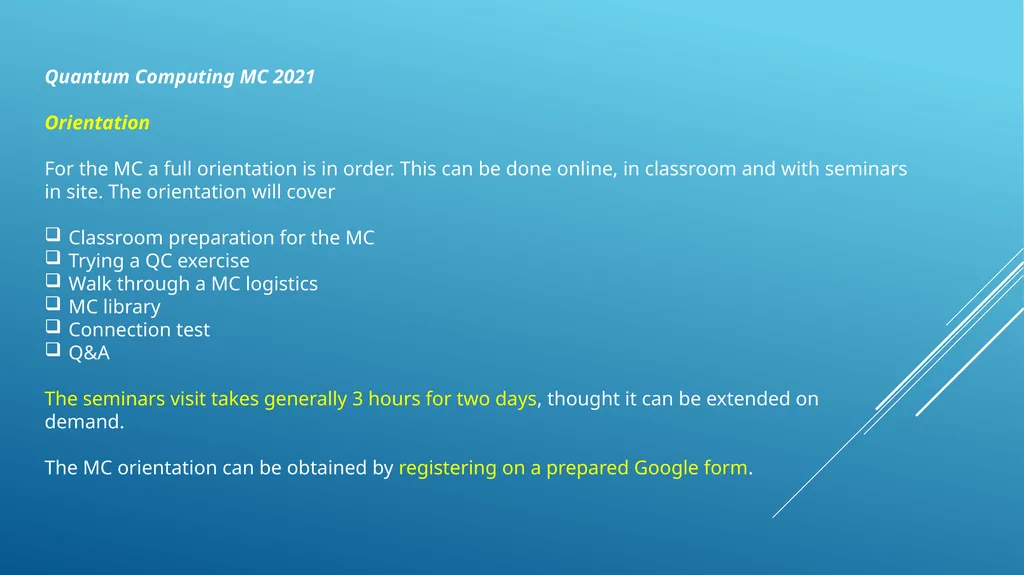
Quantum Computing MC 2021
Orientation
For the MC a full orientation is in order. This can be done online, in classroom and with seminars in site. The orientation will cover
Classroom preparation for the MC
Trying a QC exercise
Walk through a MC logistics
MC library
Connection test
Q&A
The seminars visit takes generally 3 hours for two days, thought it can be extended on
demand.
The MC orientation can be obtained by registering on a prepared Google form.<br>
Orientation
For the MC a full orientation is in order. This can be done online, in classroom and with seminars in site. The orientation will cover
Classroom preparation for the MC
Trying a QC exercise
Walk through a MC logistics
MC library
Connection test
Q&A
The seminars visit takes generally 3 hours for two days, thought it can be extended on
demand.
The MC orientation can be obtained by registering on a prepared Google form.<br>
09
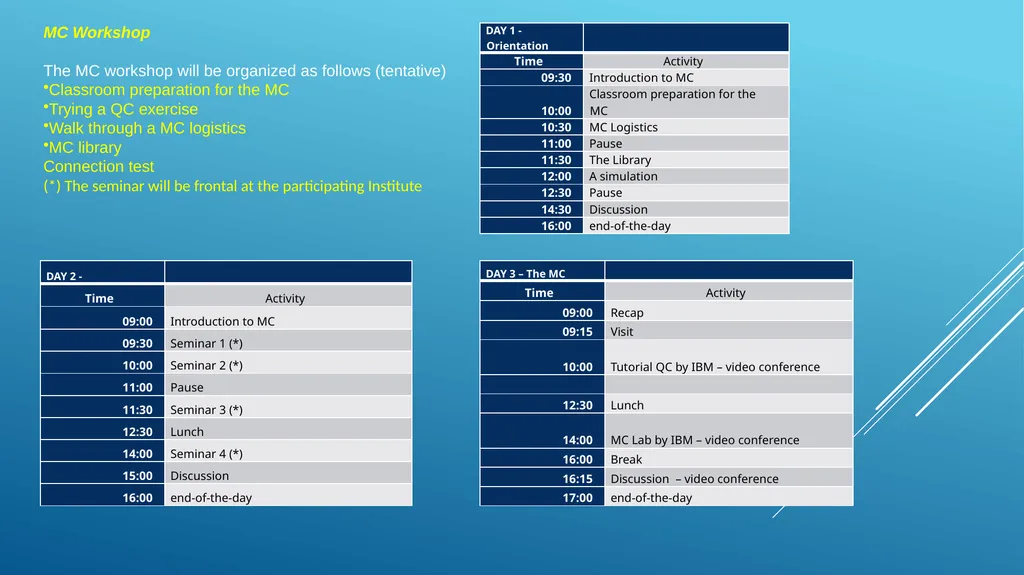
MC Workshop
The MC workshop will be organized as follows (tentative)
Classroom preparation for the MC
Trying a QC exercise
Walk through a MC logistics
MC library
Connection test
(*) The seminar will be frontal at the participating Institute<br>
The MC workshop will be organized as follows (tentative)
Classroom preparation for the MC
Trying a QC exercise
Walk through a MC logistics
MC library
Connection test
(*) The seminar will be frontal at the participating Institute<br>
10
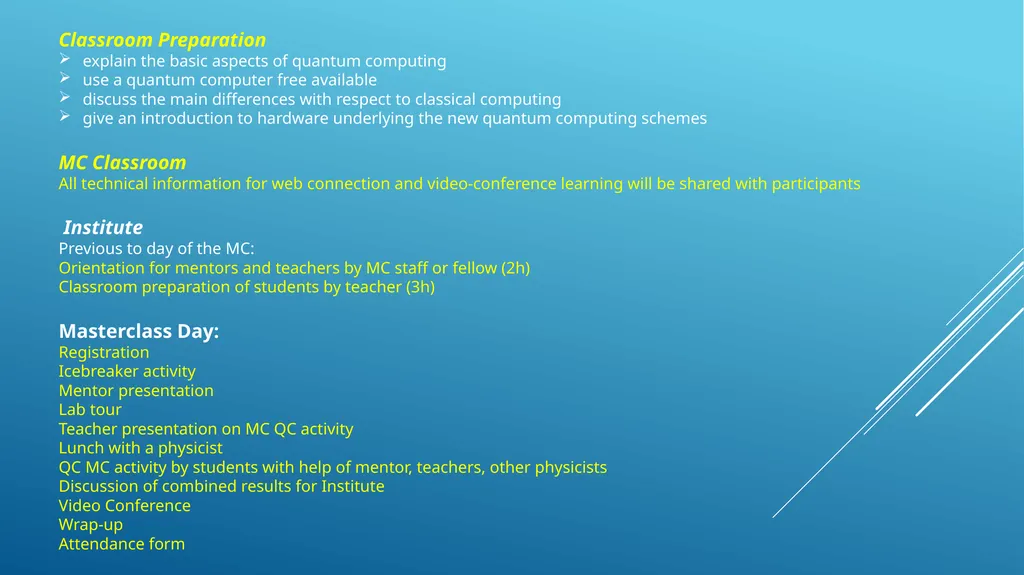
Classroom Preparation
explain the basic aspects of quantum computing
use a quantum computer free available
discuss the main differences with respect to classical computing
give an introduction to hardware underlying the new quantum computing schemes
MC Classroom
All technical information for web connection and video-conference learning will be shared with participants
Institute
Previous to day of the MC:
Orientation for mentors and teachers by MC staff or fellow (2h)
Classroom preparation of students by teacher (3h)
Masterclass Day:
Registration
Icebreaker activity
Mentor presentation
Lab tour
Teacher presentation on MC QC activity
Lunch with a physicist
QC MC activity by students with help of mentor, teachers, other physicists
Discussion of combined results for Institute
Video Conference
Wrap-up
Attendance form<br>
explain the basic aspects of quantum computing
use a quantum computer free available
discuss the main differences with respect to classical computing
give an introduction to hardware underlying the new quantum computing schemes
MC Classroom
All technical information for web connection and video-conference learning will be shared with participants
Institute
Previous to day of the MC:
Orientation for mentors and teachers by MC staff or fellow (2h)
Classroom preparation of students by teacher (3h)
Masterclass Day:
Registration
Icebreaker activity
Mentor presentation
Lab tour
Teacher presentation on MC QC activity
Lunch with a physicist
QC MC activity by students with help of mentor, teachers, other physicists
Discussion of combined results for Institute
Video Conference
Wrap-up
Attendance form<br>
11
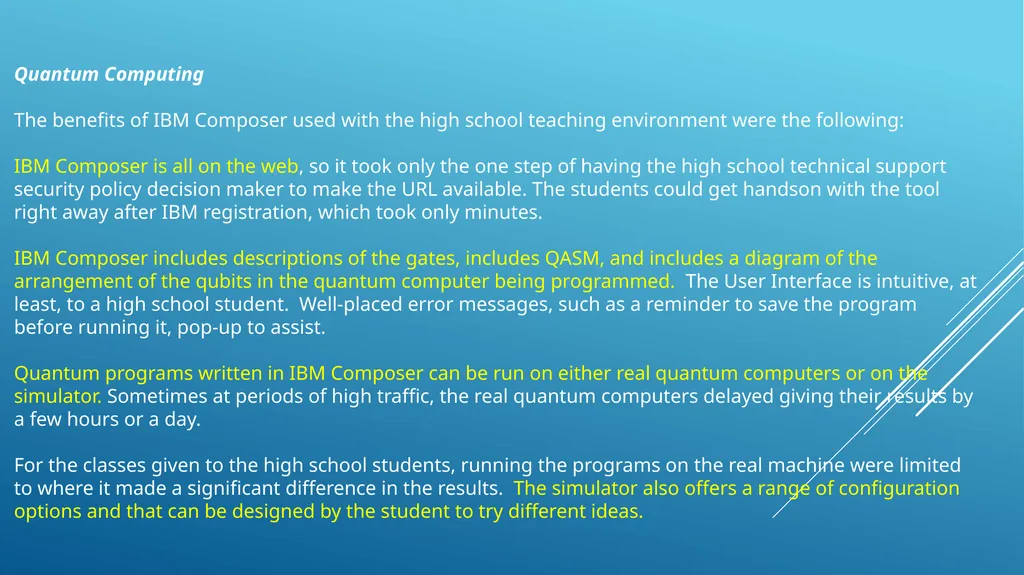
Quantum Computing
The benefits of IBM Composer used with the high school teaching environment were the following:
IBM Composer is all on the web, so it took only the one step of having the high school technical support security policy decision maker to make the URL available. The students could get handson with the tool right away after IBM registration, which took only minutes.
IBM Composer includes descriptions of the gates, includes QASM, and includes a diagram of the arrangement of the qubits in the quantum computer being programmed. The User Interface is intuitive, at least, to a high school student. Well-placed error messages, such as a reminder to save the program
before running it, pop-up to assist.
Quantum programs written in IBM Composer can be run on either real quantum computers or on the simulator. Sometimes at periods of high traffic, the real quantum computers delayed giving their results by a few hours or a day.
For the classes given to the high school students, running the programs on the real machine were limited to where it made a significant difference in the results. The simulator also offers a range of configuration options and that can be designed by the student to try different ideas.<br>
The benefits of IBM Composer used with the high school teaching environment were the following:
IBM Composer is all on the web, so it took only the one step of having the high school technical support security policy decision maker to make the URL available. The students could get handson with the tool right away after IBM registration, which took only minutes.
IBM Composer includes descriptions of the gates, includes QASM, and includes a diagram of the arrangement of the qubits in the quantum computer being programmed. The User Interface is intuitive, at least, to a high school student. Well-placed error messages, such as a reminder to save the program
before running it, pop-up to assist.
Quantum programs written in IBM Composer can be run on either real quantum computers or on the simulator. Sometimes at periods of high traffic, the real quantum computers delayed giving their results by a few hours or a day.
For the classes given to the high school students, running the programs on the real machine were limited to where it made a significant difference in the results. The simulator also offers a range of configuration options and that can be designed by the student to try different ideas.<br>
12
REFERENCES
Billig, Y. (2018). Quantum Computing for High School Students. Qubit Publishing.
Frank, R. I. (2004a). An IS Undergraduate Course Module on Quantum Key Distribution (QKD) [Quantum Encryption (QE)], The Proceedings of ISECON 2004: §2243. ISSN: 1542-7382.), and as a tutorial workshop before the conference (an extended version – see below).
http://isedj.org/isecon/2004/2243/index.html
IBM (2019a). Open Source Quantum Information Science Kit. Retrieve https://qiskit.org.
IBM (2019b). Q Experience. Retrieve https://quantumexperience.ng.bluemix.net/.
IBM (2019c). QISKit GitHub. Retrieve https://github.com/QISKit/.
IBM (2019d). IBM Q System One, https://newsroom.ibm.com/2019-01-08-IBM-Unveils-WorldsFirstIntegrated-Quantum-Computing-System-for-Commercial-Use.
Tappert, C. (2018a). Lecture Slides Quantum Computing Course at Pace University. Retrieved http://csis.pace.edu/ctappert/cs837-18spring/index.htm.
Tappert, C. (2018b). Richard Feynman. Presented as the Keynote Presentation, Proceedings of CSIS Research Day, Pace University, Pleasantville, NY. Retrieved http://csis.pace.edu/ ctappert/srd2018/feynmantappert.pptx.
Westfall, L. and Leider, A. (2018). Teaching quantum computing. In Proceedings of the Future Technologies Conference, pages 63–80. Springer.<br>
Billig, Y. (2018). Quantum Computing for High School Students. Qubit Publishing.
Frank, R. I. (2004a). An IS Undergraduate Course Module on Quantum Key Distribution (QKD) [Quantum Encryption (QE)], The Proceedings of ISECON 2004: §2243. ISSN: 1542-7382.), and as a tutorial workshop before the conference (an extended version – see below).
http://isedj.org/isecon/2004/2243/index.html
IBM (2019a). Open Source Quantum Information Science Kit. Retrieve https://qiskit.org.
IBM (2019b). Q Experience. Retrieve https://quantumexperience.ng.bluemix.net/.
IBM (2019c). QISKit GitHub. Retrieve https://github.com/QISKit/.
IBM (2019d). IBM Q System One, https://newsroom.ibm.com/2019-01-08-IBM-Unveils-WorldsFirstIntegrated-Quantum-Computing-System-for-Commercial-Use.
Tappert, C. (2018a). Lecture Slides Quantum Computing Course at Pace University. Retrieved http://csis.pace.edu/ctappert/cs837-18spring/index.htm.
Tappert, C. (2018b). Richard Feynman. Presented as the Keynote Presentation, Proceedings of CSIS Research Day, Pace University, Pleasantville, NY. Retrieved http://csis.pace.edu/ ctappert/srd2018/feynmantappert.pptx.
Westfall, L. and Leider, A. (2018). Teaching quantum computing. In Proceedings of the Future Technologies Conference, pages 63–80. Springer.<br>