04
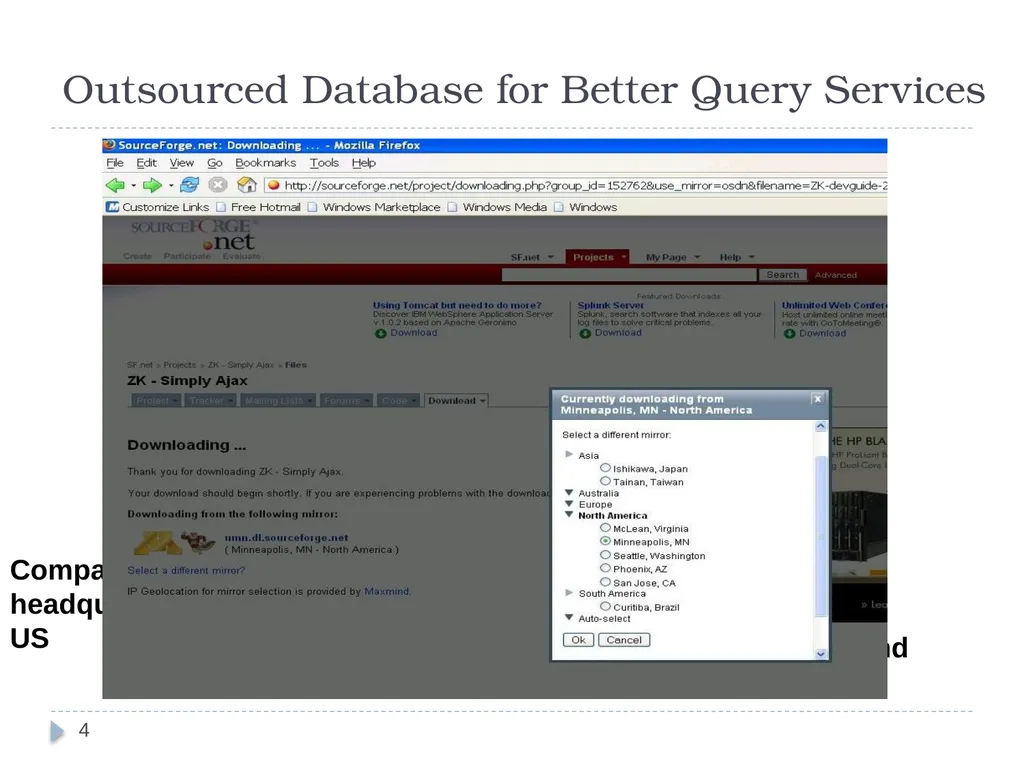
Outsourced Database for Better Query Services 4 Servers that are close to local clients and
maintained by local business partners Company with headquarters in US<br>
05
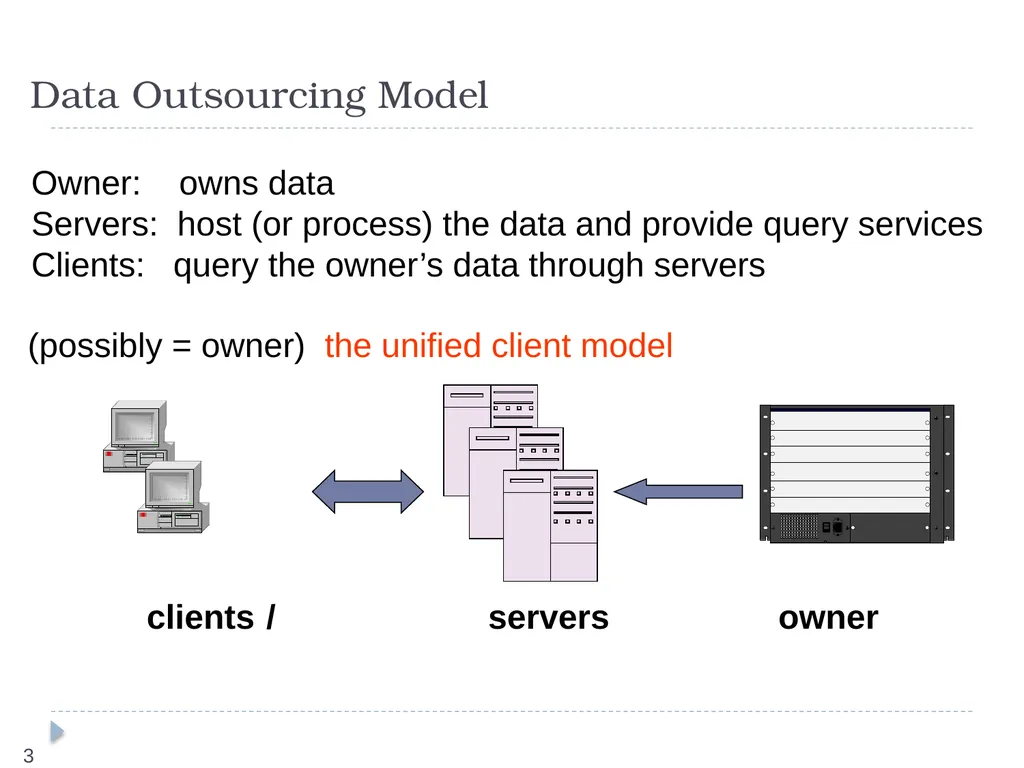
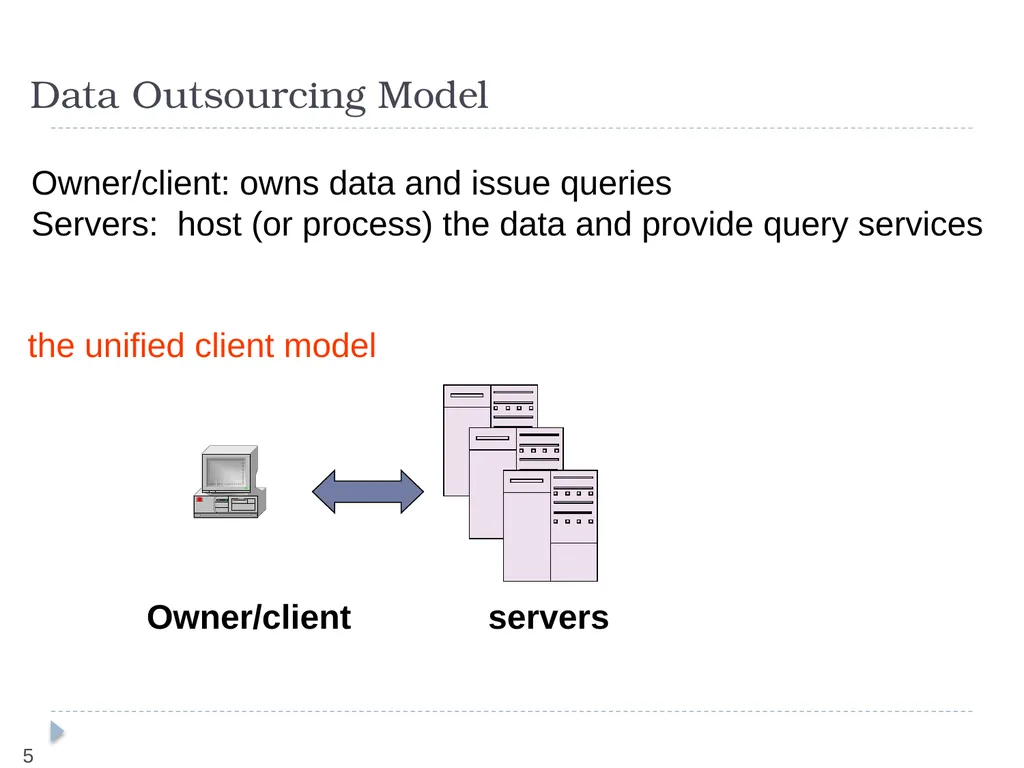
Data Outsourcing Model 5 Owner/client: owns data and issue queries
Servers: host (or process) the data and provide query services servers Owner/client the unified client model<br>
07
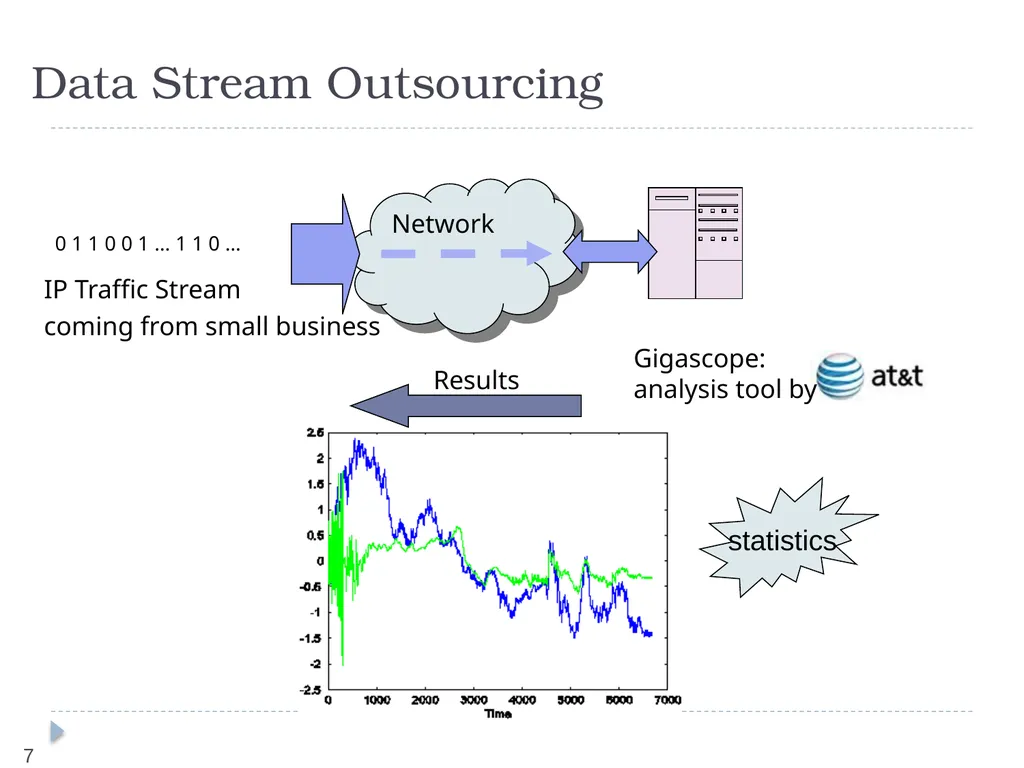
Data Stream Outsourcing 7 Network Gigascope:�analysis tool by IP Traffic Stream�coming from small business 0 1 1 0 0 1 … 1 1 0 … statistics Results<br>
08
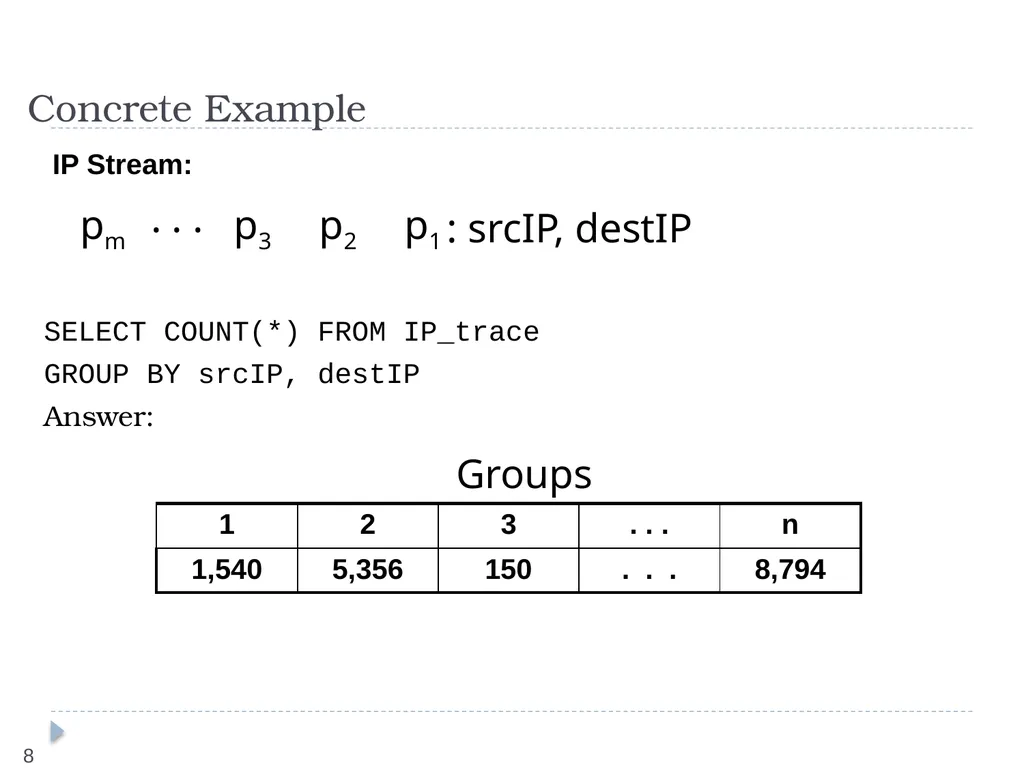
Concrete Example SELECT COUNT(*) FROM IP_trace
GROUP BY srcIP, destIP
Answer: 8 pm p3 p2 p1 . . . IP Stream: : srcIP, destIP Groups<br>
09
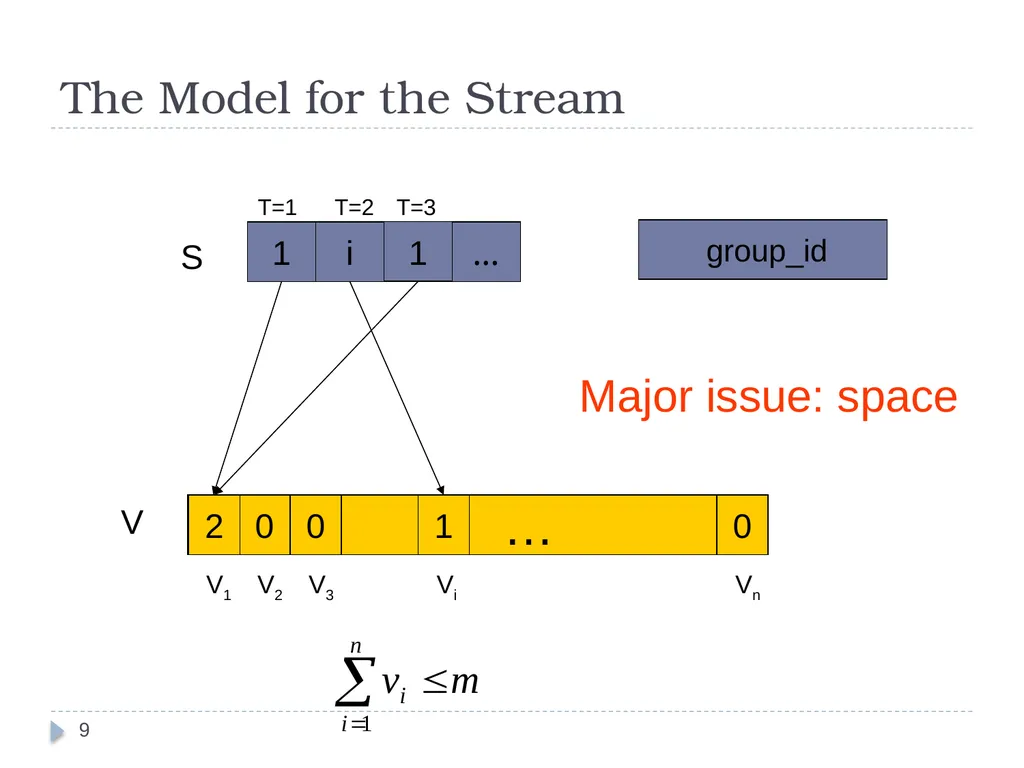
The Model for the Stream 9 1 i S 1 … 0 V 0 0 0 … V1 V2 V3 Vn 1 0 Vi 1 2 T=1 T=2 T=3 group_id Major issue: space<br>
10
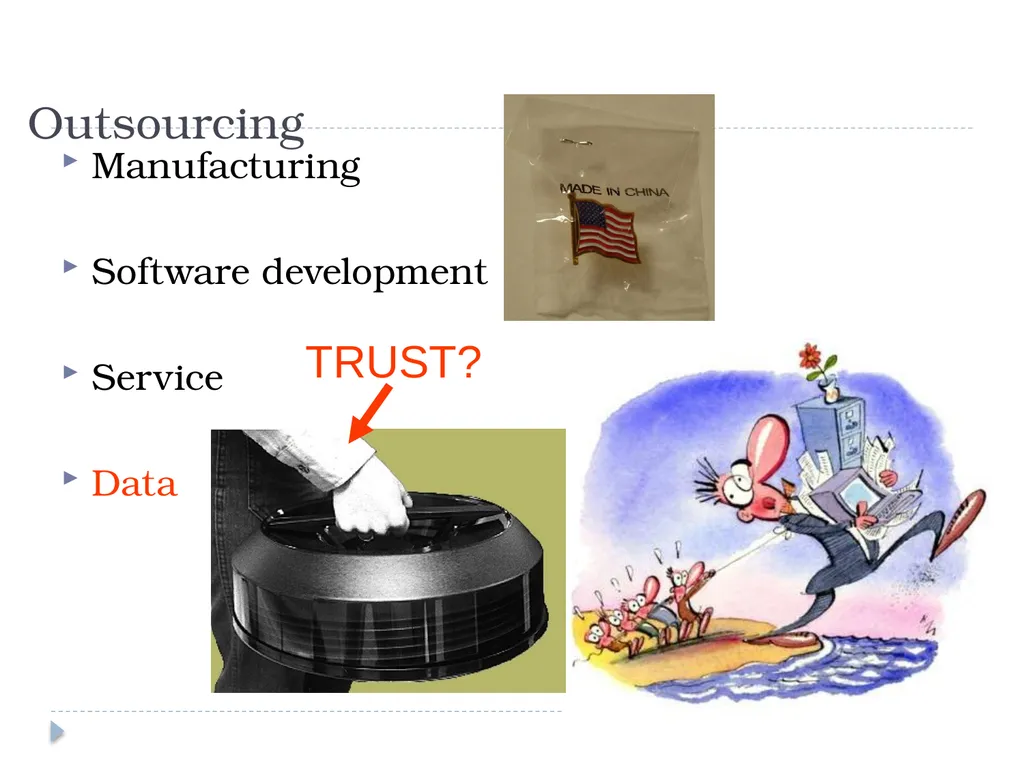
Information Security Issues 10 The third-party (server) cannot be trusted
Lazy service provider
Malicious intent
Compromised equipment
Unintentional errors (e.g. bugs)<br>
11
A Simple Solution [Sion, VLDB 05] Accumulate b queries
The owner computes r of them itself
Compute the hashes of these results, with some fake ones
Ask the server to identify these r queries
Problems:
Can only prevent (very) lazy service provider
How about malicious attacks?
Need to accumulate enough queries
What if there is only one query?
High cost: r queries need to processed locally
High failure probability: 10%-30% (typically)<br>
12
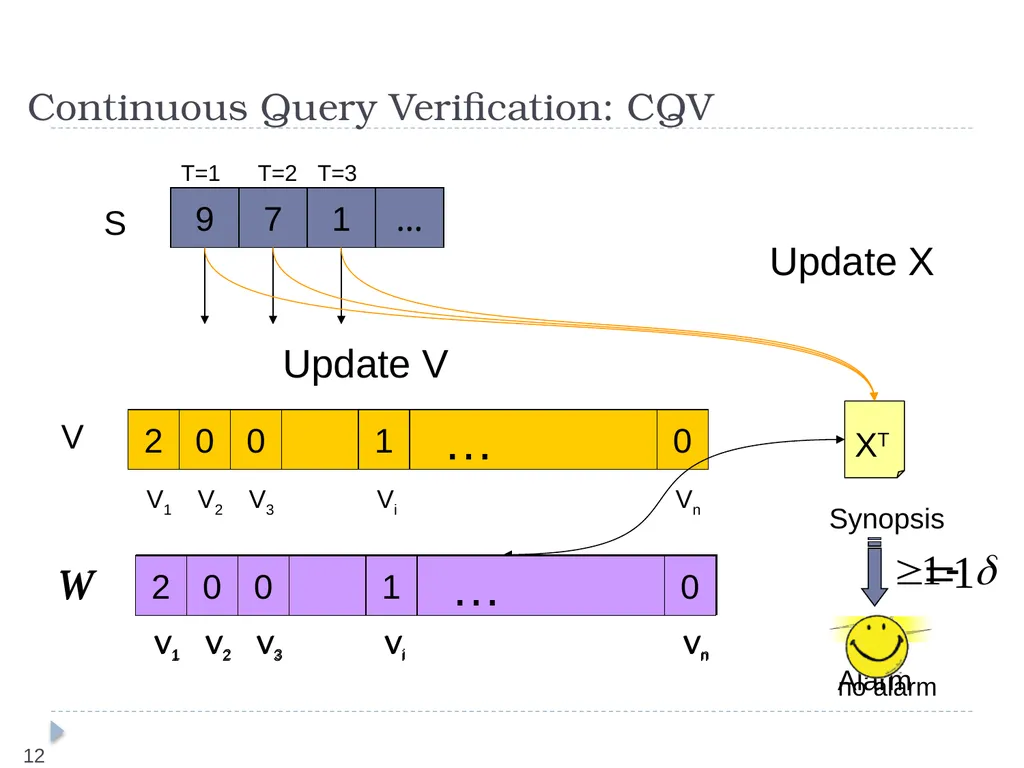
Continuous Query Verification: CQV 12 0 V 0 0 0 … V1 V2 V3 Vn 9 0 Vi 1 2 9 7 S 1 … T=1 T=2 T=3 Update V XT Synopsis Update X 0 0 2 0 … V1 V2 V3 Vn 9 0 Vi 5 2<br>
13
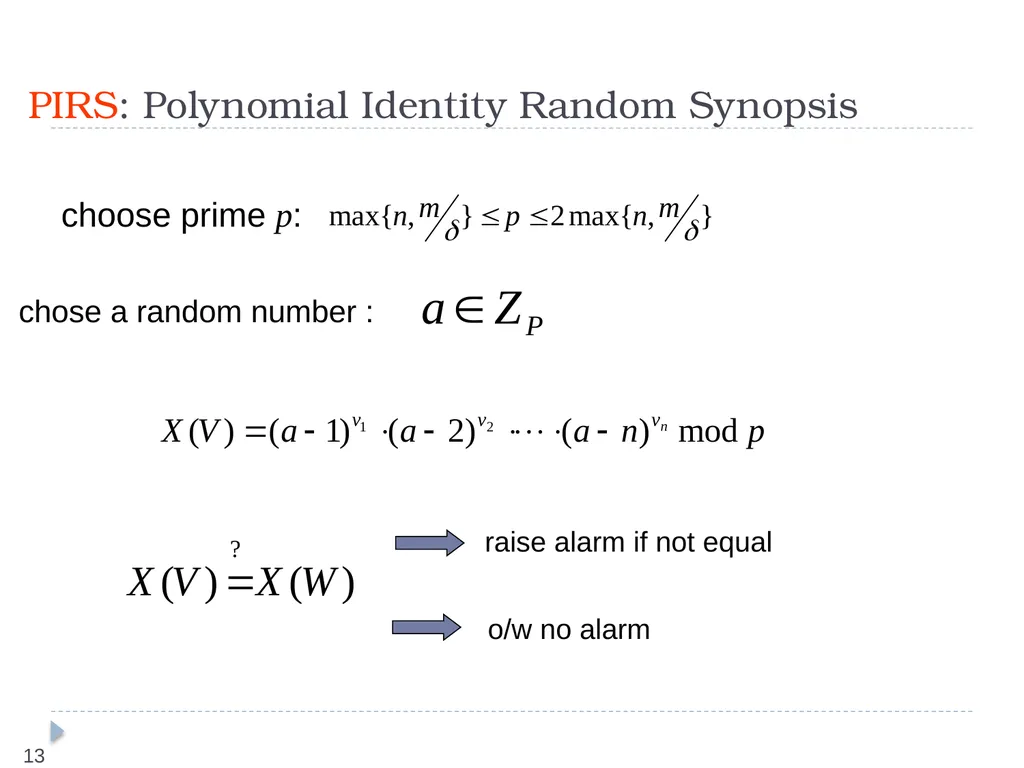
PIRS: Polynomial Identity Random Synopsis 13 choose prime p: chose a random number : raise alarm if not equal o/w no alarm<br>
14
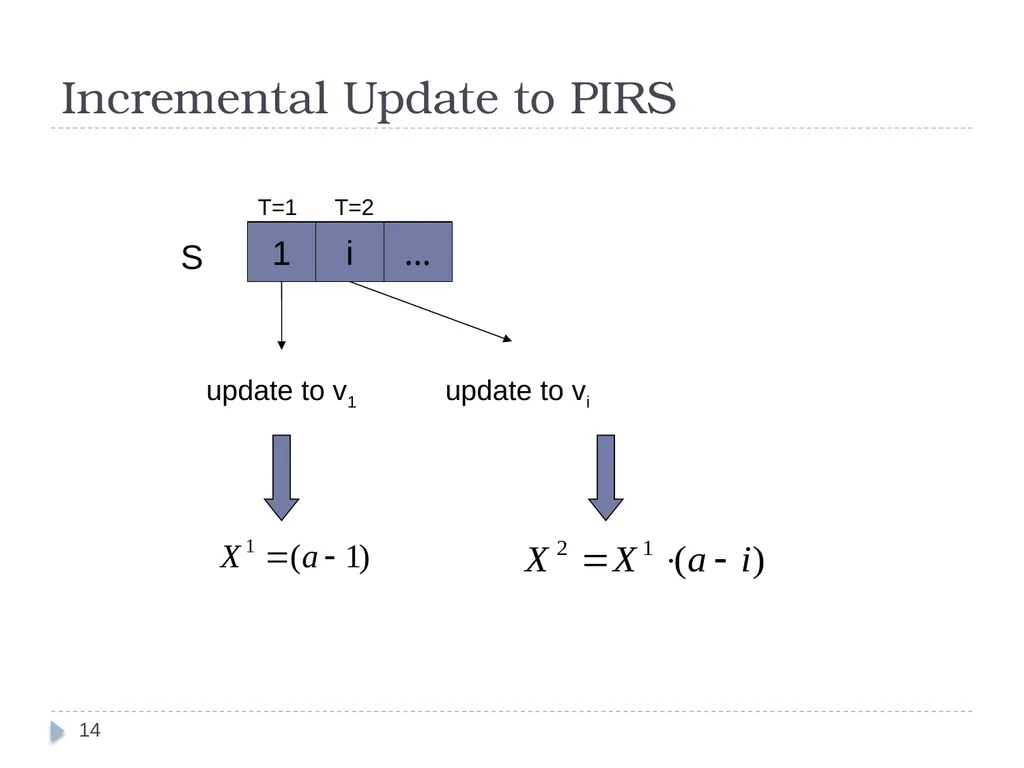
Incremental Update to PIRS 14 1 i S … T=1 T=2 update to v1 update to vi<br>
15
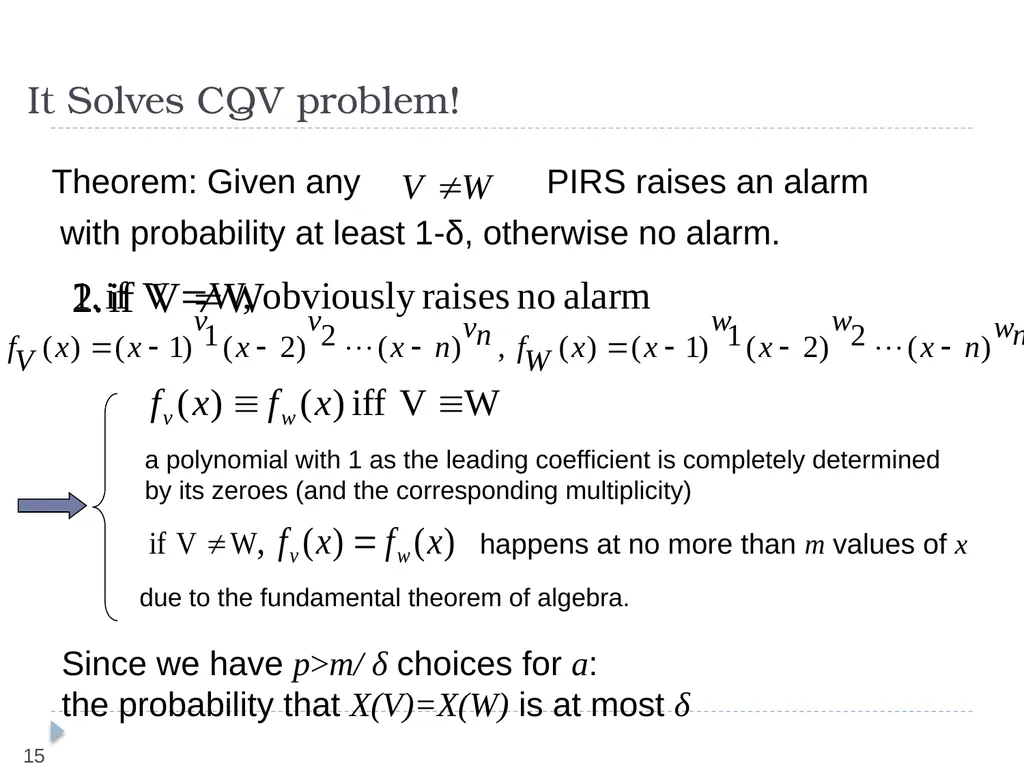
It Solves CQV problem! 15 Theorem: Given any PIRS raises an alarm with probability at least 1-δ, otherwise no alarm. a polynomial with 1 as the leading coefficient is completely determined
by its zeroes (and the corresponding multiplicity) due to the fundamental theorem of algebra. Since we have p>m/ δ choices for a:
the probability that X(V)=X(W) is at most δ<br>
16
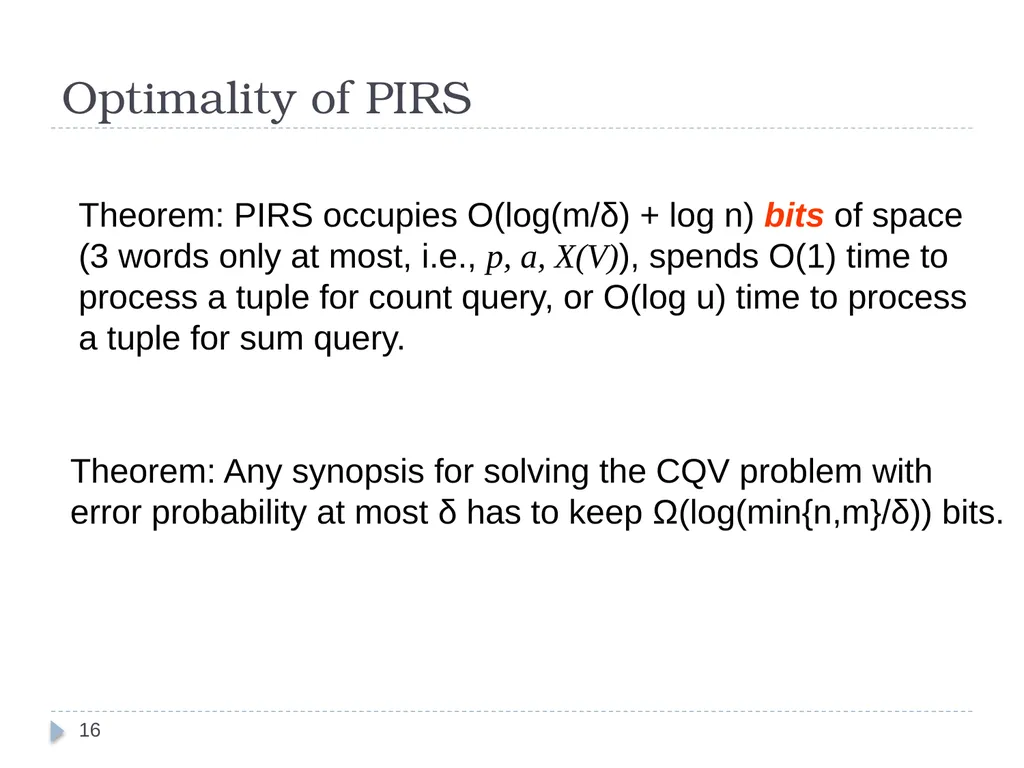
Optimality of PIRS 16 Theorem: PIRS occupies O(log(m/δ) + log n) bits of space
(3 words only at most, i.e., p, a, X(V)), spends O(1) time to
process a tuple for count query, or O(log u) time to process
a tuple for sum query. Theorem: Any synopsis for solving the CQV problem with
error probability at most δ has to keep Ω(log(min{n,m}/δ)) bits.<br>
17
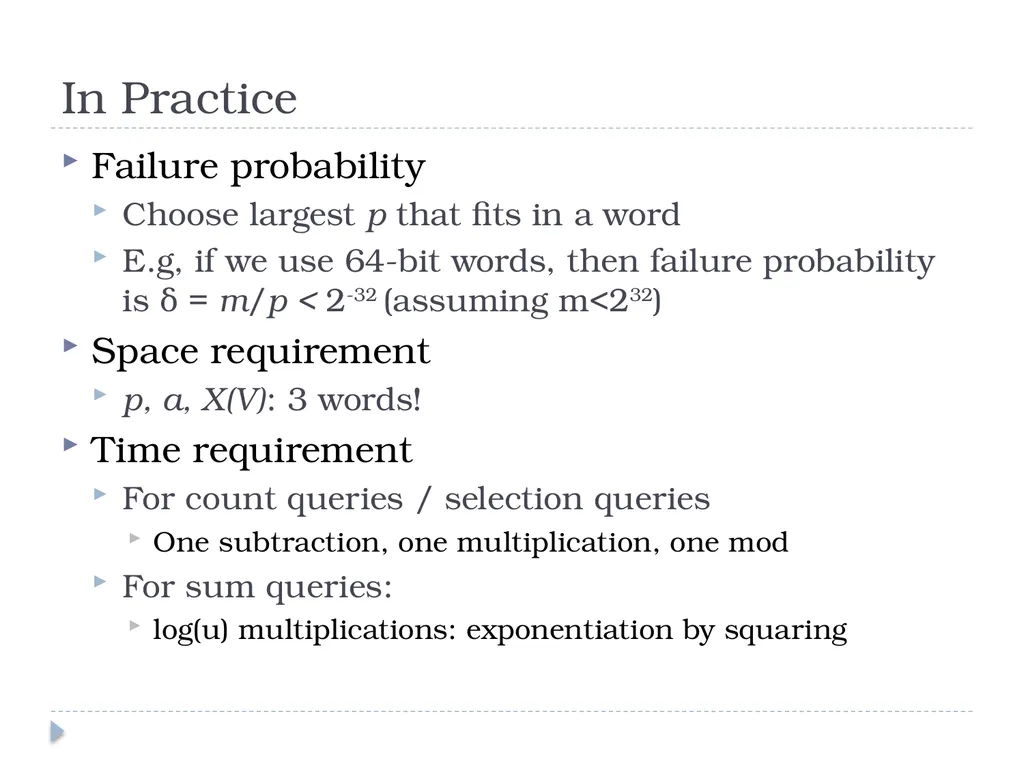
In Practice Failure probability
Choose largest p that fits in a word
E.g, if we use 64-bit words, then failure probability is δ = m/p < 2-32 (assuming m<232)
Space requirement
p, a, X(V): 3 words!
Time requirement
For count queries / selection queries
One subtraction, one multiplication, one mod
For sum queries:
log(u) multiplications: exponentiation by squaring<br>
18
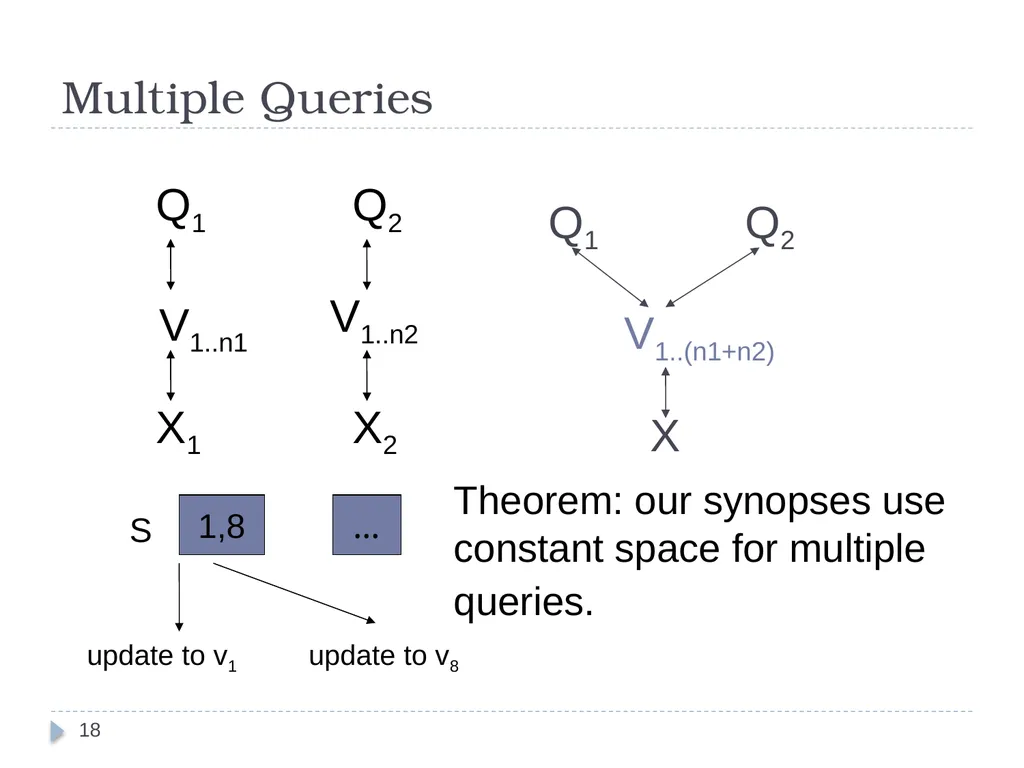
Multiple Queries 18 Q1 Q2 X1 X2 Q1 Q2 X 1,8 S … update to v1 update to v8 Theorem: our synopses use constant space for multiple queries. V1..n1 V1..n2 V1..(n1+n2)<br>
19
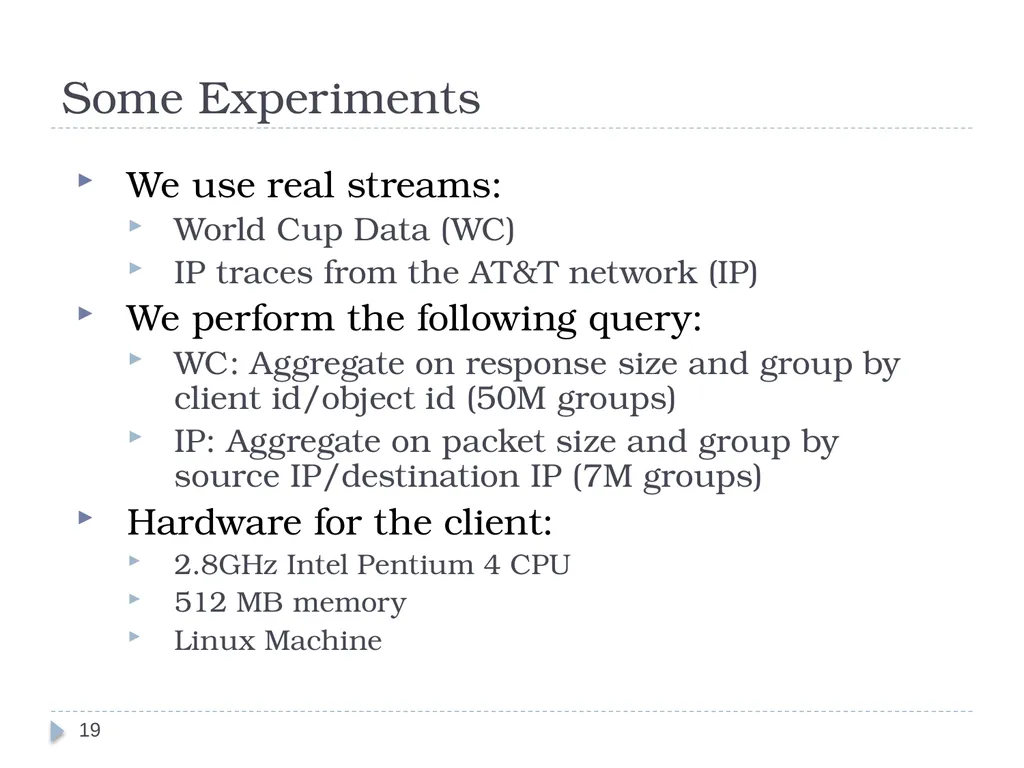
Some Experiments 19 We use real streams:
World Cup Data (WC)
IP traces from the AT&T network (IP)
We perform the following query:
WC: Aggregate on response size and group by client id/object id (50M groups)
IP: Aggregate on packet size and group by source IP/destination IP (7M groups)
Hardware for the client:
2.8GHz Intel Pentium 4 CPU
512 MB memory
Linux Machine<br>
20
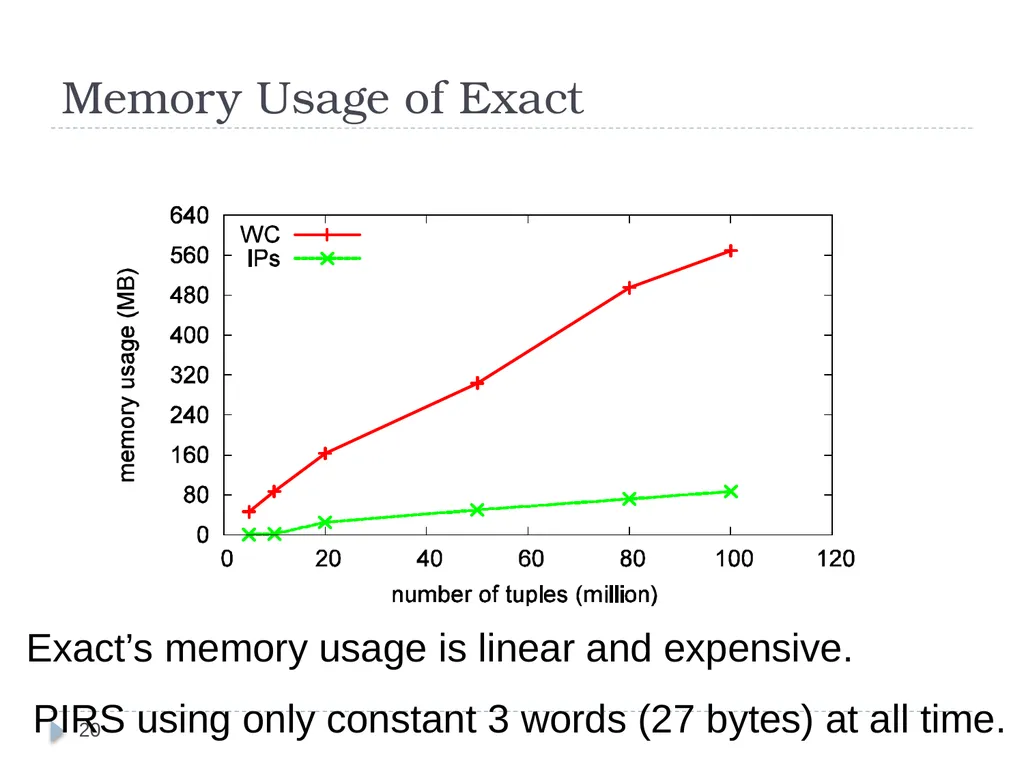
Memory Usage of Exact 20 PIRS using only constant 3 words (27 bytes) at all time. Exact’s memory usage is linear and expensive.<br>
21
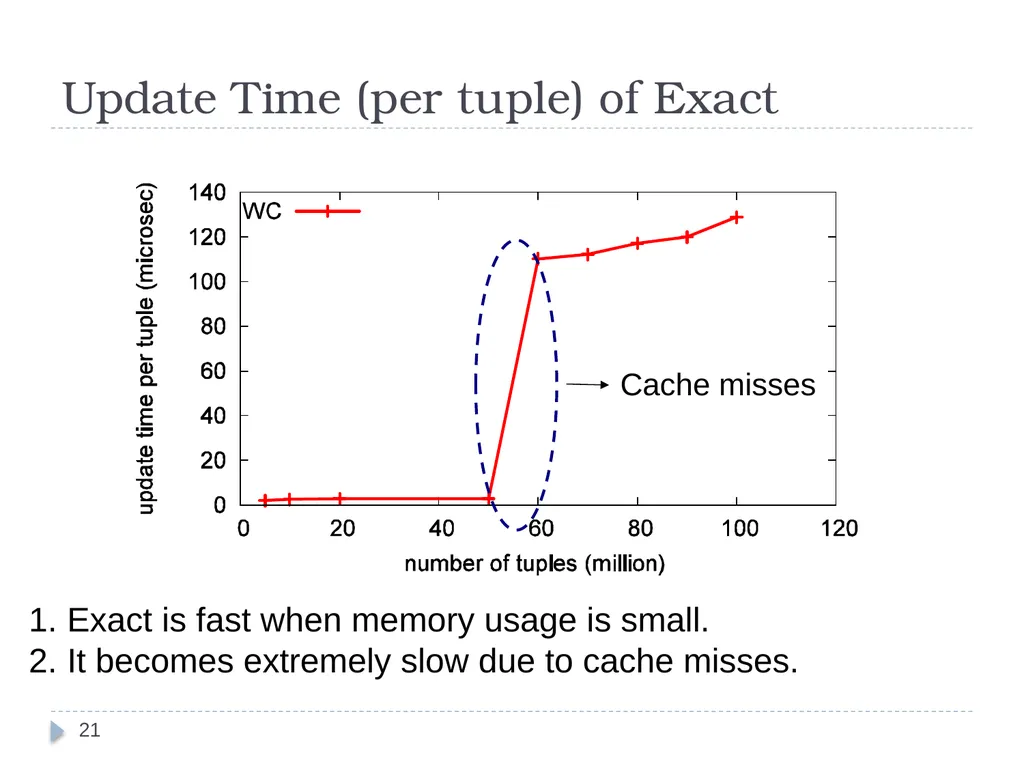
Update Time (per tuple) of Exact 21 Exact is fast when memory usage is small.
It becomes extremely slow due to cache misses. Cache misses<br>
22
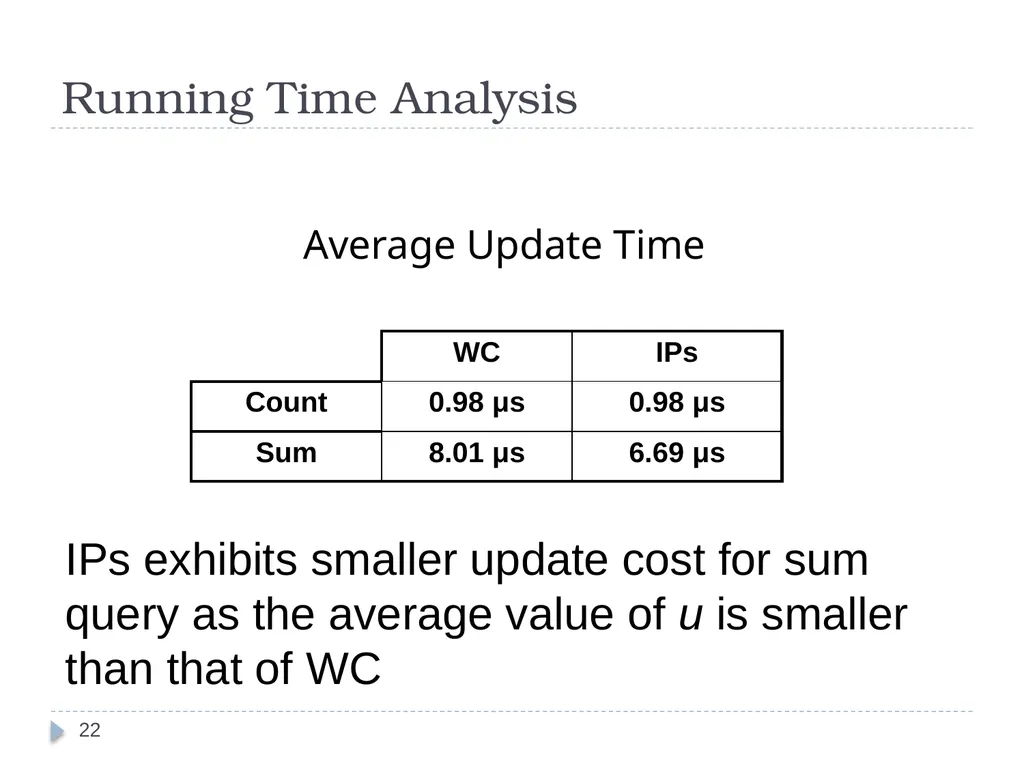
Running Time Analysis 22 Average Update Time IPs exhibits smaller update cost for sum query as the average value of u is smaller than that of WC<br>
23
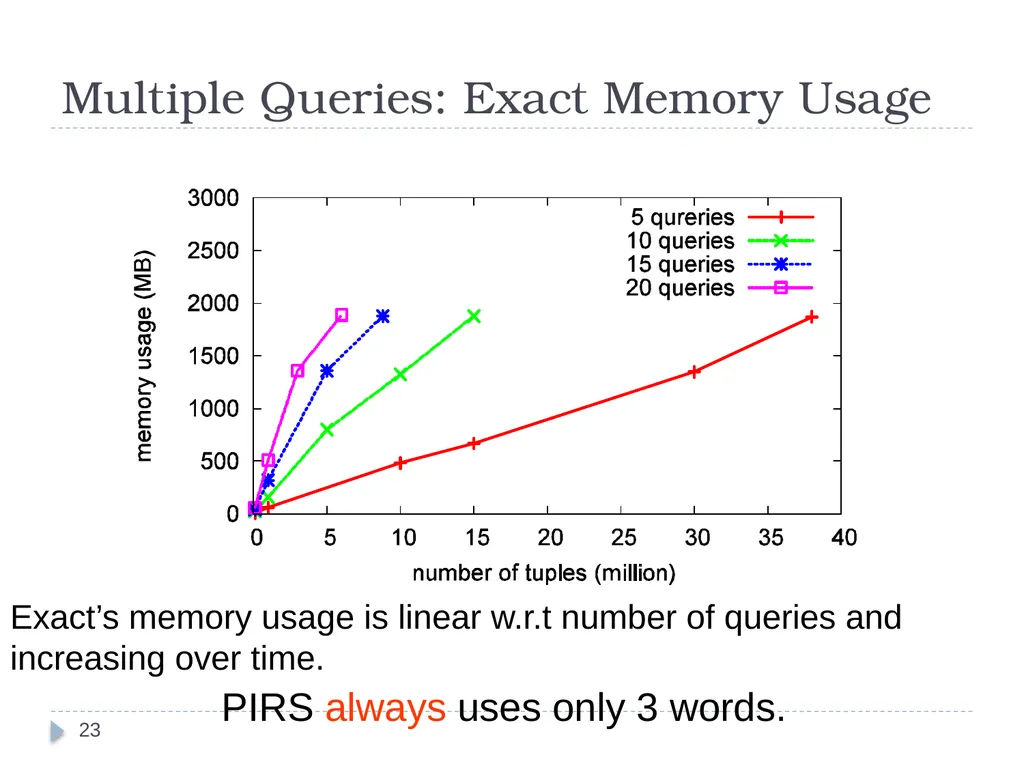
Multiple Queries: Exact Memory Usage 23 PIRS always uses only 3 words. Exact’s memory usage is linear w.r.t number of queries and increasing over time.<br>
24
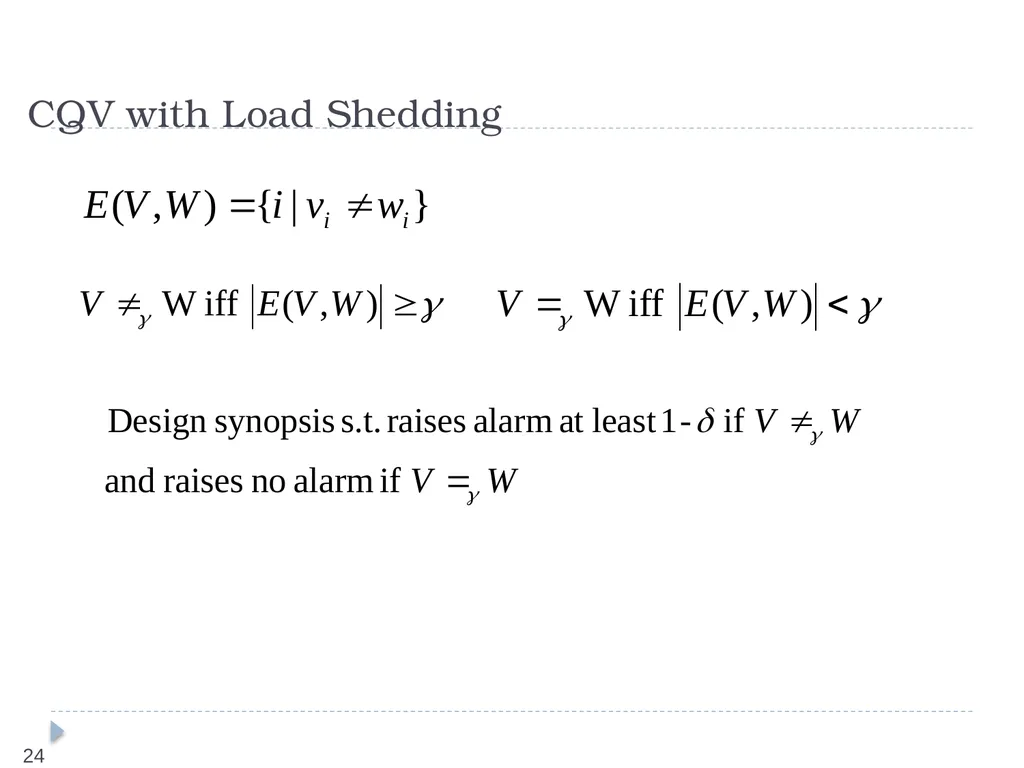
CQV with Load Shedding 24<br>
25
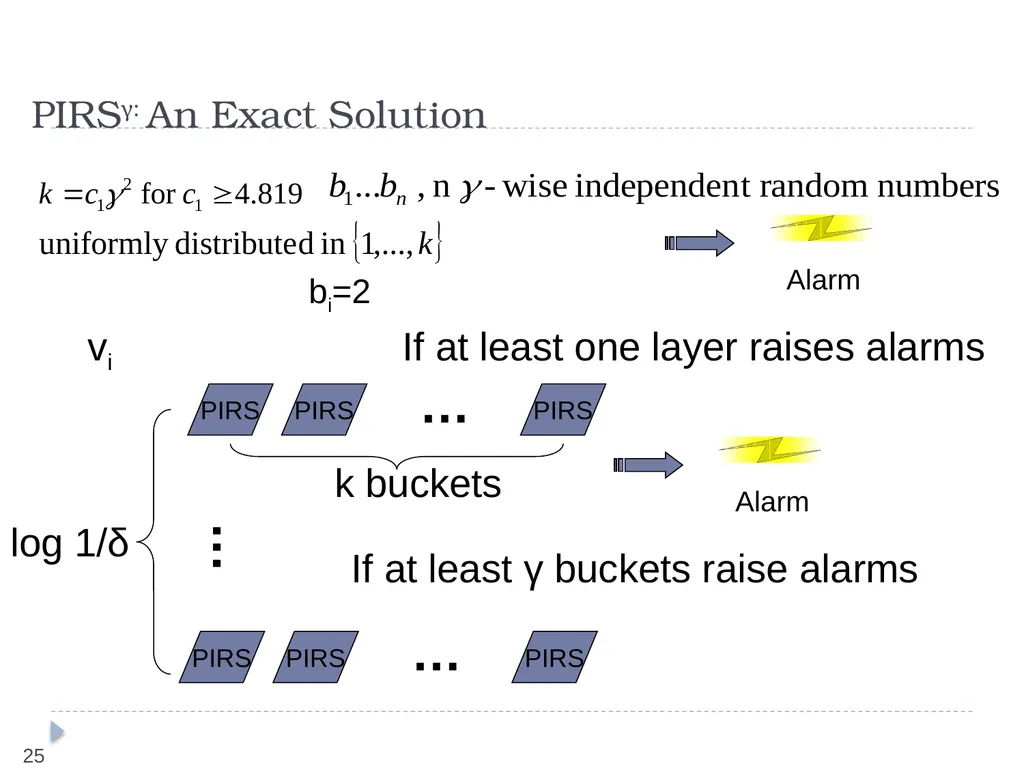
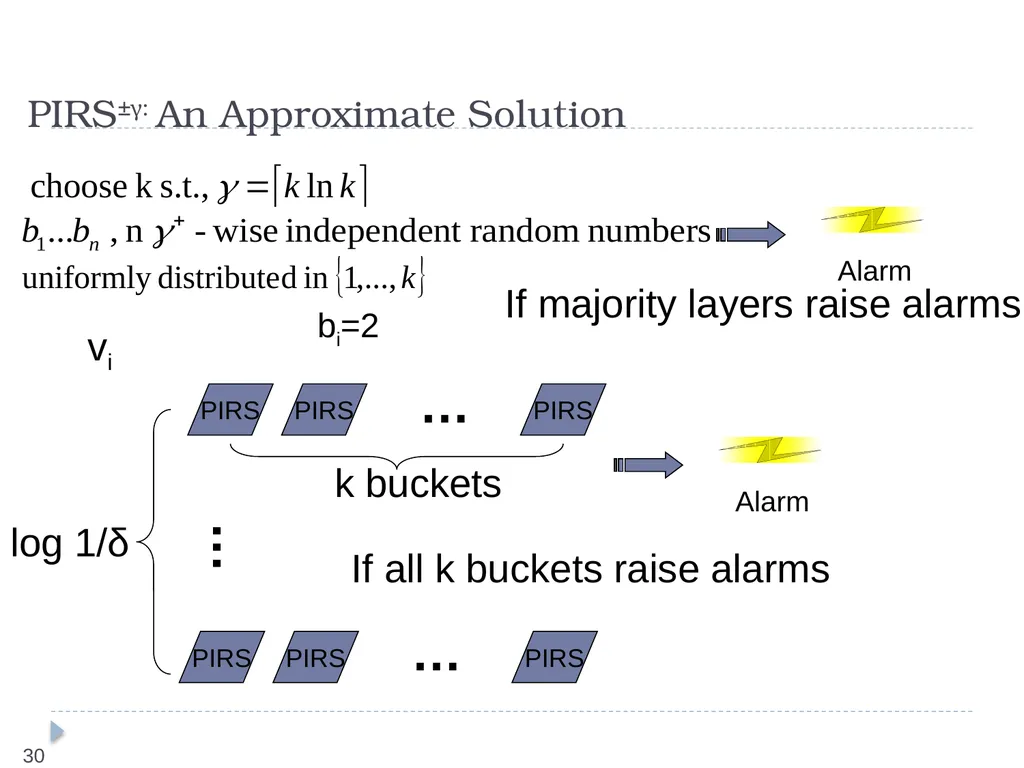
PIRSγ: An Exact Solution 25 PIRS PIRS PIRS … k buckets Alarm vi bi=2 If at least γ buckets raise alarms PIRS PIRS PIRS … … log 1/δ Alarm If at least one layer raises alarms<br>
26
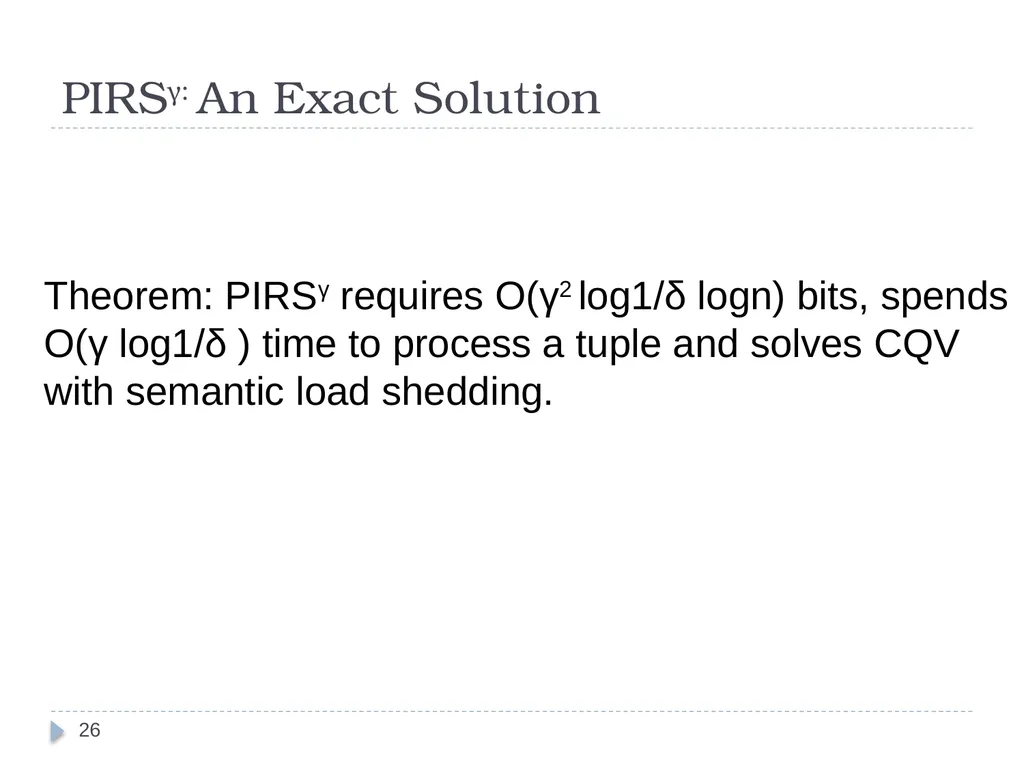
PIRSγ: An Exact Solution 26 Theorem: PIRSγ requires O(γ2 log1/δ logn) bits, spends
O(γ log1/δ ) time to process a tuple and solves CQV
with semantic load shedding.<br>
27
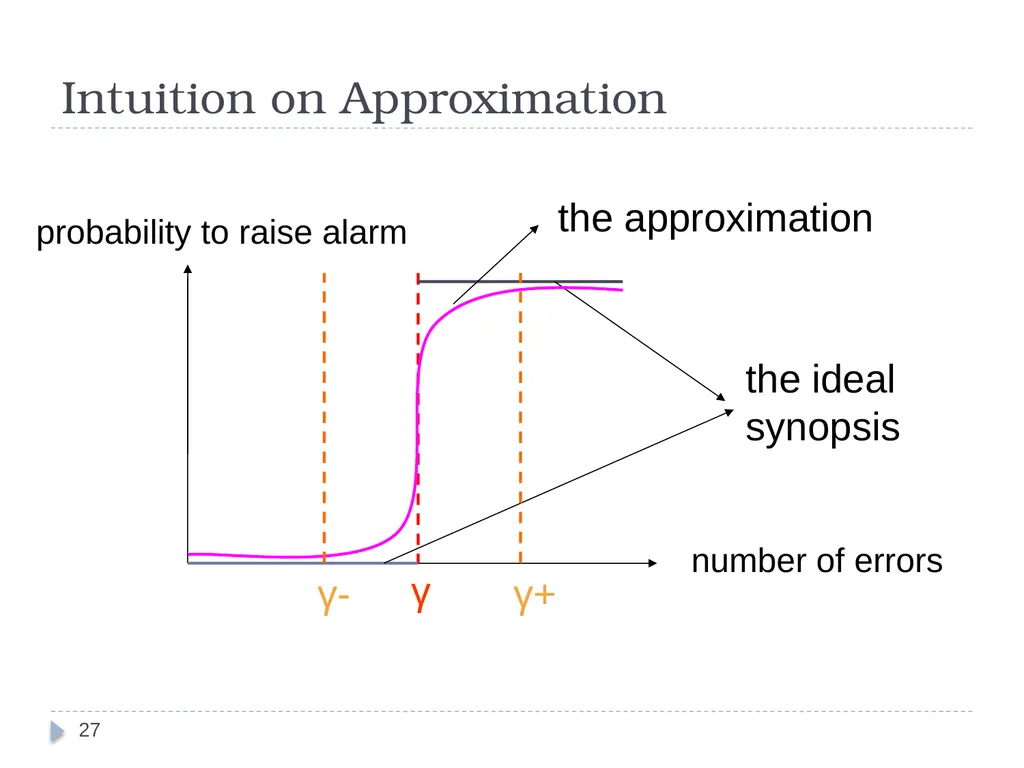
Intuition on Approximation 27 number of errors probability to raise alarm γ the ideal synopsis γ- γ+ the approximation<br>
28
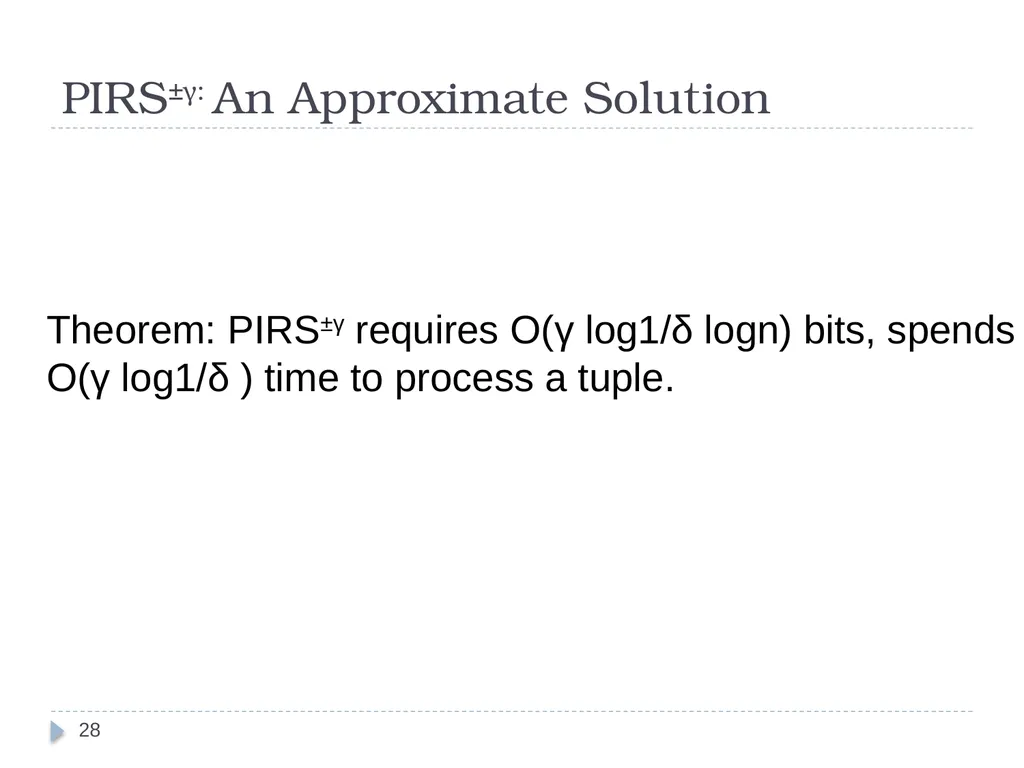
PIRS±γ: An Approximate Solution 28 Theorem: PIRS±γ requires O(γ log1/δ logn) bits, spends
O(γ log1/δ ) time to process a tuple.<br>
29
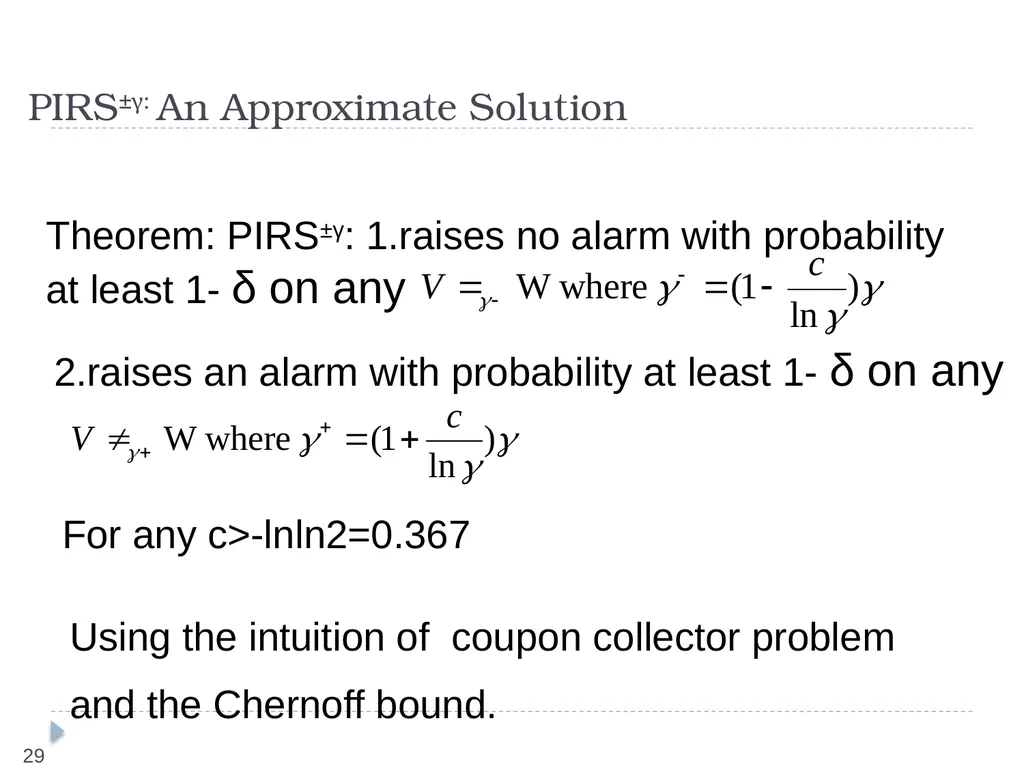
PIRS±γ: An Approximate Solution 29 Theorem: PIRS±γ: 1.raises no alarm with probability
at least 1- δ on any 2.raises an alarm with probability at least 1- δ on any For any c>-lnln2=0.367 Using the intuition of coupon collector problem
and the Chernoff bound.<br>
30
PIRS±γ: An Approximate Solution 30 PIRS PIRS PIRS … k buckets Alarm vi bi=2 If all k buckets raise alarms PIRS PIRS PIRS … … log 1/δ Alarm If majority layers raise alarms<br>
31
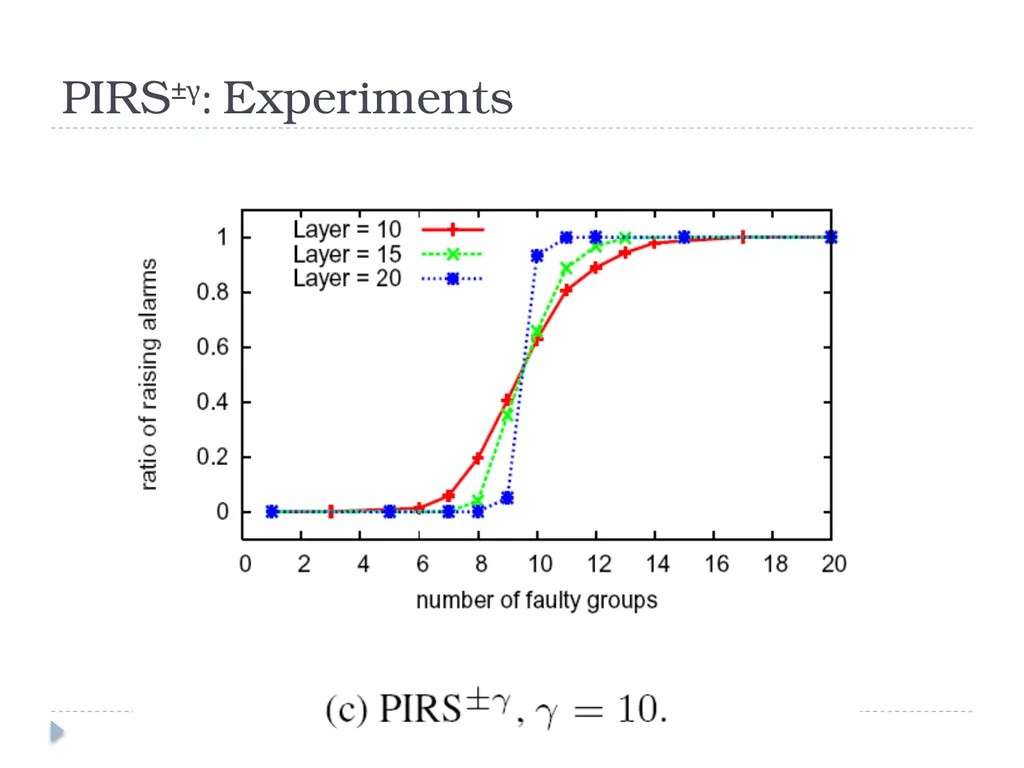
PIRS±γ: Experiments<br>
32
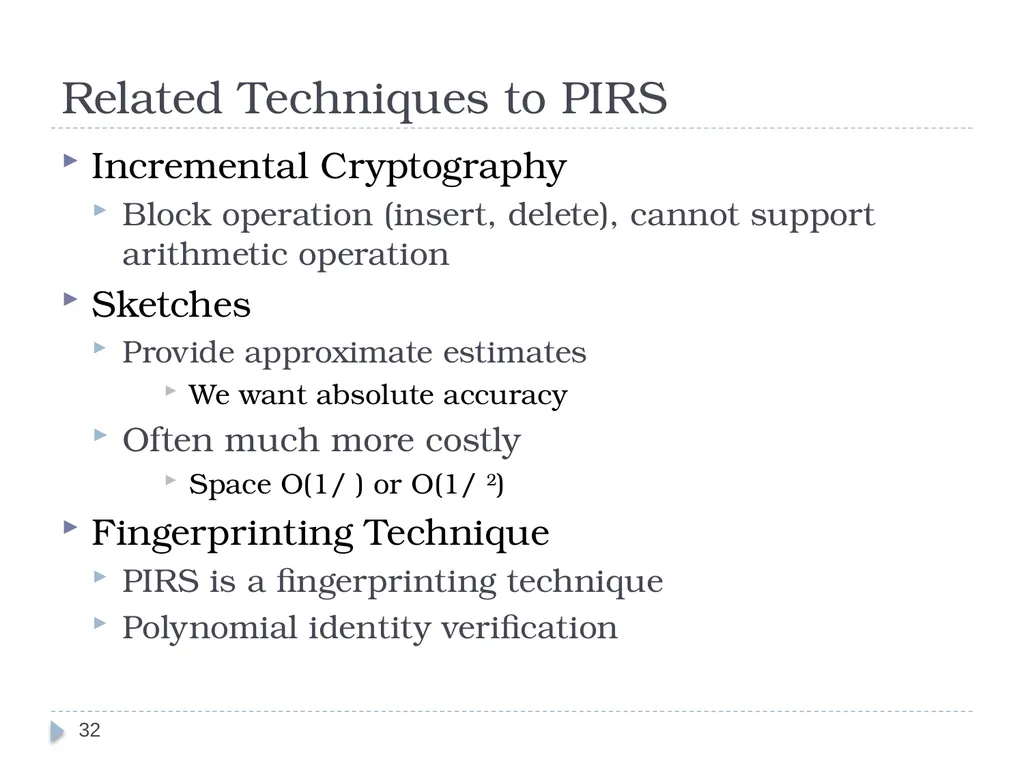
Related Techniques to PIRS 32 Incremental Cryptography
Block operation (insert, delete), cannot support arithmetic operation
Sketches
Provide approximate estimates
We want absolute accuracy
Often much more costly
Space O(1/) or O(1/2)
Fingerprinting Technique
PIRS is a fingerprinting technique
Polynomial identity verification<br>
33
Thanks! 33 Questions<br>