
Questions 1. What role does high stakes testing
TG
Published · 16 slides · 0 views
1 / 1
Description
Questions 1. What role does high stakes testing play in education? How can we expect students to be more than receptacles when all we do is deposit information into them based on tests? 2. Are there resources in place to determine
Related Topics
Share
Embed code
Download this presentation From Below
"Questions 1. What role does high stakes testing" is the property of its rightful owner. Permission is granted to download and print the materials on this website for personal, non-commercial use only, and to display it on your personal computer provided you do not modify the materials and that you retain all copyright notices contained in the materials. By downloading content from our website, you accept the terms of this agreement.
Presentation Transcript
01
Questions 1. What role does high stakes testing play in education? How can we expect students to be more than receptacles when all we do is deposit information into them based on tests?
2. Are there resources in place to determine standards-based pedagogy?
3. Doll’s post-modern view of the curriculum offers four R’s to improve the curriculum content. As future teachers, administrators, and educators, do you feel that we incorporate Doll’s ideas about the curriculum effectively into our everyday teaching?
The 3rd question is mine. Question 1 and 2 were contributed by my group partners Ellen and Richard<br>
2. Are there resources in place to determine standards-based pedagogy?
3. Doll’s post-modern view of the curriculum offers four R’s to improve the curriculum content. As future teachers, administrators, and educators, do you feel that we incorporate Doll’s ideas about the curriculum effectively into our everyday teaching?
The 3rd question is mine. Question 1 and 2 were contributed by my group partners Ellen and Richard<br>
02
The The Four R’s – an Alternative to the
Tyler Rationale
William E. Doll Jr.<br>
Tyler Rationale
William E. Doll Jr.<br>
03
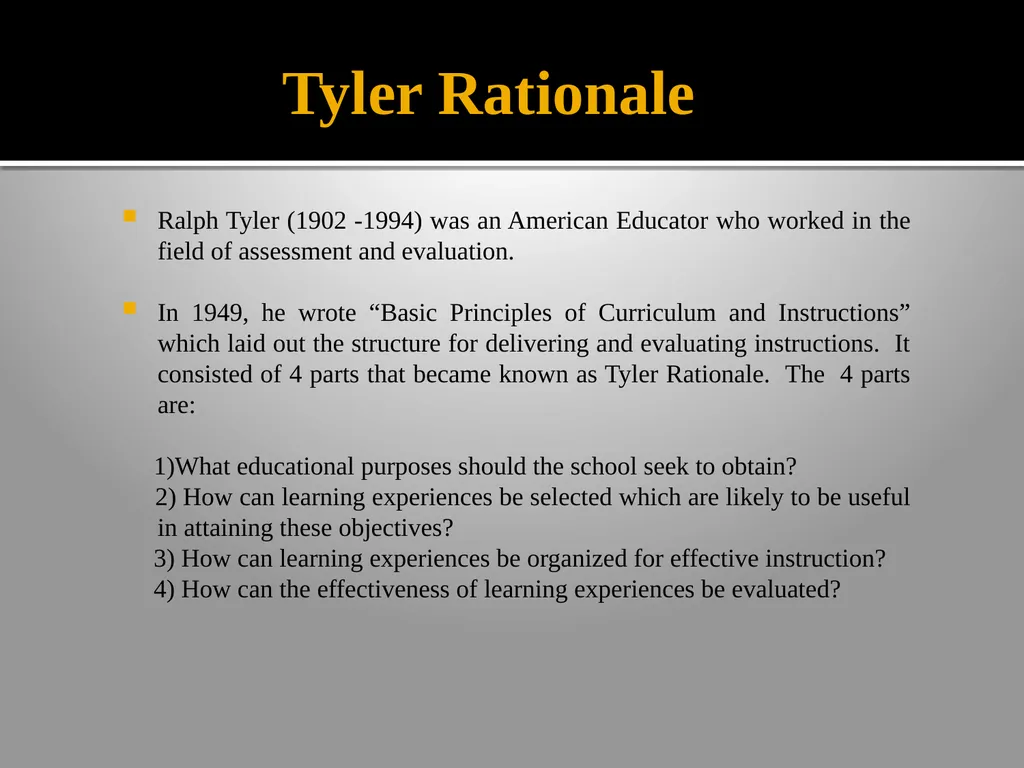
Tyler Rationale Ralph Tyler (1902 -1994) was an American Educator who worked in the field of assessment and evaluation.
In 1949, he wrote “Basic Principles of Curriculum and Instructions” which laid out the structure for delivering and evaluating instructions. It consisted of 4 parts that became known as Tyler Rationale. The 4 parts are:
1)What educational purposes should the school seek to obtain?
2) How can learning experiences be selected which are likely to be useful in attaining these objectives?
3) How can learning experiences be organized for effective instruction?
4) How can the effectiveness of learning experiences be evaluated?<br>
In 1949, he wrote “Basic Principles of Curriculum and Instructions” which laid out the structure for delivering and evaluating instructions. It consisted of 4 parts that became known as Tyler Rationale. The 4 parts are:
1)What educational purposes should the school seek to obtain?
2) How can learning experiences be selected which are likely to be useful in attaining these objectives?
3) How can learning experiences be organized for effective instruction?
4) How can the effectiveness of learning experiences be evaluated?<br>
04
William E. Doll Jr. William E. Doll Jr. is an Emeritus Professor at John Hopkins University.
In his book, “A Post-Modern Perspective on Curriculum, William E. Doll Jr. traced the movement of the curriculum from a modernist viewpoint to that of a
post-modernist.
In this excerpt he examined the assumptions of the educational polices and practices that existed when he was younger and offers his view on the curriculum as a post-modernist.
His post-modern curriculum is characterized by metaphors and ideas that form a complex system of uncertainty, ambiguity and transformation.
His idea for a post-modern perspective on the curriculum stems from ideas of Piaget, Dewey, Bruner and Whitehead.<br>
In his book, “A Post-Modern Perspective on Curriculum, William E. Doll Jr. traced the movement of the curriculum from a modernist viewpoint to that of a
post-modernist.
In this excerpt he examined the assumptions of the educational polices and practices that existed when he was younger and offers his view on the curriculum as a post-modernist.
His post-modern curriculum is characterized by metaphors and ideas that form a complex system of uncertainty, ambiguity and transformation.
His idea for a post-modern perspective on the curriculum stems from ideas of Piaget, Dewey, Bruner and Whitehead.<br>
05
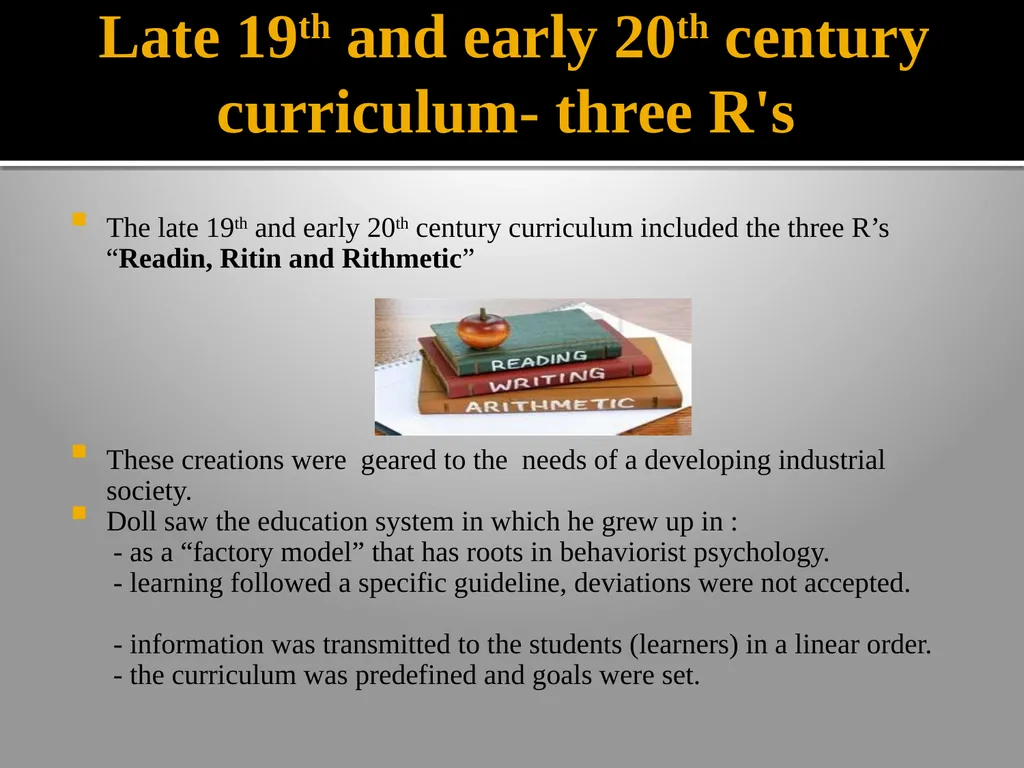
Late 19th and early 20th century curriculum- three R's The late 19th and early 20th century curriculum included the three R’s
“Readin, Ritin and Rithmetic”
These creations were geared to the needs of a developing industrial society.
Doll saw the education system in which he grew up in :
- as a “factory model” that has roots in behaviorist psychology.
- learning followed a specific guideline, deviations were not accepted.
- information was transmitted to the students (learners) in a linear order.
- the curriculum was predefined and goals were set.<br>
“Readin, Ritin and Rithmetic”
These creations were geared to the needs of a developing industrial society.
Doll saw the education system in which he grew up in :
- as a “factory model” that has roots in behaviorist psychology.
- learning followed a specific guideline, deviations were not accepted.
- information was transmitted to the students (learners) in a linear order.
- the curriculum was predefined and goals were set.<br>
06
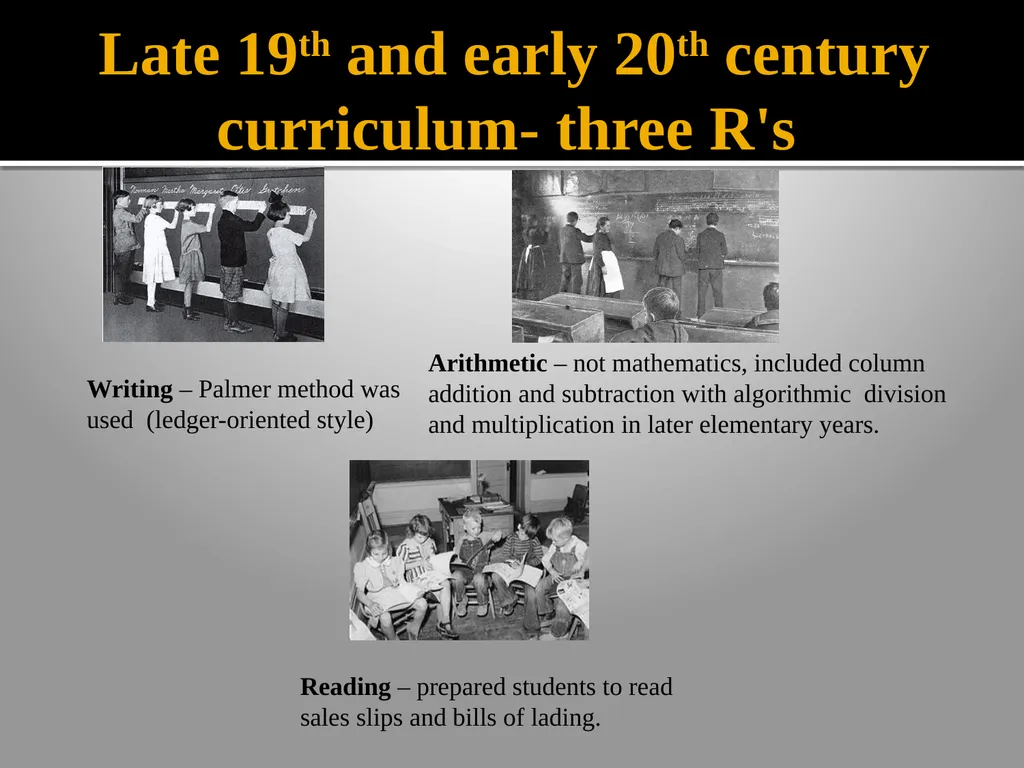
Late 19th and early 20th century curriculum- three R's Reading – prepared students to read sales slips and bills of lading. Writing – Palmer method was used (ledger-oriented style) Arithmetic – not mathematics, included column addition and subtraction with algorithmic division and multiplication in later elementary years.<br>
07
Connection between Tyler Rationale and the three R's A pre-set functionalism underlies both.
Tyler’s frame broadens industrial functionalism beyond the three R’s.
However goals are still predetermined , experiences are predetermined and so are the methods for developing these experiences in Tyler’s frame.
Goals and experiences are already in place before any type of student interaction occurs.
Evaluations are not designed to correlate with what students can produce after gaining experience.<br>
Tyler’s frame broadens industrial functionalism beyond the three R’s.
However goals are still predetermined , experiences are predetermined and so are the methods for developing these experiences in Tyler’s frame.
Goals and experiences are already in place before any type of student interaction occurs.
Evaluations are not designed to correlate with what students can produce after gaining experience.<br>
08
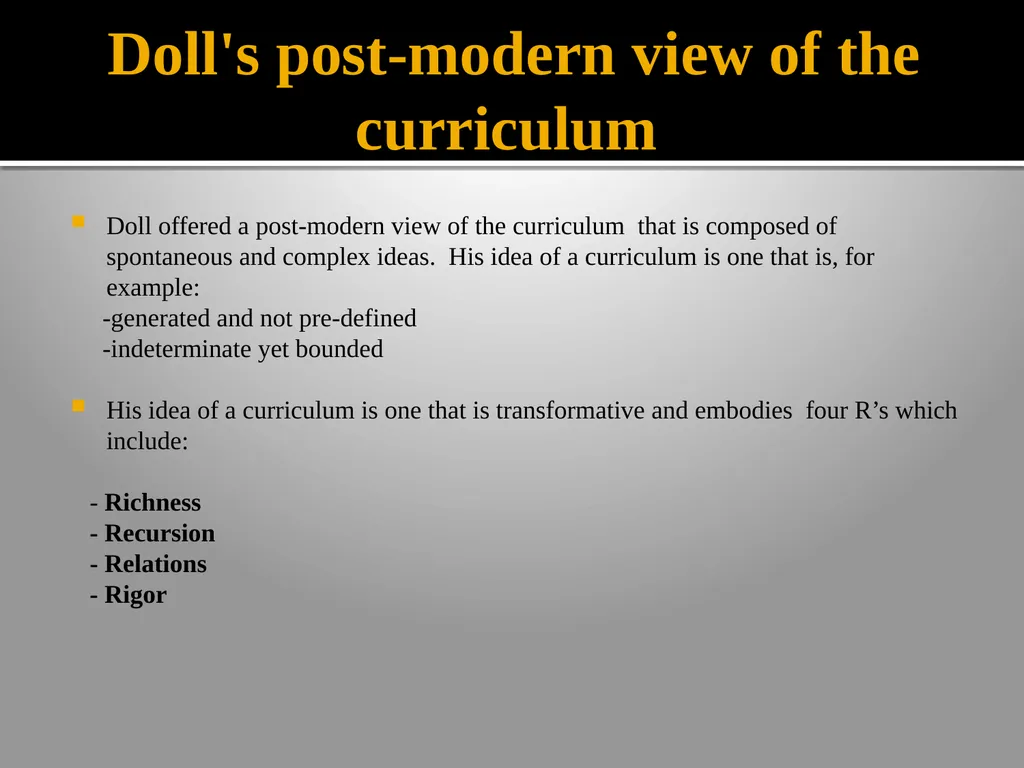
Doll's post-modern view of the curriculum Doll offered a post-modern view of the curriculum that is composed of spontaneous and complex ideas. His idea of a curriculum is one that is, for example:
-generated and not pre-defined
-indeterminate yet bounded
His idea of a curriculum is one that is transformative and embodies four R’s which include:
- Richness
- Recursion
- Relations
- Rigor<br>
-generated and not pre-defined
-indeterminate yet bounded
His idea of a curriculum is one that is transformative and embodies four R’s which include:
- Richness
- Recursion
- Relations
- Rigor<br>
09
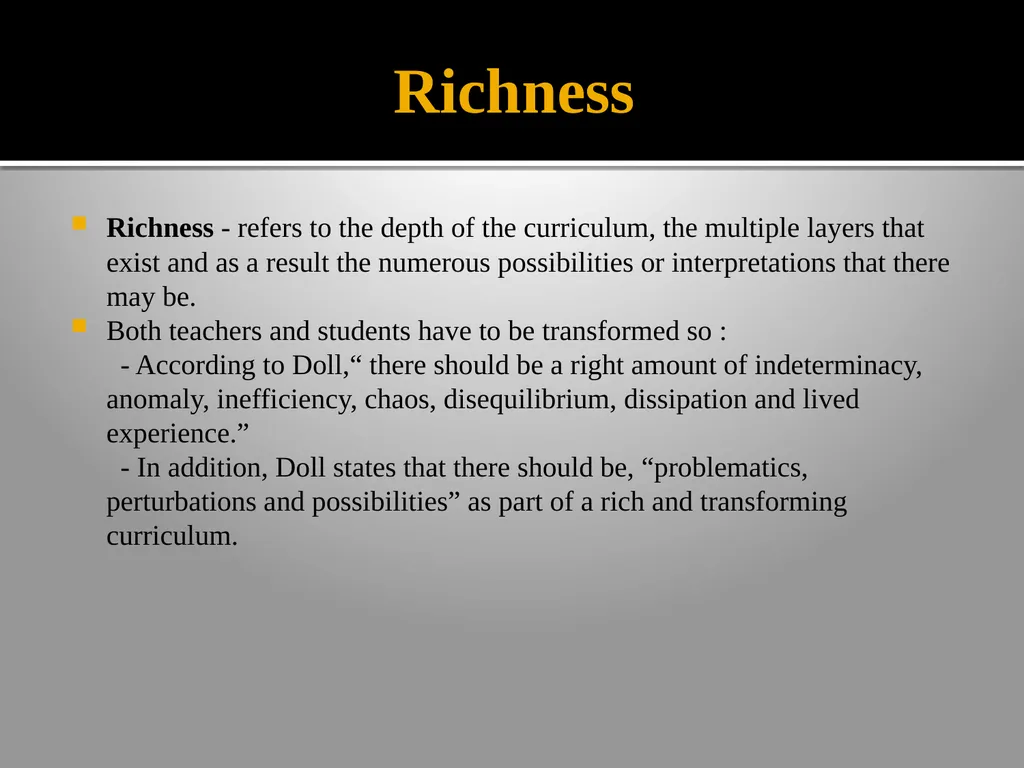
Richness Richness - refers to the depth of the curriculum, the multiple layers that exist and as a result the numerous possibilities or interpretations that there may be.
Both teachers and students have to be transformed so :
- According to Doll,“ there should be a right amount of indeterminacy, anomaly, inefficiency, chaos, disequilibrium, dissipation and lived experience.”
- In addition, Doll states that there should be, “problematics, perturbations and possibilities” as part of a rich and transforming curriculum.<br>
Both teachers and students have to be transformed so :
- According to Doll,“ there should be a right amount of indeterminacy, anomaly, inefficiency, chaos, disequilibrium, dissipation and lived experience.”
- In addition, Doll states that there should be, “problematics, perturbations and possibilities” as part of a rich and transforming curriculum.<br>
10
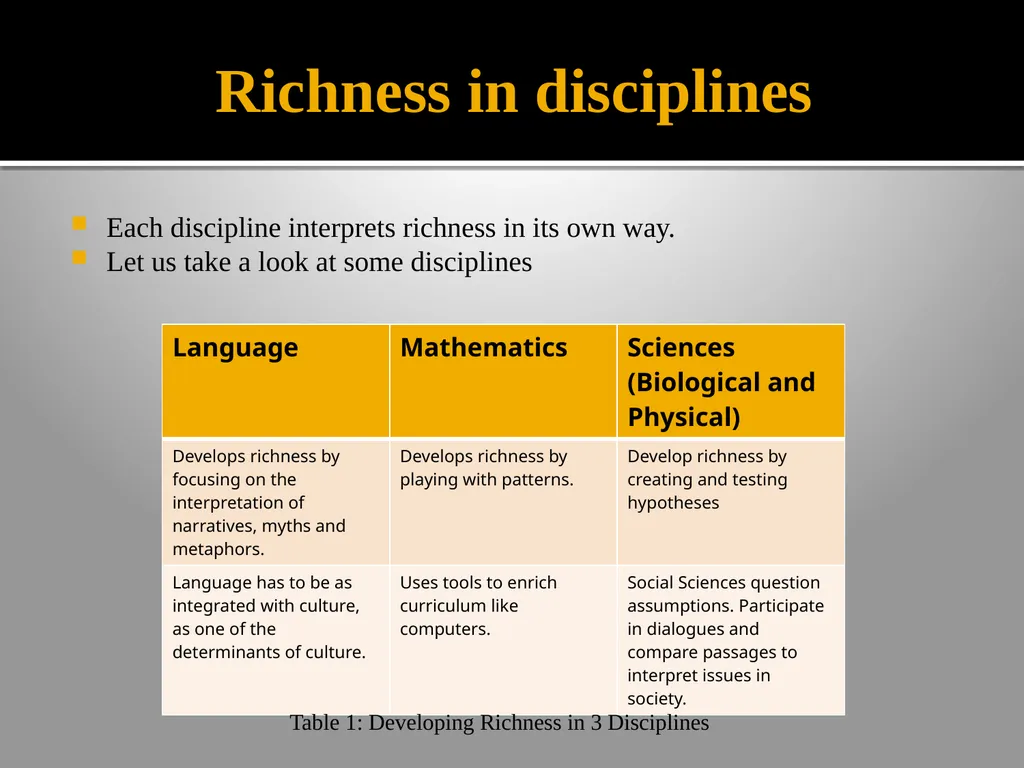
Richness in disciplines Each discipline interprets richness in its own way.
Let us take a look at some disciplines Table 1: Developing Richness in 3 Disciplines<br>
Let us take a look at some disciplines Table 1: Developing Richness in 3 Disciplines<br>
11
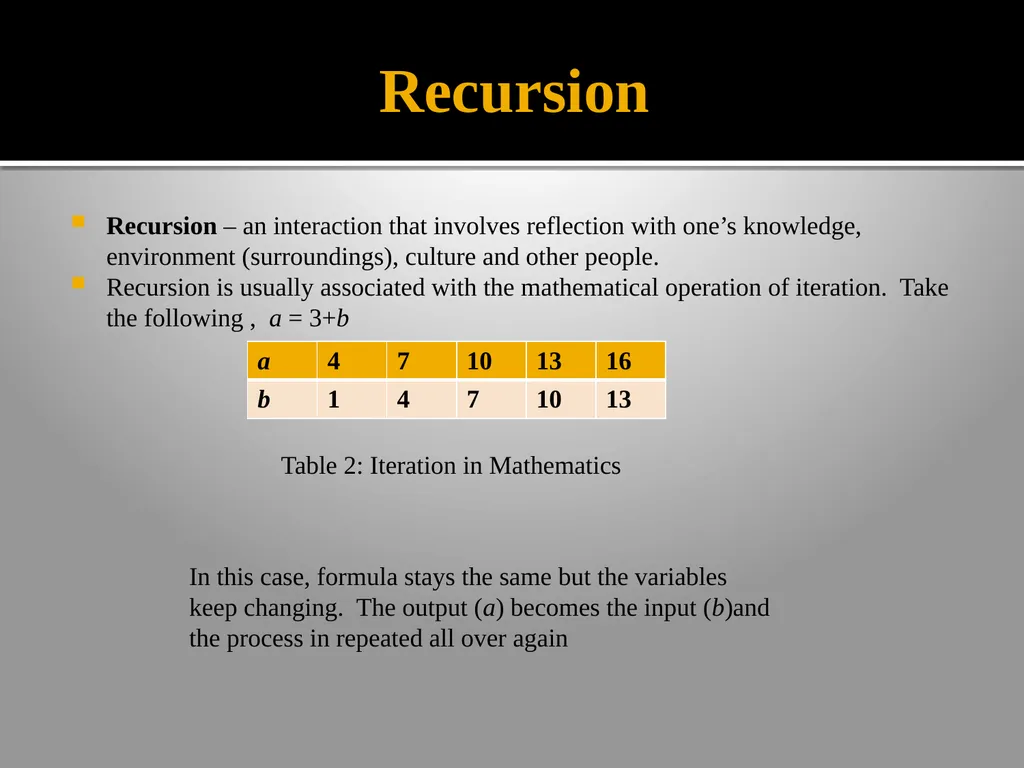
Recursion Recursion – an interaction that involves reflection with one’s knowledge, environment (surroundings), culture and other people.
Recursion is usually associated with the mathematical operation of iteration. Take the following , a = 3+b Table 2: Iteration in Mathematics In this case, formula stays the same but the variables keep changing. The output (a) becomes the input (b)and the process in repeated all over again<br>
Recursion is usually associated with the mathematical operation of iteration. Take the following , a = 3+b Table 2: Iteration in Mathematics In this case, formula stays the same but the variables keep changing. The output (a) becomes the input (b)and the process in repeated all over again<br>
12
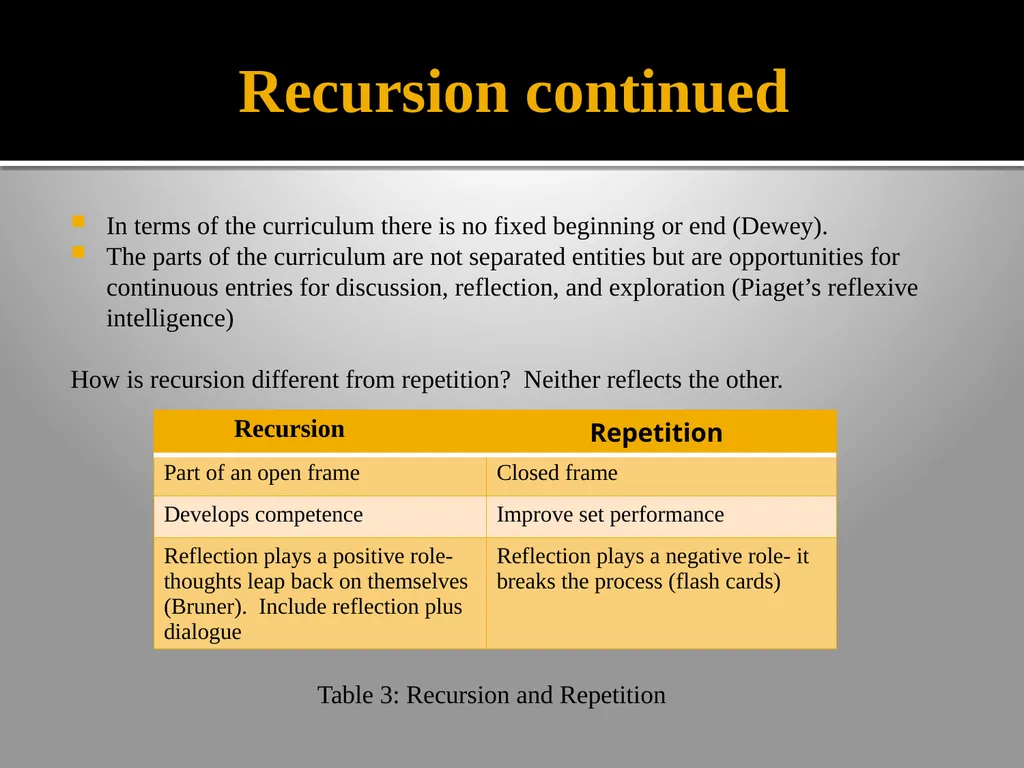
Recursion continued In terms of the curriculum there is no fixed beginning or end (Dewey).
The parts of the curriculum are not separated entities but are opportunities for continuous entries for discussion, reflection, and exploration (Piaget’s reflexive intelligence)
How is recursion different from repetition? Neither reflects the other. Table 3: Recursion and Repetition<br>
The parts of the curriculum are not separated entities but are opportunities for continuous entries for discussion, reflection, and exploration (Piaget’s reflexive intelligence)
How is recursion different from repetition? Neither reflects the other. Table 3: Recursion and Repetition<br>
13
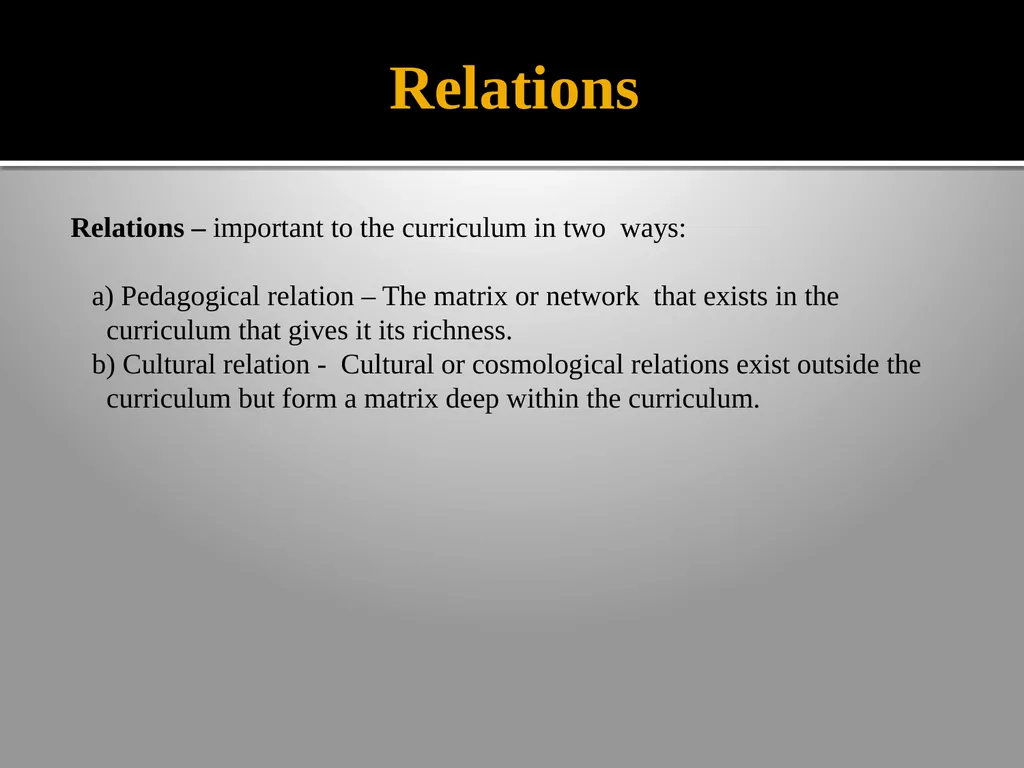
Relations Relations – important to the curriculum in two ways:
a) Pedagogical relation – The matrix or network that exists in the curriculum that gives it its richness.
b) Cultural relation - Cultural or cosmological relations exist outside the curriculum but form a matrix deep within the curriculum.<br>
a) Pedagogical relation – The matrix or network that exists in the curriculum that gives it its richness.
b) Cultural relation - Cultural or cosmological relations exist outside the curriculum but form a matrix deep within the curriculum.<br>
14
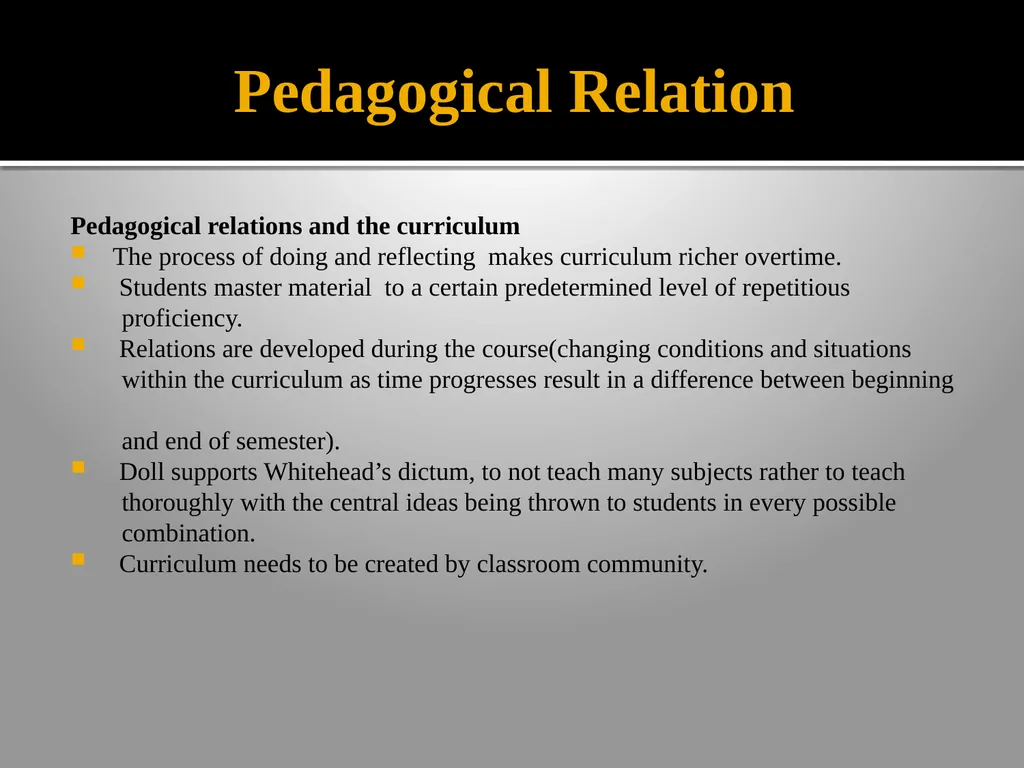
Pedagogical Relation Pedagogical relations and the curriculum
The process of doing and reflecting makes curriculum richer overtime.
Students master material to a certain predetermined level of repetitious
proficiency.
Relations are developed during the course(changing conditions and situations
within the curriculum as time progresses result in a difference between beginning
and end of semester).
Doll supports Whitehead’s dictum, to not teach many subjects rather to teach
thoroughly with the central ideas being thrown to students in every possible
combination.
Curriculum needs to be created by classroom community.<br>
The process of doing and reflecting makes curriculum richer overtime.
Students master material to a certain predetermined level of repetitious
proficiency.
Relations are developed during the course(changing conditions and situations
within the curriculum as time progresses result in a difference between beginning
and end of semester).
Doll supports Whitehead’s dictum, to not teach many subjects rather to teach
thoroughly with the central ideas being thrown to students in every possible
combination.
Curriculum needs to be created by classroom community.<br>
15
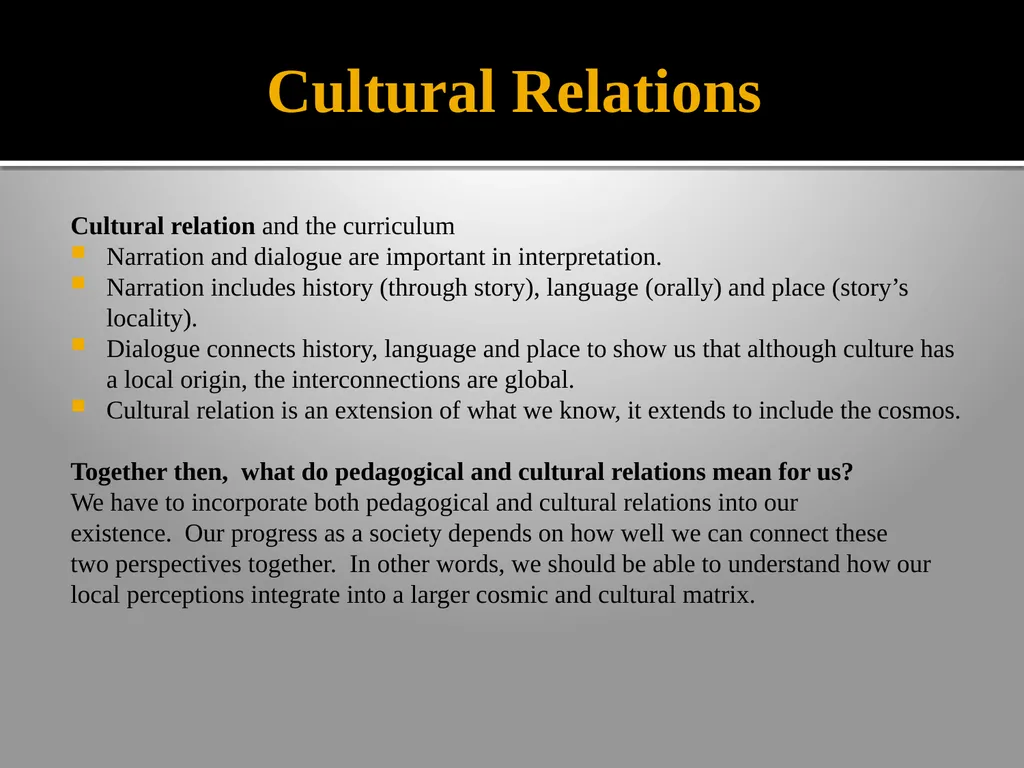
Cultural Relations Cultural relation and the curriculum
Narration and dialogue are important in interpretation.
Narration includes history (through story), language (orally) and place (story’s locality).
Dialogue connects history, language and place to show us that although culture has a local origin, the interconnections are global.
Cultural relation is an extension of what we know, it extends to include the cosmos.
Together then, what do pedagogical and cultural relations mean for us?
We have to incorporate both pedagogical and cultural relations into our
existence. Our progress as a society depends on how well we can connect these
two perspectives together. In other words, we should be able to understand how our
local perceptions integrate into a larger cosmic and cultural matrix.<br>
Narration and dialogue are important in interpretation.
Narration includes history (through story), language (orally) and place (story’s locality).
Dialogue connects history, language and place to show us that although culture has a local origin, the interconnections are global.
Cultural relation is an extension of what we know, it extends to include the cosmos.
Together then, what do pedagogical and cultural relations mean for us?
We have to incorporate both pedagogical and cultural relations into our
existence. Our progress as a society depends on how well we can connect these
two perspectives together. In other words, we should be able to understand how our
local perceptions integrate into a larger cosmic and cultural matrix.<br>
16
Rigor According to Doll, Rigor may be the most important of all R’s
Rigor according to Doll, can be conceived as a dialectic between the complexity of indeterminacy and critical interpretation.
Indeterminacy - One is never sure he/she is right. He/she is always looking for new
combinations, interpretations, alternatives and patterns.
Interpretation – attempt to rummage through problems, procedures and valued
results. In order for dialogue to become meaningful and transformative, there should
be an attempt to sort out what is important.
Rigor is therefore a mixing between these two components. Doll wants the quality of
interpretation to be rich and this depends on how well we develop the alternatives that
indeterminacy present.<br>
Rigor according to Doll, can be conceived as a dialectic between the complexity of indeterminacy and critical interpretation.
Indeterminacy - One is never sure he/she is right. He/she is always looking for new
combinations, interpretations, alternatives and patterns.
Interpretation – attempt to rummage through problems, procedures and valued
results. In order for dialogue to become meaningful and transformative, there should
be an attempt to sort out what is important.
Rigor is therefore a mixing between these two components. Doll wants the quality of
interpretation to be rich and this depends on how well we develop the alternatives that
indeterminacy present.<br>