
Quick Sentence Diagnostic (See in class handout
TG
Published · 39 slides · 0 views
1 / 1

Description
Quick Sentence Diagnostic (See in class handout and answer key) 1. When you drive a car you must carry liability insurance, which pays for any damage or injury that you may inflict on others. 2. Insurance in some places is cheaper, than
Related Topics
Share
Embed code
Download this presentation From Below
"Quick Sentence Diagnostic (See in class handout" is the property of its rightful owner. Permission is granted to download and print the materials on this website for personal, non-commercial use only, and to display it on your personal computer provided you do not modify the materials and that you retain all copyright notices contained in the materials. By downloading content from our website, you accept the terms of this agreement.
Presentation Transcript
01
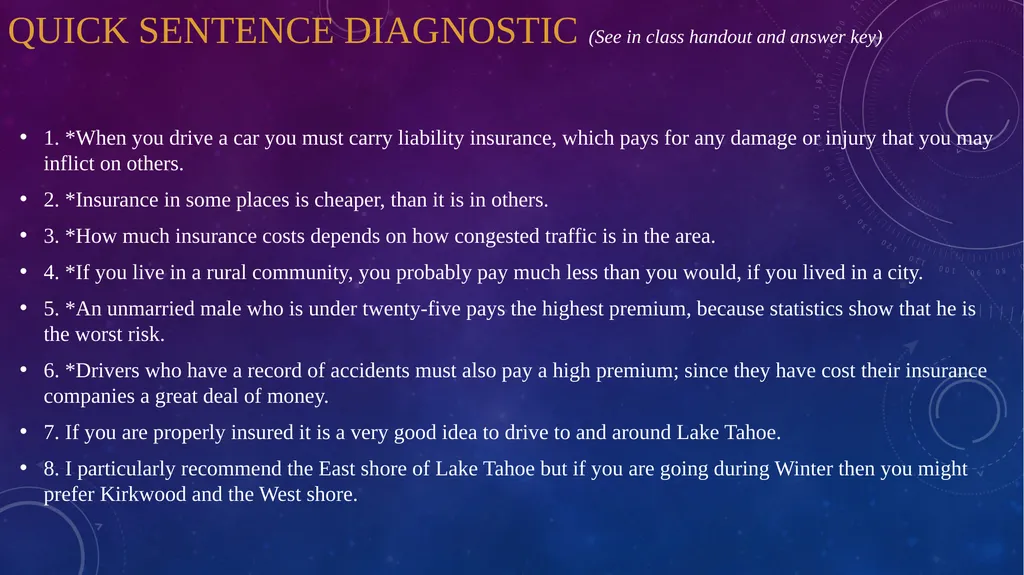
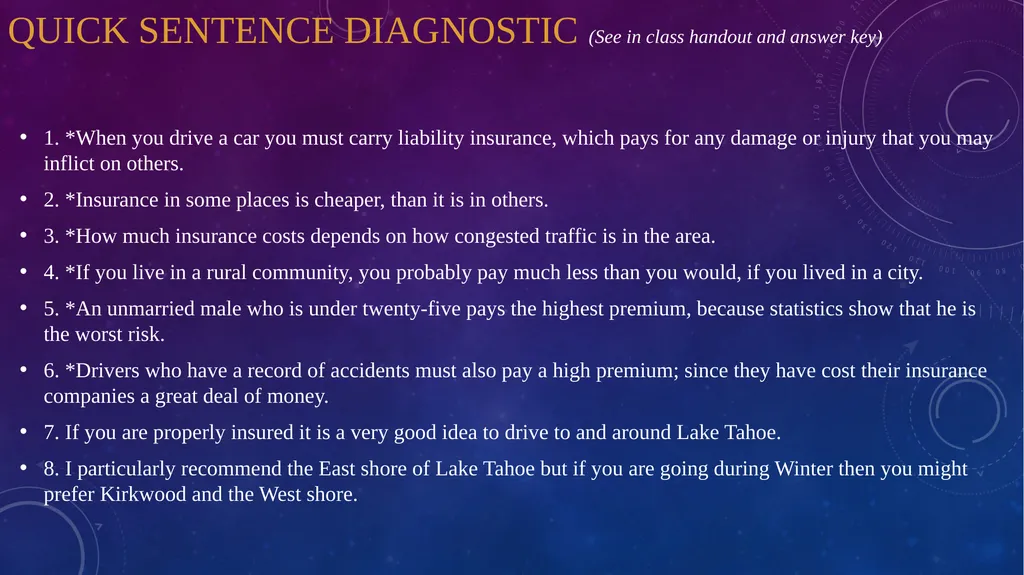
Quick Sentence Diagnostic (See in class handout and answer key) 1. *When you drive a car you must carry liability insurance, which pays for any damage or injury that you may inflict on others.
2. *Insurance in some places is cheaper, than it is in others.
3. *How much insurance costs depends on how congested traffic is in the area.
4. *If you live in a rural community, you probably pay much less than you would, if you lived in a city.
5. *An unmarried male who is under twenty-five pays the highest premium, because statistics show that he is the worst risk.
6. *Drivers who have a record of accidents must also pay a high premium; since they have cost their insurance companies a great deal of money.
7. If you are properly insured it is a very good idea to drive to and around Lake Tahoe.
8. I particularly recommend the East shore of Lake Tahoe but if you are going during Winter then you might prefer Kirkwood and the West shore.<br>
2. *Insurance in some places is cheaper, than it is in others.
3. *How much insurance costs depends on how congested traffic is in the area.
4. *If you live in a rural community, you probably pay much less than you would, if you lived in a city.
5. *An unmarried male who is under twenty-five pays the highest premium, because statistics show that he is the worst risk.
6. *Drivers who have a record of accidents must also pay a high premium; since they have cost their insurance companies a great deal of money.
7. If you are properly insured it is a very good idea to drive to and around Lake Tahoe.
8. I particularly recommend the East shore of Lake Tahoe but if you are going during Winter then you might prefer Kirkwood and the West shore.<br>
02
GWC Mastery Series: Punctuation Carla Orvis Hunt, MFA Writing
NPS Graduate Writing Center
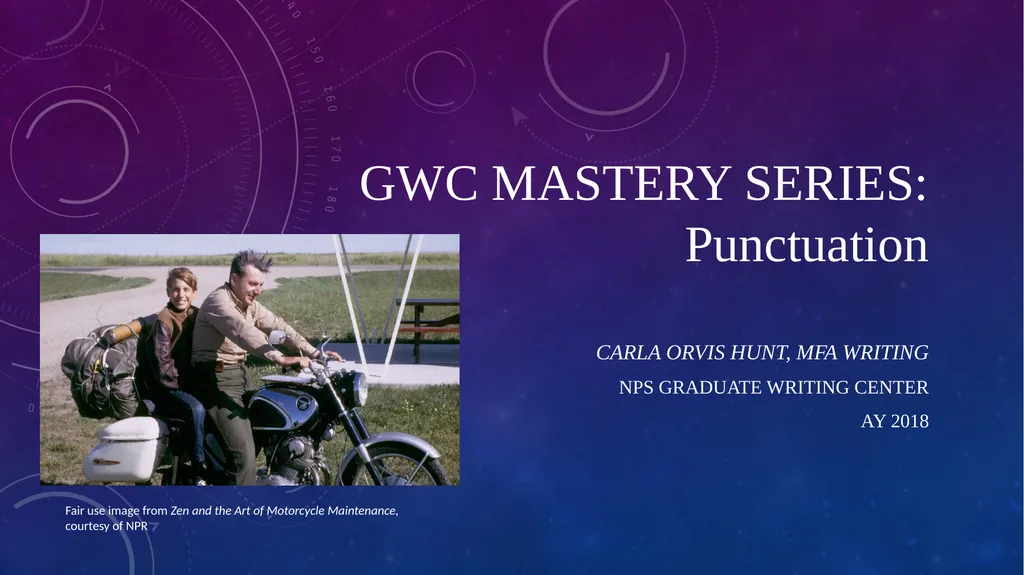
AY 2018 Fair use image from Zen and the Art of Motorcycle Maintenance, courtesy of NPR<br>
NPS Graduate Writing Center
AY 2018 Fair use image from Zen and the Art of Motorcycle Maintenance, courtesy of NPR<br>
03
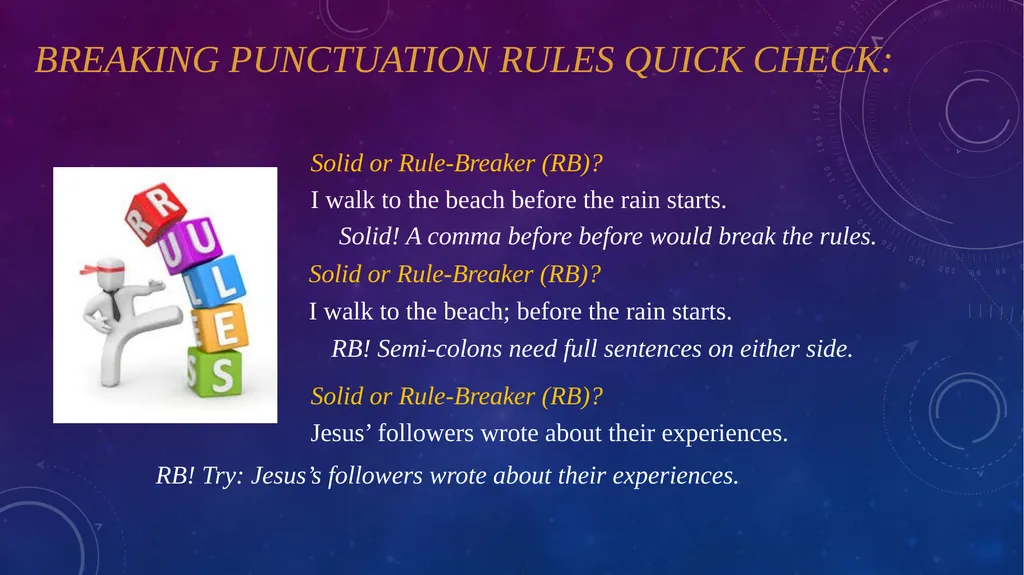
Breaking Punctuation Rules quick check: Solid or Rule-Breaker (RB)?
I walk to the beach before the rain starts. Solid! A comma before before would break the rules. Solid or Rule-Breaker (RB)?
I walk to the beach; before the rain starts. RB! Semi-colons need full sentences on either side. Solid or Rule-Breaker (RB)?
Jesus’ followers wrote about their experiences. RB! Try: Jesus’s followers wrote about their experiences.<br>
I walk to the beach before the rain starts. Solid! A comma before before would break the rules. Solid or Rule-Breaker (RB)?
I walk to the beach; before the rain starts. RB! Semi-colons need full sentences on either side. Solid or Rule-Breaker (RB)?
Jesus’ followers wrote about their experiences. RB! Try: Jesus’s followers wrote about their experiences.<br>
04
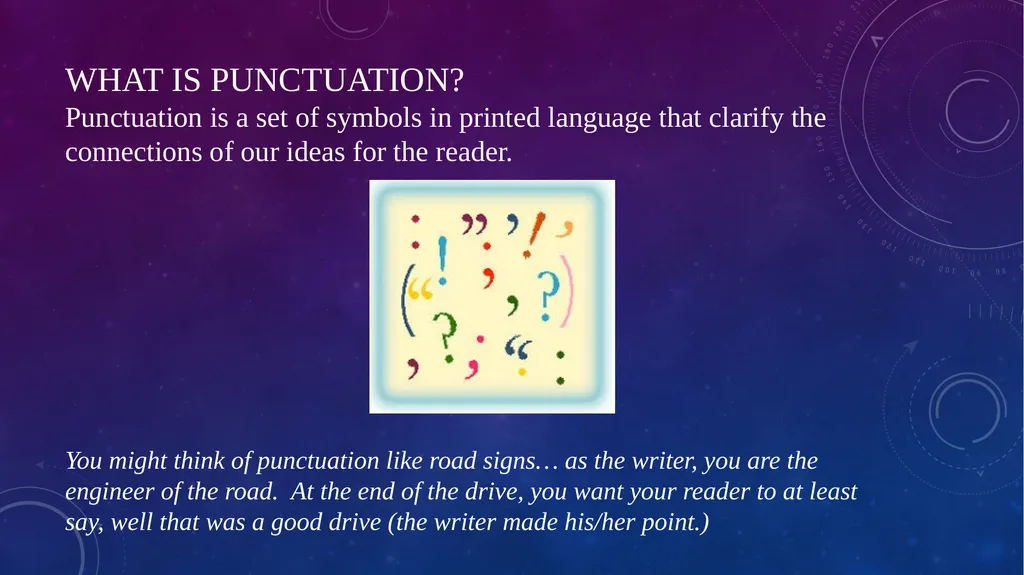
What is punctuation?
Punctuation is a set of symbols in printed language that clarify the connections of our ideas for the reader. You might think of punctuation like road signs… as the writer, you are the engineer of the road. At the end of the drive, you want your reader to at least say, well that was a good drive (the writer made his/her point.)<br>
05
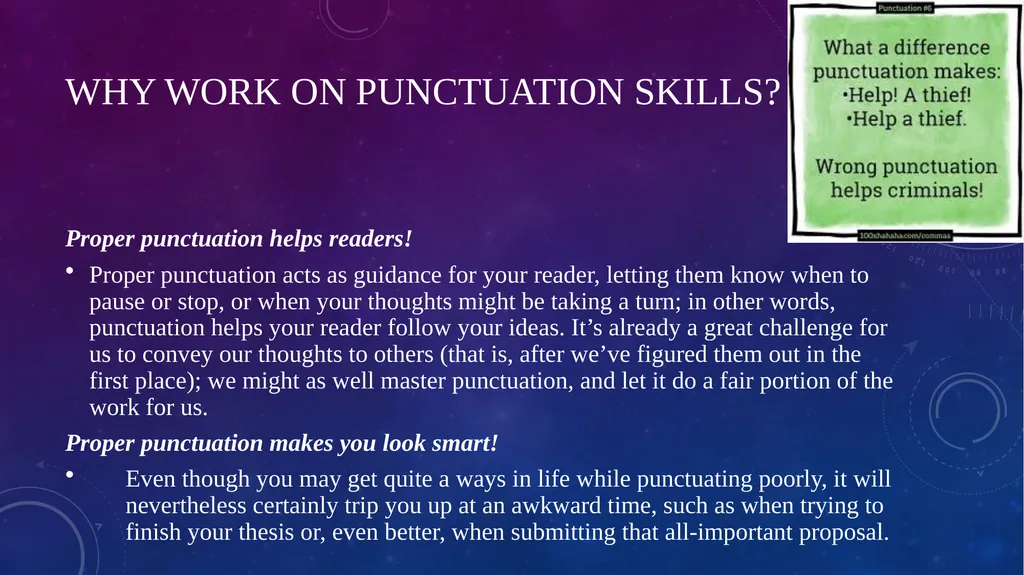
WHY WORK ON PUNCTUATION SKILLS? Proper punctuation helps readers!
Proper punctuation acts as guidance for your reader, letting them know when to pause or stop, or when your thoughts might be taking a turn; in other words, punctuation helps your reader follow your ideas. It’s already a great challenge for us to convey our thoughts to others (that is, after we’ve figured them out in the first place); we might as well master punctuation, and let it do a fair portion of the work for us.
Proper punctuation makes you look smart!
Even though you may get quite a ways in life while punctuating poorly, it will nevertheless certainly trip you up at an awkward time, such as when trying to finish your thesis or, even better, when submitting that all-important proposal.<br>
Proper punctuation acts as guidance for your reader, letting them know when to pause or stop, or when your thoughts might be taking a turn; in other words, punctuation helps your reader follow your ideas. It’s already a great challenge for us to convey our thoughts to others (that is, after we’ve figured them out in the first place); we might as well master punctuation, and let it do a fair portion of the work for us.
Proper punctuation makes you look smart!
Even though you may get quite a ways in life while punctuating poorly, it will nevertheless certainly trip you up at an awkward time, such as when trying to finish your thesis or, even better, when submitting that all-important proposal.<br>
06
WORKSHOP ROADMAP Toward clarity in written work: three punctuation concepts
Sentence Enders (periods, question marks, and exclamation points)
In-sentence Connectors (commas and semi-colons; dashes also fit here)
Indicators
of possession or contraction (apostrophes)
of spoken or written words (quotation marks, single quotes, brackets, and ellipses)<br>
Sentence Enders (periods, question marks, and exclamation points)
In-sentence Connectors (commas and semi-colons; dashes also fit here)
Indicators
of possession or contraction (apostrophes)
of spoken or written words (quotation marks, single quotes, brackets, and ellipses)<br>
07
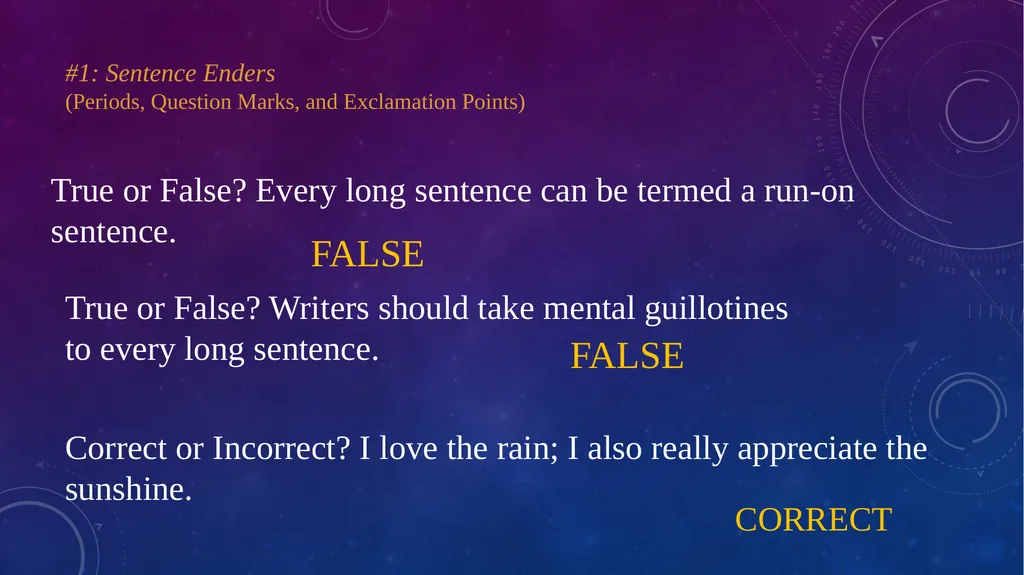
#1: Sentence Enders
(Periods, Question Marks, and Exclamation Points) True or False? Every long sentence can be termed a run-on sentence. True or False? Writers should take mental guillotines
to every long sentence. FALSE FALSE Correct or Incorrect? I love the rain; I also really appreciate the sunshine. CORRECT<br>
to every long sentence. FALSE FALSE Correct or Incorrect? I love the rain; I also really appreciate the sunshine. CORRECT<br>
08
PERIODS MARK AN END:
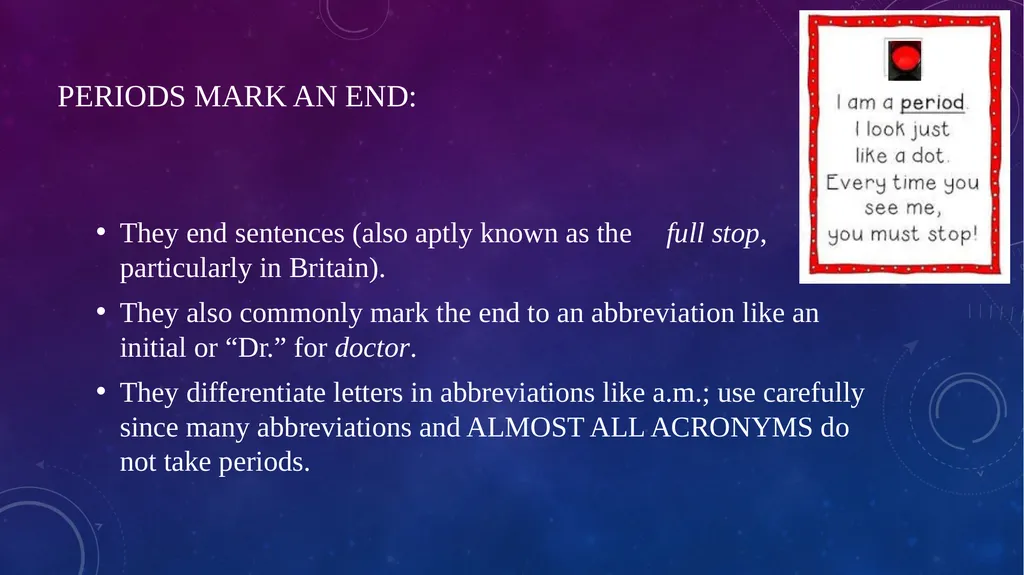
They end sentences (also aptly known as the full stop, particularly in Britain).
They also commonly mark the end to an abbreviation like an initial or “Dr.” for doctor.
They differentiate letters in abbreviations like a.m.; use carefully since many abbreviations and ALMOST ALL ACRONYMS do not take periods.<br>
They end sentences (also aptly known as the full stop, particularly in Britain).
They also commonly mark the end to an abbreviation like an initial or “Dr.” for doctor.
They differentiate letters in abbreviations like a.m.; use carefully since many abbreviations and ALMOST ALL ACRONYMS do not take periods.<br>
09
WHAT WAS THAT???!!!??? You may have noticed the exclamation points above. While they are fantastic pieces of punctuation in their own right, you will not often see an exclamation point in academic writing. You are better off letting accurate words speak for themselves rather than coming across as overly dramatic with your punctuation.
In any writing, multiple exclamation marks often obscure the words and sound like shouting.
(For more on how extra italics and underlining can similarly obscure meaning, please see Mastery Series: Clarity and Concision.) Here is a place, however, where you might find an exclamation point appropriate…
A well-placed question mark, on the other hand, can greatly benefit you. Consider that questions re-focus your reader…<br>
In any writing, multiple exclamation marks often obscure the words and sound like shouting.
(For more on how extra italics and underlining can similarly obscure meaning, please see Mastery Series: Clarity and Concision.) Here is a place, however, where you might find an exclamation point appropriate…
A well-placed question mark, on the other hand, can greatly benefit you. Consider that questions re-focus your reader…<br>
10
Which text message are you more likely to respond to right away? How are you?
I hope you are well. Why? Questions encourage response. How can you translate that urge to respond to increasing your reader’s clarity and ability to focus on what you are saying?<br>
I hope you are well. Why? Questions encourage response. How can you translate that urge to respond to increasing your reader’s clarity and ability to focus on what you are saying?<br>
11
Three Important Things about Questions ’round these NPS parts… 1) Please, if for no other reason than for the sake of keeping the Thesis Processing Office (TPO) happy, avoid combining statements and questions. For example, you might be tempted to write:
My thesis question is how can the Navy better enable military personnel and cyber experts to more efficiently work together to protect DODIN?
Instead, I advise you write the following:
My thesis question follows. How can the Navy better enable military personnel and cyber experts to more efficiently work together to protect DODIN?
In other words, let a question be a question.<br>
My thesis question is how can the Navy better enable military personnel and cyber experts to more efficiently work together to protect DODIN?
Instead, I advise you write the following:
My thesis question follows. How can the Navy better enable military personnel and cyber experts to more efficiently work together to protect DODIN?
In other words, let a question be a question.<br>
12
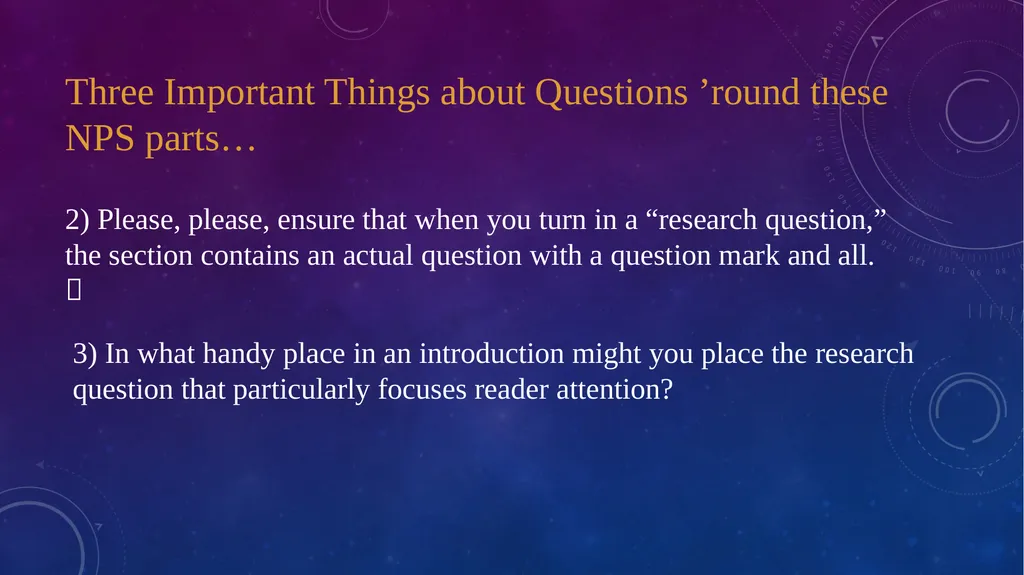
Three Important Things about Questions ’round these NPS parts… 2) Please, please, ensure that when you turn in a “research question,” the section contains an actual question with a question mark and all. 3) In what handy place in an introduction might you place the research question that particularly focuses reader attention?<br>
13
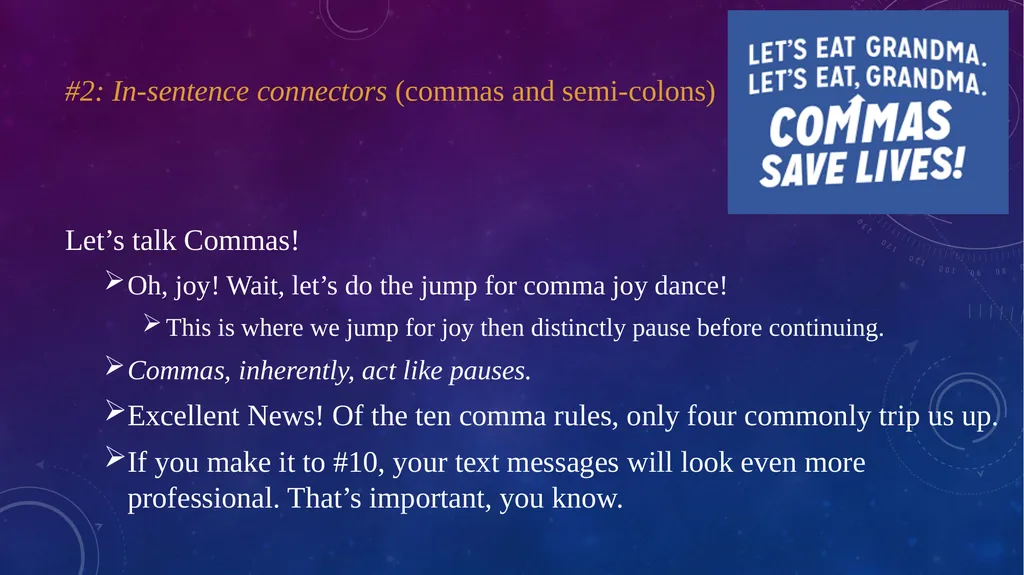
#2: In-sentence connectors (commas and semi-colons) Let’s talk Commas!
Oh, joy! Wait, let’s do the jump for comma joy dance!
This is where we jump for joy then distinctly pause before continuing.
Commas, inherently, act like pauses.
Excellent News! Of the ten comma rules, only four commonly trip us up.
If you make it to #10, your text messages will look even more professional. That’s important, you know.<br>
Oh, joy! Wait, let’s do the jump for comma joy dance!
This is where we jump for joy then distinctly pause before continuing.
Commas, inherently, act like pauses.
Excellent News! Of the ten comma rules, only four commonly trip us up.
If you make it to #10, your text messages will look even more professional. That’s important, you know.<br>
14
The Four big onES:
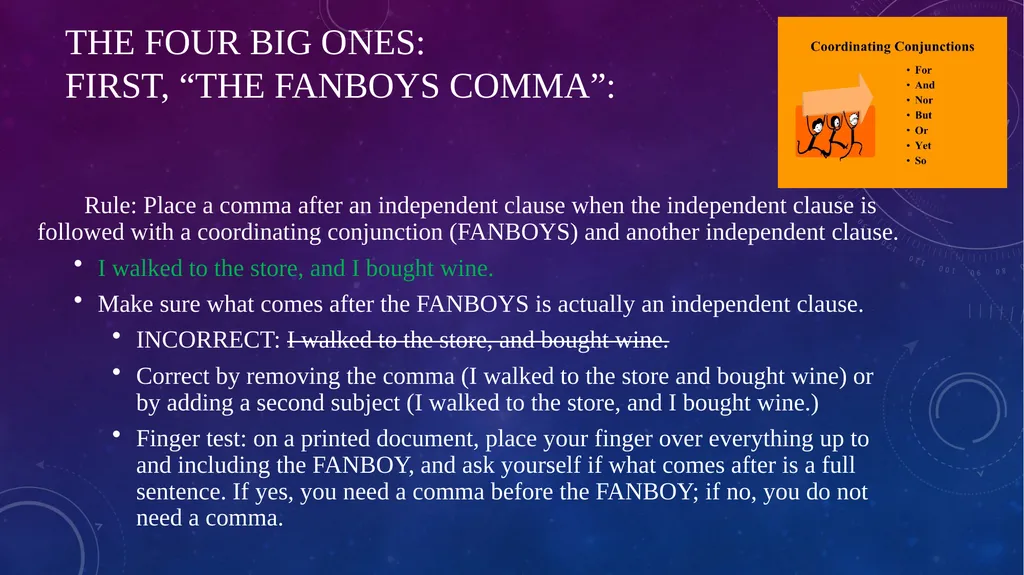
First, “THE FANBOYS COMMA”: Rule: Place a comma after an independent clause when the independent clause is followed with a coordinating conjunction (FANBOYS) and another independent clause.
I walked to the store, and I bought wine.
Make sure what comes after the FANBOYS is actually an independent clause.
INCORRECT: I walked to the store, and bought wine.
Correct by removing the comma (I walked to the store and bought wine) or by adding a second subject (I walked to the store, and I bought wine.)
Finger test: on a printed document, place your finger over everything up to and including the FANBOY, and ask yourself if what comes after is a full sentence. If yes, you need a comma before the FANBOY; if no, you do not need a comma.<br>
I walked to the store, and I bought wine.
Make sure what comes after the FANBOYS is actually an independent clause.
INCORRECT: I walked to the store, and bought wine.
Correct by removing the comma (I walked to the store and bought wine) or by adding a second subject (I walked to the store, and I bought wine.)
Finger test: on a printed document, place your finger over everything up to and including the FANBOY, and ask yourself if what comes after is a full sentence. If yes, you need a comma before the FANBOY; if no, you do not need a comma.<br>
15
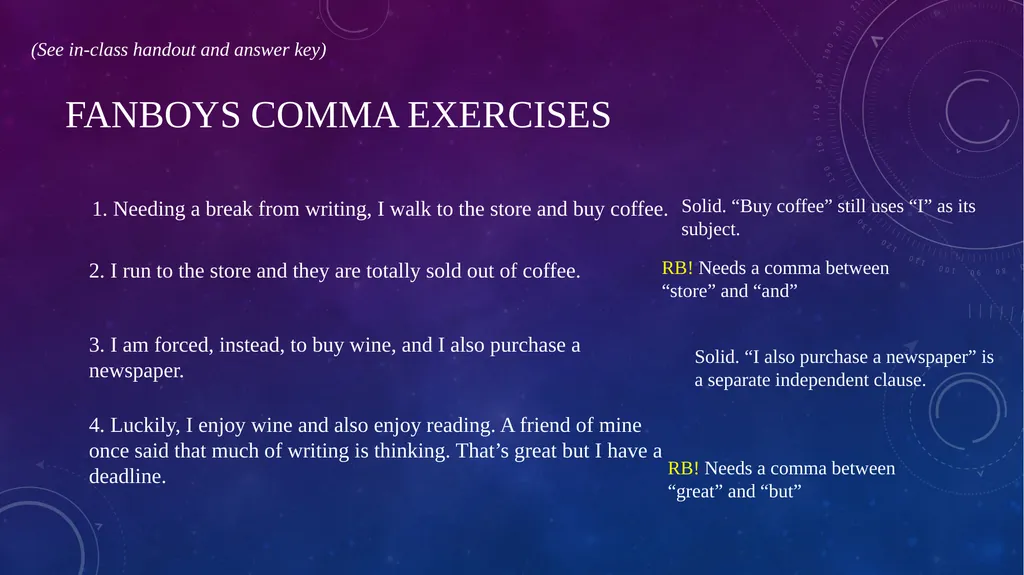
FANBOYS COMMA EXERCISES 1. Needing a break from writing, I walk to the store and buy coffee. 2. I run to the store and they are totally sold out of coffee. 3. I am forced, instead, to buy wine, and I also purchase a newspaper. 4. Luckily, I enjoy wine and also enjoy reading. A friend of mine once said that much of writing is thinking. That’s great but I have a deadline. Solid. “Buy coffee” still uses “I” as its subject. RB! Needs a comma between “store” and “and” Solid. “I also purchase a newspaper” is a separate independent clause. RB! Needs a comma between “great” and “but” (See in-class handout and answer key)<br>
16
The Four big onES:
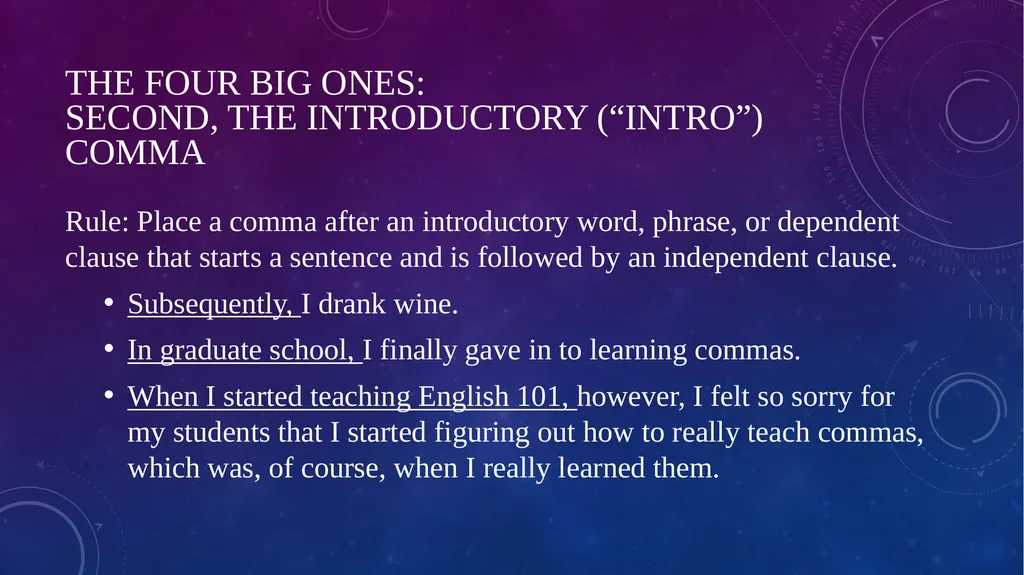
SECOND, THE INTRODUCTORY (“INTRO”) COMMA Rule: Place a comma after an introductory word, phrase, or dependent clause that starts a sentence and is followed by an independent clause.
Subsequently, I drank wine.
In graduate school, I finally gave in to learning commas.
When I started teaching English 101, however, I felt so sorry for my students that I started figuring out how to really teach commas, which was, of course, when I really learned them.<br>
Subsequently, I drank wine.
In graduate school, I finally gave in to learning commas.
When I started teaching English 101, however, I felt so sorry for my students that I started figuring out how to really teach commas, which was, of course, when I really learned them.<br>
17
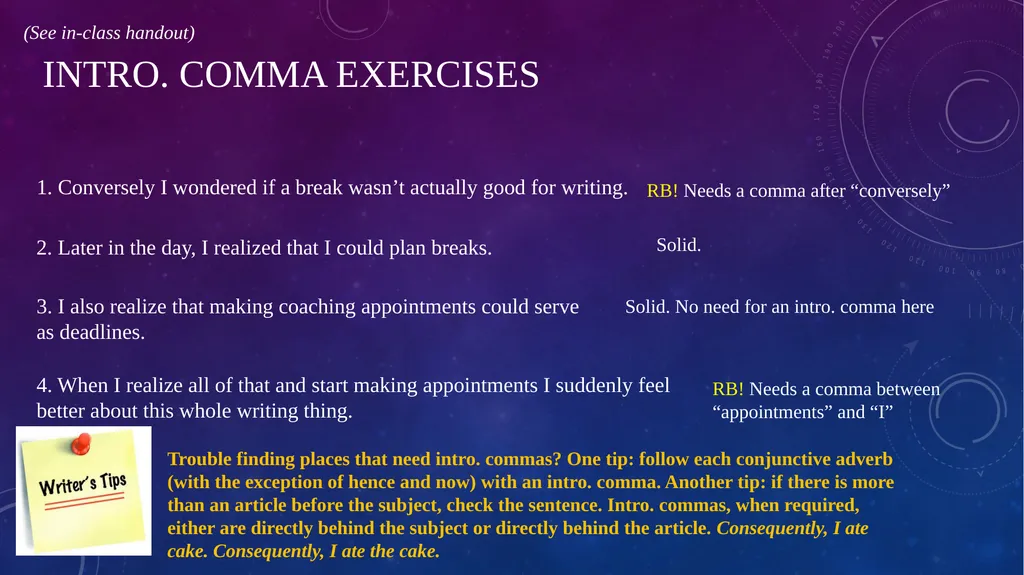
INTRO. COMMA EXERCISES 1. Conversely I wondered if a break wasn’t actually good for writing. 2. Later in the day, I realized that I could plan breaks. 3. I also realize that making coaching appointments could serve as deadlines. 4. When I realize all of that and start making appointments I suddenly feel better about this whole writing thing. RB! Needs a comma after “conversely” Solid. Solid. No need for an intro. comma here RB! Needs a comma between “appointments” and “I” (See in-class handout) Trouble finding places that need intro. commas? One tip: follow each conjunctive adverb (with the exception of hence and now) with an intro. comma. Another tip: if there is more than an article before the subject, check the sentence. Intro. commas, when required, either are directly behind the subject or directly behind the article. Consequently, I ate cake. Consequently, I ate the cake.<br>
18
THIRD, THE (SERIAL) LIST COMMA
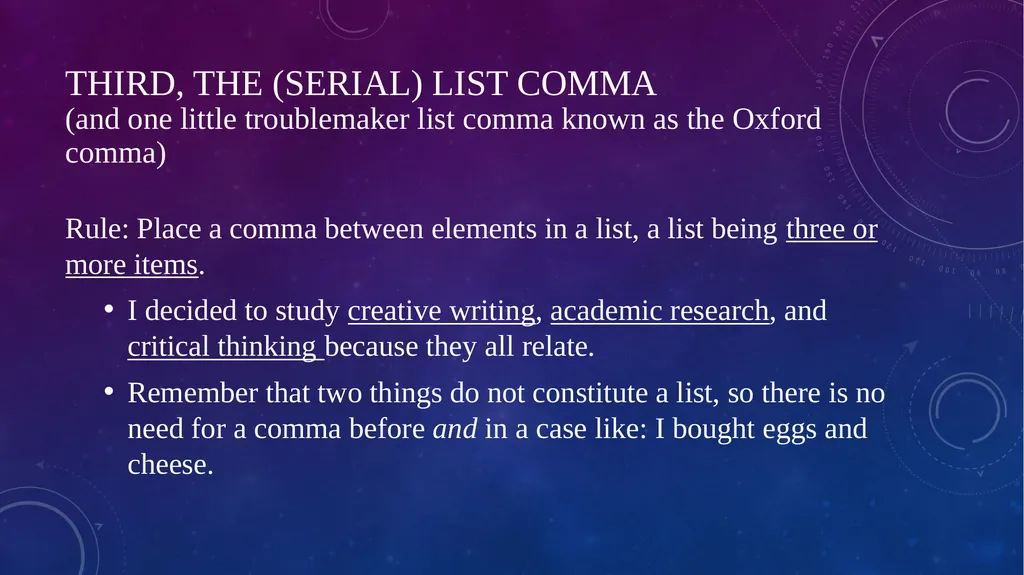
(and one little troublemaker list comma known as the Oxford comma) Rule: Place a comma between elements in a list, a list being three or more items.
I decided to study creative writing, academic research, and critical thinking because they all relate.
Remember that two things do not constitute a list, so there is no need for a comma before and in a case like: I bought eggs and cheese.<br>
I decided to study creative writing, academic research, and critical thinking because they all relate.
Remember that two things do not constitute a list, so there is no need for a comma before and in a case like: I bought eggs and cheese.<br>
19
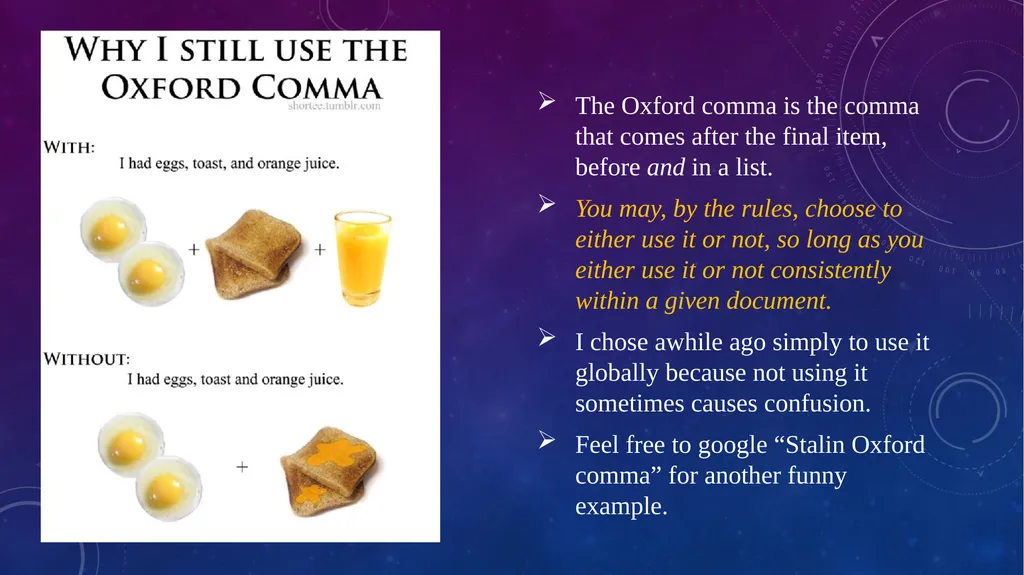
Oxford comma The Oxford comma is the comma that comes after the final item, before and in a list.
You may, by the rules, choose to either use it or not, so long as you either use it or not consistently within a given document.
I chose awhile ago simply to use it globally because not using it sometimes causes confusion.
Feel free to google “Stalin Oxford comma” for another funny example.<br>
You may, by the rules, choose to either use it or not, so long as you either use it or not consistently within a given document.
I chose awhile ago simply to use it globally because not using it sometimes causes confusion.
Feel free to google “Stalin Oxford comma” for another funny example.<br>
20
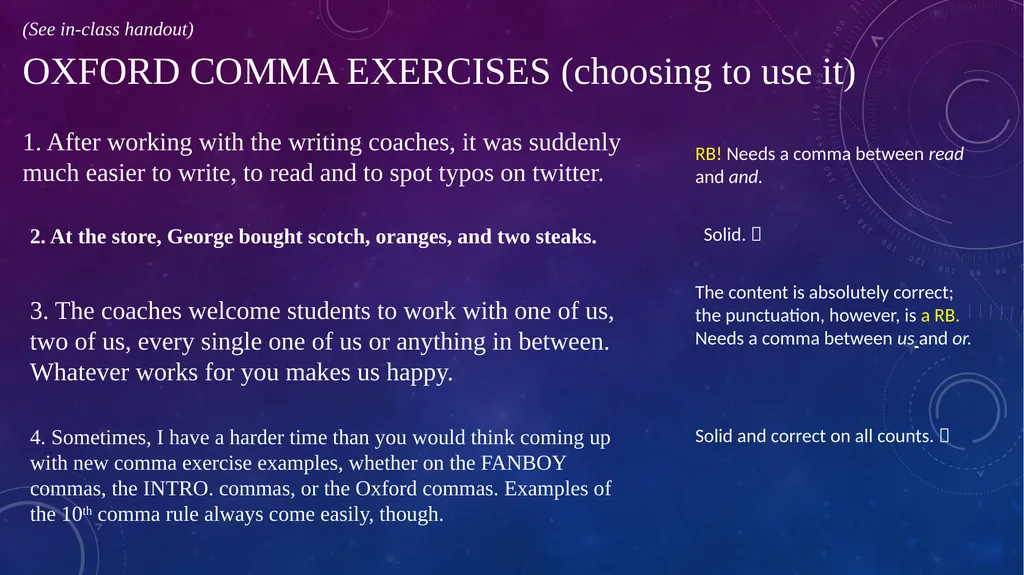
OXFORD COMMA EXERCISES (choosing to use it) 1. After working with the writing coaches, it was suddenly much easier to write, to read and to spot typos on twitter. RB! Needs a comma between read and and. (See in-class handout) Solid. The content is absolutely correct; the punctuation, however, is a RB. Needs a comma between us and or. Solid and correct on all counts. 2. At the store, George bought scotch, oranges, and two steaks. 3. The coaches welcome students to work with one of us, two of us, every single one of us or anything in between. Whatever works for you makes us happy. 4. Sometimes, I have a harder time than you would think coming up with new comma exercise examples, whether on the FANBOY commas, the INTRO. commas, or the Oxford commas. Examples of the 10th comma rule always come easily, though.<br>
21
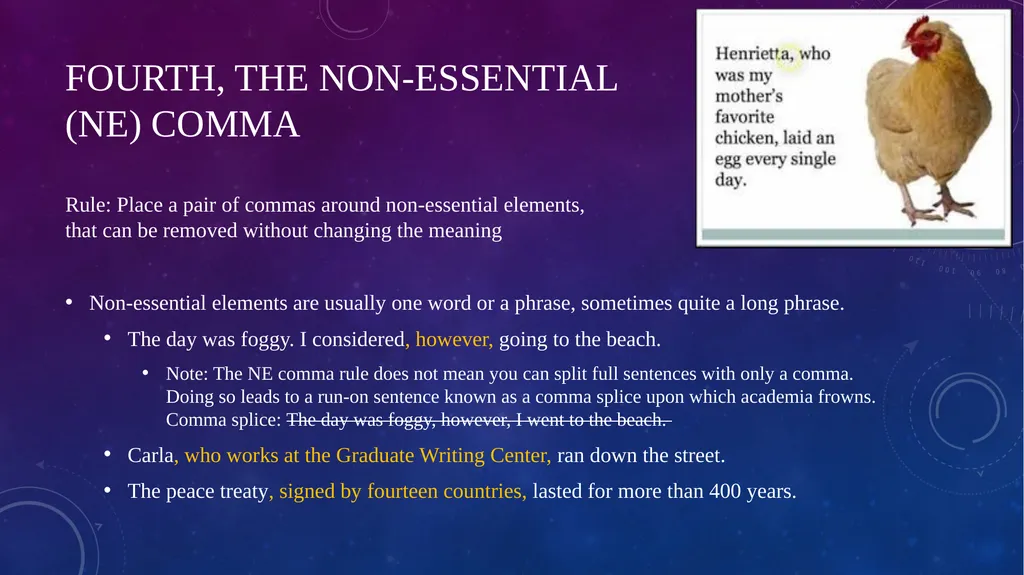
FOURTH, THE NON-ESSENTIAL
(NE) COMMA Rule: Place a pair of commas around non-essential elements, elements that can be removed without changing the meaning of the sentence.
Non-essential elements are usually one word or a phrase, sometimes quite a long phrase.
The day was foggy. I considered, however, going to the beach.
Note: The NE comma rule does not mean you can split full sentences with only a comma. Doing so leads to a run-on sentence known as a comma splice upon which academia frowns. Comma splice: The day was foggy, however, I went to the beach.
Carla, who works at the Graduate Writing Center, ran down the street.
The peace treaty, signed by fourteen countries, lasted for more than 400 years.<br>
Non-essential elements are usually one word or a phrase, sometimes quite a long phrase.
The day was foggy. I considered, however, going to the beach.
Note: The NE comma rule does not mean you can split full sentences with only a comma. Doing so leads to a run-on sentence known as a comma splice upon which academia frowns. Comma splice: The day was foggy, however, I went to the beach.
Carla, who works at the Graduate Writing Center, ran down the street.
The peace treaty, signed by fourteen countries, lasted for more than 400 years.<br>
22
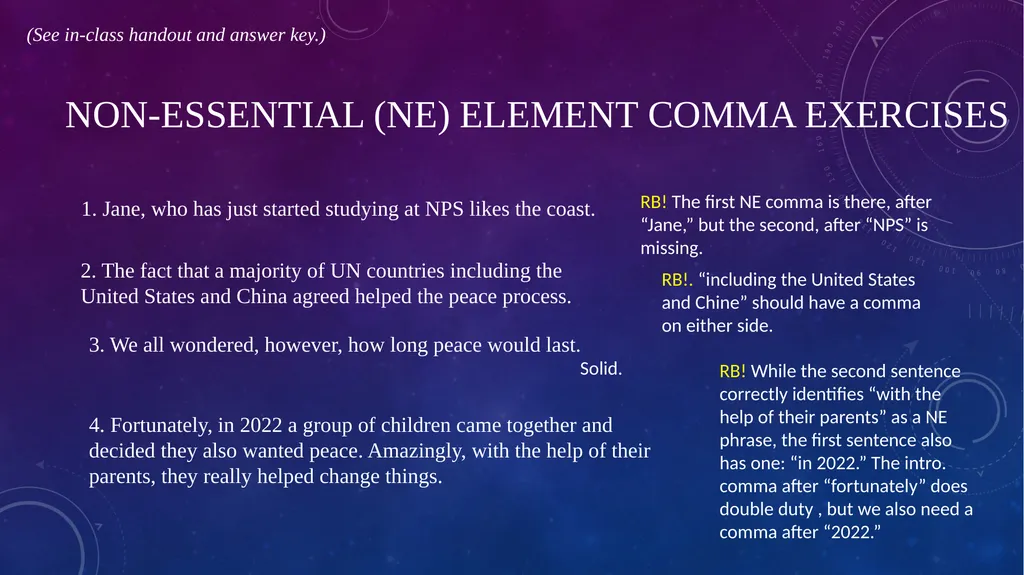
Non-ESSENTIAL (NE) ELEMENT COMMA EXERCISES 1. Jane, who has just started studying at NPS likes the coast. 2. The fact that a majority of UN countries including the United States and China agreed helped the peace process. 3. We all wondered, however, how long peace would last. 4. Fortunately, in 2022 a group of children came together and decided they also wanted peace. Amazingly, with the help of their parents, they really helped change things. RB! The first NE comma is there, after “Jane,” but the second, after “NPS” is missing. RB!. “including the United States and Chine” should have a comma on either side. Solid. RB! While the second sentence correctly identifies “with the help of their parents” as a NE phrase, the first sentence also has one: “in 2022.” The intro. comma after “fortunately” does double duty , but we also need a comma after “2022.” (See in-class handout and answer key.)<br>
23
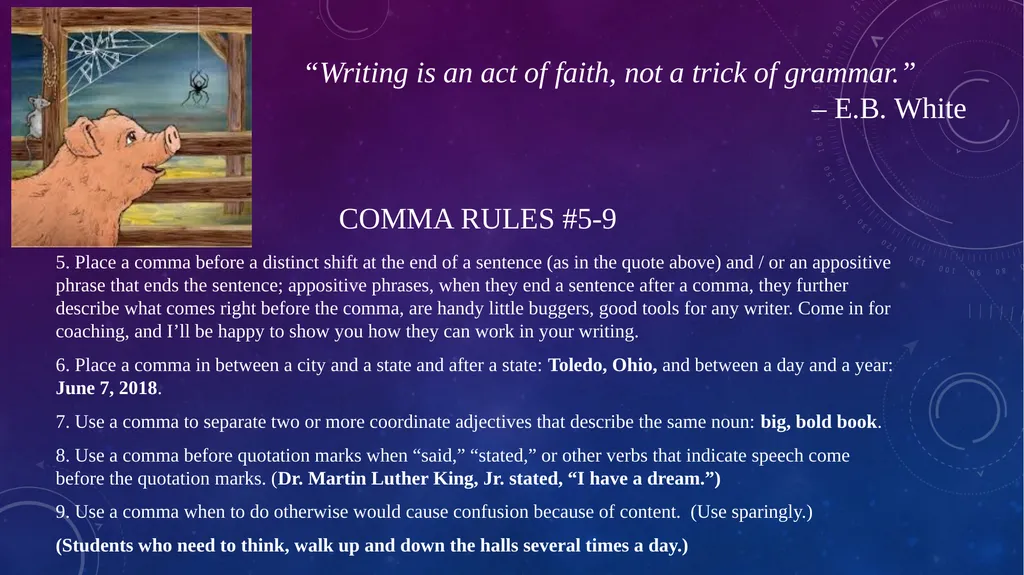
Comma rules #5-9 5. Place a comma before a distinct shift at the end of a sentence (as in the quote above) and / or an appositive phrase that ends the sentence; appositive phrases, when they end a sentence after a comma, they further describe what comes right before the comma, are handy little buggers, good tools for any writer. Come in for coaching, and I’ll be happy to show you how they can work in your writing.
6. Place a comma in between a city and a state and after a state: Toledo, Ohio, and between a day and a year: June 7, 2018.
7. Use a comma to separate two or more coordinate adjectives that describe the same noun: big, bold book.
8. Use a comma before quotation marks when “said,” “stated,” or other verbs that indicate speech come before the quotation marks. (Dr. Martin Luther King, Jr. stated, “I have a dream.”)
9. Use a comma when to do otherwise would cause confusion because of content. (Use sparingly.)
(Students who need to think, walk up and down the halls several times a day.) “Writing is an act of faith, not a trick of grammar.”
– E.B. White<br>
6. Place a comma in between a city and a state and after a state: Toledo, Ohio, and between a day and a year: June 7, 2018.
7. Use a comma to separate two or more coordinate adjectives that describe the same noun: big, bold book.
8. Use a comma before quotation marks when “said,” “stated,” or other verbs that indicate speech come before the quotation marks. (Dr. Martin Luther King, Jr. stated, “I have a dream.”)
9. Use a comma when to do otherwise would cause confusion because of content. (Use sparingly.)
(Students who need to think, walk up and down the halls several times a day.) “Writing is an act of faith, not a trick of grammar.”
– E.B. White<br>
24
You want that 10th rule, don’t you? Okay! Yay! Rule: Always place a comma before (and after if it occurs in the middle of a sentence) the word too when it means also.
Me, too.
I, too, want my text messages to make me look smart.
Do you like these funny animal memes, too?<br>
Me, too.
I, too, want my text messages to make me look smart.
Do you like these funny animal memes, too?<br>
25
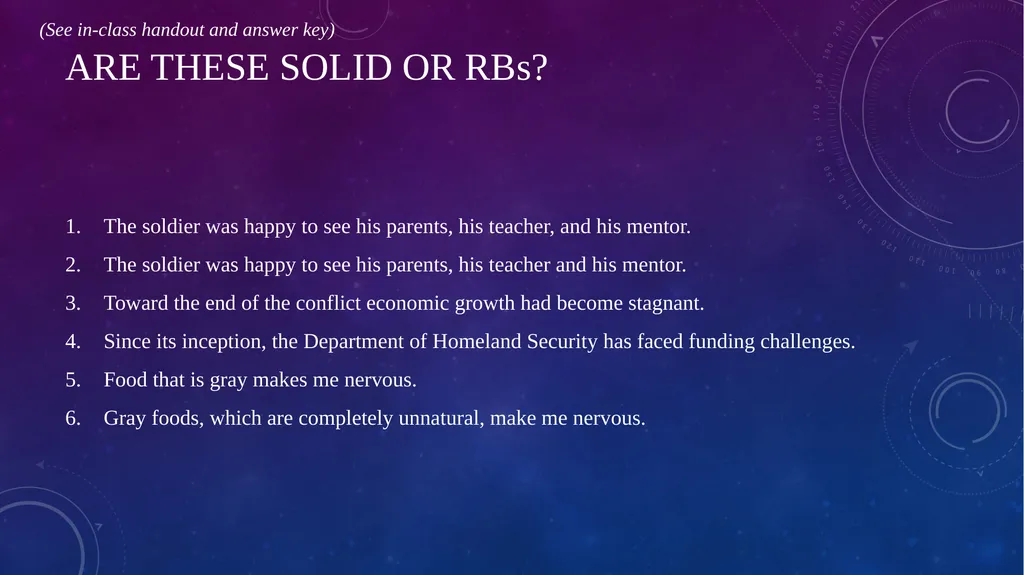
Are these SOLID or RBs? The soldier was happy to see his parents, his teacher, and his mentor.
The soldier was happy to see his parents, his teacher and his mentor.
Toward the end of the conflict economic growth had become stagnant.
Since its inception, the Department of Homeland Security has faced funding challenges.
Food that is gray makes me nervous.
Gray foods, which are completely unnatural, make me nervous. (See in-class handout and answer key)<br>
The soldier was happy to see his parents, his teacher and his mentor.
Toward the end of the conflict economic growth had become stagnant.
Since its inception, the Department of Homeland Security has faced funding challenges.
Food that is gray makes me nervous.
Gray foods, which are completely unnatural, make me nervous. (See in-class handout and answer key)<br>
26
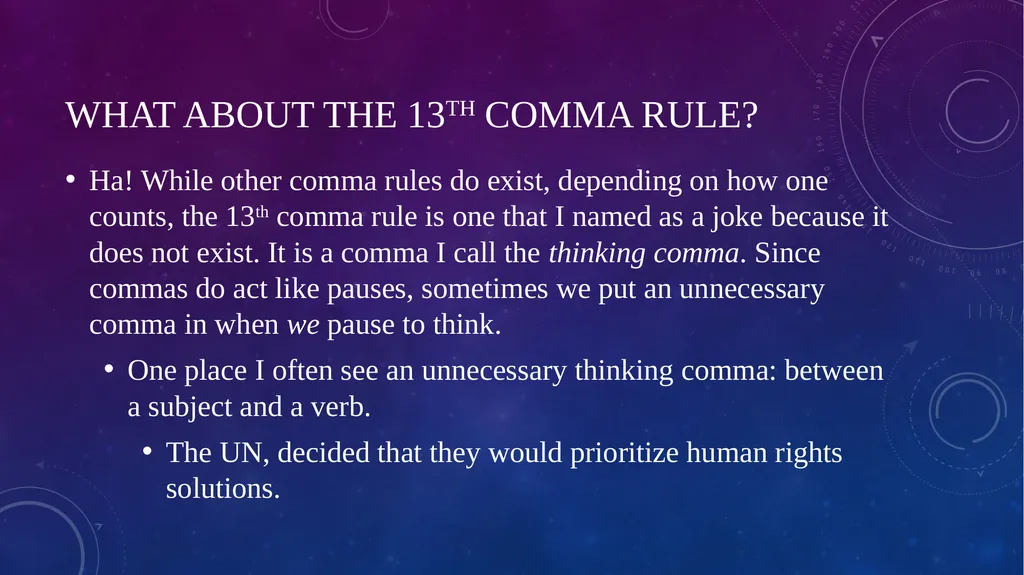
What about the 13th comma rule? Ha! While other comma rules do exist, depending on how one counts, the 13th comma rule is one that I named as a joke because it does not exist. It is a comma I call the thinking comma. Since commas do act like pauses, sometimes we put an unnecessary comma in when we pause to think.
One place I often see an unnecessary thinking comma: between a subject and a verb.
The UN, decided that they would prioritize human rights solutions.<br>
One place I often see an unnecessary thinking comma: between a subject and a verb.
The UN, decided that they would prioritize human rights solutions.<br>
27
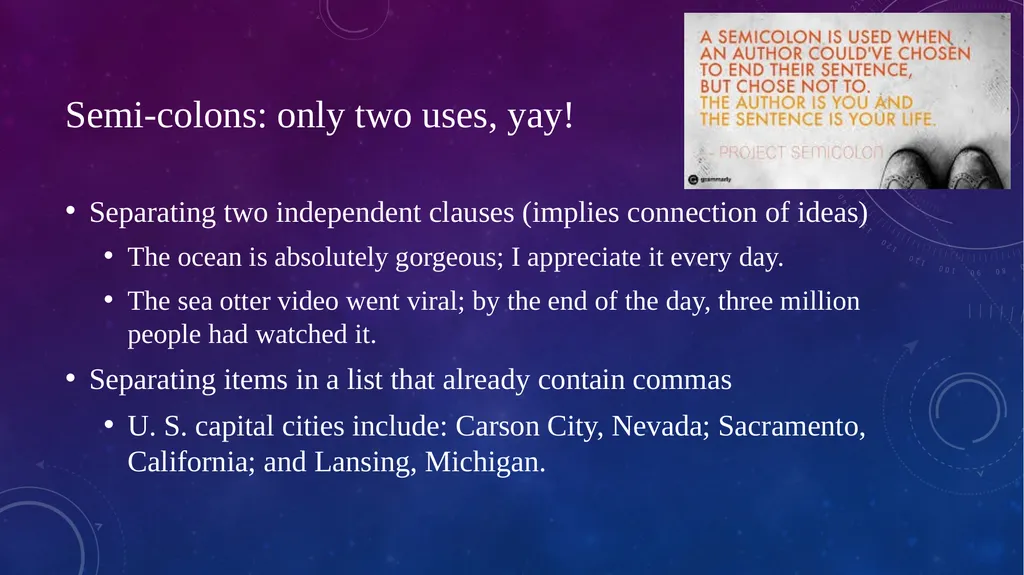
Semi-colons: only two uses, yay! Separating two independent clauses (implies connection of ideas)
The ocean is absolutely gorgeous; I appreciate it every day.
The sea otter video went viral; by the end of the day, three million people had watched it.
Separating items in a list that already contain commas
U. S. capital cities include: Carson City, Nevada; Sacramento, California; and Lansing, Michigan.<br>
The ocean is absolutely gorgeous; I appreciate it every day.
The sea otter video went viral; by the end of the day, three million people had watched it.
Separating items in a list that already contain commas
U. S. capital cities include: Carson City, Nevada; Sacramento, California; and Lansing, Michigan.<br>
28
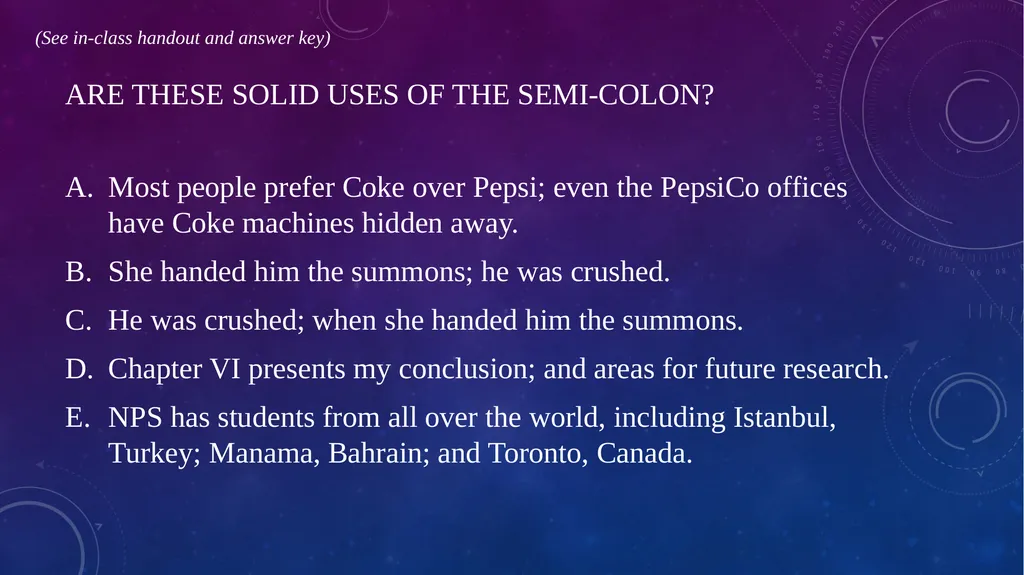
Are these Solid uses of the semi-colon? Most people prefer Coke over Pepsi; even the PepsiCo offices have Coke machines hidden away.
She handed him the summons; he was crushed.
He was crushed; when she handed him the summons.
Chapter VI presents my conclusion; and areas for future research.
NPS has students from all over the world, including Istanbul, Turkey; Manama, Bahrain; and Toronto, Canada. (See in-class handout and answer key)<br>
She handed him the summons; he was crushed.
He was crushed; when she handed him the summons.
Chapter VI presents my conclusion; and areas for future research.
NPS has students from all over the world, including Istanbul, Turkey; Manama, Bahrain; and Toronto, Canada. (See in-class handout and answer key)<br>
29
A note on dashes and parentheses
-
Consider dashes by their lengths: the shortest connect things that are most closely related.
- The shortest “dash” is known as a hyphen and connects two words like China-based or two-thirds
The medium or “en dash” connects two things that are closely related in time or distance, usually indicating a range like May-September or Chicago-Toledo. En dashes are helpful in resume writing.
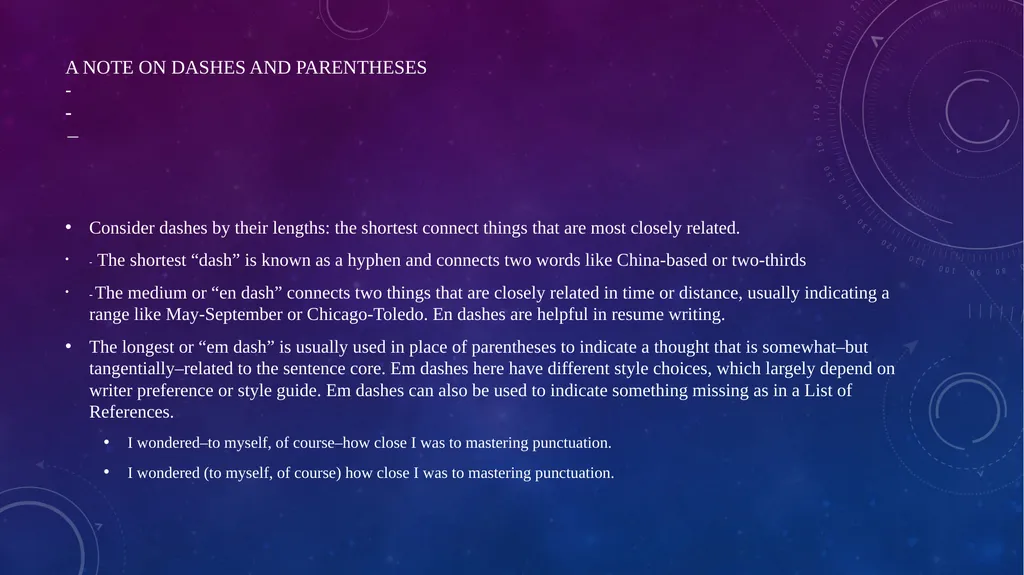
The longest or “em dash” is usually used in place of parentheses to indicate a thought that is somewhat–but tangentially–related to the sentence core. Em dashes here have different style choices, which largely depend on writer preference or style guide. Em dashes can also be used to indicate something missing as in a List of References.
I wondered–to myself, of course–how close I was to mastering punctuation.
I wondered (to myself, of course) how close I was to mastering punctuation.<br>
- The shortest “dash” is known as a hyphen and connects two words like China-based or two-thirds
The medium or “en dash” connects two things that are closely related in time or distance, usually indicating a range like May-September or Chicago-Toledo. En dashes are helpful in resume writing.
The longest or “em dash” is usually used in place of parentheses to indicate a thought that is somewhat–but tangentially–related to the sentence core. Em dashes here have different style choices, which largely depend on writer preference or style guide. Em dashes can also be used to indicate something missing as in a List of References.
I wondered–to myself, of course–how close I was to mastering punctuation.
I wondered (to myself, of course) how close I was to mastering punctuation.<br>
30
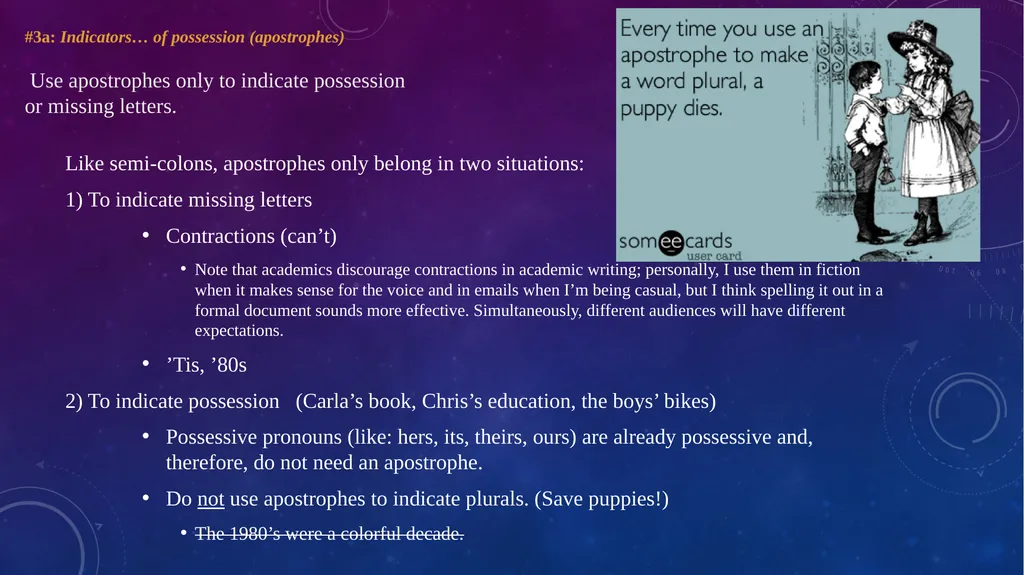
#3a: Indicators… of possession (apostrophes)
Use apostrophes only to indicate possession
or missing letters. Like semi-colons, apostrophes only belong in two situations:
1) To indicate missing letters
Contractions (can’t)
Note that academics discourage contractions in academic writing; personally, I use them in fiction when it makes sense for the voice and in emails when I’m being casual, but I think spelling it out in a formal document sounds more effective. Simultaneously, different audiences will have different expectations.
’Tis, ’80s
2) To indicate possession (Carla’s book, Chris’s education, the boys’ bikes)
Possessive pronouns (like: hers, its, theirs, ours) are already possessive and, therefore, do not need an apostrophe.
Do not use apostrophes to indicate plurals. (Save puppies!)
The 1980’s were a colorful decade.<br>
1) To indicate missing letters
Contractions (can’t)
Note that academics discourage contractions in academic writing; personally, I use them in fiction when it makes sense for the voice and in emails when I’m being casual, but I think spelling it out in a formal document sounds more effective. Simultaneously, different audiences will have different expectations.
’Tis, ’80s
2) To indicate possession (Carla’s book, Chris’s education, the boys’ bikes)
Possessive pronouns (like: hers, its, theirs, ours) are already possessive and, therefore, do not need an apostrophe.
Do not use apostrophes to indicate plurals. (Save puppies!)
The 1980’s were a colorful decade.<br>
31
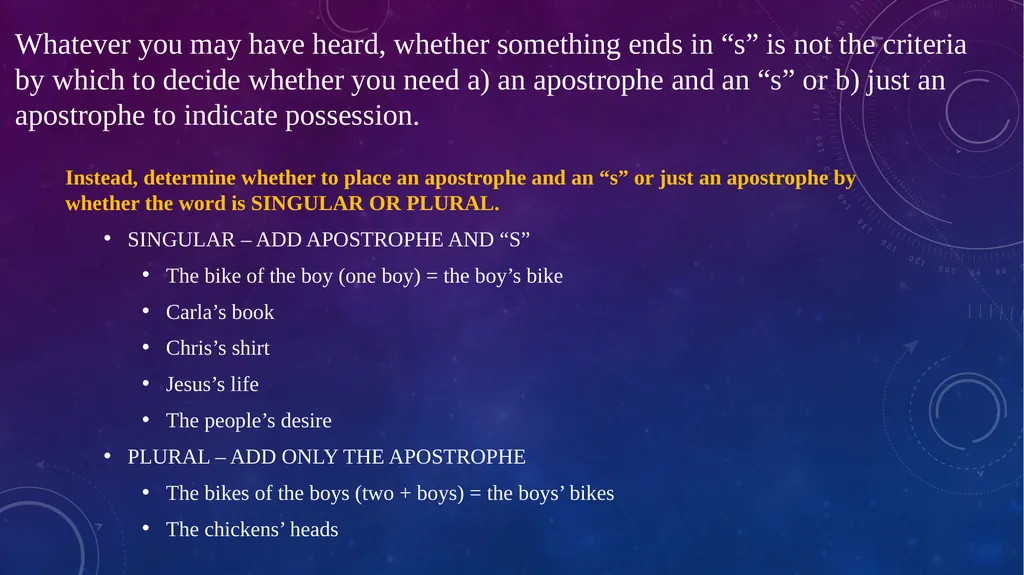
Whatever you may have heard, whether something ends in “s” is not the criteria by which to decide whether you need a) an apostrophe and an “s” or b) just an apostrophe to indicate possession. Instead, determine whether to place an apostrophe and an “s” or just an apostrophe by whether the word is SINGULAR OR PLURAL.
SINGULAR – ADD APOSTROPHE AND “S”
The bike of the boy (one boy) = the boy’s bike
Carla’s book
Chris’s shirt
Jesus’s life
The people’s desire
PLURAL – ADD ONLY THE APOSTROPHE
The bikes of the boys (two + boys) = the boys’ bikes
The chickens’ heads<br>
SINGULAR – ADD APOSTROPHE AND “S”
The bike of the boy (one boy) = the boy’s bike
Carla’s book
Chris’s shirt
Jesus’s life
The people’s desire
PLURAL – ADD ONLY THE APOSTROPHE
The bikes of the boys (two + boys) = the boys’ bikes
The chickens’ heads<br>
32
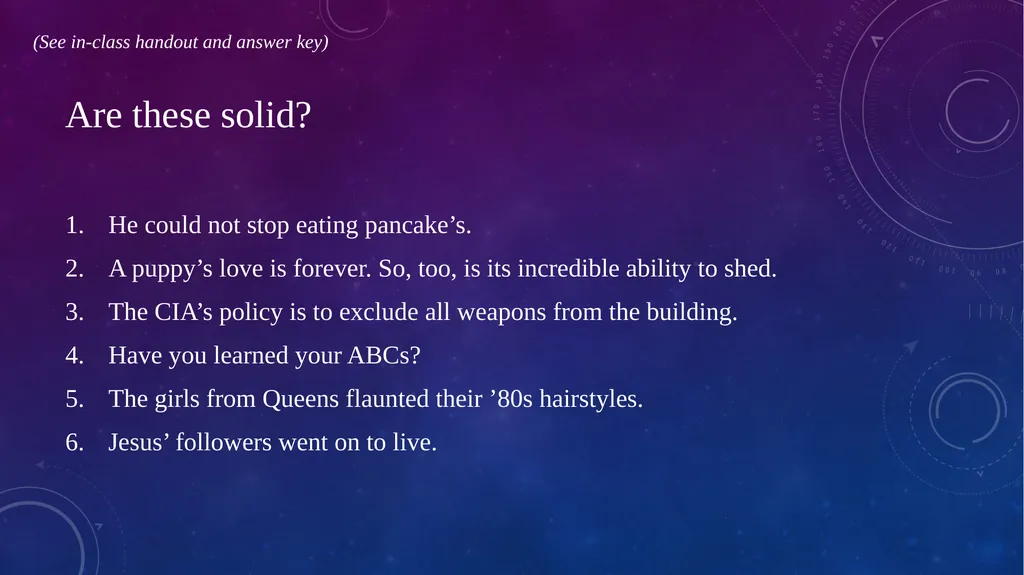
Are these solid? He could not stop eating pancake’s.
A puppy’s love is forever. So, too, is its incredible ability to shed.
The CIA’s policy is to exclude all weapons from the building.
Have you learned your ABCs?
The girls from Queens flaunted their ’80s hairstyles.
Jesus’ followers went on to live. (See in-class handout and answer key)<br>
A puppy’s love is forever. So, too, is its incredible ability to shed.
The CIA’s policy is to exclude all weapons from the building.
Have you learned your ABCs?
The girls from Queens flaunted their ’80s hairstyles.
Jesus’ followers went on to live. (See in-class handout and answer key)<br>
33
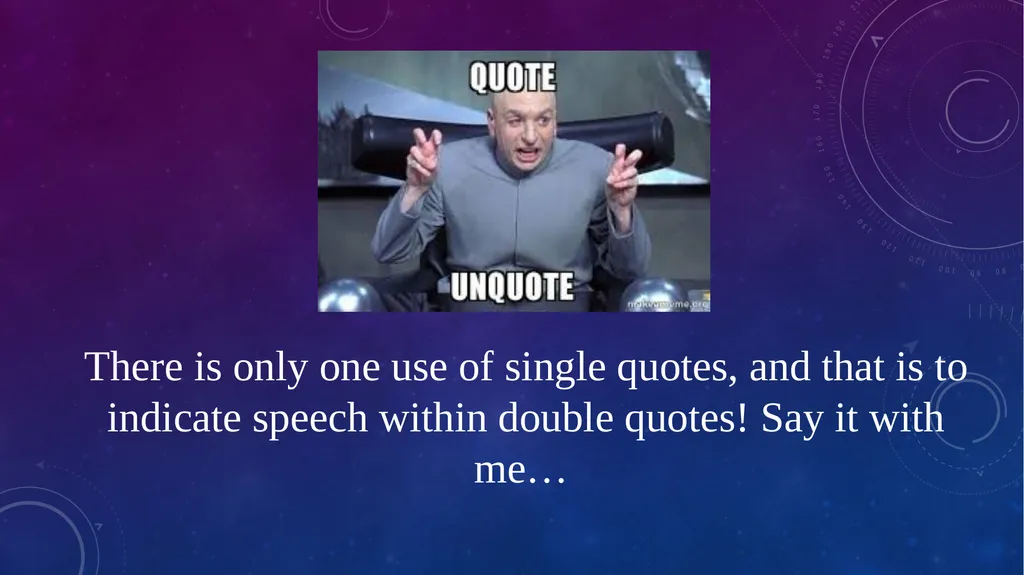
There is only one use of single quotes, and that is to indicate speech within double quotes! Say it with me…<br>
34
#3b Indicators… of spoken or written words (quotation marks, single quotes, brackets, ellipses): Use quotation marks to set off the exact words someone used.
Use double quotation marks to indicate the beginning and ending of a quotation / dialogue.
You can use double quotation marks to introduce a coined or invented expression the first time it is used (or you can use italics if you prefer).
Use double quotation marks to enclose the title of an article (the shorter work within a journal), a chapter in a book, or another short work mentioned in text. (A whole album = underlined/italicized while a track on it would receive quotation marks)
Use single quotation marks solely to indicate a quote within another quote.
DO NOT use single quotation marks in lieu of double quotation marks. (Remind yourself of silly one-finger salute.)<br>
Use double quotation marks to indicate the beginning and ending of a quotation / dialogue.
You can use double quotation marks to introduce a coined or invented expression the first time it is used (or you can use italics if you prefer).
Use double quotation marks to enclose the title of an article (the shorter work within a journal), a chapter in a book, or another short work mentioned in text. (A whole album = underlined/italicized while a track on it would receive quotation marks)
Use single quotation marks solely to indicate a quote within another quote.
DO NOT use single quotation marks in lieu of double quotation marks. (Remind yourself of silly one-finger salute.)<br>
35
How do we mark things within quotes? Use brackets to indicate if you’ve made a slight change within a quote, verb tense, for example
If the quote uses present tense, but your sentence is in past, change it to agree and bracket the change
Use[d]
To explain a term that would be obvious if they had read the whole thing (sometimes we do this when the quote read “it” but we want to be specific). Note, do not change the meaning of quotes.
The admiral told [all the sailors present] that they would receive raises.
Use brackets around sic [sic] to indicate when you notice an error in a quote
“I hear by [sic] announce that learning grammar is more fun than stressing about it.”
Use ellipses to indicate when you’ve skipped something within a quote.
There is no need to use ellipses at the beginning or end of the quote<br>
If the quote uses present tense, but your sentence is in past, change it to agree and bracket the change
Use[d]
To explain a term that would be obvious if they had read the whole thing (sometimes we do this when the quote read “it” but we want to be specific). Note, do not change the meaning of quotes.
The admiral told [all the sailors present] that they would receive raises.
Use brackets around sic [sic] to indicate when you notice an error in a quote
“I hear by [sic] announce that learning grammar is more fun than stressing about it.”
Use ellipses to indicate when you’ve skipped something within a quote.
There is no need to use ellipses at the beginning or end of the quote<br>
36
How do we get in and out of quotes? First and foremost, remember that your sentences are your own. Do not let your sentences be hijacked because of quotes (or for any other reason; for instance, we really do want to know what YOU observe and see and think, not just what the “experts” say).
Use a colon to introduce a quote if you already have a full sentence.
I discovered that omega 3 in eggs is good for you: “omega 3 helps the brain.” (Johnson, 2017, p. 17).
Use a comma to introduce a quote if it is what someone said or stated.
Walt stated that, “the thing that makes countries want to pursue some kind of nuclear deterrent is precisely the fact that they feel threatened” (Walt, 2002, 13).
There is no need for punctuation before the quote if the quote is simply a part of your sentence, and you are not saying so and so stated…
We know that there is no need for “punctuation outside of quotation marks” unless we are using APA.<br>
Use a colon to introduce a quote if you already have a full sentence.
I discovered that omega 3 in eggs is good for you: “omega 3 helps the brain.” (Johnson, 2017, p. 17).
Use a comma to introduce a quote if it is what someone said or stated.
Walt stated that, “the thing that makes countries want to pursue some kind of nuclear deterrent is precisely the fact that they feel threatened” (Walt, 2002, 13).
There is no need for punctuation before the quote if the quote is simply a part of your sentence, and you are not saying so and so stated…
We know that there is no need for “punctuation outside of quotation marks” unless we are using APA.<br>
37
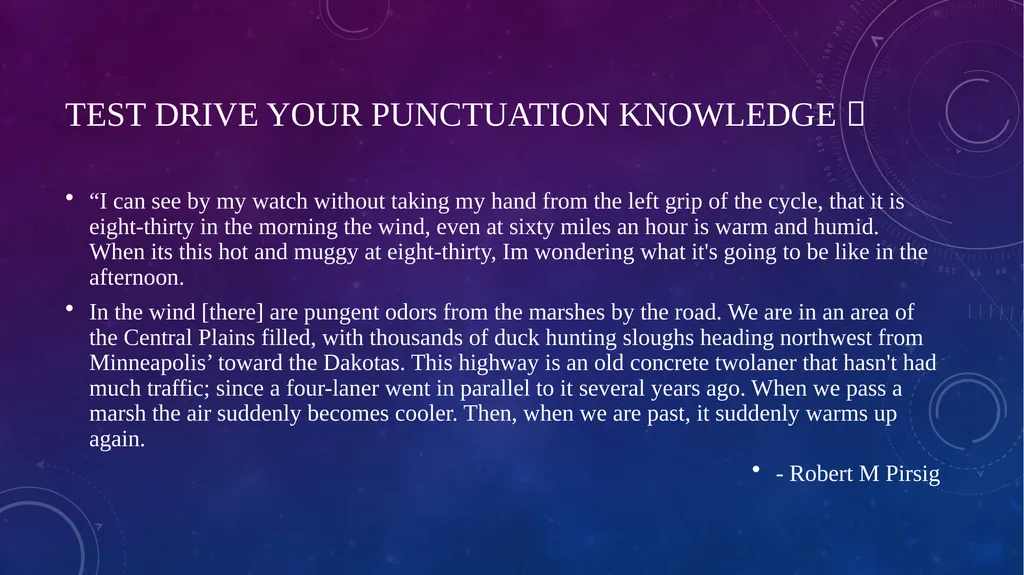
test drive YOUR PUNCTUATION KNOWLEDGE “I can see by my watch without taking my hand from the left grip of the cycle, that it is eight-thirty in the morning the wind, even at sixty miles an hour is warm and humid. When its this hot and muggy at eight-thirty, Im wondering what it's going to be like in the afternoon.
In the wind [there] are pungent odors from the marshes by the road. We are in an area of the Central Plains filled, with thousands of duck hunting sloughs heading northwest from Minneapolis’ toward the Dakotas. This highway is an old concrete twolaner that hasn't had much traffic; since a four-laner went in parallel to it several years ago. When we pass a marsh the air suddenly becomes cooler. Then, when we are past, it suddenly warms up again.
- Robert M Pirsig<br>
In the wind [there] are pungent odors from the marshes by the road. We are in an area of the Central Plains filled, with thousands of duck hunting sloughs heading northwest from Minneapolis’ toward the Dakotas. This highway is an old concrete twolaner that hasn't had much traffic; since a four-laner went in parallel to it several years ago. When we pass a marsh the air suddenly becomes cooler. Then, when we are past, it suddenly warms up again.
- Robert M Pirsig<br>
38
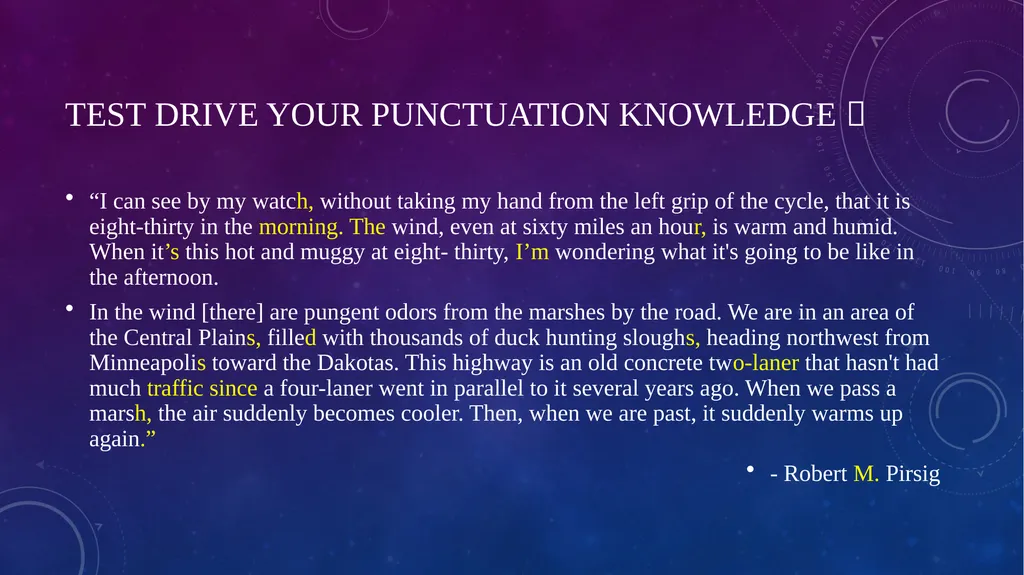
TEST DRIVE your punctuation knowledge “I can see by my watch, without taking my hand from the left grip of the cycle, that it is eight-thirty in the morning. The wind, even at sixty miles an hour, is warm and humid. When it’s this hot and muggy at eight- thirty, I’m wondering what it's going to be like in the afternoon.
In the wind [there] are pungent odors from the marshes by the road. We are in an area of the Central Plains, filled with thousands of duck hunting sloughs, heading northwest from Minneapolis toward the Dakotas. This highway is an old concrete two-laner that hasn't had much traffic since a four-laner went in parallel to it several years ago. When we pass a marsh, the air suddenly becomes cooler. Then, when we are past, it suddenly warms up again.”
- Robert M. Pirsig<br>
In the wind [there] are pungent odors from the marshes by the road. We are in an area of the Central Plains, filled with thousands of duck hunting sloughs, heading northwest from Minneapolis toward the Dakotas. This highway is an old concrete two-laner that hasn't had much traffic since a four-laner went in parallel to it several years ago. When we pass a marsh, the air suddenly becomes cooler. Then, when we are past, it suddenly warms up again.”
- Robert M. Pirsig<br>
39
Questions?<br>