Radical Candor: Candid Conversations to build
Description: Radical Candor: Candid Conversations to build Esprit de Corps What is radical candor? It is kind It is clear It is specific It is sincere It is not brutal honesty! Radical Candor Origin Story Is it possible to teach integrity? This happens
Related Topics
Download Presentation
"Radical Candor: Candid Conversations to build" is the property of its rightful owner. Permission is granted to download and print the materials on this website for personal, non-commercial use only, and to display it on your personal computer provided you do not modify the materials and that you retain all copyright notices contained in the materials. By downloading content from our website, you accept the terms of this agreement.
Presentation Transcript
slide1. Radical Candor:
Candid Conversations to build Esprit de Corps<br>
slide2. What is radical candor?
It is kind
It is clear
It is specific
It is sincere
It is not brutal honesty! Radical Candor Origin Story<br>
slide4. Is it possible to teach integrity? This happens when you say what you think while also genuinely valuing the person you are saying it to! Radical Candor
The act of demonstrating care and also being clear and direct with your critiquing feedback. This is where you want to be.<br>
slide5. Radical Candor Can you remember a time when you were screwing up, someone told you, and it helped you in the long run?
Who was this person?
How did it feel in the moment when you received the feedback?
What was the person’s direct challenge to you?
How did they demonstrate that they cared about you personally?
Looking back over time, do you feel grateful that you received this feedback, even though it might have been difficult to hear at the time?<br>
slide6. How have you recently demonstrated the “caring personally” aspect of radical candor?
How have you recently demonstrated the “challenge directly” aspect of radical candor?
In what ways do you think you could improve “caring personally” and “challenging directly”?
What are you hoping to accomplish by practicing radical candor in the workplace? Assess Your radical candor
In what ways are you on track?
How can you improve?
What are your goals?<br>
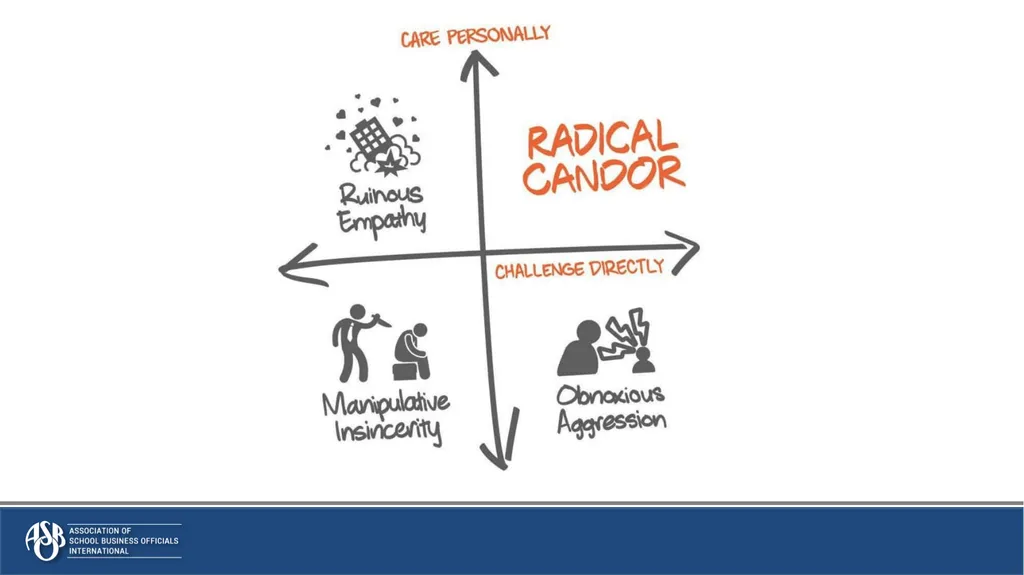
slide7. This is praise that doesn’t feel sincere or criticism that isn’t delivered kindly. Obnoxious
aggression
The act of challenging directly without much caring personally. This is probably the second most helpful behavior after “radical candor”<br>
slide8. Was there a time when someone offered you criticism (probably just trying to be helpful) but you experienced this as obnoxiously aggressive or was there a time you offered someone criticism, but the other person experienced you as obnoxiously aggressive? Obnoxious aggression<br>
slide9. Being “nice” but ultimately unhelpful or even damaging. It’s when you care about someone personally but fail to challenge them directly. Ruinous empathy
The act of caring but not challenging directly. This is the most comfortable behavior that we often stick to and not very helpful.<br>
slide10. When did you fail to give someone feedback, just to be nice, only to see the person suffer as a result of failure to correct bad behavior? Ruinous empathy<br>
slide11. This is what happens when you neither care personally nor challenge directly. Manipulative insincerity
The act of not caring and also not challenging. If you’re behaving this way you’re neither clear in your feedback or nice about it. This is the worse of the bunch.<br>
slide12. When did you fail to tell a person directly about a problem, but instead you talked about it to others? Or was there a time when you told a person their work was good while undermining it behind their back? Manipulative insincerity<br>
slide13. Think of a recent situation where you had to give one of your team members praise or criticism (or both). Describe what you said to them.
What aspects of your praise or feedback do you think you were radically candid?
What aspects of your praise and criticism do you think weren’t radically candid?
Try reframing your non-radically candid praise or criticism so that it’s more sincere and specific. What guidance type have you been using?
Think about how you usually give guidance to your team to figure out where you should ramp up your efforts in caring personally or challenging directly.<br>
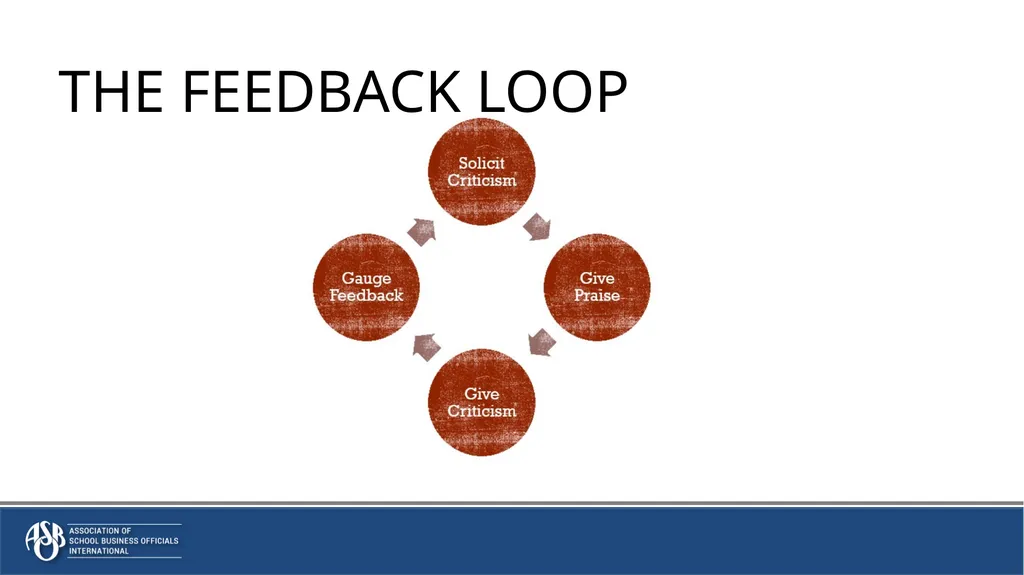
slide14. The Feedback loop<br>
slide15. One of the best ways to solicit feedback is by asking a “Go-To-Question” to get the conversation started. Solicit feedback
To get good at soliciting feedback, you will need to practice.<br>
slide16. What’s something I could’ve done or stopped doing in the last week that would’ve made it easier to work with me?
What could I have done differently to make your job easier?
Here’s what I tried to accomplish in the last week, how could I have approached this better? Solicit feedback<br>
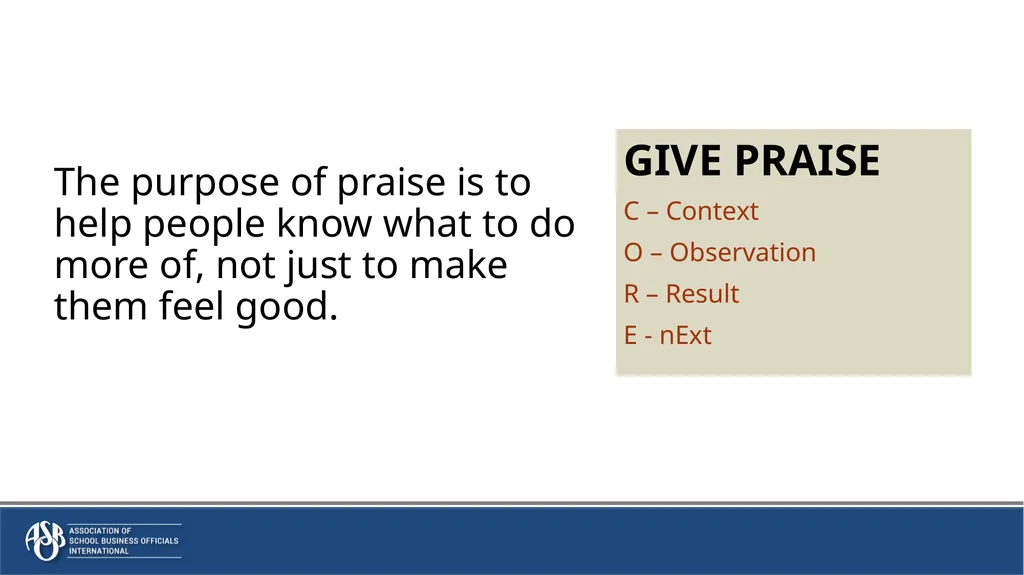
slide18. The purpose of praise is to help people know what to do more of, not just to make them feel good. Give Praise
C – Context
O – Observation
R – Result
E - nExt<br>
slide19. When was the last time you offered someone praise? Was it specific? Was it sincere? How could you make it better?
What’s a piece of praise you could offer your manager? How about a peer? Your group or partner? Someone else?
When would be your next opportunity to offer them that praise? Will you commit to offering it? Give praise<br>
slide20. When providing criticism, the most important thing is to be humble and helpful. You may be wrong and you want the other person to tell you. Give criticism
Give feedback immediately, or as close to immediately as possible.<br>
slide21. Have the conversation in private and in person (when possible) so you can pay attention to the other person’s body language.
Consider the goal of the conversation. Are you having it to win, or are you having it to help? Give Criticism<br>
slide22. Vulnerability is not weakness
Sharing ourselves can often feel like we’re putting too much at risk, but it’s necessary as a leader. Start a difficult conversation by showing respect for the other person by saying something like:
I am not sure how our conversation today is going to go, but I want you to know that I am fully committed to your success, the Finance Team’s success and schools receiving the very best service from our department so we have to address………
Sharing a story of your own growth and learnings can always be a connection as well. Give criticism<br>
slide23. State the facts: Do not try to sugar coat concerns
Let people know that you want honesty and authenticity. Create a safe place for them to speak honestly to you and they can trust you.
Work to pull any judgement, bias or preconceived thoughts out of your language.
Possible start off with a statement similar to 95% of what I’m seeing from you is exactly where it needs to be regarding your job description, today we need to address the 5% that I think will take it to the next level. Give criticism<br>
slide24. When giving praise or criticism, pay attention to how the other person is responding and adjust accordingly. Gauge feedback
Radical Candor is measured at the listener’s ear, not the sender’s mouth.<br>
slide25. “and here is the irony – the more comfortable a leader is holding people on a team accountable, the less likely she is to be asked to do so.”
Patrick Lencioni
The Advantage Gauge feedback<br>
slide26. Reflect on a time when you gave someone feedback and they reacted with either unexpected emotion or ignored what you were telling them. How did you respond? How could you have handled the situation differently? Gauge feedback<br>
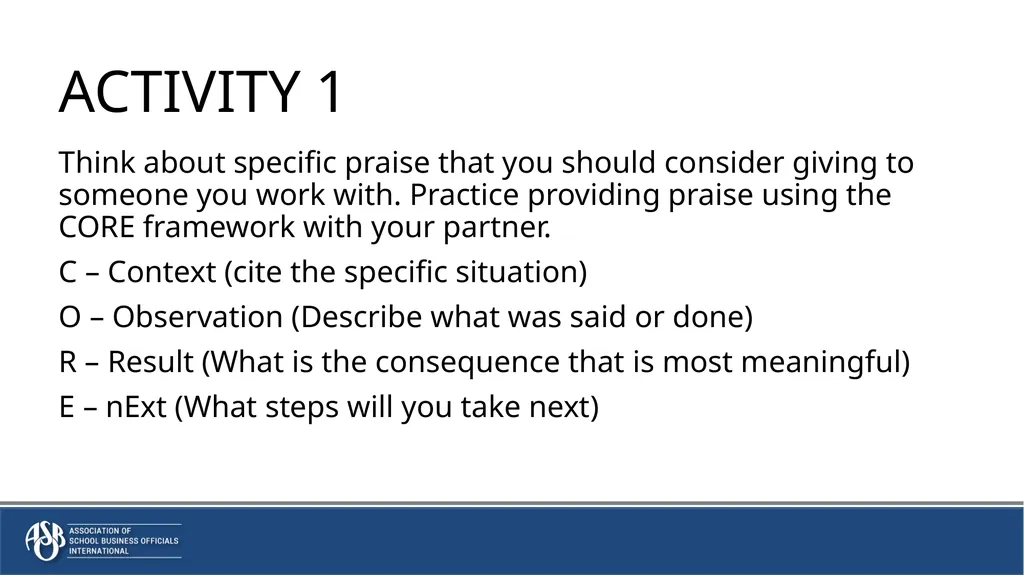
slide28. Think about specific praise that you should consider giving to someone you work with. Practice providing praise using the CORE framework with your partner.
C – Context (cite the specific situation)
O – Observation (Describe what was said or done)
R – Result (What is the consequence that is most meaningful)
E – nExt (What steps will you take next) Activity 1<br>
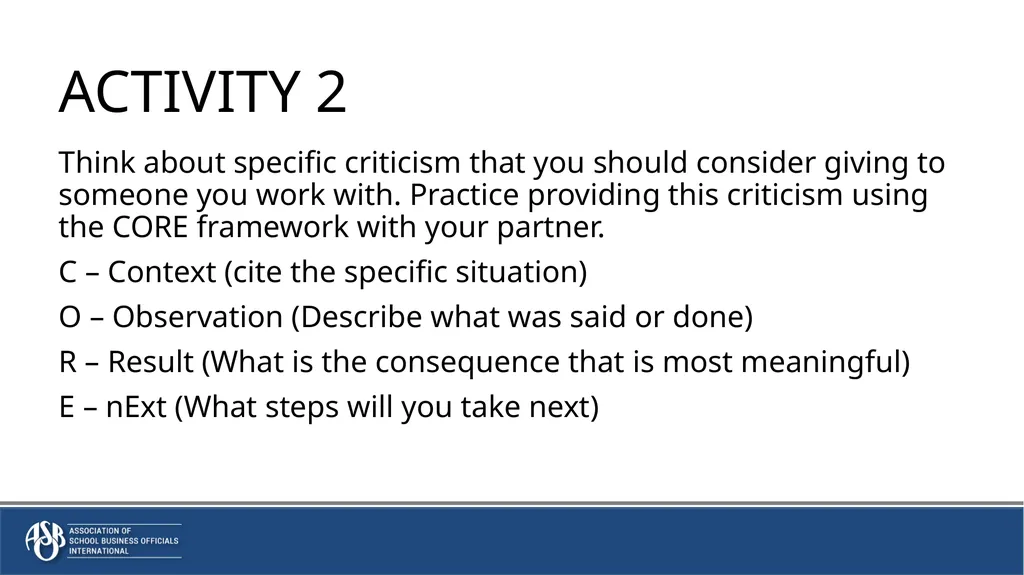
slide29. Think about specific criticism that you should consider giving to someone you work with. Practice providing this criticism using the CORE framework with your partner.
C – Context (cite the specific situation)
O – Observation (Describe what was said or done)
R – Result (What is the consequence that is most meaningful)
E – nExt (What steps will you take next) activity 2<br>
slide30. What challenging conversation do you need to have, but aren’t sure how to start?
Let’s brainstorm as a group! Activity 3<br>
slide31. Radicalcandor.com/resources/
Videos
Radical Candor in 6 minutes
Mini Keynote with Kim Scott
The Talk That Started A Revolution
Learning Guides
The Radical Candor Quick Start Guide
The ‘Radical Candor’ Book Club Discussion Guide
The Radical Candor Practice Playbook
5 Tips for Practicing Radical Candor With Direct Reports Resources<br>
slide32. Radicalcandor.com/resources/
Newsletter
Blog Posts
Book Club Guide
Podcast Resources<br>
slide33. Contact info:
Adams 12 Five Star Schoolsgina.lanier@adams12.org303.396.4381<br>
Candid Conversations to build Esprit de Corps<br>
slide2. What is radical candor?
It is kind
It is clear
It is specific
It is sincere
It is not brutal honesty! Radical Candor Origin Story<br>
slide4. Is it possible to teach integrity? This happens when you say what you think while also genuinely valuing the person you are saying it to! Radical Candor
The act of demonstrating care and also being clear and direct with your critiquing feedback. This is where you want to be.<br>
slide5. Radical Candor Can you remember a time when you were screwing up, someone told you, and it helped you in the long run?
Who was this person?
How did it feel in the moment when you received the feedback?
What was the person’s direct challenge to you?
How did they demonstrate that they cared about you personally?
Looking back over time, do you feel grateful that you received this feedback, even though it might have been difficult to hear at the time?<br>
slide6. How have you recently demonstrated the “caring personally” aspect of radical candor?
How have you recently demonstrated the “challenge directly” aspect of radical candor?
In what ways do you think you could improve “caring personally” and “challenging directly”?
What are you hoping to accomplish by practicing radical candor in the workplace? Assess Your radical candor
In what ways are you on track?
How can you improve?
What are your goals?<br>
slide7. This is praise that doesn’t feel sincere or criticism that isn’t delivered kindly. Obnoxious
aggression
The act of challenging directly without much caring personally. This is probably the second most helpful behavior after “radical candor”<br>
slide8. Was there a time when someone offered you criticism (probably just trying to be helpful) but you experienced this as obnoxiously aggressive or was there a time you offered someone criticism, but the other person experienced you as obnoxiously aggressive? Obnoxious aggression<br>
slide9. Being “nice” but ultimately unhelpful or even damaging. It’s when you care about someone personally but fail to challenge them directly. Ruinous empathy
The act of caring but not challenging directly. This is the most comfortable behavior that we often stick to and not very helpful.<br>
slide10. When did you fail to give someone feedback, just to be nice, only to see the person suffer as a result of failure to correct bad behavior? Ruinous empathy<br>
slide11. This is what happens when you neither care personally nor challenge directly. Manipulative insincerity
The act of not caring and also not challenging. If you’re behaving this way you’re neither clear in your feedback or nice about it. This is the worse of the bunch.<br>
slide12. When did you fail to tell a person directly about a problem, but instead you talked about it to others? Or was there a time when you told a person their work was good while undermining it behind their back? Manipulative insincerity<br>
slide13. Think of a recent situation where you had to give one of your team members praise or criticism (or both). Describe what you said to them.
What aspects of your praise or feedback do you think you were radically candid?
What aspects of your praise and criticism do you think weren’t radically candid?
Try reframing your non-radically candid praise or criticism so that it’s more sincere and specific. What guidance type have you been using?
Think about how you usually give guidance to your team to figure out where you should ramp up your efforts in caring personally or challenging directly.<br>
slide14. The Feedback loop<br>
slide15. One of the best ways to solicit feedback is by asking a “Go-To-Question” to get the conversation started. Solicit feedback
To get good at soliciting feedback, you will need to practice.<br>
slide16. What’s something I could’ve done or stopped doing in the last week that would’ve made it easier to work with me?
What could I have done differently to make your job easier?
Here’s what I tried to accomplish in the last week, how could I have approached this better? Solicit feedback<br>
slide18. The purpose of praise is to help people know what to do more of, not just to make them feel good. Give Praise
C – Context
O – Observation
R – Result
E - nExt<br>
slide19. When was the last time you offered someone praise? Was it specific? Was it sincere? How could you make it better?
What’s a piece of praise you could offer your manager? How about a peer? Your group or partner? Someone else?
When would be your next opportunity to offer them that praise? Will you commit to offering it? Give praise<br>
slide20. When providing criticism, the most important thing is to be humble and helpful. You may be wrong and you want the other person to tell you. Give criticism
Give feedback immediately, or as close to immediately as possible.<br>
slide21. Have the conversation in private and in person (when possible) so you can pay attention to the other person’s body language.
Consider the goal of the conversation. Are you having it to win, or are you having it to help? Give Criticism<br>
slide22. Vulnerability is not weakness
Sharing ourselves can often feel like we’re putting too much at risk, but it’s necessary as a leader. Start a difficult conversation by showing respect for the other person by saying something like:
I am not sure how our conversation today is going to go, but I want you to know that I am fully committed to your success, the Finance Team’s success and schools receiving the very best service from our department so we have to address………
Sharing a story of your own growth and learnings can always be a connection as well. Give criticism<br>
slide23. State the facts: Do not try to sugar coat concerns
Let people know that you want honesty and authenticity. Create a safe place for them to speak honestly to you and they can trust you.
Work to pull any judgement, bias or preconceived thoughts out of your language.
Possible start off with a statement similar to 95% of what I’m seeing from you is exactly where it needs to be regarding your job description, today we need to address the 5% that I think will take it to the next level. Give criticism<br>
slide24. When giving praise or criticism, pay attention to how the other person is responding and adjust accordingly. Gauge feedback
Radical Candor is measured at the listener’s ear, not the sender’s mouth.<br>
slide25. “and here is the irony – the more comfortable a leader is holding people on a team accountable, the less likely she is to be asked to do so.”
Patrick Lencioni
The Advantage Gauge feedback<br>
slide26. Reflect on a time when you gave someone feedback and they reacted with either unexpected emotion or ignored what you were telling them. How did you respond? How could you have handled the situation differently? Gauge feedback<br>
slide28. Think about specific praise that you should consider giving to someone you work with. Practice providing praise using the CORE framework with your partner.
C – Context (cite the specific situation)
O – Observation (Describe what was said or done)
R – Result (What is the consequence that is most meaningful)
E – nExt (What steps will you take next) Activity 1<br>

slide29. Think about specific criticism that you should consider giving to someone you work with. Practice providing this criticism using the CORE framework with your partner.
C – Context (cite the specific situation)
O – Observation (Describe what was said or done)
R – Result (What is the consequence that is most meaningful)
E – nExt (What steps will you take next) activity 2<br>
slide30. What challenging conversation do you need to have, but aren’t sure how to start?
Let’s brainstorm as a group! Activity 3<br>
slide31. Radicalcandor.com/resources/
Videos
Radical Candor in 6 minutes
Mini Keynote with Kim Scott
The Talk That Started A Revolution
Learning Guides
The Radical Candor Quick Start Guide
The ‘Radical Candor’ Book Club Discussion Guide
The Radical Candor Practice Playbook
5 Tips for Practicing Radical Candor With Direct Reports Resources<br>
slide32. Radicalcandor.com/resources/
Newsletter
Blog Posts
Book Club Guide
Podcast Resources<br>
slide33. Contact info:
Adams 12 Five Star Schoolsgina.lanier@adams12.org303.396.4381<br>