Radio Spectrum Considerations for Present and Future Rail Communication Systems in the CEPT Electronic Communications Committee (ECC) Managing Rail Mobile Communications Evolution, 2-3 November, ETSI Sophia Antipolis Thomas Weber, ECO,
"Radio Spectrum Considerations for Present and" is the property of its rightful owner. Permission is granted to
download and print the materials on this website for personal, non-commercial use only, and to display it
on your personal computer provided you do not modify the materials and that you retain all copyright
notices contained in the materials. By downloading content from our website, you accept the terms of this
agreement.
Presentation Transcript
01
Radio Spectrum Considerations for Present and Future Rail Communication Systems in the CEPT / Electronic Communications Committee (ECC)
Managing Rail Mobile Communications Evolution, 2-3 November, ETSI – Sophia Antipolis Thomas Weber, ECO, Spectrum Management
Thomas.weber@eco.cept.org<br>
02
Overview ECC, ETSI, and the EU
Regulating Spectrum and Equipment in Europe
Structure CEPT/ECC
Existing ECC Deliverables
Process in ECC WG FM
2-Step Procedure
Other items
New railway communications topic page<br>
03
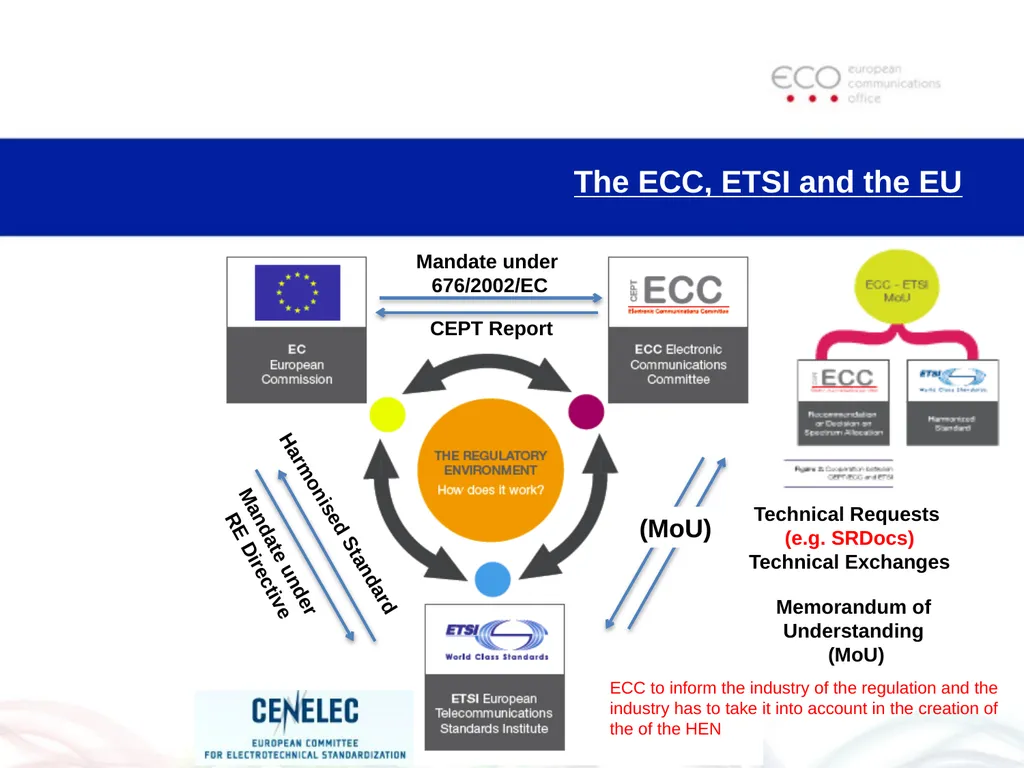
The ECC, ETSI and the EU Mandate under
676/2002/EC CEPT Report Memorandum of
Understanding
(MoU) Technical Requests
(e.g. SRDocs)
Technical Exchanges (MoU) Mandate under
RE Directive Harmonised Standard ECC to inform the industry of the regulation and the
industry has to take it into account in the creation of
the of the HEN<br>
04
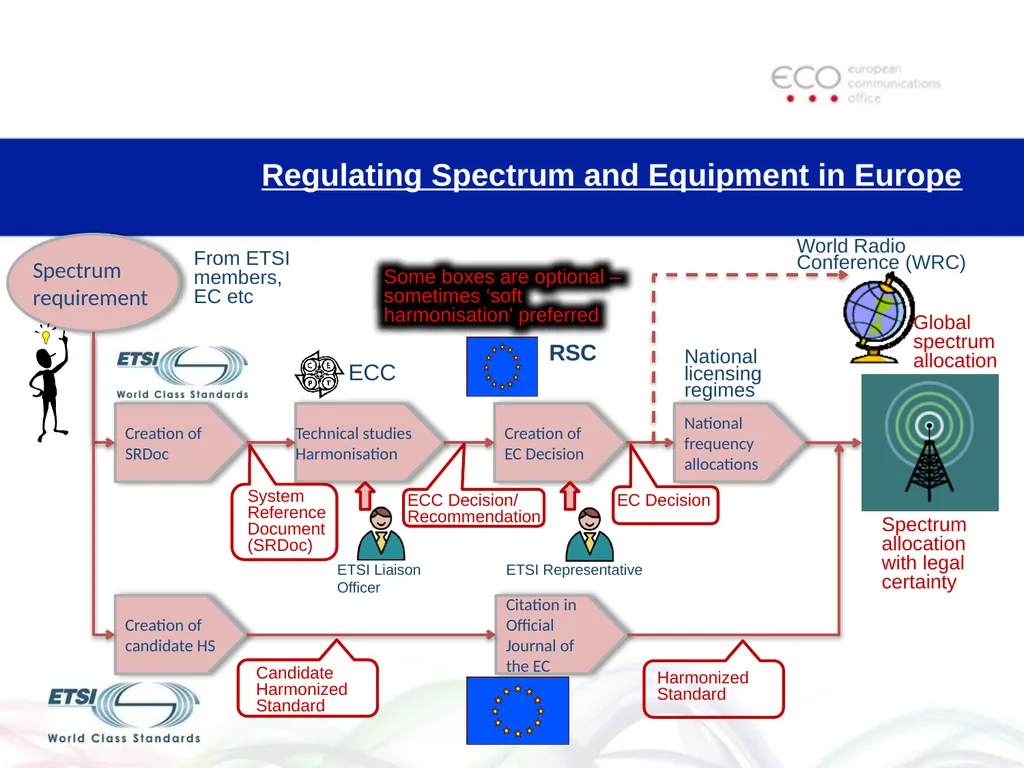
Regulating Spectrum and Equipment in Europe Creation of SRDoc Creation of candidate HS Technical studies Harmonisation Creation of EC Decision National frequency allocations National licensing regimes Citation in Official Journal of the EC Spectrum allocation with legal certainty Spectrum requirement From ETSI members, EC etc ETSI Liaison Officer ETSI Representative Some boxes are optional – sometimes ‘soft harmonisation’ preferred<br>
05
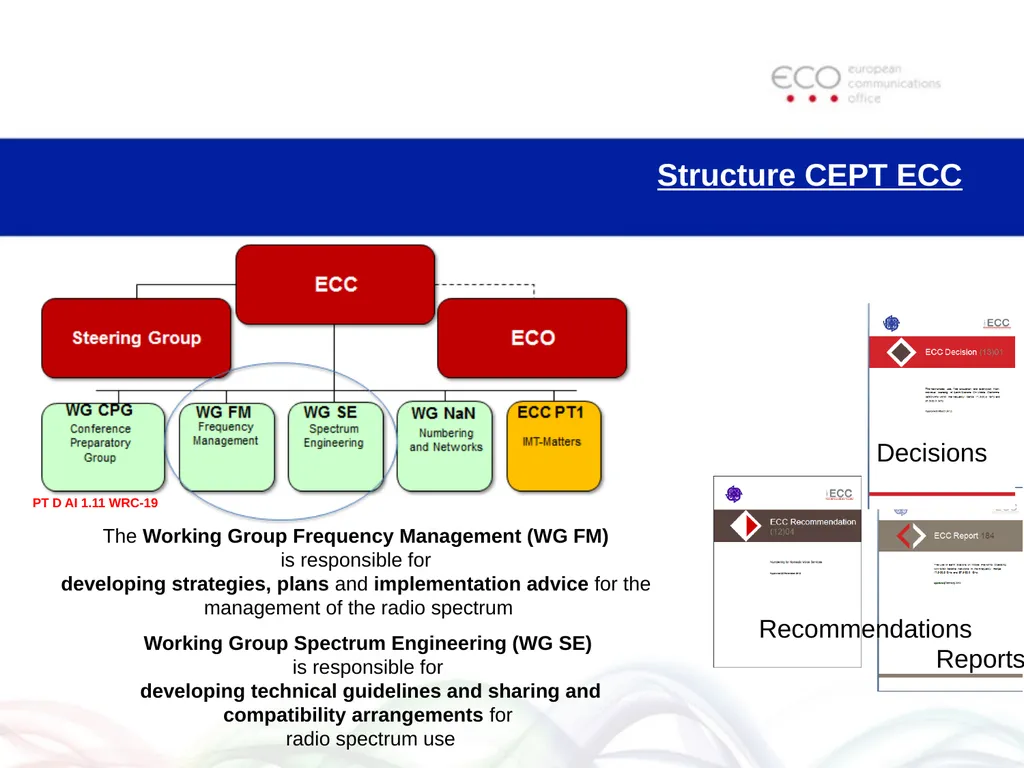
Structure CEPT ECC Decisions The Working Group Frequency Management (WG FM)
is responsible for
developing strategies, plans and implementation advice for the
management of the radio spectrum Working Group Spectrum Engineering (WG SE)
is responsible for
developing technical guidelines and sharing and compatibility arrangements for
radio spectrum use PT D AI 1.11 WRC-19<br>
06
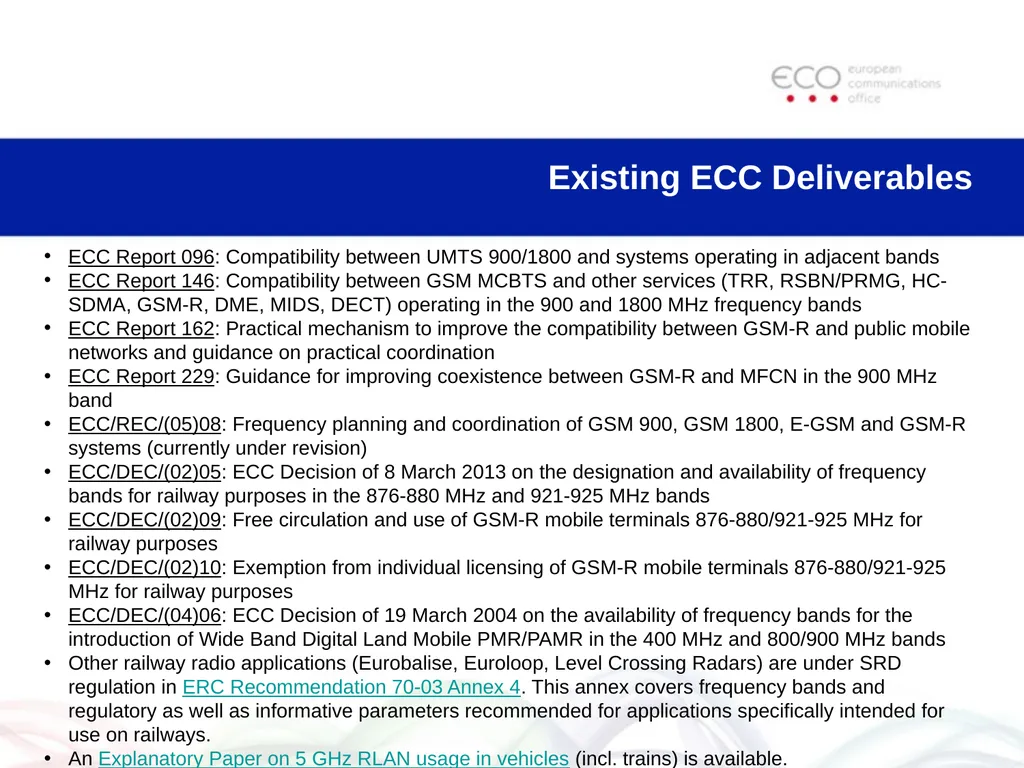
Existing ECC Deliverables ECC Report 096: Compatibility between UMTS 900/1800 and systems operating in adjacent bands
ECC Report 146: Compatibility between GSM MCBTS and other services (TRR, RSBN/PRMG, HC-SDMA, GSM-R, DME, MIDS, DECT) operating in the 900 and 1800 MHz frequency bands
ECC Report 162: Practical mechanism to improve the compatibility between GSM-R and public mobile networks and guidance on practical coordination
ECC Report 229: Guidance for improving coexistence between GSM-R and MFCN in the 900 MHz band
ECC/REC/(05)08: Frequency planning and coordination of GSM 900, GSM 1800, E-GSM and GSM-R systems (currently under revision)
ECC/DEC/(02)05: ECC Decision of 8 March 2013 on the designation and availability of frequency bands for railway purposes in the 876-880 MHz and 921-925 MHz bands
ECC/DEC/(02)09: Free circulation and use of GSM-R mobile terminals 876-880/921-925 MHz for railway purposes
ECC/DEC/(02)10: Exemption from individual licensing of GSM-R mobile terminals 876-880/921-925 MHz for railway purposes
ECC/DEC/(04)06: ECC Decision of 19 March 2004 on the availability of frequency bands for the introduction of Wide Band Digital Land Mobile PMR/PAMR in the 400 MHz and 800/900 MHz bands
Other railway radio applications (Eurobalise, Euroloop, Level Crossing Radars) are under SRD regulation in ERC Recommendation 70-03 Annex 4. This annex covers frequency bands and regulatory as well as informative parameters recommended for applications specifically intended for use on railways.
An Explanatory Paper on 5 GHz RLAN usage in vehicles (incl. trains) is available.<br>
07
Process in ECC Working Group Frequency Management
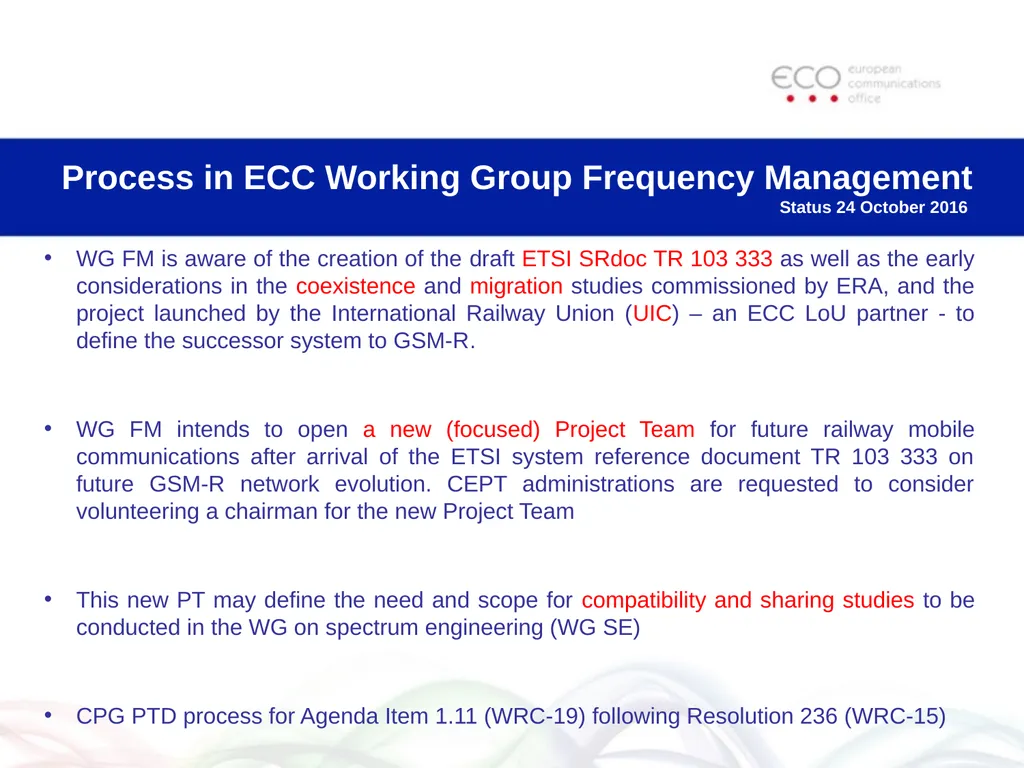
Status 24 October 2016 WG FM is aware of the creation of the draft ETSI SRdoc TR 103 333 as well as the early considerations in the coexistence and migration studies commissioned by ERA, and the project launched by the International Railway Union (UIC) – an ECC LoU partner - to define the successor system to GSM-R.
WG FM intends to open a new (focused) Project Team for future railway mobile communications after arrival of the ETSI system reference document TR 103 333 on future GSM-R network evolution. CEPT administrations are requested to consider volunteering a chairman for the new Project Team
This new PT may define the need and scope for compatibility and sharing studies to be conducted in the WG on spectrum engineering (WG SE)
CPG PTD process for Agenda Item 1.11 (WRC-19) following Resolution 236 (WRC-15)<br>
08
In parallel to the compatibility studies, the new FM PT may create a new ECC Report discussing all related aspects which may impact frequency considerations (e.g. possible type of networks (dedicated, hybrid, MNO solutions), network migration, technology aspects, related standardisation activities in ETSI and 3GPP, frequency sharing aspects, interoperability, flexibility in the approach).
After the results of the compatibility studies will become available, a new ECC harmonisation deliverable and/or change/replacement of an existing one (e.g. ECC/DEC/(02)05 and ECC/DEC/(04)06) (ECC Decision or Recommendation) will most likely be created. Normal 2-Step Procedure<br>
09
Other Items Synergies with other ‘mission-critical’ networks (BB-PPDR, see ECC Report 218 and ECC Decision (16)02, or high-voltage smart grids under PMR regulation in 400 MHz discussed in WG FM PT FM54)
ERC Recommendation 70-03 and Addendum CEPT Report 59 (SRD and RFID usage in 870-876 MHz and 915-921 MHz, section 2.6.3 recognising early GSM-R follow-on considerations) as well as primary use to be protected (military and E-GSM-R)
Intelligent Transportation Systems (ECC/DEC/(08)01) and Urban Rail systems – on-going process
Other railway radio applications (Eurobalise, Euroloop, Level Crossing Radars) under SRD regulation in ERC Recommendation 70-03 Annex 4.
Explanatory Paper on 5 GHz RLAN usage in vehicles (incl. trains)
ECC CPG Process towards Agenda Item 1.11 at WRC-19, following Resolution 236 (WRC-15)
Contribution Oct. 2016 to the ITU BR in response to a questionnaire<br>
10
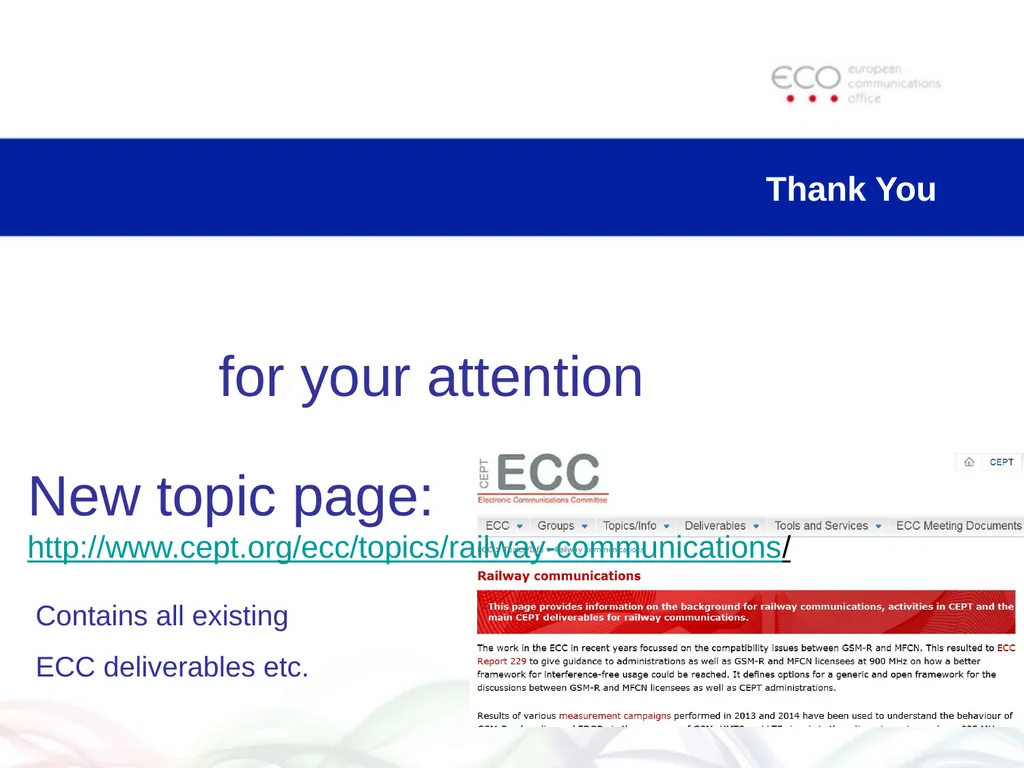
Thank You for your attention New topic page:
http://www.cept.org/ecc/topics/railway-communications/ Contains all existing
ECC deliverables etc.<br>