Rainbows for Beginners Novices Guide to being an inclusive, welcoming and kind SCH Trust carer and colleague LGBT L lesbian women who are attracted to other women G- gay men who are attracted to other men (is also used by women
"Rainbows for Beginners Novices’ Guide to being an" is the property of its rightful owner. Permission is granted to
download and print the materials on this website for personal, non-commercial use only, and to display it
on your personal computer provided you do not modify the materials and that you retain all copyright
notices contained in the materials. By downloading content from our website, you accept the terms of this
agreement.
Presentation Transcript
01
Rainbows for Beginners Novices’ Guide to being an inclusive, welcoming and kind SCH Trust carer and colleague<br>
02
LGBT+ L – lesbian – women who are attracted to other women
G- gay – men who are attracted to other men (is also used by women – see L)
B – bi– people who are attracted to more than one gender identity
T – trans – people who do not identify as the sex/gender they were assigned at birth
+ - plus encompasses all other variations on sexuality and gender<br>
03
Other terms to know Cis/cisgender – (pronounced Sis) people who identify solely as the sex/gender they were assigned at birth
Binary – the concept of only two distinct genders – male or female
Non-binary – the concept of gender existing beyond the division of male/female.
Non-binary - also used as a self-descriptor by people who do not identify as cisgender, but as a combination of both male and female, or neither male nor female, or as outside the binary concept completely<br>
04
Other terms to know Queer – umbrella term for any identity that is not cisgender and/or not heterosexual
Agender – a term to describe feeling genderless, or gender neutral, or that gender is irrelevant to them personally
Pansexual – attraction to any or all genders/gender not an influential factor in attraction
Intersex – a term to describe a person who may have biological attributes of both sexes or whose biological attributes do not fit with societal assumptions about what constitutes male or female<br>
05
There are many other words and terminologies.
If you want to understand more
“The ABCs of LGBT+” by Ashley Mardell is a fantastic book aimed at teens which describes a whole world of words and experiences related to gender and sexuality. The book does not aim simply to find labels for people, but to help people find understanding through shared vocabulary and to discover that many people have similar experiences that can sometimes be hard to describe or are frequently misunderstood.<br>
06
Footnote These terms are not all-encompassing, or rigidly definitive. The language keeps changing and evolving, but these are broadly agreed current descriptions.
Our advice here relates to personal and professional conversations we all have in the workplace. It is not an attempt to limit your freedom of speech. It is to help you become a more inclusive, skilful ally to patients, service users, and colleagues. Best practice is to ask a person what terminology and pronouns they prefer.<br>
07
Why does this matter? Language matters
You will all know words used as slurs and insults to hurt people
You will all remember words that “were fine in the 70s” that are now considered slurs and insults
You may know words that have been reclaimed by marginal groups to redefine the words and empower those groups You may understand words DO have a level of ownership and appropriateness in different situations
You may realise you speak differently with your friends and family, than perhaps with your patients, your church group, or your work colleagues<br>
08
Why does this matter? Children and young people avoid seeking healthcare due to how they are spoken to, spoken about, and treated in regards to their LGBT+ status
Children and young people are at risk of self-harm and suicide far more often due to their experience of being LGBT+
Young LGBT+ people often do not have a trusted adult in their life to rely on Staff in SCH have experienced bullying, insults & exclusion due to the language and attitudes of their co-workers
SCH has formally committed to active improvement in inclusivity and diversity, in both policy and practice
Sexuality and gender are Protected Characteristics in UK law and NHS policy<br>
09
Lesbian Please do Believe someone if they tell you
Be supportive if they are struggling
Use inclusive language – e.g. ask about ‘how is your partner doing?’ rather than assuming husband or wife
Challenge any colleague who mocks or belittles a person because of this Please don’t Make assumptions
Tell anyone without permission (unless there is a safeguarding issue)
Say they are “too young to know”
Say “it’s just a phase”
Offer a “treatment or cure”
Treat them differently
Make jokes at their expense
Use lesbian slurs/insults<br>
10
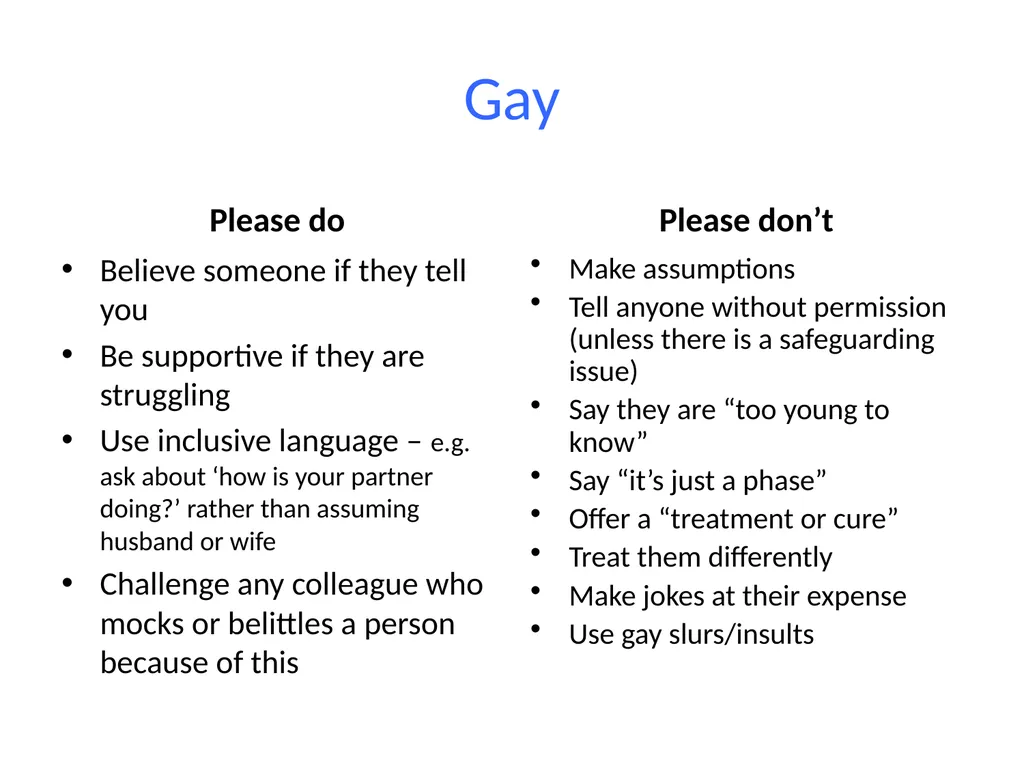
Gay Please do Believe someone if they tell you
Be supportive if they are struggling
Use inclusive language – e.g. ask about ‘how is your partner doing?’ rather than assuming husband or wife
Challenge any colleague who mocks or belittles a person because of this Please don’t Make assumptions
Tell anyone without permission (unless there is a safeguarding issue)
Say they are “too young to know”
Say “it’s just a phase”
Offer a “treatment or cure”
Treat them differently
Make jokes at their expense
Use gay slurs/insults<br>
11
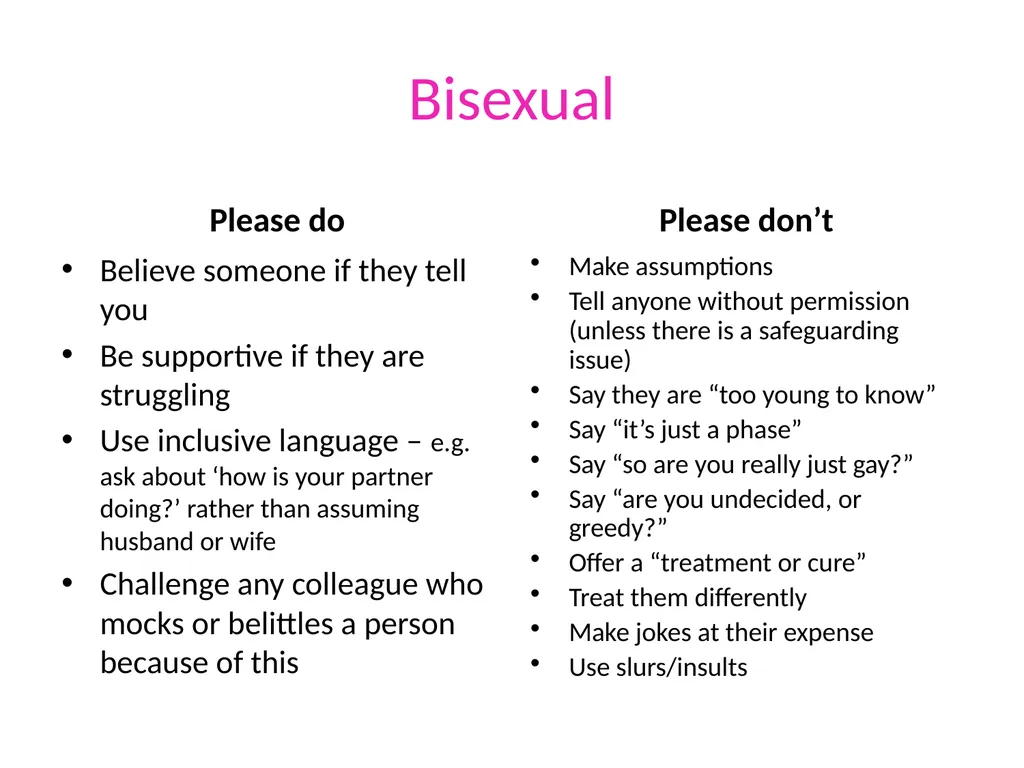
Bisexual Please do Believe someone if they tell you
Be supportive if they are struggling
Use inclusive language – e.g. ask about ‘how is your partner doing?’ rather than assuming husband or wife
Challenge any colleague who mocks or belittles a person because of this Please don’t Make assumptions
Tell anyone without permission (unless there is a safeguarding issue)
Say they are “too young to know”
Say “it’s just a phase”
Say “so are you really just gay?”
Say “are you undecided, or greedy?”
Offer a “treatment or cure”
Treat them differently
Make jokes at their expense
Use slurs/insults<br>
12
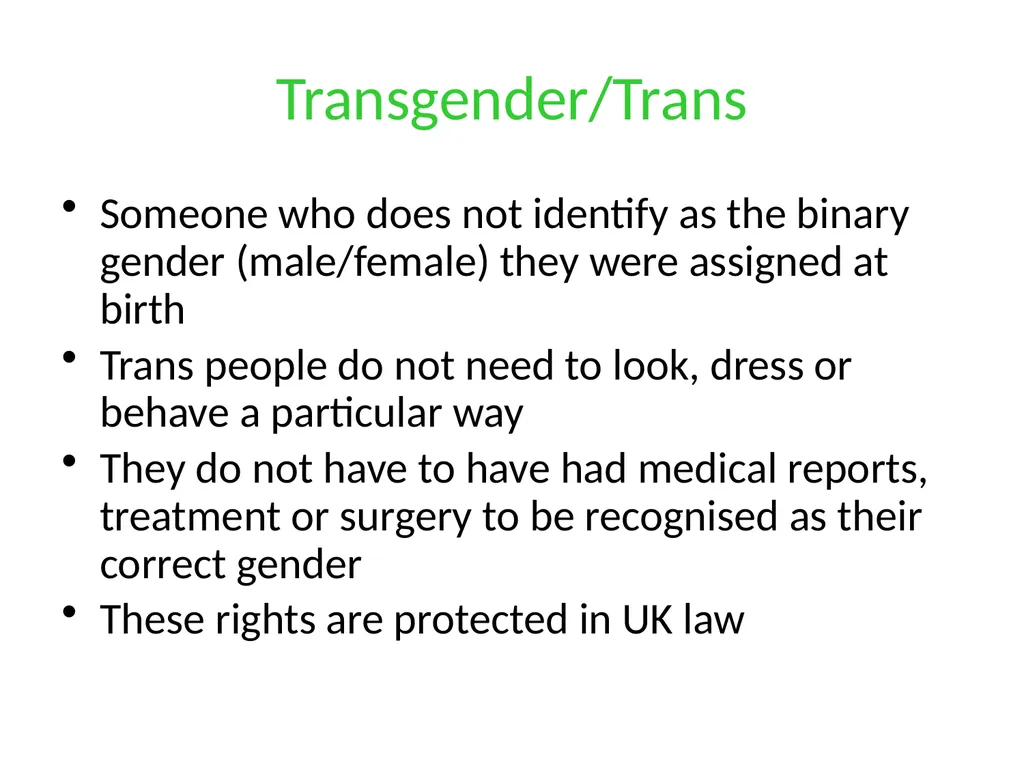
Transgender/Trans Someone who does not identify as the binary gender (male/female) they were assigned at birth
Trans people do not need to look, dress or behave a particular way
They do not have to have had medical reports, treatment or surgery to be recognised as their correct gender
These rights are protected in UK law<br>
13
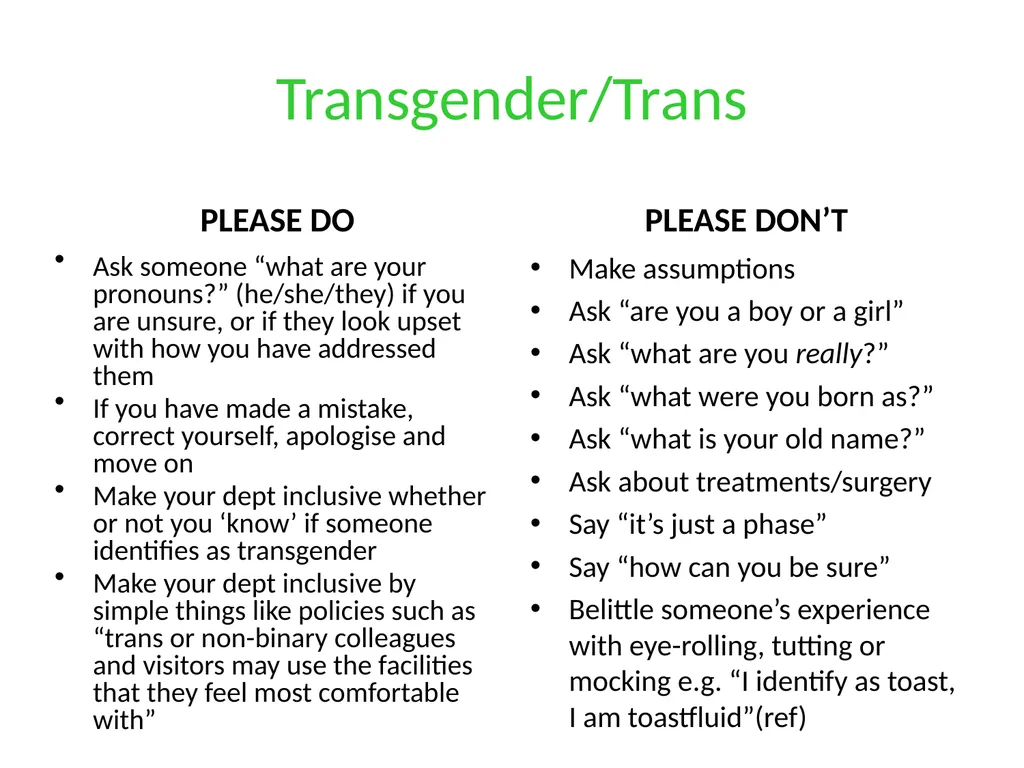
Transgender/Trans PLEASE DO Ask someone “what are your pronouns?” (he/she/they) if you are unsure, or if they look upset with how you have addressed them
If you have made a mistake, correct yourself, apologise and move on
Make your dept inclusive whether or not you ‘know’ if someone identifies as transgender
Make your dept inclusive by simple things like policies such as “trans or non-binary colleagues and visitors may use the facilities that they feel most comfortable with” PLEASE DON’T Make assumptions
Ask “are you a boy or a girl”
Ask “what are you really?”
Ask “what were you born as?”
Ask “what is your old name?”
Ask about treatments/surgery
Say “it’s just a phase”
Say “how can you be sure”
Belittle someone’s experience with eye-rolling, tutting or mocking e.g. “I identify as toast, I am toastfluid”(ref)<br>
14
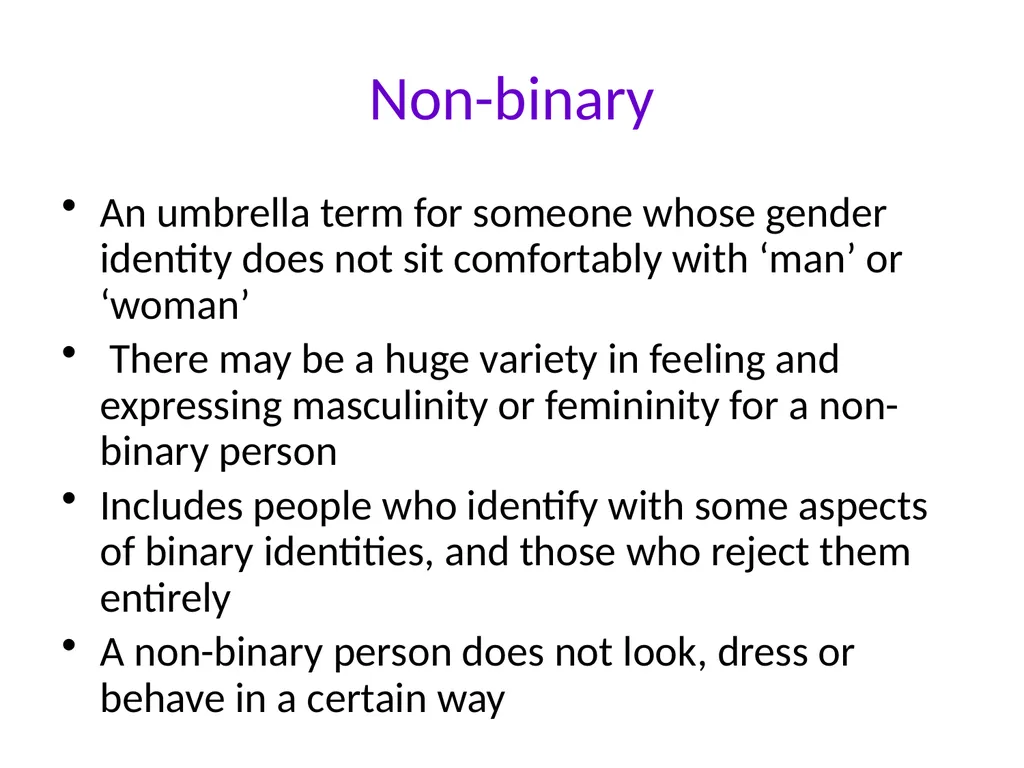
Non-binary An umbrella term for someone whose gender identity does not sit comfortably with ‘man’ or ‘woman’
There may be a huge variety in feeling and expressing masculinity or femininity for a non-binary person
Includes people who identify with some aspects of binary identities, and those who reject them entirely
A non-binary person does not look, dress or behave in a certain way<br>
15
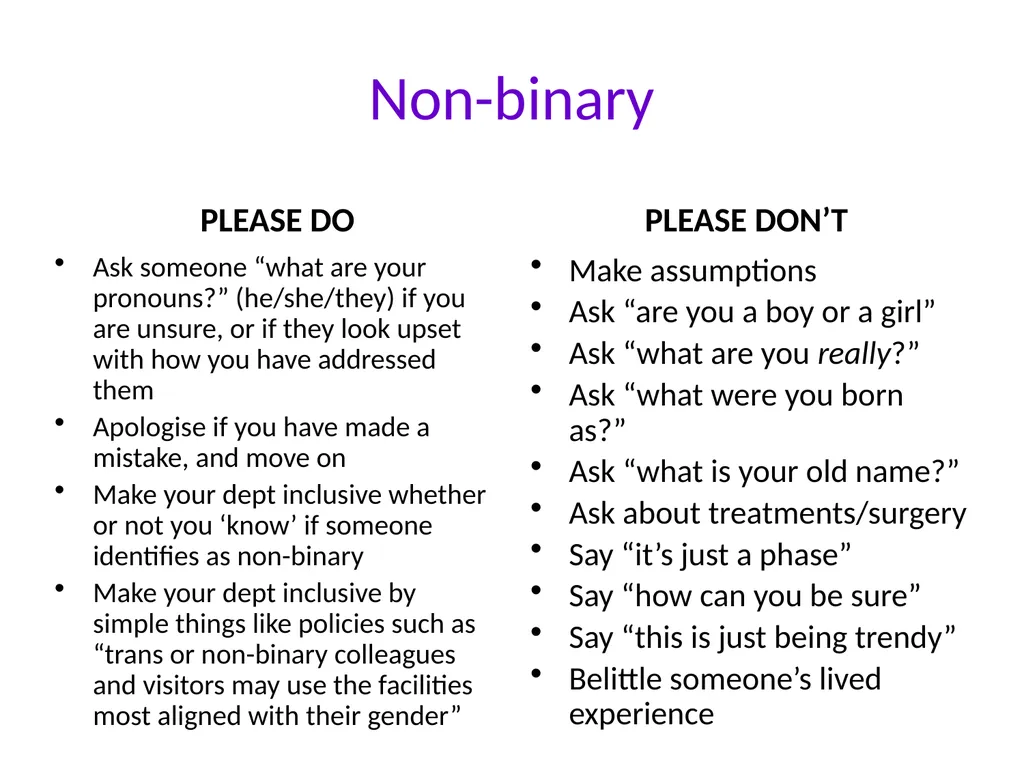
Non-binary PLEASE DO Ask someone “what are your pronouns?” (he/she/they) if you are unsure, or if they look upset with how you have addressed them
Apologise if you have made a mistake, and move on
Make your dept inclusive whether or not you ‘know’ if someone identifies as non-binary
Make your dept inclusive by simple things like policies such as “trans or non-binary colleagues and visitors may use the facilities most aligned with their gender” PLEASE DON’T Make assumptions
Ask “are you a boy or a girl”
Ask “what are you really?”
Ask “what were you born as?”
Ask “what is your old name?”
Ask about treatments/surgery
Say “it’s just a phase”
Say “how can you be sure”
Say “this is just being trendy”
Belittle someone’s lived experience<br>
16
THANKS Thanks for joining us to work through a few common situations which LGBT+ people find themselves experiencing.
Please take what you’ve read and incorporate it into your workplace.
It may seem like a small thing to you, but using fair, kind and inclusive language makes a huge difference to everyone feeling they are valued and belong here.
If you have any questions please contact us at
scn-tr.rainbowbadges@nhs.net<br>