
Ramsey Grammar School Year 9 Options 22nd April
MT
Published · 23 slides · 0 views

1 / 1

Description
Ramsey Grammar School Year 9 Options 22nd April 2021 Religious, Moral Philosophical Studies WJEC Short Course: C0011674 This is a COMPULSORY subject NB The exam is called Religious Studies though the Department is known as RMPS. How is
Related Topics
Share
Embed code
Download this presentation From Below
"Ramsey Grammar School Year 9 Options 22nd April" is the property of its rightful owner. Permission is granted to download and print the materials on this website for personal, non-commercial use only, and to display it on your personal computer provided you do not modify the materials and that you retain all copyright notices contained in the materials. By downloading content from our website, you accept the terms of this agreement.
Presentation Transcript
01
Ramsey Grammar School
Year 9 Options 22nd April 2021<br>
02
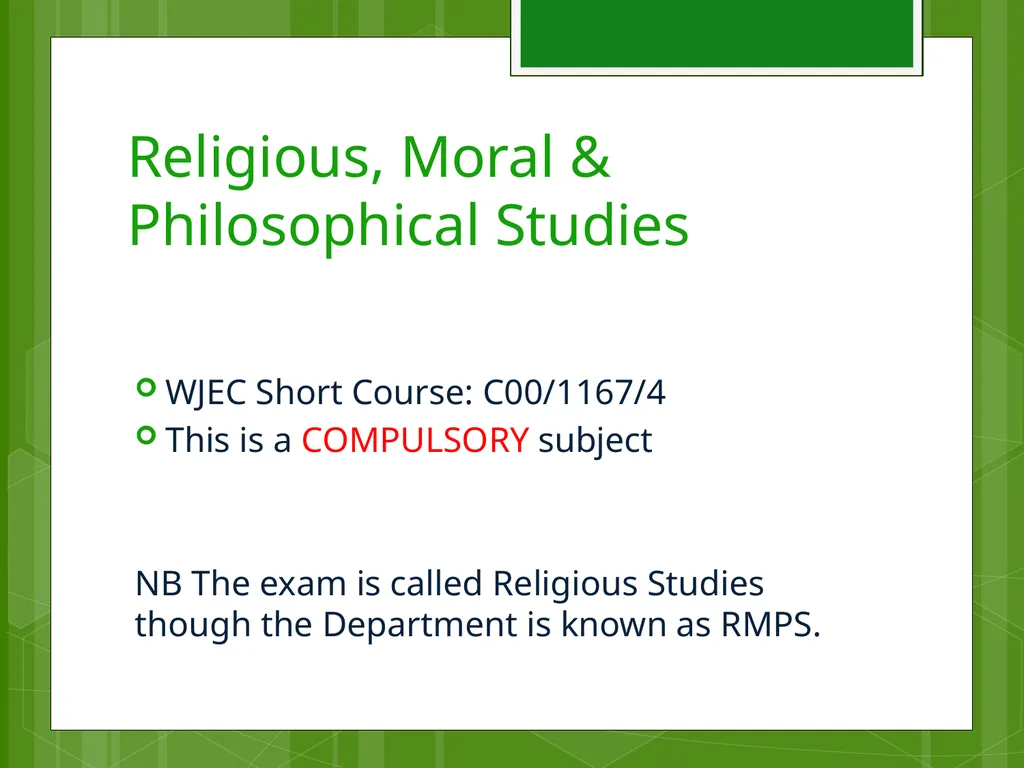
Religious, Moral & Philosophical Studies WJEC Short Course: C00/1167/4
This is a COMPULSORY subject
NB The exam is called Religious Studies though the Department is known as RMPS.<br>
This is a COMPULSORY subject
NB The exam is called Religious Studies though the Department is known as RMPS.<br>
03
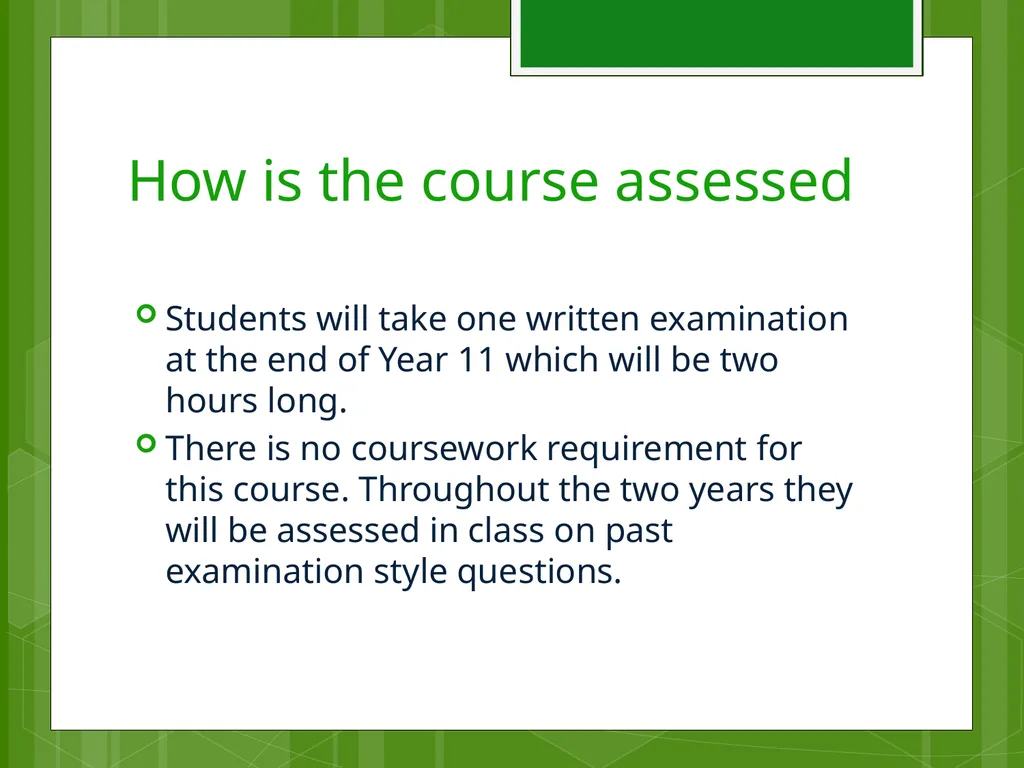
How is the course assessed Students will take one written examination at the end of Year 11 which will be two hours long.
There is no coursework requirement for this course. Throughout the two years they will be assessed in class on past examination style questions.<br>
There is no coursework requirement for this course. Throughout the two years they will be assessed in class on past examination style questions.<br>
04
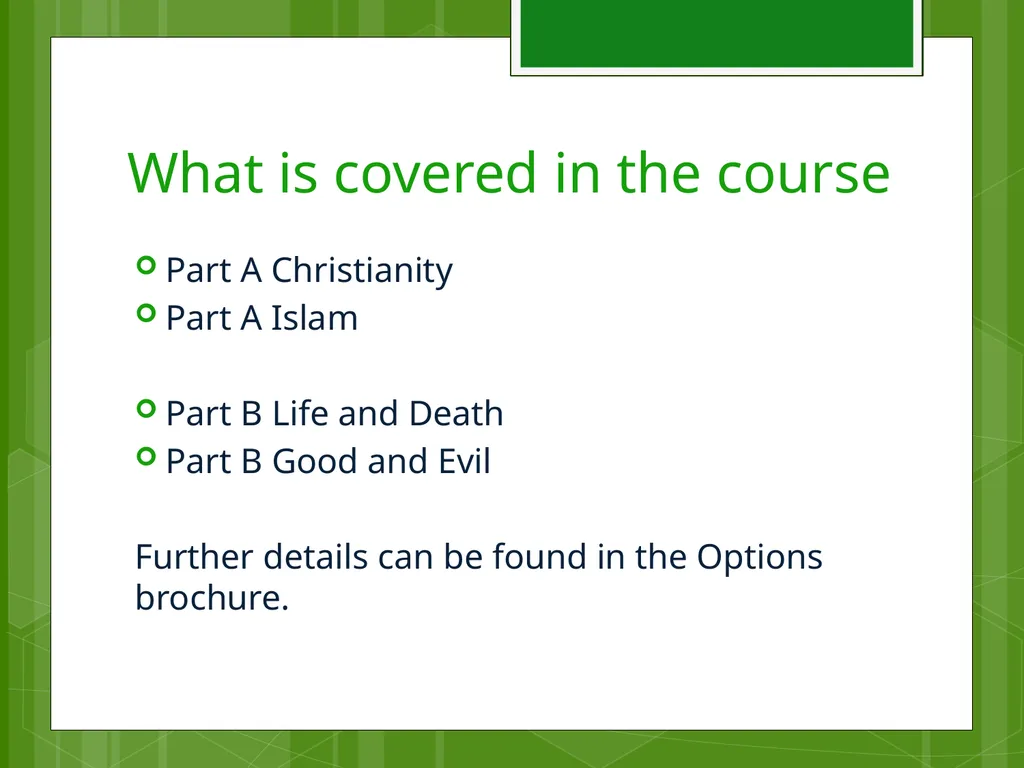
What is covered in the course Part A Christianity
Part A Islam
Part B Life and Death
Part B Good and Evil
Further details can be found in the Options brochure.<br>
Part A Islam
Part B Life and Death
Part B Good and Evil
Further details can be found in the Options brochure.<br>
05
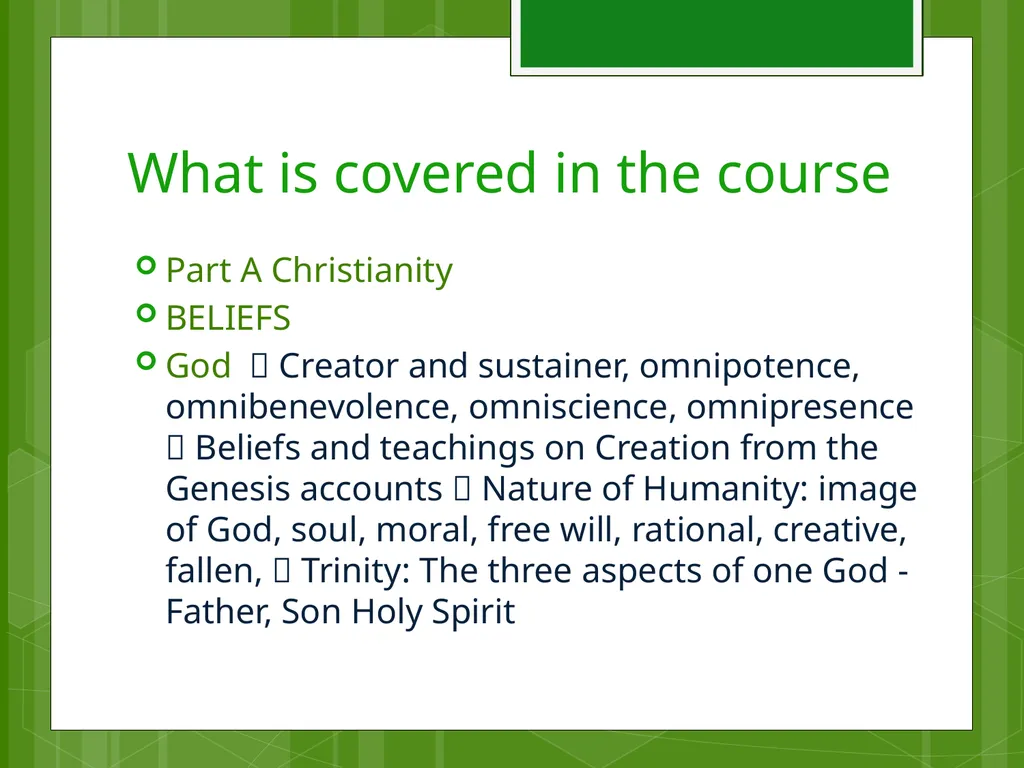
What is covered in the course Part A Christianity
BELIEFS
God Creator and sustainer, omnipotence, omnibenevolence, omniscience, omnipresence Beliefs and teachings on Creation from the Genesis accounts Nature of Humanity: image of God, soul, moral, free will, rational, creative, fallen, Trinity: The three aspects of one God - Father, Son Holy Spirit<br>
BELIEFS
God Creator and sustainer, omnipotence, omnibenevolence, omniscience, omnipresence Beliefs and teachings on Creation from the Genesis accounts Nature of Humanity: image of God, soul, moral, free will, rational, creative, fallen, Trinity: The three aspects of one God - Father, Son Holy Spirit<br>
06
What is covered in the course Jesus as God Incarnate
Son, Holy Spirit Jesus as Messiah, Saviour, Word: the Incarnation, salvation and atonement His birth, crucifixion, resurrection (key elements of the accounts of Jesus' birth, death, resurrection and ascension<br>
Son, Holy Spirit Jesus as Messiah, Saviour, Word: the Incarnation, salvation and atonement His birth, crucifixion, resurrection (key elements of the accounts of Jesus' birth, death, resurrection and ascension<br>
07
What is covered in the course PRACTICES
Morality
Divine command/absolutist and situational/relativist approaches to ethical decision making Teachings of Jesus Love / agapé Forgiveness Treasures on earth / in Heaven<br>
Morality
Divine command/absolutist and situational/relativist approaches to ethical decision making Teachings of Jesus Love / agapé Forgiveness Treasures on earth / in Heaven<br>
08
What is covered in the course Church
Diversity of Christianity: Catholic, Anglican, Church in Wales, non-conformist churches and chapels Role of the local church Diverse features of churches and chapels and diversity of worship practices. Importance of prayer, communal and private Social and community functions of churches, examples in Wales: food banks, the work of the Salvation Army, the work of Shelter Cymru Christian groups working for Social justice, Reconciliation, Inter-faith dialogue e.g. Interfaith Council for Wales, World Council of Churches, Christian-Muslim Forum, Council of Christians and Jews Persecution of Christians in the modern world<br>
Diversity of Christianity: Catholic, Anglican, Church in Wales, non-conformist churches and chapels Role of the local church Diverse features of churches and chapels and diversity of worship practices. Importance of prayer, communal and private Social and community functions of churches, examples in Wales: food banks, the work of the Salvation Army, the work of Shelter Cymru Christian groups working for Social justice, Reconciliation, Inter-faith dialogue e.g. Interfaith Council for Wales, World Council of Churches, Christian-Muslim Forum, Council of Christians and Jews Persecution of Christians in the modern world<br>
09
What is covered in the course Part A Islam
BELIEFS
The Nature of God
Allah as one God: Tawhid The qualities of Allah in the Qur'an; e.g. immanence, transcendence, omnipotence, beneficence, merciful, the 99 names of Allah The meaning of Islam as 'submission' to Allah and how Muslims live a life in submission to the will of Allah, including the importance of Greater Jihad Shahadah as a statement of faith in Allah, shirk as sin against Allah Reasons for the prohibition of images of Allah or any human figure<br>
BELIEFS
The Nature of God
Allah as one God: Tawhid The qualities of Allah in the Qur'an; e.g. immanence, transcendence, omnipotence, beneficence, merciful, the 99 names of Allah The meaning of Islam as 'submission' to Allah and how Muslims live a life in submission to the will of Allah, including the importance of Greater Jihad Shahadah as a statement of faith in Allah, shirk as sin against Allah Reasons for the prohibition of images of Allah or any human figure<br>
10
What is covered in the course The Qur'an
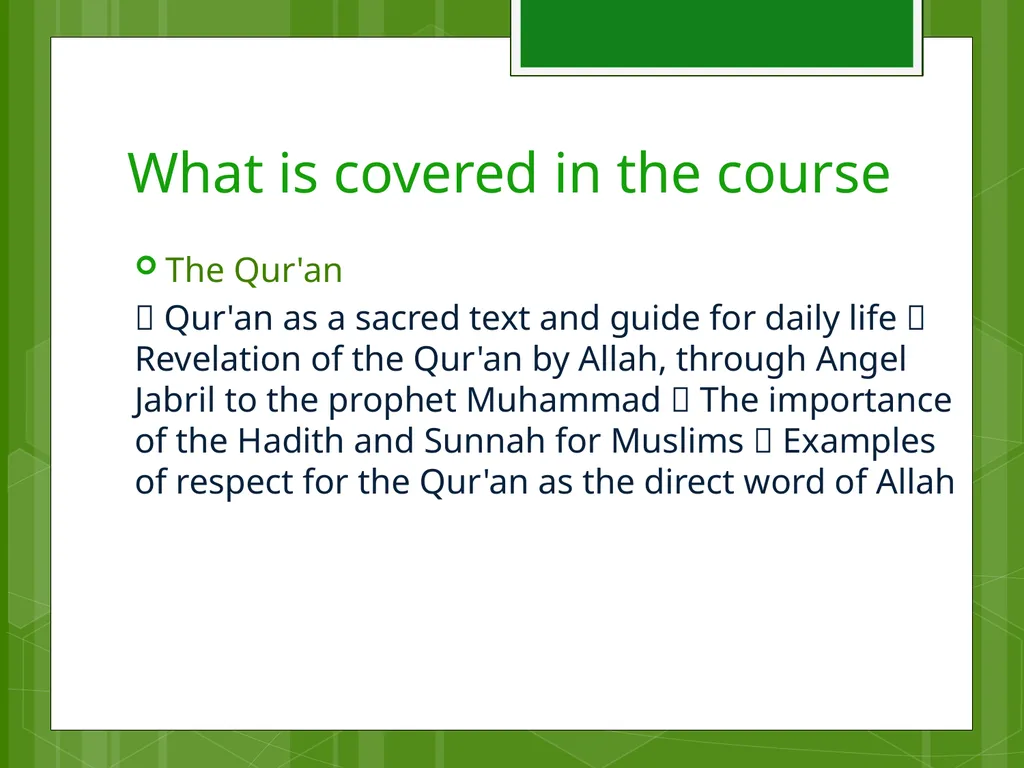
Qur'an as a sacred text and guide for daily life Revelation of the Qur'an by Allah, through Angel Jabril to the prophet Muhammad The importance of the Hadith and Sunnah for Muslims Examples of respect for the Qur'an as the direct word of Allah<br>
Qur'an as a sacred text and guide for daily life Revelation of the Qur'an by Allah, through Angel Jabril to the prophet Muhammad The importance of the Hadith and Sunnah for Muslims Examples of respect for the Qur'an as the direct word of Allah<br>
11
What is covered in the course Practices
The Five Pillars of Sunni Islam Prayer/ Salat
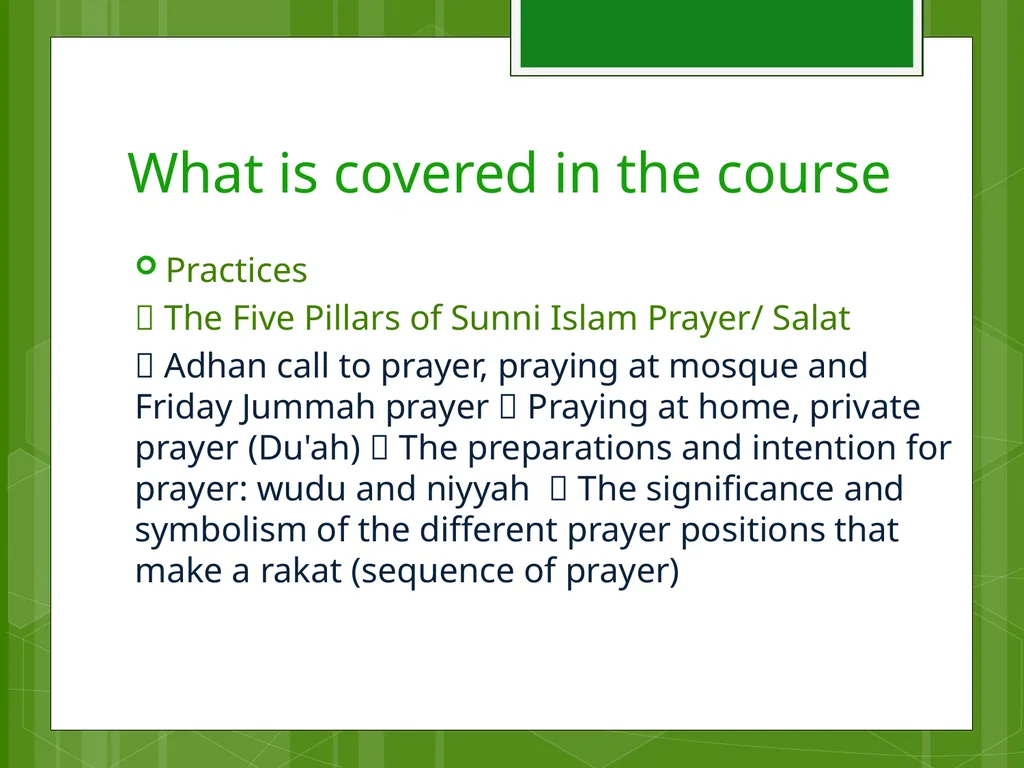
Adhan call to prayer, praying at mosque and Friday Jummah prayer Praying at home, private prayer (Du'ah) The preparations and intention for prayer: wudu and niyyah The significance and symbolism of the different prayer positions that make a rakat (sequence of prayer)<br>
The Five Pillars of Sunni Islam Prayer/ Salat
Adhan call to prayer, praying at mosque and Friday Jummah prayer Praying at home, private prayer (Du'ah) The preparations and intention for prayer: wudu and niyyah The significance and symbolism of the different prayer positions that make a rakat (sequence of prayer)<br>
12
What is covered in the course Obligatory Acts
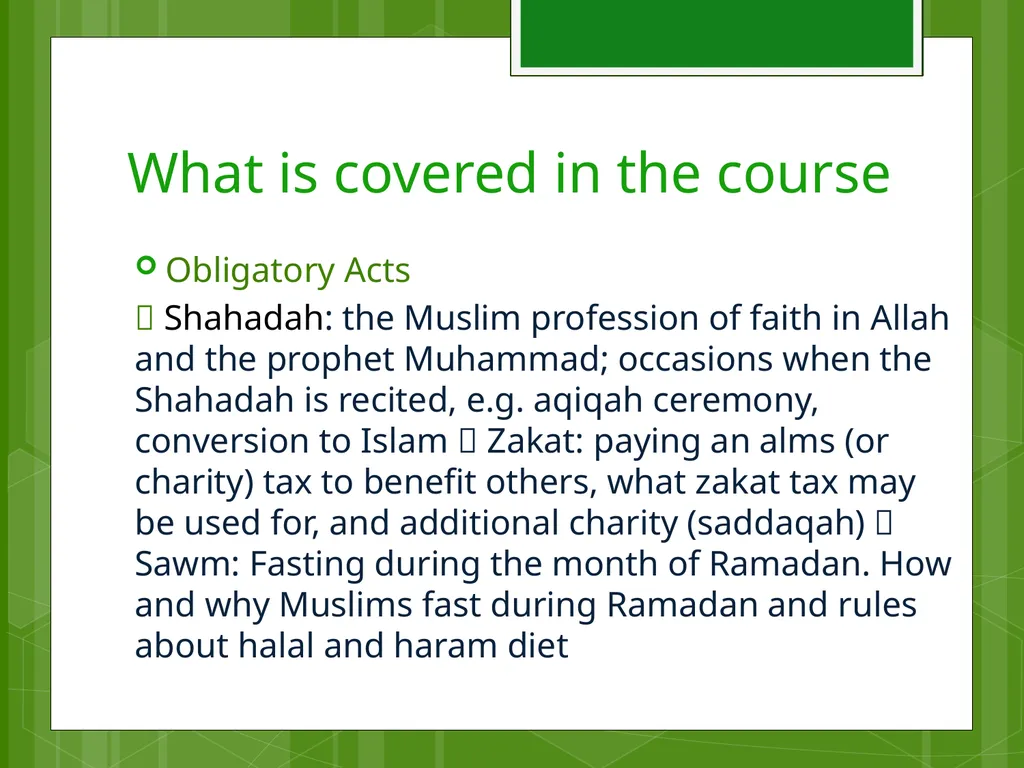
Shahadah: the Muslim profession of faith in Allah and the prophet Muhammad; occasions when the Shahadah is recited, e.g. aqiqah ceremony, conversion to Islam Zakat: paying an alms (or charity) tax to benefit others, what zakat tax may be used for, and additional charity (saddaqah) Sawm: Fasting during the month of Ramadan. How and why Muslims fast during Ramadan and rules about halal and haram diet<br>
Shahadah: the Muslim profession of faith in Allah and the prophet Muhammad; occasions when the Shahadah is recited, e.g. aqiqah ceremony, conversion to Islam Zakat: paying an alms (or charity) tax to benefit others, what zakat tax may be used for, and additional charity (saddaqah) Sawm: Fasting during the month of Ramadan. How and why Muslims fast during Ramadan and rules about halal and haram diet<br>
13
What is covered in the course Part B Life and Death
The World
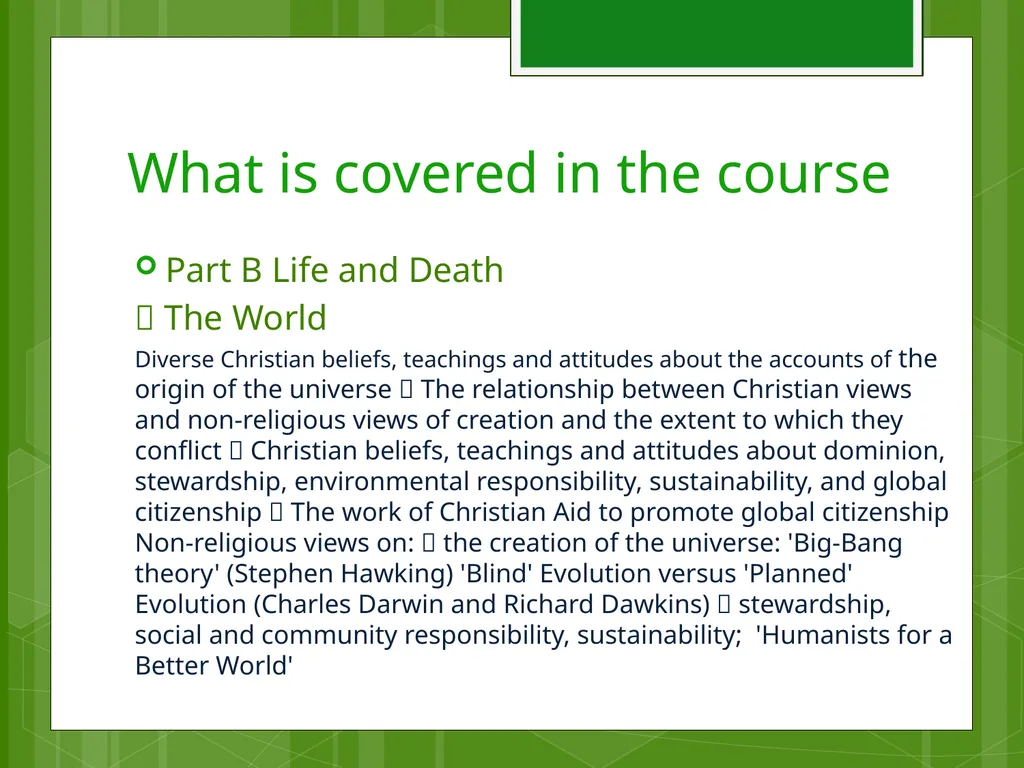
Diverse Christian beliefs, teachings and attitudes about the accounts of the origin of the universe The relationship between Christian views and non-religious views of creation and the extent to which they conflict Christian beliefs, teachings and attitudes about dominion, stewardship, environmental responsibility, sustainability, and global citizenship The work of Christian Aid to promote global citizenship Non-religious views on: the creation of the universe: 'Big-Bang theory' (Stephen Hawking) 'Blind' Evolution versus 'Planned' Evolution (Charles Darwin and Richard Dawkins) stewardship, social and community responsibility, sustainability; 'Humanists for a Better World'<br>
The World
Diverse Christian beliefs, teachings and attitudes about the accounts of the origin of the universe The relationship between Christian views and non-religious views of creation and the extent to which they conflict Christian beliefs, teachings and attitudes about dominion, stewardship, environmental responsibility, sustainability, and global citizenship The work of Christian Aid to promote global citizenship Non-religious views on: the creation of the universe: 'Big-Bang theory' (Stephen Hawking) 'Blind' Evolution versus 'Planned' Evolution (Charles Darwin and Richard Dawkins) stewardship, social and community responsibility, sustainability; 'Humanists for a Better World'<br>
14
What is covered in the course Part B Life and Death
The Origin and Value of Human Life
Diverse Christian beliefs, teachings and attitudes toward the origin and sanctity of human life Diverse Christian attitudes towards abortion and euthanasia, including Catholic and Church in Wales' views on beginning and end of life issues Welsh laws regarding: organ donation and Christian responses to it
Non-religious views on: quality of life over sanctity of life in relation to abortion and euthanasia (the views of Peter Singer - 'speciesism') 'Right to Choose', 'Dignity in Dying' (euthanasia) emphasis on life before death rather than after-life situationist/relativist approach rather than doctrinal or absolutist<br>
The Origin and Value of Human Life
Diverse Christian beliefs, teachings and attitudes toward the origin and sanctity of human life Diverse Christian attitudes towards abortion and euthanasia, including Catholic and Church in Wales' views on beginning and end of life issues Welsh laws regarding: organ donation and Christian responses to it
Non-religious views on: quality of life over sanctity of life in relation to abortion and euthanasia (the views of Peter Singer - 'speciesism') 'Right to Choose', 'Dignity in Dying' (euthanasia) emphasis on life before death rather than after-life situationist/relativist approach rather than doctrinal or absolutist<br>
15
What is covered in the course Part B Life and Death
Beliefs about Death and the Afterlife
Christian beliefs and teachings about life after death, including soul, judgement, heaven and hell Diverse Christian beliefs about the after-life: Heaven, Hell, Resurrection, Purgatory How Christian funerals reflect beliefs about the after-life Humanist funerals in Wales as reflections of beliefs about death as the end of life<br>
Beliefs about Death and the Afterlife
Christian beliefs and teachings about life after death, including soul, judgement, heaven and hell Diverse Christian beliefs about the after-life: Heaven, Hell, Resurrection, Purgatory How Christian funerals reflect beliefs about the after-life Humanist funerals in Wales as reflections of beliefs about death as the end of life<br>
16
What is covered in the course Part B Good and Evil
Crime and Punishment
What makes an act 'wrong'? Religious and ethical responses: relative and absolute morality, conscience, virtues, sin Beliefs and attitudes about the causes of crime and the aims of punishment: justice, retribution, deterrence and reformation The treatment of criminals and the work of prison reformers and prison chaplains Varied Christian responses to the Death Penalty, including interpretations of Christian teaching<br>
Crime and Punishment
What makes an act 'wrong'? Religious and ethical responses: relative and absolute morality, conscience, virtues, sin Beliefs and attitudes about the causes of crime and the aims of punishment: justice, retribution, deterrence and reformation The treatment of criminals and the work of prison reformers and prison chaplains Varied Christian responses to the Death Penalty, including interpretations of Christian teaching<br>
17
What is covered in the course Part B Good and Evil
Forgiveness
Peace and conflict: Just War Theory, Pacifism and Conscientious Objectors, Wales' Society of Friends (pacifism) Christian teachings about forgiveness, including interpretations of teachings Examples of forgiveness arising from personal beliefs<br>
Forgiveness
Peace and conflict: Just War Theory, Pacifism and Conscientious Objectors, Wales' Society of Friends (pacifism) Christian teachings about forgiveness, including interpretations of teachings Examples of forgiveness arising from personal beliefs<br>
18
What is covered in the course Part B Good and Evil
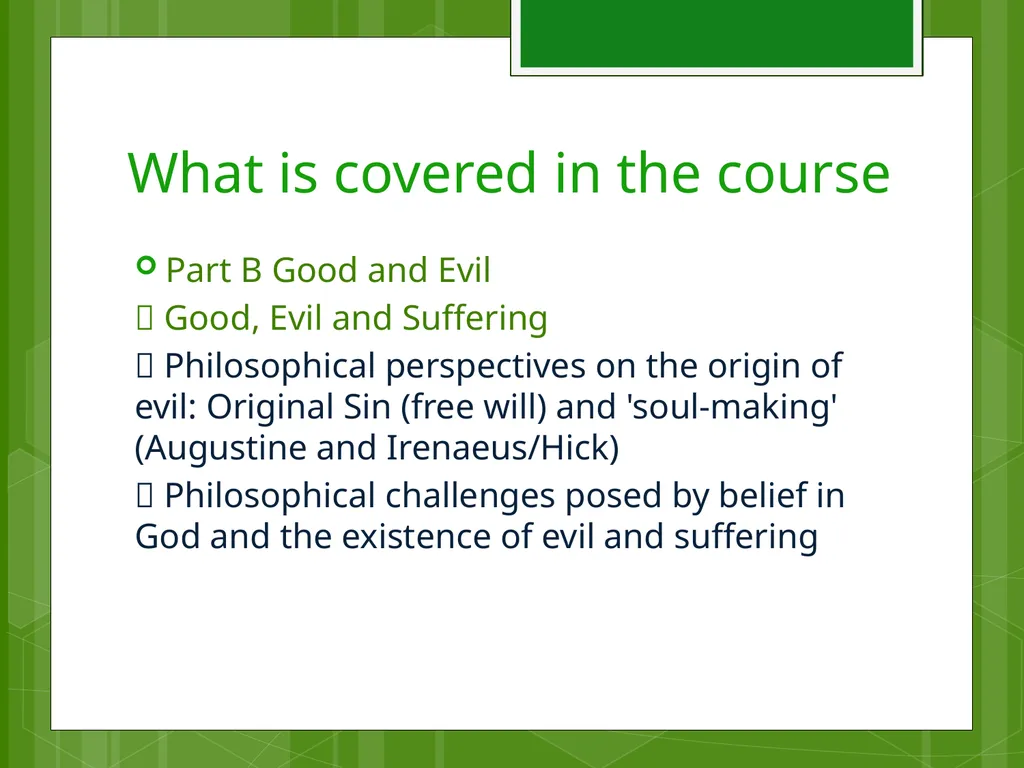
Good, Evil and Suffering
Philosophical perspectives on the origin of evil: Original Sin (free will) and 'soul-making' (Augustine and Irenaeus/Hick)
Philosophical challenges posed by belief in God and the existence of evil and suffering<br>
Good, Evil and Suffering
Philosophical perspectives on the origin of evil: Original Sin (free will) and 'soul-making' (Augustine and Irenaeus/Hick)
Philosophical challenges posed by belief in God and the existence of evil and suffering<br>
19
Qualities needed for success,
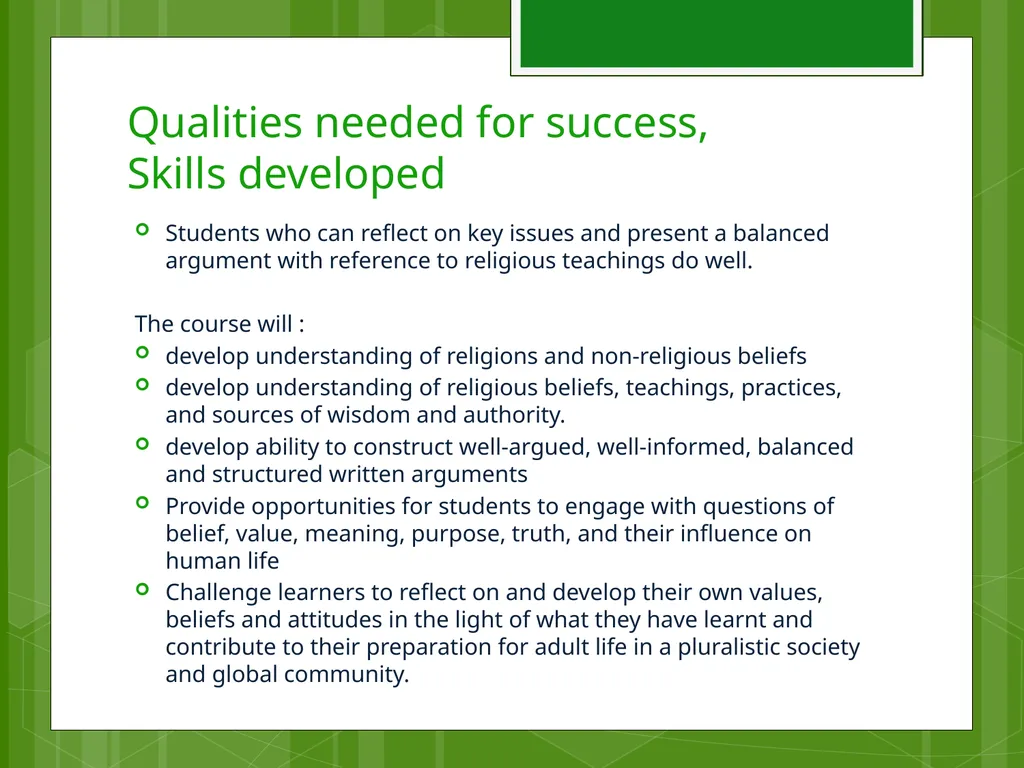
Skills developed Students who can reflect on key issues and present a balanced argument with reference to religious teachings do well.
The course will :
develop understanding of religions and non-religious beliefs
develop understanding of religious beliefs, teachings, practices, and sources of wisdom and authority.
develop ability to construct well-argued, well-informed, balanced and structured written arguments
Provide opportunities for students to engage with questions of belief, value, meaning, purpose, truth, and their influence on human life
Challenge learners to reflect on and develop their own values, beliefs and attitudes in the light of what they have learnt and contribute to their preparation for adult life in a pluralistic society and global community.<br>
The course will :
develop understanding of religions and non-religious beliefs
develop understanding of religious beliefs, teachings, practices, and sources of wisdom and authority.
develop ability to construct well-argued, well-informed, balanced and structured written arguments
Provide opportunities for students to engage with questions of belief, value, meaning, purpose, truth, and their influence on human life
Challenge learners to reflect on and develop their own values, beliefs and attitudes in the light of what they have learnt and contribute to their preparation for adult life in a pluralistic society and global community.<br>
20
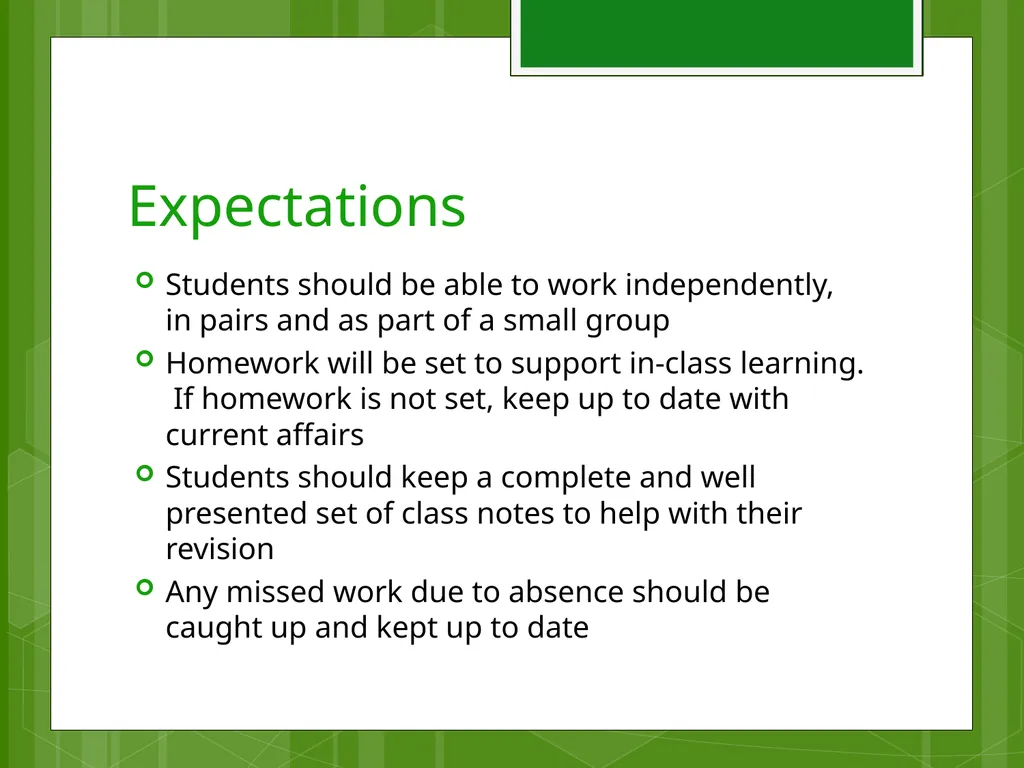
Expectations Students should be able to work independently, in pairs and as part of a small group
Homework will be set to support in-class learning. If homework is not set, keep up to date with current affairs
Students should keep a complete and well presented set of class notes to help with their revision
Any missed work due to absence should be caught up and kept up to date<br>
Homework will be set to support in-class learning. If homework is not set, keep up to date with current affairs
Students should keep a complete and well presented set of class notes to help with their revision
Any missed work due to absence should be caught up and kept up to date<br>
21
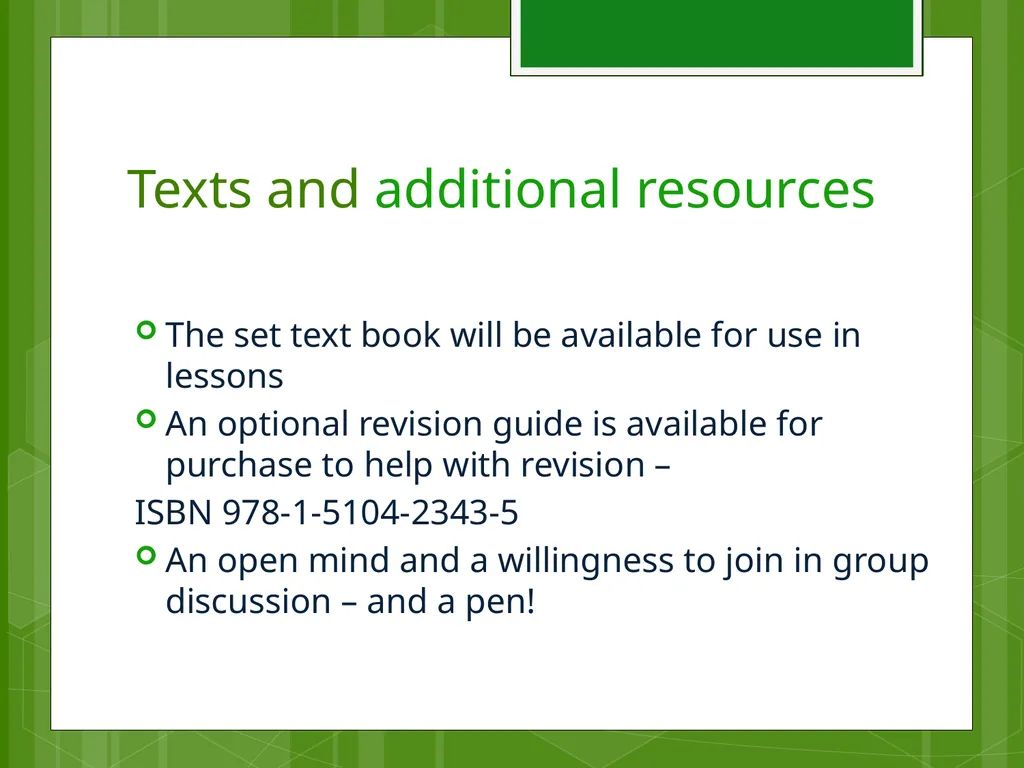
Texts and additional resources The set text book will be available for use in lessons
An optional revision guide is available for purchase to help with revision –
ISBN 978-1-5104-2343-5
An open mind and a willingness to join in group discussion – and a pen!<br>
An optional revision guide is available for purchase to help with revision –
ISBN 978-1-5104-2343-5
An open mind and a willingness to join in group discussion – and a pen!<br>
22
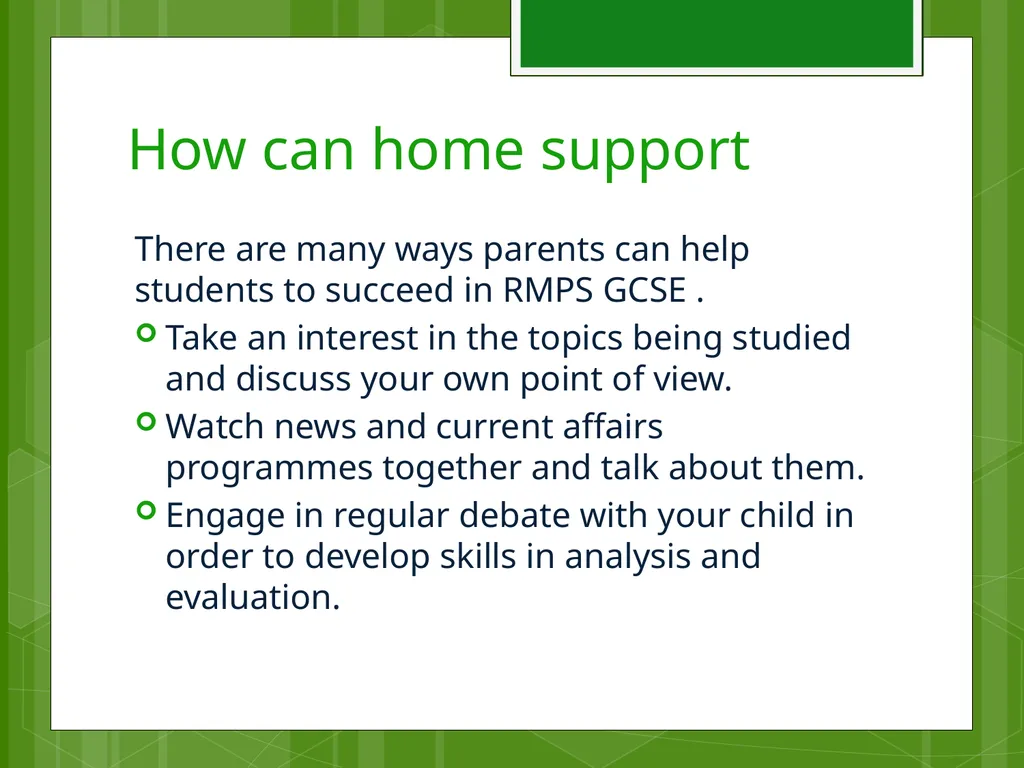
How can home support There are many ways parents can help students to succeed in RMPS GCSE .
Take an interest in the topics being studied and discuss your own point of view.
Watch news and current affairs programmes together and talk about them.
Engage in regular debate with your child in order to develop skills in analysis and evaluation.<br>
Take an interest in the topics being studied and discuss your own point of view.
Watch news and current affairs programmes together and talk about them.
Engage in regular debate with your child in order to develop skills in analysis and evaluation.<br>
23
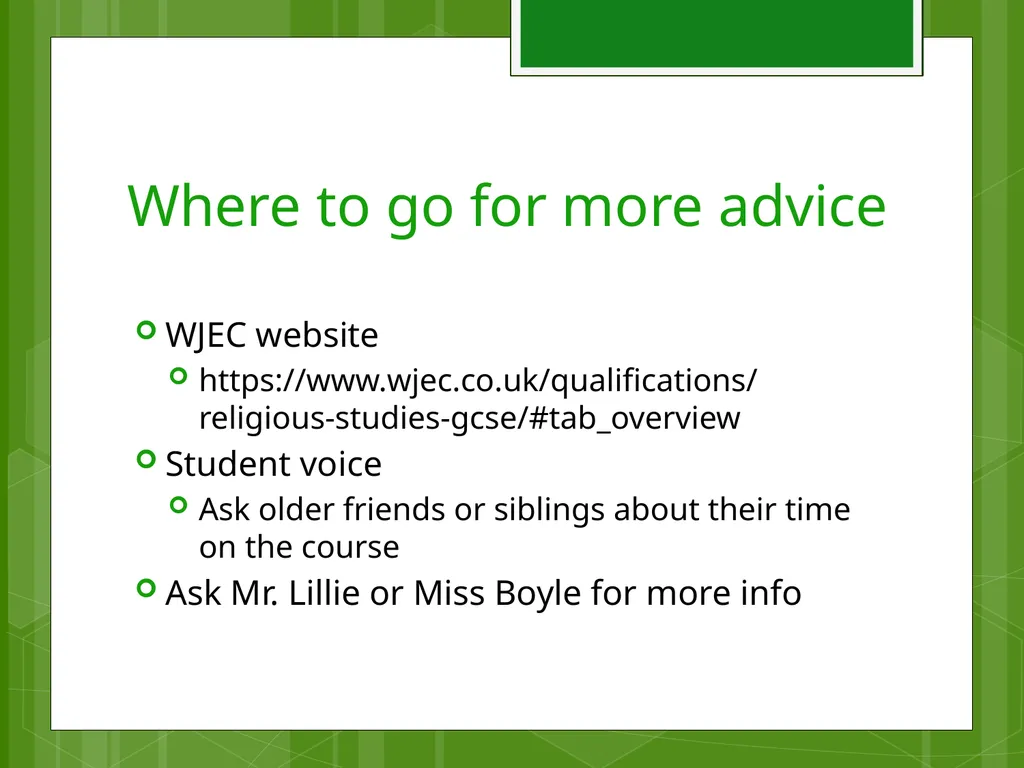
Where to go for more advice WJEC website
https://www.wjec.co.uk/qualifications/religious-studies-gcse/#tab_overview
Student voice
Ask older friends or siblings about their time on the course
Ask Mr. Lillie or Miss Boyle for more info<br>
https://www.wjec.co.uk/qualifications/religious-studies-gcse/#tab_overview
Student voice
Ask older friends or siblings about their time on the course
Ask Mr. Lillie or Miss Boyle for more info<br>