04
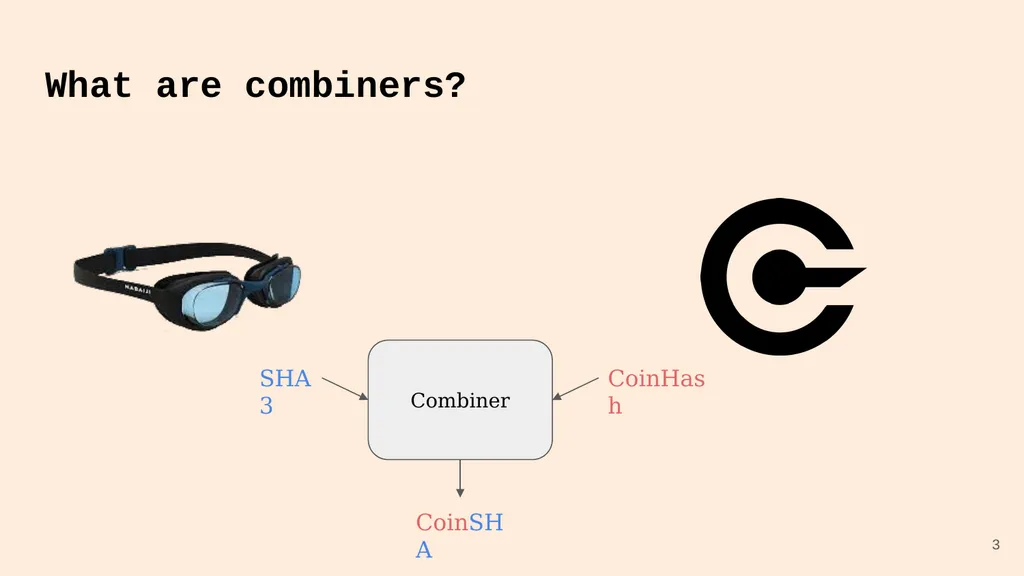
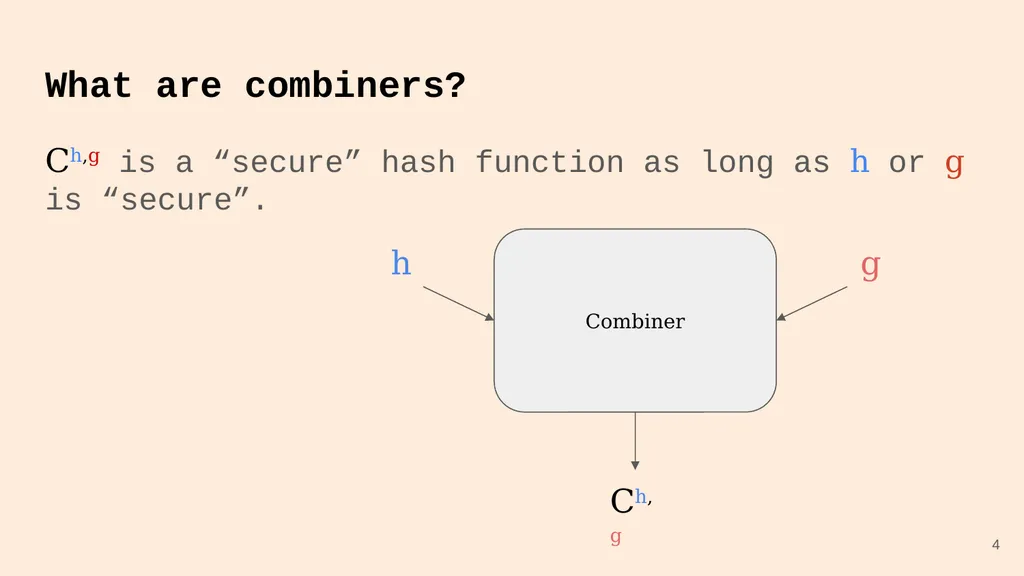
What are combiners? Ch,g is a “secure” hash function as long as h or g is “secure”. h g Ch,g Combiner 4<br>
05
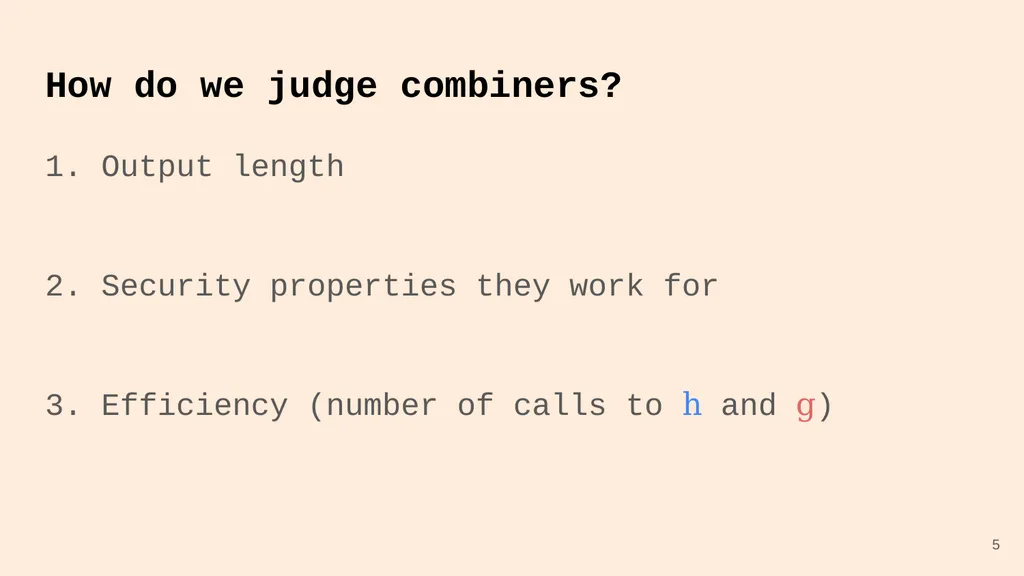
How do we judge combiners? 1. Output length 2. Security properties they work for 3. Efficiency (number of calls to h and g) 5<br>
06
PART 1 Prior Work 6<br>
07
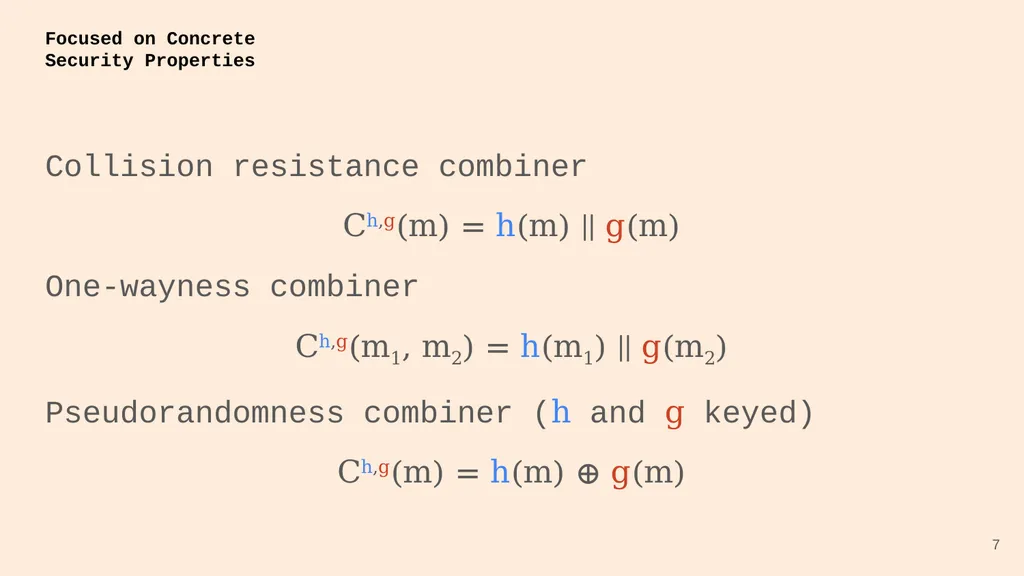
Focused on Concrete
Security Properties Collision resistance combiner
Ch,g(m) = h(m) || g(m)
One-wayness combiner
Ch,g(m1, m2) = h(m1) || g(m2)
Pseudorandomness combiner (h and g keyed)
Ch,g(m) = h(m) ⊕ g(m) 7<br>
08
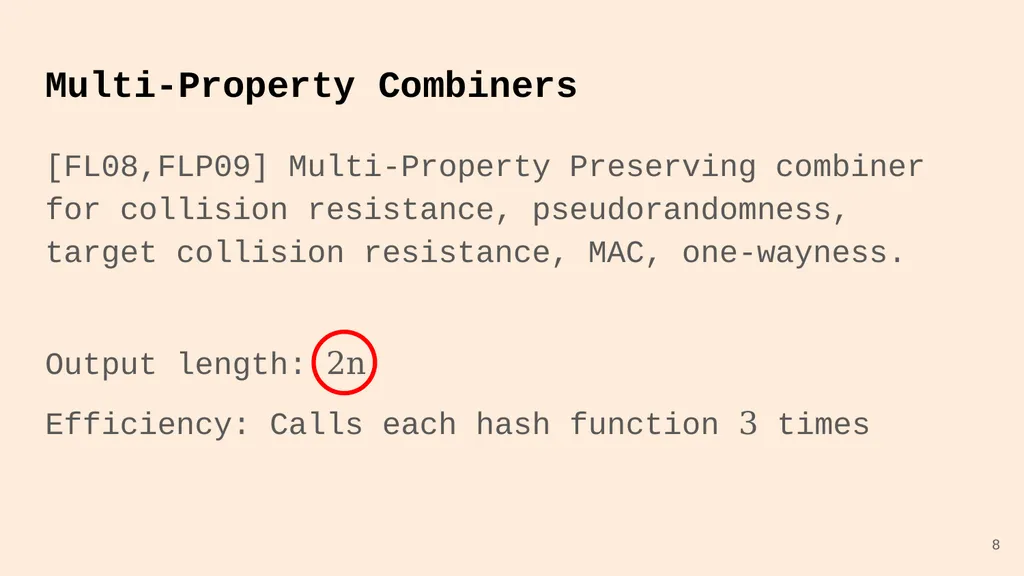
Multi-Property Combiners [FL08,FLP09] Multi-Property Preserving combiner for collision resistance, pseudorandomness, target collision resistance, MAC, one-wayness. Output length: 2n
Efficiency: Calls each hash function 3 times 8<br>
09
Short Combiners? For just collision-resistance, can we get output length to n? [BB06][Pietrzak07/08] IMPOSSIBLE! 9<br>
10
Big Question: Can we break the concatenation barrier? 10 Partial Answer: YES�Cryptophia’s Short Combiner
[Mittelbach13][MP14]<br>
11
Random Oracles to the Rescue What if we assume the “secure” hash function h is a random oracle H?
Maybe the stronger (than CR) assumption on h can overcome the concatenation barrier.
How to model the “insecure” hash function g? 11<br>
12
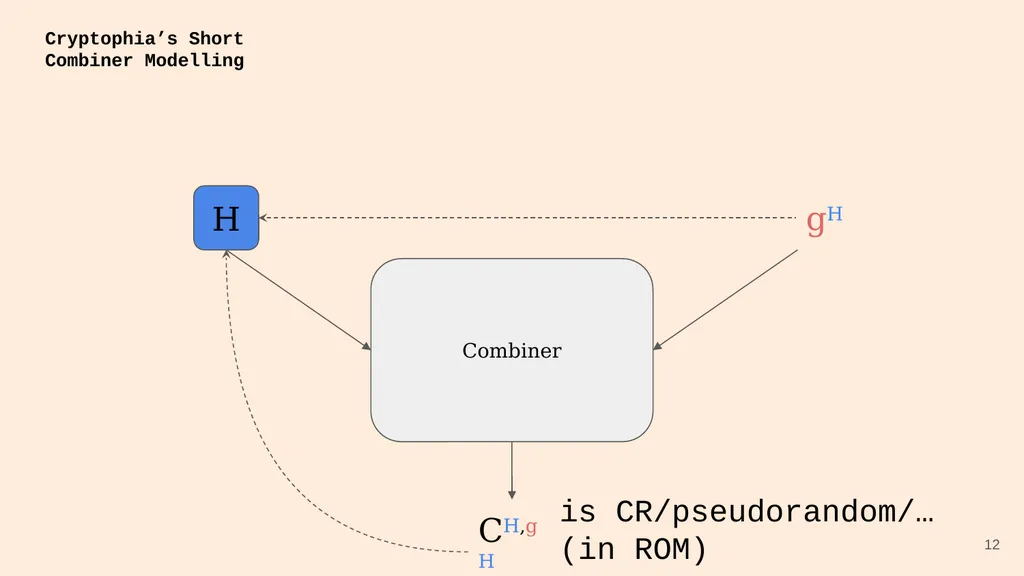
gH Cryptophia’s Short
Combiner Modelling H Combiner CH,gH is CR/pseudorandom/…
(in ROM) 12<br>
13
Efficiency of
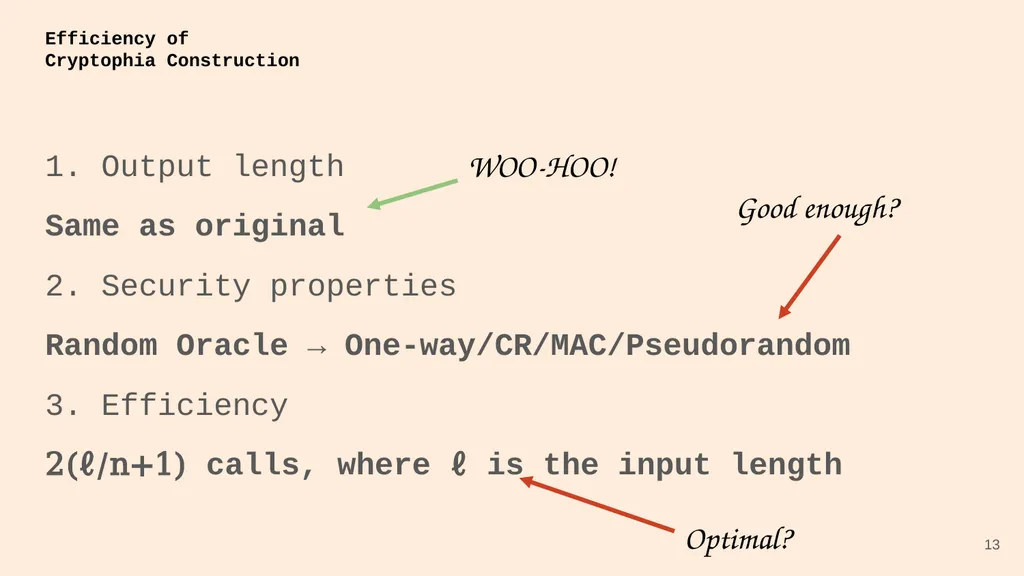
Cryptophia Construction 1. Output length 2. Security properties 3. Efficiency 13 WOO-HOO! Good enough? Optimal? Same as original Random Oracle → One-way/CR/MAC/Pseudorandom 2(ℓ/n+1) calls, where ℓ is the input length<br>
14
Are Concrete Properties Enough? No! Many real-world applications need stronger properties.
Fiat-Shamir
Hash-then-sign
Fujisaki-Okamoto
Bitcoin
... 14<br>
15
PART 2 Random Oracle Combiners 15<br>
16
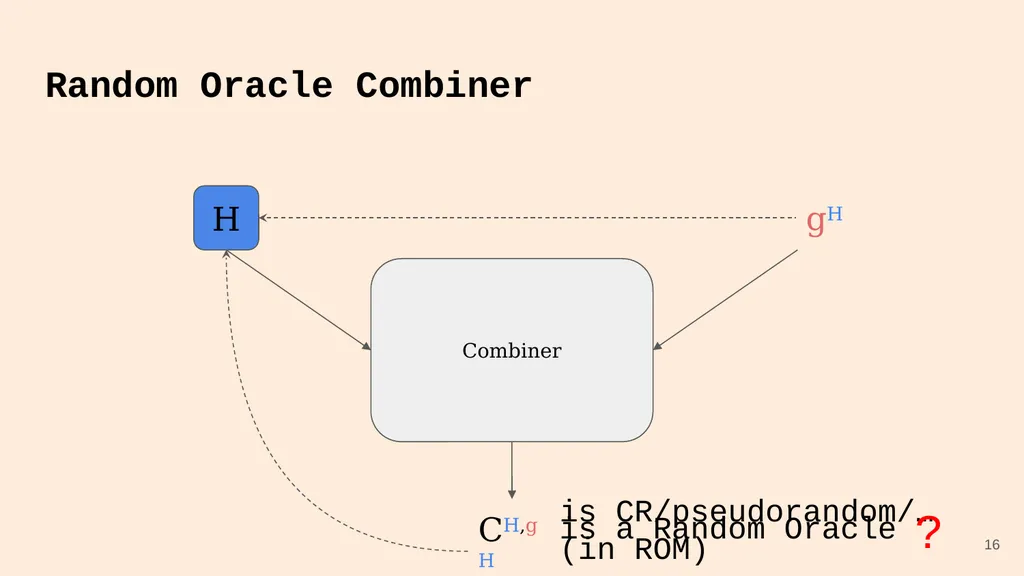
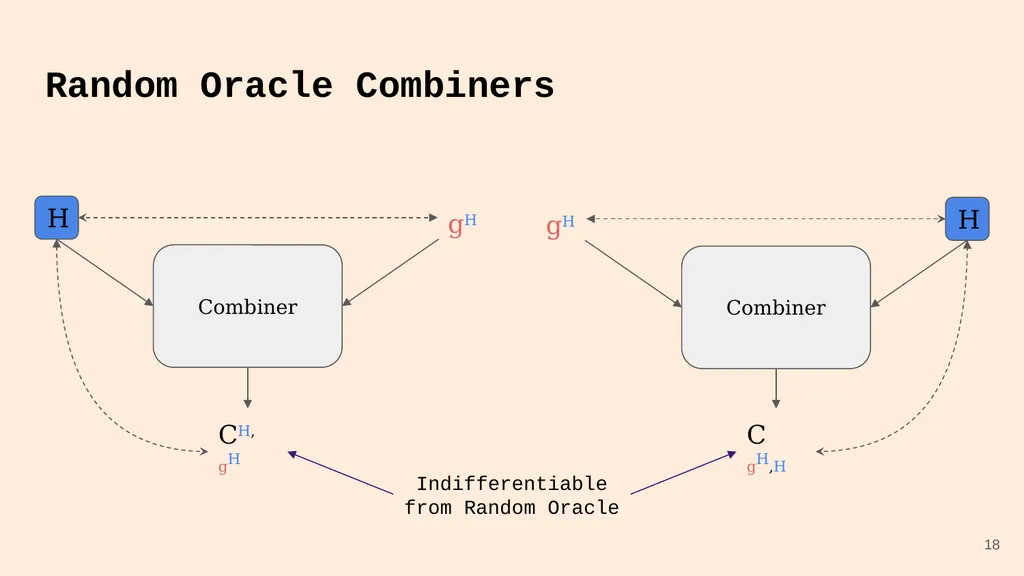
gH Random Oracle Combiner H Combiner CH,gH is CR/pseudorandom/…
(in ROM) 16 is a Random Oracle ?<br>
17
Indifferentiability
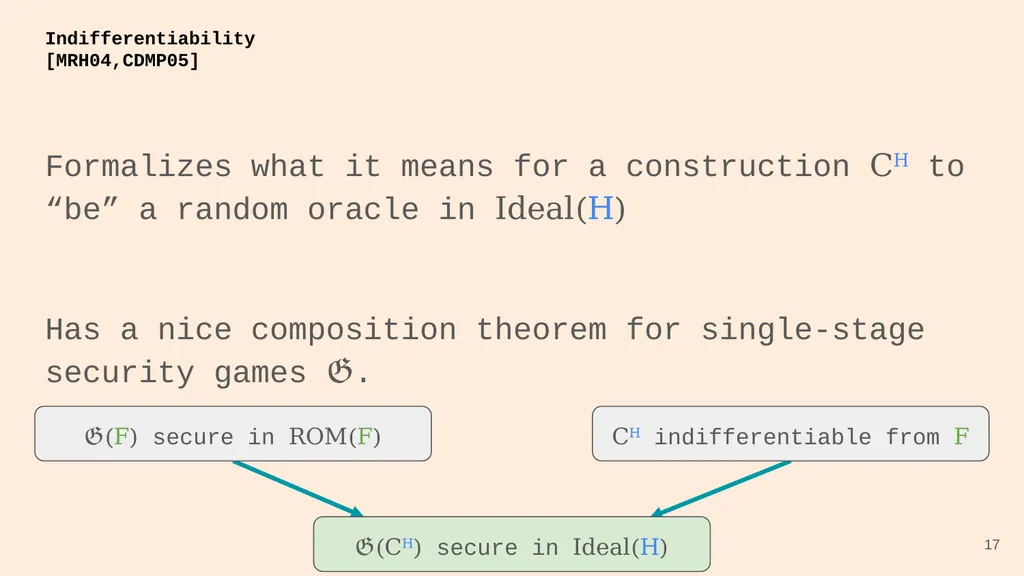
[MRH04,CDMP05] Formalizes what it means for a construction CH to “be” a random oracle in Ideal(H)
Has a nice composition theorem for single-stage security games 𝔊. 17 𝔊(F) secure in ROM(F) CH indifferentiable from F 𝔊(CH) secure in Ideal(H)<br>
18
Random Oracle Combiners gH H Combiner CH, gH gH H Combiner C gH,H Indifferentiable from Random Oracle 18<br>
19
Random Oracle Combiners
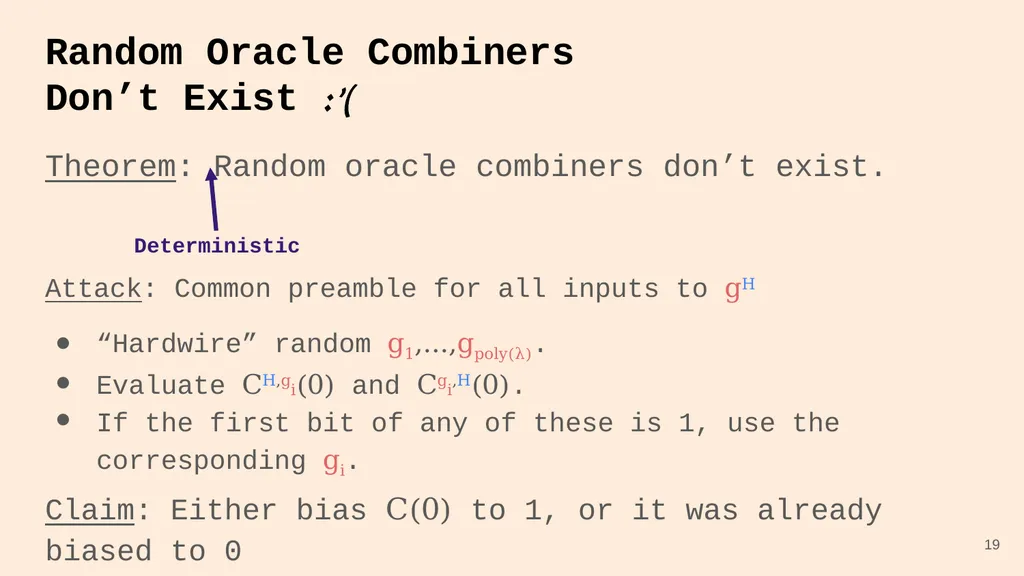
Don’t Exist :’( Theorem: Random oracle combiners don’t exist. 19 Deterministic Attack: Common preamble for all inputs to gH
“Hardwire” random g1,...,gpoly(λ).
Evaluate CH,gi(0) and Cgi,H(0).
If the first bit of any of these is 1, use the corresponding gi. Claim: Either bias C(0) to 1, or it was already biased to 0<br>
20
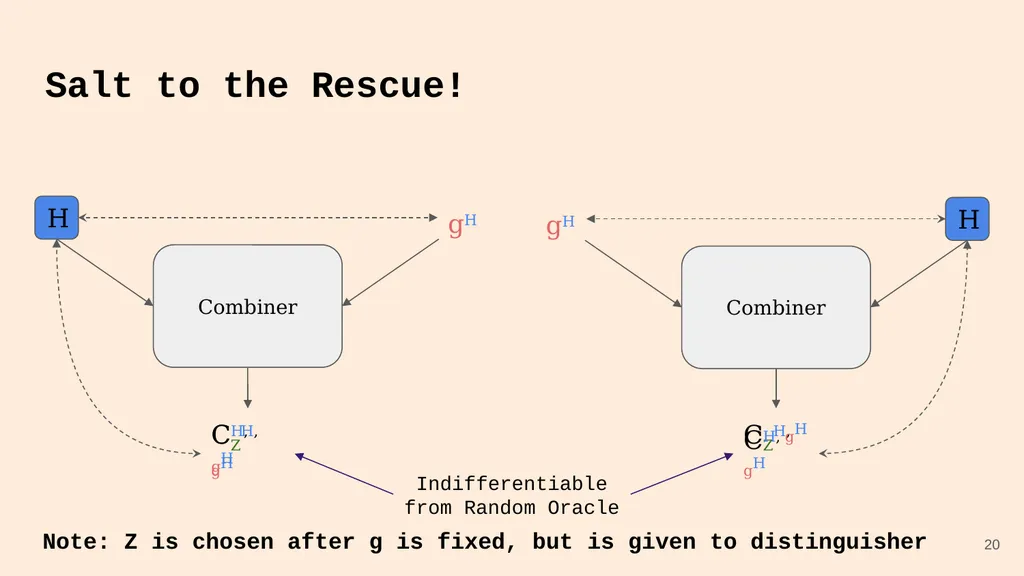
Salt to the Rescue! gH H Combiner CZH, gH gH H Combiner CZH, gH Indifferentiable from Random Oracle 20 CH, gH CH, gH Note: Z is chosen after g is fixed, but is given to distinguisher<br>
21
PART 3 The Construction 21<br>
22
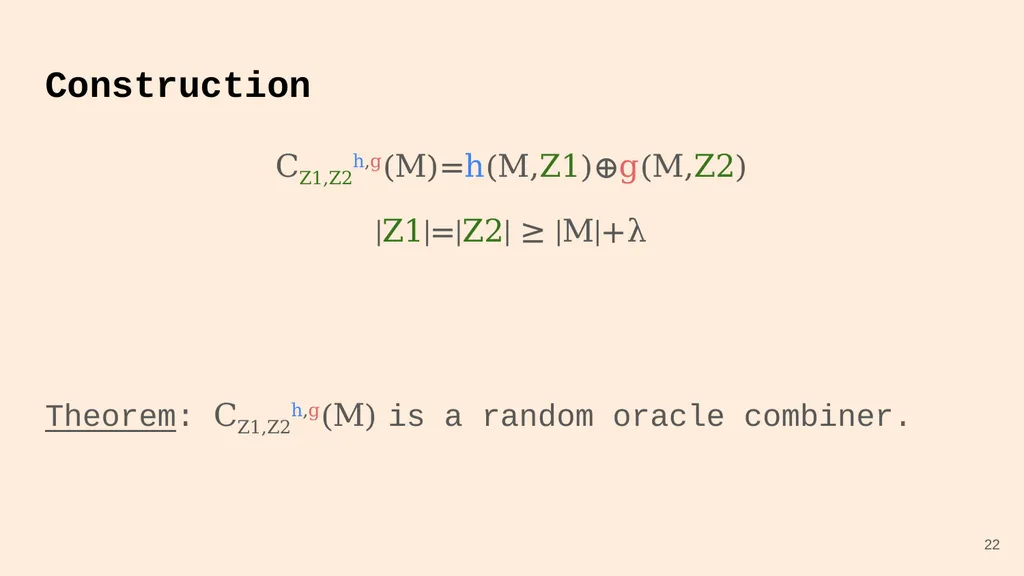
Construction CZ1,Z2h,g(M)=h(M,Z1)⊕g(M,Z2)
|Z1|=|Z2| ≥ |M|+λ Theorem: CZ1,Z2h,g(M) is a random oracle combiner. 22<br>
23
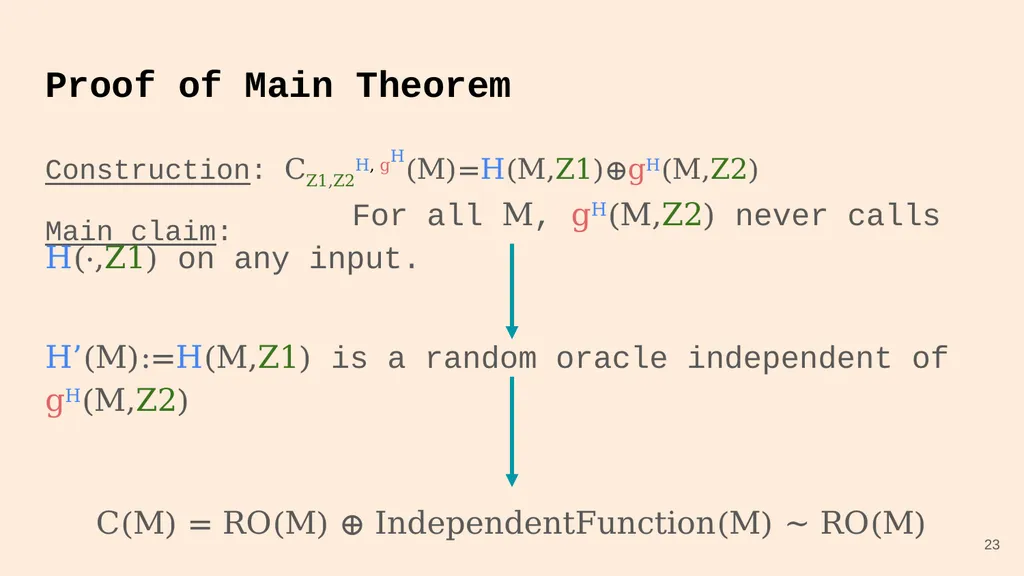
Proof of Main Theorem Construction: CZ1,Z2H, gH(M)=H(M,Z1)⊕gH(M,Z2)
Main claim: For all M, gH(M,Z2) never calls H(·,Z1) on any input. H’(M):=H(M,Z1) is a random oracle independent of gH(M,Z2) 23 C(M) = RO(M) ⊕ IndependentFunction(M) ~ RO(M)<br>
24
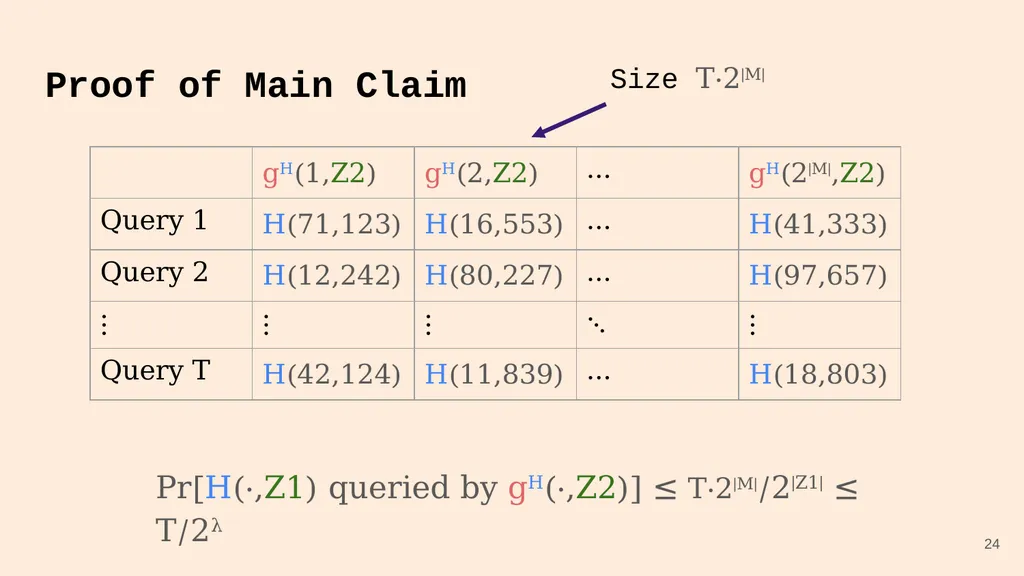
Proof of Main Claim Size T·2|M| Pr[H(·,Z1) queried by gH(·,Z2)] ≤ T·2|M|/2|Z1| ≤ T/2λ 24<br>
25
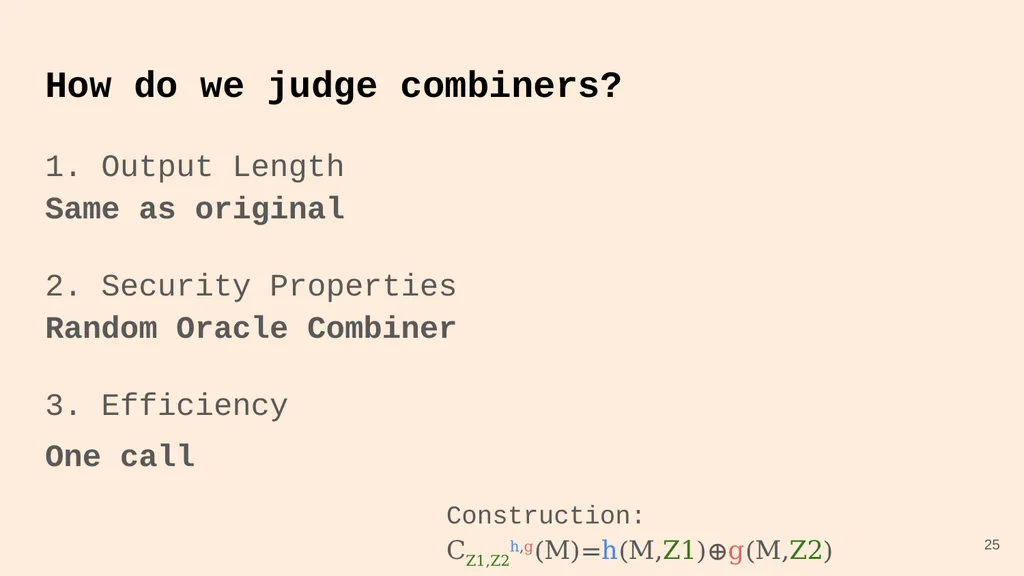
How do we judge combiners? 1. Output Length 2. Security Properties 3. Efficiency Same as original Random Oracle Combiner One call Construction: CZ1,Z2h,g(M)=h(M,Z1)⊕g(M,Z2) 25<br>
26
PART 4 Real-world hash functions 26<br>
27
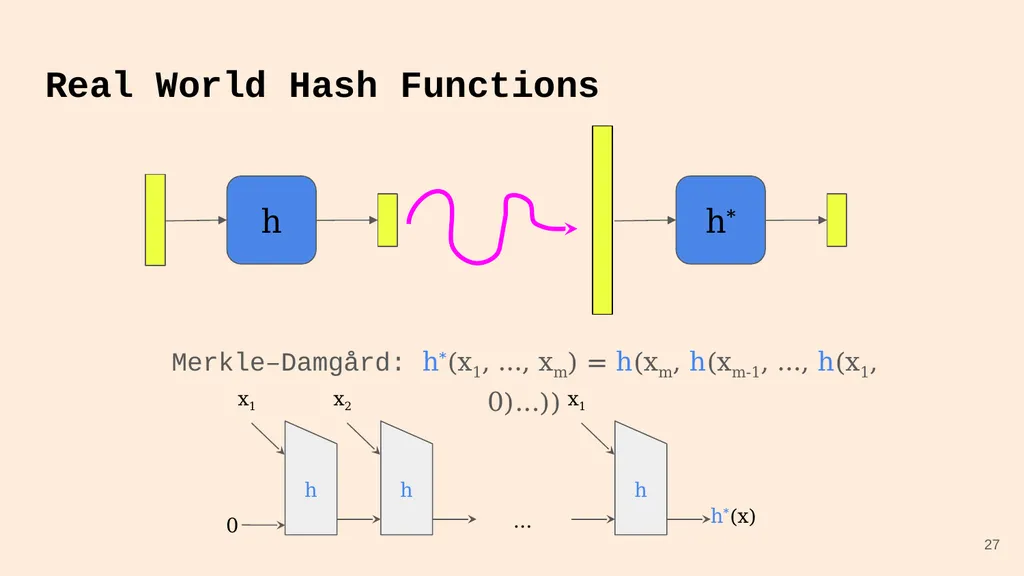
Real World Hash Functions Merkle–Damgård: h*(x1, …, xm) = h(xm, h(xm-1, …, h(x1, 0)...)) h 0 x1 h x2 h x1 ... h*(x) h h* 27<br>
28
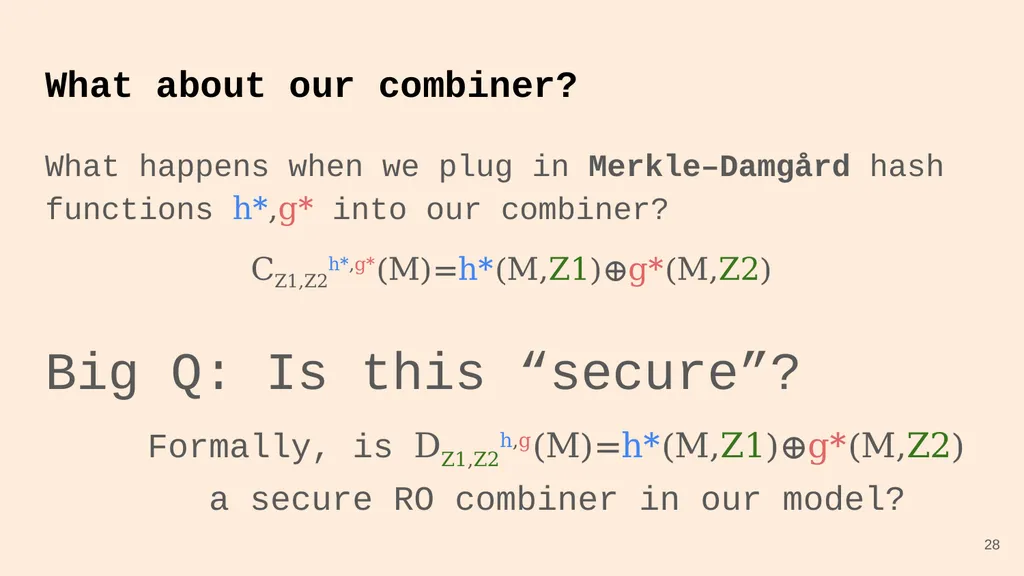
What about our combiner? What happens when we plug in Merkle–Damgård hash functions h*,g* into our combiner?
CZ1,Z2h*,g*(M)=h*(M,Z1)⊕g*(M,Z2) 28 Big Q: Is this “secure”?
Formally, is DZ1,Z2h,g(M)=h*(M,Z1)⊕g*(M,Z2) a secure RO combiner in our model?<br>
29
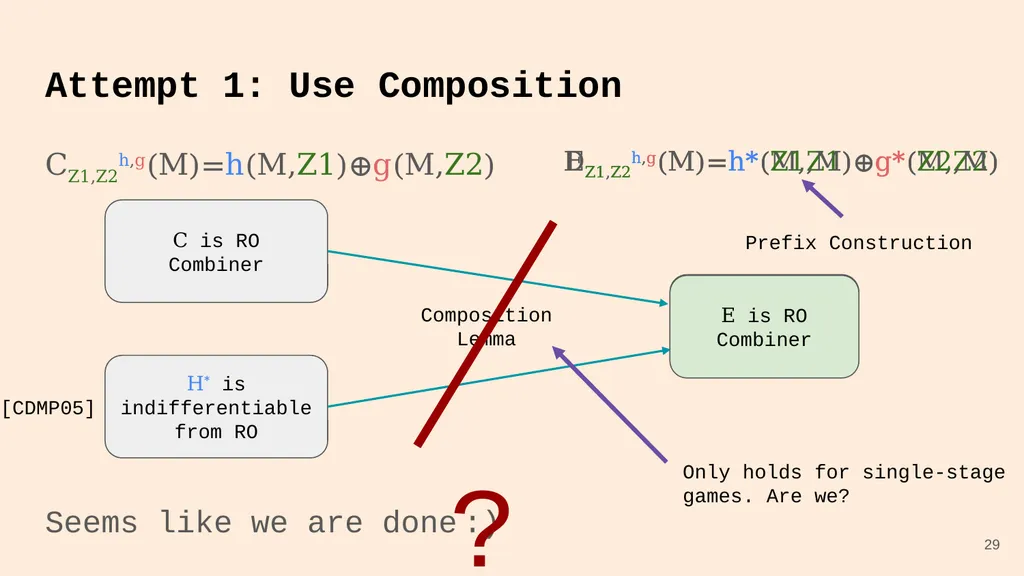
Attempt 1: Use Composition CZ1,Z2h,g(M)=h(M,Z1)⊕g(M,Z2) 29 Seems like we are done C is RO Combiner H* is indifferentiable from RO D is RO Combiner [CDMP05] Composition Lemma DZ1,Z2h,g(M)=h*(M,Z1)⊕g*(M,Z2) :) EZ1,Z2h,g(M)=h*(Z1,M)⊕g*(Z2,M) ? Only holds for single-stage games. Are we? Prefix Construction E is RO Combiner<br>
30
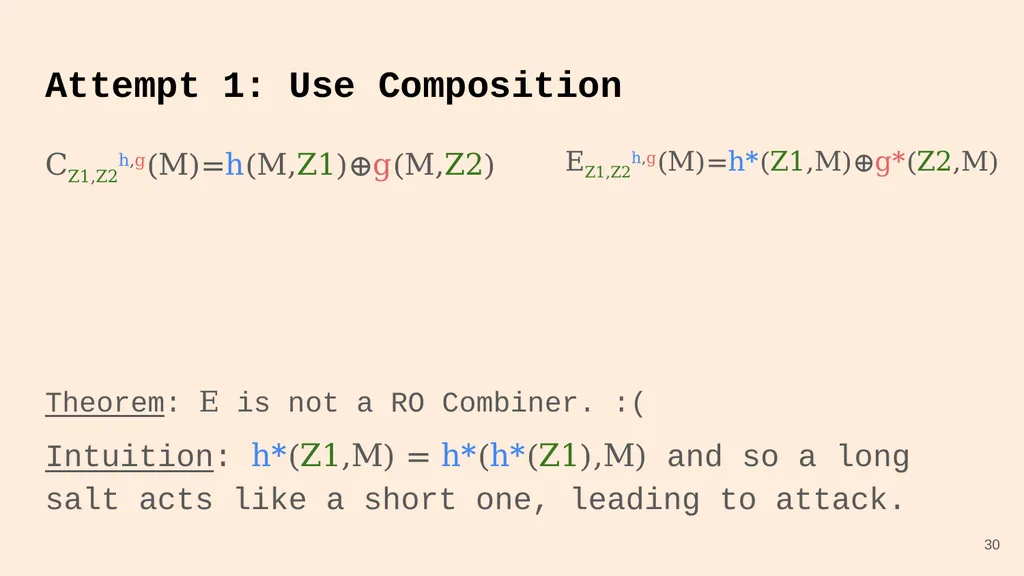
Attempt 1: Use Composition 30 CZ1,Z2h,g(M)=h(M,Z1)⊕g(M,Z2) EZ1,Z2h,g(M)=h*(Z1,M)⊕g*(Z2,M) Intuition: h*(Z1,M) = h*(h*(Z1),M) and so a long salt acts like a short one, leading to attack. Theorem: E is not a RO Combiner. :(<br>
31
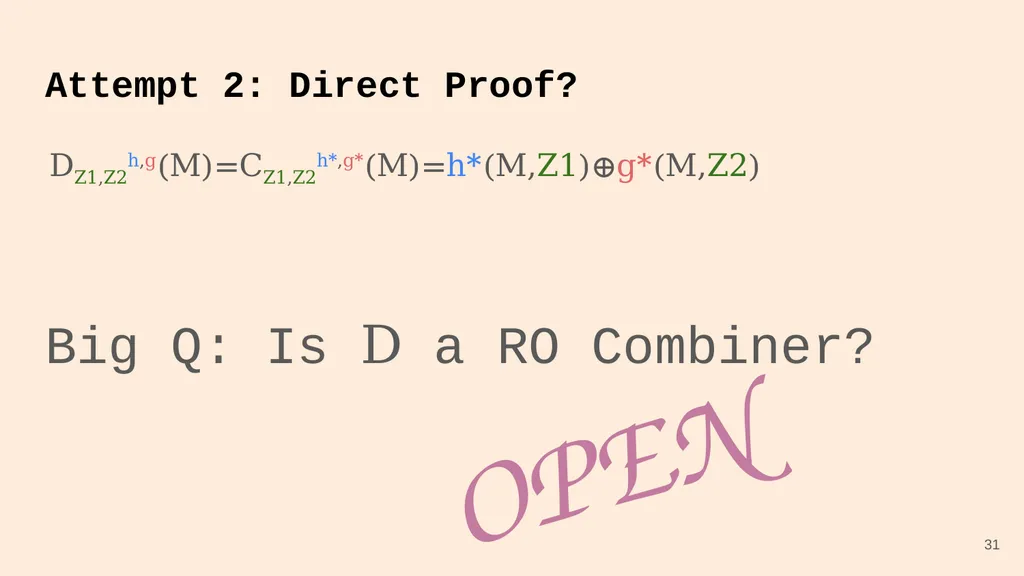
Attempt 2: Direct Proof? 31 Big Q: Is D a RO Combiner? OPEN DZ1,Z2h,g(M)=CZ1,Z2h*,g*(M)=h*(M,Z1)⊕g*(M,Z2)<br>
32
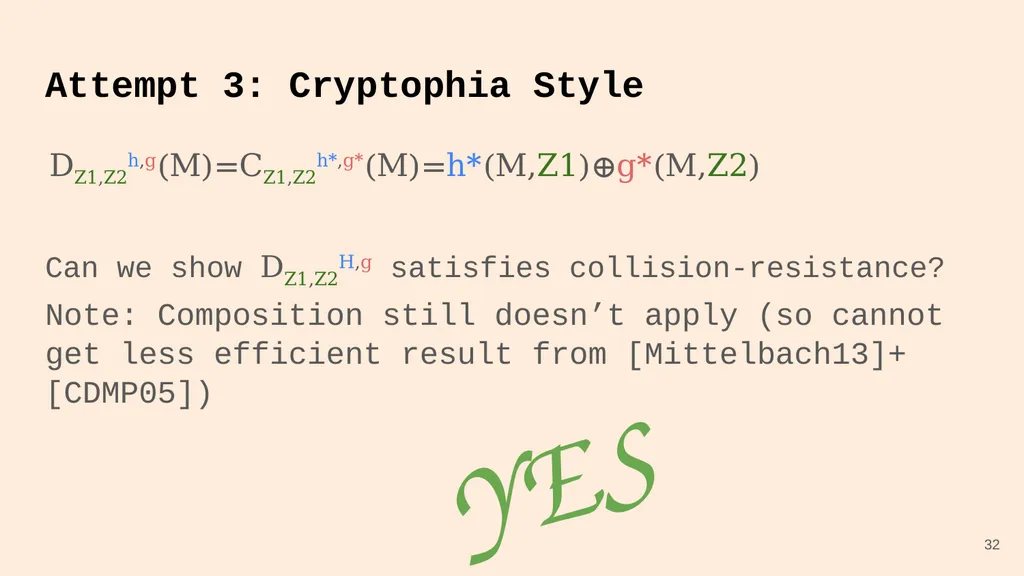
32 Can we show DZ1,Z2H,g satisfies collision-resistance? YES Attempt 3: Cryptophia Style DZ1,Z2h,g(M)=CZ1,Z2h*,g*(M)=h*(M,Z1)⊕g*(M,Z2) Note: Composition still doesn’t apply (so cannot get less efficient result from [Mittelbach13]+[CDMP05])<br>
33
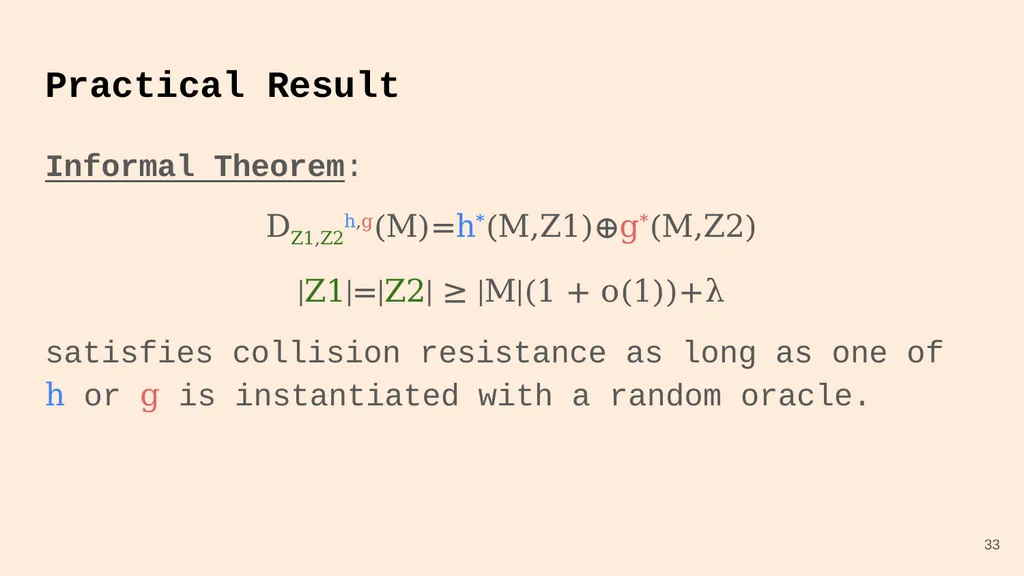
Practical Result Informal Theorem:
DZ1,Z2h,g(M)=h*(M,Z1)⊕g*(M,Z2)
|Z1|=|Z2| ≥ |M|(1 + o(1))+λ
satisfies collision resistance as long as one of h or g is instantiated with a random oracle. 33<br>
34
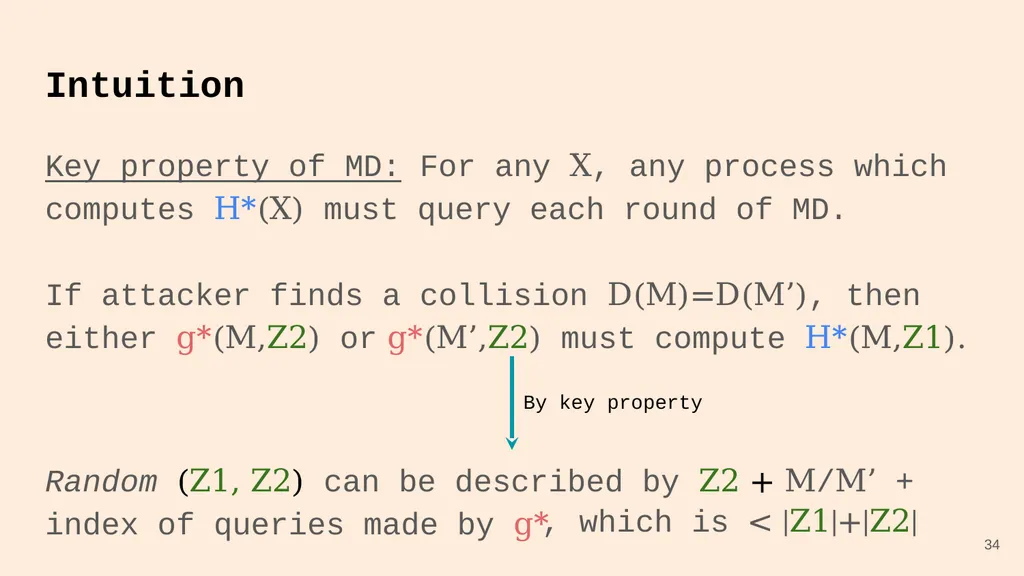
Intuition Key property of MD: For any X, any process which computes H*(X) must query each round of MD.
If attacker finds a collision D(M)=D(M’), then either g*(M,Z2) or g*(M’,Z2) must compute H*(M,Z1). 34 Random (Z1, Z2) can be described by Z2 + M/M’ + index of queries made by g* By key property , which is < |Z1|+|Z2|<br>
35
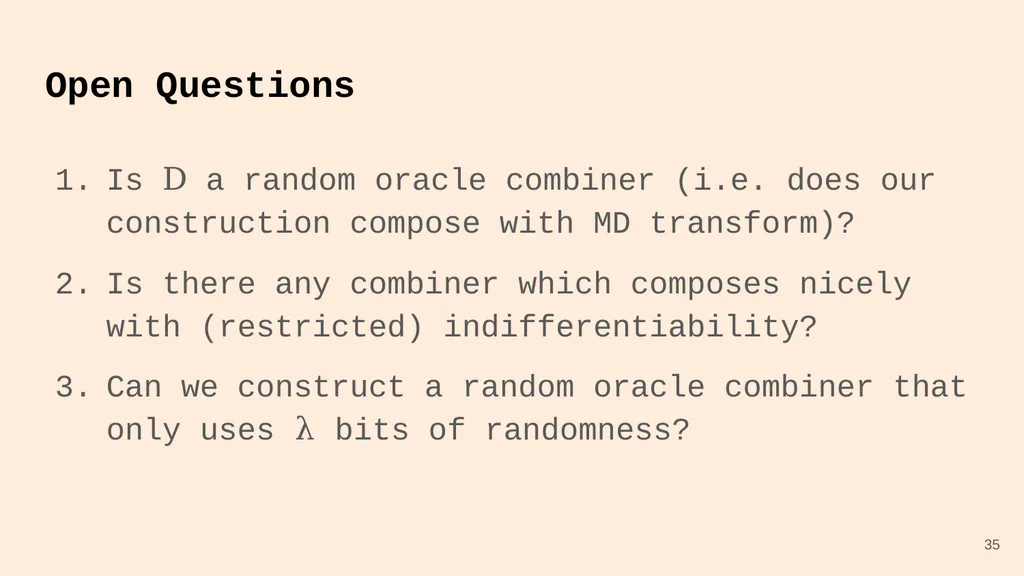
Open Questions Is D a random oracle combiner (i.e. does our construction compose with MD transform)?
Is there any combiner which composes nicely with (restricted) indifferentiability?
Can we construct a random oracle combiner that only uses λ bits of randomness? 35<br>
37
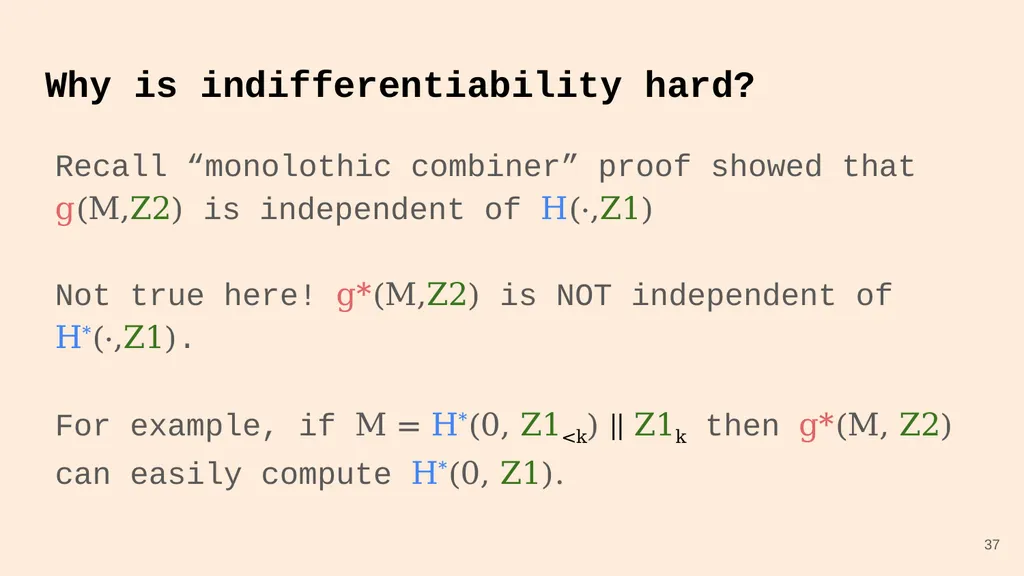
Why is indifferentiability hard? Recall “monolothic combiner” proof showed that g(M,Z2) is independent of H(·,Z1)
Not true here! g*(M,Z2) is NOT independent of H*(·,Z1).
For example, if M = H*(0, Z1<k) || Z1k then g*(M, Z2) can easily compute H*(0, Z1). 37<br>