
Reader The role, rules and advice What is a
Description: Reader The role, rules and advice What is a reader? A reader is a responsible adult who reads the instructions of the question paper and the questions to the candidate. This may involve reading the whole paper to the candidate or the
Related Topics
Download Presentation
"Reader The role, rules and advice What is a" is the property of its rightful owner. Permission is granted to download and print the materials on this website for personal, non-commercial use only, and to display it on your personal computer provided you do not modify the materials and that you retain all copyright notices contained in the materials. By downloading content from our website, you accept the terms of this agreement.
Presentation Transcript
slide1. Reader The role, rules and advice<br>
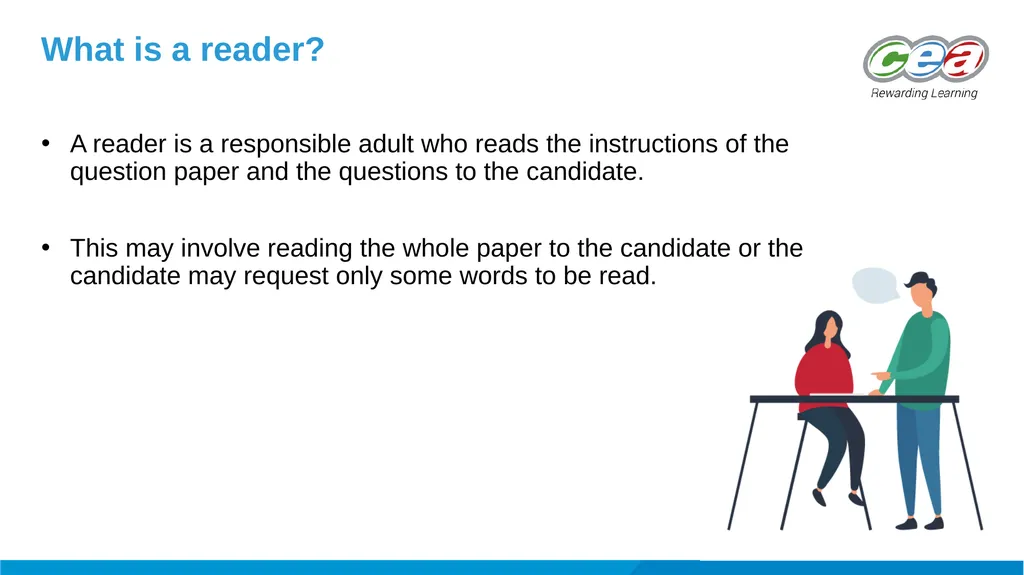
slide2. What is a reader? A reader is a responsible adult who reads the instructions of the question paper and the questions to the candidate.
This may involve reading the whole paper to the candidate or the candidate may request only some words to be read.<br>
slide3. The Role The head of centre must ensure that the person appointed to facilitate an access arrangement is a responsible adult, is appropriately trained and fully understands the rules of the access arrangement.
A reader is responsible to the exams officer and must be acceptable to the head of centre.
A reader is not a Communication Professional, practical assistant, a prompter or a scribe but the same person may act as such, as long as permission has been given for any or all of these arrangements and the regulations for the use of each arrangement must be strictly adhered to.<br>
slide4. The Role Where the candidate is accommodated separately on a one-to-one basis, the invigilator may act as a reader.
Readers may work with more than one candidate but must not read the paper to a group of candidates since this imposes timing of the paper on the candidates.<br>
slide5. The Role Where candidates only require occasional words or phrases to be read, three or four candidates may share one reader. The candidate will need to put their hand up or use a prompt card when he/she needs help with reading. If the group is accommodated away from the main examination room, a separate invigilator will be required.
The reader must not normally be the candidate’s own subject teacher or teaching assistant and must not be a relative, friend, peer or private tutor of the candidate. Where the candidate’s own subject teacher or teaching assistant is used, a separate invigilator must always be present.<br>
slide6. Types of disability or access needs requiring a reader The SENCo must produce a statement, confirming the nature of the candidate’s impairment and that the use of a reader reflects his/her normal and current way of working within the centre.
Types of disability or access needs requiring a reader:
Learning difficulties where the candidate is not subject to a Statement of Educational Needs
Learning difficulties where the candidate requires a reader but does not require extra time and/or a scribe<br>
slide7. Types of disability or access needs requiring a reader Communication and Interaction needs
Medical condition
Sensory and/or physical needs
Social, emotional and mental health needs
Speech, Language and Communication Needs<br>
slide8. A reader … may enable a vision impaired candidate to identify diagrams, graphs and tables but must not give factual information or offer any suggestions, other than the information which would be available on the paper for sighted candidates
may read numbers printed in figures as words (e.g. 356 would be read as three hundred and fifty six, but when reading the number it should also be pointed to on the question paper). An exception would be when the question is asking for a number to be written in words (e.g. write the number 356 in words)<br>
slide9. A reader … may decode symbols and unit abbreviations in Maths and Science examinations for candidates who require this arrangement to access the assess, reflecting the candidate’s current and normal way of working within the centre
may, if requested, give the spelling of a word which appears on the paper but otherwise spellings must not be given
may read back, when requested, what the candidate has written without any emphasis on any errors<br>
slide10. A reader … must read accurately
must have appropriate subject knowledge in order to act effectively as a reader in Maths and Science examinations, and decode symbols and formulae with accuracy
must only read the instructions of the question paper and questions, and must not explain or clarify
must only repeat the instructions of the question paper or questions when a candidate indicates a specific need for help<br>
slide11. A reader … must only read the instructions/rubric of a paper testing reading and must not read individual questions or text
must abide by the regulations since failure to do so could lead to the disqualification of the candidate
must not advise the candidate regarding which questions to do, when to move on to the next question, or the order in which questions should be answered
must not decode any symbols in a Music examination<br>
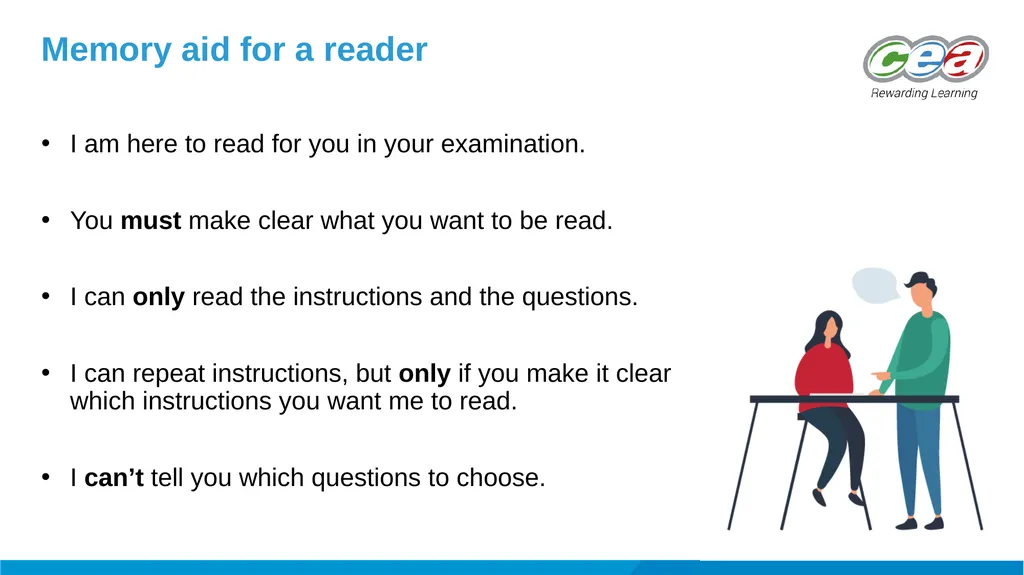
slide12. Memory aid for a reader I am here to read for you in your examination.
You must make clear what you want to be read.
I can only read the instructions and the questions.
I can repeat instructions, but only if you make it clear which instructions you want me to read.
I can’t tell you which questions to choose.<br>
slide13. Memory aid for a reader I can’t tell you when to move on to the next question.
I can’t tell you which questions to do first.
I can spell words if you ask me, but only words on the question paper.
I can read back your answer, but only if you ask me.
In GCSE English Language examinations:
⎼ I can read the questions in the writing section of the paper, but I can’t read any of the questions in the reading section.<br>
slide14. Useful Links www.ccea.org.uk
www.jcq.org.uk
http://www.jcq.org.uk/exams-office/ice---instructions-for-conducting-examinations
https://www.jcq.org.uk/exams-office/access-arrangements-and-special-consideration/regulations-and-guidance<br>
slide2. What is a reader? A reader is a responsible adult who reads the instructions of the question paper and the questions to the candidate.
This may involve reading the whole paper to the candidate or the candidate may request only some words to be read.<br>
slide3. The Role The head of centre must ensure that the person appointed to facilitate an access arrangement is a responsible adult, is appropriately trained and fully understands the rules of the access arrangement.
A reader is responsible to the exams officer and must be acceptable to the head of centre.
A reader is not a Communication Professional, practical assistant, a prompter or a scribe but the same person may act as such, as long as permission has been given for any or all of these arrangements and the regulations for the use of each arrangement must be strictly adhered to.<br>
slide4. The Role Where the candidate is accommodated separately on a one-to-one basis, the invigilator may act as a reader.
Readers may work with more than one candidate but must not read the paper to a group of candidates since this imposes timing of the paper on the candidates.<br>
slide5. The Role Where candidates only require occasional words or phrases to be read, three or four candidates may share one reader. The candidate will need to put their hand up or use a prompt card when he/she needs help with reading. If the group is accommodated away from the main examination room, a separate invigilator will be required.
The reader must not normally be the candidate’s own subject teacher or teaching assistant and must not be a relative, friend, peer or private tutor of the candidate. Where the candidate’s own subject teacher or teaching assistant is used, a separate invigilator must always be present.<br>
slide6. Types of disability or access needs requiring a reader The SENCo must produce a statement, confirming the nature of the candidate’s impairment and that the use of a reader reflects his/her normal and current way of working within the centre.
Types of disability or access needs requiring a reader:
Learning difficulties where the candidate is not subject to a Statement of Educational Needs
Learning difficulties where the candidate requires a reader but does not require extra time and/or a scribe<br>
slide7. Types of disability or access needs requiring a reader Communication and Interaction needs
Medical condition
Sensory and/or physical needs
Social, emotional and mental health needs
Speech, Language and Communication Needs<br>
slide8. A reader … may enable a vision impaired candidate to identify diagrams, graphs and tables but must not give factual information or offer any suggestions, other than the information which would be available on the paper for sighted candidates
may read numbers printed in figures as words (e.g. 356 would be read as three hundred and fifty six, but when reading the number it should also be pointed to on the question paper). An exception would be when the question is asking for a number to be written in words (e.g. write the number 356 in words)<br>
slide9. A reader … may decode symbols and unit abbreviations in Maths and Science examinations for candidates who require this arrangement to access the assess, reflecting the candidate’s current and normal way of working within the centre
may, if requested, give the spelling of a word which appears on the paper but otherwise spellings must not be given
may read back, when requested, what the candidate has written without any emphasis on any errors<br>
slide10. A reader … must read accurately
must have appropriate subject knowledge in order to act effectively as a reader in Maths and Science examinations, and decode symbols and formulae with accuracy
must only read the instructions of the question paper and questions, and must not explain or clarify
must only repeat the instructions of the question paper or questions when a candidate indicates a specific need for help<br>
slide11. A reader … must only read the instructions/rubric of a paper testing reading and must not read individual questions or text
must abide by the regulations since failure to do so could lead to the disqualification of the candidate
must not advise the candidate regarding which questions to do, when to move on to the next question, or the order in which questions should be answered
must not decode any symbols in a Music examination<br>
slide12. Memory aid for a reader I am here to read for you in your examination.
You must make clear what you want to be read.
I can only read the instructions and the questions.
I can repeat instructions, but only if you make it clear which instructions you want me to read.
I can’t tell you which questions to choose.<br>
slide13. Memory aid for a reader I can’t tell you when to move on to the next question.
I can’t tell you which questions to do first.
I can spell words if you ask me, but only words on the question paper.
I can read back your answer, but only if you ask me.
In GCSE English Language examinations:
⎼ I can read the questions in the writing section of the paper, but I can’t read any of the questions in the reading section.<br>
slide14. Useful Links www.ccea.org.uk
www.jcq.org.uk
http://www.jcq.org.uk/exams-office/ice---instructions-for-conducting-examinations
https://www.jcq.org.uk/exams-office/access-arrangements-and-special-consideration/regulations-and-guidance<br>