
Reading for Understanding, Analysis and Evaluation











Description: Reading for Understanding, Analysis and Evaluation Mr McVicar Aims of this unit To develop your critical reading skills To expand your knowledge of literary techniques To prepare you for the S2 assessments Learning Intentions for Today To
Related Topics
Download Presentation
"Reading for Understanding, Analysis and Evaluation" is the property of its rightful owner. Permission is granted to download and print the materials on this website for personal, non-commercial use only, and to display it on your personal computer provided you do not modify the materials and that you retain all copyright notices contained in the materials. By downloading content from our website, you accept the terms of this agreement.
Presentation Transcript
slide1. Reading for Understanding, Analysis and Evaluation Mr McVicar<br>
slide2. Aims of this unit To develop your critical reading skills
To expand your knowledge of literary techniques
To prepare you for the S2 assessments<br>
slide3. Learning Intentions for Today To understand what RUAE is
To know the 3 elements of RUAE
To begin to look at understanding questions<br>
slide4. What is R.U.A.E? RUAE is the part of this course that allows you to show your ability to understand a text fully and analyse the language of it.
The questions on a text will focus on 3 main areas:
What the writer says – UNDERSTANDING
How the writer says it – ANALYSIS
How effectively the writing says it – EVALUATION
We will look at each of these in turn L.I 1
L.I 2<br>
slide5. UNDERSTANDING<br>
slide6. Types of Understanding Questions There are a number of different types of understanding questions:
In your own words
Summarising
Context
You will learn how to answer each of these different questions L.I 3<br>
slide7. In your own words… A large number of Understanding questions asks you to show that you know what the writer is saying by translating important information into your own words
Having an extensive vocabulary will help you with this task. Your teacher can provide you with spelling lists to improve your knowledge if you need help with these questions L.I 3<br>
slide8. In your own words… How to go about it There are some acronyms to help you answer these questions
RAP
PARA L.I 3<br>
slide9. RAP Read the section
Ask yourself: What are the most important details? Underline them
Put these details in your own words. L.I 3<br>
slide10. PARA Put the text in your own words
Avoid copying the text
Rearrange similar text
Ask yourself if you included all the important points. L.I 3<br>
slide11. In your own words… An example China, one of the countries that can boast of an ancient civilisation, has a long and mysterious history – almost 5,000 years of it! Like most other great civilizations of the world, China can trace her culture back to a blend of small original tribes which have expanded till they became the great country we have today.
Q) In your own words, how did China develop over time? L.I 3<br>
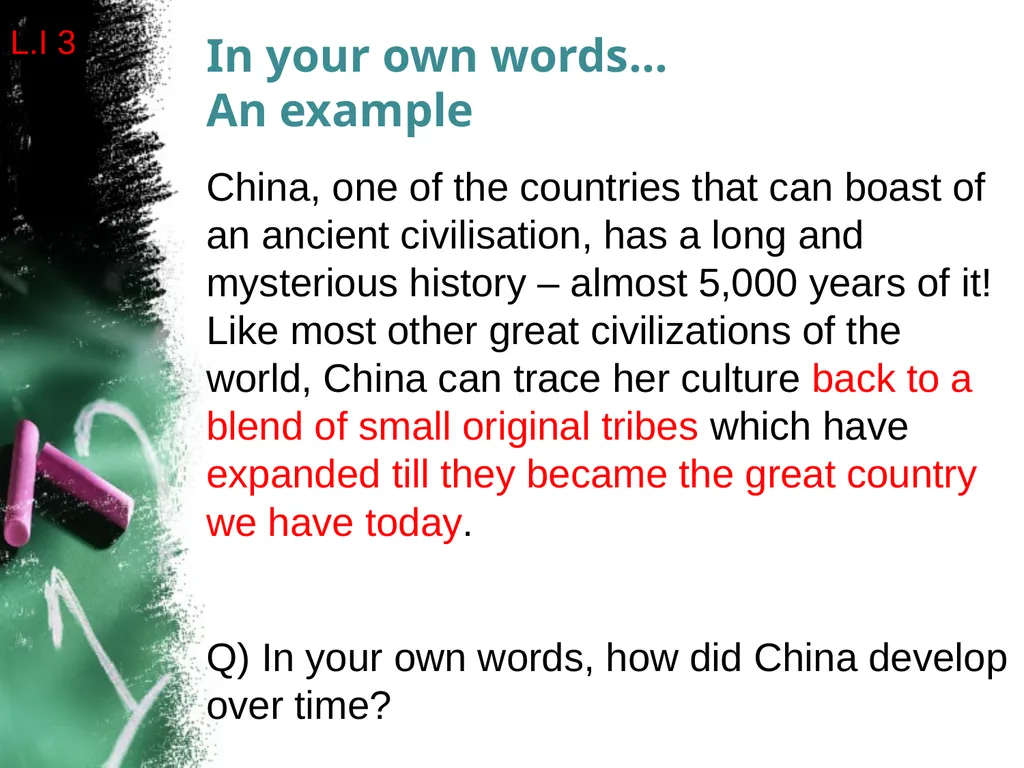
slide12. In your own words… An example China, one of the countries that can boast of an ancient civilisation, has a long and mysterious history – almost 5,000 years of it! Like most other great civilizations of the world, China can trace her culture back to a blend of small original tribes which have expanded till they became the great country we have today.
Q) In your own words, how did China develop over time? L.I 3<br>
slide13. In your own words… An example answer China originally started as a collection of small communities that merged together to become the China we now know.<br>
slide14. In your own words… Now you try It is not necessary for Scent Hounds to be as fast and agile as Sight Hounds – They do not need to keep their prey in sight. Scent hounds are built for endurance. They can follow a scent for long distances and even across running water.
Q) Explain in your own words why Scent Hounds don’t need “to be as fast and agile as sight hounds”. L.I 3<br>
slide15. In your own words… Now you try 2) Stories about haunted places are always fascinating. What goes on there, and how, and why? Some hauntings can be explained as the results of ordinary trickery. In others some natural cause is at work, though it has not yet been traced.
Q) In your own words, what two explanations does the writer give to describe the belief that some places are haunted? L.I 3<br>
slide16. In your own words… Now you try 3) I’m nocturnal. I love the moonlight, the shadows, the dark places, the dappled murk. I’m not being poetic. I’m simply being true to my nature, my nocturnal nature. Like all tarantulas.
Q) In your own words, in what way is the speaker “like all tarantulas”? L.I 3<br>
slide17. In your own words… Now you try 4) Smugglers used to spread rumours that the places where they landed their cargo were haunted. This made local people keep away, and accounted for strange lights seen flitting about after dark, or peculiar sounds. Today just occasionally tenants who want to be moved from one house to another have been known to stage a ‘haunt’.
Q) Using your own words, what two reasons does the writer give for smugglers pretending that their landing places were haunted? L.I 3<br>
slide18. Learning Review To understand what RUAE is
To know the 3 elements of RUAE
To begin to look at understanding questions Exit Pass On a post-it, write down:
One thing you learned from today’s lesson
One question you still have about what you learned<br>
slide19. Summarising Questions Understanding<br>
slide20. Starter – With your partner Most reality TV contestants almost always have a back story of personal triumph over adversity which enables us to feel that we are helping them to succeed, that we are giving them a break when no-one else will. And perhaps this is why Susan Boyle, who grew up in a council house and was bullied as a child for her learning difficulties, has proved such an enduring figure.
In your own words explain why the writer chooses Susan Boyle as an example of someone who is an “enduring figure”.<br>
slide21. Learning Intentions To develop our knowledge of Understanding questions
To understand how to answer summarising questions<br>
slide22. Summarise… These questions are similar to “in your own words” questions.
You could be asked to “list ideas” or “give reasons”
These questions ask you to list a number of points made by a writer in a section of text
You must still use your own words to answer these questions L.I 1
L.I 2<br>
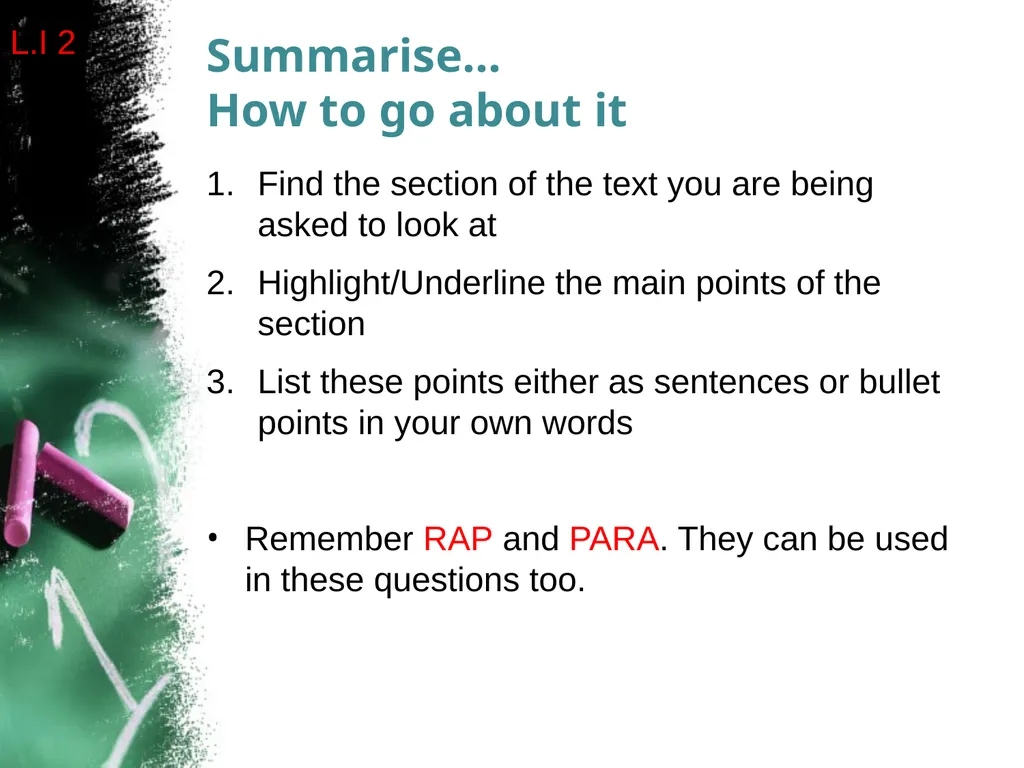
slide23. Summarise… How to go about it Find the section of the text you are being asked to look at
Highlight/Underline the main points of the section
List these points either as sentences or bullet points in your own words
Remember RAP and PARA. They can be used in these questions too. L.I 2<br>
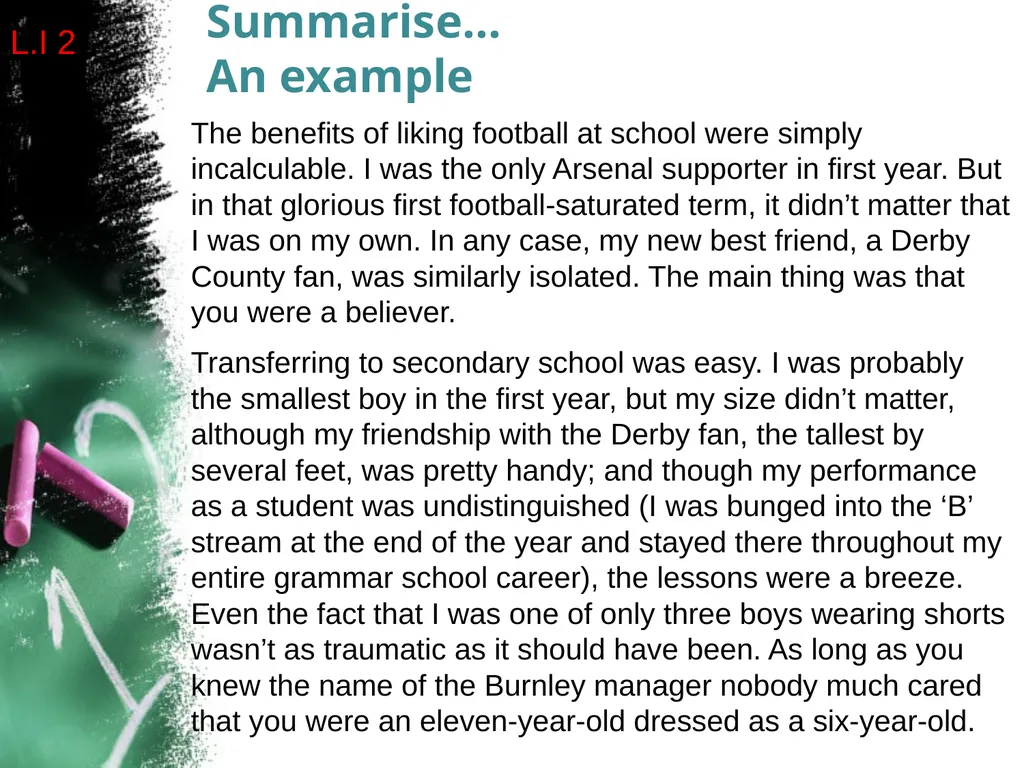
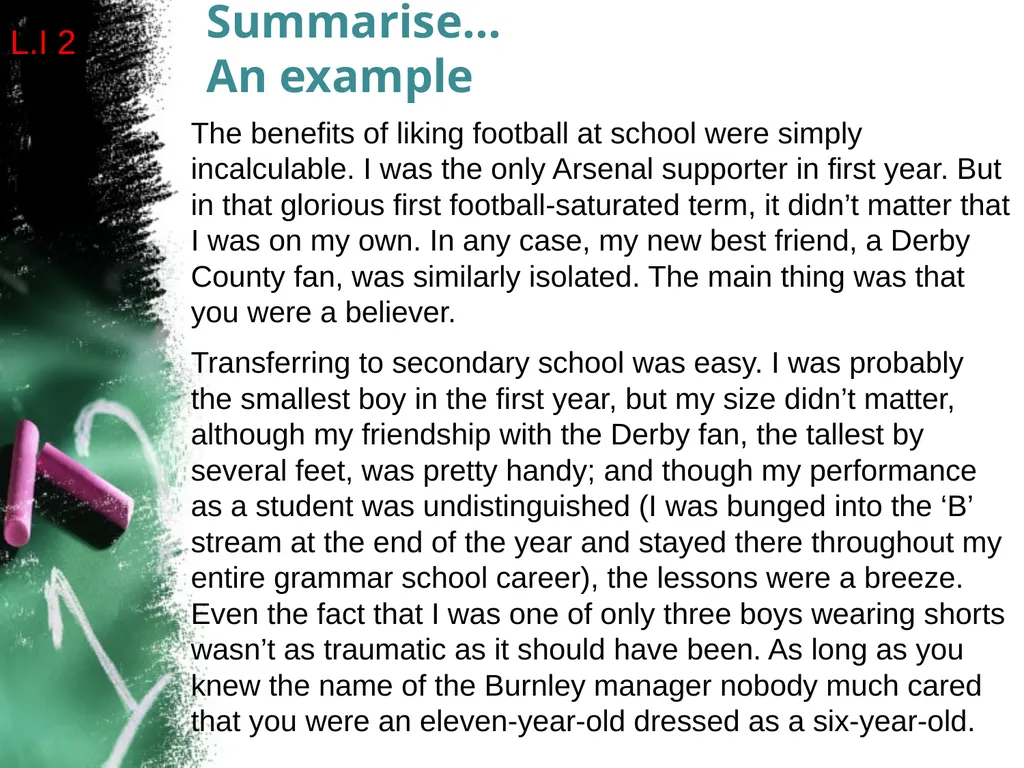
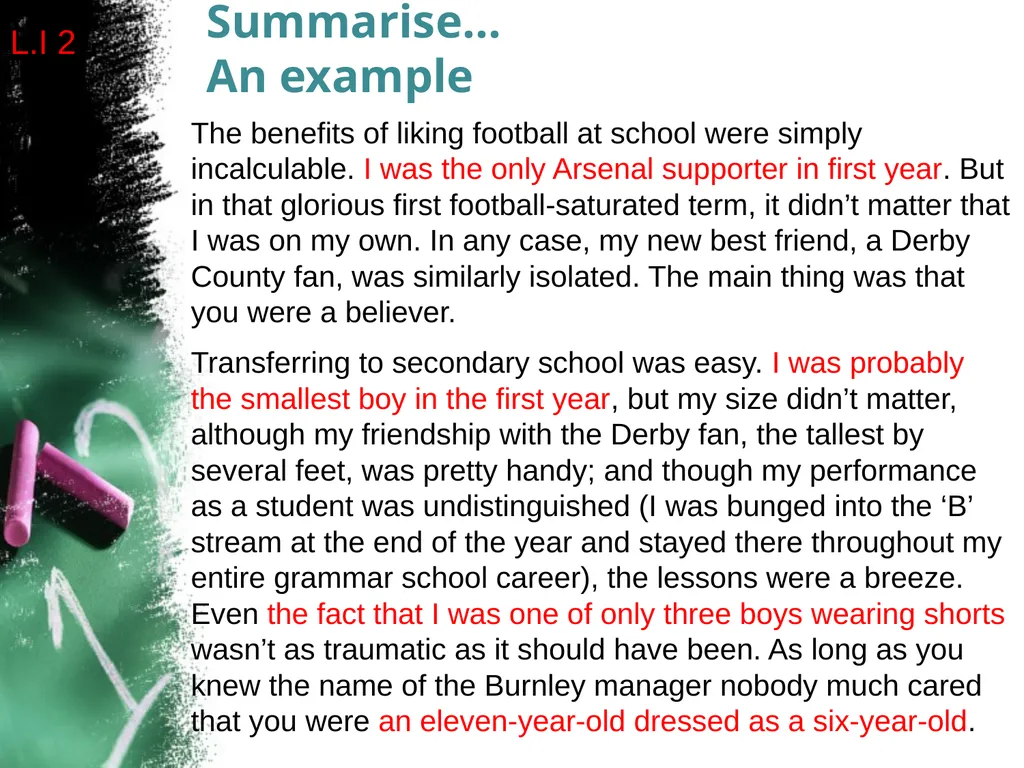
slide24. Summarise… An example The benefits of liking football at school were simply incalculable. I was the only Arsenal supporter in first year. But in that glorious first football-saturated term, it didn’t matter that I was on my own. In any case, my new best friend, a Derby County fan, was similarly isolated. The main thing was that you were a believer.
Transferring to secondary school was easy. I was probably the smallest boy in the first year, but my size didn’t matter, although my friendship with the Derby fan, the tallest by several feet, was pretty handy; and though my performance as a student was undistinguished (I was bunged into the ‘B’ stream at the end of the year and stayed there throughout my entire grammar school career), the lessons were a breeze. Even the fact that I was one of only three boys wearing shorts wasn’t as traumatic as it should have been. As long as you knew the name of the Burnley manager nobody much cared that you were an eleven-year-old dressed as a six-year-old. L.I 2<br>
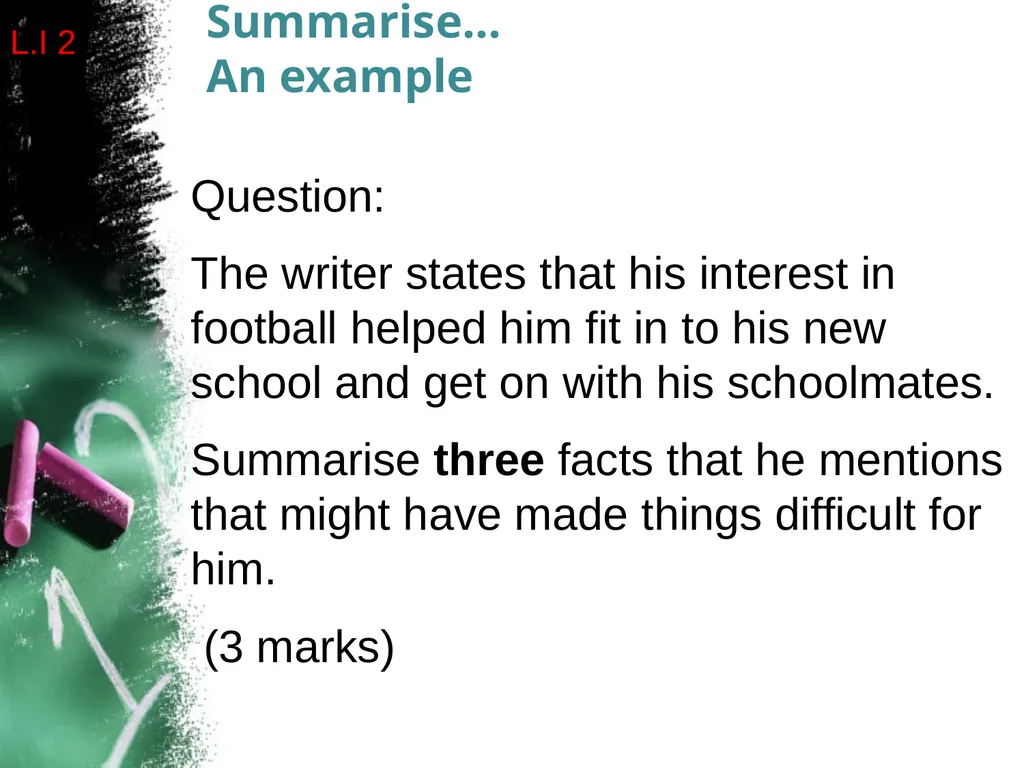
slide25. Summarise… An example Question:
The writer states that his interest in football helped him fit in to his new school and get on with his schoolmates.
Summarise three facts that he mentions that might have made things difficult for him.
(3 marks) L.I 2<br>
slide26. Summarise… An example The benefits of liking football at school were simply incalculable. I was the only Arsenal supporter in first year. But in that glorious first football-saturated term, it didn’t matter that I was on my own. In any case, my new best friend, a Derby County fan, was similarly isolated. The main thing was that you were a believer.
Transferring to secondary school was easy. I was probably the smallest boy in the first year, but my size didn’t matter, although my friendship with the Derby fan, the tallest by several feet, was pretty handy; and though my performance as a student was undistinguished (I was bunged into the ‘B’ stream at the end of the year and stayed there throughout my entire grammar school career), the lessons were a breeze. Even the fact that I was one of only three boys wearing shorts wasn’t as traumatic as it should have been. As long as you knew the name of the Burnley manager nobody much cared that you were an eleven-year-old dressed as a six-year-old. L.I 2<br>
slide27. Summarise… An example The benefits of liking football at school were simply incalculable. I was the only Arsenal supporter in first year. But in that glorious first football-saturated term, it didn’t matter that I was on my own. In any case, my new best friend, a Derby County fan, was similarly isolated. The main thing was that you were a believer.
Transferring to secondary school was easy. I was probably the smallest boy in the first year, but my size didn’t matter, although my friendship with the Derby fan, the tallest by several feet, was pretty handy; and though my performance as a student was undistinguished (I was bunged into the ‘B’ stream at the end of the year and stayed there throughout my entire grammar school career), the lessons were a breeze. Even the fact that I was one of only three boys wearing shorts wasn’t as traumatic as it should have been. As long as you knew the name of the Burnley manager nobody much cared that you were an eleven-year-old dressed as a six-year-old. L.I 2<br>
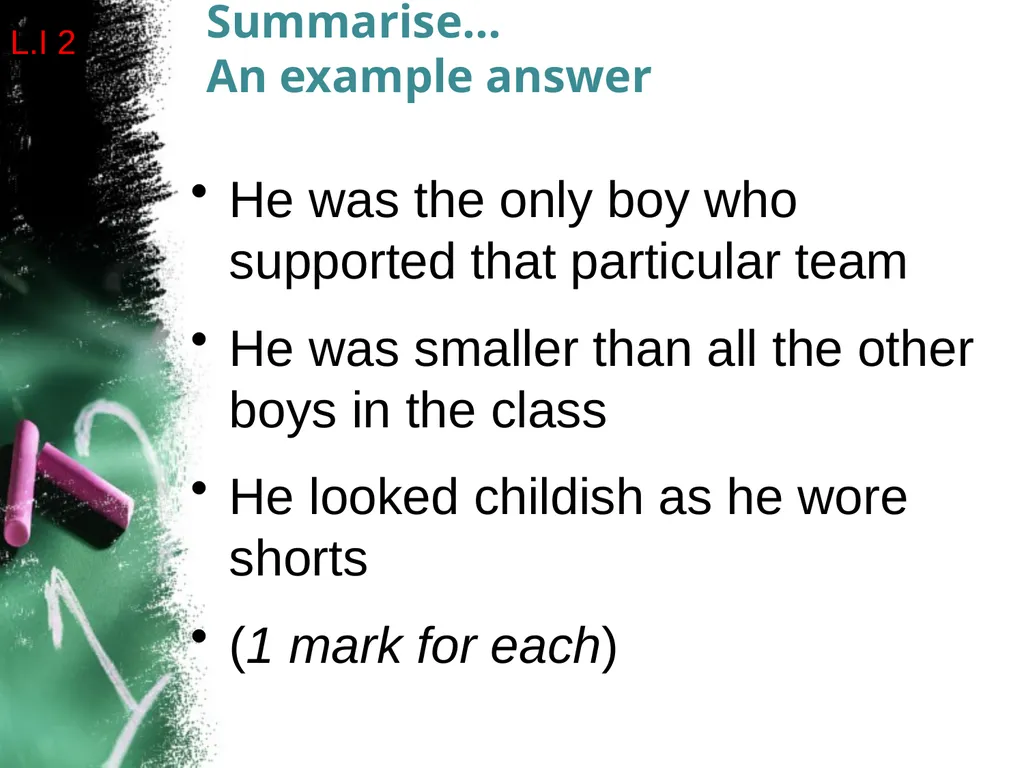
slide28. Summarise… An example answer He was the only boy who supported that particular team
He was smaller than all the other boys in the class
He looked childish as he wore shorts
(1 mark for each) L.I 2<br>
slide29. Summarise… Now you try Your teacher will issue a worksheet for this task. L.I 2<br>
slide30. Learning Review To develop our knowledge of Understanding questions
To understand how to answer summarising questions Exit Pass Think of the most important word or phrase from this lesson.
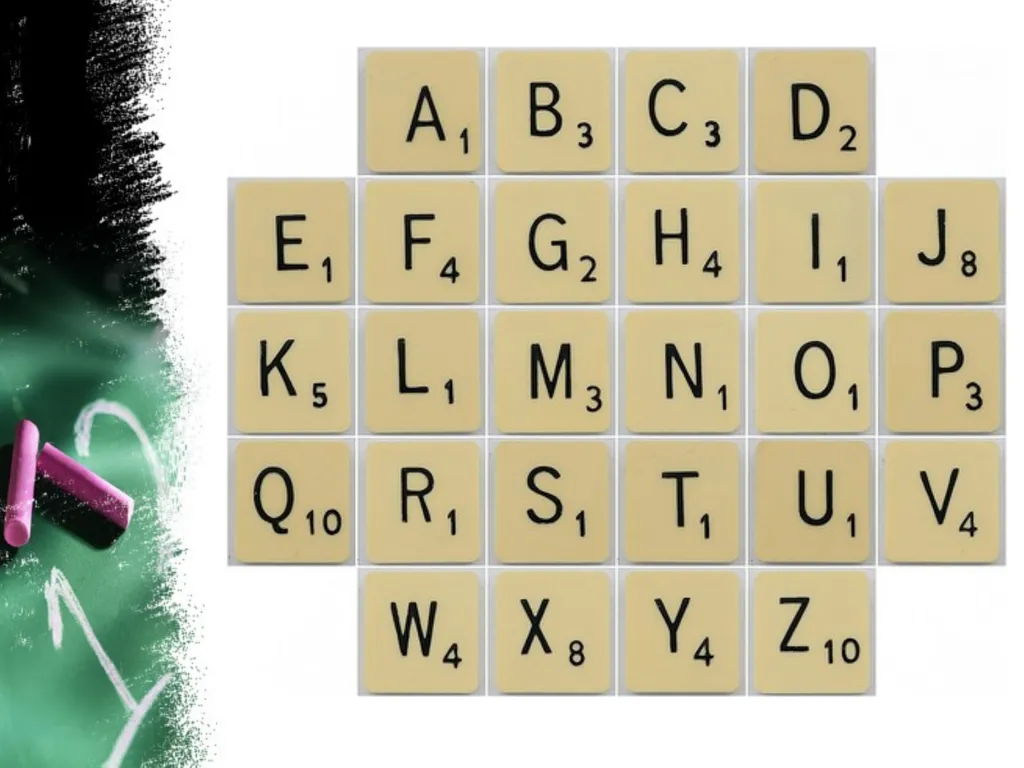
Look at the scrabble grid on the next slide.
How many points would your word be worth?
Compare with the person sitting next to you.<br>
slide32. Context Questions Understanding<br>
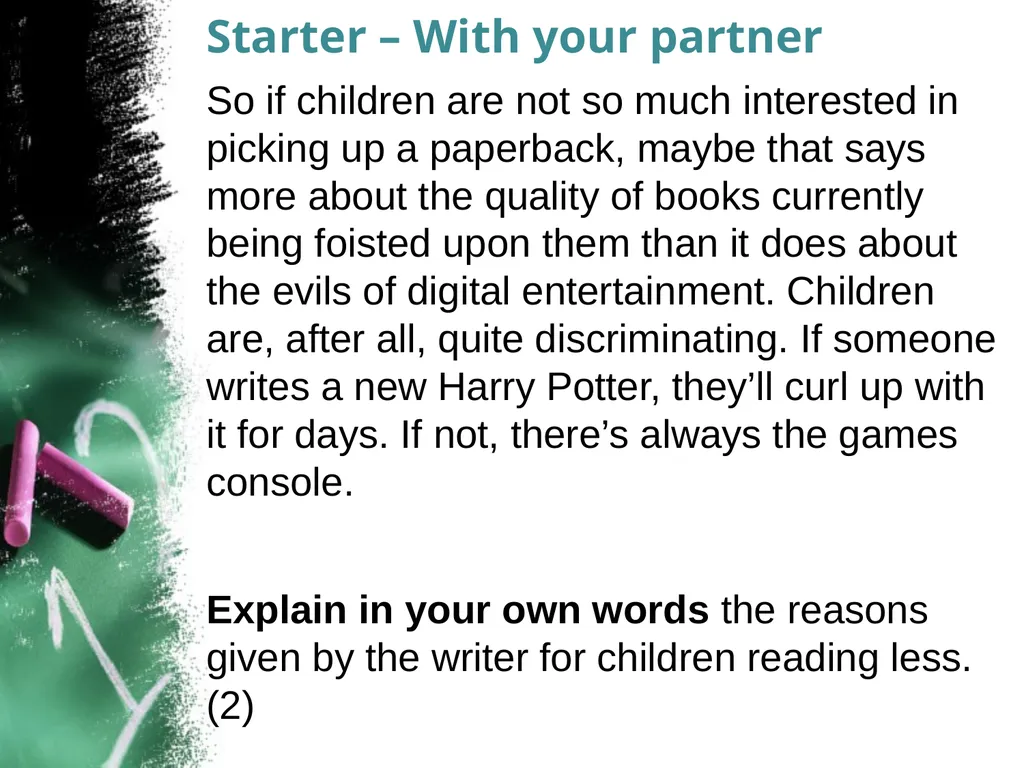
slide33. Starter – With your partner So if children are not so much interested in picking up a paperback, maybe that says more about the quality of books currently being foisted upon them than it does about the evils of digital entertainment. Children are, after all, quite discriminating. If someone writes a new Harry Potter, they’ll curl up with it for days. If not, there’s always the games console.
Explain in your own words the reasons given by the writer for children reading less. (2)<br>
slide34. Learning Intentions To develop our knowledge of Understanding questions
To understand how to answer context questions<br>
slide35. Context… This type of understanding question asks you to explain the meaning of a word or phrase used in the text.
You should use the context to help you
The context means the part of the text where the word is used L.I 1<br>
slide36. Context… How to go about it… Explain the meaning of the word or phrase
Explain how the rest of the text makes this clear by quoting the word or words which provide clues L.I 2<br>
slide37. Context… An example… I’m nocturnal. I love the moonlight, the shadows, the dark places, the dappled murk. I’m not being poetic. I’m simply being true to my nature, my nocturnal nature. Like all tarantulas.
Q) Show how the context helps you understand the meaning of ‘nocturnal’. L.I 2<br>
slide38. Context… An example answer… ‘Nocturnal’ means being active by night. The writer refers to his preference for ‘moonlight’ and ‘dark’ which both suggest night-time. L.I 2<br>
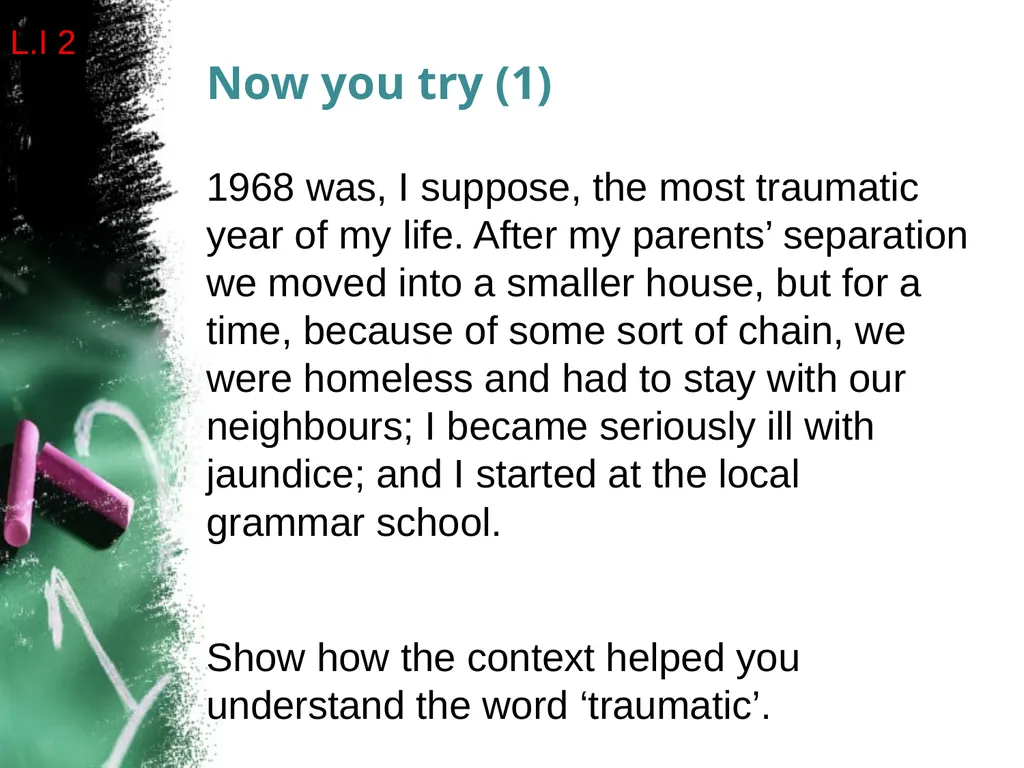
slide39. Now you try (1) 1968 was, I suppose, the most traumatic year of my life. After my parents’ separation we moved into a smaller house, but for a time, because of some sort of chain, we were homeless and had to stay with our neighbours; I became seriously ill with jaundice; and I started at the local grammar school.
Show how the context helped you understand the word ‘traumatic’. L.I 2<br>
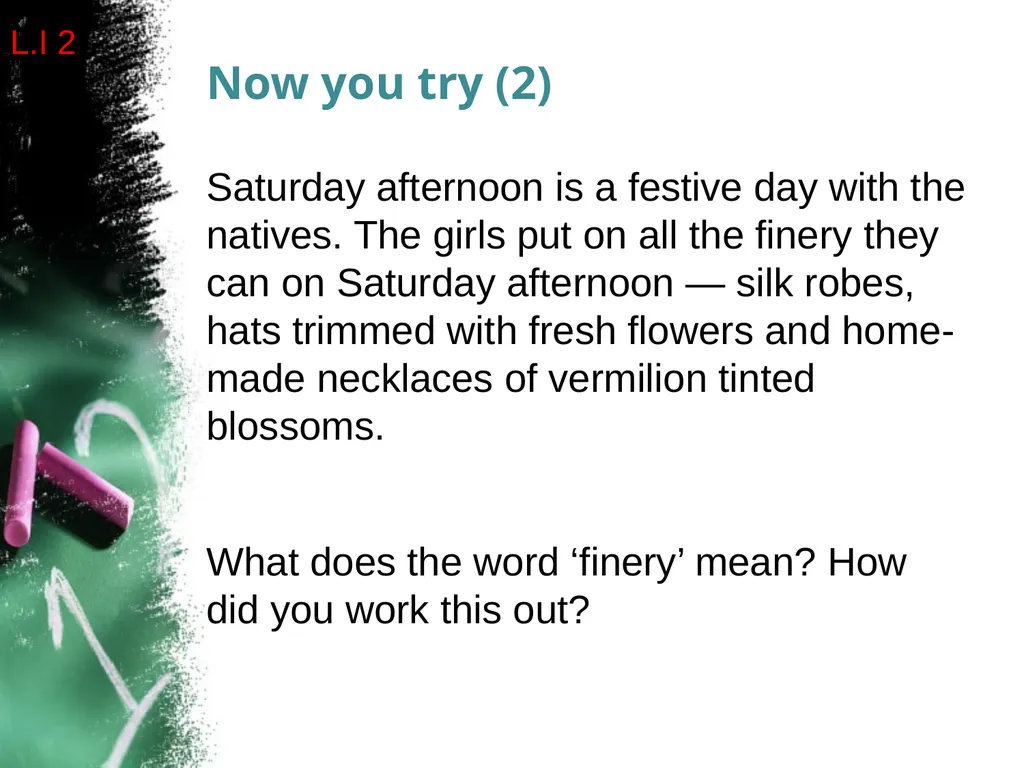
slide40. Now you try (2) Saturday afternoon is a festive day with the natives. The girls put on all the finery they can on Saturday afternoon — silk robes, hats trimmed with fresh flowers and home-made necklaces of vermilion tinted blossoms.
What does the word ‘finery’ mean? How did you work this out? L.I 2<br>
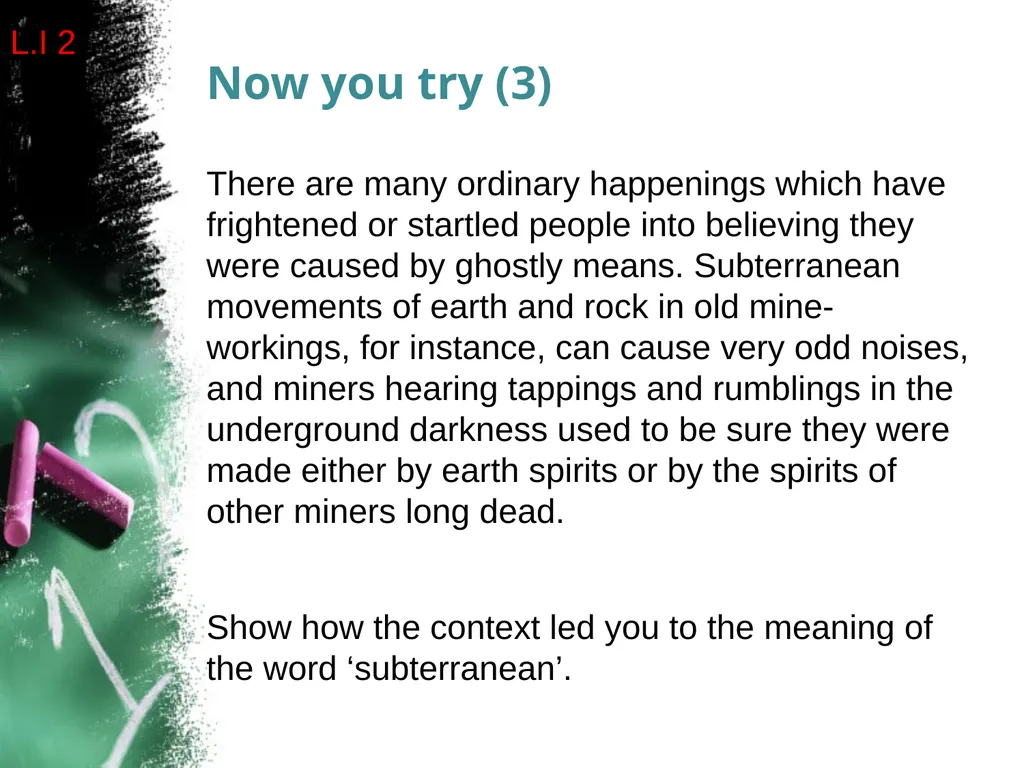
slide41. Now you try (3) There are many ordinary happenings which have frightened or startled people into believing they were caused by ghostly means. Subterranean movements of earth and rock in old mine-workings, for instance, can cause very odd noises, and miners hearing tappings and rumblings in the underground darkness used to be sure they were made either by earth spirits or by the spirits of other miners long dead.
Show how the context led you to the meaning of the word ‘subterranean’. L.I 2<br>
slide42. Learning Intentions To develop our knowledge of Understanding questions
To understand how to answer context questions Learning Review Using the fist-to-five technique, rate your understanding of each of the 2 learning intentions for today<br>
slide43. Context Questions More Practise<br>
slide44. Learning Intentions To be secure in our understanding of how to answer a context question<br>
slide45. How do you answer a context question? L.I 1<br>
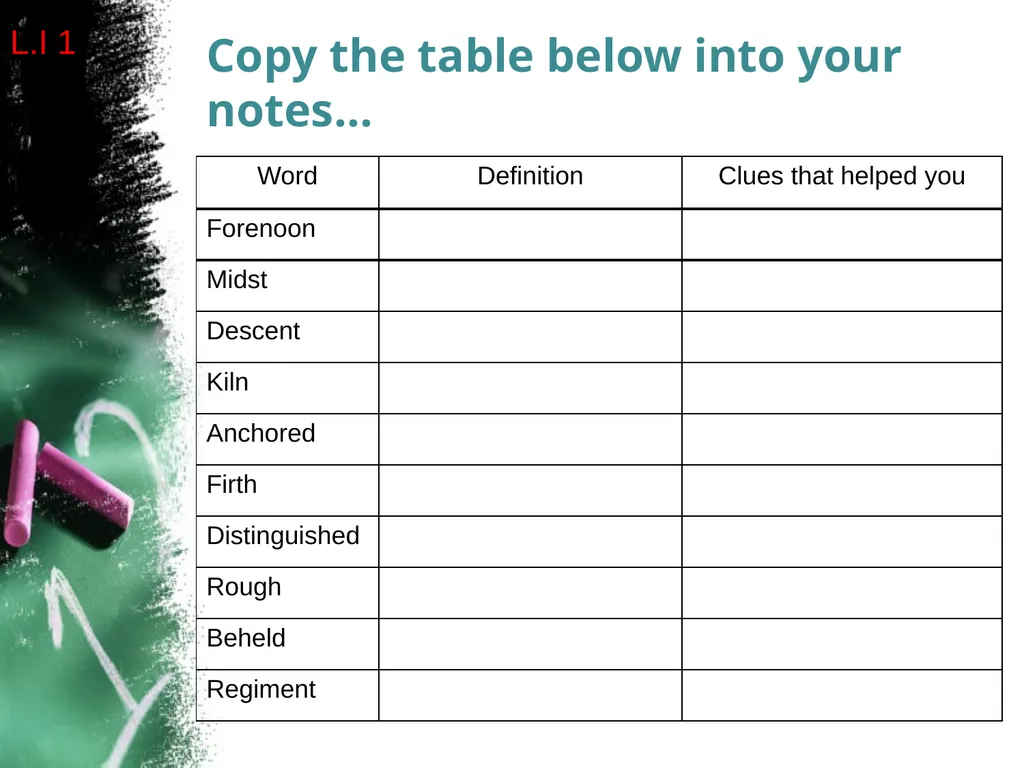
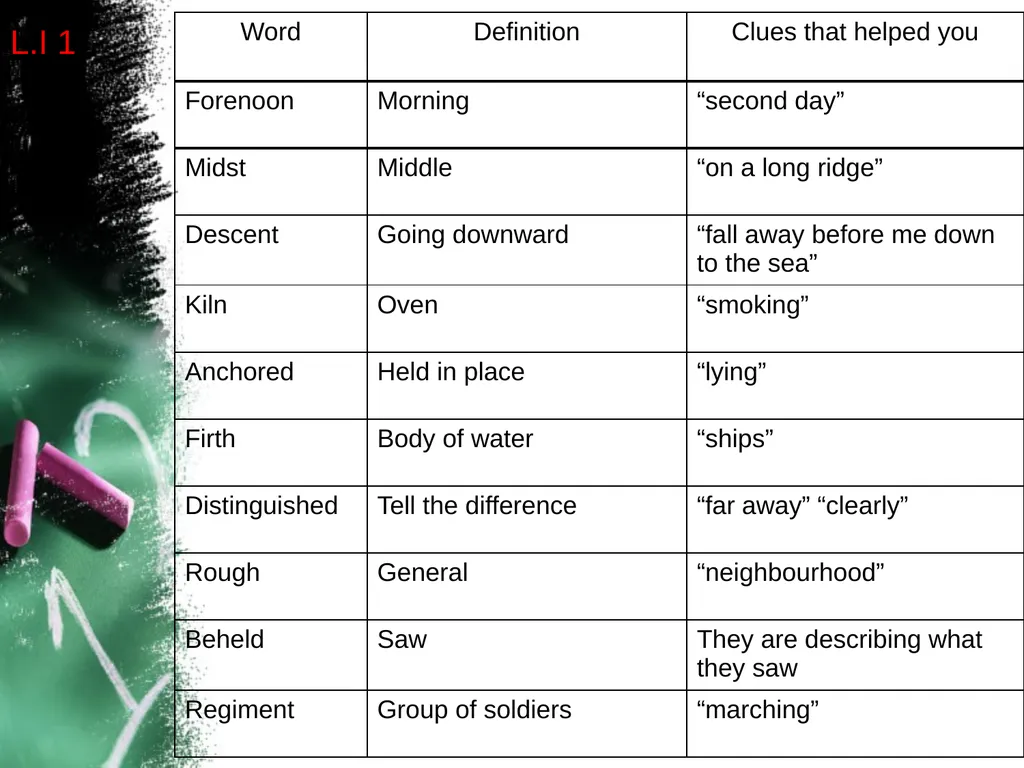
slide46. Copy the table below into your notes… L.I 1<br>
slide47. The next slide is an extract from Robert Louis Stevenson’s novel Kidnapped
The underlined words appear in your table
Can you work out the meaning of the words using the context? L.I 1<br>
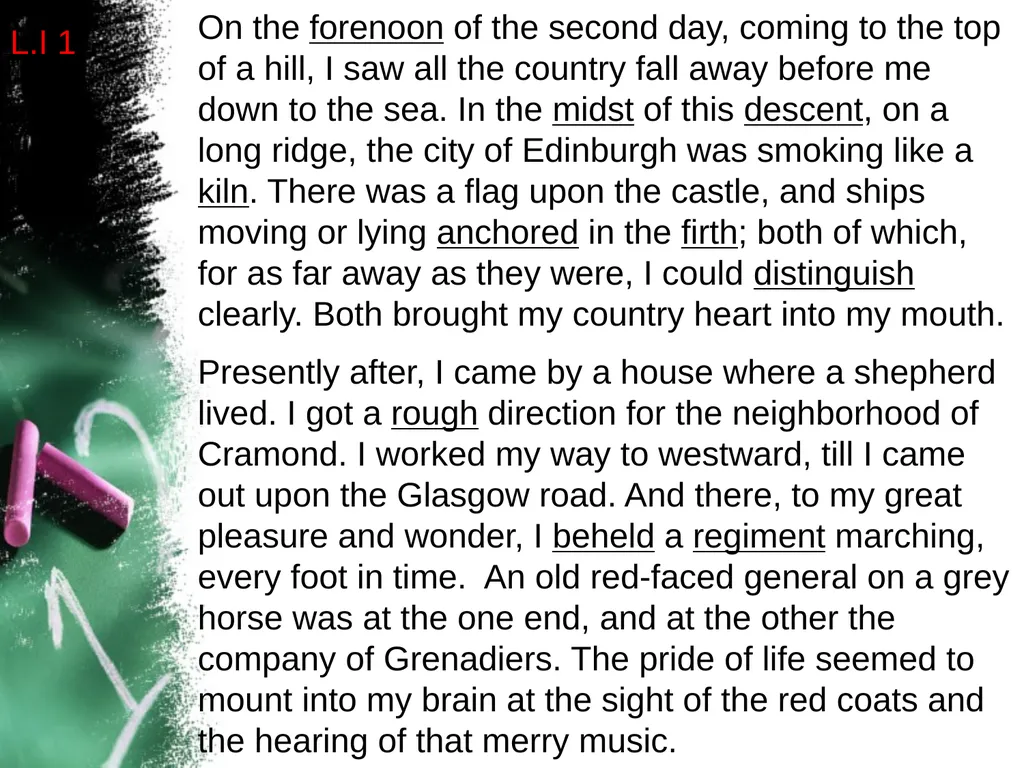
slide48. On the forenoon of the second day, coming to the top of a hill, I saw all the country fall away before me down to the sea. In the midst of this descent, on a long ridge, the city of Edinburgh was smoking like a kiln. There was a flag upon the castle, and ships moving or lying anchored in the firth; both of which, for as far away as they were, I could distinguish clearly. Both brought my country heart into my mouth.
Presently after, I came by a house where a shepherd lived. I got a rough direction for the neighborhood of Cramond. I worked my way to westward, till I came out upon the Glasgow road. And there, to my great pleasure and wonder, I beheld a regiment marching, every foot in time. An old red-faced general on a grey horse was at the one end, and at the other the company of Grenadiers. The pride of life seemed to mount into my brain at the sight of the red coats and the hearing of that merry music. L.I 1<br>
slide49. With your partner, try to work out the meaning of the words… Your are doing this to improve your knowledge of context questions and improve your vocabulary
This is a paired task
The noise level should be appropriate for paired work
You have until the end of the period L.I 1<br>
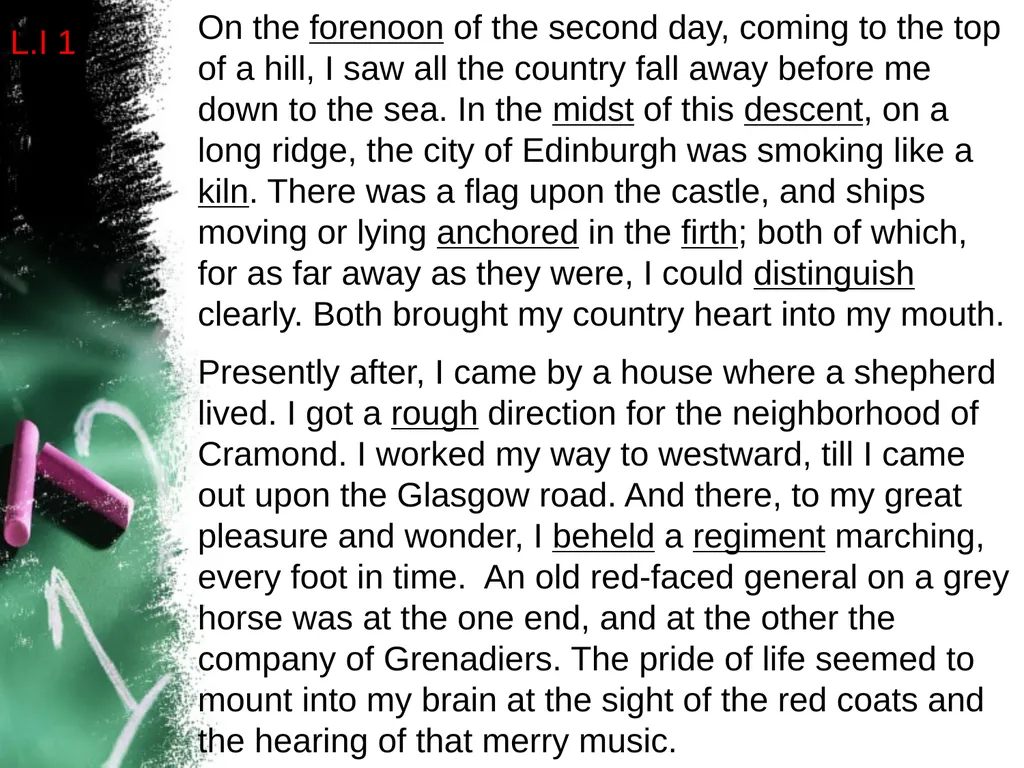
slide50. On the forenoon of the second day, coming to the top of a hill, I saw all the country fall away before me down to the sea. In the midst of this descent, on a long ridge, the city of Edinburgh was smoking like a kiln. There was a flag upon the castle, and ships moving or lying anchored in the firth; both of which, for as far away as they were, I could distinguish clearly. Both brought my country heart into my mouth.
Presently after, I came by a house where a shepherd lived. I got a rough direction for the neighborhood of Cramond. I worked my way to westward, till I came out upon the Glasgow road. And there, to my great pleasure and wonder, I beheld a regiment marching, every foot in time. An old red-faced general on a grey horse was at the one end, and at the other the company of Grenadiers. The pride of life seemed to mount into my brain at the sight of the red coats and the hearing of that merry music. L.I 1<br>
slide51. L.I 1<br>
slide52. Learning Review Understanding Questions<br>
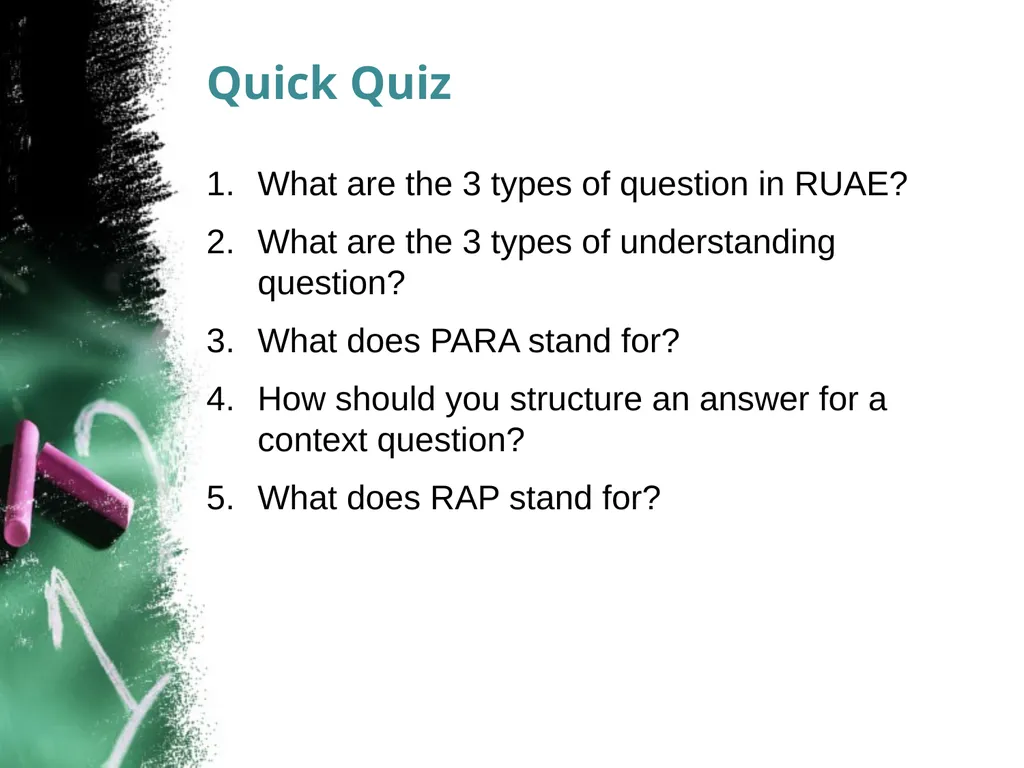
slide53. Quick Quiz What are the 3 types of question in RUAE?
What are the 3 types of understanding question?
What does PARA stand for?
How should you structure an answer for a context question?
What does RAP stand for?<br>
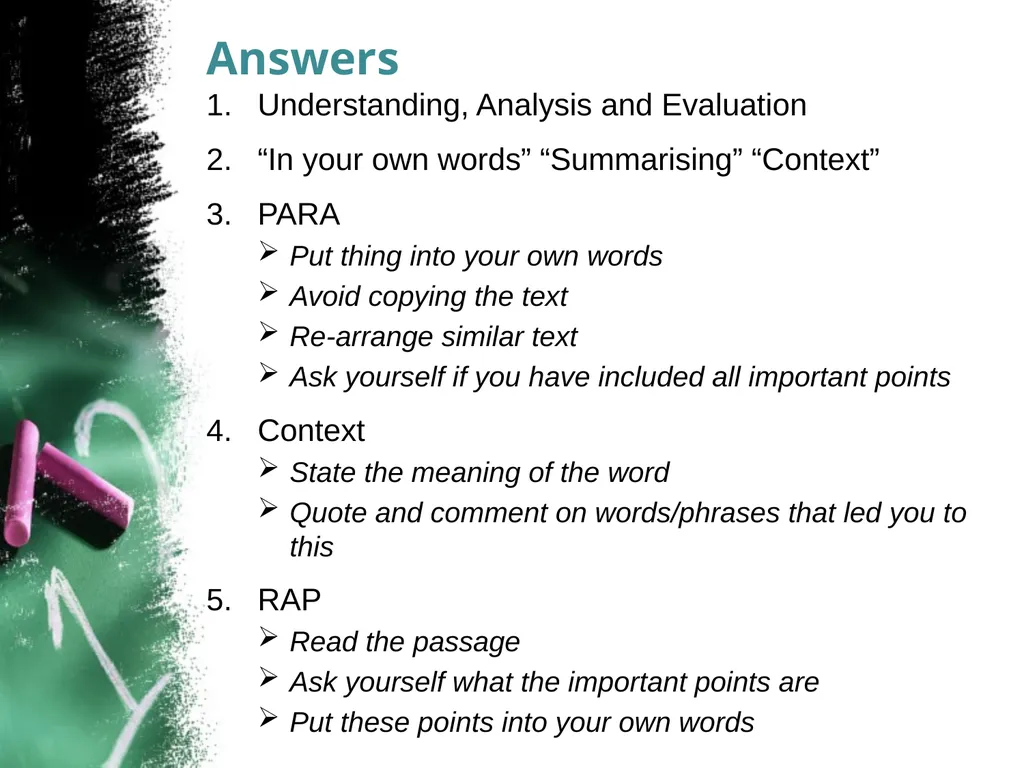
slide54. Answers Understanding, Analysis and Evaluation
“In your own words” “Summarising” “Context”
PARA
Put thing into your own words
Avoid copying the text
Re-arrange similar text
Ask yourself if you have included all important points
Context
State the meaning of the word
Quote and comment on words/phrases that led you to this
RAP
Read the passage
Ask yourself what the important points are
Put these points into your own words<br>
slide55. Now try answering questions of a full text Passage 1 - Skateboards<br>
slide56. ANALYSIS<br>
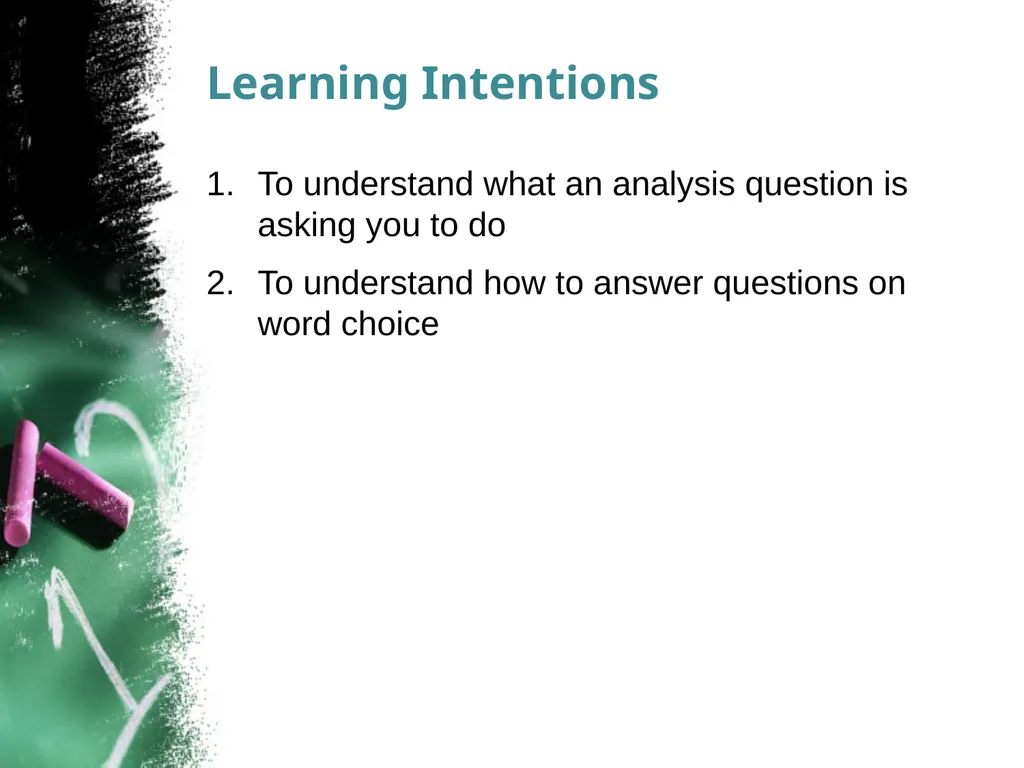
slide57. Learning Intentions To understand what an analysis question is asking you to do
To understand how to answer questions on word choice<br>
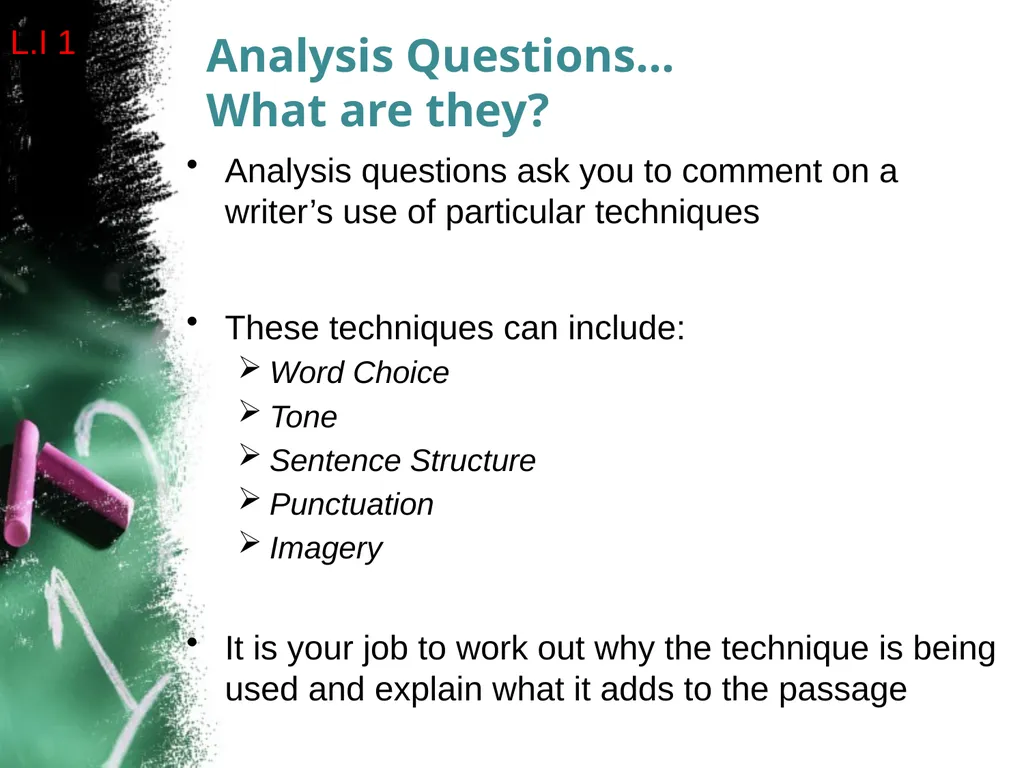
slide58. Analysis Questions… What are they? Analysis questions ask you to comment on a writer’s use of particular techniques
These techniques can include:
Word Choice
Tone
Sentence Structure
Punctuation
Imagery
It is your job to work out why the technique is being used and explain what it adds to the passage L.I 1<br>
slide59. Analysis Questions… What are they? Over the course of the next few lessons, you will look at each of these different techniques
Some analysis questions have a specific structure to their answer (such as imagery) which you will learn L.I 1<br>
slide60. WORD CHOICE Analysis Questions<br>
slide61. Word Choice… What is it? Questions that ask about word choice are really asking you to pick out and comment on a writer’s use of unusual words
The words that you might identify for word choice questions are usually variations of simple words L.I 2<br>
slide62. Word Choice… Discuss in your pairs Look at the two sentences below.
What is the difference between them?
How is the meaning of each sentence changed?
Joe walked along the corridor to his class.
Joe bolted along the corridor to his class. L.I 2<br>
slide63. Word Choice… Denotation vs. Connotation In word choice questions, you have to show that you both the denotation and connotation of particular words that you have identified
Denotation is the actual meaning of a word. The definition.
Connotation refers to the ideas we associate with a word. L.I 2<br>
slide64. The Association Game I am going to say a word to the class.
I will ask someone to say the first work they think of when they hear that word
The next person should say what they think of when they hear the word said by the person before
This should go around the class
See the next slide for an example L.I 2<br>
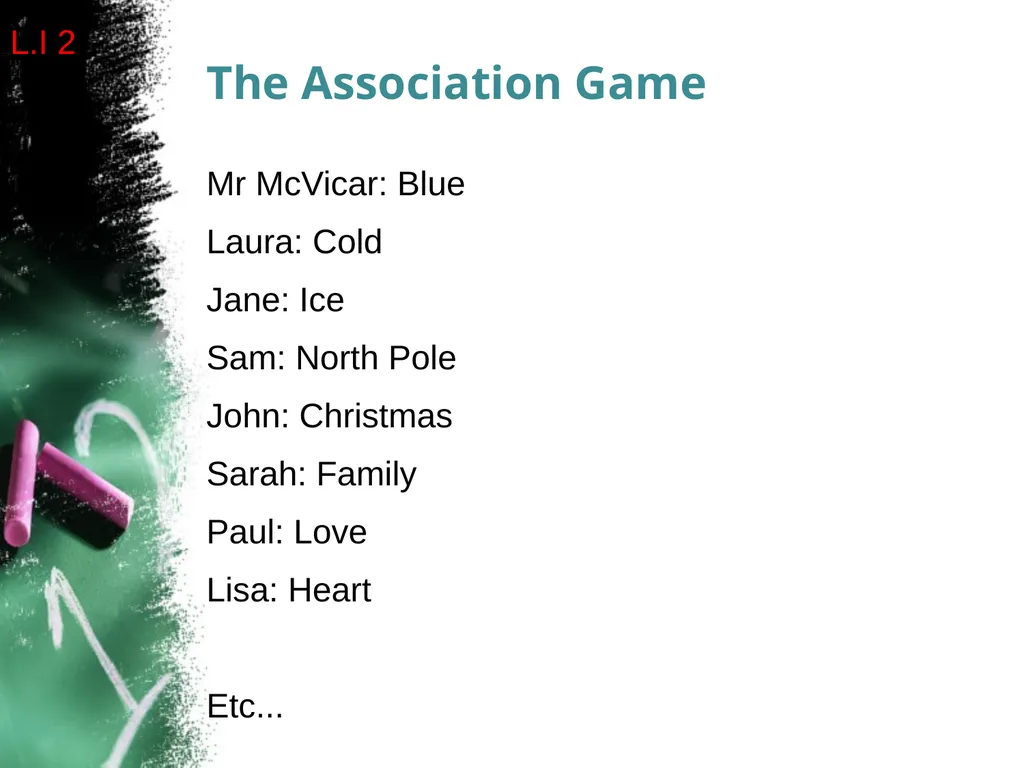
slide65. The Association Game Mr McVicar: Blue
Laura: Cold
Jane: Ice
Sam: North Pole
John: Christmas
Sarah: Family
Paul: Love
Lisa: Heart
Etc... L.I 2<br>
slide66. Word Choice… How to answer the questions… When you are answering a word choice question, you are explaining the connotation of a word.
The words have been used because of their connotations
You should lay out your answer in the following format L.I 2<br>
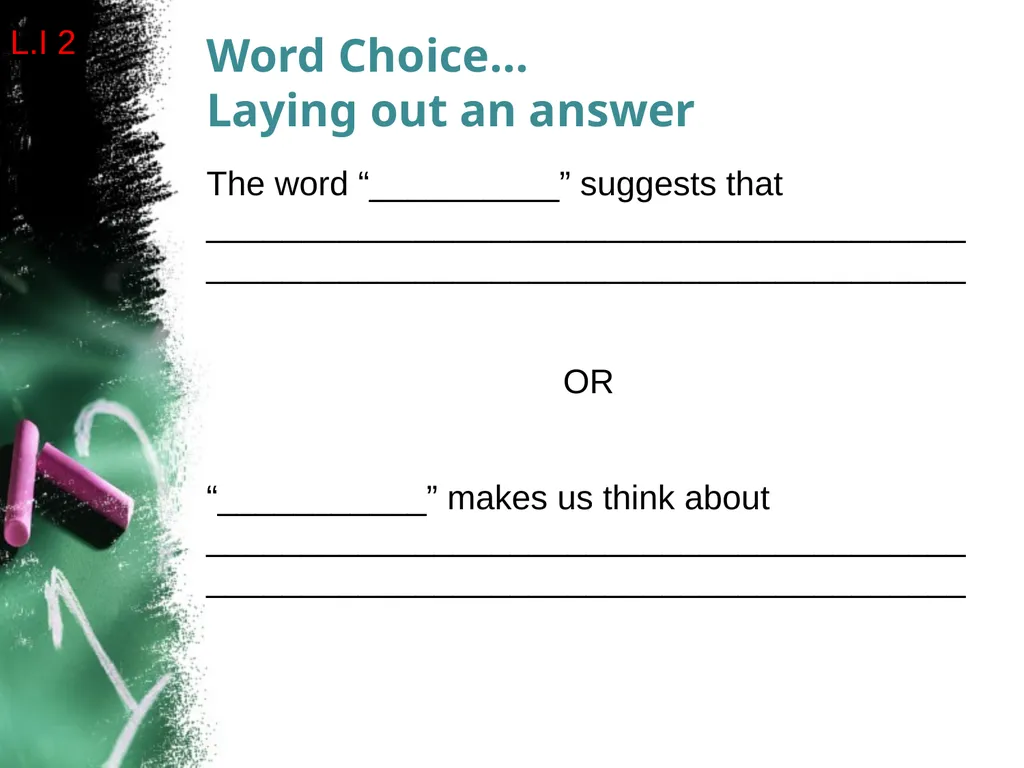
slide67. Word Choice… Laying out an answer The word “__________” suggests that ________________________________________________________________________________
OR
“___________” makes us think about ________________________________________________________________________________ L.I 2<br>
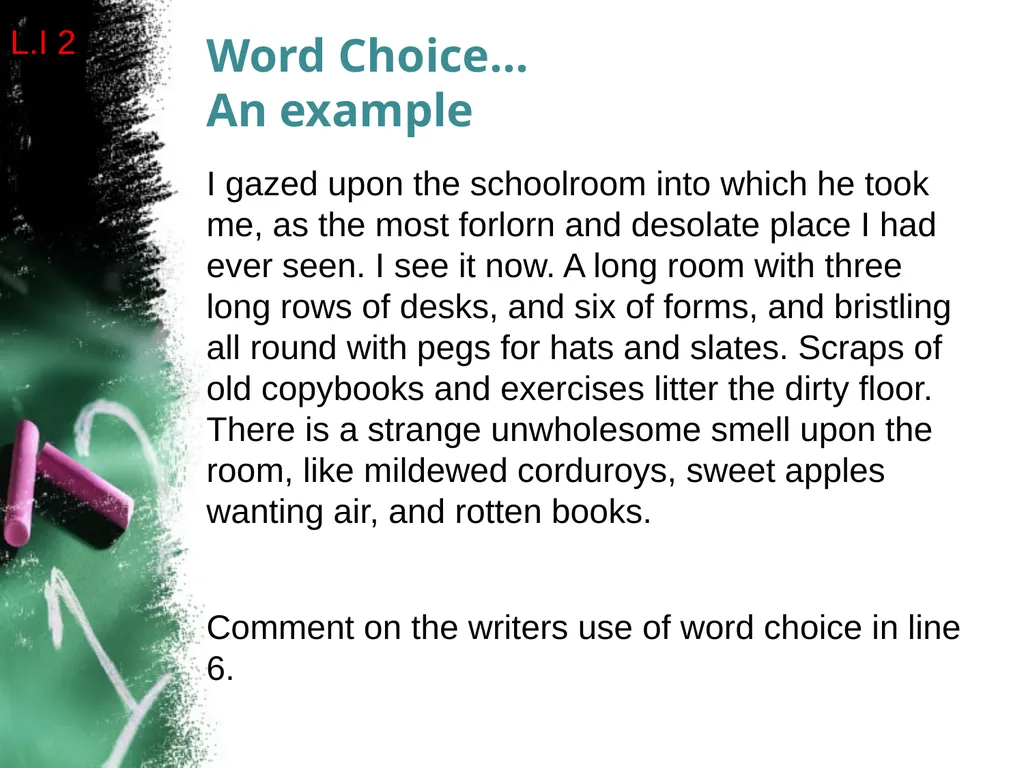
slide68. Word Choice… An example I gazed upon the schoolroom into which he took me, as the most forlorn and desolate place I had ever seen. I see it now. A long room with three long rows of desks, and six of forms, and bristling all round with pegs for hats and slates. Scraps of old copybooks and exercises litter the dirty floor. There is a strange unwholesome smell upon the room, like mildewed corduroys, sweet apples wanting air, and rotten books.
Comment on the writers use of word choice in line 6. L.I 2<br>
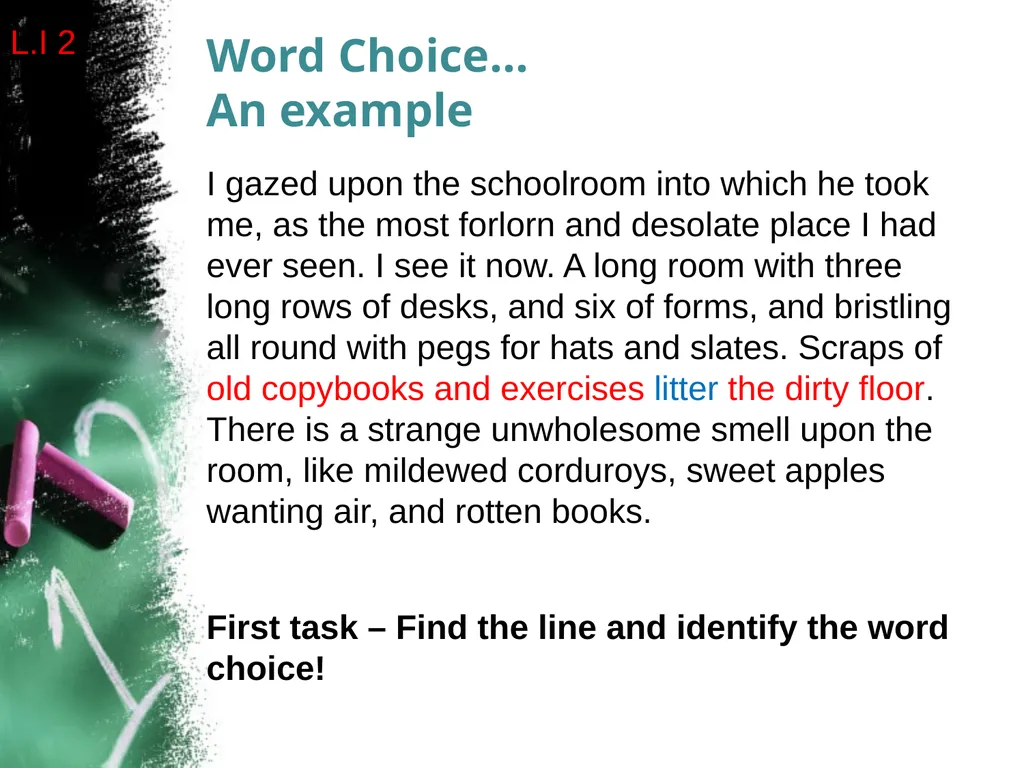
slide69. Word Choice… An example I gazed upon the schoolroom into which he took me, as the most forlorn and desolate place I had ever seen. I see it now. A long room with three long rows of desks, and six of forms, and bristling all round with pegs for hats and slates. Scraps of old copybooks and exercises litter the dirty floor. There is a strange unwholesome smell upon the room, like mildewed corduroys, sweet apples wanting air, and rotten books.
First task – Find the line and identify the word choice! L.I 2<br>
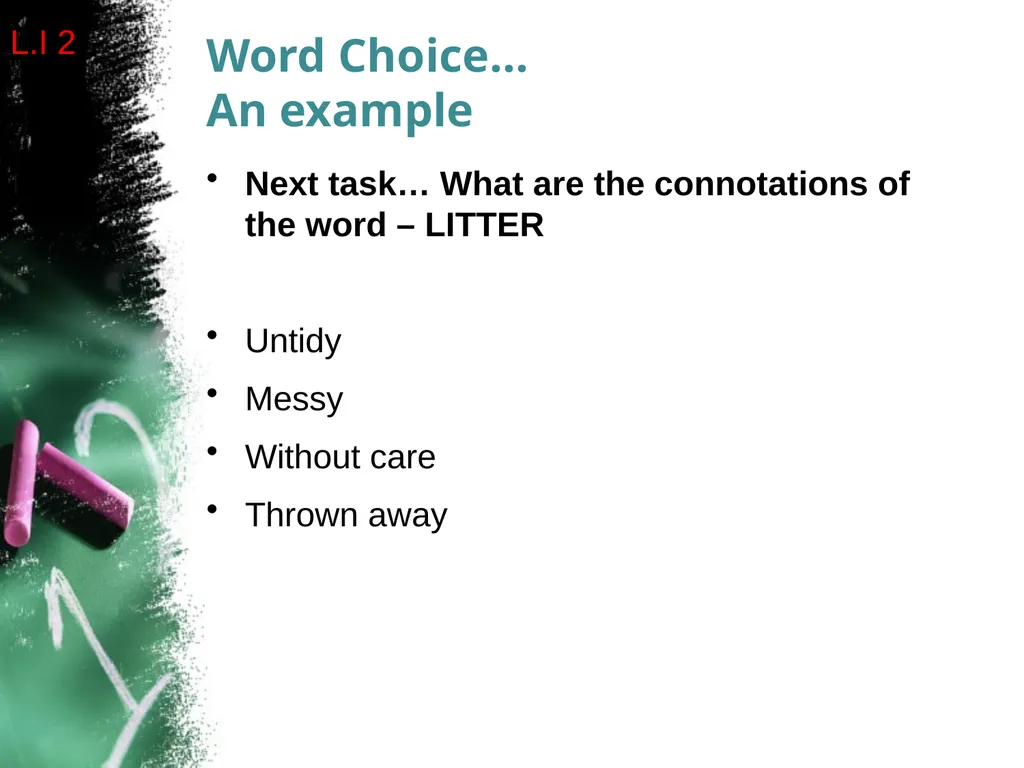
slide70. Word Choice… An example Next task… What are the connotations of the word – LITTER
Untidy
Messy
Without care
Thrown away L.I 2<br>
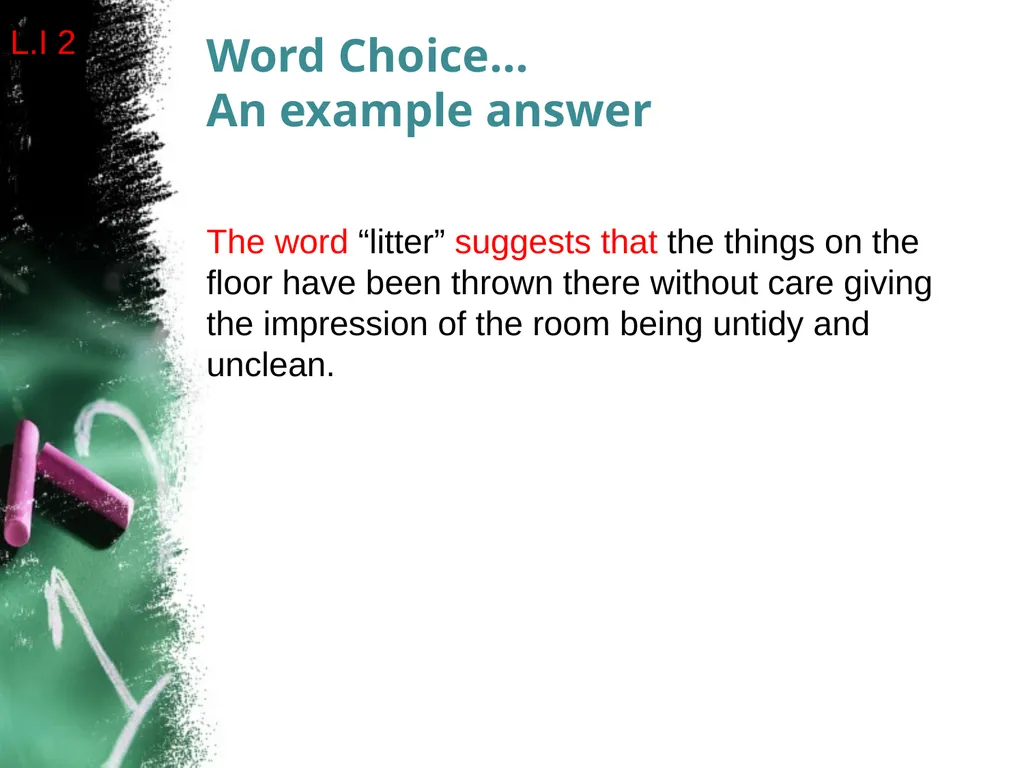
slide71. Word Choice… An example answer The word “litter” suggests that the things on the floor have been thrown there without care giving the impression of the room being untidy and unclean. L.I 2<br>
slide72. Question 1 “I could have burst into tears at that moment but I managed to control my feelings. Half an hour afterwards I slunk into the stable yard with a sinking heart. No one seemed to be about.”
Quote the word which suggests the writer is so embarrassed he does not wish to be seen. L.I 2<br>
slide73. Question 2 My guest was lying sprawled on his back. There was a long knife through his heart which skewered him to the floor.
What does the word ‘sprawled’ add to the picture of the way in which the man’s body was lying?
Explain how the word ‘skewered’ adds to the horror of the scene. L.I 2<br>
slide74. Question 3 The figure was shrouded in a garment of deepest black which concealed its head, its face, its form and left nothing of it visible except one outstretched hand.
What associations does the choice of “shrouded” add to this scene? L.I 2<br>
slide75. Question 4 Back in the main trench, I stood on the fire-step to watch the sky whitening. Sad and stricken the country emerged. I could see the ruined village below the hill and the leafless trees that waited like sentries up by Contalmaison. Down in the craters the dead water took a dull gleam from the sky. I stared at the tangles of wire and the leaning posts, and there seemed no sort of comfort left in life. My steel hat was heavy on my head while I thought how I’d been on leave last month.
Comment of any of the writer’s use of word choice in this extract. L.I 2<br>
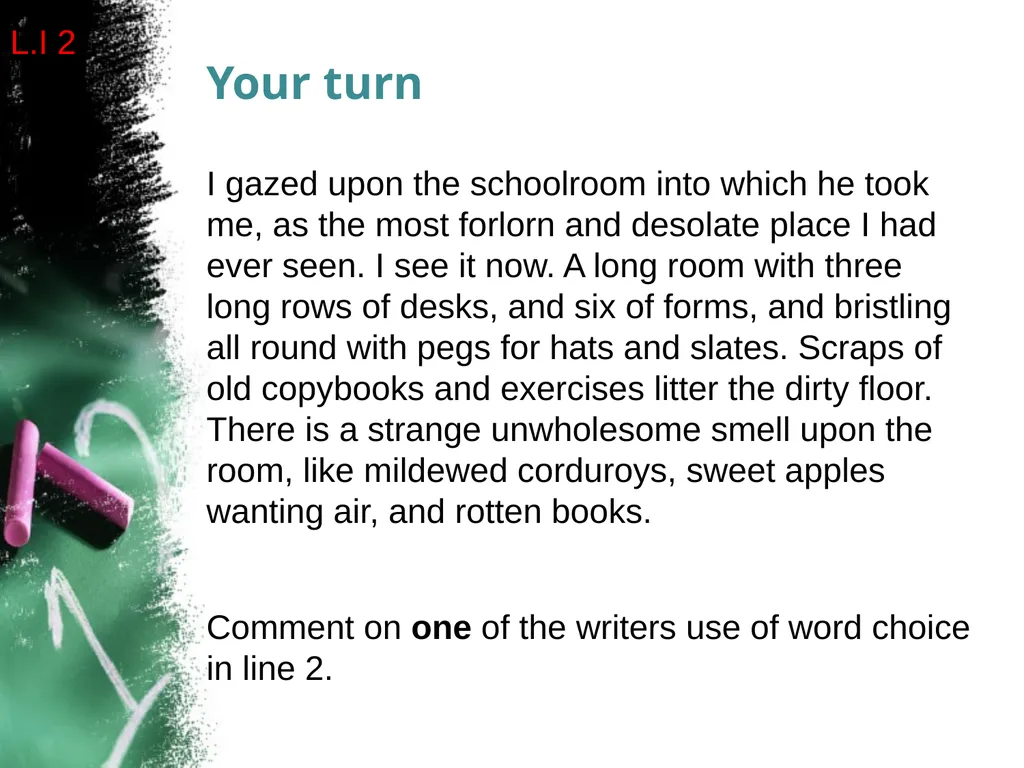
slide76. Your turn I gazed upon the schoolroom into which he took me, as the most forlorn and desolate place I had ever seen. I see it now. A long room with three long rows of desks, and six of forms, and bristling all round with pegs for hats and slates. Scraps of old copybooks and exercises litter the dirty floor. There is a strange unwholesome smell upon the room, like mildewed corduroys, sweet apples wanting air, and rotten books.
Comment on one of the writers use of word choice in line 2. L.I 2<br>
slide77. Learning Intentions To understand what an analysis question is asking you to do
To understand how to answer questions on word choice Learning Review I will call out 3 different colours that corresponds to your understanding of word choice questions. Rate your understanding
Red –No clue what was going on. I was sleeping
Yellow – Meh… So-so… More practice please
Green – Yup. I got this in the bag.<br>
slide78. TONE Analysis<br>
slide79. To understand what tone is
To be able to answer a question on tone Learning Intentions:<br>
slide80. What is it? The tone of a passage reflects the attitude of a writer. In spoken English you may speak sarcastically or politely, however this is more difficult to understand in writing.
How many times have you sent a text that you meant one way yet it was understood by someone totally differently? https://www.youtube.com/watch?v=naleynXS7yo
Only if nobody is offended by foul language! L.I 1<br>
slide81. Turn to your partner and say “I love you” in different ways:
Serious
Sarcastic
Humorous
Questioning
These are examples of tone in spoken language
Your job is to work out the tone of a written piece Say it aloud L.I 1<br>
slide82. Register <- What?
Techniques How do we identify it? L.I 1<br>
slide83. Register Register means the style of language. This can be either formal or informal.
Formal uses complex vocabulary and few contractions
Informal language sounds conversational. It uses simple language and is usually full of contractions. L.I 1<br>
slide84. Formal or informal?
This is to inform you that your book has been rejected by our publishing company as it was not up to the required standard. In case you would like us to reconsider it, we would suggest that you go over it and make some necessary changes. Register L.I 1<br>
slide85. Formal or informal?
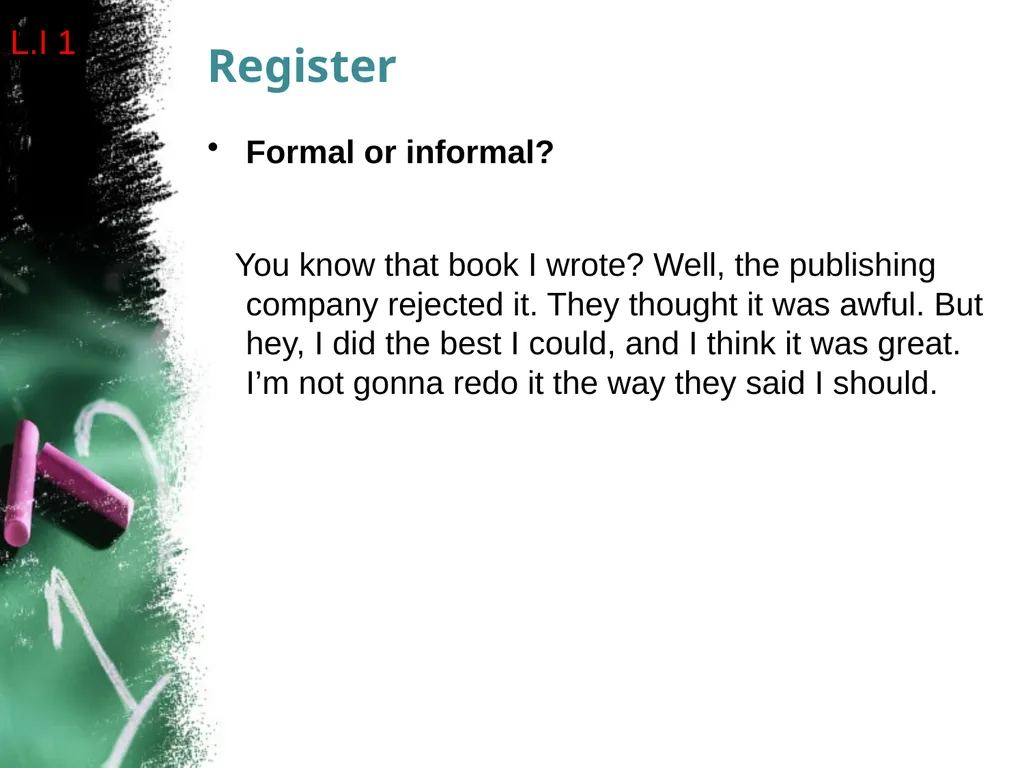
You know that book I wrote? Well, the publishing company rejected it. They thought it was awful. But hey, I did the best I could, and I think it was great. I’m not gonna redo it the way they said I should. Register L.I 1<br>
slide86. What techniques could be used to create tone?
WORD CHOICE! Techniques L.I 1<br>
slide87. Why I hate Winnie the Pooh
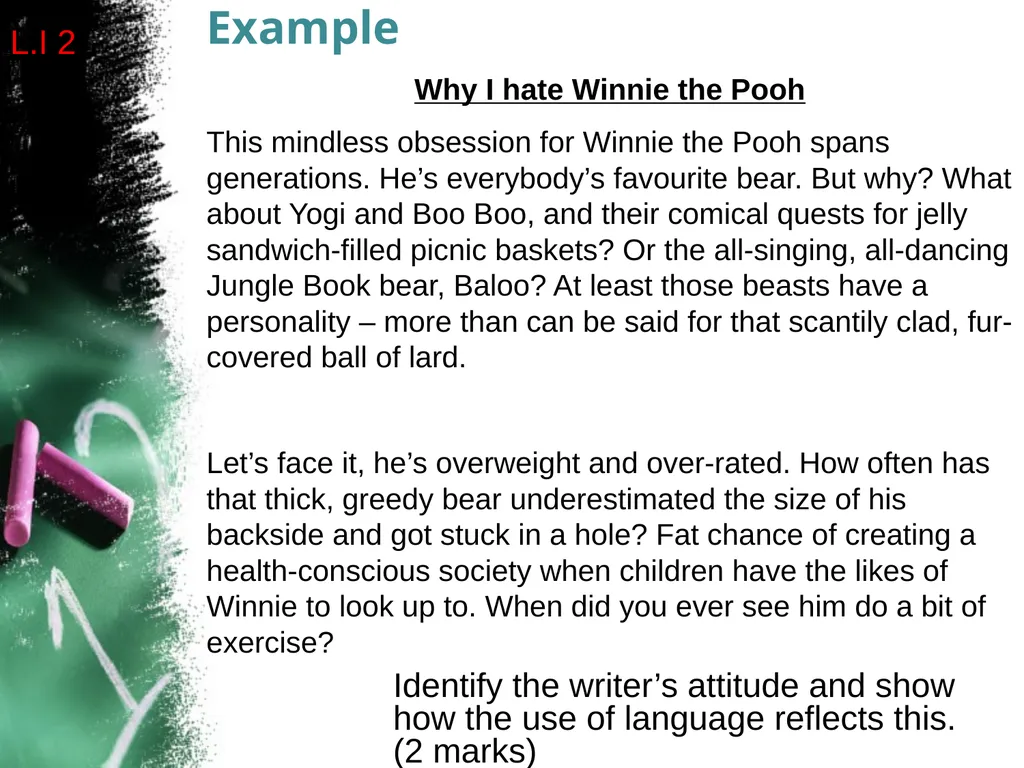
This mindless obsession for Winnie the Pooh spans generations. He’s everybody’s favourite bear. But why? What about Yogi and Boo Boo, and their comical quests for jelly sandwich-filled picnic baskets? Or the all-singing, all-dancing Jungle Book bear, Baloo? At least those beasts have a personality – more than can be said for that scantily clad, fur-covered ball of lard.
Let’s face it, he’s overweight and over-rated. How often has that thick, greedy bear underestimated the size of his backside and got stuck in a hole? Fat chance of creating a health-conscious society when children have the likes of Winnie to look up to. When did you ever see him do a bit of exercise? Example Identify the writer’s attitude and show how the use of language reflects this. (2 marks) L.I 2<br>
slide88. Identify the tone
Quote a word/expression as evidence
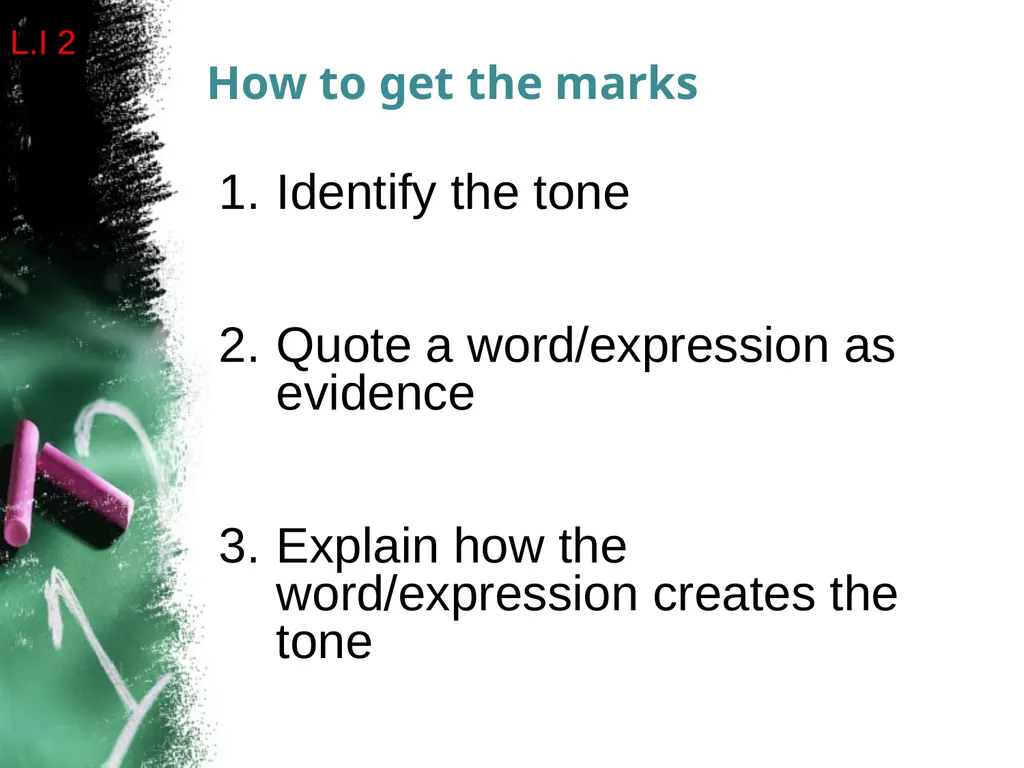
Explain how the word/expression creates the tone How to get the marks L.I 2<br>
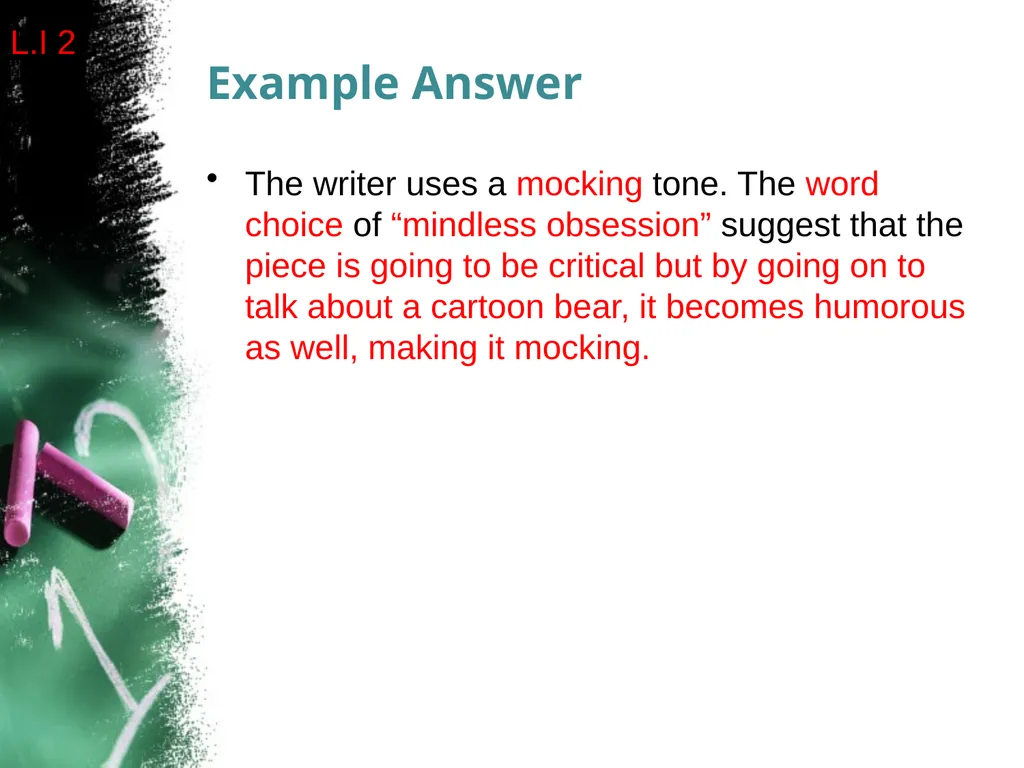
slide89. The writer uses a mocking tone. The word choice of “mindless obsession” suggest that the piece is going to be critical but by going on to talk about a cartoon bear, it becomes humorous as well, making it mocking. Example Answer L.I 2<br>
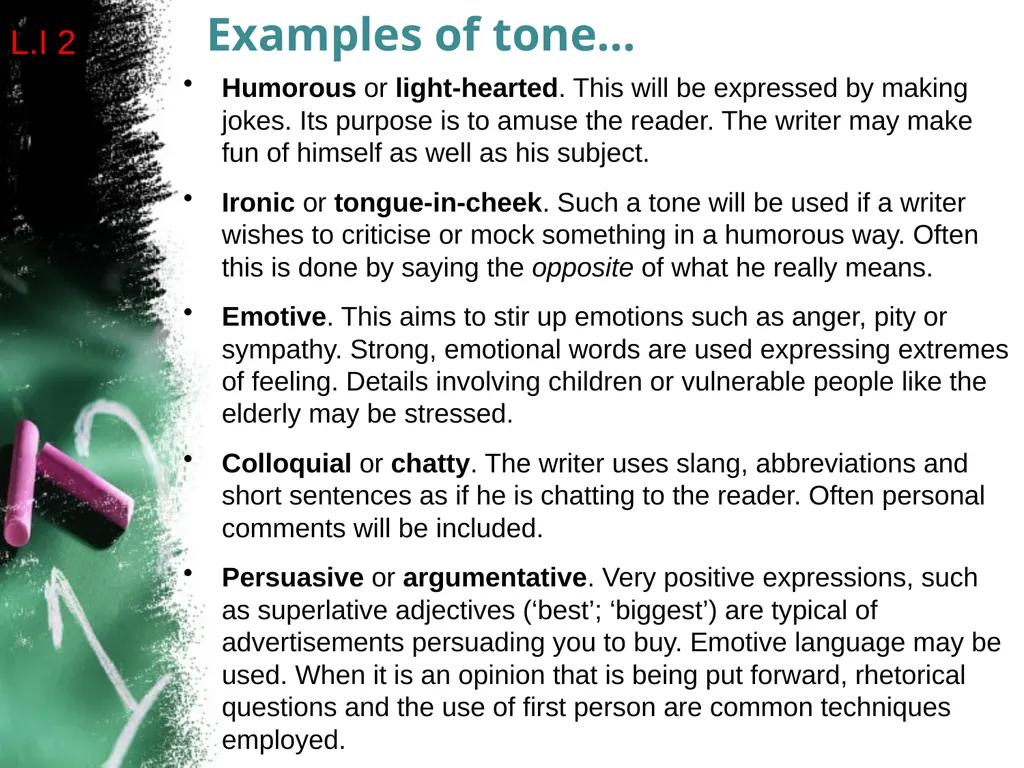
slide90. Humorous or light-hearted. This will be expressed by making jokes. Its purpose is to amuse the reader. The writer may make fun of himself as well as his subject.
Ironic or tongue-in-cheek. Such a tone will be used if a writer wishes to criticise or mock something in a humorous way. Often this is done by saying the opposite of what he really means.
Emotive. This aims to stir up emotions such as anger, pity or sympathy. Strong, emotional words are used expressing extremes of feeling. Details involving children or vulnerable people like the elderly may be stressed.
Colloquial or chatty. The writer uses slang, abbreviations and short sentences as if he is chatting to the reader. Often personal comments will be included.
Persuasive or argumentative. Very positive expressions, such as superlative adjectives (‘best’; ‘biggest’) are typical of advertisements persuading you to buy. Emotive language may be used. When it is an opinion that is being put forward, rhetorical questions and the use of first person are common techniques employed. Examples of tone… L.I 2<br>
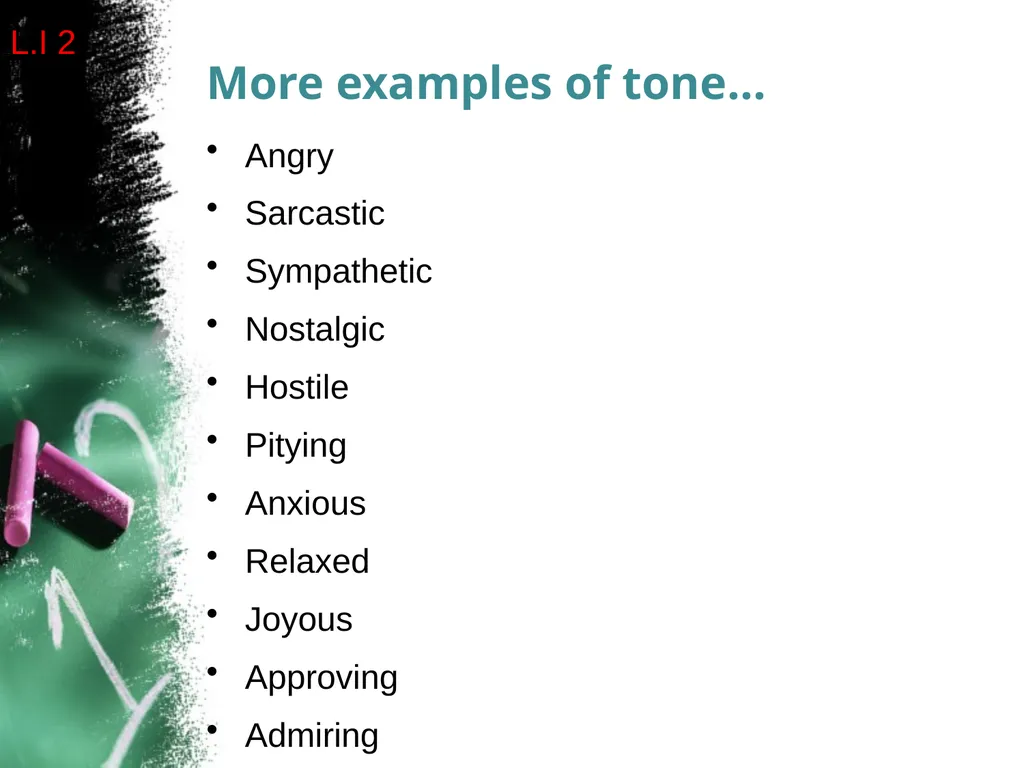
slide91. More examples of tone… Angry
Sarcastic
Sympathetic
Nostalgic
Hostile
Pitying
Anxious
Relaxed
Joyous
Approving
Admiring L.I 2<br>
slide92. Your turn On the next 5 slides are extracts from articles.
Your task to identify the tone being used by the writer
HINT: The tone could come from the list of 5 that were fully explained on the board previously L.I 2<br>
slide93. Extract 1 Terror of Hijack Jet Passengers.
Twelve gunmen who hijacked a jet subjected passengers to a terrifying five-day ordeal. Shortly after the flight took off from Kabul, Afghanistan, the men forced the pilot to divert to Stansted Airport. When the aircraft landed, they threatened to kill the 173 passengers — who included 21 children and a heavily pregnant woman — and blow up the aircraft unless they were granted asylum. The hijackers — who were heavily armed with hand grenades, loaded handguns and knives and knuckle-dusters — made repeated threats to kill passengers. A steward was beaten up and left on the tarmac with his hands tied behind his back. Passengers were ordered to keep their heads down and not to look up on pain of death. L.I 2<br>
slide94. Extract 2 In the morning I went to Elvis Presley’s birthplace. A path behind the house led to a gift shop where you could buy Elvis memorabilia — albums, badges, plates, posters. There was a visitors’ book by the door. The book had a column for remarks. Reading down the list they said, ‘Nice’, ‘Real nice’, ‘Very nice’, ‘Nice’. Such eloquence. L.I 2<br>
slide95. Extract 3 You don’t build a reputation like the University’s for no apparent reason. In fact, we believe that it’s our devotion to quality and excellence for the last 400 years that has gained us this position. It’s a position we are proud of and one we will do everything to respect. Especially these days, with more and more emphasis on quality, the University remains committed to excellence above everything else. L.I 2<br>
slide96. Extract 4 Star Wars (1977). A technically dazzling and enjoyable science fiction film for children of all ages. The plot is the bad guys (the galactic empire) vs the good guys (the rebels). You’ll root for the good guys and hope the beautiful young princess will be rescued by two young Prince Charmings. You’ll still enjoy the film on TV. L.I 2<br>
slide97. Extract 5 My father, when behind the wheel, was more or less permanently lost. Most of the time he was just kind of lost, but whenever we got near something we were intent on seeing he would become seriously lost. Generally it would take him about an hour to realise that he had gone from the first stage to the second. All during that time, as he blundered through some unfamiliar city, making sudden and unpredictable turns, getting honked at for going the wrong way down one-way streets or for hesitating in the middle of busy intersections, my mother would mildly suggest that perhaps we should pull over and ask directions. But my father would pretend not to hear her and would press on in that emiobsessional state that tends to overcome fathers when things aren’t going well.
Eventually, after driving the wrong way down the same one-way street so many times that merchants were beginning to come and watch from their doorways, Dad would stop the car and gravely announce, ‘Well, I think we should ask directions’, in a tone suggesting that this had been his desire all along. L.I 2<br>
slide98. To understand what tone is
To be able to answer a question on tone Learning Intentions: On a post-it note, note down one thing you have learned from today’s lesson and one question you still have about tone. Learning Review:<br>
slide99. SENTENCE STRUCTURE Analysis<br>
slide100. Learning Intentions To understand what is meant by Sentence Structure
To be able to identify different types of Sentence Structure
To be able to answer a question on Sentence Structure<br>
slide101. Sentence Structure… What is it? The structure of a sentence means the way in which it is made up, and how various elements of a sentence are arranged.
Punctuation can help to give you clues<br>
slide102. Recap In S1 you may have looked at different types of sentences:
Statements
Questions
Commands
Exclamations
Minor Sentences
The next few slides will recap these in case you are unsure of them<br>
slide103. Statements These tell you something. They often end in a full stop. Most sentences are statements, so it is usually other types of sentences that you will comment on.<br>
slide104. Questions These ask something. They always end in a question mark. Using questions may challenge a reader to think about an issue.
Look out for rhetorical questions, which do not expect an answer
Example: “What kind of answer is that?”
Such questions aim to stir up strong feelings in the reader, such as anger<br>
slide105. Commands These tell you to do something. They end with either a full stop or an exclamation mark. They are often used in advertising.
Example: “Think of a number.”<br>
slide106. Exclamations These express excitement or surprise.
Exclamations do not always contain verbs. They often begin with ‘What’ or ‘How’ and end in either an exclamation mark or a full stop.<br>
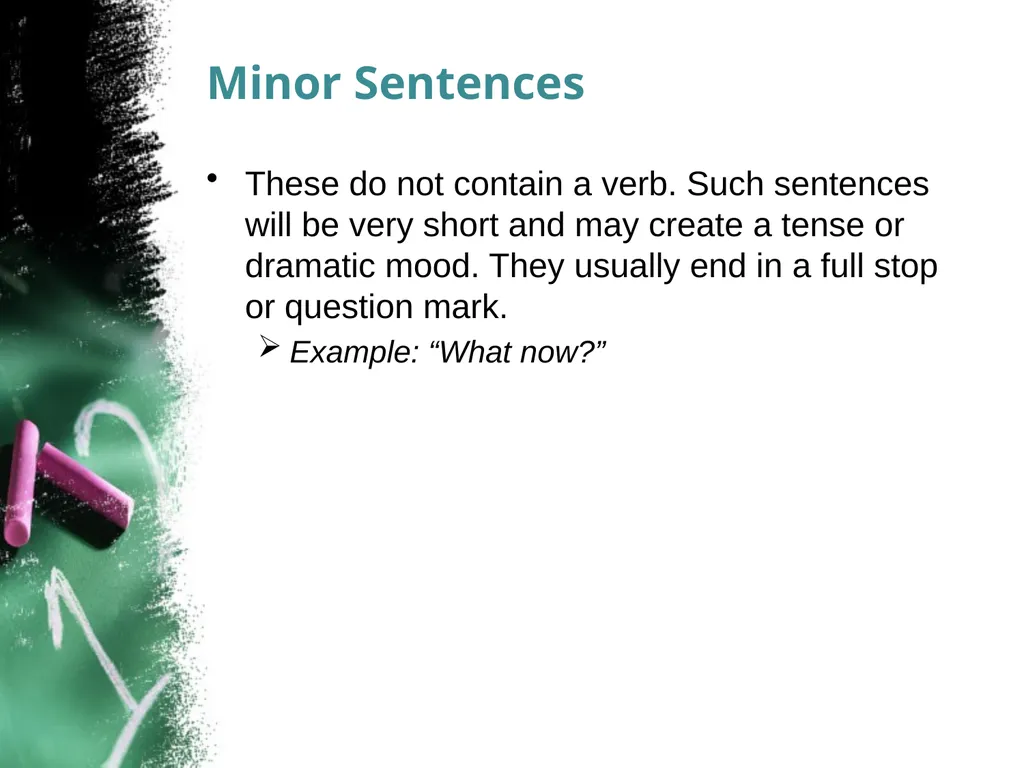
slide107. Minor Sentences These do not contain a verb. Such sentences will be very short and may create a tense or dramatic mood. They usually end in a full stop or question mark.
Example: “What now?”<br>
slide108. Sentence Structure You will never be asked to simply identify the type of sentence
You will be asked to explain the effect of choosing particular types<br>
slide109. Sentence Structure… The length of sentences You should always consider whether a sentence is long and complex or short and simple
Long sentences containing several verbs are called complex sentences. These are typical of written English, and usually, the more complex the sentences, the more formal the language
Sentences with only one verb are called simple. These are typical of speech and types of language that aims to communicate quickly<br>
slide110. Sentence Structure… Patterns in Sentences There are a number of patterns we can recognise in sentence structure
These are possibly easier to spot and comment on than other forms of sentence structure
These include
Lists – show range and variety
Repetition – highlights an important idea
Parenthesis – gives additional information<br>
slide111. Sentence Structure… The best advice is that:
ANYTHING UNUSUAL PROBABLY DESERVES A COMMENT<br>
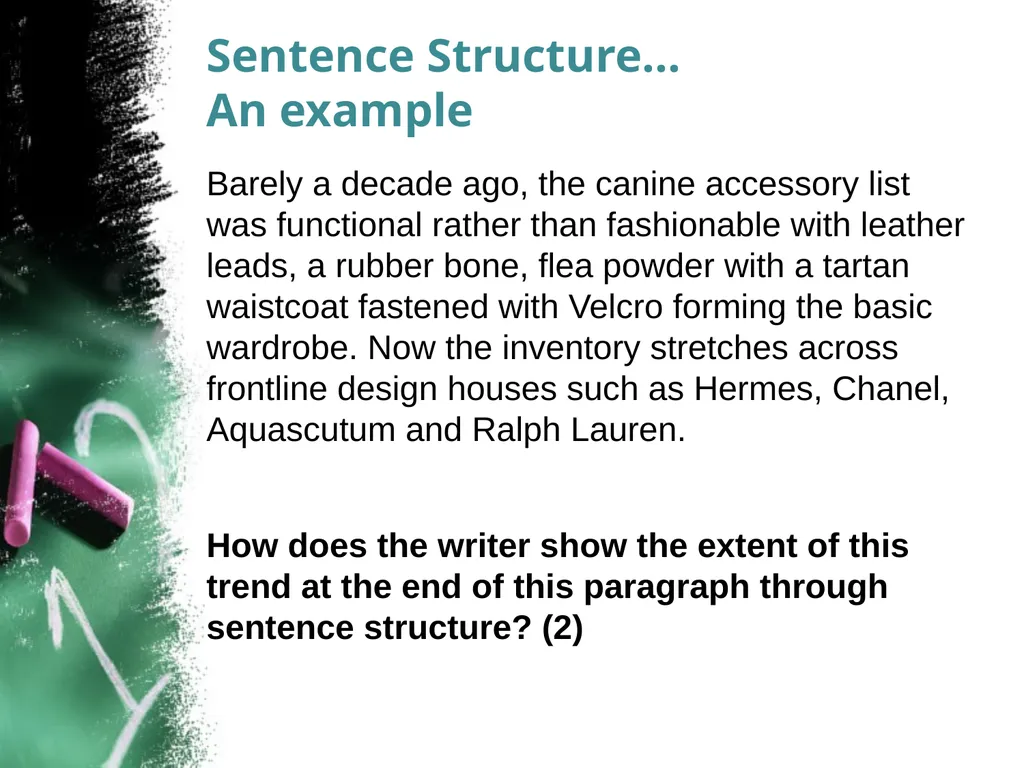
slide112. Sentence Structure… An example Barely a decade ago, the canine accessory list was functional rather than fashionable with leather leads, a rubber bone, flea powder with a tartan waistcoat fastened with Velcro forming the basic wardrobe. Now the inventory stretches across frontline design houses such as Hermes, Chanel, Aquascutum and Ralph Lauren.
How does the writer show the extent of this trend at the end of this paragraph through sentence structure? (2)<br>
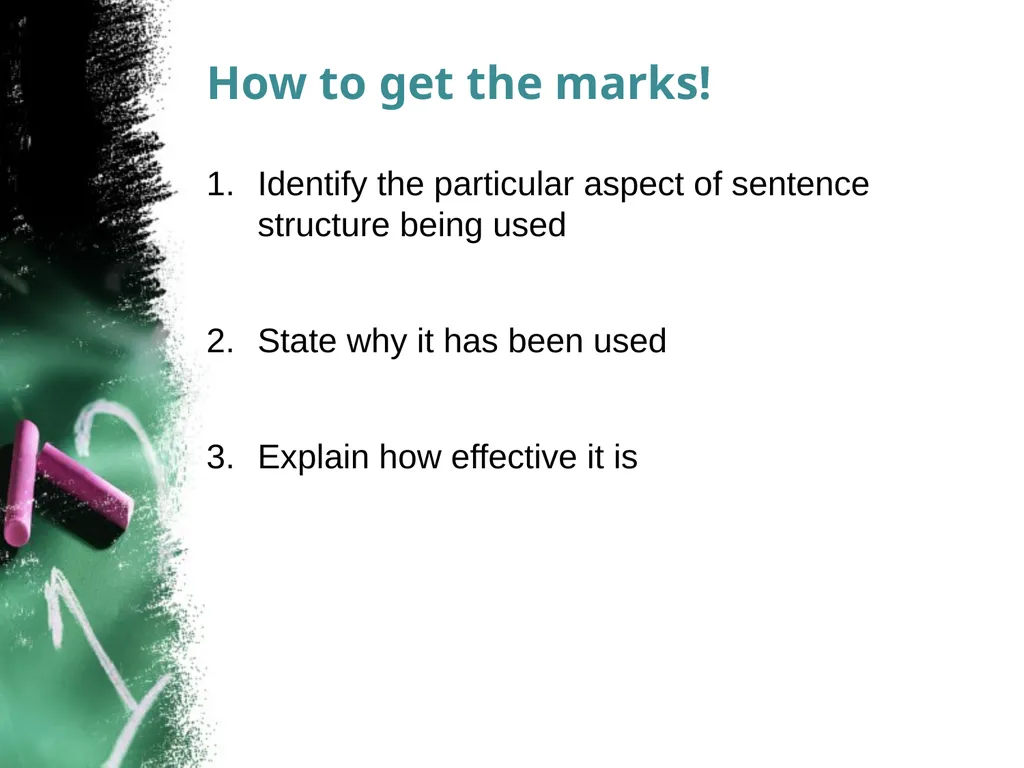
slide113. How to get the marks! Identify the particular aspect of sentence structure being used
State why it has been used
Explain how effective it is<br>
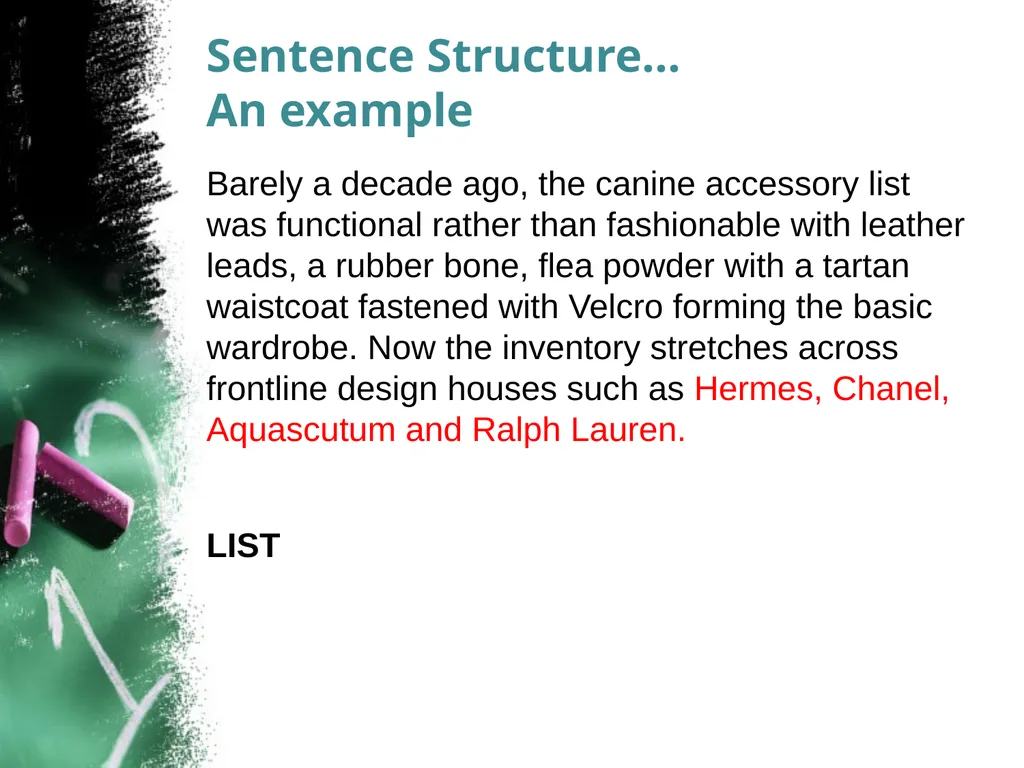
slide114. Sentence Structure… An example Barely a decade ago, the canine accessory list was functional rather than fashionable with leather leads, a rubber bone, flea powder with a tartan waistcoat fastened with Velcro forming the basic wardrobe. Now the inventory stretches across frontline design houses such as Hermes, Chanel, Aquascutum and Ralph Lauren.
LIST<br>
slide115. Sentence Structure… An example answer The writer uses a list in this sentence to show the range of different designers who have joined the trend of producing clothing lines for pets.<br>
slide116. Sentence Structure… Your turn Birds are not the only ones to suffer. Turtles, whales, seals and sea lions have all eaten plastic. It is estimated that much of the plastic rubbish that fell into the sea 50 years ago is till there today, either floating in the huge circulating “gyres” of the Pacific or sitting on the seabed waiting to be gobbled up by a passing sea creature.
How does the sentence structure emphasise the damage plastic causes in this paragraph? (2)<br>
slide117. The optician prescribed me glasses- to be precise, one pair of standard issue National Health specs of the type specifically designed to maximise the humiliation for any child. They worked a treat. From being a kid with poor eyesight and moderately high esteem I became a kid with good eyesight and low self esteem.
Comment on the sentence structure used in this paragraph. (2)<br>
slide118. In Bilbao recently for a weekend, it took me a little while to figure out why the atmosphere was so different to back home. Then I realised it was a Sunday and that all the shops were closed.
In this country, whether its Chinese New Year or Christmas, Easter or Halloween, we’re out there answering the call of the high street. And if M&S profits go down, it’s a crisis in the economy. We’ve created a system in which our future depends on our ability to shop until we drop.
How does the sentence structure in the second paragraph emphasise the extent of our shop opening hours? (2)<br>
slide119. Non-stick chewing gum which cannot glue itself to pavements, seats or shoes – and with the added bonus of being completely bio-degradable – has been invented by a British scientist in what is thought to be a world first.
How does the writer’s use of sentence structure help your understanding of the positives of this new chewing gum? (2)<br>
slide2. Aims of this unit To develop your critical reading skills
To expand your knowledge of literary techniques
To prepare you for the S2 assessments<br>
slide3. Learning Intentions for Today To understand what RUAE is
To know the 3 elements of RUAE
To begin to look at understanding questions<br>
slide4. What is R.U.A.E? RUAE is the part of this course that allows you to show your ability to understand a text fully and analyse the language of it.
The questions on a text will focus on 3 main areas:
What the writer says – UNDERSTANDING
How the writer says it – ANALYSIS
How effectively the writing says it – EVALUATION
We will look at each of these in turn L.I 1
L.I 2<br>
slide5. UNDERSTANDING<br>
slide6. Types of Understanding Questions There are a number of different types of understanding questions:
In your own words
Summarising
Context
You will learn how to answer each of these different questions L.I 3<br>
slide7. In your own words… A large number of Understanding questions asks you to show that you know what the writer is saying by translating important information into your own words
Having an extensive vocabulary will help you with this task. Your teacher can provide you with spelling lists to improve your knowledge if you need help with these questions L.I 3<br>
slide8. In your own words… How to go about it There are some acronyms to help you answer these questions
RAP
PARA L.I 3<br>
slide9. RAP Read the section
Ask yourself: What are the most important details? Underline them
Put these details in your own words. L.I 3<br>
slide10. PARA Put the text in your own words
Avoid copying the text
Rearrange similar text
Ask yourself if you included all the important points. L.I 3<br>
slide11. In your own words… An example China, one of the countries that can boast of an ancient civilisation, has a long and mysterious history – almost 5,000 years of it! Like most other great civilizations of the world, China can trace her culture back to a blend of small original tribes which have expanded till they became the great country we have today.
Q) In your own words, how did China develop over time? L.I 3<br>
slide12. In your own words… An example China, one of the countries that can boast of an ancient civilisation, has a long and mysterious history – almost 5,000 years of it! Like most other great civilizations of the world, China can trace her culture back to a blend of small original tribes which have expanded till they became the great country we have today.
Q) In your own words, how did China develop over time? L.I 3<br>
slide13. In your own words… An example answer China originally started as a collection of small communities that merged together to become the China we now know.<br>
slide14. In your own words… Now you try It is not necessary for Scent Hounds to be as fast and agile as Sight Hounds – They do not need to keep their prey in sight. Scent hounds are built for endurance. They can follow a scent for long distances and even across running water.
Q) Explain in your own words why Scent Hounds don’t need “to be as fast and agile as sight hounds”. L.I 3<br>
slide15. In your own words… Now you try 2) Stories about haunted places are always fascinating. What goes on there, and how, and why? Some hauntings can be explained as the results of ordinary trickery. In others some natural cause is at work, though it has not yet been traced.
Q) In your own words, what two explanations does the writer give to describe the belief that some places are haunted? L.I 3<br>
slide16. In your own words… Now you try 3) I’m nocturnal. I love the moonlight, the shadows, the dark places, the dappled murk. I’m not being poetic. I’m simply being true to my nature, my nocturnal nature. Like all tarantulas.
Q) In your own words, in what way is the speaker “like all tarantulas”? L.I 3<br>
slide17. In your own words… Now you try 4) Smugglers used to spread rumours that the places where they landed their cargo were haunted. This made local people keep away, and accounted for strange lights seen flitting about after dark, or peculiar sounds. Today just occasionally tenants who want to be moved from one house to another have been known to stage a ‘haunt’.
Q) Using your own words, what two reasons does the writer give for smugglers pretending that their landing places were haunted? L.I 3<br>
slide18. Learning Review To understand what RUAE is
To know the 3 elements of RUAE
To begin to look at understanding questions Exit Pass On a post-it, write down:
One thing you learned from today’s lesson
One question you still have about what you learned<br>
slide19. Summarising Questions Understanding<br>
slide20. Starter – With your partner Most reality TV contestants almost always have a back story of personal triumph over adversity which enables us to feel that we are helping them to succeed, that we are giving them a break when no-one else will. And perhaps this is why Susan Boyle, who grew up in a council house and was bullied as a child for her learning difficulties, has proved such an enduring figure.
In your own words explain why the writer chooses Susan Boyle as an example of someone who is an “enduring figure”.<br>
slide21. Learning Intentions To develop our knowledge of Understanding questions
To understand how to answer summarising questions<br>
slide22. Summarise… These questions are similar to “in your own words” questions.
You could be asked to “list ideas” or “give reasons”
These questions ask you to list a number of points made by a writer in a section of text
You must still use your own words to answer these questions L.I 1
L.I 2<br>
slide23. Summarise… How to go about it Find the section of the text you are being asked to look at
Highlight/Underline the main points of the section
List these points either as sentences or bullet points in your own words
Remember RAP and PARA. They can be used in these questions too. L.I 2<br>
slide24. Summarise… An example The benefits of liking football at school were simply incalculable. I was the only Arsenal supporter in first year. But in that glorious first football-saturated term, it didn’t matter that I was on my own. In any case, my new best friend, a Derby County fan, was similarly isolated. The main thing was that you were a believer.
Transferring to secondary school was easy. I was probably the smallest boy in the first year, but my size didn’t matter, although my friendship with the Derby fan, the tallest by several feet, was pretty handy; and though my performance as a student was undistinguished (I was bunged into the ‘B’ stream at the end of the year and stayed there throughout my entire grammar school career), the lessons were a breeze. Even the fact that I was one of only three boys wearing shorts wasn’t as traumatic as it should have been. As long as you knew the name of the Burnley manager nobody much cared that you were an eleven-year-old dressed as a six-year-old. L.I 2<br>
slide25. Summarise… An example Question:
The writer states that his interest in football helped him fit in to his new school and get on with his schoolmates.
Summarise three facts that he mentions that might have made things difficult for him.
(3 marks) L.I 2<br>
slide26. Summarise… An example The benefits of liking football at school were simply incalculable. I was the only Arsenal supporter in first year. But in that glorious first football-saturated term, it didn’t matter that I was on my own. In any case, my new best friend, a Derby County fan, was similarly isolated. The main thing was that you were a believer.
Transferring to secondary school was easy. I was probably the smallest boy in the first year, but my size didn’t matter, although my friendship with the Derby fan, the tallest by several feet, was pretty handy; and though my performance as a student was undistinguished (I was bunged into the ‘B’ stream at the end of the year and stayed there throughout my entire grammar school career), the lessons were a breeze. Even the fact that I was one of only three boys wearing shorts wasn’t as traumatic as it should have been. As long as you knew the name of the Burnley manager nobody much cared that you were an eleven-year-old dressed as a six-year-old. L.I 2<br>
slide27. Summarise… An example The benefits of liking football at school were simply incalculable. I was the only Arsenal supporter in first year. But in that glorious first football-saturated term, it didn’t matter that I was on my own. In any case, my new best friend, a Derby County fan, was similarly isolated. The main thing was that you were a believer.
Transferring to secondary school was easy. I was probably the smallest boy in the first year, but my size didn’t matter, although my friendship with the Derby fan, the tallest by several feet, was pretty handy; and though my performance as a student was undistinguished (I was bunged into the ‘B’ stream at the end of the year and stayed there throughout my entire grammar school career), the lessons were a breeze. Even the fact that I was one of only three boys wearing shorts wasn’t as traumatic as it should have been. As long as you knew the name of the Burnley manager nobody much cared that you were an eleven-year-old dressed as a six-year-old. L.I 2<br>
slide28. Summarise… An example answer He was the only boy who supported that particular team
He was smaller than all the other boys in the class
He looked childish as he wore shorts
(1 mark for each) L.I 2<br>
slide29. Summarise… Now you try Your teacher will issue a worksheet for this task. L.I 2<br>
slide30. Learning Review To develop our knowledge of Understanding questions
To understand how to answer summarising questions Exit Pass Think of the most important word or phrase from this lesson.
Look at the scrabble grid on the next slide.
How many points would your word be worth?
Compare with the person sitting next to you.<br>
slide32. Context Questions Understanding<br>
slide33. Starter – With your partner So if children are not so much interested in picking up a paperback, maybe that says more about the quality of books currently being foisted upon them than it does about the evils of digital entertainment. Children are, after all, quite discriminating. If someone writes a new Harry Potter, they’ll curl up with it for days. If not, there’s always the games console.
Explain in your own words the reasons given by the writer for children reading less. (2)<br>
slide34. Learning Intentions To develop our knowledge of Understanding questions
To understand how to answer context questions<br>
slide35. Context… This type of understanding question asks you to explain the meaning of a word or phrase used in the text.
You should use the context to help you
The context means the part of the text where the word is used L.I 1<br>
slide36. Context… How to go about it… Explain the meaning of the word or phrase
Explain how the rest of the text makes this clear by quoting the word or words which provide clues L.I 2<br>
slide37. Context… An example… I’m nocturnal. I love the moonlight, the shadows, the dark places, the dappled murk. I’m not being poetic. I’m simply being true to my nature, my nocturnal nature. Like all tarantulas.
Q) Show how the context helps you understand the meaning of ‘nocturnal’. L.I 2<br>
slide38. Context… An example answer… ‘Nocturnal’ means being active by night. The writer refers to his preference for ‘moonlight’ and ‘dark’ which both suggest night-time. L.I 2<br>
slide39. Now you try (1) 1968 was, I suppose, the most traumatic year of my life. After my parents’ separation we moved into a smaller house, but for a time, because of some sort of chain, we were homeless and had to stay with our neighbours; I became seriously ill with jaundice; and I started at the local grammar school.
Show how the context helped you understand the word ‘traumatic’. L.I 2<br>
slide40. Now you try (2) Saturday afternoon is a festive day with the natives. The girls put on all the finery they can on Saturday afternoon — silk robes, hats trimmed with fresh flowers and home-made necklaces of vermilion tinted blossoms.
What does the word ‘finery’ mean? How did you work this out? L.I 2<br>
slide41. Now you try (3) There are many ordinary happenings which have frightened or startled people into believing they were caused by ghostly means. Subterranean movements of earth and rock in old mine-workings, for instance, can cause very odd noises, and miners hearing tappings and rumblings in the underground darkness used to be sure they were made either by earth spirits or by the spirits of other miners long dead.
Show how the context led you to the meaning of the word ‘subterranean’. L.I 2<br>
slide42. Learning Intentions To develop our knowledge of Understanding questions
To understand how to answer context questions Learning Review Using the fist-to-five technique, rate your understanding of each of the 2 learning intentions for today<br>
slide43. Context Questions More Practise<br>
slide44. Learning Intentions To be secure in our understanding of how to answer a context question<br>
slide45. How do you answer a context question? L.I 1<br>
slide46. Copy the table below into your notes… L.I 1<br>
slide47. The next slide is an extract from Robert Louis Stevenson’s novel Kidnapped
The underlined words appear in your table
Can you work out the meaning of the words using the context? L.I 1<br>
slide48. On the forenoon of the second day, coming to the top of a hill, I saw all the country fall away before me down to the sea. In the midst of this descent, on a long ridge, the city of Edinburgh was smoking like a kiln. There was a flag upon the castle, and ships moving or lying anchored in the firth; both of which, for as far away as they were, I could distinguish clearly. Both brought my country heart into my mouth.
Presently after, I came by a house where a shepherd lived. I got a rough direction for the neighborhood of Cramond. I worked my way to westward, till I came out upon the Glasgow road. And there, to my great pleasure and wonder, I beheld a regiment marching, every foot in time. An old red-faced general on a grey horse was at the one end, and at the other the company of Grenadiers. The pride of life seemed to mount into my brain at the sight of the red coats and the hearing of that merry music. L.I 1<br>
slide49. With your partner, try to work out the meaning of the words… Your are doing this to improve your knowledge of context questions and improve your vocabulary
This is a paired task
The noise level should be appropriate for paired work
You have until the end of the period L.I 1<br>
slide50. On the forenoon of the second day, coming to the top of a hill, I saw all the country fall away before me down to the sea. In the midst of this descent, on a long ridge, the city of Edinburgh was smoking like a kiln. There was a flag upon the castle, and ships moving or lying anchored in the firth; both of which, for as far away as they were, I could distinguish clearly. Both brought my country heart into my mouth.
Presently after, I came by a house where a shepherd lived. I got a rough direction for the neighborhood of Cramond. I worked my way to westward, till I came out upon the Glasgow road. And there, to my great pleasure and wonder, I beheld a regiment marching, every foot in time. An old red-faced general on a grey horse was at the one end, and at the other the company of Grenadiers. The pride of life seemed to mount into my brain at the sight of the red coats and the hearing of that merry music. L.I 1<br>
slide51. L.I 1<br>
slide52. Learning Review Understanding Questions<br>
slide53. Quick Quiz What are the 3 types of question in RUAE?
What are the 3 types of understanding question?
What does PARA stand for?
How should you structure an answer for a context question?
What does RAP stand for?<br>
slide54. Answers Understanding, Analysis and Evaluation
“In your own words” “Summarising” “Context”
PARA
Put thing into your own words
Avoid copying the text
Re-arrange similar text
Ask yourself if you have included all important points
Context
State the meaning of the word
Quote and comment on words/phrases that led you to this
RAP
Read the passage
Ask yourself what the important points are
Put these points into your own words<br>
slide55. Now try answering questions of a full text Passage 1 - Skateboards<br>
slide56. ANALYSIS<br>
slide57. Learning Intentions To understand what an analysis question is asking you to do
To understand how to answer questions on word choice<br>
slide58. Analysis Questions… What are they? Analysis questions ask you to comment on a writer’s use of particular techniques
These techniques can include:
Word Choice
Tone
Sentence Structure
Punctuation
Imagery
It is your job to work out why the technique is being used and explain what it adds to the passage L.I 1<br>
slide59. Analysis Questions… What are they? Over the course of the next few lessons, you will look at each of these different techniques
Some analysis questions have a specific structure to their answer (such as imagery) which you will learn L.I 1<br>
slide60. WORD CHOICE Analysis Questions<br>
slide61. Word Choice… What is it? Questions that ask about word choice are really asking you to pick out and comment on a writer’s use of unusual words
The words that you might identify for word choice questions are usually variations of simple words L.I 2<br>
slide62. Word Choice… Discuss in your pairs Look at the two sentences below.
What is the difference between them?
How is the meaning of each sentence changed?
Joe walked along the corridor to his class.
Joe bolted along the corridor to his class. L.I 2<br>
slide63. Word Choice… Denotation vs. Connotation In word choice questions, you have to show that you both the denotation and connotation of particular words that you have identified
Denotation is the actual meaning of a word. The definition.
Connotation refers to the ideas we associate with a word. L.I 2<br>
slide64. The Association Game I am going to say a word to the class.
I will ask someone to say the first work they think of when they hear that word
The next person should say what they think of when they hear the word said by the person before
This should go around the class
See the next slide for an example L.I 2<br>
slide65. The Association Game Mr McVicar: Blue
Laura: Cold
Jane: Ice
Sam: North Pole
John: Christmas
Sarah: Family
Paul: Love
Lisa: Heart
Etc... L.I 2<br>
slide66. Word Choice… How to answer the questions… When you are answering a word choice question, you are explaining the connotation of a word.
The words have been used because of their connotations
You should lay out your answer in the following format L.I 2<br>
slide67. Word Choice… Laying out an answer The word “__________” suggests that ________________________________________________________________________________
OR
“___________” makes us think about ________________________________________________________________________________ L.I 2<br>
slide68. Word Choice… An example I gazed upon the schoolroom into which he took me, as the most forlorn and desolate place I had ever seen. I see it now. A long room with three long rows of desks, and six of forms, and bristling all round with pegs for hats and slates. Scraps of old copybooks and exercises litter the dirty floor. There is a strange unwholesome smell upon the room, like mildewed corduroys, sweet apples wanting air, and rotten books.
Comment on the writers use of word choice in line 6. L.I 2<br>
slide69. Word Choice… An example I gazed upon the schoolroom into which he took me, as the most forlorn and desolate place I had ever seen. I see it now. A long room with three long rows of desks, and six of forms, and bristling all round with pegs for hats and slates. Scraps of old copybooks and exercises litter the dirty floor. There is a strange unwholesome smell upon the room, like mildewed corduroys, sweet apples wanting air, and rotten books.
First task – Find the line and identify the word choice! L.I 2<br>
slide70. Word Choice… An example Next task… What are the connotations of the word – LITTER
Untidy
Messy
Without care
Thrown away L.I 2<br>
slide71. Word Choice… An example answer The word “litter” suggests that the things on the floor have been thrown there without care giving the impression of the room being untidy and unclean. L.I 2<br>
slide72. Question 1 “I could have burst into tears at that moment but I managed to control my feelings. Half an hour afterwards I slunk into the stable yard with a sinking heart. No one seemed to be about.”
Quote the word which suggests the writer is so embarrassed he does not wish to be seen. L.I 2<br>
slide73. Question 2 My guest was lying sprawled on his back. There was a long knife through his heart which skewered him to the floor.
What does the word ‘sprawled’ add to the picture of the way in which the man’s body was lying?
Explain how the word ‘skewered’ adds to the horror of the scene. L.I 2<br>
slide74. Question 3 The figure was shrouded in a garment of deepest black which concealed its head, its face, its form and left nothing of it visible except one outstretched hand.
What associations does the choice of “shrouded” add to this scene? L.I 2<br>
slide75. Question 4 Back in the main trench, I stood on the fire-step to watch the sky whitening. Sad and stricken the country emerged. I could see the ruined village below the hill and the leafless trees that waited like sentries up by Contalmaison. Down in the craters the dead water took a dull gleam from the sky. I stared at the tangles of wire and the leaning posts, and there seemed no sort of comfort left in life. My steel hat was heavy on my head while I thought how I’d been on leave last month.
Comment of any of the writer’s use of word choice in this extract. L.I 2<br>
slide76. Your turn I gazed upon the schoolroom into which he took me, as the most forlorn and desolate place I had ever seen. I see it now. A long room with three long rows of desks, and six of forms, and bristling all round with pegs for hats and slates. Scraps of old copybooks and exercises litter the dirty floor. There is a strange unwholesome smell upon the room, like mildewed corduroys, sweet apples wanting air, and rotten books.
Comment on one of the writers use of word choice in line 2. L.I 2<br>
slide77. Learning Intentions To understand what an analysis question is asking you to do
To understand how to answer questions on word choice Learning Review I will call out 3 different colours that corresponds to your understanding of word choice questions. Rate your understanding
Red –No clue what was going on. I was sleeping
Yellow – Meh… So-so… More practice please
Green – Yup. I got this in the bag.<br>
slide78. TONE Analysis<br>
slide79. To understand what tone is
To be able to answer a question on tone Learning Intentions:<br>
slide80. What is it? The tone of a passage reflects the attitude of a writer. In spoken English you may speak sarcastically or politely, however this is more difficult to understand in writing.
How many times have you sent a text that you meant one way yet it was understood by someone totally differently? https://www.youtube.com/watch?v=naleynXS7yo
Only if nobody is offended by foul language! L.I 1<br>
slide81. Turn to your partner and say “I love you” in different ways:
Serious
Sarcastic
Humorous
Questioning
These are examples of tone in spoken language
Your job is to work out the tone of a written piece Say it aloud L.I 1<br>
slide82. Register <- What?
Techniques How do we identify it? L.I 1<br>
slide83. Register Register means the style of language. This can be either formal or informal.
Formal uses complex vocabulary and few contractions
Informal language sounds conversational. It uses simple language and is usually full of contractions. L.I 1<br>
slide84. Formal or informal?
This is to inform you that your book has been rejected by our publishing company as it was not up to the required standard. In case you would like us to reconsider it, we would suggest that you go over it and make some necessary changes. Register L.I 1<br>
slide85. Formal or informal?
You know that book I wrote? Well, the publishing company rejected it. They thought it was awful. But hey, I did the best I could, and I think it was great. I’m not gonna redo it the way they said I should. Register L.I 1<br>
slide86. What techniques could be used to create tone?
WORD CHOICE! Techniques L.I 1<br>
slide87. Why I hate Winnie the Pooh
This mindless obsession for Winnie the Pooh spans generations. He’s everybody’s favourite bear. But why? What about Yogi and Boo Boo, and their comical quests for jelly sandwich-filled picnic baskets? Or the all-singing, all-dancing Jungle Book bear, Baloo? At least those beasts have a personality – more than can be said for that scantily clad, fur-covered ball of lard.
Let’s face it, he’s overweight and over-rated. How often has that thick, greedy bear underestimated the size of his backside and got stuck in a hole? Fat chance of creating a health-conscious society when children have the likes of Winnie to look up to. When did you ever see him do a bit of exercise? Example Identify the writer’s attitude and show how the use of language reflects this. (2 marks) L.I 2<br>
slide88. Identify the tone
Quote a word/expression as evidence
Explain how the word/expression creates the tone How to get the marks L.I 2<br>
slide89. The writer uses a mocking tone. The word choice of “mindless obsession” suggest that the piece is going to be critical but by going on to talk about a cartoon bear, it becomes humorous as well, making it mocking. Example Answer L.I 2<br>
slide90. Humorous or light-hearted. This will be expressed by making jokes. Its purpose is to amuse the reader. The writer may make fun of himself as well as his subject.
Ironic or tongue-in-cheek. Such a tone will be used if a writer wishes to criticise or mock something in a humorous way. Often this is done by saying the opposite of what he really means.
Emotive. This aims to stir up emotions such as anger, pity or sympathy. Strong, emotional words are used expressing extremes of feeling. Details involving children or vulnerable people like the elderly may be stressed.
Colloquial or chatty. The writer uses slang, abbreviations and short sentences as if he is chatting to the reader. Often personal comments will be included.
Persuasive or argumentative. Very positive expressions, such as superlative adjectives (‘best’; ‘biggest’) are typical of advertisements persuading you to buy. Emotive language may be used. When it is an opinion that is being put forward, rhetorical questions and the use of first person are common techniques employed. Examples of tone… L.I 2<br>
slide91. More examples of tone… Angry
Sarcastic
Sympathetic
Nostalgic
Hostile
Pitying
Anxious
Relaxed
Joyous
Approving
Admiring L.I 2<br>
slide92. Your turn On the next 5 slides are extracts from articles.
Your task to identify the tone being used by the writer
HINT: The tone could come from the list of 5 that were fully explained on the board previously L.I 2<br>
slide93. Extract 1 Terror of Hijack Jet Passengers.
Twelve gunmen who hijacked a jet subjected passengers to a terrifying five-day ordeal. Shortly after the flight took off from Kabul, Afghanistan, the men forced the pilot to divert to Stansted Airport. When the aircraft landed, they threatened to kill the 173 passengers — who included 21 children and a heavily pregnant woman — and blow up the aircraft unless they were granted asylum. The hijackers — who were heavily armed with hand grenades, loaded handguns and knives and knuckle-dusters — made repeated threats to kill passengers. A steward was beaten up and left on the tarmac with his hands tied behind his back. Passengers were ordered to keep their heads down and not to look up on pain of death. L.I 2<br>
slide94. Extract 2 In the morning I went to Elvis Presley’s birthplace. A path behind the house led to a gift shop where you could buy Elvis memorabilia — albums, badges, plates, posters. There was a visitors’ book by the door. The book had a column for remarks. Reading down the list they said, ‘Nice’, ‘Real nice’, ‘Very nice’, ‘Nice’. Such eloquence. L.I 2<br>
slide95. Extract 3 You don’t build a reputation like the University’s for no apparent reason. In fact, we believe that it’s our devotion to quality and excellence for the last 400 years that has gained us this position. It’s a position we are proud of and one we will do everything to respect. Especially these days, with more and more emphasis on quality, the University remains committed to excellence above everything else. L.I 2<br>
slide96. Extract 4 Star Wars (1977). A technically dazzling and enjoyable science fiction film for children of all ages. The plot is the bad guys (the galactic empire) vs the good guys (the rebels). You’ll root for the good guys and hope the beautiful young princess will be rescued by two young Prince Charmings. You’ll still enjoy the film on TV. L.I 2<br>
slide97. Extract 5 My father, when behind the wheel, was more or less permanently lost. Most of the time he was just kind of lost, but whenever we got near something we were intent on seeing he would become seriously lost. Generally it would take him about an hour to realise that he had gone from the first stage to the second. All during that time, as he blundered through some unfamiliar city, making sudden and unpredictable turns, getting honked at for going the wrong way down one-way streets or for hesitating in the middle of busy intersections, my mother would mildly suggest that perhaps we should pull over and ask directions. But my father would pretend not to hear her and would press on in that emiobsessional state that tends to overcome fathers when things aren’t going well.
Eventually, after driving the wrong way down the same one-way street so many times that merchants were beginning to come and watch from their doorways, Dad would stop the car and gravely announce, ‘Well, I think we should ask directions’, in a tone suggesting that this had been his desire all along. L.I 2<br>
slide98. To understand what tone is
To be able to answer a question on tone Learning Intentions: On a post-it note, note down one thing you have learned from today’s lesson and one question you still have about tone. Learning Review:<br>
slide99. SENTENCE STRUCTURE Analysis<br>
slide100. Learning Intentions To understand what is meant by Sentence Structure
To be able to identify different types of Sentence Structure
To be able to answer a question on Sentence Structure<br>
slide101. Sentence Structure… What is it? The structure of a sentence means the way in which it is made up, and how various elements of a sentence are arranged.
Punctuation can help to give you clues<br>
slide102. Recap In S1 you may have looked at different types of sentences:
Statements
Questions
Commands
Exclamations
Minor Sentences
The next few slides will recap these in case you are unsure of them<br>
slide103. Statements These tell you something. They often end in a full stop. Most sentences are statements, so it is usually other types of sentences that you will comment on.<br>
slide104. Questions These ask something. They always end in a question mark. Using questions may challenge a reader to think about an issue.
Look out for rhetorical questions, which do not expect an answer
Example: “What kind of answer is that?”
Such questions aim to stir up strong feelings in the reader, such as anger<br>
slide105. Commands These tell you to do something. They end with either a full stop or an exclamation mark. They are often used in advertising.
Example: “Think of a number.”<br>
slide106. Exclamations These express excitement or surprise.
Exclamations do not always contain verbs. They often begin with ‘What’ or ‘How’ and end in either an exclamation mark or a full stop.<br>
slide107. Minor Sentences These do not contain a verb. Such sentences will be very short and may create a tense or dramatic mood. They usually end in a full stop or question mark.
Example: “What now?”<br>
slide108. Sentence Structure You will never be asked to simply identify the type of sentence
You will be asked to explain the effect of choosing particular types<br>
slide109. Sentence Structure… The length of sentences You should always consider whether a sentence is long and complex or short and simple
Long sentences containing several verbs are called complex sentences. These are typical of written English, and usually, the more complex the sentences, the more formal the language
Sentences with only one verb are called simple. These are typical of speech and types of language that aims to communicate quickly<br>
slide110. Sentence Structure… Patterns in Sentences There are a number of patterns we can recognise in sentence structure
These are possibly easier to spot and comment on than other forms of sentence structure
These include
Lists – show range and variety
Repetition – highlights an important idea
Parenthesis – gives additional information<br>
slide111. Sentence Structure… The best advice is that:
ANYTHING UNUSUAL PROBABLY DESERVES A COMMENT<br>
slide112. Sentence Structure… An example Barely a decade ago, the canine accessory list was functional rather than fashionable with leather leads, a rubber bone, flea powder with a tartan waistcoat fastened with Velcro forming the basic wardrobe. Now the inventory stretches across frontline design houses such as Hermes, Chanel, Aquascutum and Ralph Lauren.
How does the writer show the extent of this trend at the end of this paragraph through sentence structure? (2)<br>
slide113. How to get the marks! Identify the particular aspect of sentence structure being used
State why it has been used
Explain how effective it is<br>
slide114. Sentence Structure… An example Barely a decade ago, the canine accessory list was functional rather than fashionable with leather leads, a rubber bone, flea powder with a tartan waistcoat fastened with Velcro forming the basic wardrobe. Now the inventory stretches across frontline design houses such as Hermes, Chanel, Aquascutum and Ralph Lauren.
LIST<br>
slide115. Sentence Structure… An example answer The writer uses a list in this sentence to show the range of different designers who have joined the trend of producing clothing lines for pets.<br>
slide116. Sentence Structure… Your turn Birds are not the only ones to suffer. Turtles, whales, seals and sea lions have all eaten plastic. It is estimated that much of the plastic rubbish that fell into the sea 50 years ago is till there today, either floating in the huge circulating “gyres” of the Pacific or sitting on the seabed waiting to be gobbled up by a passing sea creature.
How does the sentence structure emphasise the damage plastic causes in this paragraph? (2)<br>
slide117. The optician prescribed me glasses- to be precise, one pair of standard issue National Health specs of the type specifically designed to maximise the humiliation for any child. They worked a treat. From being a kid with poor eyesight and moderately high esteem I became a kid with good eyesight and low self esteem.
Comment on the sentence structure used in this paragraph. (2)<br>
slide118. In Bilbao recently for a weekend, it took me a little while to figure out why the atmosphere was so different to back home. Then I realised it was a Sunday and that all the shops were closed.
In this country, whether its Chinese New Year or Christmas, Easter or Halloween, we’re out there answering the call of the high street. And if M&S profits go down, it’s a crisis in the economy. We’ve created a system in which our future depends on our ability to shop until we drop.
How does the sentence structure in the second paragraph emphasise the extent of our shop opening hours? (2)<br>
slide119. Non-stick chewing gum which cannot glue itself to pavements, seats or shoes – and with the added bonus of being completely bio-degradable – has been invented by a British scientist in what is thought to be a world first.
How does the writer’s use of sentence structure help your understanding of the positives of this new chewing gum? (2)<br>