
Ready Set Go! The New Revenue Recognition Rules
GB
Published · 32 slides · 0 views

1 / 1

Description
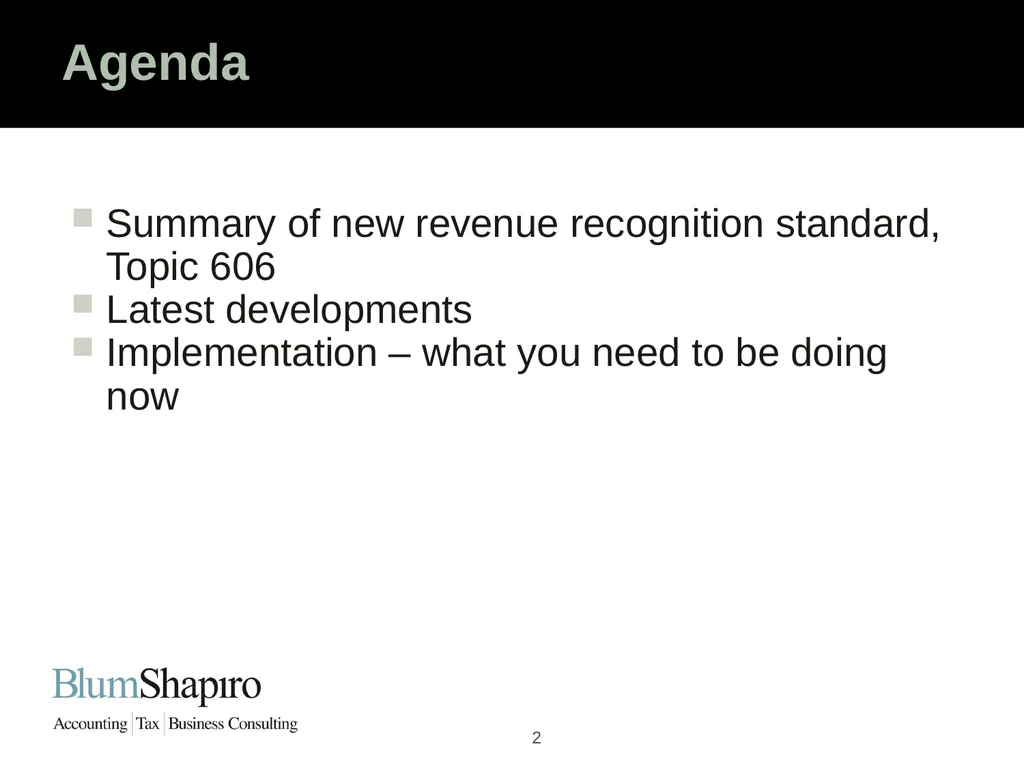
Ready Set Go! The New Revenue Recognition Rules Jessie Kanter, CPA JkanterBlumShapiro.com www.BlumShapiro.com 1 Agenda Summary of new revenue recognition standard, Topic 606 Latest developments Implementation what you need to be doing
Related Topics
Share
Embed code
Download this presentation From Below
"Ready Set Go! The New Revenue Recognition Rules" is the property of its rightful owner. Permission is granted to download and print the materials on this website for personal, non-commercial use only, and to display it on your personal computer provided you do not modify the materials and that you retain all copyright notices contained in the materials. By downloading content from our website, you accept the terms of this agreement.
Presentation Transcript
01
Ready Set Go! The New Revenue Recognition Rules Jessie Kanter, CPA
Jkanter@BlumShapiro.com
www.BlumShapiro.com 1<br>
Jkanter@BlumShapiro.com
www.BlumShapiro.com 1<br>
02
Agenda Summary of new revenue recognition standard, Topic 606
Latest developments
Implementation – what you need to be doing now 2<br>
Latest developments
Implementation – what you need to be doing now 2<br>
03
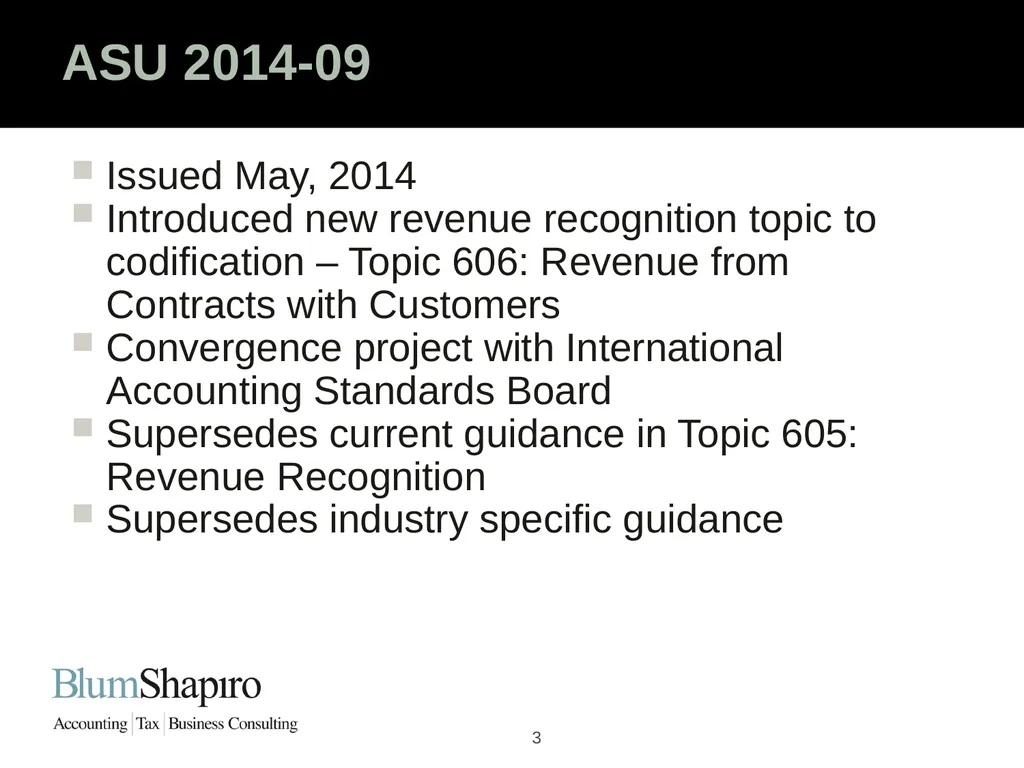
ASU 2014-09 Issued May, 2014
Introduced new revenue recognition topic to codification – Topic 606: Revenue from Contracts with Customers
Convergence project with International Accounting Standards Board
Supersedes current guidance in Topic 605: Revenue Recognition
Supersedes industry specific guidance 3<br>
Introduced new revenue recognition topic to codification – Topic 606: Revenue from Contracts with Customers
Convergence project with International Accounting Standards Board
Supersedes current guidance in Topic 605: Revenue Recognition
Supersedes industry specific guidance 3<br>
04
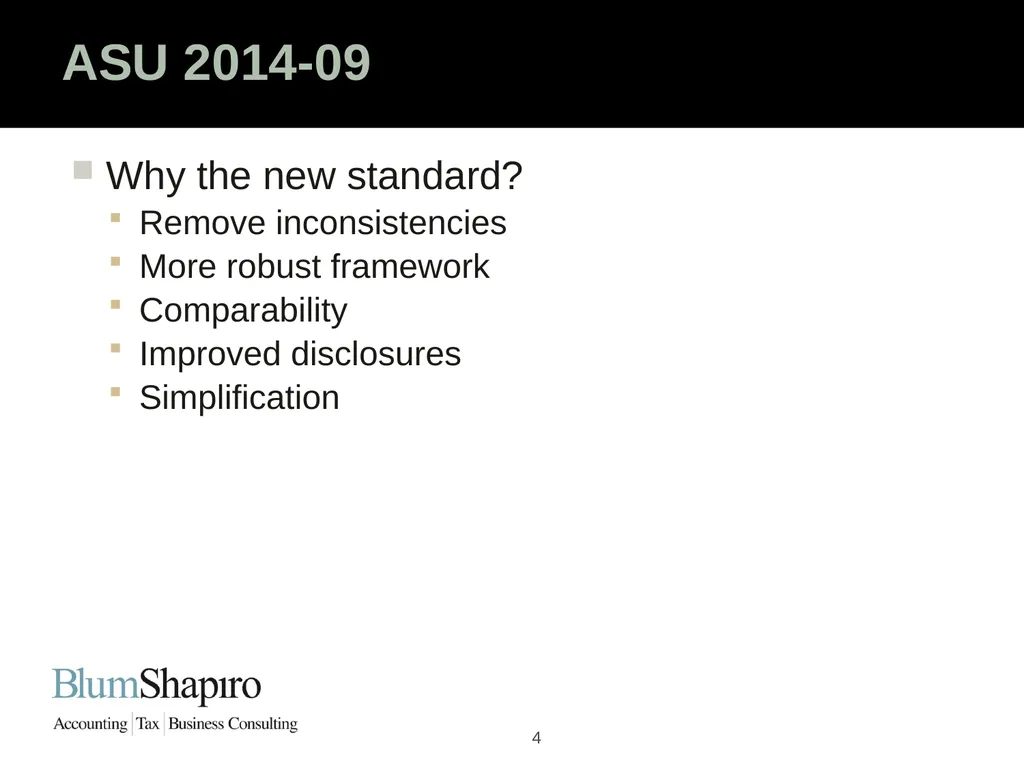
ASU 2014-09 Why the new standard?
Remove inconsistencies
More robust framework
Comparability
Improved disclosures
Simplification 4<br>
Remove inconsistencies
More robust framework
Comparability
Improved disclosures
Simplification 4<br>
05
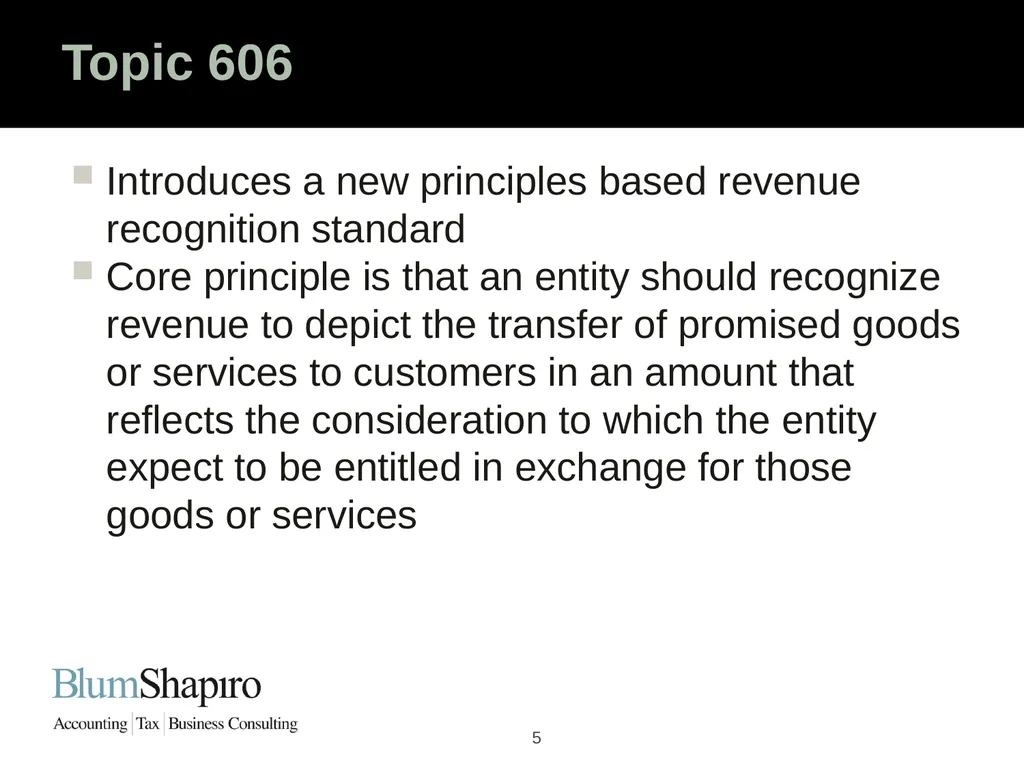
Topic 606 Introduces a new principles based revenue recognition standard
Core principle is that an entity should recognize revenue to depict the transfer of promised goods or services to customers in an amount that reflects the consideration to which the entity expect to be entitled in exchange for those goods or services 5<br>
Core principle is that an entity should recognize revenue to depict the transfer of promised goods or services to customers in an amount that reflects the consideration to which the entity expect to be entitled in exchange for those goods or services 5<br>
06
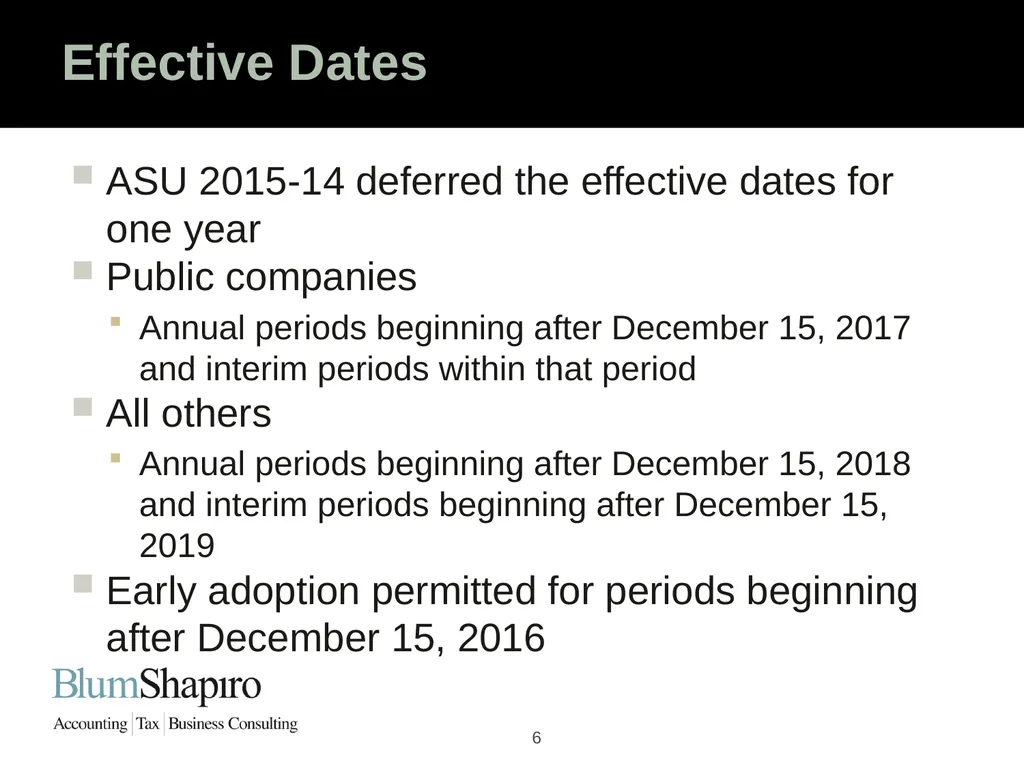
Effective Dates ASU 2015-14 deferred the effective dates for one year
Public companies
Annual periods beginning after December 15, 2017 and interim periods within that period
All others
Annual periods beginning after December 15, 2018 and interim periods beginning after December 15, 2019
Early adoption permitted for periods beginning after December 15, 2016 6<br>
Public companies
Annual periods beginning after December 15, 2017 and interim periods within that period
All others
Annual periods beginning after December 15, 2018 and interim periods beginning after December 15, 2019
Early adoption permitted for periods beginning after December 15, 2016 6<br>
07
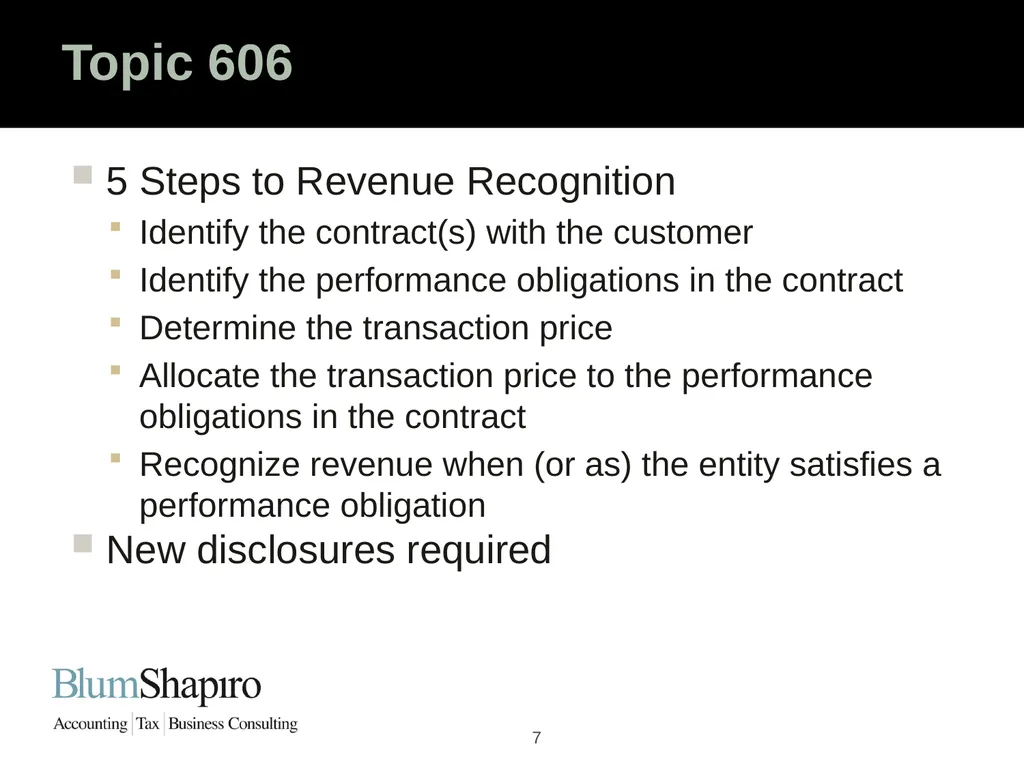
Topic 606 5 Steps to Revenue Recognition
Identify the contract(s) with the customer
Identify the performance obligations in the contract
Determine the transaction price
Allocate the transaction price to the performance obligations in the contract
Recognize revenue when (or as) the entity satisfies a performance obligation
New disclosures required 7<br>
Identify the contract(s) with the customer
Identify the performance obligations in the contract
Determine the transaction price
Allocate the transaction price to the performance obligations in the contract
Recognize revenue when (or as) the entity satisfies a performance obligation
New disclosures required 7<br>
08
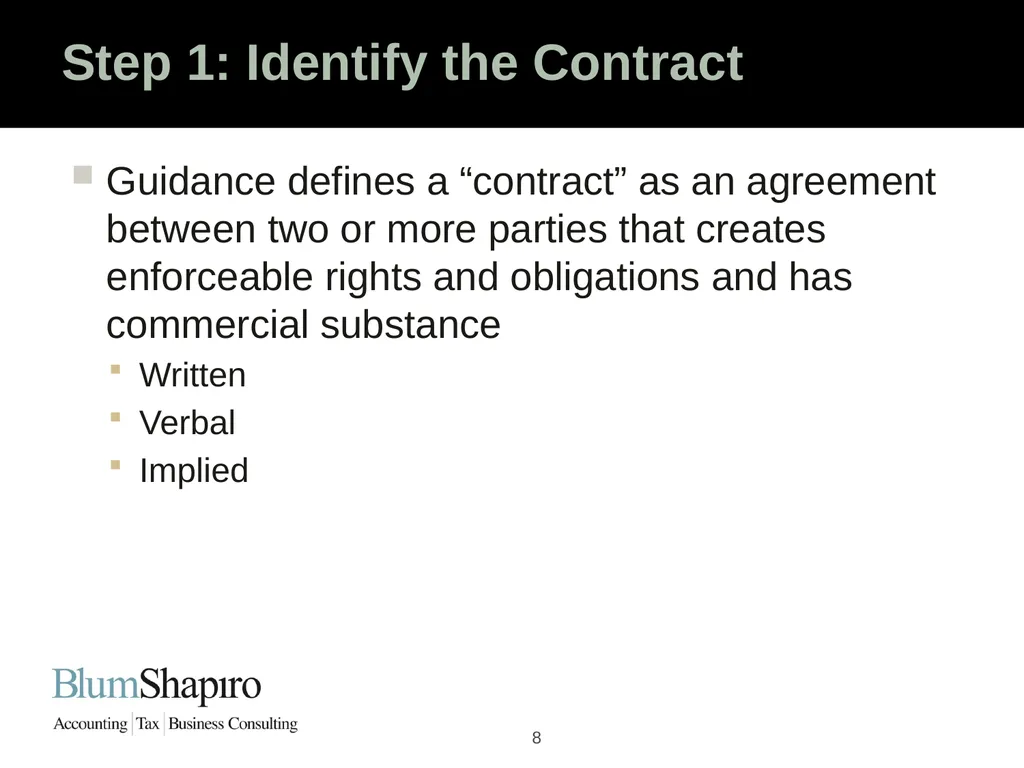
Step 1: Identify the Contract Guidance defines a “contract” as an agreement between two or more parties that creates enforceable rights and obligations and has commercial substance
Written
Verbal
Implied 8<br>
Written
Verbal
Implied 8<br>
09
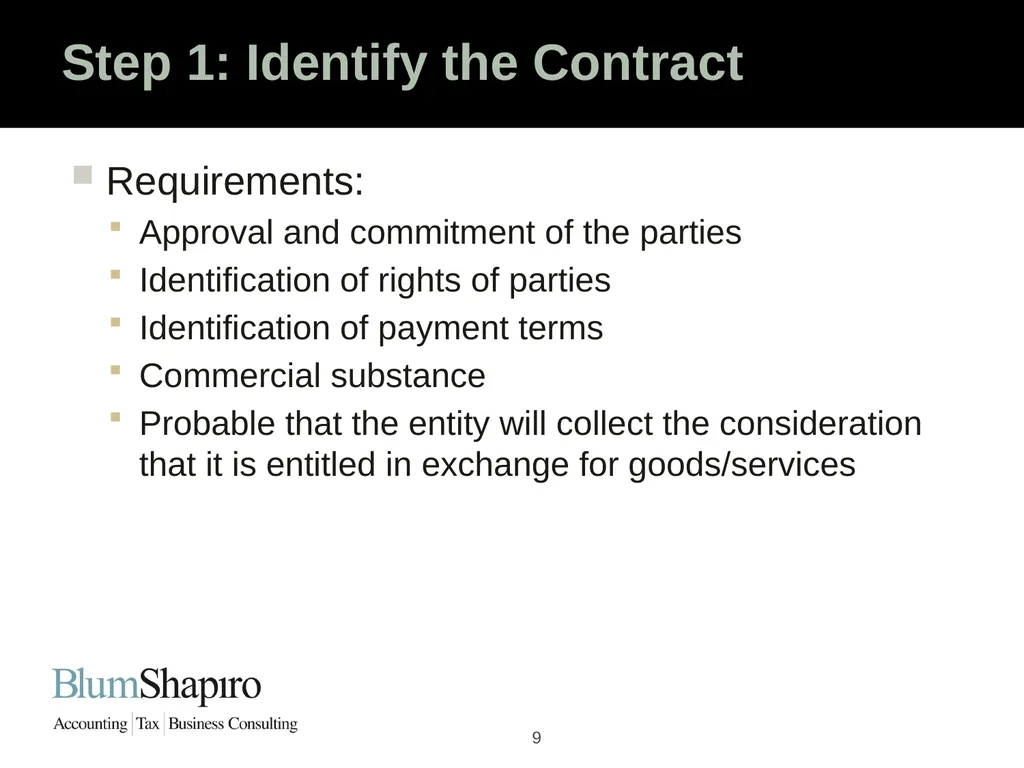
Step 1: Identify the Contract Requirements:
Approval and commitment of the parties
Identification of rights of parties
Identification of payment terms
Commercial substance
Probable that the entity will collect the consideration that it is entitled in exchange for goods/services 9<br>
Approval and commitment of the parties
Identification of rights of parties
Identification of payment terms
Commercial substance
Probable that the entity will collect the consideration that it is entitled in exchange for goods/services 9<br>
10
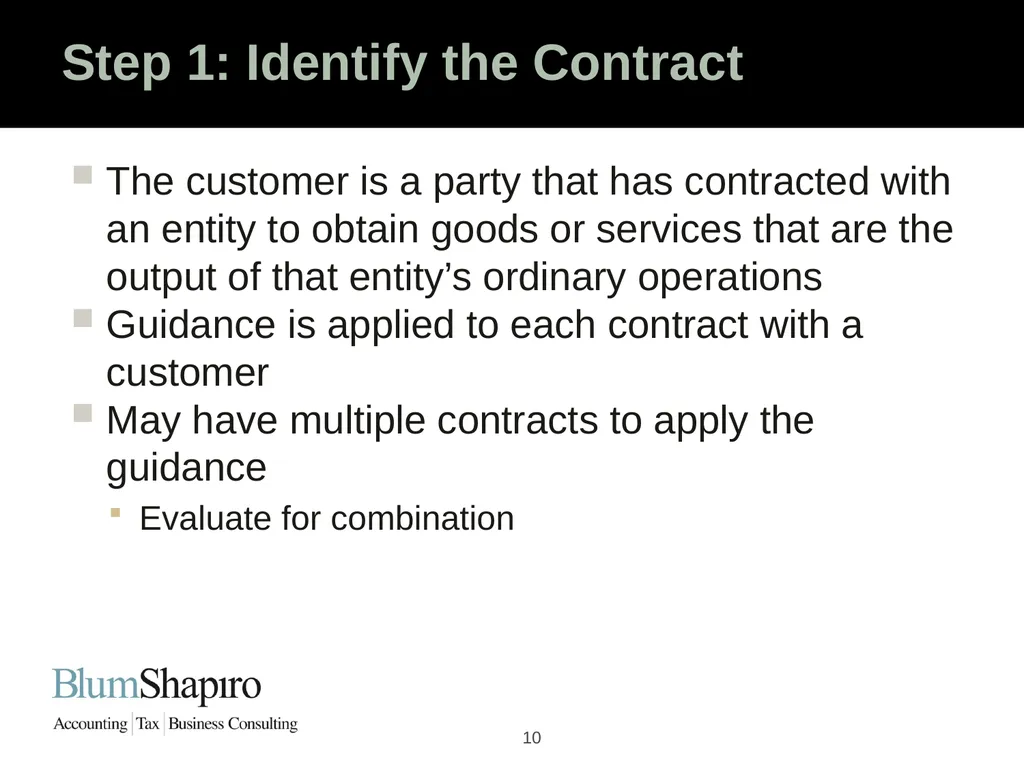
Step 1: Identify the Contract The customer is a party that has contracted with an entity to obtain goods or services that are the output of that entity’s ordinary operations
Guidance is applied to each contract with a customer
May have multiple contracts to apply the guidance
Evaluate for combination 10<br>
Guidance is applied to each contract with a customer
May have multiple contracts to apply the guidance
Evaluate for combination 10<br>
11
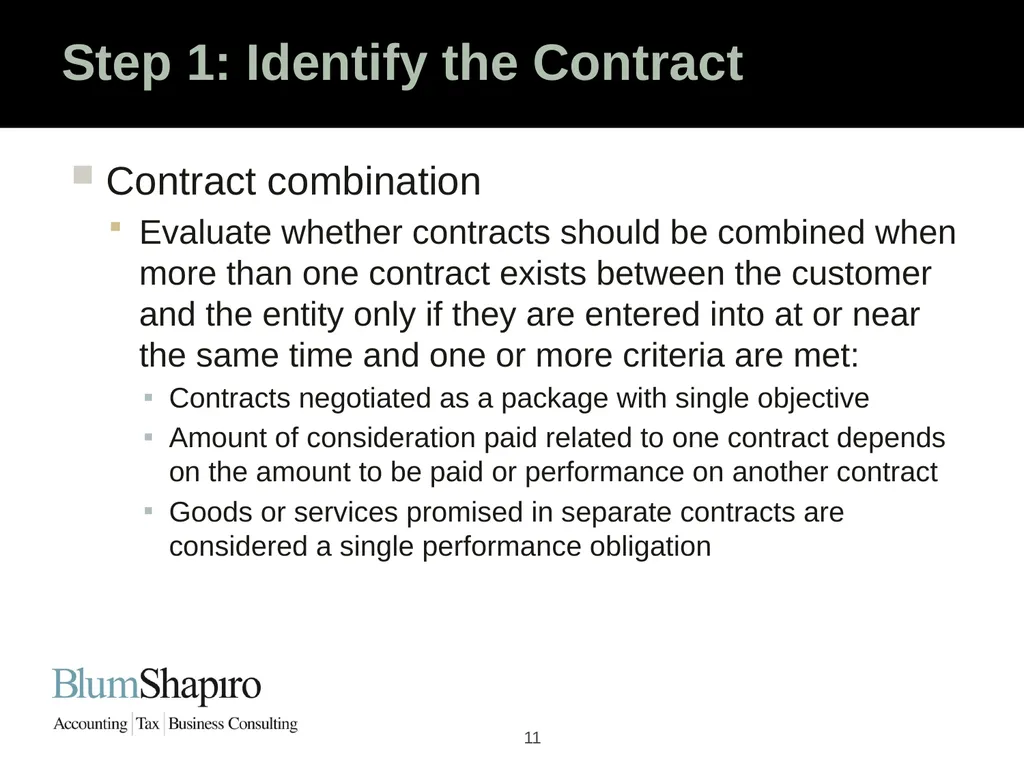
Step 1: Identify the Contract Contract combination
Evaluate whether contracts should be combined when more than one contract exists between the customer and the entity only if they are entered into at or near the same time and one or more criteria are met:
Contracts negotiated as a package with single objective
Amount of consideration paid related to one contract depends on the amount to be paid or performance on another contract
Goods or services promised in separate contracts are considered a single performance obligation 11<br>
Evaluate whether contracts should be combined when more than one contract exists between the customer and the entity only if they are entered into at or near the same time and one or more criteria are met:
Contracts negotiated as a package with single objective
Amount of consideration paid related to one contract depends on the amount to be paid or performance on another contract
Goods or services promised in separate contracts are considered a single performance obligation 11<br>
12
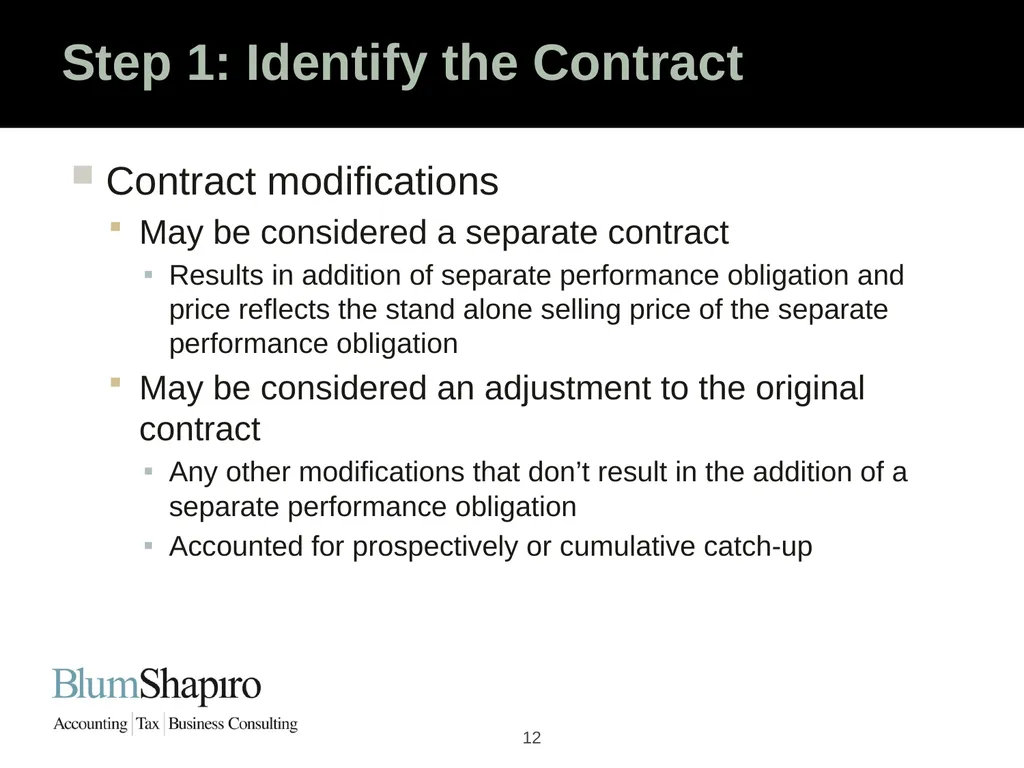
Step 1: Identify the Contract Contract modifications
May be considered a separate contract
Results in addition of separate performance obligation and price reflects the stand alone selling price of the separate performance obligation
May be considered an adjustment to the original contract
Any other modifications that don’t result in the addition of a separate performance obligation
Accounted for prospectively or cumulative catch-up 12<br>
May be considered a separate contract
Results in addition of separate performance obligation and price reflects the stand alone selling price of the separate performance obligation
May be considered an adjustment to the original contract
Any other modifications that don’t result in the addition of a separate performance obligation
Accounted for prospectively or cumulative catch-up 12<br>
13
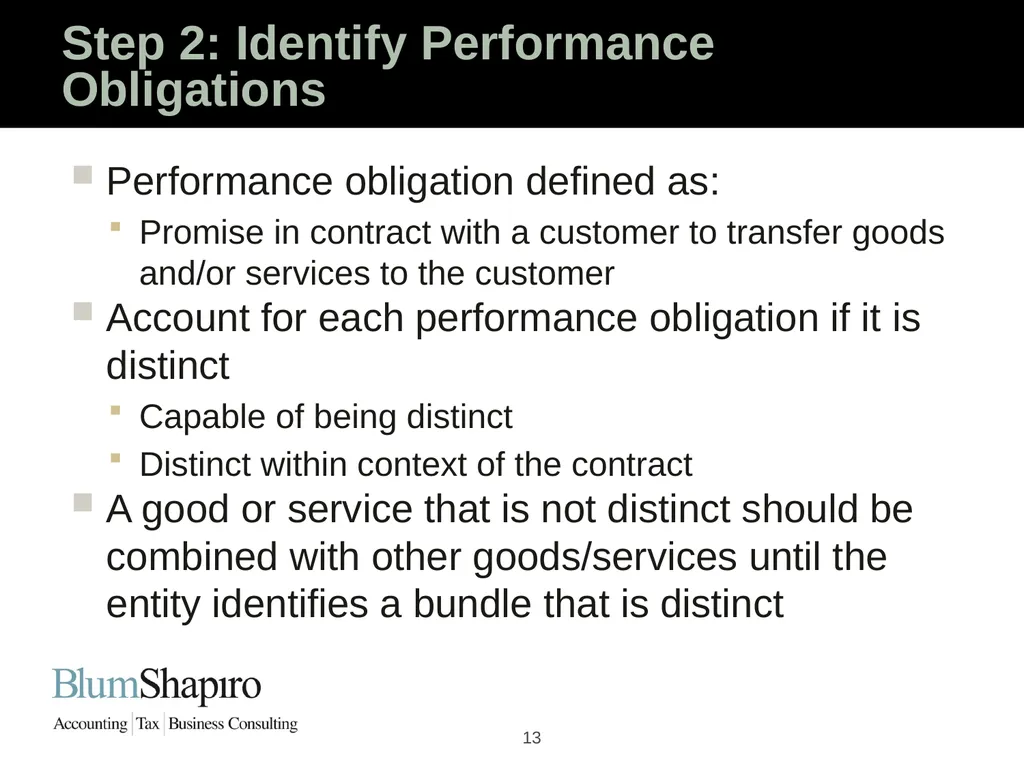
Step 2: Identify Performance Obligations Performance obligation defined as:
Promise in contract with a customer to transfer goods and/or services to the customer
Account for each performance obligation if it is distinct
Capable of being distinct
Distinct within context of the contract
A good or service that is not distinct should be combined with other goods/services until the entity identifies a bundle that is distinct 13<br>
Promise in contract with a customer to transfer goods and/or services to the customer
Account for each performance obligation if it is distinct
Capable of being distinct
Distinct within context of the contract
A good or service that is not distinct should be combined with other goods/services until the entity identifies a bundle that is distinct 13<br>
14
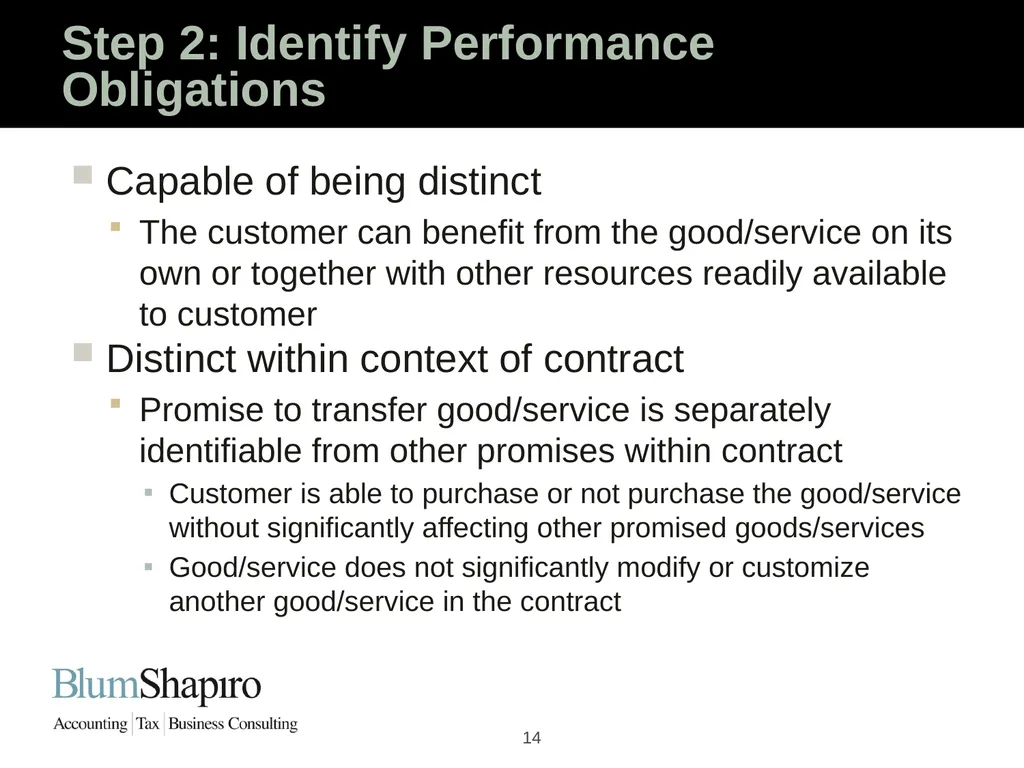
Step 2: Identify Performance Obligations Capable of being distinct
The customer can benefit from the good/service on its own or together with other resources readily available to customer
Distinct within context of contract
Promise to transfer good/service is separately identifiable from other promises within contract
Customer is able to purchase or not purchase the good/service without significantly affecting other promised goods/services
Good/service does not significantly modify or customize another good/service in the contract 14<br>
The customer can benefit from the good/service on its own or together with other resources readily available to customer
Distinct within context of contract
Promise to transfer good/service is separately identifiable from other promises within contract
Customer is able to purchase or not purchase the good/service without significantly affecting other promised goods/services
Good/service does not significantly modify or customize another good/service in the contract 14<br>
15
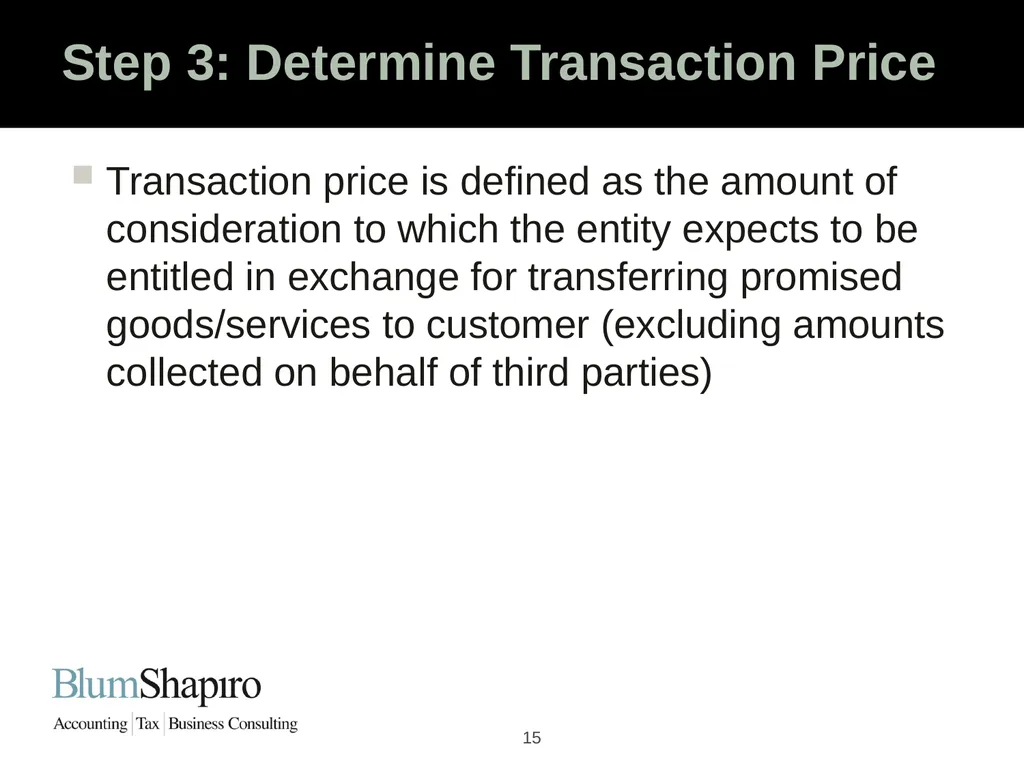
Step 3: Determine Transaction Price Transaction price is defined as the amount of consideration to which the entity expects to be entitled in exchange for transferring promised goods/services to customer (excluding amounts collected on behalf of third parties) 15<br>
16
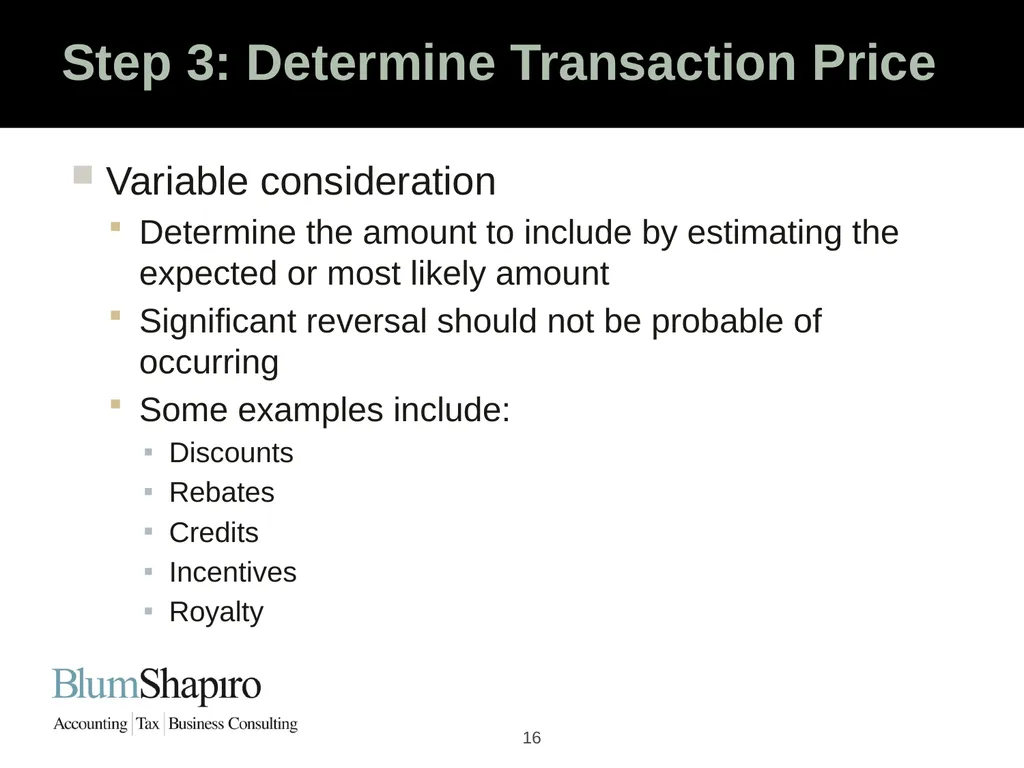
Step 3: Determine Transaction Price Variable consideration
Determine the amount to include by estimating the expected or most likely amount
Significant reversal should not be probable of occurring
Some examples include:
Discounts
Rebates
Credits
Incentives
Royalty 16<br>
Determine the amount to include by estimating the expected or most likely amount
Significant reversal should not be probable of occurring
Some examples include:
Discounts
Rebates
Credits
Incentives
Royalty 16<br>
17
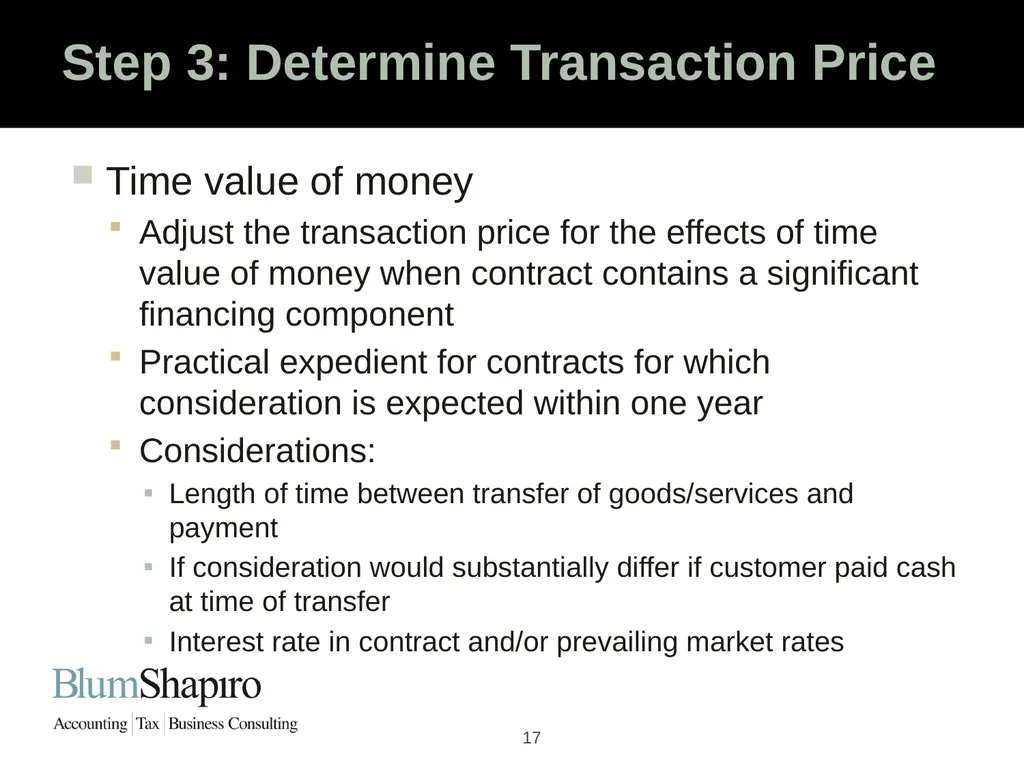
Step 3: Determine Transaction Price Time value of money
Adjust the transaction price for the effects of time value of money when contract contains a significant financing component
Practical expedient for contracts for which consideration is expected within one year
Considerations:
Length of time between transfer of goods/services and payment
If consideration would substantially differ if customer paid cash at time of transfer
Interest rate in contract and/or prevailing market rates 17<br>
Adjust the transaction price for the effects of time value of money when contract contains a significant financing component
Practical expedient for contracts for which consideration is expected within one year
Considerations:
Length of time between transfer of goods/services and payment
If consideration would substantially differ if customer paid cash at time of transfer
Interest rate in contract and/or prevailing market rates 17<br>
18
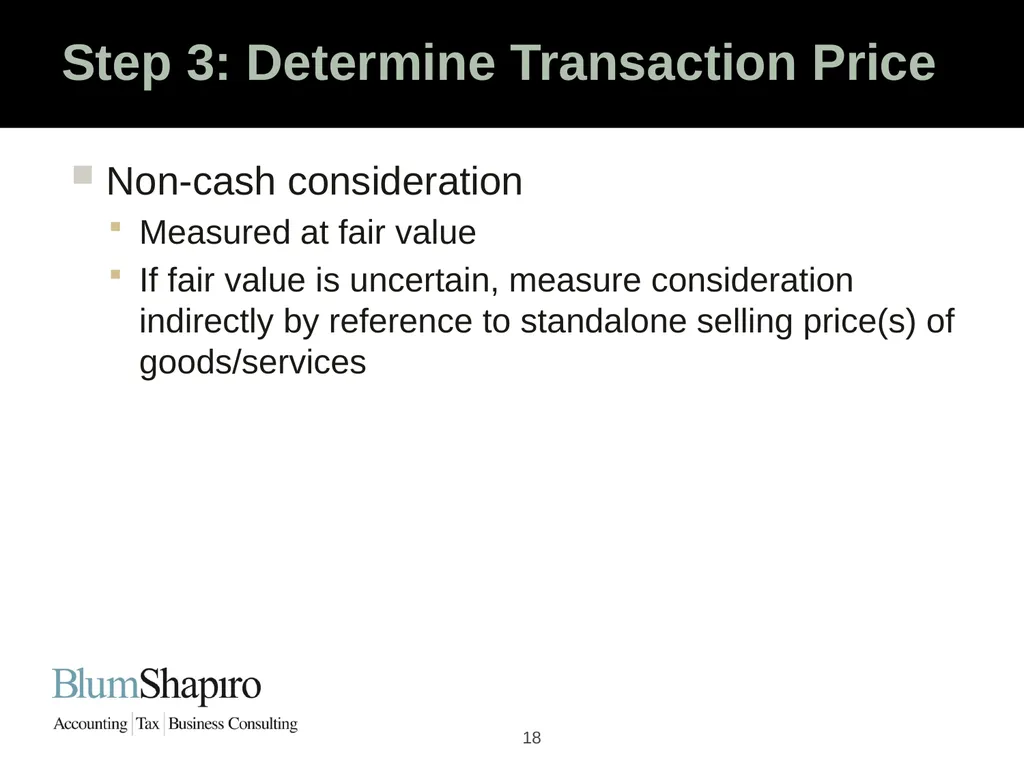
Step 3: Determine Transaction Price Non-cash consideration
Measured at fair value
If fair value is uncertain, measure consideration indirectly by reference to standalone selling price(s) of goods/services 18<br>
Measured at fair value
If fair value is uncertain, measure consideration indirectly by reference to standalone selling price(s) of goods/services 18<br>
19
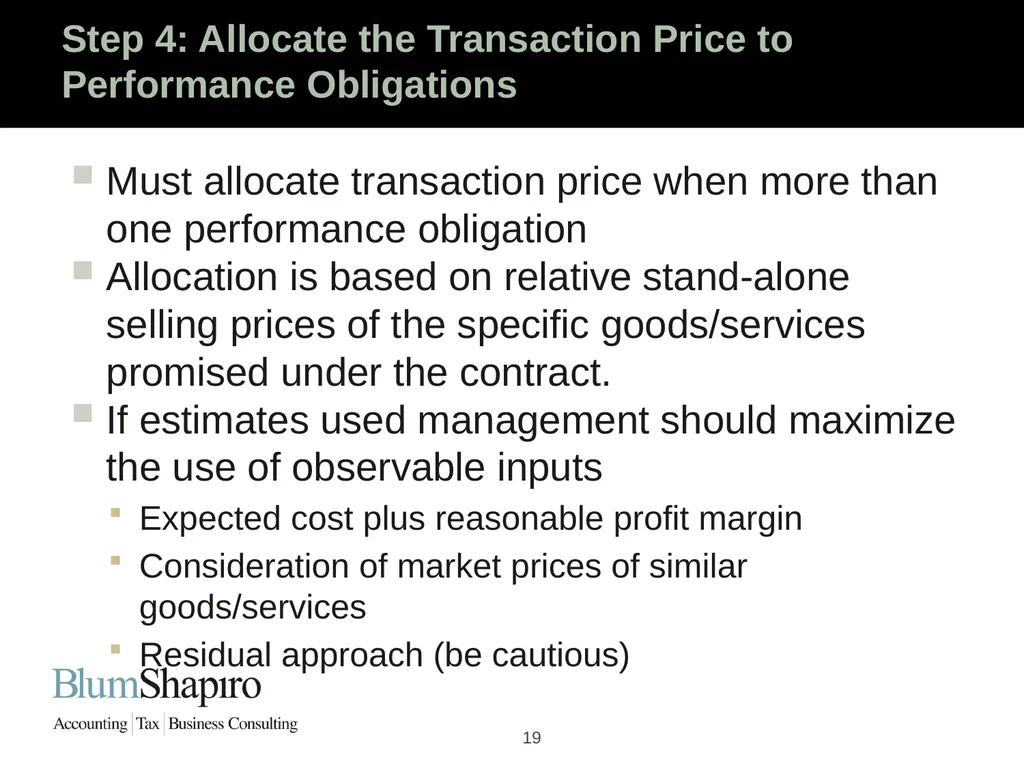
Step 4: Allocate the Transaction Price to Performance Obligations Must allocate transaction price when more than one performance obligation
Allocation is based on relative stand-alone selling prices of the specific goods/services promised under the contract.
If estimates used management should maximize the use of observable inputs
Expected cost plus reasonable profit margin
Consideration of market prices of similar goods/services
Residual approach (be cautious) 19<br>
Allocation is based on relative stand-alone selling prices of the specific goods/services promised under the contract.
If estimates used management should maximize the use of observable inputs
Expected cost plus reasonable profit margin
Consideration of market prices of similar goods/services
Residual approach (be cautious) 19<br>
20
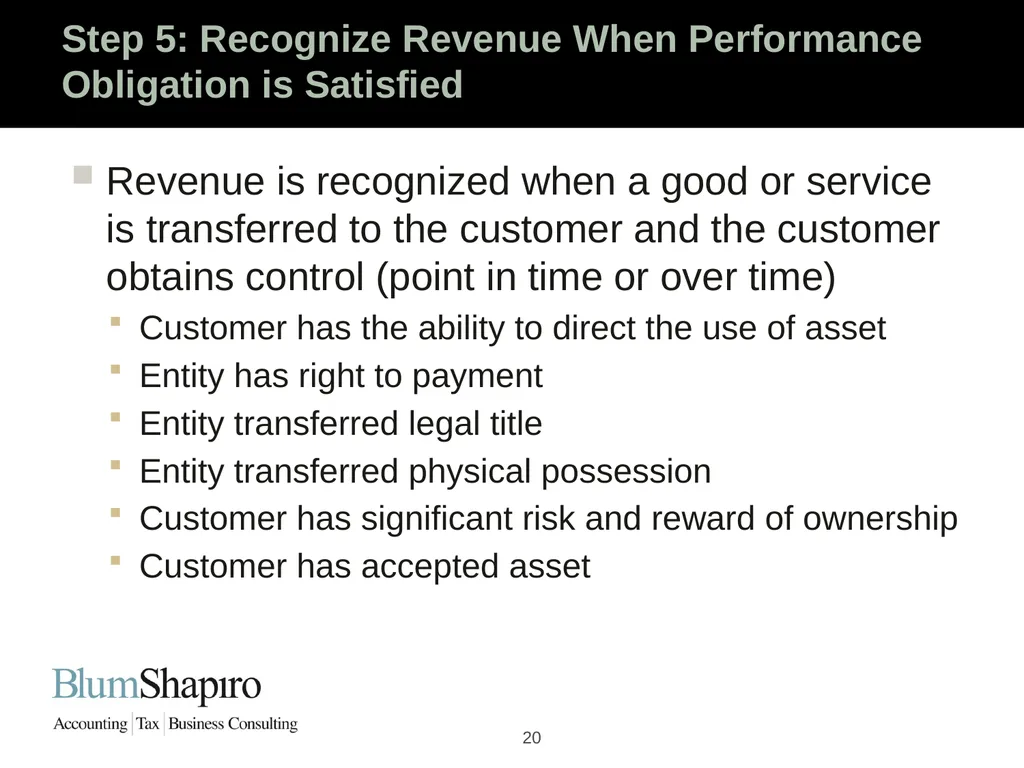
Step 5: Recognize Revenue When Performance Obligation is Satisfied Revenue is recognized when a good or service is transferred to the customer and the customer obtains control (point in time or over time)
Customer has the ability to direct the use of asset
Entity has right to payment
Entity transferred legal title
Entity transferred physical possession
Customer has significant risk and reward of ownership
Customer has accepted asset 20<br>
Customer has the ability to direct the use of asset
Entity has right to payment
Entity transferred legal title
Entity transferred physical possession
Customer has significant risk and reward of ownership
Customer has accepted asset 20<br>
21
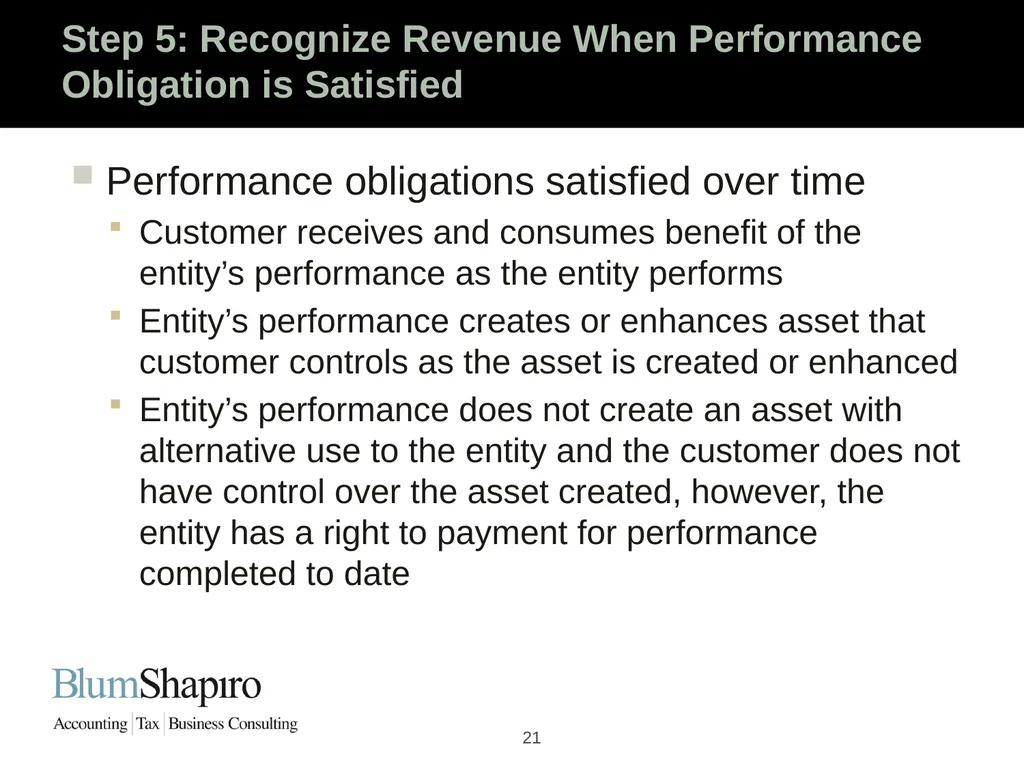
Step 5: Recognize Revenue When Performance Obligation is Satisfied Performance obligations satisfied over time
Customer receives and consumes benefit of the entity’s performance as the entity performs
Entity’s performance creates or enhances asset that customer controls as the asset is created or enhanced
Entity’s performance does not create an asset with alternative use to the entity and the customer does not have control over the asset created, however, the entity has a right to payment for performance completed to date 21<br>
Customer receives and consumes benefit of the entity’s performance as the entity performs
Entity’s performance creates or enhances asset that customer controls as the asset is created or enhanced
Entity’s performance does not create an asset with alternative use to the entity and the customer does not have control over the asset created, however, the entity has a right to payment for performance completed to date 21<br>
22
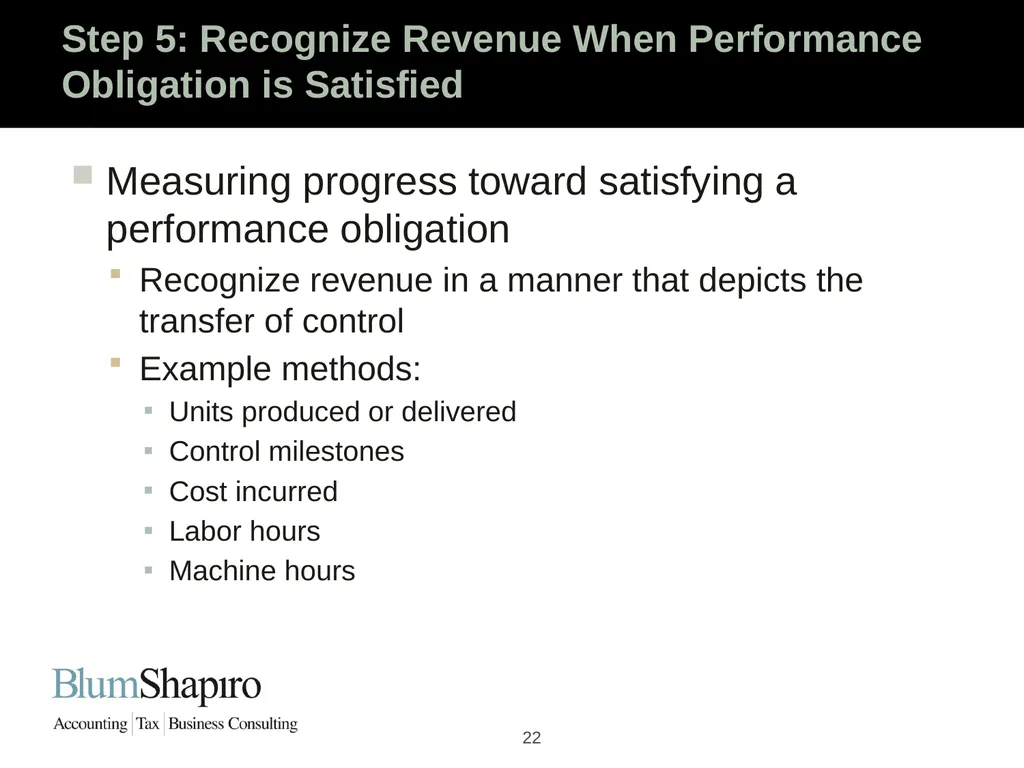
Step 5: Recognize Revenue When Performance Obligation is Satisfied Measuring progress toward satisfying a performance obligation
Recognize revenue in a manner that depicts the transfer of control
Example methods:
Units produced or delivered
Control milestones
Cost incurred
Labor hours
Machine hours 22<br>
Recognize revenue in a manner that depicts the transfer of control
Example methods:
Units produced or delivered
Control milestones
Cost incurred
Labor hours
Machine hours 22<br>
23
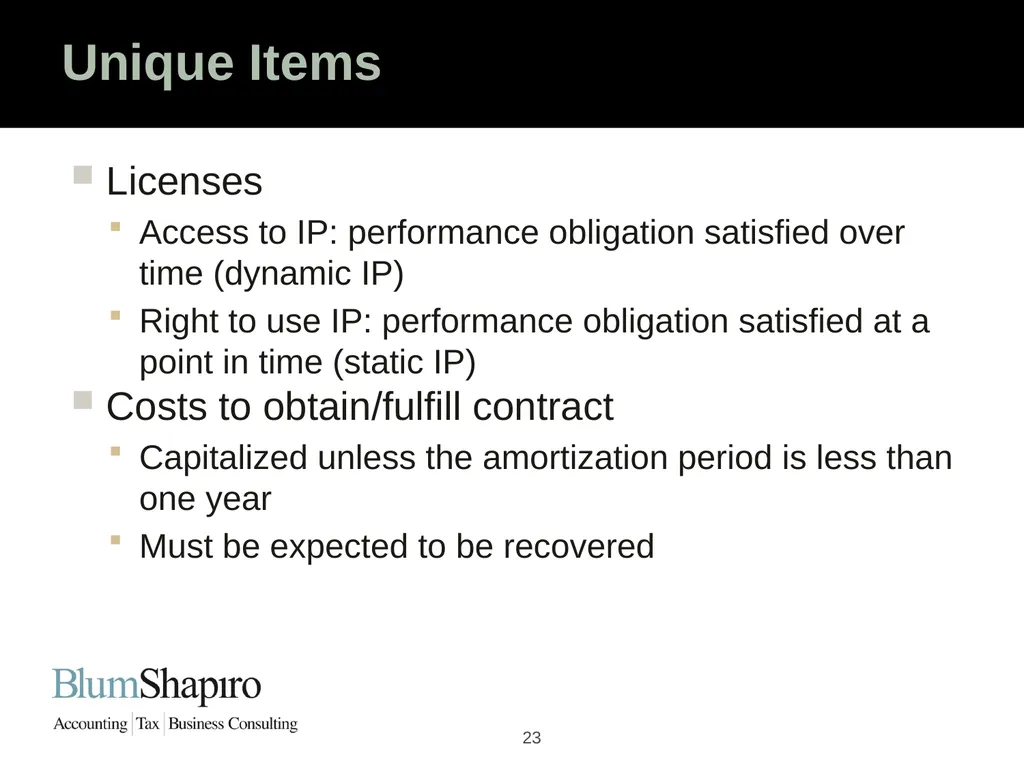
Unique Items Licenses
Access to IP: performance obligation satisfied over time (dynamic IP)
Right to use IP: performance obligation satisfied at a point in time (static IP)
Costs to obtain/fulfill contract
Capitalized unless the amortization period is less than one year
Must be expected to be recovered 23<br>
Access to IP: performance obligation satisfied over time (dynamic IP)
Right to use IP: performance obligation satisfied at a point in time (static IP)
Costs to obtain/fulfill contract
Capitalized unless the amortization period is less than one year
Must be expected to be recovered 23<br>
24
Disclosures New disclosures meant to assist the reader in understanding the amount, timing and judgments related to revenue recognition and related cash flow
Current guidance contains very little related to revenue recognition requirements 24<br>
Current guidance contains very little related to revenue recognition requirements 24<br>
25
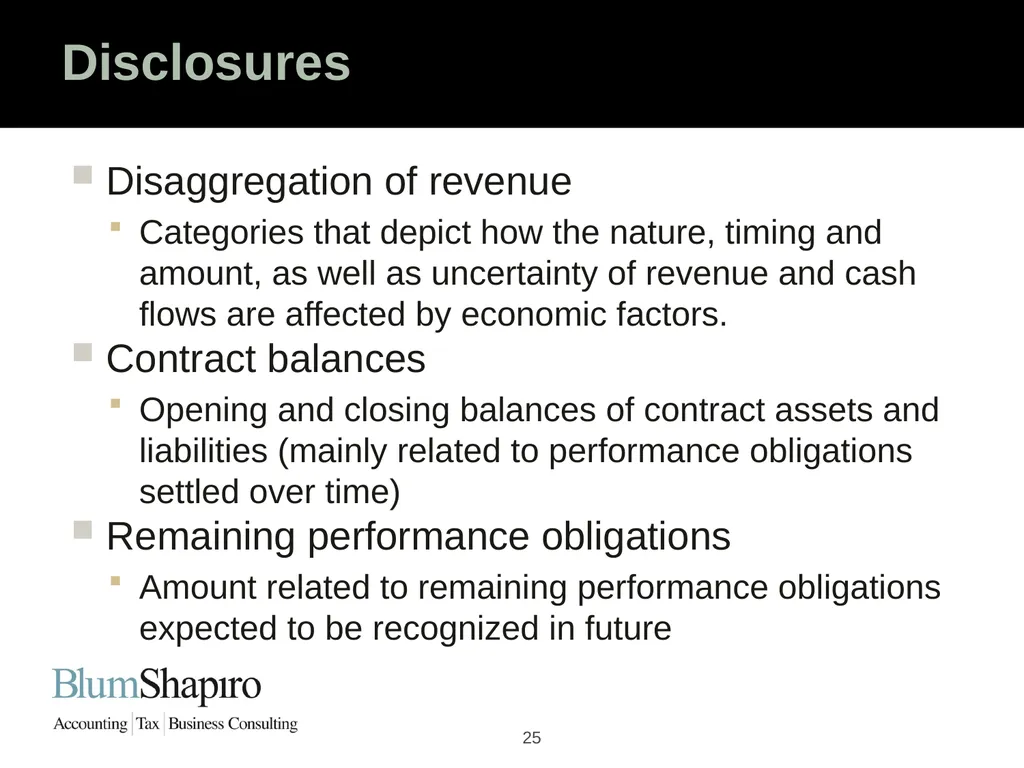
Disclosures Disaggregation of revenue
Categories that depict how the nature, timing and amount, as well as uncertainty of revenue and cash flows are affected by economic factors.
Contract balances
Opening and closing balances of contract assets and liabilities (mainly related to performance obligations settled over time)
Remaining performance obligations
Amount related to remaining performance obligations expected to be recognized in future 25<br>
Categories that depict how the nature, timing and amount, as well as uncertainty of revenue and cash flows are affected by economic factors.
Contract balances
Opening and closing balances of contract assets and liabilities (mainly related to performance obligations settled over time)
Remaining performance obligations
Amount related to remaining performance obligations expected to be recognized in future 25<br>
26
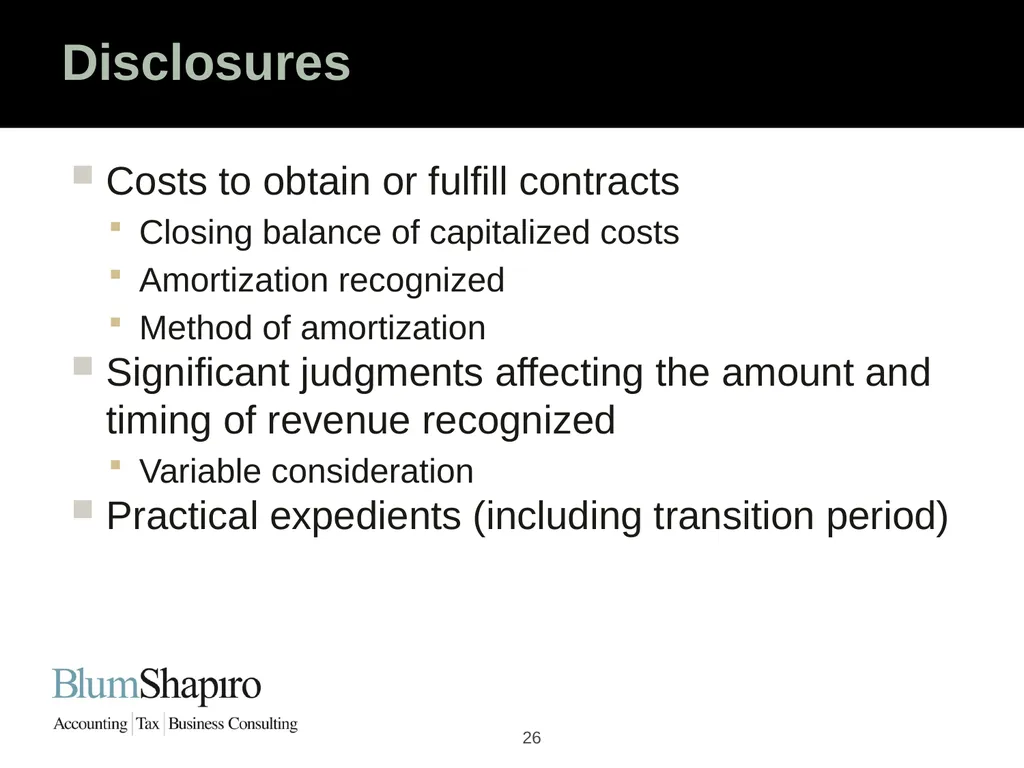
Disclosures Costs to obtain or fulfill contracts
Closing balance of capitalized costs
Amortization recognized
Method of amortization
Significant judgments affecting the amount and timing of revenue recognized
Variable consideration
Practical expedients (including transition period) 26<br>
Closing balance of capitalized costs
Amortization recognized
Method of amortization
Significant judgments affecting the amount and timing of revenue recognized
Variable consideration
Practical expedients (including transition period) 26<br>
27
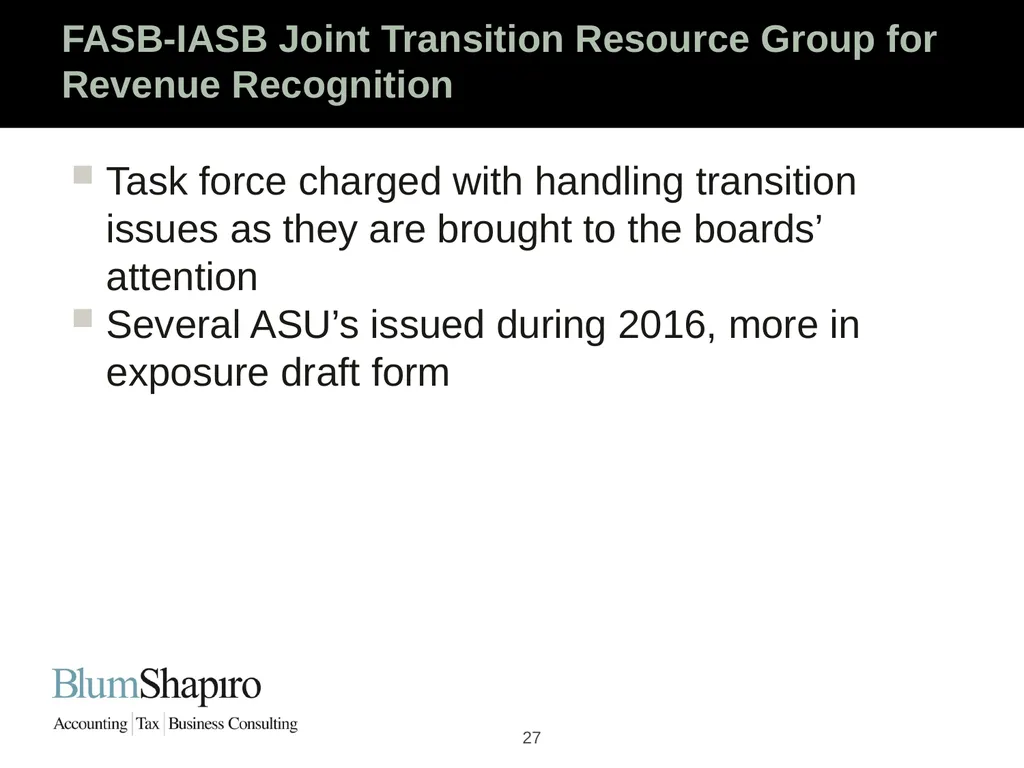
FASB-IASB Joint Transition Resource Group for Revenue Recognition Task force charged with handling transition issues as they are brought to the boards’ attention
Several ASU’s issued during 2016, more in exposure draft form 27<br>
Several ASU’s issued during 2016, more in exposure draft form 27<br>
28
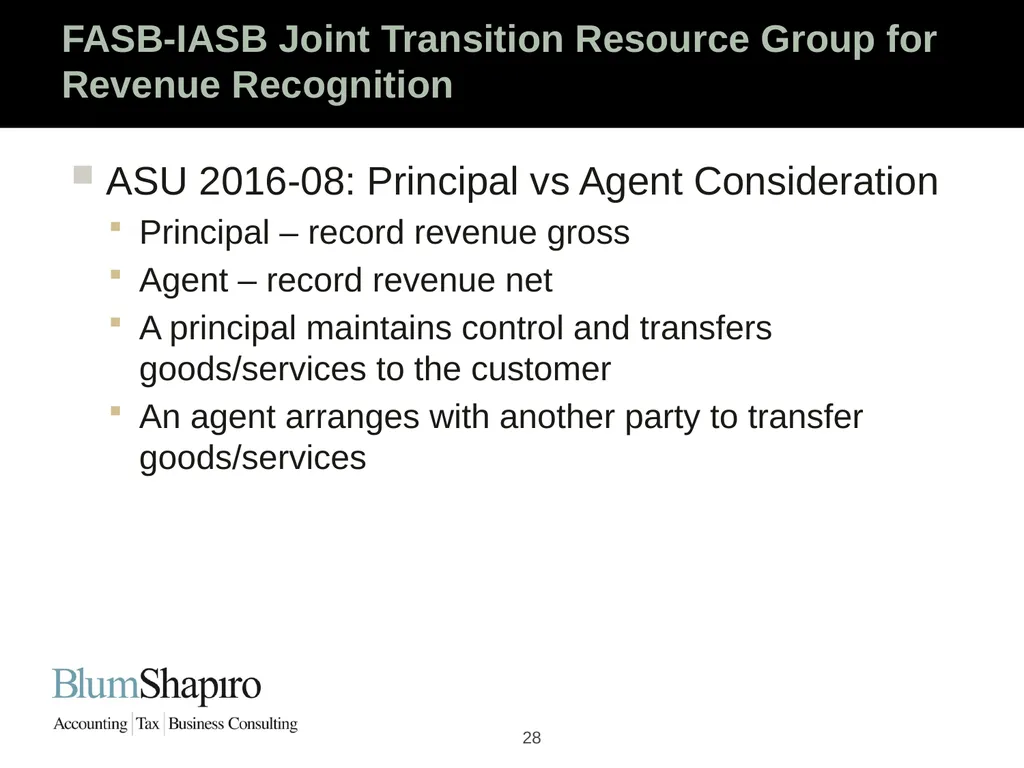
FASB-IASB Joint Transition Resource Group for Revenue Recognition ASU 2016-08: Principal vs Agent Consideration
Principal – record revenue gross
Agent – record revenue net
A principal maintains control and transfers goods/services to the customer
An agent arranges with another party to transfer goods/services 28<br>
Principal – record revenue gross
Agent – record revenue net
A principal maintains control and transfers goods/services to the customer
An agent arranges with another party to transfer goods/services 28<br>
29
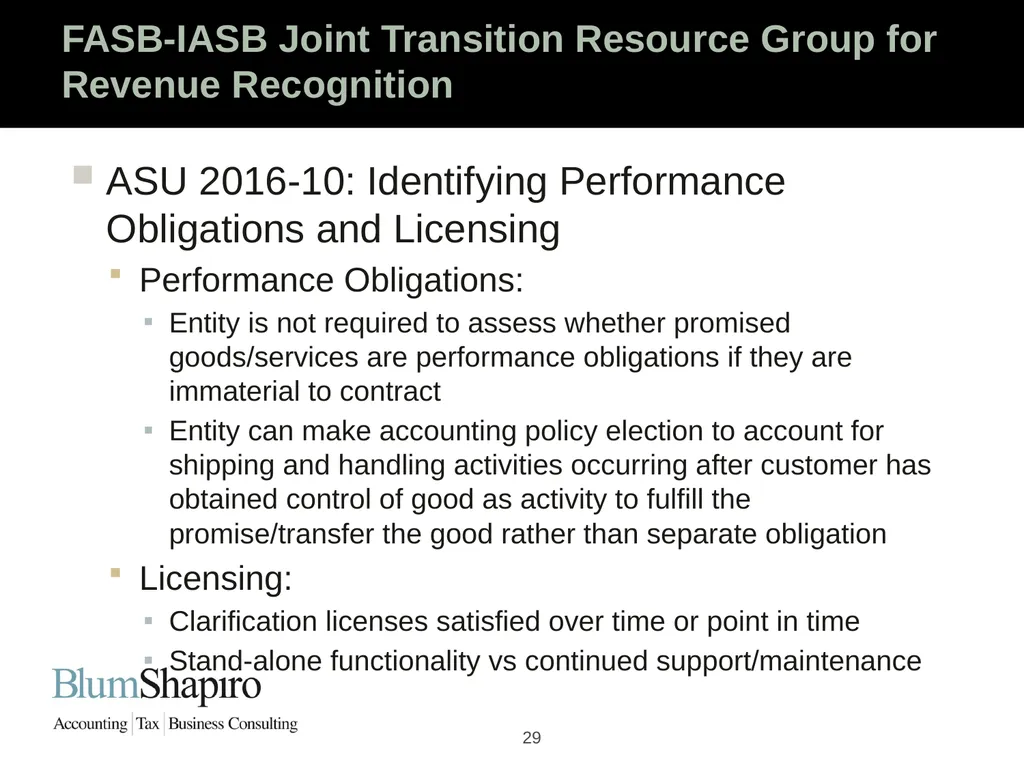
FASB-IASB Joint Transition Resource Group for Revenue Recognition ASU 2016-10: Identifying Performance Obligations and Licensing
Performance Obligations:
Entity is not required to assess whether promised goods/services are performance obligations if they are immaterial to contract
Entity can make accounting policy election to account for shipping and handling activities occurring after customer has obtained control of good as activity to fulfill the promise/transfer the good rather than separate obligation
Licensing:
Clarification licenses satisfied over time or point in time
Stand-alone functionality vs continued support/maintenance 29<br>
Performance Obligations:
Entity is not required to assess whether promised goods/services are performance obligations if they are immaterial to contract
Entity can make accounting policy election to account for shipping and handling activities occurring after customer has obtained control of good as activity to fulfill the promise/transfer the good rather than separate obligation
Licensing:
Clarification licenses satisfied over time or point in time
Stand-alone functionality vs continued support/maintenance 29<br>
30
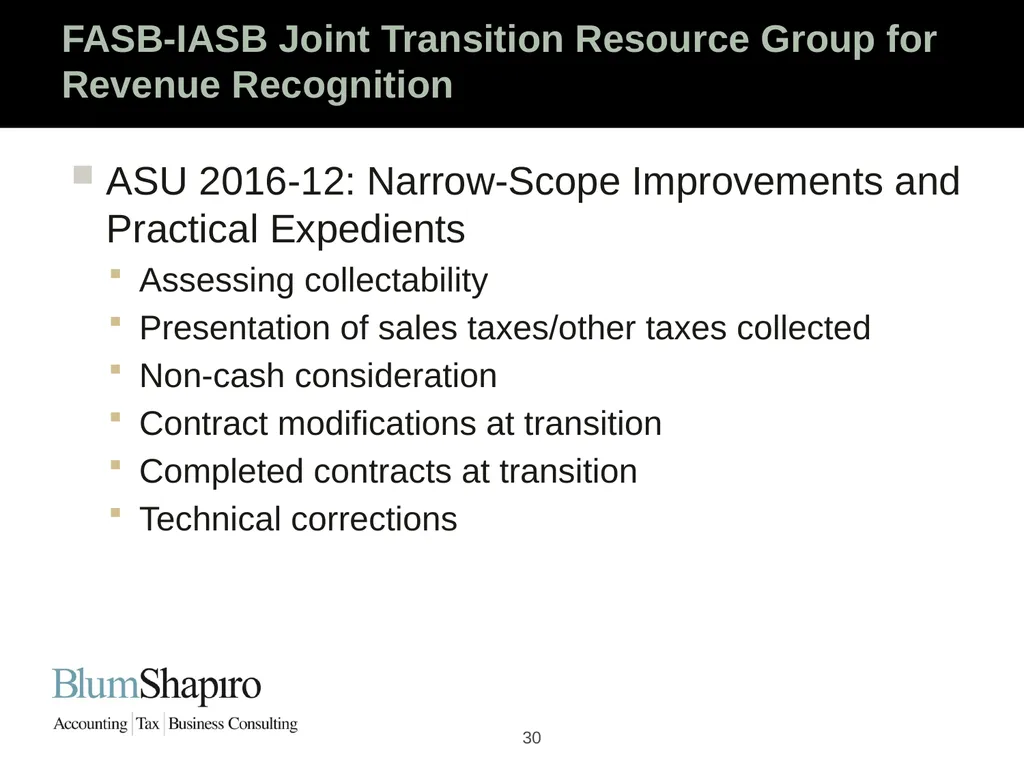
FASB-IASB Joint Transition Resource Group for Revenue Recognition ASU 2016-12: Narrow-Scope Improvements and Practical Expedients
Assessing collectability
Presentation of sales taxes/other taxes collected
Non-cash consideration
Contract modifications at transition
Completed contracts at transition
Technical corrections 30<br>
Assessing collectability
Presentation of sales taxes/other taxes collected
Non-cash consideration
Contract modifications at transition
Completed contracts at transition
Technical corrections 30<br>
31
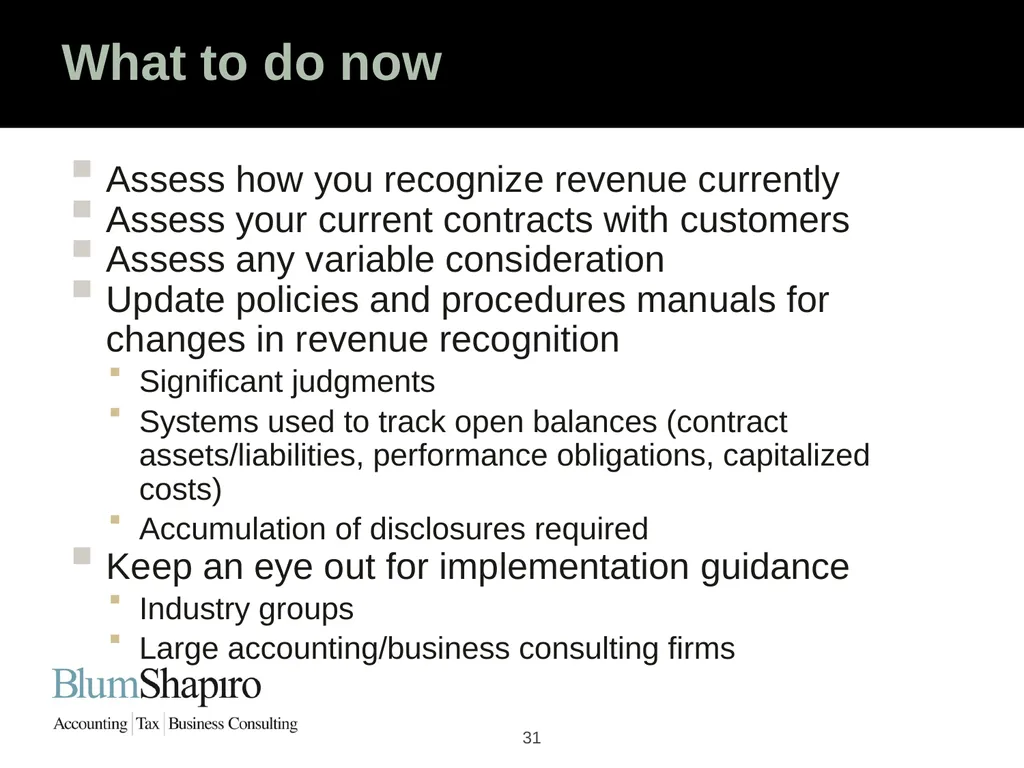
What to do now Assess how you recognize revenue currently
Assess your current contracts with customers
Assess any variable consideration
Update policies and procedures manuals for changes in revenue recognition
Significant judgments
Systems used to track open balances (contract assets/liabilities, performance obligations, capitalized costs)
Accumulation of disclosures required
Keep an eye out for implementation guidance
Industry groups
Large accounting/business consulting firms 31<br>
Assess your current contracts with customers
Assess any variable consideration
Update policies and procedures manuals for changes in revenue recognition
Significant judgments
Systems used to track open balances (contract assets/liabilities, performance obligations, capitalized costs)
Accumulation of disclosures required
Keep an eye out for implementation guidance
Industry groups
Large accounting/business consulting firms 31<br>
32
Conclusion Q&A
Thank you! 32<br>
Thank you! 32<br>