Real Options and Interactions with Financial Flexibility Lenos Trigeorgis Financial Management 22(3): 202-24 (1993) Introduction The net present value (NPV) and other discounted cash flow (DCF) approaches to capital budgeting are inadequate
"Real Options and Interactions with Financial" is the property of its rightful owner. Permission is granted to
download and print the materials on this website for personal, non-commercial use only, and to display it
on your personal computer provided you do not modify the materials and that you retain all copyright
notices contained in the materials. By downloading content from our website, you accept the terms of this
agreement.
Presentation Transcript
01
Real Options and Interactions with Financial Flexibility Lenos Trigeorgis
Financial Management 22(3): 202-24 (1993)<br>
02
Introduction The net present value (NPV) and other discounted cash flow (DCF) approaches to capital budgeting are inadequate in that they cannot properly capture management’s flexibility to adapt and revise later decisions to unexpected market developments.
Management may have flexibility to alter its operating strategy to capitalize on favorable future opportunities or mitigate losses.
Expanded (strategic) NPV = static (passive) NPV of expected cash flows + value of options from active management<br>
03
Review of the Real Options Literature Traditional capital budgeting techniques fail to account for managerial operating flexibility and strategic interactions, leading to the undervaluation of investment opportunities.
Earlier literature focuses on valuing individual real options (i.e., one type of option at a time). Real-life projects are often more complex, involving a collection of multiple real options whose values may interact.
The combined value of a collection of real options may differ from the sum of separate option values.<br>
04
Review of the Real Options Literature The ability to value complex option situations has been enhanced by numerical analysis techniques taking advantage of risk-neutral valuation. Two types of numerical techniques:
Those that approximate underlying stochastic processes directly
Those approximating the resulting partial differential equations
Real options have the potential to make a significant difference in competition and strategy
Sustainable competitive advantages resulting from various types of resources empower companies with valuable real options to grow through effective investment decisions<br>
05
Real Options Various real options may be embedded in capital investments, including
The option to defer investment: to benefit from the resolution of uncertainty about prices/demand/etc. during the intervening period
Examples: exercise the option to extract oil only if oil prices increase sufficiently
Time-to-build option (staged investments): The actual staging of capital investment as a series of outlays over time creates options to default at any given stage. Each stage can be viewed as an option on the value of subsequent stages.
Examples: default after exploration if the reserves or oil prices turnout very low<br>
06
Real Options Various real options may be embedded in capital investments, including
Option to alter operation scale (e.g., in the fashion industry):
The option to expand: accelerate the rate or expand the scale of production if conditions turn out more favorable than expected (e.g., oil prices rise)
The option to contract: operate below capacity or reduce the scale of operations if market conditions are weaker than expected (e.g., oil prices fall)
The option to shut down (and restart) operations: if oil prices are such that cash revenues are not sufficient to cover operating costs
The option to abandon for salvage value in second-hand markets:
Example: Oil prices suffer a sustainable decline or the operation does poorly for some other reason, management does not have to continue incurring the fixed costs.<br>
07
Real Options Various real options may be embedded in capital investments, including:
Option to switch use: change current input to cheapest future input (e.g., oil vis-à-vis electric power) or current output (e.g., in the toy market) to most profitable future product mix, as relative prices of inputs or outputs fluctuate
Examples: Industries where product differentiation and diversity are important and product demand is volatile
Corporate growth options: early investments set the path of future inter-project opportunities
Examples: a new-generation product or process, oil reserves, access to a new or expanding market, strengthening of the firm’s core capabilities or strategic positioning<br>
08
Real Options: Principles of Valuing The passive DCF cannot properly capture the value of embedded options because of their discretionary asymmetric nature and dependence of future events that are uncertain at the time of the initial decision. How to value investment opportunities with asymmetric/ disproportionate claims and discount rates varying over time?
Using contingent claims analysis (CCA) within a backward risk-neutral valuation process<br>
09
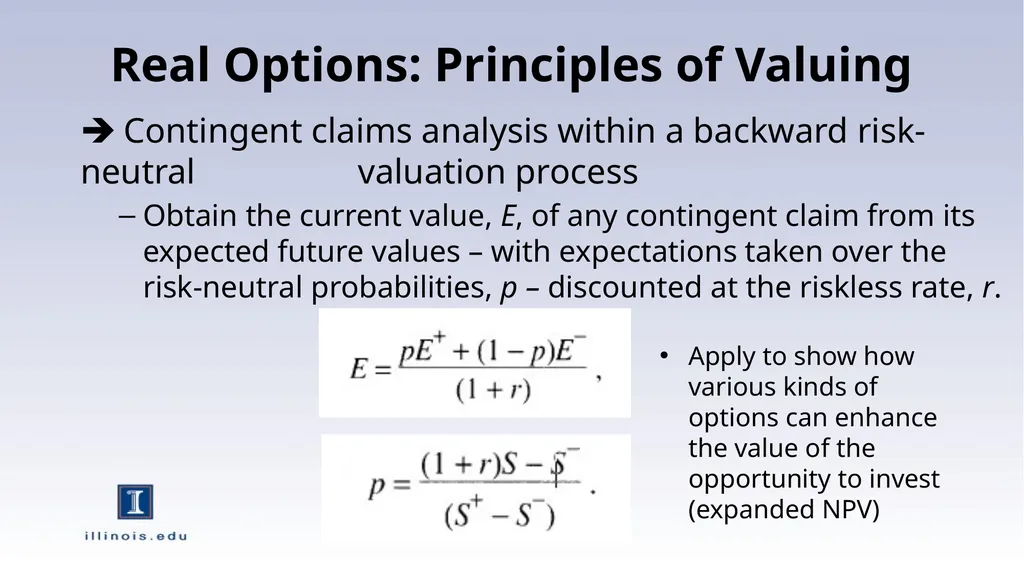
Real Options: Principles of Valuing Contingent claims analysis within a backward risk-neutral valuation process
Obtain the current value, E, of any contingent claim from its expected future values – with expectations taken over the risk-neutral probabilities, p – discounted at the riskless rate, r. Apply to show how various kinds of options can enhance the value of the opportunity to invest (expanded NPV)<br>
10
Real Options: Interactions with Financial Flexibility Previous options dealt with were operating or real options assuming an all-equity firm.
In the case of debt financing, greater financial flexibility can enhance the value of the project for both equity holders (option to default on debt payments) and lenders (option to abandon)
Operating flexibility (abandonment) and financial flexibility (default) may interact as multiple interacting options (sometimes called compound options), significantly enhancing the value of an option in the presence of other options over its individual value in isolation<br>
11
Conclusion The value of an investment deal may not depend solely on the amount, timing, and operating risk of its measurable cash flows concerning the project being examined ,
The future operating outcomes of a project can be impacted by future decisions, depending on the inherent or built-in operating and financial options and the way the deal is financed (example staging).
In such cases, interactions between a firm’s operating and financial decisions can be quite significant.<br>