
Reality Therapy in School 1 REALITY THERAPY CHOICE
YM
Published · 34 slides · 0 views

1 / 1

Description
Reality Therapy in School 1 REALITY THERAPY CHOICE THEORY Reality Therapy in School 2 THEORY Created by William Glasser Enhanced by Robert Wubbolding It is based on Choice Theory and Control Theory. One of the basic concepts of Reality
Related Topics
Share
Embed code
Download this presentation From Below
"Reality Therapy in School 1 REALITY THERAPY CHOICE" is the property of its rightful owner. Permission is granted to download and print the materials on this website for personal, non-commercial use only, and to display it on your personal computer provided you do not modify the materials and that you retain all copyright notices contained in the materials. By downloading content from our website, you accept the terms of this agreement.
Presentation Transcript
01
Reality Therapy in School 1 REALITY
THERAPY CHOICE THEORY<br>
02
Reality Therapy in School 2 THEORY Created by William Glasser
Enhanced by Robert Wubbolding
It is based on Choice Theory and Control Theory.
One of the basic concepts of Reality Therapy is that human behavior is control by the individual and therefore base on choice.<br>
Enhanced by Robert Wubbolding
It is based on Choice Theory and Control Theory.
One of the basic concepts of Reality Therapy is that human behavior is control by the individual and therefore base on choice.<br>
03
Reality Therapy in School 3 THEORY Individuals who are unhappy with their current behavior have the capacity for exploring and discovering new behaviors and replacing the old ineffective ones.
Once individuals find these new behaviors satisfying, they will repeat the behaviors until the new behaviors become a consistent part of their lives<br>
Once individuals find these new behaviors satisfying, they will repeat the behaviors until the new behaviors become a consistent part of their lives<br>
04
Reality Therapy in School 4 THEORY – BASIC ASSUMPTIONS Symptoms are the result of choices we’ve made in our lives.
We can chose to think, feel and behave differently.
Emphasis is on personal responsibility.
Therapist’s function is to keep therapy focused on the present.<br>
We can chose to think, feel and behave differently.
Emphasis is on personal responsibility.
Therapist’s function is to keep therapy focused on the present.<br>
05
Reality Therapy in School 5 THEORY – BASIC ASSUMPTIONS We often mistakenly choose misery in our best attempt to meet our needs
We act responsibly when we meet our needs without keeping others from meeting their needs<br>
We act responsibly when we meet our needs without keeping others from meeting their needs<br>
06
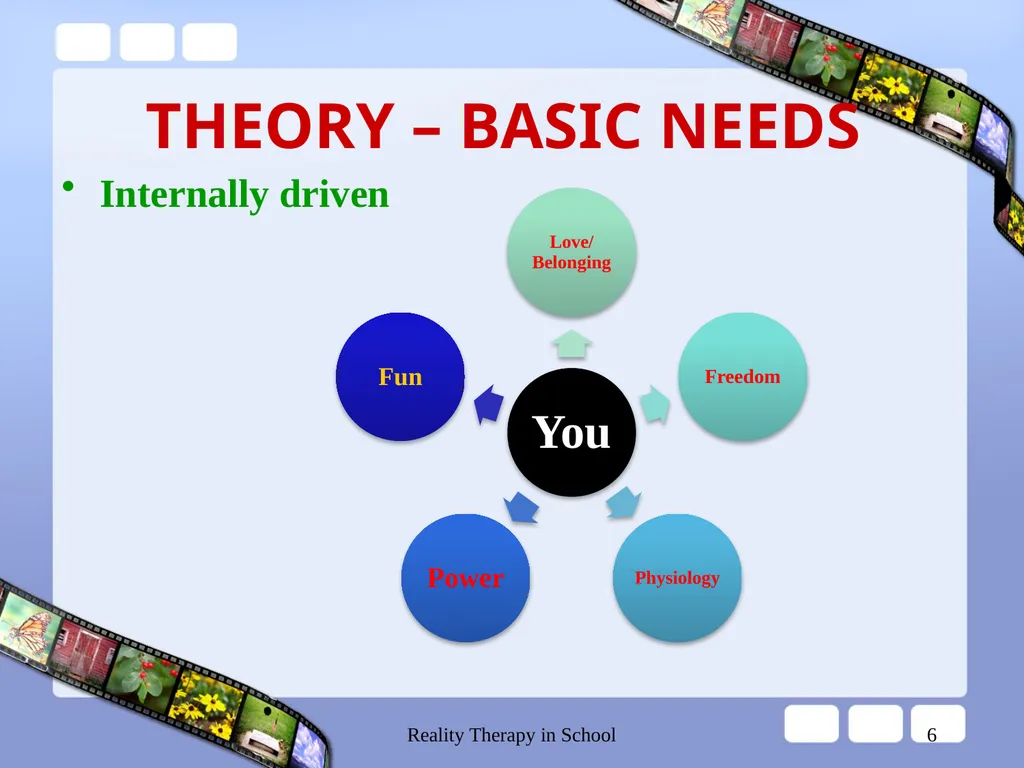
Reality Therapy in School 6 THEORY – BASIC NEEDS Internally driven<br>
07
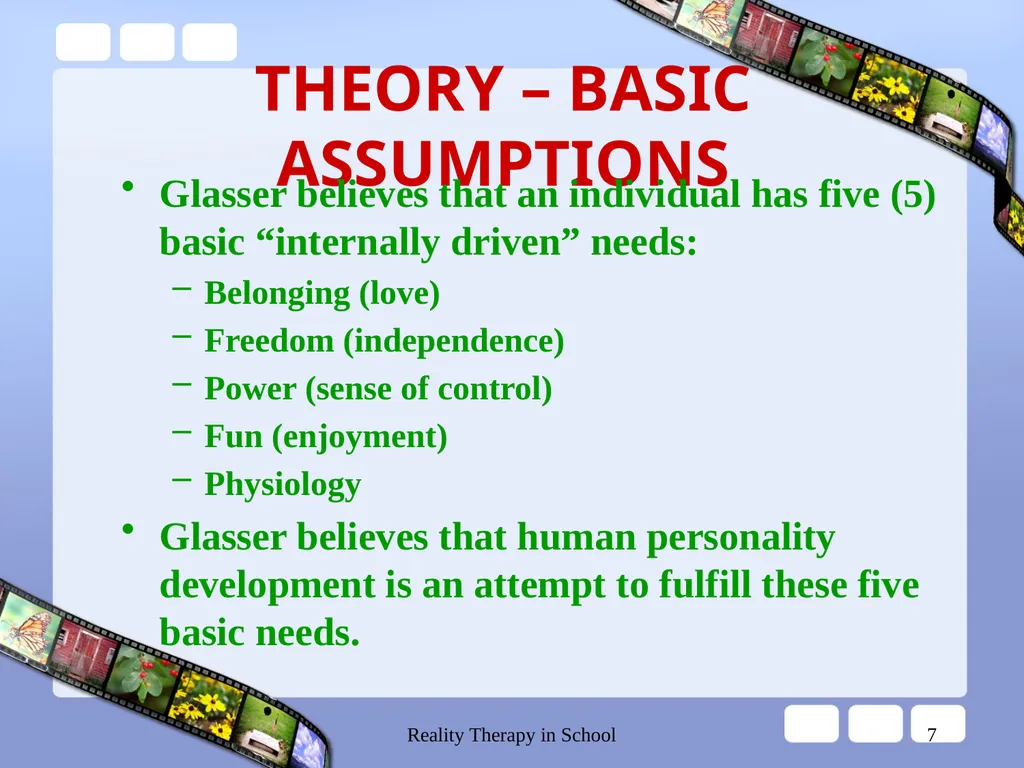
Reality Therapy in School 7 THEORY – BASIC ASSUMPTIONS Glasser believes that an individual has five (5) basic “internally driven” needs:
Belonging (love)
Freedom (independence)
Power (sense of control)
Fun (enjoyment)
Physiology
Glasser believes that human personality development is an attempt to fulfill these five basic needs.<br>
Belonging (love)
Freedom (independence)
Power (sense of control)
Fun (enjoyment)
Physiology
Glasser believes that human personality development is an attempt to fulfill these five basic needs.<br>
08
Reality Therapy in School 8 THEORY – BASIC ASSUMPTIONS Our brain functions as a control system to get us what we want.
Our quality world consists of our visions of specific people, activities, events, beliefs and situations that will fulfill our needs.<br>
Our quality world consists of our visions of specific people, activities, events, beliefs and situations that will fulfill our needs.<br>
09
Reality Therapy in School 9 THEORY – BASIC ASSUMPTIONS We create “picture albums” based on our quality world.
The difference (frustration) between what we want and what we perceive we are getting from our environment produces specific behaviors.<br>
The difference (frustration) between what we want and what we perceive we are getting from our environment produces specific behaviors.<br>
10
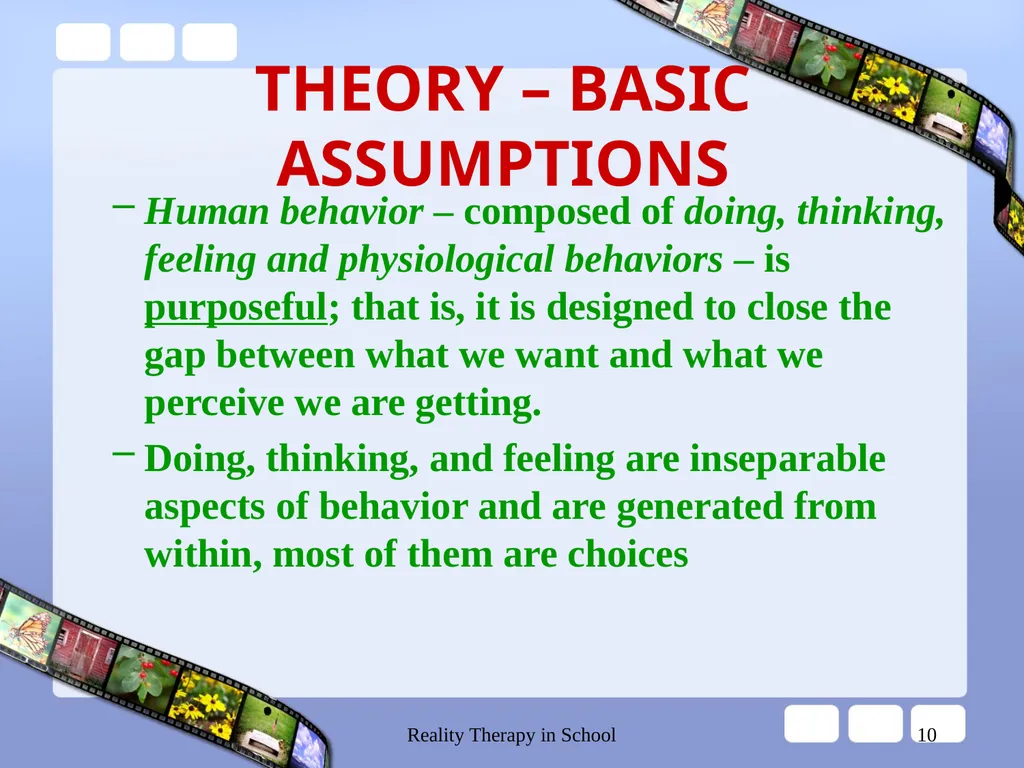
Reality Therapy in School 10 THEORY – BASIC ASSUMPTIONS Human behavior – composed of doing, thinking, feeling and physiological behaviors – is purposeful; that is, it is designed to close the gap between what we want and what we perceive we are getting.
Doing, thinking, and feeling are inseparable aspects of behavior and are generated from within, most of them are choices<br>
Doing, thinking, and feeling are inseparable aspects of behavior and are generated from within, most of them are choices<br>
11
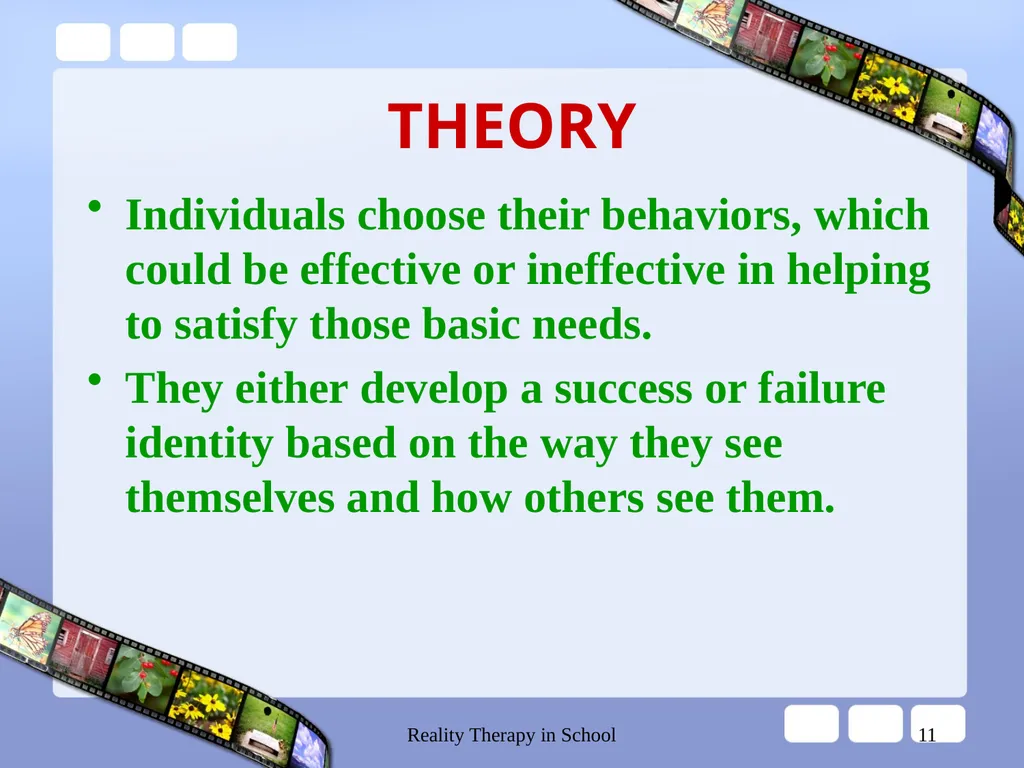
Reality Therapy in School 11 THEORY Individuals choose their behaviors, which could be effective or ineffective in helping to satisfy those basic needs.
They either develop a success or failure identity based on the way they see themselves and how others see them.<br>
They either develop a success or failure identity based on the way they see themselves and how others see them.<br>
12
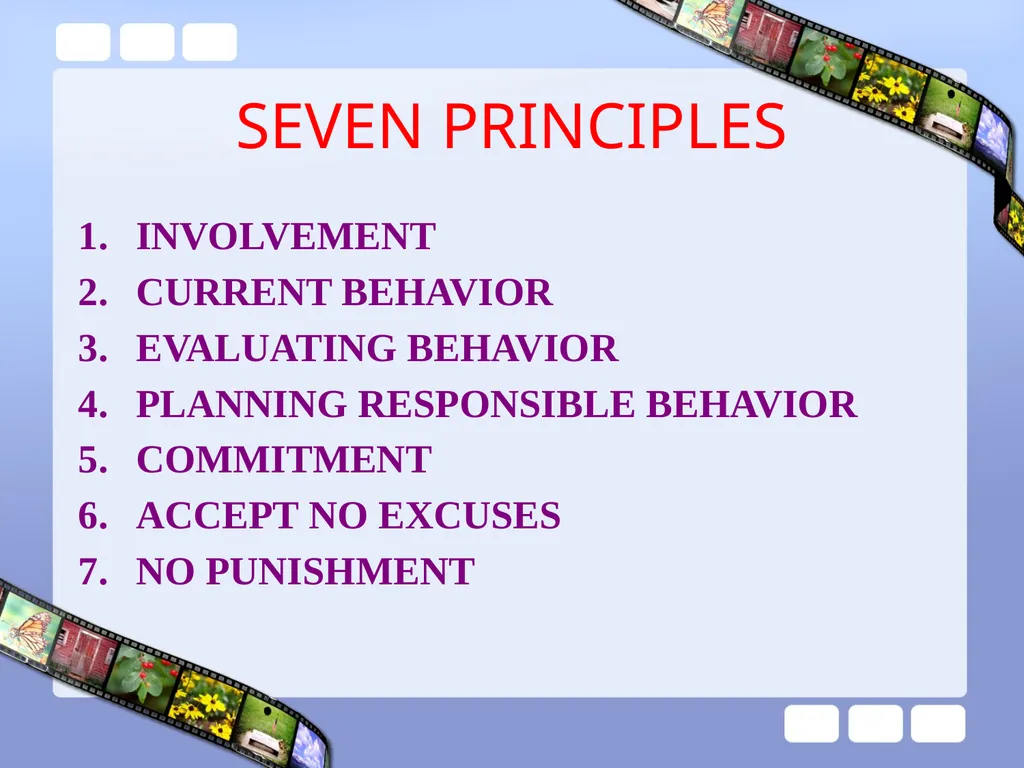
SEVEN PRINCIPLES INVOLVEMENT
CURRENT BEHAVIOR
EVALUATING BEHAVIOR
PLANNING RESPONSIBLE BEHAVIOR
COMMITMENT
ACCEPT NO EXCUSES
NO PUNISHMENT<br>
CURRENT BEHAVIOR
EVALUATING BEHAVIOR
PLANNING RESPONSIBLE BEHAVIOR
COMMITMENT
ACCEPT NO EXCUSES
NO PUNISHMENT<br>
13
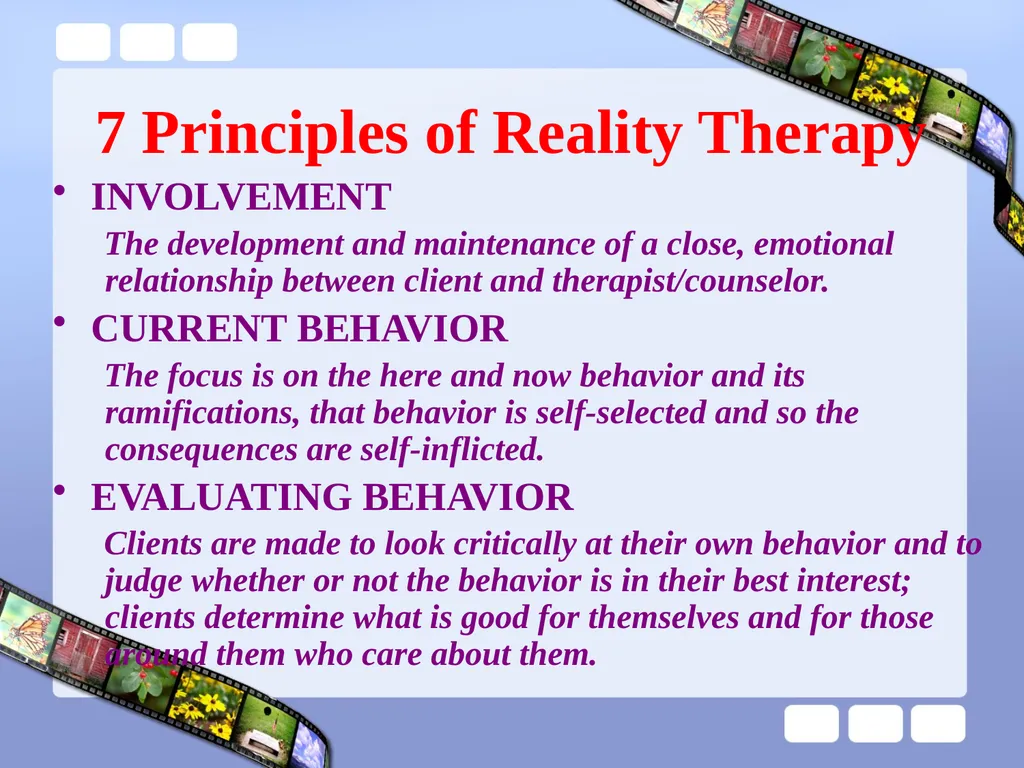
7 Principles of Reality Therapy INVOLVEMENT
The development and maintenance of a close, emotional relationship between client and therapist/counselor.
CURRENT BEHAVIOR
The focus is on the here and now behavior and its ramifications, that behavior is self-selected and so the consequences are self-inflicted.
EVALUATING BEHAVIOR
Clients are made to look critically at their own behavior and to judge whether or not the behavior is in their best interest; clients determine what is good for themselves and for those around them who care about them.<br>
The development and maintenance of a close, emotional relationship between client and therapist/counselor.
CURRENT BEHAVIOR
The focus is on the here and now behavior and its ramifications, that behavior is self-selected and so the consequences are self-inflicted.
EVALUATING BEHAVIOR
Clients are made to look critically at their own behavior and to judge whether or not the behavior is in their best interest; clients determine what is good for themselves and for those around them who care about them.<br>
14
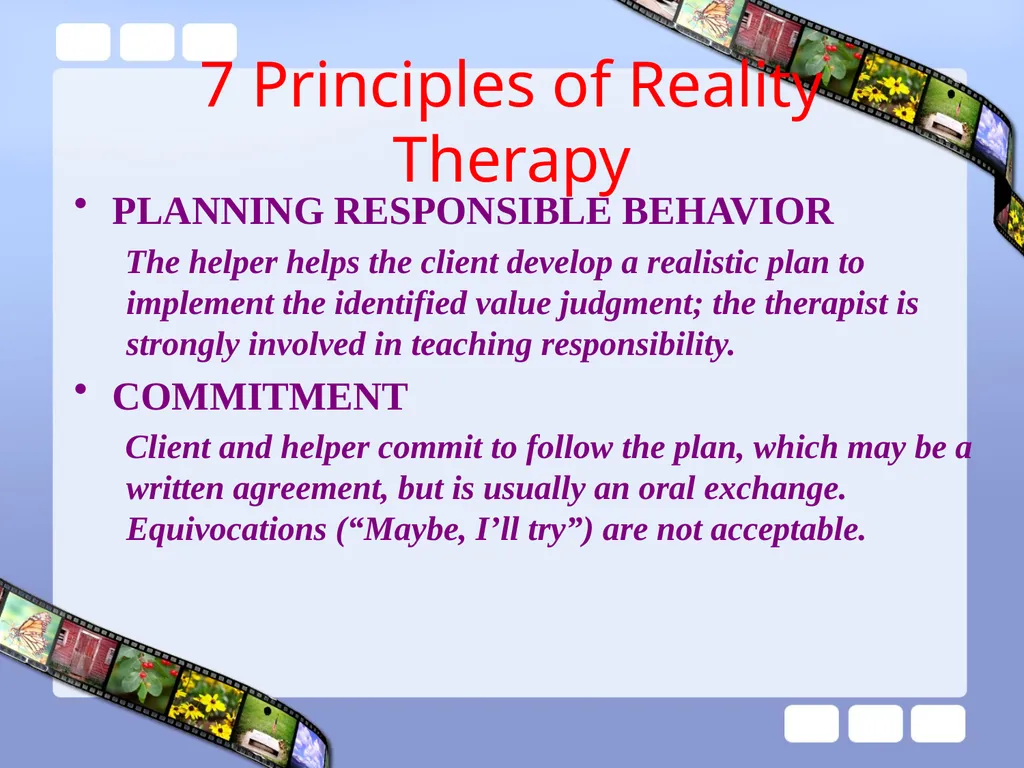
7 Principles of Reality Therapy PLANNING RESPONSIBLE BEHAVIOR
The helper helps the client develop a realistic plan to implement the identified value judgment; the therapist is strongly involved in teaching responsibility.
COMMITMENT
Client and helper commit to follow the plan, which may be a written agreement, but is usually an oral exchange. Equivocations (“Maybe, I’ll try”) are not acceptable.<br>
The helper helps the client develop a realistic plan to implement the identified value judgment; the therapist is strongly involved in teaching responsibility.
COMMITMENT
Client and helper commit to follow the plan, which may be a written agreement, but is usually an oral exchange. Equivocations (“Maybe, I’ll try”) are not acceptable.<br>
15
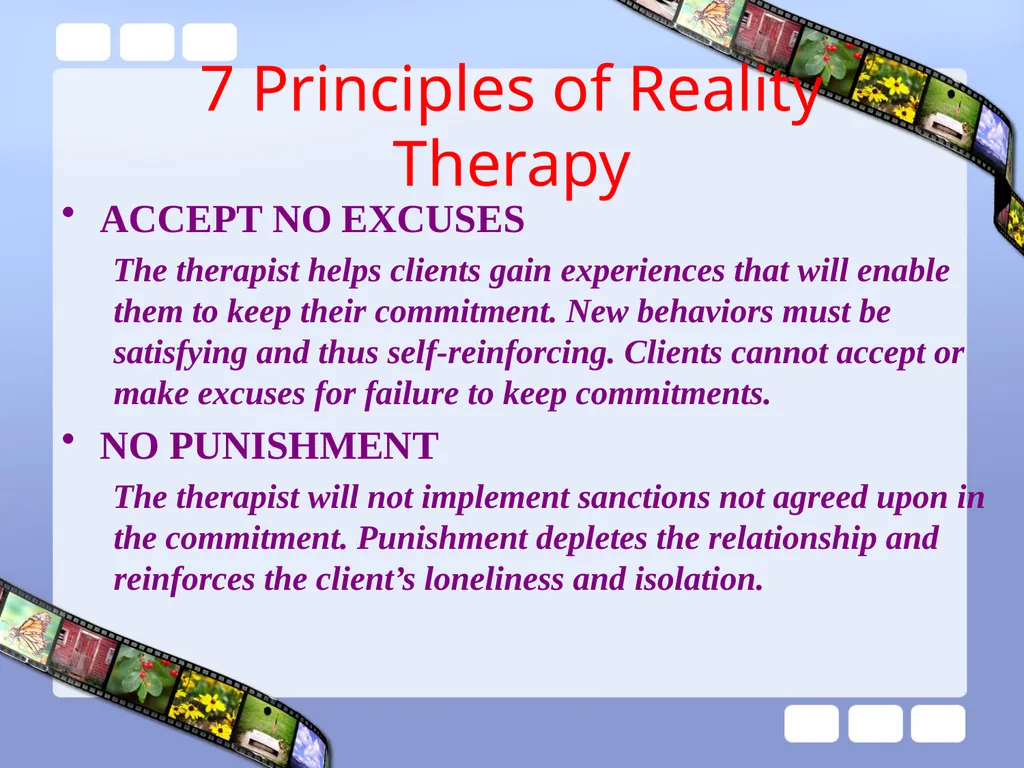
7 Principles of Reality Therapy ACCEPT NO EXCUSES
The therapist helps clients gain experiences that will enable them to keep their commitment. New behaviors must be satisfying and thus self-reinforcing. Clients cannot accept or make excuses for failure to keep commitments.
NO PUNISHMENT
The therapist will not implement sanctions not agreed upon in the commitment. Punishment depletes the relationship and reinforces the client’s loneliness and isolation.<br>
The therapist helps clients gain experiences that will enable them to keep their commitment. New behaviors must be satisfying and thus self-reinforcing. Clients cannot accept or make excuses for failure to keep commitments.
NO PUNISHMENT
The therapist will not implement sanctions not agreed upon in the commitment. Punishment depletes the relationship and reinforces the client’s loneliness and isolation.<br>
16
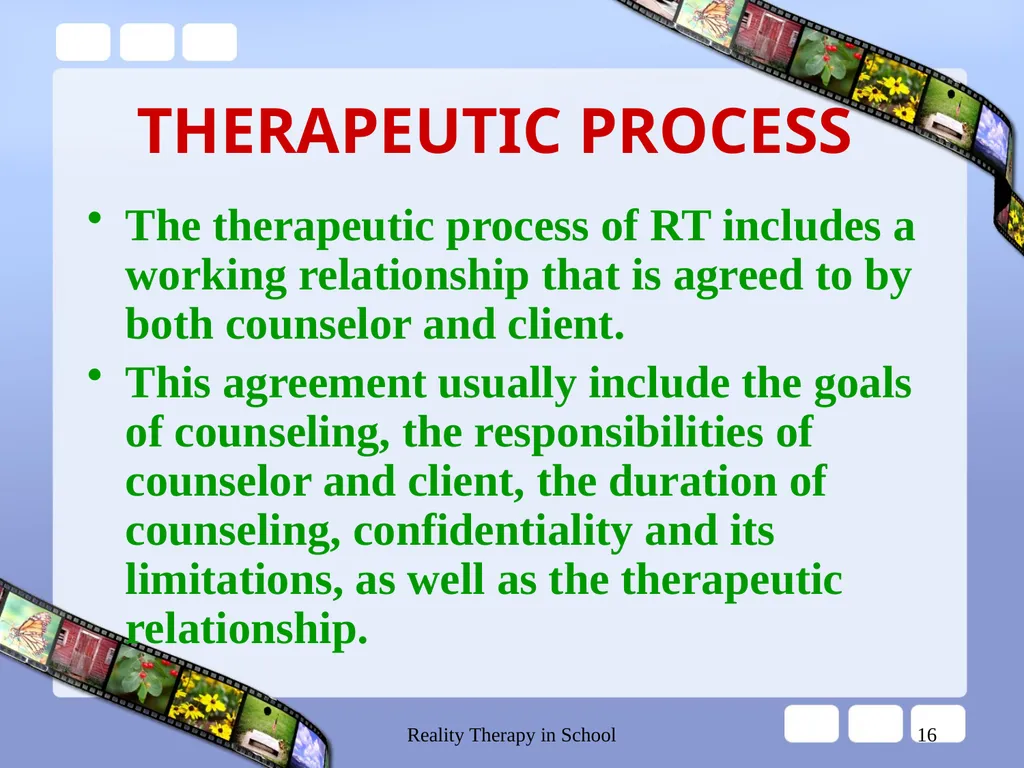
Reality Therapy in School 16 THERAPEUTIC PROCESS The therapeutic process of RT includes a working relationship that is agreed to by both counselor and client.
This agreement usually include the goals of counseling, the responsibilities of counselor and client, the duration of counseling, confidentiality and its limitations, as well as the therapeutic relationship.<br>
This agreement usually include the goals of counseling, the responsibilities of counselor and client, the duration of counseling, confidentiality and its limitations, as well as the therapeutic relationship.<br>
17
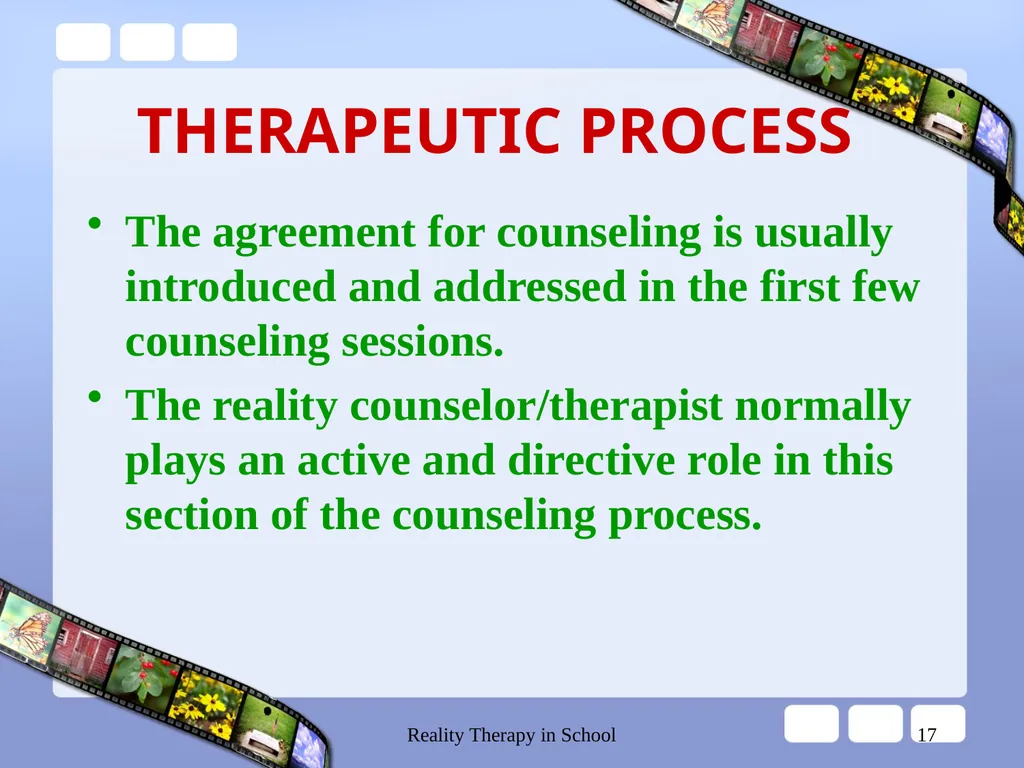
Reality Therapy in School 17 THERAPEUTIC PROCESS The agreement for counseling is usually introduced and addressed in the first few counseling sessions.
The reality counselor/therapist normally plays an active and directive role in this section of the counseling process.<br>
The reality counselor/therapist normally plays an active and directive role in this section of the counseling process.<br>
18
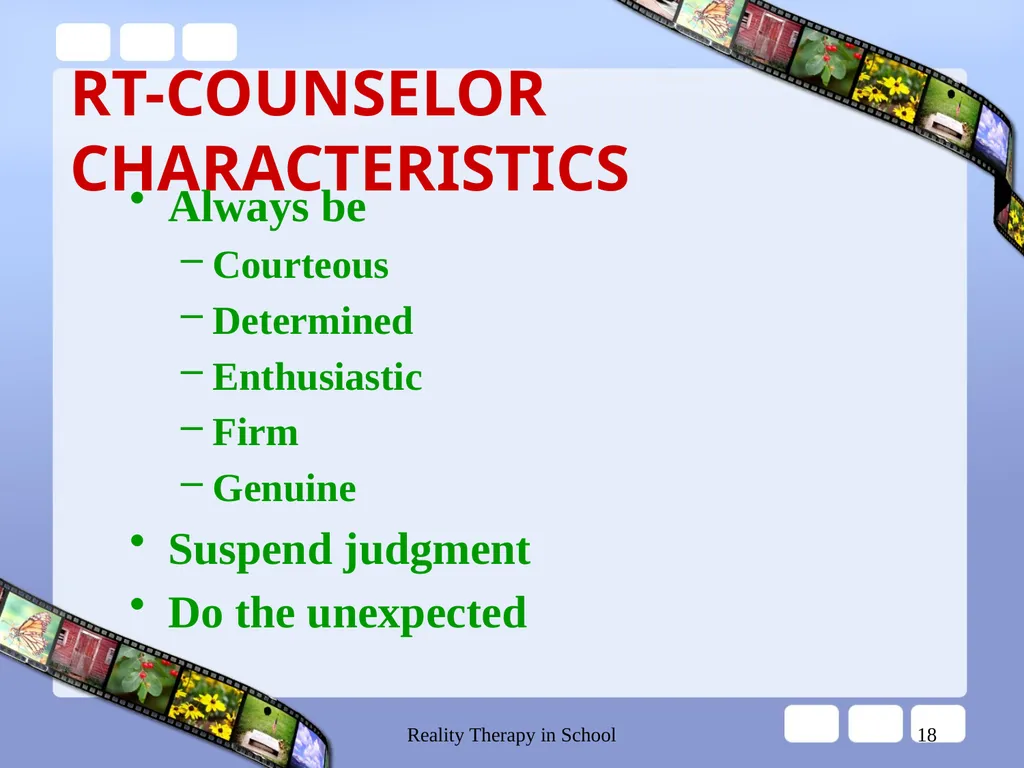
Reality Therapy in School 18 RT-COUNSELOR CHARACTERISTICS Always be
Courteous
Determined
Enthusiastic
Firm
Genuine
Suspend judgment
Do the unexpected<br>
Courteous
Determined
Enthusiastic
Firm
Genuine
Suspend judgment
Do the unexpected<br>
19
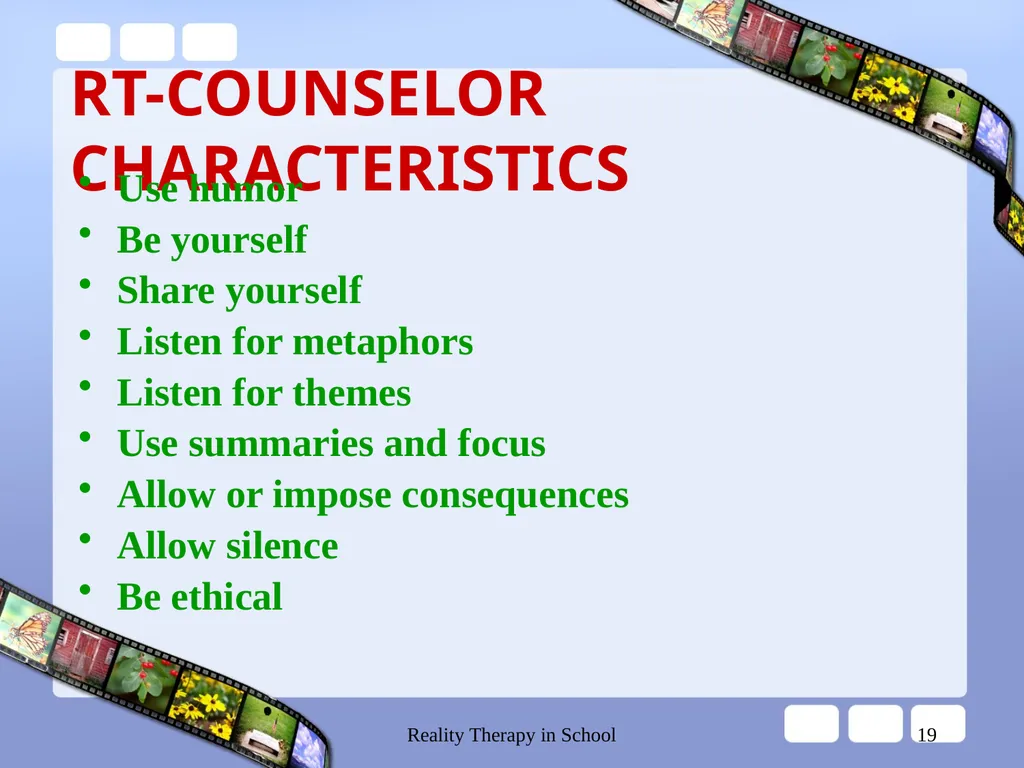
Reality Therapy in School 19 RT-COUNSELOR CHARACTERISTICS Use humor
Be yourself
Share yourself
Listen for metaphors
Listen for themes
Use summaries and focus
Allow or impose consequences
Allow silence
Be ethical<br>
Be yourself
Share yourself
Listen for metaphors
Listen for themes
Use summaries and focus
Allow or impose consequences
Allow silence
Be ethical<br>
20
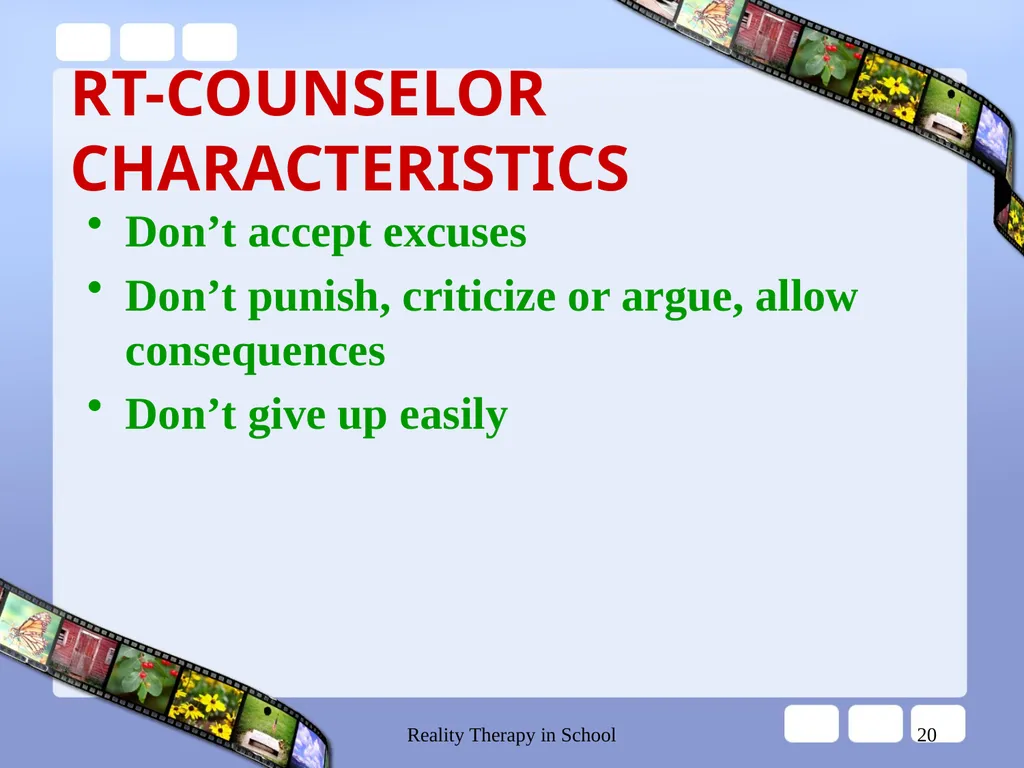
Reality Therapy in School 20 RT-COUNSELOR CHARACTERISTICS Don’t accept excuses
Don’t punish, criticize or argue, allow consequences
Don’t give up easily<br>
Don’t punish, criticize or argue, allow consequences
Don’t give up easily<br>
21
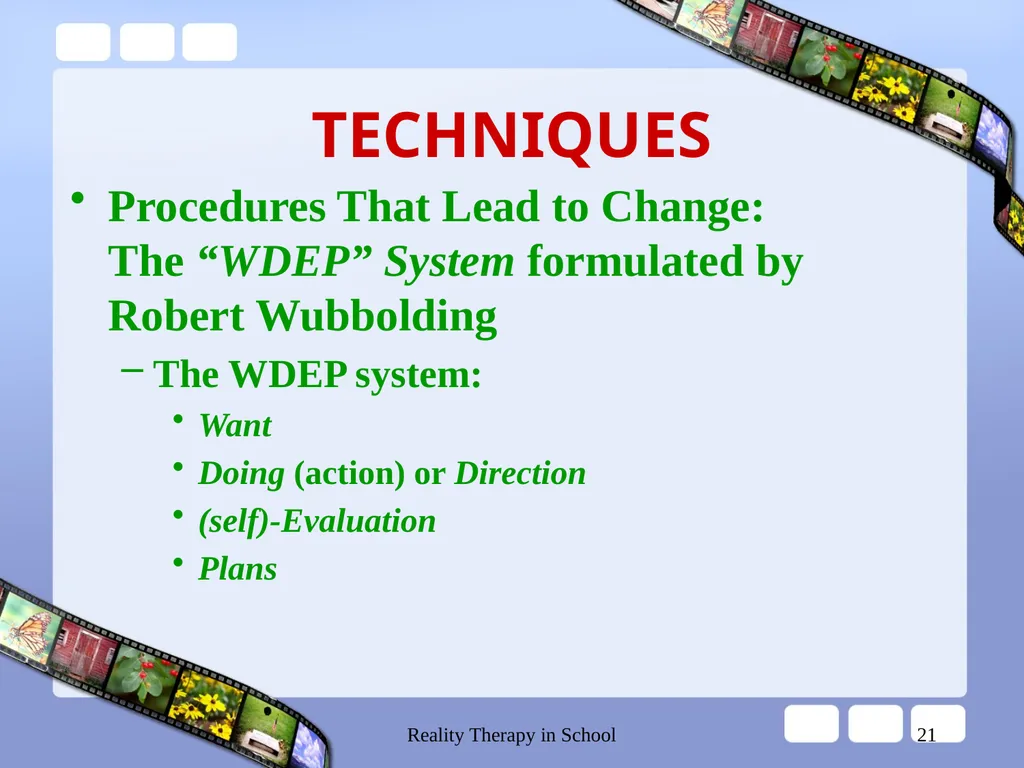
Reality Therapy in School 21 TECHNIQUES Procedures That Lead to Change:
The “WDEP” System formulated by Robert Wubbolding
The WDEP system:
Want
Doing (action) or Direction
(self)-Evaluation
Plans<br>
The WDEP system:
Want
Doing (action) or Direction
(self)-Evaluation
Plans<br>
22
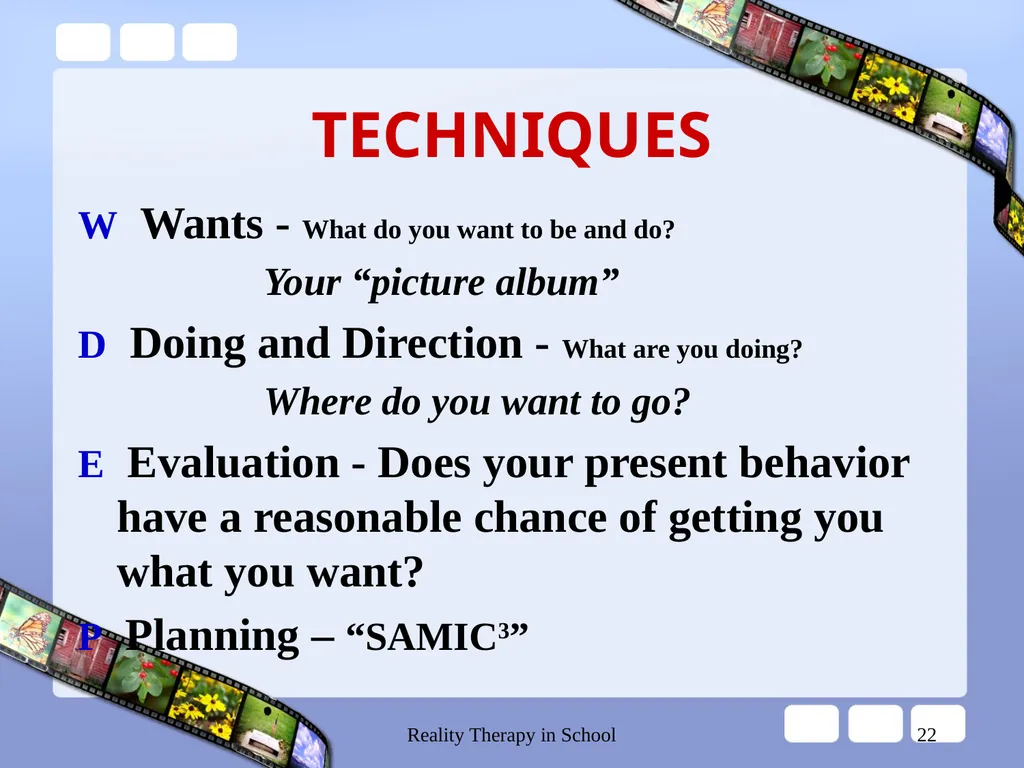
Reality Therapy in School 22 TECHNIQUES W Wants - What do you want to be and do?
Your “picture album”
D Doing and Direction - What are you doing?
Where do you want to go?
E Evaluation - Does your present behavior have a reasonable chance of getting you what you want?
P Planning – “SAMIC3”<br>
Your “picture album”
D Doing and Direction - What are you doing?
Where do you want to go?
E Evaluation - Does your present behavior have a reasonable chance of getting you what you want?
P Planning – “SAMIC3”<br>
23
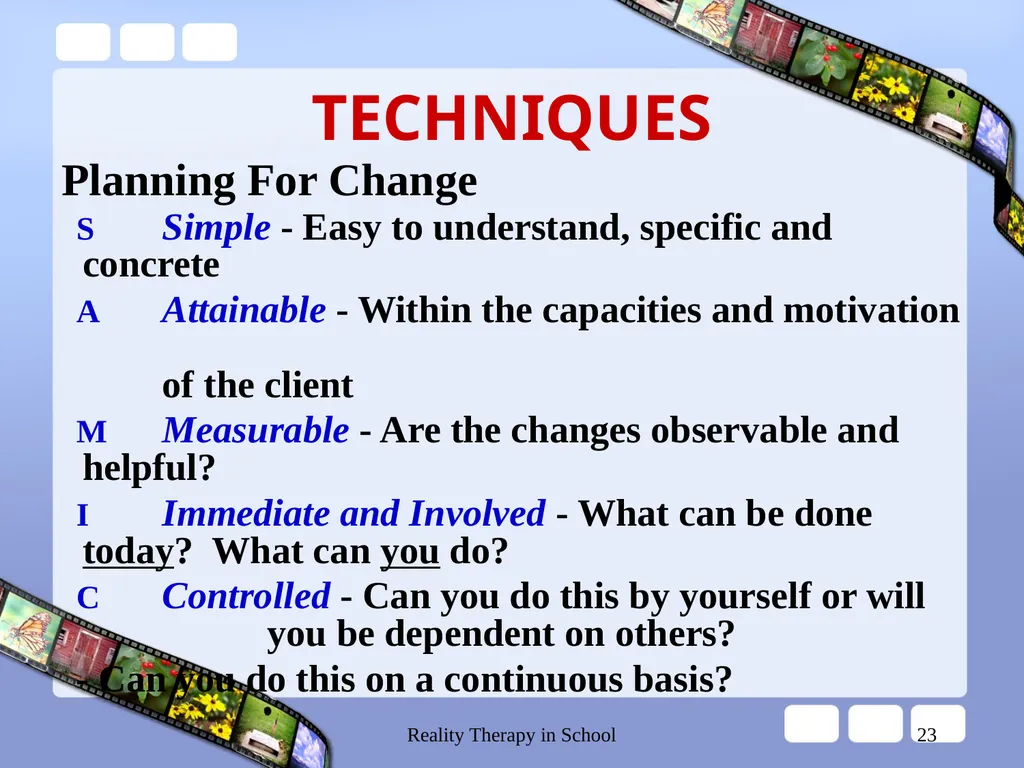
Reality Therapy in School 23 TECHNIQUES Planning For Change S Simple - Easy to understand, specific and concrete
A Attainable - Within the capacities and motivation of the client
M Measurable - Are the changes observable and helpful?
I Immediate and Involved - What can be done today? What can you do?
C Controlled - Can you do this by yourself or will you be dependent on others?
- Can you do this on a continuous basis?<br>
A Attainable - Within the capacities and motivation of the client
M Measurable - Are the changes observable and helpful?
I Immediate and Involved - What can be done today? What can you do?
C Controlled - Can you do this by yourself or will you be dependent on others?
- Can you do this on a continuous basis?<br>
24
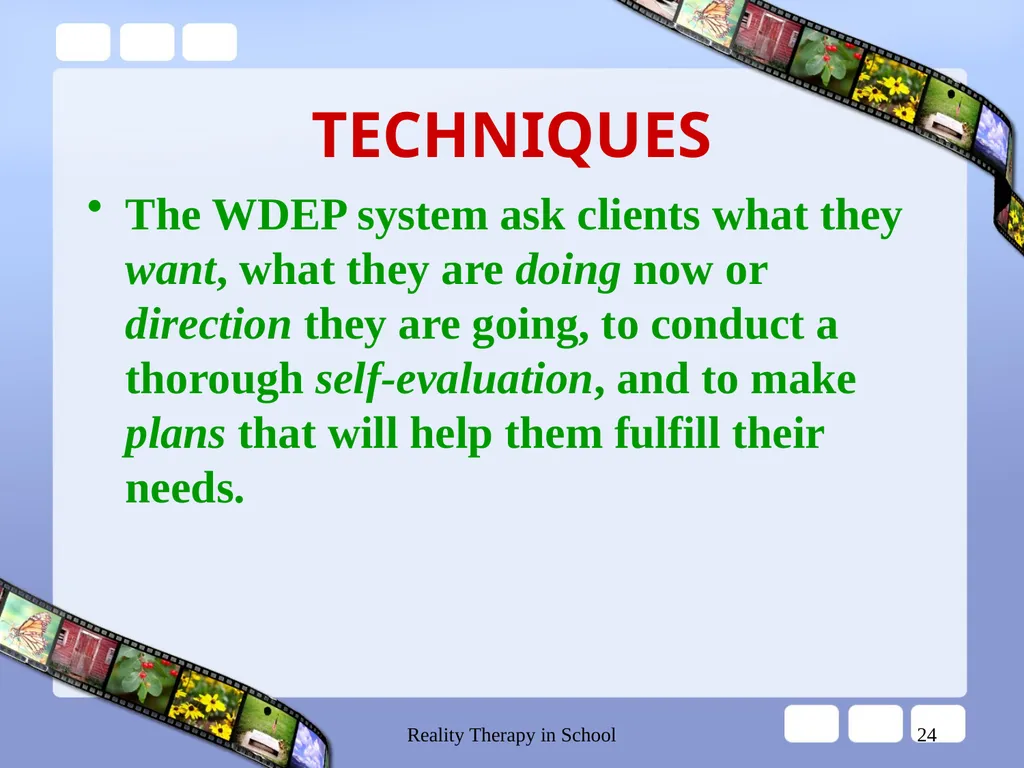
Reality Therapy in School 24 TECHNIQUES The WDEP system ask clients what they want, what they are doing now or direction they are going, to conduct a thorough self-evaluation, and to make plans that will help them fulfill their needs.<br>
25
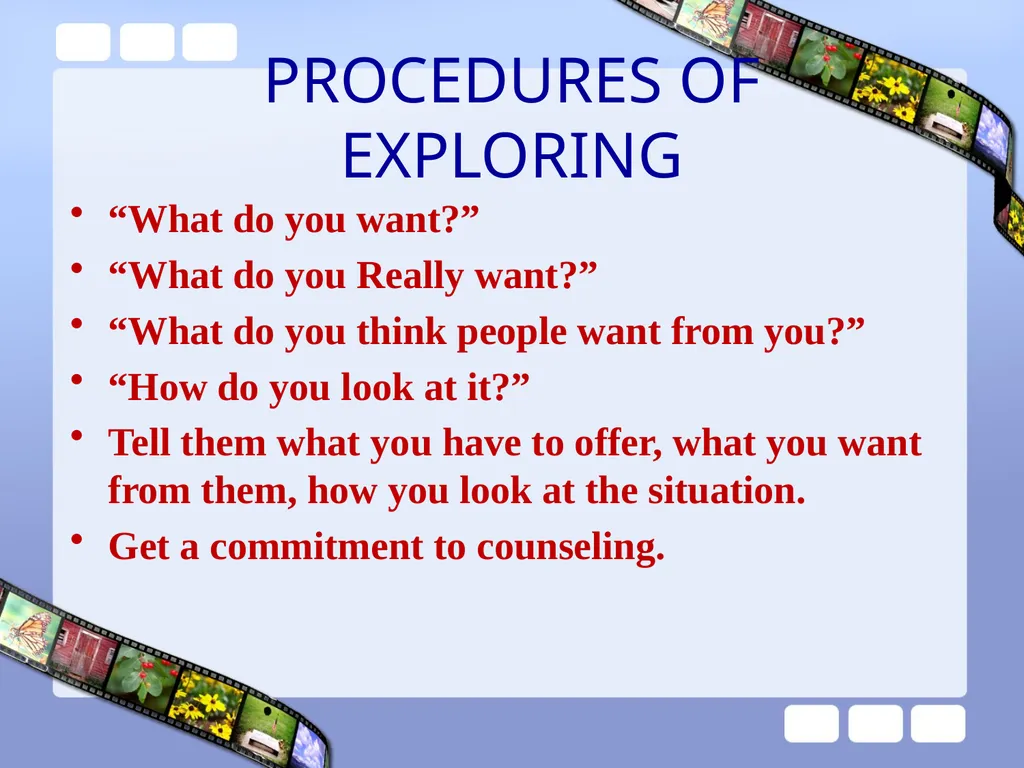
PROCEDURES OF EXPLORING “What do you want?”
“What do you Really want?”
“What do you think people want from you?”
“How do you look at it?”
Tell them what you have to offer, what you want from them, how you look at the situation.
Get a commitment to counseling.<br>
“What do you Really want?”
“What do you think people want from you?”
“How do you look at it?”
Tell them what you have to offer, what you want from them, how you look at the situation.
Get a commitment to counseling.<br>
26
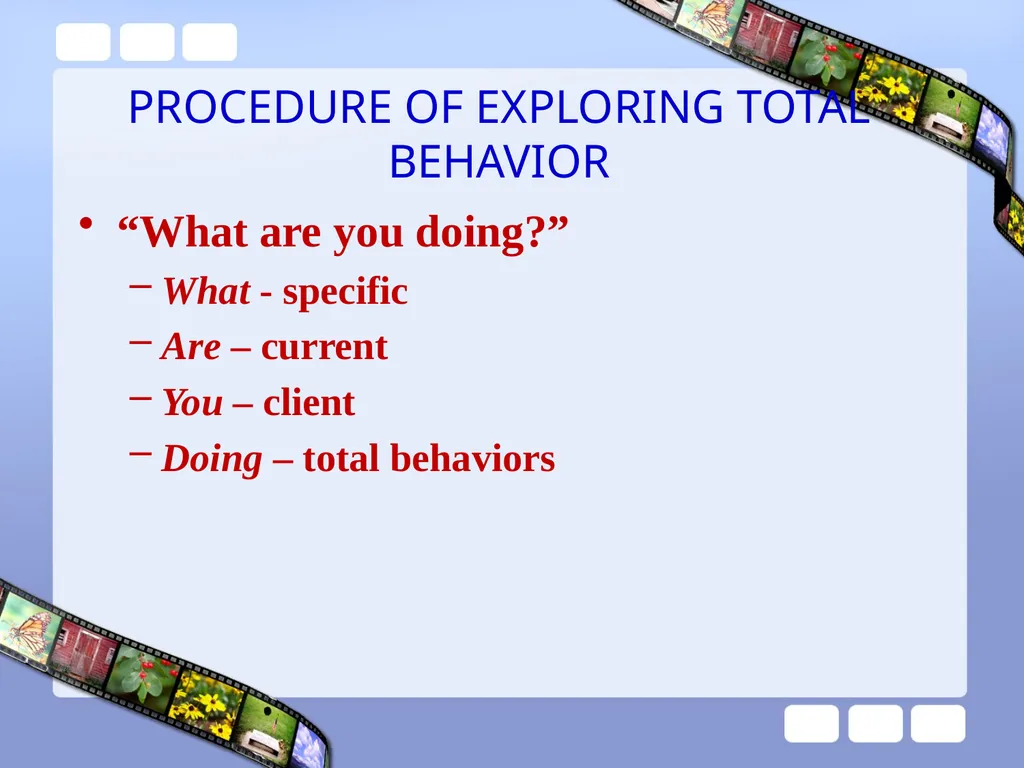
PROCEDURE OF EXPLORING TOTAL BEHAVIOR “What are you doing?”
What - specific
Are – current
You – client
Doing – total behaviors<br>
What - specific
Are – current
You – client
Doing – total behaviors<br>
27
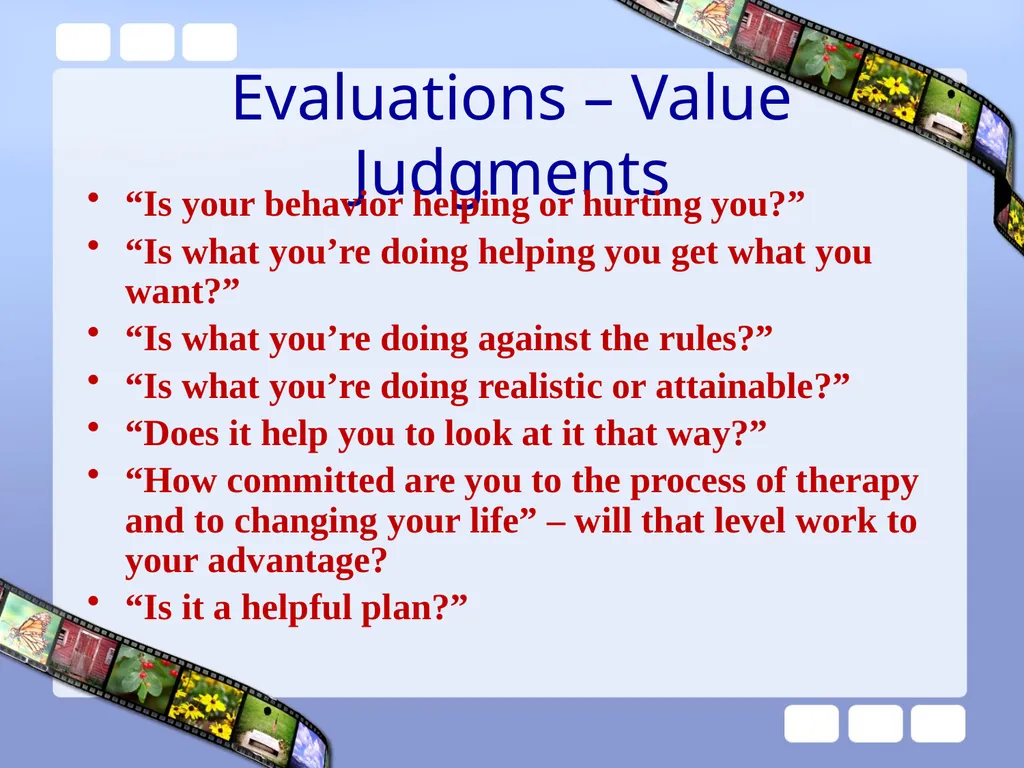
Evaluations – Value Judgments “Is your behavior helping or hurting you?”
“Is what you’re doing helping you get what you want?”
“Is what you’re doing against the rules?”
“Is what you’re doing realistic or attainable?”
“Does it help you to look at it that way?”
“How committed are you to the process of therapy and to changing your life” – will that level work to your advantage?
“Is it a helpful plan?”<br>
“Is what you’re doing helping you get what you want?”
“Is what you’re doing against the rules?”
“Is what you’re doing realistic or attainable?”
“Does it help you to look at it that way?”
“How committed are you to the process of therapy and to changing your life” – will that level work to your advantage?
“Is it a helpful plan?”<br>
28
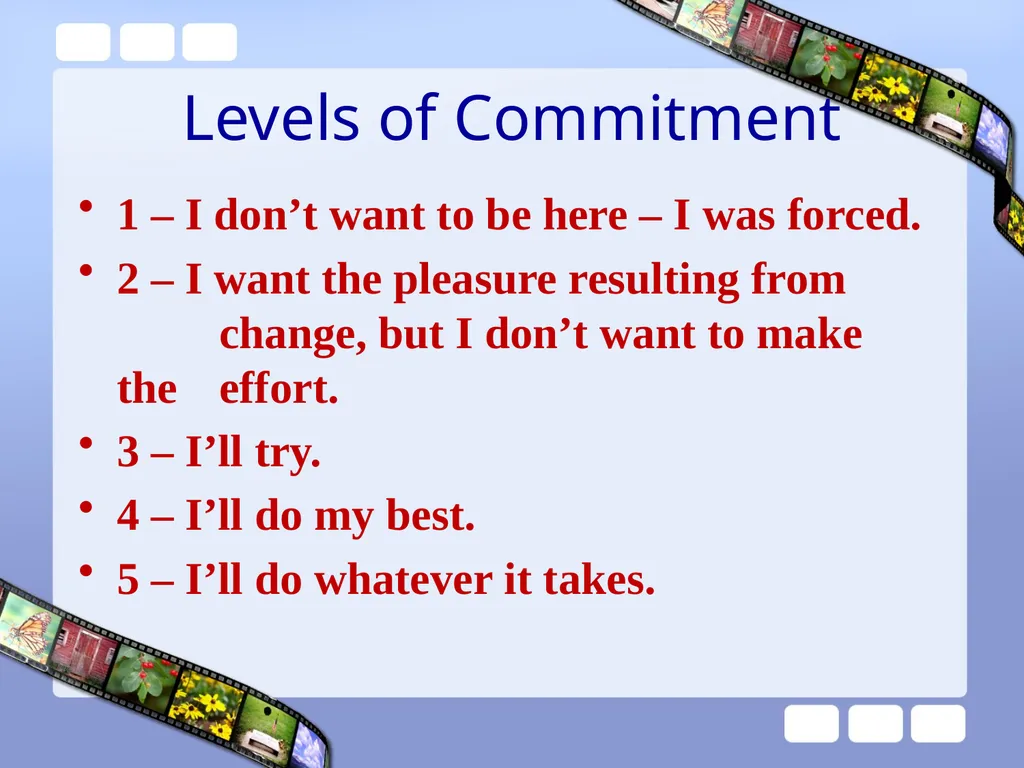
Levels of Commitment 1 – I don’t want to be here – I was forced.
2 – I want the pleasure resulting from change, but I don’t want to make the effort.
3 – I’ll try.
4 – I’ll do my best.
5 – I’ll do whatever it takes.<br>
2 – I want the pleasure resulting from change, but I don’t want to make the effort.
3 – I’ll try.
4 – I’ll do my best.
5 – I’ll do whatever it takes.<br>
29
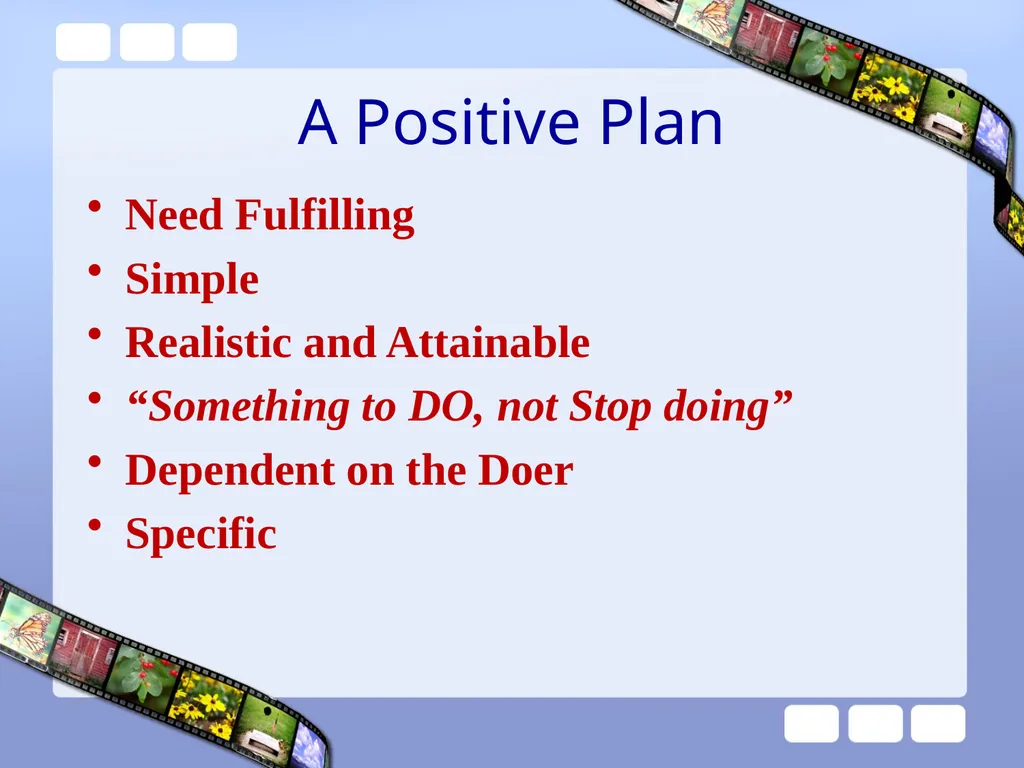
A Positive Plan Need Fulfilling
Simple
Realistic and Attainable
“Something to DO, not Stop doing”
Dependent on the Doer
Specific<br>
Simple
Realistic and Attainable
“Something to DO, not Stop doing”
Dependent on the Doer
Specific<br>
30
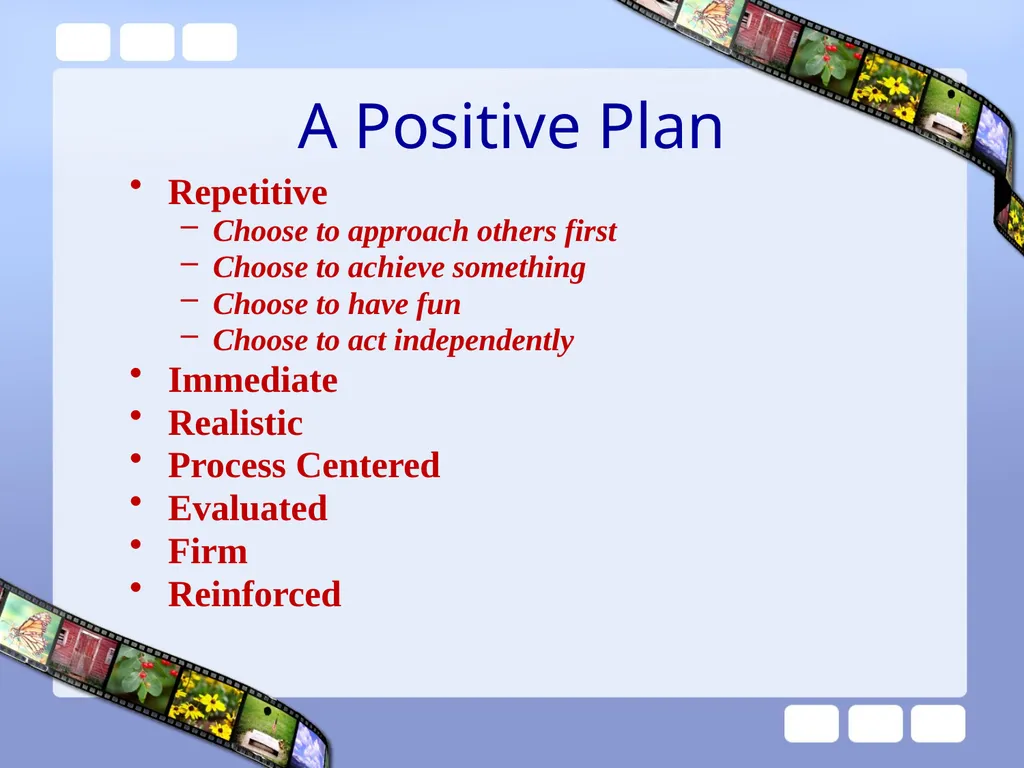
A Positive Plan Repetitive
Choose to approach others first
Choose to achieve something
Choose to have fun
Choose to act independently
Immediate
Realistic
Process Centered
Evaluated
Firm
Reinforced<br>
Choose to approach others first
Choose to achieve something
Choose to have fun
Choose to act independently
Immediate
Realistic
Process Centered
Evaluated
Firm
Reinforced<br>
31
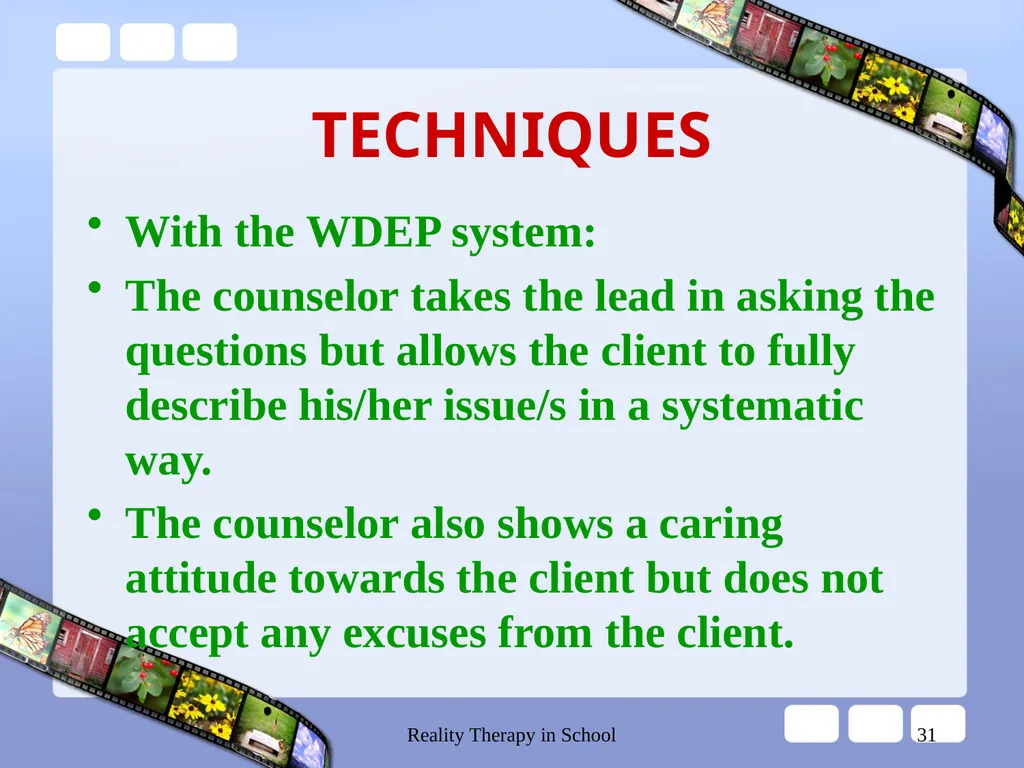
Reality Therapy in School 31 TECHNIQUES With the WDEP system:
The counselor takes the lead in asking the questions but allows the client to fully describe his/her issue/s in a systematic way.
The counselor also shows a caring attitude towards the client but does not accept any excuses from the client.<br>
The counselor takes the lead in asking the questions but allows the client to fully describe his/her issue/s in a systematic way.
The counselor also shows a caring attitude towards the client but does not accept any excuses from the client.<br>
32
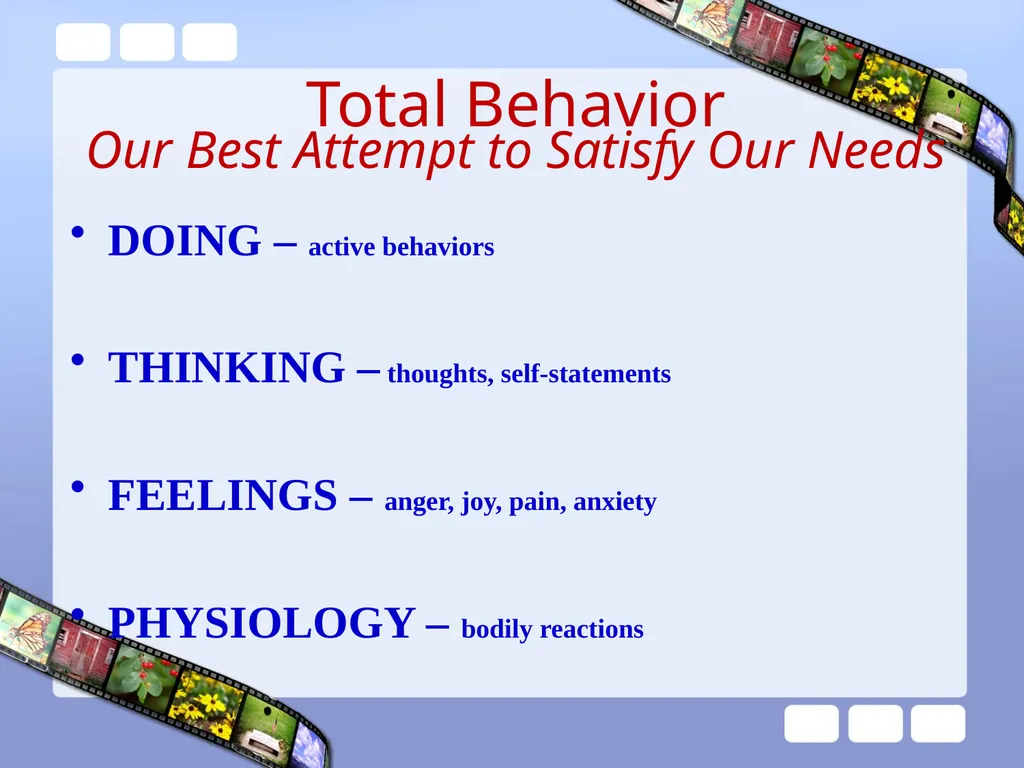
Total Behavior
Our Best Attempt to Satisfy Our Needs DOING – active behaviors
THINKING – thoughts, self-statements
FEELINGS – anger, joy, pain, anxiety
PHYSIOLOGY – bodily reactions<br>
THINKING – thoughts, self-statements
FEELINGS – anger, joy, pain, anxiety
PHYSIOLOGY – bodily reactions<br>
33
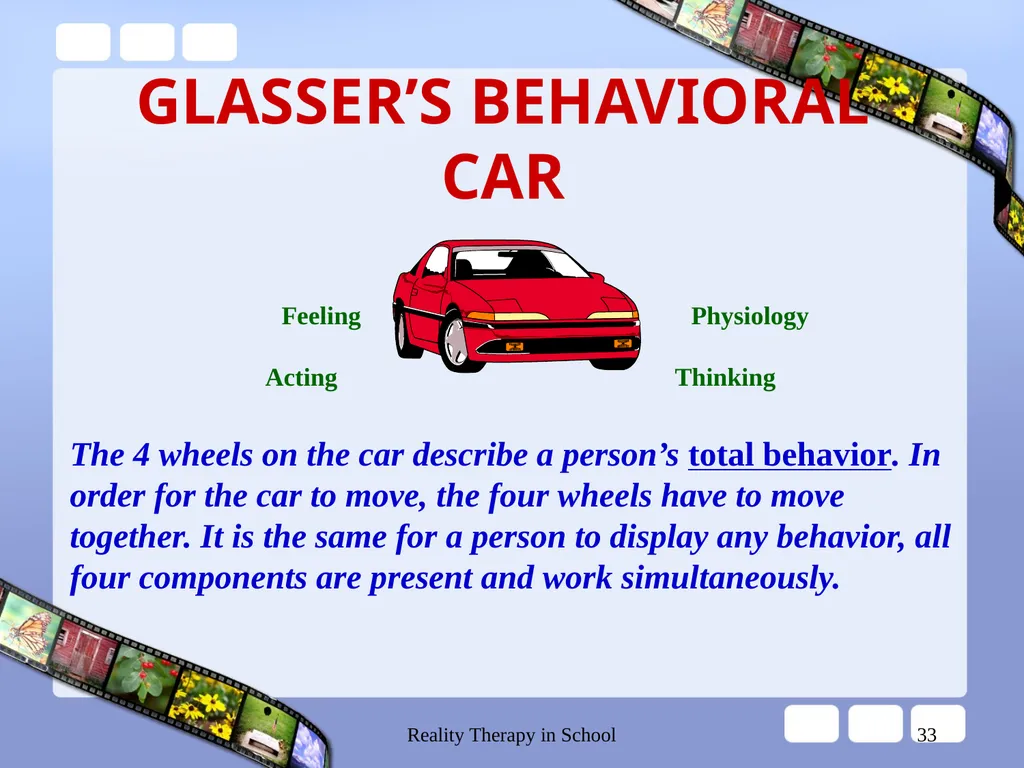
Reality Therapy in School 33 GLASSER’S BEHAVIORAL CAR Feeling Physiology
Acting Thinking The 4 wheels on the car describe a person’s total behavior. In order for the car to move, the four wheels have to move together. It is the same for a person to display any behavior, all four components are present and work simultaneously.<br>
Acting Thinking The 4 wheels on the car describe a person’s total behavior. In order for the car to move, the four wheels have to move together. It is the same for a person to display any behavior, all four components are present and work simultaneously.<br>
34
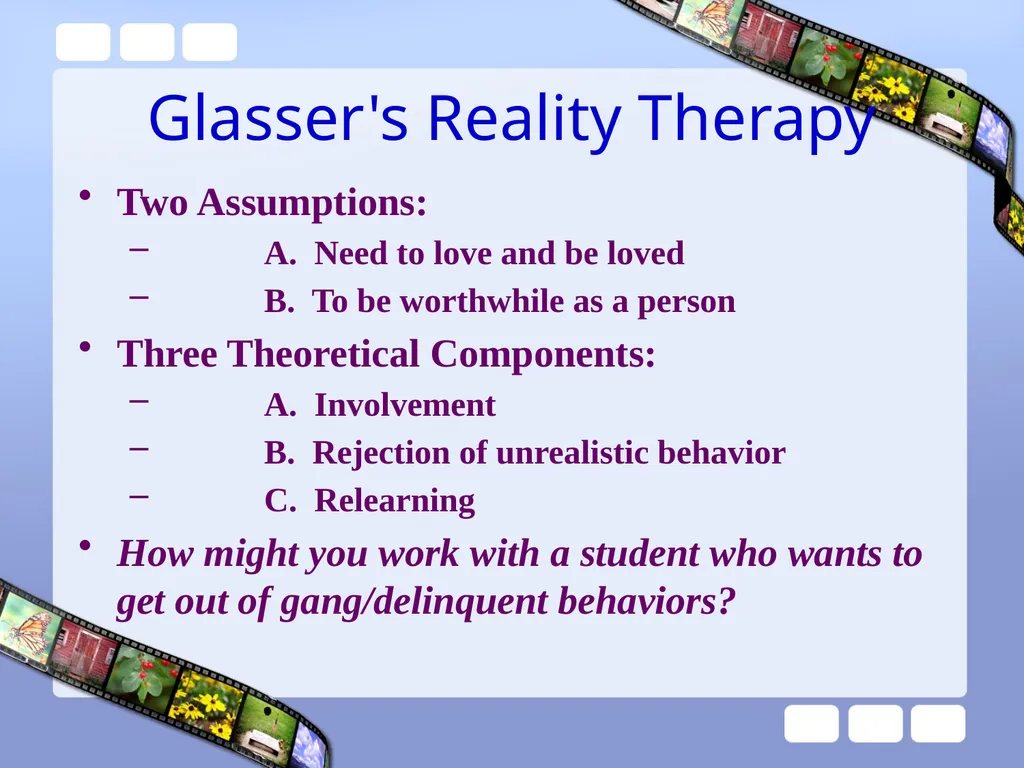
Glasser's Reality Therapy Two Assumptions:
A. Need to love and be loved
B. To be worthwhile as a person
Three Theoretical Components:
A. Involvement
B. Rejection of unrealistic behavior
C. Relearning
How might you work with a student who wants to get out of gang/delinquent behaviors?<br>
A. Need to love and be loved
B. To be worthwhile as a person
Three Theoretical Components:
A. Involvement
B. Rejection of unrealistic behavior
C. Relearning
How might you work with a student who wants to get out of gang/delinquent behaviors?<br>