
Reasoning and Proofs Geometry Chapter 2 This
PT
Published · 54 slides · 0 views
1 / 1
Description
Reasoning and Proofs Geometry Chapter 2 This Slideshow was developed to accompany the textbook Big Ideas Geometry By Larson and Boswell 2022 K12 (National GeographicCengage) Some examples and diagrams are taken from the textbook. Slides
Related Topics
Share
Embed code
Download this presentation From Below
"Reasoning and Proofs Geometry Chapter 2 This" is the property of its rightful owner. Permission is granted to download and print the materials on this website for personal, non-commercial use only, and to display it on your personal computer provided you do not modify the materials and that you retain all copyright notices contained in the materials. By downloading content from our website, you accept the terms of this agreement.
Presentation Transcript
01
Reasoning and Proofs Geometry
Chapter 2<br>
Chapter 2<br>
02
This Slideshow was developed to accompany the textbook
Big Ideas Geometry
By Larson and Boswell
2022 K12 (National Geographic/Cengage)
Some examples and diagrams are taken from the textbook. Slides created by
Richard Wright, Andrews Academy
rwright@andrews.edu<br>
Big Ideas Geometry
By Larson and Boswell
2022 K12 (National Geographic/Cengage)
Some examples and diagrams are taken from the textbook. Slides created by
Richard Wright, Andrews Academy
rwright@andrews.edu<br>
03
2.1 Conditional Statements Objectives: By the end of the lesson,
• I can write conditional statements.
• I can write biconditional statements.<br>
• I can write conditional statements.
• I can write biconditional statements.<br>
04
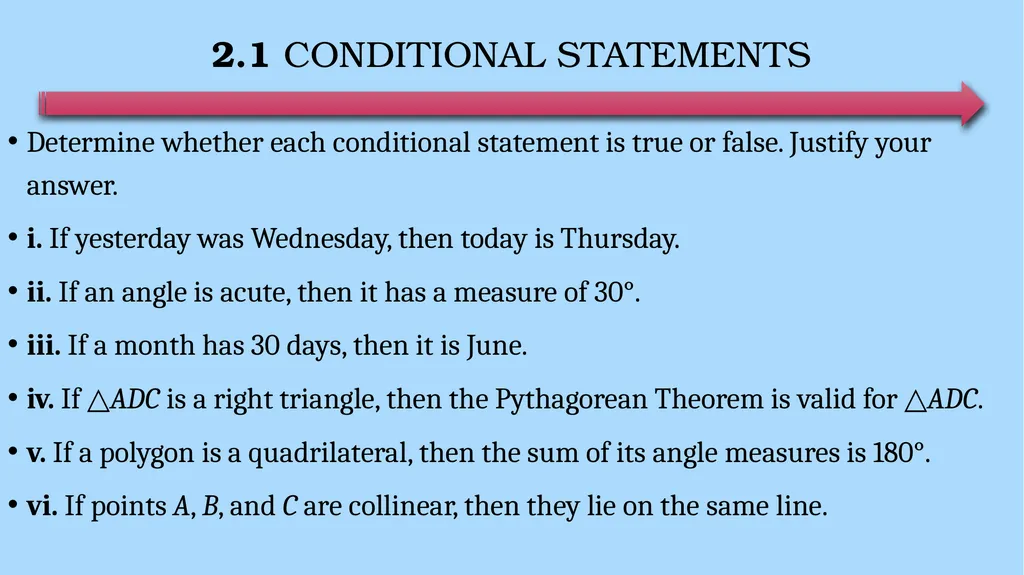
2.1 Conditional Statements Determine whether each conditional statement is true or false. Justify your answer.
i. If yesterday was Wednesday, then today is Thursday.
ii. If an angle is acute, then it has a measure of 30°.
iii. If a month has 30 days, then it is June.
iv. If △ADC is a right triangle, then the Pythagorean Theorem is valid for △ADC.
v. If a polygon is a quadrilateral, then the sum of its angle measures is 180°.
vi. If points A, B, and C are collinear, then they lie on the same line.<br>
i. If yesterday was Wednesday, then today is Thursday.
ii. If an angle is acute, then it has a measure of 30°.
iii. If a month has 30 days, then it is June.
iv. If △ADC is a right triangle, then the Pythagorean Theorem is valid for △ADC.
v. If a polygon is a quadrilateral, then the sum of its angle measures is 180°.
vi. If points A, B, and C are collinear, then they lie on the same line.<br>
05
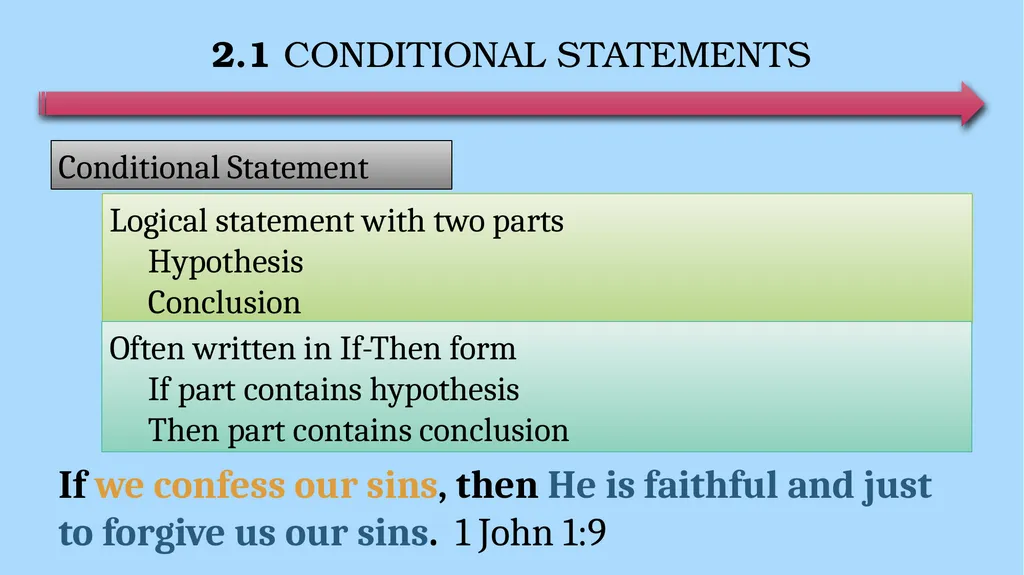
2.1 Conditional Statements Conditional Statement Logical statement with two parts
Hypothesis
Conclusion Often written in If-Then form
If part contains hypothesis
Then part contains conclusion If we confess our sins, then He is faithful and just to forgive us our sins. 1 John 1:9<br>
Hypothesis
Conclusion Often written in If-Then form
If part contains hypothesis
Then part contains conclusion If we confess our sins, then He is faithful and just to forgive us our sins. 1 John 1:9<br>
06
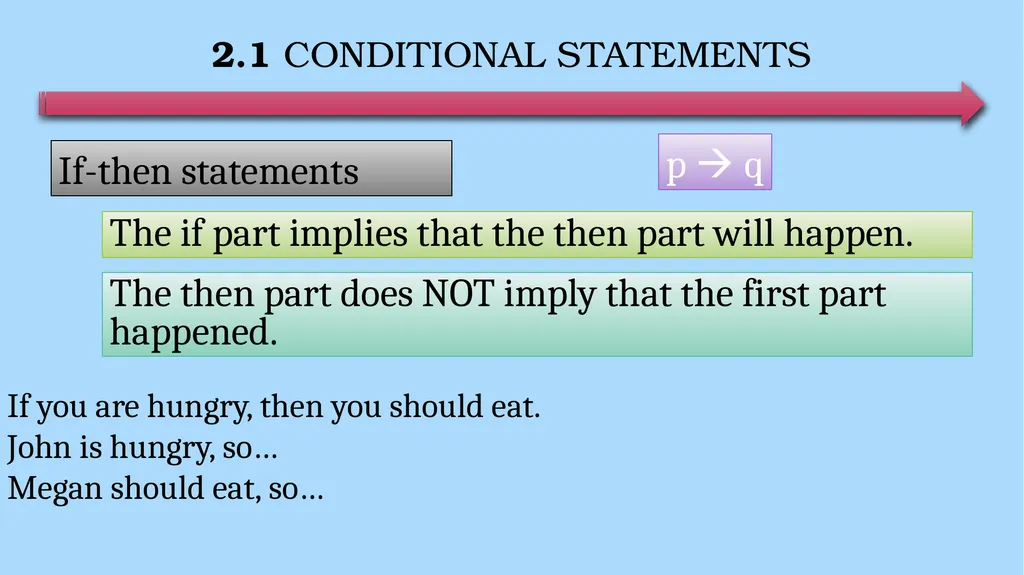
2.1 Conditional Statements p q If-then statements The if part implies that the then part will happen. The then part does NOT imply that the first part happened. If you are hungry, then you should eat.
John is hungry, so…
Megan should eat, so…<br>
John is hungry, so…
Megan should eat, so…<br>
07
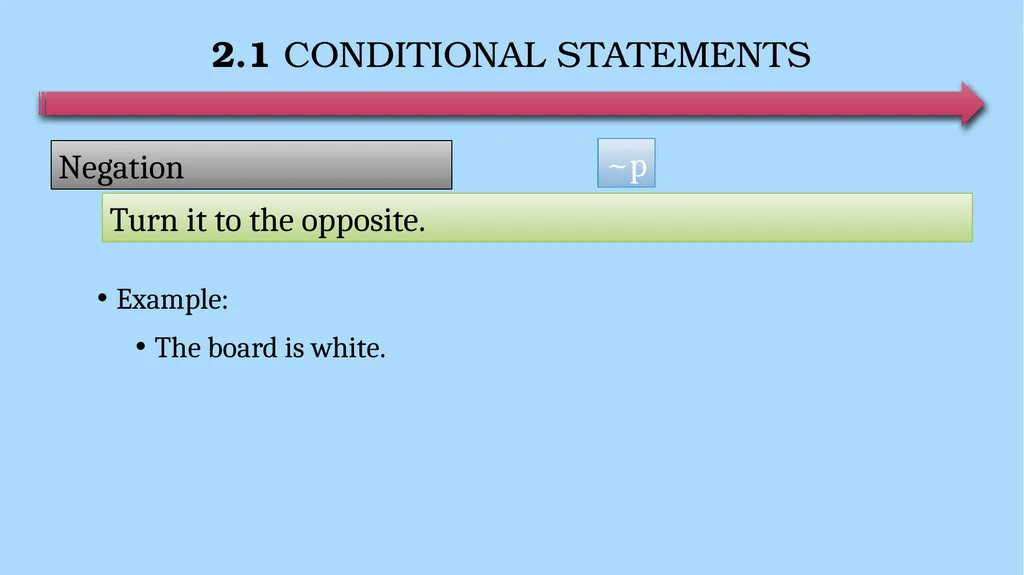
2.1 Conditional Statements Example:
The board is white. ~p Negation Turn it to the opposite.<br>
The board is white. ~p Negation Turn it to the opposite.<br>
08
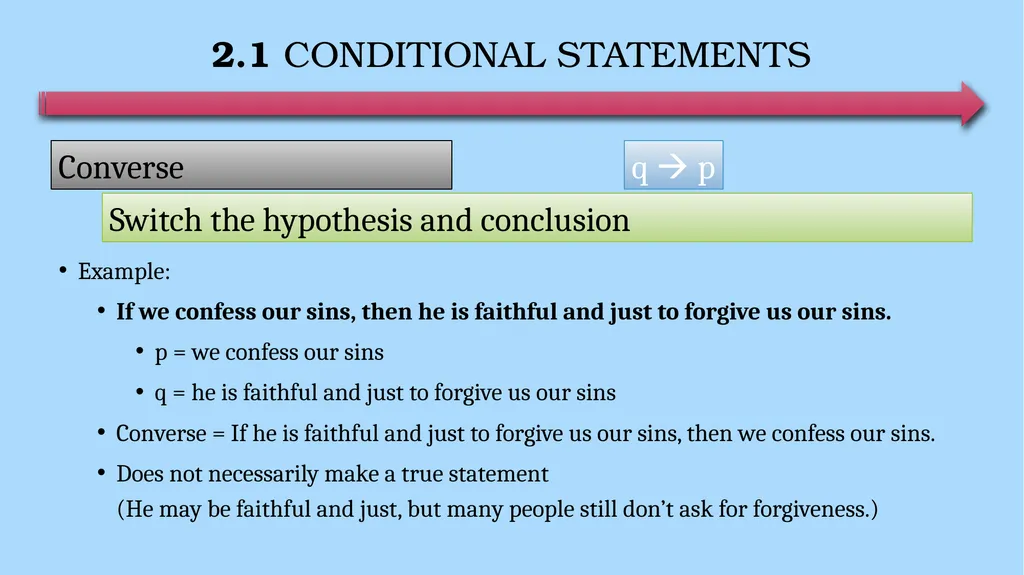
2.1 Conditional Statements Example:
If we confess our sins, then he is faithful and just to forgive us our sins.
p = we confess our sins
q = he is faithful and just to forgive us our sins
Converse = If he is faithful and just to forgive us our sins, then we confess our sins.
Does not necessarily make a true statement (He may be faithful and just, but many people still don’t ask for forgiveness.) q p Converse Switch the hypothesis and conclusion<br>
If we confess our sins, then he is faithful and just to forgive us our sins.
p = we confess our sins
q = he is faithful and just to forgive us our sins
Converse = If he is faithful and just to forgive us our sins, then we confess our sins.
Does not necessarily make a true statement (He may be faithful and just, but many people still don’t ask for forgiveness.) q p Converse Switch the hypothesis and conclusion<br>
09
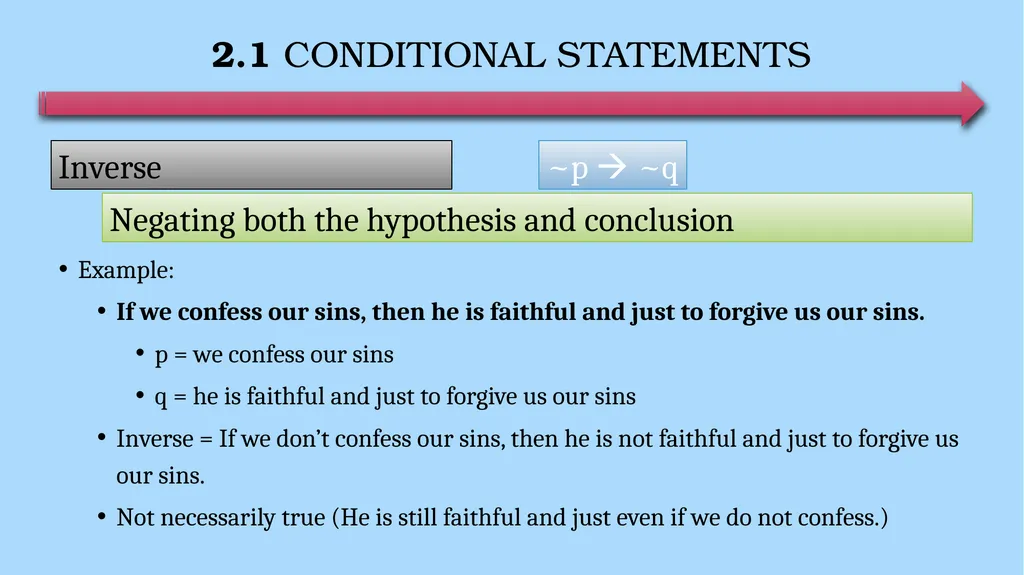
2.1 Conditional Statements Example:
If we confess our sins, then he is faithful and just to forgive us our sins.
p = we confess our sins
q = he is faithful and just to forgive us our sins
Inverse = If we don’t confess our sins, then he is not faithful and just to forgive us our sins.
Not necessarily true (He is still faithful and just even if we do not confess.) ~p ~q Inverse Negating both the hypothesis and conclusion<br>
If we confess our sins, then he is faithful and just to forgive us our sins.
p = we confess our sins
q = he is faithful and just to forgive us our sins
Inverse = If we don’t confess our sins, then he is not faithful and just to forgive us our sins.
Not necessarily true (He is still faithful and just even if we do not confess.) ~p ~q Inverse Negating both the hypothesis and conclusion<br>
10
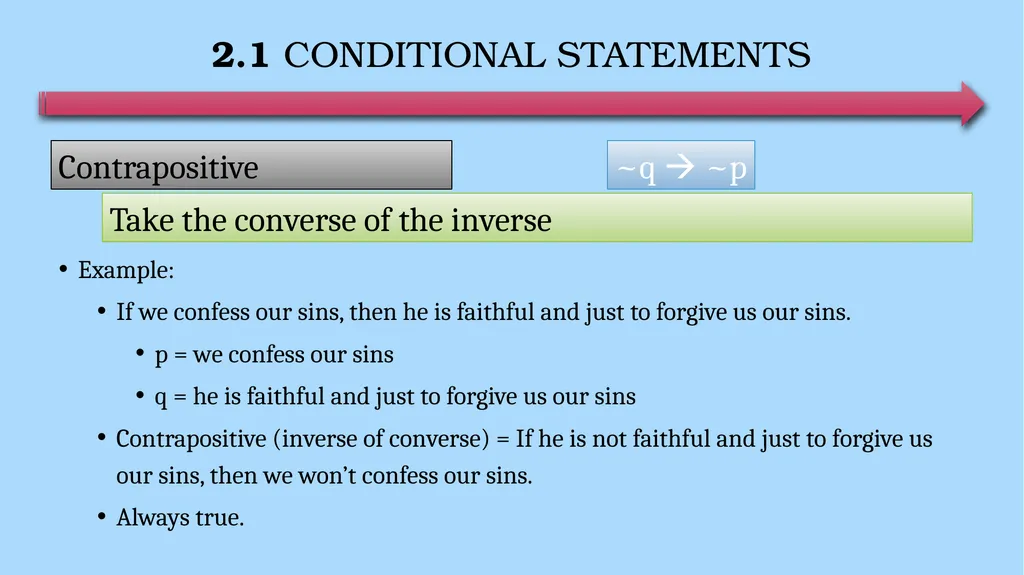
2.1 Conditional Statements Example:
If we confess our sins, then he is faithful and just to forgive us our sins.
p = we confess our sins
q = he is faithful and just to forgive us our sins
Contrapositive (inverse of converse) = If he is not faithful and just to forgive us our sins, then we won’t confess our sins.
Always true. ~q ~p Contrapositive Take the converse of the inverse<br>
If we confess our sins, then he is faithful and just to forgive us our sins.
p = we confess our sins
q = he is faithful and just to forgive us our sins
Contrapositive (inverse of converse) = If he is not faithful and just to forgive us our sins, then we won’t confess our sins.
Always true. ~q ~p Contrapositive Take the converse of the inverse<br>
11
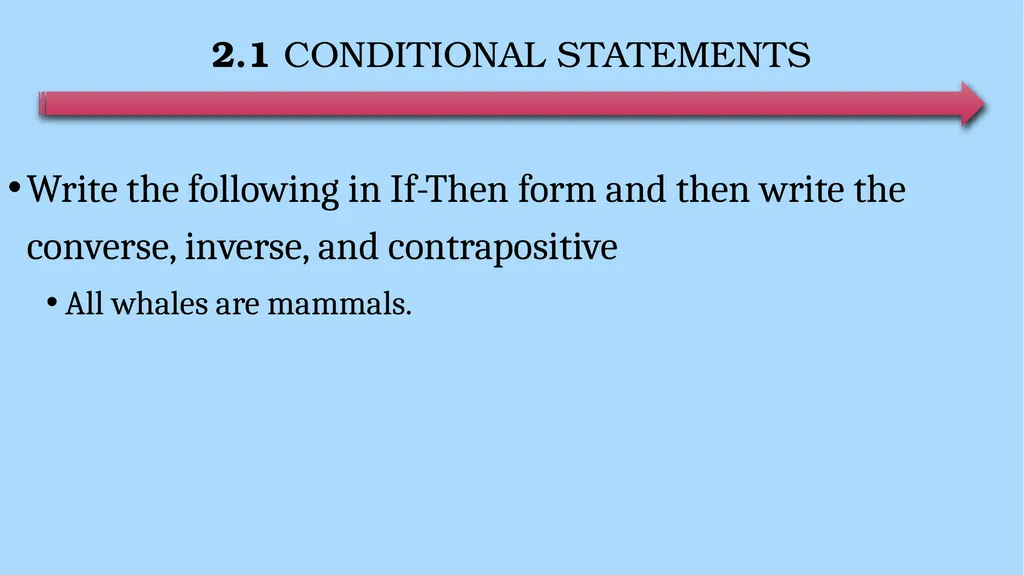
2.1 Conditional Statements Write the following in If-Then form and then write the converse, inverse, and contrapositive
All whales are mammals.<br>
All whales are mammals.<br>
12
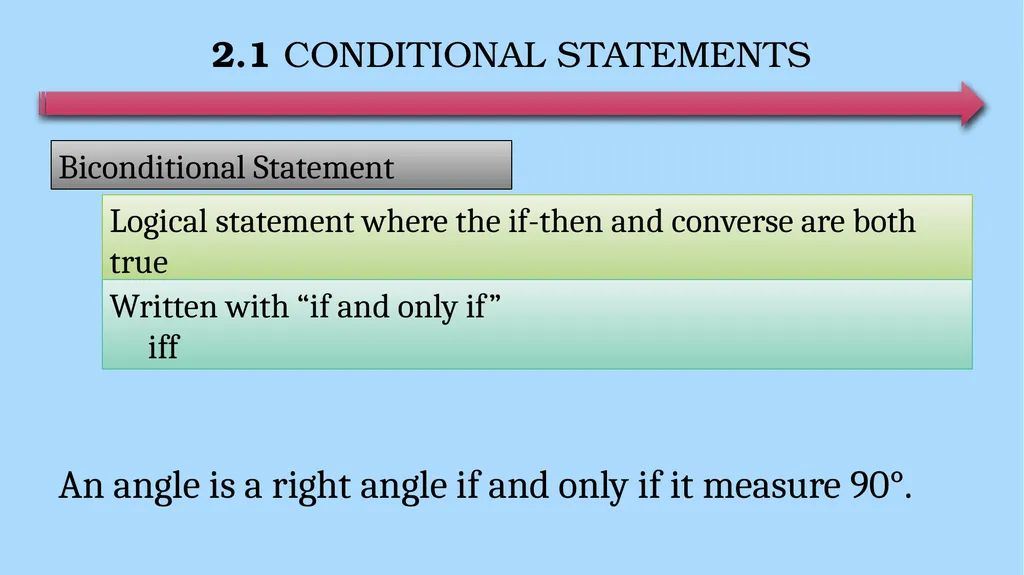
2.1 Conditional Statements Biconditional Statement Logical statement where the if-then and converse are both true Written with “if and only if”
iff An angle is a right angle if and only if it measure 90°.<br>
iff An angle is a right angle if and only if it measure 90°.<br>
13
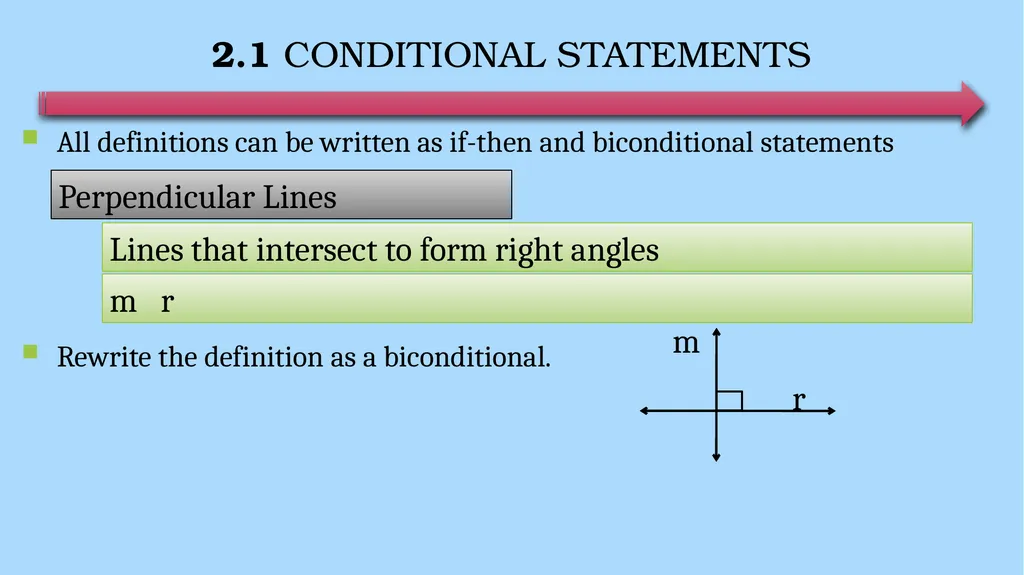
2.1 Conditional Statements All definitions can be written as if-then and biconditional statements
Rewrite the definition as a biconditional. Perpendicular Lines Lines that intersect to form right angles m r<br>
Rewrite the definition as a biconditional. Perpendicular Lines Lines that intersect to form right angles m r<br>
14
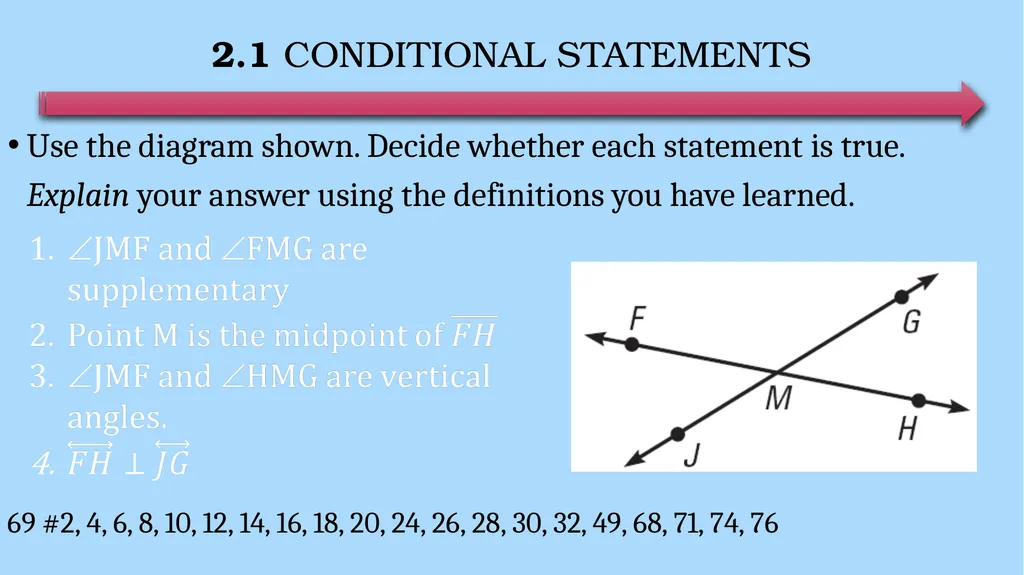
2.1 Conditional Statements Use the diagram shown. Decide whether each statement is true. Explain your answer using the definitions you have learned. 69 #2, 4, 6, 8, 10, 12, 14, 16, 18, 20, 24, 26, 28, 30, 32, 49, 68, 71, 74, 76<br>
15
2.2A Inductive Reasoning Objectives: By the end of the lesson,
• I can use inductive reasoning to make conjectures.<br>
• I can use inductive reasoning to make conjectures.<br>
16
2.2A Inductive Reasoning Geometry, and much of math and science, was developed by people recognizing patterns
We are going to use patterns to make predictions this lesson<br>
We are going to use patterns to make predictions this lesson<br>
17
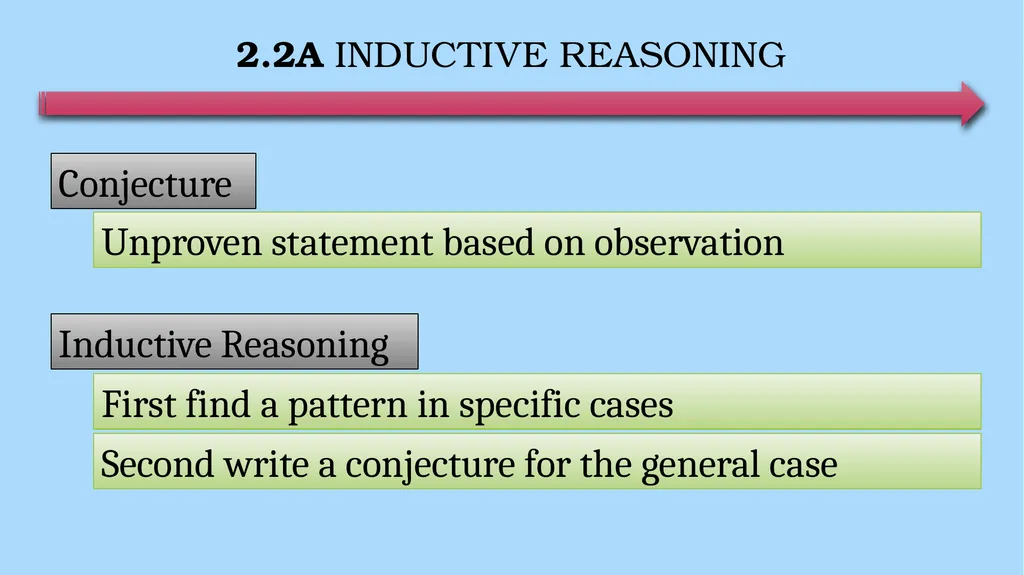
2.2A Inductive Reasoning Conjecture Unproven statement based on observation Inductive Reasoning First find a pattern in specific cases Second write a conjecture for the general case<br>
18
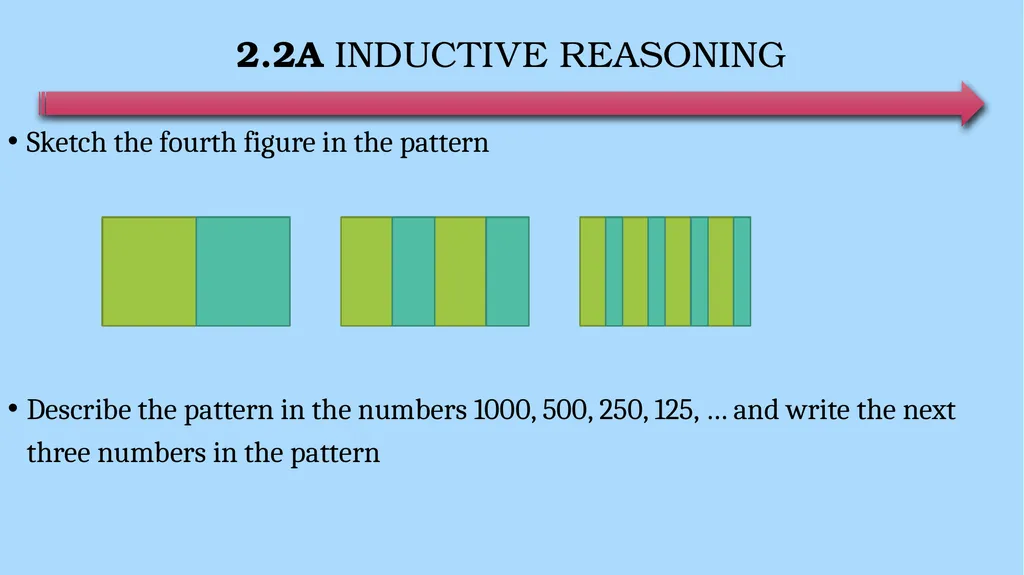
2.2A Inductive Reasoning Sketch the fourth figure in the pattern
Describe the pattern in the numbers 1000, 500, 250, 125, … and write the next three numbers in the pattern<br>
Describe the pattern in the numbers 1000, 500, 250, 125, … and write the next three numbers in the pattern<br>
19
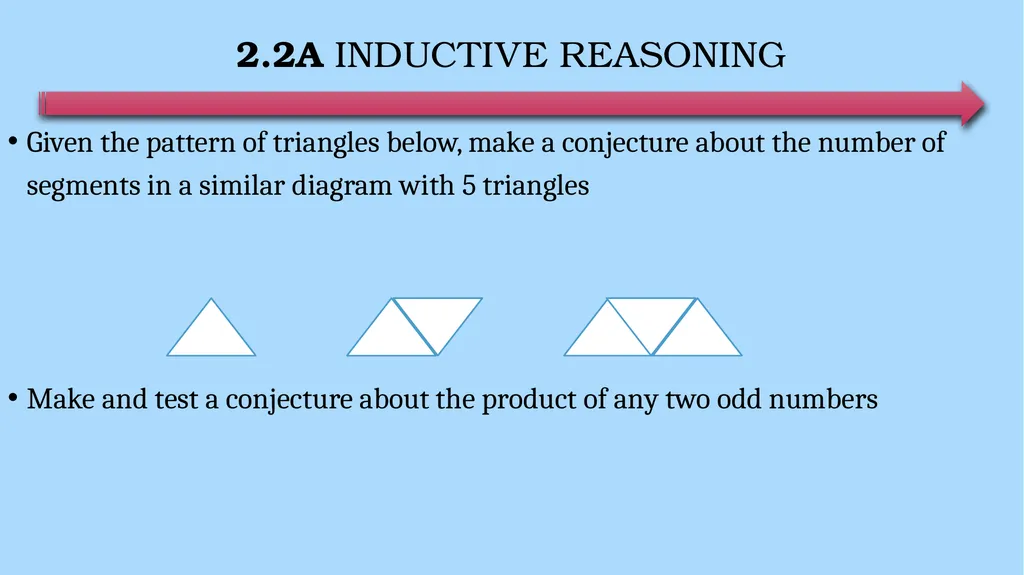
2.2A Inductive Reasoning Given the pattern of triangles below, make a conjecture about the number of segments in a similar diagram with 5 triangles
Make and test a conjecture about the product of any two odd numbers<br>
Make and test a conjecture about the product of any two odd numbers<br>
20
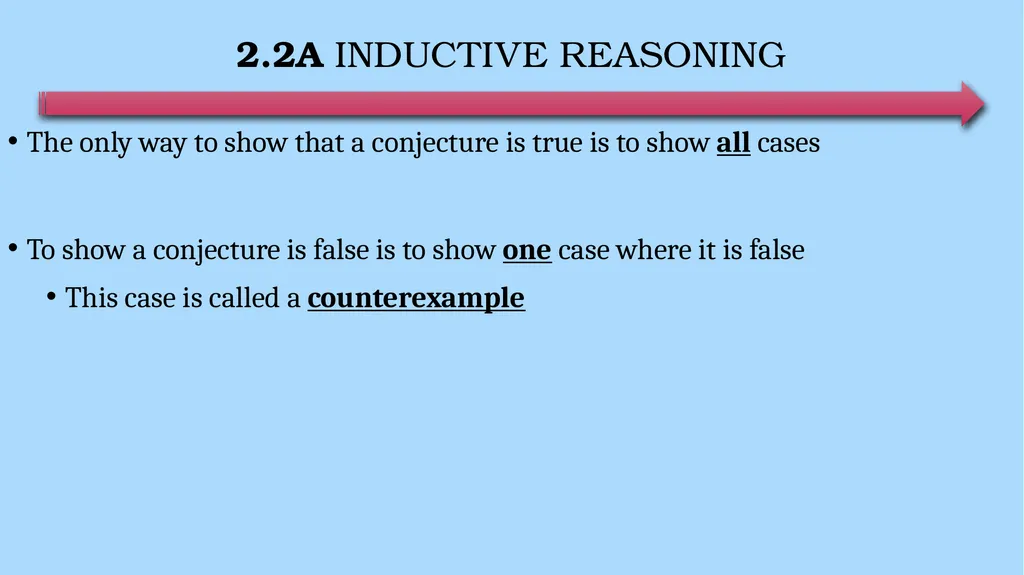
2.2A Inductive Reasoning The only way to show that a conjecture is true is to show all cases
To show a conjecture is false is to show one case where it is false
This case is called a counterexample<br>
To show a conjecture is false is to show one case where it is false
This case is called a counterexample<br>
21
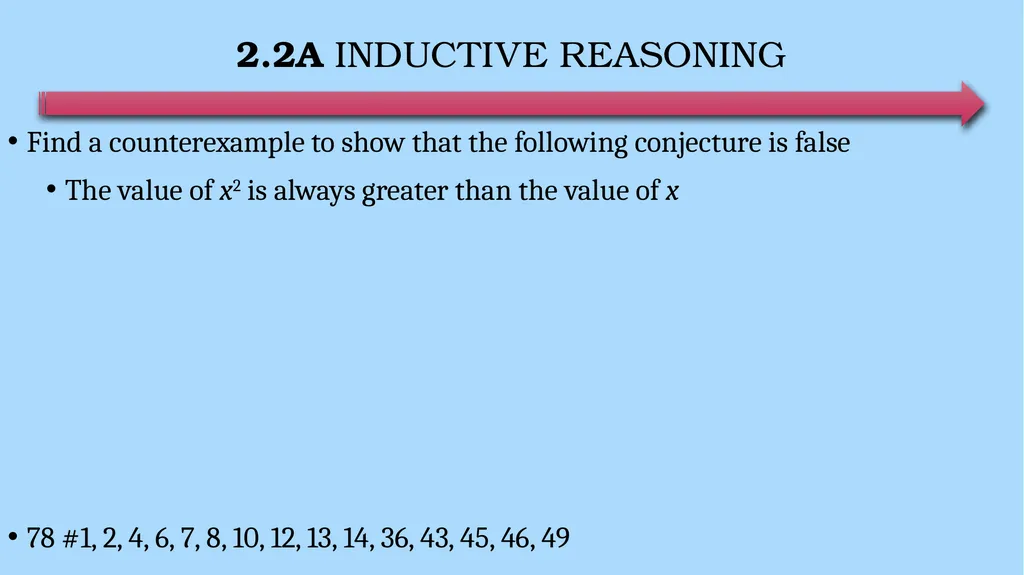
2.2A Inductive Reasoning Find a counterexample to show that the following conjecture is false
The value of x2 is always greater than the value of x
78 #1, 2, 4, 6, 7, 8, 10, 12, 13, 14, 36, 43, 45, 46, 49<br>
The value of x2 is always greater than the value of x
78 #1, 2, 4, 6, 7, 8, 10, 12, 13, 14, 36, 43, 45, 46, 49<br>
22
2.2B Deductive Reasoning Objectives: By the end of the lesson,
• I can use deductive reasoning to verify conjectures.
• I can distinguish between inductive and deductive reasoning.<br>
• I can use deductive reasoning to verify conjectures.
• I can distinguish between inductive and deductive reasoning.<br>
23
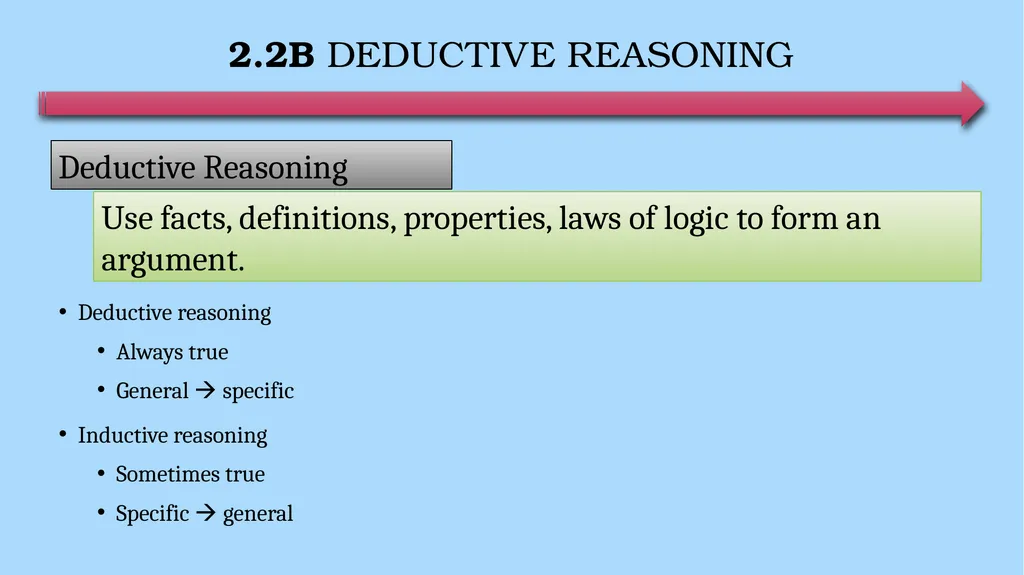
2.2B Deductive Reasoning Deductive reasoning
Always true
General specific
Inductive reasoning
Sometimes true
Specific general Deductive Reasoning Use facts, definitions, properties, laws of logic to form an argument.<br>
Always true
General specific
Inductive reasoning
Sometimes true
Specific general Deductive Reasoning Use facts, definitions, properties, laws of logic to form an argument.<br>
24
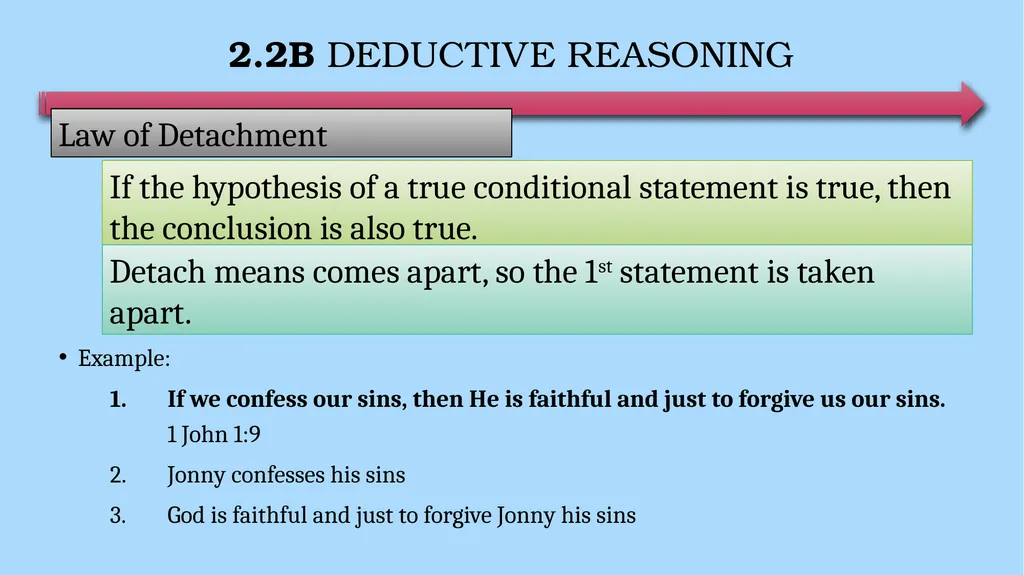
2.2B Deductive Reasoning Example:
If we confess our sins, then He is faithful and just to forgive us our sins. 1 John 1:9
Jonny confesses his sins
God is faithful and just to forgive Jonny his sins Law of Detachment If the hypothesis of a true conditional statement is true, then the conclusion is also true. Detach means comes apart, so the 1st statement is taken apart.<br>
If we confess our sins, then He is faithful and just to forgive us our sins. 1 John 1:9
Jonny confesses his sins
God is faithful and just to forgive Jonny his sins Law of Detachment If the hypothesis of a true conditional statement is true, then the conclusion is also true. Detach means comes apart, so the 1st statement is taken apart.<br>
25
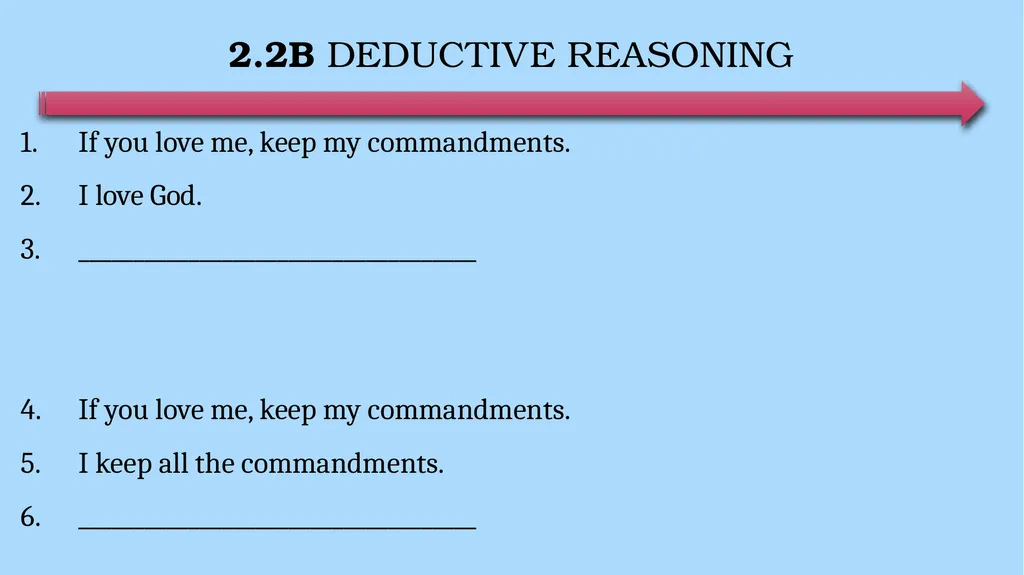
2.2B Deductive Reasoning If you love me, keep my commandments.
I love God.
____________________________________
If you love me, keep my commandments.
I keep all the commandments.
____________________________________<br>
I love God.
____________________________________
If you love me, keep my commandments.
I keep all the commandments.
____________________________________<br>
26
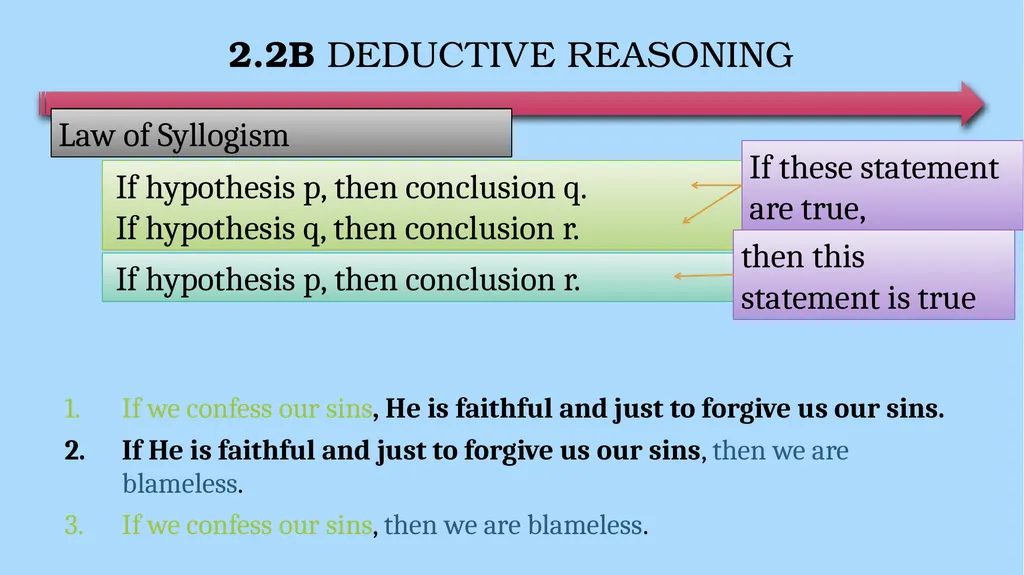
If hypothesis p, then conclusion q.
If hypothesis q, then conclusion r. If hypothesis p, then conclusion r. 2.2B Deductive Reasoning If we confess our sins, He is faithful and just to forgive us our sins.
If He is faithful and just to forgive us our sins, then we are blameless.
If we confess our sins, then we are blameless. Law of Syllogism<br>
If hypothesis q, then conclusion r. If hypothesis p, then conclusion r. 2.2B Deductive Reasoning If we confess our sins, He is faithful and just to forgive us our sins.
If He is faithful and just to forgive us our sins, then we are blameless.
If we confess our sins, then we are blameless. Law of Syllogism<br>
27
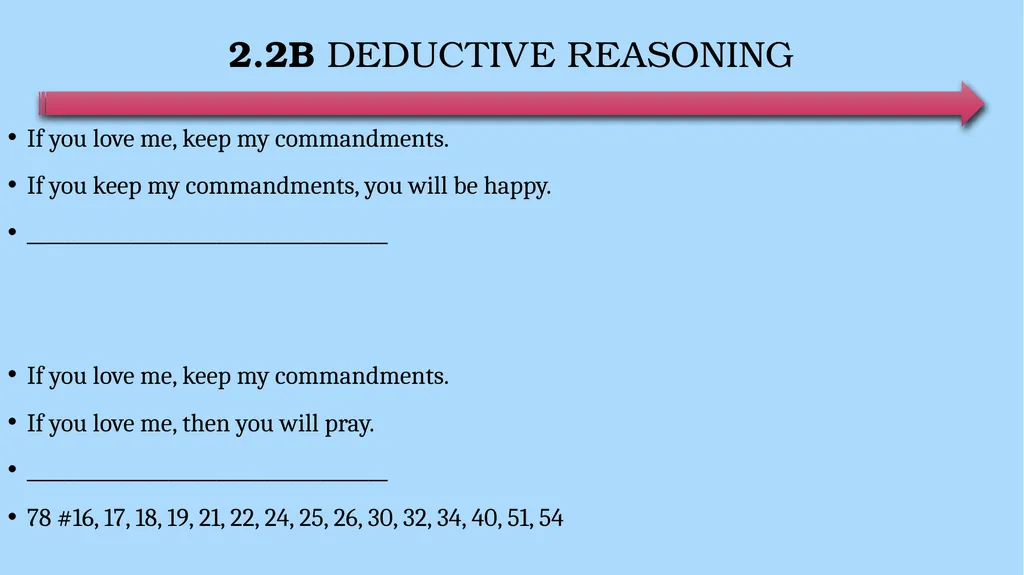
2.2B Deductive Reasoning If you love me, keep my commandments.
If you keep my commandments, you will be happy.
______________________________________
If you love me, keep my commandments.
If you love me, then you will pray.
______________________________________
78 #16, 17, 18, 19, 21, 22, 24, 25, 26, 30, 32, 34, 40, 51, 54<br>
If you keep my commandments, you will be happy.
______________________________________
If you love me, keep my commandments.
If you love me, then you will pray.
______________________________________
78 #16, 17, 18, 19, 21, 22, 24, 25, 26, 30, 32, 34, 40, 51, 54<br>
28
2.3 Postulates and Diagrams Objectives: By the end of the lesson,
• I can identify postulates represented by diagrams.
• I can sketch a diagram given a verbal description.
• I can interpret a diagram.<br>
• I can identify postulates represented by diagrams.
• I can sketch a diagram given a verbal description.
• I can interpret a diagram.<br>
29
2.3 Postulates and Diagrams Postulates (axioms) Rules that are accepted without proof (assumed) Theorem Rules that are accepted only with proof<br>
30
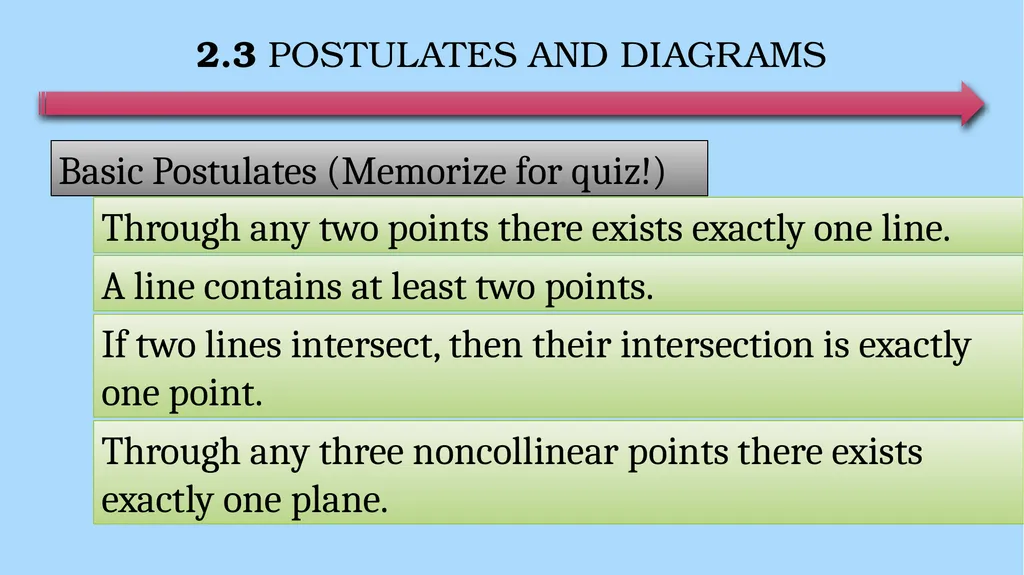
2.3 Postulates and Diagrams Basic Postulates (Memorize for quiz!) Through any two points there exists exactly one line. A line contains at least two points. If two lines intersect, then their intersection is exactly one point. Through any three noncollinear points there exists exactly one plane.<br>
31
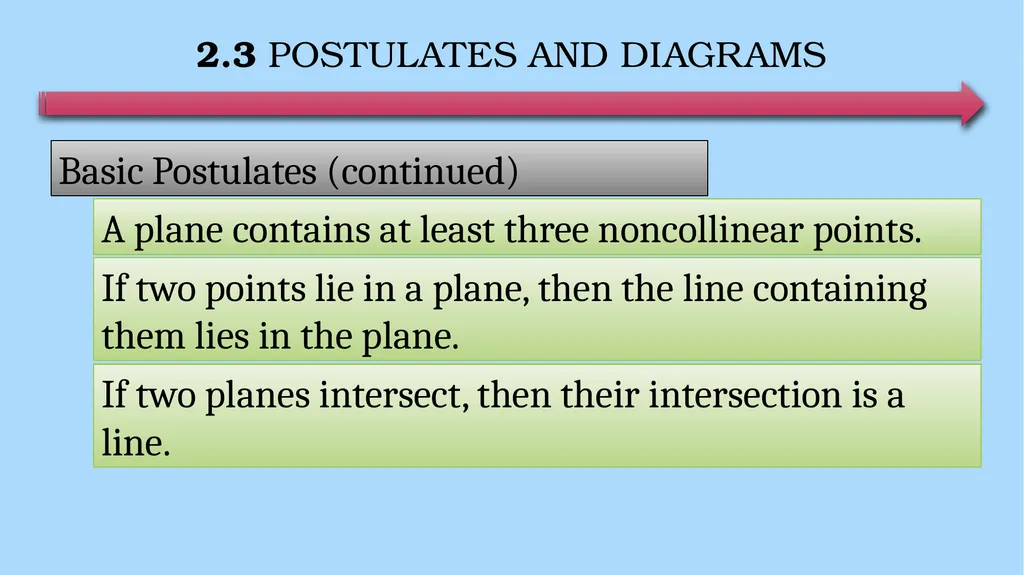
2.3 Postulates and Diagrams Basic Postulates (continued) If two points lie in a plane, then the line containing them lies in the plane. If two planes intersect, then their intersection is a line. A plane contains at least three noncollinear points.<br>
32
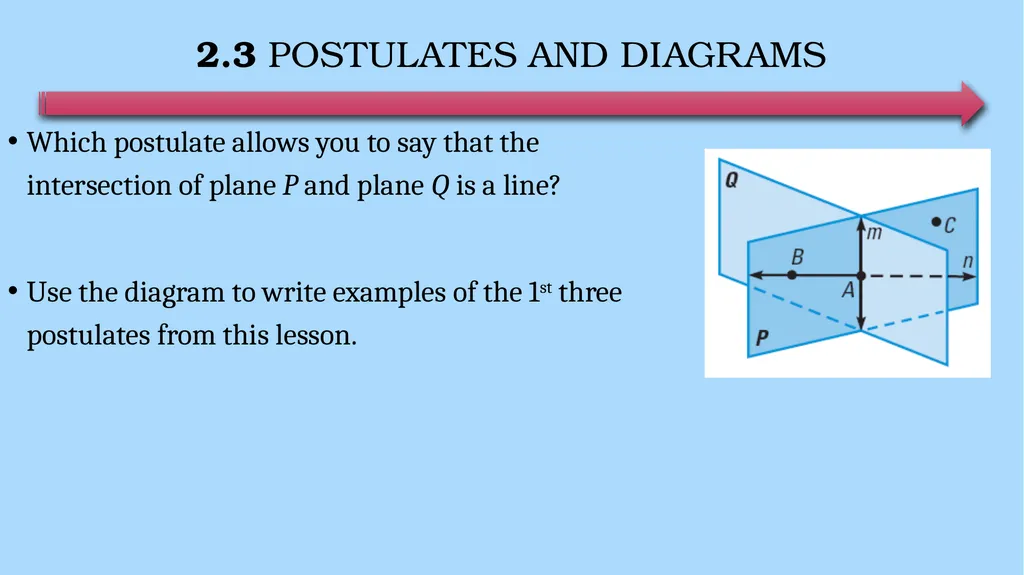
2.3 Postulates and Diagrams Which postulate allows you to say that the intersection of plane P and plane Q is a line?
Use the diagram to write examples of the 1st three postulates from this lesson.<br>
Use the diagram to write examples of the 1st three postulates from this lesson.<br>
33
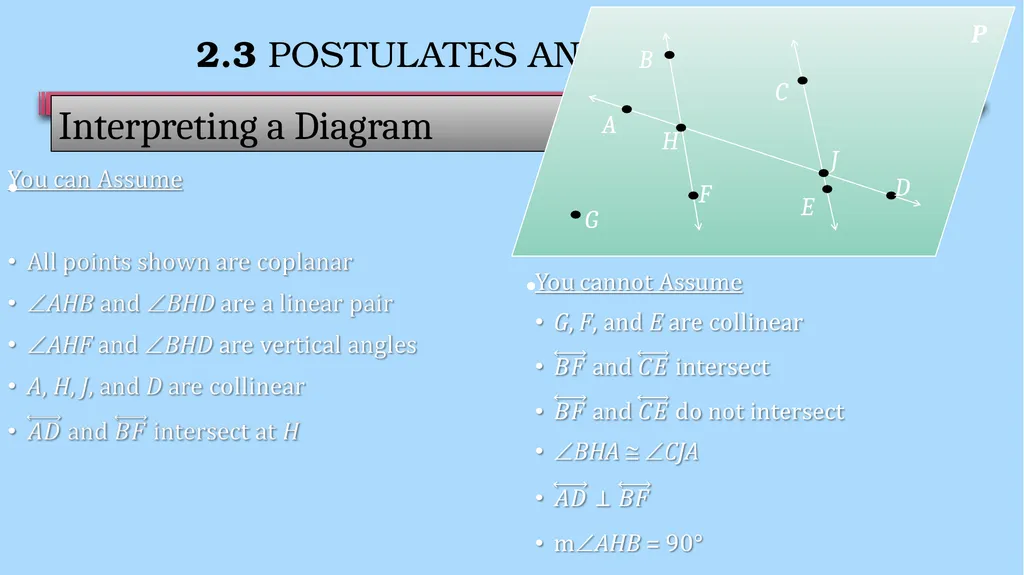
2.3 Postulates and Diagrams Interpreting a Diagram<br>
34
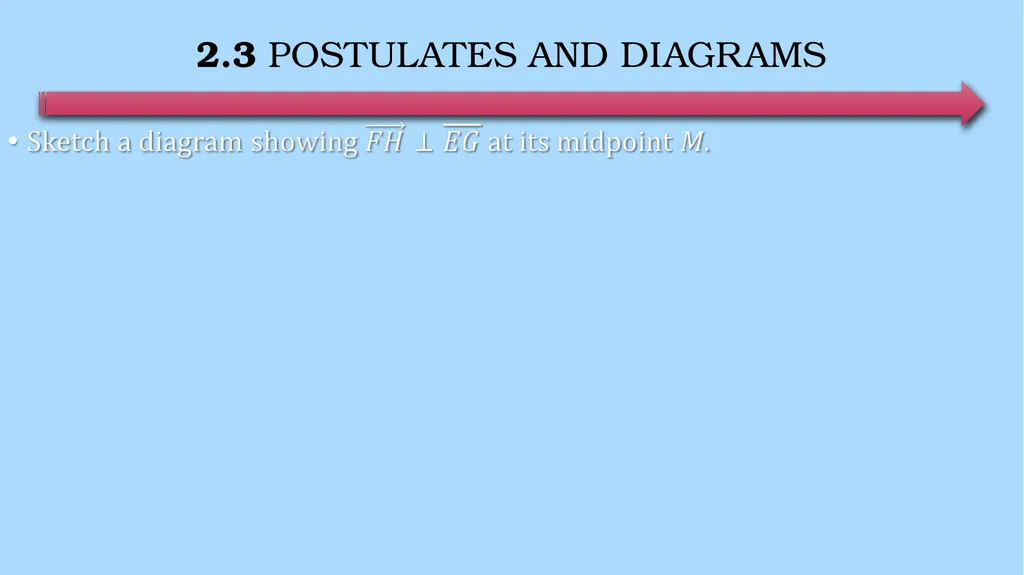
2.3 Postulates and Diagrams<br>
35
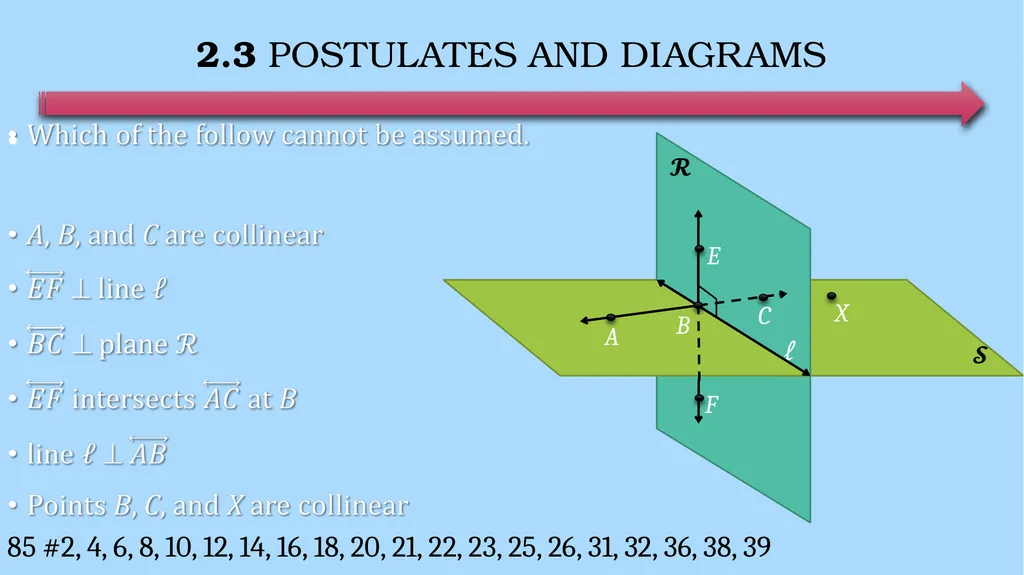
2.3 Postulates and Diagrams 85 #2, 4, 6, 8, 10, 12, 14, 16, 18, 20, 21, 22, 23, 25, 26, 31, 32, 36, 38, 39<br>
36
2.4 Algebraic Reasoning Objectives: By the end of the lesson,
• I can identify algebraic properties of equality.
• I can use algebraic properties of equality to solve equations.
• I can use properties of equality to solve for geometric measures.<br>
• I can identify algebraic properties of equality.
• I can use algebraic properties of equality to solve equations.
• I can use properties of equality to solve for geometric measures.<br>
37
2.4 Algebraic Reasoning When you solve an algebra equation, you use properties of algebra to justify each step.
Segment length and angle measure are real numbers just like variables, so you can solve equations from geometry using properties from algebra to justify each step.<br>
Segment length and angle measure are real numbers just like variables, so you can solve equations from geometry using properties from algebra to justify each step.<br>
38
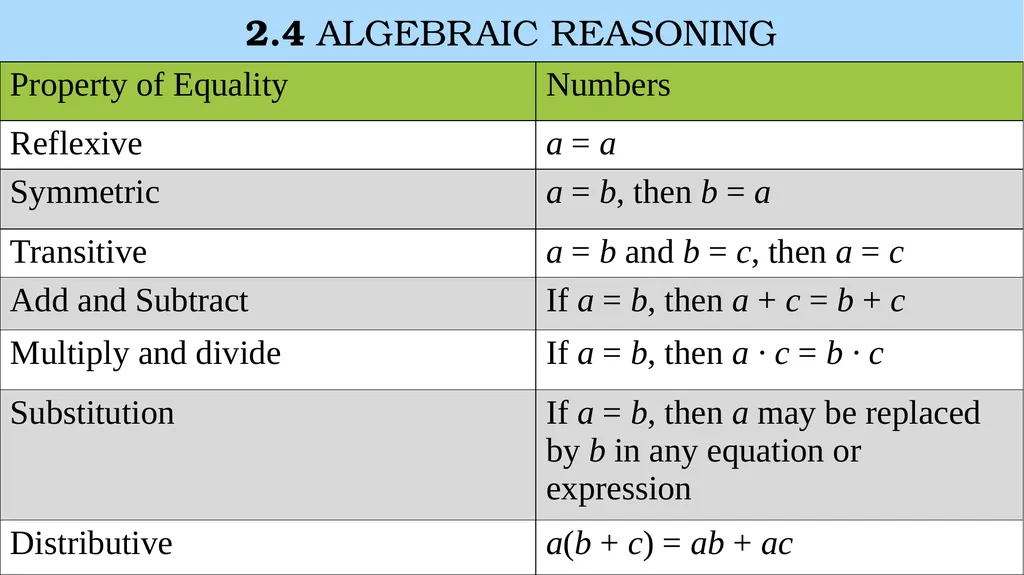
2.4 Algebraic Reasoning<br>
39
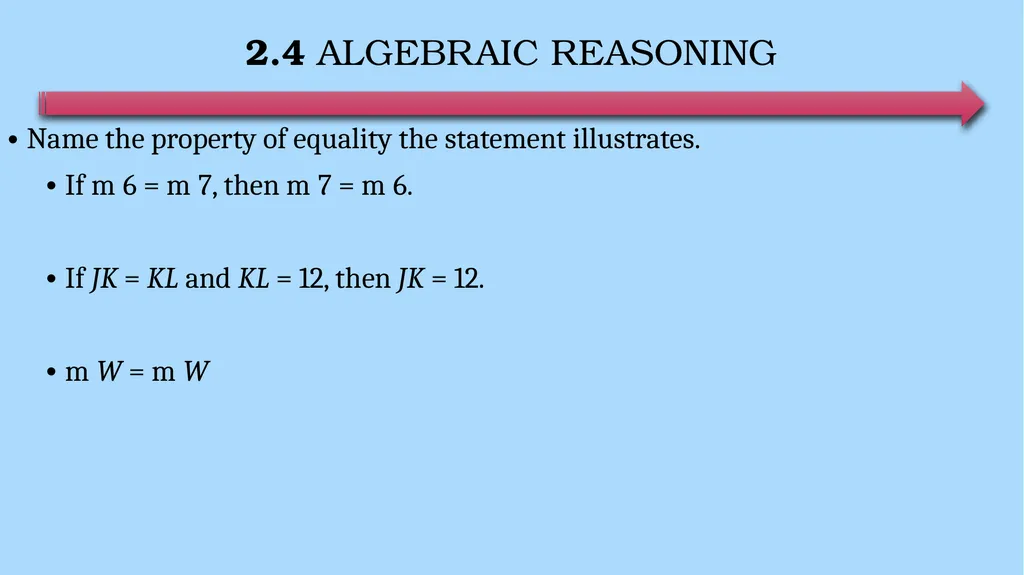
2.4 Algebraic Reasoning Name the property of equality the statement illustrates.
If m6 = m7, then m7 = m6.
If JK = KL and KL = 12, then JK = 12.
mW = mW<br>
If m6 = m7, then m7 = m6.
If JK = KL and KL = 12, then JK = 12.
mW = mW<br>
40
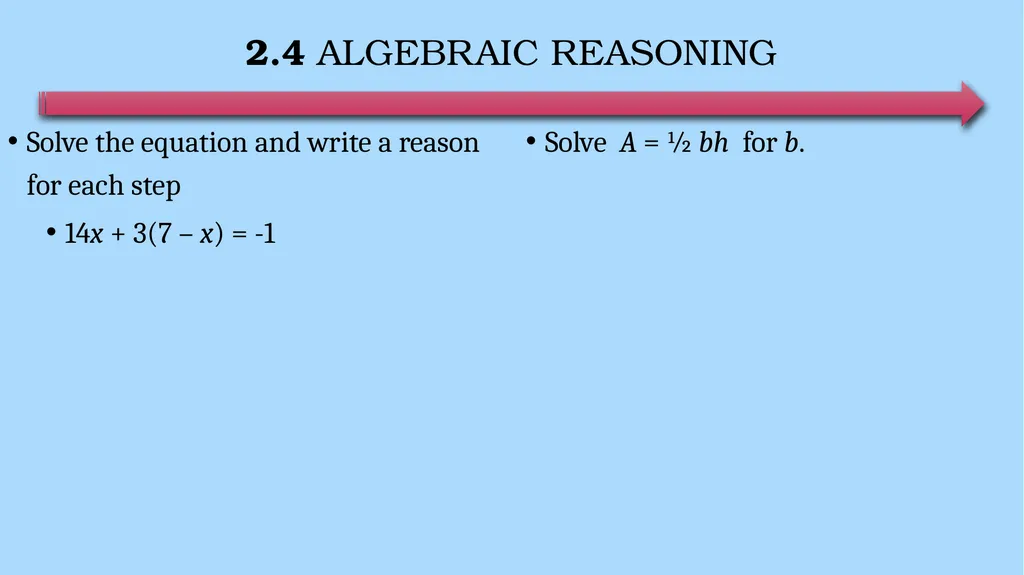
2.4 Algebraic Reasoning Solve the equation and write a reason for each step
14x + 3(7 – x) = -1 Solve A = ½ bh for b.<br>
14x + 3(7 – x) = -1 Solve A = ½ bh for b.<br>
41
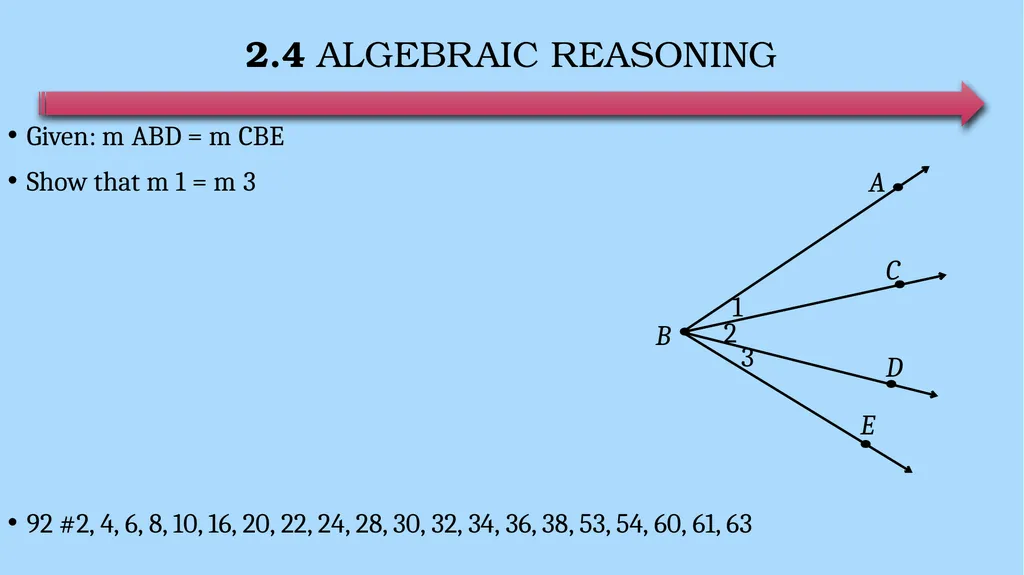
2.4 Algebraic Reasoning Given: mABD = mCBE
Show that m1 = m3
92 #2, 4, 6, 8, 10, 16, 20, 22, 24, 28, 30, 32, 34, 36, 38, 53, 54, 60, 61, 63<br>
Show that m1 = m3
92 #2, 4, 6, 8, 10, 16, 20, 22, 24, 28, 30, 32, 34, 36, 38, 53, 54, 60, 61, 63<br>
42
2.5 Proving Statements about
Segments and Angles Objectives: By the end of the lesson,
• I can explain the structure of a two-column proof.
• I can write a two-column proof.
• I can identify properties of congruence.<br>
• I can explain the structure of a two-column proof.
• I can write a two-column proof.
• I can identify properties of congruence.<br>
43
2.5 Proving Statements about
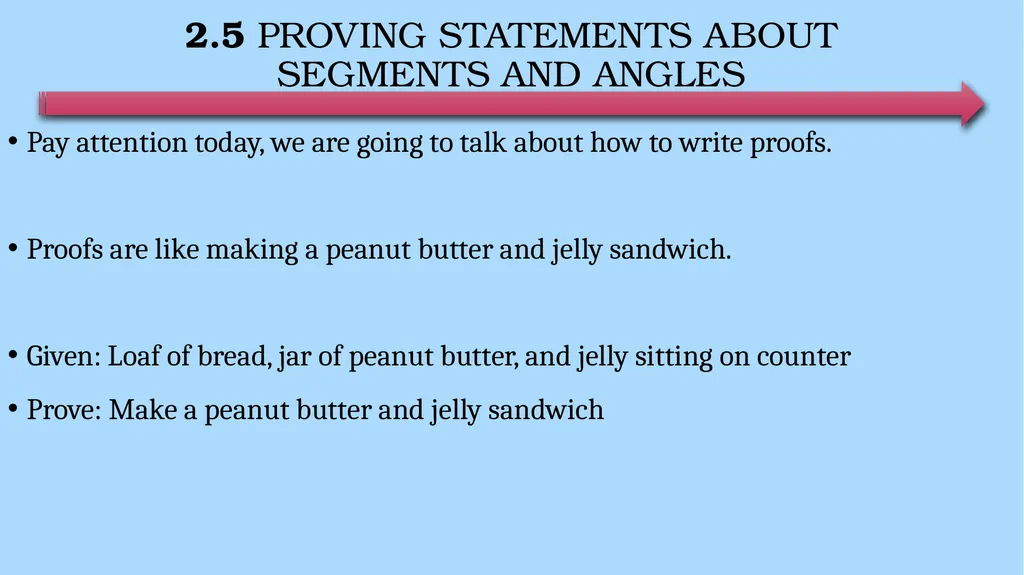
Segments and Angles Pay attention today, we are going to talk about how to write proofs.
Proofs are like making a peanut butter and jelly sandwich.
Given: Loaf of bread, jar of peanut butter, and jelly sitting on counter
Prove: Make a peanut butter and jelly sandwich<br>
Proofs are like making a peanut butter and jelly sandwich.
Given: Loaf of bread, jar of peanut butter, and jelly sitting on counter
Prove: Make a peanut butter and jelly sandwich<br>
44
2.5 Proving Statements about
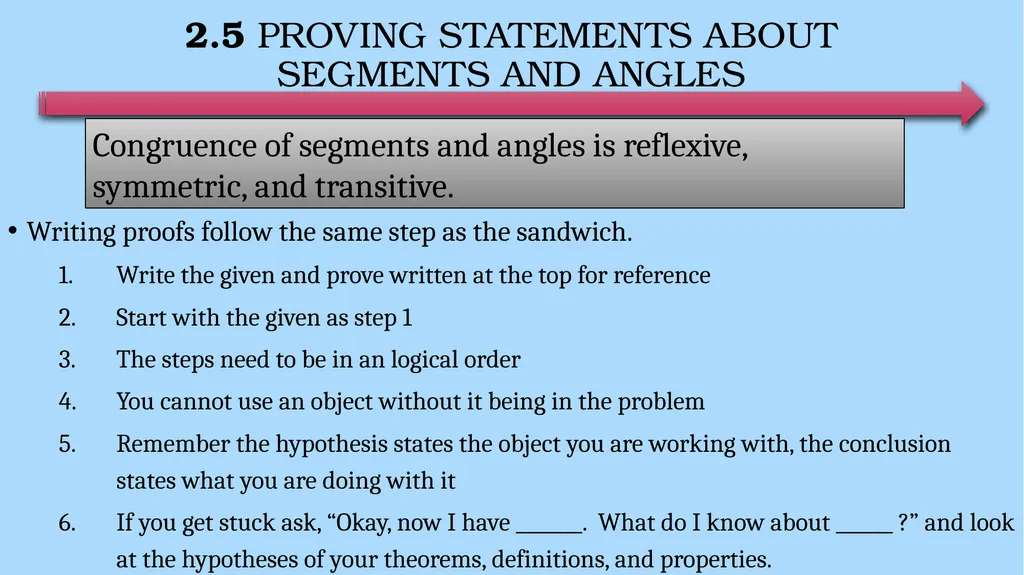
Segments and Angles Writing proofs follow the same step as the sandwich.
Write the given and prove written at the top for reference
Start with the given as step 1
The steps need to be in an logical order
You cannot use an object without it being in the problem
Remember the hypothesis states the object you are working with, the conclusion states what you are doing with it
If you get stuck ask, “Okay, now I have _______. What do I know about ______ ?” and look at the hypotheses of your theorems, definitions, and properties. Congruence of segments and angles is reflexive, symmetric, and transitive.<br>
Write the given and prove written at the top for reference
Start with the given as step 1
The steps need to be in an logical order
You cannot use an object without it being in the problem
Remember the hypothesis states the object you are working with, the conclusion states what you are doing with it
If you get stuck ask, “Okay, now I have _______. What do I know about ______ ?” and look at the hypotheses of your theorems, definitions, and properties. Congruence of segments and angles is reflexive, symmetric, and transitive.<br>
45
2.5 Proving Statements about
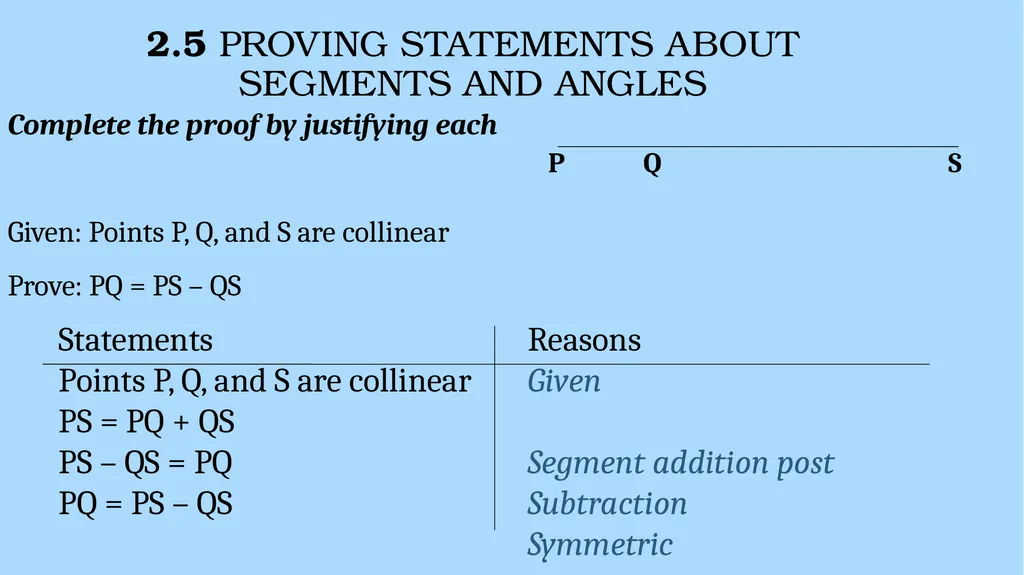
Segments and Angles Complete the proof by justifying each
Given: Points P, Q, and S are collinear
Prove: PQ = PS – QS Statements
Points P, Q, and S are collinear
PS = PQ + QS
PS – QS = PQ
PQ = PS – QS Reasons
Given
Segment addition post
Subtraction
Symmetric<br>
Given: Points P, Q, and S are collinear
Prove: PQ = PS – QS Statements
Points P, Q, and S are collinear
PS = PQ + QS
PS – QS = PQ
PQ = PS – QS Reasons
Given
Segment addition post
Subtraction
Symmetric<br>
46
2.5 Proving Statements about
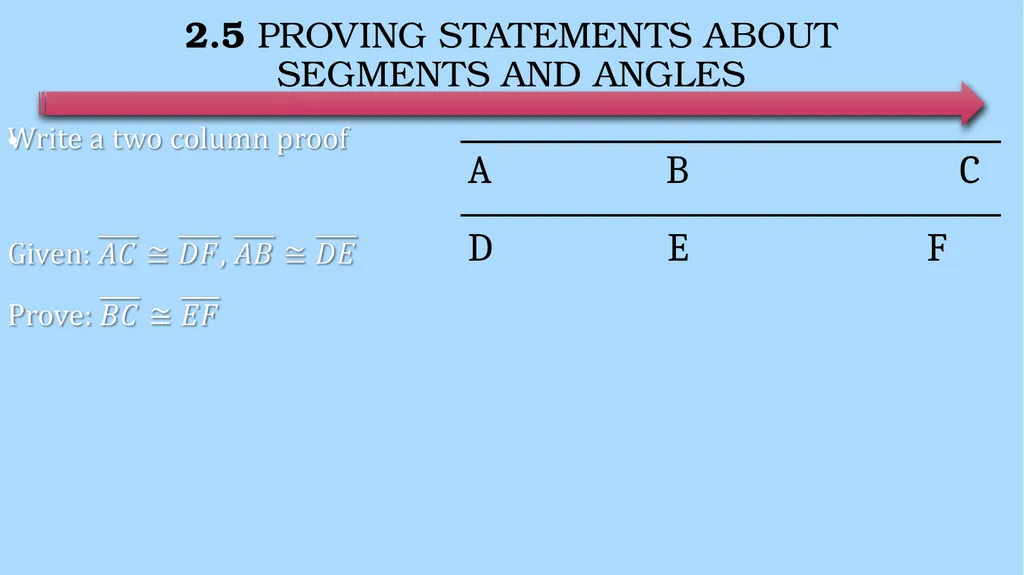
Segments and Angles<br>
47
2.5 Proving Statements about
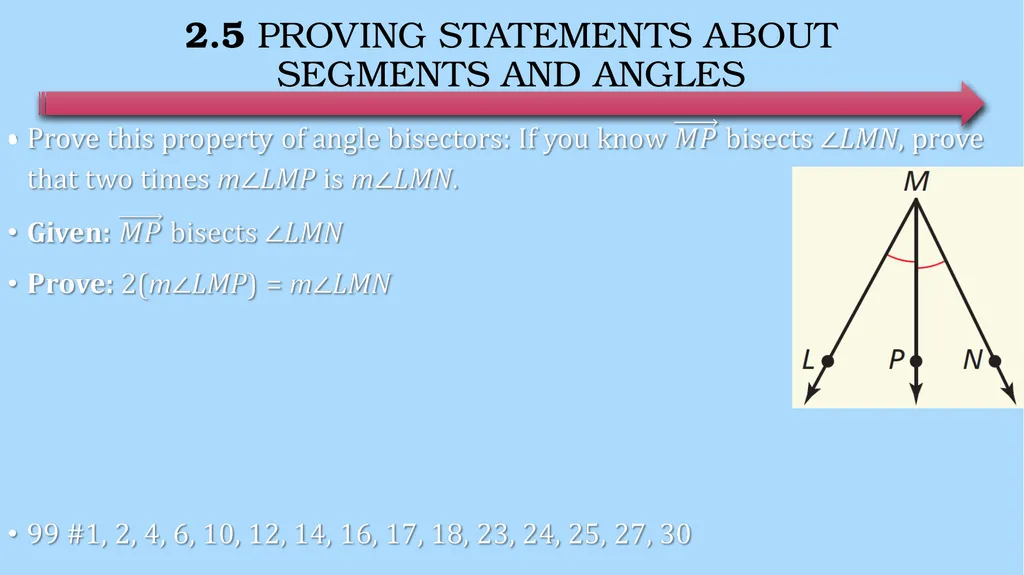
Segments and Angles<br>
48
2.6 Proving Geometric Relationships Objectives: By the end of the lesson,
• I can prove geometric relationships by writing fl owchart proofs.
• I can prove geometric relationships by writing paragraph proofs.<br>
• I can prove geometric relationships by writing fl owchart proofs.
• I can prove geometric relationships by writing paragraph proofs.<br>
49
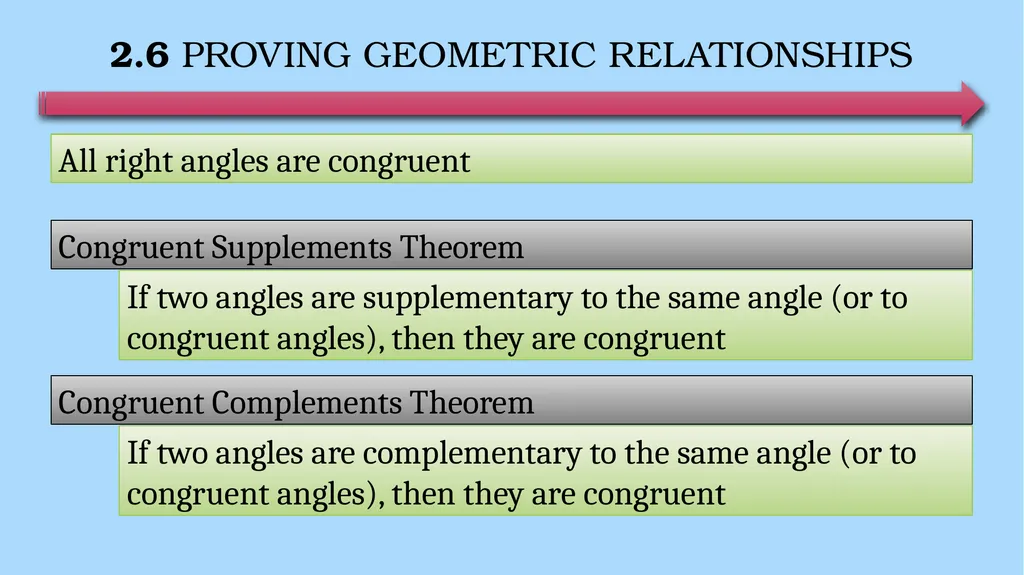
2.6 Proving Geometric Relationships All right angles are congruent Congruent Supplements Theorem If two angles are supplementary to the same angle (or to congruent angles), then they are congruent Congruent Complements Theorem If two angles are complementary to the same angle (or to congruent angles), then they are congruent<br>
50
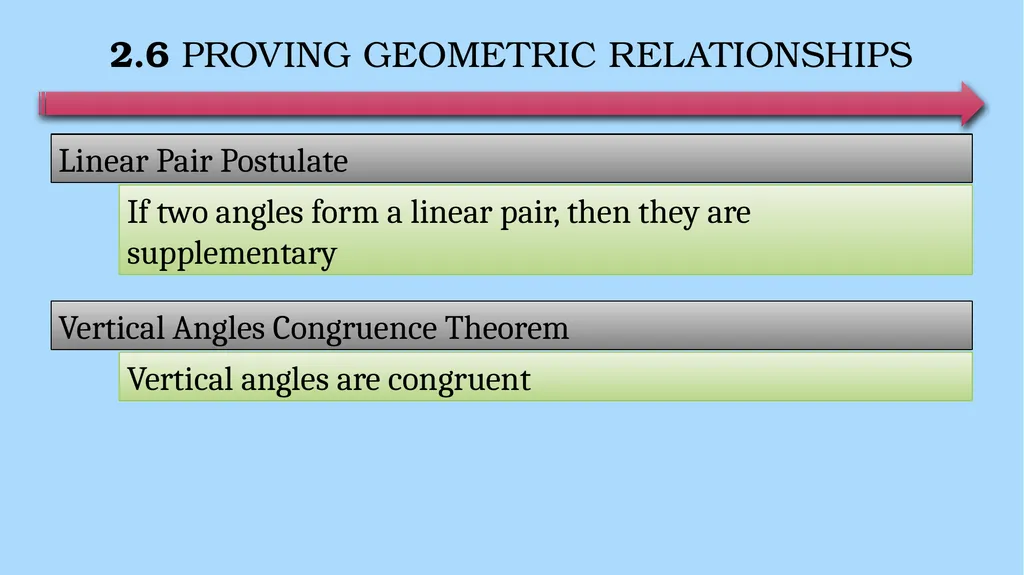
2.6 Proving Geometric Relationships Linear Pair Postulate Vertical Angles Congruence Theorem Vertical angles are congruent If two angles form a linear pair, then they are supplementary<br>
51
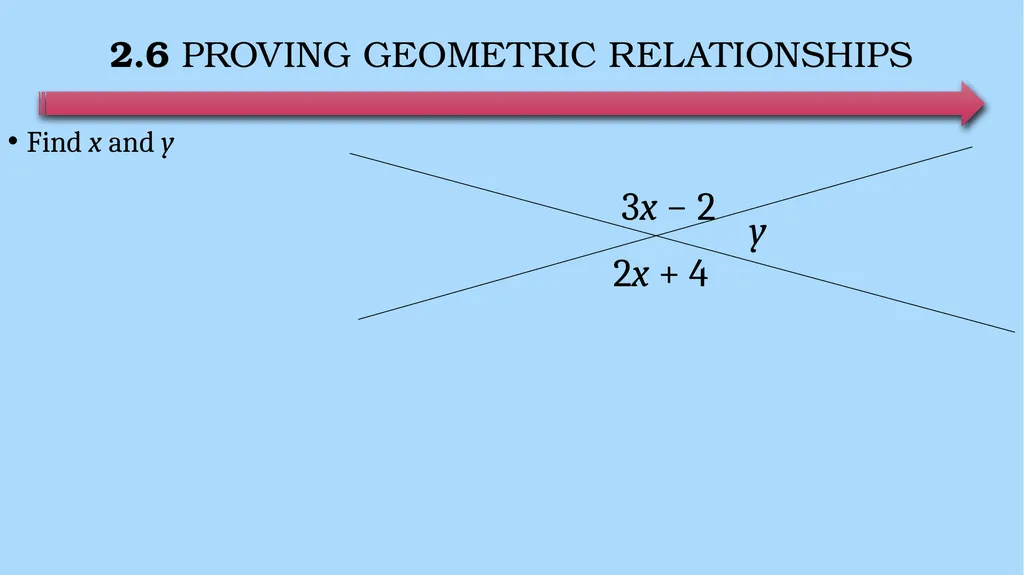
2.6 Proving Geometric Relationships Find x and y<br>
52
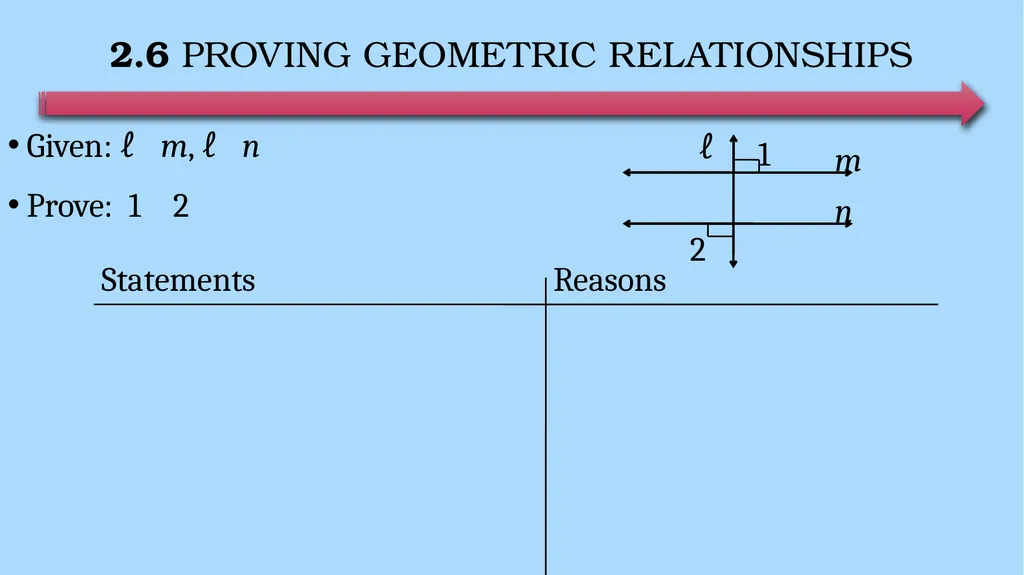
2.6 Proving Geometric Relationships Given: ℓ m, ℓ n
Prove: 1 2 Statements Reasons<br>
Prove: 1 2 Statements Reasons<br>
53
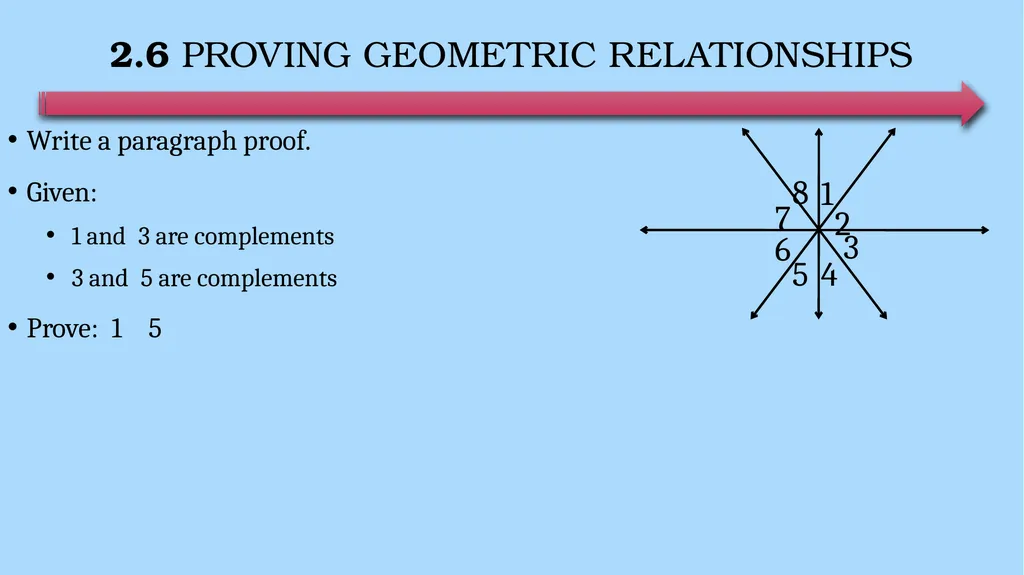
2.6 Proving Geometric Relationships Write a paragraph proof.
Given:
1 and 3 are complements
3 and 5 are complements
Prove: 1 5<br>
Given:
1 and 3 are complements
3 and 5 are complements
Prove: 1 5<br>
54
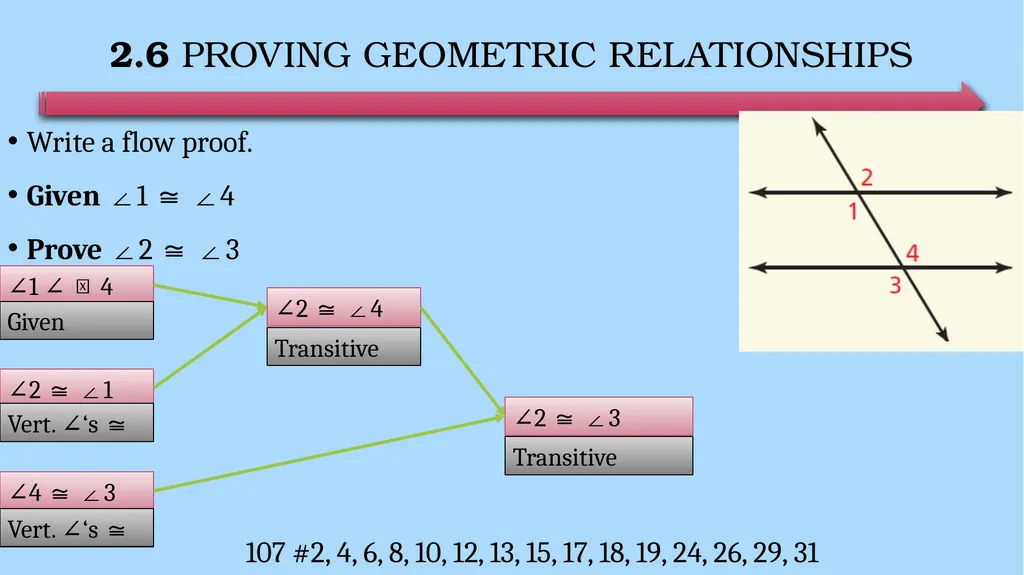
2.6 Proving Geometric Relationships Write a flow proof.
Given ∠1 ≅ ∠4
Prove ∠2 ≅ ∠3 107 #2, 4, 6, 8, 10, 12, 13, 15, 17, 18, 19, 24, 26, 29, 31<br>
Given ∠1 ≅ ∠4
Prove ∠2 ≅ ∠3 107 #2, 4, 6, 8, 10, 12, 13, 15, 17, 18, 19, 24, 26, 29, 31<br>