
Recapitalisation instruments for smaller EU
Description: Recapitalisation instruments for smaller EU corporates How equity and hybrid instruments can drive economic recovery September 2022 Our board member firms Patrick George Head of Global Markets EMEA Global Head of ICG Leonardo Arduini Head
Related Topics
Download Presentation
"Recapitalisation instruments for smaller EU" is the property of its rightful owner. Permission is granted to download and print the materials on this website for personal, non-commercial use only, and to display it on your personal computer provided you do not modify the materials and that you retain all copyright notices contained in the materials. By downloading content from our website, you accept the terms of this agreement.
Presentation Transcript
slide1. Recapitalisation instruments for smaller EU corporates
How equity and hybrid instruments can drive economic recovery September 2022<br>
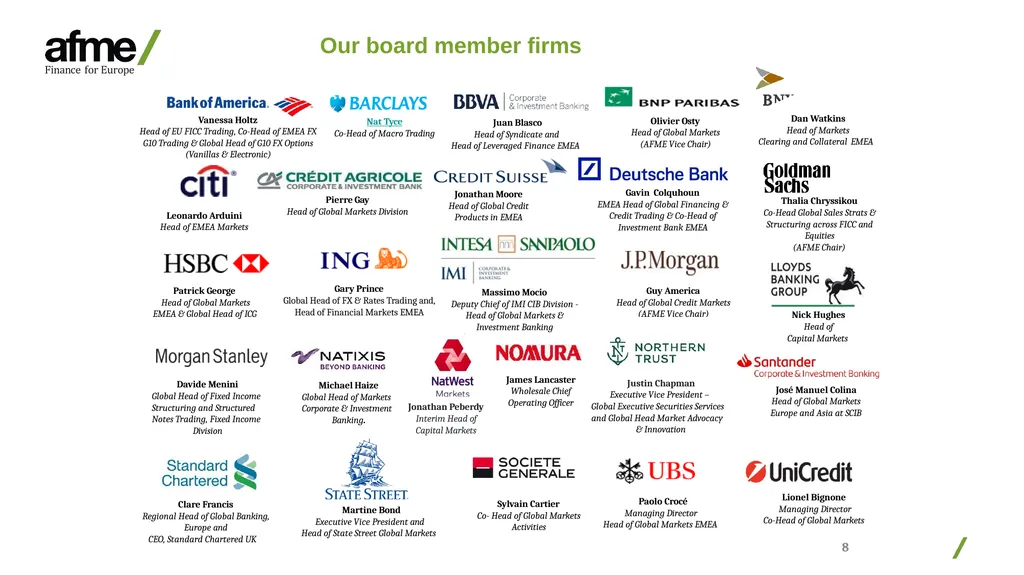
slide2. Our board member firms Patrick George
Head of Global Markets EMEA & Global Head of ICG Leonardo Arduini
Head of EMEA Markets Jonathan Moore Head of Global Credit Products in EMEA Olivier Osty
Head of Global Markets (AFME Vice Chair) Pierre Gay
Head of Global Markets Division Guy America
Head of Global Credit Markets (AFME Vice Chair) Nick Hughes
Head of Capital Markets Nat Tyce
Co-Head of Macro Trading Jonathan Peberdy Interim Head of Capital Markets Thalia Chryssikou
Co-Head Global Sales Strats & Structuring across FICC and Equities
(AFME Chair) Dan Watkins
Head of Markets Clearing and Collateral EMEA James Lancaster Wholesale Chief Operating Officer Lionel Bignone
Managing Director
Co-Head of Global Markets Paolo Crocé
Managing Director Head of Global Markets EMEA Gavin Colquhoun
EMEA Head of Global Financing & Credit Trading & Co-Head of Investment Bank EMEA Juan Blasco
Head of Syndicate and Head of Leveraged Finance EMEA Davide Menini Global Head of Fixed Income Structuring and Structured Notes Trading, Fixed Income
Division Gary Prince
Global Head of FX & Rates Trading and, Head of Financial Markets EMEA Michael Haize Global Head of Markets Corporate & Investment
Banking. Sylvain Cartier
Co- Head of Global Markets Activities Vanessa Holtz
Head of EU FICC Trading, Co-Head of EMEA FX G10 Trading & Global Head of G10 FX Options (Vanillas & Electronic) Clare Francis
Regional Head of Global Banking, Europe and
CEO, Standard Chartered UK José Manuel Colina Head of Global Markets Europe and Asia at SCIB Massimo Mocio
Deputy Chief of IMI CIB Division - Head of Global Markets & Investment Banking Justin Chapman
Executive Vice President – Global Executive Securities Services and Global Head Market Advocacy
& Innovation Martine Bond
Executive Vice President and Head of State Street Global Markets 8<br>
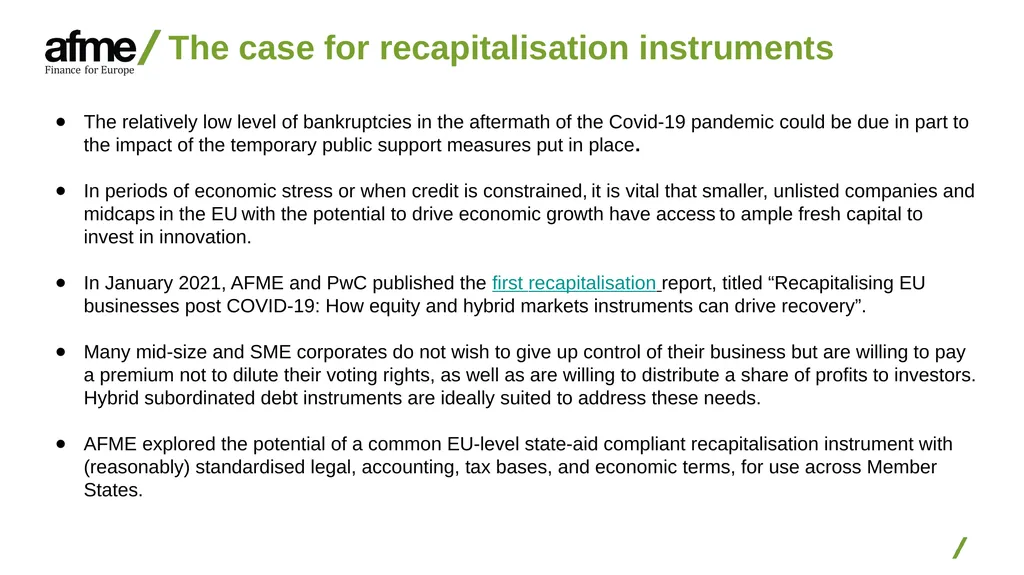
slide3. The relatively low level of bankruptcies in the aftermath of the Covid-19 pandemic could be due in part to the impact of the temporary public support measures put in place.
In periods of economic stress or when credit is constrained, it is vital that smaller, unlisted companies and midcaps in the EU with the potential to drive economic growth have access to ample fresh capital to invest in innovation.
In January 2021, AFME and PwC published the first recapitalisation report, titled “Recapitalising EU businesses post COVID-19: How equity and hybrid markets instruments can drive recovery”.
Many mid-size and SME corporates do not wish to give up control of their business but are willing to pay a premium not to dilute their voting rights, as well as are willing to distribute a share of profits to investors. Hybrid subordinated debt instruments are ideally suited to address these needs.
AFME explored the potential of a common EU-level state-aid compliant recapitalisation instrument with (reasonably) standardised legal, accounting, tax bases, and economic terms, for use across Member States. The case for recapitalisation instruments<br>
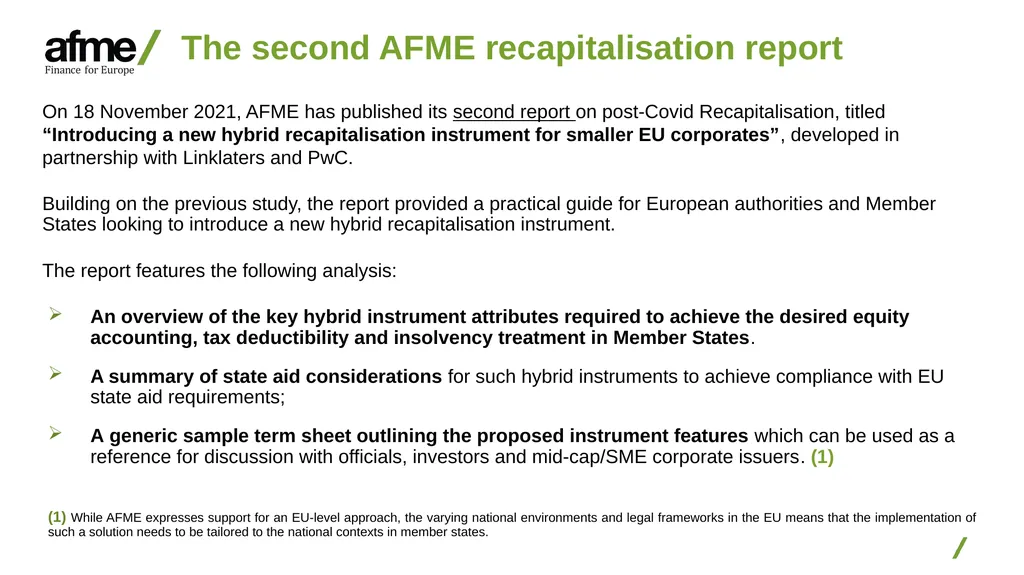
slide4. The second AFME recapitalisation report On 18 November 2021, AFME has published its second report on post-Covid Recapitalisation, titled “Introducing a new hybrid recapitalisation instrument for smaller EU corporates”, developed in partnership with Linklaters and PwC.
Building on the previous study, the report provided a practical guide for European authorities and Member States looking to introduce a new hybrid recapitalisation instrument.
The report features the following analysis:
An overview of the key hybrid instrument attributes required to achieve the desired equity accounting, tax deductibility and insolvency treatment in Member States.
A summary of state aid considerations for such hybrid instruments to achieve compliance with EU state aid requirements;
A generic sample term sheet outlining the proposed instrument features which can be used as a reference for discussion with officials, investors and mid-cap/SME corporate issuers. (1)
(1) While AFME expresses support for an EU-level approach, the varying national environments and legal frameworks in the EU means that the implementation of such a solution needs to be tailored to the national contexts in member states.<br>
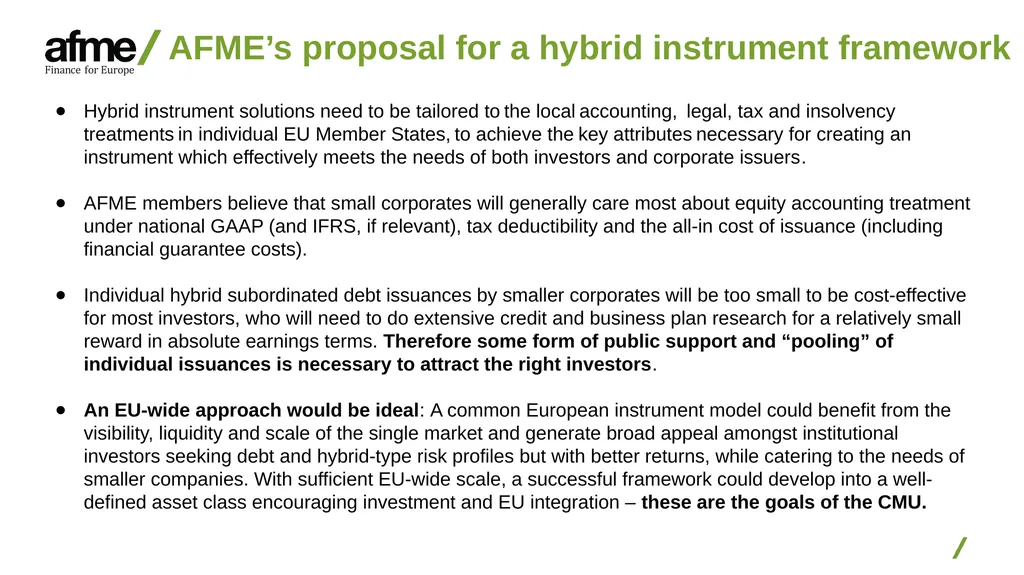
slide5. Hybrid instrument solutions need to be tailored to the local accounting, legal, tax and insolvency treatments in individual EU Member States, to achieve the key attributes necessary for creating an instrument which effectively meets the needs of both investors and corporate issuers.
AFME members believe that small corporates will generally care most about equity accounting treatment under national GAAP (and IFRS, if relevant), tax deductibility and the all-in cost of issuance (including financial guarantee costs).
Individual hybrid subordinated debt issuances by smaller corporates will be too small to be cost-effective for most investors, who will need to do extensive credit and business plan research for a relatively small reward in absolute earnings terms. Therefore some form of public support and “pooling” of individual issuances is necessary to attract the right investors.
An EU-wide approach would be ideal: A common European instrument model could benefit from the visibility, liquidity and scale of the single market and generate broad appeal amongst institutional investors seeking debt and hybrid-type risk profiles but with better returns, while catering to the needs of smaller companies. With sufficient EU-wide scale, a successful framework could develop into a well-defined asset class encouraging investment and EU integration – these are the goals of the CMU. AFME’s proposal for a hybrid instrument framework<br>
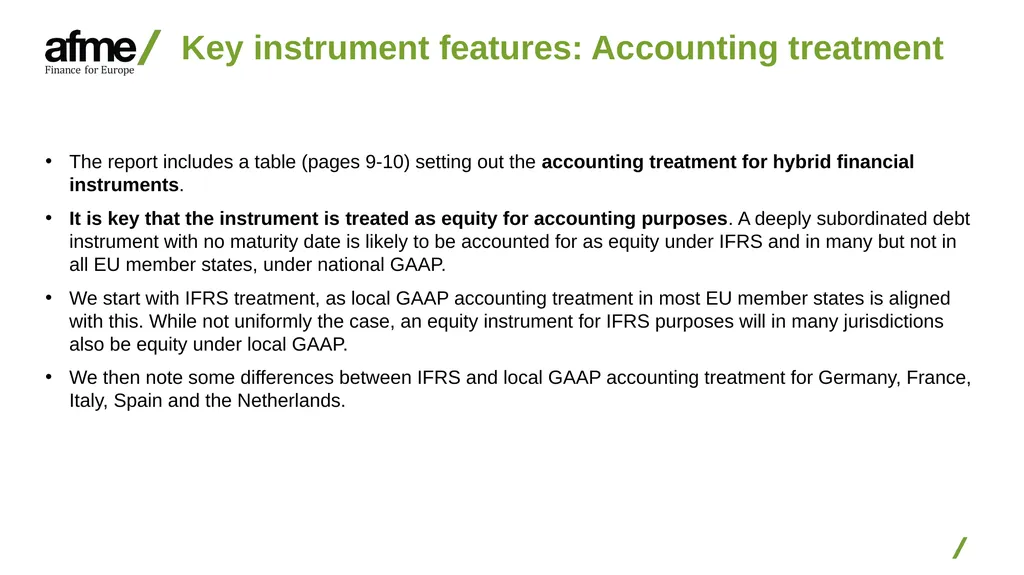
slide6. Key instrument features: Accounting treatment The report includes a table (pages 9-10) setting out the accounting treatment for hybrid financial instruments.
It is key that the instrument is treated as equity for accounting purposes. A deeply subordinated debt instrument with no maturity date is likely to be accounted for as equity under IFRS and in many but not in all EU member states, under national GAAP.
We start with IFRS treatment, as local GAAP accounting treatment in most EU member states is aligned with this. While not uniformly the case, an equity instrument for IFRS purposes will in many jurisdictions also be equity under local GAAP.
We then note some differences between IFRS and local GAAP accounting treatment for Germany, France, Italy, Spain and the Netherlands.<br>
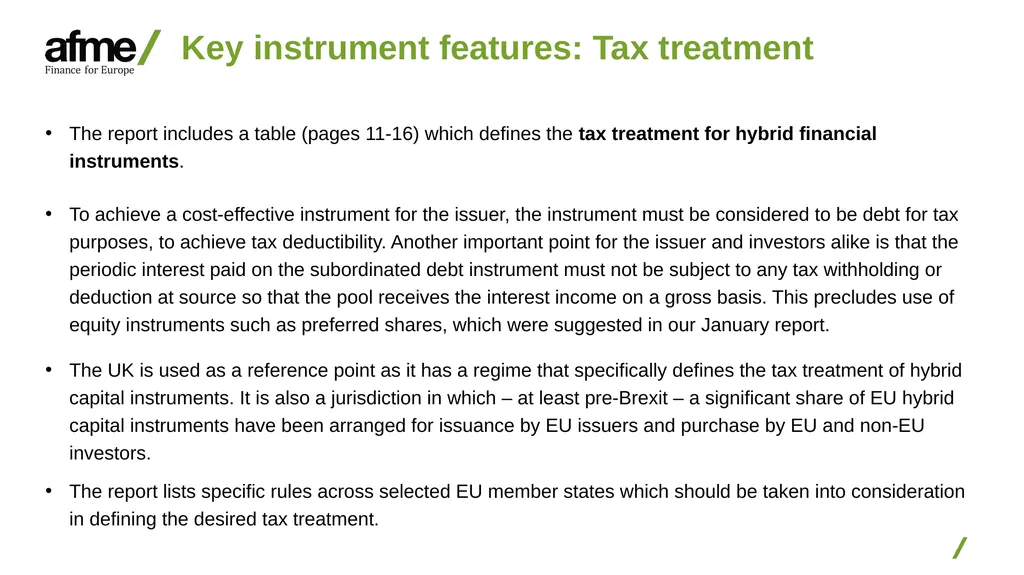
slide7. Key instrument features: Tax treatment The report includes a table (pages 11-16) which defines the tax treatment for hybrid financial instruments.
To achieve a cost-effective instrument for the issuer, the instrument must be considered to be debt for tax purposes, to achieve tax deductibility. Another important point for the issuer and investors alike is that the periodic interest paid on the subordinated debt instrument must not be subject to any tax withholding or deduction at source so that the pool receives the interest income on a gross basis. This precludes use of equity instruments such as preferred shares, which were suggested in our January report.
The UK is used as a reference point as it has a regime that specifically defines the tax treatment of hybrid capital instruments. It is also a jurisdiction in which – at least pre-Brexit – a significant share of EU hybrid capital instruments have been arranged for issuance by EU issuers and purchase by EU and non-EU investors.
The report lists specific rules across selected EU member states which should be taken into consideration in defining the desired tax treatment.<br>
slide8. Key instrument features: Insolvency treatment The report includes a table (pages 17-19) setting out the insolvency treatment of hybrid capital instruments.
A small corporate will need to ensure that the debt is subordinated below the rights of all its other creditors, in the event of an insolvency. Failure to construct the debt like this would likely impact the corporate’s ability to raise debt from traditional sources and to transact on normal terms with trade creditors.
We start with the generalised principles used across the EU, but insolvency regimes can be very different across member states. Indeed, the Capital Markets Union action plan from the European Commission has maintained a long-term aim to harmonise these rules.
We then present some of the major differences across Germany, France, Italy, Spain and the Netherlands.<br>
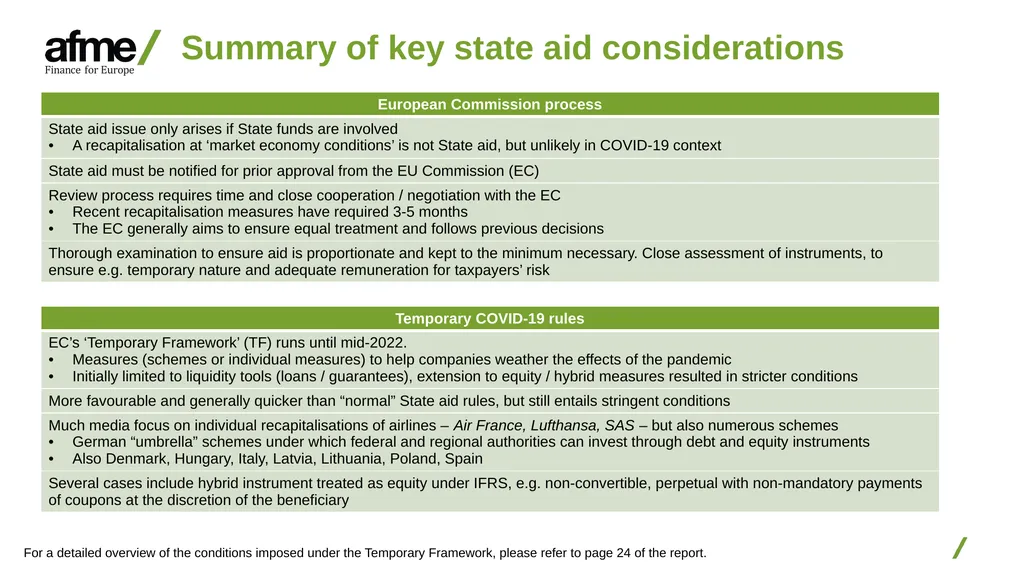
slide9. Summary of key state aid considerations For a detailed overview of the conditions imposed under the Temporary Framework, please refer to page 24 of the report.<br>
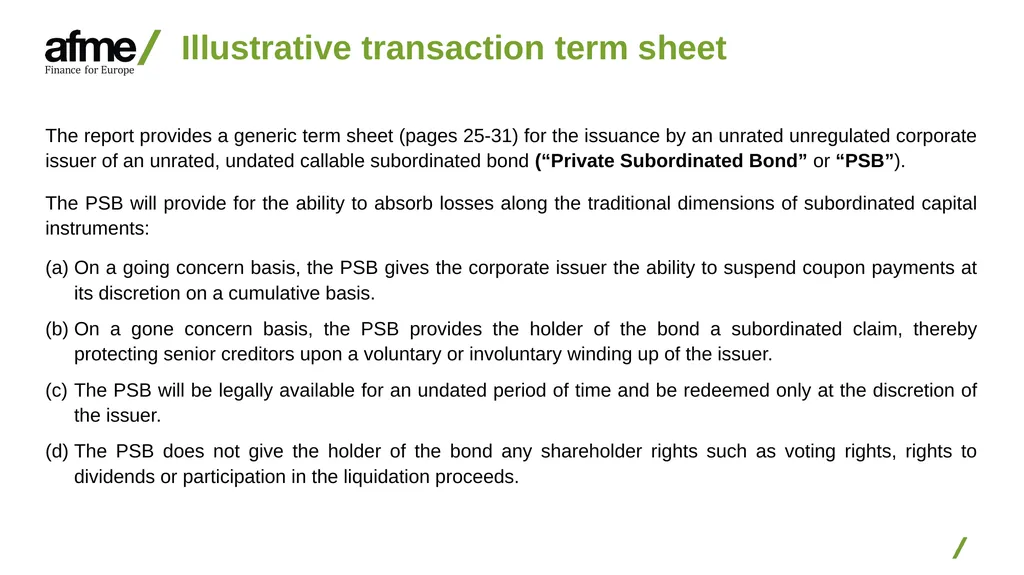
slide10. Illustrative transaction term sheet The report provides a generic term sheet (pages 25-31) for the issuance by an unrated unregulated corporate issuer of an unrated, undated callable subordinated bond (“Private Subordinated Bond” or “PSB”).
The PSB will provide for the ability to absorb losses along the traditional dimensions of subordinated capital instruments:
On a going concern basis, the PSB gives the corporate issuer the ability to suspend coupon payments at its discretion on a cumulative basis.
On a gone concern basis, the PSB provides the holder of the bond a subordinated claim, thereby protecting senior creditors upon a voluntary or involuntary winding up of the issuer.
The PSB will be legally available for an undated period of time and be redeemed only at the discretion of the issuer.
The PSB does not give the holder of the bond any shareholder rights such as voting rights, rights to dividends or participation in the liquidation proceeds.<br>
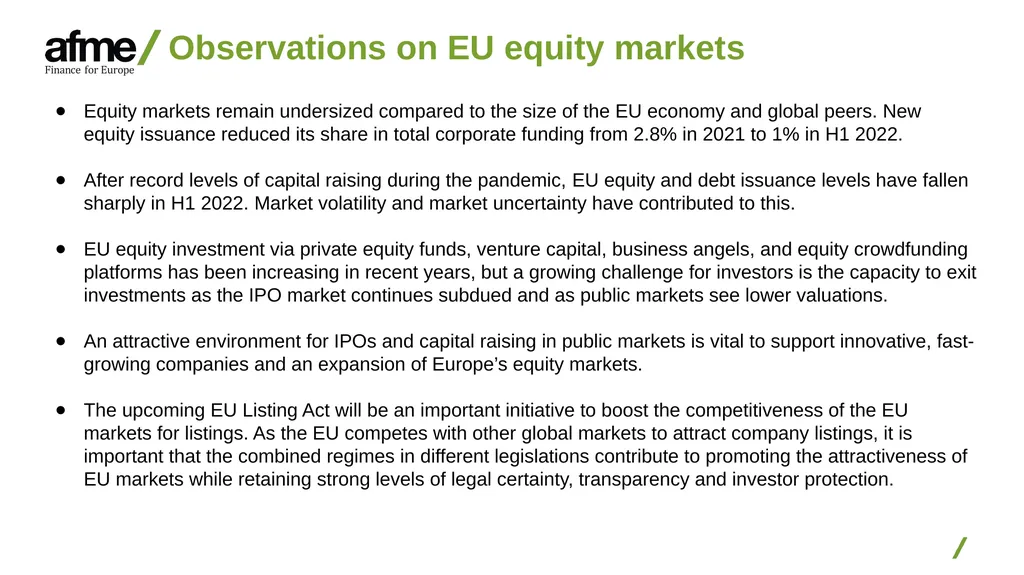
slide11. Equity markets remain undersized compared to the size of the EU economy and global peers. New equity issuance reduced its share in total corporate funding from 2.8% in 2021 to 1% in H1 2022.
After record levels of capital raising during the pandemic, EU equity and debt issuance levels have fallen sharply in H1 2022. Market volatility and market uncertainty have contributed to this.
EU equity investment via private equity funds, venture capital, business angels, and equity crowdfunding platforms has been increasing in recent years, but a growing challenge for investors is the capacity to exit investments as the IPO market continues subdued and as public markets see lower valuations.
An attractive environment for IPOs and capital raising in public markets is vital to support innovative, fast-growing companies and an expansion of Europe’s equity markets.
The upcoming EU Listing Act will be an important initiative to boost the competitiveness of the EU markets for listings. As the EU competes with other global markets to attract company listings, it is important that the combined regimes in different legislations contribute to promoting the attractiveness of EU markets while retaining strong levels of legal certainty, transparency and investor protection. Observations on EU equity markets<br>
slide12. Contacts Disclaimer and Methodology AFME
Rick Watson
Managing Director, Head of Capital Markets, Membership and Events
rick.watson@afme.eu
Pablo Portugal
Managing Director, Advocacy pablo.portugal@afme.eu Your receipt of this document is subject to paragraphs 3, 4, 5, 9, 10, 11 and 13 of the Terms of Use which are applicable to AFME’s website (available at http://www.afme.eu/Legal/Terms-of-Use.aspx) and, for the purposes of such Terms of Use, this document shall be considered a “Material” (regardless of whether you have received or accessed it via AFME’s website or otherwise).
AFME is registered on the EU Transparency Register, registration number 65110063986-76
For a description of the methodology of this report please visit
https://www.afme.eu/en/reports/Statistics/ London Office
39th Floor
25 Canada Square
London E14 5LQ
United Kingdom
+44 (0)20 3828 2700
Brussels Office
Rue de la Loi, 82
1040 Brussels
Belgium
+32 (0)2 788 3971
Frankfurt Office
Neue Mainzer Straße 75
Taunusanlage 1
60311 Frankfurt am Main
Germany
+49 (0)69 5050 60 590 Association for Financial Markets in Europe
www.afme.eu Follow AFME on Twitter
@AFME_EU<br>
slide2. Our board member firms Patrick George
Head of Global Markets EMEA & Global Head of ICG Leonardo Arduini
Head of EMEA Markets Jonathan Moore Head of Global Credit Products in EMEA Olivier Osty
Head of Global Markets (AFME Vice Chair) Pierre Gay
Head of Global Markets Division Guy America
Head of Global Credit Markets (AFME Vice Chair) Nick Hughes
Head of Capital Markets Nat Tyce
Co-Head of Macro Trading Jonathan Peberdy Interim Head of Capital Markets Thalia Chryssikou
Co-Head Global Sales Strats & Structuring across FICC and Equities
(AFME Chair) Dan Watkins
Head of Markets Clearing and Collateral EMEA James Lancaster Wholesale Chief Operating Officer Lionel Bignone
Managing Director
Co-Head of Global Markets Paolo Crocé
Managing Director Head of Global Markets EMEA Gavin Colquhoun
EMEA Head of Global Financing & Credit Trading & Co-Head of Investment Bank EMEA Juan Blasco
Head of Syndicate and Head of Leveraged Finance EMEA Davide Menini Global Head of Fixed Income Structuring and Structured Notes Trading, Fixed Income
Division Gary Prince
Global Head of FX & Rates Trading and, Head of Financial Markets EMEA Michael Haize Global Head of Markets Corporate & Investment
Banking. Sylvain Cartier
Co- Head of Global Markets Activities Vanessa Holtz
Head of EU FICC Trading, Co-Head of EMEA FX G10 Trading & Global Head of G10 FX Options (Vanillas & Electronic) Clare Francis
Regional Head of Global Banking, Europe and
CEO, Standard Chartered UK José Manuel Colina Head of Global Markets Europe and Asia at SCIB Massimo Mocio
Deputy Chief of IMI CIB Division - Head of Global Markets & Investment Banking Justin Chapman
Executive Vice President – Global Executive Securities Services and Global Head Market Advocacy
& Innovation Martine Bond
Executive Vice President and Head of State Street Global Markets 8<br>
slide3. The relatively low level of bankruptcies in the aftermath of the Covid-19 pandemic could be due in part to the impact of the temporary public support measures put in place.
In periods of economic stress or when credit is constrained, it is vital that smaller, unlisted companies and midcaps in the EU with the potential to drive economic growth have access to ample fresh capital to invest in innovation.
In January 2021, AFME and PwC published the first recapitalisation report, titled “Recapitalising EU businesses post COVID-19: How equity and hybrid markets instruments can drive recovery”.
Many mid-size and SME corporates do not wish to give up control of their business but are willing to pay a premium not to dilute their voting rights, as well as are willing to distribute a share of profits to investors. Hybrid subordinated debt instruments are ideally suited to address these needs.
AFME explored the potential of a common EU-level state-aid compliant recapitalisation instrument with (reasonably) standardised legal, accounting, tax bases, and economic terms, for use across Member States. The case for recapitalisation instruments<br>
slide4. The second AFME recapitalisation report On 18 November 2021, AFME has published its second report on post-Covid Recapitalisation, titled “Introducing a new hybrid recapitalisation instrument for smaller EU corporates”, developed in partnership with Linklaters and PwC.
Building on the previous study, the report provided a practical guide for European authorities and Member States looking to introduce a new hybrid recapitalisation instrument.
The report features the following analysis:
An overview of the key hybrid instrument attributes required to achieve the desired equity accounting, tax deductibility and insolvency treatment in Member States.
A summary of state aid considerations for such hybrid instruments to achieve compliance with EU state aid requirements;
A generic sample term sheet outlining the proposed instrument features which can be used as a reference for discussion with officials, investors and mid-cap/SME corporate issuers. (1)
(1) While AFME expresses support for an EU-level approach, the varying national environments and legal frameworks in the EU means that the implementation of such a solution needs to be tailored to the national contexts in member states.<br>
slide5. Hybrid instrument solutions need to be tailored to the local accounting, legal, tax and insolvency treatments in individual EU Member States, to achieve the key attributes necessary for creating an instrument which effectively meets the needs of both investors and corporate issuers.
AFME members believe that small corporates will generally care most about equity accounting treatment under national GAAP (and IFRS, if relevant), tax deductibility and the all-in cost of issuance (including financial guarantee costs).
Individual hybrid subordinated debt issuances by smaller corporates will be too small to be cost-effective for most investors, who will need to do extensive credit and business plan research for a relatively small reward in absolute earnings terms. Therefore some form of public support and “pooling” of individual issuances is necessary to attract the right investors.
An EU-wide approach would be ideal: A common European instrument model could benefit from the visibility, liquidity and scale of the single market and generate broad appeal amongst institutional investors seeking debt and hybrid-type risk profiles but with better returns, while catering to the needs of smaller companies. With sufficient EU-wide scale, a successful framework could develop into a well-defined asset class encouraging investment and EU integration – these are the goals of the CMU. AFME’s proposal for a hybrid instrument framework<br>
slide6. Key instrument features: Accounting treatment The report includes a table (pages 9-10) setting out the accounting treatment for hybrid financial instruments.
It is key that the instrument is treated as equity for accounting purposes. A deeply subordinated debt instrument with no maturity date is likely to be accounted for as equity under IFRS and in many but not in all EU member states, under national GAAP.
We start with IFRS treatment, as local GAAP accounting treatment in most EU member states is aligned with this. While not uniformly the case, an equity instrument for IFRS purposes will in many jurisdictions also be equity under local GAAP.
We then note some differences between IFRS and local GAAP accounting treatment for Germany, France, Italy, Spain and the Netherlands.<br>
slide7. Key instrument features: Tax treatment The report includes a table (pages 11-16) which defines the tax treatment for hybrid financial instruments.
To achieve a cost-effective instrument for the issuer, the instrument must be considered to be debt for tax purposes, to achieve tax deductibility. Another important point for the issuer and investors alike is that the periodic interest paid on the subordinated debt instrument must not be subject to any tax withholding or deduction at source so that the pool receives the interest income on a gross basis. This precludes use of equity instruments such as preferred shares, which were suggested in our January report.
The UK is used as a reference point as it has a regime that specifically defines the tax treatment of hybrid capital instruments. It is also a jurisdiction in which – at least pre-Brexit – a significant share of EU hybrid capital instruments have been arranged for issuance by EU issuers and purchase by EU and non-EU investors.
The report lists specific rules across selected EU member states which should be taken into consideration in defining the desired tax treatment.<br>
slide8. Key instrument features: Insolvency treatment The report includes a table (pages 17-19) setting out the insolvency treatment of hybrid capital instruments.
A small corporate will need to ensure that the debt is subordinated below the rights of all its other creditors, in the event of an insolvency. Failure to construct the debt like this would likely impact the corporate’s ability to raise debt from traditional sources and to transact on normal terms with trade creditors.
We start with the generalised principles used across the EU, but insolvency regimes can be very different across member states. Indeed, the Capital Markets Union action plan from the European Commission has maintained a long-term aim to harmonise these rules.
We then present some of the major differences across Germany, France, Italy, Spain and the Netherlands.<br>
slide9. Summary of key state aid considerations For a detailed overview of the conditions imposed under the Temporary Framework, please refer to page 24 of the report.<br>
slide10. Illustrative transaction term sheet The report provides a generic term sheet (pages 25-31) for the issuance by an unrated unregulated corporate issuer of an unrated, undated callable subordinated bond (“Private Subordinated Bond” or “PSB”).
The PSB will provide for the ability to absorb losses along the traditional dimensions of subordinated capital instruments:
On a going concern basis, the PSB gives the corporate issuer the ability to suspend coupon payments at its discretion on a cumulative basis.
On a gone concern basis, the PSB provides the holder of the bond a subordinated claim, thereby protecting senior creditors upon a voluntary or involuntary winding up of the issuer.
The PSB will be legally available for an undated period of time and be redeemed only at the discretion of the issuer.
The PSB does not give the holder of the bond any shareholder rights such as voting rights, rights to dividends or participation in the liquidation proceeds.<br>
slide11. Equity markets remain undersized compared to the size of the EU economy and global peers. New equity issuance reduced its share in total corporate funding from 2.8% in 2021 to 1% in H1 2022.
After record levels of capital raising during the pandemic, EU equity and debt issuance levels have fallen sharply in H1 2022. Market volatility and market uncertainty have contributed to this.
EU equity investment via private equity funds, venture capital, business angels, and equity crowdfunding platforms has been increasing in recent years, but a growing challenge for investors is the capacity to exit investments as the IPO market continues subdued and as public markets see lower valuations.
An attractive environment for IPOs and capital raising in public markets is vital to support innovative, fast-growing companies and an expansion of Europe’s equity markets.
The upcoming EU Listing Act will be an important initiative to boost the competitiveness of the EU markets for listings. As the EU competes with other global markets to attract company listings, it is important that the combined regimes in different legislations contribute to promoting the attractiveness of EU markets while retaining strong levels of legal certainty, transparency and investor protection. Observations on EU equity markets<br>
slide12. Contacts Disclaimer and Methodology AFME
Rick Watson
Managing Director, Head of Capital Markets, Membership and Events
rick.watson@afme.eu
Pablo Portugal
Managing Director, Advocacy pablo.portugal@afme.eu Your receipt of this document is subject to paragraphs 3, 4, 5, 9, 10, 11 and 13 of the Terms of Use which are applicable to AFME’s website (available at http://www.afme.eu/Legal/Terms-of-Use.aspx) and, for the purposes of such Terms of Use, this document shall be considered a “Material” (regardless of whether you have received or accessed it via AFME’s website or otherwise).
AFME is registered on the EU Transparency Register, registration number 65110063986-76
For a description of the methodology of this report please visit
https://www.afme.eu/en/reports/Statistics/ London Office
39th Floor
25 Canada Square
London E14 5LQ
United Kingdom
+44 (0)20 3828 2700
Brussels Office
Rue de la Loi, 82
1040 Brussels
Belgium
+32 (0)2 788 3971
Frankfurt Office
Neue Mainzer Straße 75
Taunusanlage 1
60311 Frankfurt am Main
Germany
+49 (0)69 5050 60 590 Association for Financial Markets in Europe
www.afme.eu Follow AFME on Twitter
@AFME_EU<br>