
Recent Advances in Geophysics Xiaohua Xu & Kai
CP
Published · 27 slides · 0 views

1 / 1
Description
Recent Advances in Geophysics Xiaohua Xu Kai Wang University of Science and Technology of China 20240909 Introduction to the Course Why Geophysics Sure, youre probably ready for a break after college. Youre a good student and youve
Related Topics
Share
Embed code
Download this presentation From Below
"Recent Advances in Geophysics Xiaohua Xu & Kai" is the property of its rightful owner. Permission is granted to download and print the materials on this website for personal, non-commercial use only, and to display it on your personal computer provided you do not modify the materials and that you retain all copyright notices contained in the materials. By downloading content from our website, you accept the terms of this agreement.
Presentation Transcript
01
Recent Advances in Geophysics Xiaohua Xu & Kai Wang
University of Science and Technology of China
2024/09/09 Introduction to the Course<br>
University of Science and Technology of China
2024/09/09 Introduction to the Course<br>
02
Why Geophysics Sure, you're probably ready for a break after college. You're a good student and you've worked hard to get your Physics or Earth Science degree. Although you love science, you've heard that jobs are scarce.
So it's tempting to take that programming job, buy a nice car and start paying off your loans. Many software companies are hiring people right now at attractive salaries.
But, if you go this route, you'll regret it. Maybe not today and maybe not tomorrow, but someday you'll regret it and find yourself asking: Why didn't I go to graduate school?<br>
03
Why Geophysics Because you'll get tired of that programming job. You'll burn out after endless 16 hours days of hacking. You will not learn anything important. You and your colleagues will not age well. You will become a boring person and people will avoid you at parties. Any skills you obtain will be obsolete in six months.
You could be going to graduate school in geophysics! Graduate school is just like college -- only better. You only take classes for a year or two and then you work on your own research project. You're part of a community of scientists that are engaged in a grand adventure, probing the nature of our planet. It's creative, stimulating work, and you are acquiring skills that will serve you well in the future.
labs.<br>
04
Why Geophysics Sure, it doesn't pay as well as a real job. But you'll have more money than you had in college. Most geophysics graduate programs waive tuition and pay enough to live on. You will have flexible hours and the opportunity to do field work and attend conferences in exotic locations.
Science is fun! Why rush to the job market and a 30 year mortgage when you can extend your college years and develop a career that will engage and challenge you the rest of your life.
The job market in geophysics is better than in straight physics, and graduates from the top programs are getting good jobs, many of them in academia and government and private labs.<br>
05
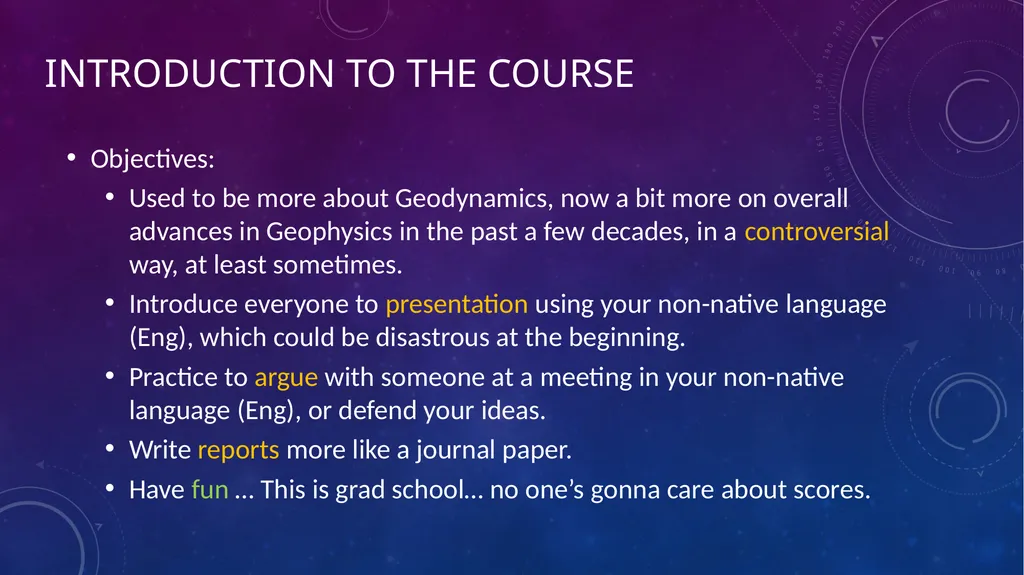
Introduction to the Course Objectives:
Used to be more about Geodynamics, now a bit more on overall advances in Geophysics in the past a few decades, in a controversial way, at least sometimes.
Introduce everyone to presentation using your non-native language (Eng), which could be disastrous at the beginning.
Practice to argue with someone at a meeting in your non-native language (Eng), or defend your ideas.
Write reports more like a journal paper.
Have fun … This is grad school… no one’s gonna care about scores.<br>
06
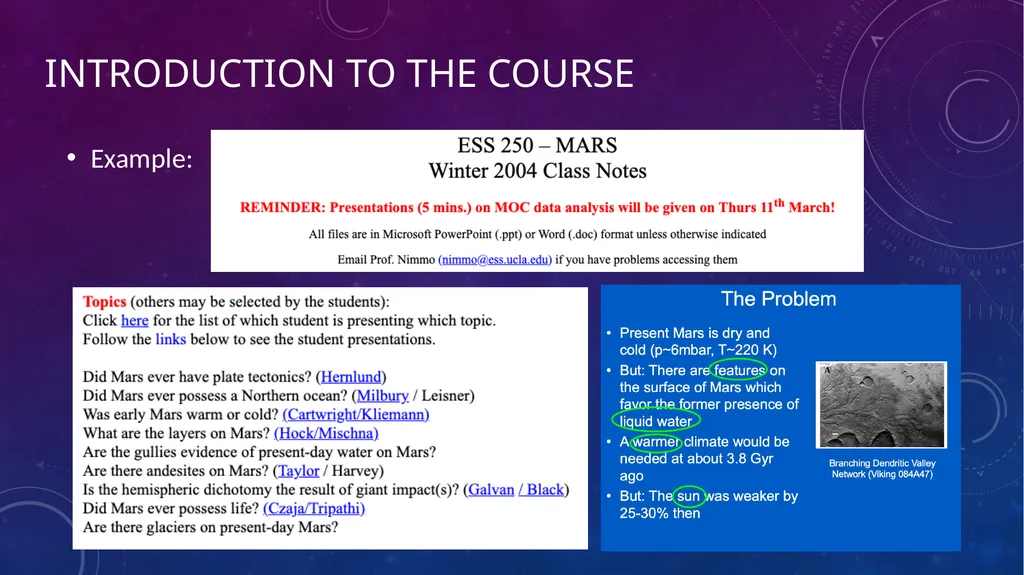
Introduction to the Course Example:<br>
07
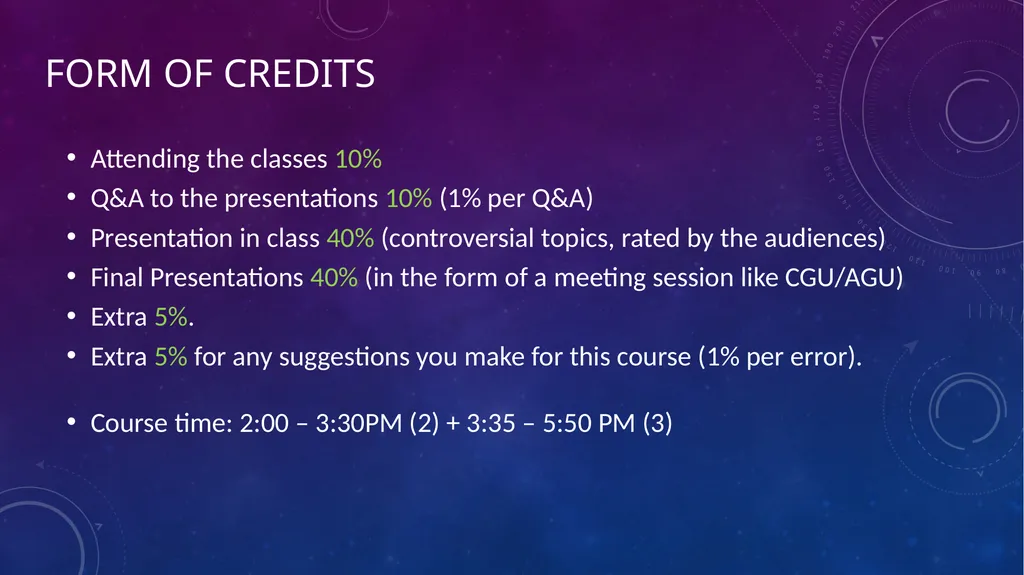
Form of Credits Attending the classes 10%
Q&A to the presentations 10% (1% per Q&A)
Presentation in class 40% (controversial topics, rated by the audiences)
Final Presentations 40% (in the form of a meeting session like CGU/AGU)
Extra 5%.
Extra 5% for any suggestions you make for this course (1% per error).
Course time: 2:00 – 3:30PM (2) + 3:35 – 5:50 PM (3)<br>
08
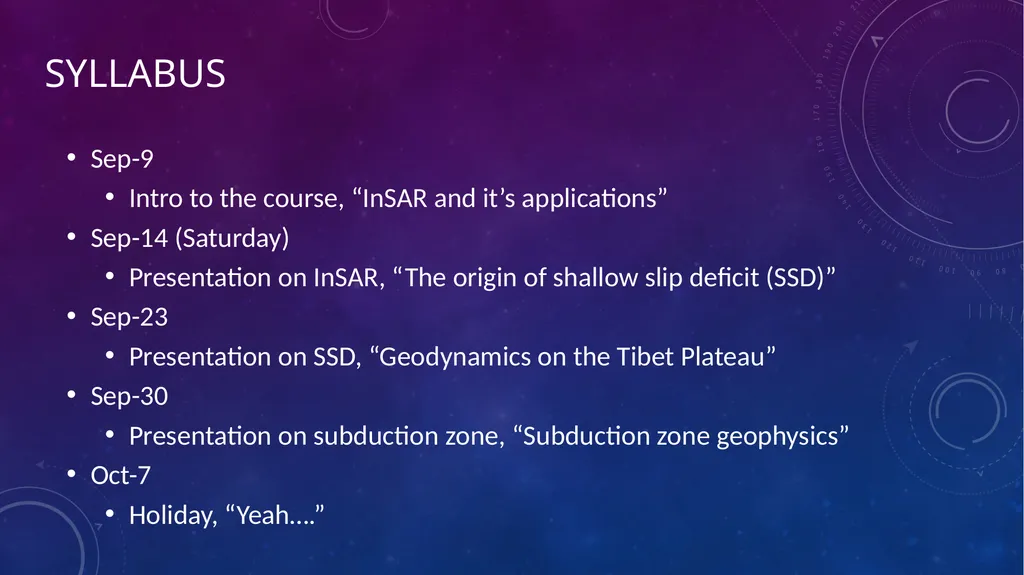
Syllabus Sep-9
Intro to the course, “InSAR and it’s applications”
Sep-14 (Saturday)
Presentation on InSAR, “The origin of shallow slip deficit (SSD)”
Sep-23
Presentation on SSD, “Geodynamics on the Tibet Plateau”
Sep-30
Presentation on subduction zone, “Subduction zone geophysics”
Oct-7
Holiday, “Yeah….”<br>
Intro to the course, “InSAR and it’s applications”
Sep-14 (Saturday)
Presentation on InSAR, “The origin of shallow slip deficit (SSD)”
Sep-23
Presentation on SSD, “Geodynamics on the Tibet Plateau”
Sep-30
Presentation on subduction zone, “Subduction zone geophysics”
Oct-7
Holiday, “Yeah….”<br>
09
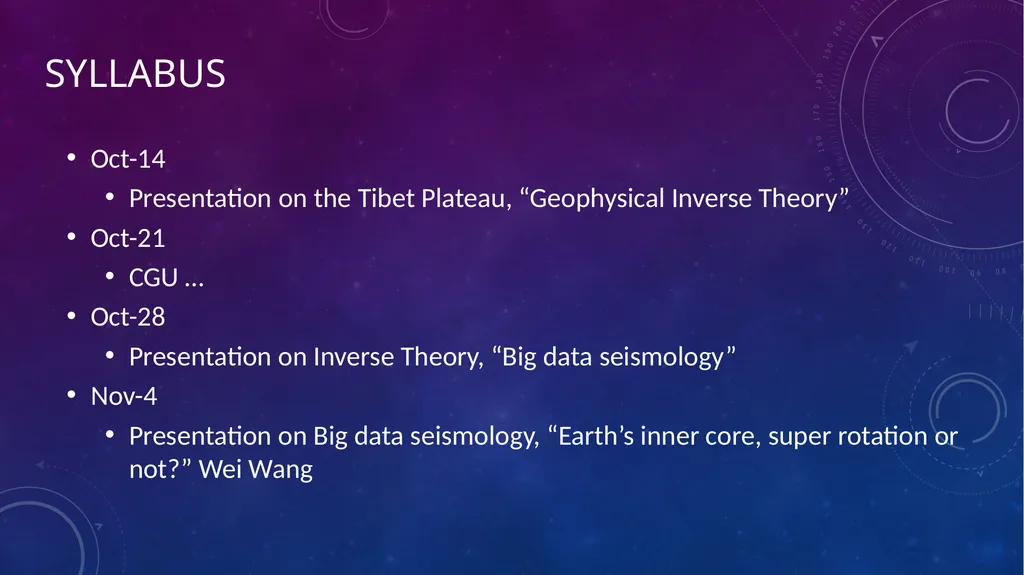
Syllabus Oct-14
Presentation on the Tibet Plateau, “Geophysical Inverse Theory”
Oct-21
CGU …
Oct-28
Presentation on Inverse Theory, “Big data seismology”
Nov-4
Presentation on Big data seismology, “Earth’s inner core, super rotation or not?” Wei Wang<br>
Presentation on the Tibet Plateau, “Geophysical Inverse Theory”
Oct-21
CGU …
Oct-28
Presentation on Inverse Theory, “Big data seismology”
Nov-4
Presentation on Big data seismology, “Earth’s inner core, super rotation or not?” Wei Wang<br>
10
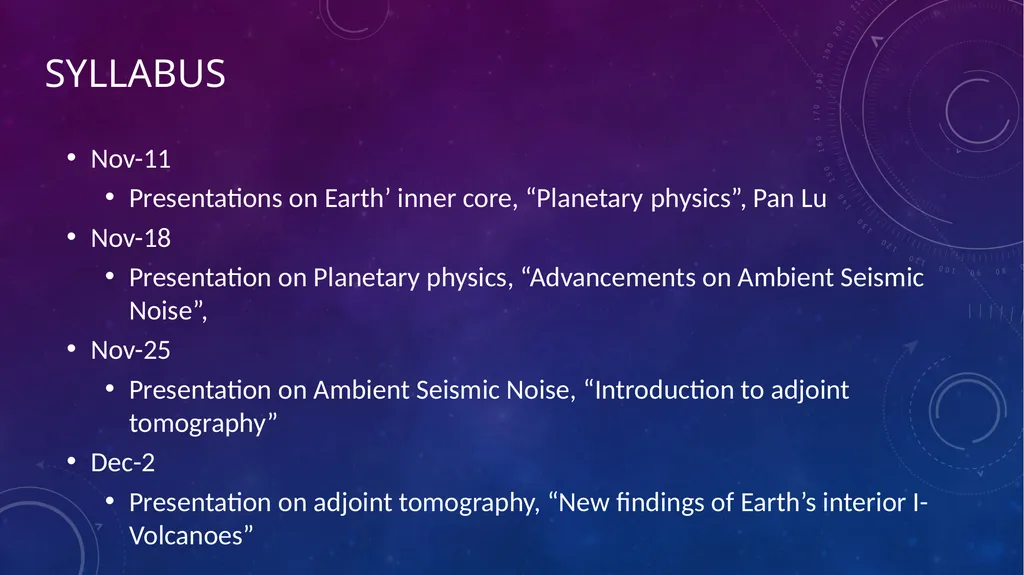
Syllabus Nov-11
Presentations on Earth’ inner core, “Planetary physics”, Pan Lu
Nov-18
Presentation on Planetary physics, “Advancements on Ambient Seismic Noise”,
Nov-25
Presentation on Ambient Seismic Noise, “Introduction to adjoint tomography”
Dec-2
Presentation on adjoint tomography, “New findings of Earth’s interior I- Volcanoes”<br>
11
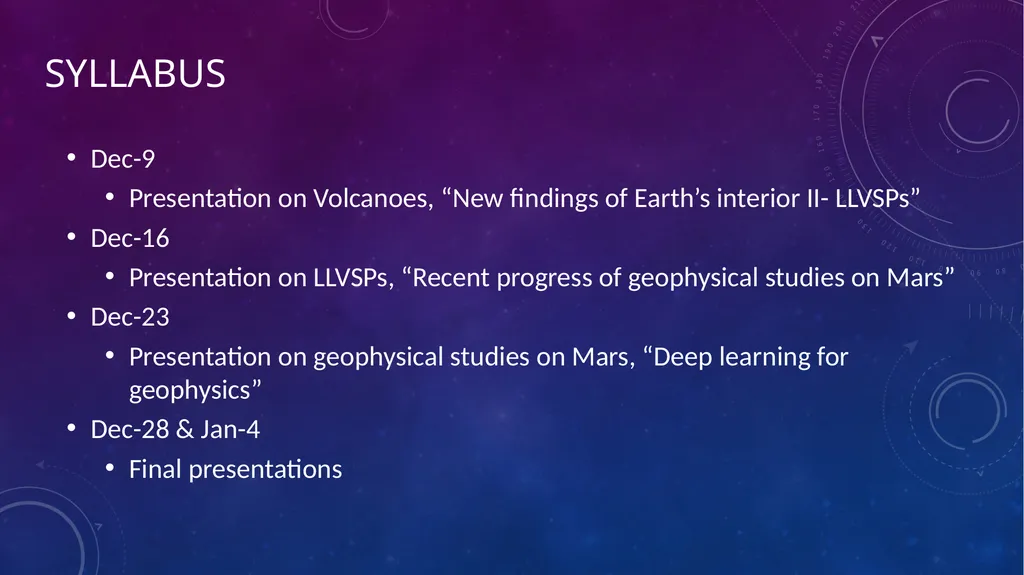
Syllabus Dec-9
Presentation on Volcanoes, “New findings of Earth’s interior II- LLVSPs”
Dec-16
Presentation on LLVSPs, “Recent progress of geophysical studies on Mars”
Dec-23
Presentation on geophysical studies on Mars, “Deep learning for geophysics”
Dec-28 & Jan-4
Final presentations<br>
Presentation on Volcanoes, “New findings of Earth’s interior II- LLVSPs”
Dec-16
Presentation on LLVSPs, “Recent progress of geophysical studies on Mars”
Dec-23
Presentation on geophysical studies on Mars, “Deep learning for geophysics”
Dec-28 & Jan-4
Final presentations<br>
12
Introduce yourselves Name, Bio
Who do you work with.
Your research interest?
What you’d like to get from the course?<br>
Who do you work with.
Your research interest?
What you’d like to get from the course?<br>
13
Why Presenting in English Job markets may require that
Help improve communication skills
Help avoid apparent mistakes in a presentation<br>
Help improve communication skills
Help avoid apparent mistakes in a presentation<br>
14
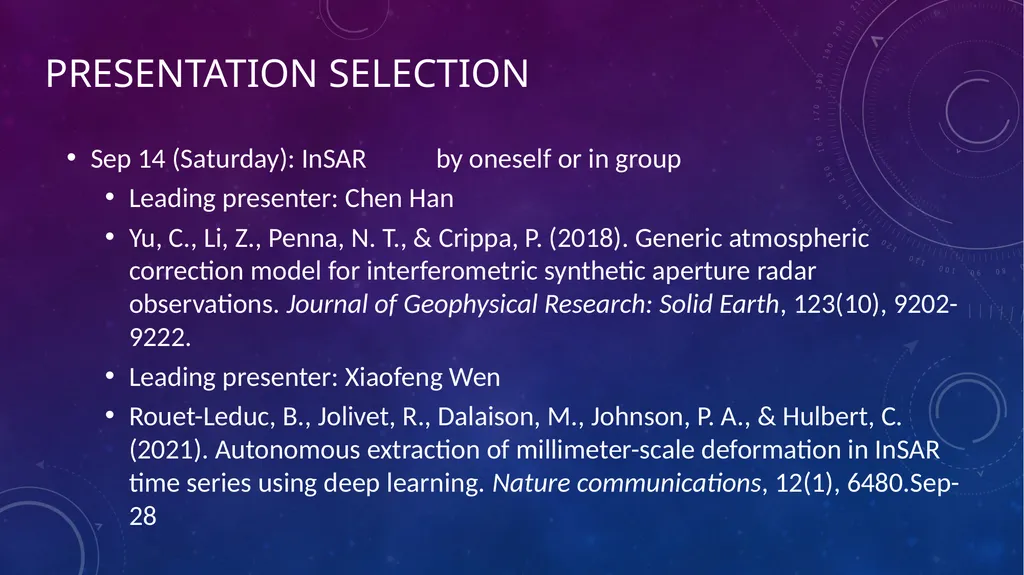
Presentation Selection Sep 14 (Saturday): InSAR by oneself or in group
Leading presenter: Chen Han
Yu, C., Li, Z., Penna, N. T., & Crippa, P. (2018). Generic atmospheric correction model for interferometric synthetic aperture radar observations. Journal of Geophysical Research: Solid Earth, 123(10), 9202-9222.
Leading presenter: Xiaofeng Wen
Rouet-Leduc, B., Jolivet, R., Dalaison, M., Johnson, P. A., & Hulbert, C. (2021). Autonomous extraction of millimeter-scale deformation in InSAR time series using deep learning. Nature communications, 12(1), 6480.Sep-28<br>
15
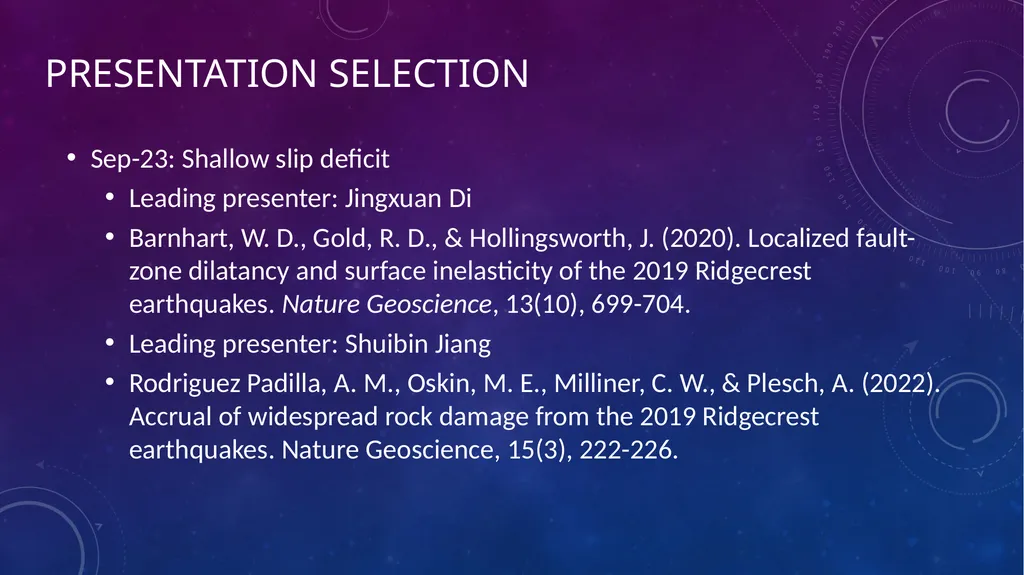
Presentation Selection Sep-23: Shallow slip deficit
Leading presenter: Jingxuan Di
Barnhart, W. D., Gold, R. D., & Hollingsworth, J. (2020). Localized fault-zone dilatancy and surface inelasticity of the 2019 Ridgecrest earthquakes. Nature Geoscience, 13(10), 699-704.
Leading presenter: Shuibin Jiang
Rodriguez Padilla, A. M., Oskin, M. E., Milliner, C. W., & Plesch, A. (2022). Accrual of widespread rock damage from the 2019 Ridgecrest earthquakes. Nature Geoscience, 15(3), 222-226.<br>
16
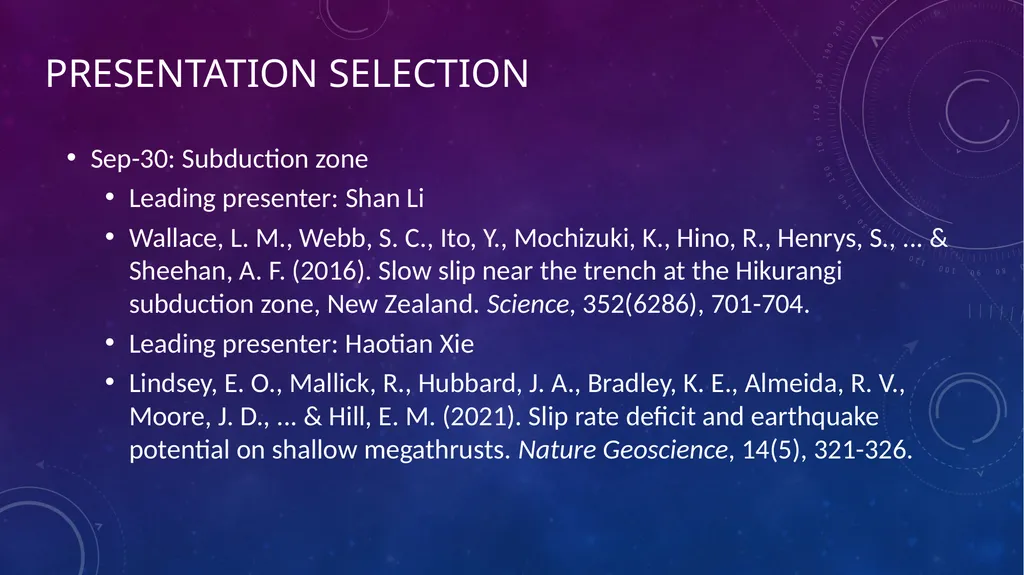
Presentation Selection Sep-30: Subduction zone
Leading presenter: Shan Li
Wallace, L. M., Webb, S. C., Ito, Y., Mochizuki, K., Hino, R., Henrys, S., ... & Sheehan, A. F. (2016). Slow slip near the trench at the Hikurangi subduction zone, New Zealand. Science, 352(6286), 701-704.
Leading presenter: Haotian Xie
Lindsey, E. O., Mallick, R., Hubbard, J. A., Bradley, K. E., Almeida, R. V., Moore, J. D., ... & Hill, E. M. (2021). Slip rate deficit and earthquake potential on shallow megathrusts. Nature Geoscience, 14(5), 321-326.<br>
17
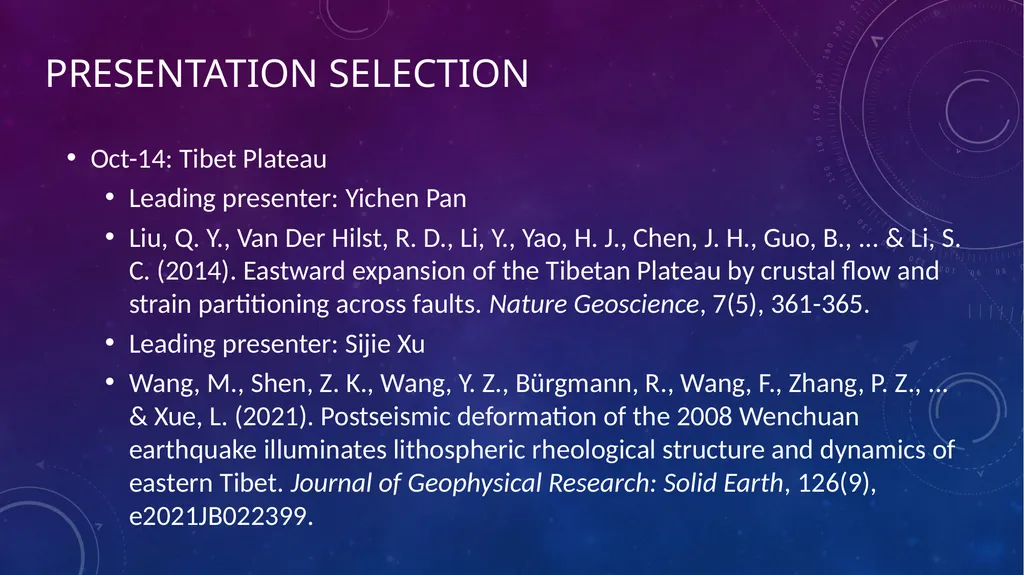
Presentation Selection Oct-14: Tibet Plateau
Leading presenter: Yichen Pan
Liu, Q. Y., Van Der Hilst, R. D., Li, Y., Yao, H. J., Chen, J. H., Guo, B., ... & Li, S. C. (2014). Eastward expansion of the Tibetan Plateau by crustal flow and strain partitioning across faults. Nature Geoscience, 7(5), 361-365.
Leading presenter: Sijie Xu
Wang, M., Shen, Z. K., Wang, Y. Z., Bürgmann, R., Wang, F., Zhang, P. Z., ... & Xue, L. (2021). Postseismic deformation of the 2008 Wenchuan earthquake illuminates lithospheric rheological structure and dynamics of eastern Tibet. Journal of Geophysical Research: Solid Earth, 126(9), e2021JB022399.<br>
18
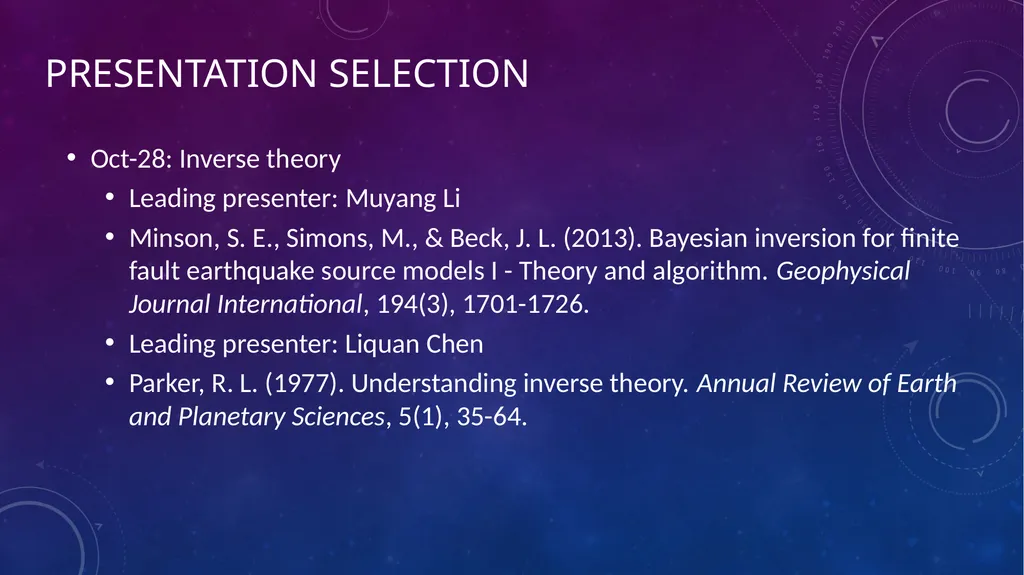
Presentation Selection Oct-28: Inverse theory
Leading presenter: Muyang Li
Minson, S. E., Simons, M., & Beck, J. L. (2013). Bayesian inversion for finite fault earthquake source models I - Theory and algorithm. Geophysical Journal International, 194(3), 1701-1726.
Leading presenter: Liquan Chen
Parker, R. L. (1977). Understanding inverse theory. Annual Review of Earth and Planetary Sciences, 5(1), 35-64.<br>
19
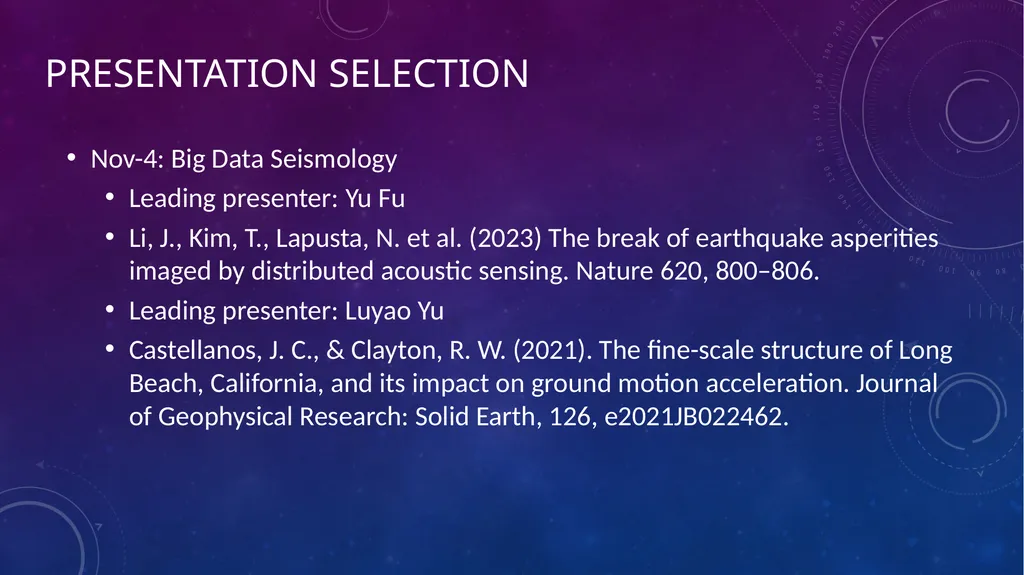
Presentation Selection Nov-4: Big Data Seismology
Leading presenter: Yu Fu
Li, J., Kim, T., Lapusta, N. et al. (2023) The break of earthquake asperities imaged by distributed acoustic sensing. Nature 620, 800–806.
Leading presenter: Luyao Yu
Castellanos, J. C., & Clayton, R. W. (2021). The fine-scale structure of Long Beach, California, and its impact on ground motion acceleration. Journal of Geophysical Research: Solid Earth, 126, e2021JB022462.<br>
20
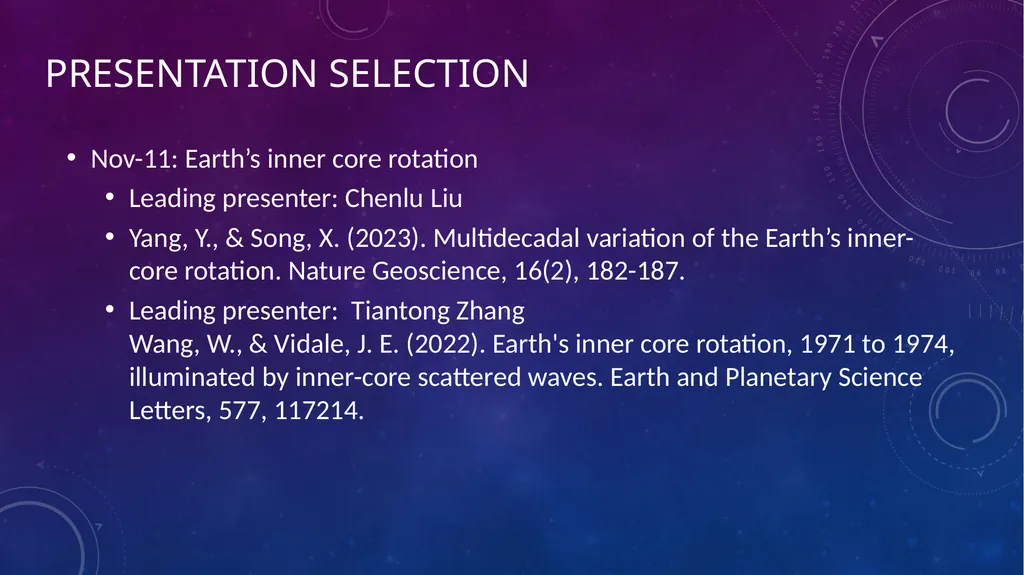
Presentation Selection Nov-11: Earth’s inner core rotation
Leading presenter: Chenlu Liu
Yang, Y., & Song, X. (2023). Multidecadal variation of the Earth’s inner-core rotation. Nature Geoscience, 16(2), 182-187.
Leading presenter: Tiantong Zhang Wang, W., & Vidale, J. E. (2022). Earth's inner core rotation, 1971 to 1974, illuminated by inner-core scattered waves. Earth and Planetary Science Letters, 577, 117214.<br>
21
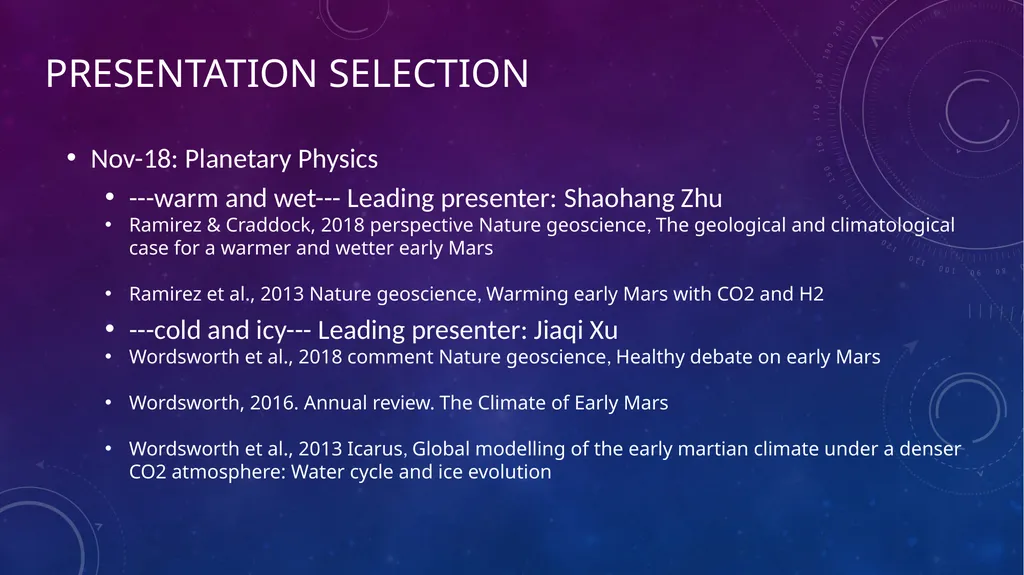
Presentation Selection Nov-18: Planetary Physics
---warm and wet--- Leading presenter: Shaohang Zhu
Ramirez & Craddock, 2018 perspective Nature geoscience, The geological and climatological case for a warmer and wetter early Mars
Ramirez et al., 2013 Nature geoscience, Warming early Mars with CO2 and H2
---cold and icy--- Leading presenter: Jiaqi Xu
Wordsworth et al., 2018 comment Nature geoscience, Healthy debate on early Mars
Wordsworth, 2016. Annual review. The Climate of Early Mars
Wordsworth et al., 2013 Icarus, Global modelling of the early martian climate under a denser CO2 atmosphere: Water cycle and ice evolution<br>
22
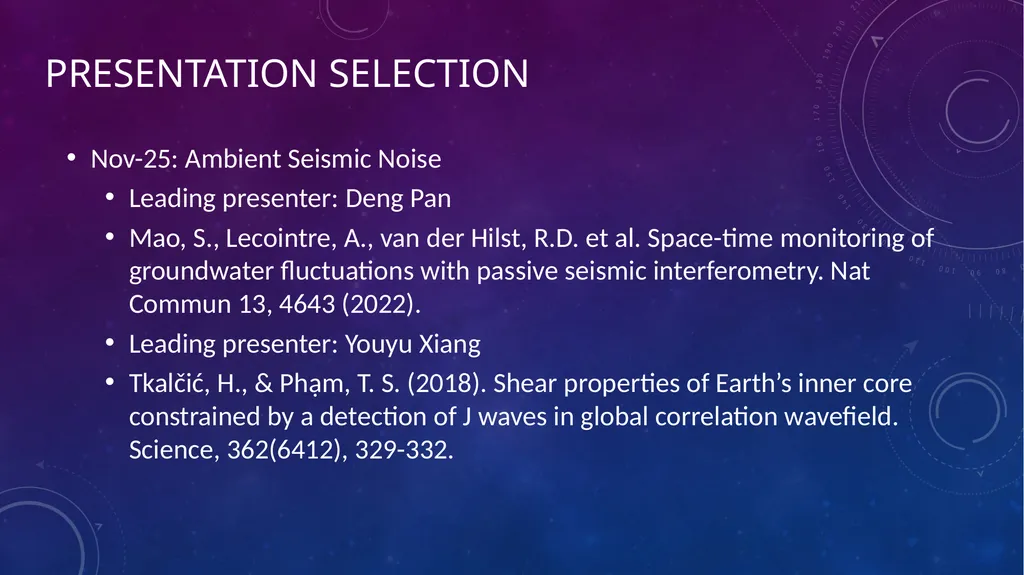
Presentation Selection Nov-25: Ambient Seismic Noise
Leading presenter: Deng Pan
Mao, S., Lecointre, A., van der Hilst, R.D. et al. Space-time monitoring of groundwater fluctuations with passive seismic interferometry. Nat Commun 13, 4643 (2022).
Leading presenter: Youyu Xiang
Tkalčić, H., & Phạm, T. S. (2018). Shear properties of Earth’s inner core constrained by a detection of J waves in global correlation wavefield. Science, 362(6412), 329-332.<br>
23
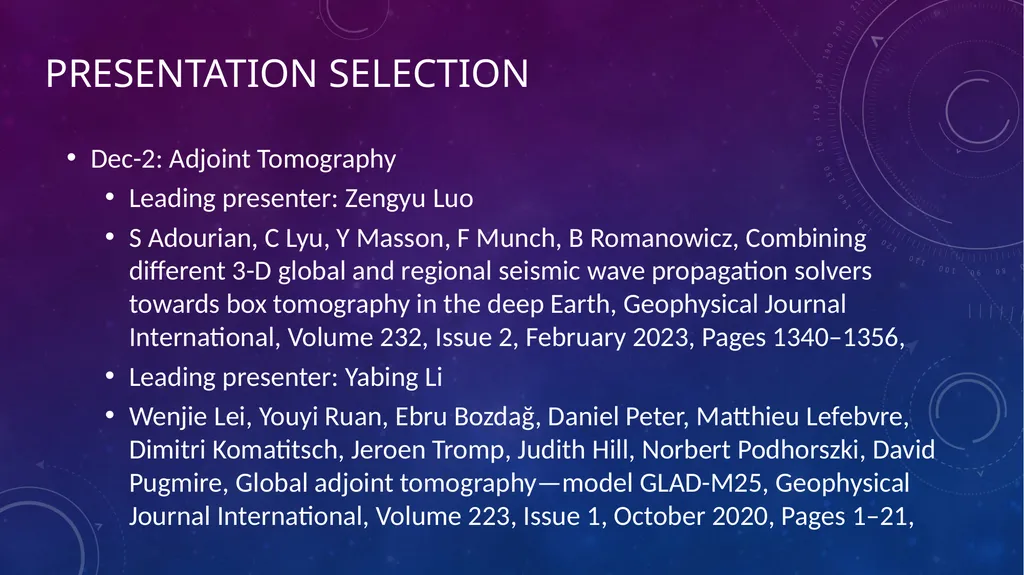
Presentation Selection Dec-2: Adjoint Tomography
Leading presenter: Zengyu Luo
S Adourian, C Lyu, Y Masson, F Munch, B Romanowicz, Combining different 3-D global and regional seismic wave propagation solvers towards box tomography in the deep Earth, Geophysical Journal International, Volume 232, Issue 2, February 2023, Pages 1340–1356,
Leading presenter: Yabing Li
Wenjie Lei, Youyi Ruan, Ebru Bozdağ, Daniel Peter, Matthieu Lefebvre, Dimitri Komatitsch, Jeroen Tromp, Judith Hill, Norbert Podhorszki, David Pugmire, Global adjoint tomography—model GLAD-M25, Geophysical Journal International, Volume 223, Issue 1, October 2020, Pages 1–21,<br>
24
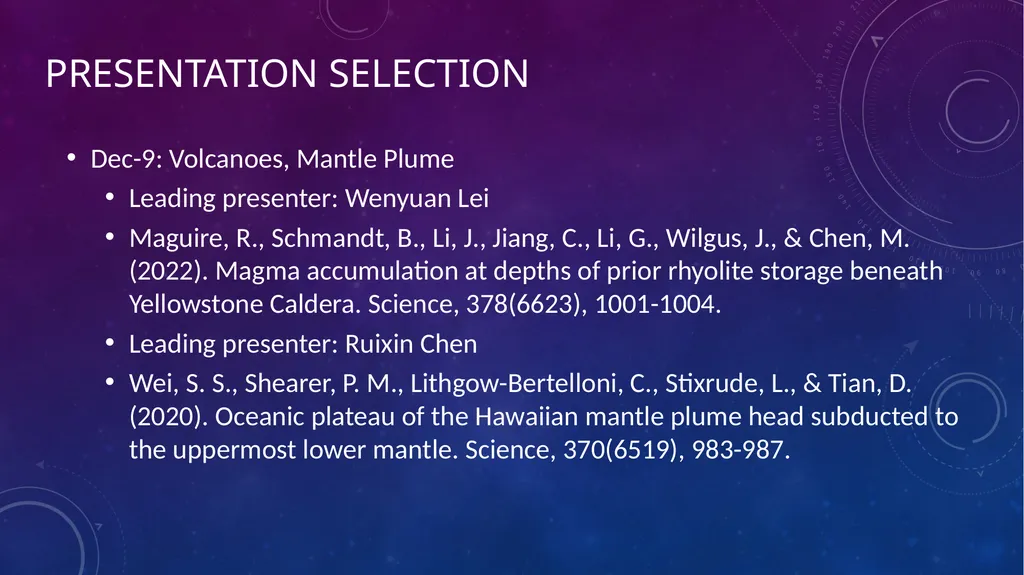
Presentation Selection Dec-9: Volcanoes, Mantle Plume
Leading presenter: Wenyuan Lei
Maguire, R., Schmandt, B., Li, J., Jiang, C., Li, G., Wilgus, J., & Chen, M. (2022). Magma accumulation at depths of prior rhyolite storage beneath Yellowstone Caldera. Science, 378(6623), 1001-1004.
Leading presenter: Ruixin Chen
Wei, S. S., Shearer, P. M., Lithgow-Bertelloni, C., Stixrude, L., & Tian, D. (2020). Oceanic plateau of the Hawaiian mantle plume head subducted to the uppermost lower mantle. Science, 370(6519), 983-987.<br>
25
Presentation Selection Dec-16: LLSVP
Leading presenter: Yao Zhang
Garnero, E., McNamara, A. & Shim, SH. Continent-sized anomalous zones with low seismic velocity at the base of Earth's mantle. Nature Geosci 9, 481–489 (2016).
Leading presenter: Yue Xu
Yuan, Q., Li, M. Instability of the African large low-shear-wave-velocity province due to its low intrinsic density. Nat. Geosci. 15, 334–339 (2022).<br>
26
Presentation Selection Dec-23: Seismic on Mars
Leading presenter: Ruidong Ma
Li, C., Zheng, Y., Wang, X. et al. Layered subsurface in Utopia Basin of Mars revealed by Zhurong rover radar. Nature 610, 308–312 (2022).
Leading presenter: Xiaohang Xu
L. V. Posiolova et al. ,Largest recent impact craters on Mars: Orbital imaging and surface seismic co-investigation.Science378,412-417(2022).DOI:10.1126/science.abq7704.<br>
27
Questions?<br>