04
Introducing an empirical basis for�distance-based language classification Automated Similarity Judgment Program<br>
05
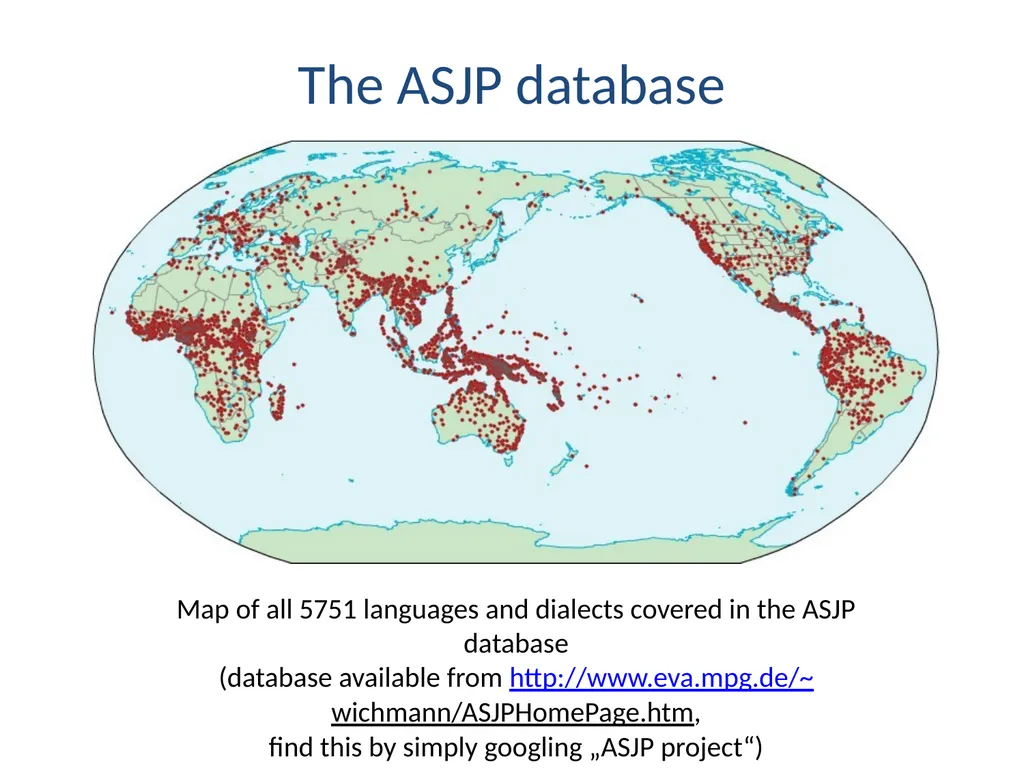
The ASJP database Map of all 5751 languages and dialects covered in the ASJP database
(database available from http://www.eva.mpg.de/~wichmann/ASJPHomePage.htm,
find this by simply googling „ASJP project“)<br>
06
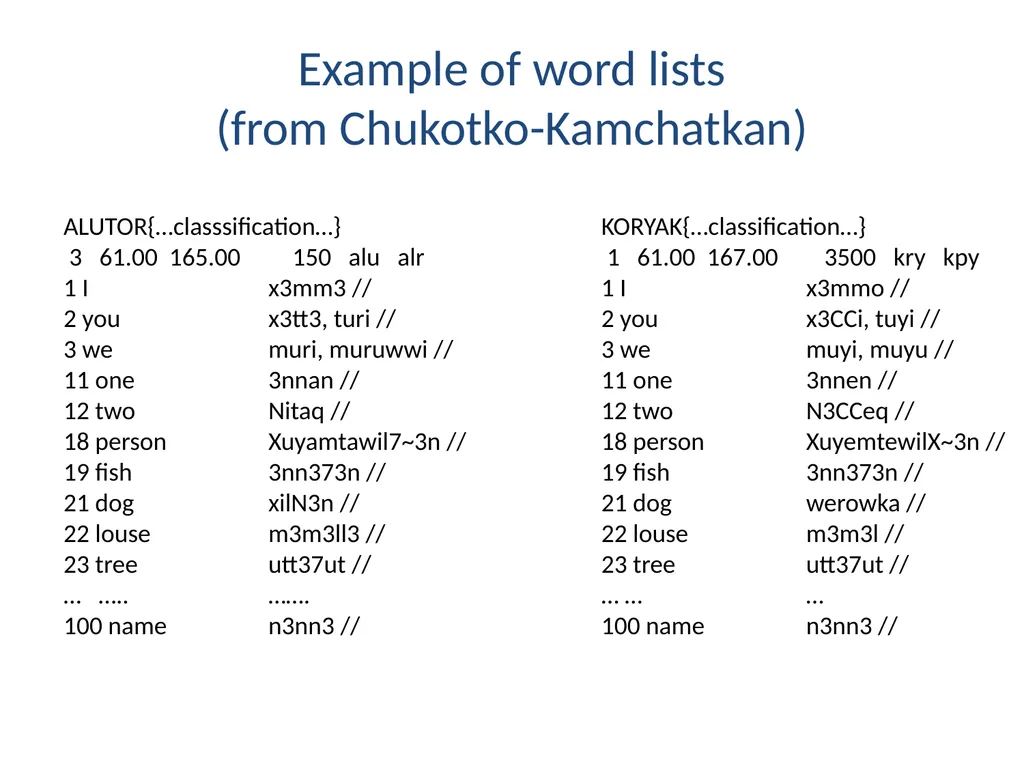
Example of word lists�(from Chukotko-Kamchatkan) ALUTOR{…classsification…}
3 61.00 165.00 150 alu alr
1 I x3mm3 //
2 you x3tt3, turi //
3 we muri, muruwwi //
11 one 3nnan //
12 two Nitaq //
18 person Xuyamtawil7~3n //
19 fish 3nn373n //
21 dog xilN3n //
22 louse m3m3ll3 //
23 tree utt37ut //
… ….. …….
100 name n3nn3 // KORYAK{…classification…}
1 61.00 167.00 3500 kry kpy
1 I x3mmo //
2 you x3CCi, tuyi //
3 we muyi, muyu //
11 one 3nnen //
12 two N3CCeq //
18 person XuyemtewilX~3n //
19 fish 3nn373n //
21 dog werowka //
22 louse m3m3l //
23 tree utt37ut //
… … …
100 name n3nn3 //<br>
07
An automated similarity measure Levenshtein distances: the minimum number of steps—substitutions,
insertions or deletions—that it takes to get from one word to another Germ. Zunge Eng. tongue
cuN3
tuN3 (substitution)
toN3 (substitution)
toN (deletion)
Or tongue Zunge
toN
toN3 (insertion)
tuN3 (substitution)
cuN3 (substitution)
= 3 steps, so LD = 3<br>
08
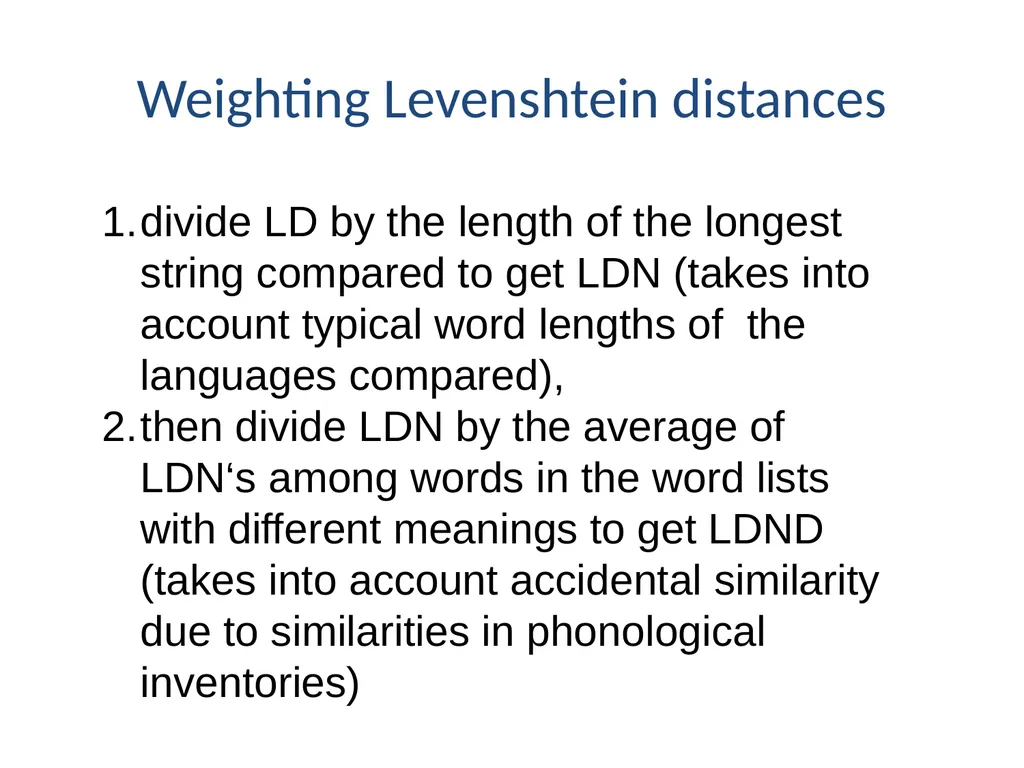
Weighting Levenshtein distances divide LD by the length of the longest string compared to get LDN (takes into account typical word lengths of the languages compared),
then divide LDN by the average of LDN‘s among words in the word lists with different meanings to get LDND (takes into account accidental similarity due to similarities in phonological inventories)<br>
09
Using modified mean distances
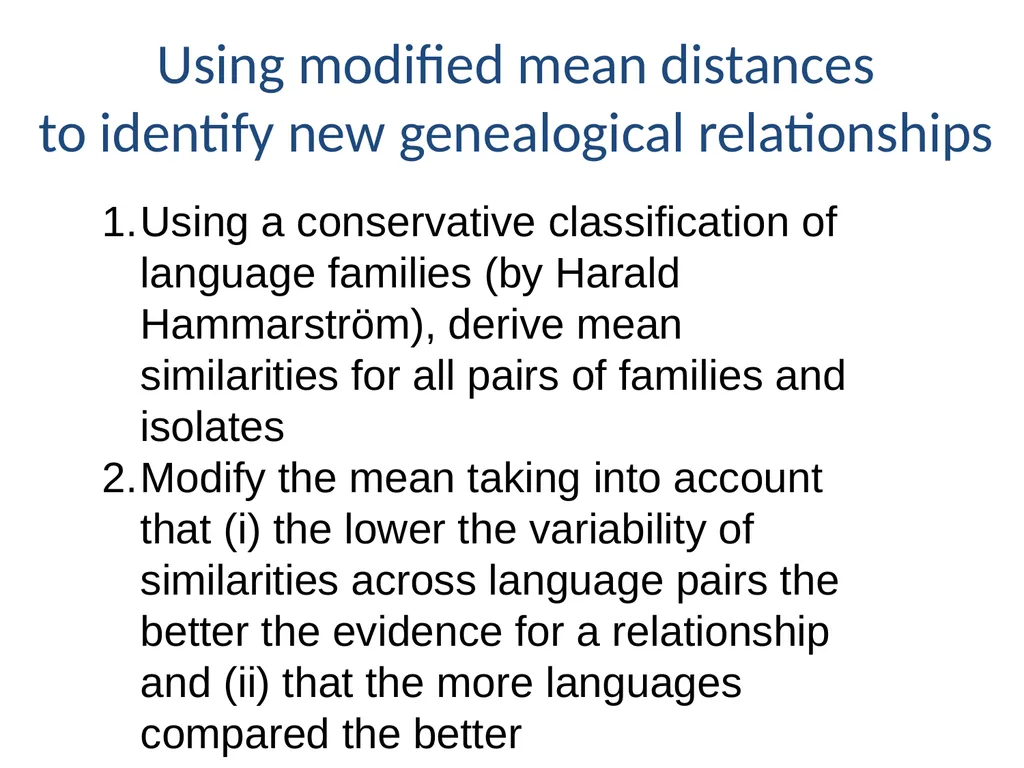
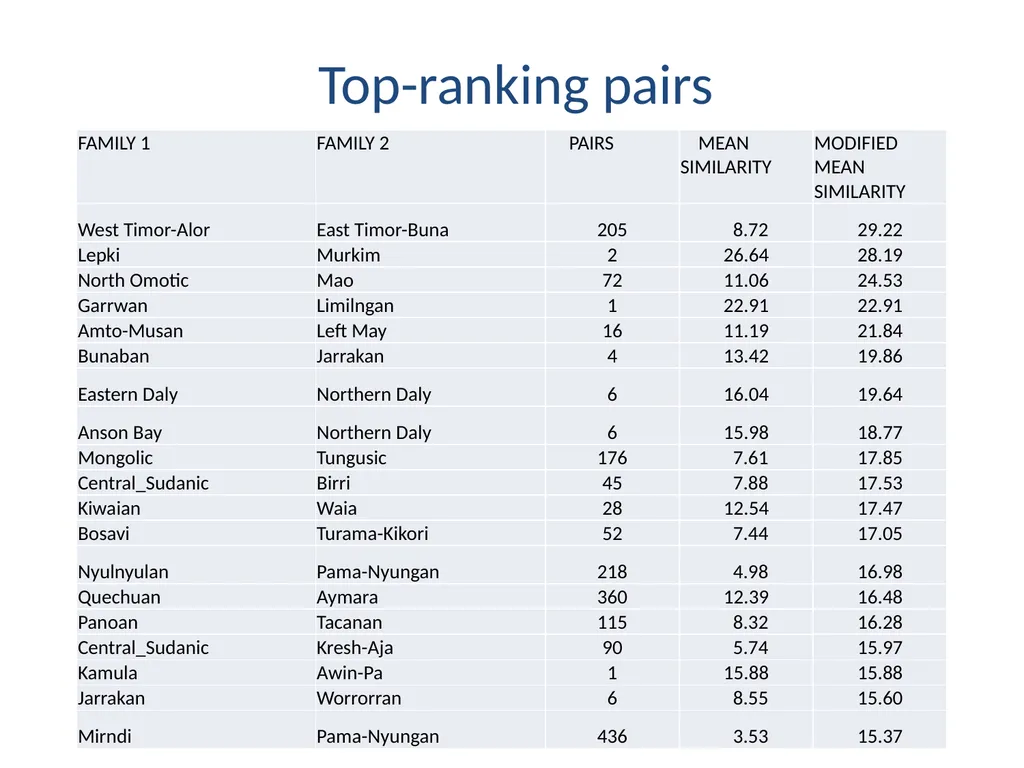
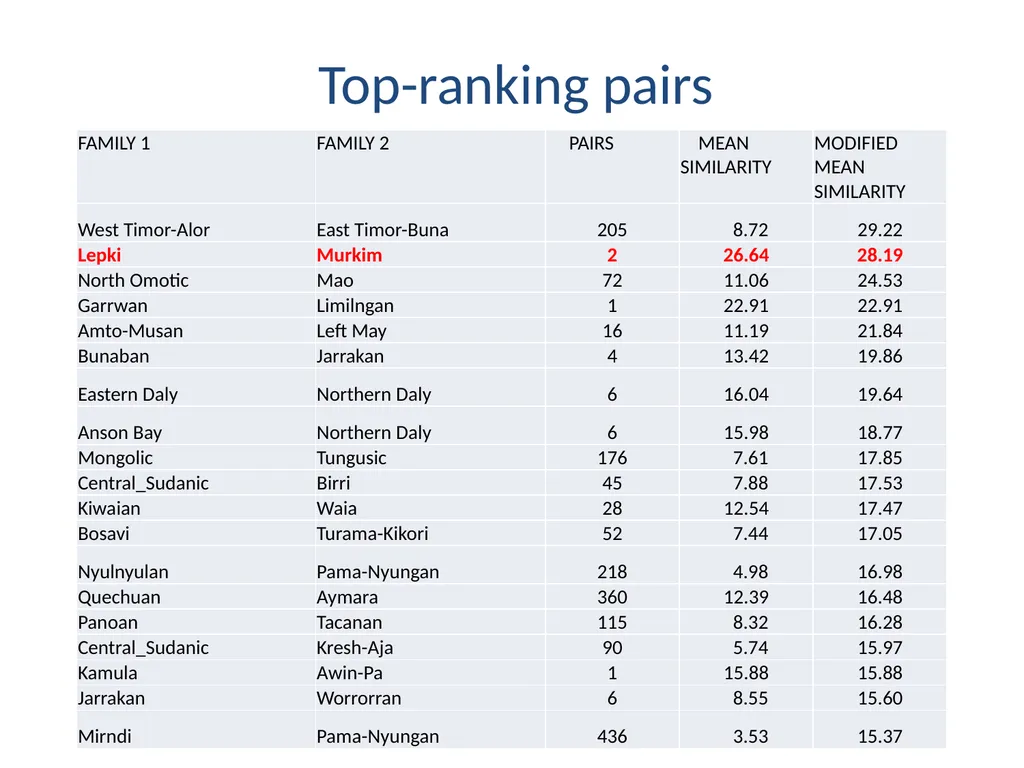
to identify new genealogical relationships Using a conservative classification of language families (by Harald Hammarström), derive mean similarities for all pairs of families and isolates
Modify the mean taking into account that (i) the lower the variability of similarities across language pairs the better the evidence for a relationship and (ii) that the more languages compared the better<br>
11
Complementary method:
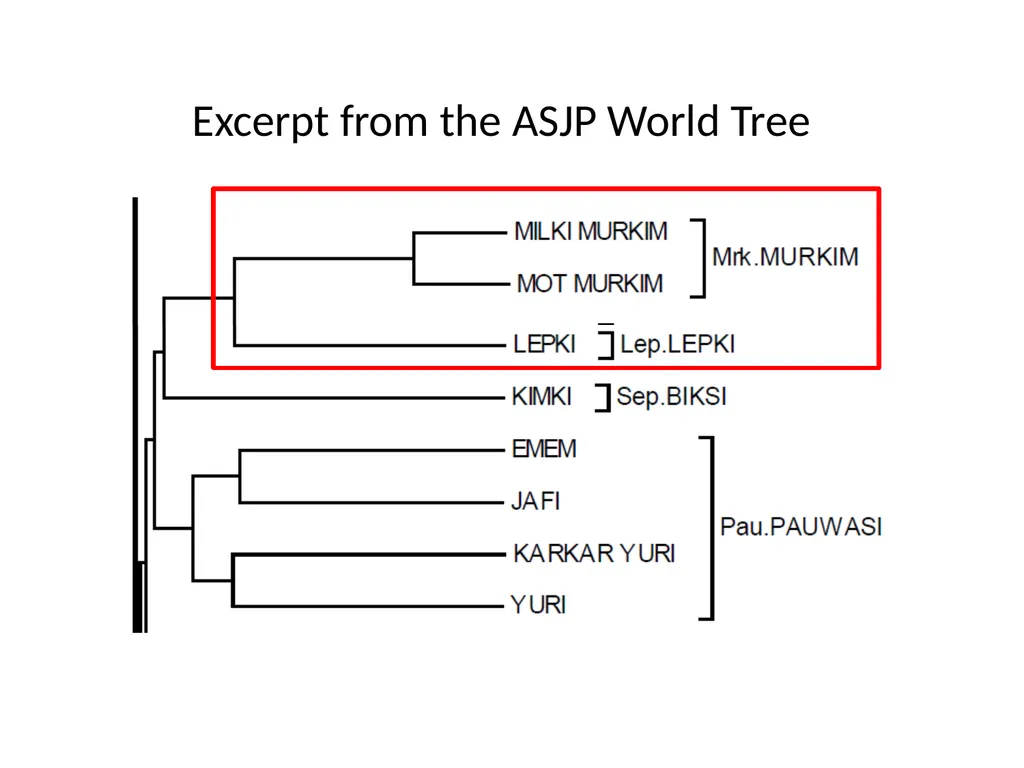
Inspecting the ASJP World Tree The world tree puts together all languages in one big Neighbor-Joining tree
It is only as good as the data put in, and it has clear limitations beyond a time depth of ~5000 years
But within a time depth of ~5000 years there are still relationships to be discovered!
So the ASJP World Tree of Lexical Similarity can be used to look for fruitful suggestions<br>
12
Not recommended: throwing the
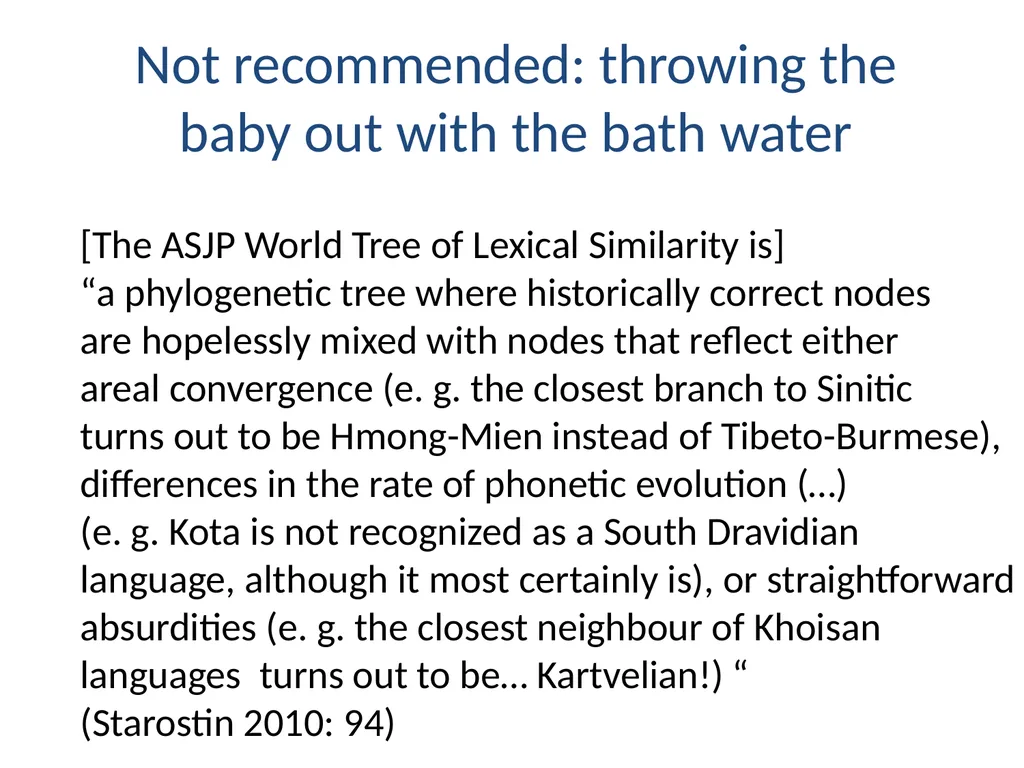
baby out with the bath water [The ASJP World Tree of Lexical Similarity is]
“a phylogenetic tree where historically correct nodes
are hopelessly mixed with nodes that reflect either
areal convergence (e. g. the closest branch to Sinitic
turns out to be Hmong-Mien instead of Tibeto-Burmese),
differences in the rate of phonetic evolution (…)
(e. g. Kota is not recognized as a South Dravidian
language, although it most certainly is), or straightforward
absurdities (e. g. the closest neighbour of Khoisan
languages turns out to be… Kartvelian!) “
(Starostin 2010: 94)<br>
13
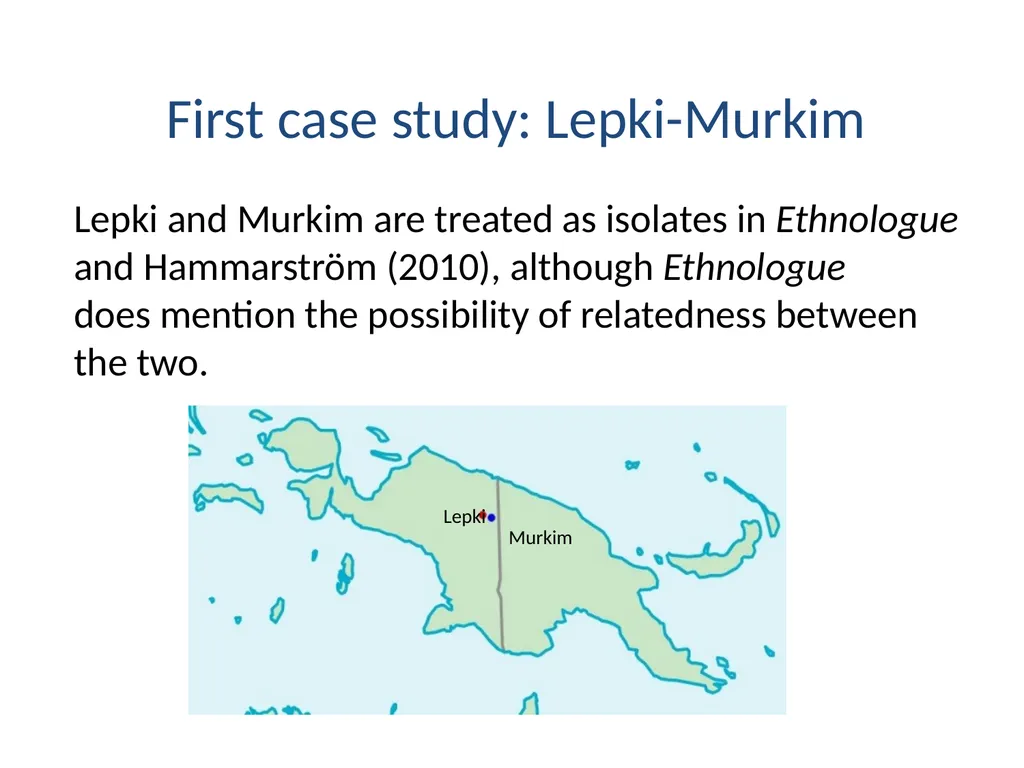
First case study: Lepki-Murkim Lepki and Murkim are treated as isolates in Ethnologue
and Hammarström (2010), although Ethnologue
does mention the possibility of relatedness between
the two. Lepki Murkim<br>
15
Excerpt from the ASJP World Tree<br>
16
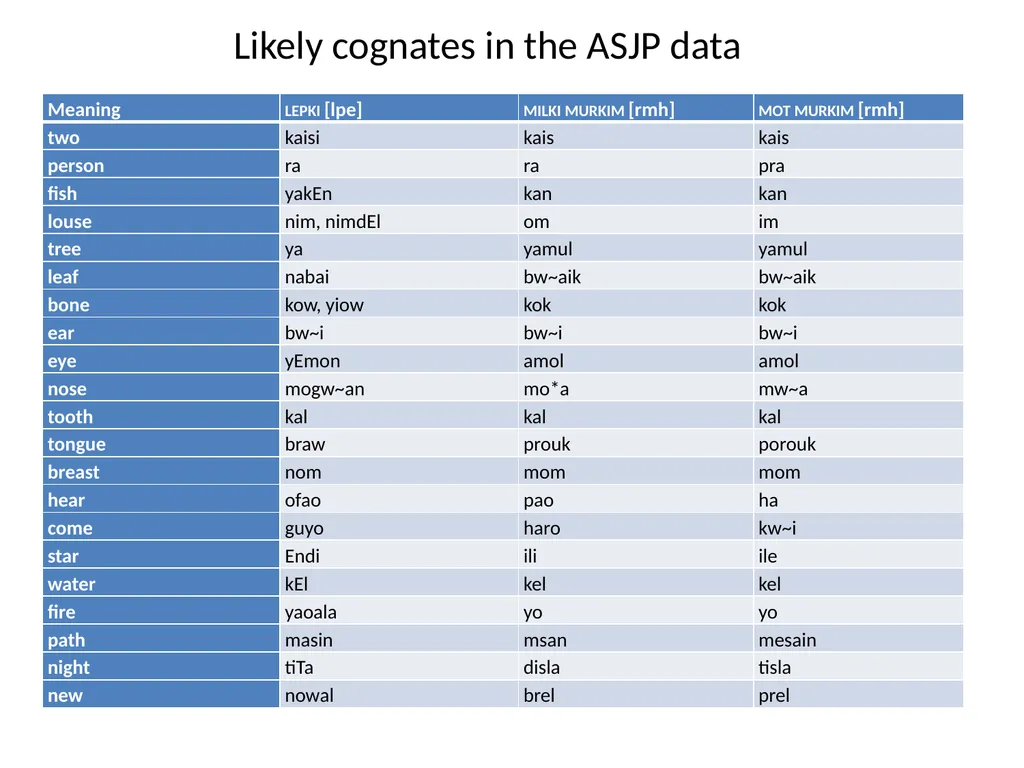
Likely cognates in the ASJP data<br>
17
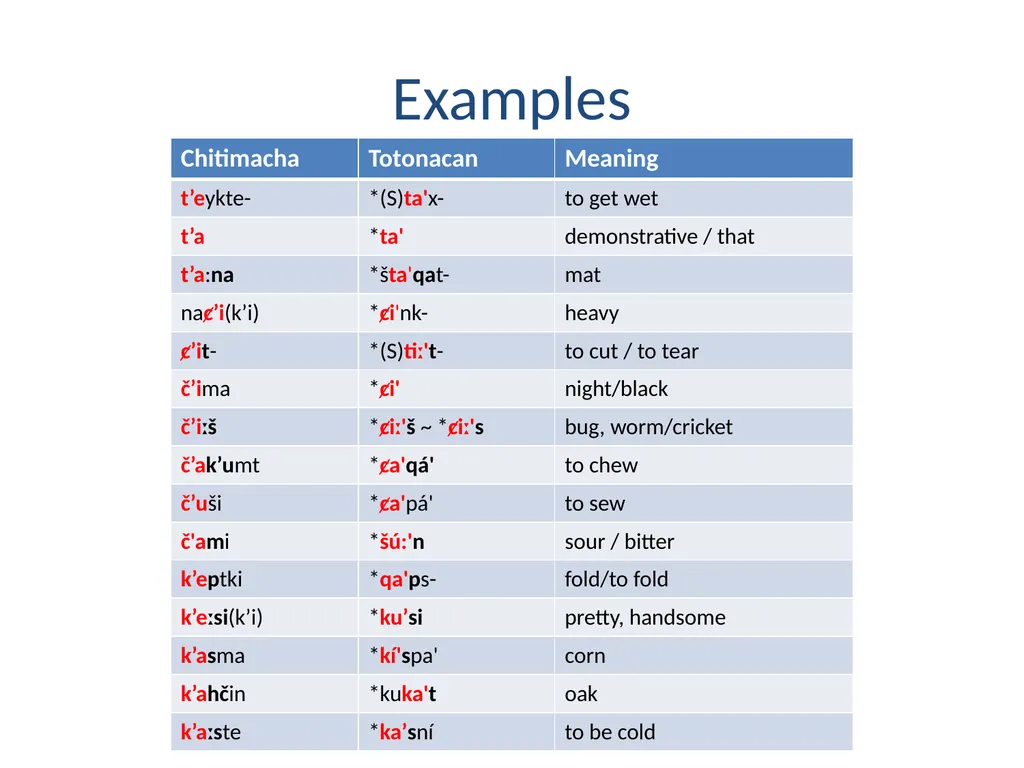
Second case study: Chitimacha-Totozoquean Totozoquean (Totonacan + Mixe-Zoquean) established in Brown, Beck, Kondrak, Watters & Wichmann (2011)
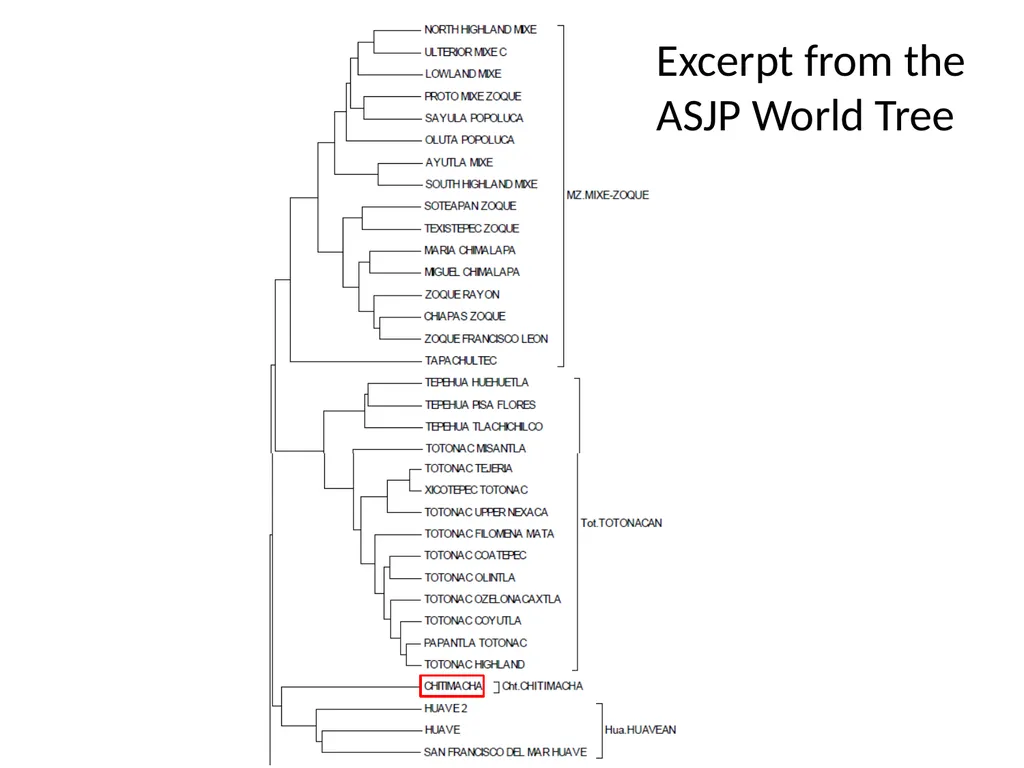
A further connection to Chitimacha suggested by the ASJP World Tree (but not strong evidence from the modified similarity scores)<br>
18
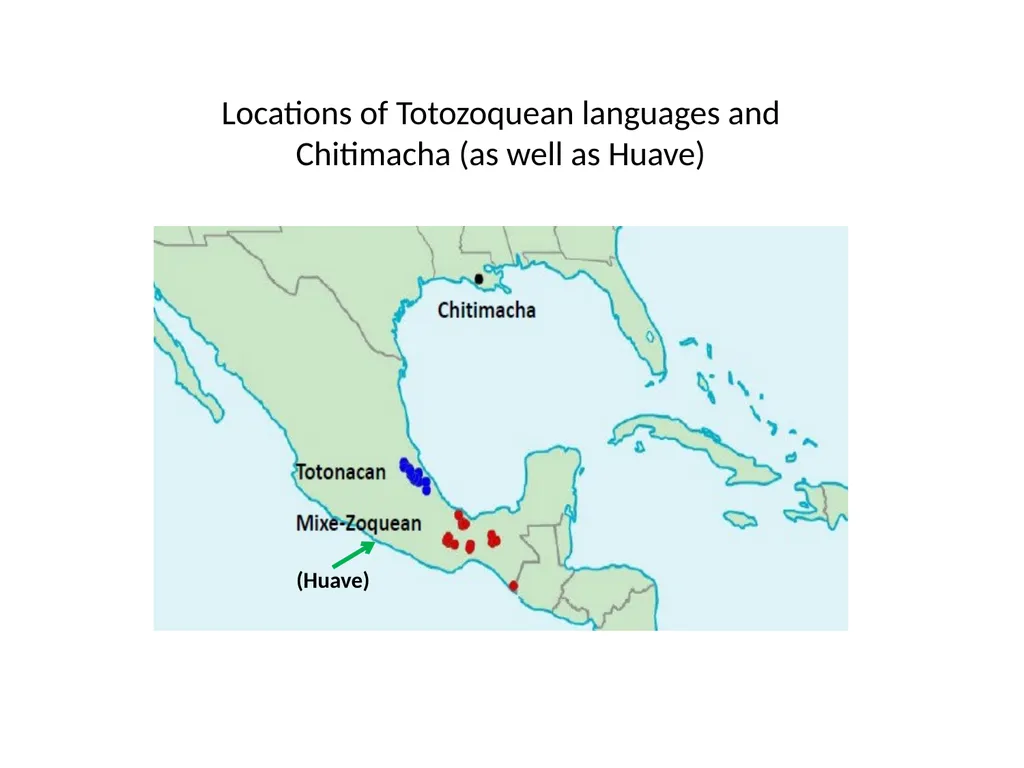
(Huave) Locations of Totozoquean languages and
Chitimacha (as well as Huave)<br>
19
Excerpt from the
ASJP World Tree<br>
20
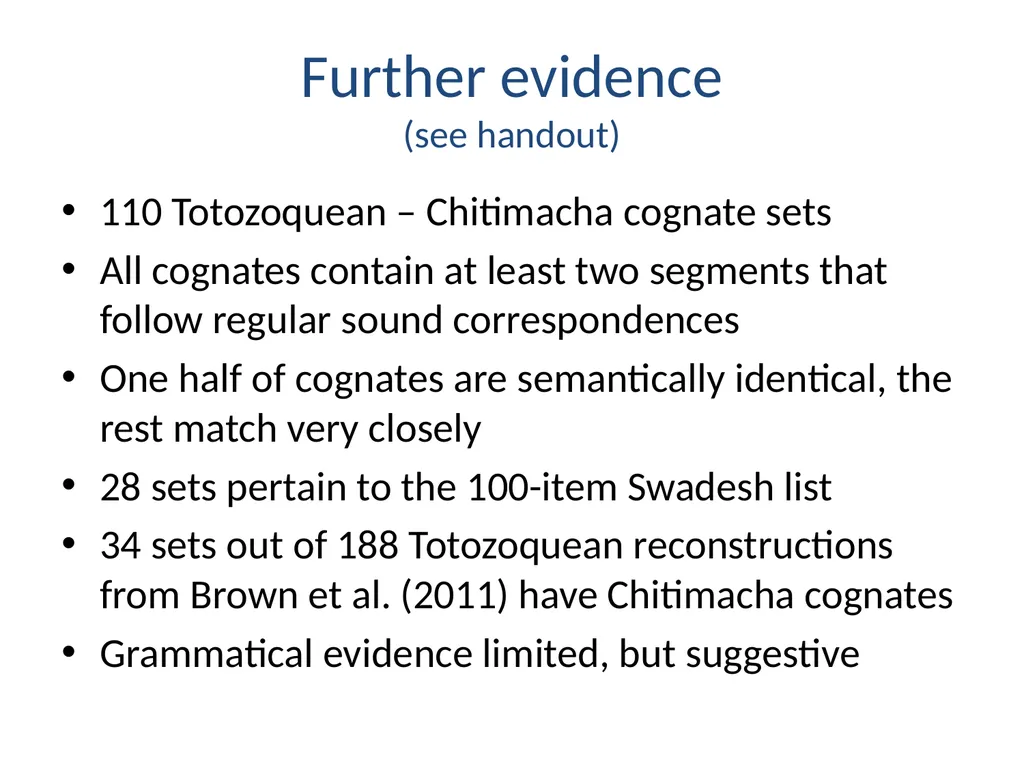
Further evidence�(see handout) 110 Totozoquean – Chitimacha cognate sets
All cognates contain at least two segments that follow regular sound correspondences
One half of cognates are semantically identical, the rest match very closely
28 sets pertain to the 100-item Swadesh list
34 sets out of 188 Totozoquean reconstructions from Brown et al. (2011) have Chitimacha cognates
Grammatical evidence limited, but suggestive<br>
21
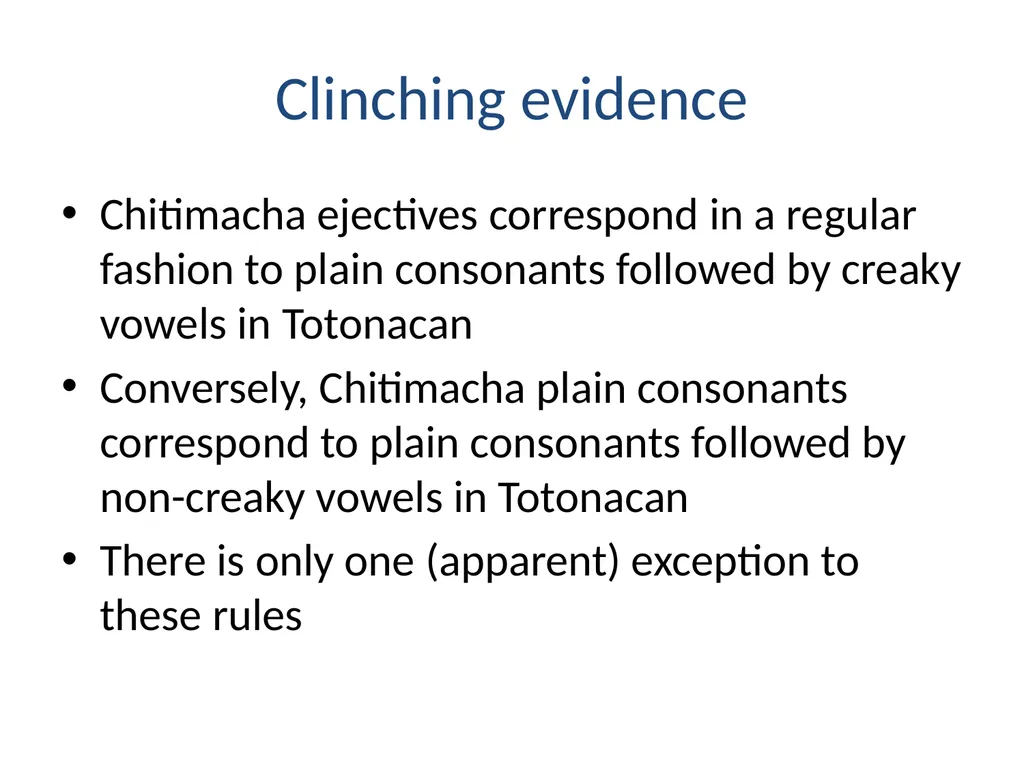
Clinching evidence Chitimacha ejectives correspond in a regular fashion to plain consonants followed by creaky vowels in Totonacan
Conversely, Chitimacha plain consonants correspond to plain consonants followed by non-creaky vowels in Totonacan
There is only one (apparent) exception to these rules<br>
23
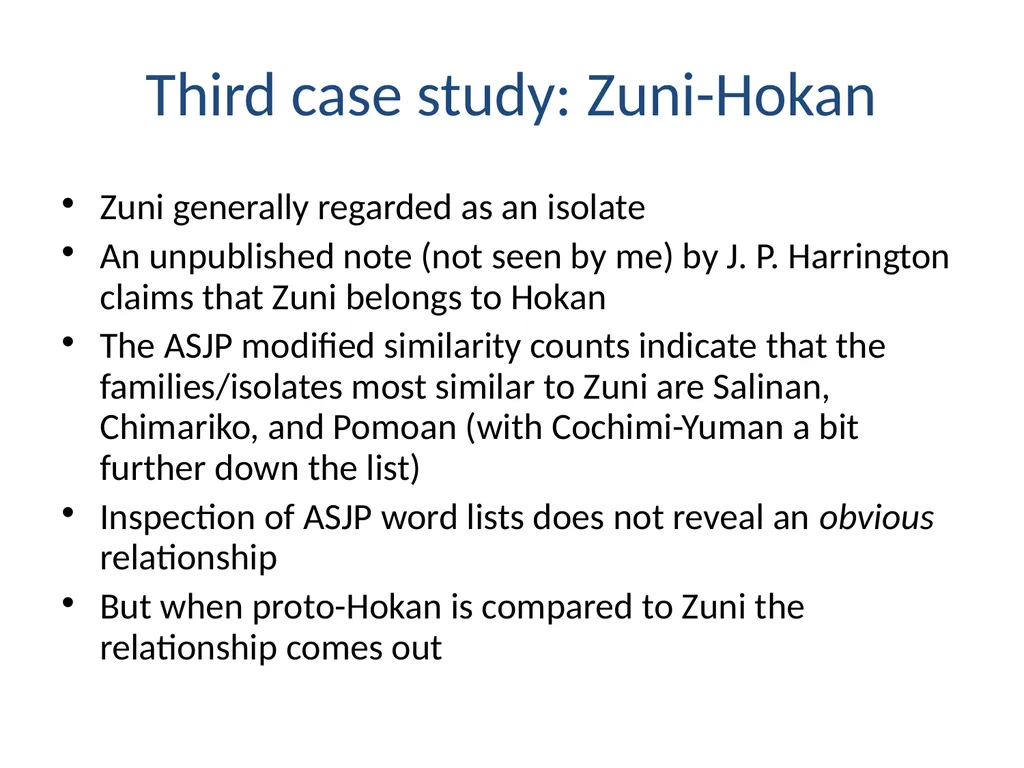
Third case study: Zuni-Hokan Zuni generally regarded as an isolate
An unpublished note (not seen by me) by J. P. Harrington claims that Zuni belongs to Hokan
The ASJP modified similarity counts indicate that the families/isolates most similar to Zuni are Salinan, Chimariko, and Pomoan (with Cochimi-Yuman a bit further down the list)
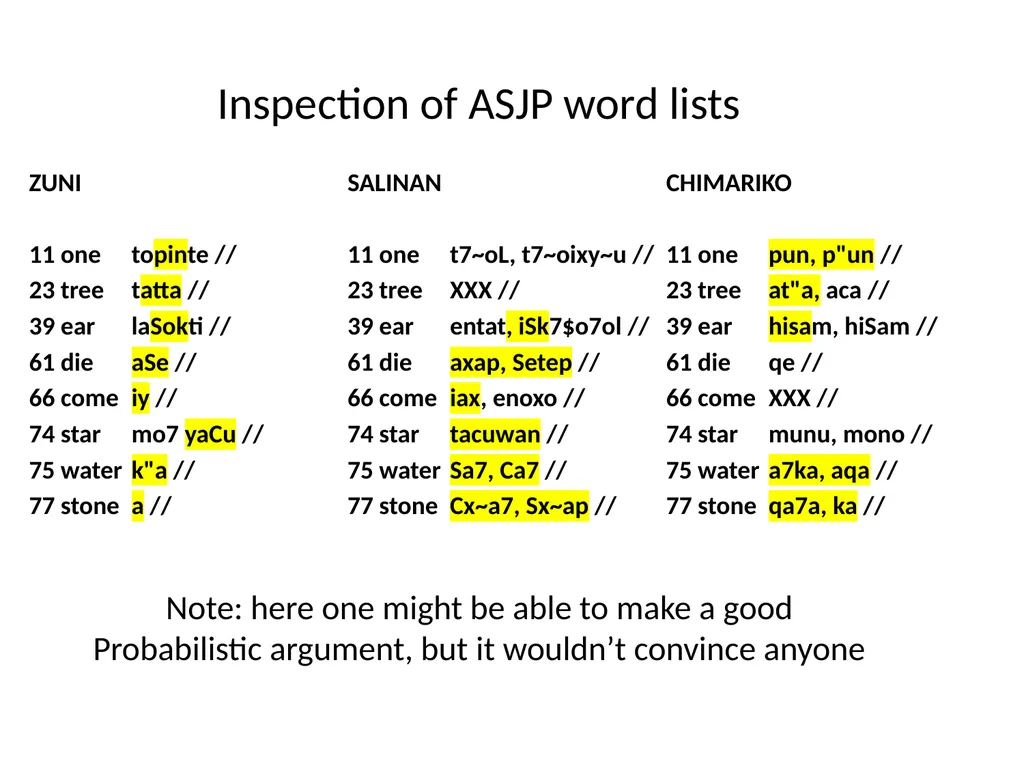
Inspection of ASJP word lists does not reveal an obvious relationship
But when proto-Hokan is compared to Zuni the relationship comes out<br>
24
Inspection of ASJP word lists Note: here one might be able to make a good
Probabilistic argument, but it wouldn’t convince anyone<br>
25
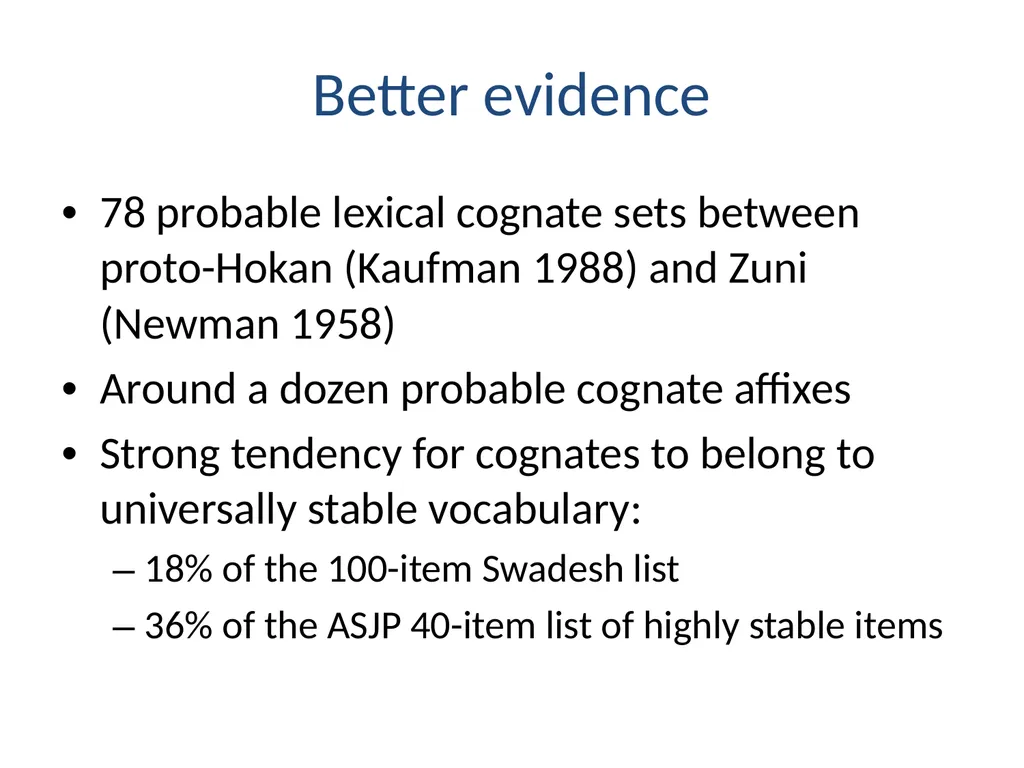
Better evidence 78 probable lexical cognate sets between proto-Hokan (Kaufman 1988) and Zuni (Newman 1958)
Around a dozen probable cognate affixes
Strong tendency for cognates to belong to universally stable vocabulary:
18% of the 100-item Swadesh list
36% of the ASJP 40-item list of highly stable items<br>
26
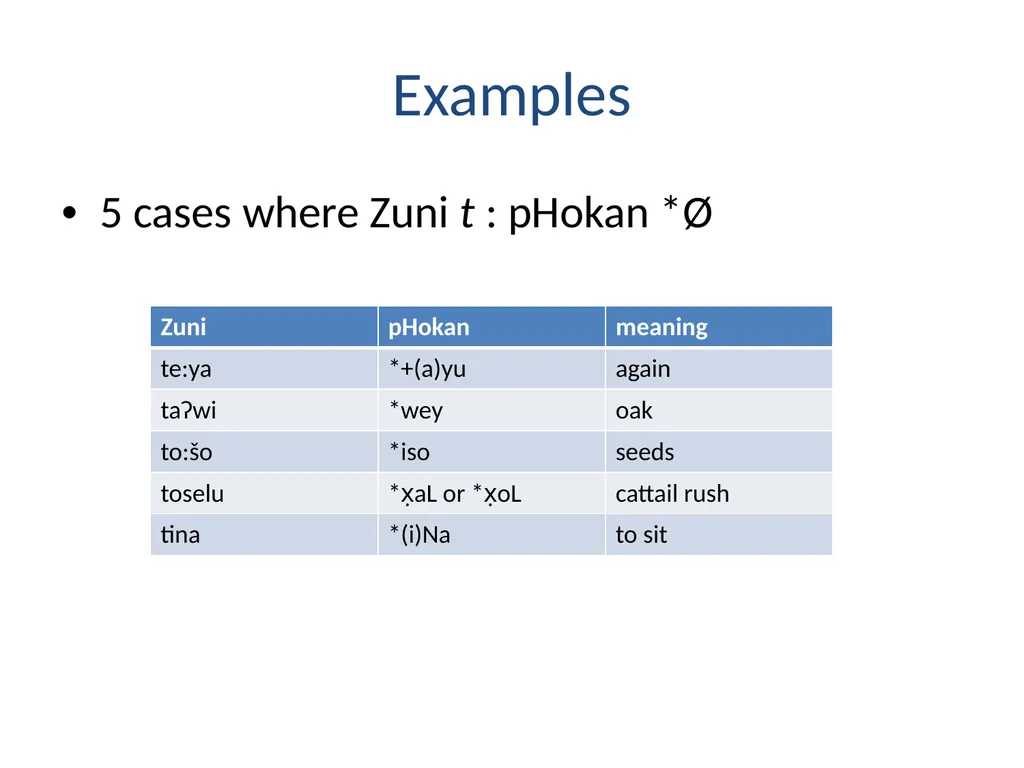
Examples 5 cases where Zuni t : pHokan *Ø<br>
27
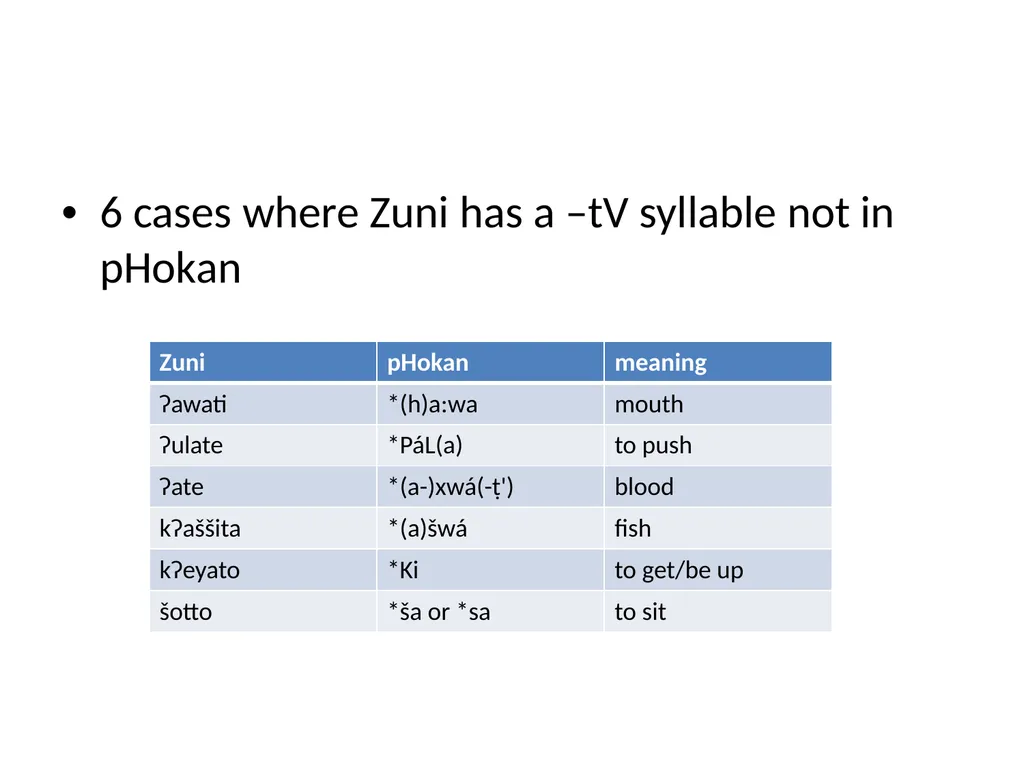
6 cases where Zuni has a –tV syllable not in pHokan<br>
28
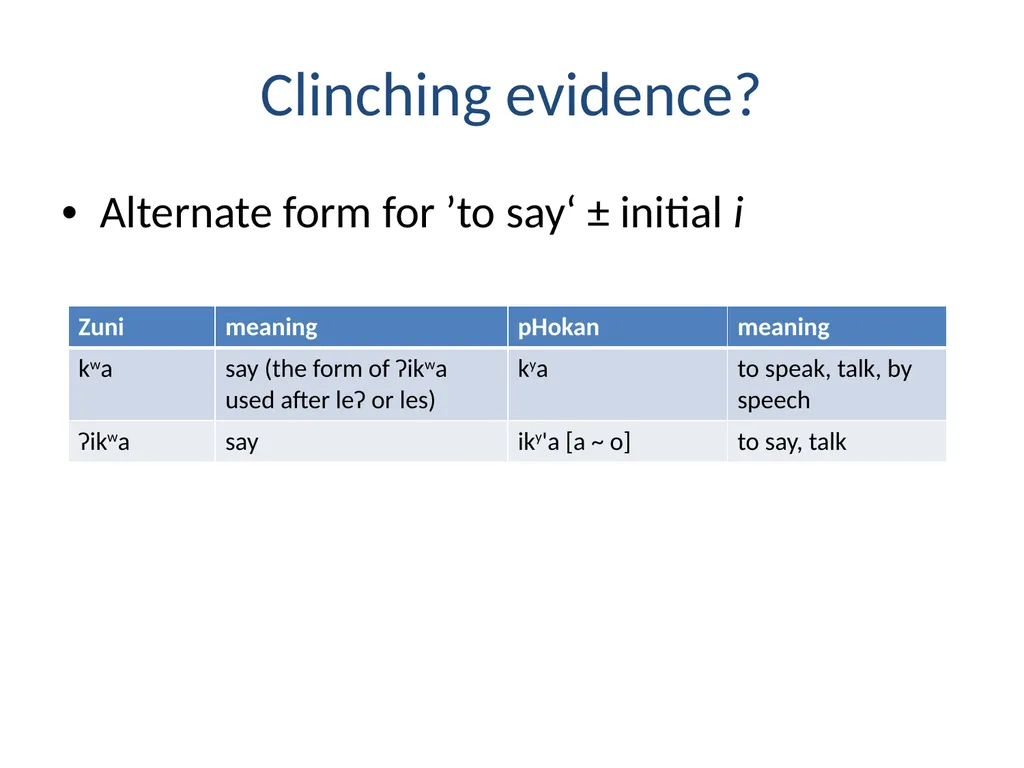
Clinching evidence? Alternate form for ’to say‘ ± initial i<br>
29
Core references Brown, Cecil H., David Beck, Grzegorz Kondrak, James K. Watters, and Søren Wichmann. 2011. Totozoquean. International Journal of American Linguistics 22:323–372.
Brown, Cecil H., Søren Wichmann, and David Beck. 2013ms. Chitimacha: A Mesoamerican language in the U.S. Southeast.
Müller, André, Viveka Velupillai, Søren Wichmann, Cecil H. Brown, Pamela Brown, Eric W. Holman, Dik Bakker, Oleg Belyaev, Dmitri Egorov, Robert Mail-Hammer, Anthony Grant, And Kofi Yakpo. 2010. ASJP World Language Tree of Lexical Similarity. Version 3 (July 2010). <http://email.eva.mpg.de/~wichmann/ASJPHomePage.htm>.<br>