
“Recent Changes to Housing Legislation a quick






Description: Recent Changes to Housing Legislation a quick guide EMPO Landlords work in partnership with Local Authorities to encourage and promote good property standards and management practices in the private rented sector. Landlord Law Changes
Related Topics
Download Presentation
"“Recent Changes to Housing Legislation a quick" is the property of its rightful owner. Permission is granted to download and print the materials on this website for personal, non-commercial use only, and to display it on your personal computer provided you do not modify the materials and that you retain all copyright notices contained in the materials. By downloading content from our website, you accept the terms of this agreement.
Presentation Transcript
slide1. “Recent Changes to Housing Legislation a quick guide”
EMPO Landlords work in partnership with Local Authorities to encourage and promote good property standards and management practices in the private rented sector. Landlord Law
Changes 2019<br>
slide2. Membership Benefits A highly competitive building and legal expenses insurance scheme
FREE access to our bank of landlord documentation including AST agreements & home safety/risk assessment documents/GDPR privacy notice
Professional landlord training courses at discounted rates for members
Membership includes a £25.00 discount off your first training course
Invitations to property investor networking events
Advice and assistance completing possession paperwork
A FREE advice helpline provided by hands-on-landlords
Regular local and national updates on legislation affecting your business
Membership brings great money saving products and services
(My Deposits, Tenant Referencing, EPC’s, EICR, Solicitor helpline, Trade Point) Landlord Law
Changes 2019<br>
slide3. Join EMPO for just £45.00, Membership until 31st January 2020
Limited Offer (No joining fee) Special Deal-Join EMPO TODAY Landlord Law
Changes 2019<br>
slide4. LANDORD LEGAL UPDATE 2018/19
Legislative changes 2018
No new tenancies to be granted on F or G EPC rated properties after April 1st 2018, all properties by 2020- For properties that do not meet an E or above rating, new changes effective 1st April 2019 will require landlords to pay for energy efficiency upgrades, subject to a cost cap of £3500.00 per property. The landlord can register for an high cost exemption if at least 3 estimates come in above this sum.
The current landlord 5 year exemption on “no cost” upfront funding will be removed completely by 1st April 2020 and their properties will no longer appear on the PRS Exemptions Register.
Where improvements have been made since 1st Oct 2017 up until 31st March 2019, these costs can be deducted from the cap.
Tenants will save up to £180.00 pa in energy costs.
Homelessness Reduction Act 2018, 3rd April 2018- Councils are now legally obliged to spend up to 56 days in trying to prevent evictions under s21. Landlord Law
Changes 2018<br>
slide5. Legislative changes 2018
Gas Safety (Installation and Use) (Amendment) Regulations 6th April 2018- To provide more flexibility, GSR can now be renewed up to 2 months before expiry, whilst retaining the original expiry date. In other words GSR can in theory now last 14 months instead of 12.
Gas Installation Boiler Requirement, 6th April 2018- Any new boiler installation MUST include an additional energy saving method such as a:
Flue Gas Heat Recovery System
Weather Compensation
This requirement was introduced as part of the general drive towards energy efficiency and to
reduce carbon emissions.
GDPR- Landlords need to be registered with the ICO
It became a legal requirement on the 25th May 2018 to issue Privacy notices to tenants outlining how their personal data is managed & stored Landlord Law
Changes 2018<br>
slide6. Legislative changes 2018
How to Rent Guide” updated 9th July 2018
The main changes in this guide include:
Information explaining landlord banning orders & the minimum EPC rating
Information about where the tenant can seek independent advice and help
The names of the three deposit and redress schemes
How to Let Guide” introduced in June 2018
In this guide, the Government have clearly stated:
“You must ensure the water supply is in working order and carry out a risk assessment to assess the risk from exposure to Legionella.”
There is a legal duty for landlords to assess and control the risk of exposure to legionella bacteria, but H&S law does not require landlords to produce or obtain, nor does HSE recognise, a ‘Legionnaires testing certificate.’
A Legionella Risk Assessment should detail at the very minimum simple control measures such as:
flushing out the system prior to letting the property
avoiding debris getting into the system (ensure the cold water tanks, have a tight fitting lid)
setting controls to ensure hot water is stored at 60°C)
make sure any redundant pipework identified is removed Landlord Law
Changes 2018<br>
slide7. Legislative changes 2018
tenants should be advised of any control measures put in place e.g not to adjust the water temperature setting on the boiler, to regularly clean showerheads and to inform the landlord if the hot water is not heating properly or there are any other problems so the landlord can take action.
Section 21 Deregulation Act 2015, 1 October 2018-
As from the 1st October 2018, ALL s21 notices need to be completed on the prescribed Form 6a. The tenant must be in receipt of a current EPC, GSR, How to Rent guide & protected deposit if the AST began or was renewed on or after the 1st October 2015.
An EPC must be provided to the tenant, it can be given late for the purposes of s21, an EPC can lapse in a current tenancy (10 year lifecycle)
Court cases in Feb 18 & 19 have clarified the requirement under the Gas Safety regs 1988 to issue the GSR before the tenant moves into the property, otherwise the s21 notice will be invalid and only a s8 notice can be issued thereafter.
The current How to Rent guide, should be provided at the commencement of a tenancy, it can be served late, but must be served before issuing a s21 notice. If a tenancy has been renewed or has become statutory periodic and a newer version of the guide has been released then the landlord needs to ensure the tenant receives the newer version prior to serving the s21 notice
GET PROOF OF RECEIPT Landlord Law
Changes 2018<br>
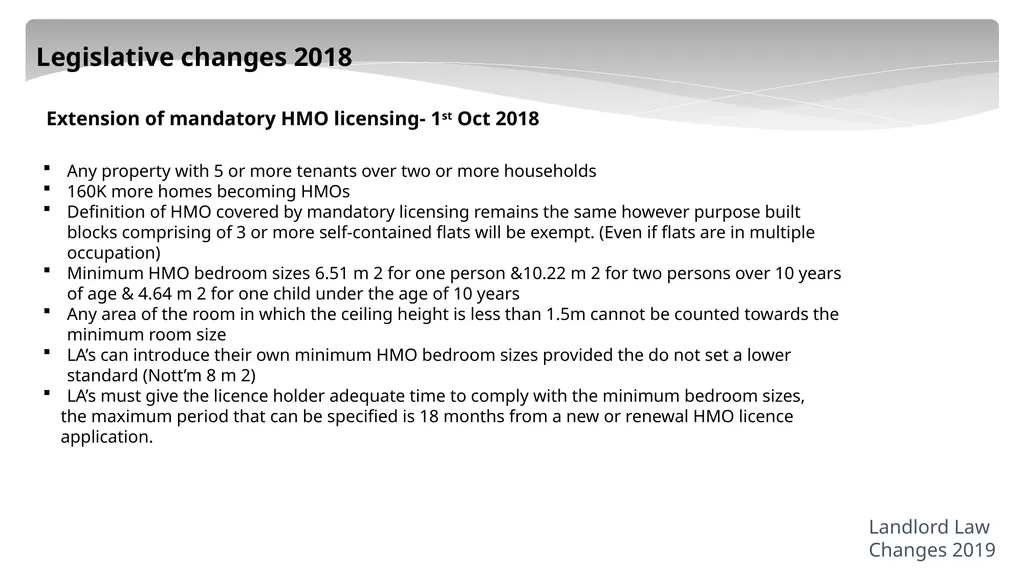
slide8. Extension of mandatory HMO licensing- 1st Oct 2018
Any property with 5 or more tenants over two or more households
160K more homes becoming HMOs
Definition of HMO covered by mandatory licensing remains the same however purpose built blocks comprising of 3 or more self-contained flats will be exempt. (Even if flats are in multiple occupation)
Minimum HMO bedroom sizes 6.51 m 2 for one person &10.22 m 2 for two persons over 10 years of age & 4.64 m 2 for one child under the age of 10 years
Any area of the room in which the ceiling height is less than 1.5m cannot be counted towards the minimum room size
LA’s can introduce their own minimum HMO bedroom sizes provided the do not set a lower standard (Nott’m 8 m 2)
LA’s must give the licence holder adequate time to comply with the minimum bedroom sizes,
the maximum period that can be specified is 18 months from a new or renewal HMO licence
application. Landlord Law
Changes 2019 Legislative changes 2018<br>
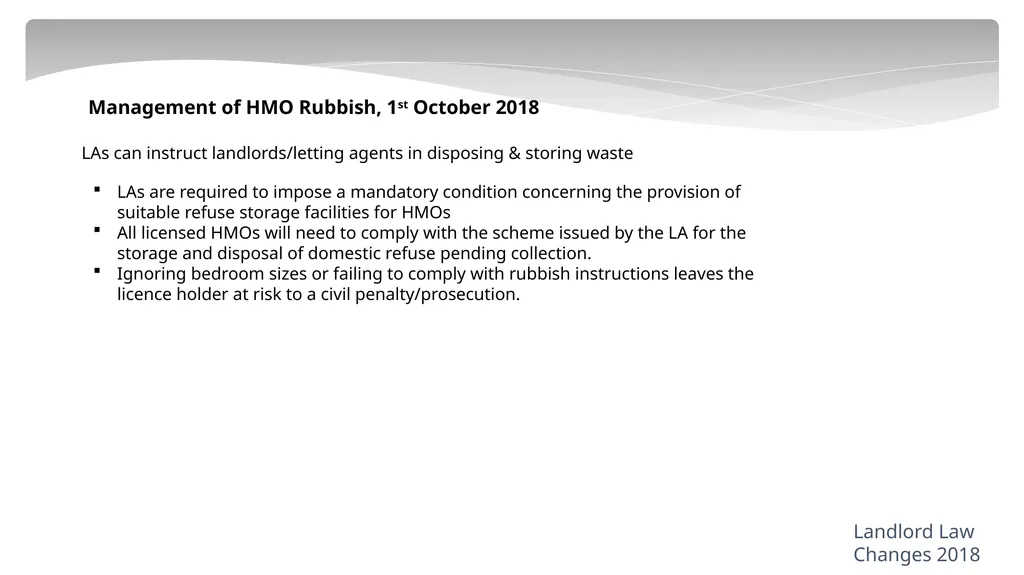
slide9. Management of HMO Rubbish, 1st October 2018
LAs can instruct landlords/letting agents in disposing & storing waste LAs are required to impose a mandatory condition concerning the provision of suitable refuse storage facilities for HMOs
All licensed HMOs will need to comply with the scheme issued by the LA for the storage and disposal of domestic refuse pending collection.
Ignoring bedroom sizes or failing to comply with rubbish instructions leaves the licence holder at risk to a civil penalty/prosecution. Landlord Law
Changes 2018<br>
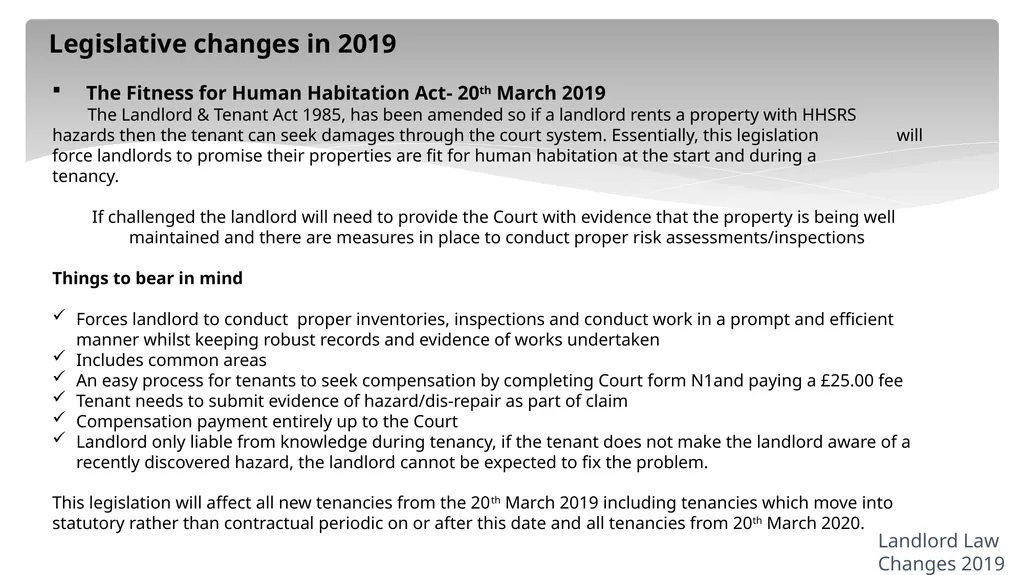
slide10. Legislative changes in 2019
The Fitness for Human Habitation Act- 20th March 2019
The Landlord & Tenant Act 1985, has been amended so if a landlord rents a property with HHSRS hazards then the tenant can seek damages through the court system. Essentially, this legislation will force landlords to promise their properties are fit for human habitation at the start and during a tenancy.
If challenged the landlord will need to provide the Court with evidence that the property is being well maintained and there are measures in place to conduct proper risk assessments/inspections
Things to bear in mind
Forces landlord to conduct proper inventories, inspections and conduct work in a prompt and efficient manner whilst keeping robust records and evidence of works undertaken
Includes common areas
An easy process for tenants to seek compensation by completing Court form N1and paying a £25.00 fee
Tenant needs to submit evidence of hazard/dis-repair as part of claim
Compensation payment entirely up to the Court
Landlord only liable from knowledge during tenancy, if the tenant does not make the landlord aware of a recently discovered hazard, the landlord cannot be expected to fix the problem.
This legislation will affect all new tenancies from the 20th March 2019 including tenancies which move into statutory rather than contractual periodic on or after this date and all tenancies from 20th March 2020. Landlord Law
Changes 2019<br>
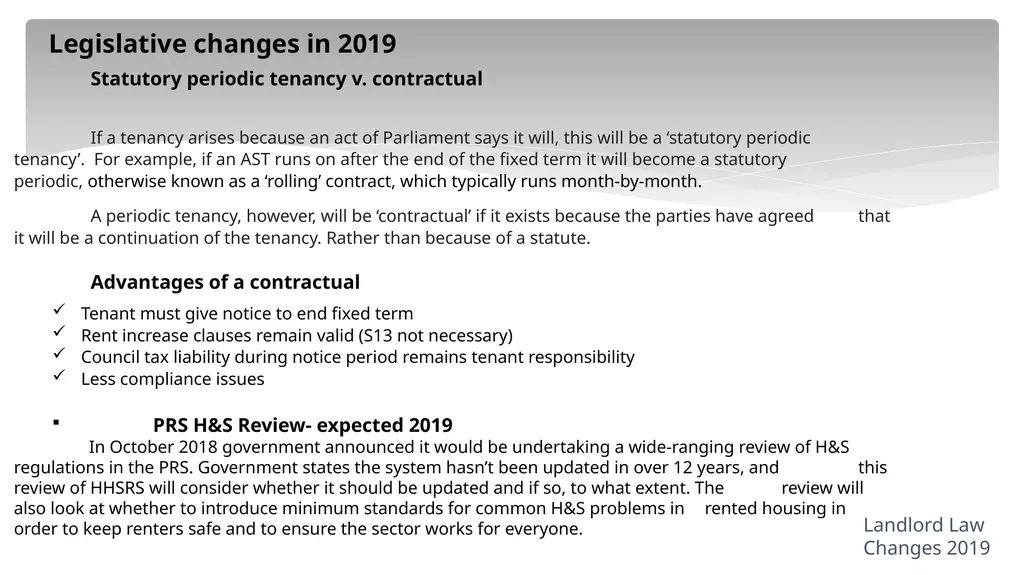
slide11. Legislative changes in 2019
Statutory periodic tenancy v. contractual
If a tenancy arises because an act of Parliament says it will, this will be a ‘statutory periodic tenancy’. For example, if an AST runs on after the end of the fixed term it will become a statutory periodic, otherwise known as a ‘rolling’ contract, which typically runs month-by-month.
A periodic tenancy, however, will be ‘contractual’ if it exists because the parties have agreed that it will be a continuation of the tenancy. Rather than because of a statute.
Advantages of a contractual
Tenant must give notice to end fixed term
Rent increase clauses remain valid (S13 not necessary)
Council tax liability during notice period remains tenant responsibility
Less compliance issues
PRS H&S Review- expected 2019
In October 2018 government announced it would be undertaking a wide-ranging review of H&S regulations in the PRS. Government states the system hasn’t been updated in over 12 years, and this review of HHSRS will consider whether it should be updated and if so, to what extent. The review will also look at whether to introduce minimum standards for common H&S problems in rented housing in order to keep renters safe and to ensure the sector works for everyone. Landlord Law
Changes 2019<br>
slide12. Legislative changes in 2019
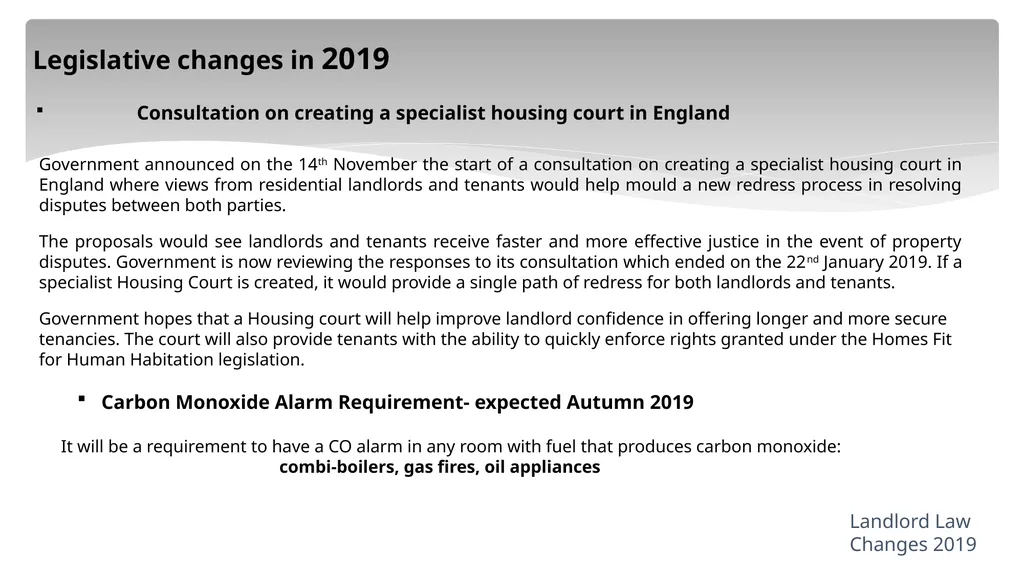
Consultation on creating a specialist housing court in England Landlord Law
Changes 2019 Government announced on the 14th November the start of a consultation on creating a specialist housing court in England where views from residential landlords and tenants would help mould a new redress process in resolving disputes between both parties.
The proposals would see landlords and tenants receive faster and more effective justice in the event of property disputes. Government is now reviewing the responses to its consultation which ended on the 22nd January 2019. If a specialist Housing Court is created, it would provide a single path of redress for both landlords and tenants.
Government hopes that a Housing court will help improve landlord confidence in offering longer and more secure tenancies. The court will also provide tenants with the ability to quickly enforce rights granted under the Homes Fit for Human Habitation legislation.
Carbon Monoxide Alarm Requirement- expected Autumn 2019
It will be a requirement to have a CO alarm in any room with fuel that produces carbon monoxide: combi-boilers, gas fires, oil appliances<br>
slide13. Legislative changes in 2019
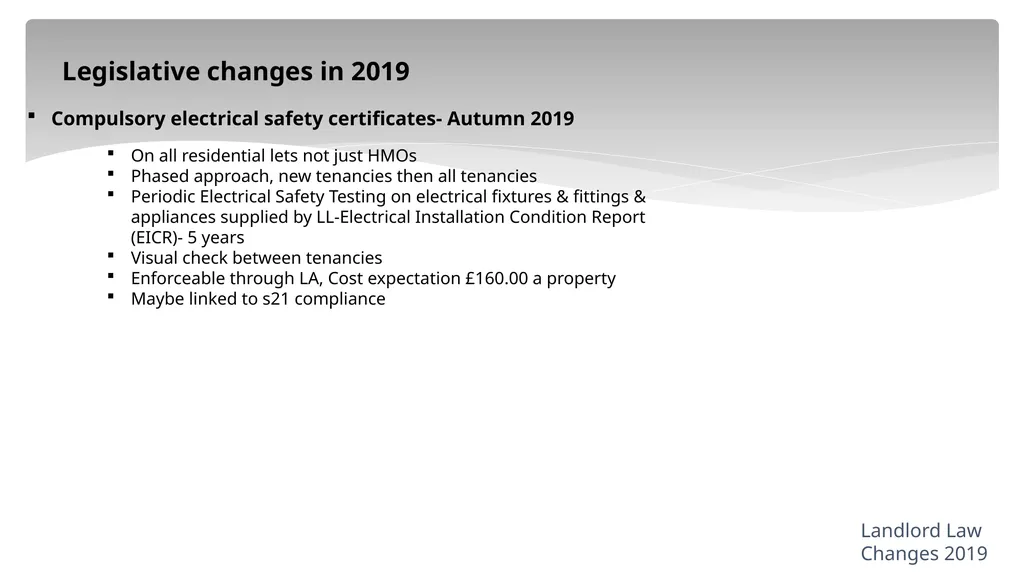
Compulsory electrical safety certificates- Autumn 2019 Landlord Law
Changes 2019 On all residential lets not just HMOs
Phased approach, new tenancies then all tenancies
Periodic Electrical Safety Testing on electrical fixtures & fittings & appliances supplied by LL-Electrical Installation Condition Report (EICR)- 5 years
Visual check between tenancies
Enforceable through LA, Cost expectation £160.00 a property
Maybe linked to s21 compliance<br>
slide14. Legislative changes in 2019
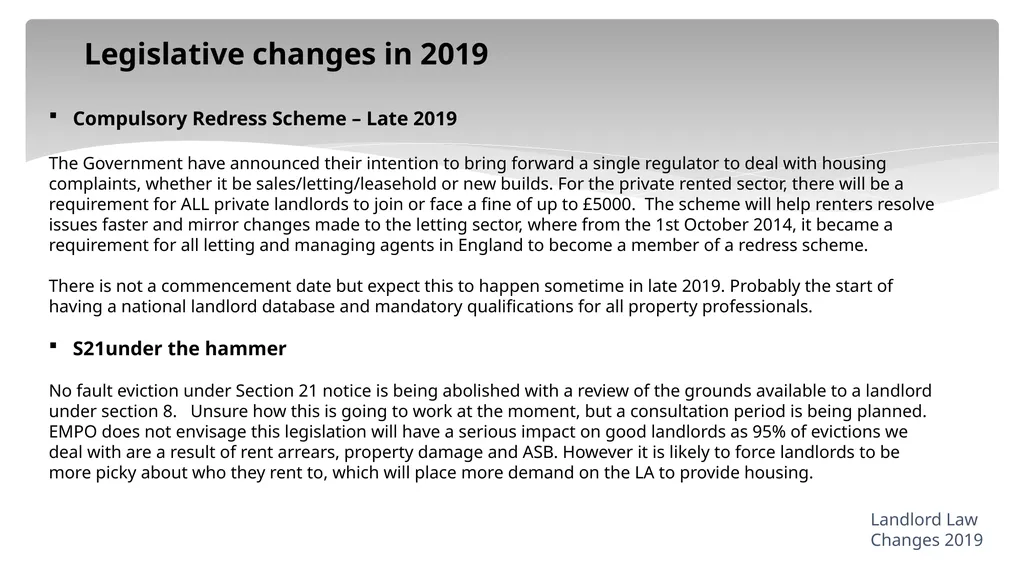
Compulsory Redress Scheme – Late 2019
The Government have announced their intention to bring forward a single regulator to deal with housing complaints, whether it be sales/letting/leasehold or new builds. For the private rented sector, there will be a requirement for ALL private landlords to join or face a fine of up to £5000. The scheme will help renters resolve issues faster and mirror changes made to the letting sector, where from the 1st October 2014, it became a requirement for all letting and managing agents in England to become a member of a redress scheme.
There is not a commencement date but expect this to happen sometime in late 2019. Probably the start of having a national landlord database and mandatory qualifications for all property professionals.
S21under the hammer
No fault eviction under Section 21 notice is being abolished with a review of the grounds available to a landlord under section 8. Unsure how this is going to work at the moment, but a consultation period is being planned. EMPO does not envisage this legislation will have a serious impact on good landlords as 95% of evictions we deal with are a result of rent arrears, property damage and ASB. However it is likely to force landlords to be more picky about who they rent to, which will place more demand on the LA to provide housing. Landlord Law
Changes 2019<br>
slide15. Legislative changes in 2019
Client Protection Schemes (CPS) Landlord Law
Changes 2019 CMP schemes protect client money (such as rent and deposit monies) which is received by agents. Membership of a CMP scheme is a legal requirement from 1st April 2019. Trading Standards will be enforcing this legal obligation with fines of up to £30K.
The government has approved the following CMP schemes for letting & property management agents in the PRS:
Client Money Protect
Money Shield
NALS Client Money Protection
Property mark
RICS
UKALA Client Money Protection
Agents must also:
hold client money in a client money account with a bank or building society authorised by the FCA*
hold and maintain appropriate professional indemnity insurance and client money protection handling procedures
obtain a certificate confirming membership of an approved CMP scheme and display this at each offices where they deal with the public and on their website
provide a copy of the certificate to any person who may reasonably require it, free of charge
* Or be making all reasonable efforts to do so. Note that while CMP schemes are permitted to offer a grace
period to allow agents to open such accounts, they may only offer a grace period until 1 April 2020.<br>
slide16. Question time<br>
EMPO Landlords work in partnership with Local Authorities to encourage and promote good property standards and management practices in the private rented sector. Landlord Law
Changes 2019<br>
slide2. Membership Benefits A highly competitive building and legal expenses insurance scheme
FREE access to our bank of landlord documentation including AST agreements & home safety/risk assessment documents/GDPR privacy notice
Professional landlord training courses at discounted rates for members
Membership includes a £25.00 discount off your first training course
Invitations to property investor networking events
Advice and assistance completing possession paperwork
A FREE advice helpline provided by hands-on-landlords
Regular local and national updates on legislation affecting your business
Membership brings great money saving products and services
(My Deposits, Tenant Referencing, EPC’s, EICR, Solicitor helpline, Trade Point) Landlord Law
Changes 2019<br>
slide3. Join EMPO for just £45.00, Membership until 31st January 2020
Limited Offer (No joining fee) Special Deal-Join EMPO TODAY Landlord Law
Changes 2019<br>
slide4. LANDORD LEGAL UPDATE 2018/19
Legislative changes 2018
No new tenancies to be granted on F or G EPC rated properties after April 1st 2018, all properties by 2020- For properties that do not meet an E or above rating, new changes effective 1st April 2019 will require landlords to pay for energy efficiency upgrades, subject to a cost cap of £3500.00 per property. The landlord can register for an high cost exemption if at least 3 estimates come in above this sum.
The current landlord 5 year exemption on “no cost” upfront funding will be removed completely by 1st April 2020 and their properties will no longer appear on the PRS Exemptions Register.
Where improvements have been made since 1st Oct 2017 up until 31st March 2019, these costs can be deducted from the cap.
Tenants will save up to £180.00 pa in energy costs.
Homelessness Reduction Act 2018, 3rd April 2018- Councils are now legally obliged to spend up to 56 days in trying to prevent evictions under s21. Landlord Law
Changes 2018<br>
slide5. Legislative changes 2018
Gas Safety (Installation and Use) (Amendment) Regulations 6th April 2018- To provide more flexibility, GSR can now be renewed up to 2 months before expiry, whilst retaining the original expiry date. In other words GSR can in theory now last 14 months instead of 12.
Gas Installation Boiler Requirement, 6th April 2018- Any new boiler installation MUST include an additional energy saving method such as a:
Flue Gas Heat Recovery System
Weather Compensation
This requirement was introduced as part of the general drive towards energy efficiency and to
reduce carbon emissions.
GDPR- Landlords need to be registered with the ICO
It became a legal requirement on the 25th May 2018 to issue Privacy notices to tenants outlining how their personal data is managed & stored Landlord Law
Changes 2018<br>
slide6. Legislative changes 2018
How to Rent Guide” updated 9th July 2018
The main changes in this guide include:
Information explaining landlord banning orders & the minimum EPC rating
Information about where the tenant can seek independent advice and help
The names of the three deposit and redress schemes
How to Let Guide” introduced in June 2018
In this guide, the Government have clearly stated:
“You must ensure the water supply is in working order and carry out a risk assessment to assess the risk from exposure to Legionella.”
There is a legal duty for landlords to assess and control the risk of exposure to legionella bacteria, but H&S law does not require landlords to produce or obtain, nor does HSE recognise, a ‘Legionnaires testing certificate.’
A Legionella Risk Assessment should detail at the very minimum simple control measures such as:
flushing out the system prior to letting the property
avoiding debris getting into the system (ensure the cold water tanks, have a tight fitting lid)
setting controls to ensure hot water is stored at 60°C)
make sure any redundant pipework identified is removed Landlord Law
Changes 2018<br>
slide7. Legislative changes 2018
tenants should be advised of any control measures put in place e.g not to adjust the water temperature setting on the boiler, to regularly clean showerheads and to inform the landlord if the hot water is not heating properly or there are any other problems so the landlord can take action.
Section 21 Deregulation Act 2015, 1 October 2018-
As from the 1st October 2018, ALL s21 notices need to be completed on the prescribed Form 6a. The tenant must be in receipt of a current EPC, GSR, How to Rent guide & protected deposit if the AST began or was renewed on or after the 1st October 2015.
An EPC must be provided to the tenant, it can be given late for the purposes of s21, an EPC can lapse in a current tenancy (10 year lifecycle)
Court cases in Feb 18 & 19 have clarified the requirement under the Gas Safety regs 1988 to issue the GSR before the tenant moves into the property, otherwise the s21 notice will be invalid and only a s8 notice can be issued thereafter.
The current How to Rent guide, should be provided at the commencement of a tenancy, it can be served late, but must be served before issuing a s21 notice. If a tenancy has been renewed or has become statutory periodic and a newer version of the guide has been released then the landlord needs to ensure the tenant receives the newer version prior to serving the s21 notice
GET PROOF OF RECEIPT Landlord Law
Changes 2018<br>
slide8. Extension of mandatory HMO licensing- 1st Oct 2018
Any property with 5 or more tenants over two or more households
160K more homes becoming HMOs
Definition of HMO covered by mandatory licensing remains the same however purpose built blocks comprising of 3 or more self-contained flats will be exempt. (Even if flats are in multiple occupation)
Minimum HMO bedroom sizes 6.51 m 2 for one person &10.22 m 2 for two persons over 10 years of age & 4.64 m 2 for one child under the age of 10 years
Any area of the room in which the ceiling height is less than 1.5m cannot be counted towards the minimum room size
LA’s can introduce their own minimum HMO bedroom sizes provided the do not set a lower standard (Nott’m 8 m 2)
LA’s must give the licence holder adequate time to comply with the minimum bedroom sizes,
the maximum period that can be specified is 18 months from a new or renewal HMO licence
application. Landlord Law
Changes 2019 Legislative changes 2018<br>
slide9. Management of HMO Rubbish, 1st October 2018
LAs can instruct landlords/letting agents in disposing & storing waste LAs are required to impose a mandatory condition concerning the provision of suitable refuse storage facilities for HMOs
All licensed HMOs will need to comply with the scheme issued by the LA for the storage and disposal of domestic refuse pending collection.
Ignoring bedroom sizes or failing to comply with rubbish instructions leaves the licence holder at risk to a civil penalty/prosecution. Landlord Law
Changes 2018<br>
slide10. Legislative changes in 2019
The Fitness for Human Habitation Act- 20th March 2019
The Landlord & Tenant Act 1985, has been amended so if a landlord rents a property with HHSRS hazards then the tenant can seek damages through the court system. Essentially, this legislation will force landlords to promise their properties are fit for human habitation at the start and during a tenancy.
If challenged the landlord will need to provide the Court with evidence that the property is being well maintained and there are measures in place to conduct proper risk assessments/inspections
Things to bear in mind
Forces landlord to conduct proper inventories, inspections and conduct work in a prompt and efficient manner whilst keeping robust records and evidence of works undertaken
Includes common areas
An easy process for tenants to seek compensation by completing Court form N1and paying a £25.00 fee
Tenant needs to submit evidence of hazard/dis-repair as part of claim
Compensation payment entirely up to the Court
Landlord only liable from knowledge during tenancy, if the tenant does not make the landlord aware of a recently discovered hazard, the landlord cannot be expected to fix the problem.
This legislation will affect all new tenancies from the 20th March 2019 including tenancies which move into statutory rather than contractual periodic on or after this date and all tenancies from 20th March 2020. Landlord Law
Changes 2019<br>
slide11. Legislative changes in 2019
Statutory periodic tenancy v. contractual
If a tenancy arises because an act of Parliament says it will, this will be a ‘statutory periodic tenancy’. For example, if an AST runs on after the end of the fixed term it will become a statutory periodic, otherwise known as a ‘rolling’ contract, which typically runs month-by-month.
A periodic tenancy, however, will be ‘contractual’ if it exists because the parties have agreed that it will be a continuation of the tenancy. Rather than because of a statute.
Advantages of a contractual
Tenant must give notice to end fixed term
Rent increase clauses remain valid (S13 not necessary)
Council tax liability during notice period remains tenant responsibility
Less compliance issues
PRS H&S Review- expected 2019
In October 2018 government announced it would be undertaking a wide-ranging review of H&S regulations in the PRS. Government states the system hasn’t been updated in over 12 years, and this review of HHSRS will consider whether it should be updated and if so, to what extent. The review will also look at whether to introduce minimum standards for common H&S problems in rented housing in order to keep renters safe and to ensure the sector works for everyone. Landlord Law
Changes 2019<br>
slide12. Legislative changes in 2019
Consultation on creating a specialist housing court in England Landlord Law
Changes 2019 Government announced on the 14th November the start of a consultation on creating a specialist housing court in England where views from residential landlords and tenants would help mould a new redress process in resolving disputes between both parties.
The proposals would see landlords and tenants receive faster and more effective justice in the event of property disputes. Government is now reviewing the responses to its consultation which ended on the 22nd January 2019. If a specialist Housing Court is created, it would provide a single path of redress for both landlords and tenants.
Government hopes that a Housing court will help improve landlord confidence in offering longer and more secure tenancies. The court will also provide tenants with the ability to quickly enforce rights granted under the Homes Fit for Human Habitation legislation.
Carbon Monoxide Alarm Requirement- expected Autumn 2019
It will be a requirement to have a CO alarm in any room with fuel that produces carbon monoxide: combi-boilers, gas fires, oil appliances<br>
slide13. Legislative changes in 2019
Compulsory electrical safety certificates- Autumn 2019 Landlord Law
Changes 2019 On all residential lets not just HMOs
Phased approach, new tenancies then all tenancies
Periodic Electrical Safety Testing on electrical fixtures & fittings & appliances supplied by LL-Electrical Installation Condition Report (EICR)- 5 years
Visual check between tenancies
Enforceable through LA, Cost expectation £160.00 a property
Maybe linked to s21 compliance<br>
slide14. Legislative changes in 2019
Compulsory Redress Scheme – Late 2019
The Government have announced their intention to bring forward a single regulator to deal with housing complaints, whether it be sales/letting/leasehold or new builds. For the private rented sector, there will be a requirement for ALL private landlords to join or face a fine of up to £5000. The scheme will help renters resolve issues faster and mirror changes made to the letting sector, where from the 1st October 2014, it became a requirement for all letting and managing agents in England to become a member of a redress scheme.
There is not a commencement date but expect this to happen sometime in late 2019. Probably the start of having a national landlord database and mandatory qualifications for all property professionals.
S21under the hammer
No fault eviction under Section 21 notice is being abolished with a review of the grounds available to a landlord under section 8. Unsure how this is going to work at the moment, but a consultation period is being planned. EMPO does not envisage this legislation will have a serious impact on good landlords as 95% of evictions we deal with are a result of rent arrears, property damage and ASB. However it is likely to force landlords to be more picky about who they rent to, which will place more demand on the LA to provide housing. Landlord Law
Changes 2019<br>
slide15. Legislative changes in 2019
Client Protection Schemes (CPS) Landlord Law
Changes 2019 CMP schemes protect client money (such as rent and deposit monies) which is received by agents. Membership of a CMP scheme is a legal requirement from 1st April 2019. Trading Standards will be enforcing this legal obligation with fines of up to £30K.
The government has approved the following CMP schemes for letting & property management agents in the PRS:
Client Money Protect
Money Shield
NALS Client Money Protection
Property mark
RICS
UKALA Client Money Protection
Agents must also:
hold client money in a client money account with a bank or building society authorised by the FCA*
hold and maintain appropriate professional indemnity insurance and client money protection handling procedures
obtain a certificate confirming membership of an approved CMP scheme and display this at each offices where they deal with the public and on their website
provide a copy of the certificate to any person who may reasonably require it, free of charge
* Or be making all reasonable efforts to do so. Note that while CMP schemes are permitted to offer a grace
period to allow agents to open such accounts, they may only offer a grace period until 1 April 2020.<br>
slide16. Question time<br>