
Reception Mathematics information for parents 2024

Description: Reception Mathematics information for parents 2024 In the Early Years Foundation Stage we teach using the DFE Statutory Framework for the Early Years Foundation Stage and the Development Matters Guidance. The teaching of Mathematics in the
Related Topics
Download Presentation
"Reception Mathematics information for parents 2024" is the property of its rightful owner. Permission is granted to download and print the materials on this website for personal, non-commercial use only, and to display it on your personal computer provided you do not modify the materials and that you retain all copyright notices contained in the materials. By downloading content from our website, you accept the terms of this agreement.
Presentation Transcript
slide1. Reception Mathematics information
for parents
2024<br>
slide2. In the Early Years Foundation Stage we teach
using the DFE Statutory Framework for the Early Years Foundation Stage and the Development Matters Guidance.
The teaching of Mathematics in the Early Years Foundation Stage (EYFS) is split into 2 areas:
Number
Numerical Patterns<br>
slide3. Number
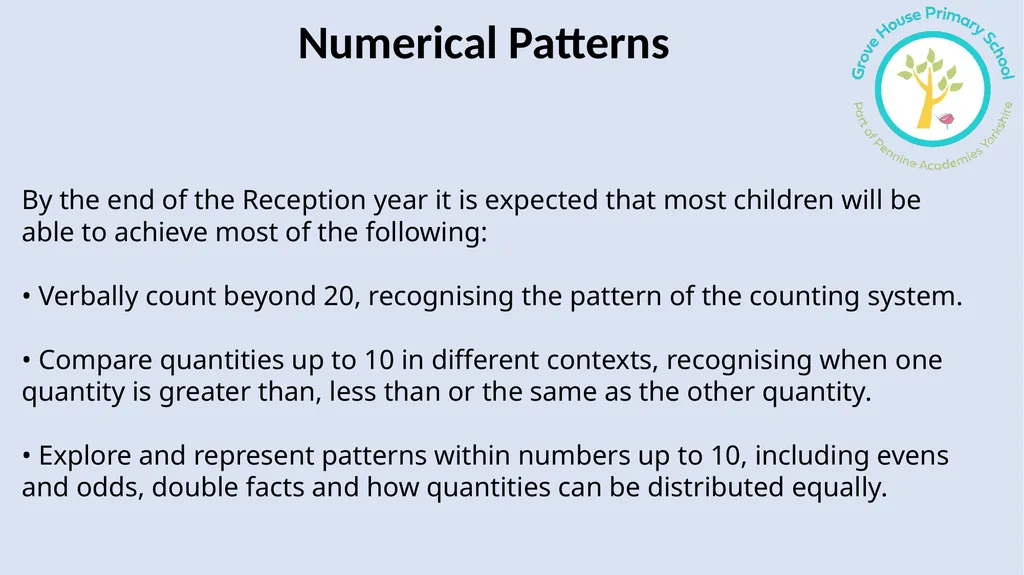
By the end of the Reception year it is expected that most children will be able to achieve most of the following:
• Have a deep understanding of number to 10, including the composition of each number
• Subitise (recognise quantities without counting) up to 5
• Automatically recall (without reference to rhymes, counting or other aids) number bonds up to 5 (including subtraction facts) and some number bonds to 10, including double facts.<br>
slide4. Numbers
Basic Key Skills:
• Reciting numbers in sequence.
• Can use one-to-one correspondence
• Realise that anything can be counted (steps, claps, jumps).
• Understand that the number of objects stays the same even if they are moved around or grouped in different ways.
• The importance of zero.<br>
slide5. By the end of the Reception year it is expected that most children will be able to achieve most of the following:
• Verbally count beyond 20, recognising the pattern of the counting system.
• Compare quantities up to 10 in different contexts, recognising when one quantity is greater than, less than or the same as the other quantity.
• Explore and represent patterns within numbers up to 10, including evens and odds, double facts and how quantities can be distributed equally. Numerical Patterns<br>
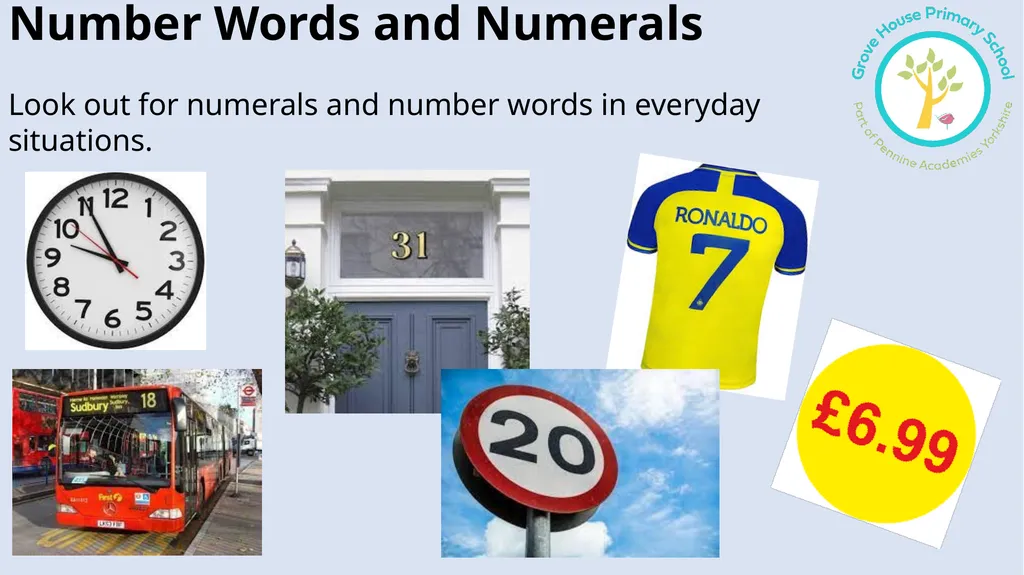
slide6. Number Words and Numerals
Look out for numerals and number words in everyday situations.<br>
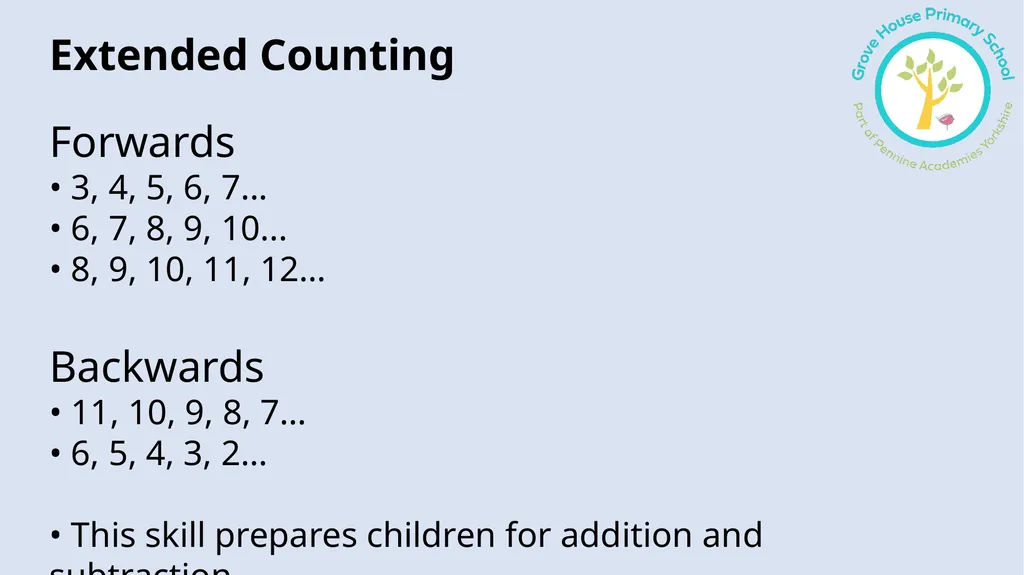
slide7. Extended Counting
Forwards
• 3, 4, 5, 6, 7...
• 6, 7, 8, 9, 10...
• 8, 9, 10, 11, 12…
Backwards
• 11, 10, 9, 8, 7…
• 6, 5, 4, 3, 2…
• This skill prepares children for addition and subtraction.<br>
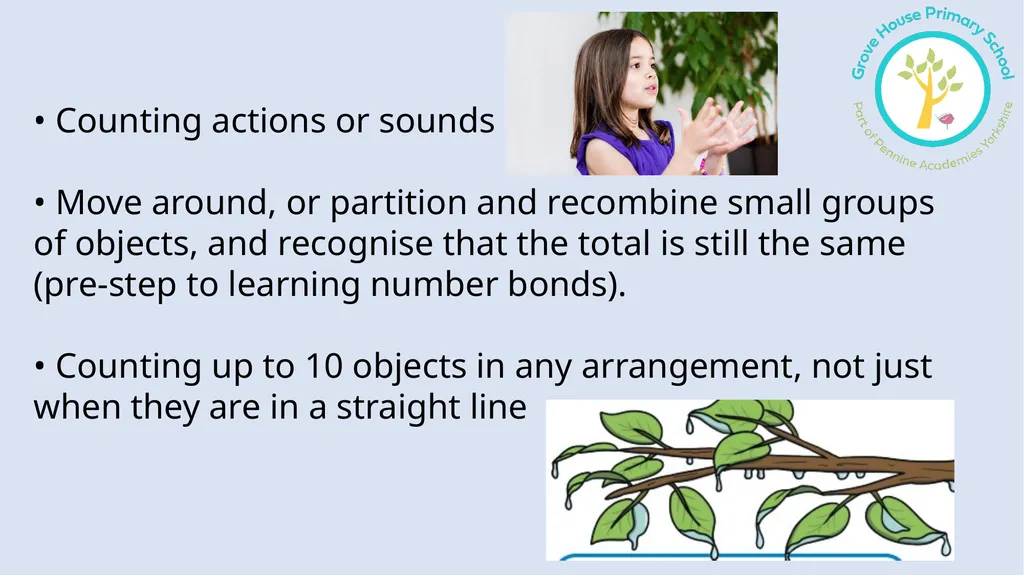
slide8. • Counting actions or sounds
• Move around, or partition and recombine small groups of objects, and recognise that the total is still the same (pre-step to learning number bonds).
• Counting up to 10 objects in any arrangement, not just when they are in a straight line<br>
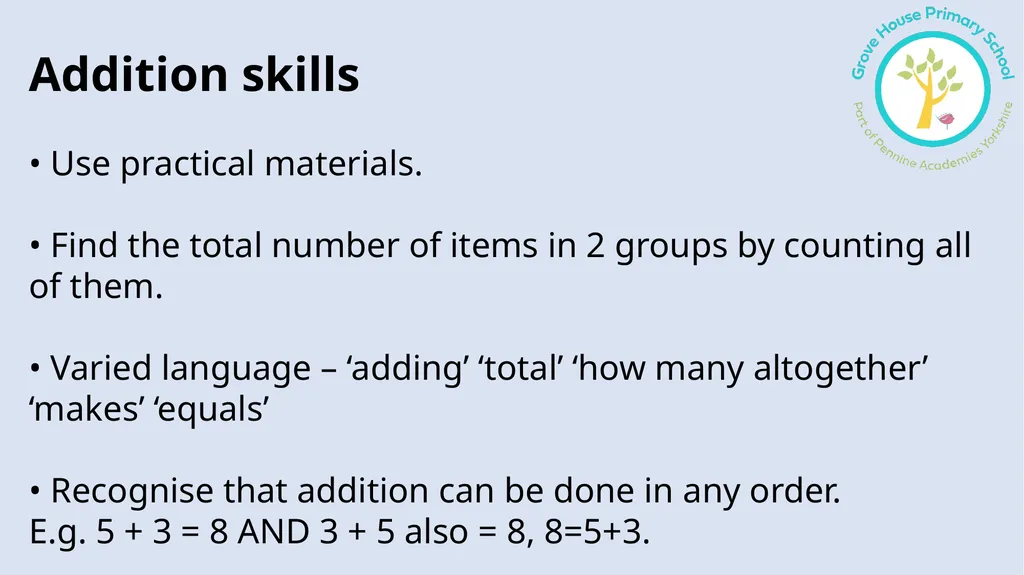
slide9. Addition skills
• Use practical materials.
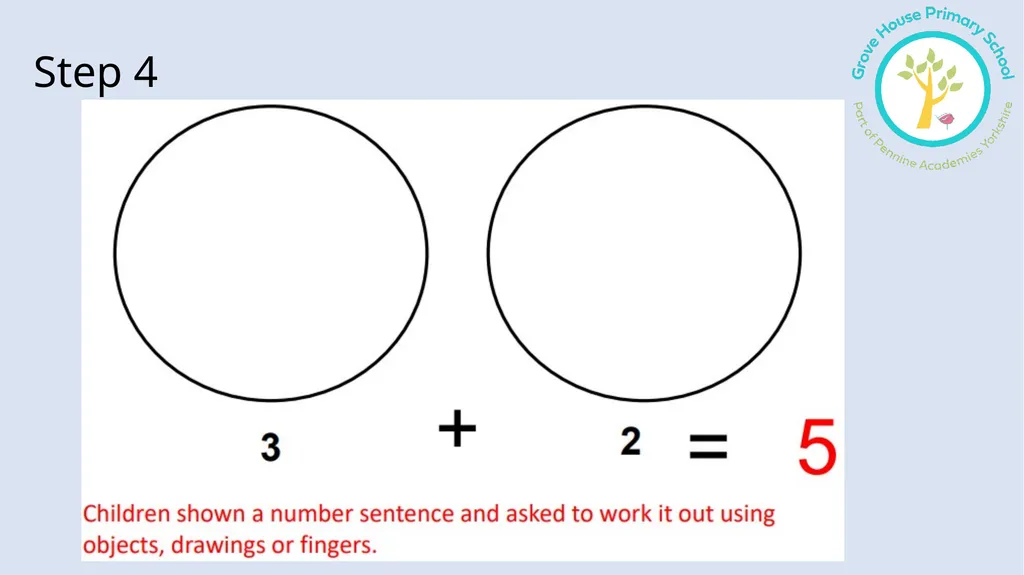
• Find the total number of items in 2 groups by counting all of them.
• Varied language – ‘adding’ ‘total’ ‘how many altogether’ ‘makes’ ‘equals’
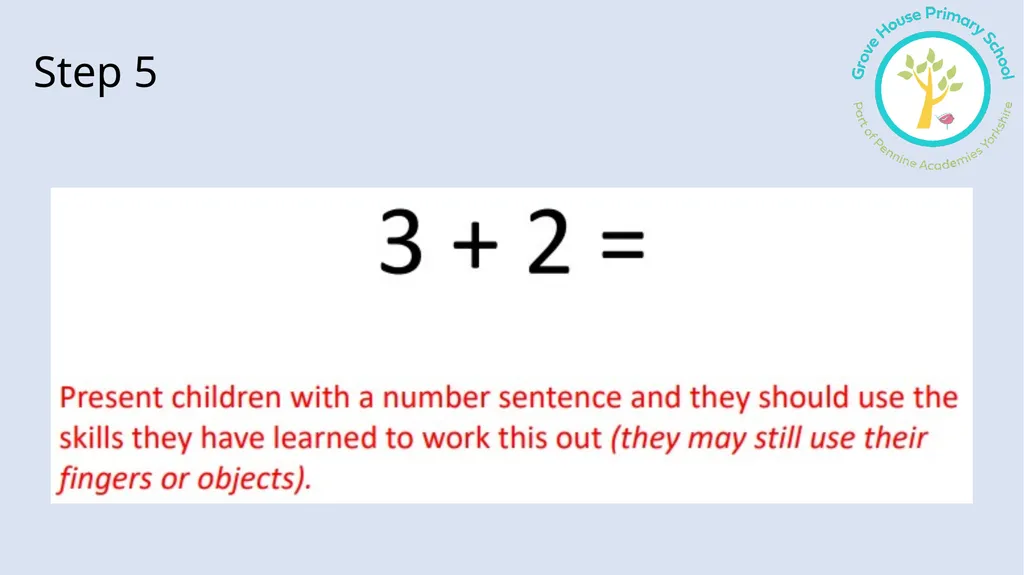
• Recognise that addition can be done in any order.
E.g. 5 + 3 = 8 AND 3 + 5 also = 8, 8=5+3.<br>
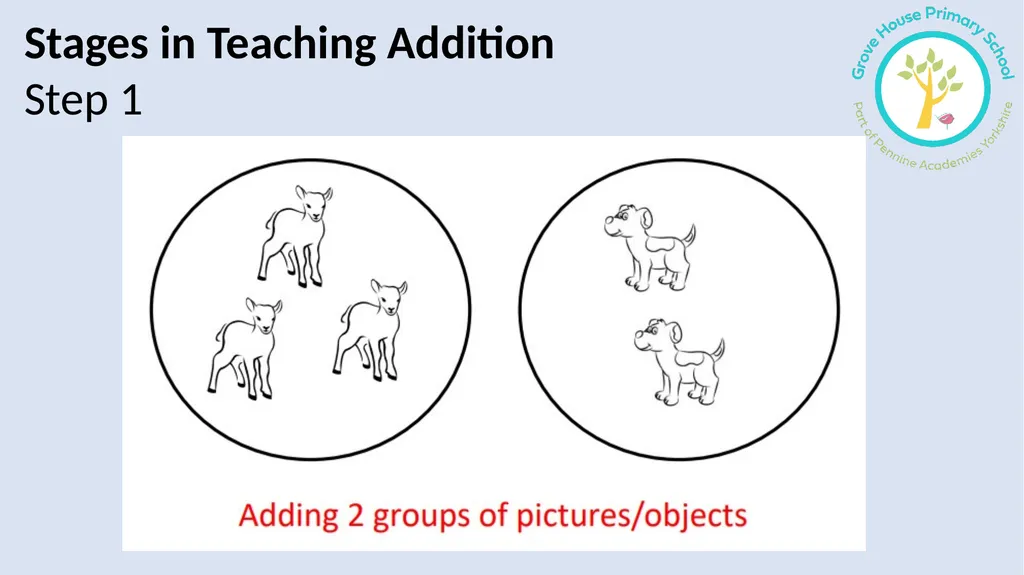
slide10. Stages in Teaching Addition
Step 1<br>
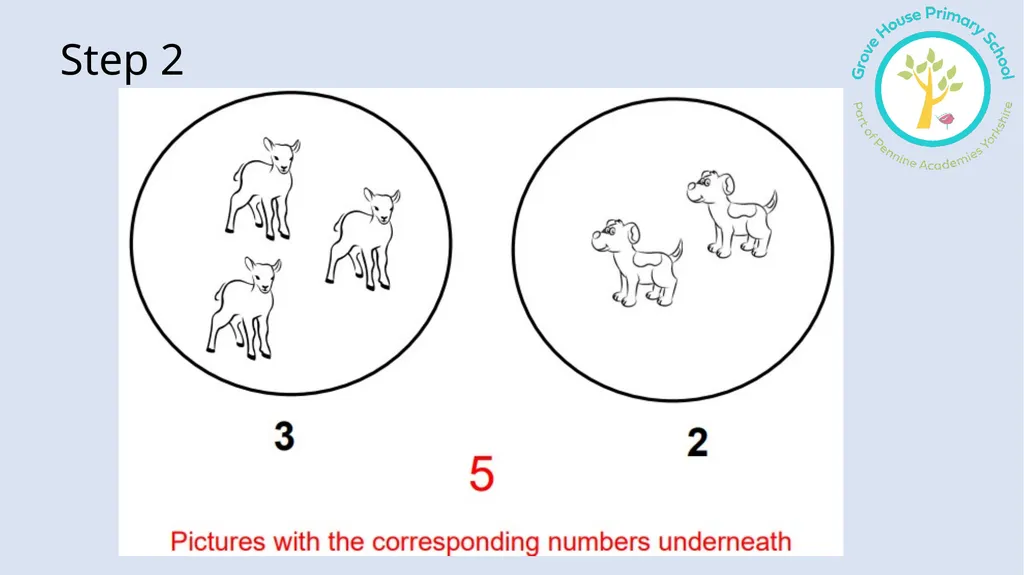
slide11. Step 2<br>
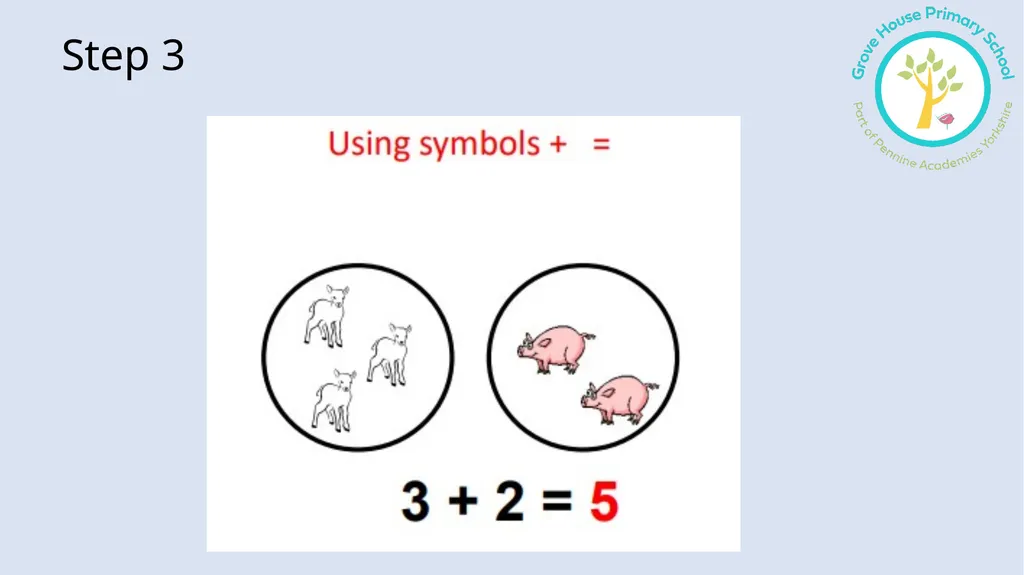
slide12. Step 3<br>
slide13. Step 4<br>
slide14. Step 5<br>
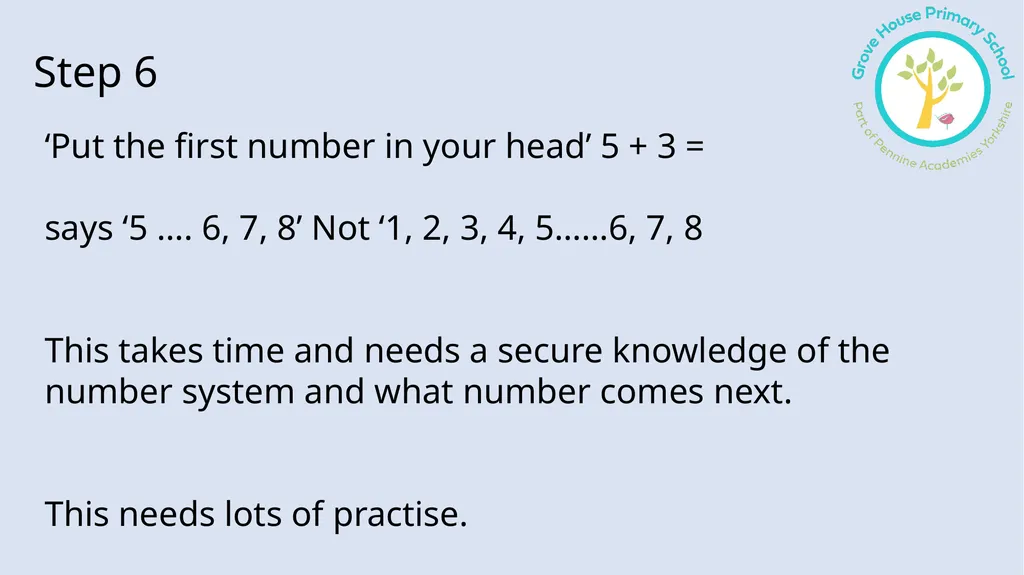
slide15. Step 6 ‘Put the first number in your head’ 5 + 3 =
says ‘5 …. 6, 7, 8’ Not ‘1, 2, 3, 4, 5……6, 7, 8
This takes time and needs a secure knowledge of the number system and what number comes next.
This needs lots of practise.<br>
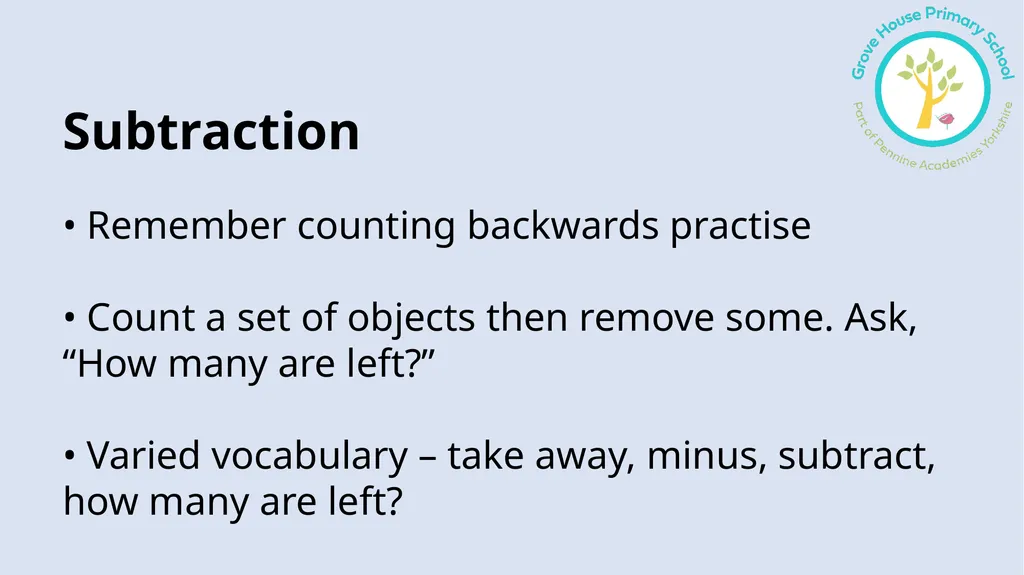
slide16. Subtraction
• Remember counting backwards practise
• Count a set of objects then remove some. Ask, “How many are left?”
• Varied vocabulary – take away, minus, subtract, how many are left?<br>
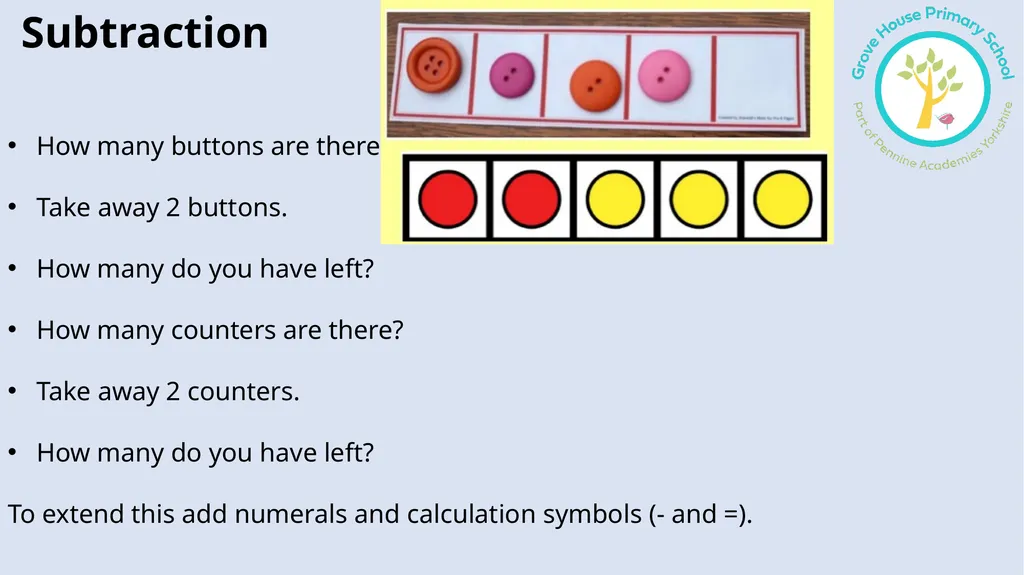
slide17. Subtraction How many buttons are there?
Take away 2 buttons.
How many do you have left?
How many counters are there?
Take away 2 counters.
How many do you have left?
To extend this add numerals and calculation symbols (- and =).<br>
slide18. Subtraction
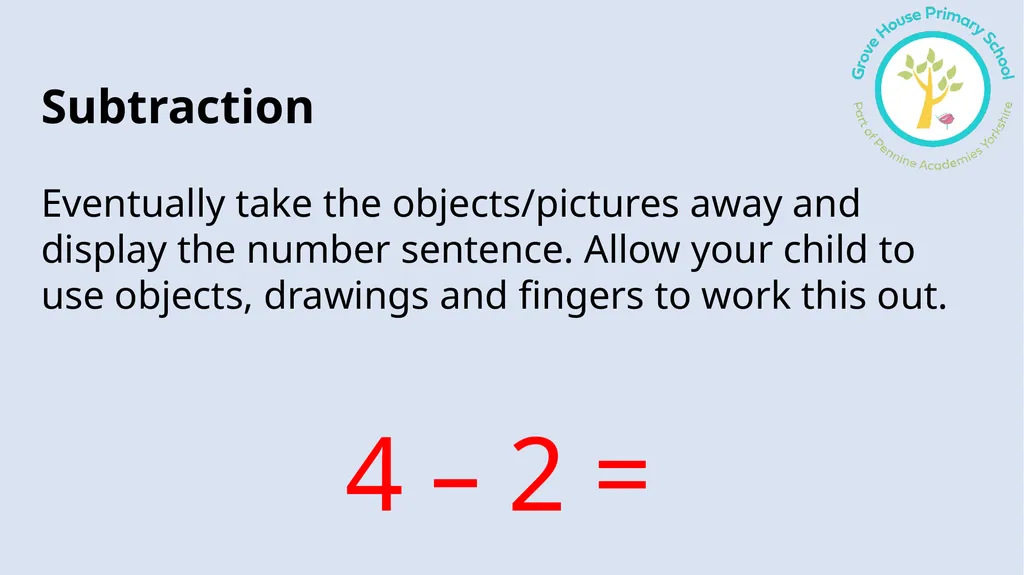
Eventually take the objects/pictures away and display the number sentence. Allow your child to use objects, drawings and fingers to work this out.
4 – 2 =<br>
slide19. When you’re at home:
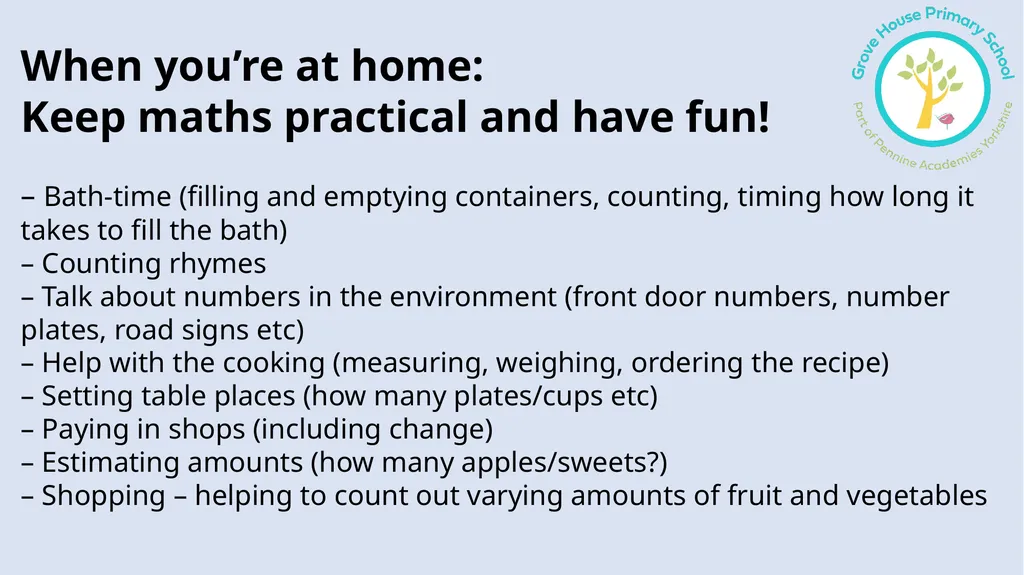
Keep maths practical and have fun!
– Bath-time (filling and emptying containers, counting, timing how long it takes to fill the bath)
– Counting rhymes
– Talk about numbers in the environment (front door numbers, number plates, road signs etc)
– Help with the cooking (measuring, weighing, ordering the recipe)
– Setting table places (how many plates/cups etc)
– Paying in shops (including change)
– Estimating amounts (how many apples/sweets?)
– Shopping – helping to count out varying amounts of fruit and vegetables<br>
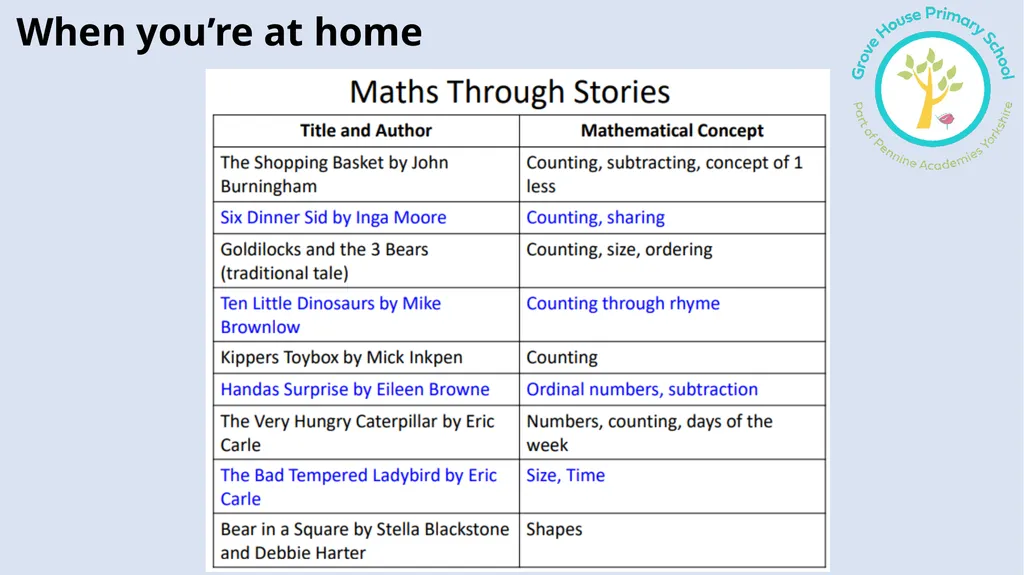
slide20. When you’re at home<br>
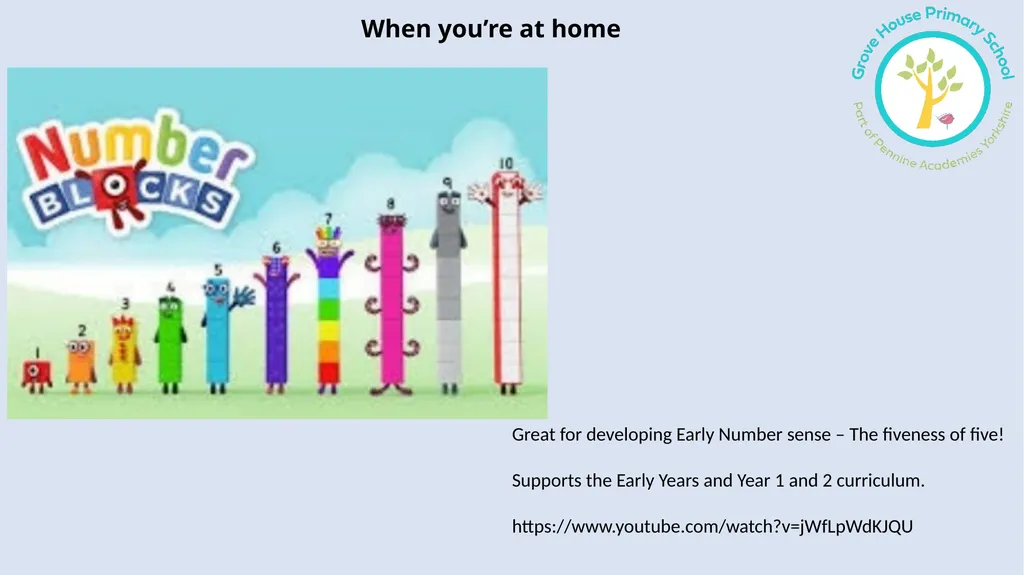
slide21. Great for developing Early Number sense – The fiveness of five!
Supports the Early Years and Year 1 and 2 curriculum.
https://www.youtube.com/watch?v=jWfLpWdKJQU When you’re at home<br>
slide22. Next steps Is there anything extra that you would like support with?
When we run sessions next academic year, what would you like to see?<br>
slide2. In the Early Years Foundation Stage we teach
using the DFE Statutory Framework for the Early Years Foundation Stage and the Development Matters Guidance.
The teaching of Mathematics in the Early Years Foundation Stage (EYFS) is split into 2 areas:
Number
Numerical Patterns<br>
slide3. Number
By the end of the Reception year it is expected that most children will be able to achieve most of the following:
• Have a deep understanding of number to 10, including the composition of each number
• Subitise (recognise quantities without counting) up to 5
• Automatically recall (without reference to rhymes, counting or other aids) number bonds up to 5 (including subtraction facts) and some number bonds to 10, including double facts.<br>
slide4. Numbers
Basic Key Skills:
• Reciting numbers in sequence.
• Can use one-to-one correspondence
• Realise that anything can be counted (steps, claps, jumps).
• Understand that the number of objects stays the same even if they are moved around or grouped in different ways.
• The importance of zero.<br>
slide5. By the end of the Reception year it is expected that most children will be able to achieve most of the following:
• Verbally count beyond 20, recognising the pattern of the counting system.
• Compare quantities up to 10 in different contexts, recognising when one quantity is greater than, less than or the same as the other quantity.
• Explore and represent patterns within numbers up to 10, including evens and odds, double facts and how quantities can be distributed equally. Numerical Patterns<br>
slide6. Number Words and Numerals
Look out for numerals and number words in everyday situations.<br>
slide7. Extended Counting
Forwards
• 3, 4, 5, 6, 7...
• 6, 7, 8, 9, 10...
• 8, 9, 10, 11, 12…
Backwards
• 11, 10, 9, 8, 7…
• 6, 5, 4, 3, 2…
• This skill prepares children for addition and subtraction.<br>
slide8. • Counting actions or sounds
• Move around, or partition and recombine small groups of objects, and recognise that the total is still the same (pre-step to learning number bonds).
• Counting up to 10 objects in any arrangement, not just when they are in a straight line<br>
slide9. Addition skills
• Use practical materials.
• Find the total number of items in 2 groups by counting all of them.
• Varied language – ‘adding’ ‘total’ ‘how many altogether’ ‘makes’ ‘equals’
• Recognise that addition can be done in any order.
E.g. 5 + 3 = 8 AND 3 + 5 also = 8, 8=5+3.<br>
slide10. Stages in Teaching Addition
Step 1<br>
slide11. Step 2<br>
slide12. Step 3<br>
slide13. Step 4<br>
slide14. Step 5<br>
slide15. Step 6 ‘Put the first number in your head’ 5 + 3 =
says ‘5 …. 6, 7, 8’ Not ‘1, 2, 3, 4, 5……6, 7, 8
This takes time and needs a secure knowledge of the number system and what number comes next.
This needs lots of practise.<br>
slide16. Subtraction
• Remember counting backwards practise
• Count a set of objects then remove some. Ask, “How many are left?”
• Varied vocabulary – take away, minus, subtract, how many are left?<br>
slide17. Subtraction How many buttons are there?
Take away 2 buttons.
How many do you have left?
How many counters are there?
Take away 2 counters.
How many do you have left?
To extend this add numerals and calculation symbols (- and =).<br>
slide18. Subtraction
Eventually take the objects/pictures away and display the number sentence. Allow your child to use objects, drawings and fingers to work this out.
4 – 2 =<br>
slide19. When you’re at home:
Keep maths practical and have fun!
– Bath-time (filling and emptying containers, counting, timing how long it takes to fill the bath)
– Counting rhymes
– Talk about numbers in the environment (front door numbers, number plates, road signs etc)
– Help with the cooking (measuring, weighing, ordering the recipe)
– Setting table places (how many plates/cups etc)
– Paying in shops (including change)
– Estimating amounts (how many apples/sweets?)
– Shopping – helping to count out varying amounts of fruit and vegetables<br>
slide20. When you’re at home<br>
slide21. Great for developing Early Number sense – The fiveness of five!
Supports the Early Years and Year 1 and 2 curriculum.
https://www.youtube.com/watch?v=jWfLpWdKJQU When you’re at home<br>
slide22. Next steps Is there anything extra that you would like support with?
When we run sessions next academic year, what would you like to see?<br>