
Recharge Policies and Procedures 1 Financial
A
Published · 83 slides · 0 views

1 / 1


Description
Recharge Policies and Procedures 1 Financial Planning and Analysis Hervé Bruckert December, 2024 Agenda 2 Framing Recharge Activities: Why Recharge? What is a Recharge Center? Functional Responsibilities How to Develop a Recharge Rate
Related Topics
Share
Embed code
Download this presentation From Below
"Recharge Policies and Procedures 1 Financial" is the property of its rightful owner. Permission is granted to download and print the materials on this website for personal, non-commercial use only, and to display it on your personal computer provided you do not modify the materials and that you retain all copyright notices contained in the materials. By downloading content from our website, you accept the terms of this agreement.
Presentation Transcript
01
Recharge Policies and Procedures 1 Financial Planning and Analysis Hervé Bruckert December, 2024<br>
02
Agenda 2 Framing Recharge Activities: Why Recharge?
What is a Recharge Center?
Functional Responsibilities
How to Develop a Recharge Rate
Billing for Recharge Goods or Services
Surpluses and Deficits
Self-Monitoring<br>
What is a Recharge Center?
Functional Responsibilities
How to Develop a Recharge Rate
Billing for Recharge Goods or Services
Surpluses and Deficits
Self-Monitoring<br>
03
Agenda 3 Self-Certification
Audit
Sustainability and Green Practices
Closing a Recharge Operation
Common Issues
References and Contact Information
Forms and Templates<br>
Audit
Sustainability and Green Practices
Closing a Recharge Operation
Common Issues
References and Contact Information
Forms and Templates<br>
04
4 1. Framing Recharge Activities:
Why Recharge?<br>
Why Recharge?<br>
05
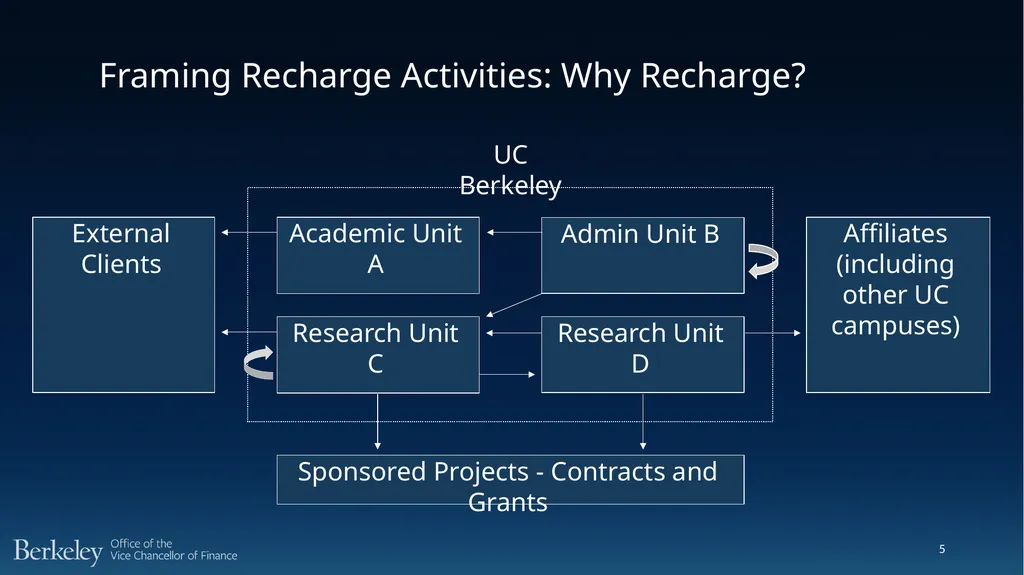
Framing Recharge Activities: Why Recharge? 5 Research Unit D External Clients UC Berkeley Sponsored Projects - Contracts and Grants Affiliates
(including other UC campuses) Academic Unit A Research Unit C Admin Unit B<br>
(including other UC campuses) Academic Unit A Research Unit C Admin Unit B<br>
06
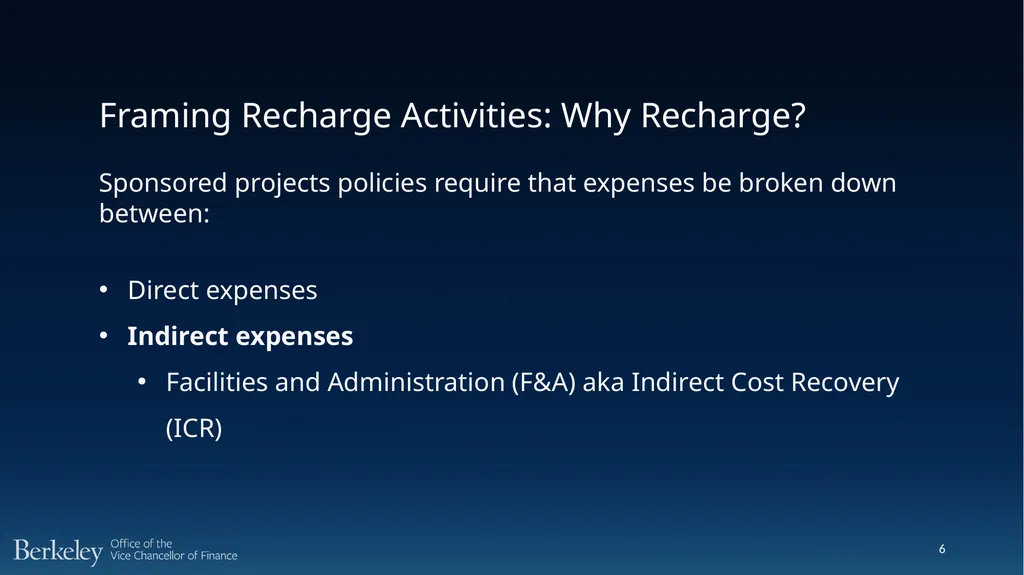
Framing Recharge Activities: Why Recharge? 6 Sponsored projects policies require that expenses be broken down between:
Direct expenses
Indirect expenses
Facilities and Administration (F&A) aka Indirect Cost Recovery (ICR)<br>
Direct expenses
Indirect expenses
Facilities and Administration (F&A) aka Indirect Cost Recovery (ICR)<br>
07
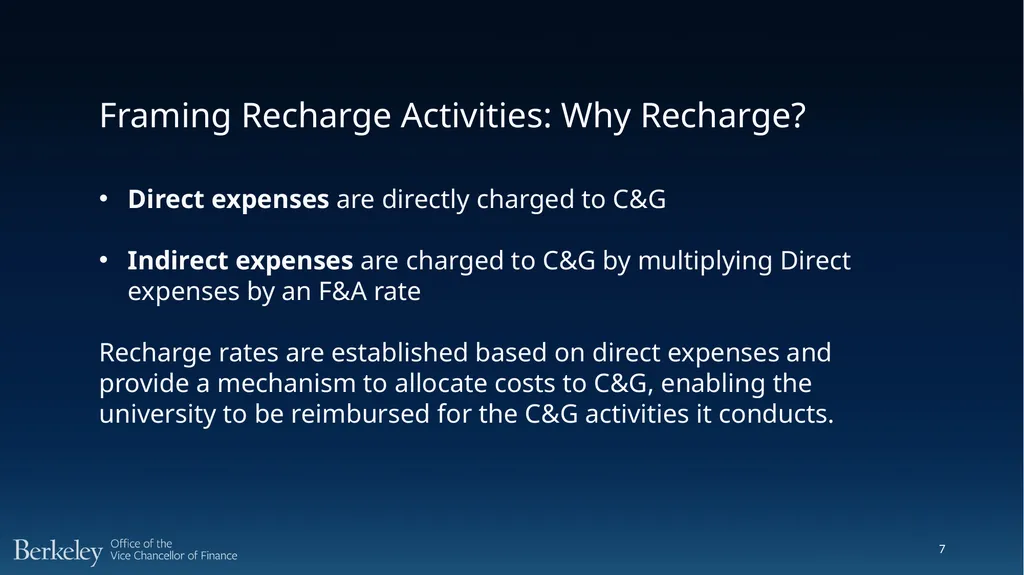
Framing Recharge Activities: Why Recharge? 7 Direct expenses are directly charged to C&G
Indirect expenses are charged to C&G by multiplying Direct expenses by an F&A rate
Recharge rates are established based on direct expenses and provide a mechanism to allocate costs to C&G, enabling the university to be reimbursed for the C&G activities it conducts.<br>
Indirect expenses are charged to C&G by multiplying Direct expenses by an F&A rate
Recharge rates are established based on direct expenses and provide a mechanism to allocate costs to C&G, enabling the university to be reimbursed for the C&G activities it conducts.<br>
08
8 2. What is a Recharge Center?<br>
09
What is a Recharge Center?
Rules and Criteria 9 Unit providing specific goods or services to a number of campus departments on an ongoing basis
The unit is allowed to recover its costs in providing those goods or services through a charge to its users<br>
Rules and Criteria 9 Unit providing specific goods or services to a number of campus departments on an ongoing basis
The unit is allowed to recover its costs in providing those goods or services through a charge to its users<br>
10
What is a Recharge Center?
Rules and Criteria 10 Some recharge centers may generate revenues from incidental sales or services to individuals or off-campus entities
Services provided should not be readily available from outside sources
or if they are, there must be overriding economic or ethical issues requiring the university to provide these services<br>
Rules and Criteria 10 Some recharge centers may generate revenues from incidental sales or services to individuals or off-campus entities
Services provided should not be readily available from outside sources
or if they are, there must be overriding economic or ethical issues requiring the university to provide these services<br>
11
What is a Recharge Center?
Rules and Criteria 11 Services can be provided to non-campus, non-affiliate entities only if they are unique and support the campus’ academic mission or are not in competition with commercial sources
Recharge rates to external clients should be fully costed and include a surcharge to recover campus indirect costs<br>
Rules and Criteria 11 Services can be provided to non-campus, non-affiliate entities only if they are unique and support the campus’ academic mission or are not in competition with commercial sources
Recharge rates to external clients should be fully costed and include a surcharge to recover campus indirect costs<br>
12
What is a Recharge Center?
Rules and Criteria 12 Recharge centers are expected to comply with the University of California Policy on Sustainable Practices and help, among other things, achieve our goals of zero waste and carbon neutrality by 2025<br>
Rules and Criteria 12 Recharge centers are expected to comply with the University of California Policy on Sustainable Practices and help, among other things, achieve our goals of zero waste and carbon neutrality by 2025<br>
13
What is a Recharge Center?
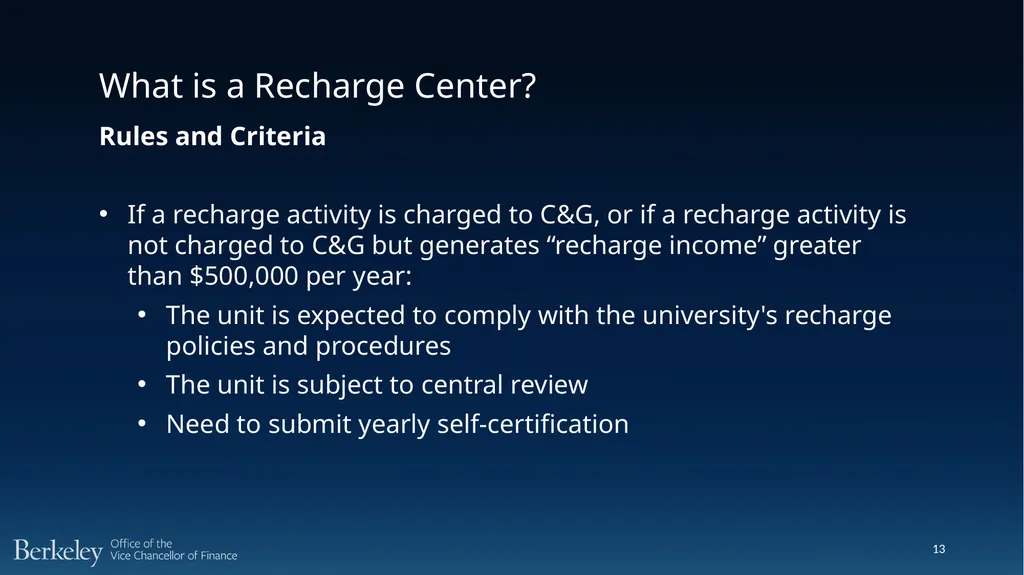
Rules and Criteria 13 If a recharge activity is charged to C&G, or if a recharge activity is not charged to C&G but generates “recharge income” greater than $500,000 per year:
The unit is expected to comply with the university's recharge policies and procedures
The unit is subject to central review
Need to submit yearly self-certification<br>
Rules and Criteria 13 If a recharge activity is charged to C&G, or if a recharge activity is not charged to C&G but generates “recharge income” greater than $500,000 per year:
The unit is expected to comply with the university's recharge policies and procedures
The unit is subject to central review
Need to submit yearly self-certification<br>
14
What is a Recharge Center?
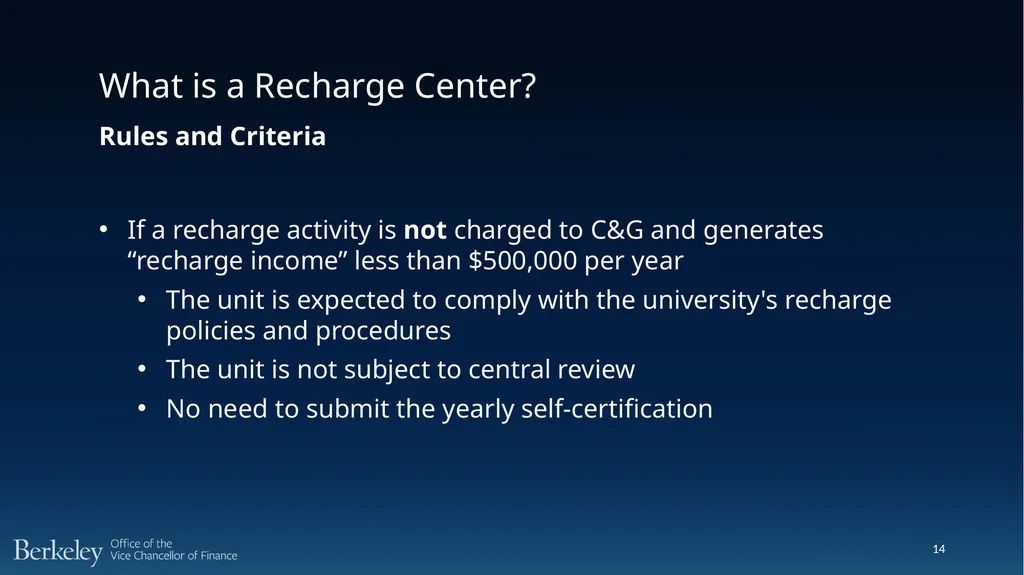
Rules and Criteria 14 If a recharge activity is not charged to C&G and generates “recharge income” less than $500,000 per year
The unit is expected to comply with the university's recharge policies and procedures
The unit is not subject to central review
No need to submit the yearly self-certification<br>
Rules and Criteria 14 If a recharge activity is not charged to C&G and generates “recharge income” less than $500,000 per year
The unit is expected to comply with the university's recharge policies and procedures
The unit is not subject to central review
No need to submit the yearly self-certification<br>
15
What is a Recharge Center?
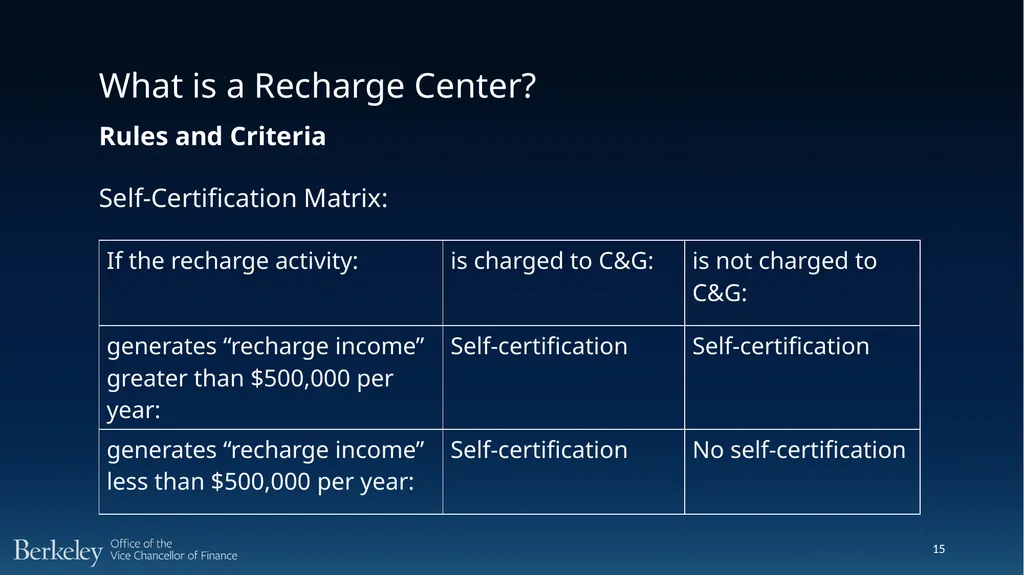
Rules and Criteria 15 Self-Certification Matrix:<br>
Rules and Criteria 15 Self-Certification Matrix:<br>
16
What is a Recharge Center?
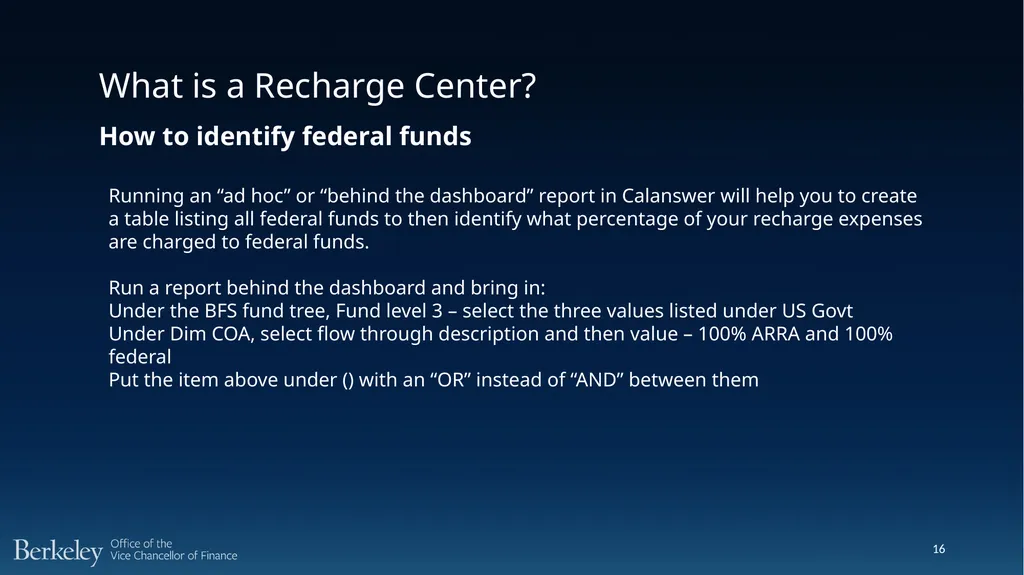
How to identify federal funds 16 Running an “ad hoc” or “behind the dashboard” report in Calanswer will help you to create a table listing all federal funds to then identify what percentage of your recharge expenses are charged to federal funds.
Run a report behind the dashboard and bring in:
Under the BFS fund tree, Fund level 3 – select the three values listed under US Govt
Under Dim COA, select flow through description and then value – 100% ARRA and 100% federal
Put the item above under () with an “OR” instead of “AND” between them<br>
How to identify federal funds 16 Running an “ad hoc” or “behind the dashboard” report in Calanswer will help you to create a table listing all federal funds to then identify what percentage of your recharge expenses are charged to federal funds.
Run a report behind the dashboard and bring in:
Under the BFS fund tree, Fund level 3 – select the three values listed under US Govt
Under Dim COA, select flow through description and then value – 100% ARRA and 100% federal
Put the item above under () with an “OR” instead of “AND” between them<br>
17
What is a Recharge Center?
Rules and Criteria 17 All campus users are charged the same rate for the same services performed or goods provided
Rates to affiliates can include a surcharge up to the ICR rate to cover any indirect cost
Recharge centers must only charge their published, authorized rates
Units should operate at close to break even<br>
Rules and Criteria 17 All campus users are charged the same rate for the same services performed or goods provided
Rates to affiliates can include a surcharge up to the ICR rate to cover any indirect cost
Recharge centers must only charge their published, authorized rates
Units should operate at close to break even<br>
18
What is a Recharge Center?
Issues to Consider when Evaluating Setting up a Recharge Center 18 Why do we want to conduct this recharge activity?
Should we be in this business?
Do we have the expertise to provide this service?
What are the risks and how will we manage them?
For example: product / service liability, workers comp, etc.
Do we have the time to manage and monitor this activity?<br>
Issues to Consider when Evaluating Setting up a Recharge Center 18 Why do we want to conduct this recharge activity?
Should we be in this business?
Do we have the expertise to provide this service?
What are the risks and how will we manage them?
For example: product / service liability, workers comp, etc.
Do we have the time to manage and monitor this activity?<br>
19
What is a Recharge Center?
Issues to Consider when Evaluating Setting up a Recharge Center 19 Is this service covered by our existing budget?
For example: 19900, 69750 fund sources, etc.
How will we determine rates?
Who are our customers?
How will we budget for this activity?
Will we breakeven?
How will we cover an unforeseen loss?
How will we monitor the financial status?<br>
Issues to Consider when Evaluating Setting up a Recharge Center 19 Is this service covered by our existing budget?
For example: 19900, 69750 fund sources, etc.
How will we determine rates?
Who are our customers?
How will we budget for this activity?
Will we breakeven?
How will we cover an unforeseen loss?
How will we monitor the financial status?<br>
20
What is a Recharge Center?
Issues to Consider when Evaluating Setting up a Recharge Center 20 How will we bill?
How will we monitor the receivables?
How will we handle cash receipts: cash, checks, credit cards, etc.?
How will we prepare the recharge journals?
How will we handle sales tax issues?
How will we report unrelated business income tax (UBIT)?
Do we have adequate insurance coverage?<br>
Issues to Consider when Evaluating Setting up a Recharge Center 20 How will we bill?
How will we monitor the receivables?
How will we handle cash receipts: cash, checks, credit cards, etc.?
How will we prepare the recharge journals?
How will we handle sales tax issues?
How will we report unrelated business income tax (UBIT)?
Do we have adequate insurance coverage?<br>
21
What is a Recharge Center?
Examples of Recharge Activities 21 Molecular Cell Biology
Genomic Sequencing Lab
Nanolab Services
Chemical Waste Disposal
Electron Microscope Facility
Mail Services
Animal Care
IT and Facilities Services
Some of the IT and FS services might, over time, shift to a common goods assessment model instead of the current recharge model<br>
Examples of Recharge Activities 21 Molecular Cell Biology
Genomic Sequencing Lab
Nanolab Services
Chemical Waste Disposal
Electron Microscope Facility
Mail Services
Animal Care
IT and Facilities Services
Some of the IT and FS services might, over time, shift to a common goods assessment model instead of the current recharge model<br>
22
What is a Recharge Center?
Examples of Non-Recharge Activities 22 Customary services within general administration (Central Accounting, Human Resources, Budgeting)
Two departments share the costs of a machine equally
General, non-identifiable services (General administration fee)
Auxiliary Services (self supporting): service to students, faculty, or staff (Parking, residential and student services)<br>
Examples of Non-Recharge Activities 22 Customary services within general administration (Central Accounting, Human Resources, Budgeting)
Two departments share the costs of a machine equally
General, non-identifiable services (General administration fee)
Auxiliary Services (self supporting): service to students, faculty, or staff (Parking, residential and student services)<br>
23
23 3. Functional Responsibilities<br>
24
Functional Responsibilities
Role of the Department 24 Overall operation of recharge centers
Assures compliance with current university recharge policy
Reviews services provided on an ongoing basis
Reviews budget, revenue, and expenditures on an ongoing basis
Reviews rates as business needs change to assure the unit’s balances remain within tolerance
Submit annual self-certification form as part of the yearly budget process<br>
Role of the Department 24 Overall operation of recharge centers
Assures compliance with current university recharge policy
Reviews services provided on an ongoing basis
Reviews budget, revenue, and expenditures on an ongoing basis
Reviews rates as business needs change to assure the unit’s balances remain within tolerance
Submit annual self-certification form as part of the yearly budget process<br>
25
Functional Responsibilities
Role of the Division 25 Oversees and assists with the operation of recharge units
Approves all recharge rate changes and annual self-certification forms prior to submission to the recharge committee
Reviews services provided by the recharge centers periodically
Assures all units within the division submit an annual self-certification form<br>
Role of the Division 25 Oversees and assists with the operation of recharge units
Approves all recharge rate changes and annual self-certification forms prior to submission to the recharge committee
Reviews services provided by the recharge centers periodically
Assures all units within the division submit an annual self-certification form<br>
26
Functional Responsibilities
Role of the Recharge Committee 26 Acts in an advisory capacity to recharge centers and campus departments
Acts in an advisory capacity for developing university recharge policy and procedure
Approves the establishment of all new recharge centers
Reviews all surplus or deficit reduction plans and monitors a unit’s progress toward reduction goals
Approves all in-year recharge rates changes and all recharge rates submitted as part of the yearly budget process<br>
Role of the Recharge Committee 26 Acts in an advisory capacity to recharge centers and campus departments
Acts in an advisory capacity for developing university recharge policy and procedure
Approves the establishment of all new recharge centers
Reviews all surplus or deficit reduction plans and monitors a unit’s progress toward reduction goals
Approves all in-year recharge rates changes and all recharge rates submitted as part of the yearly budget process<br>
27
Functional Responsibilities
Role of the Office of the VC Finance 27 Provides general accounting assistance to the recharge centers
Provides training to the campus community
Provides binding mediation on all recharge disputes between recharge centers and their customers
Provides ongoing fiscal review of the university’s recharge operations
Consolidates yearly rate change request for review and approval by the Recharge Committee
Presents in-year rate change request for review and approval by the Recharge Committee<br>
Role of the Office of the VC Finance 27 Provides general accounting assistance to the recharge centers
Provides training to the campus community
Provides binding mediation on all recharge disputes between recharge centers and their customers
Provides ongoing fiscal review of the university’s recharge operations
Consolidates yearly rate change request for review and approval by the Recharge Committee
Presents in-year rate change request for review and approval by the Recharge Committee<br>
28
28 4. How to Develop a Recharge Rate<br>
29
How to Develop a Recharge Rate
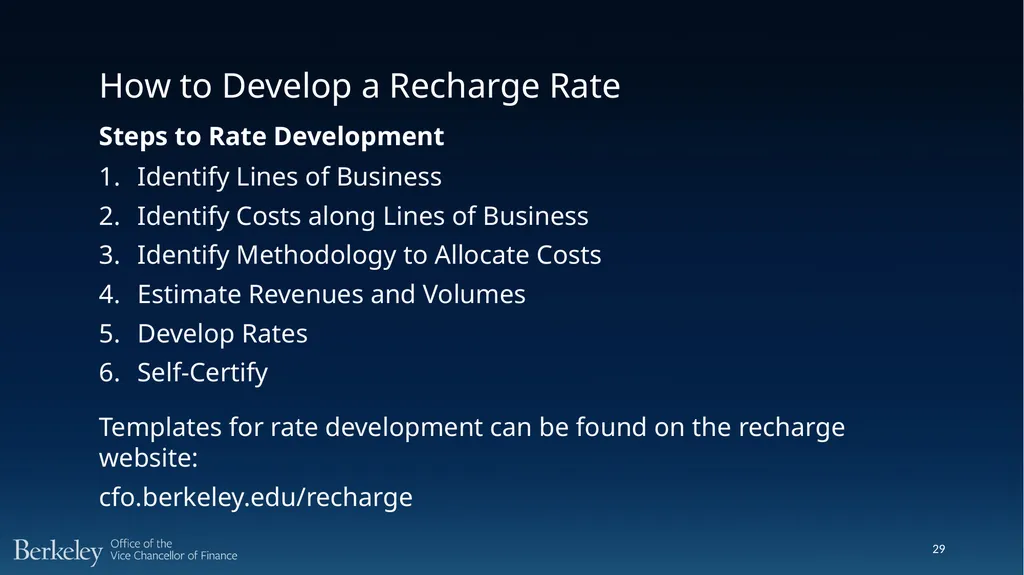
Steps to Rate Development 29 Identify Lines of Business
Identify Costs along Lines of Business
Identify Methodology to Allocate Costs
Estimate Revenues and Volumes
Develop Rates
Self-Certify
Templates for rate development can be found on the recharge website:
cfo.berkeley.edu/recharge<br>
Steps to Rate Development 29 Identify Lines of Business
Identify Costs along Lines of Business
Identify Methodology to Allocate Costs
Estimate Revenues and Volumes
Develop Rates
Self-Certify
Templates for rate development can be found on the recharge website:
cfo.berkeley.edu/recharge<br>
30
How to Develop a Recharge Rate
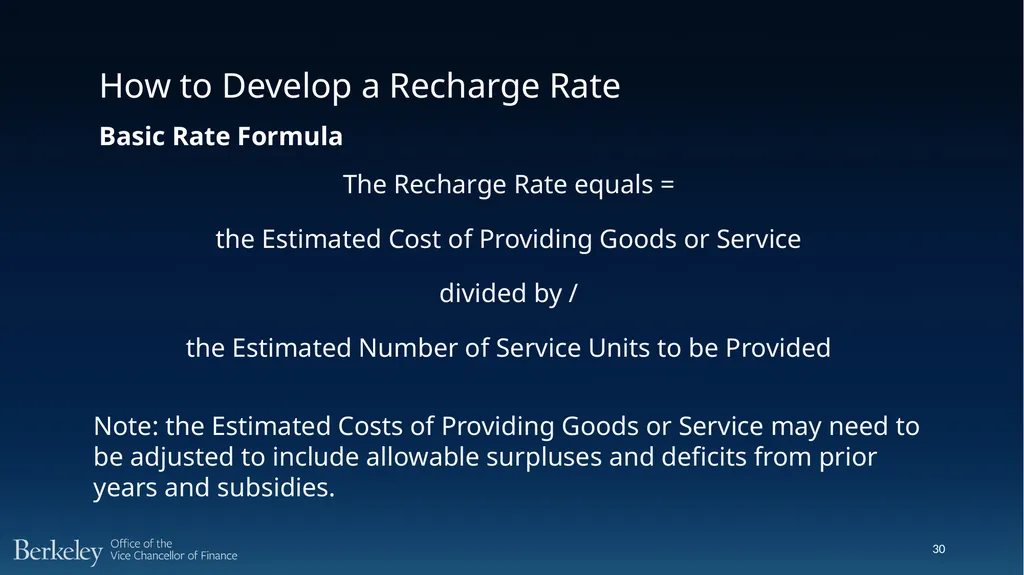
Basic Rate Formula 30 The Recharge Rate equals =
the Estimated Cost of Providing Goods or Service
divided by /
the Estimated Number of Service Units to be Provided
Note: the Estimated Costs of Providing Goods or Service may need to be adjusted to include allowable surpluses and deficits from prior years and subsidies.<br>
Basic Rate Formula 30 The Recharge Rate equals =
the Estimated Cost of Providing Goods or Service
divided by /
the Estimated Number of Service Units to be Provided
Note: the Estimated Costs of Providing Goods or Service may need to be adjusted to include allowable surpluses and deficits from prior years and subsidies.<br>
31
How to Develop a Recharge Rate
Rate Development 31 Identical goods and services must carry identical prices for any and all campus customers
Units may charge only the rates posted on the campus recharge website: cfo.berkeley.edu/recharge<br>
Rate Development 31 Identical goods and services must carry identical prices for any and all campus customers
Units may charge only the rates posted on the campus recharge website: cfo.berkeley.edu/recharge<br>
32
How to Develop a Recharge Rate
Cost Pool Development 32 Include all direct costs.
Costs must be allowable
Costs need to be reasonable
i.e. generally recognized as necessary for the operation<br>
Cost Pool Development 32 Include all direct costs.
Costs must be allowable
Costs need to be reasonable
i.e. generally recognized as necessary for the operation<br>
33
How to Develop a Recharge Rate
Cost Pool Development 33 Costs must be treated consistently
i.e. Direct vs Indirect
Costs are identifiable to the recharge unit
Costs are reasonably allocable
When allocating a cost to a recharge unit, we must be able to assign the cost, or a group of costs, to the recharge pool in reasonable and realistic proportion that demonstrates the benefit provided<br>
Cost Pool Development 33 Costs must be treated consistently
i.e. Direct vs Indirect
Costs are identifiable to the recharge unit
Costs are reasonably allocable
When allocating a cost to a recharge unit, we must be able to assign the cost, or a group of costs, to the recharge pool in reasonable and realistic proportion that demonstrates the benefit provided<br>
34
How to Develop a Recharge Rate
Allowable Costs 34 Identify costs to be included in the cost pool.
Allowable costs normally include but are not limited to:
Salaries, Wages, and Fringe Benefits
Supplies and Services
Costs of Leased Non-Capital Equipment / Facilities
Equipment Depreciation
Repairs and Maintenance
Prior Year Operating Surplus / Deficit that occurred through the normal course of business<br>
Allowable Costs 34 Identify costs to be included in the cost pool.
Allowable costs normally include but are not limited to:
Salaries, Wages, and Fringe Benefits
Supplies and Services
Costs of Leased Non-Capital Equipment / Facilities
Equipment Depreciation
Repairs and Maintenance
Prior Year Operating Surplus / Deficit that occurred through the normal course of business<br>
35
How to Develop a Recharge Rate
Unallowable Costs 35 UCRP supplemental interest and Gael should be included in the rate development, but must be subsidized if Federal Funds are planned to be charged
Costs of capitalized renovations or leasehold improvements
Internal Interest Expense
Bad Debts
Fines / Penalties
Inventorial / Capital Equipment Purchases<br>
Unallowable Costs 35 UCRP supplemental interest and Gael should be included in the rate development, but must be subsidized if Federal Funds are planned to be charged
Costs of capitalized renovations or leasehold improvements
Internal Interest Expense
Bad Debts
Fines / Penalties
Inventorial / Capital Equipment Purchases<br>
36
How to Develop a Recharge Rate
Unallowable Costs 36 Commencement / Convocation Costs
Fund Raising Expense
Contingency Reserves
Cost Paid by Federal Government
Alumni Activities
Entertainment (Alcohol, event tickets, flowers, gifts, etc.)
Donations / Contributions
Memberships / Civic / Community / Social Org
Abnormal (non-operating) deficits<br>
Unallowable Costs 36 Commencement / Convocation Costs
Fund Raising Expense
Contingency Reserves
Cost Paid by Federal Government
Alumni Activities
Entertainment (Alcohol, event tickets, flowers, gifts, etc.)
Donations / Contributions
Memberships / Civic / Community / Social Org
Abnormal (non-operating) deficits<br>
37
How to Develop a Recharge Rate
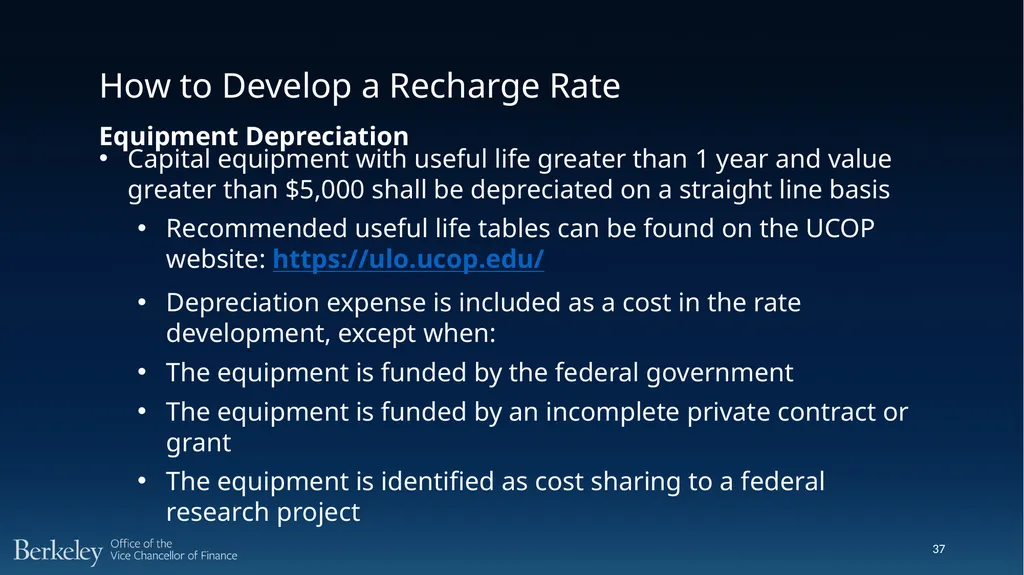
Equipment Depreciation 37 Capital equipment with useful life greater than 1 year and value greater than $5,000 shall be depreciated on a straight line basis
Recommended useful life tables can be found on the UCOP website: https://ulo.ucop.edu/
Depreciation expense is included as a cost in the rate development, except when:
The equipment is funded by the federal government
The equipment is funded by an incomplete private contract or grant
The equipment is identified as cost sharing to a federal research project<br>
Equipment Depreciation 37 Capital equipment with useful life greater than 1 year and value greater than $5,000 shall be depreciated on a straight line basis
Recommended useful life tables can be found on the UCOP website: https://ulo.ucop.edu/
Depreciation expense is included as a cost in the rate development, except when:
The equipment is funded by the federal government
The equipment is funded by an incomplete private contract or grant
The equipment is identified as cost sharing to a federal research project<br>
38
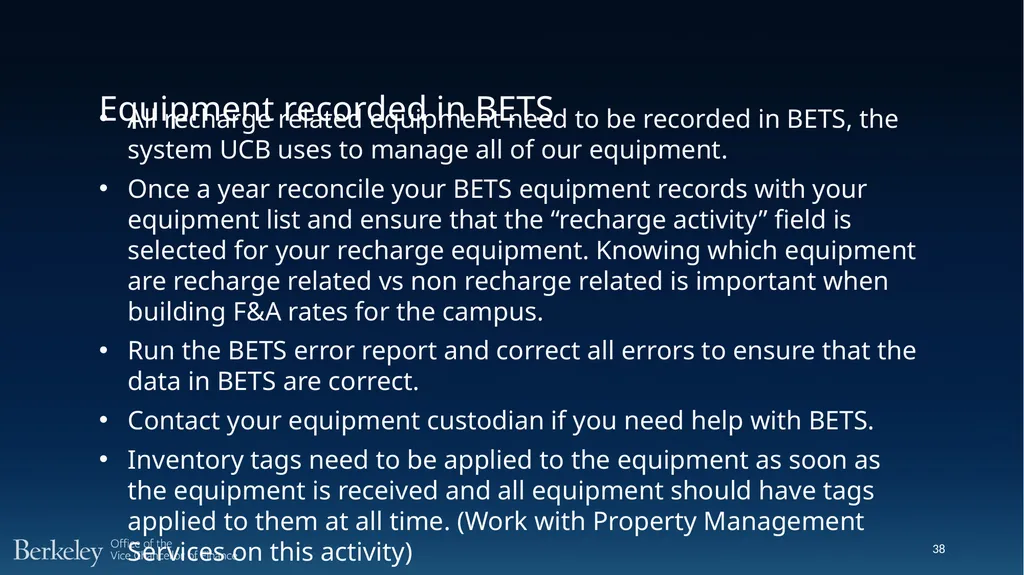
Equipment recorded in BETS 38 All recharge related equipment need to be recorded in BETS, the system UCB uses to manage all of our equipment.
Once a year reconcile your BETS equipment records with your equipment list and ensure that the “recharge activity” field is selected for your recharge equipment. Knowing which equipment are recharge related vs non recharge related is important when building F&A rates for the campus.
Run the BETS error report and correct all errors to ensure that the data in BETS are correct.
Contact your equipment custodian if you need help with BETS.
Inventory tags need to be applied to the equipment as soon as the equipment is received and all equipment should have tags applied to them at all time. (Work with Property Management Services on this activity)<br>
Once a year reconcile your BETS equipment records with your equipment list and ensure that the “recharge activity” field is selected for your recharge equipment. Knowing which equipment are recharge related vs non recharge related is important when building F&A rates for the campus.
Run the BETS error report and correct all errors to ensure that the data in BETS are correct.
Contact your equipment custodian if you need help with BETS.
Inventory tags need to be applied to the equipment as soon as the equipment is received and all equipment should have tags applied to them at all time. (Work with Property Management Services on this activity)<br>
39
How to Develop a Recharge Rate
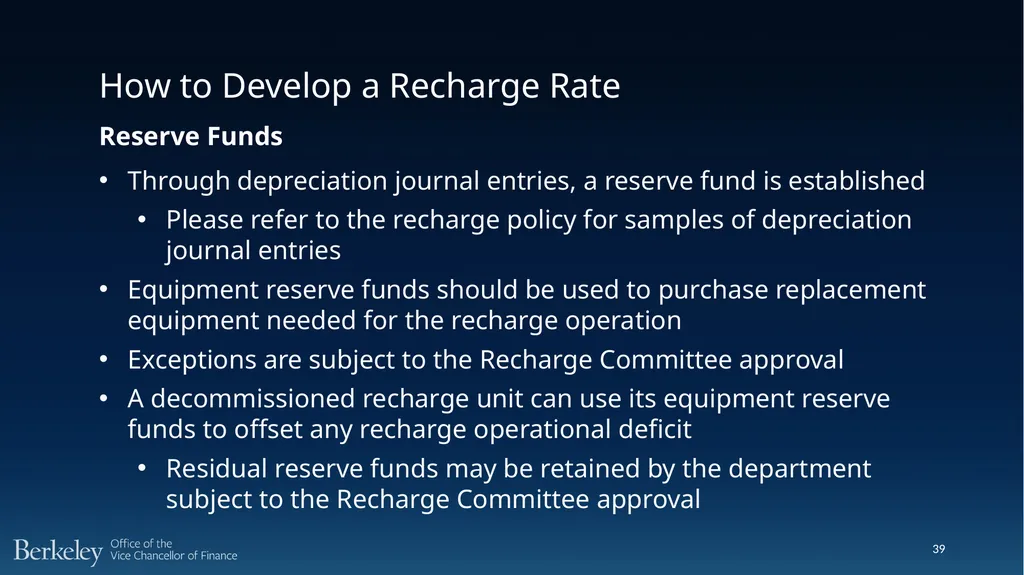
Reserve Funds 39 Through depreciation journal entries, a reserve fund is established
Please refer to the recharge policy for samples of depreciation journal entries
Equipment reserve funds should be used to purchase replacement equipment needed for the recharge operation
Exceptions are subject to the Recharge Committee approval
A decommissioned recharge unit can use its equipment reserve funds to offset any recharge operational deficit
Residual reserve funds may be retained by the department subject to the Recharge Committee approval<br>
Reserve Funds 39 Through depreciation journal entries, a reserve fund is established
Please refer to the recharge policy for samples of depreciation journal entries
Equipment reserve funds should be used to purchase replacement equipment needed for the recharge operation
Exceptions are subject to the Recharge Committee approval
A decommissioned recharge unit can use its equipment reserve funds to offset any recharge operational deficit
Residual reserve funds may be retained by the department subject to the Recharge Committee approval<br>
40
How to Develop a Recharge Rate
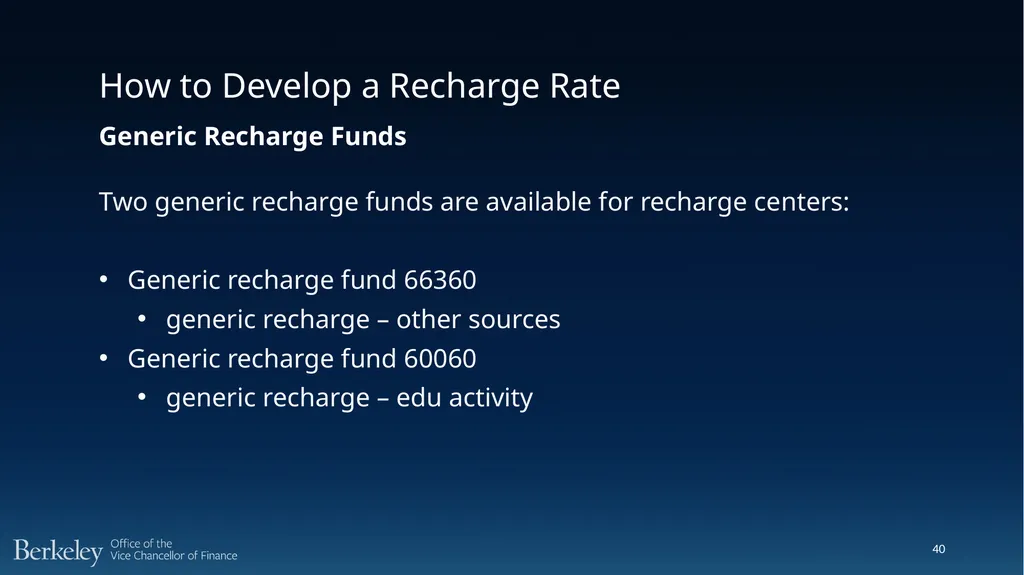
Generic Recharge Funds 40 Two generic recharge funds are available for recharge centers:
Generic recharge fund 66360
generic recharge – other sources
Generic recharge fund 60060
generic recharge – edu activity<br>
Generic Recharge Funds 40 Two generic recharge funds are available for recharge centers:
Generic recharge fund 66360
generic recharge – other sources
Generic recharge fund 60060
generic recharge – edu activity<br>
41
How to Develop a Recharge Rate
Subsidies 41 Subsidies fund a portion of the recharge unit’s total costs which result in lower recharge rates
Subsidies included in rates reduce the price for all campus users of specific products or services produced by the recharge
Non-campus customers must be charged the unsubsidized rates plus a minimum surcharge based on the current ICR rates<br>
Subsidies 41 Subsidies fund a portion of the recharge unit’s total costs which result in lower recharge rates
Subsidies included in rates reduce the price for all campus users of specific products or services produced by the recharge
Non-campus customers must be charged the unsubsidized rates plus a minimum surcharge based on the current ICR rates<br>
42
How to Develop a Recharge Rate
Surcharges 42 In addition to charging fully costed rates (unsubsidized rate), units must assess a minimum additional charge to non-campus customers intended to recover campus indirect costs (ICR)
The minimum surcharge is the F&A / ICR rate
Exceptions to charging a surcharge at the full ICR rate for external customers are subject to the Recharge Committee approval
Business contracts must be in place prior to conducting business with external clients<br>
Surcharges 42 In addition to charging fully costed rates (unsubsidized rate), units must assess a minimum additional charge to non-campus customers intended to recover campus indirect costs (ICR)
The minimum surcharge is the F&A / ICR rate
Exceptions to charging a surcharge at the full ICR rate for external customers are subject to the Recharge Committee approval
Business contracts must be in place prior to conducting business with external clients<br>
43
How to Develop a Recharge Rate
Surcharges 43 Affiliates and auxiliaries are campus customers
Affiliates, however, can be assessed a surcharge up to the current campus ICR rate
Surcharge funds generated are recorded to a separate fund and are retained by the generating department to be used at the unit’s discretion, generally to defray administrative costs
Coding to a separate fund and account ensures that the balance of the recharge operations fund is not distorted by surcharge income
For recharge units, the administrative full costing (AFC) assessment will be posted to the surcharge fund<br>
Surcharges 43 Affiliates and auxiliaries are campus customers
Affiliates, however, can be assessed a surcharge up to the current campus ICR rate
Surcharge funds generated are recorded to a separate fund and are retained by the generating department to be used at the unit’s discretion, generally to defray administrative costs
Coding to a separate fund and account ensures that the balance of the recharge operations fund is not distorted by surcharge income
For recharge units, the administrative full costing (AFC) assessment will be posted to the surcharge fund<br>
44
How to Develop a Recharge Rate
External Revenue and Surcharges 44 When booking external revenue, two components need to be booked:
The revenue based on the unsubsidized recharge rate
The surcharge (component above the unsubsidized rate)<br>
External Revenue and Surcharges 44 When booking external revenue, two components need to be booked:
The revenue based on the unsubsidized recharge rate
The surcharge (component above the unsubsidized rate)<br>
45
How to Develop a Recharge Rate
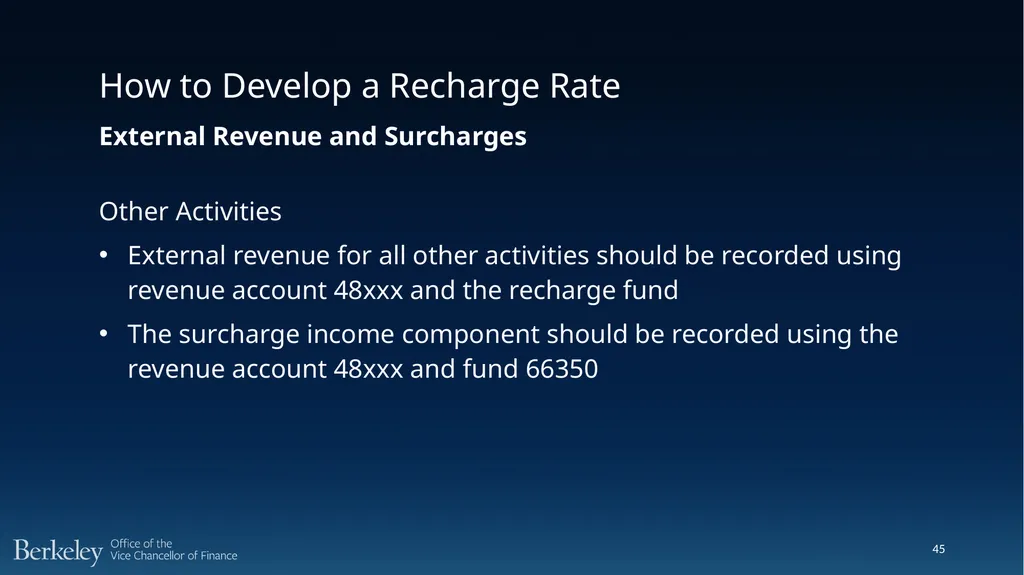
External Revenue and Surcharges 45 Other Activities
External revenue for all other activities should be recorded using revenue account 48xxx and the recharge fund
The surcharge income component should be recorded using the revenue account 48xxx and fund 66350<br>
External Revenue and Surcharges 45 Other Activities
External revenue for all other activities should be recorded using revenue account 48xxx and the recharge fund
The surcharge income component should be recorded using the revenue account 48xxx and fund 66350<br>
46
How to Develop a Recharge Rate
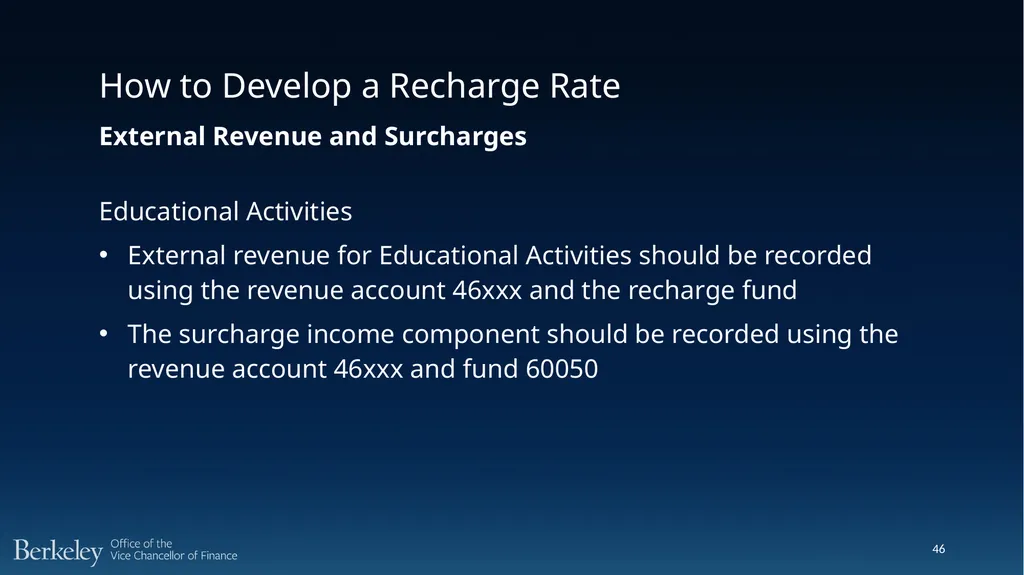
External Revenue and Surcharges 46 Educational Activities
External revenue for Educational Activities should be recorded using the revenue account 46xxx and the recharge fund
The surcharge income component should be recorded using the revenue account 46xxx and fund 60050<br>
External Revenue and Surcharges 46 Educational Activities
External revenue for Educational Activities should be recorded using the revenue account 46xxx and the recharge fund
The surcharge income component should be recorded using the revenue account 46xxx and fund 60050<br>
47
How to Develop a Recharge Rate
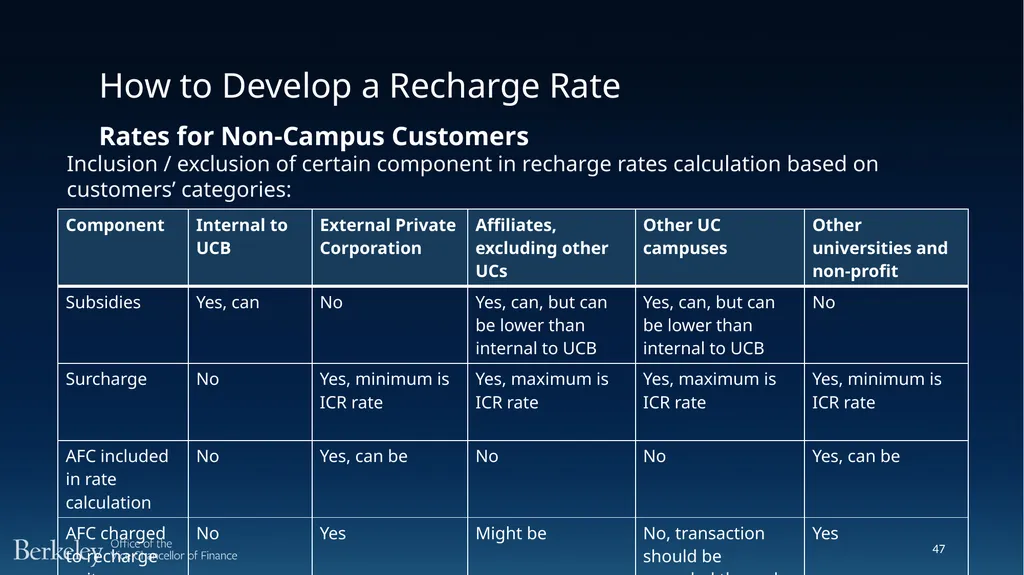
Rates for Non-Campus Customers 47 Inclusion / exclusion of certain component in recharge rates calculation based on customers’ categories:<br>
Rates for Non-Campus Customers 47 Inclusion / exclusion of certain component in recharge rates calculation based on customers’ categories:<br>
48
How to Develop a Recharge Rate
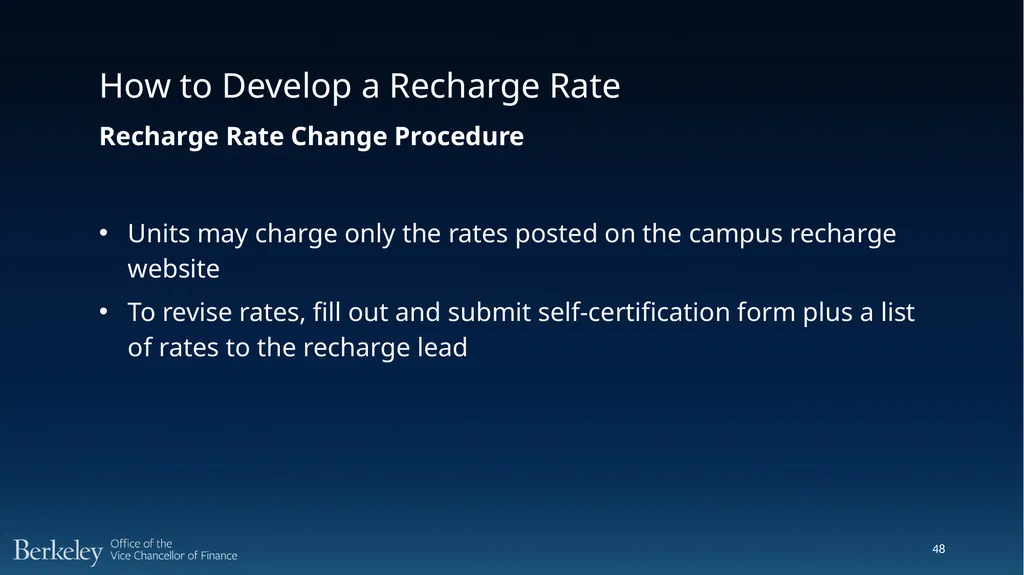
Recharge Rate Change Procedure 48 Units may charge only the rates posted on the campus recharge website
To revise rates, fill out and submit self-certification form plus a list of rates to the recharge lead<br>
Recharge Rate Change Procedure 48 Units may charge only the rates posted on the campus recharge website
To revise rates, fill out and submit self-certification form plus a list of rates to the recharge lead<br>
49
49 5. Billing for Recharge Goods or Services<br>
50
Billing for Recharge Goods or Services
Timely Billing 50 A recharge center must bill its customers in a timely manner
Within 60 days after the goods or services have been delivered or the project is complete; or
Within 60 days after the recharge center has been billed by a third party providing the goods or services
A revenue center should bill their customers in a timely manner to minimize the risk of non-payment
Best practice is to bill in advance and collect a deposit when possible<br>
Timely Billing 50 A recharge center must bill its customers in a timely manner
Within 60 days after the goods or services have been delivered or the project is complete; or
Within 60 days after the recharge center has been billed by a third party providing the goods or services
A revenue center should bill their customers in a timely manner to minimize the risk of non-payment
Best practice is to bill in advance and collect a deposit when possible<br>
51
Billing for Recharge Goods or Services
Timely Billing 51 If the billing schedule cannot be met, immediately contact your customers to negotiate a new schedule
If a mutually agreeable schedule cannot be met, the recharge center should contact the recharge lead for mediation
A recharge customer has 60 days from the time a recharge is posted to the general ledger to dispute the charge
Recharge units must use the university AR system to record receivables related to engagement with external clients<br>
Timely Billing 51 If the billing schedule cannot be met, immediately contact your customers to negotiate a new schedule
If a mutually agreeable schedule cannot be met, the recharge center should contact the recharge lead for mediation
A recharge customer has 60 days from the time a recharge is posted to the general ledger to dispute the charge
Recharge units must use the university AR system to record receivables related to engagement with external clients<br>
52
Billing for Recharge Goods or Services
Uncollectible Recharges 52 Uncollectible recharges are unallowable costs
Recharge units must identify a non-recharge chartstring to which these costs are charged
Recharge units may not include these costs in future rate developments<br>
Uncollectible Recharges 52 Uncollectible recharges are unallowable costs
Recharge units must identify a non-recharge chartstring to which these costs are charged
Recharge units may not include these costs in future rate developments<br>
53
Billing for Recharge Goods or Services
Statement Format and Content 53 Invoices for recharge goods or services must contain the following information (please refer to the policy document for a complete list):
Full chartstring charged
Description of goods / services provided
Date of service
Amount charged<br>
Statement Format and Content 53 Invoices for recharge goods or services must contain the following information (please refer to the policy document for a complete list):
Full chartstring charged
Description of goods / services provided
Date of service
Amount charged<br>
54
Billing for Recharge Goods or Services
Records Retention 54 Because recharge centers are subject to periodic review and their charges are subject to audit, each recharge center must retain the following records:
“Founding” documentation: 5 years after the unit is decommissioned
Rate development detail: 5 years
Recharge billing supporting documentation: 5 years
Recharge center operating costs
Please refer to UC retention guidelines at: policies.uci.edu<br>
Records Retention 54 Because recharge centers are subject to periodic review and their charges are subject to audit, each recharge center must retain the following records:
“Founding” documentation: 5 years after the unit is decommissioned
Rate development detail: 5 years
Recharge billing supporting documentation: 5 years
Recharge center operating costs
Please refer to UC retention guidelines at: policies.uci.edu<br>
55
55 6. Surpluses and Deficits<br>
56
Surpluses and Deficits
Recharge Operations Must Break-even 56 Break-even occurs when costs of products or services is equal to the recharge income received from customers
A recharge center is expected to operate close to break-even over a period of time and be within the recharge tolerance
Monitoring operating revenues, expenditures, and fund balances is the usual method for determining break-even compliance<br>
Recharge Operations Must Break-even 56 Break-even occurs when costs of products or services is equal to the recharge income received from customers
A recharge center is expected to operate close to break-even over a period of time and be within the recharge tolerance
Monitoring operating revenues, expenditures, and fund balances is the usual method for determining break-even compliance<br>
57
Surpluses and Deficits
Definition of a Large Surplus / Deficit 57 A large surplus / deficit is defined as:
Recharge fund balance greater than 1 month of operating expense (rolling 12 month average expenses)
If a unit needs to maintain a balance greater than 1 month of operating expense for day-to-day operations, it can seek approval from the recharge committee through the division<br>
Definition of a Large Surplus / Deficit 57 A large surplus / deficit is defined as:
Recharge fund balance greater than 1 month of operating expense (rolling 12 month average expenses)
If a unit needs to maintain a balance greater than 1 month of operating expense for day-to-day operations, it can seek approval from the recharge committee through the division<br>
58
Surpluses and Deficits
Deficits 58 Units must develop a deficit reduction plan to eliminate out-of-tolerance deficits as soon as possible
Reduction period should not exceed 1 year
Deficits outside of tolerance or outside of any approved deficit reduction plan at fiscal year’s end will be subject to the terms of the campus’ deficit resolution policy<br>
Deficits 58 Units must develop a deficit reduction plan to eliminate out-of-tolerance deficits as soon as possible
Reduction period should not exceed 1 year
Deficits outside of tolerance or outside of any approved deficit reduction plan at fiscal year’s end will be subject to the terms of the campus’ deficit resolution policy<br>
59
Surpluses and Deficits
Surpluses 59 Units cannot raise rates without a detailed review by the recharge committee
Units must submit a reduction plan to eliminate surplus within 3 months of out-of-tolerance status
Surplus reduction plans are submitted to the recharge lead
The plan should eliminate surplus as soon as possible to be within tolerance by fiscal year end
Surpluses cannot be transferred to reserve funds<br>
Surpluses 59 Units cannot raise rates without a detailed review by the recharge committee
Units must submit a reduction plan to eliminate surplus within 3 months of out-of-tolerance status
Surplus reduction plans are submitted to the recharge lead
The plan should eliminate surplus as soon as possible to be within tolerance by fiscal year end
Surpluses cannot be transferred to reserve funds<br>
60
60 7. Self-Monitoring<br>
61
Self-Monitoring 61 The recharge unit should monitor its recharge activity on a monthly basis, or at a minimum on a quarterly basis
Forecast should be updated to reflect the latest thinking for the balance of the year regarding recharge activities
Units can use Cal Answers reports and smartview reports, including the smartview report captured in the self-certification file to monitor recharge activities<br>
Forecast should be updated to reflect the latest thinking for the balance of the year regarding recharge activities
Units can use Cal Answers reports and smartview reports, including the smartview report captured in the self-certification file to monitor recharge activities<br>
62
62 8. Self-Certification<br>
63
Self-Certification
When to Self Certify 63 In January of each year as part of the yearly recharge budget process
To establish a new recharge center
To establish new services in an existing recharge center
To change rates for existing services
To apply new costing methodologies to existing rates<br>
When to Self Certify 63 In January of each year as part of the yearly recharge budget process
To establish a new recharge center
To establish new services in an existing recharge center
To change rates for existing services
To apply new costing methodologies to existing rates<br>
64
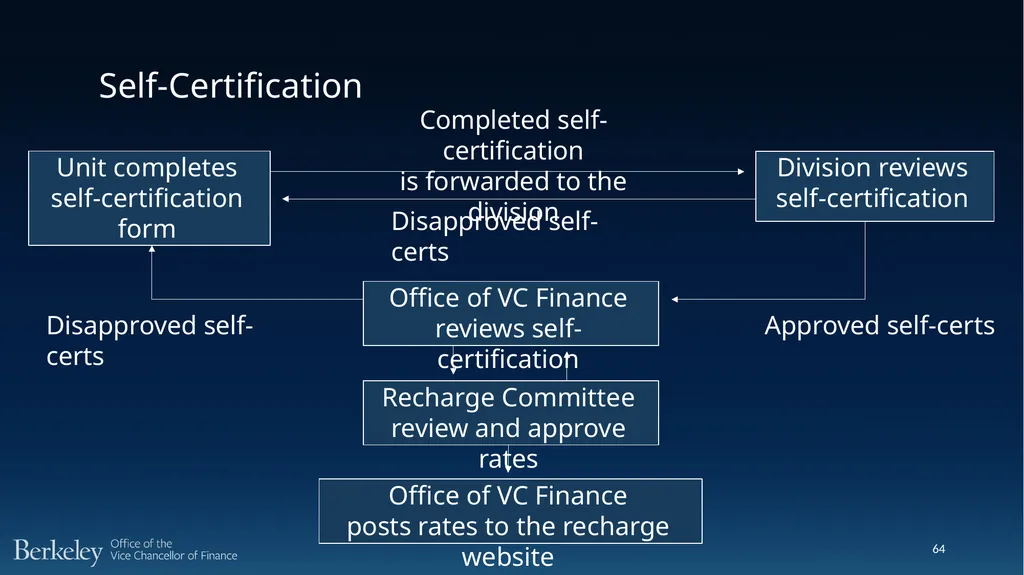
Self-Certification 64 Division reviews
self-certification Office of VC Finance
reviews self-certification Approved self-certs Completed self-certification
is forwarded to the division Office of VC Finance
posts rates to the recharge website Recharge Committee
review and approve rates Unit completes
self-certification form Disapproved self-certs Disapproved self-certs<br>
self-certification Office of VC Finance
reviews self-certification Approved self-certs Completed self-certification
is forwarded to the division Office of VC Finance
posts rates to the recharge website Recharge Committee
review and approve rates Unit completes
self-certification form Disapproved self-certs Disapproved self-certs<br>
65
Self-Certification
Recharge Rate Change Procedure 65 Normally within one month of receipt of all required documents in the Office of VC Finance, revised in-year rates are posted to the recharge website
After posting to the web, recharge centers may start applying new rates based on the approved effective dates of the rates
Recharge centers should notify customers of rate changes<br>
Recharge Rate Change Procedure 65 Normally within one month of receipt of all required documents in the Office of VC Finance, revised in-year rates are posted to the recharge website
After posting to the web, recharge centers may start applying new rates based on the approved effective dates of the rates
Recharge centers should notify customers of rate changes<br>
66
66 9. Audit<br>
67
Audit 67 Every year, internal and/or external audits will occur for recharge units
Recharge units should always be prepared to be audited and should maintain clean and accurate information about their recharge activities<br>
Recharge units should always be prepared to be audited and should maintain clean and accurate information about their recharge activities<br>
68
68 10. Sustainability and Green Practices<br>
69
Sustainability and Green Practices 69 Recharge units are expected to support and embrace the zero waste and carbon neutrality goals established on November 2013 by President Janet Napolitano, which commits UC to emitting net zero greenhouse gases from its buildings and vehicle fleet by 2025
When making decisions about investments, the carbon footprint impact should be an element of the decision making process<br>
When making decisions about investments, the carbon footprint impact should be an element of the decision making process<br>
70
Sustainability and Green Practices 70 When possible, gas-powered equipment, vehicles, and tools should be replaced with electric-powered ones to limit our carbon footprints
New vehicles should be electric powered
Goods outsourced from suppliers should also be evaluated from the perspective of zero waste and carbon footprint
Plastics should be eliminated from recharge operations when possible and be replaced with materials which can be reused or composted<br>
New vehicles should be electric powered
Goods outsourced from suppliers should also be evaluated from the perspective of zero waste and carbon footprint
Plastics should be eliminated from recharge operations when possible and be replaced with materials which can be reused or composted<br>
71
71 11. Closing a Recharge Operation<br>
72
Closing a Recharge Operation 72 Notify the Division / Dean’s Office within 10 days of deciding to close a recharge operation
the Division will forward the request to the Recharge Lead
Advise of the date-of-closure
Include proposal on how to account for any surplus / deficit in the unit<br>
the Division will forward the request to the Recharge Lead
Advise of the date-of-closure
Include proposal on how to account for any surplus / deficit in the unit<br>
73
Closing a Recharge Operation 73 If surplus is greater than 1 month operating cost, balance will be refunded to customers on pro-rata basis
If surplus is less than 1 month operating cost, balance will be moved to appropriate chart string
Must settle balance within 30 days of closure
Deficits at fiscal year’s end are subject to the terms of the campus’ deficit resolution policy without the application of a tolerance<br>
If surplus is less than 1 month operating cost, balance will be moved to appropriate chart string
Must settle balance within 30 days of closure
Deficits at fiscal year’s end are subject to the terms of the campus’ deficit resolution policy without the application of a tolerance<br>
74
74 12. Common Issues<br>
75
Common Issues 75 How to fund equipment purchases:
Equipment reserves
Gifts / donations
Campus or third party loans
Operating or capital lease
Surcharge income<br>
Equipment reserves
Gifts / donations
Campus or third party loans
Operating or capital lease
Surcharge income<br>
76
Common Issues 76 Depreciation omitted from rate development
Failure to follow billing policies and procedures
Adjustments for inventory
Established surplus / deficit reduction plan not executed
Unallowable costs in rate development<br>
Failure to follow billing policies and procedures
Adjustments for inventory
Established surplus / deficit reduction plan not executed
Unallowable costs in rate development<br>
77
Common Issues 77 Distortion of financial position by surcharge income recorded to operations fund
Inappropriate allocation basis in rate development
Charging unapproved rates
Inappropriate use of surplus balances<br>
Inappropriate allocation basis in rate development
Charging unapproved rates
Inappropriate use of surplus balances<br>
78
78 13. References and Contact Information<br>
79
References and Contact Information
References 79 Recharge Website:
cfo.berkeley.edu/recharge
Recharge Policy Document
Business and Finance Bulletin A-47
Business and Finance Bulletin A-56
Contract and Grant Manual<br>
References 79 Recharge Website:
cfo.berkeley.edu/recharge
Recharge Policy Document
Business and Finance Bulletin A-47
Business and Finance Bulletin A-56
Contract and Grant Manual<br>
80
References and Contact Information
References 80 Recharge Billing Policies & Procedures
Facilities and Administrative rates (F&A rate)
OMB Uniform Guidance
AFC Policy
AFC Campus Policies and Procedures
Sustainability Office<br>
References 80 Recharge Billing Policies & Procedures
Facilities and Administrative rates (F&A rate)
OMB Uniform Guidance
AFC Policy
AFC Campus Policies and Procedures
Sustainability Office<br>
81
References and Contact Information
Resources 81 All recharge related correspondence:
recharge_certification@berkeley.edu
Recharge policy and procedures queries - Herve’ Bruckert:
hbruckert@berkeley.edu<br>
Resources 81 All recharge related correspondence:
recharge_certification@berkeley.edu
Recharge policy and procedures queries - Herve’ Bruckert:
hbruckert@berkeley.edu<br>
82
82 14. Forms and Templates<br>
83
Forms and Templates 83 Forms and templates can be found on the recharge website:
cfo.berkeley.edu/recharge<br>
cfo.berkeley.edu/recharge<br>