
Developing Recharge Rates Hervé Bruckert
Description: Developing Recharge Rates Hervé Bruckert January7th, 2021 1 Agenda Overview Identify Lines of Business Develop Cost Pools Depreciation, Inventory and Subsidies Determine Equitable Means of Distribution Create Rates Review and Test Rates
Related Topics
Download Presentation
"Developing Recharge Rates Hervé Bruckert" is the property of its rightful owner. Permission is granted to download and print the materials on this website for personal, non-commercial use only, and to display it on your personal computer provided you do not modify the materials and that you retain all copyright notices contained in the materials. By downloading content from our website, you accept the terms of this agreement.
Presentation Transcript
slide1. Developing Recharge Rates Hervé Bruckert
January7th, 2021 1<br>
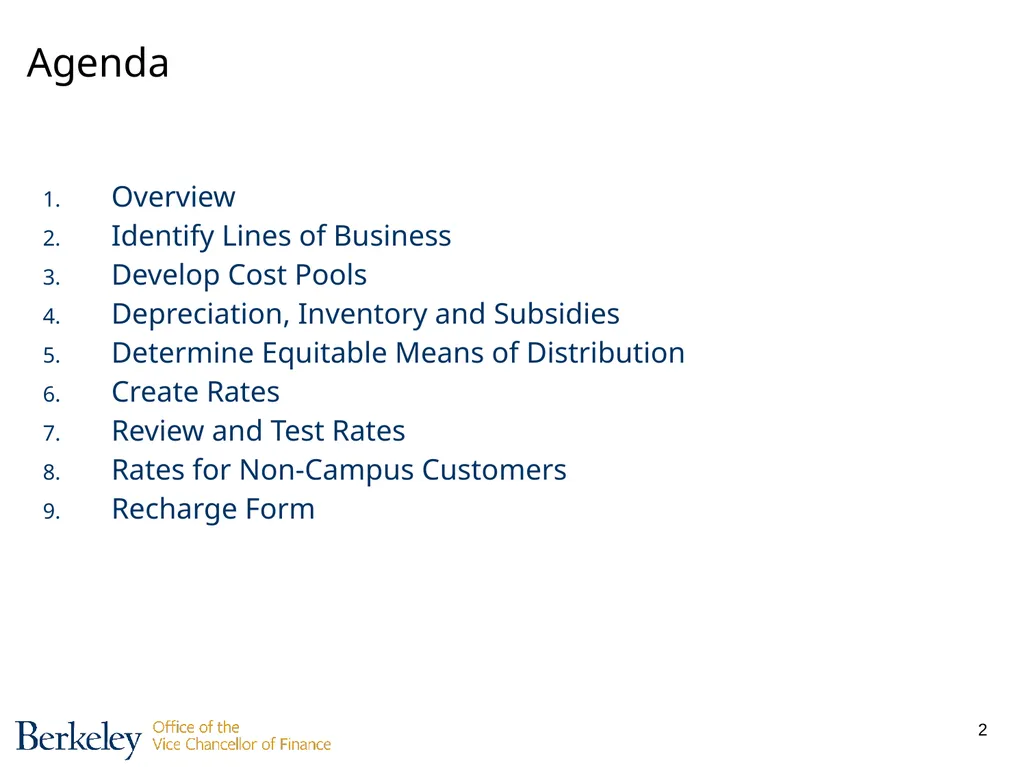
slide2. Agenda Overview
Identify Lines of Business
Develop Cost Pools
Depreciation, Inventory and Subsidies
Determine Equitable Means of Distribution
Create Rates
Review and Test Rates
Rates for Non-Campus Customers
Recharge Form 2<br>
slide3. Agenda Overview 3<br>
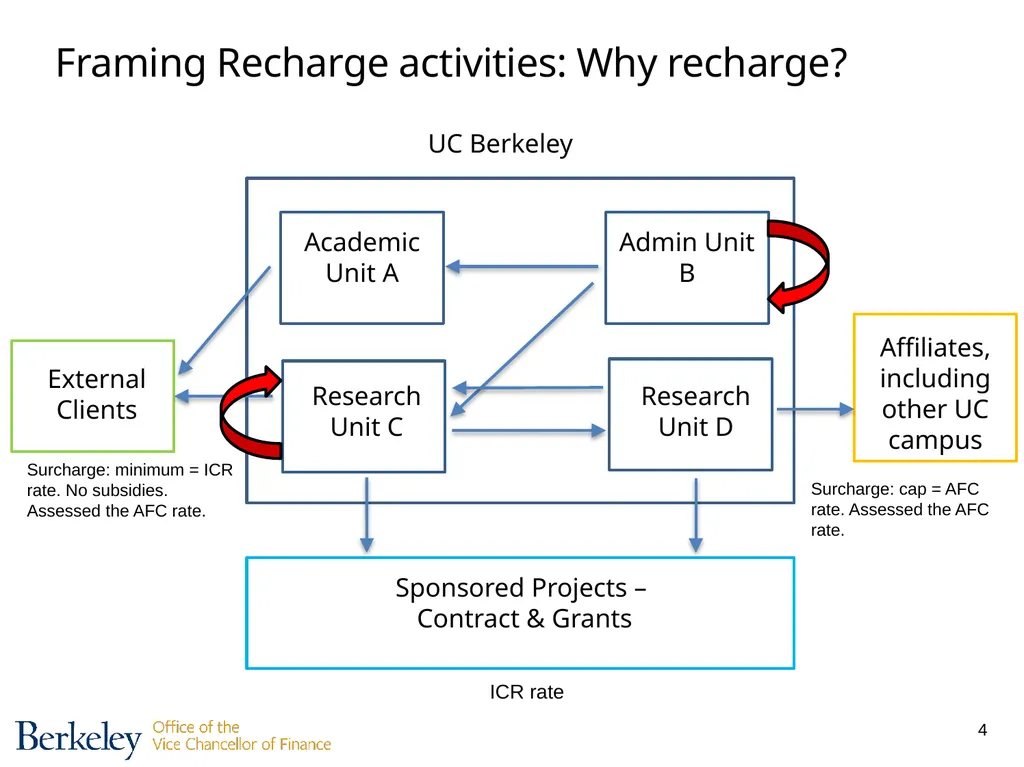
slide4. Framing Recharge activities: Why recharge? UC Berkeley Academic Unit A Admin Unit B External Clients Affiliates, including other UC campus Research Unit C Research Unit D Sponsored Projects –
Contract & Grants 4 Surcharge: minimum = ICR rate. No subsidies.
Assessed the AFC rate. ICR rate Surcharge: cap = AFC rate. Assessed the AFC rate.<br>
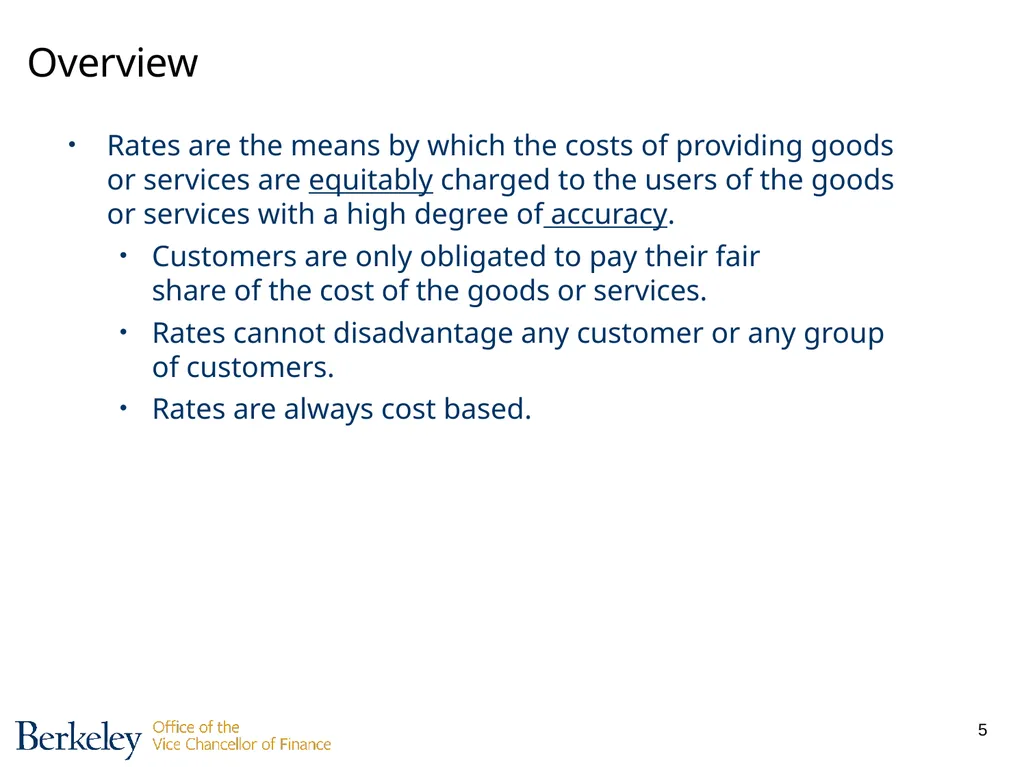
slide5. Overview Rates are the means by which the costs of providing goods or services are equitably charged to the users of the goods or services with a high degree of accuracy.
Customers are only obligated to pay their fair share of the cost of the goods or services.
Rates cannot disadvantage any customer or any group of customers.
Rates are always cost based. 5<br>
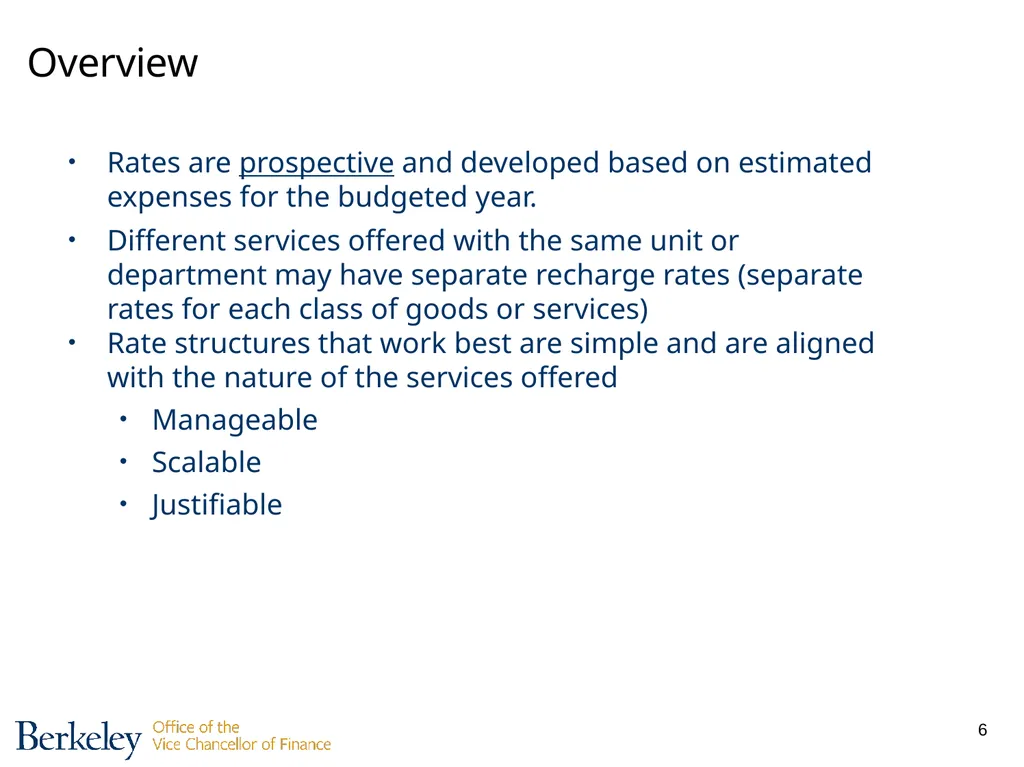
slide6. Overview Rates are prospective and developed based on estimated expenses for the budgeted year.
Different services offered with the same unit or department may have separate recharge rates (separate rates for each class of goods or services)
Rate structures that work best are simple and are aligned with the nature of the services offered
Manageable
Scalable
Justifiable 6<br>
slide7. Agenda Identify Lines of Business
Customers
Case Studies 7<br>
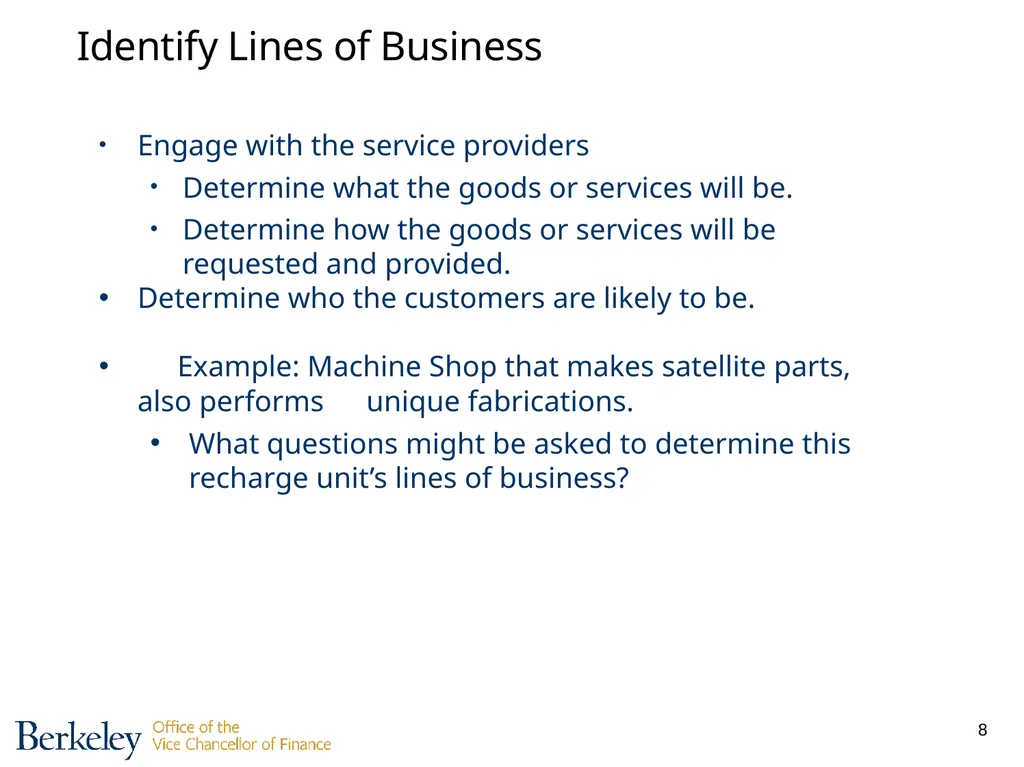
slide8. Identify Lines of Business Engage with the service providers
Determine what the goods or services will be.
Determine how the goods or services will be requested and provided.
Determine who the customers are likely to be.
Example: Machine Shop that makes satellite parts, also performs unique fabrications.
What questions might be asked to determine this recharge unit’s lines of business? 8<br>
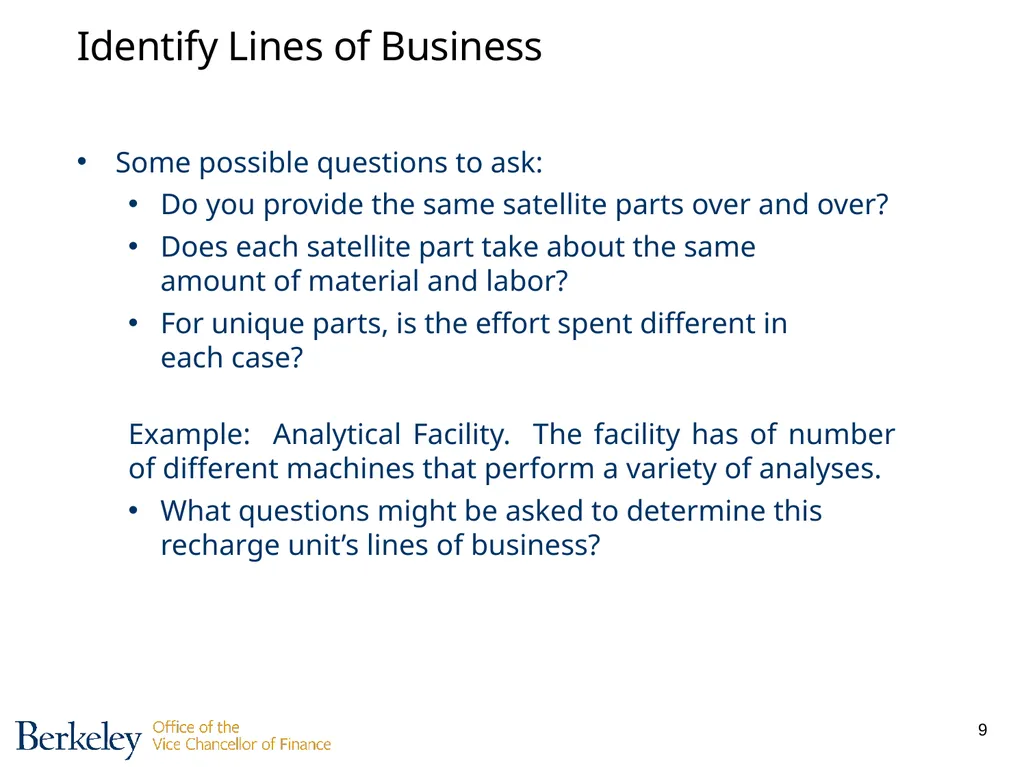
slide9. Some possible questions to ask:
Do you provide the same satellite parts over and over?
Does each satellite part take about the same amount of material and labor?
For unique parts, is the effort spent different in each case?
Example: Analytical Facility. The facility has of number of different machines that perform a variety of analyses.
What questions might be asked to determine this recharge unit’s lines of business? Identify Lines of Business 9<br>
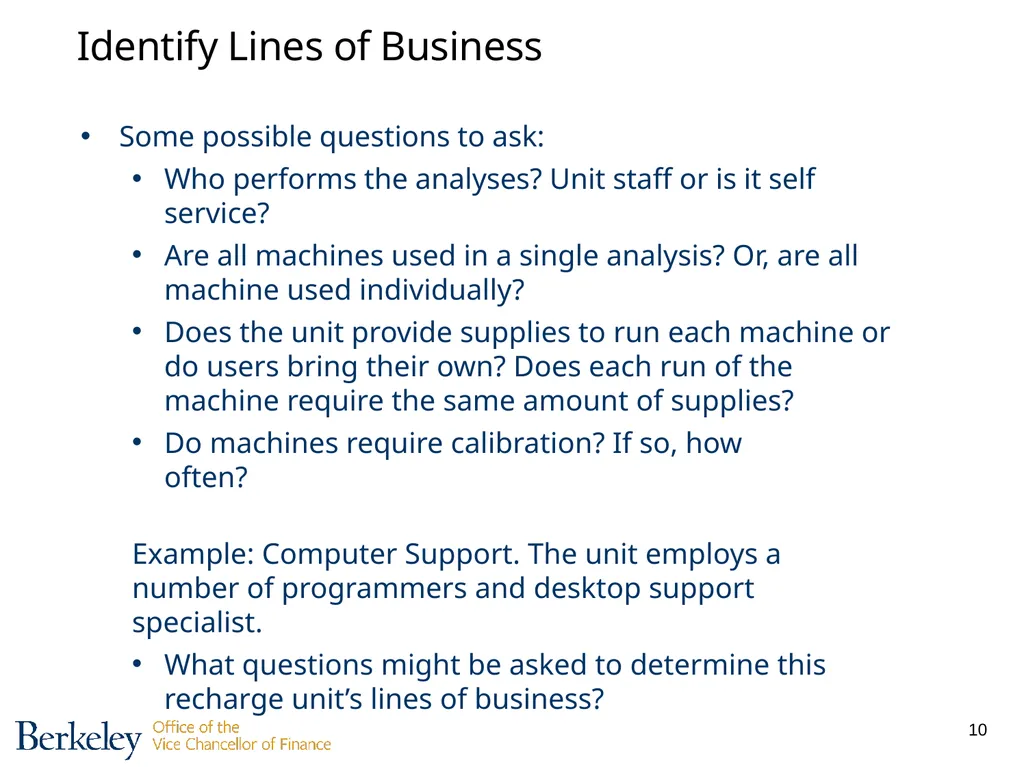
slide10. Some possible questions to ask:
Who performs the analyses? Unit staff or is it self service?
Are all machines used in a single analysis? Or, are all machine used individually?
Does the unit provide supplies to run each machine or do users bring their own? Does each run of the machine require the same amount of supplies?
Do machines require calibration? If so, how often?
Example: Computer Support. The unit employs a number of programmers and desktop support specialist.
What questions might be asked to determine this recharge unit’s lines of business? Identify Lines of Business 10<br>
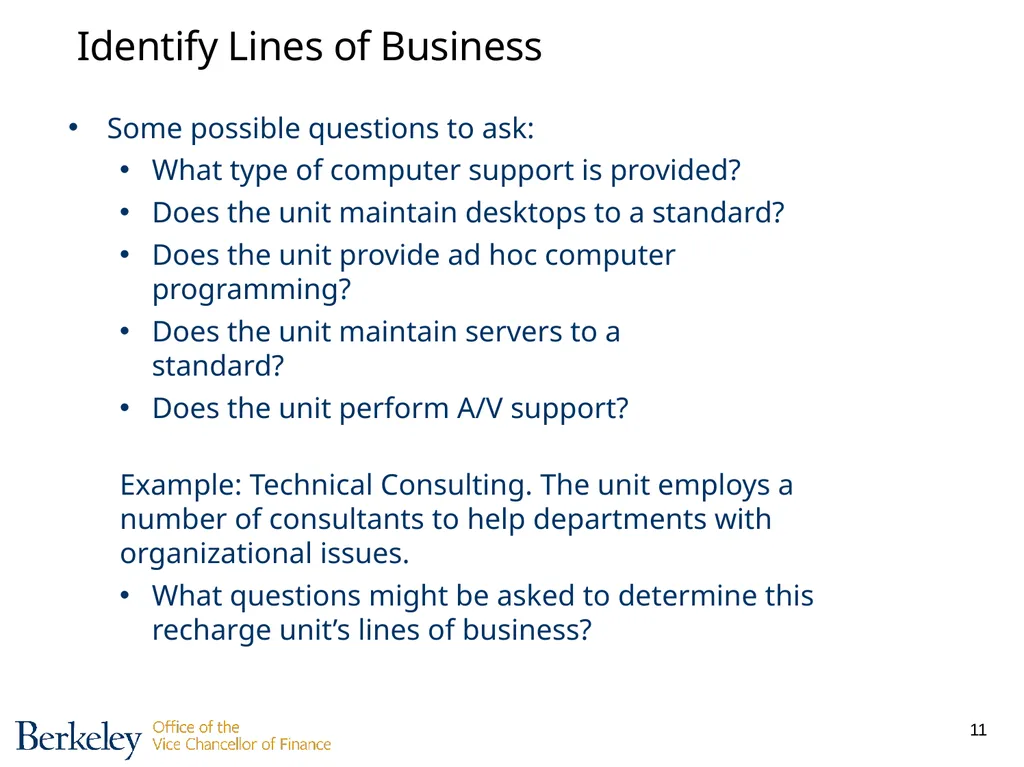
slide11. Some possible questions to ask:
What type of computer support is provided?
Does the unit maintain desktops to a standard?
Does the unit provide ad hoc computer programming?
Does the unit maintain servers to a standard?
Does the unit perform A/V support?
Example: Technical Consulting. The unit employs a number of consultants to help departments with organizational issues.
What questions might be asked to determine this recharge unit’s lines of business? Identify Lines of Business 11<br>
slide12. Some possible questions to ask:
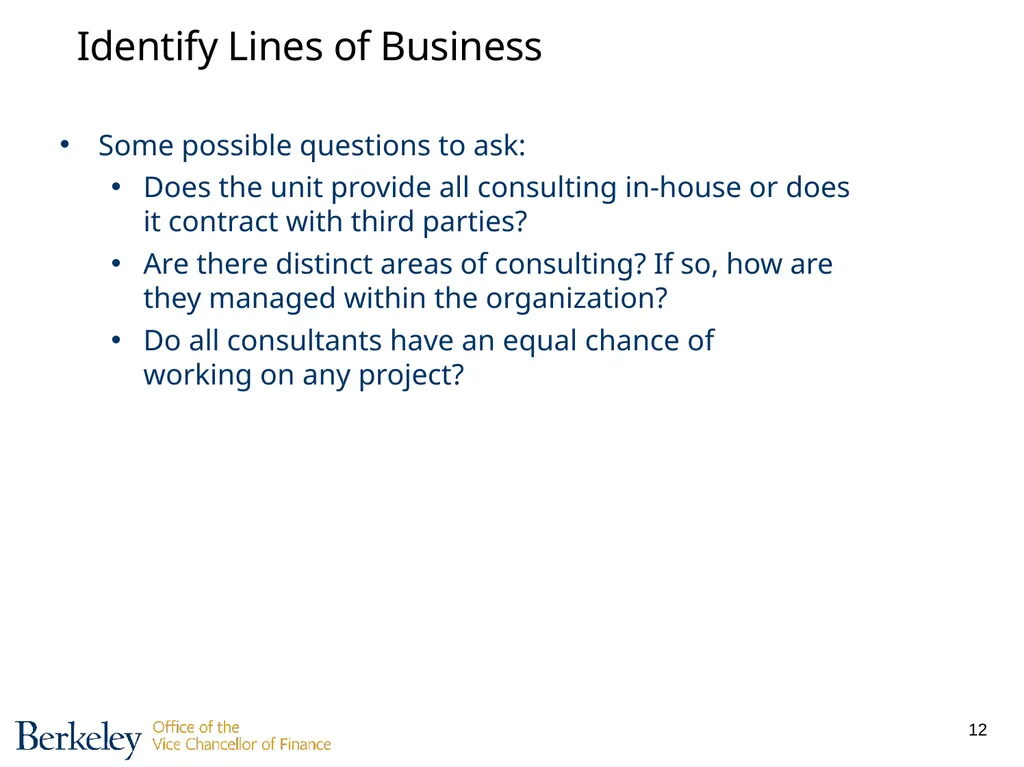
Does the unit provide all consulting in-house or does it contract with third parties?
Are there distinct areas of consulting? If so, how are they managed within the organization?
Do all consultants have an equal chance of working on any project? Identify Lines of Business 12<br>
slide13. Agenda Develop Cost Pools
Depreciation, Inventory and Subsidies
Determine Equitable Means of Distribution
Create Rates
Review and Case Studies 13<br>
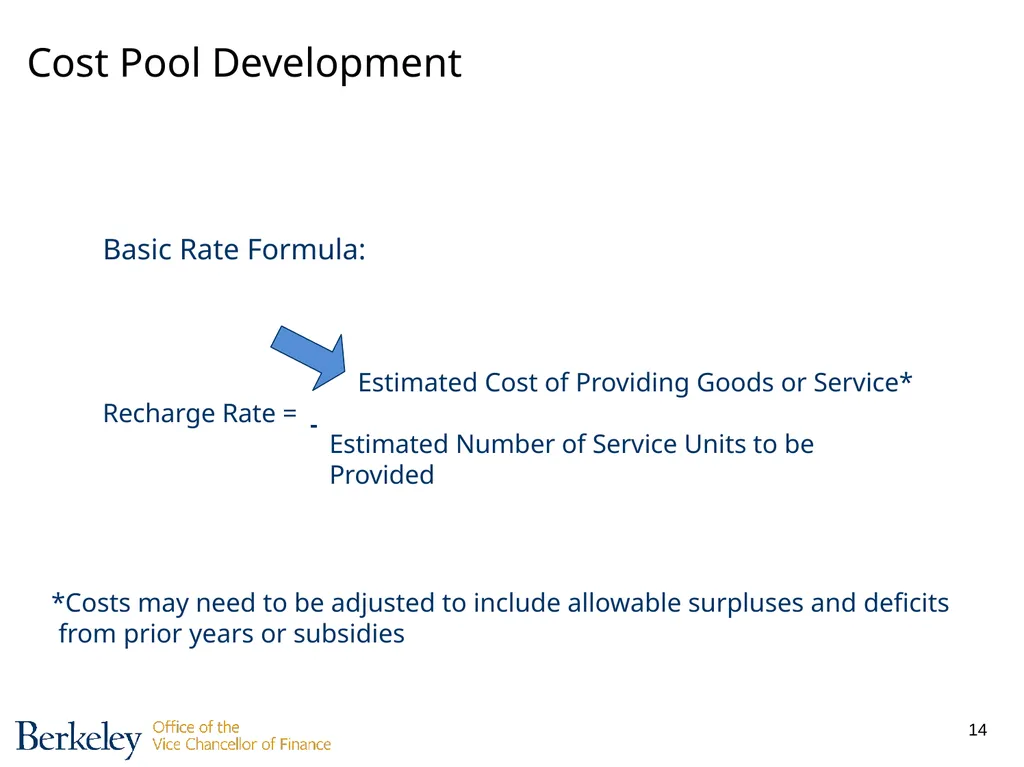
slide14. Cost Pool Development Basic Rate Formula: Estimated Cost of Providing Goods or Service* Recharge Rate =
Estimated Number of Service Units to be Provided *Costs may need to be adjusted to include allowable surpluses and deficits from prior years or subsidies 14<br>
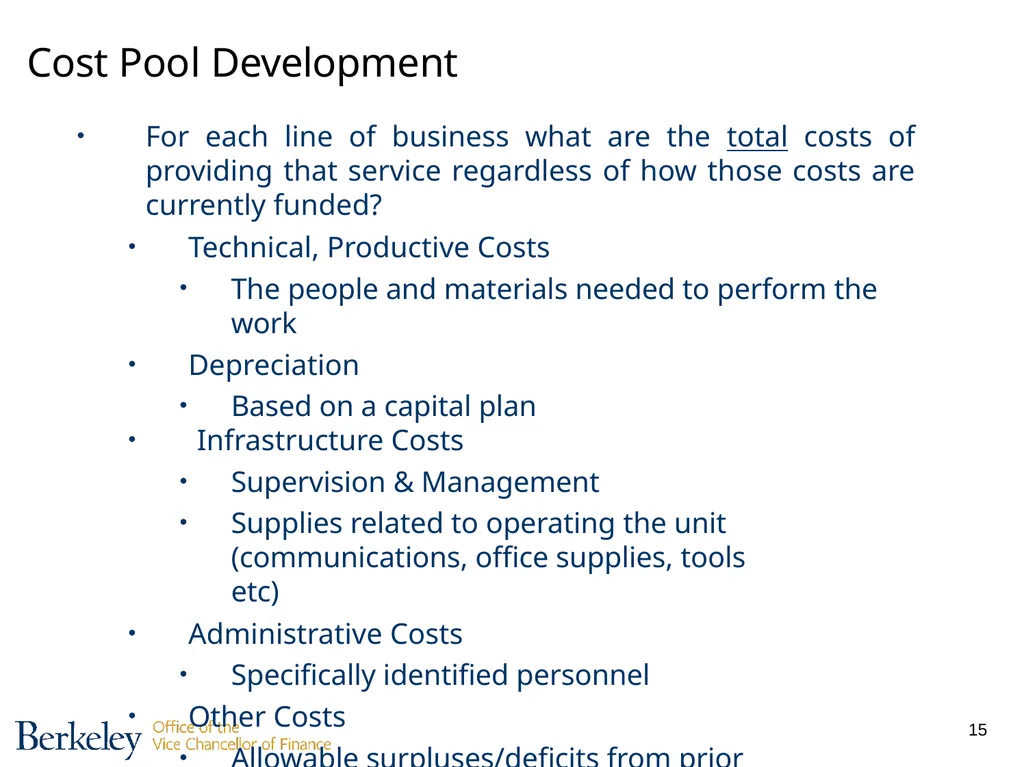
slide15. Cost Pool Development For each line of business what are the total costs of providing that service regardless of how those costs are currently funded?
Technical, Productive Costs
The people and materials needed to perform the work
Depreciation
Based on a capital plan
Infrastructure Costs
Supervision & Management
Supplies related to operating the unit (communications, office supplies, tools etc)
Administrative Costs
Specifically identified personnel
Other Costs
Allowable surpluses/deficits from prior period operation 15<br>
slide16. Cost Pool Development Be sure to recognize the offsets to the unit’s total costs
Rebates & Incentive Payments
Trade-ins
Special type of offset
Subsidies 16<br>
slide17. Cost Pool Development Costs need to be reasonable
Is the cost generally recognized as necessary for the operation? Costs must be treated consistently, direct v. indirect.
Costs need to be allocable
If allocating a cost to a recharge unit, the unit must be able to assign a cost, or a group of costs, to the recharge pool in reasonable and realistic proportion, that demonstrates the benefit provided.
Costs need to be identifiable
A cost which can be identified specifically with a recharge product or service.
Costs must be allowable 17<br>
slide18. Shared Costs Because shared costs may not be identifiable to specific lines of business they can be assigned to lines of business through an allocation process.
Most often seen with overhead or administrative costs.
Make sure you have a solid basis for the distribution of these costs.
Examples: Facility costs over square footage, equipment used for several different recharge services. 18<br>
slide19. Agenda Cost Pools
Depreciation, Inventory and Subsidies
Determine Equitable Means of Distribution
Create Rates
Review and Case Studies 19<br>
slide20. Depreciation Depreciation is the allocation of a capital asset’s cost over its useful life.
Assures customers pay for only their fair share of capital costs.
Use a depreciation schedule to identify depreciable assets and to calculate periodic depreciation expense. 20<br>
slide21. Depreciation Schedules prepared for a rate calculation forecast depreciation expense.
Schedules used in rate calculation can include anticipated purchases but, should be adjusted for previous years’ actual expense to avoid over-depreciating.
Best practice is to start depreciation in the month of acquisition, but can employ a “half year” convention. 21<br>
slide22. Depreciation All equipment used in the recharge center except:
Equipment funded by the federal government.
Equipment funded by an incomplete, private contract or grant.
Equipment identified as cost sharing to a federal research project. 22<br>
slide23. Depreciation List of all eligible capital assets identifying:
Property number
Purchase date
Value
Salvage value
Useful life
UCOP useful life tables
Actual experience
Calculate periodic charge 23<br>
slide24. Depreciation As of July 1, 2004 equipment is defined as having a useful life of one year or greater and an acquisition cost of $5,000 or greater.
Continue to depreciate existing assets until they are fully depreciated.
New acquisitions follow the new definition.
Replacement items that cost <$5,000 should be included as an in-year cost in rate development. 24<br>
slide25. Depreciation - case sample An asset used in the recharge operation has never been depreciated. It has a useful life of 5 years and is currently 3 years old. Can I claim 3 years of depreciation this year and 1 year each for the next 2 years to true up?
Will a deficit that results from depreciation “true up” be an allowable deficit for future rate calculations? Yes. 25<br>
slide26. Depreciation - case sample An asset that I’ve included in recharge rates is now obsolete. It had 2 more years left on its useful life. Do I keep including the asset on my depreciation schedule until it is fully depreciated?
No. Record the loss as an expense to the recharge operation and remove the asset from future depreciation schedules. Any deficit the loss creates in the operations fund can be included in future rates. 26<br>
slide27. Depreciation - case sample I am leasing a piece of equipment. How do I account for the lease payments and depreciation?
Is it a capital lease or an operational lease?
If operational, charge payments to operations fund and do not include the asset on any depreciation schedule.
If a capital lease where UC takes title, include on depreciation schedule and charge lease payments to reserve (or other non-federal) fund.
Lease payments that are about equal to the depreciation that could be claimed can be charged directly to operations fund and excluded from the depreciation schedule. 27<br>
slide28. Inventory Inventory is defined as products for resale or the raw materials to be used in the production of goods. Finished or partially finished products can also be considered inventory.
Rates that have an inventory component must account for any allowable losses or shrinkage. 28<br>
slide29. Inventory For inventory shrinkage calculation:
Perform a physical count of all goods.
Value inventory at average cost (not replacement cost).
Compare inventory to actual sales to determine loss, then value the loss.
“Normal” shrinkage included in rates. “Abnormal” shrinkage must be written off and possibly excluded from rates. 29<br>
slide30. Subsidies Subsidies are a special type of cost offset.
Be sure subsidies are included as a line item in the rate development.
Once a subsidy is included in a rate development, all campus and affiliate users of the service are afforded the benefit of the subsidy. 30<br>
slide31. Agenda , Inventory and Subsidies
Determine Equitable Means of Distribution
Create Rates
Review and Test Customers
Case Studies 31<br>
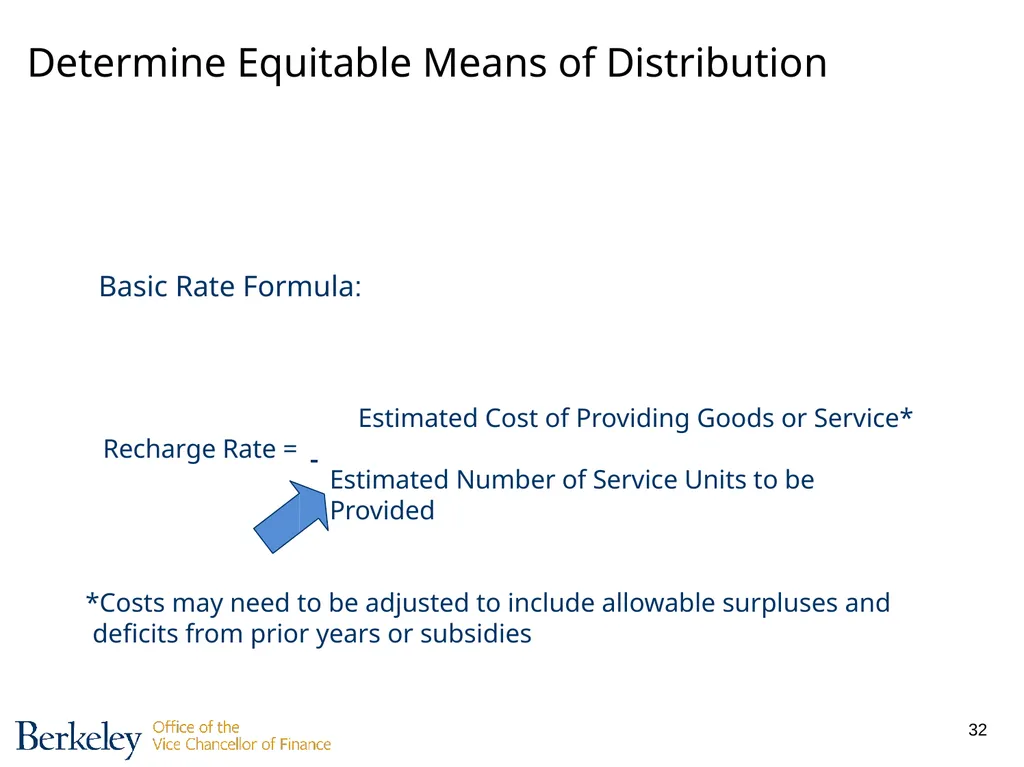
slide32. Determine Equitable Means of Distribution Basic Rate Formula: Estimated Cost of Providing Goods or Service* Recharge Rate =
Estimated Number of Service Units to be Provided *Costs may need to be adjusted to include allowable surpluses and deficits from prior years or subsidies 32<br>
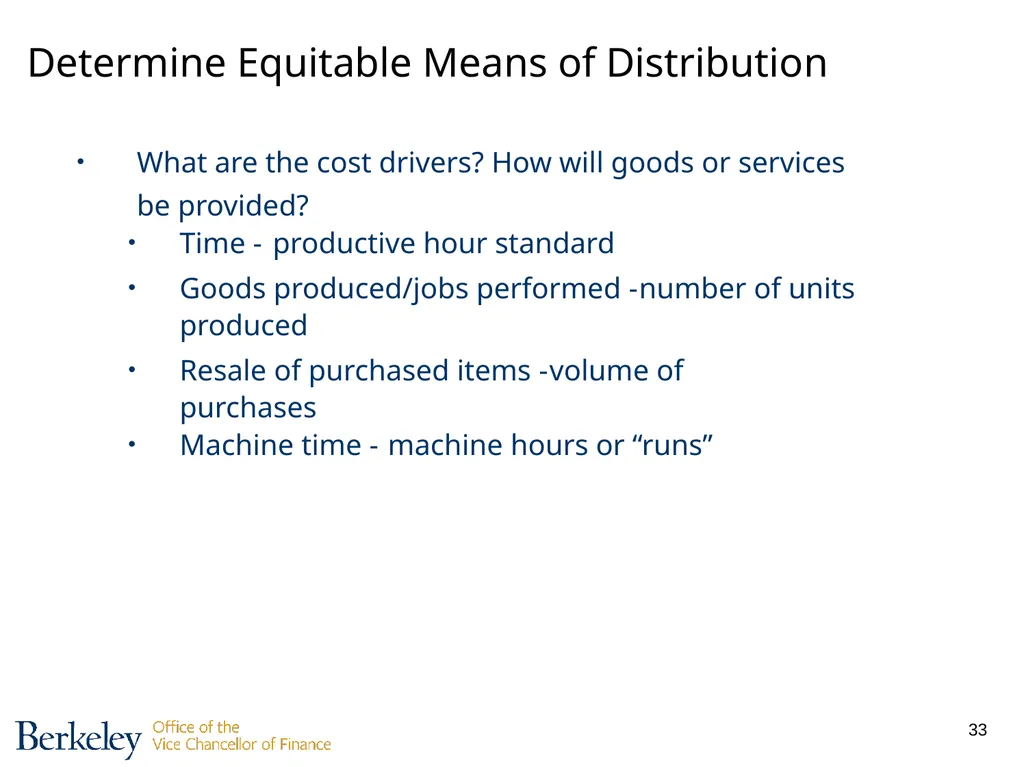
slide33. Determine Equitable Means of Distribution What are the cost drivers? How will goods or services be provided?
Time - productive hour standard
Goods produced/jobs performed -number of units produced
Resale of purchased items -volume of purchases
Machine time - machine hours or “runs” 33<br>
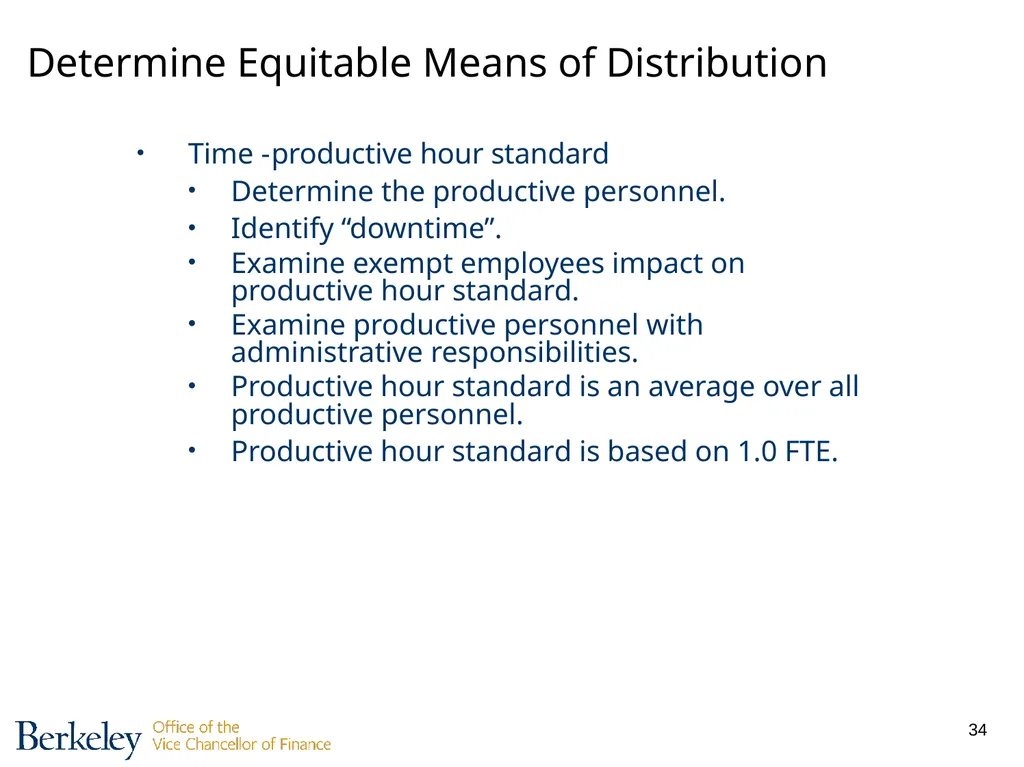
slide34. Determine Equitable Means of Distribution Time -productive hour standard
Determine the productive personnel.
Identify “downtime”.
Examine exempt employees impact on productive hour standard.
Examine productive personnel with administrative responsibilities.
Productive hour standard is an average over all productive personnel.
Productive hour standard is based on 1.0 FTE. 34<br>
slide35. Determine Equitable Means of Distribution Goods produced/jobs performed - number of units produced
Account for prototypes.
Account for defective units. 35<br>
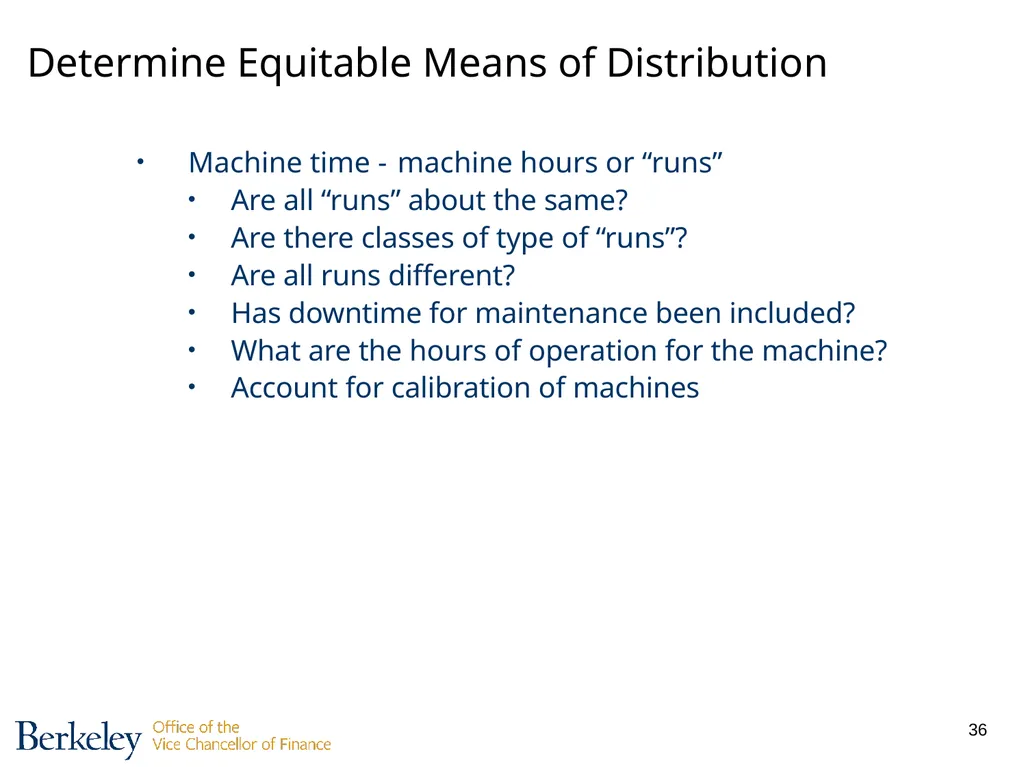
slide36. Determine Equitable Means of Distribution Machine time - machine hours or “runs”
Are all “runs” about the same?
Are there classes of type of “runs”?
Are all runs different?
Has downtime for maintenance been included?
What are the hours of operation for the machine?
Account for calibration of machines 36<br>
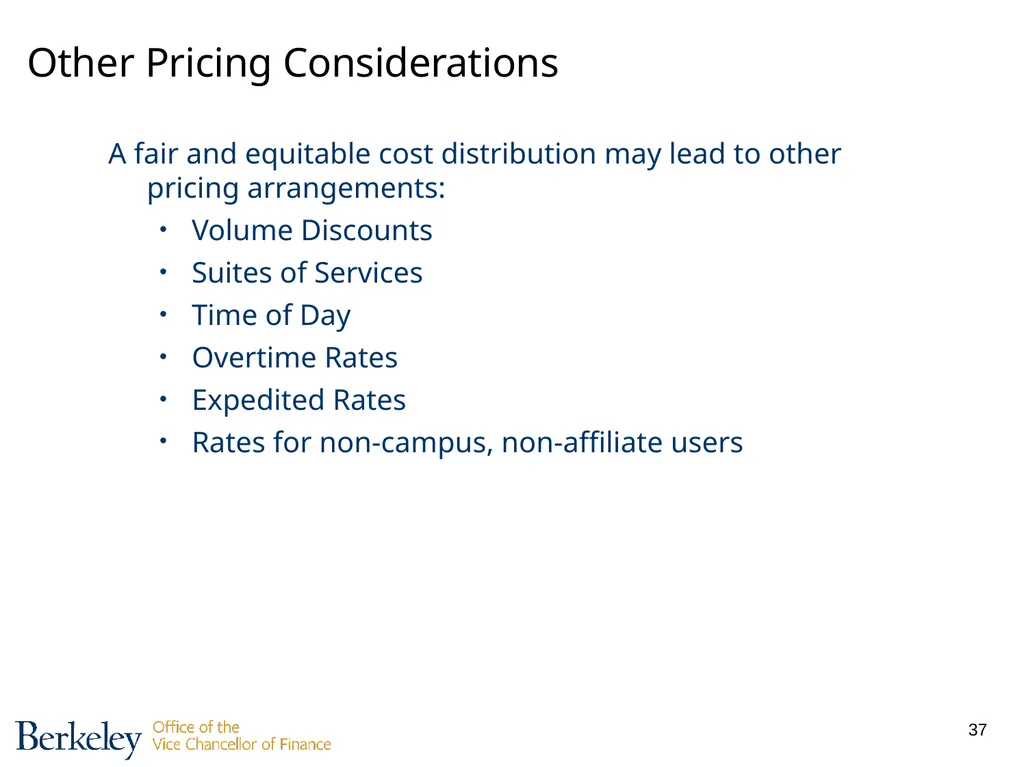
slide37. Other Pricing Considerations A fair and equitable cost distribution may lead to other pricing arrangements:
Volume Discounts
Suites of Services
Time of Day
Overtime Rates
Expedited Rates
Rates for non-campus, non-affiliate users 37<br>
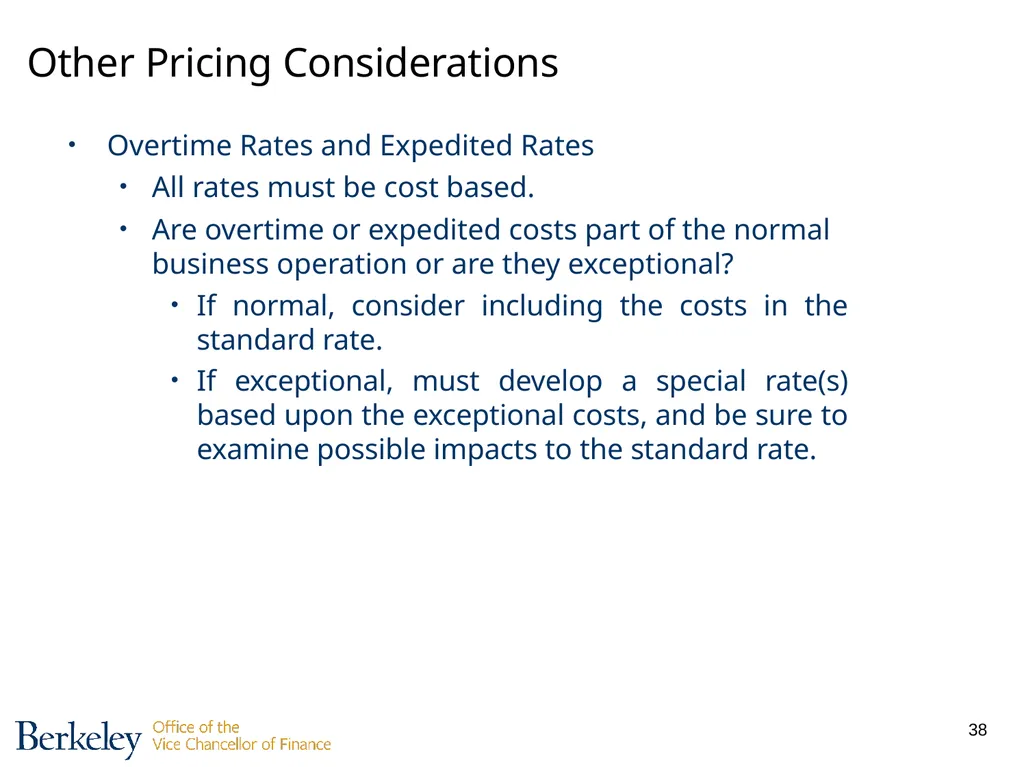
slide38. Other Pricing Considerations Overtime Rates and Expedited Rates
All rates must be cost based.
Are overtime or expedited costs part of the normal business operation or are they exceptional?
If normal, consider including the costs in the standard rate.
If exceptional, must develop a special rate(s) based upon the exceptional costs, and be sure to examine possible impacts to the standard rate. 38<br>
slide39. Agenda of Distribution
Create Rates
Review and Case Studies 39<br>
slide40. Create Rates Rounding rates is acceptable, as long as it is reasonable.
Multiple lines of business often translate into multiple rates for a recharge center.
Avoid double counting costs.
Account for surpluses or deficits along each rate.
Avoid the appearance of one rate subsidizing another. 40<br>
slide41. Create Rates Packaged or Bundled Rates
Are allowed provided they are costed properly, are reasonable and justifiable.
Be sure to examine rationale behind the creation of any rate type. 41<br>
slide42. Agenda Review and Test Rates
Rates for Case Studies 42<br>
slide43. Review of Rates For each rate, examine the ratio of direct costs to infrastructure costs. Assure that their relationship is logical and supported for the type of goods or services provided. 43<br>
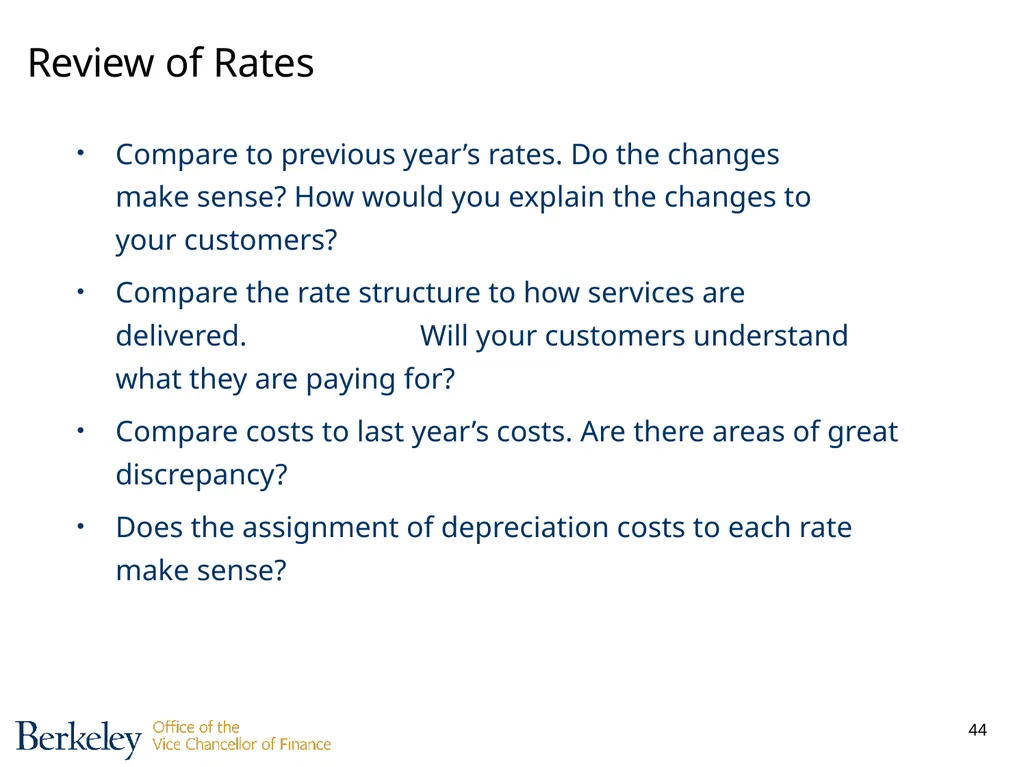
slide44. Review of Rates Compare to previous year’s rates. Do the changes make sense? How would you explain the changes to your customers?
Compare the rate structure to how services are delivered. Will your customers understand what they are paying for?
Compare costs to last year’s costs. Are there areas of great discrepancy?
Does the assignment of depreciation costs to each rate make sense? 44<br>
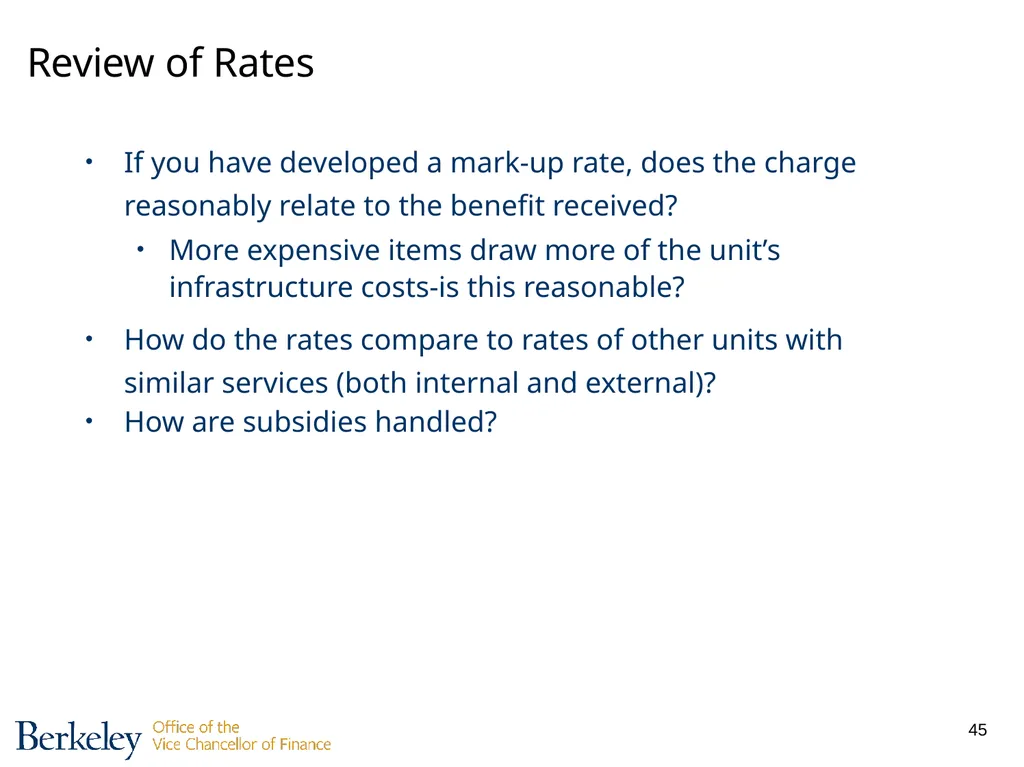
slide45. Review of Rates If you have developed a mark-up rate, does the charge reasonably relate to the benefit received?
More expensive items draw more of the unit’s infrastructure costs-is this reasonable?
How do the rates compare to rates of other units with similar services (both internal and external)?
How are subsidies handled? 45<br>
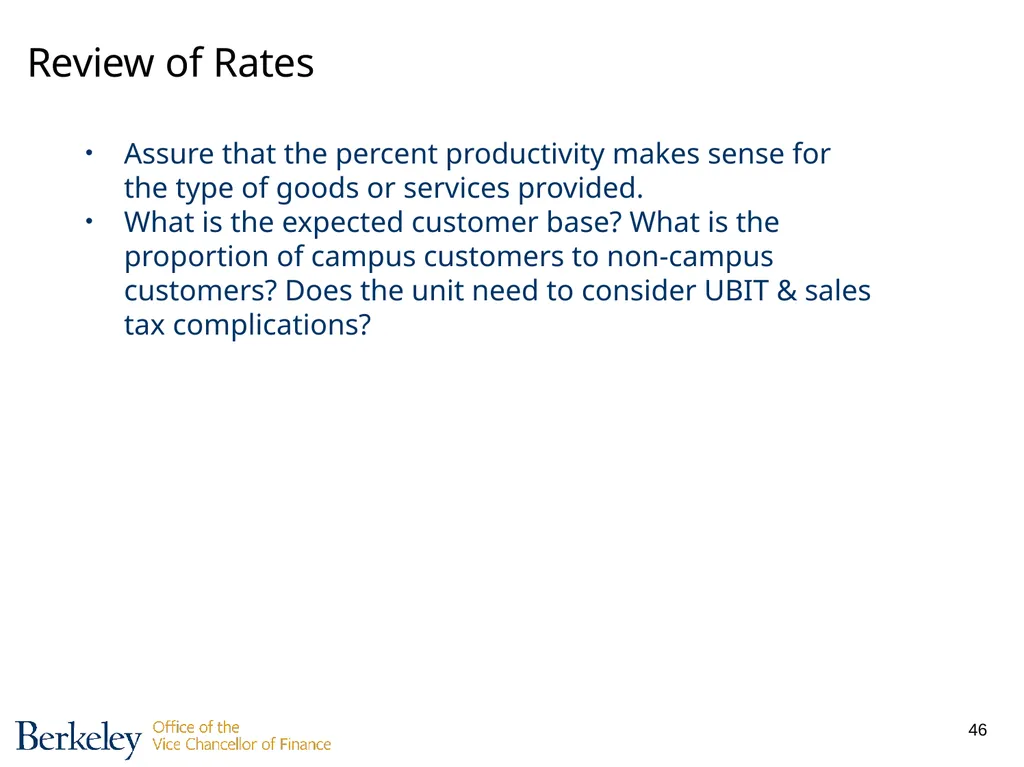
slide46. Review of Rates Assure that the percent productivity makes sense for the type of goods or services provided.
What is the expected customer base? What is the proportion of campus customers to non-campus customers? Does the unit need to consider UBIT & sales tax complications? 46<br>
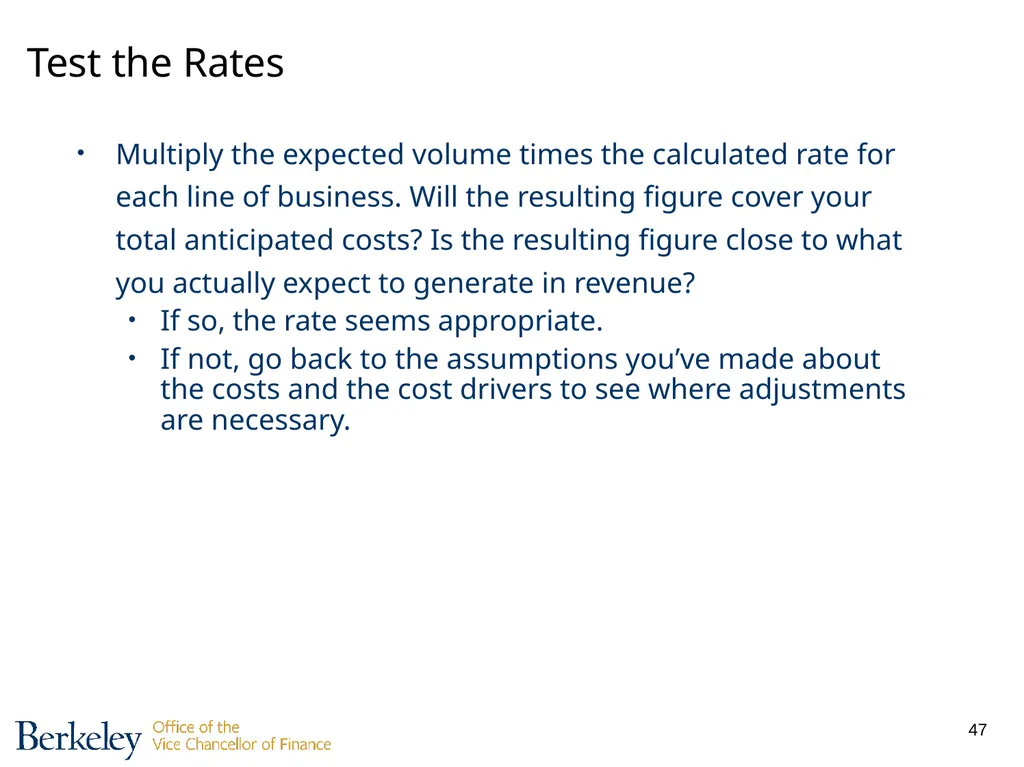
slide47. Test the Rates Multiply the expected volume times the calculated rate for each line of business. Will the resulting figure cover your total anticipated costs? Is the resulting figure close to what you actually expect to generate in revenue?
If so, the rate seems appropriate.
If not, go back to the assumptions you’ve made about the costs and the cost drivers to see where adjustments are necessary. 47<br>
slide48. Test the Rates Compare shrinkage to sales. Is the ratio within tolerable limits?
If so, the rate seems appropriate.
If not, are there other areas that need to be evaluated? 48<br>
slide49. Agenda Rates for Non-Campus Customers
Case Studies 49<br>
slide50. Rates for Non-Campus Customers Special consideration for non-campus, non-affiliate customers:
Remove all subsidies from rate.
Include federally unallowable costs in rate such as Gael and UCRP supplemental interest.
Apply surcharge at the ICR rate at a minimum. The ICR rate are negotiated and our true overhead costs are higher than the ICR rate.
Rates for the same goods or services for non-campus, non-affiliate customers are never lower than rates for campus customers for the same goods or services.
Avoid the appearance of competing with commercial entities.
Avoid the appearance of a state funded entity subsidizing commercial enterprises. 50<br>
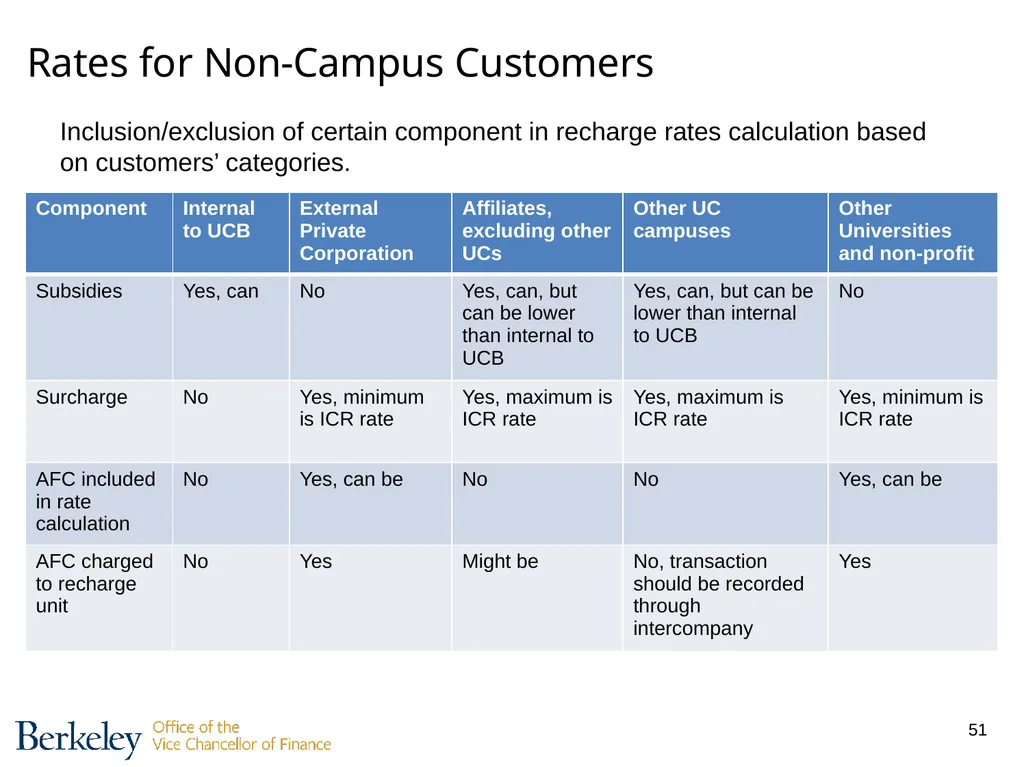
slide51. Rates for Non-Campus Customers 51 Inclusion/exclusion of certain component in recharge rates calculation based on customers’ categories.<br>
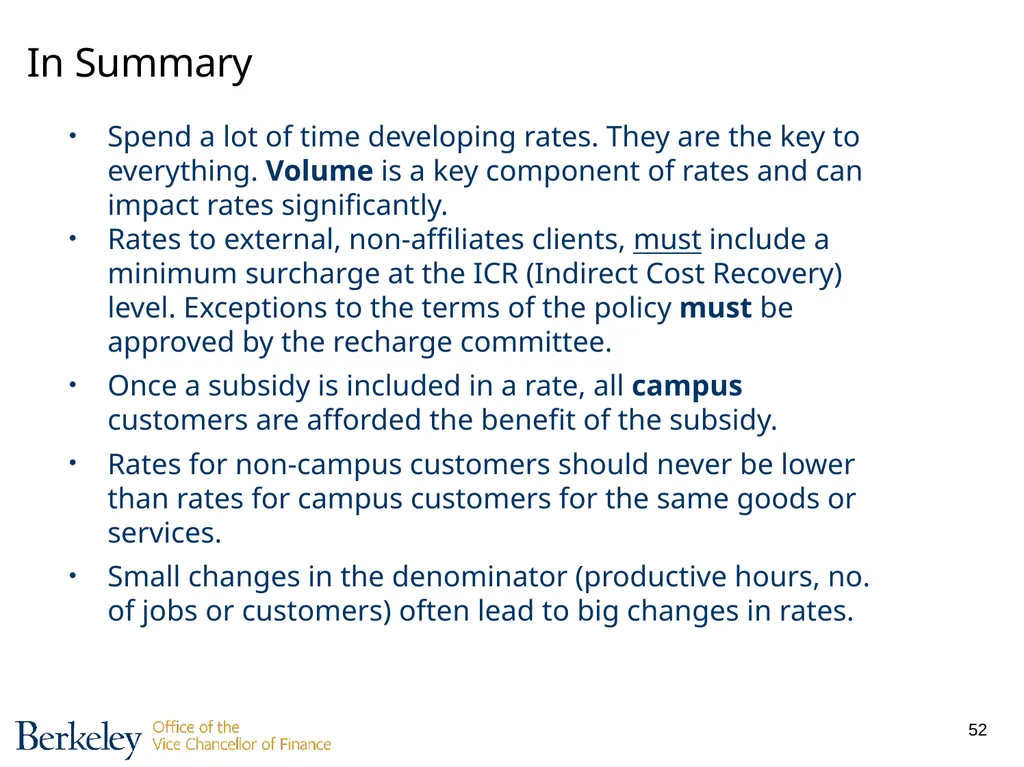
slide52. In Summary Spend a lot of time developing rates. They are the key to everything. Volume is a key component of rates and can impact rates significantly.
Rates to external, non-affiliates clients, must include a minimum surcharge at the ICR (Indirect Cost Recovery) level. Exceptions to the terms of the policy must be approved by the recharge committee.
Once a subsidy is included in a rate, all campus customers are afforded the benefit of the subsidy.
Rates for non-campus customers should never be lower than rates for campus customers for the same goods or services.
Small changes in the denominator (productive hours, no. of jobs or customers) often lead to big changes in rates. 52<br>
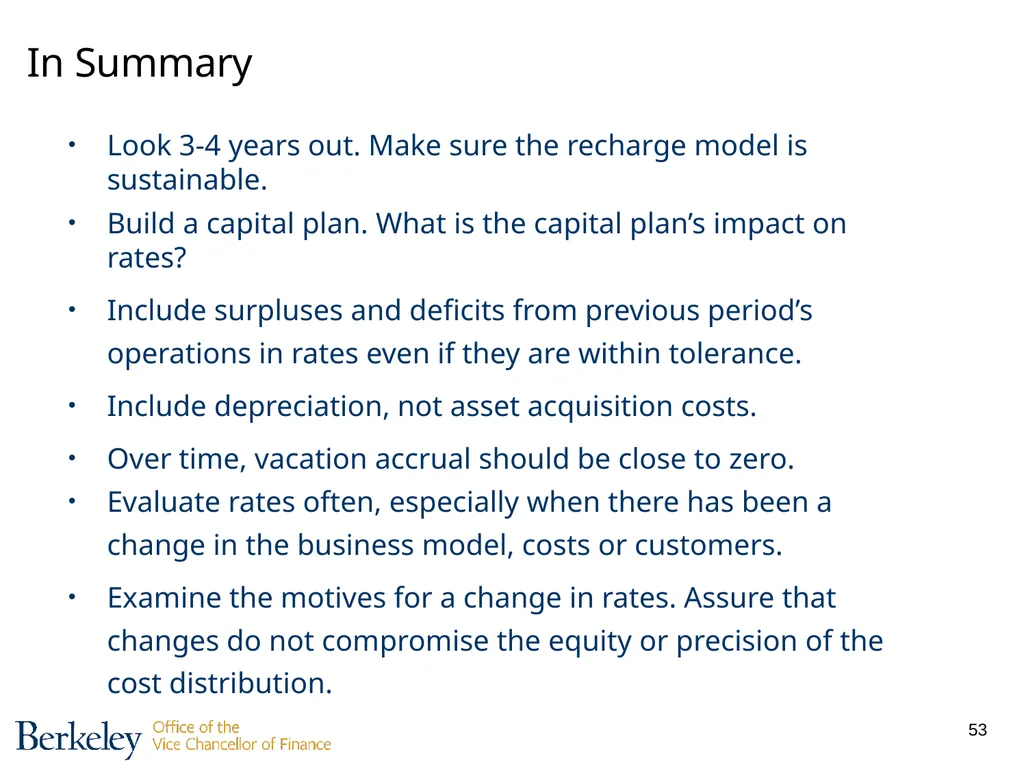
slide53. In Summary Look 3-4 years out. Make sure the recharge model is sustainable.
Build a capital plan. What is the capital plan’s impact on rates?
Include surpluses and deficits from previous period’s operations in rates even if they are within tolerance.
Include depreciation, not asset acquisition costs.
Over time, vacation accrual should be close to zero.
Evaluate rates often, especially when there has been a change in the business model, costs or customers.
Examine the motives for a change in rates. Assure that changes do not compromise the equity or precision of the cost distribution. 53<br>
slide54. References Recharge Web Site
https://cfo.berkeley.edu/recharge
Recharge Policy Document
https://cfo.berkeley.edu/file/ucberkeleyrechargepolicysept2017pdf
Business & Finance Bulletin A-47
http://www.ucop.edu/ucophome/policies/bfb/a47.html
Business & Finance Bulletin A-56
http://www.ucop.edu/ucophome/policies/bfb/a56.html
Contract & Grant Manual
http://www.ucop.edu/research-policy-analysis-coordination/resources-tools/contract-and-grant-manual/
Recharge Billing Policies & Procedures
https://cfo.berkeley.edu/recharge-billing-policies-and-procedures
Facilities & Administrative rates (F&A rate)
https://cfo.berkeley.edu/about-us/financial-planning-analysis/facilities-administrative-costs
OMB Uniform Guidance
https://www.grants.gov/web/grants/learn-grants/grant-policies/omb-uniform-guidance-2014.html
AFC Policy
AFC Campus Policies and Procedures 54<br>
slide55. Resources All recharge related correspondence:
recharge_certification@berkeley.edu
Recharge policy & procedures queries Herve’ Bruckert: hbruckert@Berkeley.edu 55<br>
slide56. Topic Forms and templates 56<br>
January7th, 2021 1<br>
slide2. Agenda Overview
Identify Lines of Business
Develop Cost Pools
Depreciation, Inventory and Subsidies
Determine Equitable Means of Distribution
Create Rates
Review and Test Rates
Rates for Non-Campus Customers
Recharge Form 2<br>
slide3. Agenda Overview 3<br>
slide4. Framing Recharge activities: Why recharge? UC Berkeley Academic Unit A Admin Unit B External Clients Affiliates, including other UC campus Research Unit C Research Unit D Sponsored Projects –
Contract & Grants 4 Surcharge: minimum = ICR rate. No subsidies.
Assessed the AFC rate. ICR rate Surcharge: cap = AFC rate. Assessed the AFC rate.<br>
slide5. Overview Rates are the means by which the costs of providing goods or services are equitably charged to the users of the goods or services with a high degree of accuracy.
Customers are only obligated to pay their fair share of the cost of the goods or services.
Rates cannot disadvantage any customer or any group of customers.
Rates are always cost based. 5<br>
slide6. Overview Rates are prospective and developed based on estimated expenses for the budgeted year.
Different services offered with the same unit or department may have separate recharge rates (separate rates for each class of goods or services)
Rate structures that work best are simple and are aligned with the nature of the services offered
Manageable
Scalable
Justifiable 6<br>
slide7. Agenda Identify Lines of Business
Customers
Case Studies 7<br>
slide8. Identify Lines of Business Engage with the service providers
Determine what the goods or services will be.
Determine how the goods or services will be requested and provided.
Determine who the customers are likely to be.
Example: Machine Shop that makes satellite parts, also performs unique fabrications.
What questions might be asked to determine this recharge unit’s lines of business? 8<br>
slide9. Some possible questions to ask:
Do you provide the same satellite parts over and over?
Does each satellite part take about the same amount of material and labor?
For unique parts, is the effort spent different in each case?
Example: Analytical Facility. The facility has of number of different machines that perform a variety of analyses.
What questions might be asked to determine this recharge unit’s lines of business? Identify Lines of Business 9<br>
slide10. Some possible questions to ask:
Who performs the analyses? Unit staff or is it self service?
Are all machines used in a single analysis? Or, are all machine used individually?
Does the unit provide supplies to run each machine or do users bring their own? Does each run of the machine require the same amount of supplies?
Do machines require calibration? If so, how often?
Example: Computer Support. The unit employs a number of programmers and desktop support specialist.
What questions might be asked to determine this recharge unit’s lines of business? Identify Lines of Business 10<br>
slide11. Some possible questions to ask:
What type of computer support is provided?
Does the unit maintain desktops to a standard?
Does the unit provide ad hoc computer programming?
Does the unit maintain servers to a standard?
Does the unit perform A/V support?
Example: Technical Consulting. The unit employs a number of consultants to help departments with organizational issues.
What questions might be asked to determine this recharge unit’s lines of business? Identify Lines of Business 11<br>
slide12. Some possible questions to ask:
Does the unit provide all consulting in-house or does it contract with third parties?
Are there distinct areas of consulting? If so, how are they managed within the organization?
Do all consultants have an equal chance of working on any project? Identify Lines of Business 12<br>
slide13. Agenda Develop Cost Pools
Depreciation, Inventory and Subsidies
Determine Equitable Means of Distribution
Create Rates
Review and Case Studies 13<br>
slide14. Cost Pool Development Basic Rate Formula: Estimated Cost of Providing Goods or Service* Recharge Rate =
Estimated Number of Service Units to be Provided *Costs may need to be adjusted to include allowable surpluses and deficits from prior years or subsidies 14<br>
slide15. Cost Pool Development For each line of business what are the total costs of providing that service regardless of how those costs are currently funded?
Technical, Productive Costs
The people and materials needed to perform the work
Depreciation
Based on a capital plan
Infrastructure Costs
Supervision & Management
Supplies related to operating the unit (communications, office supplies, tools etc)
Administrative Costs
Specifically identified personnel
Other Costs
Allowable surpluses/deficits from prior period operation 15<br>
slide16. Cost Pool Development Be sure to recognize the offsets to the unit’s total costs
Rebates & Incentive Payments
Trade-ins
Special type of offset
Subsidies 16<br>
slide17. Cost Pool Development Costs need to be reasonable
Is the cost generally recognized as necessary for the operation? Costs must be treated consistently, direct v. indirect.
Costs need to be allocable
If allocating a cost to a recharge unit, the unit must be able to assign a cost, or a group of costs, to the recharge pool in reasonable and realistic proportion, that demonstrates the benefit provided.
Costs need to be identifiable
A cost which can be identified specifically with a recharge product or service.
Costs must be allowable 17<br>
slide18. Shared Costs Because shared costs may not be identifiable to specific lines of business they can be assigned to lines of business through an allocation process.
Most often seen with overhead or administrative costs.
Make sure you have a solid basis for the distribution of these costs.
Examples: Facility costs over square footage, equipment used for several different recharge services. 18<br>
slide19. Agenda Cost Pools
Depreciation, Inventory and Subsidies
Determine Equitable Means of Distribution
Create Rates
Review and Case Studies 19<br>
slide20. Depreciation Depreciation is the allocation of a capital asset’s cost over its useful life.
Assures customers pay for only their fair share of capital costs.
Use a depreciation schedule to identify depreciable assets and to calculate periodic depreciation expense. 20<br>
slide21. Depreciation Schedules prepared for a rate calculation forecast depreciation expense.
Schedules used in rate calculation can include anticipated purchases but, should be adjusted for previous years’ actual expense to avoid over-depreciating.
Best practice is to start depreciation in the month of acquisition, but can employ a “half year” convention. 21<br>
slide22. Depreciation All equipment used in the recharge center except:
Equipment funded by the federal government.
Equipment funded by an incomplete, private contract or grant.
Equipment identified as cost sharing to a federal research project. 22<br>
slide23. Depreciation List of all eligible capital assets identifying:
Property number
Purchase date
Value
Salvage value
Useful life
UCOP useful life tables
Actual experience
Calculate periodic charge 23<br>
slide24. Depreciation As of July 1, 2004 equipment is defined as having a useful life of one year or greater and an acquisition cost of $5,000 or greater.
Continue to depreciate existing assets until they are fully depreciated.
New acquisitions follow the new definition.
Replacement items that cost <$5,000 should be included as an in-year cost in rate development. 24<br>
slide25. Depreciation - case sample An asset used in the recharge operation has never been depreciated. It has a useful life of 5 years and is currently 3 years old. Can I claim 3 years of depreciation this year and 1 year each for the next 2 years to true up?
Will a deficit that results from depreciation “true up” be an allowable deficit for future rate calculations? Yes. 25<br>
slide26. Depreciation - case sample An asset that I’ve included in recharge rates is now obsolete. It had 2 more years left on its useful life. Do I keep including the asset on my depreciation schedule until it is fully depreciated?
No. Record the loss as an expense to the recharge operation and remove the asset from future depreciation schedules. Any deficit the loss creates in the operations fund can be included in future rates. 26<br>
slide27. Depreciation - case sample I am leasing a piece of equipment. How do I account for the lease payments and depreciation?
Is it a capital lease or an operational lease?
If operational, charge payments to operations fund and do not include the asset on any depreciation schedule.
If a capital lease where UC takes title, include on depreciation schedule and charge lease payments to reserve (or other non-federal) fund.
Lease payments that are about equal to the depreciation that could be claimed can be charged directly to operations fund and excluded from the depreciation schedule. 27<br>
slide28. Inventory Inventory is defined as products for resale or the raw materials to be used in the production of goods. Finished or partially finished products can also be considered inventory.
Rates that have an inventory component must account for any allowable losses or shrinkage. 28<br>
slide29. Inventory For inventory shrinkage calculation:
Perform a physical count of all goods.
Value inventory at average cost (not replacement cost).
Compare inventory to actual sales to determine loss, then value the loss.
“Normal” shrinkage included in rates. “Abnormal” shrinkage must be written off and possibly excluded from rates. 29<br>
slide30. Subsidies Subsidies are a special type of cost offset.
Be sure subsidies are included as a line item in the rate development.
Once a subsidy is included in a rate development, all campus and affiliate users of the service are afforded the benefit of the subsidy. 30<br>
slide31. Agenda , Inventory and Subsidies
Determine Equitable Means of Distribution
Create Rates
Review and Test Customers
Case Studies 31<br>
slide32. Determine Equitable Means of Distribution Basic Rate Formula: Estimated Cost of Providing Goods or Service* Recharge Rate =
Estimated Number of Service Units to be Provided *Costs may need to be adjusted to include allowable surpluses and deficits from prior years or subsidies 32<br>
slide33. Determine Equitable Means of Distribution What are the cost drivers? How will goods or services be provided?
Time - productive hour standard
Goods produced/jobs performed -number of units produced
Resale of purchased items -volume of purchases
Machine time - machine hours or “runs” 33<br>
slide34. Determine Equitable Means of Distribution Time -productive hour standard
Determine the productive personnel.
Identify “downtime”.
Examine exempt employees impact on productive hour standard.
Examine productive personnel with administrative responsibilities.
Productive hour standard is an average over all productive personnel.
Productive hour standard is based on 1.0 FTE. 34<br>
slide35. Determine Equitable Means of Distribution Goods produced/jobs performed - number of units produced
Account for prototypes.
Account for defective units. 35<br>
slide36. Determine Equitable Means of Distribution Machine time - machine hours or “runs”
Are all “runs” about the same?
Are there classes of type of “runs”?
Are all runs different?
Has downtime for maintenance been included?
What are the hours of operation for the machine?
Account for calibration of machines 36<br>
slide37. Other Pricing Considerations A fair and equitable cost distribution may lead to other pricing arrangements:
Volume Discounts
Suites of Services
Time of Day
Overtime Rates
Expedited Rates
Rates for non-campus, non-affiliate users 37<br>
slide38. Other Pricing Considerations Overtime Rates and Expedited Rates
All rates must be cost based.
Are overtime or expedited costs part of the normal business operation or are they exceptional?
If normal, consider including the costs in the standard rate.
If exceptional, must develop a special rate(s) based upon the exceptional costs, and be sure to examine possible impacts to the standard rate. 38<br>
slide39. Agenda of Distribution
Create Rates
Review and Case Studies 39<br>
slide40. Create Rates Rounding rates is acceptable, as long as it is reasonable.
Multiple lines of business often translate into multiple rates for a recharge center.
Avoid double counting costs.
Account for surpluses or deficits along each rate.
Avoid the appearance of one rate subsidizing another. 40<br>
slide41. Create Rates Packaged or Bundled Rates
Are allowed provided they are costed properly, are reasonable and justifiable.
Be sure to examine rationale behind the creation of any rate type. 41<br>
slide42. Agenda Review and Test Rates
Rates for Case Studies 42<br>
slide43. Review of Rates For each rate, examine the ratio of direct costs to infrastructure costs. Assure that their relationship is logical and supported for the type of goods or services provided. 43<br>
slide44. Review of Rates Compare to previous year’s rates. Do the changes make sense? How would you explain the changes to your customers?
Compare the rate structure to how services are delivered. Will your customers understand what they are paying for?
Compare costs to last year’s costs. Are there areas of great discrepancy?
Does the assignment of depreciation costs to each rate make sense? 44<br>
slide45. Review of Rates If you have developed a mark-up rate, does the charge reasonably relate to the benefit received?
More expensive items draw more of the unit’s infrastructure costs-is this reasonable?
How do the rates compare to rates of other units with similar services (both internal and external)?
How are subsidies handled? 45<br>
slide46. Review of Rates Assure that the percent productivity makes sense for the type of goods or services provided.
What is the expected customer base? What is the proportion of campus customers to non-campus customers? Does the unit need to consider UBIT & sales tax complications? 46<br>
slide47. Test the Rates Multiply the expected volume times the calculated rate for each line of business. Will the resulting figure cover your total anticipated costs? Is the resulting figure close to what you actually expect to generate in revenue?
If so, the rate seems appropriate.
If not, go back to the assumptions you’ve made about the costs and the cost drivers to see where adjustments are necessary. 47<br>
slide48. Test the Rates Compare shrinkage to sales. Is the ratio within tolerable limits?
If so, the rate seems appropriate.
If not, are there other areas that need to be evaluated? 48<br>
slide49. Agenda Rates for Non-Campus Customers
Case Studies 49<br>
slide50. Rates for Non-Campus Customers Special consideration for non-campus, non-affiliate customers:
Remove all subsidies from rate.
Include federally unallowable costs in rate such as Gael and UCRP supplemental interest.
Apply surcharge at the ICR rate at a minimum. The ICR rate are negotiated and our true overhead costs are higher than the ICR rate.
Rates for the same goods or services for non-campus, non-affiliate customers are never lower than rates for campus customers for the same goods or services.
Avoid the appearance of competing with commercial entities.
Avoid the appearance of a state funded entity subsidizing commercial enterprises. 50<br>
slide51. Rates for Non-Campus Customers 51 Inclusion/exclusion of certain component in recharge rates calculation based on customers’ categories.<br>
slide52. In Summary Spend a lot of time developing rates. They are the key to everything. Volume is a key component of rates and can impact rates significantly.
Rates to external, non-affiliates clients, must include a minimum surcharge at the ICR (Indirect Cost Recovery) level. Exceptions to the terms of the policy must be approved by the recharge committee.
Once a subsidy is included in a rate, all campus customers are afforded the benefit of the subsidy.
Rates for non-campus customers should never be lower than rates for campus customers for the same goods or services.
Small changes in the denominator (productive hours, no. of jobs or customers) often lead to big changes in rates. 52<br>
slide53. In Summary Look 3-4 years out. Make sure the recharge model is sustainable.
Build a capital plan. What is the capital plan’s impact on rates?
Include surpluses and deficits from previous period’s operations in rates even if they are within tolerance.
Include depreciation, not asset acquisition costs.
Over time, vacation accrual should be close to zero.
Evaluate rates often, especially when there has been a change in the business model, costs or customers.
Examine the motives for a change in rates. Assure that changes do not compromise the equity or precision of the cost distribution. 53<br>
slide54. References Recharge Web Site
https://cfo.berkeley.edu/recharge
Recharge Policy Document
https://cfo.berkeley.edu/file/ucberkeleyrechargepolicysept2017pdf
Business & Finance Bulletin A-47
http://www.ucop.edu/ucophome/policies/bfb/a47.html
Business & Finance Bulletin A-56
http://www.ucop.edu/ucophome/policies/bfb/a56.html
Contract & Grant Manual
http://www.ucop.edu/research-policy-analysis-coordination/resources-tools/contract-and-grant-manual/
Recharge Billing Policies & Procedures
https://cfo.berkeley.edu/recharge-billing-policies-and-procedures
Facilities & Administrative rates (F&A rate)
https://cfo.berkeley.edu/about-us/financial-planning-analysis/facilities-administrative-costs
OMB Uniform Guidance
https://www.grants.gov/web/grants/learn-grants/grant-policies/omb-uniform-guidance-2014.html
AFC Policy
AFC Campus Policies and Procedures 54<br>
slide55. Resources All recharge related correspondence:
recharge_certification@berkeley.edu
Recharge policy & procedures queries Herve’ Bruckert: hbruckert@Berkeley.edu 55<br>
slide56. Topic Forms and templates 56<br>